iOS users—and only iOS users—face NSFW content ban on Discord app
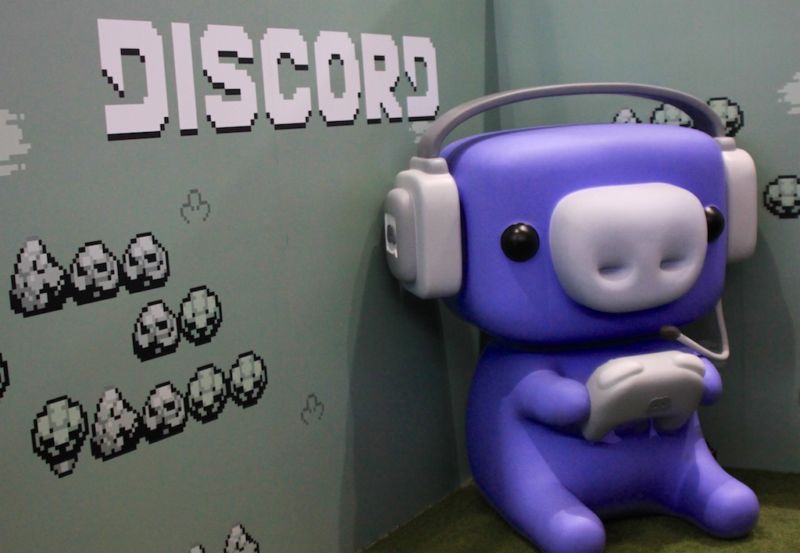
Enlarge/ This cute little pig has obviously seen some things that iOS users will no longer be allowed to see on Discord.
Discord users who access the Discord app through iOS will now face restrictions on adult content that go beyond those for other platforms. The gaming-focused social networking app—which lets users create public or private servers to chat via text, image, voice, and video livestreaming—announced this week that “all users on the iOS platform (including those aged 18+) will be blocked from joining and accessing NSFW servers. iOS users aged 18+ will still be able to join and access NSFW communities on the desktop and web versions of Discord.”
That NSFW designation can be set by the server owner or by Discord itself, in keeping with community guidelines requiring the label on “adult content.” Individual channels within a server can be designated as NSFW without imposing limits on the full server, but an entire server may be labeled as NSFW “if the community is organized around NSFW themes or if the majority of the server’s content is 18+,” the company said.
Discord has set up an appeals process for server owners to challenge an NSFW designation. Individual users can also contact Discord if they were accidentally identified as minors during an age-verification process. But that age change will still be meaningless on iOS, where users of all ages will be barred from NSFW content.
Discord didn’t specify why iOS users are being treated differently from those on other platforms, but Apple’s iOS Developer Guidelines say that apps with user-generated content “that end up being used primarily for pornographic content… do not belong on the App Store.” The guidelines allow for “incidental” NSFW content generated by users on web-based services if “the content is hidden by default and only displayed when the user turns it on via your website,” a caveat that apparently isn’t sufficient for Discord’s comfort.
Discord is using a lighter touch here, identifying and segregating NSFW content from iOS users rather than banning it altogether. Still, preventing adults from accessing adult content on one platform specifically seems like a counterintuitive way to stay in Apple’s good graces in this regard.
“Apple’s regressive stance on sexual content being available on its largest platform is verging on a full-on moral panic, and it’s really gross,” former Tumblr Product Manager Matthew Bischoff wrote on Twitter. “Entire businesses and communities have been crushed by it, and it often hurts queer and trans communities most. When we dealt with this at Tumblr, it became my full-time jobs for weeks to find incredibly complex ways to appease Apple’s censors. This happened every time they found a sexy blog they didn’t like. It’s absurd.”
Discord is reportedly in the late stages of acquisition talks—which could value the service at $10 billion—with Microsoft and other parties. The service has over 140 million monthly users and 300 million registered accounts. https://arstechnica.com/?p=1756761
How long can Epic afford to throw money at the Epic Games Store?
The bitter court fight between Apple and Epic is primarily focused on the mobile-gaming landscape and Apple’s iron-fisted control of the iOS App Store. But recent court filings in that case have also given the public a rare glimpse into just how much money Epic is throwing at the Epic Games Store as it struggles to make a dent in the PC marketplace.
The raw numbers, as reported in a “Proposed Findings of Fact and Conclusions of Law” document Apple filed last week, show massive incurred and projected losses for Epic’s game download hub, which launched in late 2018. Documents and testimony from Epic itself show a $181 million loss for the store in 2019 and projected losses of $273 million in 2020 and $139 million in 2021.
You might think Epic is incurring those losses because it only takes a 12 percent cut of third-party game revenues, compared to the industry-standard 30 percent cut on other digital storefronts. On the contrary, though—in its own court filings, Epic says that 12 percent revenue chunk has been “sufficient to cover its costs of distribution and allow for further innovation and investment in EGS.”
The main driver of EGS’ losses, instead, is Epic’s generous program of “minimum guarantees.” These encompass the advance payments Epic has used to attract so many timed exclusives to its storefront and seemingly also cover the free games Epic makes available to Epic Games Store users every week.
Epic also said last year that EGS users claimed over 749 million copies of free games in 2020. Those games would be worth billions of dollars if sold normally, even at reduced prices (though Epic likely paid much less than that to secure the free download giveaways in bulk).
Add it all up, and Epic ended up paying a whopping $444 million in minimum guarantees in 2020, according to Apple’s court filing (though that number could theoretically include future exclusives or free game deals). By contrast, Epic announced last year that players spent only $265 million on all third-party Epic Game Store games combined in 2020. In court documents, Epic also said it has paid out a total of over $700 million to third-party EGS developers so far. That suggests Epic has earned just $95 million through its standard 12 percent EGS revenue share.
It doesn’t take a budgeting genius to realize that spending $444 million on minimum guarantees in one year to earn just $95 million in just over two years is not a sustainable business. Indeed, Apple notes that “Epic has acknowledged the incentives and investments it has made in an attempt to grow EGS will result in… at least $330 million in unrecouped costs from minimum guarantees alone.”
They can afford it
Of course, Epic isn’t throwing all that money around just for its health. Epic sees spending money on timed exclusives and free games as the best way to convince PC gamers to give the new Epic Games Store a chance.
“There are two ways to bring users into something,” Epic Games co-founder and CEO Tim Sweeney told Ars in 2019, just after the launch of the Epic Games Store. “You can run Google and Facebook ads and pay massive amounts of money to them. But we actually found it was more economical to pay developers [a lump sum] to distribute their game free for two weeks… We can actually bring in more users at lower cost by doing all these great things for great people rather than paying Google and Facebook.”
That effort is starting to work. Last June, Sweeney told PC Gamer that EGS had about 15 percent of the PC gaming market. That’s not great, but it’s not bad considering the near-monopoly power Steam has in PC gaming downloads (Sweeney estimated Steam’s share at 90 percent in 2019, though that could be a bit inflated).
Epic also says over 31 million people used the Epic Games Store daily by the end of 2020. That’s lower than the 62.6 million daily users claimed by Steam, but it’s not a bad foothold for a store that launched just a little over two years ago.
<a href="https://cdn.arstechnica.net/wp-content/uploads/2021/04/fngold.jpg" class="enlarge" data-height="1080" data-width="1920" alt="Gotta put all that Fortnite money somewhere…”><img alt="Gotta put all that Fortnite money somewhere…” src=”https://rassegna.lbit-solution.it/wp-content/uploads/2021/04/how-long-can-epic-afford-to-throw-money-at-the-epic-games-store-1.jpg” width=”640″ height=”360″ srcset=”https://rassegna.lbit-solution.it/wp-content/uploads/2021/04/how-long-can-epic-afford-to-throw-money-at-the-epic-games-store-2.jpg 2x”>
Enlarge/ Gotta put all that Fortnite money somewhere…
And if those customers are primarily coming to EGS for the free games and expensive exclusives for now, Epic seems OK with that. In its court documents, Epic says it expects EGS to be profitable by 2023 and that current losses are mainly because it has “front-loaded its marketing and user acquisition costs to gain market share.”
(Apple notes in its court documents that “Epic does not expect EGS to have accumulative gross profit before 2027,” a difference that likely has to do with Apple taking current losses into account in measuring “accumulative” lifetime profits.)
Even if you accept Epic’s timetable, the Epic Games Store could easily be responsible for $750 million in losses (or more) before it ends up generating even a dollar of profit. That’s a pretty expensive gamble, even if the potential reward (i.e., a slice of the lucrative PC market) might be worth the risk.
Put those together, and you have a company making $3.85 billion dollars in gross profit on $9.625 billion in revenue, according to court documents. For a company like that, spending a few years and nearly a billion dollars in losses on a new PC gaming storefront probably feels like dropping pocket change in the tip jar.
https://arstechnica.com/?p=1756314
Review: Our fave gunslinger expels her inner demons in Wynonna Earp finale
Waverly Earp (Dominique Provost-Chalkley) is trapped in a twisted version of the Garden of Eden.
Wynonna (Melanie Scrofano) runs afoul of the new Sheriff and his sister—both members of the Clanton clan, which has a long-standing feud against the Earps.
Margot Clanton (Paula Boudreau) vows revenge on Wynonna and her family.
Doc Holliday (Tim Rozon) is a good ally to have in a bar fight.
Former Sheriff Randy Nedley (Greg Lawson) and former Black Badge Division scientist Jeremy Chetri (Varun Saranga) are back, too.
Waverly is reunited with her true love, Nicole Haught (Katherine Barrell). New to the team: teenage Rachel Valdez (Martina Ortiz-Luis).
Star-crossed lovers: romance blooms between Rachel and Billy Clanton (Billy Bryk).
Wynonna and Nicole hatch a plan.
Jeremy is the team’s Q, inventing cool high-tech weapons.
Amon (Noam Jenkins) runs the local demon bar.
Nedley and Jeremy have an idea to rid Nicole of a pesky curse.
Doc’s ex, and the sole surviving Revenant, Rosita (Tamara Duarte) asks for a pinky swear that Wynonna won’t kill her.
Demon nuns, amirite? Heather Lea MacCallum plays Medea.
Hunting for Peacemaker in the convent weapons cache.
“Make your peace.”
Doc tries to convince Hoyt Clanton (Ty Olsson) to bury the hatchet and end the feud with the Earps.
Demons are defeated, a long-running feud finally comes to an end, personal rifts are healed, and a hotly anticipated wedding finally takes place in the decidedly upbeat series finale of Wynonna Earp, SyFy’s supernatural Western/horror series. SyFy canceled the series earlier this year, although showrunner Emily Andras has not ruled out the possibility of additional seasons, should the series find a new US distributor. But for now, we must bid a fond farewell to the boozily irreverent, tough-yet-vulnerable protector of the fictional town of Purgatory.
(Spoilers for prior seasons below. All major S4 spoilers are below the second gallery. We’ll give you a heads-up when we get there.)
As we’ve reported previously, the series is based on the comic book series created by Beau Smith in 1996. Wynonna (Melanie Scrofano) takes on “revenants,” the repeatedly reincarnated outlaws that Wyatt Earp killed. They won’t stay dead until the Earp heir—Wynonna—offs them with Wyatt’s famous 16-inch-barrel revolver, dubbed Peacemaker. Over the course of four seasons, she has battled witches, vampires, vengeful spirits, nutty sister-wife cults, possessed neighbors, demonic nuns, and killer trees, among other threats. She is not without allies, however, including the immortal being, Doc Holliday (Tim Rozon), with whom Wynonna becomes romantically entangled (and yes, it’s complicated). Then there is her baby sister, Waverly (Dominique Provost-Chalkley), who falls for local deputy Nicole Haught (Katherine Barrell)—a popular pairing dubbed “Wayhaught” by shippers—and the local sheriff, Nedley (Greg Lawson), who becomes a father figure and demon-hunting ally.
In the first season, Wynonna sought out the band of revenants responsible for the deaths of her father and eldest sister, only to find her sister’s fate was something quite different. In S2, she wrestled with her mother’s mysterious abandonment of the family while contemplating her own impending motherhood, courtesy of Doc. At the same time, she discovered that Waverly might not be an Earp after all.
In S3, we got some answers, as Wynonna discovered that her mother, Michelle (Megan Follows), was a patient in a high-security psychiatric hospital, and Waverly—well, Waverly turned out to be half-angel, thanks to Mama Earp’s affair with an angel named Julian (Sebastian Pigott). Wynonna also finally had the chance to confront the demon Bulshar (Jean Marchand), the one who cursed the Earp family (and by extension the revenants) in the first place. The finale pretty much blew up the show’s original premise. The Earp curse appeared to be lifted, the revenants vanished, and Peacemaker disappeared after being used as a key to enter the Garden of Eden. Waverly was forced to remain in the Garden as its prisoner to keep the portal closed, and Doc volunteered to remain there as well, to keep her safe.
The fourth season aired in two parts after the pandemic shut down production mid-season. The first part focused, by narrative necessity, on getting Waverly and Doc out of the Garden of the Eden, with subsequent episodes dealing with the aftermath as everyone returns to a radically altered Purgatory. Wynonna must track down Peacemaker, learns about the darker side of her ancestor, Wyatt Earp, and encounters the rival Clanton clan—which has its own longstanding family curse and a revenge-fueled mission to kill all living Earps.
(WARNING: Major spoilers for the series finale below. Stop now if you’re not finished watching.)
“We back, honey.”
Someone’s using language not fit for an impressionable teenager.
Waverly’s bachelor party seems more Wynonna’s speed
Well, of course a disillusioned Cupid (Christopher Jacot) finds himself working as a stripper.
The pumpkin-faced demon Rotten Jack is terrorizing the people of Purgatory on Halloween.
The Earp sisters are on the case, and in the Halloween spirit.
The bar’s popular Trivia night becomes the focus of a killer who wants to eat the winner’s brain.
Waverly tries to revive a hungover Wynonna.
Waverly and Nicole stage an intervention.
Mutiny at the Black Badge Division’s headquarters in the Ghost River Triangle puts Jeremy and his allies in jeopardy.
Waverly’s inner avenging angel breaks free.
Watching BBD headquarters burn.
Doc inadvertently becomes the Clanton heir and takes aim at Wynonna.
Wynonna pleads with The Angel-Formerly-Known-as-Waverly for Doc’s life.
A choice, and a sacrifice.
Welcome to the Wayhaught wedding.
Doc and Wynonna reconcile.
On the road and looking forward to new adventures.
Part 2 gave us some strong “case of the week” episodes. To celebrate her engagement, Wynonna takes Waverly to a strip club, where they encounter a disillusioned, heartbroken cupid named Demetri (Christopher Jacot, Eureka) who insists that true love isn’t real. He makes a bet with Waverly, and hijinks ensue by way of a magical glitter bomb. On Halloween, a demon named Rotten Jack goes on a killing spree just as Wynonna and Waverly stumble into a thick fog and lose their memories. There’s even a cynical, constantly texting amoral genie (Nikki Duval, New Eden) whose wish-granting threatens Trivia Night at Shorty’s. It’s a fun storyline in the same vein as the S7 X-Files episode, “Je Souhaite.”
Most of all, S4 gave us a killer character arc for Wynonna, exploring the toll being the Earp heir has taken on her, as her binge-drinking becomes more severe and she increasingly cuts herself off emotionally from family and friends. I noted back in 2018 that Wynonna is the anti-Buffy: “She’s a hard-drinking, foul-mouthed, promiscuous, bar-brawling free spirit with a chip on her shoulder. She never even had a shot at being Homecoming Queen in high school.” That self-sabotaging bravado stems from her insecurity and feelings of unworthiness as the family black sheep; it serves her well as a demon hunter, but it’s also what keeps her from a meaningful relationship with Doc. Wynonna finally confronts her personal demons in the series finale and gets the happy “at least for now” ending the character has earned. Scrofano plays it to perfection.
The final season certainly wasn’t perfect. The storytelling got a bit sloppy in places; the usually crisp, sparkling dialogue was occasionally leaden; and the jokes sometimes felt more sophomoric than clever, especially in the final two episodes—which seemed unfocused and disjointed, as if the writers had to rush to wrap things up.
I mean, Waverly turns into a dark avenging angel with vague plans for ending life in Purgatory. She strikes Wynonna blind, but it wears off after ten minutes, so what was the point? Somehow Doc stops being a vampire—after turning a dying Mercedes into one, at her request (“We all know I was born to be a vampire”). He briefly becomes the Clanton heir with a mission to kill all Earps, but then he isn’t because—honestly, I have no idea, but Dark Angel Waverly eventually intervenes. Then she just as quickly reverts back to being Waverly, thanks to Nicole’s loving sacrifice.
Then we rush right into, “Hey, time for a wedding!” as if all that supernatural drama never happened. Props to the writers for coming up with a cursed wedding dress subplot that was more amusing than horrifying (despite its blood-soaked history). But it was introduced and resolved so quickly; it deserved a bit more time and attention before we jumped right back into the Wayhaught nuptials.
That wedding? That was pure fan service, and the diehard Earpers deserved it. There would not have been a S4 without them. Big speeches in big moments are the hardest to pull off, especially if there isn’t quite enough time to build up to them and make the words really sing, which was the case here. But I’d wager the Earpers were delighted.
We can always nitpick about the many loose ends, the cheesier elements, the completely insane plot twists, and so forth, but in the end, all that matters is that this series somehow always worked anyway. I chalk it up to the show’s big heart. Back in 2011, NPR’s TV critic, Linda Holmes, wrote an insightful review about why ABC’s lackluster reboot of Charlie’s Angelswas so much worse than any number of other silly, cheesy, and/or trashy shows that nonetheless manage to find an enthusiastic audience. (She used the same network’s over-the-top soap opera, Revenge, as a comparison, which debuted the same year and ran for four seasons.) Holmes argued that nobody involved ever really loved the reboot. “You can always spot a show nobody loves or has ever loved,” she wrote. And she’s right.
The reverse is true for Wynonna Earp. Everyone who worked on this show, from showrunner Andras to the entire cast and crew, loves it deeply and passionately—”that bottom-of-the-deep-dark-well way,” as Wynonna says to Doc when she finally admits she loves him. It’s something you just can’t fake. It’s what has always given Wynonna Earp that special creative spark, despite (or perhaps because of) its flaws. That love always carried us through the rough patches. In the end, Wynonna Earp was just as endearingly imperfect as its titular heroine, and just as captivating.
Voyagers explores complexities of coming of age in space
[embedded content]
Tye Sheridan and Lily-Rose Depp star in director Neil Burger’s science fiction film, Voyagers.
A crew of young people on a lifelong expedition to colonize a distant planet grow frustrated with their rigidly controlled existence and begin to rebel, putting the mission at risk, in Voyagers. Director Neil Burger’s (Limitless) new film is part classic space epic, part mystery, and part dark psychological thriller. All those elements serve as a framework to explore questions of morality, freedom, power, and the fundamental core of human nature.
(Some spoilers below, but no major reveals.)
Burger was inspired by two vivid mental images. “The first was a group of young people sitting around inside a spaceship,” he said. “They were disheveled, zoned out, and looking like predators resting after a hunt. I don’t know where that image came from. But the second [image] implied a story: that same group of people chasing another crew member down the narrow corridor of the ship, pursuing him like an animal.”
Burger sensed there was a meaningful story there and shaped his film around the ship as metaphor for our own world. He also researched the science of long-distance space exploration and on human behavior, most notably the effects of prolonged confinement, aggression, tribalism, and violence. The result is Voyagers.
Enlarge/ Director Neil Burger on set with Tye Sheridan, who plays Christopher.
Per the official premise:
With the future of the human race at stake, a group of young men and women, bred for intelligence and obedience, embark on an expedition to colonize a distant planet. But when they uncover disturbing secrets about the mission, they defy their training and begin to explore their most primitive natures. As life on the ship descends into chaos, they’re consumed by fear, lust, and the insatiable hunger for power.
In the year 2063, scientists have discovered a new, habitable exoplanet where the human race could flourish, as Earth is fast becoming uninhabitable. Richard Alling (Colin Farrell, Minority Report, Artemis Fowl) is charged with raising a crop of designer babies to serve as the crew aboard the spaceship, Humanitas. Their voyage will take 86 years, meaning it is their grandchildren who will ultimately reach their new planetary home. So the children are raised and trained in isolated conditions that mimic those they will experience on the Humanitas. Alling grows attached and opts to join them on the mission, even though he won’t live to see its end.
Ten years in, the crew have matured into young adults, dutifully performing their assigned tasks and taking their daily “vitamin supplement,” dubbed the Blue. Then Christopher (Tye Sheridan, Ready Player One) discovers a strange toxin in the irrigation water aboard the ship and realizes it’s coming from the crew’s urine. Specifically, it’s an ingredient in the Blue, designed to subdue the personality and decrease pleasurable response.
“They’re drugging us so we can be controlled,” Zac (Fionn Whitehead, Dunkirk, Black Mirror: Bandersnatch) says when Christopher tells him about the toxin. They resolve to go off the Blue, and eventually most other crew members follow suit, bringing all those raging hormones to the fore. The result is teen rebellion against Alling’s authority, growing distrust and paranoia, and of course, sexual experimentation and the desire for instant gratification. Could there be a mysterious alien life force lurking just outside the ship, further complicating matters?
It’s 2063 and the space ship Humanitas has a very special long-term mission.
Colin Farrell plays Richard Alling, who helps raise designer babies to be the perfect crew for the mission.
All grown-up and so well-behaved.
That good behavior might be due to daily doses of “the Blue.”
Christopher (Tye Sheridan) and Zac (Fionn Whitehead) decide to stop taking the Blue.
Zac develops powerful urges toward Sela (Lily-Rose Depp), who does not welcome his advances.
Quintessa Swindell plays Julie, who proves more receptive.
Isaac Hempstead Wright as Edward, Madison Hu as Anda, and Reda Elazouar as Mallick.
Romance blooms between Sela and Christopher.
Kai (Archie Madekwe) might be up to something.
A space walk goes horribly wrong.
Christopher finds an important clue.
On his guard.
Trouble in the air lock.
Ars Technica: I’ve seen this film described repeatedly as Lord of the Flies in space. Do you agree with that description?
Neil Burger: It makes sense in a way. I love that book, and I love the Peter Brook movie. Whenever there are teenagers going wild or society breaking down, it becomes a Lord of the Flies reference. And I understand that. To me, it’s a little different. Lord of the Flies is about those boys enacting male behavior from English society and [notions of] masculinity: hunting and going to war and all that stuff. This movie’s a little different in the sense that this crew—they have no cultural reference. They have none of that background.
Voyagers is about a group of extraordinary young people waking up to sensual desires, to freedom, to power, and the thrilling euphoria that goes with that experience. The ship is a sterile environment where the young crew almost seem like laboratory rats. We watch to see how they behave under the conditions, how quickly they descend into savagery. [The film] is more about, “Who are we when you strip away all that cultural baggage? Who are we at our core? Are we good? Are we animals? Are we moral?”
“Who are we at our core? Are we good? Are we animals? Are we moral?”
Ars Technica: There are so many scientific elements in this film: designer babies, exoplanets, interstellar travel. You clearly did a lot of research on these and other story elements. What is your approach to weaving science into your storytelling?
Neil Burger: I love science. I’m really interested in all sorts of aspects of it, and learning as much as I can about all sorts of things: growing babies in a laboratory, or how we’re able to sense whether a distant planet has certain chemicals, if there’s water on it. I love exploring all of that. I wanted to make [the film’s setting] as real as possible. The themes about human nature are important and real, so I wanted the setting and the ship and everything around it to be as real as possible as well. The spacecraft is purely utilitarian and functional and based on actual proposals within NASA and other organizations studying space travel outside our solar system.
Ars Technica: There’s a nature versus nurture question, I think, that comes up because, as you say, these young people have no cultural context. They were genetically designed to be the ideal crew. But sometimes it’s not enough to just design them that way, as we see with the character of Zac. There are other influences that shape who we are.
Neil Burger: For me, the movie is about human nature in a vacuum. [The crew members] have no real models for behavior and little to do on the ship except eat, work, and sleep. In a way they are pure humans—all nature, not nurture. I always thought of them as horses that have never been let out of the stall. As I said, when you strip away everything, who are we at our core? And is that even a real thing?
Perhaps for the mission planners in this movie, that’s what they were looking for. But there’s always small things that do influence us. Is there something inside Zac, for example, that makes him tend toward a certain kind of response? I would argue that he’s smart enough, that he senses that he’s being controlled. So when he gets a little taste of his own control or power, he’s just never going back. It [feels] reasonable, what he’s doing—even though it isn’t.
Ars Technica: Zac’s actions demonstrate the power of manipulating with misinformation. That resonates particularly strongly these days for obvious reasons. But it’s fairly universal in human beings: even though we love our freedom, we are very vulnerable to that kind of manipulation.
Neil Burger: I think we’re understanding that more and more. When I wrote the screenplay, it was years ago, and I was obviously aware of that happening in our society and other societies. I was writing it as a cautionary tale. In the last few months, it’s become something completely different. Fear is a big theme and a major issue in the movie: how a leader uses it to manipulate his followers and maybe even drive them to mob violence. It all raises questions about how a society can function—about selfishness and self-sacrifice. That’s the foundation of the conflict.
Ars Technica: You’ve said that the ship is a metaphor for our world: humans hurtling through space on Earth, not sure why we’re here or where we’re going. And somehow we have to find meaning in that. We see the best and worst of human nature on display in the film as it builds up to a big central question: is humanity worth saving?
Neil Burger: I think it is worth saving. And I think that we continue as a species to try to move things to a better place. It’s tough and there are setbacks, but I think that the predominant thrust is to try to alleviate suffering in our fellow humans. It’s not always easy.
Lego has a new 2,354-piece NASA Space Shuttle set, and it’s awesome
Lego’s latest official NASA set is this massive model of space shuttle Discovery on mission STS-31.
Jonathan Gitlin
There are 17 bags of Lego bricks. Well, technically there are 19, because there are two bags labeled 2 and a bag that isn’t labeled that contains some softer pieces that would otherwise get scratched in transit.
Jonathan Gitlin
A big instruction book with plenty of shuttle facts. And blissfully few stickers. My top tip was going to explain how it’s much easier to use Lego’s iPad instructions app, but I built Discovery the day it came out, and it was evidently too new to show up in the app.
Jonathan Gitlin
If I was truly insane (or had a lot of free time), I could dump all 17 bags out into a single pile and build from there. Instead, I sort the bags out a little.
Jonathan Gitlin
This is the core of the Hubble Space Telescope, which is an example of Studs Not On Top, or SNOT.
Jonathan Gitlin
The completed Hubble model on its stand.
Jonathan Gitlin
So far, so conventional—this kind of build should be familiar even if you haven’t built a Lego spaceship in decades.
Jonathan Gitlin
Now we’re starting to look like an orbiter.
Jonathan Gitlin
A closer look at the wing bracing.
Jonathan Gitlin
Lego designers intentionally include brightly colored pieces that will be covered in the final build.
Jonathan Gitlin
There are always a few extra pieces included. And did you know that Lego is the world’s largest tire manufacturer?
Jonathan Gitlin
I had already stopped and said “that’s so cool” at least twice by this point.
Jonathan Gitlin
Discovery stands on its wheels for the first time.
Jonathan Gitlin
Some of this controls the elevons, some of it is the main landing-gear mechanism.
Jonathan Gitlin
Our cargo bay is taking shape.
Jonathan Gitlin
Cameras watch the bay from all angles.
Jonathan Gitlin
If you look closely you’ll see why I hate having to apply stickers.
Jonathan Gitlin
For STS-31, there was only one chair for an astronaut on the lower deck.
Jonathan Gitlin
Just missing the Orbital Maneuvering System.
Jonathan Gitlin
About to start bag 16, with bag 17 waiting in the wings.
Jonathan Gitlin
The OMS has been installed.
Jonathan Gitlin
Not quite done yet.
Jonathan Gitlin
Here’s the flight deck.
Jonathan Gitlin
Discovery on its stand.
Jonathan Gitlin
You can also mount Hubble in the bay.
Jonathan Gitlin
Another look at Hubble being put into orbit.
Jonathan Gitlin
Once Discovery was finished, I had to turn my attention to repairing this partially disassembled Saturn V, damaged by a cat who, to scale, would be frankly enormous.
Lego has made a number of space shuttle sets over the years, but none has been as detailed as this 2,354-piece set. The finished orbiter is a substantial 21.8 inches (55.46 cm) long with a 13.6-inch (34.6 cm) wingspan, and it lends itself well to reproduction in Lego bricks at this scale; the space shuttle was covered in blocky tiles, after all.
STS-31 was a mission to launch Hubble, and so it is with Hubble that you begin, a build that was reminiscent of the construction techniques used in the Saturn V. Over the past decade or so, Lego has adopted new building methods, sometimes known as SNOT (Studs Not On Top), that give designers much more freedom than vertically stacking bricks one atop another, and this set is a wonderful demonstration of that.
Although the set is aimed at adults—the box says 18+—Discovery has a decent amount of playability. The undercarriage is spring-loaded, the elevons and rudder move, and it’s solid enough to have decent swooshability. The mark of a good Lego build, to me at least, is when you build a step, then stop and exclaim “that’s so cool!” as you understand the mechanism or construction you’re putting together. I had at least five “that’s so cool!” moments with Discovery, which should be taken as a ringing endorsement of this set.
The only thing I’m not so effusive about is the price. At $199, it’s nearly twice as expensive as the Saturn V, despite a brick count that isn’t much higher.
Listing image by Jonathan Gitlin
https://arstechnica.com/?p=1755772
Diablo II Resurrected impressions: Unholy cow, man
Blizzard / Sam Machkovech
Diablo II: Resurrected is slated to launch on PC and consoles “later this year,” but in the meantime, the remaster is far enough along that its handlers launched an early “technical alpha” demo over this weekend. (There’s a teensy-tiny chance you can still get in if you sign up right now.) I was invited for the single-player test’s first wave—and took the opportunity to stream my initial gameplay via Twitch.
Should you watch that three-hour session, you’ll see my largely positive reaction at first blush. (Once some initial online-check stupidity cleared up, at least.) Afterwards, I took a moment to breathe, have a snack, and install the game on other systems in order to do some more full-fledged testing.
Even outside that first-look afterglow of seeing D2:R running beautifully on a modern PC, the results thus far—of an admittedly unfinished preview version—have charmed me even further than my first session might have led you to believe. The “Blizzard Classic” team is currently walking on a long road into hell, and that road just might be paved with redemption.
2D to 3D: Can Blizzard do it?
Diablo II: Resurrected after-and-before gallery, all captured from the April 2021 technical alpha. Updated 4K graphics.
Same shot, classic 600p graphics. (The 600p images are all 4:3, if the blockier images weren’t obvious enough.)
Updated 4K graphics.
Same shot, classic 600p graphics.
Updated 4K graphics, after tapping the “F” button to super-zoom on this dead demon.
Same shot, classic 600p graphics. (Or at this super-zoom, I suppose it’s, what, 60p?)
Updated 4K graphics.
Same shot, classic 600p graphics.
Updated 4K graphics.
Same shot, classic 600p graphics.
Updated 4K graphics. Yes, that’s Deckard Cain.
Same eager Cain conversation, classic 600p graphics.
Updated 4K graphics.
Same shot, classic 600p graphics.
A quick summary: in terms of content, D2:R is a gussied-up Diablo II, paired with its Lord of Destruction expansion and updated to run on modern platforms. Every original class, quest, biome, monster, AI routine, dungeon-generation algorithm, song, and more returns here with both single- and multiplayer options. Your muscle memory of the original game should translate perfectly to this remaster.
The D2:R sales pitch begins with a pledge to bolt all of its new features and polish on top of the 2000 game’s original source code. Thanks to some uneven Blizzard Classic history, I didn’t know how that would work out. StarCraft Remastered pulled the trick off beautifully, since the remastered content was all higher-res 2D sprites, while WarCraft III: Reforged’s fumbles included trying to do the same with brand-new 3D content—in unbecoming ways that most players immediately disabled.
Diablo II is an entirely 2D game, but this update includes a ton of 3D assets. Is that a recipe for disaster? In D2:R‘s case, not at all.
I became optimistic earlier this year when I learned that Vicarious Visions took over lead development duties on D2:R. That studio has established a hot streak with game remasters, especially in terms of preserving original artistic intent while adding modern graphical flourishes as appropriate. The same can be said for D2:R.
Your inner glow doesn’t ruin D2:R’s outer shine
At any time, players can tap a keyboard shortcut (by default, bound to “G”) to switch between the game’s original presentation (800×600 resolution, 4:3 ratio) and modern displays (including arbitrary, ultrawide options). It’s a fun party trick, and it guarantees that at any time in the game, if you think Vicarious Visions got the game’s HD vision wrong, you can take graphical matters into your own hands. What I love thus far with D2:R‘s technical alpha is its clear demonstration that Vicarious Visions deeply cares for accuracy.
Every biome’s color tone mapping, in particular, matches almost 1:1 with the original source material—and the devs have somehow nailed this while also including a much more reactive, modern take on dynamic lighting. At any time, regions both above- and underground can be bathed in additional light, whether from your “inner glow” or from weather effects. D2:R is generally careful to have those color touches appear as mild highlights. Thus, when you compare old graphics to new, you’ll sometimes see a redder or bluer tint on a world element, but not in a way that denies those assets their original tone-neutral treatment.
If Vicarious Visions had gotten this wrong, I might’ve switched to the old graphics and never looked back. Diablo II was a legendarily good game at establishing a “dark fantasy” aesthetic without stripping its world of organic and vibrant color. It hit the sweet spot between the gray-and-brown default of Diablo and the too-saturated extremes of Diablo III—and in previews of Diablo IV, you can already see that Blizzard art team reverting to what Diablo II got so very right in 2000. Vicarious Visions clearly got the same art-direction memo, and thank goodness. Higher-tech visual touches like puddle reflections and rapidly dancing shadows look gorgeous, but they’re also grounded in the game’s core color-palette philosophy, and that means they don’t wear out their splashy welcome.
Also, it’s interesting to see Vicarious Visions pick and choose how dramatically to change game’s most dramatic moments. Maybe an original, massive puddle of blood is now a more understated, red-soaked slab of concrete. Maybe a burning house has been entirely remodeled to make room for more flames. Or maybe a cinematic burst of electricity looks remarkably similar to the 2000 original, in terms of wacky zigzag lines filling the screen. When a scene has been redone with modern rendering techniques, it’s usually for the better; walls of flame were originally broken up into separate graphic blocks, but they now combine seamlessly, and I’m fine with that artistic license. But for the most part, the new game recreates original scenes as much as possible, like when light shafts fill a “purified” cave or when enemies explode.
https://arstechnica.com/?p=1755982
Goldeneye successor unofficially unlocked as free bonus inside another game
What’s so special about a fully fledged TimeSplitters 2 menu? In this case, it’s the fact that this fully unlocked game has been hiding inside of another game for five years.
THQ Nordic
Normally, you only have access to this limited menu, which then leads you to a shrunken, two-level taste of the 2002 console classic.
But now we can play the entire campaign, and other content, refreshed for 16:9 ratios, 1080p displays, and more.
Time to have a chat with Khallos.
All original assets, including voice acting, are in the tucked-away TS2 campaign.
Time to find a gun and get the heck out of here—and finally in something other than 4:3 ratio!
TS2, like its GE007 inspiration, is full of gadgets.
The unlocked “arcade” menus are a bit trickier on PC…
…owing to serious PC-specific bugs in the menus.
I mean, we can figure it out.
Poisonous, gun-wielding monkeys. Did you really need more context?
Custom matches, meanwhile, are a mess to set up on PC as of press time. We seriously doubt THQ Nordic will patch the PC version to fix the issue.
2021 has been a bountiful year for a select group of retro console gamers—specifically, fans of Goldeneye 007. Earlier this year, we found and confirmed a leak of the N64 classic as secretly remade for Xbox 360 consoles (it’s even playable on both real hardware and emulators). Today, the same thing applies to a different game from some of Goldeneye 007‘s original creators: TimeSplitters 2.
The story began with an offhand comment on Twitter this weekend from British programmer Matt Phillips, who had worked on the 2016 video game Homefront: The Revolution. As a nod to the Easter holiday, Phillips piled onto a Twitter thread about long-lost Easter eggs inside of video games, and his was a doozy: He had put a “fully playable, native 4K port of TimeSplitters 2” into a five-year-old game without anybody realizing it.
If you’ve played H:TR, you may have seen a TS2-branded arcade cabinet toward the end of the game. Walk up to it and activate it, and that 2002 game will boot up, albeit in bite-sized form. Only its first two levels are playable, and only in single-player mode. But as it turns out, Phillips put most of the older game’s native content into that cabinet, all locked away with some debug codes.
Hilariously, he has since lost those codes. “I don’t have the notebook with it in any more,” Phillips wrote. “I once gave it to a friend to leak in some Discord channel, and they called him a liar and banned his account.”
Returning to monkey business
Once the story broke, interested fans began reverse-engineering the game’s various ports to see what they could find. A few folks individually found a series of five debug/unlock codes that work across all H:TR platforms. They all require a gamepad (even on PC), and they all must be entered within the TimeSplitters 2 menu inside of H:TR.
But sure enough, the codes unlock almost the entirety of TimeSplitters 2—and make it natively playable for the first time ever on PC, Xbox One, and PS4.
To unlock the campaign, use this series of button taps in the “select level” screen. It will take you back and forth between menus. That’s OK.
Every code found by reverse engineers this week.
Once you get far enough in the H:TR game, this convenient menu toggle will appear for future TS2 sessions.
Once the codes are entered, TS2‘s limited menu selection grows to add the entirety of the single-player game, the full “arcade” deathmatch mode, and a series of single-player challenges. On console, you’ll have to speedrun the game to reach the arcade cabinet in question, which then unlocks TS2 as a convenient menu option whenever you reboot the game. PC players can more easily download a “100%” save file to do the same. Either way, you’ll have to re-enter the TS2 debug codes every time you want to access them.
I have confirmed that the debug codes work on the PC version, and they’ve let me jump into campaign, arcade, and challenge content. While all assets and content are the same as in the game’s original PlayStation 2 and Xbox (OG) versions, everything scales up to native resolution, and thanks to Phillips’ comments, we believe this scales to as much as 4K on the last console generation’s “pro” models. Unfortunately, this walled-off content is full of bugs on PC (unsurprising, given that it was hidden as an unofficial bonus), so I’ve seen everything from garbled text menus to full-stop game crashes. One of today’s newly discovered codes freezes the PC version after showing a series of “cheat” unlock confirmations as well.
Having said that, I imagine the game’s PS4 and Xbox One versions are more stable, considering that they had to be ported for locked-down ecosystems—though I wonder whether publisher THQ Nordic will respond to this news by issuing a patch to remove it. (Or maybe the company will go the opposite direction and offer a flash sale on the game’s digital versions, which currently cost $20.) Either way, we’d much prefer THQ Nordic, who owns the rights to the TimeSplitters series, to hurry up and release a TimeSplitters anniversary collection of remastered games for modern platforms. This buggy, code-dependent solution pales in comparison to letting us directly buy the critically acclaimed likes of TS2 and TimeSplitters: Future Perfect.
I say this in particular because all of this content is currently locked to solo play, and like GE007 before it, TimeSplitters games are much better with friends, whether in split-screen or online. Before the debug codes were found, Phillips teased a way for this TS2 port to let fans recreate its epic multiplayer content: “I ported the network stack to ride on top of H:TR‘s co-op mode. If, and that’s a big if, anyone was able to hack two or more arcades into one of the co-op maps, it’ll boot to the multiplayer menu.”
Sounds like you have more work ahead of you, enterprising TimeSplitters fans.
https://arstechnica.com/?p=1755846
How a speedrunner broke Super Mario Bros.’ biggest barrier
[embedded content]
You’ll likely never see a human beat Super Mario Bros. faster than this.
But once you understand everything that needed to come together to break SMB‘s 4:55 barrier, the feat becomes something akin to speedrunning’s version of the four-minute mile. Niftski’s performance is within spitting distance of the machine-generated perfection of tool-assisted speedruns, which use emulator-recorded frame-perfect inputs to push a game to its limits. Niftski’s performance approaches the theoretical limits of what a human can achieve in this seminal game.
What goes into a feat like this? Join me for a quick primer.
Tricks of the trade
In the early 2000s, many Super Mario Bros. speedrunners struggled to beat the game any faster than in 5:08. That’s primarily because they were sticking to Twin Galaxies’ rules, which still prohibit the use of unintended glitches to complete the game faster.
In the 2010s, though, the speedrunning community by and large started ignoring those rules and exploiting a number of useful but hard-to-pull-off tricks to fool the game and save time. Discussing these glitches in full detail would take an entire separate article (this video and this tool-assisted speedrun resources page provide some good breakdowns), but here’s a quick summary of the most important glitches exploited in SMB speedruns these days:
Wall clip: Moving Mario with sub-pixel precision allows a player to get Mario’s foot partially (and briefly) stuck in a wall. Jumping repeatedly from that position will get Mario fully stuck, at which point he can clip through and run to the other side. This is useful in saving time getting to the World 1-2 warp zone and setting up a “wrong warp” in World 4-2.
Flagpole glitch: Possibly the most important glitch in Super Mario Bros. speedrunning. By performing a version of a wall clip inside the block at the bottom of the flagpole at the end of most levels, the game skips the “lowering the flagpole” animation, saving significant time. A separate version of this glitch used in World 8-2 bounces Mario off a Bullet Bill and also skips the “walking to the castle” animation.
Wrong warp: Super Mario Bros. can only load one value at a time in the memory slot for “where does a pipe/vine go?” By carefully scrolling Mario’s position on the screen or backtracking just as the next pipe value is loaded, you can fool the game into loading the wrong value and warping Mario to an unintended location. This is useful for skipping the vine-climbing animation in World 4-2 and skipping a large section of World 8-4.
Backward acceleration: From a standing start, Mario gets to full running speed faster if you jump backward. Pulling this off requires a number of frame-perfect button presses in a row but is important for shaving a few frames off in special cases.
Wall jump: By hitting the exact right pixel between two blocks in a wall and performing a frame-perfect jump, Mario can jump off the wall and save significant time in one part of World 8-4.
The other important thing to remember in Super Mario Bros. speedrunning is the so-called “frame rule.” This vagary of Super Mario Bros. programming adds a delay to the “blackout” at the end of a level so it lines up with a 21-frame timer. Think of it like a bus that leaves for the next level every 21 frames (0.35 seconds); even if you get to the stop at the end of the level a little earlier, you may end up waiting for the same bus and not saving any time.
This means that saving just a few frames over the best possible performance in a level is often fruitless and that many records come as 0.35 second improvements over the previous best. The exception to this is World 8-4, where time stops as soon as you hit the final axe, and frame rules don’t apply.
Approaching perfection
Back in 2018, YouTuber Bismuth put out an excellent video looking at the speedruns that used these glitches to break Super Mario Bros.‘ 4:56 barrier. Bismuth’s video does a good job of laying out just how difficult it is to perform all these glitches perfectly in a single run, even with practice. One-time record-holder somewes at one point performed over 6,000 streamed attempts on the game and only achieved sub-4:56 pace up to World 8-4 on two of them (both of which failed at the wall jump later in that level).
[embedded content]
Back in 2018, many thought this sub-4:56 performance was approaching Super Mario Bros. perfection.
Bismuth also laid out the differences between these human runs and the pre-recorded tool-assisted speedrun (TAS). That TAS, which has remained unimproved since 2011, sets a theoretical limit of 4:54.03 to finish Super Mario Bros. if every input is entered with mechanical perfection. That suggests we’ll never see a Super Mario Bros. performance under 4:54 and that Niftski’s sub-4:55 was the last “full second” barrier to be broken in the game.
But the Super Mario Bros. TAS exploits some acceleration tricks that require holding both left and right on the d-pad at the same time, which isn’t possible on a standard NES controller. Without those tricks (which aren’t allowed under human speedrun rules), the theoretical best is 4:54.282.
By eliminating other TAS tricks that are probably impossible for a human to perform in real time, Bismuth calculated that the best time a human could ever likely achieve on Super Mario Bros. was 4:54.798 (unless other major glitches are found). Niftski’s time earlier this week is just nine frames off from that theoretical human limit.
Enlarge/ This handy illustration from YouTuber Bismuth (circa 2018) shows just how little practical difference there is in these completion times.
Approaching that human limit required a few refinements to the 4:55.xxx speedruns of years past. The most significant came in World 8-1, where Niftski performs a fast acceleration at the beginning of the level combined with a slightly faster, more difficult version of the sub-pixel alignment needs for the flagpole glitch (which requires letting go of right for precisely two frames in the middle of the level). Combined, these moves save just enough frames to reach past the next frame rule barrier, knocking 0.35 seconds off a more reliable method used by many speedrunners.
That, plus some technical jumping improvements in World 8-2, as well as a fast acceleration when exiting a pipe in World 8-4, saved Niftski just enough time to reduce a sub-4:56 performance to a sub-4:55 performance. And don’t forget, those come on top of the “standard” flagpole glitches in Worlds 1-1, 4-1, 8-1, and 8-3; wall clips in World 1-2 and 4-2; and crucial wall jump and wrong warp glitches in World 8-4.
Pulling any of those off individually is difficult. Pulling them all off in a single run, while also playing the rest of the game at full speed and without any errors, is practically miraculous.
Niftski’s full run is worth watching in its entirety, if for no other reason than to hear his exclamations of “come on dude, stay calm… OK, don’t throw up” and “this isn’t real—it doesn’t feel real.” But Niftski isn’t resting on his achievement; his list of 2021 goals for Super Mario Bros. include setting new world records for Minus World and blindfolded runs of the game, among other feats. It just goes to show, when it comes to speedrunning, there are always new frontiers to be crossed.
https://arstechnica.com/?p=1755824
DNA analysis solves curious case of the stillborn fetus in the bishop’s coffin
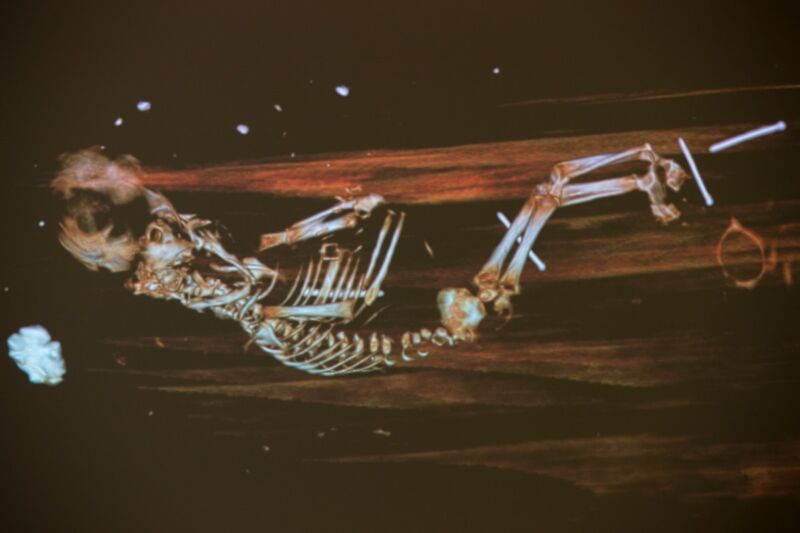
Enlarge/ X-ray image of the mysterious fetus found in the coffin of the 17th-century Swedish Bishop Peder Winstrup.
Gunnar Menander
When Swedish archaeologists in 2015 X-rayed the remains of a 17th-century bishop, they were shocked when the images revealed that the bishop shared his coffin with the remains of a stillborn premature baby. Now, ancient DNA analysis has revealed that the fetus was likely the bishop’s grandson, according to a new paper published in the Journal of Archaeological Science: Reports.
Born in Copenhagen in 1605, Bishop Peder Winstrup was a prominent church figure in Denmark and Sweden during his lifetime, who helped found Lund University in 1666 while deftly navigating the constantly shifting political environment. (He was ennobled by the Swedish king, Charles X Gustav, when his diocese passed from Danish hands in 1658.) Winstrup died in late December 1679 and was buried in Lund Cathedral in January 1680. When his coffin was opened in the early 19th and 20th centuries, the body was remarkably well-preserved.
So when the curators of the Lund University Historical Museum heard, in 2012, that the bishop’s coffin would be moved to a new burial site outside the cathedral, they joined with scientists in a multidisciplinary collaboration to study the bishop’s remains before they were reinterred. The body was X-rayed and CT-scanned, along with the bishop’s clothing, various artifacts, and plant and insect remains.
The scientists found that the bishop’s body had not been embalmed. Rather, the body was placed on a mattress stuffed with herbs (like juniper and wormwood), with the head resting on a pillow of hops, which helped preserve it—including the bishop’s clothing, although the colors had faded. They also found that Winstrup likely died of pneumonia and that he suffered from gout, arthritis, arterial plaque, and gallstones (a sign of a diet high in fatty foods), among other illnesses. He had also lost many teeth, and those that remained showed signs of decay, indicating the bishop was fond of sweets. (The coffin contained a small pouch holding several teeth.)
The bishop’s lungs also proved to be remarkably well-preserved, and anthropologists found small calcifications in those lungs—evidence of a prior infection, most likely tuberculosis. The anthropologists surmised that Winthrop likely contracted the disease during the so-called “White Plague” epidemic that swept through Europe in the 17th century. In fact, last year, researchers at Lund University, the Max Planck Institute for the Science of Human History, and the Swedish Natural Historical Museum were able to reconstruct the genome for a TB sample (Mycobacterium tuberculosis) taken from one of those calcified nodules. Because the bishop’s precise date of death is known, the team was able to determine that the TB pathogen is much younger than scientists previously believed.
But by far the most significant discovery was that the bishop was not alone in his coffin. The CT scans showed a linen-wrapped bundle containing the remains of a stillborn fetus (roughly five to six months along, in terms of development), nestled within the layers of herbs just under the bishop’s right tibia. It was initially assumed that someone (unrelated to the bishop) had taken advantage of the bishop’s burial to ensure their illegitimate offspring was buried on sanctified ground.
Bishop Peder Winstrup on a contemporary engraving printed in one of his own theological works in 1666.
Peder Winstrup in the coffin, where researchers also discovered a fetus wrapped in a bundle between his calves.
Gunnar Menander
The bundle found at the feet of the remains of Bishop Peder Winstrup.
Gunnar Menander
In fact, “It was not uncommon for small children to be placed in coffins with adults,” said Torbjörn Ahlström, a professor of historical osteology at Lund University who co-authored the new study. “The fetus may have been placed in the coffin after the funeral, when it was in a vaulted tomb in Lund Cathedral and therefore accessible.” That jibes with evidence that the wrapped fetus had been hastily placed in the coffin. And other coffins in the same vault also held remains of several children. But it would take ancient DNA analysis to definitively rule out the possibility that the fetus was related to Winstrup—so that’s what Ahlström and his colleagues set out to do.
The Lund researchers took DNA samples from Winstrup’s right femur and the left femur of the fetus. They determined that the stillborn fetus was male and that there was a second-degree kinship with Winstrup, meaning that they shared about 25 percent of the same genes. There was a Y-chromosome match but the mitochondrial DNA was different, indicating the connection was on the paternal side of the family tree. The second-degree relationship could have been grandparent-grandchild, uncle-nephew, or even half siblings or double cousins.
To narrow the possibilities, Ahlström et al. turned to a close examination of the Winstrup family’s genealogy. According to the genealogical records maintained at the House of Nobility in Stockholm, Sweden, the bishop was one of six children (four daughters and two sons). Since the Lund researchers were only concerned with paternal lineage, they could ignore the four sisters in their analysis. Winstrup’s brother, Elias, died in 1633 at the age of 27, unmarried and childless. This enabled the Lund team to rule out certain possibilities: uncle/nephew, half siblings, and double cousins, specifically.
Bishop Peder Winstrup in turn fathered five children with his first wife, Anne Marie Ernstatter Baden, three of whom (two daughters and a son) survived to adulthood. He had no children with his second wife, Dorothea von Andersen.
So the most likely possible relationship, the authors concluded, was that Winstrup was the stillborn child’s grandfather—i.e., the issue of his son, Peder Pedersen Winstrup, who bucked the family theological tradition to focus on military matters (particularly fortification), lost the family estate in the Great Reduction, and died destitute. However, there is a small likelihood that the fetus may have been that of the bishop’s sister Anna Maria (who may have died in childbirth) and her husband Casper von Böhnen, assuming Casper belonged to a similar Y haplogroup.
As for how the fetus came to rest with the bishop, “It seems probable that the relatives would have had access to the crypt where the coffins of the Winstrups were stored, and, thus, a possibility to deposit the fetus in one of the coffins, in this case that of Peter Winstrup,” the authors concluded.
Celebrate First Contact Day with this Star Trek: Discovery S4 trailer
[embedded content]
Sonequa Martin-Green revealed the first trailer for the fourth season of Star Trek: Discovery, as part of First Contact Day.
Actress Sonequa Martin-Green, who plays a key role in the series, revealed the first trailer for the fourth season of Star Trek: Discovery, during First Contact Day 2021, a virtual event hosted by Paramount+ featuring panels, livestreams, and news of various forthcoming Star Trek properties.
(Spoilers for prior seasons below.)
Martin-Green plays Michael Burnham, an orphaned human raised on the planet Vulcan by none other than Sarek (James Frain) and his human wife, Amanda Grayson (Mia Kirshner)—aka, Spock’s (Ethan Peck) parents. So she is Spock’s adoptive sister. As I’ve written previously, the S2 season-long arc involved the mysterious appearances of a “Red Angel” and a rogue Starfleet AI called Control that sought to wipe out all sentient life in the universe.
The big reveal was that the Red Angel was actually a time-travel suit worn by Michael’s biological mother. She had accidentally jumped 950 years into a bleak future in which Control had achieved its nefarious goal and had been traveling through time leaving signals (the Red Angel visions), hoping to alter that future. In the S2 finale, Michael donned a copy of her mother’s suit to lead Discovery over 900 years into the future. The crew of the Enterprise told Starfleet that Discovery was destroyed in the battle and was ordered to never speak of the ship or her crew again.
In S3, Michael, Discovery and her crew arrived in the future and found that Control’s plan had been thwarted: life still exists. But the galaxy was very different thanks to something called The Burn, a catastrophic event that caused all the dilithium in the Milky Way to explode and destroy much of Starfleet in the process. In the aftermath, with no warp drive possible, all the planets had become disconnected and were no longer governed by the Federation. Michael did, however, manage to locate one sole Federation liaison on a remote space station with the help of a new ally, Book (David Ajala).
It proved to be another strong season for the series. As Ars’ Kate Cox noted in her review last year, “S3 is absolutely Star Trek in the classic mold, where problems can be solved, where diplomacy can reign, where clever Starfleet officers can think their way out of any trap, and where the Federation and its ideals are Good, Actually, for this fallen world.”
The Discovery crew reunited with what was left of Starfleet, figured out what caused The Burn, and managed to defeat a rival syndicate known as the Emerald Chain, inspiring planets to start rejoining the Federation. Burnham finally became captain of Discovery after Saru opted to return to his home planet of Kaminar for a spell. And we bid a sorrowful farewell to Philippa Georgiou (Michelle Yeoh); a spinoff series is rumored to be in the works.
According to the official synopsis, in S4 “Captain Burnham and the crew of the USS Discovery face a threat unlike any they’ve ever encountered. With Federation and non-Federation worlds alike feeling the impact, they must confront the unknown, and work together to ensure a hopeful future for all.”
In addition to Martin-Green, much of the main cast is also returning for S4: Doug Jones as Saru, Anthony Rapp as Stamets, Mary Wiseman as Tilly, Emily Coutts as Keyla Detmer, and Wilson Cruz as Dr. Culber. S3 additions Book (David Ajala), Adira (Blu del Barrio), Gray (Ian Alexander), and Starfleet Commander-in-Chief Vance (Oded Fehr) will also be returning.
The trailer mentions a “gravitational anomaly” five miles in diameter moving through the galaxy—clearly the formable threat hinted at in the synopsis. This season looks to be another action-packed bonanza (with spiffy new Starfleet uniforms), reinforcing the themes of community and family so prominent in S3. We get glimpses of Vulcans and Book’s cat, Grudge. Co-showrunner Michelle Paradise has said that one big question for Burnham is how she’ll continue to grow and move forward now that she captains a starship and that Adira’s (technically deceased) transgender boyfriend, Gray, will eventually be visible to everyone, not just Adira. Other than that, we’ll just have to wait and see.