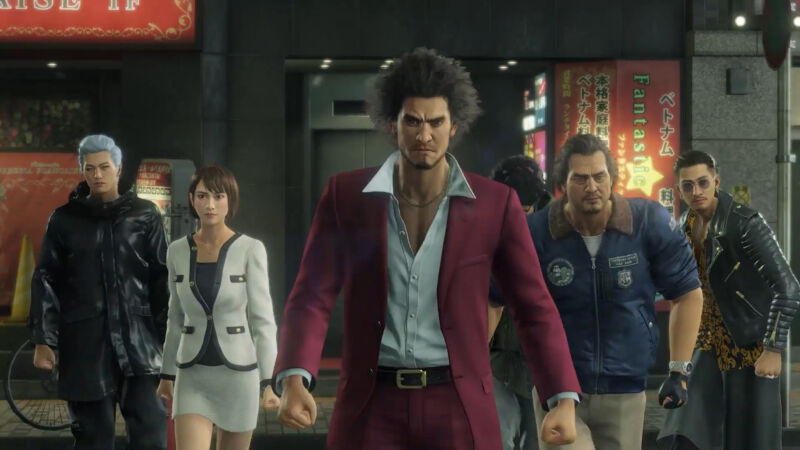
After years on PlayStation, MLB The Show hits Xbox Game Pass at launch
Enlarge/ That “PS Studios” logo on an Xbox retail box still looks a bit weird…
It has been over a year now since Sony first announced it would be bringing the previously PlayStation-exclusive series MLB The Show to Xbox as early as 2021. Today, Microsoft announced even better news for Xbox-owning baseball fans: MLB The Show 21 will be included with an Xbox Game Pass subscription the day it launches on April 20.
The move means that over 18 million Game Pass subscribers will have free access to the game on Xbox One and the Xbox Series X/S, or on Android phones via xCloud streaming. That creates a bit of an awkward situation for PlayStation owners, who will have to pay individually for a Sony San Diego-developed and Sony-published game that many Xbox subscribers will get included with their subscription fee.
That’s especially notable because Sony has its own subscription service, PlayStation Now, which is not getting MLB The Show on launch day (as of now, at least). Then again, PlayStation Now has famously struggled to compare to Game Pass’ “day one” bluster for a while now, especially when it comes to first-party software. Sony’s recent “Play From Home” initiative and the PlayStation Plus Collection have opened up access to some Sony-published titles recently, but these, too, have revolved around dated software.
MLB The Show also further establishes major sports games as a key part of the Xbox Game Pass value proposition. NBA 2K21 and Madden 21both hit the subscription service on March 4, and NHL 21 will be coming to Game Pass in April. Those games were available for months before becoming part of the subscription service, though, making MLB The Show‘s launch-day availability on Game Pass all the more notable.
“As we said from the beginning, this is an incredible moment for all of us, and bringing the franchise to more players and baseball fans is something that we at MLB, MLB Players, Inc., and Xbox are all excited about,” Microsoft said in its announcement today. “We can’t wait for Xbox fans to experience the fastest, deepest, and most intense moment-to-moment baseball action yet.”
Sony’s MLB The Show franchise has been a platform-exclusive selling point since the days of the original PlayStation, when it was simply titled MLB ’98. The series has been the only MLB-licensed baseball simulation video game since 2K Sports announced the end of the MLB2K series in early 2014.
“This is a very exciting moment for all of us as the storied franchise will be accessible to more gamers than before,” Sony said in February when it officially confirmed the Xbox versions of the game. “We would like to thank everyone at PlayStation, Xbox, Major League Baseball, Major League Baseball Players Association, and the San Diego Studio for working diligently to bring MLB The Show to more users.”
Last year saw former PlayStation exclusives Horizon: Zero Dawn and Death Strandinglaunch on the PC, the latter published by Sony Interactive Entertainment. Microsoft, meanwhile, recently confirmed that at least “some” upcoming Bethesda titles will be exclusives to Xbox consoles and the PC following the publisher’s $7.5 billion acquisition. https://arstechnica.com/?p=1754022
Not an April Fool’s joke: Theatrical trailer for The Suicide Squad drops
[embedded content]
Theatrical trailer for The Suicide Squad takes a more ominous tone than its red-band sibling.
If you ventured into a movie theater for the first time in a year to see Godzilla vs. Kong—and Ars’ Sam Machkovech suggested in his review that, if you can safely do so, that might be the most satisfying way to watch it—you likely caught a brand-new trailer for the forthcoming The Suicide Squad, with some new footage and a distinctly different tone from the red-band trailer that dropped last week. “Although it’s April Fool’s, the only joke here is on the supervillains who agreed to work for Amanda Waller,” writer/director James Gunn quipped in his Twitter announcement of the new trailer.
As we reported last week, The Suicide Squad is more of a relaunch than a direct sequel to the 2016 film; Gunn has said he wanted to take the franchise in a new direction and introduce new characters. He drew inspiration from John Ostrander‘s original 1980s Suicide Squad comics. (Ostrander has a small role in the final film.) Gunn has described his R-rated film as a superhero version of the classic 1967 film The Dirty Dozen, selecting characters he described as “loser, B-grade supervillains.” And apparently, the studio is allowing him to kill off certain characters as he sees fit, which should make for suspenseful viewing. (We’re betting Harley Quinn will survive.)
Per the official synopsis:
Welcome to hell—a.k.a. Bell Reve, the prison with the highest mortality rate in the US of A. Where the worst supervillains are kept and where they will do anything to get out—even join the super-secret, super-shady Task Force X. Today’s do-or-die assignment? Assemble a collection of cons, including Bloodsport (Idris Elba), Peacemaker (John Cena), Captain Boomerang (Jai Courtney), Ratcatcher 2 (Daniela Melchior]), Savant (Michael Rooker), King Shark (voiced by Sylvester Stallone), Blackguard (Pete Davidson), Javelin (Flula Borg), and everyone’s favorite psycho, Harley Quinn (Margot Robbie). Then arm them heavily and drop them (literally) on the remote, enemy-infused island of Corto Maltese.
Joel Kinnaman and Viola Davis are back as Colonel Rick Flag and Intelligence Officer Amanda Waller, respectively, with Steve Agee playing John Economos, prison warden and an aide to Waller. Other new cast members include Polka-Dot Man (David Dastmalchian), whose trademark polka-dotted suit is actually a collection of gadgets; Weasel (Sean Gunn), an anthropomorphic weasel; Sol Soria (Alice Braga); T.D.K. (Nathan Fillion); Mongal (Mayling Ng); Flo Crawley (Tinashe Kajese); Bloodsport’s daughter Tyla (Storm Reid); and Thinker (Peter Capaldi).
Usually, official trailers and their theatrical counterparts are largely similar in tone and content. However, “I was firm in not wanting to make two trailers exactly the same,” Gunn explained on Twitter. “That bugs me when they do that. If we’re going to ask fans to watch TWO, let’s give them a reason to do so, focusing on different aspects of our film.” He also assured fans that they didn’t need to see the David Ayers 2016 original to follow the events of The Suicide Squad and suggested his film is best viewed in IMAX. As for why King Shark wears clothes and Weasel doesn’t, Gunn said, “Have you ever tried to put clothes on your cat?”
This latest trailer dispenses with the jokey tone and running gags of King Shark’s gruesome eating habits (“num-num”) in favor of a darker, more ominous tenor. It opens with a voiceover by Capaldi’s Thinker, seemingly trolling the squad members about being Waller’s pawns. “Supervillains. Sad souls in costumes,” he intones. “Wanting you to think they’re all dark and deep. What’s it like, living life as a punchline? But all it would take would be one blessed act of rebellion for you to restore your dignity in its entirety.”
We get to see Polka-Dot Man in action in the new footage, and T.D.K. reveals a surprising ability to separate his arms from his body—to what end is not quite clear. And wonder no more about what’s written on the back of Harley Quinn’s jacket: “Live Fast Die Clown.”
The Suicide Squad opens in theaters and on HBO Max on August 6, 2021.
Margot Robbie seems as delightful as ever as Harley Quinn.
Idris Elba is Bloodsport.
YouTube/Warner Bros.
Check out the new members of the “suicide squad.”
YouTube/Warner Bros.
Honestly, it doesn’t seem like they’re sending their best
YouTube/Warner Bros.
Meet Javelin (Flula Borg).
YouTube/Warner Bros.
Mayling Ng is Mongal.
YouTube/Warner Bros.
Then there’s Weasel (Sean Gunn).
YouTube/Warner Bros.
Daniela Melchior plays Ratcatcher 2.
YouTube/Warner Bros.
Check out Polka-Dot Man in action.
YouTube/Warner Bros.
Apparently T.D.K. (Nathan Fillion) cam separate his arms from his body?
YouTube/Warner Bros.
Harley’s jacket is on point.
YouTube/Warner Bros.
Peacemaker (John Cena) thinks there’s “nothing like a bloodbath to start the day.”
E3 2021 leak suggests paywall, Nvidia streaming; ESA says it’ll be “free for all”
Aurich Lawson | Getty Images
While we’ve heard rumblings for months that the Electronic Entertainment Expo (E3) will return in some form following its 2020 meltdown and cancellation, a leak has clarified what the online-only 2021 version could look like—and has prompted its creators to confirm some of the leak’s details.
“E3’s 2021 digital show is a free event for all attendees,” the expo’s official Twitter account posted on Thursday (and apparently not as an April Fool’s prank). “We’re excited to fill you in on all the real news for the event very soon.”
Details about the leaked pitch document, obtained by Video Games Chronicle, were actually reposted by E3’s Twitter account, suggesting they may very well be accurate. VGC reports that this pitch has been handed to game publishers by E3 organizer the Electronic Software Association to excite potential partners about biz-dev minutiae like “B2B, B2M, and B2C objectives”—but also to insist that “E3 2021 is not an in-person event turned virtual.”
Even though, from the sound of it, the event is exactly that. According to the leak, the renamed Electronic Entertainment Experience (still “E3”) could include keynote sessions, an awards show, a “preview night,” and appointments for the usual attendees (business reps, journalists) to meet with game makers—only this time, all of that stuff would route through an official video-based app instead of a crowded convention hall in Los Angeles.
VGC claims that the ESA is interested in partnering with Nvidia in order to leverage the GeForce Now cloud-gaming service to stream exclusive, playable demos to E3’s virtual attendees. VGC’s language suggests no such deal has been finalized and that this plan isn’t part of the leaked pitch document.
The ESA’s tweet appears to soundly refute at least one suggestion from the leaked document: a possible paywall to access the virtual expo.
VGC cites “sources” in claiming that the ESA has considered bundling portions of E3 2021 into a “paid access pass,” which could include access to cloud-streamed demos or “extra access” of some sort. But publishers have apparently pushed back on this part of the plan, and the ESA had already expressed willingness to back down from such a proposal during the planning phases.
The ESA’s public statement may still offer some wiggle room for both extremes: “a free event” with certain aspects held behind paid, virtual velvet ropes. (You know, like many of the free-to-play games published by ESA members.)
Thanks to the dissolution of E3 in 2020, which was already facing internal turmoil before succumbing to the realities of a pandemic, exactly how the ESA will spin its E3 wheels back up and get all of this organized—particularly the pitch for physical, filmed content in Los Angeles—remains unclear.
Here’s a gallery of E3 2019’s oddest booths and products from the era when we went to physical expos. “Wow, how nice and COOL!” we’re sure you are saying to yourself.
Thermoreal uses superconductors (?!) to simulate a cold or hot feeling in metal. The company integrated this tech into VR-compatible gloves and a VR headset. As the VR environment changes, so does the sensation of real-life temperature. Trippy!
This 1000 mAh battery pack for the Switch was heavy, but the harness made it pretty easy to slide on and off to use only when it’s needed.
Some extremely generic-looking custom chip boards for use in mini-arcade devices and portable emulation devices. If anybody reading this has the rights to the Atari Jaguar Mini, look them up.
Why stream games to a smartphone with Google Stadia when the Smach Z packs an entire 1080p gaming PC with a 6-inch screen into a rather bulky portable package? Doom (2016) ran with judders, and the unit got noticeably hot in our test. But the fact that it works at all was impressive.
The Tactsuit haptic system jolts your body when playing compatible VR games and software.
The Vuvana system has something to do with using a new blockchain cryptocurrency to buy and “own” items in virtual reality, which you can view on a cell phone with this included viewer, apparently.
Oversized controllers were all the rage at E3 2019, but this one went to the trouble of building in a monitor for its game, Street Fighter 2.
Remember the iCade Mini? Someone sure does…
GameBoks is just like it sounds—a wooden box that houses a monitor, power supply, and a space to hold and connect your game console. Between this and the new Atari VCS, wood paneling is apparently the hot new retro-hardware trend.
Proximat is being sold as a “mousepad for your virtual reality feet.” It gives VR players a physical indication of their play space’s center point, complete with high-grade gel for foot comfort.
If this is a thing you’re looking for (for some reason), E3 has you covered.
Amazingly, a product with “360 ONE X” in its name has nothing to do with Xbox (it’s a 360-degree camera designed for VR).
Neither vinyl nor fidget spinners were dead at E3 2019.
I need some quick energy after seeing all of these amazing products. It’s my lucky day!
How do you make money selling $100 worth of stuff for $40? It’s an economic miracle!
This balance board is mainly meant for some easy exercise while at a standing desk, but its producers were marketing it to gamers with a Mortal Kombat 11 display.
And the award for “most dystopian sounding slogan at E3” goes to…
“In the 1989 Future” is a legitimately great tagline, we have to admit.
https://arstechnica.com/?p=1753863
HoloLens for 120,000 Army personnel: Microsoft inks $21.9 billion deal
On Wednesday, the US Army formally moved forward with the largest ever government-related deal for headsets in the virtual and augmented reality sector: a 10-year agreement with Microsoft to provide 120,000 headsets “based” on the HoloLens line.
Reports by CNBC and Bloomberg point to a $21.9 billion value for this week’s updated arrangement, following its initial announcement in November 2018. Neither of those reports point to exact reasons for the deal’s jump from an initial contract value of $480 million, despite that earlier deal confirming similarly high headset numbers.
Official IVAS image as provided by Microsoft as part of Wednesday’s announcements. Notice an array of sensors across the top, along with an apparent headset-strapping requirement for this model.
The headset model in question, as revealed by Microsoft’s Alex Kipman in a Wednesday blog post, appears to deviate slightly from its originally announced intent. While it’s still known as the Integrated Visual Augmentation System (IVAS) and includes an array of HoloLens-like sensors, the model seen in today’s announcement appears to attach to a helmet. Ars previously reported that Microsoft and the US Army intended for this headset to not require mounting on a helmet, arguably to increase its applicability.
Otherwise, we assume the headset’s goals still align with previously known plans to amplify “Lethality, Mobility, and Situational Awareness,” whether in training or in combat. The enterprise-only HoloLens 2 has already improved on crucial technical fronts, particularly the “field of view” for virtual screen elements, while the IVAS will include military-grade features previously announced, such as thermal and night vision cameras, visual target acquisition, vitality sensors, and a system that can detect if wearers suffer concussions.
Intriguingly, the Army’s Wednesday announcement confirms the most video game-like feature yet for a HoloLens-derived headset: “a life-like mixed reality training environment.” Such a combat simulator would technically count as the first official gun-combat “game” for any HoloLens product, since the hardware has largely not been aimed at gamers—even though it will likely require compatible “controllers” like real-world guns. (Hence, such a simulator is probably out of most users’ reach.)
HoloLens for war?
Today’s announcement follows heightened scrutiny over the Department of Defense’s deals with Microsoft. The loudest opposition has come from Amazon, whose AWS department was in a bidding war for a $10 billion cloud-computing contract eventually awarded to Microsoft Azure.
Before that deal was inked in October 2019, Oracle sued to claim that the bidding process was “tainted” by several DOD staffers’ close ties to Amazon. Amazon itself filed a lawsuit in December 2019, with its claims largely revolving around then-President Donald Trump’s public feuding with CEO Jeff Bezos. Amazon continues to challenge this contract in court.
Microsoft has faced internal opposition as well, particularly to the HoloLens-related piece of these deals. An early 2019 open letter penned by Microsoft employees, titled “HoloLens for good, not war,” demanded that Microsoft cancel the IVAS contract, due in part to it being internally developed with weaponization in mind—as opposed to providing open-ended software that a military division might then retrofit to support combat or violence. Microsoft CEO Satya Nadella replied at the time by telling staffers that the company would not “withhold technology” from democratic governments who “protect the freedoms we enjoy.”
https://arstechnica.com/?p=1753570
CDPR puts off planned multiplayer Cyberpunk game amid restructuring
Enlarge/ Bad news if you’ve been hoping to shoot sword-wielding laser-beam punks controlled by other humans, rather than AI…
A planned standalone multiplayer version of Cyberpunk 2077 is being “reconsidered,” developer CD Projekt Red says, as the company reconfigures itself for a new development structure going forward.
In a “strategy update” video posted Tuesday, CDPR joint CEO Adam Kicinski mentioned that the team had previously “hinted that our next AAA would be a multiplayer Cyberpunk game, but we have decided to reconsider this plan given our new more systematic and agile approach [to development].”
Instead, CDPR will be focusing on “building an online technology that can be seamlessly integrated into all of our future games,” Kicinski said. That means developing technologies that can “power online components we choose to add to our games without any technological delay.”
While such online features will be “an important part of our future games,” Kicinski stressed that “CD Projekt Red makes single-player story-driven AAA RPGs. That is not changing.” Online features will be implemented in future games only “when it makes sense,” he added.
Parallel development and cross-functional teams
CDPR’s new partial focus on online features comes amid an internal restructuring of CDPR’s project management. Kicinski said that instead of focusing on one big-budget title at a time, the company will “shift and adapt our focus to enable parallel AAA game development.” That means using “cross-functional teams” that can do simultaneous work on games in both of CDPR’s major franchises—The Witcher and Cyberpunk.
The goal is to create faster iteration and more seamless contact between teams, studio co-founder and joint CEO Marcin Iwinski said. That goal takes on added importance since Iwinski said in January that poor internal communications were partly to blame for the company missing massive bugs in “last-generation” console versions of Cyberpunk 2077 before the game was released.
“We underestimated the scale and complexity of the issues, we ignored the signals about the need for additional time to refine the game on the base last-gen consoles,” Iwinski said in a December conference call addressing the same issues. “This caused the loss of gamers’ trust and the reputation that we’ve been building through a big part of our lives.”
Under the new structure, the company’s Red Engine technology will be refocused to better serve both franchises at once, CTO Pawel Zawodny said. The newly centralized version of the engine will let the team “prepare certain functionalities that can be used in both franchises,” meaning that features like NPC routines and character control can be programmed once and applied to multiple games in parallel. Zawodny said he hopes that strategy will bring more “consistency” to CDPR games’ technical performance.
CDPR also said that, going forward, it will be changing the way it promotes its upcoming games before their release. PR campaigns for future titles will be much shorter and start closer to the game’s planned launch, with only short teasers releasing further ahead of time. Senior VP of Business Development Michal Nowakowski also promised that the team would focus on showing actual game footage before release, not mere concepts, and would make sure all planned platforms were represented in pre-release materials.
Elsewhere, in a Q&A session with investors, Nowakowski said that he feels recent patches for Cyberpunk 2077 have gotten the game closer to a planned return to the PlayStation Store, following its delisting in December. “Each and every [patch] brings us closer to going back to the PSN store,” he said. “However, the final decision, you have to understand, belongs to Sony. We do believe we’re closer than further, but of course, the final call is theirs, so let’s wait and see.” https://arstechnica.com/?p=1753516
Star Wars: The Bad Batch trailer arrives ahead of May the Fourth launch
This week’s one-two Disney+ news punch revolves around Star Wars—a PB-and-choc combo of TV series that has so far paid off richly, especially after the shaky conclusion to the franchise’s latest film trilogy.
Coming May the Fourth. (Oh, I get it—I just said that date out loud.)
The whole batch is here.
Tech! (Add your own “Donatello does mach-iiiines”-like flourish if you’d like.)
And Crosshair!
Clone Force 99 meets a new accomplice.
We don’t get her name yet, but we do see her shoot a bow and offer some wide-eyed optimism.
Tarkin is not pleased.
Saw Gerrera returns to the series’ animated universe: “You can either adapt and survive or die with the past. The decision is yours.”
A few particularly explosive scenes see Fennec Shard apparently team up with Clone Force 99.
Unsuprisingly, stuff goes boom.
First up is the newest Star Wars series to debut, coming in barely over a month. We learned last month that new series Star Wars: The Bad Batch is slated to launch on Tuesday, May 4 (huh, we wonder why they picked that date). On Tuesday, Disney followed that news with the premiere of that CGI-animation series’ first trailer, which immediately follows in the footsteps of Clone Wars‘ revival on Disney+ a little over a year ago. The new series also sees longtime Clone Wars steward Dave Filoni return as co-executive producer.
Tailed by Tarkin
Clone Wars‘ seventh season opened by focusing squarely on the Bad Batch, a ragtag group of clone troopers (also known as Clone Force 99) whose mutations turned them into supersoldiers above the rest of the clone fray. Their combination of action-filled missions and comic-relief banter set a solid tone for a season that barreled toward epic set pieces long-teased by Filoni, particularly the Siege of Mandalore.
Tuesday’s new trailer sees the quintet—Hunter, Echo, Tech, Ricker, and Crosshair—immediately fall under the watchful eye of Wilhuff Tarkin (who we first met in A New Hope, where he famously ordered the Death Star to fire upon Alderaan). He notices the unit’s knack for disobedience while doing his droid-killing bidding before eventually ordering his army to “wipe out” Clone Force 99.
Exactly why and when that order comes down is unclear, though this series takes place squarely in the franchise’s Imperial era—and thus far appears to be full of laughs, blasters, explosions, sweeping dogfights, massive lizards, and throwing knives, all rendered in the same plastic-toy aesthetic favored by Clone Wars. This trailer includes the welcome return of Mandalorian sniper Fennec Shand, voiced once again by actor Ming-Na Wen, along with an unnamed child who, according to StarWars.com, meets our heroes on the planet Kamino before getting tied up in their escape plans. Between these and the return of Clone Wars character Saw Gerrera, it’s hard to imagine Bad Batch not roping in further cameos over the course of its first season.
Unsurprisingly, Disney is sticking with its once-a-week trickle for new episodes once the series launches, and after its “special” 70-minute premiere on Tuesday, May 4, new episodes will follow every Friday (likely with shorter lengths from that point on).
[embedded content]
Star Wars: The Bad Batch official trailer.
Star Wars has been… Owen us a reunion
<a href="https://cdn.arstechnica.net/wp-content/uploads/2021/03/obi-wan-kenobi-cast.jpg" class="enlarge" data-height="1000" data-width="1000" alt="Announced cast thus far for Star Wars: Obi-Wan Kenobi. No CGI announcements for other series characters just yet.”><img alt="Announced cast thus far for Star Wars: Obi-Wan Kenobi. No CGI announcements for other series characters just yet.” src=”https://rassegna.lbit-solution.it/wp-content/uploads/2021/03/star-wars-the-bad-batch-trailer-arrives-ahead-of-may-the-fourth-launch.jpg” width=”980″ height=”980″>
Enlarge/ Announced cast thus far for Star Wars: Obi-Wan Kenobi. No CGI announcements for other series characters just yet.
StarWars.com
One day earlier, the official Star Wars blog confirmed a few things we already knew (and many we didn’t) about its upcoming Disney+ series Obi-Wan Kenobi. Production and filming are moving forward starting in April, and its most obvious stars, Ewan McGregor and Hayden Christensen, have now been flanked by a considerable cast.
Perhaps highest on the supporting list is Joel Edgerton, at least in terms of series lore, since he’ll likely reprise his Attack of the Clones role as Owen Lars—better known in the original trilogy as Luke Skywalker’s Uncle Owen. The rest of the announced cast isn’t directly connected to Star Wars films or TV series thus far, though actor and comedian Kumail Nanjiani comes to this series in tidy, corporate-synergy fashion after finishing production on upcoming Marvel Studios film The Eternals.
This cast will land in the Star Wars universe 10 years after the events of 2005’s Revenge of the Sith, though that timeline announcement doesn’t clarify where Kenobi and friends will land or how he and an ever-more-evil Anakin Skywalker may cross paths. (My personal vote is that they try some of that “talking while miles apart” approach, first seen in The Last Jedi.)
As SteamDB creator Pavel Djundik shared on Twitter Monday, Sega’s lawyers asked that the site and its host take down a page for Yakuza: Like a Dragon. The takedown request alleges that SteamDB is distributing or linking to pirated copies of the game, even though a quick glance at an archived version shows that’s not true.
That page, like every other on SteamDB, simply compiles historical data on pricing, concurrent players, and other statistics from Steam’s own API and public store pages. While there is a link to install the game near the top, that link directs users to Steam itself, which will attempt to install a legitimate copy if the user owns it.
“SteamDB does not support piracy, it does not provide downloads, it does not sell keys, it does not link to any websites that do any of these activities,” the site writes on its FAQ page. “SteamDB only embeds Steam’s official widget for purchasing the game… We consider our website to fall under fair use, please do not send us DMCA takedowns.”
Djundik says these kinds of mistaken DMCA requests happen about once a year on SteamDB, and it’s not hard to imagine an overzealous web crawler misidentifying a page for some lawyers seeking to deter software pirates. But Djundik says previous problems have always been quickly resolved with the takedown requester. In Sega’s case, Djundik says the company “did not reply to the first abuse report and sent a new one to our hoster.”
As such, the SteamDB page for Yakuza: Like a Dragon” has been replaced with the following message: “This page was taken down because SEGA is claiming we distribute their game here (we don’t).”
Djundik followed up overnight to say he has been in contact with Sega of America, which hopefully means this snafu should be resolved relatively soon (a Sega representative wasn’t immediately available to respond to a request for comment from Ars Technica). Still, the whole saga is yet another example of how easy it is for completely non-infringing content to sometimes get caught up in the DMCA’s net.
https://arstechnica.com/?p=1753133
Sony will shut down online stores for legacy PlayStation games this summer
This is probably our last chance to ever reuse this image.
If you’ve been waiting to purchase and download a game on your PlayStation 3, PlayStation Vita, or PlayStation Portable, you’d better do so soon. Sony has announced that new PlayStation Store game purchases on those consoles will be discontinued on the following dates:
PlayStation 3: July 2, 2021
PlayStation Portable: July 2, 2021
PlayStation Vita: August 27, 2021
After these dates, users of these older systems will still be able to re-download and play previous purchases, including videos and media. Continuing PlayStation Plus subscribers will also be able to download previously claimed games from that service.
But users won’t be able to make new game purchases, including purchases of in-game content or DLC on these systems after those dates. Existing funds in a PSN wallet on these consoles will still be redeemable on a PS4 or PS5, or they can be refunded at the user’s request.
If you’re looking to take one last spin on your legacy Sony hardware, a group of redditors has compiled a list of PS3 digital exclusives worth checking out.
Hop on COVID-19’s most famous ship—the Diamond Princess—in HBO’s The Last Cruise
[embedded content]
The trailer for HBO’s The Last Cruise.
Filmmaker Hannah Olson might be the only person to ever have two world premieres at South by Southwest while never having her work shown on a single screen in town. Back in 2020, Olson was ready to bring Baby God, her HBO documentary on the fallout from revelations about disgraced fertility doctor Quincy Fortier. But then March 6, 2020 happened—the city of Austin declared a disaster and effectively cancelled SXSW for the first time in the event’s 30-plus-year history.
“The pandemic became very real for me very quickly because my premiere was canceled on March 6, 2020,” Olson tells Ars. “So at that point, I felt very strongly I wanted to pivot… and I started looking closer at these people stuck on a cruise ship out in Japan.”
Just like that, Olson had unexpectedly started on her second feature documentary before her first had even debuted.
Two months earlier, in January 2020, Olson had traveled to India on vacation. Moving throughout Asia then, she quickly became aware of the uneasy spread of a novel coronavirus throughout China long before the situation landed on the radar for many Americans. But it was the February 2020 news reports about this virus being discovered on a cruise ship docked in Japan that really captured her attention.
“I’m a news junkie. So whenever I read a news story, I’m looking for people’s Facebook profile or social media profiles,” Olson recalls. “‘OK, who are these people?’ I started looking on social media thinking, ‘Maybe if they were on the ship, they were still posting to Facebook.’ Through social media, I started finding this enormous trove of footage—people on every deck recording their lives around the clock: the crew, the passengers. I just started collecting, and I eventually reached out to people to hear their stories.”
The result, Olson’s new documentary called The Last Cruise, which debuted sans Texas screens as part of SXSW Online 2021 (the film hits HBO Max on Tuesday, March 30). Built largely upon an impressive cache of eerie home video, it’s a gripping, frenetic, first-person view of one very trying month aboard the Diamond Princess cruise ship as it docked in Yokohama, Japan. This real-world exercise in found-footage horror could very well be the most unsettling, anxiety-inducing ~40 minutes you watch all year.
The most ominous, scary deck in film since the Orca.
YOKOHAMA, JAPAN – FEBRUARY 10: A member of the media wears a face mask while walking past the Diamond Princess cruise ship.
SAN ANTONIO, TX – FEBRUARY 17: American evacuees from the Diamond Princess cruise ship arrive at Joint Base San Antonio-Lackland on February 17, 2020. The Diamond Princess cruise ship, where the passengers were evacuated from while docked at the Japanese city of Yokohama, is believed to be the highest concentration of novel coronavirus cases outside of China, where the outbreak began.
Dry land, please
The Last Cruise takes viewers back to January 20, 2020, when only four confirmed cases of COVID-19 existed outside of China. For anyone who has ever dared to step on a cruise ship, the opening scenes will look familiar: older travelers living out their global dreams on small daily excursions, packed halls watching stage performances, everyone taking selfies as they look out onto the ocean at night.
Olson uses these “before times” to introduce a wider range of experiences than that, however. She connects with not only American tourists but with Indonesian workers on the ship’s crew or kitchen staff, the Italian doctor overseeing the ship’s medical resources, a ship performer, and a pastry chef. All of these people seemingly have their cell phones filming constantly, even if it’s just to say they’ll be wishing good health to family and friends in this new year.
“As much as this film is about the early days of the COVID crisis, it’s also about the way we narrate our lives—people were filming and taking photos the entire time, guests and crew. So what happens when your vacation photos become plot points in some real-life horror movie?” Olson says. “What happens when your vacation photos become part of something larger, become part of an international news story? [During production] I felt like I was looking at evidence—evidence that the government seemed to know more than they were letting on. I watched US government officials enter the boat in hazmat suits—well, OK, this isn’t matching what I’m seeing here [back in the US].”
Without spoiling any of the astounding moments captured from multiple vantage points, it suffices to say that viewers are simply along for the ride in The Last Cruise. Though bringing in a lot of post-cruise or wider-world perspective would have been easy, Olson eschews sit-down interviews with US and Japanese government officials or health experts. Or, more accurately, she did those but ultimately decided to leave such detail on the cutting-room floor: “I wanted the film to mimic the feeling of being on the ship, and no one on the ship was talking to experts. No one on the ship had information,” she says. “Other films are going to do that. We will have no shortage of expert commentary on COVID. I wanted this film to be an experience.”
Because of this, The Last Cruise maintains an almost claustrophobically narrow viewpoint focused solely on this ship at this point in time. Passengers, crew members, local health officials, and numerous onlookers come to terms with the terrors of COVID-19 in real-time, small bit of information by small bit of information. Watching the movie more than a year after the events, of course, viewers have more perspective, but that only makes seeing the utter lack of information and urgency unfolding all the more anxiety-inducing. The Last Cruise reminds us that concepts like asymptomatic spread or maxed-out hospital capacity were not always universal knowns.
“I do wonder how interested people will be in watching a COVID documentary as we’re still living in it,” Olson says. “Going into making this, in February and March last year, I kept thinking, ‘Is it too soon to make a film about COVID? We don’t know the end result.’ But I knew I’d be interested in the origin story and that the first outbreak outside of China would remain relevant and have lessons to teach us.”
“It doesn’t make any sense”
Beyond being a captivating chronology, The Last Cruise also shows that many of the greater societal challenges COVID-19 has surfaced over the last 13 months existed long beforehand. The unequal toll of this health crisis along class and racial or ethnic lines becomes literal quickly on the Diamond Princess as being “quarantined” really only applied to guests. Crew members share footage and memories of still living in close (unmasked) quarters and being required to carry out ample (and unmasked) tasks to keep the ship operating while docked. The hokey, HR-speak ship motto—”One Team, One Dream”—becomes a driving force in the downfall of many crew members.
“We couldn’t just stay in our rooms; the crew had to keep the ship going,” an American performer named Luke says in the film. “Answering phones, delivering medications, cleaning for 12 hours a day… We were delivering 3,000 meals, three times a day, to all the guests. We were put into harm’s way, but in the moment that’s all we knew how to do.”
The lack of transparency around handling the virus on ship in The Last Cruise also mimics similar issues that would reveal themselves within organizations everywhere, from employers to governments to schools. It wasn’t until Day 23 on board that a crew member broke the ship’s policy banning talking publicly about work in order to bring to light the unsafe conditions being forced upon staff. Medical officials appearing in documentary footage seem to convey almost no context to the people they approach, whether those individuals display COVID-19 symptoms or whether they’re bystanders wondering about others or when they might get home.
“It’s the whole experience but small,” Olson says. “You have the rich people staying in their room and the crew becoming essential workers, and no one has any information. All the news outlets early on were reporting that the ship was in quarantine, but all the footage I saw on Facebook from the crew members showed them continuing to live and work in shared quarters, not in quarantine. How can we talk about that as quarantine? It doesn’t make any sense.”
The Last Cruise will simply horrify viewers with what’s unfolding before their eyes while simultaneously nudging everyone to contemplate the larger issues this ongoing pandemic regularly forces society to grapple with. It may be less grim than many of the other COVID-19 documentaries that take audiences inside hospitals or keep the overall death count front and center, but it’s no less of a shake-you-to-the-core, sober viewing.
The Last Cruise becomes available on HBO Max on Tuesday, March 30.
It has been nearly 10 years now since Ars Technica first described Bitcoin to readers as “the world’s first virtual currency… designed by an enigmatic, freedom-loving hacker, and currently used by the geek underground to buy and sell everything from servers to cellphone jammers.” A decade later, Bitcoin and other cryptocurrencies are practically mainstream, and even most non-techies know the blockchain basics powering a decentralized financial revolution (or a persistent bubble, if you prefer).
What Bitcoin was to 2011, NFTs are to 2021. So-called “non-fungible tokens” are having a bit of a moment in recent weeks, attracting a surge of venture capital cash and eye-watering speculative values for traceable digital goods. This despite the fact that most of the general public barely understands how this blockchain-based system of digital authentication works, or why it’s behind people paying $69 million for a single GIF.
Fungible? Token?
Perhaps the simplest way to start thinking about NFTs is as a digital version of the various “certificates of authenticity” that are prevalent in the market for real-world art and collectibles. Instead of a slip of paper, though, NFTs use cryptographic smart contracts and a distributed blockchain (most often built on top of Ethereum these days) to certify who owns each distinct, authentic token.
As with cryptocurrencies, those contracts are verified by the collective distributed work of miners who keep the entire system honest with their computational work (the electricity for which creates a lot of nasty carbon emissions). And just like cryptocurrencies, those NFTs can be sold and traded directly on any number of marketplaces without any centralized control structure dictating the rules of those transfers.
What makes NFTs different from your run-of-the-mill cryptocurrency is each token’s distinctiveness. With a cryptocurrency like Bitcoin, each individual unit is indistinguishable from another and has an identical value. Each individual Bitcoin can be traded or divided up just like any other Bitcoin (i.e. the Bitcoins are fungible). NFTs being “non-fungible” means each one represents a distinct entity with a distinct value that can’t be divided into smaller units.
Enlarge/ It’s trivial to make a digital copy of any of the images for sale on Rarible. But those copies won’t have the “authenticity” of the actual NFT being sold…
These NFT contracts can represent pretty much anything that can exist digitally: a webpage, a GIF, a video clip, you name it. Digital artists are using NFTs to create “scarce” verified versions of their pieces, while collectible companies are using them to create traceable, unforgeable digital trading cards. Video game items and characters can be represented as NFTs, too, allowing for easy proof of ownership and portability even between games controlled by different companies (though the market for such games is still very immature).
There are plenty of even odder examples out there. Vid is a TikTok-like social media network that gives users NFT-traced ownership of their posted videos (and royalty payments for the same). The Ethereum Name Service is using NFTs to set up a decentralized version of the ICANN-controlled Domain Name Service for finding online content. Aavegotchi is a weird hybrid that uses digital pets to represent your stake in a decentralized finance protocol called Aave. Essentially, there are hundreds of companies looking to NFTs for situations where they need to trace and verify ownership of distinct digital goods.
The idea has been catching on quickly, at least among speculators with a lot of money to throw around. Nonfungibles’ database of hundreds of different NFTs has tracked over $48 million in sales across nearly 40,000 NFT transactions in just the last week. Rarible, one of the most popular NFT marketplaces, saw its daily trading volume hit $1.9 million earlier this month, tripling the same number from just a day before. Cryptopunks, an early NFT representing 10,000 unique pixellated avatars, has seen over $176 million in total transactions since its creation in 2017 (with over 10 percent of that volume coming in the last week).
How does it work?
On a technical level, most NFTs are built on the ERC-721 standard. That framework sets up the basic cryptographic system to track ownership of each individual token (by linking it to user-controlled digital wallets) and allow for secure, verified transfer on the blockchain.
Some NFT contracts have built additional attributes and features on top of that standard. The NFT for a cryptokitty, for instance, contains metadata representing that digital avatar’s unique look and traits. That metadata also establishes rules for how often it can “breed” new cryptokitty NFTs and what traits it will pass down to future generations. Those attributes are set and verified on the blockchain, and they can’t be altered no matter how or where the cryptokitty is used.
When NFT’s are used to represent digital files (like GIFs or videos), however, those files usually aren’t stored directly “on-chain” in the token itself. Doing so for any decently sized file could get prohibitively expensive, given the cost of replicating those files across every user on the chain. Instead, most NFTs store the actual content as a simple URI string in their metadata, pointing to an Internet address where the digital thing actually resides.
It may seem odd to link a system of decentralized, distributed digital goods to content hosted on centralized servers controlled by actual people or companies. Given that the vast majority of webpage links become defunct after just a few years, an NFT pointing to a plain-old web address wouldn’t seem to be a good long-term store of value.
Enlarge/ A diagram laying out the basic difference between IPFS distributed file storage and standard, centrally controlled HTTP servers.
Many NFTs get around this by using burgeoning blockchain-based file networks such as IPFS or pixelchain. These networks are designed to let users find, copy, and store cryptographically signed files that could be distributed among any number of independent nodes (including ones controlled by the NFT owner). In theory, linking an NFT to an IPFS address could ensure the digital file in question will continue to be accessible in perpetuity, as long as someone has mirrored a verifiable copy on some node in the IPFS network.
Are NFTs really that valuable?
Just like a certificate of authenticity, the value of an NFT (and the “unique” digital item it represents) is strongly tied to its provenance. The person who spent $560,000 for an NFT representing the original Nyan Cat meme, for instance, obviously didn’t purchase every copy of the famous animated GIF of a pop-tart cat with a rainbow trail behind it. You can still download your own identical copy with a few clicks. The NFT doesn’t even include the copyright to Nyan Cat, which would at least give the owner some legal control over the work (though some NFTs try to embed such rights in their contracts).
What makes the Nyan Cat NFT interesting (and potentially valuable) is that it was verified and sold by Chris Torres, the person who created and posted the original Nyan Cat video to YouTube in 2011. That gives this copy of Nyan Cat a unique history and a tie to the meme’s creation that can’t be matched by any other copy (or any other NFT, unless Torres starts diluting the value by minting more). And the blockchain technology behind the NFT ensures the chain of custody for that version of the GIF can be traced back to Torres’ original minting, no matter how many times it’s sold or transferred.
Enlarge/ This Nyan Cat GIF is practically worthless. So why is an NFT of an “identical” GIF worth so much money to a collector?
Does that fact alone really give this NFT any more value than all of the other identical Nyan Cat GIFs floating around on the Internet? That’s for a highly speculative market to figure out. But just as a stroke-for-stroke copy of a Vermeer masterpiece doesn’t have the same value as the one-of-a-kind original, a verified “original” Nyan Cat from the meme’s creator may retain some persistent value to collectors.
Just because digital goods are easier to copy than paintings doesn’t make one less valuable than the other, either. It’s trivial to make a near-perfect copy of a photographic print, but original photographs can still sell for millions of dollars to the right buyer.
On the other hand, these NFTs might end up being more akin to those novelty deeds that claim the document gives you “ownership” of a star in the night sky. While there’s probably some sentimental value to the idea of owning a star, there isn’t any real robust market where the most coveted stars trade for large sums. And just like there are a lot of competing organizations offering “star deeds” these days, there are a lot of competing firms that could dilute the market with their own NFT offerings.
Do you know where your NFT came from?
All of this means that tracing the provenance of any given NFT can be of prime importance to its implicit value. NFT marketplace SuperRare ensures its NFTs are “authentic” by only minting tokens for a set of “hand-picked artists” for the time being. NBA Top Shot, meanwhile, relies on its NBA license to make sure its randomized packs of basketball video clips are each unique and have an “official” air to them.
But there are plenty of situations where the original ownership of a particular NFT is more questionable. Game developer Jason Rohrer drew some controversy earlier this month by trying to sell NFT tokens for artwork originally created by other artists for his 2012 game The Castle Doctrine. This did not please many of the artists who were not aware their digital work was being resold as a token, to say the least.
Then there’s Tokenized Tweets, a simple service that can create a sellable NFT token representing any tweet on the service, including ones created by other people. The service has recently stopped tokenizing tweets that include visual media, and it lets artists make takedown requests if their copyrighted art/photography is tokenized by the service. But that seems like a pretty skimpy Band-Aid for an offering that seems rife with fraud potential.
Enlarge/ The NFT-backed “Marble Card” frame for Reddit.com has no actual connection to the creators or owners of Reddit. But does that matter?
There are also gray areas like Marble Cards, which lets you create an NFT “frame” intended to go around a specific, unique webpage URL. That makes each frame akin to a unique trading card with a picture of a webpage on it. While the service states clearly that “no third-party content is claimed or saved on any blockchain,” the direct link and implicit association with the webpage in question could lead to some thorny questions of ownership.
With literally thousands of companies jumping into the NFT space, there’s a gold rush mentality that seems primed to spawn plenty of scams. And even legitimate NFT efforts could see their values fade away quickly if the market’s attention moves on to a different blockchain as its store of “authentic” value. Cryptokitties, one of the first popular NFT collectibles in late 2017, saw transaction volume plummet 98 percent in 2018 as high Ethereum fees and lack of novelty drove some of the more speculative players away.
Back in 2011, it was unclear if Bitcoin was going to be a lasting financial instrument or a flash-in-the-pan technological fad. And here in 2021, you can say the same thing about the future for NFTs.