Activision releases online-only PC game without online content, cracked in one day

<img src="https://rassegna.lbit-solution.it/wp-content/uploads/2021/03/activision-releases-online-only-pc-game-without-online-content-cracked-in-one-day.jpg" alt="Want to avoid this warning message on Crash Bandicoot 4‘s PC version? That’s currently not an option for anyone who’s bought the game.”>
Enlarge / Want to avoid this warning message on Crash Bandicoot 4‘s PC version? That’s currently not an option for anyone who’s bought the game.
Activision / Sam Machkovech

2020’s Crash Bandicoot 4: It’s About Time received a soft relaunch on Friday that revolved around next-gen console patches, a downgraded port for Nintendo Switch, and a debut on Windows PC. The latter case, debuting exclusively on Activision-Blizzard’s Battle.net app, saw the publisher take an unusual step: requiring an online connection to launch the game.

While this isn’t the first “offline” Battle.net game to be saddled with online-only DRM (those honors go to February’s Blizzard Arcade Collection), it’s arguably the highest-profile game to get such an official limit and one that follows the revived platforming series’ shift from Steam to Battle.net. Perhaps even more embarrassing to Activision, this DRM effort only lasted a single day.

Wanna be the empress of Crashin’?

By midday Saturday, one day after the game’s Battle.net launch, cracking-group Empress claimed first dibs on stripping Crash 4‘s PC version of its online check-in system. Their crack replaces one file in an otherwise vanilla install, and the group’s release notes don’t clarify what the crack does, other than describing the game’s defeated DRM as “Battle.net + online only.” (We thus believe this isn’t a case of someone defeating Denuvo, even though a joke in Empress’ release notes mocks the much-maligned DRM provider.)

As of press time, Crash 4 has zero online content, in spite of a couch co-op mode (designed to let a parent and child take turns with the single-player campaign) and a simple four-player versus mode dubbed Bandicoot Battle. Thus, the Battle.net handshake appears to revolve entirely around DRM, as opposed to checking for add-on content like new levels or even score leaderboards.

Should you want to play Crash 4‘s single-player content offline legitimately, you’re limited to its console versions (and suffering with inconsistent frame rates on “base” consoles like Xbox One S or PlayStation 4). Attempts to load the legitimately installed game on an offline PC result in an error message: “Failed to sign on to Battle.net, error code: BLZ51900002.” Using the crack bypasses this restriction—without otherwise changing what content is available compared to, say, the console versions.

Playing Activision-Blizzard games while offline via Battle.net is already a tricky proposition, in part because most of the service’s games make always-online assumptions in terms of content. Battle.net’s offline mode is also a bit buried, as it requires logging out, then choosing a “play offline” toggle behind a gear icon. After this step, however, most games react confusedly, perhaps because Battle.net’s offline mode doesn’t save an encrypted token on your machine to verify that you’ve recently confirmed your purchases (a feature found in offline modes for the likes of Nintendo Switch and Steam).

This may be why StarCraft 1 and WarCraft 3 require their own in-app logins before you can actually pull your Ethernet cable and play their single-player modes offline with all of your purchases and content. Sadly, the offline content in Battle.net games like StarCraft II and Diablo III is completely inaccessible without an online connection and credential confirmation.

The last Crash Bandicoot platforming game to land on PC, the N.Sane Trilogy remaster collection, had no such online-only restrictions when it launched on Steam in June 2018. It instead relied on Steam’s built-in DRM system, which requires infrequent online checks before letting games work without interruption whenever offline mode might be toggled. This differs from Denuvo, which can be built into any game’s EXE to require a validated handshake with a game’s online server before it will function.

Activision representatives did not immediately reply to questions about Crash 4‘s online-only requirements on PC.

https://arstechnica.com/?p=1752804


A light show for every crit: How good are the $39 Pixels “smart” dice?

Oh, Kickstarter: the land of wild, wacky promises and broken dreams, where products that could’ve been imagined during a productive shower or a psychedelic trip can become a reality, logistics and physics be damned. As we’ve written and seen, however, it’s a dangerous space for consumers, so much so that Kickstarter warns customers that it’s not technically a “store.” You give Kickstarter money, and it gives you the potential to receive goods or services.

Hence, we prefer to test a mid-Kickstarter product before telling you about it, and that’s the case for Pixels Dice, as seen in the above shiny-and-alluring images. Full of sensors, LEDs, and Bluetooth functionality, these dice sounded like the smartest addition to a tabletop game I’d ever seen when they contended for the 2019 Hackaday Prize. Upon getting my hopes up, I emailed their creator a cold-call request: whenever Pixels Dice actually exist, I want to test their sales pitch.

One very long year later, a package showed up at my door, and it contained two prototype, 20-sided Pixels Dice—currently priced at $39 per die, or $199 for a seven-dice set. Now that the project’s Kickstarter is live, and (as of press time) teetering toward $3 million in sales, I wanted to share my prototype testing experience, along with my somewhat optimistic take on what to expect from the final version, currently estimated to ship in “March 2022.”

Critical hit, now with critical light

As described on their Hackaday project site, Pixels take the board-gaming convention of dice, ranging anywhere from boilerplate six-sided to D&D-standard 20-sided, then add six electronic components: a Bluetooth controller, an array of RGB LEDs, an accelerometer, a battery, a wireless inductive-charging coil, and onboard memory.

Your imagination might immediately run wild with the sum total of those components, as squished inside gaming dice, and creator Jean Simonet is bullish about their gaming potential in his sales pitch. The obvious biggie is LED light-show possibilities with every roll of the dice, as paired with accurate roll tracking. Roll a 20 (a “crit” in D&D-speak), and your die could explode in a sensational light show. Roll a 1, on the other hand, and your die could light up with the visual equivalent of a sad trombone. Roll anything in between, and each face of the die can light up with its own colors and animations, as chosen by you.

Speaking of: should your dice be synced to a nearby Bluetooth device, your dice rolls could trigger sound effects via a compatible app. Maybe you’d prefer a literal “womp womp” sound, or maybe someone at your table would benefit from the dice-roll number being spoken out loud, or tracked in a D&D-style journal, by a companion app.

Having picked through my share of high-end dice bins at nerdy conventions, I don’t flinch at the idea of spending $39 on a single, blinged-out die. $199 for a full set is another matter, however. And in my testing of Pixels thus far, that’s where I currently draw the line. The prototypes I’ve played with include a mix of strengths and annoyances, tolerable enough for a single-die investment, or maybe even a pair. But I hesitate to dump an entire set’s worth of confidence into a $199 Kickstarter preorder.

Not bad at first LED blush

All of my tests were conducted using Pixels’ nonfinal prototype hardware, which only came in D20 flavors; they’ll eventually come in other popular polyhedral flavors (6-sided, 10-sided, etc.). Anything I describe below could be improved by at least one more year of development, iteration, and testing. Anything could turn out worse in the final product, as well, once the line moves from handcrafted, one-of-a-kind prototypes to products manufactured at scale. For the rest of this article, I will call these prototypes Pixels.

When I unboxed and began rolling Pixels, I skipped syncing to any Bluetooth devices to see how the dice had been set up by Simonet (he personally packaged and shipped these suckers). I learned that each die had its own light-animation template saved onto its memory, and both revolved around a simple ruleset: one general light-show animation for numbers 2-19; a “sad” animation for 1, and a “celebratory” animation for 20. It always recognized a 20 or a 1 precisely; exactly how it measured the other numbers, I couldn’t determine with this template.

Boom: basic sales pitch achieved. If I’d bought these at a store with zero customization options, I’d think that was a fine starting point in terms of unique, high-tech dice. Still, I came to realize the pre-installed animations were not quite up to my tastes. In particular, when Pixels’ light-show animation fills every die’s face, it can be hard to quickly see which number is showing on the top—and you don’t want to be the person at your table making everyone strain their eyes for 2-4 seconds of flashy animations to figure out what you just rolled.

As a result, I’m already keen on recommending Pixels’ opaque-body models (which I’ve tested) over the transparent ones (which I haven’t). These LEDs run pretty bright, and having those lights emerge through cut-out numbers is crucial for readability as it is. I can’t imagine trying to parse the results of a Pixels die roll with more transparent plastic absorbing and showing more obfuscating light.

https://arstechnica.com/?p=1752490


Bus drivers bring adaptation of Alien to London’s West End in Alien on Stage

[embedded content]
Danielle Kummer and Lucy Harvey produced and directed the charming documentary Alien on Stage.

Imagine if your amateur high school theatrical production was suddenly asked to perform on Broadway, with just a few weeks to prepare. That’s the kind of thing that typically provides fodder for anxiety dreams. But in Alien on Stage, a group of British bus drivers overcomes the odds to bring their amateur production of Ridley Scott’s classic 1979 science fiction horror film Alien to London’s West End. This winsome documentary made its international premiere at the virtual SXSW festival last week.

Per the official premise:

This is a story about a unique crew of Dorset bus drivers whose amateur dramatics group decide to ditch doing another pantomime and try something different. Having never done anything like it before, they spent a year creating a serious adaptation of the sci-fi, horror film, Alien; finding ingenious solutions to pay homemade, homage to the original film. The show is a crushing flop but fate gives them a second chance to find their audience.

Whilst still adjusting to the idea that their serious show is actually a comedy, the group find out they’re suddenly being whisked from their village hall to a London West End theatre to perform this accidental masterpiece for one night only. With wobbly sets, awkward acting and special effects requiring “more luck than judgement,” will their West End debut be alright on the night? This bus driving crew are our space heroes. Their bus station is our space station. Dorset is outer-space and where is the Alien? It’s behind you!

The amateur company in question call themselves Paranoid Dramatics, and most of the members are employed by the Wilts and Dorset Bus Company. When we first meet them, they’ve been putting on annual holiday pantomimes locally for several years as a creative outlet, with proceeds going to charity. Their production of Robin Hood in particular proved to be a smashing success with the locals.

Pantomime, for the uninitiated, is a form of family-friendly musical theater with comic gags and slapstick, with audience participation encouraged. It usually draws upon well-known fables, legends, and folk tales. But Dave Mitchell, his wife, Lydia Hayward, and son Luc, were all huge Alien fans—the franchise is arguably part of our modern mythology—and one year convinced the troupe to stage an adaptation of the film. (Other candidates for adaptation included Kill Bill, Pulp Fiction, and Tombstone; Alien won out.) 

Luc wrote the script, Lydia was cast in the starring role of Ripley (made iconic by Sigourney Weaver in the original film), and Dave was the director. They tapped grandfather Ray to build the sets, making it a three-generation family affair.

Jason Hill was cast as Dallas, captain of the Nostromo, with Jacqui Roe as science officer Ash (later revealed to be an android); Carolyn White as the ship’s navigator, Lambert; John Elliott as engineering technician Brett; Mike Rustici as chief engineer Parker; Penny Thorne as the voice of Mother, the ship’s computer; and Scott Douglas as both the ill-fated Kane and the Xenomorph. Various other co-workers and partners chipped in as needed for lighting, stage management, operations, sound, costumes, and props and special effects.

That latter category fell to Pete Lawford, late night supervisor at the bus company, who had to figure out how to recreate Ridley Scott’s original effects for the stage, and on a minuscule budget to boot. Pete admits on camera that his only prior experience had been building models of cars. But the Internet proved to be a treasure trove of useful information, especially a site called Instructables, which yielded specific instructions for various props, including the Xenomorph costume. (The head is adapted from a motorcycle helmet, and the chin strap is used to operate the jaws.)

Lawford’s biggest challenge was the infamous chest-burster scene. He ended up using a rubber six-pack abs costume, placing the model alien in a bag just underneath it with two pints of fake blood. The chest-burster puppet was controlled (awkwardly) by wires on fishing poles, to hilarious effect, in large part because Lawford’s version looks decidedly phallic in operation. 

Alas, despite all their hard work, the opening performance of Alien at the local Allendale Community Center in Wimborne, Dorset, was a disaster, with a mere 20 people in the audience. Enter filmmakers Lucy Harvey and Danielle Kummer, a pair of Londoners who were among the rare few to catch the Paranoid Dramatics stage adaptation in Wimborne. They adored the show and set up a successful crowdfunding campaign to bring the production to London. They were convinced the show just needed to find the right audience. Sure, the troupe had intended to stage a serious production, but those pantomime roots just proved too strong. The secret to eventual success was accepting that and leaning into the comedy.

Inspired by the group’s “fearlessness and creativity,” Harvey and Kummer borrowed all the necessary filmmaking equipment to document the process of moving the show from its Dorset village community center to the Leicester Square Theatre in the heart of London’s West End. “Like them, we had never attempted to do something on this scale before, and like them, we just said, ‘Yes! Let’s do it!'” Harvey and Kummer said in a statement. Their inexperience shows in the final documentary, but like the stage production that inspired it, the amateurism is a big part of the film’s charm.

The sold-out, one-night performance of Alien at Leicester Square Theatre, as the film documents, was a smashing success—so much so that the troupe was invited back for an encore performance the following year, with proceeds once again going to charity. (Theater employees voted the production their all-time favorite.) You’ll find yourself clapping and cheering along with the audience in Alien on Stage, rooting for this intrepid group of ordinary people as they achieve something truly extraordinary.

Alien on Stage remains on the festival circuit, and there is no confirmed distribution plan as of this writing. Keep an eye on the film’s Facebook page for screening announcements.

https://arstechnica.com/?p=1752295


Can you make a comedy set during COVID-19? Recovery takes the idea for a drive

[embedded content]
The trailer for Recovery, which enjoyed its world premiere at SXSW 2021.

The second edition of South by Southwest to take place in the middle of our in-progress pandemic just wrapped. Maybe this should’ve been obvious beforehand—since everyone from Michael Bay to Netflix rolled out shot-in-quarantine films in recent months—but the era of COVID-19 films is clearly upon us, before the era of COVID-19 has subsided even a tad. Of the 75 feature-length films on the SXSW Online 2021 schedule, more than a tenth (at least eight) explicitly involve COVID-19.

Recovery is not a comedy about COVID-19; it’s a buddy comedy written by and starring actors Mallory Everton and Whitney Call. These first-time filmmakers use COVID-19 as their film’s setting in the same way that Harold and Kumar uses an insanely high night. During a panel on the film’s creation, in fact, co-director Stephen Meek said the team set out to make a road movie, taking a lot of inspiration from British films Locke and The Trip. That format, after all, could theoretically be executed safely and quickly in the middle of a global health crisis. (Apparently, roughly 20 pages of the script were all filmed on the same road.)

“This was during the time when we all were still really afraid to open our doors and breathe outside,” Call said. “It wasn’t that far after March 2020 that we made the March 2020 movie—it was June when we started writing it.”

“[A friend said] if you told me you’re going to make comedy, in a pandemic, about the pandemic, and that it’s a road trip movie, I would’ve advised you to do none of those things,” Meek said. “But we pulled it off.”

The road trip in Recovery puts sisters Jamie (Call) and Blake (Everton) behind the wheel. Shortly after Jamie’s 30th birthday, the two find themselves quarantined together in Albuquerque and slowly going a bit stir-crazy. So when they get an official notice that their grandmother in Washington state lives in a nursing home with some confirmed COVID-19 cases, the choice is clear: get in the car, get on the road, and go 20-plus hours to save Grandma.

Beyond giving the film’s two central sisters a reason to get in motion, artifacts from our COVID-times largely lurk in the background. Recovery’s ideas and punchlines about it never really move beyond surface-level. One family member ignores the increasingly clear grim reality to an alarming degree. Lysol spray flows amply. Multiple references to Tom Hanks’ well-being pop up. As with all of these comedic touches, a lot of audience can now laugh at something—say, having to rely on whatever plastic you can find in the console to touch a gas pump—because it’s become another universally relatable experience for these times. (Personally, I used dog waste bags instead of sandwich ones.) But the team had to constantly weigh the COVID-ness of it all: Which of these touchpoints could elicit laughter? Which would be relatable in a year or two? Which felt too glommed onto the story or too outside of these characters’ character?

“That was a huge fear—how much context [do you need]?” Everton said. “Do you need to really say something of value about the period you’re in? We were constantly wondering, ‘Are people going to care about this? Are they going to get this joke? Will it make sense?'”

Overall, the film can feel a little meandering at times. But whether or not it’s intentional, that attitude does genuinely mimic the experience of the 20-plus-hour road trip. When you’re in the car with only one other person for that amount of time, maybe it’s only natural to fixate a little too much on a text exchange with someone who still has the word “Tinder” attached to their name within the Contacts list, for instance. As the center of a confined buddy comedy, Jamie and Blake feel more real than some because they genuinely act like siblings would on such a tedious journey—they have inside jokes that don’t need explanation and there’s no rift just for the sake of narrative tension because these people get along and could do so for a few straight days.

Playing off that dynamic, the best bits in Recovery come from Jamie and Blake leaning into their unique brands of weirdness. Jamie teaches fourth grade and has kids watching the classroom pets while she’s away—”Have you ever smelled mouse afterbirth?” is a question that will stay with me (and reliably incite a chuckle) for a bit. She has some vivid passenger seat dreams, too. Blake has the more over-the-top personality, and her thoughts during a game of “Dealbreaker” (where you must consider whether things like having rotisserie chicken for hands would be a dealbreaker in a guy) emphasize that. They meet a few characters who reveal themselves as their oddity equal. The duo also get a few cinematically indulgent, slo-mo sequences where they dance in the middle of a desert or rollerblade down rural roads… well, because it’s fun and looks cool. Such moments earn a smirk through sheer absurdity, not from saying anything clever about COVID. (The idea of someone fermenting wine from Dial is probably a touch funnier considering the situation, though.)

Recovery could probably be a bit tighter than its current 80 minutes, or a few of the film’s slower moments could be spiked in favor of more sequences either showcasing the personalities of these two main characters or exploring the complications of the journey they’re on. For me, the film also seemed to have a false flag ending, and it’s possible that the film overall may have been more interesting if the teased route was followed. But the choice the Recovery team makes ultimately better fits the breezy, vibes-only tone of this largely hangout comedy; it’s the right way to wrap the story these writers wanted to tell.

Call, Everton, Meek, and the Recovery team managed to do all this within a short period of time while a global pandemic unfolded all around them and the industry. Considering that context, Recovery stands as a remarkably resilient bit of filmmaking—it’s a quick-turnaround project that incorporates a very scary, in-progress real world scenario and gives audiences more than a few chuckles to forget about that off-screen life for a while. Comedy, during COVID-19 or not, remains subjective, and this one won’t land for everyone. But it’s easy to root for the people you see in Recovery (both on-screen and off) as they face the unknown of life in 2020 head-on and push forward to do something.

“We decided to make this movie in the middle of 2020 to give shape to our suddenly purposeless lives, and, since we were horribly depressed, we wanted to make something that wasn’t horribly depressing,” Meek and Everton wrote in their directors’ statement. “It is a friendly wave to the world with which we miss colliding, a love letter to you and the year you’ve had… When we wrote the script, we didn’t know when the pandemic would end, and, as we write this statement, we still don’t.”

Recovery remains on the festival circuit and is currently seeking distribution. Stay tuned to production house Sorø Films’ Facebook page for the latest updates.

Listing image by Brenna Empey

https://arstechnica.com/?p=1751106


Harley Quinn has new bad guy allies in The Suicide Squad red band trailer

Idris Elba and Margot Robbie headline an ensemble cast of colorful supervillains recruited for a special military tactical response team in the red band trailer for The Suicide Squad (embedded below). It’s Director James Gunn’s (Guardians of the Galaxy) standalone follow-up to 2016’s Suicide Squad. It’s actually pretty tame as red band trailers go, playing up the jokey camaraderie amid all the explosions, gunfire, and blood spatter. Tonally, Gunn’s film feels like a cross between Guardians of the Galaxy and Deadpool—in other words, it looks like a lot of fun, and it’s definitely something we’re keen to see when it debuts this summer.

(Some spoilers for prior DCEU films below,)

The original Suicide Squad took place a year after the death of Superman in Zack Snyder’s Batman v. Superman: Dawn of Justice (2016). Intelligence Officer Amanda Waller (Viola Davis) receives permission to create Task Force X, a tactical response team to combat “metahuman” threats. The group is composed entirely of criminals and supervillains and is led by Colonel Rick Flag (Joel Kinnaman). The government plants nanite bombs in their necks to keep them reasonably under control, promising to shorten their sentences if their missions are successfully fulfilled. The all-star cast included Will Smith as Deadshot, Margot Robbie as Harley Quinn, Jai Courtney as Captain Boomerang, and Jared Leto as The Joker. 

Despite boasting such a talented cast, Suicide Squad opened in August 2016 to largely abysmal critical reviews; it has a 26 percent Rotten Tomatoes rating. (Director David Ayer later claimed the studio had interfered to turn his “soulful drama” into a jokier entity after the box office success of Deadpool.) Critics dinged the film for its thin characters, nonsensical plot, and the fact that it was just plain boring, although it did win an Oscar for Best Makeup and Hairstyling—the first DCEU film to be so honored. Suicide Squad also performed well at the box office, grossing 746.8 million globally, against a $175 million production budget ($325 million with advertising and promotion costs factored in). So the studio greenlit a sequel and several spinoff projects, including 2020’s Birds of Prey, featuring Robbie’s Harley Quinn.

What followed was an elaborate game of developmental musical chairs, as Warner Bros. did their best to coordinate multiple versions of a script and the busy schedules of Ayer and his various actors. When Ayer left the project, the studio considered several replacement directors, finally settling on Gavin O’Connor. But then O’Connor departed, purportedly frustrated because the script for Birds of Prey told a very similar story to the one he’d imagined for Suicide Squad 2.

Warner Bros. next hired Gunn in October 2018 to write a fresh script and direct Suicide Squad 2, shortly after Gunn was fired from Guardians of the Galaxy Vol. 3 in light of public backlash to some resurfaced old tweets. Disney reconsidered and reinstated Gunn soon after, but the company agreed to let him finish The Suicide Squad first before resuming work on Guardians of the Galaxy Vol. 3.

In its current incarnation, The Suicide Squad is more of a relaunch than a direct sequel to the 2016 film; Gunn has said he wanted to take the franchise in a new direction and introduce new characters. He drew inspiration from John Ostrander‘s original 1980s Suicide Squad comics. (Ostrander has a small role in the final film.) Gunn has described his R-rated film as a superhero version of the classic 1967 film The Dirty Dozen, selecting characters he described as “loser, B-grade supervillains.” And apparently, the studio is allowing him to kill off certain characters as he sees fit, which should make for suspenseful viewing. (We’re still betting Harley Quinn will survive.) Per the official synopsis:

Welcome to hell—a.k.a. Bell Reve, the prison with the highest mortality rate in the US of A. Where the worst supervillains are kept and where they will do anything to get out—even join the super-secret, super-shady Task Force X. Today’s do-or-die assignment? Assemble a collection of cons, including Bloodsport (Idris Elba), Peacemaker (John Cena), Captain Boomerang (Jai Courtney), Ratcatcher 2 (Daniela Melchior]), Savant (Michael Rooker), King Shark (voiced by Sylvester Stallone), Blackguard (Pete Davidson), Javelin (Flula Borg), and everyone’s favorite psycho, Harley Quinn (Margot Robbie). Then arm them heavily and drop them (literally) on the remote, enemy-infused island of Corto Maltese.

Smith was unable to reprise his role as Deadshot, so Gunn wrote the Bloodsport character with Elba specifically in mind. Kinnaman and Davis are back as Flag and Waller, respectively, with Steve Agee playing John Economos, prison warden and an aide to Waller. Other new cast members include Polka-Dot Man (David Dastmalchian), whose trademark polka-dotted suit is actually a collection of gadgets; Weasel (Sean Gunn), an anthropomorphic weasel; Sol Soria (Alice Braga); T.D.K. (Nathan Fillion); Flo Crawley (Tinashe Kajese); Bloodsport’s daughter Tyla (Storm Reid); and Thinker (Peter Capaldi).

The trailer opens with a plan for Flagg and his team to rescue Harley Quinn, who thwarts it by rescuing herself. The squad members get the same deal as before: ten years off their sentence if they successfully complete their mission, with a nanite injection that will explode should they disobey orders in any way. There are running gags of Davidson’s Blackguard getting things stuck to his shoe and King Shark’s gruesome eating habits (“num-num”), and Capaldi brings his trademark deadpan charm to a scene with Thinker being threatened by Flagg and Harley Quinn. Did I mention the “freakin’ kaiju” that crashes the party?

The Suicide Squad debuts in theaters and on HBO Max simultaneously on August 6, 2021. Expect to see more from this refreshed franchise. HBO Max has already ordered a Peacemaker spinoff straight-to-series, with Cena and Agee reprising their roles. That’s slated for a January 2022 release. What you probably won’t see is the “Ayer cut” of 2016’s Suicide Squad. HBO Max has said it has no plans to release it.

[embedded content]
Margot Robbie and Idris Elba head an all-star ensemble cast in Director James Gunn’s The Suicide Squad.

Listing image by YouTube/Warner Bros.

https://arstechnica.com/?p=1752433


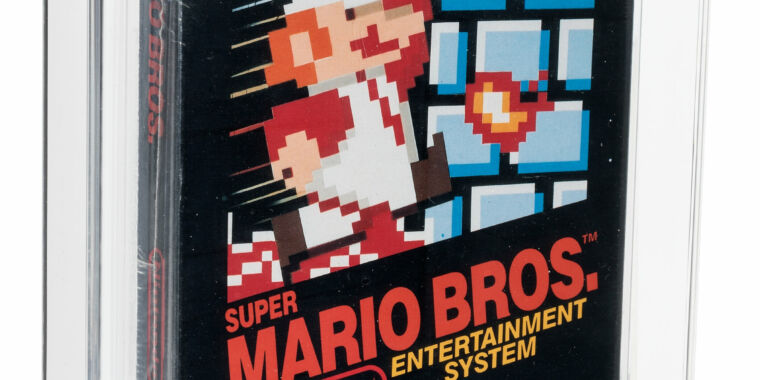
Game collecting reaches new heights as early Super Mario Bros. hits $372K bid

For a while now, we’ve watched as early sealed copies of Super Mario Bros. have commanded six-figure prices at auction, starting with a $100,000 copy sold in 2019 and continuing through a $140,000 sale last year. Those previous sales look downright cheap now, though, as bidding on another sealed Super Mario Bros. has already reached $372,000 on Heritage Auctions.

That price comes after 13 early proxy bids, placed ahead of four days of live bidding for a large lot of comics and games memorabilia set to start on April 1. The bid also includes a 20 percent “buyer’s premium” that will go to Heritage Auctions itself and not the game’s current owner.

Early provenance, excellent condition

Unlike some earlier high-priced Super Mario Bros. sales, this copy isn’t from the earliest production run of the game, which had a box sealed only with a small sticker and which was only sold in New York City during the NES’ late 1985 test-market run. But this copy is one of the earliest shrink-wrapped editions of the game, sold only for a short time in late 1986, according to WATA Games’ guide. This copy also received an incredible 9.6 out of 10 on WATA Games’ quality scale, with an “exceptional” A+ seal in “near-mint” condition. It also still has an intact hangtab, meaning it never had its seal pierced for hanging it in a store display.
To put the current Super Mario Bros. pricing in context, the only known extant prototype of the unproduced Nintendo PlayStation—a unique and important part of video game history—sold a year ago for $380,000 (with the buyer’s premium included). And back in 2014, a “world’s largest” collection of 11,000 video games sold for $750,000.

While this is the oldest shrink-wrapped copy of Super Mario Bros. Heritage has auctioned thus far, others could still exist among the millions and millions of copies of Super Mario Bros. ever produced. Then again, Heritage Auctions video game specialist and consignment director Valarie McLeckie told Ars Technica last July, “I would suspect sealed cardboard hangtab copies [still available today] number in the single digits.”

The current bidding on this sealed box far outstrips the sales record for a single video game. That honor goes to a rare, sealed Super Mario Bros. 3 variant with the “Bros.” portion of the logo positioned on the left, which sold for $156,000 in November.

Sealed classic Nintendo cartridges are in high demand elsewhere in Heritage’s current auctions. An early sealed copy of Mega Man for the NES (which misidentifies the series’ villain as “Dr. Wright”) has already been bid up to $90,000. Meanwhile, a sealed copy of one of the earliest produced editions of Pokémon Red for Game Boy has attracted a $60,000 bid.

“I fully believe that [games] are just as respectable a form of collectible as comics,” McLeckie told Ars last year. “We’ve just now started to dip a toe into formalizing this market. By and large, people are just starting to tune in to the fact that there is a rarity-based system involved.”

“If video games are going to go the way of comics and coins, then there will one day be a million dollar video game sale, and I think [Super Mario Bros.] is that game if that’s going to happen,” WATA Games CEO Deniz Kahn told Ars in 2019.

https://arstechnica.com/?p=1752439


How a “Switch Pro” leak may point to Nvidia’s megaton mobile-gaming plans

The Nvidia logo is photoshopped onto a mobile gaming console.
Enlarge / Nvidia is already tied heavily to the existing Nintendo Switch, since it includes the company’s Tegra X1 SoC. But recent rumors make us wonder about Nvidia’s potential push into mobile 3D-rendering dominance.

Earlier this week, Bloomberg Japan’s report on a rumored Nintendo Switch “Pro” version exploded with a heavy-duty allegation: all those rumors about a “4K” Switch might indeed be true after all. The latest report on Tuesday teased a vague bump in specs like clock speed and memory, which could make the Switch run better… but jumping all the way to 4K resolution would need a massive bump from the 2016 system’s current specs.

What made the report so interesting was that it had a technical answer to that seemingly impossible rendering challenge. Nvidia, Nintendo’s exclusive SoC provider for existing Switch models, will remain on board for this refreshed model, Bloomberg said, and that contribution will include the tantalizing, Nvidia-exclusive “upscaling” technology known as Deep Learning Super Sampling (DLSS).

Since that report went live, I’ve done some thinking, and I can’t shake a certain feeling. Nvidia has a much bigger plan for the future of average users’ computing than they’ve publicly let on.

Making smoother gaming—arguably easier than Tom Cruise’s face

DLSS, for the uninitiated, is a long-in-development system that relies on thousands of hours of existing video footage, largely taken from 3D games, that’s been run through a machine-learning model. When you hear about “AI-trained” systems that, say, play video games or generate wacky names, they’re usually working in the same way in order to reliably detect successful patterns. They study and duplicate existing data (dictionaries, Twitter conversations, Tom Cruise’s face, videos of StarCraft competitions), then they go through double-, triple-, and sextuple-checking runs to confirm how well a computer can organically recreate that data before loosing their systems into real-world tests.

But those tests are usually run with a supercomputer managing those troves of data. This is where DLSS pivots sharply. As a consumer-grade offering, DLSS requires Nvidia’s “RTX” graphics cards that (theoretically) cost as little as $329—and nothing else. No extra CPU, RAM, or other peripherals required. The idea being, RTX cards come with a slab of “tensor cores” baked onto the silicon, and these are dedicated to the mathematical grunt work of tasks like image interpretation and translation.

This works in part because DLSS is focused on a relatively nonvolatile prediction scenario: what a lower-resolution image would look like if it had more pixel depth. The shape of diagonal lines, the leaves on swaying tree branches, and even the letters and words on a street sign are all arguably easier to predict—at least when fueled by a lower-pixel base—than a StarCraft player’s reaction to a Zerg rush. While DLSS’s initial launch left a few things to be desired, the system has matured to a point where moving 3D images with DLSS processing generally looks better than their higher-resolution, temporal anti-aliasing (TAA) counterparts.

Side-by-side comparisons of lower-res DLSS and higher-res TAA show strengths and weaknesses, but as of 2021, it’s become a wash. That wash has substantially higher frame rates and lower processing requirements for the DLSS side, since the traditional GPU grunt work is not only pixel-bound but also texture-bound. DLSS’s savvy on upscaling doesn’t just reduce needs for clock speed and processing cores; it also translates lower-resolution textures with more fidelity, so you can arguably hop, skip, and jump past high VRAM requirements.

Calling BS on another BS Satellaview

Nintendo Switch doesn’t have exclusive license on lower amounts of VRAM, lower clock speeds, and rendering scenarios with limited die sizes and thermal envelopes to work with. Where else might those all be useful? Hmm.

The Nintendo Switch is a genius platform as a starting point, especially since we’ve said the same thing time and time again: “%GAMENAME% is amazing to play in Switch’s portable mode, where it gets close to 720p resolution, but blowing the same action up on your 1080p TV looks like trash.” You, the savvy gamer, shouldn’t seriously consider using your Switch for TV play, in spite of stats showing tons of people craving a good TV-gaming experience (and an ever-expanding market in which more people than ever are rushing to buy Xboxes, PlayStations, and Switches for their TVs).

We’re 22 years past Nintendo’s last stab at that concept.

A DLSS-equipped “Switch Pro” (not a final name), as described by Bloomberg, would reach resolutions of up to 4K when docked and connected to a television. Assuming that DLSS in this scenario requires dedicated tensor cores, we’re currently left wondering where Nvidia will slap said cores. Are we looking at a “split-motherboard” scenario, as we’ve seen on both Xbox Series X and PlayStation 5, where the TV-plugged dock takes on certain heat-generating elements like a block of tensor cores? Or will the Switch Pro’s base hardware include tensor cores on its own SoC?

My completely speculative guess is the latter for a couple of reasons. First, the rumor of higher CPU clocks and more RAM on the base unit suggests that Nintendo plans to roll out an entirely new system, as opposed to add-on hardware that would boost the base. Nintendo has experience shipping add-on hardware for its home consoles in Japan—like the Famicom Disk System (which added more power and extra sound channels), the BS Satellaview (which added RAM), and the 64DD (which added a co-processor).

But we’re 22 years past Nintendo’s last stab at that concept, and after the mass confusion caused by the Wii U, I don’t see modern-day Nintendo wading into the consumer confusion of questions like, “can I put an older Switch into a Switch Pro dock for more power?”

https://arstechnica.com/?p=1752164


HBO drops full trailer for new sci-fi period drama The Nevers

[embedded content]
Laura Donnelly stars as Amalia True and Ann Skelly stars as Penance Adair, two Victorian women who mentor gifted orphans in HBO’s new original series, The Nevers.

An inexplicable event confers supernatural powers on a select group of people in Victorian London, who must battle prejudice and those who would exploit their abilities in The Nevers, a new original series coming to HBO next month.

HBO won a fierce bidding war and approved a straight-to-series order in 2018, with Joss Whedon (The Avengers, Cabin in the Woods, etc.) as writer, director, executive producer, and showrunner. Whedon brought Douglas Petrie and Jane Espenson—both of whom worked with Whedon on Buffy the Vampire Slayer—on board as additional writers/executive producers. He said the following about the series title during Comic-Con in 2018:

They, themselves are not called that [The Nevers] in the show. It’s a phrase that’s meant to evoke a sort of reaction to their oddity, to what is considered unnatural. The idea that you should never be like this, you should never have existed. Something is not the way it should be, and you don’t have the right to have whatever weird power or ability that you have. And that idea, that some people are not of the natural order, is fascinating to me. I don’t agree with it. But to me, it’s one of those things where you take something negative, and you wear it as a badge of honor, basically. Certain things could never happen—they’re happening. And the people they’re happening to are taking their place in the world.

Last November, Whedon announced he was quitting the project, citing exhaustion and the “physical challenges of making such a huge show during a global pandemic.” (Whedon has been embattled in recent months by accusations of workplace harassment—both from Ray Fisher, aka Cyborg, during Justice League reshoots, and from several Buffy cast members—but HBO has said there were no similar reports about Whedon during production of The Nevers.)

The COVID-19 pandemic did interrupt production, however, so the 10 episodes will be broken into two parts. Six episodes will air on HBO (and stream on HBO Max) beginning on April 11, while the remaining four will be completed and aired at a later date, hopefully this year. “There was kind of a natural narrative break at six, so the thought then was to air six episodes,” HBO and HBO Max chief content officer Casey Bloys told The Wrap last month. “So at least we had something to put out there for subscribers and fans.”

Per the official premise:

August, 1896. Victorian London is rocked to its foundations by a supernatural event which gives certain people—mostly women—abnormal abilities, from the wondrous to the disturbing. But no matter their particular “turns,” all who belong to this new underclass are in grave danger. It falls to mysterious, quick-fisted widow Amalia True (Laura Donnelly) and brilliant young inventor Penance Adair (Ann Skelly) to protect and shelter these gifted “orphans.” To do so, they will have to face the brutal forces determined to annihilate their kind.

The pilot opens three years after whatever inexplicable event led to the emergence of the extraordinary abilities of the “Touched.” Amalia and Penance are working with a wealthy spinster named Lavinia Bidlow (Olivia Williams), who runs the Orphanage, a haven for the Touched. They include Annie Carbey (Rochelle Neil), aka Bonfire, who can control fire; Dr. Horatio Cousens (Zackary Momoh), who has the gift of healing; Primrose Chattoway (Anna Devlin), who stands 10 feet tall; Myrtle Haplisch (Viola Prettejohn), who has lost the ability to speak any language other people can understand; Mary Brighton (Eleanor Tomlinson), a singer who must find her voice to inspire hope across the city; and Desirée Blodgett (Ella Smith), a prostitute with a young mute son. Amy Manson plays Maladie, an unstable and violent member of the Touched who embarks on a killing spree.

The cast also includes Ben Chaplin as Detective Frank Mundi, who is trying to solve a series of brutal murders; Pip Torrens as Lord Massen, who views the Touched as a threat to society; Nick Frost as Declan Orrun, aka the Beggar King, an amoral criminal overlord who helps out Amalia when it suits him; Denis O’Hare as unhinged surgeon Dr. Edmund Hague, who longs to discover the source of these unusual abilities; Tom Riley as Augie Bidlow, Lavinia’s geeky younger brother; Kiran Sonia Sawar as Harriet Kaur, a Scottish Sikh and aspiring lawyer; Elizabeth Berrington as the streetwise Lucy Best; and James Norton as Hugo Swan, described as a “pansexual aristocrat” who owns a private underground club and sees the Touched as a veritable gold mine for exploitation.

HBO dropped an initial teaser in February, featuring plenty of fisticuffs and derring-do. This latest trailer fleshes out the basic premise and gives us a better idea of the overall tenor of the series. It seems like a winning mix of action, humor, and suspense, so color us intrigued. The Nevers debuts on HBO and HBO Max on April 11, 2021.

Listing image by HBO

https://arstechnica.com/?p=1751618


Black Widow to Disney+: We finally know when, how much

After losing its initial May 2020 release date to the emerging COVID-19 pandemic, Disney and Marvel Studios’ Black Widow has finally settled on a release strategy: a simultaneous launch in theaters and as a “premier access” purchase on the Disney+ subscription service, both coming Friday, July 9.

Watching Black Widow at home will require a one-time payment of $30 on top of your Disney+ subscription fee, which will unlock the film for repeat viewings ahead of its eventual release for all base subscribers. The same will apply to Cruella, the live-action prequel to the Disney animated classic 101 Dalmatians, which will get its own theater-and-Disney+ simul-launch on Friday, May 28.

The announcement, as distributed in a Disney press release on Tuesday, notes that this follows the “successful release” of CGI-animated feature Raya and the Last Dragon both in theaters and on Disney+ on March 5—apparently confirming that the decision made dollars and sense for everyone at Disney, following a similar release strategy for 2020’s live-action version of Mulan.

Disney chairman Kareem Daniel was quoted in the release, pointing to Disney’s focus on “providing consumer choice and serving the evolving preferences of audiences.” Though the press release loudly references issues with the global pandemic, his mention of consumers’ “evolving preferences” may imply that Disney sees some financial light at the end of the straight-to-Disney+ tunnel—especially if Disney recoups 100 percent of that $30 charge per family as opposed to divvying up a household’s ticket purchases with distributors, theaters, and other players.

Still, the announcement finally confirms Disney’s plan to tiptoe back into theaters while also accounting for an audience that may wisely not choose that option just yet. It also sees the company play catch-up with WarnerMedia, whose bullish HBO Max platform has been locked into a similar simul-release strategy for that company’s 2021 films.

And arguably, in Black Widow‘s case, the Disney machine of new TV-series content may be contingent on that Avenger’s story before the company can move forward with particular characters or plotlines. (As in, it might cost Disney streaming momentum and cash to delay BW any further, theatrical take be damned.) As of press time, the streamer has plenty of announced content coming, including this summer’s Loki on Disney+ and a glut of Hulu-exclusive animated series. But (no spoilers here) the recent end of WandaVision alone hinted to major stakes that could be tied up in a feature-length Marvel Studios story to come.

Listing image by YouTube/Marvel

https://arstechnica.com/?p=1751673


Report: The next Nintendo Switch will deliver 4K on TVs via Nvidia’s DLSS

An artist's estimation of how a new DLSS-fueled Nintendo Switch dock might look.
Enlarge / An artist’s estimation of how a new DLSS-fueled Nintendo Switch dock might look.
Getty Images / Sam Machkovech

As leaks begin to mount about a new Nintendo Switch revision, colloquially referred to as “Switch Pro,” one recent suggestion had enthusiasts scratching their heads: 4K support. How exactly would a dockable console like Switch, designed for portability and decent battery life, muster the teraflops to run games at 4K resolution?

Bloomberg Japan, who previously reported on Nintendo’s upcoming manufacturing plans, now has an answer: a new chipset, courtesy of Nvidia, that will leverage the GPU maker’s proprietary upscaling system, according to “people familiar with the matter.” This system, dubbed Deep Learning Super Sampling (DLSS), has so far only been available on Nvidia’s RTX line of graphics cards, and it relies on “tensor” GPU processing cores. Their machine learning computations, as trained on thousands of hours of existing game footage, interpret a game’s lower-resolution signal, then upscale the image to resolutions as high as 4K (or in the case of the $1,499 RTX 3090, as high as 8K).

If you’re unfamiliar with DLSS, check out my recent review of the RTX 3060, where I reviewed the progress Nvidia has made with DLSS since its retail debut in late 2018. It has progressed enough to take native resolutions as low as 1080p and boost them closer to 4K, often with fewer visual artifacts than image-smoothing methods like temporal anti-aliasing (TAA).

Where’s the new chip, doc? The dock?

This prediction isn’t completely out of left field, considering Nvidia’s Tegra X1 chip already powers existing Switch and Switch Lite consoles. However, exactly how an additional DLSS-capable chip will be implemented in the next Switch revision remains unclear. Tuesday’s Bloomberg Japan report only specifies that this DLSS-equipped Switch will “reproduce game visuals at 4K quality when plugged into a TV,” as opposed to the system’s portable mode—which Bloomberg insists will remain a 720p panel, albeit a smidge bigger at 7″ compared to the current Switch’s 6.2-inch panel. This Nvidia chipset will be paired with “a better CPU and increased memory” compared to the existing Switch, Bloomberg reports.

This doesn’t clarify whether any new or upgraded components will be built into the next Switch’s TV dock, or whether extra processing power inside the Switch itself will be left dormant until it’s safely plugged into a dock—and thus able to, say, benefit from a more robust cooling or ventilation system. (If you’re wondering, Nintendo certainly isn’t saying, as the company did not offer any comment to Bloomberg on Tuesday.)

We didn’t necessarily expect any increased power on Switch Pro to work retroactively on existing hardware, but Bloomberg’s report confirms that pessimism: Switch Pro features like DLSS will require “new code” to work. Whether this means we should expect Switch Pro-exclusive games, or fuller backwards compatibility found in jump from Xbox One S to Xbox One X (or PlayStation 4 to PS4 Pro), remains to be seen.

Bloomberg’s report predicts that the next Switch will jump in price, but those claims aren’t backed up by the unnamed sources offering details on the upcoming system’s technical makeup. That being said, predicting how much a new mass-manufactured gaming device will cost, or whether anyone will be able to buy one, feels like dark comedy at this point in 2021.

Nintendo has yet to formally announce either a mid-generation Switch refresh or anything resembling a wholly new console. Previous corporate statements have only gone so far as to say new Switch models weren’t coming to market “any time soon” and that the Switch had recently reached the “middle” of its lifespan. But years of rumors about a refreshed, higher-powered Switch model finally firmed up earlier this month when Bloomberg reported manufacturing plans for the new model—and its jump from LCD to OLED technology, along with a jump in screen size.

As Nintendo fans continue to wait for previously announced software like a sequel to Legend of Zelda: Breath of the Wild, it’s easy to wonder whether Nintendo is waiting to announce Switch Pro alongside a healthy slate of new games, all primed to take advantage of increased specs.

https://arstechnica.com/?p=1751441