The project—comprising hundreds of thousands of lines of C++ code generated over years of painstaking analysis—did not distribute any of the copyrighted image or music files needed to recompile the game. Those files needed to be sourced from an authentic copy of the PC version of the games, originally released in 2002 and 2003.
This didn’t prevent Take-Two from claiming that “the content in the links below consists of copyrighted materials owned by Take Two,” as the DMCA notice reads, in part. “The use of our copyrighted content in these links are unauthorized and it should be removed immediately.”
Is it legal?
In general, reverse-engineering source code from a compiled binary is less straightforwardly illegal than simply cracking a game’s DRM for piracy purposes, for instance. As the EFF explains, US case law includes certain fair use exceptions that can allow for this kind of decompilation work for research or interoperability purposes.
In the specific case of Grand Theft Auto, though, the game’s End User License Agreement specifically asks players to agree not to “reverse engineer, decompile, disassemble, prepare derivative works based on or otherwise modify the Software, in whole or in part.” Back in 2005, the 8th Circuit Court of Appeals upheld a similar anti-reverse-engineering EULA to take down BnetD, a reverse-engineered version of Blizzard’s Battle.net that allowed the service to be emulated on private servers.
The coder who served as the lead on the GTA reverse-engineering project, who goes by the handle aap, told Eurogamer that the team was “very much worried about” the possibility of this kind of takedown and “tried to stay under the radar for as long as possible” as a result of that worry. “We got a lot of attention when the Switch port happened [in September] but nothing from Take-Two. We took that as a sign that they don’t care (or are really blind).”
Aap added that the team felt it was a good sign that an earlier effort to reverse-engineer Super Mario 64 hadn’t yet been taken down from Github “because Nintendo is about as aggressive as Take-Two in these matters.”
Regardless of the Github takedown, the files involved in the reverse-engineering project are still out there, and no amount of legal wrangling will ever fully remove all of the copies floating around the Internet. That also applies to ports of the games for systems like the Switch and PlayStation Vita, which were enabled by the reverse-engineering project.
https://arstechnica.com/?p=1744197
Diablo II Resurrected tops BlizzCon announcement flurry
Blizzard’s latest BlizzCon event sees the longtime PC game maker at perhaps its most beleaguered yet. Game delays, notable departures, botched remakes, smartphone-gaming backlash, and an anti-protester reputation have weighed down what was once a sterling RTS/RPG reputation. That led us to wonder: can today’s streaming-only BlizzCon showcase of games and plans show that the company’s recent hires and behind-the-scenes reshuffling are paying off?
In at least one respect, the outlook is optimistic, thanks to an impressive reveal of Diablo II: Resurrected. This long-rumored remake includes everything from both the base 2000 game and its 2001 expansion, Lord of Destruction. At first glimpse, this top-to-bottom remake seems to get everything right that WarCraft III: Reforged got so very, very wrong—and we won’t have to wait very long to come up with our own impressions. Sign-ups for D2:R‘s technical alpha are now live ahead of the game’s launch on PC and consoles “in 2021.”
The right balance between preservation and polish?
Old graphics.
New graphics.
Old graphics.
New graphics.
Old graphics.
New graphics.
The rest of the gallery is all remastered D2:R graphics.
Handsome lighting model works with the updated graphics mode.
Can’t wait to jump back in as a barbarian and spin, spin our troubles away.
Everything must die in here.
If this character-selection interface doesn’t make clear, we’re in Lord of Destruction territory.
Cast magic?
Nah. Hulk smash!
Shortly after the game’s announcement, Blizzard confirmed a lovely quality-of-life tweak: a shared stash! Thank goodness.
Eight-player online co-op confirmed.
We’ve grown increasingly skeptical of Blizzard’s sales pitches in recent years, but so far, everything about D2:R strikes us as the right kind of “Blizzard Classic” approach, including the following sales pitches:
If you want to deal with online logins (and, obviously, co-op and PvP content), you get a handy perk: cross-progression for your characters between platforms, should you wish to switch between, say, your home PC and your portable Nintendo Switch.
Blizzard is sticking to the game’s original source code, which the company says has been left intact—and to prove that, players can tap a “swap graphics” button at any time to return to the 2000 original, much like in StarCraft: Remastered.
In the “new graphics” mode, heroes and monsters appear as 3D polygons, while all backgrounds are otherwise made of 2D textures and sprites. Despite this split, every element benefits from a new dynamic lighting system that otherwise preserves the game’s original, dark aesthetic. This approach strikes us as the right balance between preserving the game’s original look and feel and glossing things up for higher-res action at a 60fps refresh.
In the “original graphics” mode, players can still benefit from new, built-in support for arbitrary pixel resolutions.
The game’s original 27 minutes of cinematics are being recreated, and Blizzard President J. Allen Brack spoke specifically to these matching the look and pacing of the originals. (We’ve yet to see what they’ll look like, however.)
According to a post on Reddit ahead of the announcement, which lines up with much of what was shown on Friday, this game will include “shared stash” functionality and automatic gold pick-up, which D2 fans previously enjoyed by applying a community-made mod. Blizzard has since confirmed access to a shared stash, so we’re confident in the rest of the rumor’s details, including mention of a “one-time only” online check-in. (Yes, yes, please let us enjoy this game offline in peace, Blizzard.)
The scale of this project far exceeds what we saw from Blizzard’s re-release of Diablo 1, which saw the company merely hand the game’s original files to GOG to be resold as a DRM-free collection. This 2019 launch included a mild tweak to the handling of its online play, albeit done in a way that we still do not recommend anyone actually use. The greater scale of the project may explain why Blizzard is asking for a relatively steep price of $39.99 for its PC preorder, already live at Blizzard’s shop. (Let’s be clear: tantalizing as this already looks, we’re not preordering. You’ve got goodwill to re-earn here, Blizz.)
Reforging a reputation
Cut scene, severed ears. That’s some rogue-appropriate stuff.
One of the clearest looks we’ve seen at the in-game UI in Diablo IV.
Rogue rains down arrows.
Outdoor combat.
Indoor combat.
Glowy, scary Diablo IV creatures.
Diablo IV‘s segment, meanwhile, began with one of the most unsurprising announcements possible: confirmation that the forthcoming game will include a “rogue” character class. Even though that class has appeared in every Diablo game up until this point, Blizzard at least made the most of this announcement by dressing it in a dark, heretical take on the archetype, with a cinematic trailer full of sin, violence, and severed ears—followed by a rapid-fire gameplay montage full of back-stabbing and crossbow-rainfire attacks. After that, we got a brief peek at a character-customization interface, which includes options to pick things like your hero’s “backstory.” However, Blizzard wasn’t ready to commit to any release-date window for this sequel, leaving its likelihood for a 2021 launch in the air.
Diablo II: Resurrected was nowhere near a well-kept secret, having leaked after Blizzard announced the company’s absorption of longtime Activision support studio Vicarious Visions in January. That news immediately prompted questions about what VV had been tapped to work on, and Bloomberg reporter Jason Schreier cited inside sources in confirming that the team had been assigned to the D2 remaster. What’s more, VV had taken that project away from the same internal Blizzard team that brought us the utter disappointment of WarCraft III: Reforged.
Speaking of leaks: BlizzCon 2021’s slate of World of WarCraft announcements—about Burning Crusade Classic and a new Shadowlands content drop—appeared on Blizzard’s servers one day before the event. You can read all about that here.
Coming today to PC, PS4, XB1, and Switch, for $19.99.
Three games.
Various versions of each.
The usual emulation-collection features.
A nifty museum full of concept art and other relics from the games’ ’90s development cycles.
A bunch of new translations for each game. Nice touch, Blizzard.
QoL updates for each game.
Lost Vikings 1 & 2 content combined!
Unsure if this will work online, but we look forward to hosting Rock and Roll Racing split-screen parties someday.
Blizzard President J. Allen Brack kicked off Friday’s video presentation by announcing Blizzard Arcade Collection, a $19.99 package containing mildly updated ports of the developer’s earliest 16-bit console games: Lost Vikings 1 & 2, Rock ‘N Roll Racing, and Blackthorne. Each game benefits from typical classic-emulation collection perks, like save states and visual filters, while also getting its own specific tweaks (an updated map interface in Blackthorne, 16:9 ratios and four-player split-screen in R&RR, and “combined” content for the Lost Vikings games). The collection’s PC version launches today, and fans who already purchased a “Blizzard Digital Anniversary Bundle” (mostly full of cosmetic add-ons for existing games, as part of BlizzCon’s celebration, and starting at $20) will get the collection as part of that purchase. The collection will also arrive on PS4, XB1, and Switch digital-download shops today.
Much of Hearthstone‘s biggest news was already formally revealed ahead of Friday’s presentation: a new “Core” set of cards. All free-to-play players of the card game will have access to the new cards, which will keep them in contention when matching up against more seasoned, expansion-owning players. In WoW Classic-like fashion, one set of cards will be retired and moved to a “Legacy” mode, so that players can face off within a crystallized time capsule of the game’s earliest state. But today also saw the brand-new announcement of Hearthstone: Mercenaries, a new mode that includes “roguelike” battling scenarios and “leveling up” opportunities for the mode’s cards. Though no gameplay from this mode was shown, it certainly sounds like it draws inspiration from popular deckbuilder games like Slay the Spire and Monster Train.
Ahead of today’s events, Blizzard debuted an Instagram account for the smartphone-exclusive game Diablo Immortal, which seemed to hint at an impending launch—and that’s unsurprising, given that Blizzard previously launched a region-limited closed alpha test of the game on Android phones. Ars Technica was invited to the test, and my limited tests confirmed, among other things, a lack of gamepad support but otherwise competent introductory gameplay, should you be OK with tapping a phone screen to control isometric hack-and-slash adventures. However, the tests’ limitations meant I couldn’t dive into Immortal‘s approach to endgame content—and how real-world money and microtransactions will ultimately factor into the game, since it will launch as a free-to-play title. Whether we learn more about those aspects during BlizzCon’s ongoing video presentations, scheduled throughout today and tomorrow, remains to be seen, but for now, the game does not yet have a formal release date in any territories.
What about…
Yet while there was plenty of Diablo and WoW to go around during today’s BlizzCon keynote, two key titles remained missing from the presentation: Overwatch (and its announced sequel) and the overdue-for-patches WarCraft III: Reforged. Instead, Brack took the keynote stage after clarifying details about D2:R to point viewers to an Overwatch 2-specific presentation later today. Additionally, he said “a very small percentage of developers are working” on either the games shown off in today’s keynote or the ones that have been previously announced. “Far more people are working on the future of Blizzard,” Brack said, though he didn’t go further to clarify exactly how many games, series, or platforms the studio is currently focusing on behind the scenes.
https://arstechnica.com/?p=1743883
Valve gets dragged into Apple and Epic’s legal fight over Fortnite
Aurich Lawson / Getty Images
Apple’s bitter legal dispute with Epic Games over the distribution of Fortnite on iOS has now managed to rope in Valve. Apple has subpoenaed the Steam maker for a wide range of PC game sales data it says is crucial to its case. But Valve is fighting back against that subpoena, saying its information is proprietary, not relevant to Apple’s case, and would be costly and difficult to generate.
As discussed in a joint letter from Apple and Valve filed with the Northern District of California court this week, Apple’s November subpoena seeks two large categories of information that Valve is refusing to provide:
Documents sufficient to show Valve’s: (a) total yearly sales of apps and in-app products; (b) annual advertising revenues from Steam; (c) annual sales of external products attributable to Steam; (d) annual revenues from Steam; and (e) annual earnings (whether gross or net) from Steam; as well as
(a) The name of each App on Steam; (b) the date range when the App was available on Steam; and (c) the price of the App and any in-app product available on Steam.
While Valve has responded to some other parts of Apple’s subpoena, Apple says that information has been “so heavily redacted that Apple cannot discern what information they might contain.”
Why do you need it?
The requested information, Apple says, is key to establishing other platforms that “may be economic substitutes” for the iOS App Store when it comes to distributing Fortnite, as discussed in previous rulings in the case. Valve’s information is “crucial for calculating the total size of the market for Epic’s available digital distribution channels,” Apple says.
But Valve argues that Steam is an unrelated sideshow in the battle between Apple and Epic. “Valve does not make or sell phones, tablets, or video games for mobile devices, or otherwise compete in the mobile market,” the company writes. “Fortnite is not available on Steam, and Epic has publicly and unequivocally stated it will not offer Fortnite on Steam unless Valve changes its business model.”
While Apple says that Valve “admits that the information requested exists in some undisclosed, readily accessible format,” Valve says complying would involve “an overwhelming amount of work” and “would impose an extraordinary burden on Valve to query, process, and combine a massive amount of [information] to create the documents Apple seeks.”
Valve says that process would involve collating information from at least four separate databases for thousands of separate items. Valve also says Apple has not offered to cover the costs of this data-gathering process.
Protecting private data
Apple cites a previous court order for similar sales information from Samsung in arguing that the court should compel Valve to comply. But Valve argues that “Apple, Google, and Samsung compete with each other in the mobile app market. Valve does not compete in that market.”
Valve also argues that the fact that it’s a private company offers an important distinction from the public Samsung. “Valve has chosen to stay private in part to avoid the burden of the public company disclosure and reporting requirements that companies like Samsung or Google are subject to,” the company writes. “Valve does not disclose its sales and revenue information and projections, and Valve derives a significant value and edge from the confidentiality of such information, including by keeping it out of the hands of companies like Epic who also sell PC games.”
Valve’s argument takes on added relevance given the company’s 2018 decision to effectively block services like Steam Spy or Ars’ own Steam Gauge from creating public estimates of Steam game sales based on samples of individual public user account data. Valve said in July of 2018 that it was working on a “more accurate” replacement for that Steam Spy data but has only released sporadic and incomplete summaries of the Steam marketplace in the years since.
In any case, Apple argues that any confidential or sensitive competitive information provided by Valve could be covered by a protective order, such as the one in place for Samsung. Apple also argues that “the information sought by this request does not detail future plans or involve strategic assessments… there is no substantial risk of competitive or economic harm [to Valve].”
But Valve remains adamant that the information is private and unnecessary for Apple’s current legal fight. “Somehow, in a dispute over mobile apps, a maker of PC games that does not compete in the mobile market or sell ‘apps’ is being portrayed as a key figure,” Valve writes. “It’s not.”
https://arstechnica.com/?p=1743810
Burning Crusade Classic leaks ahead of BlizzCon
Enlarge/ That’s quite the game-announcement leak there, Blizzard.
Ahead of this weekend’s BlizzCon game-announcement frenzy, two of Blizzard’s secrets have sneaked out in the form of a leak. Both revolve around World of Warcraft: one for the latest Shadowlands expansion, and another for the World of Warcraft Classic server option.
In the latter case, 2007’s hugely popular WoW expansion pack, The Burning Crusade, will be bolted onto the WoW Classic option inside the Blizzard Launcher starting sometime in “2021.” The news comes from an apparent leak of official BlizzCon press release materials, all formatted with official images and descriptions of what’s to come, as found on Blizzard’s official servers by users at Reddit’s WoW community.
As with 2019’s official WoW vanilla launch, The Burning Crusade will return without any new or special features on top of what originally came with the game. You may recall that this expansion pack included a trickle of content drops while Blizzard maintained it before selling Wrath of the Lich King in 2008. Meanwhile, Blizzard’s leaked document claims that the original version’s update cadence will return: “Content from the original game will roll out in phases, at a cadence paced for the WoW Classic community. Prepare for the opening of the Black Temple, gear up to confront the gods of Zul’Aman, and gather your allies to face the fury of the Sunwell.”
<a href="https://cdn.arstechnica.net/wp-content/uploads/2021/02/wow-bc-art.png" class="enlarge" data-height="467" data-width="1024" alt="Delectable new Burning Crusade art, also part of today’s pre-BlizzCon leak.”><img alt="Delectable new Burning Crusade art, also part of today’s pre-BlizzCon leak.” src=”https://rassegna.lbit-solution.it/wp-content/uploads/2021/02/burning-crusade-classic-leaks-ahead-of-blizzcon.png” width=”980″ height=”447″>
Enlarge/ Delectable new Burning Crusade art, also part of today’s pre-BlizzCon leak.
Since the document doesn’t mention any quality-of-life (QoL) changes, you’ll likely have to make your peace with the expansion’s original quirks, albeit boosted by improved balance between the Horde and Alliance thanks to the Blood Elf and Draenei races newly appearing in this expansion. If this is exactly where you want your WoW memories to live on via an official Blizzard server, then you’ll be in heaven—especially since this is a free update for anyone who already pays for a WoW subscription. Meanwhile, if you really want to keep things vanilla, you’ll have the option to hold your WoW Classic characters back to remain in a world that doesn’t know the kiss of the Outland. (If you need help making that decision, perhaps flip through Ars’ 2007 review of TBC.)
Offering both options on official WoW servers is a great indicator of Blizzard’s dedication to the appeal of reliving the old WoW days, though we have to imagine the nostalgia for WoW Classic players may run out with this expansion. Our reports on fans bringing older WoW versions back to life on private servers, which Blizzard fought back on, certainly never broached the Lich King or Cataclysm eras.
The other leak in the wild, for Shadowlands‘ upcoming “Chains of Domination” update, also came in the form of a leaked Blizzard press release, which WoWHead breaks down with plenty of images and descriptions of what’s to come. Fans playing the latest expansion can expect at least one new raid and mega-dungeon, along with more of the usual expansion-patch trimmings, at some point. This leak didn’t include a release date, but we’re not sure if that means we should expect a stealth drop when the update is announced tomorrow.
https://arstechnica.com/?p=1743757
Robinhood says GameStop volatility was a “1 in 3.5 million” black swan
At the hearing, Robinhood CEO Vlad Tenev said that extreme stock volatility that led to Robinhood’s restriction was a “five sigma” event with a “1 in 3.5 million” chance of happening. That made the situation practically impossible for the company to plan for, Tenev said. “In the context of tens of thousands of days in the history of US stock market, a 1 in 3.5 million event is basically unmodelable.”
As we’ve covered previously, the high volatility of GameStop and other so-called “meme stocks” last month meant Robinhood was suddenly forced to provide much more collateral to the stock clearing houses that actually process its trades. Tenev said Thursday that these collateral obligations increased tenfold between January 25 and January 28, as GameStop rose from $76 a share to over $347, then back down to $193.
“Despite unprecedented conditions, what happened is unacceptable to us,” Tenev said. “To our customers, I’m sorry, and I apologize. We’re doing everything in our power to make sure this won’t happen again.”
Where’s the money?
Tenev reiterated multiple times that Robinhood never had a liquidity issue in terms of covering its users’ actual positions. But the company did lack immediate capital to cover those collateral requirements, which meant its only alternative was to temporarily limit sales of those stocks until it could raise more funds (or until the stocks became less volatile).
Some members of the House Financial Services Committee were not impressed with that quibbling over what “liquidity” means for Robinhood. “Your customers wanted to buy the stock,” Rep. Van Taylor (R-Texas) said at one point. “You wouldn’t let them do it because you didn’t have the capital to allow them to do it.”
Tenev was also taken to task for not clearly and quickly communicating the reasons behind those restrictions to customers. Rep. Carolyn Maloney (D-N.Y.) noted that Robinhood’s initial January 28 blog post announcing the restrictions contained “no disclosures about capital requirements” and only “vague language about restricting trading.” The initial impression, she implied, was that Robinhood was “[making] up the rules as you go along.”
Since it was forced to halt trading, Robinhood has attracted over $3.4 billion in additional investment that Tenev said “cushions the firm from market volatility and further black swan events.” And while he was apologetic, Tenev also said that “other firms did similar things in restricting buying [of these volatile stocks], which suggests it is a systemic problem rather than a uniquely Robinhood problem.”
But Rep. Alexandria Ocasio-Cortez (D-N.Y.) pointed out that “when Robinhood prohibited it customers from purchasing additional shares of certain stocks, other brokerages merely adjusted margin requirements on these stocks.” That, she suggests, might mean that “the issue isn’t clearinghouses but that you simply didn’t manage your own margin rules or failed to manage your own internal risks.”
Enlarge/ An example of an error message greeting Robinhood users trying to buy certain volatile stocks in late January.
Some on the committee also focused on Robinhood’s business model, which generates a majority of its revenue by selling its “order flow” to market makers like Citadel (who then shave a little bit of profit off of the price improvement they can provide over the exchanges). “When you’re not paying for it, it’s not free,” Rep. Brad Sherman (D-Calif.) said regarding Robinhood’s commission-free trades. “You’re the product, someone else [i.e., Citadel] is the customer.”
“If removing revenues from payment for order-flow would cause the removal of commission-free trade, doesn’t that mean trading on Robinhood isn’t actually free to begin with, because you’re just hiding the cost?” Ocasio-Cortez added in some pointed questioning.
Deregulate or re-regulate?
While Tenev was apologetic for the mistakes Robinhood made, he also placed some blame on what he called outdated and moribund trade settlement rules that place a lot of pressure on the system. Under the current T+2 timeline for stock settlement, market makers actually have two full days to officially settle a trade (i.e., transfer the shares/cash) after it’s made. When a stock’s price is especially volatile, the clearinghouse needs more collateral to cover the potential price changes that could happen on either side of the trade in that two-day interval.
“The existing two-day period to settle trade exposes investors and the industry to unnecessary risk,” Tenev said. “There is no reason why the greatest financial system in the world can not settle trades in real time…. If we had real-time settlement capability and infrastructure was modernized, we wouldn’t have seen similar problems.”
Ken Griffin, CEO of Citadel, stopped short of asking for real-time trade settlement in his testimony to the committee. But he said that relaxing the rules to a one-day turnaround would “reduce counter-party risk holistically.” While instant or same-day clearing of trades would be nice, Griffin said it would essentially require “all systems… to function at all times every day with no room for error.”
Rep. Andy Barr (R-Ky.) pointed out through his questioning that the current capital requirements were put in place in 2010’s Dodd-Frank Wall Street Reform bill. “If anyone has a problem with [Robinhood]’s decision, their frustration should be with federal regulations,” he said. Rep. William Timmons (R-S.C.) added that Dodd-Frank is “arguably to blame for this exorbitant capital requirement that you weren’t able to meet… Well-intentioned legislation is somewhat responsible.”
Other House members, like Rep. Rashida Tlaib (D-Mich.) argued forcefully for a 0.1 percent financial transactions tax, which would discourage speculative betting on meme stocks and limit algorithm-driven high-frequency trading. She noted that Hong Kong implemented a financial transactions tax that’s twice as large, limiting high-frequency trading without hurting that market’s significant growth.
But Jennifer Schulp, director of Financial Regulation Studies at the free-market-focused Cato Institute, told the committee such taxes “often fail to raise money and distort trading in a way that’s unforeseen. A financial-transaction tax might seem like a small imposition, but it often hurts individual investors’ long-term goals by affecting institutions that do the trading.”
While Schulp allowed that a financial-transactions tax might decrease total volatility in the market, she added that she doesn’t think it would have had that effect in the particular case of GameStop’s recent stock moves, which were driven primarily by heavy buying.
Diamond hands
To represent the retail traders who helped drive the GameStop bubble, the committee heard from Keith Gill, aka DeepFuckingValue on Reddit. He first invested in GameStop in mid-2019 (when the stock was valued at under $10) and heavily hyped the stock’s value on the WallStreetBets subreddit. “The market was underestimating the prospects of GameStop’s legacy business and overestimating the risks of bankruptcy,” he said. “I grew up playing video games and shopping at GameStop, and I plan to keep shopping there. GameStop stores provide real value to gamers and real revenue to GameStop.”
Enlarge/ In a WallStreetBets post from September 2019, Keith Gill shows off the value of the GameStop stock in his portfolio, well before its meteoric rise.
Gill, who has now made millions off an initial investment of about $50,000, said he still thinks GameStop is an attractive investment at its current price of about $40 a share. His optimism is thanks in large part to GameStop’s potential to pivot to a more focused e-commerce strategy. “As for me, I like the stock,” he said. “I’m as bullish as I’ve ever been on a potential turnaround, and I remain invested in the company.”
Less represented at the hearing were the many other investors who bought into the stock at or near its peak in late January, only to see their investments crumble in days. Rep. Jim Himes (D-Conn.) brought up the case of Salvador Vergara, who took out a $20,000 personal loan to invest in GameStop only to see his stock’s value go down 80 percent in days. “We need to be thoughtful about this,” Himes said, regarding how to deal with retail investors’ access to the market.
The committee also heard from Reddit co-founder and CEO Steve Huffman, who said Reddit had found no evidence of bots or foreign agents playing a significant role in trying to unduly pump up any stock through the WallStreetBets subreddit. “We will comply with requests from regulators, but we believe the community was well within bounds of our own policies,” he said.
“It’s a real community,” Huffman continued, regarding WallStreetBets. “The self-deprecating jokes, memes, and crass at times language reflect that. There’s a significant depth to the community based on the affinity users show for each other.”
https://arstechnica.com/?p=1743729
Latest Nintendo Direct event led by Zelda: Skyward Sword HD remaster
Coming July 16 to Nintendo Switch.
Excuuuuse me, princess.
Swipe with your hands in real life…
… or use the right analog stick to emulate that kind of motion.
Putting the “skyward” in Skyward Sword.
Gosh, we’d almost forgotten about this weirdo.
Depending on the angle shown, the game doesn’t necessarily look that updated.
But higher-resolution assets across the board certainly don’t hurt.
Aim at weak point for massive damage.
Unlike Skyward Sword‘s official Wii MotionPlus controller, these new Joy-Cons aren’t golden. Still cool, at any rate.
It has been a while since we’ve seen a particularly long Nintendo Direct video presentation, and Wednesday’s news-filled flurry of game announcements lived up to the company’s reputation for surprises and weirdness. And in a tip of its hat to The Legend of Zelda series’ 35th anniversary this year, Nintendo capped its first Direct of 2021 with the reveal of Zelda: Skyward Sword HD, coming to Nintendo Switch on July 16.
Skyward Sword was the only mainline Zelda game to launch with a serious reliance on Wii-like controls (Link’s Crossbow Training notwithstanding). The 2011 game required the Wii MotionPlus add-on, as its swordplay revolved around precisely angled swipes for the sake of certain enemies and puzzles, and this remaster will let players relive that experience by assigning motion controls to both left and right Joy-Con controllers. Don’t worry, Switch Lite owners: this HD re-release doesn’t mandate Wii-like waggling. If you prefer, Link’s sword angles and item tosses can be assigned to the controller’s right analog stick instead.
Whether this control update alone will redeem the game compared to other Zelda classics will probably be a matter of taste. Skyward Sword was notorious for clinging to classic series tenets in ways that bogged down its otherwise gorgeous and accessible gameplay (a criticism that somehow escaped Ars’ original review). Its successor, 2017’s Breath of the Wild, famously shattered the classic Zelda template—and for the better. But in general, even a lukewarm Zelda game is still a good video game, and like other remastered Zelda games before this one, it looks like we’re getting a handsome and tasteful touchup of everything—and this does particular wonders for LoZ:SS‘ unique “watercolor” aesthetic, which looked quite blurry on the original Wii.
Sadly, the presentation included no news on the previously announced Breath of the Wild sequel, which is now nearly 2 years old as a concept. Instead, series fans had to suffice with a DLC announcement for last year’s hack-and-slash spin-off Hyrule Warriors: Age of Calamity.
A brief, blurry battle montage confirms more Splatoon on the way in 2022.
So much new firepower.
That thing probably shoots a lot of paint.
A mysterious opening sequence shows off the ability to customize your own character…
… along with a new “buddy” character, awwww. We wonder how this little cutie will figure into campaign and multiplayer modes.
In Smash Bros. Ultimate news, we learned that the series will soon receive a new character…
… or, rather, a connected pair of Xenoblade Chronicles 2 characters.
Pyra’s “final smash” move sees her pair up with an old ally.
Pyra brings the fire.
Mythra brings the electricity.
The presentation’s “one more thing” moment wasn’t Zelda-related, surprisingly, but rather a hint of more Splatoon to come. Splatoon 3, slated for a “2022” launch, appears to mimic the same core four-on-four paint-filled combat found in the prior games, only with new, supercharged weapons and a wacky “launch into the sky” conceit. This will all take place in a new desert-like region called “the Splatlands,” so we hope this means some serious Mad Max vibes might come to the series, including maybe a series “Inkling” that plays a flaming electric guitar on top of a truck. (Hey, we can dream.)
Unsurprisingly, the presentation included the reveal of a new Smash Bros. Ultimate DLC character—though this came with the twist that the fans of that series are actually getting a pair of characters, in the form of Pyra and Mythra (tucked into the above Splatoon 3 gallery). This duo from the Nintendo-published RPG Xenoblade Chronicles 2 can swap between each other as a joint character, much like how Zelda and Sheik used to work as a combined character. Nintendo says fans should expect another video about their specific moveset ahead of the characters’ launch in “March 2021.”
Super Mario outfit dump for Animal Crossing lets you recreate iconic 8-bit scenes.
Outfits figure prominently in the update.
So does a new green warp pipe, which adds useful functionality: build two on your island, then hop on either to warp to the other. (Oh, and a Wario costume in the corner, for good measure.)
We’re always keen on more Mario Golf at Ars.
Mario, golfing. Yep, that’s Mario Golf.
But new to this game is “speed golf,” which combines hitting the ball with high-speed, super-powered platforming to run to wherever you hit your ball.
The trailer included power-ups like invincibility stars and fire flowers.
And what good is a Mario Golf game without an RPG-like mode?
Optional motion controls, using the Joy-Cons.
Miitopia gets its first home console port, and it allows you to import you and your friends’ Mii characters to complete a quest.
Many new features were teased, including management of you and your friends’ emotions to maximize your powers.
Also, you get a horse this time.
Mii creation tools within Miitopia include wigs and makeup. Sadly, these don’t export to the rest of the Switch ecosystem.
Sorry, Stan. You’re Miitopia‘s bad guy.
And rounding out the first-party fare is this pair of very old Nintendo of Japan games, newly translated into English…
… with a very high-res coat of paint.
Oodles of fully animated 3D models in this visual novel game, so Nintendo is clearly aiming for a high level of polish here.
Still, plenty of the game revolves around static characters and text-filled menus.
The rest of the presentation’s first-party Nintendo Switch lineup included: a Super Mario-themed dump of cosmetics for Animal Crossing, coming March 1; Mario Golf Super Rush, complete with a wacky “Speed Golf” multiplayer mode, a Wii-like motion option, and an RPG-like story mode, launching June 25; an expanded version of the wacky Miitopia adventure game released on 3DS in 2016, coming May 21; and the first-ever translated versions of Nintendo’s classic visual-novel entries from the NES era as two handsomely remastered games from the Famicom Detective Club visual novel series, launching May 14.
Speaking of Legend series: Square Enix’s bullish re-release schedule for its Mana series (named Seiken Densetsu in Japan) continues with Legend of Mana, the company’s PlayStation 1-exclusive action-RPG from 1999. Squeenix fans will appreciate quality-of-life tweaks and mildly up-rezzed graphics when this re-release launches on Switch on June 24. This announcement comes right alongside the previously announced RPG re-release SaGa Frontier Remastered, now slated to launch April 15.
<a href="https://cdn.arstechnica.net/wp-content/uploads/2021/02/Screenshot-1364.png" class="enlarge" data-height="1440" data-width="2560" alt="Project Triangle Strategy will continue Squeenix’s streak of handsome 2D/3D RPG hybrids, combining old-school sprites with atmospheric effects.”><img alt="Project Triangle Strategy will continue Squeenix’s streak of handsome 2D/3D RPG hybrids, combining old-school sprites with atmospheric effects.” src=”https://rassegna.lbit-solution.it/wp-content/uploads/2021/02/latest-nintendo-direct-event-led-by-zelda-skyward-sword-hd-remaster.png” width=”980″ height=”551″>
Enlarge/Project Triangle Strategy will continue Squeenix’s streak of handsome 2D/3D RPG hybrids, combining old-school sprites with atmospheric effects.
Square Enix
Squeenix wasn’t done there, however, as it also used the event to unveil 2022’s Project Triangle Strategy, a hybrid 2D/3D tactical RPG that looks much like Bravely Default. This new, strangely titled game looks far more ambitious, however, with an emphasis on reactive tactical battling that allows troops to juggle foes with perfectly aimed shoves and elemental-attack combinations. In the latter case, for example, attack a burning square on the battlefield with an ice attack to turn it watery, then follow that up with a lightning storm to shock newly drenched foes. Between each strategy-rich battle, players will also be expected to make divisive choices that bring up a “scale” image, indicating a massive change to the game’s plot. All of this won’t be out on Switch for some time, yet the game’s playable demo version will be live on Nintendo Switch by the end of the day.
<a href="https://cdn.arstechnica.net/wp-content/uploads/2021/02/Screenshot-1177.png" class="enlarge" data-height="1440" data-width="2560" alt="Fall Guys finally comes to Nintendo Switch "this summer."”><img alt="Fall Guys finally comes to Nintendo Switch "this summer."” src=”https://rassegna.lbit-solution.it/wp-content/uploads/2021/02/latest-nintendo-direct-event-led-by-zelda-skyward-sword-hd-remaster-1.png” width=”980″ height=”551″>
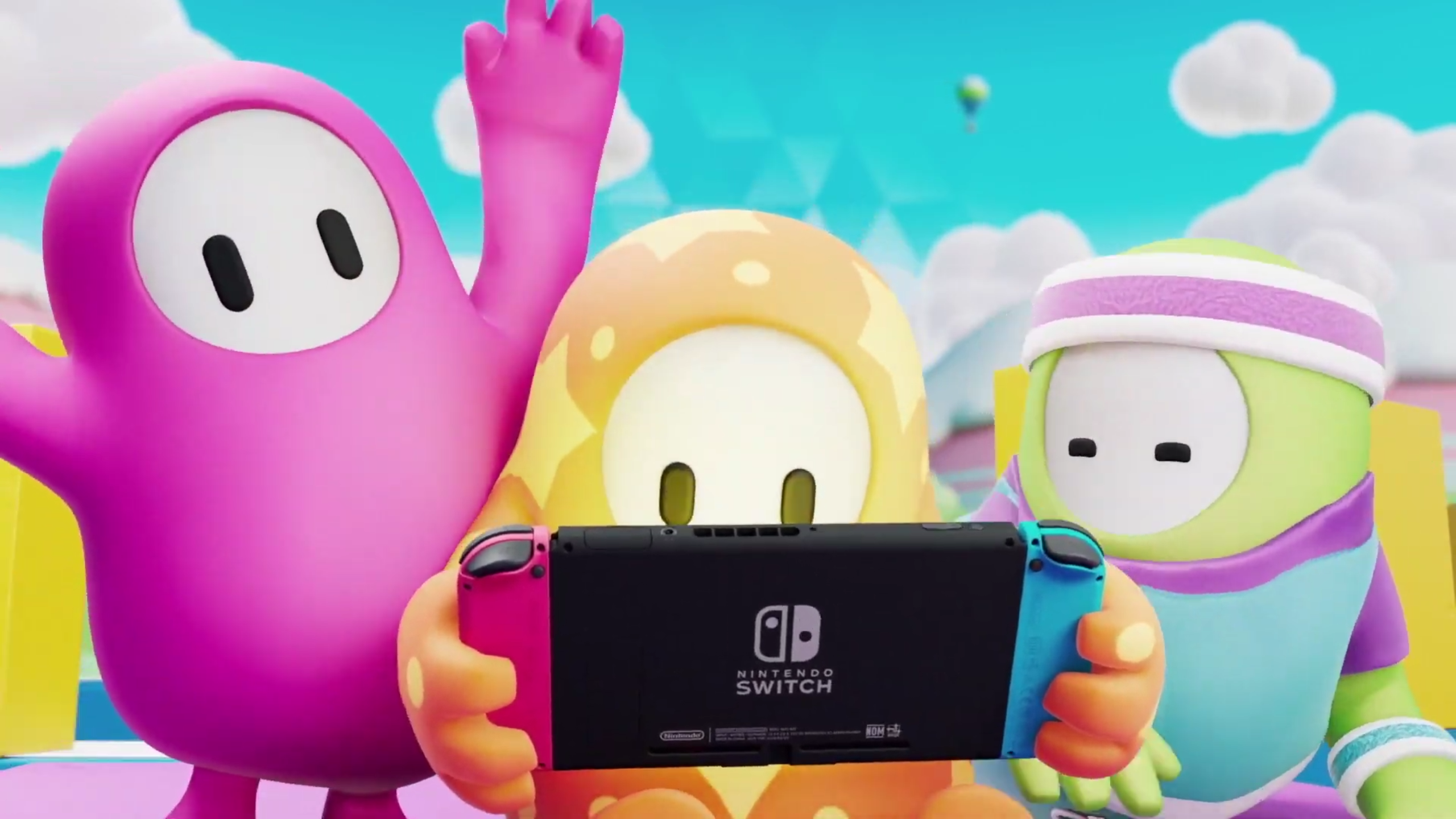
Enlarge/Fall Guys finally comes to Nintendo Switch “this summer.”
Devolver Digital
The rest of the presentation was rich with third-party Switch announcements. As a particular biggie, last year’s family-friendly battle-royale sensation Fall Guys will finally fill in an audience gap with a Switch launch “this summer.” Additionally, the Ninja Gaiden Master Collection anthology, whose title was previously leaked by a Hong Kong retailer in December of last year, has finally emerged as a real product, and it collects all three games in the series’ 3D hack-and-slash era. This anthology will launch on other consoles, as well, and while the Switch version appears to lock to 60fps, we have a hunch the other versions will clock in at higher specs, particularly resolution, when they launch June 10.
EA was on hand with a gosh-why’d-they-take-so-long flurry of game announcements. Two previously released games on other platforms, Apex Legends and Plants vs. Zombies: Battle for Neighborville, will each launch on Switch in March, though the PvZ game will cost $40, while Apex will launch as a F2P game. Additionally, EA announced a dodgeball-multiplayer game called Knockout City (also coming to Xbox, PlayStation, and PC) with a strange trailer that almost looked like a Blizzard all-stars game full of a varied, fantastical roster, only to actually mostly consist of bubbly teenaged dodgeball players. This was followed by a vaguely teased F2P Star Wars multiplayer game set between Episodes VI and VII of the film series, dubbed Star Wars Hunters, which is slated to launch “this year” on various platforms.
As for other previously announced fare: we finally got a closer look at No More Heroes III, with a trailer full of confusing mini-games and low frame rates, along with its new release date of August 27. However, neither Bayonetta III nor Metroid Prime 4 made an appearance, despite both recently being confirmed by Nintendo as still in development. The rest of the announcement-filled, 50-minute Nintendo Direct is embedded below.
Steam developer gets banned for “Very Positive” review trickery
<img src="https://rassegna.lbit-solution.it/wp-content/uploads/2021/02/steam-developer-gets-banned-for-very-positive-review-trickery.png" alt="An archived copy of Emoji Evolution‘s Steam store page shows how hard it is to distinguish the developer’s "Very Positive" name from the merely "Positive" review summary (on the right).”>
Enlarge/ An archived copy of Emoji Evolution‘s Steam store page shows how hard it is to distinguish the developer’s “Very Positive” name from the merely “Positive” review summary (on the right).
Emoji Evolution
Here at Ars, we’ve covered Valve banning Steam game developers for everything from sexual content and gratuitous ultraviolence to ill-defined “trolling.” But we’ve never seen a case where a developer got kicked off of Steam just because of its (non-infringing) name.
That’s just what happened to Emoji Evolution developer Very Positive, which said on Twitter Saturday that its developer account had been banned for “review manipulations.” Unlike other prominent examples of Steam user-review manipulation, though, Very Positive didn’t do anything to unduly skew the reviews players posted for its games.
Instead, Very Positive exploited a vagary of the Steam store’s user interface. That interface displays a game’s developer and publisher name in the same font, color, and general area as the written summary of the game’s overall user review summary (e.g., “Overwhelmingly Positive,” “Mixed,” “Mostly Negative,” etc.) Thus, it was hard for users to distinguish at a glance that the “Very Positive” developer name wasn’t an accurate summary of Emoji Evolution‘s actual user reviews (which ranged from “Mixed” to “Mostly Positive” according to screenshots).
The wrong kind of attention
Simon Carless was among the first to notice this bit of trickery, writing about it in his GameDiscoverCo newsletter on February 8. Over the next few days, word of Very Positive’s existence and actions spread among gaming news sites and social media. By February 12, the developer had been banned from Steam.
“I knew that reviews have a huge impact on the customer’s decision,” the coder behind Very Positive (who goes by the pseudonym Mike) told Vice. “I noticed that the publisher/developer name is located really close to the reviews and has the same color, and I decided to use it for my purposes.” Steam users, Mike said, “make conclusions about information when seeing familiar words and don’t spend much time reading all the words.”
Mike seems to be taking the ban in stride, promoting memes and jokey polls about the saga on Twitter. Even before the Steam ban, the Very Positive account tweeted, “to be honest the Developer and Publisher name is the best thing in the whole Emoji Evolution project,” acknowledging the bargain-basement simplicity of the game itself.
“I’ve made a really bad game—this is the only thing I’m guilty of,” Very Positive cheekily tweeted on Wednesday. “If making awful games is not allowed on Steam, why haven’t they already suspended the CDPR account?” (Zing!)
In the end, Very Positive tried to exploit a small attention glitch in Steam’s byzantine store system and failed in part because too many people gave it attention. Going forward, though, we can’t help but think a UI change on Valve’s part might be more effective (and easier to implement) than policing individual developer names for looking like “fake” review summaries. Or as Twitter user DoctorWyrm put it (in a tweet retweeted by Very Positive), “Maybe Valve should fix their easily exploitable review system instead of just banning developers.”
https://arstechnica.com/?p=1743191
Two visionaries: Marie Curie forged a friendship with dancer Loïe Fuller
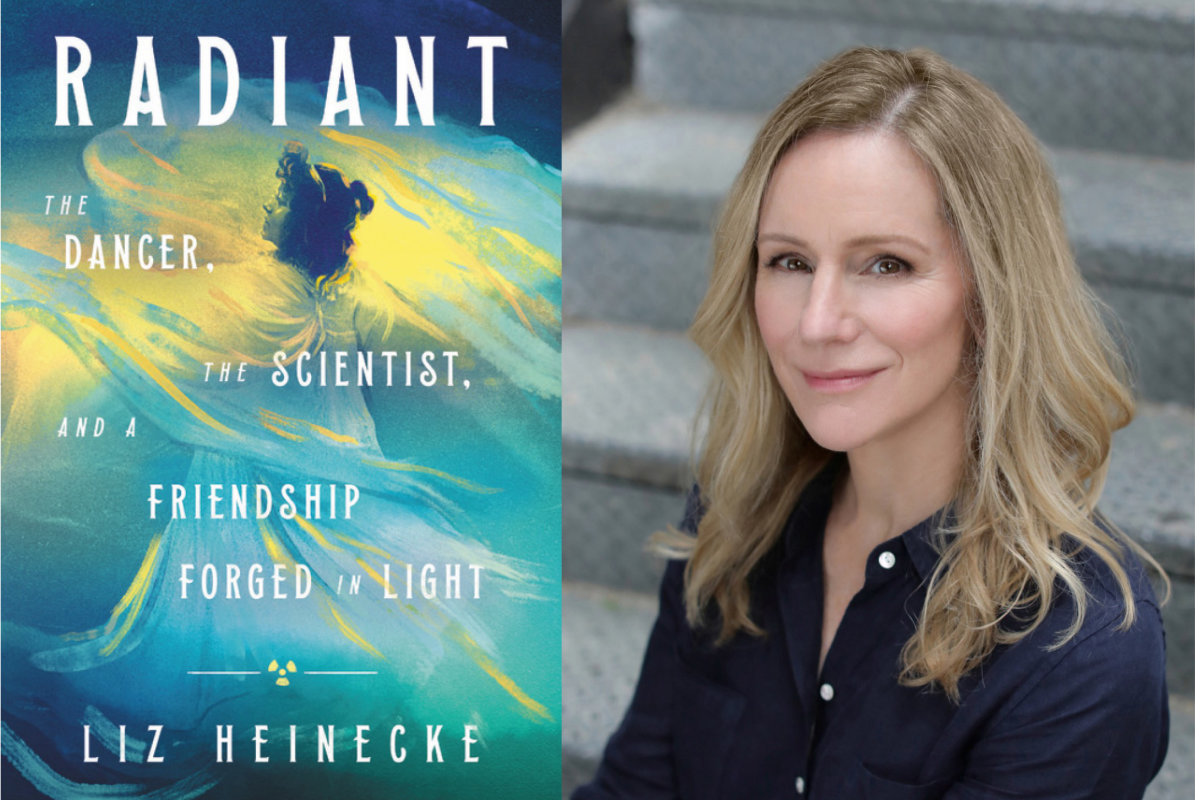
Enlarge/Radiant: The Scientist, the Dancer, and a Friendship Forged in Light explores the lives of Marie Curie and Loïe Fuller.
Both the arts and the sciences flourished in Paris during the years of the so-called Belle Époque at the dawn of the 20th century. This was when Nobel Prize-winning physicist Marie Curie and her husband, Pierre, made their breakthrough discoveries in radioactivity, discovering two new elements. At the same time, a modern dancer and pioneer in theatrical lighting named Loïe Fuller, who was all the rage in Paris, dreamed of incorporating radium into her stage act. Science writer and communicator Liz Heinecke brings the lives of these two visionary women together in an illuminating new biography, Radiant: The Scientist, the Dancer, and a Friendship Forged in Light.
The details of Marie Curie’s life are very well-documented and well-known. She left her native Poland and moved to Paris at 14 to pursue a degree in science, living in abject poverty while studying and conducting research. She met a chemist named Pierre Curie, and they began collaborating, eventually falling in love and getting married in 1895. The Curies had been married for six months when Wilhelm Roentgen discovered X-rays (winning the very first Nobel Prize in physics in 1901). Soon after, Henri Becquerel published his insight that uranium salts emitted rays that would fog a photographic plate in early 1896. Becquerel’s uranium rays so fascinated Marie that she made them the focus of her own research.
With Pierre, she uncovered evidence of two new elements they dubbed polonium and radium. The couple shared the 1903 Nobel Prize in Physics with Becquerel for their work developing a theory of radioactivity—she was the first woman to be so honored. After Pierre’s tragic death in a 1906 street accident, Marie developed new techniques for isolating radioactive isotopes from pitchblende and eventually succeeded in isolating radium in 1910. She won a second Nobel Prize (this time in chemistry) in 1911 for the discovery of polonium and radium. She remains the only woman to win the Nobel Prize twice and the only person to do so in two different scientific fields.
People who know people
Loïe Fuller, on the other hand, has been largely relegated to the footnotes of history, although there has been a resurgence of interest in her career and influence in recent years—most notably in a featured segment during Taylor Swift’s 2018 Reputation Tour, and the work of choreographer Jody Sperling. Born in the Chicago suburbs in 1862, she was a child actress who later began choreographing and performing her own dances, usually in burlesque, vaudeville, and circus venues. She started experimenting with a long skirt, moving it in different ways to explore how it reflected light, and by 1891, she had figured out how to illuminate her silk costumes during performances with lights of different colors to create striking visual effects. She was something of a self-taught chemist, eventually patenting the use of various chemical compounds and salts to create color gel and luminescent lighting.
Fuller achieved notoriety and rave reviews with her signature “Serpentine Dance” (captured on film by the Lumière brothers in 1897, although Fuller was not the dancer featured). According to dance historian Jack Anderson, “The costume for her Serpentine Dance consisted of hundreds of yards of China silk which she let billow around her while lighting effects suggested that it was catching fire and taking shapes reminiscent of flowers, clouds, birds, and butterflies.”
Alas, other, lesser dancers soon appropriated her work for their own performances, prompting a frustrated Fuller to tour Europe in hopes of gaining more recognition for her art. Her performance at the Folies Bergère in Paris was a smashing success, and she became a regular there, performing her “Fire Dance” as well as the “Serpentine Dance.” She was a fixture of the local Art Nouveau scene, hanging out with such luminaries as Henri de Toulouse-Lautrec, Auguste Rodin, Stéphane Mallarmé, and many other contemporary artists and writers. She was also a mentor and friend to American dancer Isadora Duncan and weathered public criticism over her decision to live openly with her lesbian partner.
Pierre and Marie Curie attended one of Fuller’s performances at the Folies Bergère and were greatly impressed. The admiration was mutual: Fuller was so captivated by the Curies’ radium experiments that she wrote to them in 1905, asking about the possibility of making a costume out of radium (she was unaware of just how limited a supply was in existence). Marie politely advised against it, although she herself liked to carry around vials of radium and enjoyed visiting the lab at night because “the glowing tubes looked like fairy lights.” Undeterred, Fuller worked fluorescent salts into a black gauze dress that she wore to perform her “Radium Dance,” creating the illusion of twinkling stars or ghostly lights surrounding her as she swirled on a darkened stage.
At first glance, the two women don’t seem to have much in common, but with Radiant, Heinecke has teased out some intriguing parallels between them as they transformed their respective fields and forged an unlikely friendship. Ars sat down with Heinecke to learn more.
Ars Technica: Marie Curie is practically a household name, but Loïe Fuller is not. So I’m curious what drove you to bring these two women together in a single book?
Liz Heinecke: I was reading Eve Curie’s biography of her mother and ran across Loïe Fuller’s name. I was an art major in college. My daughter is a theater kid, and I love watching dance, although I’m not a dancer myself. I googled Loïe Fuller and was fascinated right away. Eventually, I found the New York Public Library of Performing Arts database and discovered they had a little bit of her writing available to look at online. And I discovered that she was interested in radioactivity, that she had met Thomas Edison, that she was a friend of Auguste Rodin. She knew all these interesting people, and I hadn’t ever heard of her. She basically pioneered modern stage lighting. When I discovered that Marie and Loïe were born and died within five years of each other, I decided to write about the two of them together and have their stories intersect in parallel narratives.
Ars Technica: Marie Curie and Loïe Fuller met in person at least once, but what do you see as the binding connection between them?
Liz Heinecke: Curiosity. Loïe was an extremely curious person. Ultimately Loïe was probably the driving force in staying connected to Pierre and Marie because she really loved science. She wasn’t well-educated, but she was very smart and knew that technology was the thing that made her stand out. She went to Marie and Pierre’s labs because she was very curious about radium and radioactivity. I think Marie was curious about Loie’s world, too. We know that Marie and Pierre enjoyed art and theater and that Loïe took them to Rodin’s studio to see his work.
Both of them were far from perfect. Marie made mistakes in her life, but she was a more serious, careful person, and Loïe was just kind of out there. But I love that contrast, and I wrote them that way. I mean, if you read what Loïe wrote about Marie, she always felt she would never gossip about Marie. She always wrote, “Marie is very private. I want to respect her.” She did not care as much what people thought about her, as long as people came to her shows.
Enlarge/ (left) Portrait of Marie Curie, circa 1890. (right) Formal portrait of Loïe Fuller.
ullstein bild, Hulton-Deutsch Collection/CORBIS/Corbis, via Getty
Ars Technica: You chose to write Radiant very much in the style of a novel, even though it is technically nonfiction. Why is that?
Liz Heinecke: I love a good nonfiction narrative, particularly about science. When I started thinking about the story, Loïe in particular, it’s so visual. I imagined Loïe dancing on stage. I could picture Marie and Pierre in their lab surrounded by tubes of glowing radium. So I really wanted to write it so it read more like fiction. I felt like I would be able to reach a different audience, writing a book that read more like a novel rather than a straight science narrative or a straight biography.
I state in the beginning of the book that the dialogue is invented, both internal and external. I wrote dialogue based on what I had learned about the two women. After a year reading every document I could find, I felt I almost knew them. I knew that Loïe drank black coffee and Marie drank tea, what they ate at different parts of their lives, and what they worried about. But I tried to base all the dialogue on the facts that I had uncovered. Certainly all of the scenes are based on factual events in their lives that actually happened. For instance, even if you read about Loïe Fuller, no one really talks about the fact that she danced on top of the Eiffel Tower during the summer solstice. There’s so much science involved in the Eiffel Tower, I could have written a whole book just about that one night and all the interesting people that were there.
Ars Technica: I did not know that Loïe Fuller had met with Thomas Edison. It makes sense because he was involved in cutting-edge sound and lighting as well as moving pictures, and she was interested in the scientific aspects of her art. We have had this notion that there are two cultures ever since C.P. Snow coined the term in 1959. But fundamentally, science is culture, and vice versa. Loïe Fuller kind of encapsulates that.
Liz Heinecke: She does. She was so good at bringing different technologies together and creating something new. You could almost write a parallel story about Loïe and Edison. Neither of them was very well-educated, but they were both the predecessors of today’s most popular people on social media. They were both extremely good at self-promotion. They both cultivated their images very carefully. They strike me as being very similar.
I love when different disciplines come together. I feel like society today has become so compartmentalized, and in Paris in 1900, it was sort of that way, too. The scientists mostly hung out with the scientists. I thought it was so cool that Marie Curie opened herself and her world up to this dancer—someone completely outside of her sphere. It really enriched both of their lives. I feel like that’s when you see huge explosions of creativity—when people move outside of their own spheres.
<a href="https://rassegna.lbit-solution.it/wp-content/uploads/2021/02/two-visionaries-marie-curie-forged-a-friendship-with-dancer-loie-fuller-4.jpg" class="enlarge" data-height="800" data-width="1200" alt="Liz Heinecke is the author of Radiant, a parallel biography of physicist Marie Curie and groundbreaking dancer Loïe Fuller.”><img alt="Liz Heinecke is the author of Radiant, a parallel biography of physicist Marie Curie and groundbreaking dancer Loïe Fuller.” src=”https://rassegna.lbit-solution.it/wp-content/uploads/2021/02/two-visionaries-marie-curie-forged-a-friendship-with-dancer-loie-fuller-2.jpg” width=”640″ height=”427″ srcset=”https://rassegna.lbit-solution.it/wp-content/uploads/2021/02/two-visionaries-marie-curie-forged-a-friendship-with-dancer-loie-fuller-4.jpg 2x”>
Enlarge/ Liz Heinecke is the author of Radiant, a parallel biography of physicist Marie Curie and groundbreaking dancer Loïe Fuller.
Grand Central Publishing
Ars Technica: Has writing this book inspired you to try to recapture some of that Belle Époque interdisciplinary spirit?
Liz Heinecke: There’s nothing more fun than going to the library and reading through old documents, trying to find something new that no one has discovered yet. And there are so many scientific experiments you could try at home. I’m currently writing a physics book for kids, and there’s one lab that’s about creating thin layers on glass. And I thought, “Cool, let’s try to put thin layers of gelatin on glass and color it and see if we can make slides that you could hold up [to the light],” like Loïe’s multi-colored lighting.
It’s also easy to make an electroscope, the foundational concept of the equipment that the Curies used to measure radioactivity, which gives off an electrical charge. They used a version of an electroscope to spin a mirror that would let them measure how radioactive different materials were. That’s what allowed Marie to make the first real measurements of radioactivity.
I love how people from that era were able to see things very close-up with microscopes and very far away with telescopes for the first time. They could recognize that certain things under a microscope might look like a celestial object. Loïe would take things that she had seen in a scientist’s lab or under a microscope and project it on a stage. Artists are still doing that. There’s gorgeous art that modern scientists make with their microscopes and telescopes today.
https://arstechnica.com/?p=1741723
Online fighting games during COVID: How rollback helps us connect
<img src="https://rassegna.lbit-solution.it/wp-content/uploads/2021/02/online-fighting-games-during-covid-how-rollback-helps-us-connect.jpg" alt="Sol Badguy faces off against Faust in Guilty Gear Strive, the latest entry in the long-running fighting game series coming in April.”>
Enlarge/ Sol Badguy faces off against Faust in Guilty Gear Strive, the latest entry in the long-running fighting game series coming in April.
As a huge fighting-game fan I’m always excited when a new game comes out. No other genre captures my attention in the same way. The feeling of discovery, the community and competitive spirit—a good release means potentially thousands of hours of playing and learning, not to mention all the sharing and talking with fellow players.
This week I’m excited about Guilty Gear Strive, releasing April 9 on PS4, PS5, and PC. There’s an open beta this week, and Ars got early access to try it out, including the newly improved netcode.
I’m happy to report that the beta is already doing the right things to make an online game feel as much like an offline one as possible.
The offline experience
In pre-pandemic days, which already feel like years ago, I would host a weekly fighting-game night. People gathered in my garage to run friendly-but-competitive sets, help each other learn games, and just talk about life. Fighting games to us aren’t just about competing—they’re about community and connecting with people.
For me, there’s just no purer gaming experience than playing against another human being. No CPU opponent or single-player narrative can bring that same feeling of give and take, testing your skills and reflexes but also your ability to adapt and dig into the psychology of your opponent.
If you’re the better player? It’s a chance to teach someone or test ideas against someone more forgiving. The moment when you see them avoid the setup they’d been walking into all night or challenge the move you’d been bullying them with can feel as good as you winning.
If the tables are turned, and you’re the weaker one, it’s a chance to learn, and that’s much more satisfying when you finally take a match. One night, I ran a first-to-20 against a friend who’s a much stronger player than I am; I lost the set 3-20. Those three games I took? Best feeling in the world, even after getting my butt handed to me.
The real joy, though, is when you find an opponent you’re roughly equal to. Trading games, constantly pushing yourself to find an advantage, adapting and watching them adapt back, that’s when fighting games shine in a way few other games can. Could be a good friend, or a total stranger, but it’s like having a conversation in another language.
A year ago, as COVID began to pop up in Los Angeles County, I had to cancel my night. All the other weeklies, the tournaments, friendly sets at your friend’s house—they all dried up. Offline fighting games became an endangered species around the world, and the only way to get our fix was to play online.
My garage in happier days, when we could play offline.
Fighting in an online world
Fighting games, by their nature, are reliant on reflexes and being able to quickly assess data. We count frames, we look for things we know are unsafe we can punish, we watch for the telltale movements that might indicate an overhead attack is coming so we can shift our blocking to high. If someone is dashing up in your face, can you react fast enough?
In short, it’s a crummy genre to cram through Internet tubes. Any lag can destroy the feeling of the game. Without offline play, reliant entirely on the Internet, what is a fighting game fan to do?
Luckily, there’s a bit of clever networking tech, called rollback netcode, that can alleviate most of the disadvantages of distance and physics (doesn’t matter how good your Internet connection is—there’s no beating the speed of light).
Unfortunately, not every fighting game has rollback netcode, particularly ones from Japanese developers who are the titans of the genre but have been slow to adopt the technology. They’ve relied more on delay-based netcode, which provides a much less consistent or enjoyable experience. Or, in the case of Street Fighter V, half-baked rollback that provides as many frustrating online experiences as it offers good ones.
We’ve already published what is probably the most comprehensive explanation of fighting-game netcode and how rollback works. It’s a deep dive, with both technical explanations and a lot of short video clips to demonstrate the concepts—I highly recommend it for the curious. Here’s a quote from it that acts as a quick summary if you don’t want to dig in:
Since a game’s choice of netcode can never magically change the distance between a player and their opponent or prevent networks from dropping or delaying information, you may wonder how one netcode strategy could be drastically better than any other. The key lies in how the netcode handles uncertainty.
When there is no information from the remote player, delay-based netcode needs to pause and wait, as described in detail on the previous page. Rollback’s main strength is that it never waits for missing input from the opponent. Instead, rollback netcode continues to run the game normally. All inputs from the local player are processed immediately, as if it was offline. Then, when input from the remote player comes in a few frames later, rollback fixes its mistakes by correcting the past. It does this in such a clever way that the local player may not even notice a large percentage of network instability, and they can play through any remaining instances with confidence that their inputs are always handled consistently.
In short, good rollback feels much more like offline. Your timing is the same as offline, and with reasonable ping, it’s almost indistinguishable from sitting next to your opponent. Even matches played from California to New York, or across the ocean, can be very playable, with minimal visual skipping.
Enter Guilty Gear
Back in late 2019, I interviewed Daisuke Ishiwatari, the creator of the Guilty Gear series, about the upcoming release of the latest version of his game. I didn’t know the pandemic was just around the corner, but I did want to ask him about rollback netcode. The previous Guilty Gear games didn’t have it, and their online experience suffered for it. Even in a world where offline play exists, it’s much more convenient to hop online at home to play whenever you want. Did the designers intend to do the work to add rollback to the game?
Daisuke’s response didn’t engender a ton of confidence, but it did leave the door open for hope:
Where we are right now at ArcSys, in terms of rollback netcode, is we haven’t really arrived at the conclusion that we’ll need a super programmer as much, as the engineering team is kind of divided, actually. There are some that say this would be really good and others that say, you know, implementing this wouldn’t really work with the Guilty Gear system. And it makes sense for a game like Street Fighter, but how Guilty Gear is designed—this wouldn’t really fit the bill. So we’re actually right in the middle of investigating on the engineering team how that might look.
His quote from my interview was widely spread on Twitter as part of an outcry from fans for the developers to take netcode seriously. It became difficult to find any discussions of the game that didn’t include hopes about rollback. The question was, would the developers listen?
Turns out they did, and I was able to hop online and play some sets to get a hands-on feel for how both the game and netcode feel.
https://arstechnica.com/?p=1742694
An anniversary for great justice: Remembering “All Your Base” 20 years later
As the Internet began crystallizing into its modern form—one that now arguably buttresses society as we know it—its anthropology of common language and references matured at a strange rate. But between the simple initialisms that emerged by the ’90s (ROFL!) and the modern world’s ecosystem of easily shared multimedia, a patchwork connection of users and sites had to figure out how to establish a base of shared references.
In some ways, the Internet as we know it really began on February 16, 2001, 20 years ago today, when a three-word phrase blew up: “All Your Base.”
On that day, a robo-voiced music video went live at Newgrounds.com, one of the Internet’s earliest and longest-lasting dumping grounds of Flash multimedia content, and went on to become one of the most beloved Internet videos of the 21st century. Though Flash support has since been scrapped across the entire Web-browsing ecosystem, Newgrounds continues to host the original video in a safe Flash emulator, if you’d like to see it as originally built instead of flipping through dozens of YouTube rips.
In an online world where users were previously drawn to the likes of the Hamster Dance, exactly how the heck did this absurdity become one of the Internet’s first bona fide memes?
TAKE OFF EVERY ‘ZIG’!!
<img alt="Zero Wing‘s opening sequence was widely shared across the early Internet as a GIF small enough to fit on a 3.5" floppy disk.” src=”https://rassegna.lbit-solution.it/wp-content/uploads/2021/02/an-anniversary-for-great-justice-remembering-all-your-base-20-years-later.gif” width=”320″ height=”224″>
Zero Wing‘s opening sequence was widely shared across the early Internet as a GIF small enough to fit on a 3.5″ floppy disk.
KnowYourMeme
One possible reason is that the “All Your Base Are Belong To Us” video appealed to the early Internet’s savviest users, since it was sourced from an unpopular ’90s video game. Zero Wing launched on the Sega Genesis in 1992 as a competent “shmup” comparable to arcade classics like Galaga and R-Type, but it flew under the radar in an American market more obsessed with series like Sonic and Madden. By the late ’90s, however, video game emulation on PCs changed all that. Across the earliest post-BBS Internet, underappreciated 8-bit and 16-bit games changed hands at a crazy rate thanks to small file sizes and 56K modems—and if you were an early Internet user, you were likely a target audience for activities like emulating a Sega Genesis on a Pentium II-powered PC.
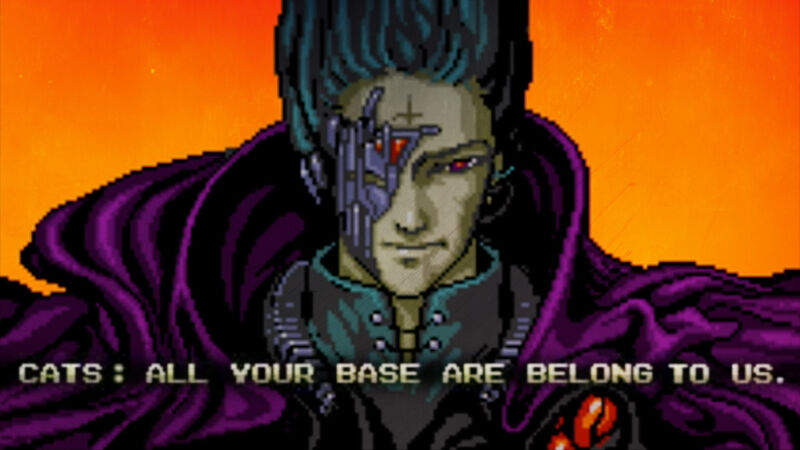
That was the first step to exposing the world to Zero Wing‘s inadvertently hilarious text, translated from Japanese to English by an apparent amateur. Classic Japanese games are littered with crappy translations, and even mega-successful publishers like Nintendo are guilty of letting bad phrases slip into otherwise classic games. But Zero Wing soundly trounced other examples of wacky mistranslations thanks to its dramatic opening sequence pitting the generic “CAPTAIN” against a half-robot, half-demon creature in a robe named “CATS.”
Its wackiness circulated on the early Internet as a tiny GIF, with each of its silly phrases (“How are you gentlemen!!”, “Somebody set up us the bomb”) pulling significant weight in terms of weirdly placed clauses and missing punctuation. Early Internet communities poked fun at the sequence by creating and sharing gag images that had the silly text inserted in various ways. But it wasn’t until the February 2001 video, as uploaded by a user who went by “Bad-CRC,” that the meme’s appeal began to truly explode. The video presents the original Sega Genesis graphics, dubbed over with monotone, machine-generated speech reading each phrase. “You are on your way to destruction” in this voice is delightfully silly stuff.
Much of the original video’s fun comes from its altered images, where the wackiness of the badly translated game’s intro collides with pop culture. Bill Gates’ infamous mug shot had become quite popular during the earliest Internet era, for example.
Who doesn’t love a BSOD that tells you who all your base now belong to?
Lots of Windows errors in the 2001 video.
Star Wars film re-releases from the late ’90s meant cereal tie-ins, which were perfect for an All Your Base memeification.
Smoking kills. For great justice.
I’d like to buy a zig.
Meme of the year.
Certainly, a twist on the idea that we were all on the way to destruction.
Somebody set up us the chicken.
Main conspiracy theory turn-on.
After this 30-second sequence concludes (admittedly lopping off some of the original, silly text), the video’s background music devolves into a thumping techno track. The original 16-bit visuals fade to black, and a low-resolution image of Planet Earth consumes the screen for some reason. Then the whole thing explodes. “ALL YOUR BASE, BASE, B-BASE, ALL YOUR BASE, ARE BELONG TO US,” the robo-voice screams, like it’s become a member of The Prodigy, while the Flash animation turns into a Photoshop frenzy of real-life images newly emblazoned with Zero Wing‘s various mistranslated phrases. These remixed images are certainly of an era; George W. Bush, Al Gore, and OJ Simpson appear in a few, as does a Windows “blue screen of death” rewritten to mostly contain the game’s text.
WE GET SIGNAL.
The video’s credits include about 20 additional usernames that reek of the year 2001, including DrMeithos, The Yellow Yell, and Generic Superhero, thus giving credit to the “shitposting” community that toyed with the “All Your Base” phenomenon in smaller online circles and generated so many silly images for this video to leverage. What’s more, the video’s entire audio sequence—the robo-voiced intro, sequenced perfectly with the Genesis game, and then its devolution into thumping techno—was made by someone else, a group of anonymous Internet users who went by The Laziest Men on Mars.
Bad-CRC may be memorialized as the video’s original uploader, but The Laziest Men on Mars helped establish a significant trend in online meme sharing: a reliance on crowdsourcing and remixing. The meme wouldn’t exist without Zero Wing‘s original content, yet dozens of people pulled and twisted that original vision like so much Internet taffy, to the point where neither the game’s creators nor any single meme contributor could take credit for the phenomenon.
It wasn’t until the Flash video appeared, synthesizing a community’s furious efforts as spread across forums and file-trading services, that the rest of the Internet world could actually find and digest this smorgasbord of WTF. Newgrounds was one of many dumping grounds for Flash animations, making it easier for friends to share links not only to videos but also free online games—usually in ways that school computer labs didn’t necessarily block, which led kids to devour and share their favorites when teachers weren’t carefully watching students’ screens. And in the case of “All Your Base,” its general lack of vulgarity made it easier to reach kids without drawing parental ire. This wasn’t like the early ’90s Congressional hearings against violent and sexual video games. It was just… weird.
And, gosh, it still is. Yes, this video’s 20th anniversary will likely make you feel old as dirt, but that doesn’t mean the video itself aged badly. There’s still something timeless about both the wackiness and innocence of so many early-Internet pioneers sending up a badly translated game. And in an age where widely disseminated memes so often descend into cruelty or shock value, it’s nice to look back at an age when memes were merely quite stupid.