EA is getting back into college football without NCAA, player licenses
Enlarge/ College Football is coming back… but the NCAA trademarks and actual college football players are not.
EA is diving back into the world of college football for the first time since 2013, the publisher announced today. But EA Sports College Football, which is currently in the early stages of development, will be making its return without licenses from the NCAA or the rights to the names and likenesses of actual current college players.
Instead, EA says the new game “will include the rights to more than 100 institutions featuring the logos, stadiums, uniforms, gameday traditions, and more that fans have come to know and love.”
The NCAA and many major college football conferences decided not to renew their exclusive contracts with EA Sports back in July 2013, amid legal disputes over whether players could share in the profits from the use of various NCAA trademarks. At the same time, EA was facing a direct lawsuit over the unauthorized use of player names and likenesses in the franchise, eventually leading to a multimillion-dollar settlement.
That combination of legal troubles led EA to announce the end of the best-selling NCAA College Football franchise in 2013. “The ongoing legal issues combined with increased questions surrounding schools and conferences have left us in a difficult position—one that challenges our ability to deliver an authentic sports experience, which is the very foundation of EA Sports games,” the company said at the time.
EA’s decision to avoid NCAA and player licenses is already drawing some controversy in the halls of power. “Cutting athletes out of this reboot so they aren’t responsible for paying them for their likeness is a grave injustice,” Sen. Chris Murphy (D-Conn.) said in a statement reported by Sports Illustrated’s Ross Dellenger. “I’ll be introducing legislation soon to help players finally profit off their talent so they don’t need to face continued mistreatment like this.
Though the NCAA and its players won’t be directly involved in the new game, EA is working with the Collegiate Licensing Company for imagery and trademarks associated with the included schools. But some of the most important trappings of the college football season, such as the conference system and bowl games, seemingly won’t be covered by that per-school licensing agreement.
EA says its deal with CLC makes it the “exclusive developer of simulation college football video game experiences.” The use of “simulation” there could be significant; similar wording in EA’s “exclusive” agreement with the NFL allowed Take-Two subsidiary 2K last year to announce the return of the NFL2K series as a “non-simulation” title.
In an interview with ESPN, EA Sports Vice President and General Manager Daryl Holt said the new game “won’t happen this year.”
https://arstechnica.com/?p=1739227
We’re getting a Wakanda spinoff series from Ryan Coogler on Disney+
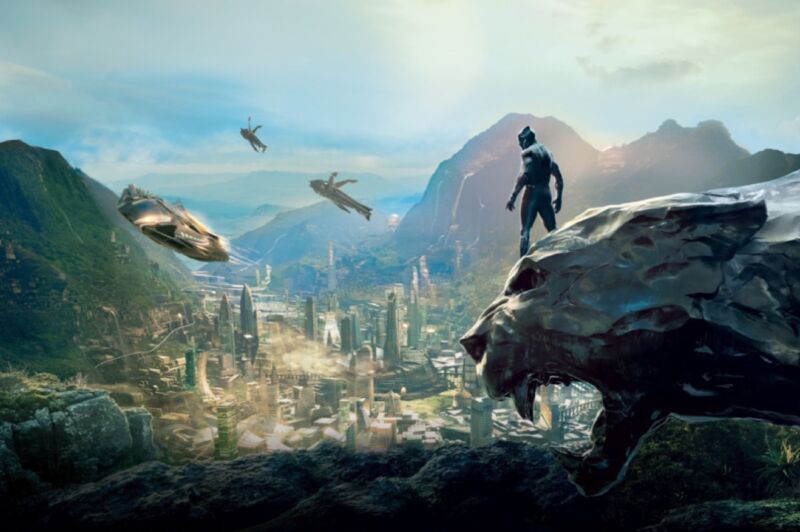
Enlarge/ We’ll be getting more Wakanda-centric stories thanks to a new development deal between Black Panther director Ryan Coogler and The Walt Disney Company.
Following on the success of The Mandalorian and WandaVision on Disney+, The Walt Disney Company has tapped Black Panther director Ryan Coogler to develop an as-yet-untitled new series for the streaming service focusing on the fictional nation of Wakanda. Deadline Hollywood reports that the planned series is part of an exclusive five-year deal between Coogler’s Proximity Media production company and the Mouse House to develop the new TV series and includes shows for other divisions of the company.
“Ryan Coogler is a singular storyteller whose vision and range have made him one of the standout filmmakers of his generation,” said Bob Iger, executive chairman of The Walt Disney Company, in a statement. “With Black Panther, Ryan brought a groundbreaking story and iconic characters to life in a real, meaningful and memorable way, creating a watershed cultural moment. We’re thrilled to strengthen our relationship and look forward to telling more great stories with Ryan and his team.”
Coogler earned praise for his films Fruitvale Station and Creed before helming Black Panther. The latter film grossed a whopping $1.3 billion worldwide—the highest-grossing film by a Black director and the ninth-highest-grossing film of all time—and became the first MCU movie to win multiple Oscars (Best Costume Design, Best Original Score, and Best Production Design). It was nominated for Best Picture, although it didn’t win.
“What makes Black Panther a welcome change isn’t just its hero, whose charisma and gravitas are undeniable, but that it is an elegantly structured adventure,” Annalee Newitz wrote in her 2018 Ars Technica review. “The stakes are high, the reveals make sense, and the payoff is satisfying. This is the way superhero movies should be done. Plus, the secret nation of Wakanda has tech that’s way more inventive than anything Tony Stark has produced lately.”
Newitz also praised the futuristic design of Wakanda, which incorporated common African tribal designs and symbolism: “Gleaming skyscrapers and maglev trains co-exist with pastoral herdsmen and packed-earth streets,” she wrote. “Machine interfaces use vivid colors, and holographic displays seem to rustle like feathers as they transform.”
A Black Panther sequel is already in development, scheduled for a July 8, 2022, release, although the untimely demise of star Chadwick Boseman last year after a four-year battle with colon cancer threw an unexpected wrench into the works. Coogler and Marvel Studios president Kevin Feige had not known of Boseman’s illness. Feige has said that the role will not be recast, although the studio is moving ahead with the sequel. The studio plans to continue to explore the world of Wakanda, through the planned sequel and, now, through Coogler’s Wakanda series.
“It’s an honor to be partnering with The Walt Disney Company,” Coogler said in a statement. “Working with them on Black Panther was a dream come true. As avid consumers of television, we couldn’t be happier to be launching our television business with Bob Iger, Dana Walden, and all the amazing studios under the Disney umbrella. We look forward to learning, growing, and building a relationship with audiences all over the world through the Disney platforms.”
https://arstechnica.com/?p=1738802
Why Animal Crossing: New Horizons’ 31 million sales are so incredible
Fig. 1: New Horizons alone is now responsible for roughly 47 percent of all lifetime Animal Crossing sales.
Fig. 2: Thus far, Switch owners are digging Animal Crossing at a way higher rate than owners of previous Nintendo consoles.
Fig. 3: Only a few other games can match the hardware attach rate of Animal Crossing: New Horizons (though New Horizons’ number may come down as time goes on).
Fig. 4: New Horizons has maintained a monthly sales rate through the majority of its first year of sales that few games can match.
Nintendo’s latest earnings report contained plenty of good news for the company, including the revelation that the Nintendo Switch has now sold nearly 80 million units worldwide. Even more eye-popping, though, is the news that Animal Crossing: New Horizons has surpassed 31 million sales as of December 31, less than 10 months after its release last March. We’ve written a number of times about why Animal Crossing‘s chill, landscape-tending gameplay lends itself perfectly to our current stuck-inside-amid-a-pandemic moment. But these new sales numbers show just how much of a phenomenon the latest title has been in driving Nintendo’s recent success.
To show just how incredible it is for an Animal Crossing game to sell 31 million copies, we’ve gathered some relevant statistics to help put that massive number into context:
31.18 million: Sales for Animal Crossing: New Horizons through December 31, 2020
11.77 million: Number of those sales that came in the game’s first 12 days on the market in March 2020.
31.38 million: Lifetime sales for Pokemon Red/Green/Blue on the Game Boy.
30.8 million: Lifetime sales for New Super Mario Bros. on the Nintendo DS.
35.12 million: Total combined sales for all previous Animal Crossing console games.
Animal Crossing: Amiibo Festival (Wii U, 2015): 490K
Animal Crossing: Happy Home Designer (3DS, 2015): 3.47M
Animal Crossing: New Leaf (3DS, 2012): 12.82M
Animal Crossing: City Folk (Wii, 2008): 4.32M
Animal Crossing: Wild World (DS, 2005): 11.75M
Animal Crossing (GameCube, 2001): 2.27M
Vs. Nintendo hardware share
39%:Animal Crossing: New Horizons sales as a percentage of total Nintendo Switch sales (31.18M / 79.87M)
16.9%:Animal Crossing: New Leaf sales as a percentage of total Nintendo 3DS sales (12.82M / 75.94M)
10.4%:Animal Crossing sales as a percentage of total GameCube sales (2.27M / 21.74M)
7.6%:Animal Crossing: Wild World sales as a percentage of total Nintendo DS sales (11.75M / 154.02M)
4.3%:Animal Crossing: City Folk sales as a percentage of total Wii sales (4.32M / 101.63M)
3.6%:Animal Crossing: Amiibo Festival sales as a percentage of total Wii U sales (0.49M / 13.56M)
Vs. other Nintendo best-sellers
39%:Animal Crossing: New Horizons sales as a percentage of total Nintendo Switch sales (31.18M / 79.87M)
41.8%:Mario Kart 8 Deluxe sales as a percentage of total Switch sales (33.41M / 79.87M)
Collect insects, fossils, and fish, then donate them to a loquacious owl.
In a series tradition, you’re greeted with a brief set of announcements at the start of every day. (If you boot the game multiple times in a single day or evening, you only see this announcement stuff once every 24 hours of play.)
Decorate the… outdoors? OK, that’s new. Yes, you’re now judged (and rewarded) for how much you decorate the exterior portions of your town.
One new outdoor decoration element, fencing, is encouraged for the sake of a higher review score—though I have yet to find doors to attach to these fences, which means I have to build them with awkward openings.
Another new element: Dodo Airlines. This works much like the previous games’ town gate, as it facilitates local and online modes.
But it also lets players fly to randomly generated islands…
…where they can acquire much-needed resources. In my tests, for example, I had to fly to a randomly generated island to get bamboo (which is crucial for many of the game’s crafting recipes).
On another randomly generated island, I found a stranger wandering around, so I invited them to my town.
One day, this dude showed up on my island and muttered a bunch of creepy stuff. What’s Harvey smoking, Nintendo?
Turns out he wants you to visit his special island…
…which is designed to let players create photo dioramas. The catch is, you can only invite characters into your photo shoots if you own their Amiibo cards or toys.
You can also use Amiibo toys and cards to invite new nonspecial characters to your island.
It’s the only way to guarantee that certain favorite characters move into your town’s extra houses, as opposed to the game’s usual “wait for random animals to appear” system. As such, it’s a bit like “paid DLC,” and I’m not necessarily fond of how it favors people who buy Nintendo’s packs of blind-draw Amiibo cards.
Back to classic series tropes, like paying off home loans.
Every time a new event or building opens, Tom Nook invites you to take part in a related ceremony.
New supply chain attack uses poisoned updates to infect gamers’ computers
Enlarge/ Circuit board with speed motion and light.
Researchers have uncovered a software supply chain attack that is being used to install surveillance malware on the computers of online gamers.
The unknown attackers are targeting select users of NoxPlayer, a software package that emulates the Android operating system on PCs and Macs. People use it primarily for playing mobile Android games on these platforms. NoxPlayer-maker BigNox says the software has 150 million users in 150 countries.
Poisoning the well
Security firm Eset said on Monday that the BigNox software distribution system was hacked and used to deliver malicious updates to select users. The initial updates were delivered last September through the manipulation of two files: the main BigNox binary Nox.exe and NoxPack.exe, which downloads the update itself.
“We have sufficient evidence to state that the BigNox infrastructure (res06.bignox.com) was compromised to host malware, and also to suggest that their HTTP API infrastructure (api.bignox.com) could have been compromised,” Eset malware researcher Ignacio Sanmillan wrote. “In some cases, additional payloads were downloaded by the BigNox updater from attacker-controlled servers. This suggests that the URL field, provided in the reply from the BigNox API, was tampered with by the attackers.”
In a nutshell, the attack works this way: on launch, Nox.exe sends a request to a programming interface to query update information. The BigNox API server responds with update information that includes a URL where the legitimate update is supposed to be available. Eset speculates that the legitimate update may have been replaced with malware or, alternatively, a new filename or URL was introduced.
Malware is then installed on the target’s machine. The malicious files aren’t digitally signed the way legitimate updates are. That suggests the BigNox software build system isn’t compromised; only the systems for delivering updates are. The malware performs limited reconnaissance on the targeted computer. The attackers further tailor the malicious updates to specific targets of interest.
The BigNox API server responds to a specific target with update information that points to the location of the malicious update on an attacker-controlled server. The intrusion flow observed is depicted below.
Eset malware researcher Sanmillan added:
Legitimate BigNox infrastructure was delivering malware for specific updates. We observed that these malicious updates were only taking place in September 2020.
Furthermore, we observed that for specific victims, malicious updates were downloaded from attacker-controlled infrastructure subsequently and throughout the end of 2020 and early 2021.
We are highly confident that these additional updates were performed by Nox.exe supplying specific parameters to NoxPack.exe, suggesting that the BigNox API mechanism may have also been compromised to deliver tailored malicious updates.
It could also suggest the possibility that victims were subjected to a MitM attack, although we believe this hypothesis is unlikely since the victims we discovered are in different countries, and attackers already had a foothold on the BigNox infrastructure.
Furthermore, we were able to reproduce the download of the malware samples hosted on res06.bignox.com from a test machine and using https. This discards the possibility that a MitM attack was used to tamper the update binary.
Eset has observed three different malware variants being installed. There’s no sign of any of the malware trying to make financial gains on behalf of the attackers. That led the security company to believe the malware is being used to surveil targets.
Sanmillan said that of more than 100,000 Eset users who have NoxPlayer installed, only five of them received a malicious update. The numbers underscore just how targeted the attacks are. Targets are located in Taiwan, Hong Kong, and Sri Lanka.
Sanmillan said that Eset contacted BigNox with the findings and the software maker denied being affected. BigNox representatives didn’t respond to email seeking comment for this post.
Anyone who has used NoxPlayer over the past five months should take time to carefully inspect their systems for signs of compromise. Monday’s post provides a list of files and settings that will indicate when a computer has received a malicious update. While the Eset post refers only to the Windows version of the software, there’s currently no way to rule out the possibility that macOS users were targeted, too.
https://arstechnica.com/?p=1738739
Multi-layered Outside the Wire is part action thriller, part intimate drama
Enlarge/ Anthony Mackie and Damson Idris must foil a a warlord’s plan to launch a network of dormant nuclear weapons in Outside the Wire.
To say that Netflix is leaning into its recent forays into feature film-making is an understatement. The streaming giant announced earlier this month that it will be releasing a new feature film on its platform every week in 2021. Among the streamer’s January releases was Outside the Wire, in which Anthony Mackie (Sam Wilson/Falcon in the MCU, Synchronic) stars as an android military officer who teams up with a disgraced drone pilot to ward off a nuclear attack.
(Some spoilers below, but no major reveals.)
Director Mikael Håfström is a Swedish director best known for the Oscar-nominated 2003 film Evil, and 1408, a solidly spooky, haunted hotel/psychological horror film starring John Cusack and based on a short story by Stephen King. So Outside the Wire is something of a departure for him: partly a military action thriller, and partly a psychological study of its two central characters. It’s the latter aspect that most strongly bears the hallmark of Håfström’s artistic sensibility. Per the official synopsis:
In 2036, America serves as a peacekeeping force and human troops on both sides are supported by robot combatants called Gumps and drone pilots monitoring skirmishes from thousands of miles away. But after headstrong drone pilot Lieutenant Harp (Damson Idris, Snowfall) disobeys a direct order to intervene in a conflict, the Army deploys him to a military outpost to confront the human costs of his button-pushing.
Harp’s expectations of guarding a fence are upended when his new commanding officer Captain Leo (Mackie) announces plans to infiltrate the demilitarized zone and apprehend Viktor Koval (Pilou Asbæk), a warlord who intends to launch a network of dormant nuclear weapons. Soon, Harp learns that his theoretical experience as a drone pilot means little out on the battlefield under enemy attack—especially after discovering that Leo is an A.I.-enhanced supersoldier whose strength, speed and demand for results promise to turn his real-world education into a trial by fire.
Mackie is the big-name star here, but the story is told from Harp’s perspective, opening with his decision to deploy a missile to take out what appears to be an enemy launcher. His action kills two young Marines, but saves 38—a tradeoff he deems acceptable. His superiors disagree, given his disobedience of their direct order, and decide that Harp needs some first-hand experience in a war zone, rather than piloting drones from a safe distance.
As soon as he arrives at his new posting—a US base of operations in Ukraine—Leo recruits him on a secret mission, telling him he’d hand-picked Harp precisely because he showed he could think for himself in a tight situation. But Harp gradually begins to realize that Leo’s true objective might be something quite different than preventing Koval from gaining control of Cold War-era nuclear missile silos.
Håfström told Ars that he was drawn to the project in part because he’d never done a science fiction film that takes place in the future (in this case, in 2036). He also liked the various layers of the film. “It’s a sci-fi movie, it’s a buddy movie to a degree, it’s a war movie,” he said. “It deals with interesting questions about modern warfare and AI, and the responsibilities we need to take when we develop these things. There were a lot of layers that I found intriguing in this material.”
Damson Idris co-stars as Lt. Thomas Harp, a drone pilot.
Anthony Mackie stars as Captain Leo, a military officer who is secretly a highly advanced android.
After he disobeys a direct order, Harp is reassigned to a base in Ukraine.
Col. Eckhart (Michael Kelly) tells Harp he must have really screwed up to get assigned to Captain Leo.
Leo recruits Harp for a secret mission to keep a Russian terrorist from gaining control of Cold War-era nuclear missile silos.
Harp tries to diffuse a standoff between US Marines and armed, suspicious locals.
They are ambushed by pro-Russian insurgents.
Harp and Leo arrive at a refugee camp.
Sofiya (Emily Beecham) is a resistance leader who runs an orphanage for children whose parents were killed in drone strikes.
Harp grapples with the human toll of his prior job as a drone pilot.
Leo finally comes face to face with the Russian terrorist Victor Koval (Pilou Asbaek).
Given that the film is set in our near future, Håfström had to straddle a fine line when it came to creating a world that is still quite recognizable as our own—just a bit more technologically advanced. However, he also brought in some decidedly “retro” elements for his android super soldier, just for contrast. “Leo is writing on an old typewriter and puts things in file cabinets, because he says that’s the best way to avoid hackers,” said Håfström.
There are military robots dubbed “Gumps,” in addition to Mackie’s advanced biotech android, and the Gumps have not easy integrated with the human soldiers, who are resentful of the very notion that they could be replaced by a machine. “Somebody thought that a vending machine could do a soldier’s job,” one soldier gripes, right before he and several others begin beating and harassing a Gump—until Leo intervenes. According to Håfström, that scene was added later, after a discussion with Mackie about the latter’s character.
Those discussions also yielded less of an emphasis on the typical butt-kicking android soldier with superpowers one associates with these kinds of films. The point is made repeatedly that Mackie is capable of emotion and compassion—perhaps more, at least at the beginning, than his human partner, Harp. “We had a lot of great discussions about how he’s a cyborg, this biotech creation, and what does that mean?” said Håfström. “What approach do you have to life, to death, to feelings? We decided to make him as human as he can possibly be. We took away the superhero stuff and made him very grounded.”
That said, there are still several well-choreographed action sequences, and Mackie’s athleticism was an added benefit, since he insisted on doing many of the stunts himself. “Anthony is a very fine actor, a very intelligent man, and he’s also one of the most physically capable actors I’ve worked with,” said Håfström. As for the inevitable showdown between Leo and Koval, “We tried to do it like a dance, like a ballet, just to keep it visually interesting,” he said.
While he sought to make the science fiction elements as credible as possible, for Håfström, the biggest challenge was ensuring that viewers felt emotionally invested in the two main characters, particularly Harp’s personal journey. “He is the one who takes us on this journey, into this landscape,” said Håfström. “For him, warfare has been a TV situation, sitting in the Nevada desert making decisions about life and death on the other side of the planet. His realization of what he’s actually doing, and the consequences of his actions, is very much part of his arc. He’s a very different guy in the final scene.”
“These guys are not heroic in a simple, old-fashioned way,” said Håfström, adding that his film “is really asking important questions about taking responsibility for your own actions. In the end, to me, it’s very much an anti-war movie.”
Outside the Wire is currently streaming on Netflix.
[embedded content]
Anthony Mackie takes us behind the action in Outside the Wire.
https://arstechnica.com/?p=1735238
A new $110 light gun for old Duck Hunts: Ars tests an HDTV-friendly option
Enlarge/Duck Hunt without a CRT? It’s finally doable, thanks to the Sinden Lightgun.
Sam Machkovech
Over the past decade, we’ve seen nearly every classic gaming console receive a cute, miniaturized re-release—and the variety has been staggering, from titans like the NES to arcade niche favorites like Neo Geo and Sega Astro City.
Yet somehow, one massive retro-gaming category has been left unmined for a nostalgic buck: the light gun genre. Nintendo never packed shooting-gallery classics like Duck Hunt into a plug-and-play Zapper, while companies like Sega and Namco have never released their legendary arcade gun games as convenient, shoot-at-the-TV collector’s editions.
Until recently, the wisdom preventing such a launch has been limitations with modern HDTVs; light gun games were largely coded for older screen technologies. But one enterprising Indiegogo project from 2019, the Sinden Lightgun, set its sights on solving the problem in a roundabout, DIY way: with a new plastic gun, starting at $110, that combines an RGB sensor with incredibly low-latency response times. After wondering how such a system works in practice (and increasingly wanting a retro-arcade experience in my locked-down home), I finally got my hands on the Sinden this week, provided by its namesake creator, British engineer Andy Sinden.
In great news, the gun works, and it rocks. Just don’t go into this PC-exclusive hardware experiment expecting plug-and-play simplicity.
Let’s start with the question I’ve gotten a lot while casually mentioning the Sinden to friends: “Why doesn’t the old NES Zapper work on modern TVs?”
Nintendo’s Zapper is the best-known example of a light gun, and the one you’re most likely to have lying around in a pile of home-console controllers and peripherals. Many arcade guns worked like the Zapper, as well: by blacking out the gameplay screen whenever you pull the gun’s trigger. This black-out lasts for a few “frames” of screen refresh and triggers a brief wave of bright-white boxes flashing from left-to-right. At this point, a simple binary light sensor inside the toy gun looks for a bright off-on-off flash, quicker than your eye can perceive. Whichever millisecond it notices the flash, that corresponds to whichever duck or target is blinking on the screen. (In other words, pointing at a bright light or piece of paper and pulling the trigger won’t work.)
This method of light-flash recognition relies on the specific refresh speed and direction of cathode-ray tube (CRT) TVs. In the Zapper’s case, a CRT’s left-to-right refresh directionality could be interpreted to more precisely define where the Zapper is being aimed at a certain moment, though this method wasn’t necessarily used in NES games. Take away the specific refresh rate and pattern of a CRT, and you take away these light guns’ working methodology. That’s why they don’t work on modern TVs like LCDs and OLEDs.
Some arcade light-gun systems released after 1985’s Zapper used different methods. Terminator 2: The Arcade Game relied on a potentiometer (pages 2-12 and 2-13) to measure the precise angle that a bolted-down gun was aimed and send X/Y data to the game accordingly, while many Sega arcade games used the “Type II” gun system with a Wii-like array of infrared bulbs. Thus, neither had to measure flashes as rendered on a CRT and could conceivably work on modern monitors, but neither is cost-effective or convenient to swoop in as a 2021 solution.
Meanwhile, the Wii’s infrared sensing bar, which powered a number of satisfying arcade shooter games in the ’00s, has a huge caveat: it delivers relative aim, not precise. You can’t look down the sights of a Wiimote or the Wii “Zapper” and expect precision—and that’s exactly why most Wii light gun games include an on-screen aiming reticule at all times. (Plus, this requires attaching a wired infrared sensor bar to your TV, which isn’t everyone’s home-theater cup of tea.)
Plugged in, ready to shoot
The Sinden Lightgun’s black version, complete with its incredibly long 15′ cord and some nice plastic molds in the grip for fingers to slide into.
Sam Machkovech
Closer zoom on the left side. The d-pad is mapped to your keyboard’s arrow keys by default, but you can remap these (and any others).
Two more buttons on the right side. By default, the one closer to the trigger will toggle the Sinden white border (more on that below).
480p webcam as built into the Sinden.
Another angle on the gun’s left side. It’s not the finest plastic molding of all time, but it does the job—and feels robust in the hand.
As an aiming peripheral for modern TVs, the Sinden Lightgun is simpler than some older options—but that’s a low bar to clear, and it’s certainly not a Nintendo-caliber, just-works kind of gun.
The first restriction is that this is primarily a PC peripheral. Hence, you can’t plug this gun’s USB Type-A port into an Xbox or PlayStation and expect it to function. But Linux does work with the Sinden, as does the Raspberry Pi platform, so if you’re the kind of gamer who typically dumps your retro collection to a device outside the Windows ecosystem, you’re in luck. (However, I only tested on Windows 10, so I cannot speak to how your favorite distro will react to the Sinden.)
The Sinden is up there with Namco’s Time Crisis guns in terms of construction and heft.
Sinden’s physical setup is the simplest part, since it’s an all-in-one gun. Hook its cable’s USB Type-A port to a compatible device, and that’s it—no infrared sensor bar or other attachments required. If your ideal retro gaming room is particularly massive, that’s OK: the Sinden’s cord is over 15 feet in length. If the cord ever has any issues, however, you’ll need to remove the Sinden’s Philips-head screws and fiddle with its internals, as the cord’s other end is built into the gun’s innards.
In terms of physicality, the 1.21-pound Sinden is up there with Namco’s classic Time Crisis guns in terms of construction and heft. In particular, the trigger’s action is satisfying, and the grip includes welcome plastic ridging for adult fingers to press against. But this gun doesn’t include faux-gun material like metal or leather—which is arcade-appropriate, of course, but worth noting that your minimum $110 purchase, before shipping and other charges, isn’t going into higher-end build quality. A few of its aesthetic flourishes are tinged with the kind of plastic shading you’ll find from higher-end 3D-printed filament, but otherwise, it’s got a clever all-around style, feels solid in the hand, and screams “’90s arcade” in all the ways that I appreciate.
Once you’ve plugged the Lightgun in, download the Sinden software suite and boot it. This software is required to trigger and identify the Sinden’s key component: its 480p, 60 fps RGB sensor (in other words, a webcam). Before doing this, the software will also ask you to phone a Sinden server and check for a hardware firmware update, then pick through menus to confirm the exact size of your TV or monitor. According to Sinden documentation, this real-life measure is combined with the gun’s ability to estimate its distance from your TV for a more proper estimate of where you’re aiming.
Pop a cap in that ass…ignment
The “default” Sinden Lightgun white border, which the built-in webcam uses to track your aim and angle. It adds a black border to increase contrast, as well, but this can be removed in your own custom border settings if you want.
An aggressive Sinden Lightgun border, designed to maximize its sensing potential when used in a dim room.
Sega / Sinden
The same image, with the Sinden border removed.
Sega / Sinden
An optional 4:3 ratio white border, which is unnecessary in general (and not preferred for me, in case I want to shoot “off-screen” to reload).
Sega / Sinden
The last crucial step before turning the Sinden’s webcam on is to enable the ecosystem’s secret sauce: a white border overlay that fills out the edge of your visible desktop. The Sinden Lightgun’s webcam then translates whatever bright white box outline it sees into an aiming grid, proven out by a preview display where your monitor becomes a clear, blue box. At this point, the gun becomes a mouse pointer with a variety of keyboard and mouse buttons built-in. Yes, it’s faking like a standard-issue mouse—but, you know, with a gun’s trigger and pump-action built-in.
Before booting any games, I tested the Sinden by enabling the white border (which can be toggled on or off with a built-in button on the Sinden’s side) and clicking around with my trigger as the mouse’s left button. Sure enough, Windows treated it as a mousing device, and a highly responsive one, at that. Even when I had a massive white-background window filling out my desktop, it worked fine, and whatever input lag might be inherent to Sinden’s translation of webcam data felt minuscule—arguably slower than a CRT-reliant light gun, but as I already explained, those guns must inherently buffer a few frames to confirm what you’re shooting at, so the comparison might be a wash.
Even with ideal lighting, Sinden’s on-screen pointer is usually a bit shaky, twitching around just a bit, and that’s arguably reflective of holding a toy gun in your hand. It’s enough to make clicking on pixel-perfect Windows desktop elements a bit of a pain, but not enough to make me miss sizable targets in an arcade shooter. I adjusted the Sinden software’s “anti-jitter” compensation sliders, but this was never enough to make me want to use the gun as, say, a normal computer mouse. I didn’t get the urge to roll hard on my desktop and pop caps to pick through spreadsheet cells.
Without ideal lighting, however, Sinden’s usefulness can vary. I struggled to get it working on a 24″ monitor on a desk in the middle of a well-lit room, even after using Sinden’s software to modify the white border and add a surrounding black edge to better establish contrast. My 55″ TV, set up directly against a wall, has consistently worked better. Think about how finicky the Nintendo Wii’s sensor bar could be in well-lit rooms, and estimate your gaming room’s Sinden-friendliness accordingly.
https://arstechnica.com/?p=1738313
Robinhood’s plan to “democratize finance” hit a GameStop-shaped speed bump [Updated]
As the price of heavily shorted stocks like GameStop has shot up in recent days, so, too, has interest in retail trading apps like Robinhood. That app, launched in 2013 with a promise to “democratize finance for all,” offers so-called retail investors simple, zero-fee trades as an easy way to gamble on quick movement of individual stocks. But that smooth path to playing the market hit a bump Thursday morning, when Robinhood announced that it was suspending the ability to purchase 13 extremely volatile stocks, including GameStop.
In the hours following the announcement, GameStop’s stock price first shot up to a high of nearly $470, then cratered to a low of about $126 by 11:20am. The price then turned back upward and has currently stabilized around $310 as of this writing.
Robinhood wasn’t the only brokerage to restrict trading in this or similar ways. But as a heavily promoted favorite of the traders at the WallStreetBets subreddit and elsewhere, it was the one that drew the most negative attention.
Politicians as varied as Rep. Alexandria Ocasio-Cortez (D-N.Y.) and Senator Ted Cruz (R-Texas) tweeted their outrage at Robinhood’s “decision to block retail investors from purchasing stock while hedge funds are freely able to trade the stock as they see fit,” as Ocasio-Cortez put it. Senate Banking Committee Chairman Sherrod Brown (D-Ohio) and ranking member of the House Financial Services Committee Patrick Henry (R-N.C.) have already announced plans to hold hearings on the matter. “It’s time for the SEC and Congress to make the economy work for everyone, not just Wall Street,” Brown said in a statement.
As of Friday morning, Robinhood is once again allowing purchases of the 13 volatile stocks it had paused, though with low limits on the total number of shares or options contracts a single user can open. But the fallout from the move is likely to have ripple effects throughout the world of retail investing and financial technology.
[Update (2:53 pm Eastern): Robinhood has updated its buying limits for certain extremely volatile stocks, including lowering the maximum buy to just a single share for stocks like GameStop, AMD, Koss, and Moderna. The original limits set early Friday morning allowed users to buy five shares of GameStock, 25 shares of Koss, and unlimited shares of AMD and Moderna, to cite just a few examples of the changes.]
The conspiracies flourish
Robinhood’s initial statement about its trading restrictions Thursday morning was frustratingly vague. The closest it came to an explanation was saying that the buying restrictions had come “in light of recent volatility” and that the company was “committed to helping our customers navigate this uncertainty.” Somewhat ironically, the announcement of trading restrictions was paired with a statement reiterating that “we fundamentally believe that everyone should have access to financial markets.”
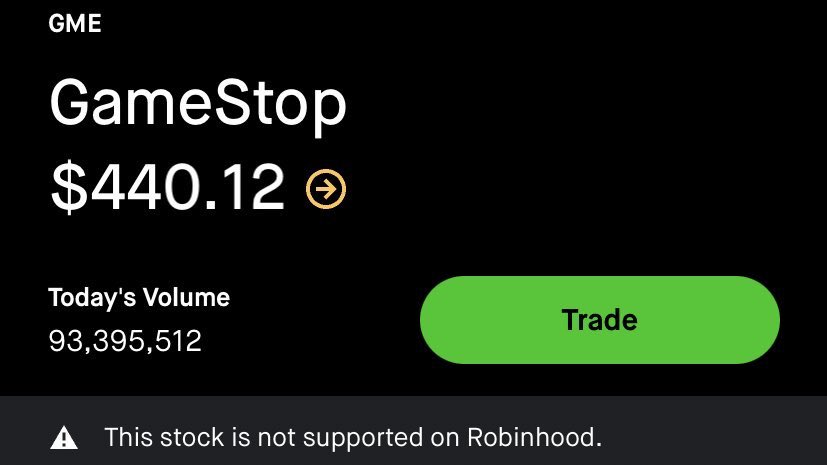
Enlarge/ An example of an error message greeting Robinhood users trying to buy certain volatile stocks Thursday.
In the absence of a stated reason for the move, some users started to get downright conspiratorial. Tweets started circulating suggesting that Robinhood was automatically selling shares of some stocks without the user’s consent. Robinhood has denied those reports, with a spokesperson telling The Verge, “I can confirm that claims that Robinhood proactively sold customers’ shares outside of our standard margin-related sellouts or options assignment procedures are false” (calling in shares bought on margin is an extreme move for a brokerage house, but it is allowed and does happen if the brokerage needs to cover other movement).
Some observers tried to connect the dots to suggest the tail was wagging the dog, with Citadel supposedly demanding help from Robinhood to protect its newly acquired short positions (even though Melvin reportedly got out of its GameStop short positions on Tuesday). Others suggested (without evidence) that the SEC or other regulators had forced Robinhood to suspend purchases to protect their true masters, i.e. the heavily shorted hedge funds.
It wasn’t until after the markets closed on Thursday that Robinhood finally started to try to put the lid on these theories. “To be clear, this decision was not made on the direction of any market maker we route to or other market participants,” Robinhood CEO Vlad Tenev tweeted at 4:15pm Thursday.
Where’s my money?
So what was behind the move, then? In a statement posted Thursday evening, Robinhood said it was a “tough decision” that was driven by pesky regulations:
As a brokerage firm, we have many financial requirements, including SEC net capital obligations and clearinghouse deposits. Some of these requirements fluctuate based on volatility in the markets and can be substantial in the current environment. These requirements exist to protect investors and the markets and we take our responsibilities to comply with them seriously, including through the measures we have taken today.
The details of the Financial Industry Regulatory Authority’s Net Capital Requirements for Brokers or Dealers get incredibly arcane incredibly quickly. At their base, though, they require brokerages to maintain a certain amount of liquid funding to cover the financial obligations of the stocks and options they hold for customers.
When the stock a brokerage holds is extremely volatile (like the 13 stocks in question here), the brokerage can’t claim the full current value when using that stock as collateral for the overnight borrowing that often helps keep it liquid (i.e. it has to take a significant “haircut” on what the market currently says that stock is worth). Stock clearinghouses, which do the backend processing for trades made through brokerages, also require more significant collateral to cover those trades when a stock is volatile.
“Now I know how Clorox and Lysol felt in the pandemic when they were running out of hand sanitizer and supplies…”
In an interview with CNBC, Tenev said point blank that “there was no liquidity problem” and that Robinhood’s move was made “pre-emptively and proactively” to “protect the firm and protect customers.” But in the same interview, he said he “know[s] how Clorox and Lysol felt in the pandemic when they were running out of hand sanitizer and supplies,” which suggests that the company didn’t have enough of something (e.g. money) on hand to handle the SEC requirements for the trading influx.
“We just haven’t seen this level of concentrated interest in a small number of names before,” Tenev continued. “So we understand our customers are upset… We stand with our customers, we stand for the everyday investor and we do believe that you should be able to buy and sell the stocks that you want to, subject to all the requirements [emphasis added].”
Can they do that?
SEC rules or no, there’s something unsettling and seemingly unfair about a major brokerage like Robinhood just changing the rules of what a retail investor can and can’t buy at a moment’s notice. A number of class-action lawsuits are already circulating accusing Robinhood of things like “depriv[ing] retail investors of the ability to invest in the open market and manipulating the open market.”
Unfortunately for those retail traders, there’s probably nothing illegal about a brokerage cutting off purchasing of specific stocks at any time. “Generally speaking, any brokerage firm’s contract is going to give them the right to reject your transaction if they want to, and it’s basically at their sole discretion,” said Steve Mellen, a partner at Winget, Spadafora & Schwartzberg who has practiced securities law since 1994.
But this general rule only applies to the ability to buy stocks. If you want to liquidate your position, a brokerage “cannot normally reject an offer to sell a stock assuming it’s a long position, (i.e. you own it in your account with your own money),” Mellen said. “Nor is there a reason they’d want to, really.” That’s probably why Tenev clarified in his CNBC interview that “to be clear, customers could still sell those securities if they had positions in them…”
Some lawsuits (and amateur observers) have pointed to FINRA rule 5310, which requires that brokerages “must make every effort to execute a marketable customer order that it receives promptly and fully.” But Mellen says that only applies if the brokerage accepts the order in the first place. If you state up front that you’re not letting a user make a trade, in other words, then there’s no trade to “execute promptly and fully.”
“Generally speaking, any brokerage firm’s contract is going to give them the right to reject your transaction if they want to, and it’s basically at their sole discretion.”
“I doubt the plaintiffs have any valid claim when they decide they won’t accept any more buy orders, as long as they tell you right away when you try to place the trade,” Mellen said. “Where they [could] get into trouble is if they lead you to believe they accepted your order, and then an hour later they call you to say they’ve decided not to because in that hour you could have gone to a different firm and maybe now you lost your buying opportunity.”
Others have suggested that if some of these stocks continue to rise, Robinhood might be on the hook for unrealized gains that its customers missed out on through the inability to buy on Thursday. “When your only complaint is that you missed out on a buying opportunity, who even knows if it would have been profitable,” Mellen said. “You certainly didn’t know at the time, you just had a hunch, and we don’t know when you would have sold it either. So it’s not actually a great claim for damages either way.”
What happens now
With the legal and regulatory liability seemingly covered, Robinhood’s main problem at this point is reputational. The idea that “everyone should have access to the financial markets” is baked right into Robinhood’s mission statement, after all. Restricting customers’ access to the hottest part of those markets—even temporarily and even with a valid reason—is not a great look, to say the least.
It’s not hard to find the usual angry social media posts and calls for boycotts in the wake of Robinhood’s decision. In the end, though, the lesson of the restrictions on Robinhood’s fee-free trades might be of the “you get what you pay for” variety. Retail trading apps are fine if you want to gamble a few dollars on a hot stock for a lark. But if you want to be assured of reliable access to the latest market moves, you may need a full-service broker that potentially uses fees to help meet all those pesky capital requirements.
https://arstechnica.com/?p=1738244
25 years later, Midway’s lost “MLB Jam” arcade game has been found
By the end of the 1990s, you couldn’t throw a quarter in most malls without hitting an NBA Jam or NFL Blitz cabinet. “Arcade sports” became a full-blown sensation, and hockey, soccer, and tennis received their own high-speed arcade conversions. But that list of American sports sure seems to be missing its slice of arcade apple pie, doesn’t it?
You may have wondered for years why baseball never got an “MLB Jam” equivalent during that golden arcade era. Turns out, the sport got close. Thanks to the Video Game History Foundation, a new ROM has been unearthed for 1996’s lost Midway arcade game, Power-Up Baseball, and some of its former devs have explained what exactly happened with its development and cancellation.
A rare pair of trackballs
Power-Up Baseball came out only one year before NFL Blitz, but back then, even a single year could be a lifetime in terms of technology.
Though, hey, digitized faces are fun, right? Your batter will look at you and glare if you miss a swing.
Attract mode includes this advertisement, though the “create your own team” angle doesn’t appear to exist in this build.
Pick your teams.
Time for a showdown. (Sadly, this doesn’t include the “cheat code” selector you’ll find in NFL Blitz.)
Twins, circa 1996.
Cubs, circa 1996.
Some tips on your pitcher’s arsenal of throws between innings.
Use the trackpad to run toward a loose ball.
Bean ball throws require using the “power-up” button.
Big hit into a digitized crowd.
The “baseball fountain” spewing from home plate honestly doesn’t look much better than this in action.
What better way to show that a homer went out of the park than taking a photo outside the park?
The story begins with VGHF, which we’ve talked about at Ars, continuing its dive into a massive pile of unearthed code fragments stored by the family of late games developer Chris Oberth. Today’s VGHF blog post points to how this collection mostly focuses on Oberth’s personal code contributions to various game projects, as opposed to compiling entire teams’ collective code. One project proved an exception to that rule: a single CD-ROM with the word “baseball” handwritten in marker.
This was a goldmine for the seemingly lost Midway game, full of source code, art assets, and compiled ROMs. This build of Power-Up Baseball, dated from 1996 and built for Incredible Technologies’ custom 32-bit arcade platform, precedes the eventual “arcade baseball” action of MLB Slugfest 2003 by a considerable margin. (After learning about its existence, Ars’ Kyle Orland pulled off a tricky reverse look-up at archive.org to see that the game was known, albeit quite forgotten.)
As part of today’s information dump, VGHF has put together a lengthy two-player video (embedded below) showing how the near-complete build worked… which unfortunately makes clear why the game never saw a retail launch. The game was built largely by the aforementioned Incredible Technologies, an arcade game maker you may better know as the people behind Golden Tee, as a Chicago-area partnership with Midway. In interviews with VGHF, members of the PUB design team make clear that one very Golden Tee-like aspect is not evident in the uncovered ROM, and it allegedly helped with the game’s arcade fun factor: a pair of trackballs built into many of the test cabinets.
“Those trackballs took a serious beating if there were two serious people playing,” Incredible Technologies programmer Brian Smolik says. “To pitch, the faster you roll that ball, the faster you pitched, and the same with batting. So you had people slamming it as hard as they could. It was super intense. And nobody in the office could concentrate, because down the hall there’s two morons screaming and yelling and beating the heck out of this game.”
“Ultimately the big mistake”
Enlarge/ Members of the Power-Up Baseball staff, as members of a hidden developer team within the game. (We’ve yet to hear about other hidden teams in the game, and we’re pessimistic about finding the Wu-Tang Clan in here, given the game’s 1996 launch. But, hey, we can dream.)
That use of a trackball to either wind up and toss pitches or crush them as home runs has never otherwise been replicated in a baseball game that we’ve ever seen. Sadly, nearly everything else about PUB had been done before—and arguably had been done to death on weaker home consoles like Sega Genesis by the time Midway’s arcade version was sent out for consumer testing. An extra “power-up” button let players spend a slowly charging energy gauge to either throw wild pitches or add power to hits, but PUB didn’t follow Midway’s arcade-sports streak by letting players break the rules or shove each other, and the lack of 3D visual polish didn’t help. The game’s sole violent exception came from an intentional bean ball option, but this gave the hitter a free base instead of paying off for the pitcher or otherwise feeling like an NBA Jam shove-down.
Project Art Director Alan Noon points to issues with the game’s 2D engine and its “Mode 7” perspective cheats as among its hiccups, along with the clunkiness of either trying to field a fly ball or manage baserunners. (In other words, slamming a trackball to belt out a home run offered more arcade-caliber fun than making an outfielder run over an empty field by himself.) Designer John Newcomer is more blunt about why the game stalled during its test phase: “You have to bring in a certain amount of quarters during primetime at the arcade.” He and other staffers agree that PUB never figured out how to translate baseball’s open-ended nature, with innings that can drag on, to something that would gobble as many quarters in a given amount of time as NBA Jam did. Changing the number of innings didn’t change the core money-spending issue, either, the former staff says.
The game’s quarter-munching potential “was ultimately the big mistake we made,” Newcomer adds. “We should have figured that out from the beginning.”
[embedded content]
Power-Up Baseball ROM footage.
Still, as a rare dueling trackball experiment, PUB is certainly a fascinating curio from the dregs of arcade history, made all the more interesting by its recovered one-of-a-kind ROM. The accompanying oral history doesn’t hurt, either, complete with accounts of its NBA Jam-like digitization process and a handy guide of “power-up” pitches and hits as animated GIFs. VGHF has now put out the call for any other ROM versions that might be floating in the wild, since this one appears to be near-complete. Whether you have that juicy information, or you just want to imagine what arcade baseball in the ’90s might have been like, you owe it to yourself to read the full VGHF report—which also includes instructions for how to compile your own version of the game.
https://arstechnica.com/?p=1737933
“Warp speed,” “Prime Directive” predate Star Trek, per new reference tool
Enlarge/ The term “warp drive” actually predates its first use in the long-running Star Trek franchise by 14 years.
There’s no denying the profound influence that the Star Trek franchise has had on our shared popular culture. But it turns out that some of the best-known terms associated with the series—transporter, warp speed, and the famous Prime Directive—actually predate Star Trek: The Original Series by a decade or more. According to Jesse Sheidlower, a lexicographer and editor of the newly launched online Historical Dictionary of Science Fiction (HDSF), the first mention of those terms appeared in 1956, 1952, and 1940, respectively.
The origins of this new online resource date back to 2001, when Sheidlower was working for the venerable Oxford English Dictionary (OED). “OED has always been a crowdsourced entity,” Sheidlower told Ars. “In fact, it was probably the first crowdsourced thing.” Back in the late 19th century, OED editors typically placed notices in newspapers and magazines asking people to read various materials and contribute to their coverage of the English language.
While at OED, Sheidlower noted that science fiction was an area that was not very well served by scholarship, partly because science fiction hasn’t had much serious literary cache historically. That meant that the most significant (and rare) pulp magazines weren’t available in the usual archives, like the Library of Congress or the New York Public Library. So he set up a Science Fiction Citations Project (SFCP) and called on the science fiction community (fans and writers alike) to submit examples of the specialized terminology they found, all curated by moderators.
There was particular interest on “antedatings,” the earliest known examples of given words, which are of great interest to scholars. For instance, the OED had an entry for mutant—”in the sense of a person with unusual abilities or appearance that has arisen by a genetic mutation”—dating to 1954, but Sheidlower thought it was likely coined much earlier. He was right: the first appearance of the term was in 1934. The site remained active for many years, and one of the moderators, Jeff Prucher, even published a Hugo Award-winning book, Brave New Words, in 2007.
Over time, however, all that activity waned, and the site became effectively static. Sheidlower left OED in 2013 and no longer had access to the SFCP. Last year, he asked OED for permission to revive the project, including a major design overhaul. The pandemic meant he had sufficient time to undertake such a massive overhaul, and the fact that many rare science fiction sources had by now been digitized—including the original pulps—made it easier for him to do his own extensive research.
Enlarge/ A sample entry for “chrononaut” in the Historical Dictionary of Science Fiction.
Jesse Sheidlower/HDSF
Like its predecessor, the HDSF helps improve and expand our knowledge of antedatings. Thus far, according to Sheidlower, the HDSF has found more than 400 antedatings. For instance, thought-controlled was thought to date back to 1977, but it has now been traced back to 1934. Deep space dates back to 1921 (instead of 1937), ray gun first appeared in 1923, deflector was first mentioned in 1931, and the notion of a mad scientist can be traced back to 1893. And the scientific terms biotechnician and graviton were first coined in science fiction, in 1940 and 1929, respectively.
The new HDSF also included some useful added features; it’s not just a list of words. Sheidlower went to great lengths to include links whenever possible to online source material—all added manually. For example, click on mutant, and you’ll find yourself on the entry page with a chronology of its usage starting with earliest mention to current usage. Click on the 1934 mention, and it will pull up an image of the actual page where the word first appeared.
“It’s turned from a site that was basically a notebook where people could write down the research they did into something that’s more broadly useful, making it both more fun to explore and more useful to those using it for serious scholarly efforts,” said Sheidlower.
There are currently no plans to adapt the HDSF into a print book, a la Brave New Words. But Sheidlower is hoping to continue to expand the resource, particular to include more 21st-century science fiction terminology. It already includes terminology from fandom communities (-con, faan, sercon), criticism, and particularly influential science fiction films and television shows (lightsaber, redshirt, TARDIS).
And while the HDSF has no official affiliation with the OED, apart from the association of its origins, at least one OED editor approves of the project. Executive Editor Peter Gilliver described it to The New York Times as “quite impressive, and very stylishly presented,” adding, “Jesse doesn’t like to leave any stone unturned. He’s a very dogged researcher.”
https://arstechnica.com/?p=1737615
The complete moron’s guide to GameStop’s stock roller coaster
Last week, an epic short squeeze had driven GameStop stock up to $40 a share, a roughly 1,500 percent increase from its low point nine months ago. Little did anyone know at the time that this would only be the beginning of the story.
As I write this, GameStop’s stock price is hovering around $350, up another 775 percent or so since I wrote about this situation eight days ago. By the time you read this, that number may be horribly outdated, as the stock continues to bounce up and down with extreme volatility hour by hour (it dipped down as low as $61 and peaked as high as $159 on Friday).
The current stock price now gives the company a market cap of about $26 billion.
On the surface, that means the market currently thinks GameStop is worth more than twice as much now (during a potentially existential threat to brick and mortar game sales) as it was during the height of the Wii boom in late 2007, when console game downloads were barely a thing.
It’s an understatement to say that nothing has changed about GameStop’s fundamental business to justify such a quick and dramatic rise in valuation. But getting at what is causing the nearly vertical launch of GameStop’s stock value is a little complicated.
A short lesson on shorts
To understand what’s happening to GameStop stock, first you have to understand short selling, where investors make a bet that a stock will go down instead of up. To do this, they borrow a share of the stock (for a fee), immediately sell it to pocket the current value, and agree to buy another share later to “cover” their short position.
But shorting stocks comes with huge risks if the stock price goes up. When your short position eventually comes due, you’re forced to buy the stock at whatever price the market currently sets, and there’s theoretically no limit to how high it could go. If you invest $1,000 in buying a stock, all you can lose is $1,000. If you borrow $1,000 worth of stock to short it, you could lose a lot more than that when you’re forced to buy much more expensive stock.
Investors as a whole were so sure that GameStop stock was going to go down that they wanted to borrow every single available share (and then some) to make money on the coming collapse.
When investors do lose money on a short position in this way, they often reborrow more short options at the new price to hedge their bet (if they expected the stock was overvalued before, it’s probably even more overvalued now, right?). That “short squeeze” process can theoretically keep going until the stock price actually starts going down (perhaps because traditional “long” investors want to pocket their profits) or the short sellers run out of capital to keep borrowing.
GameStop has been one of the most heavily shorted stocks on the market for a while now. Since the middle of 2019, the “short interest” (i.e., the number of shares investors have expressed interest in borrowing for a short position) has heavily surpassed the stock’s “free float” (i.e., the number of actively traded shares available). In other words, investors as a whole were so sure that GameStop stock was going to go down that they wanted to borrow every single available share (and then some) to make money on the coming collapse. And keep in mind, this phenomenon started when GameStop stock was already trading at historic lows of $5 a share or less.
GameStop faces plenty of headwinds to its core business of selling disc-based games in brick-and-mortar stores (as we’vewrittenaboutextensively). But that extreme level of short interest in an already heavily depressed stock was probably overly pessimistic about the company’s near-term prospects.
“They don’t have net debt, so they’re not going bankrupt or anything,” Wedbush Morgan analyst Michael Pachter told Ars last week. “And with the new console launch, they’re probably going to sell a lot of consoles and be fine.”
As it turns out, a group of retail investors noticed this excess of pessimism and was poised to exploit it.
Enter the Redditor
The WallStreetBets subreddit (WSB) describes itself as “like 4chan found a Bloomberg terminal,” and that’s not a bad description. WSB is a generally disorganized mess of posters throwing up memes and slang that can be hard to parse for an outsider. At the center of it, though, are members who analyze the market for opportunities so they can try to rally the sub’s millions of subscribers (2.9 million as of this writing) to a potential value play.
A few posters on WSB began to notice GameStop as a potentially undervalued and overshorted stock back in 2019, without too much wider action. But the group’s attention began to crystallize around April 2020, when WSB member Senior_Hedgehog laid out what turned out to be a prescient case for “the biggest short squeeze of your entire life.”
GameStop stock remained relatively flat in the months following that post. That changed in August, when Chewy.com founder Ryan Cohen bought a 9 percent stake in the company. Since then, Cohen has increased his stake in the company, earned control of three board seats, and promised to try to refocus the retailer into a more purely digital business.
“GameStop’s challenges stem from internal intransigence and an unwillingness to rapidly embrace the digital economy,” Cohen said in a November SEC filing. “If GameStop takes practical steps to cut its excessive real estate costs and hire the right talent, it will have the resources to begin building a powerful e-commerce platform that provides competitive pricing, broad gaming selection, fast shipping, and a truly high-touch experience that excites and delights customers.”
Enlarge/ The YOLO-riffic logo for r/WallStreetBets.
Whether or not that transformation will be possible, the interest from the usually risk-averse Cohen was enough to get some investors to take another look at buying GameStop. The price started creeping up from $5 in the middle of August to nearly $20 by the end of the year. That put some pressure on all those short positions, but not enough to stop them from reborrowing and keeping short interest high.
On Reddit, meanwhile, the hype around the turnaround only got louder and louder as the stock price increased. Some WSB members (and others) posted lengthy analyses suggesting a “fair value” of $100 or more per share for GameStop based on expected earnings (analysts in aggregate suggest a much more modest $13.44 price target based on the fundamentals). Others take a more meme-centric, “for the lols” route, reminding their compatriots that “stocks only go up” and urging “diamond hands” (i.e., hands that never stop holding) and bitcoin-style HODL strategies as GameStop stock goes on a “rocket to the Moon.” Some even encouraged GameStop stock owners to tell their brokers not to allow those shares to be borrowed for further short options, squeezing short borrowers even further (it’s not clear how much effect this part of the effort has had, in aggregate).
Through it all, the WSB-ers have been able to coalesce around a vision of themselves as the “little guy” using cheap retail trading tools to fight against a common perceived enemy: massive hedge funds that were heavily shorting the stock. Citron Research founder Andrew Left, who’s been publicly arguing for a $20 price target for GameStop, said last week he was targeted by a wave of harassment and attempted hacking ahead of a planned video arguing for the short position.
More recently, Melvin Capital Management has seen its value fall 30 percent this month, thanks in no small part to a heavy short position in GameStop. The hedge fund was forced to take a $2.75 billion cash infusion from Citadel to stay solvent in recent days. CNBC reports that Melvin finally closed out its short position Tuesday afternoon, i.e., taking a huge loss rather than redoubling on the short borrowing. But many WSB posters are publicly doubting that report and are confident they can literally bankrupt a massive hedge fund if the GameStop stock price goes high enough.