Archaeology is going digital to harness the power of Big Data

Archaeology is catching up with the digital humanities movement with the creation of large online databases, combining data collected from satellite-, airborne-, and UAV-mounted sensors with historical information.
Enlarge / Archaeology is catching up with the digital humanities movement with the creation of large online databases, combining data collected from satellite-, airborne-, and UAV-mounted sensors with historical information.
Brown University
There’s rarely time to write about every cool science-y story that comes our way. So this year, we’re once again running a special Twelve Days of Christmas series of posts, highlighting one science story that fell through the cracks in 2020, each day from December 25 through January 5. Today: archaeologists are using drones and satellite imagery, among other tools, to build large online datasets with an eye toward harnessing the power of big data for their research.

Archaeology is finally catching up with the so-called “digital humanities,” as evidenced by a February special edition of the Journal of Field Archaeology, devoted entirely to discussing the myriad ways in which large-scale datasets and associated analytics are transforming the field. The papers included in the edition were originally presented during a special session at a 2019 meeting of the Society for American Archaeology. The data sets might be a bit smaller than those normally associated with Big Data, but this new “digital data gaze” is nonetheless having a profound impact on archaeological research.

As we’ve reported previously, more and more archives are being digitized within the humanities, and scholars have been applying various analytical tools to those rich datasets, such as Google N-gram, Bookworm, and WordNet. Close reading of selected sources—the traditional method of the scholars in the humanities—gives a deep but narrow view. Quantitative computational analysis can combine that close reading with a broader, more generalized bird’s-eye approach that can reveal hidden patterns or trends that otherwise might have escaped notice. The nature of the data archives and digital tools are a bit different in archaeology, but the concept is the same: combine the traditional “pick and trowel” detailed field work on the ground with more of a sweeping, big-picture, birds-eye view, in hopes of gleaning hidden insights.

One paper in particular demonstrates the power of this approach, authored by anthropologists Steven Wernke and Parker VanValkenburgh, of Vanderbilt University and Brown University, respectively. They collaborated with fellow co-author Akira Saito, an ethnohistorian with the National Museum of Ethnology in Japan, to develop two online databases, and used them to bring a fresh perspective to the forced resettlement of the Inca Empire in the 1570s by Spanish conquerors.

The Linked Open Gazetteer of the Andean Region (LOGAR) is designed to collect primary source information on relevant locations of interest to those who study the Andes region. It includes information collected from a comprehensive record of the resettlement known as the “Tasa de la Visita General,” maintained by the Spanish-appointed viceroy of Peru. The Geospatial Platform for Andean Culture, History and Archaeology (GeoPACHA) complements LOGAR. It’s an open-source, browser-based platform that lets users discover and document archaeological sites in the Andes by systematically surveying satellite and historic aerial imagery, via networks of trained teams.

The trio were able to create a comprehensive basemap of the planned colonial towns (reducciones) built during that mass resettlement. That helped them spot an intriguing pattern in the distribution of those reducciones: it seemed to follow a remarkably similar distribution of the Inca imperial infrastructure, namely its road system. Specifically, they noted similar clustering of populations in the greater Cuzco and Lima areas. “The Spanish, after about 40 years of being in Peru, were trying to figure out how to govern this vast territory,” VanValkenburgh told Ars. “They directly imitated what the Inca were doing. The resettlement was one of the initiatives at the core of that attempt to reimagine Spanish governance in an Inca model.”

Peru. Machu Picchu. Ruins of Inca Empire City And Huayna Picchu Mountain In Sacred Valley.
Enlarge / Peru. Machu Picchu. Ruins of Inca Empire City And Huayna Picchu Mountain In Sacred Valley.
Marka/Universal Images Group via Getty Images

This new emphasis on using the digital tools of Big Data doesn’t mean archaeologists are “throwing in the trowel” when it comes to traditional field work, however.  Wernke and  VanValkenburgh discussed with Ars the necessity of maintaining a crucial balance between the two approaches, as well as expounding upon the potential advantages and drawbacks of tapping into the power of scale.

Ars Technica: Archaeology has been lagging behind the humanities in terms of incorporating these techniques. Why is that?

Steven Wernke: Archaeologists generally think of field-collected data as the gold standard and we tend to be very bound to that standard. We tend to think of people as the main instrument of observation as archeologists. But what we’re trying to do is not in any way to replace that, or claim that what we’re doing is somehow better. We’re trying to complement that approach with these new tools for turning old imagery into things that we can put online and search systematically.

The other dimension to this has to do with documenting archaeological heritage, at a time when it’s disappearing at an accelerating rate. Some of that is driven by climate change. In Peru we see this very concretely through intensifying El Nino events, which triggers all kinds of flooding on the North coast of Peru that is has been destroying sites. Looting is another major problem, which is really responding to market forces that originated in the Northern hemisphere from the antiquities market. There are sites in Peru with bodies laying all over the place because a cemetery was identified and the looters have gone in to try to get metal and textiles.

Parker VanValkenburgh: A big part of this is about the nature of archaeological data itself. Genetic data has this sort of primordial modularity to it, so it can be reduced down to a series of specific variables. If you’re an archaeologist and you want to study the growth of cities across the ancient world, there are variations in archaeological data caused by human culture, which is not modular. That means it’s really difficult for people to agree on what the break points are between different sorts of classifications. It’s difficult to scale up data collection and datasets to the point that you can do these types of big data analyses. So it’s natural that big data analytics are first being applied in datasets that weren’t specifically collected for archaeological analysis in the first place, like satellite data.

Ars Technica: There is inevitable tension between finely tuned details and the so-called “eye in the sky” perspective offered by a systemic digitized approach. How do you find a good balance?

Wernke: In a nutshell, you find it by doing both. We’re both field archaeologists. I would say 90 percent of what I’ve done has been survey and excavation in the field. I’ve worked in the same valley in the Andes for 25 years. That’s not unusual. Archaeologists tend to specialize geographically and they tend to get to know a place intimately. I’m a big advocate for that. We’re hyper-conscious of the fact that this kind of godlike view you get from viewing the surface of the earth from everywhere and nowhere at once brings with it a lot of risk of overlooking all this local variability, and all the complexity on the ground that we ourselves have documented. Yet we now also know if we’re only on the ground, we’re missing several levels of forces that were acting on humans in the past, forces that are acting on us presently. We’re trying to link these things together. We’re not trying to displace one with the other.

VanValkenburgh: Archaeology is a field, at least in its modern iteration, that is really good at telling these intense small stories. It’s micro-historical in a way. That’s valuable when you have these big sweeping generalizations of what happened in the past and you effectively hold generalizing theory accountable by applying it in really specific locations. But where does that theory come from? Currently what we have is a random smattering of studies. Take one example, the Inca Empire. What we know about the Inca Empire is the sum of a bunch of somewhat random studies that, in their aggregate, tell us a lot about how the Inca work and a lot about local variation. But it hasn’t been systematically sampled with an idea for understanding the entire system.

Big data is often discussed as being this radical alternative to the hypothetical and deductive approach. But in archaeology, it’s providing us with a better generalized model to test against, or to fit alongside, the really localized things we’re doing. That way we can better contextualize the type of micro-historical research that we both think is going to continue to be archeology’s bread and butter for a long time.

Engraving of the execution of Inca by A.B. Greene. The Spaniards burnt Atahualpa at the stake with a monk presiding holding crucifix to the right.
Enlarge / Engraving of the execution of Inca by A.B. Greene. The Spaniards burnt Atahualpa at the stake with a monk presiding holding crucifix to the right.
Photo12/Universal Images Group via Getty Images

Ars Technica: Your work on the Inca Empire, and the resettlement in particular, provides a useful case study. Let’s talk about the challenges of understanding this point in history and how big data can help. 

Wernke: At its peak in the 16th century, the Inca Empire was the largest empire in the world before the Spanish invaded the Americas. Terence D’Altroy, a prominent scholar of the Incas at Columbia University, has written, “If the Inca Empire were in the Old World, it would stretch from St. Petersburg in the North to Cairo in the South.” It’s enormous. That’s a big data challenge that encompasses over five modern republics in today’s terms, millions of people, dozens of ethnolinguistic groups, and one of the most [geographically] diverse areas—from the driest desert in the world, to the wettest rainforest in the world, and everything in between as you go up the Andes on one side and down the other.

The traditional narrative is Spanish conquest, with a capital C. We’re trying to complicate that narrative on several levels. This mass resettlement program occurred a generation after the invasion in the 1570s—about 40 years after the conquest of the Incas by Francisco Pizarro. You could easily fit [the resettlement] to that narrative of conquest, because over a million people virtually overnight were displaced to over a thousand towns built throughout the vice royalty. Yes, it was hugely disruptive and a form of domination, but it was also profoundly dependent on what came before, in terms of Inca administrative infrastructure and local arrangements with Spanish administrators. Through this big global picture, we can start to see one dimension of that: how they were dependent on the Inca road system that came before. So what the Spanish would say was a form of conquest was in some sense kind of an afterlife of Inca imperialism, a recycling of Andean forms of imperialism.

VanValkenburgh: The Spanish invasion was literally an infection. The first invaders from the Old World to arrive in the Andes appeared with new pathogens. Then you think about the Inca Empire as being a body and the road system as being a circulatory system. The Spanish invaded and colonized this existing thing and took it over. People always say, how is it this group of 200 people took over a vast empire? They took over the way that a virus [takes over] a host, and they played native factions against each other. The Inca had conquered a bunch of people who were not particularly fond of them and the Spanish took advantage of those rivalries. But the way that they moved around their goods, their troops, etc., after the Spanish invaded was the same road system.

Researchers pinpointed each Spanish colonial settlement atop a map of the Inca imperial highway system, demonstrating that the Spanish relied heavily on indigenous infrastructure to conquer and restructure the Inca Empire.
Enlarge / Researchers pinpointed each Spanish colonial settlement atop a map of the Inca imperial highway system, demonstrating that the Spanish relied heavily on indigenous infrastructure to conquer and restructure the Inca Empire.

Ars Technica: How do you ensure the quality of your datasets, particularly in a field like archaeology, where you’re often dealing with imperfect or incomplete information?  

Wernke: We’ve been careful to structure GeoPACHA as a peer review kind of system internally. It is crowdsourced in that many people are working on it, but it’s not just wide-open crowdsourcing. We have teams of researchers who are experts in their fields. They have come to the project with specific research questions that they want to address. They’re working with their students, and the students are working directly with them as regional editors for their projects. They review their team’s site identifications, and then we as the general editors do the final review on those before they are committed to the database. We also have a system for tracking coverage, a cell-based grid that’s overlaid on these survey areas. The user will mark a grid cell as surveyed, and that also gets reviewed by the regional editors and general editors to make sure that nothing was missed, that we don’t have false negatives.

VanValkenburgh: One of the things we both think about is, if we scale this up beyond where we’re currently working, can this model of peer review work? Wikipedia has found its own way to produce a lot of quality with a relatively small set of really dedicated people. In some ways that’s what we envision going forward. But there have been a number of different initiatives that have tried to harness the power of crowdsourcing for archaeological site edification out there, and I think initial results have shown that being able to identify archeological sites and satellite imagery is actually pretty hard to do in some cases. The kind of vision that you need to interpret satellite imagery requires a fair amount of training. This is an issue that [also extends] to textual data and all other kinds of data that have become a big part of archaeological data science.

Ars Technica: Where would you like to see this field go over the next 10 years? What’s your vision for how this might all come together?

VanValkenburgh: Cooperation and ethical introspection are the two things I think are most important.  There’s two parallel tracks in terms of data aggregation that are going on right now. We’ve got initiatives like Open Context, which is a pioneer in open data for archaeology, plus a number of other initiatives including the Digital Archaeological Record, to create massive databases that allow archaeologists to ask systematic questions about comparison. I’d love to see a cultural shift in the field, where people are attempting to get their data into repositories like that, thereby enabling us to do more systematic comparison.

There’s also the parallel development where people are going out and collecting large datasets with an end goal of modularity at large scales. LiDAR is one great example. That is a different type of big data. But I’d like for there to be some standards for data sharing in LiDAR, as well as across both of those parallel tracks. In the community, we need to have a serious conversation about the ethics and best practices of doing big archaeology. Working in scale poses questions about privacy and data sovereignty that are not unlike ones we face as archaeologists working on the ground. But the archaeologist working in a local community is beholden to personal relationships in a way that you don’t necessarily get when you’re working as an eye in the sky. So I think we’re entering a more contemplative phase of archaeological science.

DOI: Journal of Field Archaeology, 2020. 10.1080/00934690.2020.1714307  (About DOIs).

DOI: Journal of Field Archaeology, 2020. 10.1080/00934690.2020.1713286  (About DOIs).

https://arstechnica.com/?p=1732570


How electric lighting changed our sleep, and other stories in materials science

A housewife proudly presents her indispensable Pyrex kitchenware (1955). Ainissa Ramirez tells the story of its invention, and how it molded human behavior in turn, in her book, <em>The Alchemy of Us</em>.
Enlarge / A housewife proudly presents her indispensable Pyrex kitchenware (1955). Ainissa Ramirez tells the story of its invention, and how it molded human behavior in turn, in her book, The Alchemy of Us.
Chaloner Woods/Getty Images
There’s rarely time to write about every cool science-y story that comes our way. So this year, we’re once again running a special Twelve Days of Christmas series of posts, highlighting one science story that fell through the cracks in 2020, each day from December 25 through January 5. Today: Kick off the new year with physicist and “science evangelist” Ainissa Ramirez as she tells engaging stories about materials science, the technologies it enables, and how those technologies impact human behavior in her book, The Alchemy of Us.

The American 19th century entrepreneur Thomas Edison is perhaps most famous for his development of the incandescent light bulb, but few people likely know that part of his inspiration came from an obscure fellow inventor in Connecticut named William Wallace. Edison visited Wallace’s workshop on September 8, 1878, to check out the latter’s prototype “arc light” system. Edison was impressed, but he thought he could improve on the system, which used a steam-powered dynamo to produce an incredibly bright light—much too bright for household use, more akin to outdoor floodlights. The result was the gentle glow of the incandescent bulb.

Other inventors had come up with versions of an incandescent lamp prior to Edison, but the Menlo Park wizard discovered an excellent incandescent material in carbonized bamboo that lasted for over 1000 hours, and also devised a fully integrated system of electric lighting to drive adoption of this new technology. Edison found a material he could shape to his needs. But electric lighting would in turn shape how people slept, as physicist and self-described “science evangelist” Ainissa Ramirez explains in her book, The Alchemy of Us: How Humans and Matter Transformed One Another, released in April.

Prior to the Industrial Revolution, people experienced “segmented sleep”: they would retire to bed and sleep for three or four hours (“first sleep”), then wake up after midnight and stay awake for another hour or so, before going back to bed for their “second sleep.” There are references to first sleep in Homer’s Odyssey and Virgil’s Aeneid, according to Ramirez, as well as several 19th century novels and thousands of 19th century newspaper reports. “When artificial lights came into being, they pushed back the darkness and lengthened the day,” she writes.

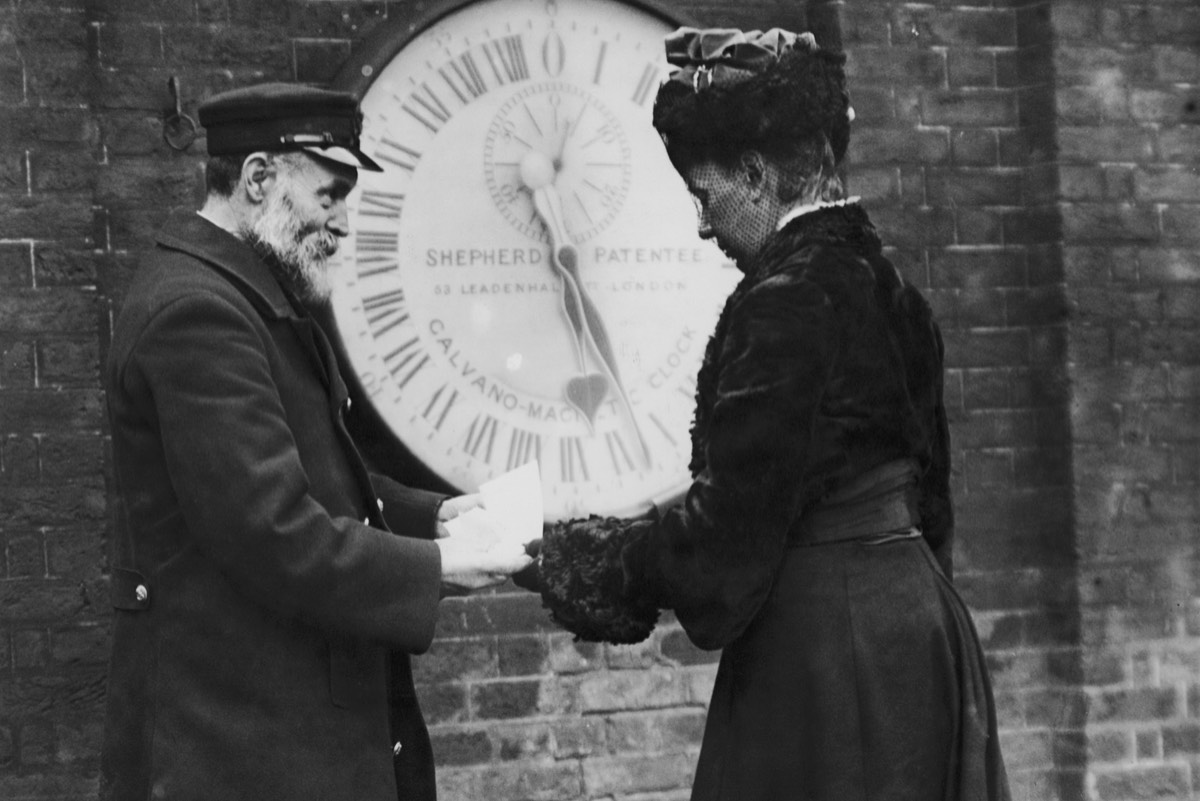
It’s just one of the many fascinating interconnected tales featured in The Alchemy of Us, which opens with the story of Elizabeth Ruth Belville, aka the Greenwich Time Lady, whose work was the means of ensuring standard time in London before the advent of radio. Bearing her pocket chronometer No. 485/786—a family heirloom dubbed “Arnold”—Belville made the rounds every day to her 200 or so clients, who would pay for the privilege of looking at Arnold (set to Greenwich Mean Time) and adjusting their own timepieces accordingly. That growing cultural obsession with keeping time also ended up impacting our sleep patterns.

Elizabeth Ruth Belville receives a timekeeping certificate from an official at the Royal Greenwich Observatory, circa 1903.
Enlarge / Elizabeth Ruth Belville receives a timekeeping certificate from an official at the Royal Greenwich Observatory, circa 1903.
Fox Photos/Hulton Archive/Getty Images

Again and again, in The Alchemy of Us, Ramirez demonstrates how we shape materials, and are shaped by them in turn, whether it’s steel rails, telegraph wires, hard disks, glass, or the thin and flexible cellulose film—which eventually spawned the entire movie industry—invented by a New Jersey preacher name Hannibal Goodwin. (Goodwin died in a tragic street accident before he could capitalize on his invention, leaving the way clear for George Eastman to start production of roll-film using his own patented process.) Ars sat down with Ramirez to learn more.

Ars Technica: What inspired you to write this particular book?

Ainissa Ramirez: I was trying to find another way for people to get excited about materials. There’s a whole range of books out there that profile different materials and how they’re used, maybe telling a few stories [in the process]. I decided to turn that upside down and really focus on the story—because I believe stories are a little stickier—and use that as a conveyor belt, if you will, to have the science enter into someone’s mind. It was also an attempt to generate new myths. We talk about great people, great men of science, and I really wanted to emphasize people that you don’t know, who’ve made things that you take for granted.

Ars Technica: We have built a popular science mythology with people like Thomas Edison, Nikola Tesla, Albert Einstein, and so forth in the pantheon. But there are all kinds of inventors and scientists lost to the archives—William Wallace doesn’t even have his own Wikipedia page—and your book brings them more to the forefront. How does it happen that some of these people get forgotten while others are lionized? 

Ramirez: Well, part of Edison’s business was promoting Edison. He actually had a reporter following him all the time. He met William Wallace in Ansonia, Connecticut, which is actually two cities over from where I am. I went over there and I asked people, “Did you know Edison came to Connecticut?” Nobody knew this. Over the generations, the myth has become that he just had this bolt of inspiration, not that he got it from some gentleman tinkerer.  So Wallace is often relegated to the footnotes in many Edison biographies. I got to see one of the lights Wallace had made, and the factory. There was much, much more to him than that footnote. I just wanted to give him an opportunity to shine.

Ars Technica:  I understand the book’s theme came about when you signed up for a glass-blowing class. Can you tell us a little about that? 

Ramirez:  I live about two cities over from a glassblowing studio. I had gone to Italy and saw Murano glass makers and I was like, “Oh, my God. This is amazing.” I wanted to learn new things about an old material. When I’ve worked with materials [in the past], I was working with nanotechnology, so I had many degrees of separation between myself and the material. So I signed up for a class, but I was very, very timid, because you’re working with things that can definitely give you some harm. My instructor said, “If you step on hot glass, it’s going to melt a hole in your shoe.”

There was a physicality to it that I really enjoyed. I also was able to put concepts together with action. I could swing the glass and I was employing viscosity. The way that I rolled the glass on this metal surface spoke to heating and cooling. I was developing over the course of weeks a new relationship with glass. And then I had a very bad day where I was working with the glass and it fell on the floor. Fortunately my instructor came over and reattached the piece to my pipe.  But after I completed that very lopsided looking piece, I thought, “I came into class in a very bad mood. And then I wasn’t in a bad mood.” The glass shaped me. I was certainly shaping it because it was a lump and I was giving it form.

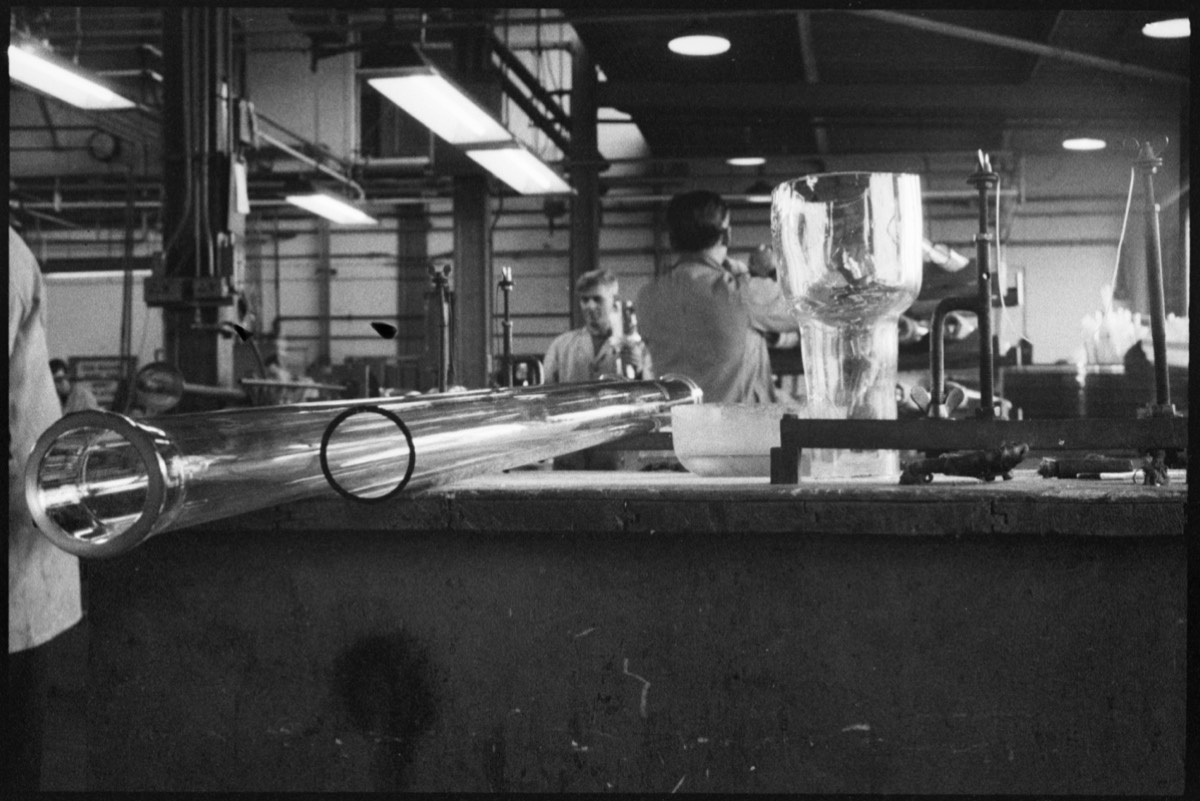
Laboratory glassware being manufactured at the Wear Flint Glass Works, 1961.
Enlarge / Laboratory glassware being manufactured at the Wear Flint Glass Works, 1961.
Heritage Images/Getty Images

Maybe it was a little bit of a stretch, but it made me think, “Okay. I was in a dance with this glass. Nothing else was on my mind. It was shaping me because it was putting me in a better mood.” That was the impetus for me to think about this dance between humans and matter, and how they shape each other. I kind of became a glass nerd. What I didn’t think was covered was glass’s role in science and how instrumental it’s been in terms of discovering things like the electron, and penicillin, for example.

Ars Technica: What are some of your favorite stories that you discovered while researching and writing your book?

Ramirez: I stumbled on the story of Hannibal Goodwin by accident.  My brother told me, “I just heard about this guy in Newark, a preacher who made a camera film.” I said, “Stop giving me new work. I’ve got stuff to do.” But I looked into it and yes, Hannibal Goodwin had created camera film before George Eastmam. I’m originally from New Jersey, and I hate when New Jersey history gets buried. I found the people who are taking care of Hannibal Goodwin’s old home. It’s very dilapidated. In fact, you can’t walk in the center of the floor because it’s decaying. But I was able to go into his house and take a picture of where he did his experiments.

I also learned about Almon Brown Strowger, a mortician who became convinced that the operator was redirecting calls to his competitors. The story goes that he was reading the obituary section, and he was upset because his friend had died. We’re not sure whether he was more upset that his friend had died, or that his competitor had embalmed the body. It put him into a creative rage, where he wanted to figure out how to make an automated switch that didn’t require female operators,  known as “Hello Girls.” He wore very nice clothes and he kept his collars in a cylindrical box. He took that out, dumped all the collars, and stuck in some pins. He thought, if I were to move something up and down, I can reach each one of these pins, and each pin could be a telephone number. If the number was 73, the pin would move over seven and up three, for example.

He applied for a patent for [the “Strowger switch“] and eventually found someone to make it. That was the first automatic exchange, and it was part of Bell Labs’ business for a long, long time. I worked at Bell Labs, but I had never heard of Almon Strowger.  I only heard about him because I went to an antique radio museum—really just an old warehouse—in New Haven.  I called my friend at the Bell Labs archives and said, “There was a mortician who created the switch. How come you don’t put that out in the front? Because that’s an amazing story.”

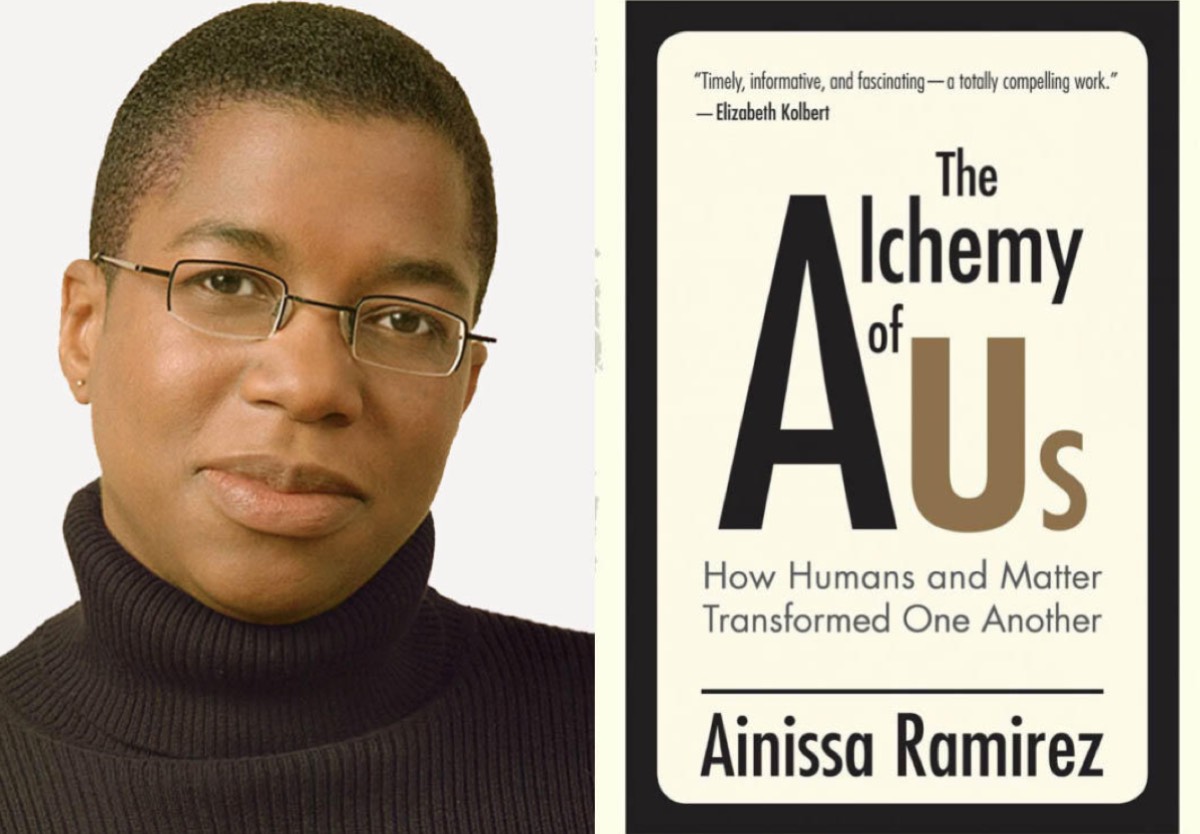
Physicist and science evangelist Ainissa Ramirez explores how we are shaped by technology, and vice versa, in her book, <em>The Alchemy of Us</em>.
Enlarge / Physicist and science evangelist Ainissa Ramirez explores how we are shaped by technology, and vice versa, in her book, The Alchemy of Us.
Ainissa Ramirez/MIT Press

Ars Technica: The last chapter, “Think,” talks about how, even though materials, and the associated technology, is shaping us, we can and probably should push back a little, because it might in turn help us reshape technology in a more beneficial way. Can you elaborate on that point? 

Ramirez:  Thinking is the most human part of us. It’s already been shown that the way that we think has been altered by our devices. This has always been the case. Ancient Greek teachers used to be so angry when their students wrote stuff down because they were expected to memorize and remember those things.  The computer might just be an extension of that, but the way computers are being infused into our lives, it’s happening much faster. I think we should just pause and make sure that this is the direction that we want to go in. I know my childhood phone number but I don’t know my mother’s [current] phone number because it’s stored in my smartphone. We now have a new relationship to information.

Having stuff in our memory banks is good, because in our subconscious we’re going to put them together in new ways. But if we’re just offloading them to our hard drives or to our computers, will creativity look the same? That’s the question I wanted to ask, and I used this book as a gymnasium. I’m hoping that if we look at older technologies that we think are simple, like the telegraph and the light bulb—if we can be critical of them, then when things come down the line like driverless cars and AI, we can at least feel empowered to ask questions. “Hey, the telegraph shaped language in unexpected ways. This AI thing, I have some questions.” Hopefully this book is a manual for us to look to the future, by taking another gander at the past.

https://arstechnica.com/?p=1732479


Superhero showdown: Which comic book rumble was the real Battle of the Century?

Hmm, we're sensing a trend here...
Hmm, we’re sensing a trend here…
Update, 1/1/21: It’s New Year’s Day, and Ars staff is still enjoying some necessary downtime to prepare for a new year (and a slew of CES emails, we’re sure). While that happens, we’re resurfacing some vintage Ars stories like this 2014 examination of a classic comic book claim, “The Battle of the Century.” This piece was first published on December 10, 2014, and it appears unchanged below.

Here’s one of those hidden-in-plain-sight industry secrets: headlines sell. Whether it’s cover lines on your favorite magazine, the title of a new novel, or headlines on Ars and elsewhere, good display text should draw readers in and spell out what’s coming.

When it comes to headlines and 20th century comic books, there’s one phrase that keeps popping up. Several books—not, one, not two, not three—boldly claim the title of “The Battle of the Century” on their covers. But since that 100 years is now behind us, we can look back to decide which truly was the Battle of the Century (and possibly call everyone else a liar).

What should constitute the Battle of the Century? To these comics, it’s two main things. First, the two combatants must both be at the top of their game. That’s more in terms of popularity and relevance than pure ability (Lil’ Abner versus Superman wouldn’t be fair otherwise). The second requirement is as easy—the battle itself has to somehow be epic. While doing research, we didn’t limit candidates to books using the word “battle”; we also included things like “fight,” “bout,” and “showdown.” The extravagant claim simply had to appear on the cover.

In total, this battle for the Battle of the Century comes down to 12 comics making the claim. We’ll consider these cases in chronological order, so first up is The Human Torch vs. The Sub-Mariner!

Candidate #1: The Human Torch vs. The Sub-Mariner

Admittedly, we’re already breaking our arbitrary rules. This comic does not state “Battle of the Century” on its cover; that claim lives on the splash page. However, this may be the first comic to make the claim, so it deserves some leeway.

Why are they fighting?

Namor, the Sub-Mariner, has vowed to destroy the human race. The Human Torch has recently joined the police department. So as Namor attempts to wreck the Washington Bridge, the Human Torch arrives to stop him. It’s easy to side with the Torch on this one.

How epic is the battle?

After the initial encounter, Namor soon retreats to his winged submarine to grab an air tank. He immediately returns to the surface, quickly blowing out the Torch’s flame. With his enemy distraught, Namor then drags the Torch underwater to his “Aerial Sub.” Namor wins in four pages!

But wait! Namor accidentally loses control of an air hose (which powers his engine) and it hits the Torch. Not only does the errant hose revive the Torch, it also surrounds him with an air bubble that eventually floats to the surface. Namor tries to stop the Torch bubble but can’t. (That’s right, ladies and gentlemen, The Sub-Mariner, Lord of the Seven Seas, is unable to pop an air bubble.)

Torch’s bubble bursts as it reaches the surface. Our hero is free and on fire, and the battle has transitioned back to land. Soon, Namor has jumped into a water reservoir for a refreshing dip. But the Torch (somehow) covers the reservoir with flame, trapping Namor. Namor immediately starts to suffocate because of the water’s chlorine content. He passes out.

So… The Torch wins!

Well, unfortunately the Torch can’t see Namor through the flames and doesn’t know his predicament. He contacts the Army and asks them to bomb the reservoir. (Yes, these two superhumans are actually trying to kill each other.) The American Army successfully drops an American bomb on the American reservoir. And this, of course, blows Namor out of the water, inadvertently saving him from suffocation.

As the fight begins anew, fans learn something new about The Sub-Mariner—he has a sprinkler system.

Who really wins?

After more shenanigans, Namor eventually slips a “translate case” over the Torch. This isn’t really a win, however. Every time Namor lifts the case to kill him, the Torch has enough air to burst back into flames.

Suddenly, an outside party appears. It’s Betty Dean, described as Namor’s “only human friend.” With Dean’s intervention, we’re treated to the searing, nail-biting conclusion:

[Betty sizes up the situation] “Listen to reason! There’s nothing you can do. Call the whole thing off. I promise you—if you go away and leave us alone, the Torch will never bother you again!”

After a brief clarification that this promise (unlike previous ones) will be upheld, the dispute is settled! (It’s actually quite sweet.) The former enemies quietly exchange pleasant goodbyes.

So… is it the Battle of the Century?

Both the characters were relatively well-known, there’s collateral damage, and it appears the fight lasted most of a day. On top of that, this brouhaha took place in 1940, when it’s possible that no one else yet made the claim. It’s a definitive “yes.” At this point in the 20th century, it is the Battle of the Century!

https://arstechnica.com/?p=581475


That time physicist John Wheeler left classified H-bomb documents on a train

In 1953, the eminent physicist and H-bomb advocate took an ill-fated overnight train from Philadelphia to Washington, DC, that would indirectly lead to the Robert Oppenheimer security hearing.
Enlarge / In 1953, the eminent physicist and H-bomb advocate took an ill-fated overnight train from Philadelphia to Washington, DC, that would indirectly lead to the Robert Oppenheimer security hearing.
Michail_Petrov-96/iStock/Getty Images
There’s rarely time to write about every cool science-y story that comes our way. So this year, we’re once again running a special Twelve Days of Christmas series of posts, highlighting one science story that fell through the cracks in 2020, each day from December 25 through January 5. Today: the story of how physicist John Wheeler once left classified documents about the newly developed H-bomb on a Pullman train.

In the popular science world, physicist John Wheeler is probably best known for popularizing the term “black hole,” although his research spanned a broad range of fields, including relativity, quantum theory, and nuclear fission. He also worked on Project Matterhorn B in the early 1950s, the controversial US effort to develop a hydrogen bomb. In January 1953, Wheeler accidentally left a highly classified document concerning that program on a train as he traveled from his Princeton, New Jersey home to Washington, DC. It was a stereotypical “absent-minded professor” moment, and one with significant national security implications.

Alex Wellerstein told the story in detail late last year in an article in Physics Today. Wellerstein is a historian of science at the Stevens Institute of Technology in New Jersey, where his research centers on the history of nuclear weapons and nuclear history. (Fun fact: he served as a historical consultant on the short-lived TV series, Manhattan.) His forthcoming book, Restricted Data: The History of Nuclear Secrecy in the United States, is slated for publication in April 2021 by the University of Chicago Press.

A self-described “dedicated archive rat,” Wellerstein maintains several homemade databases to keep track of all the digitized files he’s accumulated over the years from official, private, and personal archives. The bits that don’t find their way into academic papers typically end up as items on his blog, Restricted Data, where he also maintains the NUKEMAP, an interactive tool that enables users to model the impact of numerous types of nuclear weapons on the geographical location of their choice.

Wellerstein stumbled across the Wheeler story while examining declassified congressional transcripts from the 1950s, notably from the Joint Committee on Atomic Energy. “It was a very powerful committee in the 1950s,” he told Ars. “There’s all these strange stories that come up, because none of the [committee members] ever thought these things would see the light of day, so they were remarkably frank.” There are even comments in the transcript where members ask why the meeting is being recorded at all, because who would ever read it? “It’s me. I’m the one that’s going to read it one day,” said Wellerstein.

The “Wheeler incident” appealed to Wellerstein because it was rife with colorful details, as well as being of historical interest and relevance. But it was just one account from one person—the Joint Committee’s chief of staff, William Borden, who was fired after the incident—so he started digging around the archives for more information, even filing a FOIA request for Wheeler’s FBI file. That file turned out to be the most useful for the Physics Today article.

“They worked very hard to reconstruct exactly what had happened, so they interviewed everybody a million times,” said Wellerstein. “The FBI ended up being sort of a liaison between Congress, the Atomic Energy Commission, and Wheeler, because those groups weren’t really cooperating with each other.”

No ordinary report

What was it that was so special about those documents Wheeler took with him on the train? “The H-bomb document was no ordinary technical report,” Wellerstein wrote in Physics Today. “It was a bureaucratic weapon aimed directly at its creators’ political enemies.” In 1949, the Soviets detonated their first atomic bomb, and the US lost a major military strategic advantage. Some physicists, led by Edward Teller and Ernest Lawrence, felt the solution was to build a new kind of nuclear weapon: a hydrogen bomb that relied on nuclear fusion, rather than fission, for its devastating explosion (although such a reaction would need to be powered by a fission bomb).

But others, like J. Robert Oppenheimer, former head of the Manhattan Project, objected to the program, deeming it unnecessary. President Harry Truman ultimately sided with Teller and Lawrence, and the Matterhorn B project was born, but physicists remained bitterly divided on the topic. In March 1951, Teller and Stanislaw Ulam came up with an H-bomb design that even opponents of the program acknowledged would likely work. The prototype “Mike” device was successfully detonated in November 1952. But it wasn’t ready for practical use as a military weapon, Wellerstein wrote, given the 80 tons of cryogenic equipment needed to keep its deuterium fuel in a liquid state.

Meanwhile, a different kind of war was being waged on the political front by H-bomb proponents on the Joint Committee on Atomic Energy, many of whom were still bitter about Oppenheimer’s sharp criticism in particular. It fell to Borden, as chief of staff, to compile an official history of the H-bomb’s development, based on documentary sources, which doubled as a smear campaign against Oppenheimer. He sent a six-page extract of the document to Wheeler in Princeton, so the physicist could check the technical details.

Wheeler took the document on a Pullman sleeper train as he headed back to Washington, DC, and read it overnight—mostly to avoid the added expense of paying for an overnight stay in the hotel. Although he later began to doubt his memory, Wheeler recalled that he put the extract into its white envelope, placed that back inside its manila envelope, put the manila envelope in his suitcase, and then wedged the suitcase between himself and the wall. The porter, Robert Jones, awakened Wheeler at 6:45am as he had requested, and Wheeler took his suitcase to the men’s lavatory at the other end of the train to perform his morning ablutions. Per Wellerstein:

Wheeler left his suitcase on the counter, took the manila envelope with him into the men’s “saloon” (toilet stall), and closed the door. Finding nowhere to put the envelope, he wedged it between some pipes and the wall, just under the window on his right. He used the toilet. He exited the stall, continued washing up—and then realized he had left the envelope wedged against the saloon wall.

At that point two other men were using the wash basins and another man was occupying the toilet stall. Not letting decorum get in the way of security, Wheeler climbed on the washstand and attempted to peer through the metal grate on the toilet door. He could not see the envelope, but he could see the other man on the toilet and could see that he was not reading anything. Wheeler watched him until he finished his business and opened the door, at which point Wheeler ran in behind him and grabbed the manila envelope from behind the pipes. It did not seem tampered with.

But when Wheeler got back to his berth and looked inside the manila envelope, the white envelope containing the classified documents was gone. With the porter’s help, Wheeler searched the train for the missing white envelope, even checking with the station’s lost-and-found on the extremely unlikely chance that someone had turned it in—to no avail. Not even the FBI’s extremely thorough subsequent investigation turned up the missing documents.

Schematic drawing of the Pullman car where John Wheeler spent the night on 6 January 1953.
Enlarge / Schematic drawing of the Pullman car where John Wheeler spent the night on 6 January 1953.
Newberry Library, Chicago

In fact, those documents were never recovered, and their whereabouts remains a mystery to this day, although there are plenty of speculative theories. Wellerstein personally favors the theory that the porter found the documents and just threw them away rather than reporting the find, because he thought he would be better off pretending he never saw it—although being stolen by a spy is a far more exciting hypothesis. But given the lack of evidence, he thinks the spy scenario is highly improbable.

According to Wellerstein, Wheeler’s misplacing of the classified H-bomb documents happened at the worst possible time, particularly given how the hydrogen bomb was viewed as distinctly different from the first atomic bombs. It was also a technology controlled by secrets as opposed to materials. “It’s not some magical material, and it’s not hard to build,” he said. “It’s just knowing how to arrange it.” This had huge strategic implications for American policymakers and military leaders, who feared the information would fall into Soviet hands, thereby posing an even greater risk to the safety and security of the United States.

“For them, it’s really this life or death situation,” said Wellerstein. “The H-bomb was something they thought they had this big advantage on because the spies of the Manhattan Project didn’t know that much about it. You’ve got the principle of the thing but you don’t actually have any H-bombs in your stockpile. And now there’s this possibility that there’s no advantage whatsoever, if this has fallen into Soviet hands.”

The loss of the documents derailed several political careers, including Borden’s. After being fired from his position, Borden returned to his private law practice, and became a full-blown conspiracy theorist. He had a particular vendetta against Oppenheimer, and his unrelenting campaign against the physicist was one of several factors that led to the infamous Oppenheimer security hearing, which stripped the physicist of his security clearance.

As for Wheeler, he got off easy with a sharply worded letter of rebuke from the Atomic Energy Commission. “He was too valuable as a scientist,” said Wellerstein. “They said they couldn’t punish him without hurting the nuclear program.”

DOI: Physics Today, 2019. 10.1063/PT.3.4364 (About DOIs).

https://arstechnica.com/?p=1732329


WW1984 lassos solid box office return, record downloads for HBO Max

<em>Wonder Woman 1984</em> posted the strongest box office showing yet during the pandemic, despite many movie theaters still being shuttered. Warner Bros. just fast-tracked a third film in the franchise with Director Patty Jenkins back at the helm.
Enlarge / Wonder Woman 1984 posted the strongest box office showing yet during the pandemic, despite many movie theaters still being shuttered. Warner Bros. just fast-tracked a third film in the franchise with Director Patty Jenkins back at the helm.

Wonder Woman 1984 has posted the strongest box office showing yet during the ongoing pandemic, despite many movie theaters still being shuttered, raking in an estimated $85 million globally thus far. The film was simultaneously released on HBO Max on Christmas Day, and the streamer also reported that downloads were in high demand. In light of that strong showing (especially given the unprecedented circumstances), Warner Bros. has fast-tracked a third Wonder Woman film, with Patty Jenkins writing and returning as directors and Gal Gadot back in the title role.

“As fans around the world continue to embrace Diana Prince, driving the strong opening weekend performance of Wonder Woman 1984, we are excited to be able to continue her story with our real life Wonder Women—Gal and Patty—who will return to conclude the long-planned theatrical trilogy,” Toby Emmerich, Chairman of Warner Bros. Pictures Group, said in a statement.

The studio hasn’t released any hard streaming numbers for HBO Max, just the following statement: “Nearly half of the platform’s retail subscribers viewing the film on the day of its arrival, along with millions of wholesale subscribers who have access to HBO Max via a cable, wireless, or other partner services. HBO Max also saw the total viewing hours on Friday more than triple in comparison to a typical day in the previous month.” But according to Bloomberg News, the market-research firm Apptopia estimated that 554,000 users signed up for the HBO Max app between Friday (Christmas Day) and Sunday. There were 244,000 downloads on Sunday alone, a single-day record for the streaming platform.

“Wonder Woman 1984 broke records and exceeded our expectations across all of our key viewing and subscriber metrics in its first 24 hours on the service, and the interest and momentum we’re seeing indicates this will likely continue well beyond the weekend,” Andy Forssell, Executive Vice President and General Manager, WarnerMedia Direct-to-Consume, said in a statement. “During these very difficult times, it was nice to give families the option of enjoying this uplifting film at home, where theater viewing wasn’t an option.”

However, as Anthony D’Alessandro pointed out over at Deadline Hollywood, Wonder Woman 1985‘s box office is still “a disaster by normal pre-pandemic marketplace standards,” and he questioned the wisdom of a simultaneous theatrical and streaming release. “Why do box office damage to a piece of lucrative IP by forcing a theatrical release when exhibition is barely alive and the feature can feasibly be copied via its HBO Max streaming drop?” [UPDATE, 12/30/2020]: Torrent Freak reports that the film’s release on pirate sites has already hit record numbers. On Saturday, nearly 10 percent of all pirate downloads on torrent sites related to Wonder Woman 1984.

It’s estimated that Wonder Woman 1984 would have to gross $500 million worldwide to break even, given its blockbuster production budget.  D’Alessandro also provided a sobering reality check regarding that HBO Max performance:

For all the fairy tale notions that any shortfall at the global box office here for WW84 will be made up by HBO Max subscriptions, keep the following in mind: In order to make a ton of money, WarnerMedia needs to grow their subscriber base outside of HBO. AT&T reported during their third quarter that it had 38M subscribers between HBO pay-cable subs and HBO Max subs. AT&T CEO John Stankey recently reported at the UBS Global TMT Virtual Conference that HBO Max added 4M customer “activations” to reach 12.6M. WarnerMedia doesn’t make any money by merely activating current HBO subscribers into HBO Max subs with WW84. They need to make greater outsider additions, and right now, HBO Max is only a US service. If 38M households became active over the holiday weekend with HBO Max, and assuming two tickets potentially bought per household, that’s 76M tickets unsold to WW84. But, once again, the leverage of WW84 on HBO Max was a marketing stunt to raise the streamer’s profile. Go figure.

Earlier this month, WarnerMedia announced that it will follow a similar concurrent digital/theater launch plan for all the movies slated for release in 2021, in yet another staggering blow to movie theaters still struggling amidst a raging pandemic that shows no sign of slowing down, particularly in the United States. The entire slate of films will be available to HBO Max subscribers for 31 days, after which they will only be playing in theaters. Once the traditional time has elapsed between theater and home release, the films will be available to rent via the usual online platforms (Amazon, iTunes, or Fandango). That 2021 slate includes includes The Little Things, Judas and the Black Messiah, Tom & Jerry, Godzilla vs. Kong, Mortal Kombat, Those Who Wish Me Dead, The Conjuring: The Devil Made Me Do It, In the Heights, Space Jam: A New Legacy, The Suicide Squad, Reminiscence, Malignant, Dune, The Many Saints of Newark, King Richard, Cry Macho, and Matrix 4.

WarnerMedia chair and CEO Ann Sarnoff described the model as a “unique one-year plan,” given the unprecedented challenges inflicted on the industry by the pandemic. This is not expected to continue into 2022. But it’s still not sitting well with exhibitors, who are fighting to survive. “This continues to feel like a doomsday scenario for exhibition, and we’ll see how the marketplace plays it out once the pandemic lifts,” D’Alessandro observed at Deadline Hollywood

It’s not yet clear whether the as-yet-untitled Wonder Woman 3 will follow a similar hybrid model, or whether it will be released exclusively in theaters. It all depends on when it’s slated for release (ithe script hasn’t even be completed yet) and whether the pandemic has subsided sufficiently for most theaters to be open by then. Clearly Warner Bros. is hedging its bets for 2021. But the studio recently announced that three major 2023 movies are going straight to theatrical: Coyote vs. Acme, Mad Max prequel Furiosa, and The Color Purple. That probably bodes well for the third Wonder Woman installment.

https://arstechnica.com/?p=1732302


FAA finally sets rules for piloting small drones

FAA finally sets rules for piloting small drones
Bruce Bennett/Getty Images

After months of uncertainty, corporations and hobbyists alike finally have a set of drone guidelines from the Federal Aviation Administration. The final rules are a step back from some proposed restrictions, as they will allow flights over crowds and some nighttime operations. But all drones weighing over 0.25kg (0.55lb) will need to have a unique Remote ID, as will smaller drones that are flown over crowds.

One proposal that didn’t make the final cut would have required Remote ID to connect over the Internet to a location-tracking database so drone operations could be monitored in real time by the FAA (and law enforcement). The FAA believes that Remote ID, which will locally transmit the location of both drone and “control stations,” meets the needs of national security and law enforcement.

“These final rules carefully address safety, security and privacy concerns while advancing opportunities for innovation and utilization of drone technology,” said US Secretary of Transportation Elaine L. Chao in a press release.

Remote ID is a must for all drones over the half-pound weight limit. Obviously, there are a large number of hobbyist drones in operation that lack Remote ID capability. To get around this, the FAA says that such drones should be affixed with a “Remote ID broadcast module” that would broadcast the relevant information. The only other alternative is to fly a drone solely at specific “FAA-recognized identification areas.”

The FAA has created four categories [PDF] for drones. Category 1 is for drones under the weight limit that are not covered by this rule-making. Categories 2 and 3 are essentially defined by the amount of injury they could cause in a crash, while Category 4 is for drones that need an airworthiness certificate. Category 1-3 drones are permitted to operate over people, but not continuously fly above moving vehicles.

Drones operating under the cover of darkness will need navigation lights viewable from three miles away. Those wishing to fly at night will need to pass a test first.

Both UPS and Amazon have received federal approval for limited drone deliveries, and the new rules are seen as a positive for them and other companies looking to commercialize delivery by drone.

The new rules will take effect 60 days after publication in the Federal Register. Once published, drone manufacturers have an 18-month window in which to begin building drones with Remote ID baked in. One year after that window closes, all drone operators will need to be flying drones that broadcast their Remote ID.

https://arstechnica.com/?p=1732256


CD Projekt Red investors sue company over Cyberpunk 2077 debacle

People are complaining about situations like this in <em>Cyberpunk 2077</em>.
Enlarge / People are complaining about situations like this in Cyberpunk 2077.

On its release day, Cyberpunk 2077 immediately pivoted from one of the holiday season’s most hotly anticipated new games to one of this year’s biggest debacles, as bugs both comical and game-breaking proved to be so prolific on consoles that Sony even delisted the title entirely from its digital storefront for the time being. Developer and publisher CD Projekt Red has had its hands full for the last few weeks juggling broad mockery and unhappy customers, and now there’s a new woe on their pile: shareholder suits.

Two different law firms announced last week they were filing suit against CD Projekt, alleging the company violated securities law by misleading investors (and everyone else) about the state of Cyberpunk 2077 and whether it would be playable on current-generation consoles, the PlayStation 4 and XBox One.

Statements CD Projekt Red made about Cyberpunk throughout 2020 were “materially false and misleading,” the complaint (PDF) alleges, because the company failed to mention that the game “was virtually unplayable on the current-generation Xbox or Playstation systems due to an enormous number of bugs.”

Those bugs were not widely known prior to the game’s release, because the company did not make console copies of the game available for review. Every outlet that had a pre-release copy of Cyberpunk (including Ars) played it on PC. CD Projekt after release apologized for not making the console version available “and, in consequence, not allowing you to make a more informed decision about your purchase.”

The suit cites the many release delays the game faced, first from April 2020 to September 2020, then from September to November, and eventually from November to December. Each time the studio announced a delay, executives promised publicly that the game was totally on track but just needed a little more polish and kicked off a period of sustained crunch to make it happen.

In the wake of the game’s release, however, CDPR joint-CEO Adam Kiciński admitted that the company focused too hard on that thrice-delayed deadline instead of the actual issues with the game.

“We underestimated the scale and complexity of the issues, we ignored the signals about the need for additional time to refine the game on the base last-gen consoles,” Kiciński said in a conference call.

“We were updating the game on last-gen consoles until the very last minute, and we thought we’d make it in time,” joint-CEO Marcin Iwiński said in the same call. “Unfortunately, this resulted in giving it to reviewers just one day before the release, which was definitely too late, and the media didn’t get the chance to review it properly. That was not intended; we were just fixing the game until the very last moment.”

CD Projekt Red said in a filing over the weekend it would defend itself “vigorously” against the shareholders’ claims.

Meeting expectations

Given the ongoing debacle of the Cyberpunk 2077 launch, an investor suit seemed all but inevitable. This kind of legal action is incredibly common anytime a company takes a major PR hit.

Under US law, publicly traded companies have a fiduciary duty to their shareholders. Basically, officers of a corporation have a legal obligation to act in the company’s, and its investors’, best interest. Shareholders and corporate officers have a tendency to interpret this as a legal duty to maximize the company’s profits, although that is not exactly what the law says.

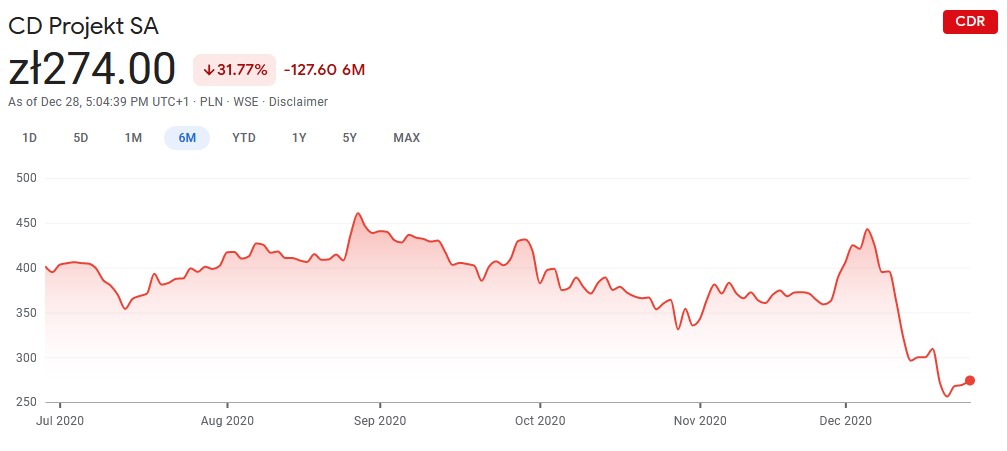
The December peak in CDPR's stock price came on Dec. 4. Outlets (<a href="https://arstechnica.com/gaming/2020/12/a-week-spent-in-cyberpunk-2077s-beautiful-messy-urban-future/">including Ars</a>) began publishing reviews on Dec. 7 (the first drop), the game was released on Dec. 10 (the middle of the big downward slope), and Sony <a href="https://arstechnica.com/gaming/2020/12/sony-delists-playstation-version-of-cyberpunk-2077-begins-full-refund-program/">delisted</a> the game on Dec. 17 (the tiny little peaklet right before the second drop).<br />
Enlarge / The December peak in CDPR’s stock price came on Dec. 4. Outlets (including Ars) began publishing reviews on Dec. 7 (the first drop), the game was released on Dec. 10 (the middle of the big downward slope), and Sony delisted the game on Dec. 17 (the tiny little peaklet right before the second drop).
Google Finance

The argument in this kind of shareholder suit basically says: The company did something it should not have—lied about something, downplayed a risk, made a colossal error in judgement, and so on—and as a result, harmed the company’s public image and, in turn, harmed investors.

Pinterest shareholders, for example, filed a suit against that company earlier this month claiming the board failed its fiduciary duty as allegations of rampant race- and gender-based discrimination inside the company were hurting its image with its largely-female user base. Google settled a similar shareholder suit in September, over its handling of harassment claims inside the company. And back in April, Zoom investors sued the overnight videoconference sensation, arguing that the company should have known its product was not up to spec before the pandemic hit.

https://arstechnica.com/?p=1732130


Dark Archives: Come for the floating goat balls, stay for the fascinating science

These might look like your standard leather-bound texts, but they are actually bound in human skin—a practice known as "anthropodermic bibliopegy." All five are housed in the Mütter Museum in Philadelphia.
Enlarge / These might look like your standard leather-bound texts, but they are actually bound in human skin—a practice known as “anthropodermic bibliopegy.” All five are housed in the Mütter Museum in Philadelphia.
Mütter Museum/College of Physicians of Philadelphia)
There’s rarely time to write about every cool science-y story that comes our way. So this year, we’re once again running a special Twelve Days of Christmas series of posts, highlighting one science story that fell through the cracks in 2020, each day from December 25 through January 5. Today: a look at medical librarian Megan Rosenbloom’s book, Dark Archives, about tomes bound in human skin.

When you think about medical librarians and rare book specialists, chances are you picture them poring over rare tomes in a dusty archives—and chances are, you wouldn’t be wrong. But when Megan Rosenbloom set out to separate fact from fiction on the existence of rare books bound in human skin, her investigations took her to some uncommon places—like an artisanal tannery in upstate New York, where the floor resembled “Mountain Dew with chunks floating in it,” and emptying drums of tanning effluvia might just unleash a few floating goat testicles among the mix.

The technical term is “anthropodermic bibliopegy,” and Rosenbloom first became fascinated with this macabre practice in 2008, while she was still in library school and working for a medical publisher. While strolling through the vast collection of medical oddities at the famed Mütter Museum of the College of Physicians of Philadelphia, she came upon a glass display case holding an intriguing collection of rare books uncharacteristically displayed with their covers closed. The captions informed her that they had been bound in human skin, along with a leather wallet.

She was shocked to learn that such bindings were typically created by doctors as luxury items in their private rare book collections. “This wasn’t a doctor learning about anatomy through dissection,” Rosenbloom told Ars. “It wasn’t a specimen of rare disease used to educate people. Yet it didn’t seem like the doctors who made these books were Hannibal Lecter-type serial killers. They seemed to be upstanding doctors in the community. And I couldn’t understand in what context a seemingly normal doctor would feel okay doing that.”

Thus began a years-long journey, culminating with the publication in October of Dark Archives: A Librarian’s Investigation into the Science and History of Books Bound in Human Skin, an engaging, thoughtful exploration of this morbid practice, handled with remarkable sensitivity. Rosenbloom is now a medical librarian in charge of the medical collections at the University of Southern California in Los Angeles, as well as a member of the Order of the Good Death and co-founder of that organization’s Death Salon, devoted to fostering conversations and scholarship about mortality and mourning.

Her adventures in anthropodermic bibliopegy resulted in the founding of the Anthropodermic Book Project, a scientific collaboration that seeks to build a census of all the alleged books bound in human skin around the world, testing them to determine whether the bindings are truly human in origin. “We get emails probably once a week now from random people who think that Grandpa had a human skin book in their attic or something,” Rosenbloom said.

One of those confirmed books belongs to Harvard University’s Houghton Library: Des destinées de l’ame by Arsène Houssaye, created by one Dr. Ludovic Bouland of Strasbourg, who died in 1932. It was confirmed by Harvard chemist Daniel Kirby, who used peptide mass fingerprinting (PMF) to make the determination. The same method has been used to confirm the authenticity of all five books purported to be bound in human skin in the Mütter Museum. I’ll let Rosenbloom explain how it works:

First, remove a tiny chunk of a book’s binding with a scalpel or sharp tweezers; if the chunk is visible to the human eye, it is more than enough. The sample is digested in an enzyme called trypsin and the mixture is dropped onto a MALDI ( matrix-assisted laser desorption/ionization) plate. The MALDI plate is placed into a mass spectrometer, where lasers irradiate the sample to identify its peptides (the short chains of amino acids that are the building blocks of proteins) and create a peptide mass fingerprint (PMF). The “fingerprint” looks like a line graph of peaks and valleys, and each fingerprint corresponds with an entry in a library of known examples from animals. Each animal family shares a strain of protein markers that act as reference points scientists can use to distinguish one from another.

A matrix-assisted laser desorption/ionization (MALDI) preparation plate.
Enlarge / A matrix-assisted laser desorption/ionization (MALDI) preparation plate.

As of May 2019, the Anthropodermic Book Project had identified 50 books rumored to have human skin bindings, and had tested 31, 13 of which turned out to be fake. But 18 really are bound in human skin. They include a book housed in Surgeons’ Hall Museums in Edinburgh, Scotland, bound in the skin of a killer named William Burke. Burke was an infamous body snatcher who, with William Hare, killed 16 people in 1828 and sold the corpses to a Scottish anatomist named Robert Knox, who used them for dissection during his lectures.

Among the confirmed books in the Mütter Museum’s collection is one bound in the skin of a Civil War soldier. Another once belonged to a 19th century Philadelphia physician named John Stockton Hough. In January 1869, Hough was performing an autopsy on the corpse of a woman named Mary Lynch, and found tiny worms wriggling in a cyst in her pectoral muscles. It was the first known case of trichinosis in the city. Perhaps that’s why Hough decided to remove a large slice of Mary Lynch’s skin from her thighs, tossing them into a chamber pot to better preserve them. The salt and acid in urine acts as a pickling brine, a key first step in the tanning process.

Rosenbloom picked up that nugget of wisdom during her visit to Pergamena, an artisanal tannery in New York’s Hudson Valley run by Jesse Meyer—part of a long line of tanners dating back to 16th century Germany. Ever the inquiring scientist, Rosenbloom wanted to know exactly how one would go about creating a book binding out of human skin. “A lot of artisan trades didn’t really write down how they did things,” she said. “It was just apprenticeships. They weren’t exactly keeping manuals.” The process is much the same as that used to tan animal skins, and Pergamena is one of the few remaining places where traditional 19th century tanning techniques are used.

Her account of the tannery visit is one of the highlights of the book, giving Rosenbloom prime fodder for her sly, self-deprecating humor. She was particularly struck by the powerful odor, strugging to find the words to describe it. “It was not merely a smell,” she writes in Dark Archives. “It felt like having raw animal organs stuffed into my mouth and pulled through my nose.” (The smell permeated her old Keds, and she had to ditch them on the drive back home.) As for the aforementioned floating goat balls, Meyer confirmed that this was not an uncommon occurrence, since the hides he uses come from animals slaughtered for food. And sex organs typically stay with the hide.

Medical librarian Megan Rosenbloom became fascinated by books bound in human skin while visiting the Mütter Museum in 2008
Enlarge / Medical librarian Megan Rosenbloom became fascinated by books bound in human skin while visiting the Mütter Museum in 2008
Macmillan/Polly Antonia Barrowman

There were also a fair share of frauds and fakes among the books that Rosenbloom and her colleagues with the Anthropodermic Book Project tested. For example, a piece of parchment in the Huntington collection was inscribed with the claim that it was “the skin of a White Man, taken by a Ingen,” who was roasted on a bed of coals, and his skin flayed to make the parchment. The parchment turned out to be be fake. Rosenbloom also dispels the myth of Nazi lampshades and other leather items—including books—being bound in human skin.

The closest contemporary analogue to binding books in human skin is the emerging practice of preserving someone’s tattoos after they die—the speciality of a mortician named Kyle Edwards, who runs Save My Ink Forever. Anecdotally, at least, Rosenbloom has found that people heavily invested in their tattoos are quite open to the prospect of having their skin art preserved after their deaths, despite the ‘ick’ factor. “Many of them don’t even blink an eye,” she said. “They’re like, ‘Yeah, I spent a lot of money on this, I have this beautiful piece of art, and it’s just going to rot in the ground. I would totally save that.'”

Per Rosenbloom, the results are pretty impressive, too. “They’re very clean and bright because they use that under-layer epidermis,” she said. “So even if you’re very old when you die, the tattoo ink goes all the through through the dermis. If you take off the top layer, it looks like the tattoo basically just got inked.”

Books bound in human skin also serve as a physical reminder for Rosenbloom of the extent to which many in the medical profession try to emotionally distance themselves from patients. “This is as a far as you can get from someone’s humanity, if you are cutting someone open on the autopsy table and decide, ‘You know, I’m going to save this piece of skin for later,'” she said. In the medical profession, residents frequently work 24 hours shifts and must deal with the constant stress of life and death situations.

“It’s the dark secret about the working lives of doctors,” said Rosenbloom. “They go into the profession because they care about people and want to help them, and then they get that empathy beaten out of them. If one is not able to work in humane conditions, and if the educational system does not insist upon, and prioritize, those humane conditions for their medical students and doctors, you are more likely to get people who are acting in insane ways. Doctors need to be able to reconnect themselves with their humanity in order to treat their patients humanely.”

[embedded content]
A Librarian’s Investigation into the Science and History of Books Bound in Human Skin.

https://arstechnica.com/?p=1717384


Best new board game apps of 2020

Welcome to Ars Cardboard, our weekend look at tabletop games! Check out our complete board gaming coverage at cardboard.arstechnica.com.

The 2020 global pandemic might seem like an ideal time for new board game app releases, but the increasing development time for more complex games means we’re going longer between initial announcements and final releases than we have before. Below, I’ve ranked my nine best new board game apps of 2020 based on app quality, play experience, and purchase price. I’ll give a quick honorable mention to Lorenzo il Magnifico, which I tested out a year ago when it was still in beta on Steam and of which I thought highly—but which I haven’t gotten to try in its newest version.

9. Viticulture (Digidiced)

Placing workers in the spring to plant vines and build buildings, but sadly no grape-stomping.
Enlarge / Placing workers in the spring to plant vines and build buildings, but sadly no grape-stomping.

The first game from designer Jamey Stegmaier (Scythe, Charterstone) gets the app treatment from Digidiced, whose apps all have the same general look and feel. You’re running a vineyard and placing workers in spring or in winter to plant vines, build up your farm, and run tours for money. It’s a relatively complex economic game at heart, and the app works well, but the tutorial here isn’t detailed enough; it might be better if you have some familiarity with the physical game.

8. Finished! (Eric Snider)

Sort your cards 1-48 by spending candy and using card actions.
Enlarge / Sort your cards 1-48 by spending candy and using card actions.

Friedman Friese is probably best known for his complex game Power Grid, but he’s produced a number of solo games, all of which have titles that start with F, including Friday (which has a pretty great app version). Finished! is a game of a single deck of 48 numbered cards, shuffled except for card #48, that you’ll try to sort into their order before you go through the deck 7 times. The cards also have functions like letting you put cards back into the deck and drawing new ones, or letting you retrieve the last two cards you’ve discarded. They might also show candies, which you’ll need to use the actions on other cards. It’s way harder than it sounds, which gives the game good replay value, although the amateurish art and color scheme leave something to be desired. It’s only available for iOS.

7. Clever Cubed (Brettspielwelt)

I mean, the title is a bit pretentious, but it is actually clever.
Enlarge / I mean, the title is a bit pretentious, but it is actually clever.

If you’ve played That’s Pretty Clever or the sequel Twice as Clever, this is more of the same and from the same developers—but this app is smoother and more polished than its predecessors. You roll six dice in different colors, then score them in the matching area on your scoresheet (with the white die as a wild). Each die color scores in a different way, and there are bonuses all over the scoresheet for filling in certain spaces, rows, or columns. Scoring 300 is a reasonable challenge, and 400 is doable but hard, while good players have gotten well over 500 (but this player still has not). The original game is probably still the best, but I’d rate this higher than the second one. The board game is multiplayer with a solitaire mode, but the app is solo only.

6. Charterstone (Acram Digital)

A worker placement legacy game that starts as simple as it looks here but grows more complex.
Enlarge / A worker placement legacy game that starts as simple as it looks here but grows more complex.

Charterstone is a legacy game from Jamey Stegmaier, whose Viticulture appeared earlier on this list. This game is a very traditional worker placement sort of game, but one where the rules—and even the workers—change a little bit in each of the 12 games you’ll play in a complete campaign. It’s beautifully rendered, with lots of cute animations for the various buildings you’ll construct, but the physical board is wide and detailed. This app has some trouble translating that to the screen, which is a limitation because you can place a worker on any building, even if it’s not one you placed yourself. The app does still work well with competent AI opponents.

5. Cartographers (Brettspielwelt)

This flip-and-write game translates seamlessly to digital as you fill out your map with polyomino shapes.
Enlarge / This flip-and-write game translates seamlessly to digital as you fill out your map with polyomino shapes.

The physical game was nominated for the Kennerspiel des Jahres award this past year, losing to The Crew, and it plays an unlimited number of people (like fellow roll-and-write Welcome To…). The app is a straight solo game with several modes, including an unranked one, but it’s the same game. You have a giant sheet with a grid on it, and you try to fill it out in a way to score the four unique scoring cards for that specific game. You do so by coloring in the shapes on the cards that are drawn each round in four different colors, although each card either gives you a choice of two colors or a choice of two shapes. There’s a “cost” associated with each scoring card, so it’s very easy to score in the negatives. I’ve done so many times, in fact.

4. Roll for the Galaxy (Temple Gates)

Roll your dice to spend them as workers, building worlds and trading goods for points.
Enlarge / Roll your dice to spend them as workers, building worlds and trading goods for points.

Funny story about this app. I never loved the physical version of Race for the Galaxy, the predecessor to Roll for the Galaxy, but its app is one of the best board game apps ever created. I liked the physical version of Roll for the Galaxy even less… but, once again, the app is spectacular. The general gist is the same in both games–here you’re trying to build a series of tiles, up to 12 total, which you’ll do in part by producing and selling trade goods for money or points. You roll a series of dice that show all the different possible actions and then assign them to their matching actions, picking one of these as your chosen action for the round; other players (or AI players) do the same, and then you take only the chosen actions that each player picked—and only if you have dice assigned to those actions. The AI players seem strong, and games move very quickly.

3. Wingspan (Monster Couch)

Feed the birds—tuppence a bag.
Enlarge / Feed the birds—tuppence a bag.

Wingspan is the best new board game to appear in the last five years, and it’s gotten a digital port worthy of the physical version from developers Monster Couch, who made their first splash in the board game space with this app. Wingspan is a card-drafting and hand-management game, as players try to bring diverse bird species to their three habitats by gathering food, playing cards, and hatching eggs, all of which can also lead to more points. It’s more complex under the hood than it first appears because of the myriad ways to score points and build your ecosystems, but the digital port is tremendous. It takes the physical game’s art and adds animations, and it allows for online play, play against AI opponents, and play with the “automa” solitaire variant from the physical game, which works well since Wingspan doesn’t have that much player interaction. Wingspan appeared for Steam this fall and is coming to Switch at the end of December, so there’s some reason to think iOS and Android versions might be somewhere down the line, which is the only major issue with the app right now.

2. Sagrada (Dire Wolf Digital)

Draft dice to make the most beautiful stained glass window for your cathedral.
Enlarge / Draft dice to make the most beautiful stained glass window for your cathedral.

Sagrada is an amazing game that also seems to lend itself perfectly to the digital sphere, and Dire Wolf, which developed the top two apps on this list, gave it the adaptation it deserves. It’s a dice-drafting game, so in every round the app rolls a number of dice that players will choose in a snake draft and then place on their boards, which represent stained glass windows. The boards require dice of certain colors for some squares and dice of certain values for other squares, and you score based on objective cards that change in each game (such as having no repeated cards or values in rows or columns, for example). It’s great, it’s replayable, and my only quibble is that I wish the AI players were a bit stronger. Here’s hoping some of the many expansions to the physical game come to the app at some point.

1. Root (Dire Wolf Digital)

Don't let the cute creatures fool you—the forest of <em>Root</em> is a vicious place.
Enlarge / Don’t let the cute creatures fool you—the forest of Root is a vicious place.

Also from Dire Wolf, Root is a fantastic adaption of a very good but peculiar board game. It’s asymmetrical, meaning that every player has different pieces, powers, goals, and even to some extent different rules. The theme itself is a funny one, as the players represent up to four warring animal factions competing for control of a forest, occasionally getting points by crafting different goods. Each faction requires its own strategy, and you will probably have a favorite or two. The app version does everything right, including the way that it translates the large board to the smaller screens of tablets and phones. The animations enhance the game-play experience, even though they don’t add anything specifically to the game itself, and the tutorial here is among the best ever. It’s a winner even if you haven’t tried the physical game—and a great way to learn it, too.

https://arstechnica.com/?p=1731701


TV Technica 2020: Our favorite shows and binges in a year of living distantly

TV stepped in to fill the pandemic-fueled gap in new movie releases with a broad array of entertaining series.
Enlarge / TV stepped in to fill the pandemic-fueled gap in new movie releases with a broad array of entertaining series.
Photo collage by Aurich Lawson
Warning: This story includes major spoilers for the series finale of The Good Place. Although we’ve otherwise done our best to avoid spoiling anything too major, please note this list includes specific references to The Mandalorian, The Flight Attendant, Lovecraft Country, The Boys S2, Star Trek: Lower Decks, and The Queen’s Gambit, among others.

This was the year that going to the movies suddenly became a rare event. As we observed in our roundup of the best films in 2020, “The pandemic has ransacked reliable sources of new films, like theaters and film festivals. And any number of major titles we may have looked forward to on January 1, 2020 (from Dune to Top Gun) have instead chosen to push back by at least 12 months.” Fortunately, TV was there to pick up the slack and keep pandemic-weary viewers entertained at home with more quality content than ever before—much of it from streaming platforms rather than traditional broadcast television.

It’s a trend that has been building for some time, but the streaming wars are now in full swing. Just two broadcast offerings made our year-end list, although CBS’ streaming platform, CBS All Access, made its mark with two of its Star Trek franchise programs. Netflix dominates with nine entries, followed by HBO/HBO Max (5), Amazon (3), and Disney+/ESPN+ (2), with Hulu/FX getting a category all its own. Heck, even YouTube gets a nod this year with Philadelphia Sixers Matisse Thybulle’s series of videos documenting life in the NBA bubble.

We don’t know what 2021 holds for television, with rising production costs squeezing budgets and forcing premature cancellations of many of our favorite shows this year that were on the bubble in terms of viewership (R.I.P. Teenage Bounty Hunters). The ongoing pandemic means new productions-in-progress could be shut down any moment if someone on set tests positive for COVID-19 until quarantine periods are complete. So we may have fewer offerings as the industry reckons with the fallout from the pandemic.

But we’ll still have the glorious cornucopia that was this past year in television. With apologies to the many great series we just didn’t have room for on this year’s list, here are our favorite TV watches and binges for 2020, in no particular order:

A bittersweet farewell.
Enlarge / A bittersweet farewell.
NBC/Universal

The Good Place series finale

We kicked off 2020 by bidding a tearful farewell to The Good Place, NBC’s hilariously inventive, yet thoughtful, take on the afterlife. The show delivered rich characters and plenty of laughs, but it also challenged us to ponder deeper questions of what it really means to be a good person. Consistently intelligent and insightful, particularly about human foibles, each season held enough surprising turns and unexpected twists to keep a typical sitcom running for twice as many seasons. But The Good Place was never a typical sitcom. In the series finale, the writers didn’t blink while grappling with (among other things) the troubling implications of an infinite afterlife for finite humans.

In the show’s final episodes, the Soul Squad revamped the afterlife so that all humans will have the chance to be rebooted as many times as necessary, until they show enough improvement to earn admission to the Good Place. As a reward, the Soul Squad finally gets to the Good Place. And that’s when we learn that an eternity of perfection is not all it’s cracked up to be.

The Good Place residents are frankly bored with eternity. There are only so many times you can fulfill all your deepest desires before it just becomes run-of-the-mill. The solution: there is one last door that anyone in the Good Place can walk through when they feel they are ready to end their afterlife. Maybe. What happens beyond the door remains an unknowable mystery, much like that faced by humans on Earth pondering what happens after you die. It’s the fact that life ends and that we don’t know what comes next that gives our lives purpose and meaning. It’s why our actions, relationships, and so forth matter so much.

Honestly, the series could have ended right there. But did you really think series creator Michael Schur was going to let us off that easy? The roughly 80-minute finale was essentially a prolonged bittersweet denouement, in which we see each original member of the Soul Squad reach a point where they want to move on in some way—whether they choose to walk through the final door or not. Schur could have spun out the show for many more seasons, but in the end he applied the same principle to the series as Michael did to fix the Good Place. Knowing that its time was finite made this final season—and the entire run—especially bittersweet, and hence that much more meaningful, to its fans.

—Jennifer Ouellette, Senior Writer

Mandalorian and Child.
Enlarge / Mandalorian and Child.

The Mandalorian S2

What does it mean to wear a mask? What can a person hide behind a mask, one they’re devoted to wearing because of a lifelong order? And at what point does the humanity behind a mask reveal itself anyway, even in spite of the strength and thickness of beskar?

The Mandalorian‘s second season was many things. For starters, it was more of a traditional Gunsmoke-style TV series than last time around, owing to fetch quests and monsters-of-the-week moving the action along. It also settled into a comfortable groove at times in terms of ensuring that certain first-season plot points and characters might appear again. There was simply no way Mando S2 was going to deliver as many surprises or develop as many new characters.

Some of those S1 returns were more fruitful than others—with the high highs absolutely making up for the ho-hum retreads, proving that Jon Favreau and Dave Filoni can maintain an entire corner of the Star Wars universe quite handily. But last year’s series-premiere bombshell of an adorable, miniaturized Yoda eventually had to give way to other obvious series cameos and references, and this season was all about those payoffs—all done quite masterfully.

Take the season’s fifth episode, where Mando seeks wise counsel on what exactly to do with “The Child.” There’s a spoilery mess I can’t get into that links this episode to another Star Wars property, but bigger than that was how a new kinda-sorta ally and Mando each join forces for just long enough to fulfill their own destinies. In Mando’s case, this was resolved in part by an impeccably shot face-off in a wide-open town, battered with dust and poverty in the kind of way that you could practically see a tumbleweed blow past as Pedro Pascal and his rival exchanged not-at-all-pleasantries. The Mandalorian S2 savors these tense moments, these silent passages where cameras can linger, and enough action, character development, and light-hearted ribbing build to these moments in the exact ways that define the best scenes in modern television.

Above all else, of course, is the mask. A mask can mean many things, and The Mandalorian S2 speaks to that very human concept, mixed with satisfying amounts of Star Wars action, bombast, lore, and heart to make it some of the best television of the past 10 years.

—Sam Machkovech, Tech Culture Editor

Fraternal twin sisters Sterling (Maddie Phillips) and Blair (Anjelica Bette Fellini) join forces with bounty hunter Bowser Simmons (Kadeem Hardison) in <em>Teenage Bounty Hunters</em>.
Enlarge / Fraternal twin sisters Sterling (Maddie Phillips) and Blair (Anjelica Bette Fellini) join forces with bounty hunter Bowser Simmons (Kadeem Hardison) in Teenage Bounty Hunters.

Teenage Bounty Hunters

Twin sisters in Atlanta, Georgia, juggle the demands of high school, their Christian youth group, and raging hormones with a side gig working for a local bounty hunter in Teenage Bounty Hunters. Creator Kathleen Jordan’s delightful comedy-drama definitely brings the laughs with its razor-sharp satire, but it is also a smart, nuanced coming of age story with some genuinely surprising twists and turns. The dialogue is note-perfect, the characters are complicated in interesting ways, and these ten episodes are expertly paced, making Teenage Bounty Hunters a perfect weekend binge. 

Atlanta high schoolers Sterling (Maddie Phillips) and Blair (Anjelica Bette Fellini) meet bounty hunter Bowser (Kadeem Hardison) by accident one night when they crash their father’s pricey hunting truck into the car of a bail jumper (“skip”) he’s chasing. And like the good southern Christian girls they are, they have guns and are more than proficient with said weapons, capturing Bowser’s skip for him in exchange for a share of the reward. They wheedle their way into working more jobs, telling their straitlaced parents that they are working at Yogurtopia, a frozen yogurt shop that Bowser runs when not tracking down skips. (Every bounty hunter needs a side hustle.)

Phillips and Fellini are terrific as the twin sisters, bringing just the right mix of bravado, innocence, curiosity, and vulnerability to their roles. They are charming and likable characters when they could have easily just been annoying. Hardison’s world-weary Bowser can’t help but feel protective toward them through his exasperation. The satirization of evangelical Christian purity culture is spot-on, and Wynn Everett is sheer perfection as Ellen Johnson, the relentlessly cheery fellowship teacher at Willingham Academy.

Alas, Netflix opted not to renew Teenage Bounty Hunters for a second season—another casualty of the higher production costs associated with taking the necessary pandemic precautions on sets. So we’ll never get to see how that final twist regarding the twins’ parentage plays out.

—Jennifer Ouellette

https://arstechnica.com/?p=1726397