Wonder Woman 1984 is fun, but doesn’t quite capture magic of its predecessor

Count me among the many millions who likely logged onto HBO Max on Christmas Day to watch Wonder Woman 1984, Director Patty Jenkins’ hotly anticipated, oft-delayed stand-alone follow-up to her 2017 global blockbuster, Wonder Woman. I’m a major fan of the latter, which gave us our super-powered Amazonian’s origin story, and had high hopes for the follow-up.

Those hopes weren’t completely dashed, but they weren’t really fulfilled either. While Wonder Woman 1984 still has a bit of the old magic, and its leads all turn in terrific performances, the film is hampered by a frequently nonsensical plot, extraneous showy action sequences, and it’s way too heavy-handed with the moralizing. But it still delivers quite a lot of slick, 1980s-infused fun if you turn your brain off and just go with it—and you’ll definitely want to stick around for a post-credits scene.

(Some spoilers below, with a couple of major spoilers below the second gallery. We’ll give you a heads up when we get there.)

Inspired by the comic book heroine created by William Moulton Marston in the 1940s for DC Comics, Wonder Woman got her own TV show in 1975, with former Miss World USA Lynda Carter in the leading role and Lyle Waggoner as Steve Trevor. The first season was set in 1940s World War II, with the pair battling Nazis, and subsequent seasons were set in the 1970s, mostly to save on production costs. The dialogue is leaden, the acting is terrible (there are some very bad German accents), the effects are pure cheese, and the less said about the fighting skills, the better. (That… is not judo, Stella Stevens, I’m just saying.)  But it’s entertaining in a campy kind of way, and HBO Max is currently streaming some of those episodes, for the nostalgically inclined.

The Amazonian superhero made her big-screen debut in the DCEU with 2016’s Batman v Superman: Dawn of Justice, followed by 2017’s Justice League. As we reported previously, the first fell short of box office expectations; the second bombed outright. So when Jenkins took on Wonder Woman’s origin story, she deliberately departed from the grim humorlessness and dark sensibility of those earlier films, bringing a brighter energy and wit to her tale, along with the usual action.

That vision paid off: Wonder Woman went on to gross $821 million worldwide and earned critical raves, making it the most successful of the DCEU films thus far. But let’s face it, origin stories—where a hero comes into his or her full powers, learning valuable lessons along the way—just seem to make for better films, whether we’re talking about Iron Man, Captain America, Superman, Spider-Man, and so forth. Jenkins’ sequel was probably doomed to come up a bit short.

That ’80s aesthetic

Wonder Woman 1984 is set almost seventy years after the original film. Since we’re now in the 1980s, Diana is operating in a Cold War scenario, taking on Pedro Pascal’s villainous Maxwell Lord, an ambitious, flamboyant businessman and purveyor of TV informercials. Jenkins has said her interpretation of Lord was modeled after Gordon Gekko from the film Wall Street (1987)—his motto was “Greed is good”—and Lex Luthor in 1978’s Superman, starring the late Christopher Reeves. Kristen Wiig plays Barbara Ann Minerva, a gemologist who eventually evolves into Diana’s arch-nemesis Cheetah. And Chris Pine is back from the dead as Diana’s lost love, Steve Trevor (more on that later).

The film opens by bringing us back to Diana’s childhood in Themyscira, when a young Diana (Lilly Aspell) competes in a grueling Amazonian athletic tournament. Diana does remarkably well for her tender years, but a momentary loss of focus results in her being unhorsed and missing a stage of the race. Desperate to win, she takes “the shorter path” to catch up, and is disqualified for cheating. It was a tough lesson for Diana to learn—”You cannot be the winner because you are not ready to win,” her mother, Queen Hippolyta (Connie Nielsen) tells her—and one that will resonate throughout the rest of the film.

Flash forward to 1984, where an older, much less naive Diana is working as a cultural anthropologist at the Smithsonian Institution in Washington, DC, by day, and fighting crime as Wonder Woman by night. She foils a robbery attempt of a jewelry store in a local mall, which turns out to be a front for smuggling priceless artifacts. She and Barbara, a fellow Smithsonian employee, are tasked with analyzing and cataloguing the recovered artifacts. Among them is something that appears to be a cheap knockoff trinket made of citrine quartz, that turns out to be something much more powerful—and dangerous.

(WARNING: A couple of major spoilers below. Don’t read further if you’ve yet to watch the film.)

The artifact turns out to be a magical Dreamstone, created by an unnamed god of treachery and mischief, and it grants one’s dearest wish. Unaware of the Dreamstone’s true power, the lonely, isolated Diana longs for the return of Steve Trevor, while the mousy Barbara idolizes Diana and wishes to be just as strong and special as she is. Both wishes are granted: Steve’s soul takes over another man’s body (Kristoffer Polaha), reuniting our star-crossed lovers, and Barbara becomes stronger and more confident, and with more stylish sex appeal.

But like the proverbial monkey’s paw, those gifts come at great cost: the stone grants your wish and takes what you value most. For Diana, it is her demigod powers. She becomes progressively weaker as the film progresses, even as Barbara becomes stronger, while losing her warmth and humanity.

Make a wish

Of course, Max Lord gets hold of the Dreamstone, and makes a wish to become the embodiment of it, investing himself with the power to grant wishes. This is where some the aforementioned incoherent plot elements come into play. Everyone only gets one wish, except Lord is able to manipulate others into making wishes and extracting whatever he wants from them in return. He has to be physically touching them, but finds a loophole around that, too, so he can grant wishes via satellite TV—something about the “particles” that convey the information in the broadcast “touching” everything makes it work. I’m not a stickler for textbook physics in superhero films by any means, but these elements should at least be internally consistent. A willing suspension of disbelief can only take you so far, even for a plot that revolves entirely on an wish-granting magic stone.

The same goes for the new superpowers Diana mysteriously develops. For instance, before her powers wane, she’s able to concentrate really, really hard and make the plane she and Steve commandeer invisible, both to the human eye and to radar. Yes, it’s Wonder Woman’s trademark invisible plane! Diana is apparently able to, I dunno, create a magical cloaking metamaterial with a negative index of refraction. It’s actually never explained, which is probably for the best, but it still makes little sense. And while she’s always been capable of gravity-defying leaps, by film’s end, she’s learned to fly like Superman, thanks to a brief conversation with Steve about how he thinks and feels when he’s flying planes.

That said, there’s much to like about Wonder Woman 1984, even if an extended action sequence set in Egypt feels unnecessary and probably could have been cut entirely. The production and costume design are spectacular, and one could write an entire thesis on the contrast between Diana’s and Barbara’s changing looks, as a reflection of their shifting power dynamics and fundamental natures. I also loved the comic scene where Steve is trying to pick out a suitable outfit—a callback to when Etta Candy (Lucy Davis) helped Diana do the same—and discovers parachute pants. It’s a nice role reversal, where Steve becomes the fish out of water in Diana’s new world.

Their relationship (and the stars’ onscreen chemistry) remains the heart of the film, and they make a good crime-fighting team, even though Diana must eventually accept that the cost of keeping Steve in her life is simply too great. Pedro Pascal imbues Max Lord with a vulnerability that makes his overweening desire for more—money, power, fame, influence—almost tragic; his wish drains him of health and vitality, and also threatens his young son. As for Wiig, she starts out playing a version of her scattered, insecure Bridesmaids/Ghostbusters characters, but gets the chance to stretch her range as Barbara slowly transforms into Cheetah, fueled by a crippling inferiority complex, and bitter resentment of Diana for the latter’s perceived patronizing manner.

Ultimately, Jenkins seems to be trying to make a profound statement about 1980s-style greed—we want what we want, and damn the consequences—and how everything has a price; how our power must be earned, not magically granted; and how we must have courage to face hard truths, because “nothing good is born from lies.” But despite hammering those various points home with all the subtlety of a pile driver, her message ends up as muddled as the plot. And that’s too bad, because it’s the sort of timeless wisdom we could all stand to be reminded of in these troubled times.

Wonder Woman 1984 is now streaming on HBO Max and playing in select theaters.

[embedded content]
The path to greatness is not what you think. See young Diana in action in the opening scene of Wonder Woman 1984.

Listing image by Warner Bros.

https://arstechnica.com/?p=1731935


Study: children’s belief in Santa Claus is more nuanced than you think

Writing letters to Santa Claus and leaving out milk and cookies are two actions that reinforce children's belief.
Enlarge / Writing letters to Santa Claus and leaving out milk and cookies are two actions that reinforce children’s belief.
Carol Yepes/Getty Images
There’s rarely time to write about every cool science-y story that comes our way. So this year, we’re once again running a special Twelve Days of Christmas series of posts, highlighting one science story that fell through the cracks in 2020, each day from December 25 through January 5. Today: how children’s belief in Santa Claus is part of a hierarchical pantheon of real and non-real figures.

Do you believe in Santa Claus? If you’re over the age of eight, you probably don’t. We tend to think young children are simply more gullible due to their tender years. But their belief in Santa, the Tooth Fairy, or similar cultural figures isn’t quite as simple as that, according to a June paper published in the journal PLOS ONE.

Rather, such figures fall into an ambiguous category between “real” and “nonreal” for many children, indicating that their belief structures are much more nuanced than previously believed. Rituals like writing letters to Santa, or leaving out milk and cookies on Christmas eve, reinforce their belief in these ambiguous figures. The fact that the milk and cookies are gone on Christmas morning serves as a form of indirect evidence, and when children interact with a Santa figure at the mall, it further reinforces that belief.

“[Children] are cannier than we give them credit for.”

“Historically, in the field of psychology, it was held for a long time that children are gullible, which is very unfair,” lead author Rohan Kapitany of Keene University told Ars. “They ask a lot of questions. They think deeply. Children do believe in these things at much higher rates than adults, but you can’t just convince them that the boogeyman is under the bed. It’s a lot harder than that. They are cannier than we give them credit for.”

Kapitany earned his PhD in developmental psychology, focusing on how children learn through imitation, and this led to his interest in the role of ritual in shaping beliefs. He was interested in exploring further how children evaluate different types of figures across a spectrum of real and non-real.

“I don’t think it’s a coincidence that [rituals] are so often linked to religions and invisible things like values and beliefs, and it seems like very fertile soil to begin to understand how children reconcile reality,” he said. “Santa and the Easter Bunny are easy examples, but children have to grapple with more complex things, like dinosaurs, or the presence of a contagion in our world. We don’t get direct evidence of it, and so we look to people’s behaviors to inform our beliefs, based on their behaviors and beliefs.”

One of the more interesting studies in this area was a 2013 paper by Jacqueline Woolley et al. involving a fictional character called the Candy Witch. Participating children were told about the Candy Witch, a friendly being who would trade toys for their Halloween candy. But the children had to exercise self-control and not eat all their candy in order to “pay” the Candy Witch for the toys. And their parents had to telephone the witch to arrange for her visit.

The result: most of the children believed the Candy Witch was real, even though they never saw her in person—a belief that persisted in some of the participating children even a year later. “Woolley and her collaborators didn’t frame it in terms of rituals, but she’s subsequently spoken about rituals as a special form of testimony by asking children to refrain from eating all their Halloween candy,” Kapitany said. “It’s piggy-backing on a lot of other structural schemes children have about Christmas.”

In fact, the Candy Witch study is a bit like the infamous marshmallow test, in which young children were left alone in a room with a marshmallow. If they could refrain from eating it for 15 minutes, they would get a second marshmallow when the experimenter returned. The Candy Witch experiment required children to wait two weeks before receiving a present as a reward. “I think we don’t appreciate quite how big the task was that Woolley was asking of these kids,” said Kapitany. “The kind of commitment she asked children to engage in is the kind of commitment which would only be asked if something was real.”

Children's endorsement scores for individual figures and categories.
Enlarge / Children’s endorsement scores for individual figures and categories.
Kapitány et al, 2020

Based on those results, Woolley has argued that three factors are required to convince children that a given figure is real: testimony, i.e., being told about the figure;  indirect evidence, like Santa filling Christmas stockings, or finding money from the Tooth Fairy under their pillow; and engaging in rituals, like leaving milk and cookies out for Santa, or hunting for the Easter Bunny’s chocolate eggs. Direct evidence, like visiting Santa at the mall, further reduces a child’s natural skepticism. In other words, kids rely on several different lines of evidence as they build their beliefs, some more influential than others—a “hierarchy of endorsement.”

This latest study by Kapitany et al. was intended as “a first attempt to present children with a range of real, cultural, and fictional characters in order to determine whether children build a hierarchy of endorsement,” the authors wrote. They asked 176 Australian children between the ages of two and 11 years old to rate how real they thought 13 different figures were, on a scale of 0 (not real at all) to 8 (very real).

Those figures included Santa Claus and the Tooth Fairy, ghosts, dinosaurs, fictional characters (Spongebob Squarepants, Princess Elsa from Frozen), and real figures like the popular Australian children’s music group, The Wiggles.  They also had 56 adults participate for comparison. All these figures vary in their degree of “reality.”

The data revealed that most children’s conception of those 13 figures could be categorized into four groups. The Wiggles and dinosaurs ranked highest on the “realness” scale for children (7 points), followed by cultural figures like Santa and the Tooth Fairy (6 points). Ranking lower were ambiguous figures like aliens, dragons and ghosts, and fictional characters like Spongebob Squarepants. For adults and children over seven years old, the 13 figures fell into three groups, with the cultural figures category omitted.

Anthony Field, Emma Watkins, Lachlan Gillespie and Simon Pryce of The Wiggles perform on stage with guitarist Oliver Brian during a live-streaming event at the Sydney Opera House on June 13, 2020 in Sydney, Australia.
Enlarge / Anthony Field, Emma Watkins, Lachlan Gillespie and Simon Pryce of The Wiggles perform on stage with guitarist Oliver Brian during a live-streaming event at the Sydney Opera House on June 13, 2020 in Sydney, Australia.
Lisa Maree Williams/Getty Images

“The hierarchy is important because not all forms of evidence in our world are equal,” said Kapitany. In the case of testimony, for instance, “I can tell you that pigs fly, but you’re not going to believe that until you have some direct evidence of it.” He believes costly actions, often in the form of rituals, are among the highest forms of evidence in this hierarchy. “You can get belief without rituals, but rituals are particularly useful in providing beliefs,” he said. Per Kapitany, it’s not a coincidence that these things occur in religions or organizations like the military, where ideological conformation is desired.

While the hierarchy of endorsement revealed by the data differed in some ways from their original hypothetical conception, there was still substantial support for much of Kapitany’s ideas. Kapitany has since completed a follow-up study in Europe, and that data replicates the findings, although the paper on that work is still being prepared for publication.

As for future work, Kapitany is keen to conduct experiments similar to Woolley’s Candy Witch project in the lab, rather than relying on correlational data from online surveys. “I would like a more targeted, large-scale study where we could convince children that the oogey-boogey exists, and see if we can get some long-term endorsement and behaviors consistent with that,” he said.

DOI: PLOS ONE, 2020. 10.1371/journal.pone.0234142  (About DOIs).

https://arstechnica.com/?p=1731335


Poignant The Midnight Sky wrestles with whether humankind is worth saving

Director George Clooney and assembled cast members answered questions via Zoom about the new Netflix feature film, <em>The Midnight Sky</em>.
Enlarge / Director George Clooney and assembled cast members answered questions via Zoom about the new Netflix feature film, The Midnight Sky.

“I hate being cold more than anything in the world,” actor/director George Clooney confesses in a featurette (embedded below) on the making of his new post-apocalyptic science fiction film, The Midnight Sky.  But in order to play a terminally ill astronomer in the Arctic after a cataclysmic event kills most of the people on Earth, Clooney had to endure weeks of shooting in frigid conditions in Iceland. The film is adapted from the critically acclaimed 2016 debut novel, Good Morning, Midnight, by Lily Brooks-Dalton, which has been compared to Kim Stanley Robinson’s Aurora and Emily St. John Mandel’s Station Eleven.

(Some mild spoilers below, but no major reveals.)

In the novel, a brilliant astronomer named Augustine is posted to the Arctic, scanning the night sky for clues about the birth of the universe. Then a mysterious global apocalypse occurs, prompting all his fellow scientists to evacuate. But Augustine remains behind, dedicated to continuing his research, even as the airwaves go silent. Meanwhile, a team of astronauts aboard the spaceship Aether is set to return to Earth after a mission to Jupiter. On board is Sully, who sacrificed her marriage and left her daughter behind in order to become one of the first humans to travel so far in our Solar System. The astronauts are unaware of the catastrophe that has befallen Earth, and it falls to Augustine to warn them not to return.

Clooney’s film adaptation hews pretty closely to the novel, with some minor tweaks (e.g., Sully is romantically involved with one of her crewmates and they are expecting a child, rather than sacrificing her marriage and daughter). Per the official premise: “This post-apocalyptic tale follows Augustine (Clooney, Syriana, Oceans Eleven), a lonely scientist in the Arctic, as he races to stop Sully (Felicity Jones, Rogue One: A Star Wars Story) and her fellow astronauts from returning home to a mysterious global catastrophe.” The cast also includes David Oyelowo (Selma, Don’t Let Go) as Commander Tom Adewole; Ethan Peck (Star Trek: Discovery) as a young Augustine; Sophie Rundle (Peaky Blinders) as Augustine’s youthful love, Jean; Kyle Chandler (Bloodline, First Man) as Matthew, the Aether‘s pilot; Tiffany Boone (The Following) as flight engineer Maya; Demián Bichir (A Better Life) as Sanchez; and Caoilinn Springall as Iris, a mysteriously mute child that Augustine befriends in the Arctic.

During a virtual press conference with Clooney and the cast on Zoom (arranged onscreen like members of the Brady Bunch—the director called it “the weirdest possible press conference I think we’ve ever done”), Clooney talked about what he hoped to add to this particular genre with his film. The catastrophic event that leads to the devastation on Earth in the film is never explicitly described. But in development talks with Netflix, he was interested in exploring “what man is capable of doing to man and mankind,” specifically all the anger and hatred playing out all over the world.

“If you play that out for 30 years, it’s not inconceivable that we could, one way or another, blow it in a big way,” Clooney said. “So to me, the idea was to have that conversation about what we’re capable of doing. Then after we finished shooting, the pandemic came around and it became clear that what the story was enveloping was our desperate need to be home, to be close to the people we love,  and how difficult that struggle is to communicate with one another Suddenly these themes are relevant.”

The two storylines—Augustine and Iris trying to find a way to warn the Aether, and the crew aboard the spaceship trying to find out why Earth has suddenly gone silent while dealing with the harsh environment of space—almost feel like two different films at times. Apparently that’s how the film was shot, with Clooney and and his young co-star, Springall, filming their scenes in Iceland and in the studio, and then Clooney shooting the segments that take place on board the spaceship once the Arctic filming wrapped. “We were shooting two different movies, if you want to know the truth,” he said. “In a way, it’s helpful if you do your homework and you’re prepared. At least you’re not bouncing back and forth between two different worlds.”

Springall described herself as a bit of a chatterbox who found it challenging to convey emotion without words, but Clooney declared her to be a consummate professional, despite her tender years, who routinely nailed her scenes in a single take. “She put all of us to shame,” he said. “I’d say, ‘Just give me your sad, scared face.’ And she’d do one take and it’s perfect, and I go, “Okay, well, now you’re making acting look really, really easy.'”

Three weeks into filming, Clooney learned that co-star Felicity Jones was pregnant. Jones admitted to being worried she might be fired, but Clooney took the news in stride, offering his congratulations and asking Jones whether she wanted to continue. She did, and Clooney decided the best course was to simply have her character, Sully, also be pregnant in space. “I have to thank him [because] initially, when I was trying not to look pregnant, I was denying myself a lot of chocolate cake,” Jones joked. “So when he said, ‘You can actually be pregnant in the film,’ I was relieved.” (Bring on the chocolate cake.)

“It really came down to the idea that the best versions of things are when you accept them and you don’t see them as problems,” he said of his approach. Jones’ baby-in-progress became a character in its own right (dubbed Wilbert on set), and in the end, her pregnancy helped reinforce the sense of the crew of the Aether as a family. He even included a scene of Sully getting an ultrasound in space.

Jones’ pregnancy did mean that she didn’t have to do quite as intensive wire work as her cast mates for the zero gravity scenes, particularly when Sully, Tom, and Maya must perform a dangerous space walk to repair the Aether‘s communications system. The actors were warned they would need to develop very strong core muscles in order to perform the scenes, which involved being suspended by wires attached  to various parts of the body. Boone very nearly passed out the first day of intense training, but soon rose to the challenge.

“A lot of effort goes into looking like there is no effort,” said Oyelowo. “It was humiliating to begin with. I spent a lot of time looking very uncool upside down hanging from wires. But we got there in the end, and Tiffany [Boone] and I became wire buddies. I’m so glad I had already had my four children by the time we did this.”

One of the most visually arresting scenes aboard the Aether is when Maya is injured during the space walk, and drops of blood float out of her spacesuit and hover near her, thanks to the lack of gravity. “There was no [actual] blood there, it was all of us imagining that blood,” she recalled. “So seeing it in the final cut is like, wow. The special effects team did such a great job of putting what we saw in our heads right there.”

“Basically, I went to the effects guys, and said, ‘I want this blood to be a ballet,'” said Clooney, and gave similar guidance to the film’s soundtrack composer, Alexandre Desplat. “Everybody had to deal with that sequence blindly, including myself, in a way, because I knew what I wanted, but I didn’t know if it would look right.”

As for Lily Brooks-Dalton, who wrote the novel, she appears as an extra in the film, sitting in the audience when a young Augustine (Peck) gives a lecture on the promise of other habitable worlds. Brooks-Dalton loved the film, per Clooney. “Obviously, you have to condense things and condense characters and stuff like that,’ he said. “But she was very, very proud of the film.”

One of those changes was a renaming of Oyelowo’s character, who was Commander Hopper in the book. Oyelowo loved the diversity of the Aether‘s crew, appropriate for a film set several decades in the future. So he approached Clooney about changing Tom’s last name to Adewole, a name from the Nigerian tribe Oyelowo is from.  “It’s gonna sound very self-important, but the name means the king has entered the house,” he said. “I told George this and he said, ‘Well, that’s in the movie.’ So not only am I very grateful to him about that, but several millions of Africans will be very grateful to see that kind of representation in the film as well.”

Somehow, The Midnight Sky still manages to offer hope and warmth despite its bleak premise. “There was a real fight for the idea of whether or not mankind is worth the struggle,” said Clooney. “And you see that it is. In many ways, it’s a film about regret, because of the character that I play. But he gets a redemption. And I think redemption is a really big and important thing that washes over us and gives us hope. You get the sense of a continuum, that we’re gonna be okay. We may not get out of all of this alive, but we’ll get out of it intact. And I think that’s what makes it hopeful.”

The Midnight Sky is now streaming on Netflix.

[embedded content]
George Clooney talks about shooting his most ambitious film yet in the extreme conditions of the glaciers of Iceland, and the challenges of being in front of and behind the camera.

Listing image by Netflix

https://arstechnica.com/?p=1730954


Microsoft Flight Simulator in VR: A turbulent start for wide-open skies

Screenshot of video game menu.
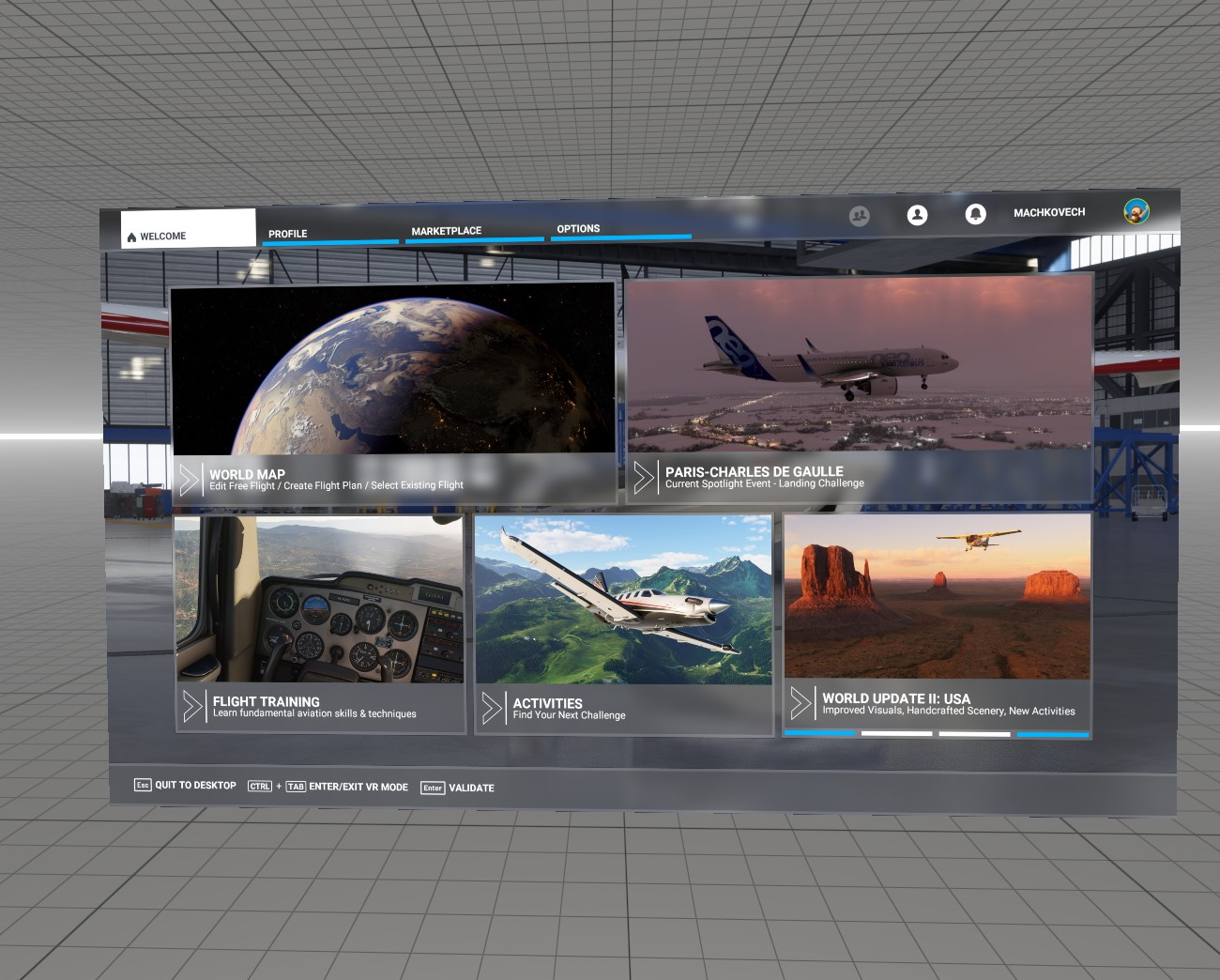
Enlarge / Microsoft Flight Simulator‘s VR mode starts like this, with its standard menu floating in a VR void. This part of the VR mode is the one that runs the most efficiently, as of press time.

After over a year of requests from fans and enthusiasts, and months of official teases, Microsoft Flight Simulator has a virtual reality mode. Whether you play the game via Steam or the Windows Store, you can now take advantage of “OpenXR” calls to seemingly any PC-VR system on the market, aided by an “enable/disable VR” keyboard shortcut at any time.

This summer, ahead of the game’s final-stretch beta test, the developers at Asobo Studio used a screen-share feature in a video call to tease the VR mode to us at Ars Technica. This is never an ideal way to show off VR, in part because the platform requires high refresh rates for comfortable play, which can’t be smoothly sent in a pandemic-era video call. But even for a video call, it looked choppy. Asobo’s team assured us that the incomplete VR mode was running well—but of course, we’re all on edge about game-preview assurances as of late.

Now that users have been formally invited to slap Microsoft Flight Simulator onto their faces, I must strongly urge users not to do so—or at least heavily temper their expectations. Honestly, Asobo Studio should’ve issued these warnings, not me, because this mode is nowhere near retail-ready.

Setup, mouse cursors, and floating VR menus

VR support begins with a shortcut in the game’s top-level menu, letting players know it’s just a click away. Turning VR on will neatly beam the game’s bifocal feed to whatever VR system you have running in the background (SteamVR, Oculus, Windows Mixed Reality) while overtaking your desktop feed with a full-screen preview that, unfortunately, can neither be alt-tabbed out of nor reduced in size or pixel density.

However, upon first boot, don’t take MSFS up on its convenient offer and tap directly into VR. The game doesn’t tell you this, but you need to manually assign two crucial button functions for VR’s sake: one to switch into and out of VR on the fly, and one to “center” your VR perspective. The latter is required to start the game, which makes sense, as your headset might point in the wrong direction at the moment of toggling. But if that’s not toggled, you basically lock the game up by enabling VR. Alt+F4 and try again. (Also, this is confusing: you currently can’t assign these buttons in the top-level “VR” options menu; you have to instead search for “VR” in the “controls” menu.)

Your next step might be to map any VR controller functions to MSFS‘s button assignments. Bad news: you currently cannot, at least not within MSFS‘s menu system, and I was unable to manually assign functions to the Valve Index Controllers (aka Valve Knuckles) via the SteamVR debug interface. I mention the Knuckles because these are arguably the ultimate flight simulator hand controllers, since they clasp over the hand in ways that let users simultaneously grab a flight stick and toggle its buttons and switches. Having their extra buttons, triggers, and joysticks handy while within VR would be super convenient, but MSFS skips them entirely in order to avoid adding hand tracking to the game.

Instead, once you land inside a VR cockpit, you become an invisible, floating camera without a body or hands—even though MSFS has over a dozen character-model options for visible pilots in the game. (Those only appear in third-person camera views outside VR, however, so their absence in hand-tracked VR makes some sense.) While the savviest MSFS pilots may already have their favorite planes’ functions mapped to every button on their keyboard, mouse, flight stick, throttle stick, rudder, and other add-ons, the game still supports tapping anything visible on your chosen plane’s panels—and this is where a floating VR mouse cursor comes into play. Basically, the entire surface of your craft’s panels, along with any emergency handles elsewhere in the cockpit, are mapped to a massive “mouse pad,” as draped over their entire 3D boundary. While in VR, grab your mouse and drag it around, and it will move over the cockpit in ways that mostly make sense. It’s absolutely not the equivalent of reaching for panels with your own fingers in free, 3D space, but in a pinch, it works well enough.

With a headset over your eyes, you’ll run into the issue of real-world controls not mapping 1:1 to whatever rig you’ve opted for or having to blindly reach in real life for your favorite controls. Luckily, Microsoft Flight Simulator has been preparing pilots for this issue for months, since the 2D version lives and dies by that very abstraction. Unless you own a different flight stick and panel add-on system for every plane in the game, you’ll never have enough hardware to emulate the game’s physical aspects. Other VR flight sim options, including the fantastical Elite Dangerous and the realistic X-Plane, have long worked the same way, forcing users to place flight hardware near their favorite headset and operate a bit blindly while in VR. It works fine.

My only note is to make sure you add a mouse to your VR setup, if it’s not already there, because you’ll want to drag the game’s optional 2D information panels with your cursor. The ability to add pop-up maps and tower comms panels to the “infinite” monitor arrangement of VR is some seriously futuristic stuff, and I’m all about it within MSFS.

A VR flight simulator for the future, in more ways than one

Asobo appears to have built a new pipeline for every 3D-rendered element within VR. The graphics settings menu now has a “VR” tab, which defaults to “low” and “off” for every toggle across the board, but even with these settings maxed out, they’re not a 1:1 match for the same toggles in 2D mode. Light-ray resolution, distant-object detail, volumetric clouds, level-of-detail sliders, foliage, shadows, ambient occlusion, and on and on: they’re all weaker in VR.

That may lead you to believe this has been a brutally optimized build for the demands of VR, a platform that requires nothing less than a steady 80 fps for comfort and stomach sensitivity. Sadly, that’s not the case.

My testing rig—with an RTX 3080, an i7-8700K (overclocked to 4.6GHz), 32GB DDR4-3000 RAM, and a PCI-E 3.0 M2 SSD—can barely get to 90 fps with all VR settings turned to their lowest and in-game resolution downgraded to 60 percent of the Valve Index’s native resolution. (I’ve honestly never seen this rig, with a top-of-market GPU, struggle so much with VR frame rates; the 8700K is admittedly not currently a top-end CPU, but it’s certainly within a stone’s throw of AMD and Intel’s current champs.) I can get close to this 90 fps rate when flying through rural environments with nary a cloud in the sky. Take the same settings into any city or any geometrically intense valley (complete with CPU-accurate wind modeling across its range of elevations), and my machine can barely muster 60 fps.

Worse is the general sense of stutter that plagues this week’s world-premiere version of the mode. Pinning down the exact source of brutal frame stuttering is hard from our perspective, but one clue comes from when I’ve naturally turned my gaze from a straight-ahead angle to an arbitrary point of interest, perhaps to the left or right of the cockpit or even craning my neck to peek below the plane. Asobo’s engine has always stuttered a smidge when players tap a “turn the camera 90 degrees” button midflight, arguably to deal with instant engine demands to populate a new perspective with accurate, high-fidelity geometry. And while the 105° FOV of VR is ample, it makes sense to look around while conducting a long flight and thus trigger terrain-load demands on a more regular basis within VR.

The stutter isn’t helped by Asobo’s decision to lock the complete rendering engine to a single refresh rate instead of siloing the plane’s interiors and cockpit and locking their contents’ refresh rate. X-Plane‘s VR mode takes this approach, as do other flight-first VR games, and that anchored content in your immediate vicinity goes great lengths to keep players comfortable while distant terrain or weather effects slow down the outside world. Any update that addresses this refresh-rate concept would go a great way to ease players into the mode’s earliest, unoptimized state, while Asobo figures out the rest of the VR rendering pipeline.

Something better than “potato,” please

Ultimately, trying to use the 2020 version of MSFS within its VR mode’s “potato” settings is a stupid idea until some kinks get worked out. It’s bad enough how many visual toggles must be dropped to PS2 levels to reach a comfortable 90 fps refresh; what’s worse is that even in this low-fidelity baseline, you’ll still face serious stomach-turning anguish in the form of constant frametime spikes. Turn the details up to a “medium” level in order to savor the incredible graphics engine Asobo built, of course, and you’re closer to 45 fps. I didn’t even bother finding an average performance for the settings at maximum. That test made me sick enough to delay this article by a few hours.

Avid users at the official MSFS forums have been chiming in with tweak suggestions to things like Nvidia and AMD control panels or SteamVR and Oculus settings, but I’ve been testing VR software for long enough to know that the game’s own optimizations will go much further than any per-application anguish in system menus. VR software ecosystems aren’t actively trying to limit your gaming PC’s full rendering power. MSFS should be doing the work here, not users.

The thing is, my VR stomach can always survive the first few minutes of a bumpy refresh before I have to rip my headset off in anguish—and this was long enough to see the absolute potential of MSFS as a must-play VR library addition. I don’t have an ultrawide monitor, so testing MSFS has always been an exercise in wishing for a better field of view—to replicate the glance-all-over behavior of actual flight. Getting a taste of that in my headset—with accurate cockpit lighting, impressive volumetric clouds, and 3D modeling of my plane’s various sounds—made me want to sit for hours in this mode and get lost in compelling, realistic flight.

But even the most iron stomachs can only take so much screen flicker within VR before churning, and that makes MSFS‘s demanding 3D engine a terrible fit for the dream of hours-long VR flight… at least, for the time being.

https://arstechnica.com/?p=1731540


Leonardo da Vinci’s drawings have unique microbiomes, study finds

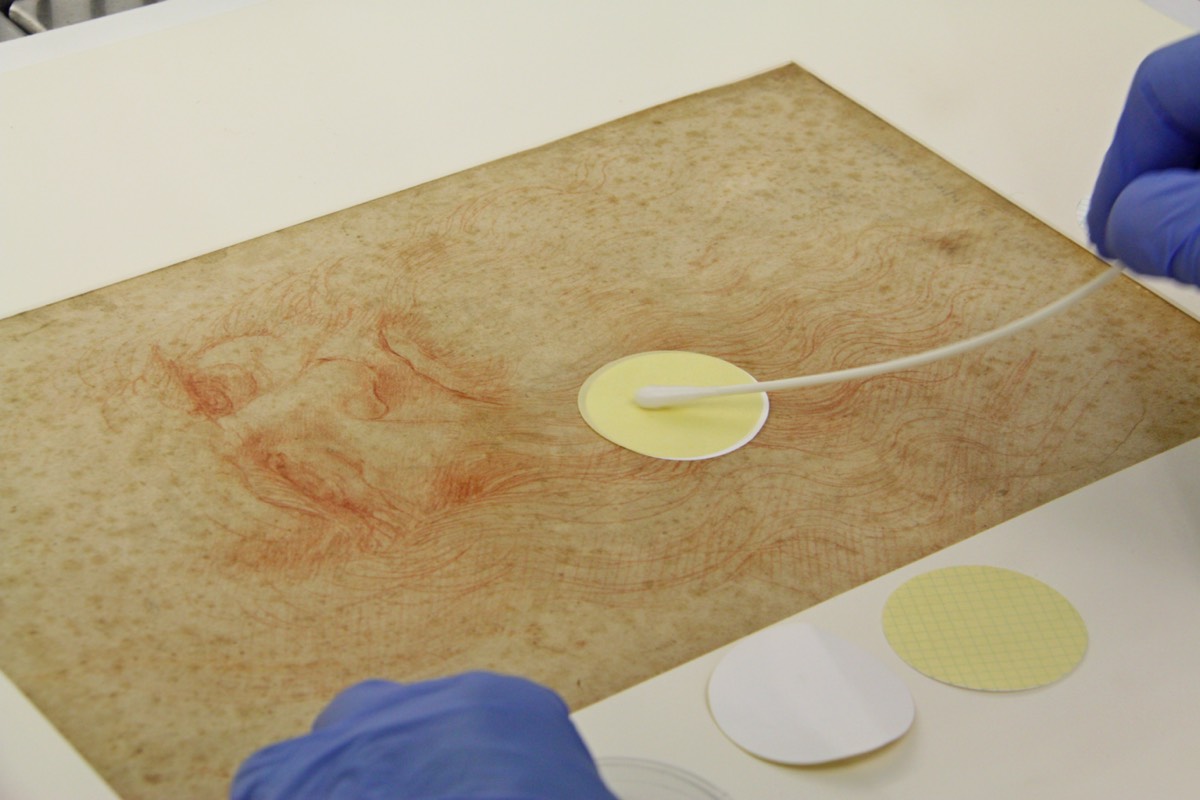
Sampling microbes from Leonardo da Vinci's <em>Portrait of a Man in Red Chalk</em> (1512).
Enlarge / Sampling microbes from Leonardo da Vinci’s Portrait of a Man in Red Chalk (1512).
Guadalupe Piñar et al.

Microbiomes are all the scientific rage, even in art conservation, where studying the microbial species that congregate on works of art may lead to new ways to slow down the deterioration of priceless aging artwork, as well as potentially unmask counterfeits. For instance, scientists have analyzed the microbes found on seven of Leonardo da Vinci’s drawings, according to a recent paper published in the journal Frontiers in Microbiology. And back in March, scientists at the J. Craig Venter Institute (JCVI) collected and analyzed swabs taken from centuries-old art in a private collection housed in Florence, Italy, and published their findings in the journal Microbial Ecology.

The researchers behind the earlier March paper were JCVI geneticists who collaborated with the Leonardo da Vinci DNA Project in France. The work built on a prior study looking for microbial signatures and possible geographic patterns in hairs collected from people in the District of Columbia and San Diego, California. They concluded from that analysis that microbes could be a useful geographic signature.

For the March study, the JCVI geneticists took swabs of microbes from Renaissance-style pieces and confirmed the presence of so-called “oxidase positive” microbes on painted wood and canvas surfaces. These microbes munch on the compounds found in paint, glue, and cellulose (found in paper, canvas, and wood), in turn producing water or hydrogen peroxide as byproducts.

“Such byproducts are likely to influence the presence of mold and the overall rate of deterioration,” the authors noted in their paper. “Though prior studies have attempted to characterize the microbial composition associated with artwork decay, our results summarize the first large-scale genomics-based study to understand the microbial communities associated with aging artwork.”

As an added bonus, they found they could discern between microbial populations on different types of materials. Specifically, stone and marble art fostered more diverse populations than paintings, possibly due to the “porous nature of stone and marble harboring additional organisms and potentially moisture and nutrients, along with the likelihood of biofilm formation,” they wrote. Oil paintings offered more meager nutrients for microbes to metabolize, by contrast.

The authors acknowledged the small sample size, but they nonetheless concluded that microbial signatures could be used to differentiate artwork according to the materials used. As always, more research is needed. “Of particular interest would be the presence and activity of oil-degrading enzymes,” the authors wrote. “Such approaches will lead to fully understanding which organism(s) are responsible for the rapid decay of artwork while potentially using this information to target these organisms to prevent degradation.”

Swabbing Renaissance art

Guadalupe Piñar and her team at the University of Natural Resources and Life Sciences in Vienna, Austria, collaborated with conservators from the Instituto Centrale per la Patologa degli Archivi e del Libro (ICPAL) for the microbiome analysis of the Leonardo da Vinci drawings. Last year, Piñar et al. relied upon microbiome analysis to study the storage conditions of three statues retrieved from smugglers, as well as pinpointing their possible geographical origins. Earlier this year, they analyzed the microbiome of 1,000-year-old parchments, from which they were able to deduce the animals whose skins were used to make the parchments.

For this latest paper, Piñar’s team turned to a third-generation sequencing method known as Nanopore, which uses protein nanopores embedded in a polymer membrane for sequencing. It comes with a portable, pocket-size sensing device, the MinION, making it ideal for cultural heritage studies. For the Leonardo drawings, Piñar et al. combined the Nanopore sequencing with a whole-genome-amplification protocol.

The ICPAL conservators used a delicate, noninvasive microaspiration (i.e., filtering suction) sampling method to collect dust particles, microbial cells, and other debris from small surface areas on both the recto and verso of each drawing. Then the DNA was extracted, amplified, and sequenced by the Austrian team. They used optical microscopy to image features of interest in all seven drawings and scanning electron microscopy (SEM) to analyze all the micro-objects gathered from the drawings.

A “biological pedigree”

Each drawing had its own unique microbiome—an “independent molecular profile or biological pedigree.” But Piñar et al. were surprised to find that, overall, bacteria dominated fungi in the drawings’ microbiomes, contradicting widespread belief that fungi would be more dominant, given their higher potential to colonize on paper-based works. The researchers detected no visible biodeterioration on the drawing, apart from foxing stains (small yellow-brown spots or blotches).

Much of those bacteria are typically found in human microbiomes, suggesting they found their way onto the drawings while being handled during restoration—although one could speculate about whether it came from the artist himself. (The authors note that bacteria in dust could “remain in suspension” for long periods.) Other bacteria were typical of insect microbiomes and may have been introduced long ago by flies depositing excrement on the drawings. Those droppings showed up under imaging analysis as waxy brown incrustations in the fibers.

The Austrian/Italian team was unable to conclude definitively whether any of the microbial contaminants date back to Leonardo’s time. It seems far more likely that the human microbial elements are due to more recent restoration work. This is most likely to be the case for the drawing designated L4 (Studi delle gambe anteriori di un cavallo) in particular, which showed the least biodiversity and the heaviest contamination from human DNA. The authors hypothesize further that the recipe Leonardo used—”a preparatory layer made with powdered calcinated chicken bones, white lead, indigo… mixed with animal gelatin”—may have interfered with the preservation of the microbiome of L4, so only recent DNA remained.

But Piñar insists that being able to track this kind of data is nonetheless highly valuable. “The sensitivity of the Nanopore sequencing method offers a great tool for the monitoring of objects of art. It allows the assessment of the microbiomes and the visualization of its variations due to detrimental situations,” she said. “This can be used as a bio-archive of the objects’ history, providing a kind of fingerprint for current and future comparisons.”

DOI: Microbial Ecology, 2020. 10.1073/pnas.1802831115

DOI: Frontiers in Microbiology, 2020. 10.1007/s00248-020-01504-x (About DOIs).

https://arstechnica.com/?p=1724965


Review: Alice in Borderland takes us down a deliciously bonkers rabbit hole

Tokyo residents find themselves trapped in a post-apocalyptic parallel world called Borderland, where they must compete in deadly games to survive.
Enlarge / Tokyo residents find themselves trapped in a post-apocalyptic parallel world called Borderland, where they must compete in deadly games to survive.

In the carefree, pre-pandemic Before Times, escape rooms were all the rage as fun group activities, where people had to solve a puzzle or mystery, or complete a series of tasks, in order to escape. Alice in Borderland, a hugely entertaining new Netflix series from Japan, takes that concept to a whole new level, transforming Tokyo into an alternate dimension called “Borderland.” Those trapped therein must compete in deadly games to survive, and escape is by no means guaranteed. This is an emotionally intense, addictive series you’ll definitely want to binge.

(Some spoilers below, but no major reveals.)

As previously reported, the series is based on the Japanese manga by Haro Aso. It has elements of Alice in Wonderland and Ready Player One, with a dash of Lord of the Flies and the 1997 sci-fi horror film, Cube, thrown in for good measure, but it’s very much an original vision. The TV adaptation is directed by Shinsuke Sato, best known for 2001’s The Princess Blade and last year’s Kingdom, and co-written by Haro Aso and Yasuko Kuramitsu. The manga tells the story of Ryōhei Arisu (Arisu can be translated as “Alice”), a bored high schooler who longs for a more exciting life. Arisu’s wish is granted during a fireworks celebration: he and his two best friends find themselves in a post-apocalyptic parallel world known as Borderland.

The Netflix adaptation follows the same basic premise, with a few minor tweaks—most notably, the central characters are young adults rather than high schoolers. Arisu (Kento Yamazaki) is “a listless, jobless and video-game-obsessed young man.” Karube (Keita Machida) is a bartender who has just been fired for sleeping with the boss’s girlfriend, and Chota (Yûki Morinaga) is a bored, mild-mannered office worker. After a mysterious power outage, they suddenly find themselves in an eerie, emptied-out version of Tokyo.

As night falls, neon signs direct them to what turns out to be a gaming “arena.” Once they enter the arena, they are issued smartphones that deliver instructions for the game at hand—in this case, a locked-room puzzle in which they must repeatedly guess the correct door to pass from room to room in a building. Guess wrong, and the room will engulf them in flames. They must win the game (i.e., survive) in order to exit, and they do so, thanks to Arisu’s quick thinking. But they are still trapped in this strange world, along with many others, and must keep playing games to survive. They do find other allies along the way, most notably a young woman named Usagi (Tao Tsuchiya), a mountain climber with excellent survival skills.

Games are held every night after sundown. Each game comes with a particular playing card. Win the game, and the player is issued a “visa”—a pass wherein they don’t have to compete for a certain number of days, corresponding to the number of the card. The four suits are specific categories of games.

Spades are games that require physical strength (Usagi and Karube excel at them), diamonds are games of wit and intelligence (Asiru’s specialty), clubs are games where teamwork is required (Chota’s forte), and hearts—well, hearts are the cruelest games of all, since they are psychological games that involve emotional manipulation and betrayal. You can win a game of hearts, but that victory will come at a tremendous cost, and it might just break you entirely.

The locked-room game, for instance, corresponds to the 3 of Clubs, so when they win, Asiru and his pals have three days’ respite before they have to compete in another deadly game. The penalty for not playing is being zapped into oblivion by a deadly laser beam shooting down from the sky, so let’s just say the unwilling participants are highly motivated to comply. There are also “dealers” charged with infiltrating the games for the express purpose of sabotaging them, in exchange for visas.

Much of the pleasure and dramatic tension of Alice in Borderland arises from the sheer sadistic ingenuity of the games. For instance, a twisted game of tag (5 of Spades) gives all the players 20 minutes to find a safe base somewhere within an abandoned apartment building, while avoiding the person designated “It”—whose job is to gun down any player he or she encounters. After 20 minutes, the entire building is rigged to explode. As for Hide and Seek (7 of Hearts), all the players don a special electronic collar; one person is the “wolf,” the others are “sheep.” Lock eyes with the wolf and you trade designations. The person who is the wolf after 15 minutes wins the game; the sheep’s heads explode. (Yes, the body count for this series is substantial.)

Another strength: the many different colorful characters, each with their own compelling back stories—the better to break the viewers’ hearts should one of them eventually lose a game. There is a version of the Mad Hatter, known simply as the Hatter (Nobuaki Kaneko), who sets up a collective of survivors dubbed “the Beach,” with the aim of cooperating to play enough games to collect all the cards in the deck. (There is an unconfirmed rumor that this is the only way to escape Borderland.)  A mysterious figure known as Chishiya (Nijirô Murakami), aka “Cheshire,” forms an alliance with Kuina (Aya Asahina), a former clerk in a clothing store with martial arts training, who in turn has a bikini-clad showdown with a katana-wielding tattooed psycho known as the Last Boss (Shuntaro Yanagi). And so forth.

The pacing is relentless, chock-full of unexpected twists and WTF scenes, plus a few well-placed moments of downtime to give viewers a chance to catch their breath now and then. The stakes rise fast, and thanks to the expert plotting, the stakes keep rising all the way through to the finale, which—in time-honored Netflix fashion—wraps up a bunch of narrative threads while setting up a possible second season. The remaining players “level up” to the next stage, but we still have no idea of the identity of the master(s) behind the games.

There’s no official word yet on the show’s renewal. S1 roughly covered events in the first 31 chapters of the manga; a second season could easily encompass the remaining 33 chapters. Here’s hoping Alice in Borderland escapes the streaming giant’s brutal, pandemic-driven budget axe, and we get the chance to lose ourselves down this deliciously bonkers rabbit hole once again.

Alice in Borderland is now streaming on Netflix. In Japanese with English subtitles.

https://arstechnica.com/?p=1729488


Humanity is in danger of becoming obsolete technology in LX 2048

[embedded content]
James D’Arcy stars as a terminally ill man who gets the chance to “upgrade” his life in Guy Moshe’s sci-fi film LX 2048.

A fatally ill man tries to secure the future of his family in a near-future world where the toxicity of the Sun forces people to stay inside during the daytime in LX 2048, starring James D’Arcy (Agent Carter, Homeland). It’s a flawed yet thought-provoking surreal science-fiction film, chock-full of big ideas on our relationship to technology and what it means to be human and anchored by D’Arcy’s fantastic performance.

(Some spoilers below.)

D’Arcy plays Adam Bird, a married father of three on the brink of divorce from his wife, Reena (Anna Brewster). The year is 2048, and people are largely living indoors during the day because the sunlight is powerful enough to scald human skin instantly. Everyone spends most of their time in a virtual world known as The Realm. (The fact that Reena caught Adam virtually cavorting with his AI lover is just one of their many marital issues.) Everyone also takes regular doses of LithiumX to ward off depression. Adam, however, clings to his old habits, driving a convertible to the office in a hazmat suit and refusing to take the drug.

Then he learns he has a terminal heart condition and must shore up his struggling VR business long enough to maintain their premium insurance policy. It provides for a clone, complete with all of Adam’s memories and traits, to raise his family in his place once he dies. In fact, the clone would be an improved version of himself, and Adam isn’t quite ready to face this bitter reality. Things become much more complicated and weirder from there. We sat down with Director Guy Moshe (Bunraku) to learn more about the genesis of the film and its themes.

Ars Technica: Can you tell us a little bit about the genesis of this film?

Guy Moshe: It started with the human aspect. I’m happily married, got three kids. We were spending a lot of time with other families, and in a span of a year or so, there were a lot of these relationships going up in flames all around us—people separating and getting divorced. Even though every story is different and every individual is different, I could see a through line: people reaching adulthood and feeling like, at some point along the way, they didn’t get a chance to be all that they wanted to be, or that they could be. That gave birth to the idea of a person trapped inside a situation like this within their relationship. I also couldn’t escape the thought that part of the reason the family structure in today’s world is a little less sacred than it used to be is because of all this technological revolution going on around us, which reduces the need for social interaction. It makes us less of the social creatures that we were intended to be.

With these two linking ideas in mind, the film started evolving. I wanted to focus on one character’s journey. We all have the image of ourselves that we want to be, that we project to the outside world. But there’s also another image of who we really truly are, which a lot of us either never discover or never have the courage to admit to ourselves. Then there is another image of the way other people see us on the outside, and finally, the potential of the best version of ourselves that we can be. I wanted to examine the journey of a person as he discovers these different facets of himself.

It was one of the scripts that I thought about the most of everything I’ve ever written. But when I finally sat down to write it, the first draft of the script came out of me almost like a stream of consciousness. When I knew I was going to cast James [D’Arcy] in the lead role, I shaped it to his character a little bit more.

Ars Technica: How did James become involved in the project? He’s well-known for his supporting roles, and it was such a pleasure to see him in a meaty leading role for a change. 

Guy Moshe: He’s such a wonderful actor. I was actually discussing a bigger project with James that was very close to happening while working on the script [for LX 2048]. When that other film ended up postponed, I couldn’t escape the feeling that James would be so great in this role. There’s something about James; he has such great humility, such an easy ability to command the stage. Because of his nature, his personality, he’s holding a lot back, and he has a great self-deprecating humor. Also, I love seeing these great actors, who don’t always get to be at the center of things, play these types of roles.

Ars Technica: When Adam confronts his clone, he discovers that his wife knew him better than he thought. The clone is more like what Adam, deep down, wished he could be. It was funny in a sad way.

Guy Moshe: None of us, I think, knows truthfully, who we would be, if by some magic somebody gave you the option to be all that you could be. A lot of us don’t have the capacity to even imagine ourselves like that, because we live inside ourselves a lot. Oftentimes it’s the people that are closest to us who can see and understand us more objectively. Yet the tragedy of a lot of these relationships falling apart is that we’re not able to communicate with one another, on the positive side, about the things that brought us together to begin with. So I knew that Reena would know better than him what would make him happy, but I also knew that there was no way in the real world that she could ever help him get to that place.

Ars Technica: In many ways, the film is quite timely. The Sun has not become fatally toxic, but we’re in the middle of a pandemic, and we’re having to engage with each other mostly in the virtual realm. 

Guy Moshe:  During the lockdown, I had the opportunity to be in some big Zoom meetings where suddenly I’m talking to 30 people [virtually]. On the one hand, you tell yourself, well, I’m actually interacting with people right now. Some people would tell you they’ve spoken more with their families [during the pandemic] than they did before.

But the first time, when [social distancing measures] were relaxing a little bit, we went out to a small birthday [gathering]; everybody in that small event couldn’t stop talking about how they didn’t realize how much they missed being in the presence of other people. So there is clearly a huge difference. I think that the sense of touch is something that is so important to human beings; it’s essential to our existence. To me, the scary part is this idea that we’re losing the ability to interact with the world in the way that we were biologically intended to do.

Ars Technica: The film explores this notion of the darker side of upgrades—viewing people as obsolete technology. And while the clones are deemed to be superior to the humans, there’s a virtual chip waiting in the wings that will one day make the clones obsolete as well.

Guy Moshe: What I loved is that the clone himself is aware of the fact that it is just a transitional upgrade. This cannot be the end result, because the moment you start taking it all digital, there’s no reason for the biology to exist anymore. To me it’s a very big question. Of course, there’s much more successful people than myself that are walking around now wondering if we’re all currently existing in some computer simulation. The film talks about it from the biological standpoint. Maybe that’s an admission on my part of what I would love to believe. There is this moment where [Adam’s AI lover] Maria [talks about] the fact that we might all be cells of a bigger body. If you could transfer this to the digital realm, that would equate to an existence that is 100 percent virtual. Everything, all the data that we interpret, even with our sense of touch, is eventually transformed into electrical impulses. So maybe it’s possible.

Whether or not that’s where humanity is headed, I’m sure I’m never going to live for enough time to know, but it certainly begs the question. I can tell you one interesting little thing. I have kids who love basketball. But if I give them the option to play physical basketball, or to play NBA 2K21 on the PlayStation, they’ll take the digital game any day of the week. I don’t know what to think about it, because I didn’t grow up like this. Maybe it doesn’t mean anything. Maybe it shows where we’re headed.

LX 2048 is available for streaming on Amazon Prime and VOD.

Listing image by Chimera Pictures/Quiver Distribution

https://arstechnica.com/?p=1711575


The 15 best films of a bizarre (and probably historic) year for film

Clear your year end vacation schedule, there's streaming to do.
Enlarge / Clear your year end vacation schedule, there’s streaming to do.
Nathan Mattise / ESPN / Orion Pictures / Ingrid Haas / Warner Bros. / Joshua Tsui / Fantasia Fest

“2020 has been a weird year for film” feels like a massive understatement even in the moment. The pandemic has ransacked reliable sources of new films like theaters and film festivals. And any number of major titles we may have looked forward to on January 1, 2020 (from Dune to Top Gun) have instead chosen to push back by at least 12 months.

In just a few years, however, it feels more likely we’ll look back at 2020 not as “weird,” but as an industry inflection point. Warner Bros. is the first major studio to push an entire year’s worth of film releases to streaming services simultaneously with whatever theaters are open, a trend that has loomed over the film landscape ever since streaming-first companies like Netflix and Amazon have become major production powers. And just a year after an independent foreign film took home the Oscars top prize, the uncertainty of the box office moving forward may all but ensure the only stuff that makes it to most theaters (whatever that landscape may look like heading into 2022 and beyond) will be heavily reliant on familiar IP, whether that means superheroes, space, or some other established film franchise behemoth.

Today, we’re not here to hypothesize or fret about film’s future, though. As grim as things seem, right now there’s still an ample amount of diverse new films worth getting excited about. From the streaming services churning out new work with heavyweights (from Mank to Da Five Bloods), to unorthodox productions pleasing massive audiences (American Utopia, Hamilton), to however you want to classify a new 2020 Borat film, 2020 may have been harrowing for films at large but it gave film fans just as many exciting new titles to enjoy as almost any other year.

We’ve whittled down the cache of new films we’ve seen across screeners, drive-ins, streaming services, and VOD film festivals into a list of the 15 best things we’ve seen these last 12 bizarre months. So with apologies to some supposedly great films we just haven’t caught (the pandemic horror classic, Host; RZA’s post Katrina action film, Cut Throat City; one of many excellent COVID-19 docs, Totally Under Control) and to the promising titles that just rolled out to late for us to consider (Wonder Woman 1984, Soul, or promising documentary, The Last Blockbuster), these are the best films of 2020. In alphabetical order…

Be Water

We are living in a golden age for documentary, with more platforms than ever willing to invest in a filmmaking genre that traditionally wouldn’t deliver massive numbers at the box office. (On top of that, there’s perhaps a premium on facts and truth for a majority of the country.) Perhaps our favorite for 2020 comes from one of the modern documentary scene’s stalwarts: ESPN. Be Water provides an in depth look at the life and impact of Bruce Lee, leveraging Lee’s own unearthed writings, interviews with friends and family, and oodles upon oodles of great footage. The Last Dance (rightfully) sucked up a lot of the (attention) oxygen for ESPN’s 2020 output, but Be Water is the more apt film for the times, especially in a year where COVID-19 fears bred anti-Asian sentiment and thousands continue to take to the streets in support of Black Americans. In between all the action brilliance and details showcasing Lee’s immense cultural significance, director Bao Nguyen never lets audiences forget the actor rose to prominence in the United States during the 1960s civil rights era. More than a platform for some cool Lee facts and face-offs, Be Water again and again shows him as a man of his time pushing for equality across many aspects of his life.

—Nathan Mattise || Stream the film on ESPN+.

Bill & Ted: Face The Music

If you would call yourself a Bill & Ted series diehard—the kind who suffered through the uneven cartoon adaptation and has written lengthy online analyses of their Bogus Journey—this blurb isn’t for you. You have already seen (and adored) Bill & Ted Face The Music, the series’ third feature-length film from this August, and you got everything you wanted: A tasteful transition from George Carlin’s character Rufus, a healthy dump of amusing references from the original films, and a whole lot of Keanu.

For the rest of us, B&T3 isn’t necessarily essential viewing. But it sure is an ideal film for this year: one that is perhaps too polished and amusing for “straight to video” designation, yet whose cheesy ending and occasional momentum stumbles are all the easier to swallow as high-quality living-room viewing. The sequel’s absolute highlight is its toying with Bill S. Preston Esq. and Ted Theodore Logan’s multiple selves colliding via near-term time travel. The filmmakers apply deft green-screen editing to slam the characters into each other, thus mining this gimmick to incredible comic effect while standing out from other takes. (For my money, I enjoyed it more here than as an Avengers Endgame macguffin, as much as I liked that film.)

Plus, this year is an ideal one to see old, comfortable characters slot into ridiculously happy, stars-aligned endings. All of us at Ars were able to put our critical glasses down and beamed with misty eyes to see Bill, Ted, and their families get their wicked licks together just in time to save the world (spoiler alert, whatever, you’ll see it coming). We urge you to get your own kids together to do the same.

—Sam Machkovech, Esq. || Stream the film on almost every VOD/Rental platform on the Internet.

[embedded content]
Trailer for Feels Good Man.

Feels Good Man

Making a good film about the Internet is hard (see modern film history from The Net onward); making a compelling and true film about the Internet might be Cuphead-level hard. And while anyone who’s seen Feels Good Man will inevitably refer to it as “the Pepe film” (yep, the same animated frog co-opted by the alt right), this documentary earned a place in our hearts for how thoroughly it understands and explains the way information spreads and evolves in the most unvisited corners of the Internet. Illustrator Matt Furie is an extremely willing participant for director Arthur Jones throughout, but it’s Feels Good Man’s diversity of interviews that ensures this film paints a fuller and more robust picture of modern online media. From 4chan users to scholars studying meme spread, major television illustrators to a digital director for the Trump 2016 campaign, the array of perspectives encompassed in Feels Good Man might make Ken Burns blush. It’ll definitely give viewers at all levels of Internet savvy something new to think about.

—Nathan Mattise || Stream this film on most major VOD platforms (Amazon Prime, Microsoft Store, Google Play, Vimeo on Demand, et al.)

https://arstechnica.com/?p=1727759


Miyamoto leads fans through Super Nintendo World—and it looks incredible

On Friday, Nintendo and Universal Studios Japan took the veil off a years-in-the-making project: the very first Nintendo-themed theme park, appropriately named Super Nintendo World. And who better to introduce the world to this life-sized walk through all things Mario than the character’s creator himself, longtime Nintendo developer and designer Shigeru Miyamoto.

The 15-minute video, embedded at the end of this article, revolved largely around the park’s introductory moments, which are full of Super Mario melodies and interactive elements. Many of the park’s decorations and objects can be interacted with by park visitors who wear a special wristband, dubbed the Power-Up Band, which includes an Amiibo-like NFC chip. Press its sensor near park objects like a Super Mario coin block, and a new virtual item will appear in a synced Super Nintendo World app on your smartphone. Exactly how these virtual items will affect your visit to Super Nintendo World remains unclear, but Miyamoto-san hinted to surprising attractions and hidden interactable panels for park visitors to discover in person. (Additionally, those Power-Up Bands will double as Amiibo for compatible hardware, like Nintendo Switch.)

Only one “ride” received a showcase in the video, albeit a brief one: a Mario Kart race against Bowser. It’s hosted inside a replica of Bowser’s castle, and visitors will sit in one of a series of Mario-styled go-karts that appear to be linked on a rollercoaster-like track, as opposed to freely controllable. Exactly what visitors will see on that ride remains unclear, but previous news about the ride’s augmented reality (AR) elements was reinforced with the first official look at the park’s AR glasses, which come attached to a Super Mario hat.

Unsurprisingly, the theme park will include a robust gift shop, which Miyamoto-san confirms will include exclusive Nintendo merchandise—particularly a robust Super Mario toy whose legs articulate in a walking motion with no batteries needed, just the push of a hand. (It’s easy to forget that Nintendo’s history as a game publisher was preceded by an incredible variety of cleverly designed toys, largely thanks to former Nintendo designer Gunpei Yokoi, who eventually masterminded the first Game Boy.)

Miyamoto-san also walked viewers through one of the park’s restaurants, which is Toad themed and includes “windows” into its kitchen (though these are just high-res LCD panels with pre-rendered CGI animations of Toad characters making food). A few of the park’s food options were shown off, and anyone who’s been to a themed Japanese café knows that the nation takes its quirkily designed food very seriously—which is immediately apparent in the weird-looking food shown off in today’s video.

However, today’s video didn’t reveal any other branded experiences at Super Nintendo World, particularly ones that are reported to revolve around the famed Nintendo character Donkey Kong or the previously teased Yoshi’s Adventure ride. We’ll apparently have to wait until the park opens in Japan on February 4, 2021, to see if non-Mario content will be open to the public during its launch window—and even longer for the Nintendo-themed park to get launches at Universal Studios’ locations in Orlando, Los Angeles, and Singapore. (Unsurprisingly, today’s reveal included multiple warnings about COVID protocols for the Japanese launch.)

Though I was eager to highlight the video’s details in gallery form, any Nintendo fan worth their salt owes it to themselves to watch Miyamoto-san giddily introduce everything in this park. I personally cannot remember the last time I saw the man this excited by a project, and based on what’s been shown so far, I do not blame him.

[embedded content]
Shigeru Miyamoto walks fans through Super Nintendo World at Universal Studios Japan

Listing image by Nintendo / Universal Studios Japan

https://arstechnica.com/?p=1730919


Greenland is as much a love story as an epic spectacle of impending disaster

[embedded content]
Gerard Butler stars as a structural engineer in Atlanta who must get his family to safety in the face of a looming extinction event in Greenland.

The Earth is facing an extinction-level event from an interstellar comet as a man and his family race against time to find safe haven in Greenland, a new disaster thriller starring Gerard Butler (300, Angel Has Fallen) and directed by Ric Roman Waugh (Snitch, Angel Has Fallen).

(Some spoilers below, but no major reveals.)

Per the official premise:

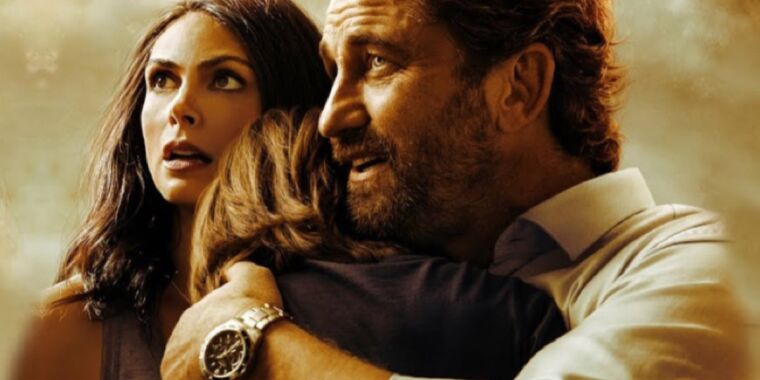
A family fights for survival as a planet-killing comet races to Earth. John Garrity (Gerard Butler), his estranged wife Allison (Morena Baccarin), and young son, Nathan (Roger Dale Floyd), make a perilous journey to their only hope for sanctuary. Amid terrifying news accounts of cities around the world being leveled by the comet’s fragments, the Garritys experience the best and worst in humanity while they battle the increasing panic and lawlessness surrounding them. As the countdown to global apocalypse approaches zero, their incredible trek culminates in a desperate and last-minute flight to a possible safe haven.

The comet in question has been dubbed Clarke, and initially everyone is assured that Earth will not be much affected as Clarke swoops by, other than providing a spectacular light show as fragments in the comet’s tail burn up in Earth’s atmosphere. When a fragment the size of a football field instead levels Florida during a neighborhood watch party, panic ensues. The Garritys are the only family on their block to receive notification that they’ve been selected for transport to an underground military bunker for safety—mostly because John is a structural engineer with skills that will be needed to rebuild after the devastation. And there will be devastation: one of the fragments is nine miles wide, large enough to trigger an extinction-level event. Translation: the Garritys’ neighbors are screwed. They don’t take it well.

What comes next is a white-knuckle road adventure as the family becomes separated right before takeoff and must figure out how to regroup at the home of Allison’s father, Dale (Scott Glenn). Like all the best disaster movies, Greenland is about so much more than the epic spectacle of an extinction-level event. Ars recently sat down with Waugh to talk about how he successfully merged a disaster thriller with an intimate family drama as well as the film’s current relevance.

Ars Technica: One of the most interesting aspects of the film is the exploration of human behavior—and not just the expected widespread panic and mass hysteria. Different people react in very different ways. Otherwise good people make bad decisions, and sometimes bad people make good decisions. We’re seeing some of that complicated human behavior play out during the current pandemic.

Ric Roman Waugh: I remember reading the script for the first time pre-COVID. What I loved about the material is that it wasn’t really a disaster film. It was a love story about humanity, exploring how we would react to each other when something hits like this. Then suddenly COVID comes around and you’re seeing it firsthand. It was such a surreal experience.

When I went back to watch the movie, at first, I was like, God, who’s going to want to watch a disaster movie in the middle of a disaster? But this is a love story. It’s a story about hope. A lot of heinous things are going to happen during tragic events like this, but there’s also going to be a lot of good. I’ve always loved the metaphor of what the Garrity family stands for: a husband and wife that are so far apart, they’re on the brink of divorce, and yet trying to give it one last shot. Many sins have happened in the marriage that they’re trying to atone for and find their way. I thought that was really about what society is right now, of how divisive we are and how miles apart we are from one another. Yet when a life-or-death event happens, sometimes it has a way of knocking the rest away.

Ars Technica: You’re also grappling with moral and ethical questions, like who gets selected to be transported to the underground bunkers. There’s a terrible scene where the Garritys’ neighbor is begging them to take her daughter with them to save her. You can understand why these difficult decisions must be made and yet it’s still horrific.

Waugh: The moment when we knew that this movie could touch people, is when we shot in a real neighborhood in Marietta, Georgia, in a real cul-de-sac, with real families. We took over a house, and they were very gracious to us. I don’t think any of them really saw a movie being made before. About day three in the first week was when we had to shoot that horrible scene. I usually shoot these types of scenes in one long take. When I was done with the first take, my first AD put his hand on my shoulder and said, “Look up the street.” All of the real neighbors had been watching, and they were all in tears, crying.

If you could only save so many people, how would you go about it without creating mass hysteria? If you could only save a fraction to try to rebuild the earth in a catastrophic event, who would you save and why would you save them? That fascinated me, because you’re in this no-win situation where you can’t save everybody.

Ars Technica: This is a fictional Hollywood film, but you seem to have gone out of your way to make the science behind the basic premise reasonably plausible.

Waugh: You have to go in knowing you’re not making a documentary; that’s a different narrative. We wanted to make ourselves feel as grounded as possible, yet still allow creative license. First, how did the extinction event [that killed the dinosaurs] take place? Everything’s a theory because nobody was alive back then, but there’s a lot of data, and if you start cross-referencing, you get a really good imprint of what scientists think. The other part was the comet. One of our great discoveries was learning how a lot of near-Earth objects like asteroids or comets will break apart as they hit other kinds of debris in outer space, so that you end up with these fragments.

It gave me creative license and a construct, not to just have a movie that relies on the big one at the end, but actually have the monster constantly attacking all the way throughout the movie. It allowed the engine of the movie to be different, where I can have fragments hitting constantly. And it wasn’t just one monster. It was the monster in the sky, but it was also humanity. Would we become the monster and turn on one another, or would we help each other?

Ars Technica: That ties in to another aspect I appreciated about this film: the way you kept upping the emotional stakes. There’s so much more to this story than just trying to outrun an extinction event.

Waugh: Gerard Butler and I really wanted this to be about a man and a woman trying to win their love back by going on this journey, as they seek shelter and end up getting separated, etc. Each one goes through tremendous hardships to the point of hitting rock bottom. I think it was my way of saying, “Hey, you know what? Sometimes we do have to hit rock bottom to understand how to dig ourselves out and to rebuild.” And I wanted that to carry forward. It really is this 60-minute gauntlet run to get to Grandpa’s (Scott Glenn) house. And then the movie changes and becomes about rooting for this unit to survive the monster in the sky.

Ars Technica: Were there any particular highlights for you during filming?

Waugh: I’m a big supporter of the veteran community, and I’m constantly hiring as many military veterans in front of the camera and behind the camera as I can. The US Air Force was involved with the making of Greenland. We shot at Warner Robins Air Force Base in Georgia. I’m very proud that 90 percent of the men and women that you see in uniform in the movie are active duty enlisted and had never been on camera before. A lot of the people playing the civilians in the crowds and so forth are their families. It was really rewarding to have them all be a part of this.

Greenland debuts today on VOD and will be coming to HBO Max and Amazon Prime.

Listing image by STX Films

https://arstechnica.com/?p=1730381