VR meetings are weird, but they beat our current reality

A virtual workspace is composed of heavily stylized floating heads and a permanent sunset.

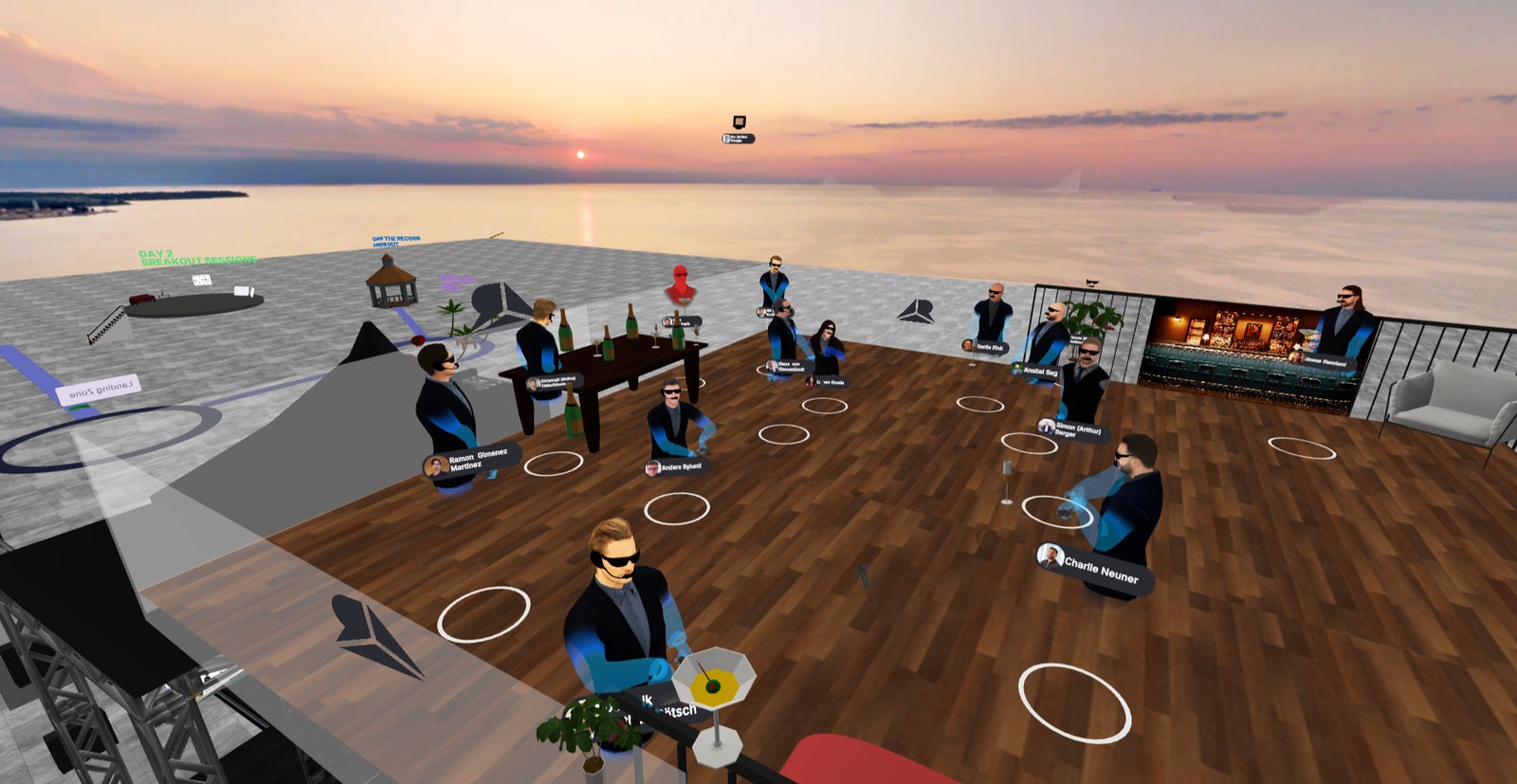
The Sun never sets in virtual reality. This occurred to me after an hour-long briefing in an Oculus Quest 2 headset. Joined by more than a dozen other floating avatars, we teleported our way around an “outdoor” meeting space that could only be described as aircraft-carrier-meets-Croatian-vacation.

Beyond the vast expanse of virtual breakout spaces was a stunning sunset, but the day never grew dark. When I pressed a button on the Touch Controller a tad too long, I ended up standing unnervingly close to another avatar, a fellow journalist. Then I remembered that you can’t catch the coronavirus from a digital simulacrum.

The press briefing was one of a few ever to occur in VR, a spokesperson for this new app claimed. It’s called Arthur, and part of the pitch is that it’s going to catapult VR for work into the mainstream, that meetings and collaboration sessions and deskside briefings will become… headset briefings.

The app launched on December 8, but it’s been in development for four years. The company behind it, also named Arthur, is headquartered in San Mateo, California, with employees scattered around the globe. It has secured seed funding from VC firm Draper Associates, and it lists the United Nations, Societe General, and a large automaker as its beta testers.

Taking a meeting in Arthur requires a literal suspension of reality. You exist only from the waist up (hey, just like Zoom!), and your shirtsleeves taper off to reveal blue computer arms, which move according to how you move the Oculus Quest controllers in your hands. Your digital eyes are obscured by Matrix-style glasses, and a headset microphone covers your virtual mouth. This is because the technology can’t yet mimic facial expressions in VR, and “it’s better than looking at dead eyes,” says Arthur founder Christoph Fleischmann. My avatar looked nothing like me except that it had dark brown hair.

Still, meeting in VR felt like somewhere else, if not somewhere in the physical world. I was sitting in the same living room I’ve occupied for most of the year, but I was present with other people. I was aware that my headset’s physical microphone was on, that anything I said would be part of the conversation. It felt rude to step away and start making coffee in my kitchen.

When Fleischmann urged the group to take a seat ahead of a presentation in a virtual amphitheater (which appeared on demand, the fastest and cheapest construction project ever), we scattered awkwardly among the seats the way we might in real life. And after the presentation, during which Fleischmann touted the collaborative benefits of working in VR, we teleported to a roof-deck bar and used our hand controllers to pick up virtual cocktails. Everyone loosened up, despite these being unreal drinks. All the while, the Sun remained stuck in its permanent position of almost set. It was surreal, but it beat our current reality.

Meet me here

Arthur wouldn’t be the first to try to carve out a space for itself in enterprise VR. Until recently, VR headsets—as well as mixed-reality headsets, like Microsoft’s HoloLens—were prohibitively expensive, costing over $1,000 per unit. Any company looking to make inroads in the industry had to at least consider selling to big businesses, the ones who could afford the nascent technology. That was the approach Spatial took, a buzzy New York-based startup that WIRED’s Julian Chokkattu covered earlier this year.

“We always say we’re like Zoom and Slack had an AR/VR baby,” Jacob Loewenstein, Spatial’s head of business, tells me over Zoom from his New York City apartment (the Zoom meeting was my request; I was on deadline and didn’t want to dither in VR). “And we really mean it. Because if we succeed it’s because we’ve made this thing just stupidly easy to use.”

If you look carefully, you can spot an Ars alum in this VR setting.
Enlarge / If you look carefully, you can spot an Ars alum in this VR setting.

Part of that ease of use comes from the fact that Spatial is cross-platform, running the Web as well as AR and VR headsets like Oculus Quest. Your colleague could be experiencing the app in VR, using pop-out versions of Google Drive or Microsoft 365, but if you don’t happen to have a headset nearby, you can join via weblink on your laptop and still get some of the three-dimensional benefits. (Arthur is also testing a Web client and plans to support AR in the future.)

Both Lowenstein and Anand Agarawala, Spatial’s chief executive and cofounder, say the pandemic has been good for business. The company made its $20-per-month Pro app free this spring and saw daily users jump by 130 percent. There have been more than half a million “meeting joins” in the Spatial app. Recently, the number of people joining Spatial meetings from VR headsets surpassed the number of Web users.

Agarwala says Facebook’s release of the $299 Oculus Quest 2 this fall has helped drive business, too. “We saw demand all summer long, with people asking us, ‘Where do I get a headset? We just want to get in [the app].’ And now all the travel budget they’ve saved this year, they’re dumping into the Quest,” he says.

But whether the pandemic has been a true boon for VR depends on who you ask. In September, the research firm IDC put out a report forecasting that the market for VR headsets would decline nearly 7 percent in 2020. Jitesh Ubrani, one of the authors of the report, noted the market would potentially bounce back in 2021 and that VR for enterprise could grow to over half the total VR market by 2024. This year, though, VR was set back by hardware production issues in the first half of the year, something that affected the tech industry broadly. Even if you wanted to spend the dough on the original Oculus Quest or the HTC Vive Pro or the Valve Index, they were hard to come by.

Face to face

I didn’t need to ask an analyst about the numerous peculiarities of VR. Getting set up in Arthur wasn’t hard, but it took time. I went through an onboarding session with Arthur’s incredibly patient business operations manager, Simon Berger. This involved downloading the app and authenticating using a hand controller and a virtual keyboard.
Then there was the VR press briefing itself, a day later. As soon as I logged in, I realized I didn’t really have a good mechanism for taking notes, which is paramount for a journalist. The Arthur app does have a notepad, but using the hand controller to take notes seemed arduous, and I was completely cut off from the physical keyboard and voice recorder I use in the real world. You can record video and audio from the headset, but it’s all stored locally until you export it.

That doesn’t mean there isn’t potential in VR for work, or that the companies working on these apps are blind to the barriers. The technology just hasn’t fully arrived in time for the pandemic. “I think if VR headsets were available en masse in April, you probably could have convinced every Fortune 1000 company in the world to buy VR headsets,” Spatial’s Loewenstein says.

If I’d heard that statement back in April, I might not have believed it. But now, nine months into the pandemic and working solo from home, I can at least see the appeal. During my Arthur VR onboarding, the company’s founder, Christoph Fleischmann, just happened to “drop in” on our meeting in VR. It was no doubt planned, but the remarkably good spatial audio and the sudden appearance of this new person in my virtual world had all the markings of real-world spontaneity. I heard myself saying “nice to see you” to an avatar of another human, and meaning it.

This story originally appeared on wired.com.

https://arstechnica.com/?p=1729450



Copyright law is bricking your game console. Time to fix that

picture of Xbox Series X, PlayStation 5, Xbox Series S.
Enlarge / Awkward Thanksgiving portrait, next-gen console edition.
Sam Machkovech
Kyle Wiens is the cofounder and CEO of iFixit, an online repair community and parts retailer internationally renowned for its open source repair manuals and product teardowns.

There aren’t enough game consoles in the world for our upcoming locked-down holiday. Good luck finding a PS5 for Christmas. As Nintendo similarly struggles to keep up with demand, the number of people searching iFixit for Switch repair guides has more than tripled since last year. Traffic to our Joy-Con controller repair page started growing dramatically on March 14—the day after President Trump declared a national emergency. It’s been surging ever since. At a time when so many of us are turning to games for fun, stress relief, and social connection, it is imperative for our collective sanity that we press every game console into service.

But if you talk with expert repair technicians like Bryan Harwell, they’ll tell you that significant obstacles stand in the way.

At Replay’d, Harwell’s Boston repair and game shop, one out of every 10 customers brings in a console with a broken optical drive. Not only does a broken drive mean you can’t play your favorite discs, but on most Xbox and PlayStation models, a faulty DVD or Blu-ray drive will cause the whole console to stop working, even if the owner mostly plays downloaded, digital games. Harwell has hundreds of Xboxes in the shop basement that his technicians could harvest drives from, but there’s a catch—an obscure part of US copyright law makes it illegal for him to repurpose those drives. All too often, he’s had to give a hopeful child a dour prognosis: The only cost-effective way to fix their console is illegal. The only legal path requires parts so expensive that they’d be better off buying a new console (if they can find one).

The root of the problem is that Microsoft and Sony lock down the software they use to pair their disc readers with their consoles’ motherboards. Shops like Replay’d could easily replace those drives by accessing the software pairing the drives with the boards. Instead, the repair industry is cowering in fear of a relatively obscure provision of copyright law banning the removal of digital locks that’s kept everyone from gamers to farmers and hospitals from fixing the devices they own.

Kyle Wiens

Fortunately, Congress built an escape hatch. Every three years, the Librarian of Congress decides that, for certain products, circumvention of these digital locks should be allowed. That time is once again upon us. Next week, with the help of Public Knowledge and our fellow advocates for Right to Repair, iFixit will ask the US Copyright Office to make fixing consoles, along with other software-enabled devices, legal.

Section 1201 of the Digital Millennium Copyright Act, passed by Congress in 1998, makes it illegal to “circumvent a technological measure that effectively controls access to a copyrighted work.” In Harwell’s case, the copyrighted work is the firmware on the optical drive.

Manufacturers, and the Copyright Office, have interpreted this to mean that maneuvering around the digital locks on your own devices in order to fix them is against the law. And the penalties for breaking this law are harsh, with fines up to $150,000 and even jail time.

The result is that too many beloved consoles are heading for the trash heap rather than getting regifted under the Christmas tree. That’s a shame, because the demand is there—iFixit’s Xbox and PlayStation repair pages get hundreds of thousands of hits every year.

Manufacturers argue that enabling repair will open a Pandora’s box of game piracy and cheating. But pirates and cheaters aren’t deterred by copyright law. The Entertainment Software Association claims that the locks are necessary to “to prevent users from making unauthorized copies.” They point out that manufacturers have mail-in repair programs and will happily fix your console for a fee. But when I logged in to Microsoft.com to see what it would cost to fix the drive in my Xbox One, they told me “there are no service options available.”

If the manufacturers won’t fix them, then consumers and repair shops will have to maintain their consoles themselves. But all the latest consoles have locks getting in the way of standard repairs, and gamers are stuck without options. After modders discovered a way around the Xbox 360’s safeguards with a drill and a resistor, Microsoft built a custom circuit board onto the Xbox One optical drive. That game-verifying board shares a secret key with the main processor, and removing either one causes the system to fail.

Kyle Wiens

Earlier this month, we took apart the Xbox Series X and the PlayStation 5. Both offer optical drives that let you enjoy your library of older game discs, but after trying to swap the drives between two of our brand-new PS5s (this is only slightly a humblebrag that we have two glorious new consoles), the console complained that our newly unwrapped copy of Spider-Man: Miles Morales “isn’t supported by the PS5.” We quickly swapped them back. Sadly, the new Xbox also pairs its optical drive and motherboard.

That leaves gamers stuck with a catch-22: The manufacturers won’t fix their consoles, and it’s illegal for them to do it themselves. That’s why we go back to Congress every three years seeking exemptions. And it’s worked: We’ve successfully legalized unlocking cell phones, modifying smart home devices and vehicles, and fixing tractors. But three years ago, they denied my request for video game repair—leaving console gamers in the lurch.

Game consoles aren’t the only things that are illegal to fix. Philips is suing companies who repair medical equipment for hospitals, arguing that they have circumvented digital locks in the course of their work. Sound familiar? That’s because there’s not much practical difference between the software in your console, your smartphone, or a ventilator. They’re all just computers. But the Copyright Office insists on defining these categories so narrowly that we have to apply for separate exemptions for each type of product. For instance, the Copyright Office requires us to apply for a different exemption for smart televisions than smart refrigerators, even though Samsung uses the same Tizen operating system for both. Accessing the software in the exact same John Deere engine in a tractor or a boat requires two totally different exemptions. According to the Copyright Office, the former is currently allowed and the latter is not.

Hopefully some boat mechanics will band together to hire expensive IP lawyers that can ask Washington to make their trade legal again. If that sounds ludicrous, that’s exactly what Summit Imaging and Transtate Equipment, two medical servicing companies, are doing right now.

This hodgepodge of product-specific exemptions is the result of a process that is biased against tech users. Having to go to the Copyright Office every three years, hat in hand, to ask for permission to simply fix our stuff is infuriating. Congress thinks so too, and Representative Zoe Lofgren of California has repeatedly introduced legislation that would grant a permanent exemption to Section 1201 for activities like repair that don’t otherwise violate copyright law.

A lot has happened in the last three years, and a lot will happen in the next three. Tech moves at a speed that far outpaces the Copyright Office’s exemption process. There’s no way current copyright exemptions can predict (and protect us from) new repair-hostile practices, emerging tech, or a global supply-chain breakdown. The Copyright Office may believe it’s protecting the content industry’s interests, but in reality, it’s hamstringing essential repair services—critical to keeping the things that power our economy running—with arbitrary rules and burdensome administrative processes. We can’t keep playing exemption whack-a-mole. Consumers deserve the right to repair everything that they own.

Unfortunately for now, we’re stuck with a broken law. But an exemption for gaming consoles will help people and repair shops get consoles working again, save more circuit boards from clogging waste streams, and get you back to playing your favorite games.

Even though manufacturers keep releasing new consoles, repair shops are seeing real demand to keep older game consoles running. Harwell knows there are some customers who—out of nostalgia, frugality, or a desire to appease the kids—want to fire up an earlier Xbox or PlayStation and jam with some old favorites.

But the inability to fix consoles without a new motherboard or time-consuming soldering work make repairs more expensive than they need to be. Tim Mentzer, owner of Mentzer Repairs in Ephrata, Pennsylvania, estimates that locked-down parts are responsible for about 70 percent of decommissioned consoles at his shop—either because of physical impossibility or because the required parts make it too expensive for his customers.

When I spoke to Harwell at Replay’d, he didn’t mince words, “Microsoft and Sony are being irresponsible,” he told me. “It’s irresponsible that they make consoles with a part that could be easily replaced so difficult to [repair]. You could prevent all the waste once the drives go bad. We end up with all these boxes just recycled and trashed.”

This story originally appeared on wired.com.

https://arstechnica.com/?p=1729471


The Expanse S5 review: The show is bigger, bolder, and better than ever

Space is mind-bogglingly big... but what happens there may not stay there.
Enlarge / Space is mind-bogglingly big… but what happens there may not stay there.

The science fiction space opera is by now a well-known genre, and yet somehow The Expanse is hard to describe. Let me try to sum it up at its most basic: The Expanse is a show about space. It is a show about society, about resources, about people with passions and problems and desires and—most especially—about what happens when all those things collide.

It is also, in a word, excellent. The Expanse‘s fifth season is the best since its first, a long-awaited high-stakes payoff to several seasons’ worth of setup. If you drifted away from the show during earlier seasons, like something accidentally dropped in microgravity, this new season makes it worth finding a way to come back.

The setup

For the first few seasons, The Expanse was concerned entirely with our own solar system. In its vision of the 24th century, we have fairly widespread access to spacefaring technology, just all at sublight speeds. The moons of Jupiter and Saturn might be accessible, but not so much the stars beyond.

That all changed at the end of season three thanks to the alien protomolecule, an artifact of a long gone alien civilization that apparently sent some of it toward the Sol system in days gone by. Long story incredibly short, the discovery of the protomolecule led to the construction of a weird and mysterious ring at the far reaches of the Solar System. Go through the ring, and you end up in a weird massive null space that basically serves as a transit hub where more than 1,300 wormholes connect—each with access to a different star system. Surprise! Suddenly humans can access and colonize space outside of our Solar System.

The sudden appearance of the ring gates wrought havoc on an already unstable political situation. During the first few seasons, the politics of the Solar System break down into three core factions. Earth is the dominant political center, with the United Nations serving as a global government. A little further out, we have Mars. Mars is a smaller power, but during its centuries of terraforming and independence from Earth, it developed a strong military with advanced stealth technology.

Even farther away from the warmth of the Sun, we have the third, and most interesting, faction: the Belt. All of the people who live and work on the moons, asteroids, and planetoids both in the asteroid belt and beyond it fall into this category. These colonies—mines, farms, shipyards—tend to be much less pleasant places to live, and the Belters who call them home are by and large a heavily exploited, oppressed underclass. Those conditions tend historically to inspire rebellion, and space is no exception. By season 5, the OPA (Outer Planets Alliance), a loosely aligned group of factions with no small amount of violence and piracy in their collective past, is trying to go legit as the ruling government for the outer solar system.

Everyone wants access to the newly available planets on the far side of the ring gate, but perhaps no one wants it more than Belters. Season 4 dealt with the messy colonization of one planet, Ilus. Not only were opposing factions from the Belt and Earth shooting at each other over resources, but also the planet turned out to have massive alien artifacts on it related to the protomolecule. The Rocinante crew, our main characters, survived a series of disasters throughout that season and at the end of it headed home, exhausted.

This, then, is where we begin season 5: Belters don’t want to put up with living on crappy asteroids, making Earthers rich at their own expense, when there are literally thousands of habitable planets out there for the taking, wild-west style. Mars is falling into crisis, as Martians, too, are less invested in the long-term terraforming project to make Mars a proper home when, again, there are literally thousands of other planets out there. And Earth is losing its influence, as anyone with a craft that can hold atmosphere is striking out for the ring gates to seek their fortune light years away.

The players

The crew of the Rocinante work best as an ensemble and as a family, but season five deliberately splits them up. Ship’s captain James Holden (Steven Strait) ends up hanging out on Tycho Station, the effective headquarters of the nascent Belt government, while the Roci undergoes repairs after the misadventures of Ilus. The rest of the crew, meanwhile, basically takes advantage of the downtime to go deal with all the personal affairs they’ve been neglecting while they were chasing around the Solar System (and the galaxy) saving other people’s butts.

Our brilliant engineer Naomi Nagata (Dominique Tipper), who is also Holden’s girlfriend, heads off to the Belt to try to find the son she left behind years ago when she fled from a dangerous ex. Our hotshot pilot, Alex Kamal (Cas Anvar), likewise hopes to reconcile with the son, and perhaps the ex-wife, he left behind on Mars when he took up working in space. And our mechanic and all-around heavy, Amos Burton (Wes Chatham), heads to Earth to deal with the last loose ends he left behind in his home city of Baltimore before he went “up the well” and into space.

This is a tough trick to pull off: with no two characters in the same place at first, the show somehow has to keep us invested in more than half a dozen different points of view and plots without letting any either drop for too long or crowd out others. Spreading out the Roci crew, though, also helps us stay deeply connected to all the political threads.

Holden’s cooling his heels on Tycho Station puts him in the same place as Fred Johnson (Chad Coleman), the effective head of the legitimizing Belt. Events of previous seasons made the two occasional allies and eventual friends; events of season five force them to work together once more, as a crisis involving the protomolecule appears to be unfolding on the station.

Over on Mars, Alex reconnects with Bobbie Draper (Frankie Adams), where he tries to help her chase down a massive network of dealers apparently selling off Martian weapons and technology on the black market. Bobbie, in turn, is funded by Chrisjen Avasarala (Shohreh Aghdashloo). Over the course of the show, Avasarala has held various high-ranking government roles, including a term as the UN’s secretary general—basically, president of Earth. At the end of season 4 she lost her re-election bid, and as season 5 begins she is struggling to adapt to her new lack of political power. Bobbie is one of the few assets she has left.

Naomi’s attempt to reconcile with her son Filip (Jasai Chase Owens), meanwhile, brings her closer to the dangerous Marco Inaros (Keon Alexander)—Filip’s father. Inaros charmed his way out of execution in season 4, only to return in the season’s final episode to ambush and murder Klaes Ashford, who had previously spared him. Camina Drummer (Cara Gee), who was Johnson’s protegé before taking over as captain of Medina Station (humanity’s outpost in the ring gate space) also kicks off season five trying to chase down Inaros in the wake of Ashford’s death.

Amos heads to Earth alone to pursue his own affairs, the only major character to be deliberately heading away from any of the political leadership and conflict in the Solar System. Conflict, though, has a way of finding him.

Some characters’ arcs suffered from the long buildup of seasons 3 and 4 (Bobbie Draper, I’m looking at you), as the show seemed to need to keep them fresh in viewers’ minds without actually giving them a whole lot to do. There’s a reason the show kept everyone where it did, though, and all those characters metaphorically shift out of park and start racing away in season 5.

https://arstechnica.com/?p=1728912


We’ve got our first real look at Loki as Disney drops lengthy teaser trailer

[embedded content]
Marvel’s Loki trailer.

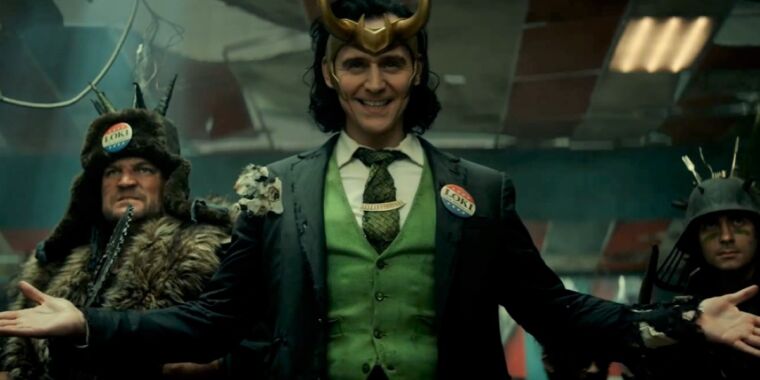
Among the many (many!) tidbits unveiled during Disney’s Investor Day was a lengthy teaser trailer for Loki, the Marvel spinoff limited series featuring Tom Hiddleston’s charismatic trickster demigod and (adoptive) brother to Thor, last seen in Avengers: Endgame. Marvel Studios had vowed to provide “hefty” budgets for its various limited series, like WandaVision (which also has a new trailer), and this Loki teaser definitely has the high cinematic production values to show for it.

(Some spoilers below for Avengers: Endgame in particular.)

Marvel Studios announced the development of its various limited series for Disney+ in 2018, all featuring supporting characters from the films who were not given their own standalone films within the MCEU. Details have largely been kept tightly under wraps, but we do know that both Loki and WandaVision will tie into the forthcoming Doctor Strange in the Multiverse of Madness. Fan favorite Loki has always been one of the most multi-layered, psychologically complex characters, so we’re keen to see what the limited series has in store for him.

Loki‘s head writer, Michael Waldron (Rick and Morty), talked a little bit about that in a podcast interview back in March. “I think it’s the struggle with identity, who you are, who you want to be. I’m really drawn to characters who are fighting for control,” said Waldron. “Certainly, you see that with Loki over the first ten years of movies, he’s out of control at pivotal parts of his life, he was adopted and everything, and that manifests itself through anger and spite towards his family.”

A brief shot from Loki that aired during the Super Bowl this year showed him wearing a jumpsuit with the initials “TVA” stamped on it. Hardcore Marvel fans will recognize the acronym: it stands for Time Variance Authority, the so-called “custodians of chronology” in the MCU, who monitor violations to the timeline. Catch their attention by trying to change history, and you just might meet the wrong end of the Retroactive Cannon (Ret Con) and have your entire history deleted from the historical timeline.

Time travel will very likely play a significant role in Loki, and this teaser trailer largely confirms that. It opens with a flashback to a pivotal scene in Endgame, where 2012 Loki snags the tesseract containing the Space Stone and vanishes through a portal. We next see him in a barren desert, with some puzzled local denizens looking on. Cut to a scene with Owen Wilson’s still-unidentified character in an elevator—he’s definitely TVA, since Loki is wearing his prisoner’s jumpsuit, and Wilson admits as much in the scene (“Time passes differently in the TVA”).

Loki assumes he’s going to be executed, but Wilson’s character assures him he just wants to talk. Loki claims he doesn’t like to talk, but, well, that’s a lie. (“We both know you love to talk,” Wilson’s character snarks. “Talky talky… “) The rest of the trailer is a jumble of scenes without much of a narrative thread, but it does seem clear that the TVA will be forcing Loki to face up to the damage he has wrought.

Loki is currently slated for release on Disney+ on May 21, 2021. All in all, it looks like a terrific new adventure for the character, and we’re counting the days till then.

Listing image by Marvel Studios

https://arstechnica.com/?p=1729154


More Disney 2021 plans: Kate McKinnon as Elizabeth Holmes, Y: The Last Man on FX

[embedded content]
Raya and the Last Dragon, now coming to Disney+ simultaneously in March 2021.

Disney held its 2020 Investor Day event on Thursday, and naturally the House of Mouse’s high-profile franchises have grabbed all the initial headlines. Yada, yada, Fantastic Four MCU film and Loki series. Blah, blah, seven new Star Wars things.

But Lucasfilm and Marvel were far from the only Disney-owned entities making investors tingle with anticipation due to exciting upcoming projects. With the full project rundown now available to peruse, a few announcements in particular caught our eye on first pass.

For FX on Hulu, the long-anticipated adaptation of Y: The Last Man will finally debut in 2021. Brian K. Vaughan and Pia Guerra’s famed DC Comics title centers on a post-apocalyptic world where only one mammal with a Y chromosome survived: a cisgender man who roams this new reality with his pet monkey. The story has been rumored for a film or TV adaptation basically since the comic neared its ending (Disturbia Director D.J. Caruso was once attached back in 2007), but Diane Lane and relative newcomer Ben Schnetzer will ultimately headline the cast bringing it to life.

Those critical darlings at FX will also notably bring the Alien franchise to TV for the first time (the show is in development with no firm time frame, though). Fargo and Legion showrunner Noah Hawley will serve as the creator, but Disney noted FX is negotiating with Sir Ridley Scott to have him serve as executive producer. As for the plot? “Set not too far into our future, it’s the first Alien story set on Earth—and by blending both the timeless horror of the first Alien film with the non-stop action of the second, it’s going to be a scary thrill ride that will blow people back in their seats.”

Elsewhere in the Hulu/FXverse, Disney also announced a fifth season for perhaps the scariest show on TV, The Handmaid’s Tale, before its fourth season begins. Counterpart showrunner Justin Marks will adapt the feudal Japan epic Shōgun (“one of the most sweeping, sophisticated and adult series FX has ever created,” says the release). And SNL star Kate McKinnon will play Theranos’ Elizabeth Holmes in an eight episode adaptation of the ABC News podcast, The Dropout. Disney expects that to debut on Hulu in 2021.

For National Geographic, Disney revealed a new Jacques Cousteau documentary, called Cousteau, is coming from filmmakers behind such recent hit docs like What Happened, Miss Simone?, Free Solo, and Icarus. No time frame was announced, but Disney is still planning a theatrical and festival release for the documentary before it hits Disney+. The film has been made by leveraging “a treasure trove of previously unseen archival material… featuring never-before-seen 4K footage from the Cousteau Society’s archives.” (Elsewhere, no joke, Will Smith will helm a docuseries called, Welcome to Earth.)

Finally, there were a few other Disney+/Marvel development linear notes worth shouting out, such as:

  • Oscar winner Mahershala Ali will be taking the title role of Blade in a new feature for everyone’s favorite vampire.
  • New Marvel Disney+ series announcements included: Samuel L. Jackson as Nick Fury in Secret Invasion; Ironheart with Dominique Thorne as a genius inventor; and Armor Wars with Don Cheadle as War Machine.
  • Upcoming Disney animated feature, Raya and the Last Dragon, will get the Mulan treatment by simultaneously debuting on Disney+ Premier Access and in theaters in March 2021.
  • John Mulaney and Andy Samberg (Chip and Dale), Tom Hanks (presumably Gepetto), and Jude Law (Captain Hook) are all reprising iconic Disney characters in the near future. And in 2022, Captain America himself will take over the Space Command headgear from Tim Allen, as Chris Evans voices Buzz Lightyear in the Buzz origin story, Lightyear (srsly).

Listing image by National Geographic

https://arstechnica.com/?p=1729153


Disney+ drops Andor teaser, announces gazillion other Star Wars projects

Promotional image for multiple upcoming Star Wars series.
Enlarge / Lucasfilm President Kathleen Kennedy unveiled a slew of forthcoming Star Wars projects at Disney’s Investor Day.

Lucasfilm President Kathleen Kennedy gave updates on a slew of forthcoming Star Wars film and TV projects at Disney’s Investor Day—including a behind-the-scenes teaser for Rogue One-spinoff series Andor, set five years before the events of the 2016 blockbuster film.

“With The Mandalorian on Disney+, we’ve ushered in an entirely new era for Star Wars,” Kennedy said. “These interconnected shows, along with future stories, will excite new audiences, embrace our most passionate fans, and will culminate in a climactic story event.”

(Some spoilers below.)

Andor

Andor is being described as a “tense nail-biting spy thriller,” with Diego Luna reprising his titular role as Cassian Andor from Rogue One. Tony Gilroy, who co-wrote that film, will serve as showrunner, and Alan Tudyk will be returning as the reprogrammed Imperial droid K-2SO. The cast also includes Genevieve O’Reilly as Mon Mothma, a senator of the Republic who helped found the Rebel Alliance, as well as Stellan Skarsgård, Kyle Soller, Denise Gough, Adria Arjona, and Fiona Shaw. The 12-episode series will be set five years before the events of Rogue One.

Andor S1 is set to debut on Disney+ in 2022. Production just started three weeks ago in London. You can watch the behind-the-scenes teaser below.

[embedded content]
Diego Luna reprises his Star Wars: Rogue One role as Cassian in Andor, coming to Disney+ in 2021. It was just one of the many Star Wars projects announced at Disney Investor Day.

Obi-Wan Kenobi

We learned last year at Disney’s D23 Expo that Ewan McGregor would be reprising his role as the iconic character Obi-Wan Kenobi in a live-action spinoff series. Kennedy disclosed that the series will be set 10 years after Star Wars: Revenge of the Sith—you know, the one where Obi-Wan faced off against Anakin Skywalker, who turned to the dark side and eventually became Sith Lord Darth Vader. The big news here is that Hayden Christiansen is reprising his role as Anakin Skywalker. Kennedy called it “the rematch of the century.”

Ahsoka, Rangers of the Republic, Lando, The Acolyte

If you were disappointed not to see more of Rosario Dawson’s Ahsoka on The Mandalorian this season (at least she told us The Child’s name is Grogu), you’ll be delighted to hear that the character is getting her own spinoff series on Disney+. In fact, we’re getting two spinoffs from The Mandalorian; the second is called Rangers of the New Republic, executive-produced by Jon Favreau and Dave Filoni.

But wait! There’s even more Star Wars live-action goodness in the works. That lovable scoundrel Lando Calrissian will be getting his own limited series, simply titled Lando. And Russian Doll creator Leslye Headland has signed on to create the female-centric The Acolyte, described as “a mystery thriller that will take the audience into a galaxy of shadowy secrets and emerging dark side powers in the final days of the High Republic era.” It’s supposedly set in a different timeline, or “pocket,” of the Star Wars universe.

Rogue Squadron

You’d think Director Patty Jenkins would have her hands full with the Wonder Woman franchise, but Kennedy announced that Jenkins will also serve as director for a new Star Wars feature film, Rogue Squadron. The film is currently slated for a Christmas 2023 release.

Jenkins tweeted out a special video announcement for the project: “It’s been a lifelong dream as a filmmaker to one day make a great fighter pilot film,” Jenkins said in her statement. “As the daughter of a great fighter pilot myself, some of the best memories of my life are of seeing my father’s squadron take off in their F4s every morning, and hearing and feeling the awe-inspiring power and grace. When he passed away in service to this country it ignited a burning desire to one day channel all of those emotions into one great film. When the perfect story arrived in combination with another true love of mine, the incomparable world of Star Wars, I knew I’d finally found my next film. I’m extremely honored and excited to take it on, and grateful to Lucasfilm, Disney, and the fans for extending that thrill to me.”

And we already knew that none other than Taika Waititi has been tapped to helm an as-yet-untitled Star Wars feature film. “Taika’s approach to Star Wars will be fresh, unexpected, and… unique,” said Kennedy. “His enormous talent and sense of humor will ensure that audiences are in for an unforgettable ride.”

Animated series

Disney isn’t forgetting about animated series, either. Kennedy introduced a teaser (embedded below) for The Bad Batch, about a group of experimental elite clones first introduced in The Clone Wars. It’s set immediately after the events of that series. Each Bad Batch member has a unique skill, and together they will “take on daring mercenary missions as they struggle to stay afloat and find new purpose.”

In addition to that series, we’ll be getting the animated A Droid Story on Disney+, described as “an epic journey” featuring “a new hero, guided by legendary duo R2-D2 and C-3PO.” Finally, there is Star Wars: Visions, a series of animated short films set in the Star Wars universe, created by leading Japanese anime studios.

[embedded content]
New animated series The Bad Batch.

https://arstechnica.com/?p=1729130


R.I.P. Henri, le Chat Noir, angst-ridden feline YouTube star for the ages

[embedded content]
“Je suis un chat noir.” Henri the existential cat made his YouTube debut on May 24, 2007, and quickly became an Internet sensation. He and Will Braden, aka “the thieving filmmaker,” would go on to make 17 short films together.

We are très désolé to report that YouTube cat-video sensation Henri, le Chat Noir has died at the ripe old age of 17. His collaborator Will Braden, aka the “thieving filmmaker,” announced Henry’s passing in a moving Facebook post. Apparently, Henri had a deteriorating spinal condition and had been rendered largely immobile as a result. Despite the pandemic, a local vet made a home visit to “help him pass peacefully, surrounded by those that loved him,” Braden wrote.

Henri (née Henry) was not actually Braden’s cat; the Facebook post identifies Braden’s mother as Henri’s real-life caretaker. Henri lived in an undisclosed location in Seattle’s North End, largely oblivious to his online celebrity. He was a rescue cat, adopted from a local animal shelter as a kitten, who shared his living space with a second white cat, known to his fans as ‘l’Imbecile Blanc,” who survives him. While a student at the Seattle Film Institute, Braden noted Henri’s “regal presence and distinguished personality,” and he featured the cat in a short film for class. The video hit YouTube on May 24, 2007, and Henri’s existential musings soon began winning enthusiastic fans.

It was the 2012 sequel (embedded below), Henri 2: Paws de Deux, that went truly viral and turned Henri into an Internet celebrity, with many declaring it to be the best cat video on the Internet. Indeed, the short film won the Golden Kitty Award at the Walker Art Center’s Internet Cat Video Festival. Henri gave a suitably world-weary statement on his win via Braden: “That I have received this golden, smiling idol for a film documenting my metaphysical torment speaks volumes about the spiritual void of humanity. Shiny and meaningless, life marches on.”

Braden and Henri went on to make a total of 17 short films together. Braden wrote the scripts, and his mother, who is fluent in French, assisted with the translations. Who can forget Henri’s trip to the vet, or Henri 5: The Worst Noel, or his grumpy feline musings on politics and literature? Kibble-manufacturer Friskies commissioned four short films on “cat food boredom” as a YouTube viral marketing campaign, and Braden published two books featuring the angst-filled feline. Henri officially “retired” from his film career in 2018, announced in Henri 11: Oh, Revoir.

Braden also offered some thoughts on the secret of Henri’s broad appeal in his Facebook tribute:

I always noted how little Henry had in common with the angst-filled character he portrayed. He was a good-natured and happy cat, and as far as I could tell, never suffered a single existential crisis during his life. But as the years went on, I started to realize that it was his imperious stare and the nobility behind his eyes that made Henri work, more than my terrible French and pedestrian piano playing. No one had a problem immediately accepting that this cat was a deep-thinking philosopher. Maybe he actually was. He also liked chin scratches.

Despite his grief, Braden is planning a video tribute to Henri (and Henry) for next year’s Internet Cat Video Festival. “I know that hearing this sad news will be difficult,” Braden wrote on Facebook. “But remember that Henri lives on in your memories as well as ours, and in the amusement he brought to all of you. The foremost goal was always to make people laugh! I would encourage all of you to share your favorite Henri video or quote today, because everyone needs a good laugh now more than ever.”

Farewell, our beloved Henri, le Chat Noir. The Internet never forgets.

[embedded content]
“I am surrounded by morons.” Henri 2, Paw de Deux was released in 2012 and won the Golden Kitty Award for best cat video on the Internet at the Walker Art Center’s Internet Cat Video Festival.

Listing image by Henri, le Chat Noir/Facebook

https://arstechnica.com/?p=1728958


Chloë Moretz battles gremlins on a plane in Shadow in the Cloud trailer

[embedded content]
Chloë Grace Moretz stars as a tough-as-nails female Women’s Auxiliary Air Force captain who finds herself battling gremlins aboard a B-17 Flying Fortress in Shadow in the Cloud.

Chloë Grace Moretz (Kickass) plays a female WWII pilot on a secret mission who must contend with an evil gremlin attempting to dismantle her B-17 in mid-air in Shadow in the Cloud, a horror/action film that debuted at the Toronto International Film Festival in September and is now coming to VOD on New Year’s Day. Based on the trailer, it looks like a mashup of Gremlins meets Snakes on a Plane, with some over-the-top Vin Diesel-style action tossed in for good measure.

Set in 1943, the film had a somewhat rocky road on the way to completion. Max Landis—creator of the BBC’s Dirk Gently’s Holistic Detective Agency, based on the Douglas Adams novels, and son of Director John Landis—penned the original draft script, and relative newcomer Roseanne Liang was hired to direct. Then Landis was accused of sexual and emotional abuse by eight women and dropped from the project. (In a since-deleted tweet, Director Josh Trank, who worked with Landis on the 2012 low-budget superhero movie Chronicle, said he believed the accusations and had even banned Landis from the set during Chronicle‘s principal photography.)

Liang overhauled the script herself, punching up the female empowerment angle while still maintaining the horror/action thriller sensibility. The film premiered at a Toronto drive-in and proved hugely popular with festival attendees, even winning the People’s Choice Award for Midnight Madness. (It already holds a 74-percent fresh rating on Rotten Tomatoes.) All that buzz led to a distribution deal with Vertical Entertainment and Redbox Entertainment, purportedly worth about $5 million—apparently the first “drive-in theater movie” to be so acquired, per Deadline Hollywood.

Moretz plays Women’s Auxiliary Air Force Captain Maude Garrett, a tough-as-nails fighter pilot on a secret mission to deliver a mysterious highly classified package. She travels aboard a B-17 Flying Fortress dubbed “The Fool’s Errand” and is almost immediately the target of jokes and sexist slurs from her male cohorts. She gets stuck with Sperry, or ball turret, duty, but clearly she’s up to that task. More worrying than Japanese fighter planes is an evil presence—a gremlin—that threatens to tear the plane apart in mid-air.

Shadow in the Cloud premieres on video on demand on January 1, 2021. The trailer certainly makes the film look like solid, high-octane fun, even including a sly nod to the classic Twilight Zone episode, “Nightmare at 20,000 Feet.” Writing for Variety, Peter Debruge offered high praise, declaring it an “insanely entertaining high-altitude horror movie,” while acknowledging that the film “parts ways with credibility altogether.” It might be just the ticket for a lazy New Year’s Day.

Listing image by YouTube/ONE Media

https://arstechnica.com/?p=1728735


Cyberpunk 2077 could trigger seizures in photosensitive players [Updated]

The strobe effects flashing from those two LED arrays in <em>Cyberpunk 2077</em> could cause seizures in epileptic gamers.
Enlarge / The strobe effects flashing from those two LED arrays in Cyberpunk 2077 could cause seizures in epileptic gamers.

Epileptic gamers who are sensitive to flashing lights and strobing effects may need to take special care when playing Cyberpunk 2077 after its release later this week.

Game Informer Associate Editor Liana Ruppert wrote yesterday about her experience with a grand mal seizure while playing a pre-release version of the game. The seizure was triggered by the game’s short introductory cutscene for the “braindance” interface. That scene features a device flashing bright, screen-filling red and white lights at the player in an increasing cadence before sending them into a virtual world to explore another character’s memories.

With no way to skip this cutscene, Ruppert recommends that photosensitive players “look away completely or close their eyes” to avoid triggering a seizure whenever going into a braindance, which they’re required to do at multiple points in the game’s story.

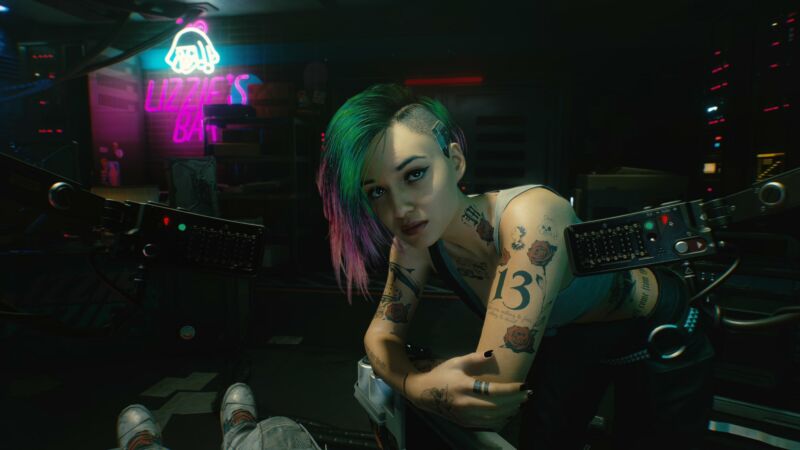
Ruppert also notes how certain characters and objects inside and outside of braindances are rendered with a “flickering pale blue glitch effect” that could set off some players’ photosensitivity. Bar and club scenes also often feature high-contrast flashing neon lights that could represent a “danger zone” for photosensitive players, Ruppert writes.

“We are alarmed and saddened that a game reviewer had a seizure triggered by Cyberpunk 2077, before it was even launched,” UK-based charity Epilepsy Action said in a statement. “The game features rapidly blinking lights and other animations that could cause seizures in people with photosensitive epilepsy.

“These features are unsafe and should have been avoided to make the game more accessible. With huge demand and excitement building for its release, it may pose a serious risk to people with photosensitive epilepsy. The developers CD Projekt RED should consider how they can update the game to make it safer. A disclaimer warning at the beginning isn’t enough.”

CD Projekt Red has yet to respond to a request for comment from Ars Technica.

Update 12:56pm EST: CD Projekt Red does include a seizure warning in Cyberpunk 2077‘s End User License Agreement, telling players the game “may contain flashing lights and images, which may induce epileptic seizures.” No similar warning appears on screen at any point during the game.

Update 3pm EST: CD Projekt Red has since directly responded to Game Informer’s report in the form of a Twitter post: “We’re working on adding a separate warning in the game, aside from the one that exists in the EULA. Regarding a more permanent solution, Dev team is currently exploring that and will be implementing it as soon as possible.”

Original story resumes:

A well-known problem

About 2.7 million Americans have been diagnosed with some form of epilepsy, according to an Epilepsy Foundation article from 2014. About 100,000 of those have some level of photosensitivity to strobing light effects, representing one person in every 3,000 to 4,000.

But incidence studies in other countries suggest there may be as many as 800,000 photosensitive Americans who have simply not been exposed to a trigger that could set off a seizure, with higher potential concentrations in those ages 7 to 19.

The particular risk of seizures caused by video games has been well-known for decades. In 1993, a 14-year-old died from complications of a seizure suffered while playing Super Mario World, leading to sensationalized international headlines about the overall safety of games. And in 1997, an episode of the Pokémon anime that featured strobing light effects led to nearly 700 Japanese children being hospitalized with seizure-related problems.

Incidents like these prompted Nintendo to begin including a warning about the potential dangers of strobe effects to the Health and Safety notices included with its games (Sony and Microsoft have similar warnings for their consoles). Nintendo has faced a number of lawsuits over the seizure-inducing effects of its games, including one it settled out of court in 2004.

Many game-makers also put prominent epilepsy warnings in their manuals or on-screen when a game is loading. A handful of game-makers also follow Game Accessibility Guidelines recommendations to avoid specific patterns of flashing lights or include optional toggles to remove or reduce flashing effects in the game. Though these modes can never be called 100-percent “epilepsy safe,” they can help reduce the incidence of problems among photosensitive players.

Without such specific options (or even in-game warnings) in Cyberpunk 2077, players are left to fend for themselves as far as reducing their seizure risk. Ruppert recommends turning down the screen brightness or using existing colorblind graphics options to make the game more comfortable.

https://arstechnica.com/?p=1728396


Cyberpunk 2077 is equal parts beautiful and messy

Cyberpunk 2077, the first game by CD Projekt Red since 2015’s triumphant The Witcher III: Wild Hunt, delivers perhaps the most ambitious open-world facade to date. Open-world games like Grand Theft Auto to Watch Dogs are just facades, after all—giant virtual theme parks that try to get gamers to suspend their disbelief and buy in to fully inhabiting a new world.

CDPR’s Night City—its retro-futuristic take on Los Angeles—is a triumph of speculative urban, architectural, and narrative design. It’s a truly stunning imagined city of the future that doesn’t feel like a scaled-down virtual compromise. Just existing in this space is a joy, whether you’re eavesdropping on the citizens going about their day or diving deep into the city’s criminal and technological underworld.

But the more you start poking at that facade, the less convincing it seems. The smoothness of the presentation makes it all the more glaring when you run into major holes in the game’s simplistic combat, encounter frequent glitches, or reach confusing moments when the conversational or plot paths break down. More often than you’d like, Cyberpunk 2077 leaves you scratching your head.

It’s the uncanny valley effect, just extended to an entire city. Cyberpunk 2077 gets so close to utter believability that you can’t help but pick out all the inherent video game imperfections.

Diving in

Cyberpunk 2077 product image

Cyberpunk 2077 [PS4, Xbox, PC]

(Ars Technica may earn compensation for sales from links on this post through affiliate programs.)

Cyberpunk 2077 doesn’t throw you into the deep end of its world so much as it simply treats your character as a well-established part of it from the jump. Whichever of three archetypes you choose for the protagonist, simply named V (I went with the rough-and-tumble hard-luck “Street Kid”), that character is already broadly familiar with the avalanche of names, tech concepts, and futuristic slang that other characters sling with confidence. There’s a minimum of overbearing tutorials explaining how to do every last thing, and the game offers almost no pedantic expository dialogue breaking down the rules of the world.

Slowly, you piece together how Night City works through context. Some facts, like the extreme gulf between rich and poor or the personal integration of cybernetic implants in pretty much every single citizen, are apparent just from observing the carefully crafted people and architecture. Other facets, like the outsized role of corporations or the internecine battles between the city’s criminal factions, come out more organically through conversation. A full picture of Night City unfolds quite slowly, and the game rewards you for paying attention as it does.

Night City is a sprawling city-state unto itself, designed with an attention to architectural detail that borders on obsessive. It’s a crowded, messy place, full of neighborhoods that feel like they’ve slowly accreted new buildings and slum-like enclaves over decades of semi-unstructured growth. The city wraps around itself, extending vertically into raised market stall platforms and crisscrossing walkways and descending into glittering underground pleasure clubs.

More than that, Night City feels crowded and alive in a way many video game cities often don’t. A ridiculous variety of character designs and outfits fill the streets when appropriate, and they mill about in small isolated groups when it’s not. Most of them won’t respond with anything interesting if you try to engage directly, but just listening in on random conversations adds a lot of flavor to the world.

Back to the retro-future

This is still a very ’80s vision of the future, as is only appropriate for a world based on a tabletop RPG first released in 1988. Everything is drowned in neon and dayglo colors that come across as almost quaint here in 2020. Music still comes through the radio, ads talk about TV shows with set broadcast times, and news is still delivered on broadsheets with animated images. And while the game’s gas guzzlers can be auto-driven to your location at your command, almost everyone still drives those cars themselves.

Anachronisms aside, Cyberpunk 2077 does an admirable job of integrating its imagined technology into the everyday life of its citizens and the functioning of the city itself. The game takes pains to dive into the societal and philosophical effects of elements like mass-market body part replacements or “Braindances” that can let people truly experience someone else’s life, or even the role of the individual in a corporatized society where everything is for sale.

While the treatment of these issues never gets much beyond the surface level, sharp writing helps integrate these heady topics into everyday conversation without ever seeming dry or academic. Everything flows naturally, thanks in large part to excellent vocal and motion-capture work that adds important nonverbal cues to even simple conversations. And while it can get a bit tropey if you’re familiar with similar sci-fi stories, it’s handled with such style and grace that it’s hard to care too much.

https://arstechnica.com/?p=1727962