All we want for Christmas is Mel Gibson’s Bad Santa in the Fatman trailer

[embedded content]
Mel Gibson plays a bitter, hard-drinking Chris Cringle in the forthcoming film Fatman.

If you’re one of those people who consider Die Hard and the first Lethal Weapon film a classic Christmas movie double feature, we’ve got good news for you. Mel Gibson plays a broke, embittered, hard-drinking, heavily armed Santa Claus in the forthcoming action/comedy Fatman. The official trailer dropped yesterday, and it looks like an irreverently fun, wild ride.

Written and directed by brothers Eshom and Ian Nelms (Small Town Crime), the film co-stars Walton Goggins (The Righteous Gemstones, Ant-Man and the Wasp) and Oscar-nominee Marianne Jean-Baptiste (Secrets and Lies, Blindspot). Per the official premise:

To save his declining business, Chris Cringle (Gibson), also known as Santa Claus, is forced into a partnership with the U.S. military. Making matters worse, Chris gets locked into a deadly battle of wits against a highly skilled assassin (Goggins), hired by a precocious 12-year-old after receiving a lump of coal in his stocking. ‘Tis the season for Fatman to get even, in the action-comedy that keeps on giving.

“I don’t know what I’m doing wrong—I’ve lost my influence,” we see Gibson’s Cringle mourn to Mrs. Cringle (Jean-Baptiste) about the decline in his business. “Maybe it’s time I retired the coast. Some kids with an air rifle put two holes in the sleigh and one in me. All I have is a loathing for a world that’s forgotten.” So when the US military arrives to “procure” his services, he accepts, with the caveat that it will be a “one-time deal.”

Cut to Christmas morning, when young Billy (Chance Hurstfield, The Package, Good Boys) opens a gift from Santa, only to find a lump of coal inside. Billy is not amused. In fact, he is outraged to the point of hiring Goggins’ Skinny Man to kill Santa Claus, aka the titular Fatman. Billy demands the big man’s head as a trophy, but Skinny Man warns him that heads rot and mold. When Billy next demands his beard, the hit man refuses: “I’m not shaving off a dead man’s beard.” (Skinny Man is clearly not fond of his client, since the caller ID for Billy is “Little Turd.”)

The trailer features several other amusing scenes, such as Cringle introducing a visitor to one of his reindeer, Donner. (“You’re lucky it wasn’t Blitzen. She’ll tear your package clean off.”)  The elves put on quite a dessert-centric spread for the military troops, insisting the sugar helps keep them young. And Goggins seems to be having a blast playing Skinny Man: building up his weapons cache, brushing up on his mixed martial arts, and taking a few practice punches at a cartoonish Santa head target.

“I’ve come for your head, Fatman!” Skinny Man taunts when he finally arrives at Santa’s wintry base of operations.

“You think you’re the first?!” Cringle shouts back. “You think I got this job because I’m fat and jolly?” Yes, we did think that. Turns out we were wrong. “I’ll come while you sleep,” we hear Cringle say in an ominous voiceover. “The Fatman has got his eye on you, kid.”

Honestly, if the film is as good as the trailer, we might be looking at a new holiday classic; it would pair nicely with the 1989 French film Dial Code: Santa Claus (a dark precursor to Home Alone). Fatman hits whatever theaters are open on November 13, 2020, followed by a VOD release on November 17, 2020.

Listing image by YouTube/Saban Films

https://arstechnica.com/?p=1712922


Kate Mulgrew returning as Capt. Janeway in Star Trek: Prodigy

A woman speaks into a microphone in front of the original Star Trek logo.
Enlarge / Kate Mulgrew speaking on a panel during the 17th annual official Star Trek convention on August 4, 2018, in Las Vegas, Nevada.

Actress Kate Mulgrew, who played Captain Kathryn Janeway in Star Trek: Voyager, is returning to the franchise to reprise her role in the upcoming Star Trek: Prodigy animated series, ViacomCBS announced today.

Mulgrew popped in to make made the surprise announcement during the end of a Star Trek panel at this year’s all-virtual New York Comic Con. “I have invested every scintilla of my being in Captain Janeway, and I can’t wait to endow her with nuance that I never did before,” Mulgrew said. “How thrilling to be able to introduce to these young minds an idea that has elevated the world for decades. To be at the helm again is going to be deeply gratifying in a new way for me.”

Executive Producer Alex Kurtzman leveled a sideways blow at the sexism that dogged the first female Star Trek captain when she was cast in the 1990s, saying, “Captain Janeway was held to a different standard than her predecessors. She was asked to embody an inhuman level of perfection in order to be accepted as ‘good enough’ by the doubters but showed them all what it means to be truly outstanding. We can think of no better captain to inspire the next generation of dreamers on Nickelodeon, than she.”

[embedded content]

Mulgrew starred as Janeway in all seven seasons of Star Trek: Voyager, running from 1995 through 2001. Her most recent on-screen appearance in Star Trek was a cameo as Admiral Janeway in the 2002 film Star Trek: Nemesis.

Prodigy, the first modern* Star Trek series to be explicitly targeted to a young audience, will be coming to Nickelodeon at some point in 2021. According to ViacomCBS, the show “follows a group of lawless teens who discover a derelict Starfleet ship and use it to search for adventure, meaning, and salvation.”

The computer-animated series will be the fourth spin-off Star Trek series to follow the launch of Star Trek: Discovery, joining Picard, Lower Decks, and the still in-production Strange New Worlds.

*Star Trek: The Animated Series ran as a Saturday morning cartoon in 1973 and 1974; all Treks since then have been aimed more-or-less at grown-ups. Including Lower Decks, which only tries to reach our inner 12-year-old selves, rather than literal children.

https://arstechnica.com/?p=1712827


One resolution to rule them all: Lord of the Rings trilogy coming to 4K Blu-ray [Updated]

Peter Jackson’s Lord of the Rings trilogy, arguably the greatest home theater showcase outside of documentaries like Planet Earth, is finally coming to 4K UHD Blu-ray.

Details emerged late Monday via Den of Geek, whose Instagram account posted leaked images from Best Buy-exclusive listings for the trilogy’s SteelBook version. While Best Buy store listings were soon found by enterprising fans, those were eventually taken down, but they were followed by nonexclusive versions at Amazon: $90 for the normal trilogy, spread across nine Blu-ray discs, or $140 for a “gift set” version, which collects all of the normal cases in a larger, book-like case that may or may not include a replica of the One Ring.

Whichever set you buy, you can expect both theatrical and extended cuts of each film in the set, along with “digital code” redemption options for both versions of each film. Should you be on the lookout for a 4K UHD Blu-ray player, all disc-based Xbox consoles since the Xbox One S (including the brand new Series X, but not the disc-less Series S) support the standard, while the PS5 is the only PlayStation console to do so.

Unfortunately, listings at Amazon in both the United States and Europe currently lack back-of-box explainers about what to expect technically.

[Update, 3:40pm EDT: A report from The Digital Bits claims that the set will include both HDR-10 and Dolby Vision tone-mapping, along with a brand-new Dolby Atmos surround mix for audio. The report also claims that Peter Jackson has overseen the 4K remastering project with 4K scans of both the original camera negatives and the original CGI readings from the films. Whether we’ll see the same color correction applied to the original trilogy’s Extended Edition Blu-ray set, which fans previously called into question, remains to be seen.]

Peter Jackson’s Hobbit trilogy is getting the up-res treatment as well: $90 for the standard 4K UHD Blu-ray set (with two discs per film, offering both theatrical and extended cuts), with no sign of its own “gift set” version just yet.

Listing image by Warner Bros. / Aurich Lawson

https://arstechnica.com/?p=1712482


The first PlayStation 5 teardown reveals some hardware secrets

We’re still a bit over a month away from the official launch of the PlayStation 5, but we’ve already got the first public teardown of the console hardware courtesy of Sony itself.

The Japanese video (with English subtitles) Sony posted Wednesday morning answers quite a few nagging questions left from previous announcements and recent hands-on time from some Japanese press.

Chief among them is a demonstration of how the system’s circular black stand works. When the PS5 is placed vertically, the stand is held in place with a single large screw. When that screw is removed, it can be stored in a compartment in the base, and a small cap fills in the screw hole in the system itself.

PS5 owners will use the same base when placing the PS5 horizontally, seemingly to give a flat surface for the system’s gentle curves to rest on. In this configuration, though, the base simply snaps into place along a set of marks on one of those white panels, no screw required.

Speaking of those white panels, the teardown video shows that they can be popped off easily without tools. Just “lift the back corner and slide it off,” as the video explains it. With the white panels off, users get easy access to the outside of the system’s cooling fan, which draws in air from both sides of the system through two long side vents on the front and a rear vent that runs the entire length of the system.

The inner shell also features two “dust catcher” holes that can be easily vacuumed out, according to Sony. That should be welcome news for PS4 owners who have gotten used to tearing open the system and blasting it with canned air to remove system-clogging dust.

Listing image by Sony / Youtube

https://arstechnica.com/?p=1712402


Latest Free Guy trailer is giving us strong Upload vibes

[embedded content]
Ryan Reynolds discovers he is a background player in a video game in the epic adventure-comedy Free Guy.

20th Century Studios has dropped a new trailer for Free Guy, the sci-fi comedy starring Ryan Reynolds, currently slated for a December 11 release. But in these pandemic times, all release dates are basically pencilled in until further notice—which is why Reynolds and company also released an amusing teaser in which they debate potential alternate dates for the film’s release.

Per the official premise: “A bank teller who discovers he is actually a background player in an open-world video game decides to become the hero of his own story… one he rewrites himself. Now in a world where there are no limits, he is determined to be the guy who saves his world his way… before it is too late.”

Tonally, the trailer feels like a live-action Wreck-It Ralph with dashes of The Matrix and the Deadpool movies thrown in for good measure. In fact, the new trailer is giving us strong Upload vibes, which can only be a good thing, since Upload was one of our fave new series this year.

Ryan Reynolds’ character, named Guy, finds an ally in Milly, aka Molotov Girl (Killing Eve‘s Jodie Comer), who is able to move in and out of the game at will. Meanwhile, game developer Antoine (Taika Waititi) has plans to shut the game down, against the objections of a programmer, Keys (Joe Keery, aka Steve Harrington on Stranger Things). Keys and Milly created the code that resulted in Guy becoming aware of his virtual environment.

Director Shawn Levy debuted the first Free Guy trailer way back in December 2019 at the 2019 Comic Con Experience (CCXP) in Sao Paulo, Brazil. He described it as “a superhero origin story except without the tights, powers, or pre-existing IP,” according to Deadline Hollywood. “It’s not just spectacle—it’s very much connected to the characters. It’s the rise of an idealist in a world that is very cynical and dark.” At the same event, Reynolds described the film as “a modern-day Back to the Future for this generation.”

In this latest trailer, we get some new footage—including lots more Jodie Comer—and a clearer idea of the plot. Guy has been feeling unfulfilled in his daily existence, which consists of getting coffee and then having the bank where he works get robbed every day. Sometimes he gets wiped out by a car or flattened by “the Murder Train” for good measure. When he decides to fight back, he tries on a robber’s glasses. These allow him to see the underlying gaming environment of Free City.

We also learn that Guy longs for love, so when he catches sight of Milly, he follows her—and starts behaving out of character (i.e., more heroic) even more. This makes him hugely popular with fans while infuriating Antoine, who demands the game (also called Free City) be shut down. Can Milly and Guy inspire the other non-player characters—”This place, this people, that’s all I have”—to revolt against their programming and rise up to save Free City and themselves? After all, just because they’re not “real,” that doesn’t mean what they do can’t matter. Guy is virtual proof of that.

As of now, Free Guy will hit theaters on December 11, 2020, assuming sufficient theaters have reopened by then. Otherwise, look for it “this Pinecone Celebration Day.”

[embedded content]
“No, no, no, no, there’s a but… “

Listing image by 20th Century Studios

https://arstechnica.com/?p=1711746


PlayStation 5 runs cool and quiet, according to initial hands-on reports

Like most of the world, we here at Ars are still waiting for our first hands-on experience with the PlayStation 5 ahead of its planned release next month. But over the weekend, a handful of Japanese journalists and YouTubers got to try out Sony’s new system and have revealed a few new tidbits about the hardware and its design.

The most welcome news—at least for those accustomed to the “jet engine” fan noise sometimes encountered on the PS3 and PS4—is that the PS5 seems to remain relatively quiet even while in continuous use. Dengeki Online (Google Translate) noted that “it was really quiet” after playing for hours in a hot room, with no apparent heat felt on the surface of the system itself.

AV Watch (Google Translate) similarly noted that “the operating sound of the main unit [is] now smaller than [that] of PS4,” as was the sound of pressing buttons on the DualSense controller. And 4Gamer (Google Translate) confirmed that “the exhaust was gentle, and I could hardly hear what seemed to be the rotating noise of the fan.”

Light ’em up

AV Watch also noted that there is an LED “in the gap between the white body and the black part” of the PS5 itself. That’s apparently used to show the system’s current status: blue when the system is connected to power and white when the system is on, much like the PS4.

The PS5’s new DualSense controller (which is the only controller that will work for most PS5 games) features colored lights as well—these accent LEDs can shine blue, red, green, or purple through the small gaps to the left and right of the trackpad area in the center of the controller. In addition, the DualSense has four LED lights that shine beneath the trackpad to indicate which player number corresponds with that controller.

4Gamer also notes that “you can see some metal parts through the gap in the upper intake” of the system itself. There’s already some speculation that this metal “latch” is used to access the interior of the system to install approved M2 SSDs for storage expansion, but nothing has been confirmed on this score as of yet.

The Japanese press didn’t get to see the PS5’s new system-level user interface, which PlayStation VP of UX Design Matt MacLaurin has previously promised will be a “100 percent overhaul of the PS4 UI” that showcases “some very different new concepts.” That means the journalists didn’t get to test the system’s “quick resume” game switching or new social sharing functions.

But AV Watch notes that the system interface and games will now be standardized to use the X button to confirm selections and the O button to cancel them worldwide. On previous PlayStation systems, those options were reversed in Asian markets.

A few other tidbits about the controller from the hands-on event:

  • In addition to a microphone hole on the rear of the controller, there is a small, paper-clip-sized hole referred to as a “reset port.” It’s unclear from the coverage exactly what this is intended for, but it seems like it could reset a controller to factory default settings.
  • The controller has a small mute button sitting below the PS logo in order to silence the built-in microphone.
  • The analog sticks on the DualSense have been “surface treated to prevent finger slippage,” as 4Gamer puts it.

If you’re looking for a more active look at the PS5, Famitsu has a couple of videos showing close-up use of the DualSense controller, as well as direct feed video footage of Astro’s Playroom and Godfall.

Listing image by 4Gamer

https://arstechnica.com/?p=1711857


The history of Galloping Ghost, the USA’s largest classic arcade

If you’re anything like us, you’re itching for a return to physical gaming experiences like expos and arcades. The next best thing this week is a new 30-minute mini-documentary (embedded below) about the history of Galloping Ghost, a Chicago mega-arcade whose massive collection, full of rarities, was given the Ars Technica spotlight years ago.

The story is told primarily by arcade co-founder Doc Mack, who sits in his arcade’s main office and recalls how the idea for an arcade began in part when he was a lowly clerk at a Babbage’s in the ’90s. Mortal Kombat co-creator Ed Boon came into his shop to buy video games, and Mack worked up the nerve to ask how he got into the game industry. A terse interaction followed, and Mack read between the lines: “Wow, Ed Boon didn’t want to hear anything I had to say.” Mack took the meeting as motivation to realize he’d have to change gears entirely to pursue his games-industry dream and start his own business.

The documentary skips over Mack’s exact path from Babbage’s to his own arcade, merely hinting at “business ideas” he had along the way, before jumping ahead to a friend prompting him to co-found and open an arcade in 2010. While trying to score classic arcade machines in the run-up, he was stunned to discover that out of 80 venues he visited, none had a working cabinet for Mortal Kombat 2 (one of his admitted favorites) for sale. “That motivated me,” he says.

After this and the story of a “barn find” of 114 dormant arcade machines in Iowa for $5,000 total, the documentary settles into a groove of showing footage of customers diving into the games and offering their personal anecdotes, along with a breakdown of Doc’s decision to forgo typical things like “ticket redemption” games or quarters. (Galloping Ghost charges a flat fee to enter, at which point all games are free to play, no quarters required.) This footage appears to have been captured well before pandemic-related measures changed average attendance at arcade facilities (an issue that has already wreaked havoc on arcades around the world), and this doc avoids any commentary on current events. It’s just about the games.

In Galloping Ghost’s case, that includes a number of rare and prototype games, including a pair of unreleased Atari games donated to Mack by arcade-era legend Brian “Rampage” Colin and a restored prototype of the unreleased Primal Rage 2. (When asked about how the arcade’s rarities have affected business, Mack says plainly, “A couple hitchhiked here from Oregon just to play Primal Rage 2.”) The rare games are shown briefly as examples of the arcade’s massive 750+ selection of cabinets—and the doc doesn’t even get into Galloping Ghost Pinball, the company’s sister site down the block dedicated to flipping pins.

For more historical nuggets and amusing anecdotes, check out the embedded doc below. And while the documentary doesn’t mention it, Galloping Ghost is currently running a crowdfunding campaign to expand its primary facility in order to offer over 1,000 arcade cabinets for play.

[embedded content]
Galloping Ghost mini-documentary, from Diamond Head Productions.

Listing image by Nate Anderson

https://arstechnica.com/?p=1711761


Publishers worry as ebooks fly off libraries’ virtual shelves

Publishers worry as ebooks fly off libraries’ virtual shelves
Getty Images

Before Sarah Adler moved to Maryland last week, she used library cards from her Washington, DC, home and neighboring counties in Virginia and Maryland to read books online. The Libby app, a slick and easy-to-use service from the company OverDrive, gave her access to millions of titles. When she moved, she picked up another card, and access to another library’s e-collection, as well as a larger consortium that the library belongs to. She does almost all of her reading on her phone, through the app, catching a page or two between working on her novels and caring for her 2-year-old. With her husband also at home, she’s been reading more books, mostly historical romance and literature, during the pandemic. In 2020, she estimates, she has read 150 books.

Adler buys books “rarely,” she says, “which I feel bad about. As someone who hopes to be published one day, I feel bad not giving money to authors.”

Borrowers like Adler are driving publishers crazy. After the pandemic closed many libraries’ physical branches this spring, checkouts of ebooks are up 52 percent from the same period last year, according to OverDrive, which partners with 50,000 libraries worldwide. Hoopla, another service that connects libraries to publishers, says 439 library systems in the US and Canada have joined since March, boosting its membership by 20 percent.

Some public libraries, new to digital collections, delight in exposing their readers to a new kind of reading. The library in Archer City, Texas, population 9,000, received a grant to join OverDrive this summer. The new ebook collection “has really been wonderful,” says library director Gretchen Abernathy-Kuck. “So much of the last few months has been stressful and negative.” The ebooks are “something positive. It was something new.”

More expensive ebooks

But the surging popularity of library ebooks also has heightened longstanding tensions between publishers, who fear that digital borrowing eats into their sales, and public librarians, who are trying to serve their communities during a once-in-a-generation crisis. Since 2011, the industry’s big-five publishers—Penguin Random House, Hachette Book Group, HarperCollins, Simon and Schuster, and Macmillan—have limited library lending of ebooks, either by time—two years, for example—or number of checkouts—most often, 26 or 52 times. Readers can browse, download, join waiting lists for, and return digital library books from the comfort of their home, and the books are automatically removed from their devices at the end of the lending period.

The result: Libraries typically pay between $20 and $65 per copy—an industry average of $40, according to one recent survey—compared with the $15 an individual might pay to buy the same ebook online. Instead of owning an ebook copy forever, librarians must decide at the end of the licensing term whether to renew.

The rising demand for digital materials has prompted some librarians to shift what they buy, even as they fear shrinking budgets amid the economic downturn. A recent survey of 400 librarians in the US and Canada found that one-third are spending less on physical books, audiobooks, and DVDs, and more on digital versions since the pandemic began. Twenty-nine percent have had their budgets frozen or reduced.

But the publishers’ licensing terms make it “very difficult for libraries to be able to afford ebooks,” says Michelle Jeske, director of the Denver Public Library and president of the Public Library Association. “The pricing models don’t work well for libraries.” Between January and July, the Denver system saw 212,000 more books downloaded than the same period last year, a 17 percent increase.

Last year, Macmillan took an additional step, limiting each library system to only a single digital copy of a new title—at half its usual price—until it had been on the market for two months. Macmillan CEO John Sargent said he worried there was too little friction in library ebook lending. “To borrow a book in [the pre-digital days] days required transportation, returning the book, and paying those pesky fines when you forgot to get them back on time,” he wrote in a letter announcing the policy. “In today’s digital world there is no such friction in the market.” Many librarians, arguing the Macmillan policy hurt large urban systems that already struggle to keep up with demand for new and noteworthy books, organized to boycott the publisher.

COVID closings

But in mid-March, days after libraries around the country began to close, Macmillan dropped the policy. “There are times in life when differences should be put aside,” Sargent wrote in a memo. A spokesperson for Macmillan declined to comment.

Librarians argue that digital lending promotes sales in the long run, by introducing readers to authors whose books they might not have bought otherwise. Research by the OverDrive-funded organization Panorama Project suggests that library book clubs, and the marketing that goes with them, boost or don’t affect sales of the same book title. This year, for example, ebook sales were up 7.6 percent through June, according to the NPD Group. The Panorama Project is conducting more thorough research on the issue.

“I think one of the things we’ll see in the postmortem of this year is that the importance of libraries is going to stand out,” says Guy LeCharles Gonzalez, the project leader for the Panorama Project. “Any publisher that gets out of 2020 not missing their budgets too much—they’re going to owe that to libraries” (also, he says, Amazon).

Some publishers have made changes during the pandemic. Penguin Random House just extended through the end of the year a program that allows libraries to license ebooks and audiobooks for a year at half the price they usually pay. That makes it easier for a library to, say, load up on licenses for a popular bestseller and then let them go when patrons no longer demand as many copies. (A Random House spokesperson didn’t respond to a request for comment.) Many publishers have also created one-off pandemic- or social-justice-related programs, freeing up titles for newly curious readers. Some smaller publishers still allow libraries to license ebooks in perpetuity. Amazon’s publishing arm does not sell digital copies of its books to public libraries.

But the tension between libraries and publishers remains. Libraries want more flexibility, and to assure that they’ll have their collections for a long time, says Michael Blackwell, the director of St. Mary’s County Library in Maryland and the program director for the advocacy group Readers First. “Whether or not [the pandemic] is going to convince the publishers to work better with us, I don’t know,” he says. “Frankly, I am skeptical.”

At the same time, Jeske and others worry about shifting too much of their collections online, because some residents don’t have access to ebook readers, laptops, or Wi-Fi. Librarians in Denver have taken their laptop and free Wi-Fi program outside, where they hope ventilation and distance will protect everyone against the virus. They wipe down borrowed laptops between uses.

The debate has attracted attention in Washington. The House Antitrust Subcommittee last year launched an investigation of competition in the digital marketplace, and subcommittee chair Representative David Cicilline (D–Rhode Island) has met with library advocates. “The whole issue of this negotiation [between libraries and publishers] over the last decade derives from a place where libraries have almost no rights in the digital age,” says Alan Inouye, the senior director of public policy and government relations at the American Library Association. “In the longer run, there needs to be a change in the environment or in the game. That means legislation or regulation.”

This story originally appeared on wired.com.

https://arstechnica.com/?p=1711429


Review: Raised by Wolves squanders early promise with clumsy, bizarre finale

Amanda Collin stars as Mother in <em>Raised by Wolves</em>: a deadly Android reprogrammed to raise human children on the virgin planet Kepler-22b to establish an atheist civilization.
Enlarge / Amanda Collin stars as Mother in Raised by Wolves: a deadly Android reprogrammed to raise human children on the virgin planet Kepler-22b to establish an atheist civilization.

A pair of androids struggle to raise human children on a hostile planet in Raised by Wolves, the new sci-fi series that just concluded its first season on HBO Max. In this era of bankable franchises, reboots, and adaptations, it was refreshing to see something so original and visionary hit the small screen, and we had high hopes for the series.

That hope was sadly misplaced. Granted, in its earlier episodes, Raised by Wolves is moody, atmospheric, strangely disquieting, and thought-provoking, with gorgeous cinematography. So it’s especially maddening that the show squanders all that considerable promise with a clunky, incoherent finale featuring a hackneyed, ham-fisted, totally unnecessary twist that left us seriously questioning whether we even want to tune in for a second season.

(Spoilers below, but all major reveals about the finale—because WTAF?—are below the gallery and we’ll give a heads up when we get there.)

As we reported previously, the series was created by Aaron Guzikowski, who also penned the script for the 2013 thriller Prisoners. The ten-episode series was initially a straight-to-series order for TNT but moved to HBO Max last October. Executive Producer Ridley Scott (Blade Runner, Alien, etc., etc.) directed the first two episodes, making this his US TV directorial debut. Those two episodes are terrific, but the series becomes increasingly “Ridley-ized” for the worse as things progress, veering directly into Prometheus territory in the finale.

The story involves two androids serving as Mother (Amanda Collin) and Father (Abubakar Salim) figures on a strange virgin planet, Kepler 22b (an actual observed extrasolar planet), after Earth has been destroyed by the outbreak of a religious war. They are programmed to incubate, birth, and raise human children to rebuild the population and set up an atheist civilization to keep the human race from going extinct. It’s a harsh, dangerous environment, even for androids, and only one of their original six children survives: Campion (Winta McGrath).

Then the remnants of an extreme religious sect from Earth, the Mithraic, who worship Sol, find their way to the same planet aboard a spaceship, or ark, called Heaven. The reconnaissance team tries to abduct Campion and kill Mother. That’s when we discover that Mother has special abilities: she’s actually a reprogrammed weaponized android called The Necromancer, who once slaughtered atheists back on Earth. Now her deadly sonic screams—which can disintegrate humans in seconds—are turned on the Mithraic, and she crashes their ark onto the planet. Her new maternal instincts lead her to bring the surviving Mithraic children into her fold.

Complicating matters further: among the Mithraic survivors are an atheist soldier, Marcus (nee Caleb, played by Travis Fimmel) and his partner, Sue (nee Mary, played by Niamh Algar), who infiltrated the sect to escape a doomed Earth. They are determined to rescue their (technically adopted) son Paul (Felix Jamieson) from Mother and Father, against the orders of the Mithraic leader, Ambrose (Awissi Lakou). The various conflicts inevitably escalate, and the planet itself has its own mysterious secrets and hidden dangers, with the fate of the human race lying in the balance.

(WARNING: Major spoilers for the finale below, because we need to vent our inchoate rage. Do not read further if you haven’t yet watched the episode.)

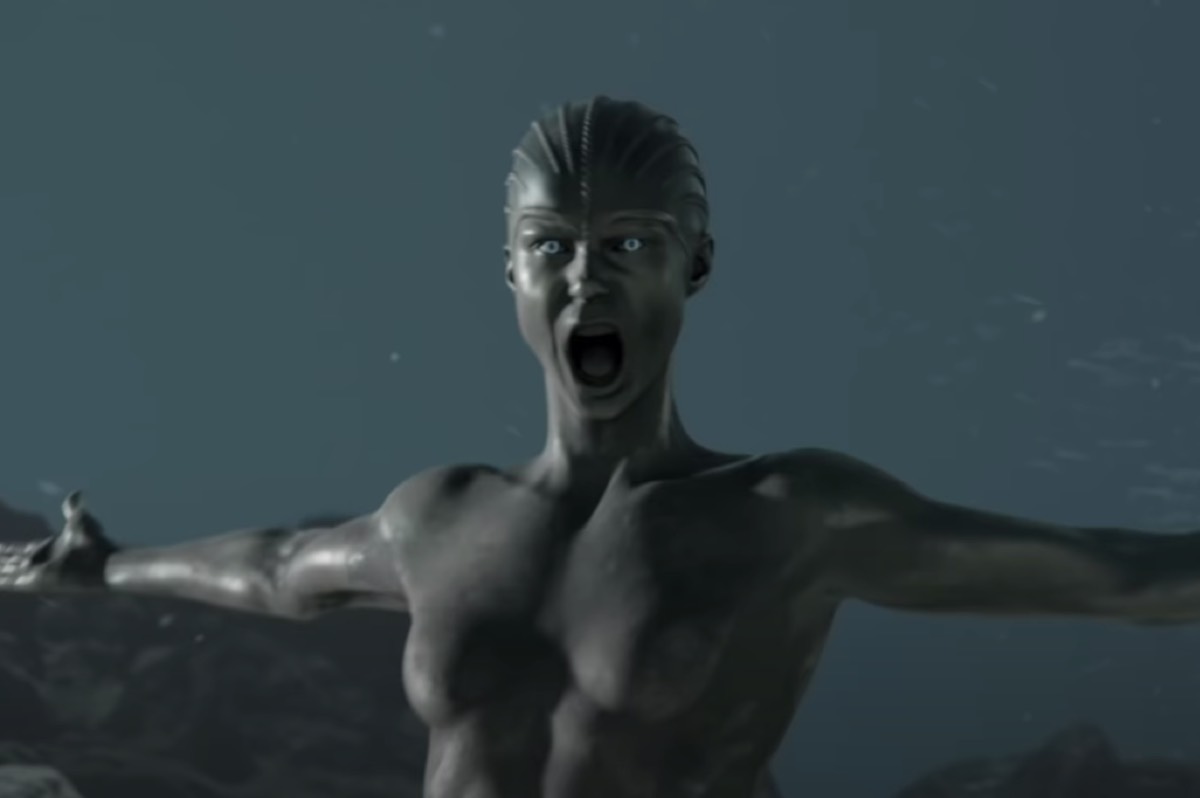
Danish actress Amanda Collin gives a truly extraordinary performance as Mother, and her angular, androgynous physique (augmented by makeup and wardrobe) is visually very striking. The jaw-dropping scene where she first lets loose with her sonic screams to protect her child from the Mithraic, and transforms into The Necromancer, is sci-fi television at its finest. Much of the season centers on her journey of self-discovery and how the revelations about her true nature and mission impact her relationship with both Father and Campion. The backstory of who reprogrammed her—a former Mithraic scientist turned atheist named Campion Sturges (Cosmo Jarvis), who then fell in love with her, just like Pygmalion—is fascinating; there just wasn’t enough of it.

I was even willing to cut the show some slack when Mother ends up having virtual sex with a VR Sturges and winds up inexplicably pregnant. She tells Father she “downloaded” the required information to build a new life form, which was the first warning sign that things were about to go seriously sideways with the plot. What kind of life form is she gestating so rapidly? There were some intriguing possibilities: something half-human, half android perhaps?

And then, it comes time to deliver, and Mother literally vomits up a creepy snake with suckers that—I kid you not—can fly with no obvious means of generating lift. (Apart from everything else, it’s just bad creature design from a biophysics standpoint.) This is a huge blow to Mother, who realizes she did not download instructions from Sturges, but rather has been infected by some alien sperm while she was getting it on in the VR simulation. Or something. It’s honestly not entirely clear. She and Father try to destroy the creature—which will hanker for human blood and threaten their children as it grows—in a suicide mission but somehow the darn thing foils that plan and is released into the wild.

I admit, I uttered some especially salty observations once the credits rolled.

I admit, I uttered some especially salty observations once the credits rolled.

Ars Technica Senior Technology Editor Lee Hutchinson had the exact same reaction to the finale. “I can forgive a lot for an interesting story,” he said. “I’m willing to overlook minor stuff like, how the Heaven ark crashed a mile from the family’s camp, and yet somehow on foot there’s three days’ worth of desert in between the two locations. But a flying alien sucker snake? WTF?” Even that, we might have forgiven, if the finale had given us any answers or insight into the planet’s central mystery that the show has been hinting at for ten episodes. Instead, it went for a jarring, over-the-top ploy that simply wasn’t sufficient payoff for the viewer, and clashed mightily with the original set-up.

Scott’s fingerprints are all over Raised by Wolves, right down to the central mythology—or at least what little we learn of it. “This is a take on the same core story he’s been trying to tell in his last couple of movies—what is life? what does being alive mean?—but without all the contractually obligated Alien baggage,” Lee said. “David from Prometheus would be right at home hanging out with Mother and Father, and the bits with Marcus/Caleb (the atheist-turned-high-priest) felt Gladiator-esque. And the ‘alien bursts out from the host’ bit was too on the nose, unnecessary, and dumb.”

The newly birthed flying snake even looks like the snakelike creatures from Prometheus, raising questions about whether the show will devolve (like the planet’s early humans) into just another take on the Alien franchise mythology. Also: Lee points out that flying sex snakes are a featured card in Cards Against Humanity, and “now I have a mental image of exactly what it means.”

Raised by Wolves has already been renewed for a second season, and apparently the flying alien sucker snake (FASS)—which had rapidly grown to an alarming size in the final scene— is going to be a major part of the overall narrative arc for S2. Le sigh. Meanwhile the ultimate fates of Mother and Father remain ambiguous; since Collin’s Mother was hands-down the most interesting character, that doesn’t bode well for S2. Guzikowski and Scott clearly feel they have a lot more story to tell about this fictional world. The question is, will frustrated viewers tune in?

Raised by Wolves is streaming on HBO Max.

https://arstechnica.com/?p=1710502


Going in-depth with Nintendo’s augmented reality Mario Kart RC car

The toy industry has given us plenty of radio-controlled cars that are modeled after the Mario Kart franchise. But the $100 Mario Kart Life: Home Circuit, announced last month, promises to be the first to integrate such a toy car with an augmented reality camera and attendant Switch game experience.

While we haven’t gotten any hands-on time with Mario Kart Live: Home Circuit yet, we were able to participate in a recent livestream demo of the RC car/AR app combo ahead of its planned October 16 release. What we saw doesn’t quite match up to a full-fledged Mario Kart game, but it looks like it could add a lot of creativity and imaginative play opportunities to the standard RC car experience.

On your mark…

The demo walked us through the Mario Kart Live setup process, which starts off by using the camera on the Kart to scan a QR code found on the free downloadable Switch app (that app won’t work at all without the Kart). With that scan, the Kart and Switch are connected directly via Wi-Fi, without the need for any router or live Internet connection.

When you put the Kart down, you get an over-the-shoulder view of what the camera sees on your Switch screen (either docked or in handheld mode, standard or Switch Lite). Nintendo isn’t discussing specifics of the streaming resolution/frame rate of this setup, but a Nintendo representative said he hadn’t seen any latency between the Switch controls and the physical movements of the Kart itself.

The camera’s positioning means you don’t see the actual physical Kart from this view. Instead, you see your Kart represented as an animated 3D model at the bottom of the livestreamed camera view. This can lead to some lively interactions, like when Mario playfully gets your attention by knocking on the “camera’s” glass.

Get set…

With the connection established, you set up your course by simply driving around your room; wherever your Kart goes, the virtual track will follow at a uniform width. The only physical requirement is four fold-out cardboard AR gates, each about three times the width of the Kart itself. You have to use all four of these in designing your course (no more, no less), and the Kart has to roll under each one in order, though you can loop back through a gate multiple times before moving to the next one.

You can make your course as simple or as complicated as you want between gates, adding zigzags, loops, intersections, or long straightaways to your heart’s content. But the gates are the only strict requirement when navigating the course later; the game itself offers no penalty for driving off the course you lay out at any point.

[embedded content]

You’re driving a physical Kart, though, so you can set up walls and barriers on the side of your virtual course to help encourage or force players to drive the “right” way. There’s also a “smart steering” option for racers that helps to automatically keep the Kart on track.

“You’re playing a game, and it’s up to you to make your own rules,” a Nintendo representative told Ars Technica. “In multiplayer, though, you’re definitely going to get called out [for cutting corners].”

…Go!

With your course built, you can race through a simple Grand Prix mode that takes you through the basic track three times, each with different environmental hazards and visual themes (snow, rain, underwater, lava, 8-bit, Rainbow Road, etc.). While you set up the layout of the road itself, in this mode the game automatically puts out customizations including boosts, item boxes, and coins (used to unlock cosmetic options, not to increase your top speed). The modification are intended to make each race in the three-race series a bit harder, with the usual Mario Kart point-scoring for your speed and placement.

In Explore mode, you can add a bit more virtual customization to the gates themselves, choosing from a variety of hazards or boons when you drive under them. The most interesting of these was a Magikoopa effect, which mirrors your camera view of the course (and thus the real world around it) until you hit it again. There’s also a Time Trial mode that lets you race against a ghost version of your best time and tracks the exact positioning of your Kart in that race.

In single-player races, computer-controlled Koopalings (and Bowser Jr.) serve as computer-controlled opponents. This being Mario Kart, those virtual opponents can affect your Kart with a variety of items. This means real-world effects on your physical Kart, too; a Red Shell or Piranha Plant gate will stop your Kart temporarily, while a Sandstorm or Magnet Gate actually makes your Kart drift left or right briefly. And yes, you can give your Kart a physical speed boost with a mushroom (or by holding a drift for the requisite time).

While the course-customization options don’t seem deep enough to really emulate a full-fledged Mario Kart game, Mario Kart Live still looks like a fun way to bring the basic concepts of the series into the real world. We’re looking forward to getting some hands-on time with it soon.

Listing image by Nintendo

https://arstechnica.com/?p=1711184