Sony makes it official: PlayStation 5 won’t natively support PS1, PS2, PS3
Enlarge/ Were you hoping to play classic PlayStation discs on the newest PlayStation 5 console later this year? If so, we have bad news.
Wednesday’s deluge of PlayStation 5 news mostly revolved around brand-new content launching alongside the console on November 12. Lost in the fray was a key detail that confirmed an August leak about PS5: its lack of sweeping backward-compatibility support.
This prevented Sony from delivering compatibility with older consoles, Ryan told Famitsu, even though he made clear that Sony wanted to support PlayStation 4’s “100 million players” by developing compatibility with “99%” of PS4 games, since “we thought that they would like to play PS4 titles on the PS5, as well.”
“Why would anybody play this?”
This announcement doesn’t clarify whether PS1 games purchased for use on PS4 will transfer to PS5. It also doesn’t mention the existing ability for players to stream older-generation games to PS4 from the PlayStation Now cloud-subscription service or whether we should expect that functionality to seamlessly transfer to PS5 in November. SIE reps did not immediately respond to our questions about those possible features.
Ryan’s current statement about affection for PS4 backward compatibility is curious, considering he has previously scoffed at affection for older console generations. As he told Time Magazine in 2017:
When we’ve dabbled with backward compatibility, I can say it is one of those features that is much requested, but not actually used much. That, and I was at a Gran Turismo event recently where they had PS1, PS2, PS3 and PS4 games, and the PS1 and the PS2 games, they looked ancient, like why would anybody play this?
Ryan’s take about that older generation probably wasn’t helped by lackluster PlayStation Classic sales in 2018 (though those were arguably less about classic games and more about iffy execution).
As I wrote about PS5’s rumored back-compat news in August:
PlayStation 4 was the company’s first console to not ship with native backward-compatibility support for disc-based games, along with incompatibility with download-only software that debuted on PlayStation 3. That meant you had to hold on to your old console to access those disc-less games. This followed the PS3 receiving a major revision early in its lifetime to remove support for PS2 discs (due to this feature running on PS2 “Emotion Engine” architecture built into early PS3s, which was dumped to cut costs).
Comparatively, Microsoft has aggressively courted fans of older games with a backward-compatibility sales pitch on both Xbox One and Xbox Series consoles. That means gamers in the Xbox ecosystem can expect native access to previous purchases (whether in disc form or as a digital purchase) across multiple console generations and resolution and performance upgrades on a game-by-game basis. We’re still waiting to hear whether PS4 games that struggled with performance issues might receive PS5-specific upgrades, though the PS4 Pro’s optional “boost mode” already made clear that certain games (cough, cough, Bloodborne) would need special patches to take advantage of newer hardware.
Wednesday’s dump of PlayStation 5 news did not go into further detail about additional boosts to PS4 games as played on the upcoming console. Instead, we learned that some major PlayStation 5 games, particularly Horizon: Forbidden West and Marvel’s Spider-Man: Miles Morales, will launch simultaneously on PS5 and PS4. This appears to run somewhat counter to Sony’s recent comments about maintaining “generations” instead of supporting an Xbox-style “forward-compatible” plan for its biggest games. https://arstechnica.com/?p=1707505
The end of the 3DS marks an inflection point for portable gaming
A few of the 3DS variation that were, until recently, supported by Nintendo.
Mark Walton
The 3DS XL line was meant for bigger hands and chunkier pixels.
Kyle Orland
The Nintendo 2DS ditched the stereoscopic 3D and the folding hardware design in favor of low costs.
Kyle Orland
The “new” in the “New Nintendo 3DS” mainly meant the addition of that tiny right-analog nub in the upper corner.
Kyle Orland
This PAX-goer was using all 10 of these 3DS systems to streetpass with himself. Yes really.
Thickness/height comparison. From top: 3DS, 3DS XL, PS Vita, 2DS.
Kyle Orland
Nintendo seems to have halted production on all variations of the Nintendo 3DS, marking the first time since 2004 that Nintendo is not producing any dual-screen portable systems.
Nintendo’s Japanese website now lists all the recent hardware variations in the Nintendo 3DS line (the Nintendo 2DS, New Nintendo 2DS LL, and New Nintendo 3DS LL) as “Out of Production.” Nintendo’s US site, meanwhile, seems to have been scrubbed of all mentions of the 3DS: the system’s official landing page now just redirects to Nintendo’s general home page, while Google’s cache and The Internet Archive showed an active promotional page just days ago.
But despite a brief sales spike in 2018, by early 2019 Nintendo was acknowledging that 3DS sales were falling “faster than anticipated.” With new 3DS software slowing to a trickle as developers moved to the Switch, last year’s launch of the $200 Switch Lite probably put the final nail in the 3DS coffin (and helped make the earlier portable’s 800×240 resolution look downright antiquated).
A modest success
The 3DS launched in early 2011 counting on a novel (and somewhat gimmicky) glasses-free stereoscopic 3D display to attract new customers. But the system ran into lower-than-expected sales almost immediately, thanks in large part to its $250 price ($290 in 2020 dollars). The original Nintendo DS, by contrast, launched at $150 in 2004 ($208 in 2020 dollars).
The 3DS line went on to ship over 75 million units in a span of nearly 10 years. The original DS, by contrast, shipped over 154 million units between 2004 and 2013, while the Switch has already achieved 61 million shipments in just 3.5 years.
Major console makers aside, dedicated portable gaming is now mostly focused on nostalgia: handheld devices like the Evercade and upcoming Analogue Pocket representing the low and high ends of cartridge-based retro players, respectively. Then there are devices like the GPD XD Plus, which add physical buttons and tiny analog sticks to an Android tablet that you can load up with emulators and (legally acquired) ROMs to your heart’s content.
Aside from that, quirky efforts like the monochrome, crank-controlled Playdate somewhat capture the spirit of portable gaming experimentation that led to systems like the Nintendo DS and Nintendo 3DS in the first place. As Nintendo marks the end of the dual-screen gaming era, we hope more experimental hardware-makers will take up that mantle and play around with unique portable form factors that expand handheld gaming beyond the touchscreen on your smartphone.
https://arstechnica.com/?p=1707308
PlayStation 5 event: $499 with a disc drive, $399 without, on Nov. 12
Fancy, reflecting eyeballs for FFXVI.
No release date yet.
One of FFXVI‘s main protagonists.
Another one of FFXVI‘s main protagonists.
FFXVI showdown between a summon and a foe.
FFXVI battle.
FFXVI character is about to have a bad time.
You’re gonna need a lot of teraflops for all of those bloody faces.
FFXVI battle.
Hot-blooded conversation after a FFXVI battle.
FFXVI beast battle.
The Final Fantasy XVI reveal included a whirlwind presentation of various characters hanging around in a medieval-styled town.
Your FFXVI summon is ready to freeze things.
A massive creature emerges in FFXVI.
An army of Chocobo riders in Final Fantasy XVI.
As part of a PlayStation 5 showcase today, Sony finally revealed the launch pricing for the PlayStation 5: $499.99 for the standard edition (€499.99, £449.99, ¥49,980) or $399 for the “All-Digital” version without a disc drive (or €399.99, £359.99, ¥39,980).
Both consoles will launch on November 12 in the United States, Japan, Canada, Mexico, Australia, New Zealand, and South Korea, followed by a November 19 launch in the rest of the world. Pre-orders will be available at select retailers starting Thursday, September 16, Sony said after the event, though some retailers like Walmart, Best Buy, and GameStop in the US have made the console available as soon as Wednesday. (Update, 5:20pm EDT: Sony Interactive Entertainment has confirmed five first-party launch titles shipping alongside PS5 on November 12: Astro’s Playroom (pre-installed for free on all PS5 consoles), Demon’s Souls, Destruction All-Stars, Marvel’s Spider-Man: Miles Morales, and Sackboy: A Big Adventure.)
The $499 price matches Microsoft’s Xbox Series X pricing on the top end of the next console generation. The All Digital Edition, however, comes in at $100 more than the similarly discless Xbox Series S, which is also a step down in hardware power from the Series X.
It’s official.
Prices in your favorite currencies.
Cool logo for what appears to be Sony’s clear answer to Xbox Game Pass—even though it seems to largely resemble PlayStation Now, and it only has PS4 games advertised as of press time.
Footage of Square Enix’s Final Fantasy XVI led off a series of game trailers. The new game features apparently real-time battles that look heavily inspired by the like of Devil May Cry, with enemies straight out of Dark Souls and its ilk. The sword-and-sorcery setting and characters pack on the pathos, too, intoning lines like “We do not question orders—we follow them,” and “I’ll kill you if it’s the last thing I do” with absolutely no irony. The game will be a console-exclusive on PlayStation and will also be available on PC.
No target release date was announced, but we’ll remind you that 10 full years elapsed between the announcement and eventual release of Final Fantasy XV.
Trying to keep the bus from falling, backup plan.
The name’s Morales. Miles Morales.
Miles tries to keep the peace.
New bad guys for a new Spider-man adventure.
Miles triggers an orange-electric burst to chain-attack enemies in midair.
Invisible Spidey for maximum butt-kicking.
It can’t be a superhero game in 2020 without a massive battle on a bridge.
Leaping into action.
Trying to keep the bus from falling.
Miles goes on a stroll with a serious emphasis on reflections.
Press “square” to save lives.
Can one wizard save the world?
New beastly friends in a new Hogwarts universe.
Escaping an attacking dragon in the Hogwarts Legacy.
Coming in “2021.”
Five Nights at Freddy’s with a reflection-heavy PS5 version.
New footage of Spider-Man: Miles Morales highlights an accident that gives the titular hero glowing, electricity-based powers in addition to the standard webslinging. The fight scenes reminded us of Spider-Man by way of a game like Infamous. The PS5 launch title will also be available on the PS4.
A new Harry Potter-inspired game, Hogwarts Legacy, takes place in a late 1800s version of Hogwarts School of Witchcraft and Wizardry, where “now is the time to add your story to these hallowed halls.” The trailer hints at a larger mystery that will require leaving the school and using your newfound wizarding powers to “reveal what you stand for… The choices you make now will define the legacy of Hogwarts.” Look for it in 2021.
New Deathloop footage shows off some more of the parkour-inspired, telekinetic first-person gunplay. The trailer also highlights how the game’s eight targets have interlocking stories that will be revealed through repeated loops through the same day. Players will have to arrange things to get multiple targets to come together in one place for more efficient killing in the game loop’s strict time limit. Deathloop is coming as a PlayStation console exclusive (with a PC version) in the second quarter of 2021.
Demon’s Souls. Remember when scenes like this were the fake “target” renders shown off in magazines?
Demon’s Souls. Incredible texture work in the updated version.
Demon’s Souls. RUN!
Demon’s Souls. What terrors await within?
Demon’s Souls. You might want to dodge-roll away from those oncoming flames.
Demon’s Souls. Dark corridors in the trailer are a great showcase for the game’s dramatically updated lighting engine.
Demon’s Souls. The idea of this much fidelity in a real-time game has us excited—but can we expect locked 60 fps performance? That remains unclear, due to the reveal’s slightly fuzzy nature.
Demon’s Souls. Deep reds at the edge, and an emerald haze at the center.
Demon’s Souls. Rise, warrior.
Demon’s Souls. Though this new version is a lot more colorful, each new scene’s palette selection is quite tasteful.
Demon’s Souls features a man in medieval armor wandering dark, eerily quiet castle halls and slashing both living and undead enemies with his sword, as you might well expect. Some excellent lighting effects were in play during the trailer, from torches on walls to fire-breathing dragons to rays of moonlight filtering through open castle sconces. The game will be available at launch on the PS5 and, somewhat surprisingly, will also be coming to PC.
The showcase concluded with a brief tease of a sequel to 2019’s God of War remake. “You must prepare yourself” Kratos warns, because “Ragnarok is coming” in 2021. No gameplay or cut scene footage was shown, however.
Other games shown at the event include:
A new Five Nights at Freddy’s game, Security Breach, features an eerie robotic voice trying to lure you out to play in a shiny family fun center environment. No actual gameplay was shown or release date discussed in the short teaser trailer.
Village, aka Resident Evil VIII is coming in 2021.
Devil May Cry 5: Special Edition is a special edition of Devil May Cry 5 that will be available digitally when the PS5 launches.
The multiplayer alpha of Call of Duty: Black Ops – Cold War will be available exclusively on PlayStation 4 from Friday, September 18, through September 20.
Apple asks to block iOS Unreal Engine development in new court filing
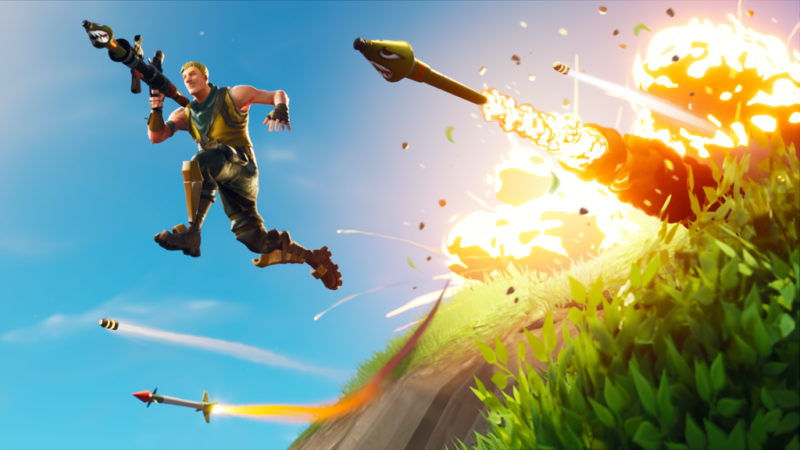
Enlarge/ Artist’s conception of Apple’s conception of Epic trying to evade punishment for its breach of Apple’s developer agreement with regards to Fortnite.
“Epic started a fire, and poured gasoline on it, and now asks this Court for emergency assistance in putting it out, even though Epic can do so itself in an instant by simply adhering to the contractual terms that have profitably governed its relationship with Apple for years,” the motion reads, in part. “Epic is a saboteur, not a martyr.”
Security-centered arguments
Apple’s argument for keeping Fortnite off the App Store without changes relies heavily on arguments around protecting iPhone security. When Apple first created the iOS App Store, it says, “Rather than recreating the Internet, Apple opted instead to create a safe and trusted place for its iPhone customers to discover and download apps, confident that they will work seamlessly and securely with the tap of a finger.”
Epic undermined that secure approach by violating the contractual terms of its developer agreement and inserting its own Direct Payments option into the iOS version of Fortnite via a “hotfix”, which Apple was unable to review before it went live. Because of this, Apple says it was unable to ensure that Epic had “not made changes to the payment system or bypassed security features of the iPhone or privacy protections,” as it usually does.
As it stands, for instance, Fortnite‘s Direct Payment Option (which remains available and widely used by players who previously downloaded Fortnite for iOS) is not blocked by the iPhone’s built-in parental control restrictions on in-app purchases. “Apple promises its customers that the App Store will be a safe and trustworthy place for customers to discover and download apps,” the company writes. “By inserting secret and unreviewed functionality into an app, Epic threatens the relationship between Apple and iPhone customers.”
If Epic succeeds in its argument here, Apple warns, there will be nothing stopping other developers from also undermining Apple’s 30 percent cut of in-app purchases. “Epic insists that other developers will not follow its lead because they will fear ‘retaliation,'” Apple writes. “But no one will fear Apple’s response if this Court grants the injunction Epic seeks and declares that all developers can flout Apple’s rules with no consequence as long as they claim Apple’s rules are anticompetitive.”
Still going after Unreal Engine
Fortnite aside, Apple also argues that it must retain the right to close all of Epic’s iOS developer accounts. That includes the accounts behind the development of Unreal Engine on iOS, which are currently protected by a restraining order.
Apple says it wants to close all of Epic’s accounts in part to prevent what it calls a “shell game” of apps being transferred from one developer account to another. But Apple says it’s also because the company now sees Epic’s Unreal Engine as a “potential threat” that poses as a second potential ‘trojan horse’ that would enable Epic to carry through on its threats to undermine the App Store and insert further unauthorized features.”
Through Unreal Engine, Apple argues, Epic could “insert malware, or other unauthorized features such as alternative direct payment mechanisms” into “the non-Epic apps that are available on the App Store and rely on Unreal Engine… It is easy to see that a rogue application affecting the operation of a significant fraction of the world’s iPhones could substantially disrupt local or even worldwide telephony systems, as well as broad segments of the Internet itself.”
As far-fetched as those claims of worldwide-Internet-sabotage-via-game-engine may be, Apple’s main point is that it can no longer give Epic the benefit of the doubt with regard to its iPhone security and iOS development contract obligations. “Apple does not wait to be fooled a second time before terminating an affiliate for the bad deeds of its principals,” the company writes.
Not a monopoly?
The rest of Apple’s motion largely rehashes previous arguments that Epic is unlikely to prove its claims that Apple is a monopolist exerting unreasonable control over the marketplace. The fact that Epic enjoys “alternative means to distribute Fortnite,” from consoles and PCs to Android phones, “present[s] a textbook example of services that are ‘reasonably interchangeable’ when used ‘for the same purposes,'” Apple writes.
More than that, though, even on iOS Apple says that Epic has other options to monetize Fortnite without paying Apple’s 30 percent fee on in-app purchases. “A developer can generate revenue through advertising, through the sale of physical goods and services, and through any number of other ways that will result in no commission to Apple,” the company writes, adding that over 80 percent of the apps on the App Store use such business models.
Apple also reiterates its position, previously supported by the court, that Epic’s harm in this matter is self-inflicted and thus does not require a preliminary injunction to rectify. To Epic’s claimed “reputational harm” in being forced off the App Store, Apple notes that “Epic has engaged in a full-scale, pre-planned media blitz surrounding its decision to breach its agreement with Apple, creating ad campaigns around the effort that continue to this day. If Epic were truly concerned that it would suffer reputational injury from this dispute, it would not be engaging in these elaborate efforts to publicize it.”
https://arstechnica.com/?p=1706983
Review: We do not recommend the $299 Oculus Quest 2 as your next VR system
Enlarge/ It looks the same as its predecessor, but Oculus Quest 2 is quite different—and mostly in disappointing ways.
Sam Machkovech
The long-rumored (and recently leaked) Oculus Quest 2 is here, in my home, on my face. I received it earlier this month, along with news that this would be Oculus’s cheapest “all-in-one” VR system yet: starting at $299 and shipping on October 13.
That’s one hell of a price for cutting-edge VR. But it comes at a cost.
Part of that comes from Facebook’s aggressive policy about making Facebook social media accounts (whose terms of service revolve around a “real name” policy) mandatory to use new Oculus VR headsets, including the Quest 2. Let me be blunt: that is a terrible idea. Attachment of a social media account and its massive Web of personally identifying data (as accumulated by everything from service log-ins to average Web-browsing cookies) to computing hardware (VR headsets, phones, computers, TVs, etc) is quite frankly an irresponsible move on Facebook’s part.
If that’s the beginning and the end of this review for you, I do not blame you. I also encourage you to move comments about that specific opinion to my August op-ed about the development. (Or, quite honestly, redirect that comment-writing energy to your state or country’s regulators. I’ve already written to my home state’s Attorney General.)
But let’s say you already bought into Oculus hardware or software in the past, or you’ve made your peace with the company’s Facebookening. Or maybe in spite of all of the bad news, you’d make a deal with the Mephi-zuck-eles for a higher-performing, “all-in-one” Oculus Quest that’s now powered by a Snapdragon 865-equivalent SoC with more RAM, more pixels, and a higher refresh rate.
If that’s where you land, you’ll eventually find a different bummer about Oculus Quest 2: how desperate Facebook is to get the price down to that magical $299 number. It seemed like every single day that I tested this device in the pre-release period, I discovered some new corner-cutting issue that wasn’t worth the savings. Those piled up to the point where Facebook will need to launch a Quest “2+” revision before I’m ready to recommend this headset.
Everything looks similar… but it’s not
New box, with a much different, less sleek aesthetic compared to prior Oculus releases.
Inside this is an even simpler cardboard box.
But, I mean, you’re just going to toss the box, anyway.
Headset, front-facing view. It’s near-identical to Quest 1 in terms of dimensions.
Headset from the side.
Headset, on the author’s head.
Those lens stickers have got to go.
Volume slider. But where’s the IPD slider from Quest 1? Er… we’ll get to that.
New controller (right) posed next to Quest 1 controller (left). Buttons are nearly identical, but now there’s a larger pad for resting your thumb.
Closer zoom on both generations of Oculus Quest controllers. Yes, my original Oculus Touch 1 controllers have lived a long and full life.
Oculus Quest 2 should look familiar, as its design language and general form factor are nearly identical to the original VR system that launched in March 2019 starting at $399. Both versions have four outward-facing cameras to track your nearby environs, so you can put the headset on anywhere and expect a convincing “transportation” effect inside VR. This “inside-out” tracking model can be found in most Windows Mixed Reality headsets, and it differs from systems like HTC Vive and Valve Index, which won’t work without infrared-spewing “tracking boxes” installed in your preferred playing space.
Unlike most other VR headsets, the Quest line does not require connections to a PC or console. Strap it onto your face, map out a “playing space” inside your home using your hands, and Quest 2’s internal hardware will do all of the 3D rendering. (Like the first model, Quest 2 supports optional connections to PCs for their higher-end games, as well.)
Quest 2’s pair of hand-tracked controllers include the same array of buttons, triggers, and joysticks as the first version, along with the same “halo” construction to hold their infrared sensors. You may glance at these and think you’re in for identical performance compared to other “Oculus Touch” controllers. Not so fast.
Facebook reps mentioned that the controllers were redesigned with an emphasis on increased battery life and comfort, which I found curious. The original Oculus Quest controllers didn’t last very long, but they only required one AA battery and were far more efficient than, say, the HTC Vive Cosmos controllers. What got the battery drain down further? This is when Facebook reps claimed that Quest 2’s controllers have fewer infrared sensor points: “We’re able to find computer vision algorithms tuned to achieve the same [level of controller] tracking in fewer LEDs, thus [requiring] less power,” a Facebook representative told Ars Technica.
I went back to compare tricky “expert” Beat Saber levels on both Quest 1 and Quest 2, and sure enough, the older controller is noticeably more accurate. It’s hard to perfectly measure VR controller detection without access to verbose data logs (which I’ve used to diagnose issues with SteamVR in the past). But I can safely say that after an hour going back and forth between Quest 1 and 2, the number of lost swipes on the newer hardware was higher. So this downgrade in sensor points checks out.
[Update, 3:30 p.m. ET: Since this article went live, we’ve seen infrared camera footage from Tested confirming an identical number of LED bulbs in both generations of Quest controllers, which puts Facebook’s original statement into question. The FB rep may have been describing a downgrade in frequency or power for those LED bulbs in Quest 2 controllers.]
Worse, Quest 2 has removed the grippy, cross-grain texture found in Quest 1 controllers, while making the controllers slightly heavier (151g for the new controllers, versus 129g for Quest 1’s controllers). As a result, I’ve felt them slip out of my grip much more often than with Quest 1. Having a wider pad on top of the controller to rest my thumb doesn’t alleviate the issue. It’s the first of many curious changes between Quest headset generations.
Fabric feelings, strap yaps
In terms of cosmetic changes, Quest 2 no longer lines the headset’s sides with soft fabric, nor does it include a similar fabric lining in the inside. The former is a manageable bummer; I miss that soft sensation of picking the Quest up, but I can live without it. The latter genuinely impacts usability by allowing more light bleed into your field of view—it’s not much, but with VR immersion, every bit of light leak counts.
The biggest “cosmetic” change is also incredibly impactful to the headset’s function—the Quest 2 has a new strap. Ugh. I have never seen such an abomination in my years of reviewing VR headsets. It’s worse than Oculus Go, the previous bottom-rung candidate for cheapest-feeling headset strap on the market.
This default, cheap, backpack-like strap must be adjusted every time you put Quest 2 on, or take it off, because it doesn’t come with a nifty elastic strap a la Quest 1.
Sam Machkovech
An awkward photo of this strap on the author’s head.
Instead of employing a typical “halo” strap design, meant as much to shift support and weight to the back of your head as to allow a variety of hairstyles through, Oculus has opted for an uncomfortable split-strap design. This connects a top-of-head strap and two straps leading to the headset’s left- and right-hand sides. If you have long hair, you now have one fewer organic way to pull that hair out comfortably.
Worse, you must adjust this strap’s fit every single time you put it on or take it off, since it works like a strap on a backpack or messenger bag: you must pull the strap through a pair of double-looped buckles. Quest 2 asks users to pull to the left to tighten, to the right to loosen. (Ever heard the phrase “righty-tighty, lefty-loosie,” Facebook?) It feels clumsy and obnoxious every single time, and its shape does a bad job of properly distributing the headset’s weight. That weight, by the way, is nearly identical to Quest 1; the new headset’s “10%” reduction in weight comes almost entirely from the change to this lighter default headstrap.
https://arstechnica.com/?p=1703203
“This is the way”: Disney drops first trailer for The Mandalorian S2
[embedded content]
Pedro Pascal is back as the titular bounty hunter who befriends a mysterious Child in The Mandalorian S2.
Disney has dropped the first trailer for the second season of The Mandalorian, the Emmy-nominated first live-action Star Wars TV series created by Jon Favreau. Starring Pedro Pascal as Din Djarin, the titular Mandalorian, the series takes place a few years after the fall of the Empire and before the emergence of the First Order.
(Spoilers for S1 below.)
The basic premise is that, after the defeat of the Empire in Return of the Jedi, there was a period of chaos and lawlessness as a new government struggled to emerge from the wreckage. Pascal’s bounty hunter is “a lone gunfighter in the outer reaches of the galaxy, far from the authority of the New Republic.”
In S1, the Mandalorian is looking for a bigger payout from Greef Karga (Carl Weathers), leader of a guild of bounty hunters. Karga directs him to Werner Herzog’s “The Client,” a nameless figure who hires the Mandalorian to retrieve a valuable asset. This turns out to be “The Child” (aka “Baby Yoda,” played by puppeteers), who became the instant breakout star. The Internet (and Herzog, apparently) fell in love with “Baby Yoda” (although he isn’t the Yoda, just an infant of the same species—which makes him about 50 years old).
The Mandalorian’s long-buried altruism emerges when he realizes that the Client’s intentions are to harm (possibly even kill) The Child, and he absconds with The Child instead. That puts a bounty on his head, as well, and much of the first season followed the unlikely duo as the Mandalorian sought to find a safe haven for The Child. Their main pursuer: former Empire governor Moff Gideon (Giancarlo Esposito). Fortunately, they find useful allies in several places, as well as in Cara Dune (Gina Carano), a former Rebel shock trooper from the destroyed planet of Alderaan. And The Child himself turns out to have some surprising abilities of his own.
As Ars’ Sam Machkovech noted in his review of the pilot episode last year, “The Mandalorian is Star Wars for a generation of fans who remember the film series as an aesthetic, an ethos, and a promise of morally mixed discovery.” He particularly praised “the balance of practical effects, carefully molded alien costumes, and intentionally cheeseball CGI,” adding, “Those brief CGI moments are forgivable in light of gorgeous set design, a John Williams-caliber score of brand-new compositions, and a cast of actors who savor their pauses, beats, and moments to simmer in tension (both for action and comedy’s sake).”
A long time ago, in a galaxy far, far away….
YouTube/Star Wars/Disney+
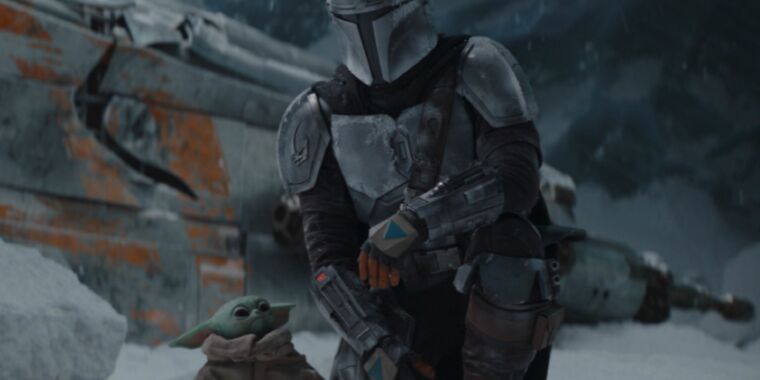
There was a Mandalorian (Pedro Pascal)…
… and also a Child (aka Baby Yoda).
LucasFilm Ltd.
“Show me the one whose safety deemed such destruction.”
LucasFilm Ltd.
Mando must search the galaxy to find an “order of sorcerers” known as Jedi. Maybe you’ve heard of them.
LucasFilm Ltd.
Seeking refuge in an icy realm.
YouTube/Star Wars/Disney+
Storm trooper alert!
LucasFilm Ltd.
D’aww, Baby Yoda close-up.
YouTube/Star Wars/Disney+
More Baby Yoda.
YouTube/Star Wars/Disney+
OK, just one more shot of Baby Yoda.
YouTube/Star Wars/Disney+
Cara Dune (Gina Carano) and Greef Karga (Carl Weathers) are back for S2.
YouTube/Star Wars/Disney+
No Star Wars series would be complete without nifty fighters.
YouTube/Star Wars/Disney+
Mando and The Child find themselves in a port city.
YouTube/Star Wars/Disney+
Someone is watching from the shadows.
LucasFilm Ltd.
Mando and The Child set off to sea.
YouTube/Star Wars/Disney+
This is no place for a Child.
YouTube/Star Wars/Disney+
“Where I go, he goes.”
LucasFilm Ltd.
The first rule of Fight Club….
YouTube/Star Wars/Disney+
Mando finds himself surrounded by mercenaries.
YouTube/Star Wars/Disney+
“This is the way.”
YouTube/Star Wars/Disney+
They make a good team.
The series garnered 15 Emmy nomination for its eight-episode freshman outing. And it easily landed a spot on our top TV shows of 2019. “Favreau’s brainchild has proven to be a killer vehicle for the most Star Trek-like storytelling yet in a live-action Star Wars product,” Machkovech wrote. “Even better, its freak-of-the-week and brand-new-planet progression has been paired with a proper samurai story, as anchored by the religious, fervent, and conflicted Mando himself.”
So naturally we’re all eager for S2 (and preproduction on a possible third season has purportedly already begun). Carano, Weathers, and Esposito are all returning for the second season, the latter having survived being shot down by Karga and the Mandalorian in the season finale. Alas, we bid farewell to several great characters in S1, including the assassin Fennec Shand (Ming-Na Wen); Kuiil (voiced by Nick Nolte, performed Misty Rosas in an animatronic face mask), an Ugnaught moisture farmer and former slave of the Empire who sacrificed his life to protect The Child; and the droid IG-11 (voiced by Taika Waititi).
New faces
New S2 cast members include Rosario Dawson as Ahsoka Tano, Anakin Skywalker’s former Jedi Padawan, who is now a spymaster for the Rebel Alliance; Katee Sackhoff as Bo-Katan Kryze (reprising her voice role from The Clone Wars and Rebels animated series), who leads a Mandalorian group known as the Nite Owls; Timothy Olyphant as Cobb Vanth, a former slave who now has possession of fan favorite/bounty hunter Boba Fett’s armor; and Temuera Morrison as Boba Fett—a bit of a surprise since the character seemingly perished in Return of the Jedi.
The official S2 premise is appropriately vague: “The Mandalorian and The Child continue their journey, facing enemies and rallying allies as they make their way through a dangerous galaxy in the tumultuous era after the collapse of the Galactic Empire.” The trailer doesn’t offer much beyond that. Mando receives instructions to reunite The Child with his own kind, although exactly where that species might be lurking is apparently something he’ll have to figure out for himself. It will involve seeking out “an order of sorcerers called Jedi”—sworn enemies of the Mandalorians in eons past. We get scenes of space battles, storm troopers, our duo traipsing through a remote icy world, and of course, lots and lots of Baby Yoda. And the Mandalorian remains a formidable adversary, as one band of goons learns to its detriment.
The Mandalorian S2 debuts on Disney+ on October 30, 2020. A few additional promotional stills are below.
Mandalorian and Child.
Mando is once again in league with Gina Carano as Cara Dune and Carl Weathers as Greef Karga.
LucasFilm Ltd.
Dune is a former rebel shock trooper-turned-mercenary from the now-destroyed planet of Alderaan. She fought in the Galactic Civil War for the Rebel Alliance.
LucasFilm Ltd.
Karga is an ex-magistrate and leader of a bounty hunter guild who hires the Mandalorian to track a valuable asset.
LucasFilm Ltd.
Giancarlo Esposito as Moff Gideon, a former officer of the Imperial Security Bureau, whose life changed after the Rebel Alliance destroyed the second Death Star.
Once an upstart, the Forza franchise is now firmly established within the pantheon of great racing games. The first installment was created as the Xbox’s answer to Gran Turismo, but with a healthy helping of online multiplayer racing, too. Since then, it has grown with Microsoft’s Xbox consoles, with more realistic graphics and ever-more accurate physics in the track-focused Forza Motorsport series as well as evolving into open-world adventuring (and even a trip to the Lego dimension) for the Forza Horizon games.
If you’re one of the millions of people who’ve played a Forza racing game, you’re probably aware of the games’ AI opponents, called “Drivatars.” When the first Drivatars debuted in Forza Motorsport in 2005, they were a substantial improvement over the NPCs we raced in other driving games, which often just followed the same preprogrammed route around the track. “It was a machine-learning system on a hard drive using a Bayesian Neural Network to record [racing] lines and characteristics of how somebody drove a car,” explains Dan Greenawalt, creative director of the Forza franchise at Turn 10 Studios, in our latest War Stories video.
In fact, the technology originated at Microsoft Research’s outpost in Cambridge, England, where computer scientists started using neural nets to see if it was possible to get a computer to identify a Formula 1 driver by the way they drove through corners.
In the years since, Drivatars have evolved considerably—and not always in ways that players appreciate. For the first few games, which were written for the Xbox and Xbox 360 consoles, Drivatars lived entirely on the console’s local hard drive. As you lapped the various tracks in the game, the Drivatar system was quietly using that data in the background to train the AI you were racing against. But with the move to the Xbox One, Greenawalt’s team decided to make use of the cloud.
“All of a sudden going to Thunderhead, we had millions of laps within what, a week?” Greenawalt says. “It was crazy.”
More data, more problems
Very quickly, the team at Turn 10 began learning a lot about the way different players drove their cars. Tracks aren’t uniform—they vary in elevation, width, corner profile, and more—and that complicates the way the neural net tries to generalize a racing line. Things get even more complicated when you’re racing against other cars; human players are much more aggressive with AI drivers than other humans, and by Forza Motorsport 6, the games started to include a way to toggle off some of the AI’s aggression as a way to combat single-player games that became demolition derbies when the AI tried to wreck the humans at every opportunity.
In this video—recorded remotely due to COVID-19—Greenawalt goes into some degree of detail in recalling how his team has handled these challenges across the years and even discusses the dreaded problem of “rubber banding,” where the AI cars slow down a little to allow a human player to catch up after a spin. Even if you’re not a fan of racing games, we think you’ll find this one pretty engrossing.
Listing image by Ars Technica
https://arstechnica.com/?p=1705877
Facebook leak reveals Oculus Quest 2 as a 4K standalone VR headset
Meet the Oculus Quest 2, now in white!
The strap design looks pretty different from the original.
Rear view shows more of the strap.
Close up on the strap’s rear connection behind your skull.
The handheld Quest controllers have been updated with “new ergonomics” according to the leak.
Close up on the new controllers.
Check out this average consumer having so much fun with the new Oculus Quest 2!
You could be this gleeful, too, if you were in the Oculus Quest 2!
Facebook has inadvertently revealed key information about its next VR headset, the Oculus Quest 2, ahead of an expected unveiling at the Facebook Connect conference later this week.
As discussed in videos posted briefly on Facebook’s Blueprint e-learning platform (and since archived on YouTube), the Oculus Quest 2 is presented as more of a spec upgrade to the existing Quest than a completely new generational split. The standalone headset, which doesn’t require external sensors or processing hardware, will play all original Quest games, according to the video. The Quest 2 can also display VR games running on a Windows PC via Oculus Link, just like the original headset.
The Quest 2 sports a SnapDragon XR2 processor, according to the videos, a significant upgrade from the Snapdragon 835 that was adapted for the Quest from mobile phones. Chipmaker Qualcomm says the XR2 can provide two times the CPU & GPU performance, four times the pixel throughput, and 11 times the AI operations per second, compared to the 835.
That extra power goes in part toward an “almost 4K display” on the Quest 2 with nearly 2K resolution per eye, according to the video. That’s a nearly 50 percent increase in raw pixel count over the original Quest, making it “the highest-resolution headset we’ve ever made).
The new headset also sports an upgrade to 6GB of RAM (up from 4GB on the original) and will come in configurations with up to 256GB of storage. The headstrap has been redesigned as a “new soft touch strap” while the Oculus Touch controllers have been “updated with new ergonomics,” according to the videos.
How the Warsaw Ghetto beat back typhus during World War II
Enlarge/ Painting by Israel Bernbaum depicting Jewish children in Warsaw Ghetto and in the death camps (1981).
Monclair State University collection
During the Nazi occupation of Poland during World War II, Jewish residents in Warsaw were forcibly confined to a district known as the Warsaw Ghetto. The crowded, unsanitary conditions and meager food rations predictably led to a deadly outbreak of typhus fever in 1941. But the outbreak mysteriously halted before winter arrived, rather than becoming more virulent with the colder weather. According to a recent paper in the journal Science Advances, it was measures put into place by the ghetto doctors and Jewish council members that curbed the spread of typhus: specifically, social distancing, self-isolation, public lectures, and the establishment of an underground university to train medical students.
Typhus (aka “jail fever” or “gaol fever”) has been around for centuries. These days, outbreaks are relatively rare, limited to regions with bad sanitary conditions and densely packed populations—prisons and ghettos, for instance—since the epidemic variety is spread by body lice. (Technically, typhus is a group of related infectious diseases.) But they do occur: there was an outbreak among the Los Angeles homeless population in 2018-2019.
Those who contract typhus experience a sudden fever and accompanying flu-like symptoms, followed five to nine days later by a rash that gradually spreads over the body. If left untreated with antibiotics, the patient begins to show signs of meningoencephalitis (infection of the brain)—sensitivity to light, seizures, and delirium, for instance—before slipping into a coma and, often, dying. There is no vaccine against typhus, even today. It’s usually prevented by limiting human exposure to the disease vectors (lice) by improving the conditions in which outbreaks can flourish.
A scourge for centuries
Something very like typhus was first described in 1489 CE during the War of Granada, in which the Spanish army reported losing 17,000 men to disease. In 1577, an assizes held in Oxford, England (now known as the Black Assizes), led to an outbreak that killed over 300 people after infected prisoners were brought into the court and spread the disease to the members. By 1759, nearly a quarter of English prisoners were dying of gaol fever. There were fatal outbreaks during Napoleon’s retreat from Moscow in 1812, during the Irish famine between 1816 and 1819, in Philadelphia in 1837, and all along the Eastern Front during World War I.
Yet another outbreak spread through much of Europe during the Russian Revolution. An estimated 30 to 40 million people contracted the disease in Russia alone, according to co-author Lewi Stone of RMIT University and Tel Aviv University, and between 3 million and 5 million died. Typhus proved to be an equally deadly scourge during World War II, particularly in Nazi-occupied cities and concentration camps. (Anne Frank and her sister, Margot, died of typhus at Bergen-Belsen at the ages of 15 and 19, respectively.)
Nearly 450,000 Jewish residents were packed into the 3.4 kilometers of the Warsaw Ghetto and rationed a meager 200 calories per day, with little soap and water to keep clean. “With poor conditions, rampant starvation and a population density 5 to 10 times higher than any city in the world today, the Warsaw Ghetto presented the perfect breeding ground for bacteria to spread typhus, and it ripped through the mainly Jewish population there like a wildfire,” said Stone. “Of course, the Nazis were well aware this would happen.” The paper cites a 1941 document by ghetto commissar Heinz Auerswald noting a “quantum leap” in May deaths, for example, and the situation became so bad that the streets were littered with human corpses covered in newspapers.
Stone et al. point out that the widespread extermination of Jews was partly triggered (or at least rationalized) by public health concerns—a convenient pretext to commit genocide. The paper quotes an October 1941 statement by Jost Walbaum, chief health officer of occupied Poland, calling Jews “carriers and disseminators” of typhus, and offering two solutions. “We sentence the Jews in the ghetto to death by hunger or we shoot them…. We have one and only one responsibility, that the German people are not infected and endangered by these parasites.” The authors note that his comments were met with enthusiastic applause, adding, “Today, more than ever society needs to grasp how a virus or bacterium can create utter havoc, dragging humankind to this terminal point of evil.”
“Today, more than ever, society needs to grasp how a virus can create utter havoc, dragging humankind to this terminal point of evil.”
Stone is a mathematical biologist who has been modeling diseases for decades, a research area that includes reconstructing past epidemics and pandemics, like the Black Death that ravaged Europe in the 14th century, the Spanish Flu of 1918, or more recently, the outbreak of Zika in Brazil before the 2016 Olympic Games. He came across an article that mentioned outbreaks of typhus during World War II and wanted to learn more. After he found some data on typhus in the Warsaw Ghetto, he plotted it on his computer.
It proved challenging to find additional information, however. Ghetto residents often avoided reporting such diseases. That was because the Nazis typically responded with extreme measures, like injecting phenol into the hearts of those who were sick, killing them instantly, or burning a hospital to the ground, patients still inside, because they were infected with typhus.
That said, according to Stone, there were many experienced doctors housed in the Warsaw Ghetto, some of whom survived the war, and they documented the various measures taken to battle the typhus outbreak. He visited libraries all over the world, scouring their archives for relevant documents that might provide more details about the kinds of strategies deployed.
Enlarge/ Homeless children in the Warsaw Ghetto, circa 1941.
“We know that in other towns of the region, typhus continued on through the winter unabated,” said Stone, citing historical records. “So it was odd that just in the Warsaw Ghetto, the disease should die out before winter when it was expected to accelerate. Thus, we are fairly confident that the intervention succeeded.” He admitted being surprised by that finding and initially assumed it was the result of a corrupted data set. But the diary of Polish historian and Warsaw Ghetto resident Emanuel Ringelbaum provided corroborating evidence. Ringelbaum documented the day-to-day happenings in the ghetto and reported a 40-percent drop in the epidemic rate at that time, calling it “irrational.”
Stone and his co-authors thought their mathematical models might shed some light on this oddity. The model revealed that there must have been some kind of behavioral change factor, since without it, the epidemic would have peaked in the middle of winter (January 1942) and been as much as two to three times larger. Epidemics typically collapse when there aren’t enough susceptible (uninfected) people in a given population to sustain the spread. But less than 10 percent of the Warsaw Ghetto residents had been infected when the outbreak died down in late October of that year.
The ghetto doctors and council members encouraged (and even enforced, when necessary) general good hygiene and cleanliness, despite the terrible conditions. They encouraged social distancing, and those sickened were quarantined. The community even managed to open up soup kitchens, smuggling in extra food to augment their rations. There were public lectures to educate the residents about the importance of such measures and even a rudimentary underground university to train new doctors. Stone et al. estimate that these measures likely prevented as many as 100,000 people from contracting typhus and tens of thousands from dying of the disease.
Nonetheless, Stone was astonished at the sheer number of typhus cases predicted by their model—100,000 infected people over the course of the epidemic—compared to the official reported numbers. And the official number of recorded deaths from typhus and starvation didn’t match what he was reading in diaries and reports of the ghetto’s epidemiologists, corroborated by a mathematical analysis of food ration cards (the subject of a forthcoming paper) that were handed out to all the ghetto residents each month. “We believe there were far more deaths in 1941 than realized,” Stone said, mostly due to typhus, starvation, or both combined, since the two formed a deadly feedback loop.
Lessons for COVID-19
Enlarge/ National monument at the Ghetto’s former Umschlagplatz—the term used to denote the holding areas adjacent to railway stations, where Jews from ghettos were assembled for deportation to Nazi death camps—symbolizing an open freight car. Stawki Street, Warsaw.
According to Stone, there are striking similarities between that 1941 typhus outbreak and the current COVID-19 pandemic. A bacteria or virus spreads and causes widespread havoc, breaking up the social fabric of the community. “In the Warsaw Ghetto, the hospitals completely lacked resources, became overcrowded with a shortage of beds, there was no food and unchecked starvation,” said Stone. There was also a strong effort to set up quarantines when necessary and efforts to produce a vaccine. “I find what happened in the Warsaw Ghetto a microcosm of COVID-19 days, or, it seems, rather like a parallel universe, at least in terms of contagion and its outcomes.”
The two diseases are still different, however. Typhus is a bacterial disease spread by lice, in contrast to COVID-19, which spreads mainly from person to person, typically through respiratory droplets from coughing, sneezing, or talking. The latter is more contagious, but typhus is more deadly, per Stone, so it’s not clear whether the exact same mitigation methods that helped control typhus in the Warsaw Ghetto would be equally effective against COVID-19—especially given how politicized the current outbreak has become. “This was, after all, a period when medical experts were in fact respected and their advice heeded,” Stone said. “The methods perfected by infection disease experts from centuries of dealing with these pandemic-like events are our best defense.”
“As those in the Warsaw Ghetto demonstrated, the actions of individuals in practicing hygiene, social distancing, and self-isolating when sick can make a huge difference within the community to reduce the spread,” concurred co-author Yael Artzy-Randrup of the University of Amsterdam. “It is the cooperation and active recruitment of communities that beat epidemics and pandemics, not government regulations alone.”
Tragically, all those community measures based on sound medical knowledge couldn’t save the surviving residents of the Warsaw Ghetto from the occupying Nazis, who started deporting them to the concentration camps soon after. At least a quarter of a million Warsaw Jews were deported to Treblinka in the summer of 1942 alone. (Only Auschwitz boasted higher death tolls.) Those who were not deported resisted when the second wave of deportations began in January 1943—known as the Warsaw Ghetto uprising. The Nazis crushed the insurrection a few months later, burning and blowing up the buildings block by block, and capturing or shooting any Jewish people they could find. It’s a sobering reminder of the staggering capacity of man’s inhumanity to man that, frankly, feels especially relevant right now.
AI ruined chess. Now it’s making the game beautiful again
Chess has a reputation for cold logic, but Vladimir Kramnik loves the game for its beauty.
“It’s a kind of creation,” he says. His passion for the artistry of minds clashing over the board, trading complex but elegant provocations and counters, helped him dethrone Garry Kasparov in 2000 and spend several years as world champion.
Yet Kramnik, who retired from competitive chess last year, also believes his beloved game has grown less creative. He partly blames computers, whose soulless calculations have produced a vast library of openings and defenses that top-flight players know by rote. “For quite a number of games on the highest level, half of the game—sometimes a full game—is played out of memory,” Kramnik says. “You don’t even play your own preparation; you play your computer’s preparation.”
Wednesday, Kramnik presented some ideas for how to restore some of the human art to chess, with help from a counterintuitive source—the world’s most powerful chess computer. He teamed up with Alphabet artificial intelligence lab DeepMind, whose researchers challenged their superhuman game-playing software AlphaZero to learn nine variants of chess chosen to jolt players into creative new patterns.
The project also showcased a more collaborative mode for the relationship between chess players and machines. “Chess engines were initially built to play against humans with the goal of defeating them,” says Nenad Tomašev, a DeepMind researcher who worked on the project. “Now we see a system like AlphaZero used for creative exploration in tandem with humans rather than opposed to them.”
People have played chess for around 1,500 years, and tweaks to the rules aren’t new. Neither are grumbles that computers have made the game boring.
New rules
Chess spread rapidly around 500 years ago after European players promoted a slow-moving piece into the powerful modern-day queen, giving the game more zip. In 1996, one year before IBM’s Deep Blue defeated Kasparov, chess wunderkind-turned-fugitive Bobby Fischer called a press conference in Buenos Aires and complained that chess needed a redesign to demote computer-enhanced memorization and encourage creativity. He unveiled Fischer Random Chess, which preserves the usual rules of play but randomizes the starting positions of the powerful pieces on the back rank of the board each game. Fischer Random, also known as Chess960, slowly earned a niche in the chess world and now has its own tournaments.
DeepMind and Kramnik tapped AlphaZero’s ability to learn a game from scratch to explore new variants more quickly than the decades or centuries of human play that would reveal their beauty and flaws. “You don’t want to invest many months or years of your life trying to play something, only to realize that, ‘Oh, this just isn’t a beautiful game,’” says Tomašev.
AlphaZero is a more flexible and powerful successor to AlphaGo, which laid down a marker in AI history when it defeated a champion at Go in 2016. It starts learning a game equipped with only the rules, a way to keep score, and a preprogrammed urge to experiment and win. “When it starts playing it’s so bad I want to hide under my table,” says Ulrich Paquet, another DeepMind researcher on the project. “But seeing it evolve from a void of nothingness is exciting and almost pure.”
In chess, AlphaZero initially doesn’t know it can take an opponent’s pieces. Over hours of high-speed play against successively more powerful incarnations of itself, it becomes more skilled and, to some eyes more natural than prior chess engines. In the process, it rediscovers ideas seen in centuries of human chess and adds flair of its own. English grandmaster Matthew Sadler described poring over AlphaZero’s games as like “discovering the secret notebooks of some great player from the past.”
Enlarge/ Former chess world champion Vladimir Kramnik, left, worked with Alphabet’s DeepMind, founded by Demis Hassabis, right, to explore new forms of chess using artificial intelligence.
The nine alternative visions of chess that AlphaZero tested included no-castling chess, which Kramnik and others had already been thinking about and which had its first dedicated tournament in January. It eliminates a move called castling that allows a player to tuck their king behind a protective screen of other pieces—powerful fortification that can also be stifling. Five of the variants altered the movement of pawns, including torpedo chess, in which pawns can move up to two squares at a time throughout the game, instead of only on their first move.
One way of reading AlphaZero’s results is in cold numbers. Draws were less common under no-castling chess than under conventional rules. And learning different rules shifted the value AlphaZero placed on different pieces: under conventional rules, it valued a queen at 9.5 pawns; under torpedo rules, the queen was only worth 7.1 pawns.
But is it fun?
DeepMind’s researchers were ultimately more interested in the analysis of the other great chess brain on the project, Kramnik. “This is not about numbers, but whether it is qualitatively, aesthetically pleasing for humans to sit down and play,” says Tomašev. A technical paper released Wednesday includes more than 70 pages of commentary by Kramnik on AlphaZero’s explorations.
Kramnik saw flashes of beauty in how AlphaZero adapted to the new rules. No-castling chess provoked rich new patterns for keeping the king safe, he says. A more extreme change, self-capture chess, in which a player can take their own pieces, proved even more alluring. The rule effectively gives a player more opportunities to sacrifice a piece to get ahead, Kramnik says, a tactic considered a hallmark of elegant play for centuries. “All in all it just makes the game more beautiful,” he says.
Kramnik hopes AlphaZero’s adventures in alien forms of chess will convince players of all levels to try them. “It is our gift to the world of chess,” he says. Now could be an opportune moment.
Chess has been gaining popularity for years but experienced a pandemic boost as many people sought new intellectual stimulation, says Jennifer Shahade, a two-time women’s US chess champion. Interest in Chess960 has grown too, suggesting an appetite for new types of play, including from some superstars. Later this week, Shahade will provide commentary for a Chess960 tournament including world No.1 Magnus Carlsen and Kasparov, the former champ.
“Mind-bending”
Like Kramnik, Shahade saw things to like in several variants AlphaZero tested, even if changes like allowing pawns to move sideways felt “mind-bending.” If any gain traction, some players will still want to lean on computers and deep research to get ahead, but resetting the cycle could be fascinating to watch. “The discoveries would feel fresh—it could be very exciting and benefit a different type of player,” says Shahade, who is also women’s program director at the US Chess Federation.
DeepMind and Kramnik’s project might also encourage computer chess to get more creative, now that machines are unbeatable. “Instead of making computer chess stronger and trashing humans, we can focus on chess as an art in the form of a game,” says Eli David, a researcher at Bar-Ilan University in Israel who has built machine-learning-powered chess engines of his own. One grad student in his lab is working on chess software that learns to mimic the style of a particular player, which could make it possible to ask a machine what a favorite grandmaster past or present would do in a particular situation.
Kramnik’s experience suggests that having humans work with, not against, machines can expand the emotional as well as technical experience of the game. AlphaZero took him to places outside even his vast understanding. “After three moves you simply don’t know what to do,” he says. “It’s a nice feeling, like you’re a child.”