Defying crackdowns, QAnon continues its relentless global spread
Enlarge/ BOSTON—A man wearing a QAnon vest held a flag during a No Mandatory Flu Shot Massachusetts rally held outside of the State House in Boston on Aug. 30, 2020, to demonstrate against Gov. Charlie Baker’s order for mandatory influenza vaccinations for all students under the age of 30, an effort to lower the burden on the health care system during the COVID-19 pandemic.
Boston Globe | Getty Images
The online phenomenon known as QAnon is evolving beyond its pro-Trump roots and spreading rapidly into new global communities, despite efforts by social media platforms to stamp out the world’s most persistent conspiracy theory.
Cryptic posts by the group or individual known as “Q” first began appearing on the imageboard 4chan in 2017, propagating a theory that swiftly gained traction online in which the US president is leading a battle against a “deep state” that wields control over the country.
In July, TikTok blocked several hashtags, while Twitter banned thousands of accounts. Last month, Facebook launched a sweeping crackdown on the movement, including shutting down 790 QAnon-related groups.
But adherents of QAnon have been swift to adapt to their new conditions, rebranding themselves to avoid detection and piggybacking on to related movements to further propagate their message.
“It’s a meta-conspiracy—it just has so much in it you can pick and choose from, which explains its rapid spread,” said Chine Labbe, European managing editor at NewsGuard, a counter-misinformation organization. “It seduces people in a lot of different circles and across ideologies.”
After the shutdowns
Facebook’s actions succeeded in removing some of the biggest accounts from the platform, including QAnon News and Updates—the largest group on the site, with 200,000 members at its peak. But a range of groups from a wide variety of communities has since absorbed the newly displaced believers.
As of September 9, a search for “QAnon” on Facebook yielded 11 groups with 10,000 or more members, compared with 30 in July. One, a private group called QAnon Update Group, has more than 39,000 likes and predates the first QAnon post, with previous names referring to extraterrestrials, popular video games, and a Vietnamese marketplace.
Meanwhile, members of the closed QAnon groups have used a range of tactics to remain on the platform and continue to spread their message. Some have migrated to other areas, said Angelo Carusone, president of Media Matters for America, targeting related communities such as anti-mask groups or remnants of the Tea Party, to maintain their network on the platform.
“If [Facebook] had taken their action a year ago, you would not have seen that explosive growth [in QAnon] which began in March,” said Mr. Carusone. “The core infrastructure would not have been able to scale with it.”
Aoife Gallagher, a researcher at the Institute for Strategic Dialogue, a London-based think-tank, added that some QAnon believers were trying to circumvent detection, sometimes by changing their names. One group with around 3,000 followers had substituted the word Cue for the letter Q.
A spokesperson for Facebook said that the company always removes content which incites violence and had removed QAnon accounts, groups, and pages that had violated the policies in the past. They also said that they were aware that movements and groups can evolve quickly and that the platform’s teams were studying attempts to avoid enforcement.
New dimensions
The social media crackdown came as QAnon had already begun to move into a range of new online communities, tweaking its message in the hope of broadening its network and capturing more adherents.
On Facebook, for instance, QAnon-related content has been posted on a number of spiritual, wellness, and alternative medicine groups. One such group, with over 90,000 members, featured memes about crystal healing, palmistry, and alien technology interspersed with QAnon-related claims about pedophilia and COVID-19 denialism.
“If you post a QAnon meme to one of these groups, they can be distributed far and wide,” said Mr. Carusone.
A newer breed of QAnon believer has emerged from these communities, said Joe Ondrak, senior researcher at Logically, a counter-misinformation organization, which he dubs “lower-case q.” Rather than the political dimension of the conspiracy theory, they are primarily focused on child sex-trafficking claims—one of the other original tenets of QAnon.
“They’re all about the narrative itself—they’re not big on personalities except when it comes to the bad guys,” he said. “It’s not the Trump cult for them—it’s about saving kids from this shadowy cabal.”
“A real knot of different narratives”
QAnon content now circulates freely on anti-child abuse groups on Facebook. Several of these were created in recent months, coinciding with QAnon-driven conspiracies about child trafficking and efforts by believers to hijack hashtags such as #SaveTheChildren.
Content in these groups ranges from genuine news reports of pedophilia and child abuse to misinformation. References are often made to the QAnon mythos, even when the wider movement is not always explicitly named. “They’re mixing fictional problems with real ones, creating a real knot of different narratives,” said Mr. Ondrak.
The problem of disentangling real and QAnon narratives has been further complicated as the movement has spilled into the real world. Logically and outlets including NBC document links between QAnon believers and organizing of global marches against child sexual abuse.
Mr. Ondrak argued that this softer-edged form of the conspiracy requires a particularly nuanced policy response to counter the spread of disinformation while avoiding penalizing genuine advocates for child safety.
Q goes global
At the same time, QAnon is increasingly shedding its US-centric focus. “Every country in the world has elites, so [QAnon advocates] manage to work these local stories to adapt the QAnon framework,” said Ms Labbe.
In France, QAnon ideas have merged with the similarly nebulous Yellow Vest movement, which began two years ago as a protest against fuel prices and the cost of living. Three of the Facebook QAnon groups with more than 10,000 members are Francophone.
According to Similar Web data, Dissept, a French conspiracy theory website created in June 2020, is the single largest site of referrals to Qmap.pub, the major dedicated QAnon website. A NewsGuard report found that, in under two months, it had reached the top 2,500 sites in France by online engagement.
Mr. Ondrak said that narratives could also adapt significantly when crossing international borders, sometimes in seemingly contradictory ways. He pointed to the co-opting of QAnon discourse by Islamophobic groups in the UK, a sentiment not usually present in its US incarnation.
“It’s this weird malleability and localization as it spreads further into Europe,” he said. “They’re folding localized prejudices into the pyramid of [QAnon beliefs].”
Don’t risk your health to see Tenet, which is uber-fun but still just a movie
[embedded content]
John David Washington stars in Christopher Nolan’s forthcoming film Tenet.
NEW BRAUNFELS, Texas—The biggest irony in this summer’s cinematic saga over Tenet—director Christopher Nolan’s latest heady time travel detective movie that he and his studio insist must play in The Theater™ despite a worldwide pandemic—is that the film itself will inevitably get lost. Whatever performances, ideas, and dazzling set pieces Nolan manages to imbue into this film have and will become secondary to the bigger industry struggles. What does reopening theaters safely look like? Is it too soon to do so? Does limiting the release of such a high profile film to theaters become unethical if it puts viewers at risk? And if the bottom line continues to motivate all this, does pivoting to VOD-first, even temporarily in the midst of unprecedented health challenges, mean eventually transitioning to that model (and its potentially smaller revenue ceiling) forever?
All that stuff sat on my mind when I received two emails last month. The first, on August 11, seemed to be testing the water. “How do you feel about attending a ‘press only’ (no guests) in a playdate theater, where there will be social distancing and face masks required?”
My response: lol, no. Even movie theaters boasting HEPA Filter Vacuums and 25 percent capacity run directly in conflict with World Health Organization advice that suggests the best way to minimize COVID-19 risk is to avoid the Three Cs: crowded places, close-contact settings, and confined or enclosed spaces. The Texas Medical Association placed “going to the movies” near the top of its COVID-19 risk scale alongside experiences like “going to a theme park,” “eating at a buffet,” and “attending religious service with 500+ patrons.” If you haven’t read the news in the US lately, it remains not good: we’re about to surpass 200,000 COVID-19 deaths in the very near future as communities grapple with things like school re-opening, football season, and in-person voting.
In that light, the email on August 28 seemed downright silly based solely on the subject line: “URGENT! TENET SCREENING.” In good faith—as a person with a family who reads scientific coverage on Ars Technica—I could not justify the risk to see a film early and review it for an audience who largely can’t see it anyway. Though it has already been screening for the rest of the world, Tenet opened in the US over Labor Day Weekend, with Nolan and Sony Pictures insisting it would only appear in theaters, which are very much not open nationwide. Those parameters did have one small technicality working in my favor, though: two weeks before its release, Sony announced Tenet would also be playing a limited number of outdoor theaters if that particular market had indoor theaters open to the public. And thanks to Austin’s Alamo Drafthouse opening in late August for Bill & Ted Face The Music, the Stars & Stripes Drive-In 45 minutes south of town in New Braunfels suddenly became a safer option to see whether the film at the center of all this hoopla even merited talking about.
No spoilers to come, but I’ll say this: Tenet won’t save physical movie theaters, financially or culturally speaking. It is, however, a totally fun nearly two-and-a-half-hour thrill ride with some clever ideas that wouldn’t necessarily make it past Neil deGrasse Tyson. In a vacuum, this film could have easily popped up mid-summer and taken over the pop culture zeitgeist in print and online, à la Once Upon A Time In Hollywood in 2019. In 2020, though, see it at a drive-in if you can—otherwise, waiting won’t be the end of the world. There’s no need to fly somewhere for a “safe” screening or drive four hours or cross state lines.Really.
The Stars & Stripes Drive-In has oodles and oodles of parking space—so much so they could require social distancing (one car every three spots or so). Combined with a Texas evening in the mid-to-low 80s, and this is as comfortable as movie watching in 2020 gets.
Nathan Mattise
A neon oasis slightly off I-35
Nathan Mattise
You could even still pull into spots backwards and pop the hatch if you’re so inclined. (“Mask required in shared areas” signage was also prominent, as was welcome signs in German since New Braunfels is an old Texas German town).
Nathan Mattise
Nathan Mattise
Not a lot of social distancing, but thankfully plenty of masks at the ’50s-style concessions stand.
Nathan Mattise
Nolan sound editing ain’t really conducive to FM audio, but I didn’t really have problems.
Whatever happened here hasn’t actually happened yet.
YouTube/Warner Bros.
Michael Caine is a welcome addition to any film.
YouTube/Warner Bros.
Hey, it’s Kenneth Branagh!
YouTube/Warner Bros.
Robert Pattinson driving backwards on a freeway.
YouTube/Warner Bros.
Let John David Washington save the world all the time
Tenet is the kind of movie that leaves you asking, “Why can’t we have John David Washington as James Bond?” Secret operations take place where the stakes involve the fate of all humanity. Good looking people in well-tailored suits get into occasional fist fights as they globetrot around to access person of interest after person of interest until reaching the big bad. Fixers play a substantial role, and each has an ambiguous initial backstory and motivation that our hero (literally named “Protagonist,” says IMDB) slowly unravels. The full picture keeps changing. Stuff blows up, a lot, and looks really, really cool doing so.
But Tenet is not the newest Bond movie (No Time To Diestill has time to make a release decision that doesn’t put viewers in a bad position); this film proudly maintains the DNA of a Christopher Nolan blockbuster. The trailer from late last year set up the basic premise: a small team of spies sets out to prevent World War III, and it appears traveling through time plays a factor in that. On a Nolan high concept scale from Inceptionto Interstellar, the sci-elements in Tenet probably fall more toward the latter. Things kinda, sorta make sense logistically if you don’t think about it too hard.
Thematically, though, Tenet’s ideas and themes really feel apt in 2020 (even if Nolan never could have written this with our current moment in mind). How will decisions we make now—on climate change, sure, but also about taking necessary precautions to avoid contracting and spreading COVID-19—affect the way future generations view the past? Do people travel through time or does time travel through generations of people? And to a lesser extent, when you have to don a mask to breathe, are you still you and does the world function in a radically different way? (Yes and no.)
Even if endless Reddit threads will some day try to determine whether everything that happens in Tenet’s first hour perfectly syncs with its second half, as it’s happening, this film rips. Nolan’s strength in set pieces continues, with my favorite being one of the smaller ones, actually, as Washington engages in a good ol’ fist fight at the back of some Michelin star European restaurant. Watching the action unfold in lush scenery across Mumbai, London, and throughout the Italian coast will make you long for the day when travel is again possible (even if it’s just to grandma’s house for most of us). The soundtrack has that Watchmen electronica vibe to keep your pulse moving in conjunction with the visuals. Kenneth Brannagh makes for an easy-to-despise villain, to say nothing about the fate of Elizabeth Debicki’s likable character. (Internet film heads will probably be looking up “Christopher Nolan dead wife complex” again.) Washington and co-star Robert Pattinson even inject a little lighthearted humor into their characters, a rarity for Nolan films.
Tenet just has style and kinetic energy to spare. If this was 2005, college dorm rooms would eventually be flooded with the DVD on a shelf and Tenet posters on the wall. (For now, maybe people will find a way to buy Washington’s watch.) Obviously it’s 2020, though, and this has proven to be its own unique, hellish year on many fronts. Some people will see Tenet now, risks be damned, because it’s a big shiny thing that will temporarily make you feel like you’re at the movies during any other time and place (mask-wearing regulations aside). A night at the drive-in certainly had that effect, even if I immediately disliked the idea of a 45-minute ride home after 11pm.
But for the other, health-conscious film fans who’ve stayed on top of the latest COVID-19 recommendations yet also regret not being able to read reviews or listen to podcasts centered on the only Hollywood A-list film we could get for the rest of the year, don’t fret. Tenet won’t change the world, solve the COVID-19 crisis, or even ensure the future of movie theaters remains a bright and physical thing. It will entertain, just eventually, when its studio backers make the rational decision to leverage the VOD infrastructure in place and allow people to watch safely at home. If the Disney-fied set pieces of Mulan merit a $30 ticket on top of a subscription fees, Tenet could probably still make a few bucks that way, too.
Listing image by Nathan Mattise
https://arstechnica.com/?p=1704750
Review: Small World of Warcraft takes the tabletop strategy hit to Azeroth
Welcome to Ars Cardboard, our weekend look at tabletop games! Check out our complete board gaming coverage at cardboard.arstechnica.com.
Since it was first published in 2009, the hyper-competitive family strategy game Small World has become a perennial tabletop favorite. Ironically, given its name, its success has caused its fantasy realm to grow over the years, with a steady stream of expansions introducing new factions to command and new regions to explore. Now, though, the game has shifted to an entirely new setting with Small World of Warcraft, a standalone game set in WoW’s orc-infested land of Azeroth.
For the uninitiated, the original Small World has players control rival factions, all competing to seize territory and expand their empires. While it’s a premise shared by countless “dudes-on-a-map” strategy games, Small World‘s unpredictable take on the concept comes with a handful of twists that help it stand out from the crowd.
The biggest twist is that, unlike many games which put players in command of a single civilization over centuries, Small World makes things far less permanent. Its empires rise and fall just like in the real world. At the beginning of the game, you’ll choose a race to command from a selection including elves, orcs, towering giants, and savage rat-men. Each comes with its own special ability, giving you advantages when it comes to movement, scoring, attacking, or defending regions. With each passing round, you’ll spread your troops further across the game’s map but inevitably will overextend your borders, sending your civilization into decline and forcing you to choose a new one to start the process from scratch.
Your chosen race is only one half of the equation, though. Whenever you choose a faction, you’ll also gain an associated special power token taken from a random stack. This means you will select from different combinations of powers on every play-through, which makes Small World a game of shifting situations and mutable tactics.
The game carries its tried and tested formula neatly into this new setting with factions drawn straight from World of Warcraft lore. Each feels true to its presentation in the PC game. Dwarves get a strength boost when invading mountainous regions, cave-crawling kobolds can traverse a network of underground tunnels, tech-savvy gnomes attack distant regions with flying machines, and ocean-dwelling naga can occupy lake and sea spaces inaccessible to their rivals. Different races also come aligned to the Horde and the Alliance (the powerful warring groups who battle for control of Azeroth). And while you can control factions of any affiliation, you’ll gain bonus points whenever your current troops defeat their sworn enemies in battle.
The other big departure from the original Small World blueprint lies in the game’s map. Rather than fighting over a single land mass, Small World of Warcraft divides the battlefield into a chain of islands, each represented by its own mini board. It’s a handy way to grow or shrink the game to accommodate different player counts, and it also throws up some decisions about exactly where you want to commit your limited forces.
Some regions also come with tokens representing magic items and important locations, each of which grants a new ability to whomever holds it at any given time—buffs in battle, boosts to your score, or extra troops to throw into the fight. It’s an element taken directly from 2011’s Small World: Underground, and it means that these coveted spots on the map become the target of everyone’s expansionist ambitions, switching hands repeatedly during the course of the game and forcing you to think about how much of your army you’re willing to throw at them.
It all makes for a game with a little more depth than classic Small World—but not change here is an improvement.
One issue is that some of the special powers in the game are only effective under certain conditions. Orcs, for example, are members of the Horde, and they gain bonus points whenever they successfully attack Alliance races like humans or dwarves. But with a mix of Alliance, Horde, and neutral races available for players to command, there are times when you simply won’t have a valid target for your aggression.
It’s a particular problem in two-player games. And it’s compounded by the fact that with fewer players at the table, fewer of the available races are present on the board at any one time. This strips some of the variety and depth that comes from the interaction between special powers.
An overview of the name game board and pieces.
Days of Wonder
For this reason, it’s hard to recommend Small World of Warcraft as a two-player game. It only comes into its own with more rivals in the contest, especially when you have enough players to try its team-based “Battle for Azeroth” variant, which ensures there are always Alliance and Horde races in the fight and sees partners attempting to come up with joint strategies. While it’s possible to try this with lower player counts, the game recommends four or five.
Is this latest spin-off of an established hit worth spending your money on? The answer is: it depends. If you’ve tried Small World and didn’t enjoy it, there’s nothing here that will magically change your mind. If you’re a fan of the original game, this is a slightly deeper version, albeit one that recycles some ideas from previous releases while introducing others that make it incompatible with the 2009 game. And if you’re a newcomer to Small World, the original game’s collection of expansions offers more to discover over time and more ways to tweak its setup.
The folks who will enjoy Small World of Warcraft most, then, are World of Warcraft fans looking for an accessible, team-based strategy game in a favorite setting. That’s why it feels odd that the team game, which fixes many of the problems with the individual setup, is included as an optional add-on variant. Once you’ve tried that, it’s the only way you’ll ever want to play.
https://arstechnica.com/?p=1705540
E-sports pros have “dream” jobs—but game publishers have all the power
Enlarge/ James Eubanks competes during a Call of Duty final in 2017.
Chesnot | Getty Images
In 2008, James “Clayster” Eubanks, then 16, decided he had what it took to be the number one Call of Duty player in the world. Growing up in Virginia, Eubanks owned all the latest consoles and specced-out gaming PCs; his house was the first on the block to have DSL. Now, he put all that practice to use, grinding up the Call of Duty ranks every single day, balancing his competitive ambitions against school, part-time jobs, girls. Playing the game professionally wasn’t an established career path yet, but there eventually came to be a loose circuit of tournaments. “It was really hectic,” Eubanks says. “But it became more and more sophisticated as the years have gone on.” Every year, tournament prizes got a little bigger. The competition got harder. He got more famous.
Then, the esports industry ballooned, as the massive popularity of League of Legends and Starcraft II esports kicked off a wave of big-money sponsorships and international stadium events. Publisher Activision began looking at competitive Call of Duty through a new lens. In 2020, Activision launched the Call of Duty League: 12 teams with five players each, representing 12 different cities around the world. As a top competitor playing on the Dallas Empire, Eubanks helped his team take the first Call of Duty League championship in July. He was thrilled. Then everything changed.
In August, Activision decided that professional Call of Duty games should be four-versus-four, not five-versus-five. Twenty percent of the league’s players had to go. Days after his big victory, the Dallas Empire dropped Eubanks, who had been designated fifth on the roster. “Got about 24 hours of happiness before I got thrown back into the blender, but that’s the story of my career,” Eubanks wrote on Twitter.
CDL commissioner Johanna Faries says Activision’s decision was “an outgrowth of a very extensive process” that included feedback sessions with teams, players, and “all key stakeholders.” While Eubanks believes that the new format is better for the game overall, he says he was never consulted about a move that would directly impact him and has “no idea how it happened.”
You can’t escape the IP
As esports expands—generous appraisals put the global esports market at $1 billion—it has come to resemble other professional sports like soccer: international leagues, slickly branded teams, investors seeking vanity projects, 18-year-old wunderkinds. There is, however, still one major difference: Nobody owns soccer. The beautiful game isn’t anyone’s intellectual property. Esport games are.
This simple fact, for esports game publishers, incentivized the creation of these leagues in the first place, as a way to advertise their products. For professional gamers, it’s helped stabilize a tumultuous line of work: A regular paycheck, and benefits, too. Balenciaga sneakers. Hair and make-up. Well-attended Twitch streams and vlogs from a clean pool behind the Los Angeles team house. But at the same time, franchised esports is a modern experiment in what happens when a marketing initiative becomes its very own industry. While players acknowledge the opportunities they’ve been given to literally game for work, they’re wary of how much power the publishers hold.
“If they truly cared about competitive Call of Duty, and it being a competitive esport, a lot of things would be done differently,” says Eubanks. “Call of Duty esports will always and forever be a marketing tool for Activision and for Call of Duty.”
Publishers made a game. They sell the game. They own the IP. Anything having to do with the games has to go through them. And now they own the leagues, too: In 2013, Riot Games launched its own League of Legends league, the League of Legends Championship Series. Activision Blizzard’s Overwatch and Call of Duty followed years later. These game publishers sell spots in their franchised esports leagues for anything from a reported $10 million to $60 million. Activision Blizzard charged a reported $20 million as an entry fee for the Overwatch League’s original 12 franchise teams, which attracted investors like Robert Kraft and Jeff Wilpon. (Tom Martell, Riot’s director of operations for global esports, told WIRED they intentionally charge under market value to promote long-term stability.) There is, of course, just one top-level league for each game; and at least for Call of Duty, fan-favorite teams like 100 Thieves have been unable to participate because of the huge buy-in.
It’s a good setup for the publishers. The leagues are essentially subsidized. Game publishers also make money off media rights and advertising, some of which is shared with teams. Twitch paid a reported $90 million to Activision Blizzard for exclusive streaming rights to Overwatch League. These cash injections keep the high alive, but do not forget the slow-release tablet magnifying this corporate euphoria: constantly refreshing years-old games’ relevance.
The franchising frenzy has coincided nicely with a trend in game design (and revenue-generation) called “games as a service”—a term that applies to Overwatch, League of Legends, Fortnite, and other blockbuster hits. Compared to a GameBoy Pokémon cartridge, these online competitive games are designed to stay alive forever, or at least, until their next iteration comes out. Players pay anywhere from $0 to $60 as the initial buy-in, and then can keep shelling out as the game continually adds new characters, outfits, loot boxes, and events. Publicly traded game publishers, like Activision Blizzard and EA, have boasted of gargantuan revenues from this sort of thing. And their esports leagues keep fans’ attention going, constantly generating headlines that tickle memories of the game in players’ heads.
“Esports is what sports would look like if traditional sports could have monopolistic control over their ecosystem,” says Will Partin, an esports consultant writing a book on the industry. “Esports is an attempt to create a version of a sport aligned with the financial incentives of game publishers.”
Executives in charge of esports leagues disagree with this characterization. “There’s no question a healthy esports program can keep a game healthy,” says Pete Vlastelica, both CEO of Activision Blizzard Esports and commissioner for the Overwatch League. But he adds, “Our top priority as Activision Blizzard Esports is not to market the game. That’s not how our success is measured. We’re trying to build successful esports programs, period.”
I used to have to lug a CRT uphill through 18 inches of snow…
It wasn’t always like this, of course. Quake players will hound you with stories of lugging CRTs across state lines for small, networked tournaments at local LAN centers in the ’90s. Players of 1999’s Counter-Strike, originally a mod for another game, will recall basement money-matches at neighbor’s houses. Local tournaments ballooned into regionals and nationals. After the success of 2010’s Starcraft II and 2009’s League of Legends, the esports industry gelled into an international network of big-money tournaments flush with hundred-thousand-dollar payouts. Eighteen-year-olds were getting plucked out of in-game ranking systems and placed onto backlit stages in packed venues. It looked luxe from the outside, but like any McMansion, it had some structural issues.
“For a long time, esports had a problem with payouts and empty promises. It still does, but it used to be very bad,” says Malik Forté, an esports caster and former Rainbow Six pro player. “I saw those big-money companies getting in but heard rumblings from players about not getting paid.”
Franchising gifted security, with the centralized structure of a league and its teams. These players are full-time employees with guaranteed salaries and health benefits, not independent contractors. “It wasn’t a job I hated. I had so much fun doing it,” says Jay “Sinatraa” Won, who was the 2019 Overwatch League MVP before retiring this spring. He’d wanted to be a pro player ever since he was 12, and when Overwatch came out, he dropped out of high school in Washington state to pursue it professionally. By age 16, he was making $1,700 a month as part of Selfless Gaming, a short-lived Overwatch team that disbanded before the league launched. In 2017, Won signed a contract with the San Francisco Shock Overwatch League team for $150,000, according to ESPN. He was eventually the highest-paid player in the league.
As an on-air commentator for Overwatch League in 2018, Forté was on-the-ground at tournaments, socializing with competitors and fans. He met kids who’d left high school or college in South Korea or China to play Overwatch in the Burbank arena. He watched them practice day in and day out. It was, of course, the dream; at least, at face. But Forté says he worried about the players too.
“To put it bluntly, I felt bad for some of them. The pressure was on all of them to win,” says Forté. “You saw the stress and pressure of all that mix with this crazy practice regimen and crazy schedule of playing four games a week. You saw it come into play almost immediately.” One team, the Shanghai Dragons, went 0-32 in the inaugural season, with a practice schedule that lasted from 10:30 am to 10:30 pm six days a week, Dot Esports reports. Players’ minimum salary was $50,000, per league rules.
Activision Blizzard has a player bill of rights, but three sources formerly involved with the Overwatch League say it didn’t do much else to ensure players’ health and wellness. There were serious inconsistencies with the ways teams cared for pros, and one source said it was hard to convince some owners to hire translators. “The players are just grinding, grinding, grinding all the time. A lot of players who come in are very young. You’re getting 18-year-olds plucked out from behind a computer who are expected to integrate and function as an adult. I don’t think teams were as prepared,” says one source who asked to be anonymous. Players reported stress, depression, and panic disorders.
Then, there was the travel. Overwatch and Call of Duty’s leagues made a play for local fandoms by branding teams after cities: the New York Excelsior, the Paris Eternal. While the leagues initially played in Burbank, California, the goal was to offer local games with these locally-branded teams by 2020. As the 2020 season approached and plans for home and away games moved forward, several players shared concerns with Kotaku about burnout. Players would have to travel from Europe to the United States or China after grueling practice schedules. After the 2020 Overwatch League schedule was released, Upcomer estimated that teams would fly between 20,000 and 70,000 miles. The league says this estimate was incorrect, and that at most a team would be expected to travel around 52,000 miles over a season, a range comparable to other sports leagues. Vlastelica says the league did a lot of work to make sure travel within a region was concentrated. Still, it was slated to be a labor nightmare. Then, Covid-19 hit.
Most other major professional sports today have labor unions, such as the MLB Players Association or the Professional Footballers’ Association, that negotiate agreements with leagues over athletes’ working conditions. In esports, however, unions are still a rarity. League of Legends has the North American LCS Players Association, which is not a recognized union, but an advocacy group. “The idea is to provide players with the opportunity to work and use their collective power to achieve their objectives as professionals,” says Hal Biagas, who was elected to lead the North American League Of Legends Championship Series’ player advocacy group in 2017. Working together, Biagas says, they’re able to accomplish so much more.
After launching a database to capture players’ hours worked, salaries, streaming requirements, housing stipend, severance, and other data, League of Legends players compared notes and negotiated. (Biagas admits that some teams pushed back against the database.) Now the average salary of a player in the North American players association is $410,000. The average Overwatch League salary in 2019 was about $100,000, says Vlastelica.
Publishers are also uniquely in control of their leagues because they completely control the dynamics and rules of their games. Riot Games could delete a top player’s favorite character and single-handedly reshape the League of Legends competitive landscape. Multiple times a season, Blizzard introduces patches that make some Overwatch League teams less powerful and boost others. (An Overwatch League team with a 4-17 record may win the playoffs.) For Call of Duty, a new game launches every year. Eubanks says this can be annoying, but finds it pretty hype overall: As a time-tried veteran, it lets him show off how good he is. More frustrating, he says, is that Call of Duty developers might release a patch right before a tournament, impacting the competitive integrity.
“With the Call of Duty League and teams investing millions of dollars,” says Eubanks, “one of the basic things I think Activision could do is force the developer to listen to us, and release patches on a timely note and not right before a tournament.”
“Game publishers having control over so many of these tournaments and leagues is a huge issue,” says Forté. “The esports is ultimately a device for them to sell more of their game. I understand that. It makes sense. But the integrity of these leagues come into question when you think about that.”
Power imbalances
This power imbalance applies to teams, too. While esports is widely seen as a growth industry, according to a Kotakureport last year, esports teams rarely if ever break even. Teams are expected to raise money for their operations from investors, sponsors, and fans. Three sources involved with Overwatch and Call of Duty’s leagues say that the publisher sometimes vetoes players’ and teams’ potential sponsorships, as they conflict with greater league plans; Vlastelica says only a couple sponsorship categories are off-limits for them, and that this helps “deliver more value at the highest level.” Activision asked teams to front the cost of renting out hugely pricey local arenas, like New York’s Hammerstein Ballroom. A source who worked closely with one Overwatch League team says team owners were concerned early on that it would cost hundreds of thousands of dollars a day for a three-game home stand, and that ticket and merchandise sales would not be enough to recoup the expenses.
“There was no way to make money off that,” they said. “They [Activision Blizzard] would say, ‘This is our plan.’ And it was completely bonkers, on more than one occasion. And we’d have to have our owners and investors go up against the league.”
Esports is not a trickle down economy. Activision Blizzard’s CEO pulled in $40 million in 2019, according to Bloomberg. Another executive received a $15 million bonus after his appointment to CFO, on top of this $900,000 salary. That same year, Activision Blizzard announced huge layoffs that struck at its esports initiatives. “All these football team owners invested all this money. And here I am being told, ‘You’re lucky you have your job today.’ That was super strange to me,” says Forté. This year, the pandemic has shut down most large indoor events, including esports—cutting off a major revenue stream. In July, ESPN reportedthat the parent companies of eight Overwatch League and Call of Duty League teams were approved for between $150,000 and $2 million of loans from the Paycheck Protection Program.
Moves by league executives do trickle down to team and players in other ways, though. Controversy erupted this July when Riot Games announced a sponsorship deal with Neom, a $500 billion city development project in Saudi Arabia overseen by Crown Prince Mohammed Bin Salman. League of Legends fans, esports casters, and Riot Games employees were furious, in part, because of Saudi Arabia’s bad history on human rights. (The city also pushed the Huwaitat tribe off native land). The deal was terminated shortly after it was announced.
“In an effort to expand our esports ecosystem, we moved too quickly to cement this partnership and caused rifts in the very community we seek to grow,” said Alberto Guerrero, Riot’s director of esports for the EMEA region. “While we missed our own expectations in this instance, we’re committed to reexamining our internal structures to ensure this doesn’t happen again.” Riot Games now plans to establish an ethics committee.
Says former League of Legends European Championship team co-owner Susan Tully, “Riot owns the IP. They have all the control, they have all the power, right? No doubt about it. This is an example with this Neom deal, you know. You’re in an org and they can bring in a sponsor like that without consulting, and you have literally no control over it.” Of League of Legends esports, she adds, “Only time will tell whether or not this is a good investment [for orgs]. But who it is a good investment for is Riot. It’s great marketing for their game.”
This is the brand grift. Everybody feels lucky to be there, including those best poised to be exploited, and it’s taken as given that power is concentrated at the top of the pyramid. A lot of players don’t think of these leagues as anything but dream jobs. And they might be right. After maxing out his fame in the Overwatch League, Jay “Sinatraa” Won transitioned to another shooter, Riot Games’ Valorant, which a couple months after release does not yet have a franchised league. (Riot says they want to wait until the community establishes its own infrastructure before entering officially.) Now, Won says he doesn’t think much about Activision Blizzard and his role in marketing Overwatch.
“Honestly, not really,” he says with an athlete’s swagger. Then, he reconsiders: “Actually, just recently, all my friends from high school sent me videos of them going to the grocery store and picking up a Cheez-It Groove box that my face is on. I guess that’s cool if you think about it.”
This tiny reproduction of Girl With a Pearl Earring is “painted” with light
Enlarge/ An illustration of how millions of nanopillars were used to control both the color and intensity of incident light, projecting a faithful reproduction of Johannes Vermeer’s Girl With a Pearl Earring.
T. Xu/Nanjing University
Scientists have fabricated tiny “nanopillars” capable of transmitting specific colors of light, at specific intensities, which hold promise for improved optical communication and anti-counterfeit measures for currency. For proof of concept, they decided to digitally reproduce Dutch master Johannes Vermeer’s famous painting Girl With a Pearl Earring—just painted in light instead of pigment. They discussed their work in a recent paper published in the journal Optica.
“The quality of the reproduction, capturing the subtle color gradations and shadow details, is simply remarkable,” said co-author Amit Agrawal, a researcher with the National Institute of Science and Technology (NIST). “This work quite elegantly bridges the fields of art and nanotechnology.”
Nature abounds with examples of structural color. The bright colors in butterfly wings don’t come from any pigment molecules but from how the wings are structured, for instance. The scales of chitin (a polysaccharide common to insects) are arranged like roof tiles. Essentially, they form a diffraction grating, except photonic crystals only produce certain colors, or wavelengths, of light while a diffraction grating will produce the entire spectrum, much like a prism
Scientists have sought to mimic nature with nanofabrication techniques capable of generating structural colors, just by tweaking the dimensions of nanostructures. However, the brightness of the colors such “metasurfaces” generate is fixed; they don’t allow for tuning the brightness to achieve the complex interplay of light and shadow known in the art world as “chiaroscuro.”
Nanopillars are a type of nanostructure with a unique shape, tapering from a bottom pillar into a pointed top. Group them into arrays and they are an excellent means of capturing light (up to 99 percent) with less material—making them a promising alternative for manufacturing solar panels. They can also be used to create antibacterial surfaces, much like the tiny, similarly shaped rods in a cicada’s wings can kill bacteria by rupturing their cell membranes.
Enlarge/ Left: Schematic for generating a full-color nanopainting image. Insets show a constituent titanium dioxide nanopillar and a scanning electron microscope image of the fabricated nanopillars. Right: Experimental color image of Girl With a Pearl Earring generated under white-light illumination.
T. Xu/Nanjing University
Nanopillars can also be used to generate structural colors. For instance, scientists have previously illuminated nanopillar arrays with white light to produce specific colors (red, blue, and green light), simply by varying the sizes (widths) of the nanopillars. However, the authors note that while those arrays can produce vibrant colors, the brightness (or intensity) of the generated colors is fixed and cannot be “tuned.” Shifting levels of brightness are key to reproducing the chiaroscuro of an image. “By tuning the brightness of a color, the generated shadow rendering effect can make an image appear with a stronger space and stereo perception,” the authors wrote.
It’s possible to add liquid crystals and electrochromic polymers to metasurface arrays to control that brightness, but that control does not extend across the full visible spectral range. And the complicated electronic architectures required make it difficult to adapt such metasurfaces for practical applications.
The NIST team’s nanopillars address many of those issues, most notably the question of tunability. The team fabricated titanium dioxide nanopillars on glass slides, using an elliptical cross-section rather than a circular one so that the diameter wasn’t uniform but had a longer axis and shorter axis. By changing the alignment of the long axis with the polarization of incoming white light and pairing that with a special polarizing filter on the back of the glass slide, the team was able to tailor the intensity of the light transmitted by the nanopillars.
In principle, it works in much the same way as polarized sunglasses. The greater the rotation angle of the polarization, the greater the intensity of the transmitted light. By this means, the scientists were able to control both color and brightness across the visible spectrum of color.
Vermeer is a noted master of light and shadow, and his paintings are rich in chiaroscuro. So Girl With a Pearl Earring was a natural choice when the NIST team sought a good test candidate to see if their technique could digitally reproduce the painting with light. First, they made a digital copy of the painting, just 1 millimeter in length, and then used that information to design a matrix made up of millions of nanopillars. Groups of five nanopillars (one red, two green, two blue), oriented at the desired angles, formed pixels of the Vermeer. Finally, they shined white light through the matrix to produce a millimeter-sized reproduction of the original.
The results proved quite impressive, even capturing some of the texture of oil on canvas. “It can be observed that the girl wears a blue turban and gold jacket with a white collar underneath, which presents ultra-smooth brightness transitions, and the darker peripheral sides blend seamlessly with the black background,” the authors wrote. “The smooth color hue and brightness transitions allow the image to present an oil painting-like texture, elegantly bridging the gap between scientific results and art.”
These nanopillar metasurfaces could be used to add specific wavelengths of light in an optical fiber, the better to control the amount of information that fiber can carry. It could also be possible to use the technique to paint paper currency with complex colors that would be difficult to forge.
Apple allows streaming games on iOS, but there’s a catch [Updated]
Aurich Lawson / Getty Images
New App Store Review Guidelines published by Apple today open the door for streaming game apps like Google Stadia and Microsoft’s xCloud to be available on iOS devices for the first time. But the guidelines also impose some onerous requirements on multi-game streaming subscriptions that could prove difficult for services to meet.
By way of summary, Apple’s new guidelines say that any streaming game apps simply have to “adhere to all guidelines” for non-streaming apps. That means “each game update must be submitted for review, developers must provide appropriate metadata for search, games must use in-app purchase to unlock features or functionality, etc.”
More than that, though, each game in a multi-game streaming subscription needs to be submitted separately for App Store review. That step is necessary so each game can “[have] an App Store product page, appear in charts and search, [have] user ratings and review… be managed with ScreenTime and other parental control apps, appear on the user’s device, etc.”
Besides being a logistical headache, this could also serve as a licensing problem for some streaming game providers. A service like Stadia, for instance, will need to obtain not only the rights to stream third-party games as part of its service but also the rights to submit the game as a standalone streaming iOS app of some sort.
Individual streaming game apps on iOS can be collected in a singular “catalog app,” similar to GameClub’s collection of downloadable iOS games. But each individual game in that catalog “must link to an individual App Store product page.” The service as a whole must also offer an in-app option for new subscribers, though users who subscribe outside the app will also be able to use it.
Apple also requires that streaming game subscriptions don’t “disadvantage non-subscribers.” That would seem to suggest that each individual streaming-game app would at least have to be minimally functional on its own, without a subscription, even if that just means providing a short, time-limited demo of the game in question. We’ve reached out to Apple for clarification on how, exactly, this might work for game streaming apps.
When contacted by Ars, Google representatives declined to comment on the new guidelines. Microsoft representatives did not respond to a request for comment from Ars.
[Update: In a statement provided to media outlets, Microsoft said “This remains a bad experience for customers. Gamers want to jump directly into a game from their curated catalog within one app just like they do with movies or songs, and not be forced to download over 100 apps to play individual games from the cloud. We’re committed to putting gamers at the center of everything we do, and providing a great experience is core to that mission.”]
Cracking the door open
It should be clear by now that Apple’s game streaming guidelines differ significantly from those for other streaming subscription services on the App Store. Netflix doesn’t have to submit individual movies for Apple’s approval or offer each movie as its own “watching app,” to cite one of many examples.
Microsoft noted as much in a statement last month, when App Store guidelines didn’t allow streaming game apps at all. “[Apple] consistently treats gaming apps differently, applying more lenient rules to non-gaming apps even when they include interactive content,” the company said at the time. “All games available in the Xbox Game Pass catalog are rated for content by independent industry ratings bodies such as the ESRB and regional equivalents.”
Elsewhere in the new guidelines, Apple now allows for iOS apps that serve “as a stand-alone companion to a paid Web-based tool.” Such apps are fine as long as they don’t offer in-app purchases “or calls to action for purchase outside of the app.” This carve-out seems particularly targeted at services like Basecamp’s hey.com email, which got into a heated battle with Apple earlier this summer.
Apps that deal with real-world person-to-person experiences can now facilitate payments without using Apple’s in-app purchasing tools, the company says. This exemption only applies to “one-to-one” experiences between two people, though, and not one-to-many broadcast situations.
Finally, “reader” apps like Netflix or Kindle (i.e. apps that exclusively make use of content or subscription purchased elsewhere) can now offer in-app account creation for any existing free tiers of service, as well as account management tools for current subscribers, without breaking Apple’s rules.
Immortals hands-on: I guess Ubisoft is copying Breath of the Wild now
Fenyx, the star of Immortals: Fenyx Rising. (All images in this article’s galleries were directly captured from my gameplay demo and represent real-time graphics.)
Taking flight.
Climbing walls with a status indicator. Look familiar?
Completing puzzles by manipulating large objects via telekinesis. More familiar stuff.
Fenyx gets a bow and arrow
When you complete a puzzle zone, you’ll get treasure and bonuses.
Puzzle zones are made of floating geometry.
One new twist from Immortals is the ability to slow time down while aiming arrows. We need to hit an object, but it’s obscured.
Manually aim the arrow while slowing down time, and you can hit the thing.
One frustrating puzzle required that I figure out how to deactivate windy vents in order to push puzzle-solving orbs into the correct spots.
Descend to battle enemies in a clouded zone.
Gliding from zone to zone was one of my favorite parts of the Immortals: Fenyx Rising demo.
Into a dark chamber to battle a boss.
The game’s brightly colored world has its darker moments, like this handsomely lit boss battle.
Dodge this boss’s rotating laser blasts.
Another massive boss. Time your dodge maneuver perfectly to avoid its swipes, and this will slow time down for you to set up a counterattack.
In order to ride a horse, you must sneak up to it and tame it. (Seriously, these BotW similarities keep piling up.)
Arrows constantly recharge, so you don’t have to craft or find new arrows when yours run out.
Your powerful, slow-moving axe gets its own dedicated button, as does your quicker sword. Each weapon gets an additional special attack when holding the “left bumper” down, so long as your stamina meter is still full. (Dodging, parrying, and attacking do not impact your stamina meter.)
The two-hour demo I played of Immortals: Fenyx Rising, a third-person adventure in the vein of Nintendo’s Legend of Zelda: Breath of the Wild, feels like a game from a problematic Ubisoft era. (It’s been around for long enough, having originally been revealed as a game called Gods & Monsters, but now has a new title and a December 2 release date.) Before I get into the game’s mechanics—which rip off BotW so shamelessly that I wonder whether Nintendo may press charges—I want to talk about its tone.
“Get a room, already”
The game stars Fenyx, a mortal Greek woman with supernatural powers like flight and telekinesis, on a mission to restore order to Mount Olympus. At first glance, you may look at the armor-clad hero and think Ubisoft has continued its streak of cool-and-powerful game heroines, following Assassin’s Creed Odyssey‘s Kassandra.
But my two hours with the game included very little dialogue from this heroine. Instead, she mostly toils in silence, while Zeus and Prometheus serve as overbearing narrators, riffing like a Greek-god version of the Muppets’ Statler and Waldorf. This starts out cute enough, with meta-jokes like Zeus asking Prometheus in the demo’s opening to cut an elaborate story short. “It’s called dramatic effect,” Prometheus explains. “It’s called, where’s my skip button?” Zeus retorts. That sort of thing.
But by the end of the demo, these narrators’ constant needling, meant to lighten the game’s mood, instead sounded like the stuff of a low-brow locker room shouted over a leading woman’s heroics. “A lot of poetry for something they’re just going to stick in their mouth,” Zeus quips about a description of an in-game food item. “Isn’t that what the best poetry’s about?” Prometheus replies. Um.
Other commentary directly undercuts her actions. After Fenyx completes one trial, Zeus says, “OK, I get the picture, she’s our hero. Can we skip forward?” And when Prometheus describes a beautiful vista in the distance, Zeus seems to insinuate that this is somehow a flirt toward Fenyx: “Over it. Just get a room, already.”
The only defense of this tone that I could offer at this point is that it sets up Zeus as a toxic, domineering father figure, which is in line with Greek mythology. But I’m not sure Ubisoft has chosen the best time to use an accurate read of classical literature as an excuse for two larger-than-life men to mock a woman who does all the work.
A Breath of not-so-fresh air
Fenyx always wields a sword, an axe, and a bow.
Stats for various equippable items.
A zoomed-out view of the game’s total map.
Zoom in closer for a peek at a quest (and Zeus’ snark, which touches every portion of the game).
I point all of that out because the game in question is otherwise a polished and entirely familiar take on 3D adventuring. Have you managed a stamina meter while climbing walls and gliding over landscapes? Have you been presented with physics puzzles in the middle of a massive landscape, some of which are tucked away into shrine-like challenge zones? Have you used telekinesis to grab massive rocks and objects from a distance, then placed them to solve puzzles? Have you hopped on a horse to hustle more quickly from one zone to the next? And have you otherwise gotten into rote, open-world combat with a mix of melee and ranged weapons?
Then you mostly know what you’re in for.
Immortals isn’t identical to Breath of the Wild, mind you. Fenyx’s weapons don’t deteriorate, and she has access to a few supercharged attacks that she can juggle into attack combos, which let her immediately switch between a quick sword, a slower axe, and a ranged bow. Also, in the demo level I played, Fenyx couldn’t do BotW-styled things like slow down time, create a bomb, and then whack a time-frozen object to turn it into a zany ping-pong ball.
Instead, the only time-slowing option I found was a magical arrow that Fenyx can take control of and manually aim, which figured into a few of the puzzles I played. I liked the idea, but it was hard to appreciate when the game’s puzzles were an absolute slog to complete. One of them asked me to guide an arrow through a series of gates, and each lit up when I successfully went through the gate, but I kept failing the puzzle. Immortals let me aim my arrows out of order without any sort of “you missed one of the gates” notices you might expect in a game’s typical puzzle scenario.
Is it fun?
Other puzzles in my two-hour session were impossible or difficult to complete, owing to the demo’s prerelease status—but with only a few months ahead of Immortals‘ December launch, that’s cold comfort. Carefully shoving and guiding physics-driven puzzle elements for minutes at a time, only to land in repeated failure states, isn’t my idea of a good adventure-gaming time.
But if another third-person adventure from Ubisoft that lands somewhere between Assassin’s Creed, Kid Icarus, and Breath of the Wild sounds like fun to you, take a look at the above gallery to get a sense of the game’s open-world questing potential ahead of its December 2 launch on consoles, Stadia, and PC.
Beware of sandworms: Dune trailer gives us our first look at an epic world
[embedded content]
Timothée Chalamet stars as Paul Atriedes in Denis Villeneuve’s upcoming adaptation of Dune.
Warner Bros. debuted the first trailer today for Dune, director Denis Villeneuve’s ambitious (could it be anything else?) adaptation of Frank Herbert’s sprawling epic novel. It was preceded by a livestreamed event in which Late Show host Stephen Colbert interviewed Villeneuve and several cast members: Timothée Chalamet (who stars as Paul Atreides), Oscar Isaac, Rebecca Ferguson, Josh Brolin, Zendaya, Javier Bardem, Jason Momoa, and Sharon Duncan-Brewster.
Dune is set in the distant future and follows the fortunes of various noble houses in what amounts to a feudal interstellar society. Much of the action takes place on the planet Arrakis, where the economy is driven largely by a rare life-extending drug called melange (“the spice”) that also conveys a kind of prescience. There’s faster-than-light space travel, a prophecy concerning a messianic figure, giant sandworms, and lots of battles, as protagonist Paul Atreides (a duke’s son) contends with rival House Harkonnen and strives to defeat the forces of Shaddam IV, Emperor of the Known Universe.
That brief synopsis hardly does justice to the sweep and enormous cultural influence of Herbert’s novel. When it was first published, the Chicago Tribune called it “one of the monuments of modern science fiction.” Astronomers have used the names of fictional planets in Dune to identify various topographical features on Saturn’s moon Titan. Herbert wrote five sequels, and the franchise also includes board games, computer games, and numerous prequels and sequels written by his son, Brian Herbert, with Kevin J. Anderson.
Earlier this year, Vanity Fair gave us our first look at the film, including several photos of some of the main characters. Dune is notoriously difficult to adapt—as David Lynch discovered when he directed his critically panned 1984 film adaptation—but Villeneuve found the trick was to split the novel in half. This first film will cover events in the first half of the novel, with a second installment planned to cover events in the second half.
“I would not agree to make this film adaptation of the book with one single movie,” Villeneuve told Vanity Fair. “The world is too complex. It’s a world that takes its power in details.”
Timothée Chalamet stars as Paul Atreides, the scion of House Atreides.
Paul has been having seemingly prophetic dreams.
YouTube/Warner Bros.
Some Ars staffers didn’t care for the reverend mother’s veil.
YouTube/Warner Bros.
A mysterious box holds pain.
YouTube/Warner Bros.
Remove your hand from the box and you die.
YouTube/Warner Bros.
Paul realizes there is a plot to wipe out his entire family.
YouTube/Warner Bros.
Oscar Isaac plays Duke Leto Atreides, Paul’s father, a nobleman newly bestowed with the stewardship of the dangerous planet Arrakis.
YouTube/Warner Bros.
Rebecca Ferguson plays Lady Jessica, Paul’s Bene Gesserit mother and concubine to Duke Leto.
YouTube/Warner Bros.
Jason Momoa as Duncan Idaho, the swordmaster of House Atreides and one of Paul’s mentors.
YouTube/Warner Bros.
Dave Bautista as Glossu Rabban, the brutish nephew of Baron Harkonnen.
YouTube/Warner Bros.
Zendaya as Chani, a mysterious young Fremen woman.
YouTube/Warner Bros.
“There’s a crusade coming.”
YouTube/Warner Bros.
Something important is being swallowed up in the sand.
YouTube/Warner Bros.
Paul must let it go.
YouTube/Warner Bros.
Check out the gigantic sandworm.
YouTube/Warner Bros.
The scion of House Atreides salutes you.
YouTube/Warner Bros.
Stephen Colbert hosted a livestreamed event with the director and several cast members before the trailer’s debut.
Twitter/Warner Bros.
Chalamet plays the scion of House Atreides, Isaac plays Duke Leto Atreides, Ferguson plays Lady Jessica, Momoa plays Duncan Idaho, and Zendaya plays the mysterious Chani. Brolin plays Paul’s other mentor, troubadour/warrior Gurney Halleck, while Bardem plays Stilgar, the leader (naib) of the Fremen tribe—original inhabitants of Arrakis who naturally view House Atreides as invaders. Villeneuve tapped Stellan Skarsgård (in full-body prosthetics) to play Baron Vladimir, head of House Harkonnen. In a departure from the book, the character of Liet-Kynes, an Imperial planetologist on Arrakis, has been gender-swapped to be a black woman, played by Duncan-Brewster.
Ars staffers were mixed in their reactions to the trailer. I found the 1984 Lynch film almost comically unwatchable (see Sting’s space Speedo), so Villeneuve’s take looks appealing to me. And I’m generally pretty tolerant of creative adaptations and thus not as heavily invested in how much the new film adheres to the details in Herbert’s novels. I think it was wise of Villeneuve to split the film into two parts; in fact, a big-budget prestige TV series might be even better, given the span and complexity of the source material.
On the other hand
But creative director Aurich Lawson thought Villeneuve’s vision was “inferior” to the 1984 Lynch movie and aesthetically disappointing. “The still suits look wrong,” he said. “They’re over designed, and that’s in direct contradiction with the Fremen aesthetic. They look like form over function.” He also didn’t care for the reverend mother’s veil or Chalamet’s casting and bad voiceovers. (Given that Chalamet is the lead, that’s a big issue.) “I’m just fundamentally running into this vibe of ‘these people don’t get it,'” Lawson added.
Jonathan Gitlin, automotive editor, gave the trailer low marks, too. “It’s Blade Runner 2049, but Dune. And Hans Zimmer sandworms,” he noted. “Based on this three minutes, I haven’t seen anything that makes me think this will be a lot better than the Lynch film, which I really like. The spaceships looked better in 1984.”
Kate Cox, tech policy reporter, was more forgiving and thought the trailer did a good job playing down the annoying “Chosen One” aspects of Herbert’s narrative. However, “I think I’ve just realized that at this point in my life the story of Dune is not one I’m that interested in anymore,” she concluded. “I’d rather see it retold as primarily about Jessica and Chani, if anything.”
The upshot: whether or not this trailer works for you might just depend on whether you’ve read the book(s)—and how recently—and how much you liked the Lynch version. Dune is scheduled to hit theaters on December 18, 2020 (coronavirus willing).
Xbox All Access seems like one of the best deals in gaming
Today, Microsoft revealed prices for its next-gen consoles: $299 or $499 for an Xbox Series S or Xbox Series X, respectively, starting November 10. But Microsoft is also talking up a smartphone-style program that lets players get either system for no money upfront as part of a subscription plan called Xbox All Access.
We’ve seen “no money down” Xbox hardware plans like this before—a similar All Access program has been available for the Xbox One line since 2018. But we’re using this high-profile occasion to remind you of a little-known fact about Xbox All Access: it can save new console buyers money in the long run, as well as upfront.
What’s the deal?
First, let’s run the numbers. With Xbox All Access, you make a two-year commitment to pay $24.99/month (for the Xbox Series S) or $34.99/month (for the Xbox Series X). In exchange for that commitment, you get the relevant hardware upfront, to keep, as well as a two-year subscription to Xbox Game Pass Ultimate.
Game Pass Ultimate usually costs $14.99/month, so your All Access monthly payments end up a bit higher to make up for that “free” upfront hardware. But in addition to not having to spend hundreds of dollars in one lump sum, All Access subscribers can actually come out ahead at the end of two years.
For the Xbox Series S:
With All Access: $0 upfront + $24.99/month * 24 months = $599.67
Without All Access: $299 upfront + $14.99/month * 24 months = $658.76
All Access savings: $59.09
For the Xbox Series X:
With All Access: $0 upfront + $34.99/month * 24 months = $839.76
Without All Access: $499 upfront + $14.99 * 24 months = $858.76
All Access savings: $19.00
So All Access subscribers save a lot of money upfront and a little money in the long run over players who buy their console and Game Pass separately. Not a bad deal, all things considered.
What’s the catch?
Before you jump on the All Access train, there are a few things to keep in mind.
First off, All Access is obviously only worthwhile if you’re interested in Microsoft’s Game Pass Ultimate subscription in the first place. That subscription is already a pretty good value, though, providing downloadable and xCloud streaming access to hundreds of titles across Xbox history, as well as over 200 Windows games for PC players. A Game Pass subscription also includes every Microsoft Game Studios game on the day it’s released and now comes with the entire EA Play library as a bonus.
Still, if you prefer to buy your games individually and not be stuck with Microsoft’s subscription selection, you’re better off buying your console upfront.
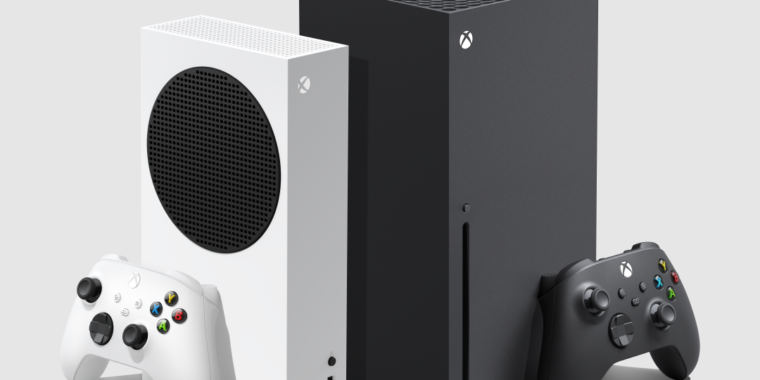
No, that’s not a Series X-compatible smart-speaker. That’s the Xbox Series S.
Don’t talk to me or my son ever again.
The Series S is nearly 60 percent smaller than the Series X, Microsoft says.
The Series S comes with a controller that Microsoft is calling “Robot White.”
Despite the Eye of Sauron design, the Xbox Series S is not watching you through its unblinking circular vent.
A console that’s thinner than the controller it uses? What will they think of next?
Even if you think Game Pass seems appealing, keep in mind that All Access also locks you in to that subscription for a full two years. If you try out Game Pass and find you want to cancel the subscription after 6 months, or 12 months, or 23 months, you’ll still be on the hook for the remainder of the full two years of monthly payments. If you want more flexibility to sample the subscription plan, All Access is not for you.
It’s also important to remember that Game Pass Ultimate subscriptions are frequently offered at significant discounts over the $14.99/month list price. Taking advantage of those deals could save a savvy console buyer a bit of money over the Xbox All Access plan.
The final thing to keep in mind is that Xbox All Access isn’t actually available for every Xbox buyer. Microsoft has announced 11 countries where participating retailers will offer the subscription deal this holiday season, with more planned for next year:
Australia at Telstra
Canada at EB Games
Denmark at Elgiganten
Finland at Gigantti
France at FNAC
New Zealand at Spark
Norway at Elkjøp
Poland at Media Expert
South Korea at SK Telecom
Sweden at Elgiganten
UK at GAME and Smyths Toys
United States at Best Buy, GameStop, Target, Microsoft Store, and Walmart
Even in those countries, not every customer will be able to take advantage of the All Access subscription. Participation is subject to a credit check and approval of a line of credit from Citizens One bank, which is partnering with Microsoft for the program. That credit line doesn’t carry any fees or interest and can be paid off early without penalty. Still, customers who have had credit problems in the past might find they can’t get approved for All Access in the first place.
Microsoft’s shifting focus
For a while now, Microsoft has said that it no longer measures success based purely on the console market share for Xbox hardware. “We’re not motivated by beating Sony, we’re motivated by gaining as many customers as we can,” Xbox chief Phil Spencer said in 2015. More recently, Spencer said that he sees streaming giants like Amazon and Google “as the main competition going forward,” rather than the likes of Nintendo and Sony.
All Access reflects that new focus to a large extent. Rather than demanding upfront payment to offset the cost of its hardware, Microsoft is playing the long game by tying All Access customers into a two-year subscription program. For Microsoft, the loss of upfront and overall revenue during that two years (compared to “standard” pricing) is a small cost to bear to get more players accustomed to the idea of a Game Pass subscription.
And Microsoft isn’t just hoping those All Access subscribers forget to cancel their costly monthly subscriptions after two years. A Microsoft representative told Ars Technica, “Once the 24-month subscription to Xbox Game Pass Ultimate included with Xbox All Access expires, you will need to purchase a new Xbox Game Pass Ultimate membership or purchase standalone Xbox Live Gold and Xbox Game Pass memberships in order to continue taking advantage of Xbox Live Gold and Xbox Game Pass benefits.”
In other words: Microsoft is not going to stick you with an auto-renewing plan that docks your credit card until you remember to tell them to stop. After 24 months, it’s up to you to renew or renege.
Microsoft seems confident that some proportion of its All Access customers will renew after getting a two-year taste of the service. Even those who don’t, though, will be locked into the Microsoft’s console ecosystem rather than Sony’s, without needing to commit hundreds of dollars upfront.
When combined with Game Pass, Xbox All Access is one of the most interesting changes in the way we think about buying a new generation of console hardware in a long time. We’ll be watching with interest to see if this no-upfront-cost program attracts a critical mass of consumers looking for a new console this holiday season.
https://arstechnica.com/?p=1704768
Microsoft confirms $499 Xbox Series X for Nov. 10
No, that’s not a Series X-compatible smart-speaker. That’s the Xbox Series S.
Don’t talk to me or my son ever again.
The Series S is nearly 60 percent smaller than the Series X, Microsoft says.
The Series S comes with a controller that Microsoft is calling “Robot White.”
Despite the Eye of Sauron design, the Xbox Series S is not watching you through its unblinking circular vent.
A console that’s thinner than the controller it uses? What will they think of next?
Microsoft has finally revealed a $499 “estimated retail price” for its top-end Xbox Series X. That system will launch alongside the $299 Xbox Series S on November 10, the company confirmed this morning.
The CPUs on the Series S and X are “similar,” Microsoft says, while the I/O system behind the heavily touted “Velocity Architecture” is identical on both consoles, Microsoft says. But the Series S has only 512GB of fast-access storage built-in, compared to a full 1TB on the Series X (adding more fast storage is possible but could be quite expensive).
While Microsoft hasn’t detailed the physical dimensions of the Series S box yet, it is selling the disc-drive-free unit as “the smallest Xbox ever created” and “nearly 60% smaller” than the Series X. That could be a particularly savvy marketing move, considering the PlayStation 5 is shaping up to be among the largest home consoles ever created.