Shenmue returns again—this time as a Crunchyroll, Adult Swim anime
Enlarge/Shenmue‘s characters, atmosphere, and martial arts, without all the QTEs? Sure, we’re interested.
Crunchyroll
Recent teasing and rumors about the Shenmue video game series came to fruition on Friday with a surprise announcement at the Virtual Crunchyroll Expo: The cult Sega game series will soon receive an anime adaptation, complete with series creator Yu Suzuki on board as an executive producer.
Crunchyroll issued a formal announcement shortly after the Expo presentation, confirming that production is already underway at anime studio Telecom Animation Film with a single-season, 13-episode commitment. The episodes will air on Adult Swim’s “Toonami” block in the United States, while Crunchyroll will carry its streaming rights through much of the world. No dates were attached to the news.
The announcement didn’t confirm any hard details about what to expect plot-wise. Suzuki-san has gone on the record saying he wants to continue telling the series’ story after the events of 2019’s Shenmue III, but at least one insider, who teased the news at gaming forum ResetERA days before it was official, has suggested that the new series will be a retread:
The [Shenmue TV] season tackles the first game and part of the second game. Includes a lot of story ideas they never got to put into the game either due to budget, time, or mature rating reasons. It’ll be an adult animated retelling of Shenmue 1 & 2 with lost story beats.
Should that apparently well-placed source be correct, this would be very good news for anyone interested in the story, characters, and atmosphere of the series’ first two games—but not necessarily interested in their dated gameplay. The same could be said for any eventual anime version of Shenmue III, a game that broke Kickstarter records (and melted Kickstarter servers) when announced in 2015 but didn’t necessarily blow fans away four years later. https://arstechnica.com/?p=1703897
Tony Hawk’s Pro Skater 1+2 PC impressions: No pretending for this Superman
Enlarge/ The real video of modern-day Tony Hawk pulling tricks is pretty good stuff. Arguably, the virtual version in this week’s remaster is even more exciting.
Activision
Before we begin putting arms around each other as a bunch of PlayStation skateboarding fans, screaming classic pop-punk songs and praising this week’s new Tony Hawk’s Pro Skater 1+2, let’s remember the last time a nostalgic cash-in pretended to be a Superman.
Tony Hawk’s Pro Skater HD launched in 2012 as a last gasp of the Xbox 360 and PS3 generation, but it was far from the return to skateboarding glory that fans had hoped for—especially as the series had been written off after watered-down sequels and peripheral add-ons. As a “compilation” of the first two mega-popular Tony Hawk games, THPSHD only included seven skateparks from both games combined. Its “HD” status may have technically been true, but glitchy physics, questionable color-mapping, and a broken “big drop” system made it far from definitive.
Eight years later, the series’ handlers at Activision are back with another crack at the first two Tony Hawk games, once again at the cusp of a new console generation. In good news, this time, Tony Hawk’s Pro Skater 1+2 is… good. Like, it’s really good.
What to expect, how it feels
The THPS2 “Hangar” course, reimagined.
Yes, you can still grind on a helicopter’s blades and open up a snowy outdoor space to skate around in.
The THPS1 “Warehouse” course.
You can arguably play this level over and over and over and get your money’s worth.
One of the more dramatically lit remastered levels.
THPS1 “School” course.
Lots of shadowy portions as you look for tables and schoolbells to grind on.
“Downtown” from THPS1. Pre-session goals give you hints for what you need to complete.
“Venice” from THPS2. The sunset effect is handsome…
…but sometimes, I wish I could toggle the sun shining more directly from above.
Tony Hawk’s Pro Skater 1+2
(Ars Technica may earn compensation for sales from links on this post through affiliate programs.)
The sales pitch is simple: Every skatepark from the series’ first two PlayStation games is back, all touched up with modern graphical flourishes while otherwise resembling the courses’ original geometry. In kind, gameplay breaks down like it traditionally did—a mix of a “classic” campaign, ample “free skate” options, multiplayer versus, and a massive create-a-park mode.
Having spent the past day playing a lot of the remake’s PC version, I can report that the rebuilt-from-scratch controls and physics are (mostly) on point—with every major difference hinging on a jump from the original game’s refresh rate. What once natively ran at under 30fps can now run at an unlocked rate at arbitrary resolutions, and I’ve seriously enjoyed the results on my 144Hz monitor.
Mechanically, the multi-studio team that pieced Tony Hawk back together appears to have erred on the side of allegiance to the first two PlayStation games. How high you jump; how long you hover in mid-air while boosting up a half-pipe; how quickly your body rotates as you pull a trick; how long it takes tricks to animate: Set a stopwatch on the modern versions and their PS1 forebears, and they’re pretty much 1:1. This differs slightly from the Xbox and Dreamcast versions of the first two games, which each added floatiness to most of the above metrics.
If your brightest THPS memories come from the ’90s, then you’re likely to remember the game as played on a CRT panel, a screen technology that benefits from lower latency between button taps and on-screen action. This was the first thing I thought about when I struggled with trick timing while playing THPS1+2 anew: Is my monitor the bottleneck for my high scores and sick tricks? Does my screen suck, or is it just me? So I grabbed my Samsung Galaxy S9, toggled super slow-motion video, and got down to business.
Lapsed THPS players should expect short-lived frustrations.
On default monitor and GPU settings, my PC version of the game shows roughly 16 frames between a button tap (using an Xbox One gamepad, connected via 2.4GHz wireless adapter) and a significant in-game animation beginning (in my test’s case, a mild bending of the knees before pulling an “ollie” hop on a skateboard). On a 144Hz monitor, those 16 frames equate to roughly 0.11 seconds. Depending on your GPU manufacturer, however, you can toggle different types of “low latency” modes. In my case, I went into an Nvidia Control Panel, switched “low latency” mode to “on” (not “ultra”) and tried again. This cut the tap-to-animation time in half, from 16 frames to 8 frames (down to 0.05 seconds). After making this switch, I did indeed start doing better. (Again, this is just the animation before your skater actually hops. Milliseconds matter.)
Without a copy of the game on either PS4 or Xbox One to compare, I’ll merely estimate that those systems’ input latency counts, as connected to standard HDTVs and running at 60fps, are floatier than a high-end PC connected to a high refresh-rate monitor. Mostly, I’ve had to come to terms with how the series’ classic controls and timings feel different when your character’s animations run that much more smoothly, and your mileage will quite honestly hinge on how that switch strikes you. (Lapsed THPS players should expect short-lived frustrations getting used to it.)
More on mechanics, achievements
Let’s start this menu-dive gallery with a look at the create-a-skater interface. One of the facial options feels very, very 2020.
The game’s new achievement system rewards players with in-game cash and experience points.
You’ll need both experience levels and in-game cash to unlock some of the fancier cosmetics, like a series of skateboard graphics that animate.
The create-a-park system gates some of its wackier decoration options behind in-game cash and experience levels, as well.
The menu option many of you will be most interested in: the playlist. Most, but not all, of the first two games’ songs have returned.
PC video options, part one.
PC video options, part two.
Some in-game options, including HUD tweaks.
Want to remove some of the QoL tweaks and have the game better resemble either THPS1 or THPS2? That’s an option.
If that seems like overkill, you’ve clearly never tried racking up precise, multi-part skate-trick combos in a classic Tony Hawk game before. In great news, at least, this week’s remake accounts for the realities of modern screens with a mild change to the scoring system. Should you miss your trick’s landing angle, the window for landing has been widened, only with a score penalty for “sloppy” landings (or enjoy a score bonus for a “perfect” landing). However, that tweak doesn’t apply to trick animations that bleed from, say, a mid-air kickflip to a rail grind. (These in particular have been kicking my butt.)
With all of that in mind, the controls can best be described as “Tony Hawk 2-Plus.” Every trick chain can be extended with “manuals” (pop a skateboard “wheelie” while keeping your feet balanced) and “reverts” (land from a half-pipe with a slick rotation), while the biggest mechanic lifted from a later sequel is the wall plant, which lets you bounce off a wall with your foot instead of having a trick chain end with a wall collision. Otherwise, the mechanical system is mostly old school. Speed is managed with the same “special” meter from the first two games, while the “big drop” mechanic has been removed, so you can survive crazy falls so long as your skateboard lines up with the ground.
Should you wish to jump into your favorite old level and skate around to your heart’s content, every standard course is unlocked immediately for this purpose. (Meaning, THPS1+2 passes Ars Technica’s metric for game remakes.) The “classic” campaign is mostly a 1:1 retread of the original two games’ collect-a-thon goals on each course, though the old games’ “cash” pickups have been turned into a simpler “upgrade point” currency. For the most part, you can watch a classic PS1 walkthrough to find all of this game’s best techniques and collectible guides.
Behind this is a comprehensive new “achievements” system, which is easily the game’s best under-the-hood update. Start with simple goals like building your first create-a-park course or pulling off a specific trick with a famous skateboarder (like Tony Hawk’s 900). From there, graduate to crazier goals like chaining together specific tricks in a combo. This entirely optional system lets you accrue in-game cash to buy outfits, accessories, and skateboards for your characters, with no apparent real-money system as of launch. Activision has a history of sneaking real purchases into games after launch, but in recent years, they’ve relented on this practice, so we’re hopeful Tony Hawk fans can put their credit cards away after buying the danged game.
Graphics, online, other odds-and-ends
Enlarge/ Don’t want to bother unlocking content in the normal campaign? That’s fine! THPS1+2 has (nearly) every course unlocked in a “free skate” interface upon first boot.
Activision
I’ve grown to appreciate the wash of paint applied to these classic skateparks, though I do wish they’d come with more dynamic lighting options. Each skatepark is bathed in handsome lighting effects, all optimized for realistic levels of contrast and shadow depending on whatever time of day has been locked in stone. The trouble is, this covers some classic levels’ stretches in noticeable shadows, and this has toyed with my muscle memory of what I’m looking for as I pilot a chain of tricks.
That’s more of a nitpick for anyone who remembers, say, the Venice beachside skatepark as a bright, evenly lit zone of hops, grinds, and strategically arranged “VB gap” half-pipes. I’d personally like to see some of these handsomely reimagined parks light up with different time-of-day effects, but the developers chose pre-baked lighting effects to keep things running at a high frame rate. (Fair trade.) Every newly rendered course is otherwise clear and readable in terms of navigation and trick execution, so you shouldn’t worry about handing this to a brand-new Tony Hawk player in your family.
Due to their allegiance to older console limitations, THPS1+2‘s courses start to feel a bit claustrophobic after a few hours of play. Really, the number of twisting paths, hidden rooms, and spacious plazas in each course is a reminder of how much Neversoft squeezed out of PS1 hardware in the late ’90s, and you’ll have plenty of fun tearing through these smartly arranged courses in 2020. (Plus, later Tony Hawk games suffered specifically because of oversized, bloated courses.) But a little part of me wishes this year’s dev team had found clever ways to sew one skatepark into the next, so that you could seamlessly smash through a window in the THPS1 warehouse and land in the THPS2 bullring. Alas.
Because this is an impressions take, I can only report that the online multiplayer modes function mostly as advertised, as opposed to offering a deep dive. Various classic game modes, which range from score attacks to quirky modes like “graffiti,” rotate in public online matchmaking lobbies against up to seven other players, and in these, players can’t collide with each other, so at least they’re not ruined by griefers (though I’ve already seen online players rack up seemingly impossible scores, without any sense of whether they’re great players or great hackers). Weirdly, while friends can set up local split-screen modes on the same couch, even on PC (and thank goodness), they cannot create custom online lobbies for friends-only skate challenges. I currently cannot invite friends over to my home (hi, pandemic), and I’d really like to share this classic gaming goodness with friends, not silent strangers, Activision.
The rest of the experience is easy to summarize: The create-a-park mode is full of cool options, along with easy ways to upload and share your creations (and download freebies made by lead studio Vicarious Visions); nearly every licensed rock, pop-punk, and hip-hop song returns from the first two games, along with fitting new ones, for a grand total of 60 tracks; and you can pick from every real-world skateboarder from the first games, along with up-and-coming skaters and four create-a-skater slots.
Verdict: Activision didn’t screw this up. If you’re fiending for a return to old-school, lean-and-mean Tony Hawk’s Pro Skater, buy.
[embedded content]
THPS1+2 official launch trailer, PlayStation version
https://arstechnica.com/?p=1703812
New No Time To Die trailer showcases everything you’d expect in a Bond film
[embedded content]
Daniel Craig plays James Bond for his fifth and final outing in No Time To Die.
Movie theaters are starting to open up again in spots around the globe—basically, anywhere that has gotten coronavirus outbreaks under control. So now is the perfect time to remind frustrated filmgoers about No Time To Die, the next film in the James Bond franchise, starring Daniel Craig in his fifth and final outing as 007. A fresh trailer just dropped, with a scheduled release date of November 12 in the United Kingdom and November 20 in the United States (as always, coronavirus willing).
This 25th installment in the franchise is co-produced by MGM and Eon Productions, with United Artists and Universal serving as distributors in North America and internationally, respectively. Directed by Cary Joji Fukunaga (True Detective, Beast of No Nation), the film takes place about five years after the capture of Spectre‘s archvillain, Ernst Stavro Blofeld (Christoph Waltz), a criminal mastermind and head of the organization SPECTRE. (Ian Fleming’s original character inspired Dr. Evil and his cat, Mr. Bigglesworth, in the Austin Powers film series.)
For those who skipped Spectre or who haven’t seen it recently, it opens with Bond being suspended from MI6 after carrying out an unauthorized mission to stop a terrorist bombing in Mexico City—based on a posthumous message from Judi Dench’s late, lamented M. The new M (played by Ralph Fiennes) finds his agency in competition with a rival, privately backed intelligence service led by C (Andrew Scott).
Things get complicated, as they always do, leading to a showdown between Bond and Blofeld, who is behind an attempt to infiltrate a planned global intelligence surveillance system so that SPECTRE can access information about any investigations into its criminal activities. (In an unusual twist, Blofeld turns out to be Bond’s foster brother.) The film ends with Blofeld captured and Bond driving off into the sunset with his romantic interest, psychiatrist Madeleine Swann (Lea Seydoux).
Bond thought he was entering retirement, but no “00” agent gets to live happily ever after, it seems. Per the official synopsis: “In No Time To Die, Bond has left active service and is enjoying a tranquil life in Jamaica. His peace is short-lived when his old friend Felix Leiter from the CIA turns up asking for help. The mission to rescue a kidnapped scientist turns out to be far more treacherous than expected, leading Bond onto the trail of a mysterious villain armed with dangerous new technology.” Fukunaga has said that he intended the film to explore the world of espionage “in an era of asymmetric warfare.” It should also wrap up several loose narrative threads from the prior Bond films starring Craig.
James Bond (Daniel Craig) is enjoying his retirement with Madeleine Swann (Léa Seydoux).
A spot of trouble.
YouTube/MGM/Eon
Madeleine realizes retirement might be over.
YouTube/MGM/Eon
Who is this mysterious villain in a Noh-inspired mask?
YouTube/MGM/Eon
Rami Malek plays archvillain Safin.
YouTube/MGM/Eon
Lashana Lynch as Nomi, a new “00” agent who joined after Bond retired.
YouTube/MGM/Eon
Getting the band back together: Eve Moneypenny (Naomie Harris) and Q (Ben Whishaw) join Nomi.
YouTube/MGM/Eon
Q still has some technological tricks up his sleeve.
YouTube/MGM/Eon
Jeffrey Wright reprises his role as Felix Leiter, Bond’s friend and a CIA field officer
YouTube/MGM/Eon
Ana de Armas as Paloma, another CIA agent.
YouTube/MGM/Eon
Don’t mess with Paloma.
YouTube/MGM/Eon
Aston Martin’s classic DB5, now with miniguns
YouTube/MGM/Eon
Doing donuts.
YouTube/MGM/Eon
An icy encounter with Safin
YouTube/MGM/Eon
“Bond. James Bond.” Daniel Craig strikes a classic pose.
YouTube/MGM/Eon
Seydoux reprises her role as Madeleine Swann. Other returning cast members include Waltz, Ben Whishaw as Q, Jeffrey Wright as Felix Leiter, Naomie Harris as Eve Moneypenny, Rory Kinnear as M’s chief of staff, Bill Tanner, and Ralph Fiennes as M. New characters in this installment include Rami Malek as the archvillain Safin, described by the director as a “hyper intelligent and worthy adversary” for Bond; Lashana Lynch as Nomi, a new “00” agent who joined MI6 following Bond’s assumed retirement; Ana de Armas as Paloma, a CIA agent assigned to help Bond; and David Dencik as Valdo Obruchev, a scientist who has disappeared.
This new trailer has everything you’d expect in a Bond film. Exotic locations? Check. It was filmed in Italy, Jamaica, Norway, London, and the Faroe Islands. Car chase scenes? Of course. Beautiful women? Paloma not only rocks a black evening gown, she pulls off some impressive combat moves. Daring, dangerous stunts? Craig had to have ankle surgery after he was injured during the stunts filmed in Jamaica.
And of course, as Ars’ Jonathan Gitlin reported earlier this year, the film is packed with Aston Martins. There’s the classic DB5, now avec miniguns, as well as a DBS and what looked more than passingly like a 1980s-era Vantage in the first trailer released last December. The film also reportedly features one of Aston Martin’s brand-new midengined hybrid hypercars, the Valhalla, developed in conjunction with legendary F1 aerodynamicist Adrian Newey.
As for that spooky mask Safin sports in this trailer, it’s modeled on the traditional Noh style of Japanese theater. (It was originally supposed to be based on Siberian hunting bear armor, apparently, but Fukunaga thought the Siberian mask dominated the costume too much.) Safin seems to be out for revenge and isn’t above taking out a lot of innocent people in the process. “We both eradicate people to make the world a better place,” he says to Bond. “I just want to be a little tidy.” That could involve killing millions, so naturally Bond isn’t going to let that happen.
[embedded content]
“No Time To Die” by Billie Eilish, the theme song for the James Bond film of the same name.
Facebook halts Oculus Quest sales in Germany amid privacy concerns
Aurich Lawson / Facebook
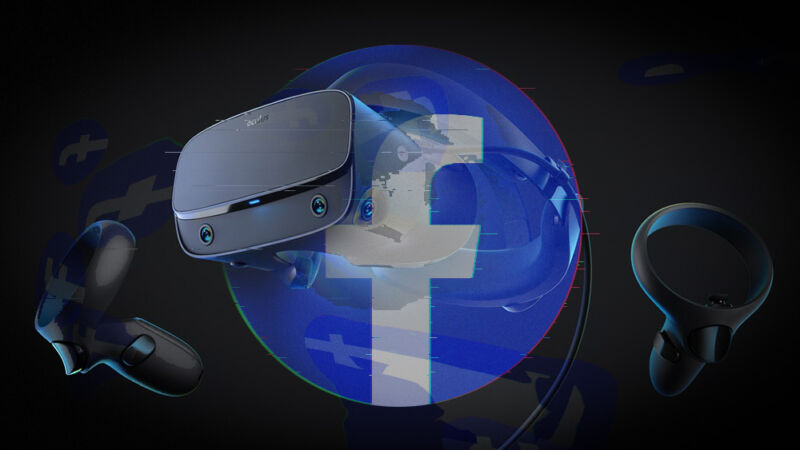
Facebook subsidiary Oculus says it has “temporarily paused” sales of Oculus Quest headsets to customers in Germany. Reports suggest the move is in response to concerns from German regulators about the recently announced requirement that all Oculus users will need to use a Facebook account by 2023 to log in to the device.
“We have temporarily paused selling Oculus devices to consumers in Germany,” Facebook writes in a brief message on the Oculus support site. “We will continue supporting users who already own an Oculus device and we’re looking forward to resuming sales in Germany soon.”
Facebook declined an opportunity to provide additional comment to Ars Technica. But in a statement to German News site Heise Online (machine translation), the company said the move was due to “outstanding talks with German supervisory authorities… We were not obliged to take this measure, but proactively interrupted the sale.”
“The obligation to create a Facebook account [to access an Oculus headset] is legally extremely questionable, at least for those who have already bought a headset. Whether this also applies to new customers is definitely open to discussion. That should largely depend on the design of the contract, which we do not have.”
The group goes on to cite the GDPR’s so-called “coupling ban”, which prohibits tying one side of a contract (say, the EULA needed to use an Oculus headset) to the sharing of specific personal data (say, the data included in a user’s personal Facebook account).
Facebook’s requirement that “the use of the headset should be linked to the establishment of a Facebook account” would seem to violate this coupling ban, HCDPFI said. “For those users who already have a headset and do not log in with a Facebook account after 2023, there is also no immediately suitable alternative to continuing to use the headset. The compulsion to use Facebook is therefore exerted on both old and new customers.”
Both the HCDPFI and Germany’s Federal Cartel Office (which protects against anti-competitive practices in the country) made it clear to Heise that they were not currently in discussions with Facebook on this matter. But the Cartel Office has previously gone after the company for merging user data from a variety of sources (such as WhatsApp and Instagram) without the user’s active consent.
“Regulators in Germany are right to question the legality of this move,” Ray Walsh, a digital privacy expert at ProPrivacy, said in a statement provided to Ars Technica. “Consumers should be allowed to own a device without linking it to Facebook. Forcing users to be part of a social ecosystem is not necessary for the purposes of playing the vast majority of games, and those who wish to play games without social networking should be free to do so.”
Walsh continued:
It seems clear that Facebook is using its market-leading position within the VR industry to bully users into providing data about themselves. Just how much data Facebook is harvesting from headsets is a grey area, but it is clear that the headsets, which have the ability to map people’s homes, have a vast potential for accumulating a wealth of data about users and their homes… The danger for users is that the small amount of data Facebook currently claims to collect from headsets will be widened in the future; with the emergence of social VR platforms such as Facebook Horizons. These will create the perfect ecosystem for gathering data about users in all sorts of problematic ways.
https://arstechnica.com/?p=1703429
“This is the day”: The Mandalorian season 2 will premiere October 30
Enlarge/ Disney’s new key art for The Mandalorian season two.
Disney took to its Disney+ and The Mandalorian Twitter accounts this morning to announce the premiere date for the second season of the live-action Star Wars TV series: October 30.
The show was a huge part of Disney+’s early success in driving subscriptions, as it gained a large following, a lot of buzz, and generally positive critical response. However, when or if a second season would be coming was not clear, given the impacts of the COVID-19 pandemic.
The previous season ended its run on December 27 of last year. The final episode of season one resolved most of that season’s story arcs but laid the groundwork for a new story for season two. That said, it’s not yet clear exactly what form the new season will take.
There have been confirmations on social media that Pedro Pascal (obviously) and Gina Carano will reprise their roles. The series will continue its practice of tapping big-name directors to handle individual episodes; one of those confirmed so far is Robert Rodriguez of Desperado and Sin City fame.
Additionally, rumors have been circulating about new cast members, including a story in The Hollywood Reporter claiming that prequel trilogy actor Temuera Morrison (who played Jango Fett) will play Boba Fett in season two. In Star Wars lore, Boba Fett is not actually a Mandalorian, despite the fact that his character introduced the Mandalorians’ famous armor to the canon.
Not much else is known for certain, but we now know we only have about two months until we start finding out.
As of this May, Disney+ had reached just over 50 million subscribers, making it one of Netflix’s chief rivals in the streaming space. Subscriptions have been driven by content like The Mandalorian, as well as at-home releases of event films like Hamilton and, soon, Mulan.
https://arstechnica.com/?p=1702952
The finer points of Mario Kart 8 on the Switch, explained by a pro
A few months back, before COVID-19 upended life, we tried out a new video concept: we took a bunch of random folks and forced them to play Nintendo games in our science laboratory studio while we did science upon them filmed them talking about the games. The first video we got out of the experience covered Super Mario Bros., but we also had one more game on tap that day—Mario Kart 8.
In our new video, you can watch three different players, with three different levels of skill, power their way through Mario Kart 8 on Switch. We managed to scoop up a new player and a well-seasoned video game veteran to offer some commentary on how the game feels; and to provide some expert-level contrast, we also roped in speedrunner and Mario Kart record holder Amber_cxc. Amber_cxc also gives a good breakdown of the ins and outs of Mario Kart speedrunning, along with tips and hints on how to get faster in going around those crazy-ass tracks.
There are more War Stories videos in production, too, so if you’re looking for more deep dives into the challenges of making games, stay tuned—we’ve got them coming!
https://arstechnica.com/?p=1702945
Walmart+ takes aim at Amazon Prime, launches September 15
Enlarge/ If you’ve ever wanted full bags of groceries to semi-magically appear on your doorstep, Walmart has a proposition for you.
Although it’s arriving several months later than expected, Walmart’s answer to Amazon Prime is finally scheduled to launch in two weeks, on September 15. Like Prime, Walmart+ offers unlimited free delivery, with some products available same-day in many markets.
Walmart+ looks cheaper than Amazon Prime at first blush—the annual prices for the services are $98 and $119, respectively—but the difference may be less relevant to each company’s bottom line than it looks. Both services also offer a monthly plan, and there’s effectively no cost difference there. When paid monthly, Prime and Plus are only four cents apart, at $12.99 and $12.95 per month, respectively.
Although Amazon is the incumbent in any online shopping competition, Walmart does have some advantages. Where Amazon needed to build massive distribution centers from the ground up, Walmart only needed to leverage small-scale deliveries from the distribution centers and stores it already has. Walmart can also offer some products that Amazon generally can’t—you’ll be able to shop online for local, fresh groceries with Walmart+, as well as get membership-based discounts on gasoline at many of Walmart’s brick-and-mortar locations.
Enlarge/ Most Walmart+ orders will be fulfilled directly from a local store—in this scene from a promotional video, a staffer picks products directly from shelves for delivery.
There will be some other key differences between Prime and Plus. Amazon offers free delivery of any Amazon-warehoused product to Prime customers, even in very small quantities. This may not be quite the case with Walmart+; Bloomberg reports that online orders that can’t be fulfilled from a local store will still require a $35 minimum purchase in order to qualify for free shipping.
The new service is considerably later than many insiders expected it, and the timing could have been better—the delay kept Walmart+ from being available for either the quarantine-related grocery surge or the more recent back-to-school rush. A Walmart spokesperson told Bloomberg that the company needed the time to adjust the program to drastic, pandemic-related changes in the way customers shop—and characterizes the entire program as a “life hack” for Walmart customers.
Enlarge/ The 2018 trial of Scan&Go offered customers dedicated loaner devices in kiosks like these. The new Scan&Go will likely be via downloaded app only.
In addition to online shopping, Walmart+ at launch offers 5 cent per gallon gasoline discounts at Walmart, Murphy USA, and Murphy express fuel stations, with Sam’s Club fuel stations expected to follow soon. It also offers a new in-store shopping method called Scan & Go, in which customers use the Walmart smartphone app as both scanner and payment method. The new Scan & Go looks to be a resurrection of a limited program by the same name from 2018, which eliminated the usual checkout process entirely.
https://arstechnica.com/?p=1702895
Ubisoft removes Black Lives Matter image from Tom Clancy game’s terror group
Enlarge/ A shot from the introductory cut scene to Tom Clancy’s Elite Squad showing a Black Lives Matter raised fist symbol used to represent the game’s terrorist antagonists.
Ubisoft apologized over the weekend for a cut scene in Tom Clancy’s Elite Squad, a mobile game released last week, that used a raised fist symbol associated with the Black Lives Matter movement to represent an in-game terrorist organization masquerading as a populist front.
The cut scene in question shows a world descending into chaos and introduces UMBRA as a “faceless organization that wants to build a new world order” and “a new threat [emerging] to take advantage of escalating civil unrest.” The group “claims to promote an egalitarian utopia to gain popular support, while behind the scenes… organiz[ing] deadly terrorist attacks to generate even more chaos and weaken governments at the cost of many innocent lives.”
While the intro’s entire over-the-top (and perhaps overly topical) concept was roundly mocked on social media over the weekend, the specific use of the raised fist symbol in UMBRA imagery drew condemnation from many.
“Imagery that appears in the opening video sequence of Tom Clancy’s Elite Squad featuring a ‘raised fist’ was insensitive and harmful in both its inclusion and how it was portrayed” the company wrote in a tweet Saturday. “We have listened to and appreciate the players and the broader community who have pointed it out and we apologize.”
A coming update will remove the “raised fist” imagery, Ubisoft said, as of Tuesday on Android and “as soon as possible” on iOS.
Bloomberg reports that many Ubisoft employees responded with anger to the cut scene’s imagery and its inclusion in the game. Creative Director Charlie Guillemot of Owlient—the developer behind Elite Squad—told employees the entire opening sequence would be removed from the game, according to Bloomberg’s sources. He added that “in the future, we will more rigorously review content produced and about to be released in order to help us avoid similar mistakes.” Ubisoft was one of a number of video game companies that made statements and donations in the wake of George Floyd’s June killing, contributing $100,000 to the NAACP and Black Lives Matter. The company has also seen a number of high-level executives depart in recent months amid widespread complaints of sexual harassment and assault. https://arstechnica.com/?p=1702529
PlayStation 5’s paltry back-compat stance seemingly confirmed by Ubisoft
Enlarge/ Were you hoping to play classic PlayStation discs on the newest PlayStation 5 console later this year? If so, we have bad news.
On Monday, an Ubisoft FAQ page went live to walk the company’s fans through games coming out on a bunch of consoles this holiday season. In doing so, the FAQ seems to have finally confirmed something Sony hadn’t yet announced about its PlayStation 5 console: its backward-compatibility limitations.
PlayStation 4 players will be able to join multiplayer games with PlayStation 5 players. Backwards compatibility will be available for supported PlayStation 4 titles, but will not be possible for PlayStation 3, PlayStation 2, or PlayStation games.
[Update: Shortly before this article’s publication, the quoted text was removed from the Ubisoft page in question, though it remained live for hours while PlayStation fans began sharing it far and wide.]
A less-welcome generational leap
Sony Interactive Entertainment representatives did not immediately confirm whether Ubisoft’s claim is legitimate. Up until this point, we were only aware of PS5 backward compatibility with PS4 software, as Sony Senior VP Hideaki Nishino told fans in March that he “believe[d] that the overwhelming majority of the 4,000+ PS4 titles will be playable on PS5.” This followed a March presentation about the PS5’s architecture that included this interesting image:
Enlarge/ This explainer about PS5 backward compatibility includes a curious amount of empty space. We wonder what other PlayStation generations might sneak into the PS5 in the future, as rumored. For now, just PS4 (in “normal” and “pro” modes as options).
At the time, we at Ars wondered aloud whether that noticeable amount of empty space meant we might expect other PlayStation console generations to get slotted into the PS5 family or whether we’d see messaging about older generations being supported on Sony’s PlayStation Now cloud-streaming service. Paying PS Now subscribers can currently stream a Sony-curated selection of PS2 and PS3 games to compatible devices like PS4 consoles and Windows PCs. While we’d love to see Sony offer a bare-minimum plan to recognize and stream PS1/2/3 games from the cloud when their discs are recognized on a PS5, if not natively run them, today’s news doesn’t make that sound likely.
PlayStation 4 was the company’s first console to not ship with native backward-compatibility support for disc-based games, along with incompatibility with download-only software that debuted on PlayStation 3. That meant you had to hold on to your old console to access those disc-less games. This followed the PS3 receiving a major revision early in its lifetime to remove support for PS2 discs (due to this feature running on PS2 “Emotion Engine” architecture built into early PS3s, which was dumped to cut costs).
Comparatively, Microsoft has aggressively courted fans of older games with a backward-compatibility sales pitch on both Xbox One and Xbox Series X. That means gamers in the Xbox ecosystem can expect native access to previous purchases (whether in disc form or as a digital purchase) across multiple console generations and resolution and performance upgrades on a game-by-game basis. We’re still waiting to hear whether PS4 games that struggled with performance issues might receive PS5-specific upgrades, though the PS4 Pro’s optional “boost mode” already made clear that certain games (cough, cough, Bloodborne) would need special patches to take advantage of newer hardware. https://arstechnica.com/?p=1702461
Tesla is a fittingly unconventional biopic of a most unconventional man
[embedded content]
Ethan Hawke stars in Tesla, an inventive new biopic from Director Michael Almereyda.
The world is arguably overdue for a biographical film about the eccentric Serbian inventor Nikola Tesla, and Director Michael Almereyda (Experimenter: The Stanley Milgram Story) has obliged with his new film, Tesla, starring Ethan Hawke. But this is not your traditional biopic. We know we’re in for a very different, more dream-like, interior kind of movie in the very first scene. A woman’s voice informs us that Tesla became fascinated by electricity as a young boy upon learning that the sparks he created while stroking his pet cat were the same phenomenon as the lightning in the sky. “Is nature a gigantic cat?” he wondered. “And if so, who strokes its back?”
Almereyda became intrigued by Tesla as a teenager when he became friends with comic book artist Alex Toth, who was a Tesla enthusiast. It became a lifelong obsession. The Serbian inventor was the subject of Almereyda’s very first screenplay, which the writer/director would ultimately rework, decades later, into the script for Tesla. The director has probably read just about everything about Tesla ever written.
Along with Margaret Cheney’s seminal 1981 biography, Tesla: Man Out of Time, Almereyda was particularly influenced by Christopher Cooper’s 2015 book, The Truth About Tesla: The Myth of the Lone Genius (which dispels many of the most popular myths and Internet rumors surrounding the inventor), as well as Derek Jarman films and episodes of Drunk History. Although Almereyda’s film is serious in tone, the influence of the latter is felt in its deliberate nonlinearity and clever use of intentional anachronisms.
For those unfamiliar with the late 19th-century “war of the currents,” George Westinghouse espoused alternating current (AC) for power generation and distribution; Thomas Edison favored direct current (DC). The latter had the famous Edison name and associated influence behind it, but AC current was cheaper. It could travel farther, supplying electricity to homes across a wider area than DC, so Westinghouse’s approach required less copper wire and fewer generating stations. Tesla initially worked for Edison when he arrived in America but left in frustration when Edison refused to consider his novel designs for AC motors and transformer. Westinghouse brought the young man on board, and Tesla’s AC design eventually won out.
After that success, Tesla threw his energy into the wireless transmission of energy, setting up a laboratory in Colorado Springs, Colorado. His main rival in this area was Guglielmo Marconi, who was giving radio demonstrations and developing wireless telegraphy. Marconi successfully sent the first wireless telegraphic signals across the Atlantic Ocean in 1901.
Tesla’s own vision of wireless communication centered on building a global wireless communication system located in Wardenclyffe, New York, consisting of a power plant and giant electrical tower. The project foundered after financier J.P. Morgan pulled the funding, skeptical that Tesla’s system was even plausible. But Tesla’s vision of a wireless future did eventually come to fruition. That makes him the forefather of many of today’s most revolutionary technologies, which is why Tesla fans often consider him the “forgotten father of technology.” Tesla himself once said of his contemporary detractors, “The present is theirs. The future, for which I really worked, is mine.”
Man out of time
Tesla demonstrating wireless lighting by “electrostatic induction” during an 1891 lecture at Columbia College via two long Geissler tubes (similar to neon tubes) in his hands.
Public domain
Mark Twain in Tesla’s South Fifth Avenue laboratory, 1894
Public domain
A Westinghouse display of the “Tesla Polyphase System” at Chicago’s 1893 Columbian Exposition.
Public domain
Famous photograph of Tesla in his Colorado Springs laboratory circa 1899. He is supposedly sitting reading next to his giant “magnifying transmitter” high-voltage generator while the machine produces huge bolts of electricity. The photo is a double exposure—a promotional stunt by photographer Dickenson V. Alley.
Public domain
Tesla sitting in front of a spiral coil used in his wireless power experiments at his East Houston St. laboratory.
Public domain
Nikola Tesla Museum in Belgrade, Serbia.
Public domain
Tesla is a well-known figure in my profession, so it’s sometimes easy to forget that the vast majority of the public doesn’t really know who he was—they assume one is talking about the electric car. (Elon Musk named his company as a tribute to the inventor.) That said, he has appeared as a fictionalized character in multiple novels, comics, films, and TV shows.
Most notably, Christopher Nolan’s 2006 film, The Prestige (based on the 1995 novel by Christopher Priest), featured a fictionalized Tesla (played by David Bowie) inventing an electro-replicating machine for a late-19th-century magician to recreate a rival’s illusion, called “The Transported Man.” And last year, Director Alfonso Gomez-Rejon released the director’s cut of his film, The Current War, a fictionalized account of the historical rivalry between Edison (Benedict Cumberbatch) and Westinghouse (Michael Shannon) to bring electricity to the masses, in which Nicholas Hoult played Tesla.
“Nolan was clever in getting an icon [Bowie] to play an icon, but he also fabricated a Tesla that has no relation to reality,” Almereyda told Ars. “The real Tesla didn’t retire comfortably in Europe, he didn’t dabble in teleportation. He wasn’t, as Bowie seems to be in that movie, a successful businessman. He was a desperate, struggling inventor who kept chasing money that didn’t show up. So I think of The Prestige more as a very good comic book movie.” As for The Current War, Almereyda correctly notes that Tesla is largely sidelined in that film to focus on the business rivalry between Edison and Westinghouse.
So Almereyda felt there really hadn’t been a film yet made about Tesla that truly did the inventor justice. “He’s important partly because he did originate systems of transmitting and distributing power and light that are still with us, and that’s an astonishing achievement,” he said. “But I think he’s also important because he embodies a sort of idealism about technology that’s still very valuable and inspiring.”
Per the official premise:
Brilliant, visionary Nikola Tesla (Ethan Hawke) fights an uphill battle to bring his revolutionary electrical system to fruition, then faces thornier challenges with his new system for worldwide wireless energy. The film tracks Tesla’s uneasy interactions with his fellow inventor Thomas Edison (Kyle MacLachlan) and his patron George Westinghouse (Jim Gaffigan). Another thread traces Tesla’s sidewinding courtship of financial titan J.P. Morgan (Donnie Keshawarz), whose daughter Anne (Eve Hewson) takes a more than casual interest in the inventor. Anne analyzes and presents the story as it unfolds, offering a distinctly modern voice to this scientific period drama, which, like its subject, defies convention.
A most unconventional man
Ethan Hawke plays the eccentric Serbian-born inventor Nikola Tesla.
Kyle MacLachlan plays Tesla’s arch-rival in the “current war,” Thomas Edison.
Eve Hewson as Ann Morgan offers an occasionally anachronistic narration.
Pondering his financial predicament.
Edison and Tesla have a falling out.
One of Tesla’s patents.
YouTube/IFC Films
Tesla makes his case.
YouTube/IFC Films
Jim Gaffigan plays George Westinghouse, who sees the potential for AC power.
YouTube/IFC Films
One of Tesla’s crowd-pleasing public demonstrations.
YouTube/IFC Films
Ann Morgan is among those in attendance.
YouTube/IFC Films
Ann is fascinated by the eccentric inventor.
Recreating a famous Tesla photograph.
Rebecca Dayan plays actress Sarah Bernhardt.
YouTube/IFC Films
Tesla at Niagara Falls.
YouTube/IFC Films
Breaking the fourth wall to regale the audience with Tears for Fears’ “Everybody Wants to Rule the World.”
Much of this finds its way into Tesla. Apart from a few artistic liberties here and there, Almereyda is largely true to the known facts, given his encyclopedic knowledge of the man. Some of the dialogue is even drawn from actual historical documents like letters and diaries of the central characters. Edison’s dialogue in the montage of William Kemmler’s execution by electric chair is taken from court transcripts. But as I said, this is no standard biopic; it’s more a creative moody remix of the facts.
Among other innovations, Tesla has a narrator—of sorts—in the character of Ann Morgan (Eve Hewson), in that she frequently breaks the fourth wall to address the audience, occasionally even looking up Tesla facts on the Internet on a laptop. (It is she who supplies the opening voiceover.) For instance, there is a scene where Tesla—still working for Edison—tries to collect on a generous sum of money he believes his employer had promised him. “Tesla, you don’t understand our American humor,” Edison drawls. Tesla responds by slinging ice cream from the cone in his hand at him. Ann interrupts to inform the audience that this didn’t actually happen.
In another scene, Hawke’s Tesla also breaks the fourth wall by singing an off-key rendition of Tears for Fears’ “Everybody Wants to Rule the World.” There are many deliberate anachronisms, mostly tied in some way to modern technologies that Tesla either predicted and/or laid the foundation for with his inventions. It was Almereyda’s way of tying Tesla’s past to our present.
“To pretend to follow a conventional path about this very unconventional man just seemed flat-footed,” said Almereyda. “I wanted it to be more psychological, more personal. So Ann Morgan became a kind of surrogate for me, a way of getting closer to an impenetrable personality. By having her confide things she discovered or intuited, [she] became my way of confiding in the audience. I hope it just made the story a little more vivid and intimate.”
Something that is not an anachronism (although it is a fiction) is the opening scene with Tesla roller skating. The scene was inspired by depictions of ice skating in the paintings of Winslow Homer, but Almereyda didn’t have the budget to create an ice skating rink in May over the 20 days when the film was shooting. He decided roller skating would be a plausible substitute, since it was also a very popular activity during that time.
“Tesla was a cat and Edison was a dog. They just had different temperaments. They were not of the same species.
“It’s not likely that Tesla went roller skating, but it’s not impossible,” said Almereyda. “It felt like a way to introduce the idea of Tesla being a little off-balance, never fully steady on his feet. I think that’s the nature of being a genius, trapped in your head. Your path in the world is not smooth and grounded. So it became both a metaphor and a way of having fun with the premise.”
Almereyda very deliberately diverged from the common recent framing of Edison as a ruthless villain (after decades of mythologizing Edison as an American hero), humanizing the character through the death of his first wife, and his use of Morse code to propose to his second wife. (Edison’s story to his employees of the drowning of a childhood friend is almost verbatim to how the real Edison later recalled it.) “I think he was a complicated man,” Almereyda said. “He was a ruthless capitalist, but he was also incredibly imaginative and creative, and an artist in his own right. I told the actors that Tesla was a cat and Edison was a dog. They just had different temperaments. They were not of the same species.”
In fact, the director cites an anecdote from Edmund Morris’ 2019 biography Edison of Tesla coming back to New York from Colorado Springs to give a lecture. Edison showed up a little bit late, and Tesla stopped speaking, walked over to his former rival, and escorted him to his seat, before resuming his lecture. “If they were really archenemies and rivals, that wouldn’t have happened,” said Almereyda. “It’s just evidence that history isn’t simple. There’s always room to keep building our understanding of these people and how they relate to the present.”
Tesla only follows the inventor through 1901, before his fortunes declined. He died virtually penniless of coronary thrombosis on January 7, 1943, in the Hotel New Yorker, where he lived for the last ten years of his life, growing increasingly eccentric and making wild claims about death rays that could make entire armies vanish in seconds. “I think the next 40 years were pretty miserable for him, and that’s a long, long period of misery,” said Almereyda, who would love to see more movies about Tesla in the future. “I think there’s room for more. He’s that multidimensional, that complicated.”