Battletoads game review: Good moments don’t save the toad-al package

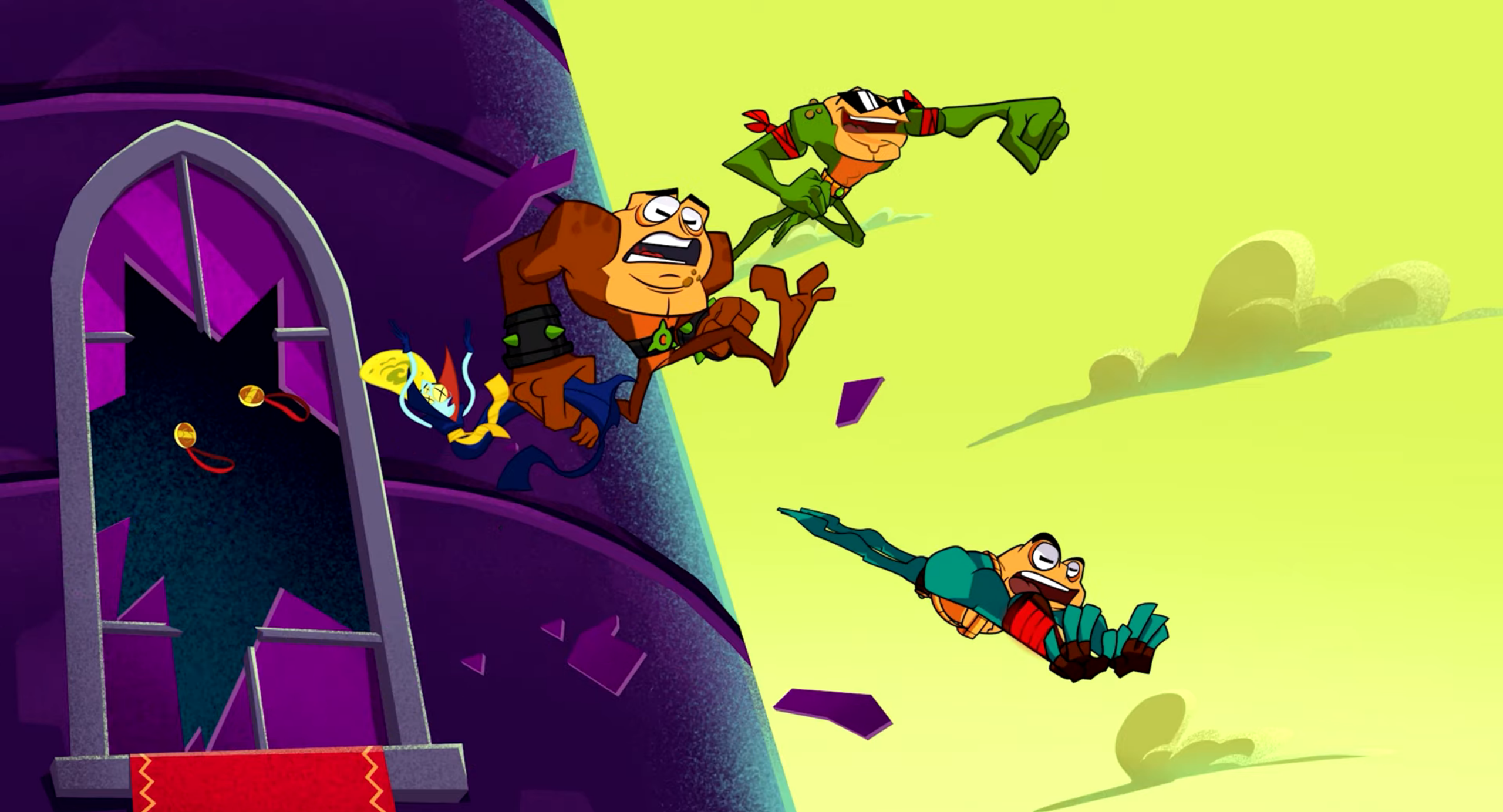
Battletoads midmission cut scene: three heroes jump out of a window
Enlarge / The Battletoads are back. We wish that were better news.

When Battletoads arrived on the Nintendo Entertainment System in June 1991, it rode on a wave of limited-time momentum in the West. Ninja Turtles fever was still a thing. The NES ruled the charts, even though Sega’s own attitude-filled mascot was about to emerge. And Nintendo’s official US magazine devoted page after page to a new, weirdly named toad trio: Zitz, Rash, and Pimple.

As an early ’90s pre-teen, I was convinced that Battletoads was absolutely massive. I later realized that wasn’t the case; a lot of people hated how hard the first game was, while subsequent games flopped. But I’ll always be fond of the original game’s graphical tricks, over-the-top combat, and wacky mix of genres.

Nothing—not even this week’s inspired-yet-messy series rebirth—can take that away from me. For all of its good moments, this year’s 10GB version of Battletoads is somehow less diverse and exciting than the 256KB original.

The Looney Tunes-caliber stuff

The new game, simply titled Battletoads, sees the series’ corporate handlers at Rare Ltd. hand their web-toed fighters to Dlala Studios, an English developer with an eye for hand-drawn 2D art. You can tell why they got the job after playing the first two levels. The game’s best bits are a delight to play, either solo or with friends.

Sadly, Dlala picked the series’ first game as its inspiration, as opposed to 1994’s more straightforward Battletoads Arcade (which Xbox owners can play on the Rare Replay anthology). Times have changed since Rare’s crack programmers squished so many genres into a tiny cartridge, and by the time I got through the crushingly short game (only 2.5 hours), I realized Dlala was not up to the same task.

We’ve seen some killer 2D beat-‘em-up revivals as of late, and in great news, Battletoads‘ combat portions are up there with the likes of Streets of Rage 4 and River City Girls. Each of the starring ‘toads has a unique and accessible move set, and their variety of punches, “launchers,” and sweeping attacks strikes a satisfying balance between quickness, power, and ridiculous animations. You’re here for the Looney Tunes-caliber stuff, after all, and it’s not just fists and feet turning super-sized when a punch combo reaches its climax. Each character has a few particularly over-the-top “heavy” attacks, as well, like when Rash conjures the series’ original arcade cabinet and uses it to whack his enemies.

This isn’t an endless animation parade of new maneuvers, mind you; you’ll see each character’s complete attack arsenal after completing the first level. But the basic attacks do well to strike an appropriate balance between hilarious and unobtrusive.

Great humor, rough color saturation

The same cannot be said for the enemies’ art style, which revolves around invented races of aliens who come in anatomically unsound shapes and colors. Their attack patterns and animations are actually quite awesome, and the basic act of kicking their weirdly shaped butts feels good. But by and large, the backgrounds’ color saturation matches poorly with the foes’ acid-trip designs. While you’ll have to strategize in focusing on particular foes to survive (and using the Battletoads’ clever new tongue-spit system to deal with anything on the other side of the screen), you’ll also possibly need to pause the game and furiously blink on occasion.

Also, heads-up: the general formula has been tweaked to add a “quick-dodge” maneuver, and while it fits nicely with this game’s combat, that means the classic “run-and-tackle” attacks of yore aren’t here. And neither can you expect to bash a robot, pick up its legs, and use it as a weapon for future battles. (In fact, there’s no wielding or throwing any weapons in Dlala’s version of Battletoads.)

The thing is, those wacky, unreadable character designs are a sheer delight outside of combat, because they fill a serious acid trip of a plot. Between levels, fully animated sequences tell the story of exactly why Zitz, Rash, and Pimple disappeared for 26 years and how they intend to claw their way back to superhero status on a new alien planet. All through the course of the game, the dialogue and voice acting do a wonderful job of erring on the side of cheese, camp, and absurdity, and even when the results veer dangerously into “try-hard” territory, they still range from amusing to roaringly hilarious. (With one exception, which I’ll get to.)

Variety is not the spice of these ‘toads

In the original NES game, however, combat was but one part of the package. Dlala appears to have missed the memo on exactly what made that game’s variety so special.

In the NES game’s case, Rare pushed the NES to its limits in tweaking the side-scroller formula. Some of these were clear homages to Super Mario Bros. (swim through spikes, slide through ice), while others were wholly unique (grab onto and ride massive snakes, pilot speeder bikes, climb a “3D” tower). Dlala has only paid one of these original concepts forward in the form of the speeder bikes, and their 3D transformation is fine enough, with the same emphasis on tricky, last-second dodging and jumping (made easier in the game’s “default” difficulty).

Unlike the NES game, Dlala has a few quick-time event levels that exist entirely for comedy’s sake. I won’t spoil exactly how these play out, other than to say that they start out as hilarious surprises and eventually become time-wasting, button-tapping frustrations.

This year’s game also has some side-scrolling, Mario-styled levels without combat, but compared to the edge of the 1991 game’s snake-riding, ice-sliding, or surfboard-bouncing zones, these newer platforming levels feel toothless and generic. Their art style’s aggressively flat staging compares unfavorably to the likes of Rayman Legends, while their rolling-momentum jumps feel really clumsy compared to Donkey Kong Country: Tropical Freeze. In a larger game, one or two of these levels might be fine, but by the fourth, I was pretty worn out.

In addition, one level has players ride a mine cart (of sorts) and press buttons to “grind” on various surfaces, while another three levels put players in control of a twin-stick shooter, where they have to shoot at aliens. Both of these are cute diversions worthy of the “what genre is coming next” appeal of Battletoads, but the latter lasts for far too long. The NES game knew better than to make players repeat certain level types over and over.

Scrambling to make jokes out of tragedy

Then again, the NES game had more variety to work with. Everything I just mentioned is it for the 2020 game. Standard combat; speeder bikes; one type of non-combat platforming; a mine cart; shoot-‘em-up battles; and QTEs.

Earlier this year, I breathlessly recommended Streets of Rage 4 because its similarly brief runtime was dedicated to a finely honed brawling system. You can get an easy 10 hours out of that game, if not more, by replaying with wildly different characters and teaming up with friends. Battletoads, on the other hand, is the worst of both worlds: it struggles with pacing between a series of uneven gameplay modes yet somehow also doesn’t deliver enough of them. Did other series homages get cut during its production? Did Dlala spend too much time nailing the combat instead of fleshing out the variety?

One hint comes from Battletoads‘ mostly funny plot. During my testing, I was confused by a few lapses in continuity, whether because the characters riffed on a fourth-wall-breaking story of something missing in the game or because a few plot circumstances emerged with zero explanation. Now that I’ve played the whole thing, I’m convinced that Dlala cut entire chunks of the game, perhaps late in production, and the script’s writers were left scrambling to make a joke out of that tragedy.

[embedded content]
Battletoads launch trailer

Arguably, I’m more heartbroken than most potential Battletoads players. Unlike the NES original, this new game benefits from milder default difficulty, particularly thanks to respawn and checkpoint options during the most brutal sequences (which can be disabled, should you seek more challenge). And many of the above comparisons won’t register for people who barely remember this series’ brief place in the Nintendo Power spotlight.

The larger issue, arguably, is the lack of online multiplayer. Unlike Streets of Rage 4, Battletoads is offline-only, so if your ideal playmate can’t get to your couch as of late, I’d recommend other superior beat-‘em-up options. Should you have a good two- or three-person posse on your couch, and you already pay for Xbox Game Pass, expect a funny, brief, 10-and-older cartoon romp. But Dlala has implemented just enough obnoxious stuff between Battletoads‘ good bits to stop me, a pretty freakish Battletoads fan, from recommending that anyone buy it outright.

https://arstechnica.com/?p=1699644


Menus on Xbox Series X will look a lot like those on Xbox One

As we scoot ever-closer to the November launch of the Xbox Series X, Microsoft is highlighting some upcoming changes to its “Xbox Experience” interface. Those improvements will start to roll out to the Xbox One as well in the coming weeks, Microsoft says, before the company plans to “celebrate a milestone in our user experience journey alongside the launch of Xbox Series X” in November.

Speed is a big focus of this coming round of improvements. Microsoft says the familiar Home screen will now load over 50% faster when the Xbox One boots up and nearly 30% faster when returning from a game. That comes on top of improvements to the Xbox One app store interface, which now loads in just over two seconds after an update last month.

The new menu will also have a 40 percent smaller memory footprint, Microsoft says, to “maximize the console horsepower available to games.” That echoes improvements to the system’s GPU bandwidth allocation from way back in 2014 which gave game developers more processing power originally dedicated to the background system menu.

Visual changes to the interface are generally a little more subtle, as you can see in the above gallery. Microsoft says the new interface will mean that “text is more readable, elements on screen are easier to understand at a glance, and accomplishing your tasks is faster than ever. This includes tile shape, fonts, an updated illustration style, and more.”

Microsoft is also improving the Xbox mobile app’s integration with PC and console games. When you capture a clip on your console, for instance, it will be automatically sent to your mobile app, where you can add text to a social media update without having to fight with your TV’s on-screen keyboard. The mobile app will also consolidate notifications across the PC and console, Microsoft says.

The UI changes being teased around the release of the Xbox Series X definitely pale in comparison to the “clean slate” UI overhaul Microsoft rolled out with the Xbox One in 2013. Then again, the Series X itself is being positioned as more of an evolutionary upgrade from the Xbox One, with most games working across both consoles for the foreseeable future. Still, it’s odd to see an entirely new console with a system menu that looks more or less identical to that on the console it’s replacing.

[embedded content]

Listing image by Microsoft / YouTube

https://arstechnica.com/?p=1700004


A dark comic book conspiracy turns out to be all too real in Utopia trailer

[embedded content]
John Cusack and Rainn Wilson star in Amazon Prime’s black comedy/conspiracy thriller Utopia.

Last month at the virtual San Diego Comic Con, Amazon dropped the first teaser for Utopia, a reboot (adapted by Gone Girl and Sharp Objects author Gillian Flynn) of the controversial 2013-2014 British black comedy/conspiracy thriller. Now the streaming platform has released the official full trailer, and the series looks like it’s going to be quite the wild ride.

As we reported previously, the series is about online fans of a dystopian graphic novel called Utopia that seems to have the power to predict the real-world future. The fans are obsessed with tracking down the sequel (which supposedly also predicts future world events). This makes them targets of a secret organization called The Network.

The British version received critical praise for its originality and visual style, offset by strong reservations about its extreme violence, which struck many as unnecessarily gratuitous. (The most famous scene involved a torturer using a spoon to gouge out a victim’s eye). It remains to be seen if Amazon’s Utopia will match the same scale of violence, although Flynn recently told Deadline Hollywood that it wouldn’t be as prominent.

“I’m more ‘less is more’ as far as violence goes,” Flynn said. “I’m the person who loves that moment in Rosemary’s Baby where we’re only seeing part of the conversation whereas the whole audience is trying to look around the corner to see what’s happening, or obviously Jaws. I’m a big believer in that. I don’t want it for a cartoon effect or for shock value. I think we as an audience are past most of that as pure shock value. I want to use violence when it’s effective and appropriate.”

And unlike the sleek, Britpop-influenced tone of the British original, Flynn found inspiration for her take on the series in 1970s conspiracy thrillers like The Parallax View and Marathon Man. “In fact, when I was pitching this, I called it The Goonies meets Marathon Man,” she said. “I took this idea of a group of ragtag, unlikely heroes who get caught in this incredibly dark conspiracy.”

Per the official premise: “When the conspiracy in the elusive comic Utopia is real, a group of young fans come together to embark on a high-stakes twisted adventure to use what they uncover to save themselves, each other and ultimately humanity.” Ian (Dan Byrd, Easy A), Becky (Ashleigh LaThrop, The Handmaid’s Tale), Samantha (Jessica Rothe, Happy Death Day), Wilson Wilson (Desmin Borges, You’re the Worst) and Grant (Javon “Wanna” Walton, Euphoria) are the conspiracy-minded uber-fans, intent on teasing out the hidden meanings they believe are hidden within the pages of Utopia. When the dangers depicted in the comics begin manifesting in the real world, they decide to take action.

The cast also includes John Cusack (Grosse Pointe Blank) as Dr. Kevin Christie, Rainn Wilson (The Office) as Michael Stearns, and Sasha Lane (American Honey, 2019’s Hellboy) as Jessica Hyde, the comic’s famed central character, who leads our ragtag group on their mission to save the world. But she also has a few secrets of her own. The series also stars Farrah Mackenzie (Logan Lucky) as Alice, Christopher Denham (Manhattan) as Arby, and Cory Michael Smith (Gotham) as Thomas Christie.

The trailer opens, fittingly enough, at a comics convention as our main protagonists gather to revel in their mutual love for the Utopia comics. Samantha waxes enthusiastic to several fans about how much of the events depicted in the comics have come true—horrible viruses like Ebola and Zika, for instance. They are not impressed. “You’re one of those, huh?” a cynic sneers. “‘It all has to mean something!'” But amidst the normal business of the convention, mysterious figures are lurking—and watching.

Things get real with the appearance of Jessica Hyde. “You wanna stay alive, come with me,” she says. “They’ve killed every single person who’s seen Utopia.” Apparently, Samantha was right: everything in Utopia is real. As REM’s “The End of the World As We Know It” plays in the background, we see a quarantine camp and get our first glimpse of Stearns, the foremost expert on a new strain of the flu virus; the latest outbreak has now been declared a national pandemic.

“Our undoing”

Samantha and her friends remember that in the comics, the pandemic leads to “our undoing.” So naturally they join up with Stearns, who assures them, “We can fight it. We’d just be going in the belly of the beast, practically begging to be slaughtered.”

“Wait, what? That’s extreme,” Ian says. But’s it’s probably not an exaggeration, given that eyepatch Wilson Wilson is sporting—a hint that the eye-gouging-by-spoon scenario has likely survived the transition to American TV. The rest of the trailer is flashes of exploding cars, public protests, an ominously smirking Cusack, and the kids trying to break into a quarantine area while sporting colorful makeshift hazmat gear.

“How much evil do you have to do to do good?” Jessica asks, implying that the ends will justify any drastic means they take.

To which a horrified Stearns replies, “None! None evil!” We’ll have to see whether his conscience holds sway.

Utopia premieres on Amazon Prime on September 25, 2020.

Listing image by YouTube/Amazon Prime

https://arstechnica.com/?p=1699724


The Facebookening of Oculus VR becomes more pronounced starting in October [Updated]

The Facebookening of Oculus VR becomes more pronounced starting in October [Updated]
Oculus / Aurich Lawson

The next generation of virtual reality headsets remains unclear, but the VR software ecosystem just firmed up an unsurprising—and potentially unwelcome—requirement for a huge swath of users.

Starting “this October,” anyone brand-new to the Oculus VR ecosystem will be forced to log in to devices using a Facebook account, instead of creating and logging into a separate Oculus-specific account. If you already have an Oculus account (which is free and doesn’t require an Oculus-branded headset), you can continue using those credentials for existing headsets until January 1, 2023, at which point all connected Oculus services will not function without a Facebook account.

[Update, 4:40pm EDT: After this article’s publication, a Facebook representative clarified to Ars Technica that this restriction is even more severe than we previously understood. “All future unreleased Oculus devices will require a Facebook account, even if you already have an Oculus account,” the representative wrote.]

“Your use of VR and other Facebook products”

Though Oculus’s official announcement begins by trumpeting how this change will improve the Oculus VR experience, it concludes with the exact kind of information-sharing and tracker-heavy deluge that many Facebook critics fear:

When you log into Oculus using your Facebook account, Facebook will use information related to your use of VR and other Facebook products to provide and improve your experience. This information is also used to show you personalized content, including ads. For example, we might show you recommendations for Oculus Events you might like, ads about Facebook apps and technologies, or ads from developers for their VR apps.

Since its massive, Kickstarter-backed launch, Oculus has maintained its own login system so that users can manage digital licenses, friend lists, and other VR-specific content. But Facebook, who acquired Oculus in 2014, eventually asked VR users to connect their Facebook credentials to their accounts. While that process has been routinely described as wholly optional, Oculus has begun gating certain content—particularly “social” sharing features like gameplay videos—to connected FB credentials.

The 2023 changeover includes very little good news for anyone who does not maintain a Facebook account. At that time, your Oculus-made headset will essentially become an offline device in terms of the Oculus Store, which is troubling news for anyone who purchased the headset and connected software licenses under the assumption that the devices may remain Facebook-free for years to come. In good news, this move will likely not affect Oculus users who invest in purchases made via storefronts like SteamVR or Windows Mixed Reality, as those platforms are open to Oculus headsets (though the same cannot be said for non-Oculus headsets accessing the Oculus Store, as these still require fan-made workarounds like Revive).

A Link to your past

If you’ve enjoyed Oculus Quest’s “Link” functionality, which connects that popular, portable headset to higher-end PCs, this too will be affected by the Facebook requirement, since Oculus Link relies on the headset’s Internet-connected software suite.

Facebook insists that this change is essential for “social features,” but its list doesn’t appear to mention anything that would specifically benefit game development or usability. The announcement also makes abundantly clear that Facebook will access data based on your use of the device and tie that information specifically with your Facebook account, with zero indication that users will be able to tell Facebook to stop tracking things like “your VR activity, like which apps you use,” or “information about your activity on other Facebook products, such as Pages you like and groups you join.”

Oculus may very well be getting this news out ahead of major Facebook-related announcements for the Oculus hardware and software ecosystem, as rumors and device images hint to a refresh of the popular Oculus Quest headset coming sometime in September. [And as our updated introduction has since clarified, this means whatever Oculus has in store on the hardware side will require Facebook credentials to operate.] We expect Facebook’s experiments with VR social spaces to get an update at that time as well, which we last saw in 2019 in the form of Facebook Horizon. https://arstechnica.com/?p=1699757


You can now play an ultra-rare Quake arcade cabinet at home

[embedded content]
Video of Quake Arcade Tournament Edition, featuring the “Instaprize!” backpacks.

Since its 1996 PC release, id’s seminal shooter Quake has been ported to everything from flip phones and smartphones to game consoles and Web browsers. But even many serious fans of the series don’t know about Quake Arcade Tournament Edition (Quake ATE), an officially licensed version of the game that ran on custom arcade cabinets.

Even among those who know about it, few ever got a chance to play it during the brief time it was in arcades, and hardware-based DRM built into the cabinet meant the game wasn’t playable on home emulators. That state of affairs now seems set to change thanks to the recent release of a Windows executable that can decrypt the data dumped from those aging arcade hard drives for play on a modern home computer.

From PC to arcade

First released in May 1998, Quake ATE featured a custom Quicksilver PC made by a little-known company called Quantum3D. That hardware—running Windows 95 on a blazing-fast 266 MHz Pentium II with 32MB of RAM—was squeezed into an arcade cabinet with a 27″ or 33″ CRT monitor, seven control buttons, and a trackball, all hooked up to the PC through a special connector called the Quantum3D Game Control Interface. Slap on a few AVI videos for the attract mode (which warns players of the coming “ANIMATED VIOLENCE STRONG”) and some software to detect coin drops, and suddenly your PC shooter is an arcade game.

As shown in the above video, the single-player version of ATE plays almost identically to the well-known PC release. The main difference is that enemies occasionally drop backpacks that earn players in-game “coins,” (and an announced crying “Instaprize!” when you pick them up). Those coins can, in turn, can cause the game to spout out prize-redemption tickets through an optional printer.

The game also featured what porting company LBE Systems said was “the world’s first multi-player arcade game network, SparkyNET OS.” That system let multiple cabinets in a single location be hooked up in a LAN for deathmatch play, including Quake II‘s famous “The Edge” map for good measure.

A preserved rarity

In a statement when the game launched, id Software CEO Todd Hollenshead said Quake ATE “gives a large number of Quake players an opportunity to experience the excitement and thrill of playing multiplayer Quake in the arcades. But that “large number” part turned out to be a stretch, since not many late-’90s arcade owners were willing to shell out for a cabinet based around a high-end PC just to offer Quake to their patrons.

[embedded content]
Quake ATE‘s Attract Mode.

While cabinetmaker Lazer-Tron produced a limited run of specially designed cabinets for the game, Quake ATE was more often seen as a conversion kit jammed inside some much jankier-looking setups. Even those conversions weren’t common, though; the International Arcade Museum ranks the game as one of the rarest in members’ collections, with only six extant copies to be found among the nearly 150,000 cabinets tracked from nearly 9,000 collectors.

While the 225MB of game data found on those Quantum3D hard drives had been dumped long ago, the game itself remained unplayable without a special decryption dongle that was included with the actual arcade hardware. Last month, though, Github user mills5 has fixed that with a decryption program that ensures this historical curiosity will be preserved and playable even without a preserved cabinet.

Not that Quake ATE has finally been freed from its arcade-cabinet prison, we have to wonder what other never-emulated classics may soon be playable at home.

Listing image by Internet Archive

https://arstechnica.com/?p=1699497


Review: Smartly satirical Teenage Bounty Hunters is a perfect weekend binge

[embedded content]
Fraternal twin sisters Sterling (Maddie Phillips) and Blair (Anjelica Bette Fellini) join forces with bounty hunter Bowser Simmons (Kadeem Hardison) in the new Netflix series Teenage Bounty Hunters.

Twin sisters juggle the demands of high school, their Christian youth group, and raging hormones with a side gig working for a local bounty hunter in the new Netflix series, Teenage Bounty Hunters. Creator Kathleen Jordan’s delightful comedy-drama definitely brings the laughs with its razor-sharp satire, but it is also a smart, nuanced coming of age story with some genuinely surprising twists and turns. One of the executive producers is Jenji Kohan, who also worked on Weeds, GLOW, and Orange Is the New Black, and Teenage Bounty Hunters shares a similar sensibility.

(Mild spoilers below, but no major reveals.)

Per the official premise:

Rebelling against their buttoned-up Southern community, sixteen-year-old fraternal twin sisters Sterling (Maddie Phillips, Summerland) and Blair (Anjelica Bette Fellini, The Gifted) Wesley team up with veteran bounty hunter Bowser Jenkins (Kadeem Hardison, Black Monday) for an over-the-top adventure as they dive into the world of bail skipping baddies and suburban secrets while trying to navigate high school drama—love, sex, and study hall.

Atlanta high schoolers Sterling and Blair meet Bowser by accident one night when they crash their father’s pricey hunting truck into the car of a bail jumper (“skip”) he’s chasing. And like the good southern Christian girls they are, they have guns and are more than proficient with said weapons, capturing Bowser’s skip for him in exchange for a share of the reward. They wheedle their way into working more jobs with him to pay for the damage to the truck, telling their straitlaced parents that they are working at Yogurtopia, a frozen yogurt shop that Bowser runs when not tracking down skips. (Every bounty hunter needs a side hustle.)

The original title was Slutty Teenage Bounty Hunters, but Netflix dropped the “slutty” moniker when its premiere date was announced. That was a good decision, because one of the strongest aspects of the show is the straightforward, starkly honest way in which it deals with teenaged sex.  Neither of the sisters are actually “slutty,” however much they like to toss that adjective around because they think it sounds badass. They’re in that “pushing society’s boundaries” phase of teenage development. The moniker might apply to “Horny Lorna” (Given Sharp, Swamp Thing), a notoriously promiscuous fellow student at Willingham Academy, the twins’ private school. But even Lorna is pretty performative in her supposed sluttiness, so she might be making some of it up, too.

Sterling loses her virginity to her longterm boyfriend, Luke (Spencer House, Space Force), in the pilot—she seduces him by quoting Bible verses. Blair has yet to have sex, but she is quite matter-of-fact about seeking feedback from the boy she’s been seeing on the technical proficiency of her hand jobs. In other words, they both have perfectly healthy, normal sex drives, and they have a desire to act on those drives—on their own terms.

That said, it’s behavior that certainly qualifies as “slutty” within their Christian youth fellowship, particularly with Sterling’s arch-nemesis, the ambitiously self-righteous April (Devon Hales, The Resident). The satirization of evangelical Christian purity culture is spot-on. April wants nothing more than to oust Sterling and take over as leader of the fellowship, and she sees her chance when she suspects Sterling isn’t quite as pure as the others believe.

Indeed, Sterling is ostracized when she comes clean about having sex with Luke, at least until she figures out how to play the “redemption” game to get back in the fellowship’s good graces. If there’s anything evangelical circles love as much as judging and ostracizing the fallen, it’s welcoming the fallen back into the fold after they hit bottom, are “touched by Jesus,” and repent of their wicked ways. The way Sterling milks her “special” status as a repentant sinner, compared to her cohorts who are hungry to experience something that “real,” is masterful.

The satirization of evangelical Christian purity culture is spot-on.

Phillips and Fellini are terrific as the twin sisters, bringing just the right mix of bravado, innocence, curiosity, and vulnerability to their roles. They are charming and likable characters when they could have easily just been annoying. Hardison’s world-weary Bowser can’t help but feel protective toward them through his exasperation—they’re still teenagers, however helpful they prove to be when it comes to infiltrating exclusive (all-white) country clubs and nursing homes. Their relationship with Bowser reveals that his heart is bigger than his surface cynicism would otherwise attest.

The supporting cast is just as good. There’s a rival bounty hunter with his own popular YouTube channel, Terrance Coin (played to perfection by Cliff “Method Man” Smith, The Wire), who is Bowser’s competition not just for prime skips with big payouts, but also for the affection of bail bonds person Yolanda (Shirley Rumierk, Rise). Hales’ April might seem like the stereotypically insincere goody-two-shoes endlessly spouting evangelical catchphrases, but Hales brings so much more depth to the character as the season progresses.

Virginia Williams (Fuller House) shines as the twins’ mother, Debbie Wesley, who might just have a secret of her own, and Wynn Everett (This Is Us, Agent Carter) is sheer perfection as Ellen Johnson, the relentlessly cheery fellowship teacher at Willingham Academy. Mackenzie Astin (The Magicians, Rosewood) plays the twins’ father, Anderson, and he takes what could have been a one-dimensional role and brings out the man hiding beneath the veneer of the perfect Christian patriarch.

The cast has the pleasure of working with some very smart, savvy writing and directing. The dialogue is note-perfect, the characters are complicated in interesting ways, and these ten episodes are expertly paced, making Teenage Bounty Hunters a perfect weekend binge.

Teenage Bounty Hunters is now streaming on Netflix.

Listing image by Netflix

https://arstechnica.com/?p=1699177


Netflix’s Project Power, the most fun you won’t have at the movies this summer

Remember movie theaters? Those things were fun—even in the dead heat of summer, you could snag a $10 ticket for two hours of air conditioning, varying degrees of thrills, and the option to overspend on popcorn and M&Ms. Perhaps even better, this situation encouraged out-of-your-comfort-zone choice. Only so many different films can play on a theater’s limited number of screens at once, so instead of being paralyzed by endless selection screen scrolling, you and your cohort simply aimed for what sounded best and maybe enjoyed something you wouldn’t have tried otherwise.

Project Power, available this weekend on Netflix, stars Jamie Foxx, Joseph Gordon-Levitt, and Dominique Fishback. It screams “summer action movie, available for a few weekends in July.” But in 2020, such things remain fantasies of the past. That’s a shame for many, many reasons, but one of the tinier downsides of the film industry’s current reality is that Project Power is a good time many people will simply never see, maybe never even know exists.

An archetype project

In a broad sense, Project Power tells a classic tale of those in power conducting experiments on the rest of us. A seedy scientific startup called Teleios has created a drug that gives humans superpowers (the drug’s plainly called Power). The drug sits firmly in the development stage, though. Users don’t know what power they’ll develop—the list of classics includes chameleon-like camouflage, super strength, regeneration abilities, etc.—but not all of ‘em end up benefitting users.

Despite the imperfections, this company has evidently gotten a little impatient. Instead of going through the proper (and slow) channels of standard scientific approval, Teleios solicits drug dealers in New Orleans to distribute their product throughout town for a more informal trial. The goals are two-fold: see the drug’s shortcomings so Teleios can continue to improve it, and showcase its capabilities so Teleios can sign fat government contracts abroad.

Unleashing superhero pills in an unsuspecting city comes with some consequences, though. For “good” cop Frank (Gordon-Levitt), he notices the NOPD handles any incident involving Power quite differently, deferring immediately to men in black suits. (“We know what happened last time we were counting on guys in suits to save New Orleans,” he bluntly tells the chief.) For high schooler Robin (Fishback), she suddenly sees an easy way to make a buck as her mother deals with diabetes and a lack of health insurance. And for military vet Art (Foxx), well, his daughter has been missing and he has reason to believe she’s caught up in this whole mess.

Things start to snowball, however, when Teleios invites a South American buying group to town and Art arrives on the scene that same week. Both he and Frank want to get to the people behind Power, and the only person they know of with any connection happens to be Robin. But as the three of them start to cross paths and learn of their common pursuits, more and more pill-popping employees of Teleios seem to be following their tracks with intentions of cleaning up anything standing in the way of better drugs and more contracts.

[embedded content]

The trailer for Netflix’s Project Power[/ars_trailer]

Power lies in executing the familiar

If all that sounds familiar, it kind of is. The world will get more “superpowers are complicated” stories this month (maybe) with The New Mutants currently scheduled on August 28 and Amazon’s The Boys returning soon after on September 4. And these days, ample “governments manipulating the public to sustain control” fantasies can be found in the dark corners of any social media platform. (Legitimate versions of that can be found in any newspaper with government beat reporters, of course: “In the real world power goes to where it always goes, to the people who already had it,” as Art puts it.)

But Project Power works—and would make for a fun sitting at a drive-in, on the couch, or in a theoretically risk-free theater—because of how competently it executes a known blueprint. That starts with the performances. It’s been awhile since Fox or Gordon-Levitt had a hit film, but maybe their best work has always subtly been in the action genre, from Django to Baby Driver to Looper to Dark Knight Rises. Each manages fight sequences and daring vehicle chases/escapes with ease (JGL even had a bike accident during filming, but you wouldn’t know it). Fishback may be the most consistently charming of the three leads, though. Anytime Robin showcases the growing ability behind  her rapping dreams, for instance, it’s among the film’s most enjoyable moments. Even if it’s not totally relevant to the plot in the end, I appreciate a budding rapper with the range to reference Celine Dion one moment and Dwight Howard the next.

The film also has an ideal setting for our stuck at-home times, since it lightly immerses you in the unique community of New Orleans. As someone who spent a handful of years living in the city, I’m probably 20 percent more likely to enjoy a film that’s not only set there, but genuinely holds production in the Crescent City. (This is how CSI: New Orleans stays on the air, right? Also, #LoganIsUnderrated.) Well-traveled viewers will recognize notable spots in the Lower Ninth Ward or the most famous abandoned theme park in Hollywood among more locality layups like the street car, Blue Bikes, or background visages of the Superdome. Frank’s Steve Gleason jersey or Robin using Zion Williamson as her phone background simply represent the powdered sugar on top.

The biggest driver of Project Power’s success, though, happens off-screen. For a first time feature writer, Mattson Tomlin’s script is nicely paced, which is to say this film starts and stays brisk. Maybe things like Robin’s rapping scenes are superfluous, but they’re consistently welcomed and never overstay their welcome. That’s indicative of Tomlin’s work overall—there’s just not a ton of aimless scenery chewing stuff, long character monologues, or overwrought action sequences. Maybe some viewers will be annoyed with a few morals that feel pasted on (Art keeps telling Robin to nurture her power in order to combat those in power; Frank has a lot of “this is my city” moments battling various organizational corruption) or with some key moments of exposition, but the latter may be intended to help folks who may watch this like a more traditional Netflix movie, aka while they’re only half paying attention. You don’t have to squint too hard to see how Tomlin recently found himself thrust into screenwriting duties on The Batman. 

Project Power is ultimately the type of movie you used to be able to reliably find each summer at the theater: an action film that flashes a little comedy, stars someone you want to spend almost two hours with, and has enough happening to keep audiences moving through its perhaps not super complex plot. (I didn’t look at my phone at all here, which says something about a Netflix film in 2020.)

Even pre-COVID-19 ravaging the movie business, studios and theaters became less likely to create and distribute films like this. As production budgets grew and heightened the need for a big box office return, sure fire ways to continue that high wire financial act become the norm: known franchises or IP, kids movies, vehicles designed specifically for an A-lister of the moment (which Foxx definitely once qualified, but not today—am I the only one whose family dragged them to see sexy Robin Hood during the 2018 holiday season?), or more auteur-y projects that boast either Oscar aspirations or filmmakers that excite the critical community. Other things struggled to get made and/or find their way to theaters.

And so, streaming has stepped up to fill the void, with Netflix particularly doing so in a big way. From The Discovery, What Happened To Monday?, and Mute to Triple Frontier, Extraction, and The Old Guard, Netflix has perhaps become the reliable spot for what used to be a summer staple at the cineplex.

Project Power falls into this lineage. It will neither win an Oscar, capture the Internet zeitgeist, nor take the critical community by storm. Netflix didn’t even have Project Power showcased in the top of the page banner when I logged in to watch it Friday morning. But these capable B-movies or popcorn flicks can be fun when well or even adequately done—Project Power certainly qualifies.

Listing image by SKIP BOLEN/NETFLIX © 2020

https://arstechnica.com/?p=1699221


An extended interview with Subnautica director Charlie Cleveland

[embedded content]
Sure, you could watch some film on Netflix this weekend… or you can learn all you ever wanted to about the great Subnautica. Directed by Sean Dacanay, edited by Jeremy Smolik.

Around Ars, we always knew Subnautica was special. The gaming world has been littered with different spins on a survival game—from Minecraft to Don’t Starve et al.—but reviewer Steven Strom put his finger on the key difference when reviewing the game back in February 2018:

Unlike the other survival games I’ve tried, [Subnautica] has a beginning, middle, and ending. There’s a purpose to the player’s time spent stranded on Planet 4546B. By giving an end to the means, survival doesn’t just feel like satisfaction for its own sake—for my own self-aggrandizement.

Naturally, when we had the chance to get director Charlie Cleveland in a room last year to walk us through this modern classic’s backstory (err, War Story), we dove in deepsea helmet-first. Cleveland walked us through his initial inspiration (a game that wasn’t built around guns and combat), what made the game’s mysteries so effective (being engaged is more important than being engaged in combat), and how he settled on placing this alien world below rather than above ground.

But really, for game with the depth of Subnautica, 20 minutes ain’t nearly enough. So we’ve finally made our entire 90-plus minute conversation with Cleveland available for your enjoyment. If you love Subnautica or are even just curious about it, this cut has much, much more detail than our initial War Story. Be sure to stick around till the interview’s final third in particular if you’re interested in seeing some early versions of the game.

Listing image by Sean Dacanay / Jeremy Smolik

https://arstechnica.com/?p=1699258


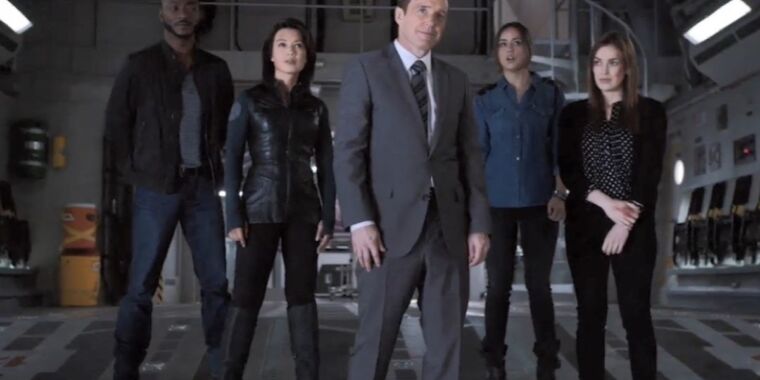
Agents of S.H.I.E.L.D. takes final bow with high-octane journey through time

[embedded content]
One last mission: Marvel’s Agents of S.H.I.E.L.D. ended its seven-year run with a two-part finale.

Agent Phil Coulson and his plucky team of superheroes battled an alien race of Chronicoms in a high-octane journey through multiple time periods in the seventh and final season of ABC’s Agents of S.H.I.E.L.D. It has always been a fun show, even when the narrative occasionally went bonkers—honestly, especially then—with compelling characters that kept you coming back each week. The seventh and final season brought a pronounced sense of playfulness to the show’s pre-existing strengths, effectively saving its best season for last and tying everything together in a satisfying two-part finale.

(Some spoilers below, but no major plot twists.)

The spin-off series created by The Avengers writer and Director Joss Whedon brought Coulson (Clark Gregg) back from the dead to lead an elite squad of agents to take on the terrorist group Hydra, eventually incorporating a superhuman race called Inhumans into the storyline.

One of the S6 subplots involved aliens called Chronicoms seeking Fitz (Iain De Caestecker) and Simmons’ (Elizabeth Henstridge) help in solving the problem of time travel so they could save their home planet, Chronyca-2—until there was an internal coup and their new leader, Sibyl (Tamara Taylor), decided she would rather take over Earth and turn it into their Chronyca-3. In the finale, May (Ming-Na Wen) was fatally wounded and placed in a stasis pod, as an upgraded, time-traveling version of their ship, the Zephyr One, zapped them several decades into the past, where they were trapped going into S7. Meanwhile, Simmons built a Life Model Decoy of Coulson, replete with knowledge about the entire history of S.H.I.E.L.D., to help them navigate through history and hopefully save the future once and for all.

Per the official S7 premise: “Coulson and the Agents of S.H.I.E.L.D. are thrust backward in time and stranded in 1931 New York City. With the all-new Zephyr set to time-jump at any moment, the team must hurry to find out exactly what happened. If they fail, it would mean disaster for the past, present and future of the world.” And time-jump they do. This season finds the team visiting the 1950s, the 1970s, and the 1980s, giving fans the pleasure of revisiting the history of the agency since its inception, as well as revisiting the far future featured in S5 and S6. Much of the arc touches back on events from the first two seasons, too, so the showrunners brought everything full circle for the series’ final bow.

Blasts from the past

The main cast members from S6 all returned for this final season: not just Gregg, Ming-Na Wen, Henstridge, and De Caestecker, but also Chloe Bennet (Daisy, aka Quake), Henry Simmons (Mack), Natalia Cordova-Buckley (Yo-Yo), and Jeff Ward (Deke). Agent Carter‘s Hayley Atwell was rumored to have a cameo, but that proved to be false. However Enver Gjokaj reprises his role as her former colleague and love interest, Daniel Sousa, joining the team in this season’s time-traveling adventures. And Patrick Warburton makes another brief cameo as Rick Stoner, the first director of S.H.I.E.L.D. in the comics, before Nick Fury replaced him. (He appeared briefly in hologram form in S5.)

All that time-jumping proved challenging from a production standpoint, since the production team had to recreate multiple historical time periods, beginning with 1931—including hair, makeup, wardrobe, and recreating cityscapes and accurate geographical layouts. According to VFX Supervisor Mark Kolpack, the Warner Bros. backlot has a New York street that fit the bill, and period details were added based on the time period of a given episode.

One scene required the Zephyr One to land in the south end of Manhattan along the harbor where boats would moor, with a view across the water to New Brunswick, New Jersey. “The Zephyr is 280 feet long, it’s almost a football field in length,” Kolpack told Ars. He quickly realized they would have to do a digital ground extension in order for the shot to make sense. “We did a fantastic matte painting with a period ship that you would never suspect were visual effects.” The same was true for many other scenes set in historical time periods. “We just had to adjust certain areas of the landscape to fit the time period, removing the modern-day elements and reverting it,” he said.

The attention to period detail carries over to the title cards for each episode. For the first two episodes, the cards reflect the 1930s aesthetic, while the 1950s title cards are done in a film noir style. (One of those episodes was filmed entirely in black-and-white with Coulson narrating via internal monologue, apparently due to a glitch in his software. It even features an homage to the famous opening scene from the Oscar-winning 1950 classic noir film Sunset Boulevard.) There are also ’70s themed cards, as well as title cards that reference 1980s hacker films Tron and Back to the Future.

The visual effects were scaled down a bit in earlier episodes, according to Kolpack, in part because of the storyline and also to save the big-budget effects for the two-part series finale. But there were key elements that required considerable digital finessing, such as the time-jumping effect introduced in the S6 finale’s final shot, which had to be redone, according to Digital Effects Supervisor Kevin Yuille. “It was a pretty wide shot and a simple set up,” he told Ars. “By the new season, we had to redo everything to support a resolution you could almost walk up to.”

One final mission

The Lighthouse headquarters for S.H.I.E.L.D. posed a different challenge, since it required complicated simulations to create the image of a 300-foot submerged base rising out of the water—including a giant waterfall all around the tower as it rises. “The first time that was done, it kept crashing the SIM,” said Kolpack. “It was a very complicated shot. We traveled from a high bird’s-eye view down to the actual 300-foot valance. And all that water had to churn and interact with the CG geometry of the actual opening.”

The 1970s Project Insight rocket launch scene—a callback to Captain America: The Winter Soldier—required another complicated simulation. “The biggest challenge was the missile launch itself, figuring out the characteristics of the fire and smoke that emerged from beneath the water, because of the pyroclastic qualities of the smoke trail itself,” said Yuille. “There’s a lot of detail in that explosion.”

According to Kolpack, the design was originally based on a Saturn-V launch pad, just modified a bit because that design was copyrighted. “I was pulling up video of rockets launching out of silos and trying to get the character of the fire shooting back out, hitting the ground, and shooting up,” he said. While there is “a bit of a cheat” when the rocket is shot down—a doubling up of the action that meant the timing was just a bit off—”It plays just fine, emotionally.”

There were many such tradeoffs that had to be made, as the VFX team sought to find creative, budget-friendly compromises to accommodate the episode directors’ visions. “We usually have way too many creative ideas in a script than the budget can sustain,” said Kolpack. Scripts were submitted, Kolpack and his team would crunch out the numbers, “and then we would have a very sad meeting to talk about the realities,” he said. “We chose our battles carefully. More is not better, sometimes more is just more.” By focusing just on those elements that were integral to the story, they could come up with creative workarounds. That said, “It’s still the best visual effects of broadcast television, period,” said Kolpack.

The two-part series finale pulled out all the VFX stops, as our agents faced off against a fleet of Chronicom ships in a final showdown to restore the original timeline to keep Earth from becoming Chronyca-3. If there’s a flaw in this final season, it’s the pronounced absence of Fitz—a necessity because De Caestecker had a scheduling conflict with another project when shooting began. The showrunners wrote around the character, explaining that his absence is due to the necessity of he and Simmons remaining apart if they are to foil Sibyl’s master plan and preserve the timeline. Simmons has a brain implant that suppresses her memories of Fitz’s whereabouts (and/or whenabouts), lest the Chronicoms try to forcibly extract that information from her.

As a narrative device, it mostly works in the context of the season as a whole. But Fitz and Simmons are the show’s great love story, and having them separated for so long—he doesn’t show up until the finale—was deeply frustrating for fans. Fortunately, there were plenty of other emotional stakes and character-driven drama to go around, mostly centered on the complicated family dynamics that is a thematic mainstay of the series. We’re sorry to say goodbye to Agents of S.H.I.E.L.D., but the show went out strong, and frankly, the team deserves a break after seven seasons of saving the Earth.

[embedded content]
Marvel’s Agents of S.H.I.E.L.D. Cast & Creators Say Goodbye.

https://arstechnica.com/?p=1698048


As Epic attacks Apple and Google, it ignores the same problems on consoles

Epic’s battle for “open platforms” ignores consoles’ massive closed market
Aurich Lawson / Getty Images

Yesterday, Epic used Fortnite to essentially wage open war against Apple’s and Google’s mobile app marketplaces. First it added a discounted “Epic Direct Payment” option alongside the standard iOS App Store and Google Play payment options in Fortnite, in direct violation of those stores’ policies.

Then, when Fortnite was predictably removed from both platforms, Epic filed lawsuits against both companies, alleging “anti-competitive restraints and monopolistic practices” in the mobile app marketplace. That move came alongside a heavy-handed PR blitz including a video asking players to “join the fight to stop 2020 from becoming ‘1984.’”

But through this entire public fight for “open mobile platforms,” as Epic puts it, there is one major set of closed platforms that the company seems happy to continue doing business with. We’re speaking, of course, about video game consoles.

Happy to pay

Most if not all of the complaints Epic makes against Apple and Google seem to apply to Microsoft, Sony, and Nintendo in the console space as well. All three console makers also take a 30 percent cut of all microtransaction sales on their platforms, for example.

This DLC fee represents a big chunk of those console makers’ revenues, too. “Add-on content” was a full 41 percent of Sony’s Game and Network revenue in the latest completed fiscal quarter. Microsoft saw a 39 percent increase in gaming revenue the quarter after Fortnite was released, too, coyly attributing the bump to “third-party title strength.” And the Switch saw similar post-Fortnite digital revenue increases after Nintendo announced that fully half of all Switch owners had downloaded Fortnite.

Even though consoles charge a 30 percent fee for all game DLC, Epic still offered console players a discount that it said necessitated "Direct Payments" on mobile platforms.
Enlarge / Even though consoles charge a 30 percent fee for all game DLC, Epic still offered console players a discount that it said necessitated “Direct Payments” on mobile platforms.
Epic Games

On mobile platforms, Epic is calling the same kind of 30 percent fee “exorbitant” and says it wants to offer a more direct payment solution so it can “pass along the savings to players.” On consoles, though, Epic happily introduced a permanent 20 percent discount on all microtransaction purchases, despite there being no sign that the console makers have changed their fee structure.

A brief history of console control

The major console makers also all exercise full control over what games and apps can appear in their own walled gardens. When it comes to iOS, Epic says that “by blocking consumer choice in software installation, Apple has created a problem so they can profit from the solution.” When it comes to consoles, Epic is silent about the same state of affairs.

In this sense, consoles are even more restrictive than Android, where games and apps (including Fortnite) can be sideloaded without using the Google Play Store. Yet Google has earned a lawsuit for its role in this state of affairs, while the console makers have remained undisturbed.

In addition to the business implications, console makers’ total control of their marketplaces also has a direct impact on the types of content that players get to play. Any game that receives an Adults Only rating from the ESRB isn’t welcome on any of the three major consoles, for instance. And if you want to use UWP to code an N64 emulator that works on the Xbox One, Microsoft will pull it down as quickly as it can.

It wasn’t always this way, of course. Back in the days of the Atari 2600, anyone with the programming skill and cartridge manufacturing capacity could make games for the console. That state of affairs led to a glut of poorly made Atari software flooding the market, a situation many observers blame for the video game industry crash of 1983.

Without full control over their software, console makers fear another glut like the kind that led to excess Atari cartridges being buried in a New Mexico desert.
Megan Geuss

To prevent history from repeating itself, Nintendo created a lockout chip for the NES that gave it effective control over what cartridges could run on its hardware (and gave it the capability to extract a licensing fee from game developers for the privilege of producing cartridges). When companies like Tengen tried to get around this restriction, Nintendo took them to court and won, cementing their right to Apple-style control of their own software marketplace.

Decades later, this kind of absolute control over compatible software is treated as the de facto standard in the console space. But in the world of mobile phones, companies like Epic are increasingly and publicly lambasting similar restrictions as anti-competitive monopolistic practices. What’s the difference?

Splitting the difference

Some might argue that software restrictions on consoles are less impactful because the hardware is only designed to play games. As Epic puts it in its own FAQ, “mobile devices are essential computing devices upon which we conduct our social and professional lives and engage in commerce and entertainment.” That FAQ compares the mobile marketplace only to “other general-purpose computing platforms, including Web, Windows, and Mac.” Consoles don’t fit in that same “general purpose” framework, it seems.

But that’s an increasingly outdated view of what consoles can do. The Xbox One, to cite just one example, includes a a wide-ranging selection of non-game apps for functions like video on demand, music streaming, VoIP, email, and more. That might not put it on the same tier of software selection as a smartphone, but it does push it ever closer to the “general-purpose computer” space.

Some might point to the very different nature of the revenue model for the different ecosystems. While Apple makes a significant profit on every iPhone sale, console makers routinely sell their hardware at a loss or at nearly no profit, to increase the user base for future software licensing and sales.

That might help explain why console-makers feel the need to guard their 30 percent cut on software and microtransaction sales. But it doesn’t really explain why a company like Epic would be OK with paying that fee to Sony but not to Apple.

Maybe Epic is simply more worried about the potential for lost revenues on consoles versus mobile platforms. A mid-2019 Newzoo study of three major Battle Royale games, including Fortnite, found that 71 percent of players mainly played on consoles, compared to just 17 percent on PC and 12 percent on mobile. Being cut off from those console players during a heated public battle would be a much more significant blow to the game’s revenue stream.

“Epic hearts Microsoft”

Or maybe Epic just has a better relationship with console makers than mobile phone makers. Epic has long made console the main focus of its Unreal Engine development, after all, in a way that has been less true for mobile phones.

Sony recently invested $250 million in Epic and prominently featured Epic’s Unreal Engine 5 in a recent major PlayStation 5 promotional demo, too. Even Nintendo, which traditionally uses its own technology for game development, has begun using Unreal Engine for its own titles in recent years. In a way, Epic can’t attack these platform holders without also attacking itself.

[embedded content]

Sony and Epic were practically holding hands and skipping together for this rollout of Unreal Engine 5 on the PlayStation 5 in May.[/ars_video

And while Epic and Microsoft famously sparred over the Universal Windows Platform on PCs, the two companies publicly buried the hatchet last year during the rollout of the HoloLens 2 platform. “Epic loves Microsoft,” Tim Sweeney said at the time. “Epic hearts Microsoft.”

Apple and Epic aren’t exactly strangers in the world of business, though. Epic’s Infinity Blade and Unreal Engine were featured in an iPhone keynote presentation back in 2010, for instance, and the company unveiled a “Zen Garden” demo for iOS 8 at WWDC 2014. But while Unreal Engine is a key part of the console landscape these days, the high-end 3D graphics it enables are still more of a niche on mobile platforms, which are often underpowered for those kinds of games.

Perhaps the answer is that Apple in particular is just a riper target these days. Everyone from Microsoft and Google to email app makers to European regulators are taking aim at the anti-competitive nature of the iOS marketplace in recent months. Perhaps Epic doesn’t want to be the only company taking on the console triumvirate in the same way.

With Epic yet to respond to our requests for comment, we’re left guessing at why consoles have been spared from the company’s legal and PR wrath. But in the end, it may just be a question of timing. Maybe Epic is merely focusing on mobile marketplaces first, hoping to set a precedent that can also break the monopoly control console makers hold over their own hardware.

These days, it’s tough to imagine a world where console makers don’t get to approve the software that runs on their systems. But if Epic is successful in its attacks on the mobile phone realm, that could be where we’re headed.

https://arstechnica.com/?p=1699059