Real Genius turns 35—celebrating this cult classic is a moral imperative

Mitch (Gabriel Jarret) and Chris (Val Kilmer) play young science whizzes trying to build a 5-kilowatt laser in the 1985 film <em>Real Genius</em>.
Enlarge / Mitch (Gabriel Jarret) and Chris (Val Kilmer) play young science whizzes trying to build a 5-kilowatt laser in the 1985 film Real Genius.
TriStar Pictures

Back to the Future justly dominated the summer box office in 1985, but it’s too bad its massive success overshadowed another nerd-friendly gem, Real Genius, which debuted one month later, on August 9. Now celebrating its 35th anniversary, the film remains one of the most charming, winsome depictions of super-smart science whizzes idealistically hoping to change the world for the better with their work. It also boasts a lot of reasonably accurate science—a rare occurrence at the time.

Real Genius came out the same year as the similarly themed films Weird Science—which spawned a 1990s TV sitcom—and My Science Project, because 1980s Hollywood tended to do things in threes. But I’d argue that Real Genius has better stood the test of time, despite being so quintessentially an ’80s film—right down to the many montages set to electronic/synth-pop chart-toppers. The film only grossed $12.9 million domestically against its $8 million budget, compared to $23.8 million domestically for its fellow cult classic, Weird Science. (My Science Project bombed with a paltry $4.1 million.) Reviews were mostly positive, however, and over time it became a sleeper hit via VHS, and later, DVD and streaming platforms.

(Spoilers for the 35-year-old film below.)

Fifteen-year-old Mitch Taylor (Gabriel Jarret) is a science genius and social outcast at his high school. So he is over the moon when Professor Jerry Hathaway (William Atherton), a star researcher at the fictional Pacific Technical University, stops by the science fair to inform Mitch he’s been admitted to the university. Even better, Hathaway has handpicked Mitch to work in his own lab on a laser project. But unbeknownst to Mitch, Hathaway is in league with a covert CIA program to develop a space-based laser weapon called “Crossbow,” designed for precisely targeted political assassinations. The only remaining obstacle is the weapon’s power source: they need a 5-megawatt laser and are relying on Hathaway to deliver.

The first act is a nerdier version of the classic fish-out-of-water tale, as Mitch arrives at Pacific Tech and tries to fit in. His roommate, Chris Knight (Val Kilmer), is a senior who was once a bright young star like Mitch but has since rebelled against the high-pressure academic grind and embraced a goofy YOLO approach to life, urging his fellow students to allow themselves to blow off a little steam now and then. Mitch butts heads with Kent (Robert Prescott), a less gifted older protegé of Hathaway’s who is jealous of the attention Mitch receives. He finds friends and allies not just in Chris, but also fellow science nerds “Ick” Ikagami (Mark Kamiyama) and Jordan Cochran (Michelle Meyrink), a hyperactive young woman who rarely stops talking or inventing gadgets, and by her own admission almost never sleeps.

Then there is Lazlo Hollyfeld (Jon Gries), a former star student who cracked under the pressure and is now an eccentric hermit living in the dormitory steam tunnels. Fun fact: Lazlo’s steam tunnel hideout, accessible through Mitch’s closet, is an elaborate homage to Leonardo da Vinci. As depicted when Mitch finally figures out how to gain access, it features a multidirectional elevator built out of a small car controlled by a rotating screw. The car descends to a horizontal track and is propelled forward by a hidden drive chain. The automated scribbler Lazlo uses to submit more than a million entries to the Frito-Lay Sweepstakes was inspired by a sketch in one of Leonardo’s notebooks.

Eventually, Mitch and Chris succeed in solving the power problem for their laser, only to realize (thanks to Lazlo) that it will be used to build a powerful directed-energy laser weapon. The five of them team up to foil Hathaway’s big military test of the system, in their usual eccentrically ingenious way.

It fell to film consultant Martin A. Gunderson of the University of Southern California (who has a bit part as a math professor) to help ensure that the science and campus culture depicted in the film were plausible, even if certain liberties were taken. Certain details were deliberately left out, according to Director Martha Coolidge, such as those for Mitch’s flash-pumped ultraviolet laser at the science fair, and technical details pertaining to a directed-energy laser weapon. (“We didn’t want to inspire any lethal tinkering.”)

I’ve always appreciated how closely the laboratory laser setups hewed to reality: Gunderson himself provided the blue-green argon laser and tunable dye laser used in those scenes. Chris uses a cube beam splitter to create the laser light show announcing the Tanning Invitational pool party that incurs Hathaway’s wrath. That said, a 5-megawatt laser had certainly not been achieved in 1985. While Chris’ construction of a xenon-halogen laser to solve the power problem was purely theoretical at the time, the underlying scientific details were later outlined in a scientific paper—a fitting example of how science and Hollywood can both benefit from such collaborations.

For the “Smart People on Ice” scene, the crew used a frozen volatile gas, pumped through thousands of feet of tubing beneath the corridor flooring that was connected to a refrigeration unit to keep the gas cold. And as Ick explains when Kent asks him what will happen when the ice melts, the frozen gas shifts directly from a solid to a gaseous state, rather than melting into a liquid.

Then there is the famous popcorn scene that marks the group’s triumph over Hathaway. Mitch, Chris, Ick, Jordan, and Lazlo fill his newly renovated house (accomplished with funds embezzled from his CIA grant) with unpopped popcorn covered in tinfoil. They place a prismatic-like piece of glass on the window sill and hijack the computer during Hathaway’s big military test to redirect the laser energy through that window. The kernels start popping, expanding to fill the entire house until it quite literally bursts at the seams.

[embedded content]
Real Genius movie clip: Jerry’s House of Popcorn.

In a 2010 interview with the AV Club, Atherton revealed that the studio had six ten-foot-high air poppers devoted to popping popcorn all day for three months, filling a massive storage tank. Since the popcorn had been treated with fire-retardant to keep it from combusting, additional measures had to be taken to ensure the birds didn’t eat it. All that popcorn was then carted out to a new subdivision being built in Canyon Country just northwest of Los Angeles and then stuffed inside a Victorian frame house specifically built for the film. That way the crew could pull the whole thing down in the climactic scene with the help of an elaborate network of conveyor belts, hydraulic lifts, airblowers, and vacuum hoses. “Now they’d do it digitally, I guess, but in those days, you had to pop the dang popcorn and put it in a truck and schlep it out to the valley,” Atherton said.

As evidence of the film’s enduring popularity with the nerdy set, the Mythbusters decided to test the feasibility of popping that much popcorn in 2009 with a laser and destroying a house. The initial test went well: the team successfully popped a single kernel wrapped in aluminum foil with a ten-watt laser. Unfortunately, they weren’t able to get a sufficiently powerful laser for their scaled-up experiment, relying instead on a large pan used to cook the popcorn via induction heating. They also built a scaled-down model of the house in the film with a piston on the floor pushing popped popcorn upward to see if it could generate sufficient force to break apart the house. Alas, the Mythbusters determined it would require several tons of force. So myth: busted. But it’s still an entertaining movie comeuppance.

Real Genius is admittedly a bit cheesy. The plot is predictable, the characters are pretty basic, and the dialogue can be clunky. And it goes without saying that the sexually frustrated virgin nerds ogling hot cosmetology students in bikinis during the pool party reflects hopelessly outdated stereotypes on several fronts. But the film still offers smartly silly escapist fare, with a side of solid science for those who care about such things. And its yearning idealism is a good antidote to the current prevailing cynicism.

https://arstechnica.com/?p=1697354


Three algorithm-less streaming sites revive the wacky Web from days of yore

An average performance you can expect to see, and participate in, at Internet Temple. Co-creator Clayton Collins is in the center frame, performing as his alter-ego Long Distance Husband.
Enlarge / An average performance you can expect to see, and participate in, at Internet Temple. Co-creator Clayton Collins is in the center frame, performing as his alter-ego Long Distance Husband.

In early May, I needed a change of pace from my usual YouTube rabbit holes, having gone down a few of those during months of quarantine. My discovery of Internet Temple almost felt like finding a good bar or music venue; instead of being served content by a video platform’s algorithm, I had to know someone, get a tip, and type an entire URL.

The Temple made a blunt entrance on my browsing tab with little more than a cropped YouTube embed and a chat box with no scrolling feature. And then it got weird.

I witnessed a startling musical performance drenched in autotune (the laughs between songs were also autotuned). The singer wore snowman print boxers, an oversized sweater featuring abstract humanoid images, and a hat reading “WWW DOT COM MY ASS.” He danced with three stuffed sheep in his hands, while behind him, a green screen was flooded with imagery chosen by audience members. They had selected images of Shrek and Unicode shrimp emojis.

All of this, I would come to learn, was not as silly as it appeared. Rather, Internet Temple’s proprietors are invested in decimating the concept of Web 2.0, and they’ve started with three separate, intriguing projects.

Weird on the cheap

Performer Clayton Collins and venue creator Toby Alden (they/them) are a fringe breed, making idiosyncratic websites in the spirit of a bygone Internet. Collins, who sometimes goes by “Clayton Online,” has a day job maintaining software that manages bus schedules. Alden is a full-time game developer working on an indie video game. The Portland duo’s extracurricular creations are essentially alternatives to social media, and they’re being made for next to no money.

Toby Alden (left) and Clayton Collins (right) in their hometown of Portland, OR.
Enlarge / Toby Alden (left) and Clayton Collins (right) in their hometown of Portland, OR.
Conor Carlton

The first of these, Internet Temple, features a crowded background collage of late-’90s Japanese game sprites. The Temple has hosted live music, DJ sets (some proudly streamed with abysmal quality through Google Hangouts), and poetry readings. The design, with one stage front-and-center, is antithetical to Twitch.

“If you’re streaming on Twitch, you’re competing with everyone else on there by design,” Alden says. They point to the constant nudging by said website to jump to other streams or watch ads, fueled in part by an increasing dependence on the recommendation algorithm.

“They all make you feel bad”

Collins and Alden don’t identify with a particular movement, but they’re aware that other projects like theirs flourish in the Internet’s corners, both by way of small cliques and lone-wolf programmers. Although DIY Internet culture has existed since the days of BBSes, its modern versions stand in contrast to major social media companies accused of selling data, avoiding taxes, and allowing misinformation—most recently by Congress in a July 29 hearing.

“You used to go online and type in the URLs of your favorite sites to see if hardcoregaming101.net had updated,” Alden says. “Now it’s mostly five or six sites: YouTube, Facebook, Twitter, Insta, Amazon, and so on.”

“You don’t even need to say, ‘And so on,'” Collins interjects. “That’s it. Those are them.”

“And they all make you feel bad.”

The Temple was written in Node.js over the course of three days in 2016. It’s recently begun sidestepping YouTube Live (the kind of stream-and-chat system you might expect from a site like this) by borrowing code from Collins’ platform Saladbowl, where he hosts and streams videos directly from his computer to bypass copyright strikes. This service is, according to Collins, a fight against the “corporate movement to make art private property.” He uses it to broadcast his personal .MP4 video collection to friends, but the bigger goal is a DIY streaming tool for the masses.

https://arstechnica.com/?p=1697178


Science, history, and purring cats: Brief podcasts for the nerdy set

Podcasts with your interests—and attention span—in mind.
Enlarge / Podcasts with your interests—and attention span—in mind.
Aurich Lawson / Getty Images

The beauty of the podcast format is also sometimes its curse: arbitrary episode lengths. Finding a new podcast to love can be daunting when episodes regularly exceed the hour-long mark. If you’re struggling to commit to podcasts on topics like history and science, don’t fret: We have recommendations for great series that typically serve complete episodes well under half an hour.

Science Diction

Sometimes the best way to recover from stress is to focus on learning something new. Science Diction helps with this by presenting the etymologies of familiar scientific technical terms alongside bite-sized usage histories of how people engage with science. The episode on “Meme,” for example, tells the story of the word’s coinage as a parallel to “gene” to show how ideas spread through a culture. Science Diction talks about the spread of “meme” itself, sometimes as a meme, until it became the one of the most common ways to refer to images and jokes passed around on the Internet. An episode titled “Vaccine,” meanwhile, teaches us what happens when the public is scared of new science, describing antivax propaganda nearly as old as the first vaccines themselves.

Science Diction releases episodes monthly, and it only started this year, so many of its episodes are about concepts related to COVID-19. Even if you’re fatigued by that topic, I still recommend this podcast as a refreshing, historical overview of similar stories, told in a laid-back way.

Chemistry in its Element

What Science Diction does with science terms, Chemistry in its Element does with science materials. Originally a show about the history and usage of chemical elements, CE branched out when it reached the end of the periodic table. Now the show offers accessible discussions of more complex chemicals. While many of their episodes focus on chemicals related to current events, like potential COVID-19 cures, they also discuss everyday chemicals like porcelain and 2AP (which gives buttered popcorn its distinctive smell). Some episodes even dive into fascinating science fiction compounds like hexasilabenzene, which could make silicon-based alien life possible. It’s a wonderful way to learn about how chemistry relates to our lives.

Witness History

If history is more your thing, try spending your brain breaks with Witness History, a BBC podcast that tells the stories of historical events from the perspective of people who were actually there. This podcast spends more time on serious topics than the others on this list, but its miniseries about Black history and the fall of the Berlin Wall are well worth listening to. And if you’re willing to spend a little time poking around in their archive, there’s a lot of hope to be found in the BBC’s retelling of history, from the story of Jewish women winning the right to pray at the Western Wall, to the history of the “Friendship Train” that runs between India and Bangladesh, to an interview with the first astronauts to board the International Space Station.

Purrcast

If you’re tired of people talking at you all day, and wish you could just spend your lunch break at home with your cat—or if you don’t have a cat, and wish you did—you may want to give Purrcast a listen. Each episode is approximately five minutes of a cat purring. That’s it. There are no ads, aside from occasional shoutouts to the cat rescue where the episodes are recorded. There is no background music or images of someone else’s cat to distract you from the companionship of your ideal feline friend.

Purrcast might be the most relaxing podcast on this list—and it might be good to intersperse between some of the shows on this list in retrospect. My advice: play the podcast through your phone’s speakers, then rest your device on your lap or chest so you can pretend the cat is lying on you while it purrs. It’s all of the anxiety-melting goodness of cat ownership without a litter box to deal with.

QWERPline

If you’re looking more specifically for a reason to laugh, I recommend QWERPline, a semi-improvised narrative podcast by Canadian comedy troupe LoadingReadyRun that takes the form of a morning radio show from a topsy-turvy small town. Think A Prairie Home Companion meets Firesign Theater, designed to make even its own cast burst out laughing. The show’s hosts, Graham and Alex, act as relatively sane foils for the hilarious inhabitants of Nsburg, from perpetually clueless radio station intern Derek to traffic correspondent Richter Hammockslam, who does everything except report on traffic, to Lorna Schlitzwhistle, a regular caller and purveyor of New Age nonsense. I recommend starting with the Harvest Festival episode to get the best sense of both the bizarre logic of Nsburg and the dramatic vocal ranges of QWERPline’s five cast members.

This one’s a little longer than the other shows on this list, but episodes are still usually under half an hour. You can also find them on YouTube, accompanied by images that immerse you in Nsburg’s bizarre culture and clarify some of the more complicated jokes. LoadingReadyRun has also done a series of noncanon episodes as part of their annual Desert Bus for Hope charity fundraiser (this playlist also includes the Desert Bus for Hope segments that inspired QWERPline).

One FYI: this podcast contains swearing and innuendo that you may not want to have to explain to a younger audience.

Honorable mentions

Some of my favorite podcasts I’ve recommended in earlier roundups are also under half an hour. Encyclopedia Womannica and Chemistry Cayk, in particular, provide delightful bite-sized brain breaks that let you chill out while still learning new and interesting things. If you have other shows that can be sampled before soup finishes on the stove, let us know in the comments what short podcasts you’re excited about!

https://arstechnica.com/?p=1697338


Review: Doom Patrol comes back strong with fierce and fun S2

[embedded content]
Trailer for the second season of Doom Patrol.

Lots of people missed last year’s debut of Doom Patrol, a delightfully bonkers show about a “found family” of superhero misfits, because it aired exclusively on the DC Universe streaming service.  Fortunately, S2 also aired on HBO Max, expanding the series’ potential audience. Apart from one sub-par episode, this second season expanded on the strengths of the first, with plenty of crazy hijinks, humor, pathos, surprising twists, and WTF moments. Alas, the season finale is bound to frustrate fans, since it ends on a major cliffhanger and leaves multiple dangling narrative threads.

(Spoilers for S1; some S2 spoilers below the gallery.)

As we reported previously, Timothy Dalton plays Niles Caulder, aka The Chief, a medical doctor who saved the lives of the various Doom Patrol members and lets them stay in his mansion. His Manor of Misfits includes Jane, aka Crazy Jane (Diane Guerrero), whose childhood trauma resulted in 64 distinct personalities, each with its own powers. Rita (April Bowlby), aka Elasti-Woman, is a former actress with stretchy, elastic properties she can’t really control, thanks to being exposed to a toxic gas that altered her cellular structure. Larry Trainor, aka Negative Man, is a US Air Force pilot who has a “negative energy entity” inside him and must be swathed in bandages to keep radioactivity from seeping out of his body. (Matt Bomer plays Trainor without the bandages, while Matthew Zuk takes on the bandaged role.)

Cliff Steele, aka Robotman, is a former NASCAR driver whose brain was transplanted into a robot body after a horrific crash. (Brendan Fraser plays the human Cliff, and Riley Shanahan plays the robot version.) Finally, there is Vic, aka Cyborg (Joivan Wade), whose father gave him cybernetic enhancements to save his life after an accident. Together, they make up the titular Doom Patrol.

In S1, the team faced arch-villain Eric Morden, aka Mr. Nobody (Alan Tudyk), who can travel through dimensions and alter reality, frequently breaking the fourth wall—as the only character who’s aware he is on a TV show—to narrate the action, thereby manipulating events to his liking. Mr. Nobody kidnaps Caulder and holds him captive in a dimension called the “White Space,” and the Doom Patrol spends most of the first season trying to rescue him, wrestling with their personal demons along the way.

In the end, the Doom Patrol defeats Mr. Nobody, but they also discover that The Chief is the one responsible for all the tragedies that gave them each their powers. Let’s just say the team is dealing with some intense feelings of betrayal right now. Caulder had his reasons: he has a super-powered daughter, Dorothy Spinner (Abigail Shapiro), who is deeply troubled, and his actions were a means of trying to extend his own life as much as possible so he could continue to protect her. Oh, and the entire team, except for Larry, is now the size of a cockroach.

Family of misfits

The writers have a bit of fun with the miniaturized theme in S2’s first episode, but fortunately they don’t let them linger too long in that state. Willoughby Kipling (Mark Sheppard), the occult detective and chaos magician we met in S1, is summoned to save the day. But his help comes at a cost: Caulder must give him the talisman that grants him immortality, which is how everyone learns that the Chief is 139 years old.

Now the clock is ticking to find another way to extend Caulder’s life so he can continue to protect Dorothy, his daughter with Slava (Pisay Pao), an immortal primitive woman. Dorothy inherited Slava’s ability to bring imaginary friends to life, which isn’t so bad when it’s a friendly giant beast named Manny or Herschel the giant spider. But there is another, more insidious creature lurking inside Dorothy’s imagination: The Candlemaker, apparently linked to a tribal curse. He emerges whenever Dorothy makes a wish, and widespread slaughter is usually the result.

Along the way, the Doom Patrol encounter the disco-loving Dr. Jonathan Thyme (voiced by Dan Martin, played by Brandon Perea), who is in possession of an alien element that controls time. They take on Red Jack (Roger Floyd), who draws energy from the pain of others. They get captured by White Space creatures known as Scants, and the Doom Patrol meet the Pioneers of the Uncharted, Caulder’s old research team—ageless astronauts led by Valentina “Moscow” Vostok (Mariana Klaveno), who also has a Negative Spirit inside her and thus bonds with Larry.

Therapy patrol

The power of imagination to explore childhood trauma was a prevailing theme this season, most obviously in the case of Dorothy. But every member of the Doom Patrol is badly damaged in some way, and not just because of what Caulder did to them as he was seeking the secret to prolonging his own life. Over the course of the season, we see Larry try to reconnect with his surviving son, and Cliff attempt to make amends to his daughter, Clara (Bethany Anne Lind). Vic falls in love with Roni (Karen Obilom), a veteran whose cybernetic enhancements were removed and left her scarred, as he confronts his own PTSD.

As for Jane, we learn a great deal more about her various personalities and how they have manifested over the years, as well as the psychological space they all share, known as the Underground. Every personality has its own station, although Jane is the primary personality—until the Underground starts to question whether she is still focused on the primary mission (“protect the girl,” i.e. Kay, the core personality who retreated after years of abuse by her sadistic father). The entire cast of Doom Patrol give strong performances, but Guerrero still stands out, switching between different personalities with ease and making us feel for each one of them.

Alas, Rita’s psychological breakthrough—in which she confronts the trauma her domineering stage mother inflicted upon her—is the focus of what is easily the weakest episode of the season (“Sex Patrol”). After Dorothy accidentally breaks Danny the Brick (formerly Danny the Street), superhero Flex Mentallo (Devan Chandler), whom we met in S1, shows up with the former “Dannyzens” to throw a party in hopes of lifting Danny’s spirits and healing him. Flex can alter reality by flexing his muscles, and there was an amusing moment last season where he inadvertently flexed the wrong muscle and gave the entire Doom Patrol simultaneous intense orgasms (except for Cliff because he’s all robot now, although he tried to fake one in solidarity).

It was a great throwaway moment, one of many (like recurring S1 mentions of Animal Vegetable Mineral Man) that really adds to the overall sense of madcap fun. But during Danny’s party, Rita seeks to control her power by asking Flex to repeat the orgasmic feat, which in turn draws the attention of a sex demon: The Shadowy Mr. Evans, who could eventually kill all children. It’s just not funny—it’s even a little gross—and Flex as a character deserves better than being reduced to a sniggering, puerile in-joke. It also strains credibility that this would be the key to Rita resolving her past childhood trauma and gaining better control over her blobbiness.

In the finale, Dorothy gets her first period, marking her transition into womanhood, and the Candlemaker’s powers begin to manifest in the real world. But just as the action builds to a crescendo, the episode just… ends. Frankly, it was maddening. A good finale wraps up the main story line and sets up a cliffhanger for the next season. This one just cut off abruptly. There were only nine episodes this season, compared to 15 in S1, so it’s possible the pandemic cut production short. But I certainly hope airing the series on HBO Max as well as DC Universe brought in sufficient new viewers that we get a third season because I’m dying to know what happens next.

https://arstechnica.com/?p=1689395


Fall Guys review: A perfect amount of cheap, stupid fun with online friends

Fall Guys: half a dozen players run up a ramp through an obstacle course
Enlarge / Try not to get whacked on your way to this race’s finish line.

Have you been looking for a good online multiplayer game that’s accessible to anyone who can use a joystick and three buttons? Fall Guys: Ultimate Knockout is that game. Imagine the minigame zaniness of Mario Party combined with the simple, squishy controls of Gang Beasts, then remixed to deliver the kind of fun that won’t have you screaming in sheer anger at your friends. (Meaning, much better than Mario Party.)

The biggest catch, as those comparisons hint at, is Fall Guys‘ weakness as a solo game. Every match you’ll play in the game’s launch version is a battle against up to 59 online strangers, and the same design elements that make this a fun game with friends will leave you frustrated and furious when it’s just you versus the world.

Fall Guys is a must-play with friends in your online party, a more tiring slog when played alone, and a party game that currently lacks any form of local-multiplayer functionality. If that sales pitch hasn’t lost you, read on.

Tails, balls, and whacks

Each Fall Guys session takes place over five rounds of elimination contests, whittling the fray down from 60 competitors to a single winner. In every round, you control a slow, bean-shaped “fall guy,” likely named after its floppy balance issues. You’ll run and jump through obstacle courses, between swinging pendulums and platforms, and across soccer-like arenas, and anything less than a smooth landing will see your colorful, squeaky character topple over, get up, and try again.

The randomly selected minigames break down into a few categories. In races, you run as part of a pack of dozens of critters to reach a finish line, and each of the race types has a different notable obstacle. One of them has a series of walls, and the mob has to figure out which ones break open and which are too firm to pass through. Another one has a Last Crusade-style array of fake ground tiles, which break apart at the slightest touch, so you and other competitors must figure out the actual solid walking path to the finish line (though you can usually start over if you fall through a false tile). Standard-issue obstacle courses come with their own wacky-physics objects (swinging hammers, massive propellers) that can whack your character out of the running—or, with precise timing, forward to success.

“Tail” contests revolve around seeing who has a glowing tail on their butt by the end of a match’s timer, and if you don’t have one, you can use a “grab” button to swipe one off someone else. A few contests revolve around massive soccer balls, and these often split remaining players into teams to either play a straightforward soccer match—shoving massive balls with their tiny bodies into opposing goals—or to push and control a series of balls into their own colored zone before time runs out.

The fun of each of these is about the game’s gooey-collision physics playing nicely with what appears to be solid in-game netcode. Sometimes, roughly 20 players will try to squish or bounce through the same narrow passageway, and while the resulting fray can range from hilarious to frustrating, you can’t blame it on anything but fellow players’ bedlam. Without that execution, you might write Fall Guys off as a battle royale cash-in, but instead, this has a seriously delightful, goofy feeling—arguably more like Super Mario Maker 2‘s online-versus modes, without the atrocious lag.

PS4 vs. PC

On PlayStation 4, Fall Guys is the summer’s biggest no-brainer. It’s a PlayStation Plus giveaway for the month of August, and on that platform, it requires PS Plus to work (since it’s online-only). So if you and your friends use that console and have any interest, your group should cash in any remaining PS Plus trials or vouchers to claim the game before month’s end.

The PC side of things is a slightly hairier proposition, given that there’s a minimum $20 entry cost—and I’ve recently complained about retail-priced games that include obvious free-to-play hooks. Fall Guys smothers its interface with reminders that you can pay real money to change your blobby character’s “completely optional” cosmetics, and in this game’s case, the combination of impressive outfit designs and massive crowds of fellow players means you’re always getting slapped with the potential FOMO of not having a cool outfit.

In good news, you can’t pay for the game’s “season pass” of earnable outfits. The season pass offers a solid range of silly outfit options, along with enough in-game currency to buy custom outfits from a store’s rotating selection of outfits, pants, colors, and tattoo-like patterns. Importantly, on all platforms, certain cosmetics can only be purchased by getting first place in any 60-strong competition round, which gives winning players a single “crown” of currency. (Right now, rare outfit pieces cost up to five crowns a pop.)

As such, on PC, you’re essentially prebuying a F2P game’s season-pass content in perpetuity, instead of jumping in for free and then later deciding whether to buy into that stuff. The game in question has to be good enough for me to recommend such an option, especially when it prods players to possibly open their wallets and join the outfit-purchase frenzy. When played with a group of friends, Fall Guys exceeds that threshold.

It’s dangerous to Fall alone

[embedded content]
Fall Guys: Ultimate Knockout launch trailer.

When you party with up to three other friends, you’ll matchmake into the same 60-strong session, and everyone in your party will be marked by a small icon. That means you can either leave them alone or inflict friendly hazing. Once anyone in the party is knocked out of a round, they can either hang around and spectate, or they can quit and play a separate session by themselves. I heartily recommend that friends stick together whenever possible, even if that means your entire party force-quits because someone loses in the first round. I recommend this because the game’s lengthy rounds include ample opportunities for get-pumped banter and holy-cow shrieks of delight or frustration.

I haven’t had this much fun with friends in an online game in all of 2020, so long as everyone was connected with mics (usually via a third-party app like Discord). Fall Guys is even more fun when the entire group sticks around while a single party member survives into the final round and everyone else spectates and cheers them on. Viewers can each switch camera angles to follow other competitors and offer play-by-play commentary of the ensuing chaos as six to 10 people vie for that lucrative end-of-match crown.

Solo is so-so

The same simply cannot be said for solo play, however. Many of Fall Guys‘ minigames revolve around last-second BS, quite honestly, where a round’s prior two or three minutes are completely meaningless thanks to a random, perfectly timed confluence of factors. I’ve taken to calling this minigame “F*** You: The Video Game” due to how an entire round of “good” play can go sideways thanks to someone sneaking up and stealing a tail or blocking your path to pushing a ball into a goal. Moments like these are tolerable and even delightful when shared among friends. Playing alone—when it’s just you, a mass of silent opponents, and a wacky physics engine—doesn’t make room for healthy, fun reactions.

Hence, I only play Fall Guys: Ultimate Knockout when at least one friend is available—and ever since the game’s retail launch, I’ve been fortunate to have friends ping me on a pretty regular basis, asking if I can drop everything I’m doing and rack up a few rounds. I did that so many times this week that, if I’m being frank, writing this review was the only way to not get in trouble with Ars management. I didn’t respond to messages, emails, and calls quickly the past few days, boss, because I was, er, working on this review. And loving it.

Verdict: A must-play if you already subscribe to PlayStation Plus. A hearty party-game recommendation if you can convince online friends to join in. A tough sell for loners or couch co-op players.

https://arstechnica.com/?p=1697218


Star Trek: Lower Decks review: Comfort food with a comic twist

Screenshot from Star Trek: Lower Decks trailer
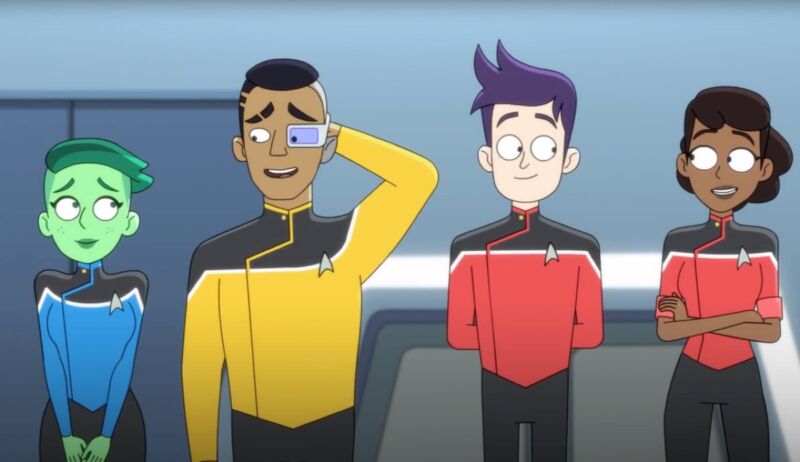
Enlarge / Ensigns Tendi (Noël Wells), Rutherford (Eugene Cordero), Boimler (Jack Quaid), and Mariner (Tawny Newsome) reporting for duty.
YouTube/CBS All Access

Star Trek has been many things in the past 54 years: eight television series, 13 films, the better part of a thousand total novels, and the beating heart that arguably created modern fandom as it now stands. But for all the humor—both intentional and not—scattered throughout its storied history, there is one frontier it has not yet explored: the half-hour comedy.

The ninth and newest Star Trek series aims to change all that. Lower Decks is a half-hour animated series set in the timeline two years after the conclusion of Star Trek: Voyager. The half-hour comedy cartoon format is a definite change of pace from ViacomCBS’ other recent Star Trek offerings, the heavily serialized dramas Picard and Discovery. The question any fan might have then, is simple: does it hold up?

And the answer is yes, mostly—but don’t set your expectations to “stunned.”

A labor of love

I previewed the first two episodes of Lower Decks at an online premiere “event” Tuesday, ahead of the series’ public debut on Thursday. The content was exactly as you might expect from the trailer, which was heavily (though not exclusively) composed of shots and scenes taken from the first episode.

Lower Decks takes place on the USS Cerritos, a “second contact” ship, in the year 2380. The main characters are a motley quartet of ensigns serving in the medical, engineering, and command divisions. Our heroes are the usually unnamed and unsung crew members with but a single lone pip on their collars who show up when senior officers have delegated out their tasks and moved on to the next interesting thing. The Cerritos‘ missions are not new explorations and important diplomatic functions but instead the nine-to-five work of bureaucrats and grunts who have to hold it all together somehow.

Producer Alex Kurtzman earlier this year described Lower Decks as a “love letter” to the franchise from series creator, producer, and writer Mike McMahan (writer on Rick and Morty), who is an enormous Star Trek fan, and that description is apt.

McMahan’s love shines through from literally the first note of the Lower Decks theme. The entire opening credits sequence is done in the style of Star Trek: The Next Generation, using the same iconic blue font to lay out the names of the cast. The way episodes are directed, with a more static camera and just-so use of ship-against-planet exterior shots, is inspired more by the 1990s than by the kinetic, frantic framing and editing of the 2010s.

The name of the series itself is taken from an episode of Next Generation‘s seventh and final season, which relegated the senior staff and bridge crew to background activity and instead focused on four lower-ranking officers among the Enterprise crew. Nearly every scene drips with Easter eggs and overt references to the tricks that came before, from Gary Mitchell and Sulu as swordsman to the “Janeway protocol.” the Cerritos crew is populated with Benzite, Bajoran, and Trill officers alongside the more common complement of Human, Vulcan, and Orion crew.

I don’t get to make TV shows, but I, too, have been a Star Trek fan since I was six years old, and TNG is my show. It’s the one I was raised on, it’s the one I watched reruns of at 5 and 6 pm every weekday once it hit its 100th episode and went into broad syndication, and it’s the one I can still recite disturbingly large portions of in my sleep. I am, in short, McMahan’s audience, and when he seeks to reference my longstanding comfort food, well—I am indeed comforted.

Such a labor of love, however, treads a dangerous line. Winks, nods, and references are fine up to a certain point; they tell the audience that they and the creator are in on a joke together and can respect each other’s knowledge. Too many, though, are alienating: a viewer can start to feel that the creator understands the form, but not the function, of what they are supposed to be accomplishing.

In the first two episodes, at least, Lower Decks manages to fall on the correct side of that line. I felt as though I were in a room with a very enthusiastic and knowledgeable fan just brimming over with things he wanted to say, rather than trapped in a “how do you do, fellow kids” hellscape. That said, once the show has proven its bona fides—it’s OK! I’m a real Star Trek show, I promise!—it could do well to lay off a little bit on the deep cuts that don’t add anything.

Despite its pushing to be considered a proper member of the canon in its own right, Lower Decks feels most like an amuse bouche: a fun little treat to keep you fed and happy until your real food arrives.

The conversation

Art, a wise friend recently reminded me, is always part of a conversation—with other art, with the broader culture, and with its audience. Star Trek in particular has always deliberately planted its stakes and stood its ground in our culture, and countless other pieces of media have taken their inspiration from it.

Lower Decks, however, may be the clearest example to date of Star Trek in its own turn taking hefty cues from the art its fans created over the years. It owes a nod to Galaxy Quest, to The Orville, and to John Scalzi’s novel Redshirts, among others. Likewise, as a half-hour “adult” comedy, it owes nods to every 30-minute animated comedy that came before it, starting with The Simpsons and going straight through its most obvious predecessor, Rick and Morty.

Star Trek, writ large, has always made a point of using its position to say something worth hearing: to urge us to be our best selves, to explore the universe with wonder, to accept and cherish that the world around us is full of infinite diversity in infinite combination. Across hundreds of cumulative episodes, there remain soaring, searing investigations asking us to challenge what it means to be alive… right up alongside absolute duds of pure silliness (and not the good kind of silliness).

That attempt to impart meaning, even when handled clumsily, is a large part of what has given the venerable franchise such extraordinary sticking power. Star Trek‘s last attempt at a half-hour animated series—the aptly named Star Trek: The Animated Series—has not entered the Trek canon with nearly the adoration and staying power of all four live-action series that aired in the 20th century.

Recent entrants Discovery and Picard, for all their flaws and controversies, both leaned in hard to their perceived obligation to Say Something right from the start. One could reasonably argue that both shows took that principle a little too seriously, in fact—and the heroes of Lower Decks would agree. In a universe of lofty goals and monologued moral exhortations, Lower Decks primarily begs us to check ourselves before (and after) we wreck ourselves and to take the opportunities to screw around, have fun, and enjoy the absurdities of space when they are presented.

The first season of Star Trek: Lower Decks will premiere on CBS All Access on Thursday, August 6 with the remaining nine episodes in the season airing weekly on Thursdays thereafter.

https://arstechnica.com/?p=1696630


Horizon Zero Dawn on PC: Not the optimized port we were hoping for

In still-image form, <em>Horizon Zero Dawn</em> sure is a looker on PC. But it's a video game, not a slideshow, and that brings us to some bad news.
Enlarge / In still-image form, Horizon Zero Dawn sure is a looker on PC. But it’s a video game, not a slideshow, and that brings us to some bad news.
Sony Interactive Entertainment

Horizon Zero Dawn was an easy Ars pick for one of 2017’s top five video games, but a certain subset of our readers disagreed. This was due almost entirely to the game’s PS4 exclusivity. Never mind that its developer, Guerrilla Games, is a wholly owned Sony subsidiary; we want it on PC, our readers declared.

Historically, Sony Interactive Entertainment (not to be confused with other Sony publishing arms) has been cagey about letting its PlayStation exclusives land elsewhere, but the past couple of years has seen that stance shift, with games like Heavy Rain and Death Stranding making their PC debuts. Death Stranding stands out as a particularly impressive example of a console game’s PC port gone right.

I remarked at the time that DS‘ PC version was good news for HZD, mostly because they share the same underlying tech, Guerrilla’s Decima Engine. But today, two days before HZD‘s “complete” edition lands on Steam for $50, I’m here to report that their shared tech hasn’t been paid forward with identical PC-version results.

An alarming list

HZD‘s preview version went live for members of the press on July 31, and sometimes, these early peeks include specific notes about errors and last-minute tweaks we should expect. But we received nothing of the sort, and it wasn’t until we sent SIE and Guerrilla a bullet-point list of pre-release errors that we were told to expect a patch. That patch has since arrived, but sadly, it doesn’t appear to fix everything we reported.

Since this appears to be the “day-one patch” Sony has told us about, we’re left wondering how many of the following issues will be resolved for retail customers ahead of Friday’s Steam launch:

Serious performance woes on my high-end rig. My best testing PC sports an i7-8700K CPU (overclocked to 4.8GHz), an Nvidia RTX 2080 Ti GPU Founder’s Edition (overclocked using EVGA X1 software), 32GB DDR4-3000 RAM, and an NVME solid-state hard drive. This rig has a lot of headroom to spare in order to get most 3D games to hit a mostly steady 60fps refresh at resolutions nearing 4K (2160p).

Indeed, the pre-release build of HZD hits 60fps on my best machine… but this requires a considerable downgrade to somewhere around 60 percent of 4K, which can be toggled in an in-game menu. The game includes an automatic resolution-scaling system, which drops the pixel count in order to lock to your preferred frame rate of choice. When I leave the game at “high” settings (not maxed-out, graphically, but close to it), this automatic 60fps slider bumps the pixel count down to roughly 60 percent, as well. That result lines up with other resolution tests on the same system; 1440p, or roughly 44 percent of 4K, runs at 68fps on average with the same “high” settings preset.

Since the PC port’s resolution-scaling system doesn’t borrow from the much ballyhooed “checkerboard rendering” found on PS4 Pro games, the results at this scaling level look pretty blurry—and arguably worse than a $300 console (which, admittedly, maxes at 30fps).

Serious performance woes on my medium-spec laptop: In testing the game on a 2018 HP Omen 15, with an i7-8750H CPU and an Nvidia GTX 1070 Max-Q, getting the game to stick to a 60fps refresh with all graphics settings turned down to “original” (meaning, roughly “medium”) is also difficult to achieve.

The issue isn’t just that our average frame rate on this rig at 1080p hovers at around 48fps. There’s also something seemingly broken about CPU optimization, which leads to some serious frame time spikes and audio stuttering, whether because a cut scene is playing out, a wave of NPCs in a town appear, or—worst of all—you’re doing standard HZD stuff, like attacking enemies with your spear. (This kind of frame time spiking happened on my high-end rig as well if the automatic frame rate setting wasn’t enabled.)

Even dropping all settings to “low” doesn’t currently help stabilize the frame rate enough to make this a smooth 60fps battling experience—though we wouldn’t recommend doing so, since this reduces some polygonal models to seriously low fidelity. An adaptive frame rate toggle doesn’t secure a 60fps lock on this lower-spec machine, either; even with a significant resolution drop, this laptop still suffers more stuttering bumps by default.

Cannot cap to 30fps: Depending on the PC in question, you might not hit 60fps even if the game were better optimized. In that case, you’d want to enable the 30fps lock in the options menu; in theory, combining that with the game’s solid per-object motion blur system could at least look and perform as well as its PlayStation 4 sibling. Unfortunately, as of press time, the 30fps toggle is broken and sees the game’s frames update at a rate closer to 28fps—meaning, it throws up multiple, garish frame time spikes every second and is far less playable than the original console version.

Anisotropic filtering issues: In our first tests with the game, anisotropic filtering (which improves the fidelity of textures as they blur together, especially in the distance) didn’t appear to be enabled. That has since been added back in, but should you toy around with AF settings mid-game, it can actually just wipe AF altogether, requiring a reboot to get turned back on.

Maybe it will get better? Someday?

In good news, the game’s PC version lets players bump graphics settings like view distances, model detail, texture fidelity, the quality of distant shadows, and cloud detail beyond what we saw in the console version—and these all offer a performance tradeoff, should you want to disable anything for smoother gameplay. (The fluffier clouds are a lovely option, but you can safely cross these off as your first step to smoother performance.) Exactly how these options scale, however, will likely vary more as the PC port receives more patches.

You also get PC-exclusive toggles like an FOV slider and higher frame rate options, but in the latter case, not everything unlocks beyond the game’s original 30fps cap. In particular, facial animations and eye blinks will sometimes lock to 30fps, even though other motions and tics operate in whatever preferred frame rate you’ve chosen. SIE has confirmed that this is an issue, and an SIE representative tells Ars, “We are exploring how we can improve this with a future update.” (That is not the same as confirming it will be changed.)

And if you’ve got an HDR-capable monitor or TV, HZD‘s PC port includes full support for the feature, along with a useful HDR-specific page to adjust settings like a “paper white” level. As we previously reported, HDR in HZD is a stunner.

I’m a big fan of HZD, and on my most powerful PC, I can currently play a tolerable-if-blurry 4K version at a nearly locked 60fps (or a native 1440p version at around 68fps on a variable refresh rate monitor). And it’s a great action game at 60fps and above, especially when you juggle hero Aloy’s selection of weapons and traps to fake like a real robo-safari hunter. There’s no modern action game quite like it.

There’s a chance your specific combination of CPU and GPU will play nicely enough with the game at launch, as well, and if so, the HZD fanboy in me would suggest you take the plunge sooner than later. But from the look of things, a day-two, day-three, and even day-four patch may be in order before I can safely recommend that a majority of PC owners pick this over the PS4 version.

https://arstechnica.com/?p=1696453


Mulan skips US theaters, will debut on Disney+ Sept 4—for an extra $30

After delisting Mulan from a potential theatrical run in June, Disney has firmed up its plans for its newest live-action remake. Starting September 4, Mulan will premiere exclusively on Disney+ in various territories, including the United States, Canada, and New Zealand, according to Disney CEO Bob Chapek.

Unlike other Disney+ streaming premieres, however, Mulan will launch with an extra price point on top of the service’s $7/mo subscription rate. Paying Disney+ users in the US will have to fork over an additional $30 for what Chapek described as “premiere access,” which likely equates to a temporary rental of the film instead of full-blown ownership a la platforms like iTunes and Amazon Video. Other territories’ rates have not yet been confirmed. (Chapek took the opportunity to confirm that Disney+’s worldwide subscriber numbers are somewhere near 60.5 million.)

In certain territories that have not yet seen a Disney+ rollout, particularly China, Disney will move forward with a theatrical run of Mulan, which has yet to be given a release date.

The CEO called this move a “one-off” during a conference call with investors on Tuesday. He then insisted that this was not a new business model. Yet Disney already set a similar precedent in 2020 when it moved its big-screen adaptation of the popular Broadway musical Hamilton from a 2021 theatrical run to a Disney+ launch in July 2020. Hence, it remains to be seen whether Disney will continue to commit to its November 2020 launch plans for its next Marvel Studios film, Black Widow (which was previously slated to launch in theaters on May 1). Meanwhile, filmmaker Christopher Nolan’s upcoming opus Tenet continues playing chicken with reopening plans, as it is currently slated to launch in certain territories during August before debuting in North America over Labor Day weekend.

Listing image by Disney

https://arstechnica.com/?p=1696506


The Umbrella Academy comes back stronger than ever with briskly paced S2

Ars staffers were divided on the merits of The Umbrella Academy‘s first season. The pacing dragged a bit in the earlier episodes, and the deviations from the source material—the Dark Horse Comics series created by Gerard Way and illustrated by Gabriel Bá—were not to everyone’s taste. But I appreciated the time taken to flesh out the main characters, and I thought S1 ended strong, with a promising setup for a second season. I’m happy to report that S2 is even better: faster paced and well-acted, with some intriguing plot twists and developmental arcs for the Hargreeves siblings as they find themselves scattered in Dallas, Texas, in the early 1960s.

(Spoilers for S1; some spoilers for S2, but no major reveals with regard to the final episodes.)

For those unfamiliar with the series, billionaire industrialist Sir Reginald Hargreeves (Colm Feore, House of Cards) adopts seven children out of 43 mysteriously born in 1989 to random women who had not been pregnant the day before. The children are raised at Hargreeves’ Umbrella Academy, with the help of a robot “mother” named Grace (Jordan Claire Robbins, iZombie) and become a family of superheroes with special powers. But it’s a dysfunctional arrangement, and the family members ultimately disband, only reuniting as adults when Hargreeves dies.

Number One, Luther (Tom Hopper, Game of Thrones), is the super-strong Spaceboy. When he was critically injured on a mission, his father injected him with a lifesaving serum with an unfortunate side effect: it turned his upper body into that of an ape. Number Two, Diego (David Castañeda, Blindspot), aka The Kraken, specializes in knife-throwing, since he can bend trajectories of metallic objects. 

Number Three, Allison (Emmy Raver-Lampman, Jane the Virgin), is The Rumor, who can manipulate people with her lies. Number Four, Klaus (Robert Sheehan, Mortal Engines), is The Seance, a flamboyantly charming telekinetic who can communicate with the dead—resorting to drugs as an adult to silence those voices. Among the dead: Number Six, Ben (Justin H. Min, CSI: Cyber), aka The Horror, whose power as a child was the ability to summon tentacled Lovecraftian monsters from other dimensions through his body—until his untimely demise. He now exists in ghost form and only Klaus can interact with him.

Then there’s Number Seven, Vanya (Ellen Page, Inception), who apparently has no superpowers, although we eventually learn she is most powerful of all and can use the energy of sound waves to destructive ends. Sir Reginald had lied to her about her abilities and kept her medicated most of her life because, well, she kept killing the nannies in her toddler fits of rage. Vanya is also a master violinist—hence her nickname, The White Violin.

Finally, there is Number Five (Aidan Gallagher, Nicky, Ricky, Dicky, and Dawn), who can teleport through time and space. He still has the form of a boy, thanks to getting stuck in the future for many years and then escaping back to the present. He recruits his siblings to help him avert the apocalypse, which will occur in eight days. But he’s also being hunted by a couple of assassins from the future, courtesy of a group called the Commission, who send people back in time to kill historical figures.

S1 ended on a cliffhanger, after Vanya rediscovered her powers and destroyed the Moon with the acoustic energy she accumulated playing the violin in a concert at the Icarus Theater. As the Moon’s fragments rained down on Earth, marking the start of the apocalypse, Five offered to bring his siblings back with him in time, so they could once again try to avert the destruction of the world. The finale ended with the group’s time jump.

But the jump didn’t go smoothly. Per the S2 official synopsis:

Five warned his family (so, so many times) that using his powers to escape from Vanya’s 2019 apocalypse was risky. Well, he was right—the time jump scatters the siblings in time in and around Dallas, Texas. Over a three year period. Starting in 1960. Some, having been stuck in the past for years, have built lives and moved on, certain they’re the only ones who survived. Five is the last to land, smack dab in the middle of a nuclear doomsday, which—spoiler alert!—turns out is a result of the group’s disruption of the timeline (déjà vu, anyone?). Now the Umbrella Academy must find a way to reunite, figure out what caused doomsday, put a stop to it, and return to the present timeline to stop that other apocalypse. All while being hunted by a trio of ruthless Swedish assassins. But seriously, no pressure or anything.

Since landing in the past, Klaus has become a cult leader with hordes of followers, while Allison has married a civil rights leader named Raymond (Yusuf Gatewood, Good Omens). Luther is the champion of an underground fight club, while Diego finds himself confined to a psych ward—until his fellow inmate, Lila (easily the best new character, thanks to a ferocious performance by Ritu Arya, Humans) helps him escape. Vanya has lost her memory and found work as a live-in nanny for a rural couple with an autistic son, falling in love with the mother, Sissy (Marin Ireland, Y: The Last Man). Even Ben is there, because apparently ghosts can time travel, too.

Dallas, Texas, in 1963 wasn’t exactly a random choice for where to send the Umbrella Academy with S1’s last-ditch time jump: the second volume of Wray’s comic series is set in the same time period, and showrunner Steve Blackman drew on elements of that storyline for his TV adaptation. “The show is not a carbon copy of the graphic novel,” Blackman told Ars. “Gerard [Way] is very open with me about deviating on my own path. But at the same time, I’m trying to be respectful to the fans.” There are certainly nods to The Umbrella Academy: Dallas in S2, most notably the almost throwaway appearance of Commission leader A.J. Carmichael (Robin Atkin Downes, Star Wars: The Clone Wars), aka Shubunkin Goldfish, who taps Five to assassinate President John F. Kennedy to preserve the timeline—at least in the comics.

But that second volume only had six issues, so those elements are just a small part of S2’s 10-episode arc. “It was such a tumultuous time,” said Blackman. “There was so much paranoia, with the Cold War between the US and the Soviet Union, [plus] there was the civil rights movement. The challenge was making it feel real so you were never distracted by the look and you jumped right into the story.” Most of the Dallas scenes were actually shot on location in Hamilton, Ontario, because “there were no streets that looked like 1963 Dallas anymore” in the city today, according to Blackman, although they did shoot a few scenes on the infamous grassy knoll.

The issue of civil rights provided a powerful narrative arc for the character of Allison in particular: a Black woman from the 21st century who experiences the culture shock of being Black in the 1960s. Thanks to an incensed Vanya slashing her throat in the S1 finale, Allison is also unable to speak for over a year, and hence unable to use her power. “It’s symbolic that she physically can’t talk, because as a woman of color in the south, her voice didn’t matter,” said Blackman. So naturally she becomes a civil rights organizer with her husband, thereby finding her voice, both literally and figuratively.

Blackburn also drew on his personal experiences when creating the family with whom Vanya finds refuge: he has a nonverbal autistic son, and while the character of Sissy’s son, Harlan, is not based solely on his own son, it was certainly inspired by such children. “It was important that they never use the word autism on the show,” he said, given how little understood the condition was during the 1960s. It also allowed him to explore family dysfunction beyond the members of the Umbrella Academy—not just Sissy and her son, but Lila’s testy relationship with her adoptive mother (and Five’s former boss), The Handler (Kate Walsh, Private Practice). “It’s all layers of family complications,” Blackburn said. “Even the Swedes, the bad guys, are a family of brothers who love each other despite being adopted.”

Both seasons of The Umbrella Academy raise questions about the nature of time travel (as presented in the series) and the tension between choice and predetermination. What if the siblings can’t control the timeline and despite their best efforts, the apocalypse always happens? There is a pivotal scene in the eighth episode where Five is asked why he can’t bring some people from the past back with him into the future, since they are largely inconsequential. “Five says that everybody is consequential when you talk about time travel. Everyone matters,” said Blackman. “He knows that time is fickle; it will punish you if you’re not careful.”

As for where the series goes from here, S2 neatly wraps up its main narrative threads while also ending on another cliffhanger to set up a possible third season. Blackman is understandably circumspect with regard to his plans for S3, but one element will involve exploring what may have happened to the other special children who were born on the same day as the Umbrella Academy siblings. Ben is also likely to have a greater role, although Blackburn is cagey about when we might learn more about how, precisely, Ben died in the original timeline. “That’s something I’ve talked about with Gerard, because it’s something he wants to do in later volumes,” he said. “I promised I’d hold off to try and be in synch with telling that story.”

The Umbrella Academy S2 is currently streaming on Netflix. Here’s hoping we get a third season.

[embedded content]
What the hell did they do now? Watch the explosive opening scene from The Umbrella Academy S2.

Listing image by Netflix

https://arstechnica.com/?p=1695244


PS4 gamepads won’t work for PS5 games, Sony says

You won’t be able to use Sony’s DualShock 4 or other third-party PS4 gamepads to play PlayStation 5 games, Sony confirmed in a blog post today.

Those older gamepads will still work with “supported PS4 games” running on the PS5, Sony said, and PS5 software will work with “specialty peripherals” designed for the PS4—including “officially licensed racing wheels, arcade sticks, and flight sticks.” Those caveats highlight the fact that there’s no technical limitation or communication protocol mismatch stopping the upcoming hardware from communicating with legacy controllers.

But Sony says it “believe[s] that PS5 games should take advantage of the new capabilities and features we’re bringing to the platform, including the features of DualSense wireless controller.” Those features include what Sony is calling “haptic feedback and dynamic trigger effects” and a built-in microphone (last month, Geoff Keighley hosted what is, thus far, the only public hands-on impressions of these new controller features).

The DualSense compatibility decision casts Sony in contrast to Microsoft, which is promising that “your Xbox One gaming accessories come into the future with you, too” with the coming Xbox Series X. While that promise doesn’t extend to the defunct Kinect camera, it does include specialty pads like the Xbox Elite Controller and Xbox Adaptive Controller. “We believe that your investments in gaming should move with you into the next generation,” Microsoft wrote in a blog post last month.

PlayStation Move controllers—first released in 2010 for use with the PS3—will continue to work with PlayStation VR games on the PS5, Sony said. The PS4’s existing PlayStation Camera accessory will also work on the PS5, though it will require an adaptor that Sony says it will be providing to users for free.

While original DualShock controllers designed for the PS1 worked with certain PS2 games (and all backward-compatible PS1 titles running on the PS2), most Sony systems have not officially supported gamepads designed for previous generations. Third-party peripherals have filled in the gap during previous console generation transitions, though, including a $40 converter that enables PS3 controllers on the PS4 and a Dualshock-2-to-PS3 controller converter I reviewed back in 2007.

Listing image by Sony

https://arstechnica.com/?p=1695897