HBO debuts first His Dark Materials S2 trailer at San Diego Comic-Con@Home

[embedded content]
HBO’s His Dark Materials season 2 trailer.

The trailers and sneak peeks just keep coming from the virtual San Diego Comic-Con@Home, running all this weekend. HBO dropped the first trailer for the second season of His Dark Materials, an adaptation of the best-selling fantasy trilogy by Philip Pullman. While there were supposed to be eight episodes in this second season, just like S1, production was shut down due to the pandemic. So there will only be seven episodes.

(Some spoilers for S1 below.)

First published in 1995, the three books in the series are The Golden Compass (published as Northern Lights in the UK), The Subtle Knife, and The Amber Spyglass. They follow the adventures of a 12-year-old girl named Lyra, who lives in a fictional version of Oxford, England, circa the Victorian era. Everyone has a companion daemon in the form of an animal—part of their spirit that resides outside the body; Lyra’s is named Pantalaimon. Lyra uncovers a sinister plot that sends her on a journey to find her father in hopes of foiling said plot. That journey takes her to different dimensions (the fictional world is a multiverse) and ultimately to her own coming of age.

The HBO/BBC One adaptation mostly covered the events of The Golden Compass, although S1 also included characters and events from The Subtle Knife—most notably, introducing the character of Will Parry (Amir Wilson), who befriends an on-the-run Lyra and has possession of the titular knife, which can cut the curtain between universes. Per HBO’s official S1 synopsis:

[T]he first season follows Lyra (Dafne Keen, Logan), a seemingly ordinary but brave young woman from another world. Her search for a kidnapped friend uncovers a sinister plot involving stolen children, and becomes a quest to understand a mysterious phenomenon called Dust. As she journeys through the worlds, including our own, Lyra meets Will (Amir Wilson), a determined and courageous boy. Together, they encounter extraordinary beings and dangerous secrets, with the fate of both the living — and the dead — in their hands.

The first season met with mixed reviews, but it warranted an honorable mention in our 2019 year-end TV roundup. I called it “a visually gorgeous, deftly paced and plotted series that brings Pullman’s fictional multiverse to vivid life. Dafne Keen is perfectly cast as the feisty and adventurous main protagonist, Lyra, while Ruth Wilson’s taut performance brings out Mrs. Coulter’s almost feral ruthlessness, along with her cunning sophistication and a hint of vulnerability. It’s not perfect, but it’s definitely an improvement over the uneven 2007 film adaptation, The Golden Compass.”

In the S1 finale, Lyra finally finds her father, Lord Asriel (James McAvoy), but she learns that he has nefarious designs on her best friend Roger, whom Lyra had rescued from the Bolvangar experimental facility. Lord Asriel needs a source of energy to open a bridge between the worlds of the multiverse, thereby furthering his research. And severing a child from their daemon is the best source of that energy—except Roger is killed in the process. Lyra decides to follow Lord Asriel across the multiverse bridge. Meanwhile, Will Parry discovers his own entrance into the multiverse. That’s where we left off.

Per the official S2 description:

Lord Asriel has opened a bridge to a new world, and, distraught over the death of her best friend, Lyra (Dafne Keen) follows Asriel into the unknown. In a strange and mysterious abandoned city, she meets Will, a boy from our world who is also running from a troubled past. Lyra and Will learn their destinies are tied to reuniting Will with his father but find their path is constantly thwarted as a war begins to brew around them. Meanwhile, Mrs. Coulter searches for Lyra, determined to bring her home by any means necessary.

The trailer for S2 opens with Lyra exploring the new world in which she finds herself before meeting up with Will. They both realize neither is from this world. Meanwhile, Mrs. Coulter has tasked Lord Carlo Boreal (Ariyon Bakare) of the Magisterium (who has found his own gateway between worlds) with finding Lyra and bringing her home. “There are multiple worlds out there, and people will be looking for her—not all of them good,” she says.

As for the Magisterium, the trailer promises that it is determined to “take control.” That will put it in direct conflict with a coven of witches, among other factions. And is that a glimpse of physicist Mary Malone from The Amber Spyglass?

The second season of His Dark Materials will air this fall on HBO. In the meantime you can catch up on S1 on HBO and HBO Max.

Listing image by YouTube/HBO

https://arstechnica.com/?p=1694115


Simon Pegg, Nick Frost return to horror-comedy roots with Truth Seekers teaser

[embedded content]
Amazon’s new supernatural comedy series Truth Seekers reunites Simon Pegg and Nick Frost.

A group of part-time paranormal investigators teams up to uncover a deadly conspiracy in the first teaser for Truth Seekers, a forthcoming sci-fi/horror comedy series from Amazon starring Simon Pegg and Nick Frost. The first teaser was unveiled today at San Diego Comic-Con @Home, which has had to switch to an online-only virtual format this year due to the continuing pandemic.

Created by Pegg, Frost, James Serafinowicz, and Nat Saunders, the eight-episode series is envisioned as a cross between The X-Files and the British TV series Arthur C. Clarke’s Mysterious World. Each episode will focus on a specific paranormal incident, a throwback to a classic monster-of-the-week format. Rather than going with pure spoof, Truth Seekers will apparently take its horror aspects seriously.

“You have to not make fun of the horror,” Pegg said during the Comic-Con panel. “It’s tempting with genre fare to parody that… but I think the key for horror-comedy is to take the horror seriously.”

Per the official synopsis:

Truth Seekers is a supernatural comedy series about a team of part-time paranormal investigators who team up to uncover and film ghost sightings across the UK, sharing their adventures on an online channel for all to see. However, as they stake out haunted churches, underground bunkers and abandoned hospitals with their array of homemade ghost-detecting gizmos, their supernatural experiences grow more frequent, more terrifying and even deadly, as they begin to uncover a conspiracy that could bring about Armageddon for the entire human race.

Frost plays Gus, described as a lonely guy with a boring job installing broadband, who moonlights as an amateur paranormal investigator. During the panel, Frost described his character as being “lost and looking for some truth in many aspects of his life”—specifically, he lost someone close to him, and part of the appeal of being a ghost hunter is the hope that he might make contact with that person. Pegg plays Gus’ boss, Dave, who may or may not be up to something suspicious. “I only crop up in a couple of scenes,” Pegg said during the panel. So we shouldn’t expect another Shaun of the Dead or Paul buddy romp.

The rest of the cast includes Gus’ fellow ghost hunters: Richard (THE Malcolm McDowell, A Clockwork Orange, Bombshell), Astrid (Emma D’Arcy, Hannah), Elton (Samson Kayo, Dolittle), and Helen (Susie Wokoma, Year of the Rabbit, the forthcoming Enola Holmes). Julian Barratt (In Fabric) plays Dr. Peter Toynbee.

“Can you feel it?” a voiceover intones in the teaser. “Ancient magic resides all around us. Ours is not the only universe. There are realms beyond it. Beneath it. Myriad of parallel dimensions.” We are introduced to Gus and Richard and the rest of the Truth Seekers as they go on various ghost-haunting jaunts, convinced they are on the verge of a major breakthrough. And they just might be right. All in all, it looks like loads of fun.

Truth Seekers is slated to premiere this fall on Amazon Prime.

Listing image by YouTube/Amazon Prime

https://arstechnica.com/?p=1694057


CBS’ overzealous copyright bots hit Star Trek virtual Comic-Con panel

CBS’ overzealous copyright bots hit Star Trek virtual Comic-Con panel

San Diego Comic-Con—like just about every large conference, convention, and gathering in 2020—has had to switch to an online-only virtual format this year due to the continuing pandemic. Media companies that usually have a large presence at events like SDCC worked hard to create streaming alternative content—but it seems they forgot to tell their copyright bots.

ViacomCBS kicked things off today with an hour-long panel showing off its slew of current and upcoming Star Trek projects: Discovery, Picard, Lower Decks, and Strange New Worlds.

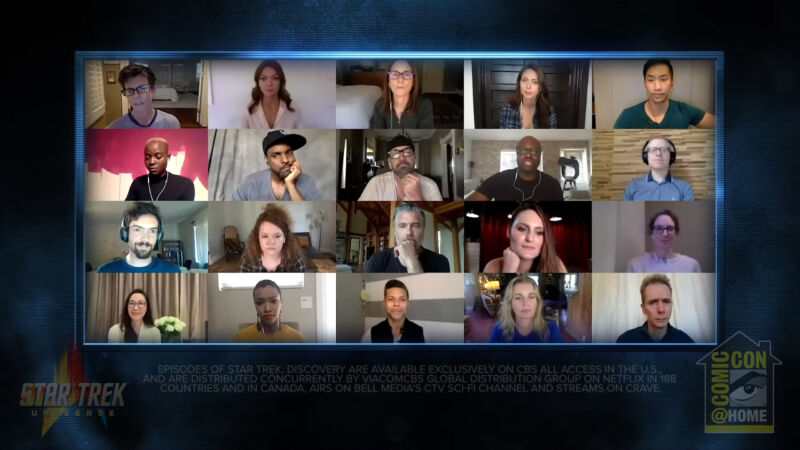
The panel included the cast and producers of Discovery doing a read-through of the first act of the season 2 finale, “Such Sweet Sorrow, Part 2.” The “enhanced” read-through included sound effects, effects shots, and storyboard images meant to bolster the actors as they delivered lines from their living rooms and home offices.

Even if the presentation didn’t look like a real episode of Discovery to the home viewer, it apparently sounded close enough: after the Star Trek Universe virtual panel began viewers began to lose access to the stream. In place of the video, YouTube displayed a content ID warning reading: “Video unavailable: This video contains content from CBS CID, who has blocked it on copyright grounds.”

After being blacked out for about 20 minutes, the panel was restored, and the recording of the virtual panel has no gaps in playback.

Obviously, CBS would not benefit from pulling its own marketing material offline on purpose; it seems most likely that software simply heard a match, made a match, and threw up a notice until a human could override and fix it. Unfortunately, it seems an array of media companies are each going to have to rush to correct the error in turn: two hours later, io9 reporter Beth Elderkin tweeted that a Cartoon Network panel livestream was pulled offline due to a copyright claim from Turner, Cartoon Network’s parent company.

https://arstechnica.com/?p=1694047


Bill and Ted Face the Music drops final trailer with a new release date

[embedded content]
Keanu Reeves and Alex Winter reprise their iconic roles in the final trailer for Bill and Ted Face the Music.

We finally have the official full trailer for Bill and Ted Face the Music, courtesy of Orion Pictures, plus a new release date: September 1, 2020. And for those of us who are skeptical that the majority of theaters will have opened their doors by then, the studio will be releasing the film simultaneously on demand. That’s most excellent news all around.

As we reported last month, in the original 1989 film, Bill & Ted’s Excellent Adventure, Bill (Alex Winter) and Ted (Keanu Reeves) are high school students in danger of flunking history. If that happens, Ted’s father will ship him off to a military academy, thus breaking up their band, Wyld Stallyns. But the band is destined to usher in a future utopia, which is now threatened. With the help of a time machine in the form of a phone booth—provided by Rufus (George Carlin), a messenger from the year 2688—the pair travels through history, meeting Socrates, Billy the Kid, Sigmund Freud, Beethoven, Genghis Khan, Joan of Arc, and Abraham Lincoln, among others.

The movie was a surprise hit, grossing $40.5 million against its modest $6.5 million budget. So naturally it spawned a sequel, Bill & Ted’s Bogus Journey (1991), in which the boys must defeat their evil robot doubles from the future to preserve the utopian society based on their ideals. Among the highlights: Bill and Ted must play a game against Death in order to free their souls and return to Earth to win the Battle of the Bands. It’s a clear nod to Ingmar Bergman’s The Seventh Seal (1957) where a man plays a game of chess in hopes of defeating Death. Bill and Ted challenge the Grim Reaper to Battleship, Clue, and Twister, easily winning every time.

The official premise describes the new movie:

The stakes are higher than ever for the time-traveling exploits of William “Bill” S. Preston Esq. and Theodore “Ted” Logan. Yet to fulfill their rock and roll destiny, the now middle aged best friends set out on a new adventure when a visitor from the future warns them that only their song can save life as we know it. Along the way, they will be helped by their daughters, a new batch of historical figures, and a few music legends to seek the song that will set their world right and bring harmony in the universe.

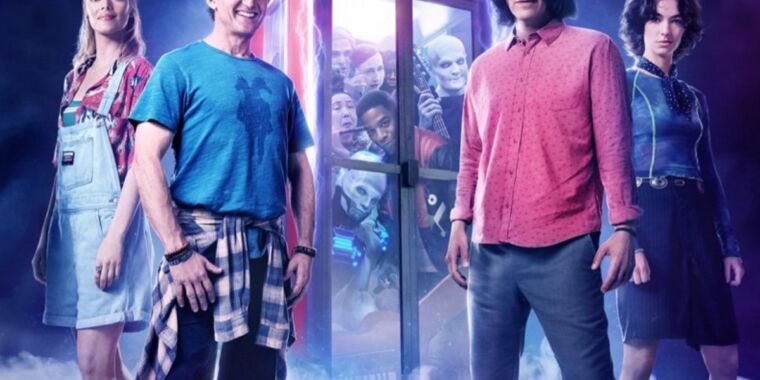
An official teaser dropped in June, giving us our first look at what the dynamic duo has been up to since their bogus journey. Answer: not much. They’re having a bit of a mid-life crisis, with Wyld Stallyns reduced to playing gigs “in Barstow, California, for 40 people, most of whom were there for two-dollar taco night,” as the future utopia’s Great Leader (Holland Taylor) observed. We got a brief glimpse of William Sadler’s Grim Reaper and Bill’s and Ted’s two daughters, Wilhelmina/Billie “Little Bill” Logan (Brigette Lundy-Paine, Bombshell) and Theodora/Thea “Little Ted” Preston (Samara Weaving, Ready or Not). Bill and Ted concoct a plan to travel to the future to steal the song that saves the world from themselves after they’ve already written it. (“How is it stealing if we’re stealing it from ourselves, dude?”)

The full trailer opens with Bill and Ted in marital counseling with their respective wives, Princess Joanna (Jayma Mays, Glee) and Princess Elizabeth (Erinn Hayes, Medical Police)—although as the therapist, Dr. Taylor Wood (Jillian Bell, Brittany Runs a Marathon), points out, joint couples therapy is probably not what the princesses had in mind.

Hal Landon Jr. returns as Ted’s father, Captain Jonathan Logan, this time chastising his son about his “delusions” of having traveled through time. “Here’s a real idea for you: be role models to your daughters! Get real jobs.” But the duo is tired of trying to unite the world after all these years; Ted in particular is feeling discouraged. That’s when Kelly (Kristen Schaal, Bob’s Burgers) arrives from the future in a cute egg transport to bring them to the Great Leader. The Great Leader informs them that they must perform an original song by Preston and Logan to save “reality as we know it.”

Note the wording there: a song by “Preston and Logan,” not necessarily Wyld Stallyns. Clearly, the daughters have a musical destiny, too. Billie and Thea realize their dads are in trouble and resolve to help them out. So while Bill and Ted travel to the future in their trusty old phone booth to steal the song they supposedly wrote from themselves, Billie and Thea use Kelly’s egg to travel through time collecting famous musicians throughout history to be in their band, including Kid Cudi (playing himself). Bill and Ted track down the Grim Reaper and find him playing hopscotch by himself (and cheating). And it looks like Billie and Thea, like their dads, get into a bit of trouble and wind up dead. And in hell. But otherwise, you know, they’re good.

Bill and Ted Face the Music will premiere on September 1, 2020 in select theaters (i.e., those that are open by then) and on demand.

Listing image by Orion Pictures

https://arstechnica.com/?p=1693861


Xbox’s July event: Halo Infinite finally has some first-party company

As the not-quite-E3 season of video game trailers comes to a close, Microsoft unveiled its biggest show of first-party force for its upcoming Xbox Series X console on Thursday. Hype began building for this event as soon as Microsoft confirmed plans to reveal Halo Infinite campaign gameplay, but the story was just as much about which new and familiar game series did (and didn’t) show up alongside Master Chief.

The event wasted no time getting to all things Halo, complete with a voiceover from the popular character Cortana narrating the reconstructing of the Master Chief armor set: “Liquid crystal cannot rise on its own.” Shortly after, we see Chief in a spaceship, piloted by the man who discovered Chief in last year’s cinematic trailer, as they argue about what to do next. “You’d still be out there if it wasn’t for me,” the man says. “I thought I was going home.”

“There won’t be a home if we don’t stop the Banished,” Chief replies. This detail is the first potential confirmation that a 4chan leak from last night was actually accurate, and the second indication came shortly after, once the reveal switched to live gameplay—and Chief is seen brandishing a grappling hook, which he uses to hook to a foe from a distance, zip directly into its face, and smack it with his fist. We also get a first glimpse ever at a Halo game with a built-in map, complete with marked mission locations—proving out years of rumors that Halo Infinite is likely an open-world adventure in the Halo-verse.

[embedded content]
Halo Infinite trailer

But otherwise, the demo sequence, which ran at an apparent 60fps, is everything you might hope for from a mainline Halo game: crafty AI that divides and conquers and an assortment of powerful weapons to beat them with (including at least one new UNSC rifle and one new alien-branded laser launcher). The demo concluded with the announcement of a release window of “Holiday 2020,” but nothing more specific than that just yet. (We were already warned that this event would not include release date info for the Xbox Series X.)

And if you’d like to know more about Halo Infinite, you’re in luck: I’ll be attending a special reveal event for the game behind closed virtual doors later today and will report back on my findings as soon as I’m able.

Every game shown will come to Game Pass

Xbox chief Phil Spencer confirmed that Halo Infinite, and every other game shown during the event, will debut as part of the paid Xbox Game Pass subscription service. Nearly all of the games shown are listed with Windows 10 versions, as well.

This includes:

Forza Motorsport: No release window for this one, and Spencer described this as a “work-in-progress,” suggesting that the popular Xbox-exclusive racing series won’t launch alongside Xbox Series X this year. Instead, we were treated to a sizzle reel that Spencer insisted was made entirely of in-engine footage, and it was rich with glossy real-time reflection effects and polygon-rich racing cars on the firmer racetracks of the “Motorsport” fork, as opposed to the open-nature driving of Forza Horizon. And, wouldn’t you know it, this one does not appear to be slated to launch on base Xbox One consoles!

Fable: Confirming one of the worst-kept rumors in all of British gaming history, Microsoft finally took the wraps off of the simply named “Fable,” developed by the team at Playground Games (best known for the Forza Horizon series). This reveal came in the form of a silly pre-rendered video in which a pixie flies around with hopeful, optimistic music and narration—before being swallowed by a frog. No gameplay was shown, so the reveal simply appears to be a statement of intent for the series’ return since Peter Molyneux’s Lionhead Games shut down so many years ago.

State of Decay 3: This non-gameplay sequence saw a woman hunting a deer in a snowy landscape, only to discover the deer in question is infected with some sort of zombie-like overgrowth.

<em>Everwild</em> is Rare's next adventure series.
Enlarge / Everwild is Rare’s next adventure series.

Everwild: Rare’s previously teased game received a cinematic sizzle reveal of cartoony, fantasy-hero characters doing apparently mystical stuff, like conducting a seance to bring a deer-like creature back to life.

Tell Me Why: Dontnod Entertainment, the team behind Life Is Strange, revealed a new narrative-driven story set in a small woodland town about a brother and a sister. The game will launch first on Xbox consoles and Windows 10, its first chapter will arrive on August 27, and it’s clearly designed for current-gen machines.

Ori and the Will of the Wisps: We got confirmation that this previously released game will jump to 120fps refresh rates on Xbox Series X.

Obsidian's next brand-new franchise, <em>Avowed</em>, sure looks like a first-person open-world RPG to us.
Enlarge / Obsidian’s next brand-new franchise, Avowed, sure looks like a first-person open-world RPG to us.

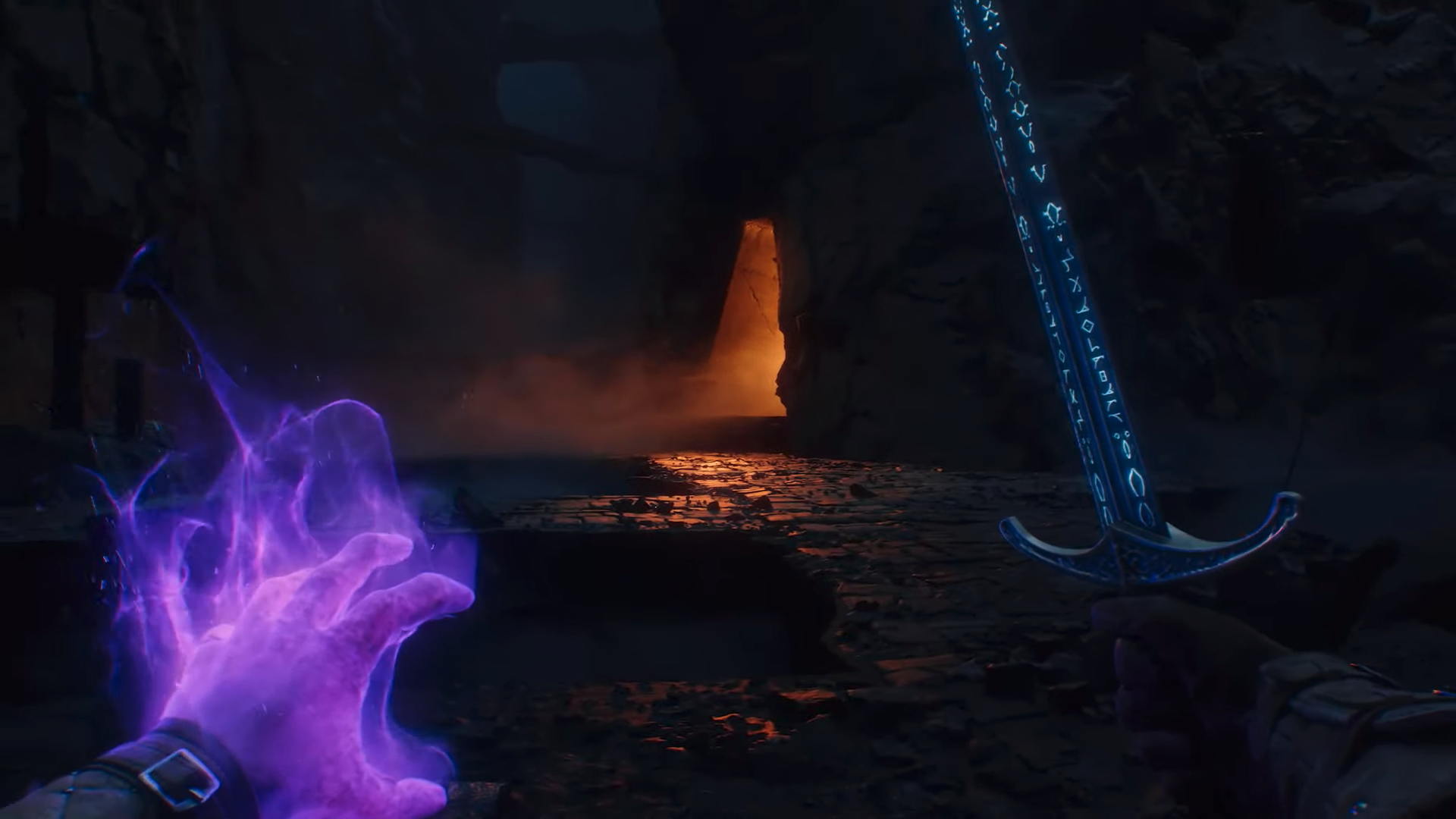
Avowed: Obsidian Entertainment teased its first Xbox-exclusive RPG after revealing previously announced fare, and the brief footage vaguely leans into obvious Skyrim-like inspirations.

Psychonauts 2: A trippy music-filled sequence (with Jack Black singing a new original song) showed the long-in-development game running at a crisp 60fps refresh, suggesting this is its Xbox Series X build. Sadly, however, this tease didn’t include any hint of a release date update.

[embedded content]
STALKER 2 sizzle trailer

STALKER 2, Warhammer 40,000: Darktide: Brief sizzle reels for each of these first-person follow-ups revolved around pre-rendered cut scenes, so it remains to be seen what’s to come for each.

Tetris Effect: Connected: This appears to be a “2.0” update to 2017’s stunning Tetris Effect, and it will remain an Xbox and Windows 10 exclusive for an undetermined period of time before coming to other platforms as a free update to the existing game. It adds the one thing I wanted in the original game: multiplayer, whether played locally or online. If you’ve never played this game in VR and have Game Pass Ultimate, rest assured, its Windows 10 version will include VR support.

<em>The Gunk</em>.
Enlarge / The Gunk.

The Gunk: Splatoon meets No Man’s Sky in this third-person adventure, which has you using a suction gun to clear evil goo and traverse a fantastically colored alien world.

Microsoft’s last attempt at an Xbox Series X gameplay reveal in May fell a bit flat, since it focused primarily on indie developers; its few “major” third-party entries consisted mostly of pre-rendered footage and unclear gameplay. Sony was keen to capitalize on this disappointment with a stunning June presentation of PlayStation 5 exclusives and reveals.

Listing image by Microsoft / 343 Industries

https://arstechnica.com/?p=1693897


Rocket League’s free-to-play transition is a red card for its Steam listing

Rocket League’s free-to-play transition is a red card for its Steam listing
Rocket League / Aurich Lawson

Sometime “this summer,” the popular car-soccer video game Rocket League will become fully free to play on all existing platforms. In order to pull this off, however, the game’s publishers at Epic Games are making a curious change to its PC version: it will be delisted from Steam.

If you have not already purchased the game’s existing PC version, priced at $19.99, the only way to claim its free version once it launches will be through the Epic Games Store. Tuesday’s announcement from game developer Psyonix did not include a firm estimate of when this “summer” switchover will happen, and Psyonix representatives did not confirm a time frame when asked directly by Ars—so if you don’t already own the game and feel wedded to Steam, consider this a final “summer” warning. Anyone who has already purchased the game on Steam will still be able to download and play the free-to-play version through that interface—and receive updates, patches, and access to existing content and unlocks.

“Long-term plans” are here today

Existing players on any platform (Steam, EGS, Nintendo Switch, PlayStation 4, Xbox One) who pay for and log in to Rocket League before its F2P transition the end of today, July 21, will receive a bundle of free “Legacy” content, mostly consisting of new and existing cosmetic options for the game’s roster of cars. (This means owners of the game’s disc version must log in ASAP to claim said goodies; after the switchover, your paid disc copy of the game won’t trigger any special status.) This includes a few packs of cars and decorations that used to be sold as traditional DLC, before Rocket League delisted all discrete DLC packs in favor of an in-game, Fortnite-like store full of limited-time sales options.

With this update, the game will add a form of cross-platform support for statistics, cosmetic purchases, unlocks, and more, all tied to an Epic Games account. Exactly how this will work, and how it will interface with the existing Steam version, remains unclear; “more details on account linking will be shared in the future,” Psyonix’s Tuesday update says.

Core gameplay appears to be unaffected by the free-to-play transition, since the most obvious changes with such a business model—a storefront full of cosmetic purchases, and a paid, cosmetic-filled “battle pass” progression system—have already been added to the game. The news follows Epic Games’ purchase of Psyonix roughly one year ago, which raised questions of whether the game might become an Epic Games Store exclusive on PC. At the time, the developers offered a vague assurance: “Rocket League remains available for new purchasers on Steam, and long-term plans will be announced in the future.”

Rocket League‘s original stratospheric spike in popularity arguably came because of a 2015 launch on PlayStation Plus—back when that paid subscription service offered brand-new indie games day-and-date with their retail launch. (The game languished when it previously launched as a PS3 indie, titled Supersonic Acrobatic Rocket-Powered Battle-Cars, in 2008.) PS Plus has since cooled on that promise of hot new indies; Xbox’s rival Game Pass service has largely picked up that mantle with its own bullish launches of first- and third-party games as part of its paid subscription.

This article has been updated with a correction about the game’s “Legacy” requirements.

https://arstechnica.com/?p=1693272


EA’s new $30 online-only game: An uphill slog in a free-to-play world

Roughly 20 years ago, online-only video games became a significant force in retail. You could expect boxed games, ranging from $30 to $60, to revolve entirely around things like versus-deathmatch arenas or MMO quests. That, obviously, has changed on modern PCs and consoles.

But what happens when a game publisher in 2020 tries to go back in time and charge $30 for one of these things? Can a paid, online-only game work in the modern, free-to-play marketplace?

We don’t get a conclusive answer from Rocket Arena, which EA released last week on PC, PS4, and Xbox One for $30. There may very well be a brand-new game in this era that’s up to the task, but this one is more of a cautionary tale.

Which Rocket Arena? Did you mean Rocket League?

[embedded content]
EA’s version of Rocket Arena, not to be confused with the Quake mod of old.

Because this is Ars Technica, we must start by differentiating this new game’s name from the popular, long-running mod of the same name. “Rocket Arena” is also the name of a fun 1v1 tweak for games like Quake III Arena that gives two players every possible weapon at the start of a match, then places them in a high-speed duel. Apparently, that mod’s name was never trademarked, and this new game’s developers at Final Strike Games swooped in to nab it in 2017.

From here on out, any italicized mention of Rocket Arena refers to the new 2020 game. And, yes, before hitting “publish,” I had to make sure I didn’t accidentally type Rocket League, the name of a wildly successful 3v3 car-soccer game.

EA’s new game, admittedly, leans more into the title as a concept, because it revolves almost entirely around rocket launchers as weapons. Pick from 10 combatants, each with their own specialized rocket launcher as a primary weapon, and jump into 3v3 online battles. There’s zero offline mode to speak of beyond a simplistic practice mode; if you want to fight the game’s AI, there’s an online option, tucked into a few menus.

Things begin awkwardly thanks to the tutorial’s focus on “rocket jumping.” For the uninitiated, classic Quake games revolve around the idea of blasting yourself to a higher jump by launching a rocket at your feet. This high-speed maneuver comes with a damage tradeoff: jump farther, take blast damage. In Rocket Arena, nobody can hurt themselves, and this fact, coupled with the tutorial’s insistence that you learn the move to climb up walls, might make you think the whole game is a blast-to-jump movement frenzy.

Trouble is, the EA game’s versus arenas are mostly open-air battlegrounds with floating platforms, not corridor-lined Quake maps of old; there’s rarely an organic wall or corner to bounce yourself off of for any strategic reason. Worse, you might hope that a rocket jump would offer a useful speed boost across these maps, since the game’s modes emphasize movement (which I’ll get to). But these bounces offer the same speed as the built-in “triple jump” mechanic. So… why all that emphasis on rocket jumping?

Didn’t I already pay?

Before the game tries to answer that question, however, Rocket Arena slaps you across the face with an interface that looks straight out of Fortnite. Buy new outfits! Buy a battle pass! Buy decorations for your “totem,” a flag that briefly appears between matches. The ways Rocket Arena nudges you to spend real-world money, after you’ve already paid $30 to start the game, would be hilarious if they didn’t feel like a slap in consumers’ faces.

Had the UI been redesigned to reflect how the in-game economy works, EA might have left a different impression. A first-time player can rack up a ton of in-game currency by simply playing one match with each of the 10 characters, which can be spent on certain cosmetic unlocks. What’s more, a majority of the launch game’s cosmetic options can only be earned via gameplay. And once you’re in the game, all of the modes are available; no gameplay is gated behind further payments.

Maybe, just maybe, EA should have removed all ties to real-world money in its “launch” period, thus forcing players to explore how the natural act of playing the game leads to new outfits and decorations… before trying to squeeze us all for a few more bucks.

Characters without character

Let’s say EA somehow straightened its messaging about money and respected players. Is there a game worth recommending here? Almost.

Rocket Arena offers a few versus modes, all broken down to 3v3 faceoffs. Two of these modes offer traditional versions of team deathmatch and king-of-the-hill; two offer slightly unusual spins on capture-the-flag and zone control; and the last one is a “horde” mode against waves of AI baddies. (Without any adjustable difficulty or other options for RA‘s horde mode, however, I cannot recommend it.)

The trouble begins with a cast of 10 characters who are clearly not designed to shine in every mode. One example is Plink, the preteen wiz-kid who can absolutely lay waste to foes thanks to his default barrage of mini-rockets that kinda-sorta home in on targets. Should you need to move the “rocketball” (this game’s version of a flag) from one side of an arena to another, he’s not up to snuff, as his “teleport” ability isn’t a movement-tech option. But he’s an imbalanced damage machine who can instantly turn the tide in a round of team deathmatch. Worthless in some modes; imperative in others.

A good “hero shooter” works when its range of classes encourage teamwork and coordination, and thus make any team framework viable in any mode. But Rocket Arena‘s mechanics revolve around doing damage and picking up temporary items scattered across the map (speed boosts, throwable bombs), not setting up things like buffs or zone-control augmentations. Out of the 10 combatants, only two have the ability to conjure “shields” of any kind, and only one of these shields benefits teammates by slowing down enemies’ attacks in a certain zone. (Rocket Arena buries this issue, in part by not letting players tap a single button to review character abilities before or during a match.)

At launch, I’ve only had success with characters who pile on the damage, like Plink and the doesn’t-have-to-reload pirate Blastbeard, and the super-fast character Rev for the sake of objective-based modes. I’ve had zero fun experimenting with less capable damage-dealing options.

Listing image by Electronic Arts

https://arstechnica.com/?p=1692872


By the sword: Cursed is an inventive remix of classic Arthurian legend

A young fey woman with magical gifts finds herself hurtling toward a tragic destiny in Cursed, the latest re-imagining of Arthurian legend, this time from the perspective of the Lady of the Lake. The 10-episode Netflix series is an adaptation of the young adult novel of the same name, written by Tom Wheeler and illustrated by none other than the legendary Frank Miller (Sin City, 300, The Dark Knight Returns).

(Only the mildest of spoilers and no major reveals below.)

As we reported last month when the trailer dropped, the YA novel was published last year by Simon & Schuster—with eight full-color and 30 black-and-white original illustrations, making it a collector’s item for diehard Miller fans. Wheeler is a well-known screenwriter, producer, and showrunner, with such credits as Empire (ABC) and The Cape (NBC), as well as the Oscar-nominated Puss in Boots and The Lego Ninjago Movie.

The subject matter might seem like an unusual choice, particularly for Miller, whose large body of work has dealt with darker, decidedly adult themes. But Miller is no more immune to the power of Arthurian legend to ignite the imagination than the rest of us, first falling in love with the stories when he saw Walt Disney’s animated Sword in the Stone (1963) in his youth. “This has always been a mythology and a storyline I’ve been fascinated with,” he told Ars.

Wheeler, too, had long dreamed of coming up with a fresh angle on Arthurian legend and leapt at the chance to work with Miller on the project. “Arthurian legend is the original fantasy world, impacting everything from Star Wars to The Lord of the Rings,” he told Ars. “So the idea of playing in that sandbox and seeing these characters through a Frank Miller lens was ridiculously appealing to me. It freed us up to think about these characters in new and dynamic ways. We definitely wanted to bring something original to the party.”

They certainly had a rich trove of material to mine for their project; there are so many different legends relating to the central character, spanning centuries. And since Arthur’s origins have been the focus of most popular-culture interpretations, Wheeler and Miller chose to focus instead on the Lady of the Lake, most commonly known as Nimue in the lore. (There are many variants, both in the spelling of the name and with regard to the character, since writers have been inventing new Arthurian stories for centuries.)

“We thought we could approach this through the eyes of a young woman, seizing her destiny and wielding the sword herself,” said Wheeler. “I haven’t heard that version of this story.”

Wheeler and Miller finished writing and illustrating the book as they were developing the series, and they served as executive producers on the latter. So this is less a typical TV adaptation of the YA novel than a cross-pollinating collaboration, with book and TV series development feeding into each other.

Per the official premise:

Based on the New York Times bestselling book, Cursed is a reimagining of the Arthurian legend, told through the eyes of Nimue, a young woman with a mysterious gift who is destined to become the powerful (and tragic) Lady of the Lake. After her mother’s death, she finds an unexpected partner in Arthur, a humble mercenary, in a quest to find Merlin and deliver an ancient sword. Over the course of her journey, Nimue will become a symbol of courage and rebellion against the terrifying Red Paladins, and their complicit King Uther. Cursed is a coming-of-age story whose themes are familiar to our own time: the obliteration of the natural world, religious terror, senseless war, and finding the courage to lead in the face of the impossible.

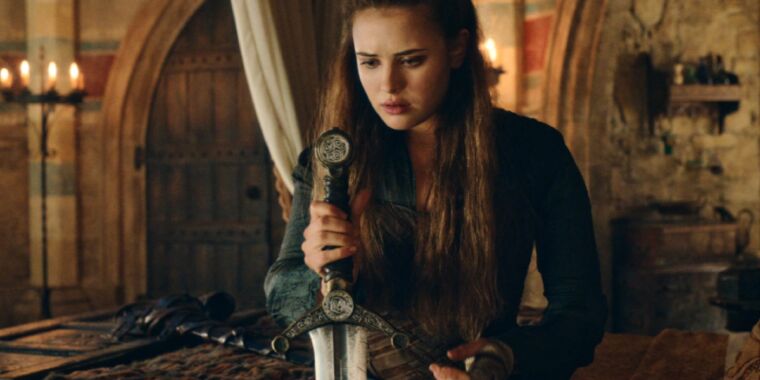
The Wheeler/Miller take is an inventive remix of some of the key elements and characters from Arthurian legend. Katherine Langford (13 Reasons Why) stars as Nimue, who is viewed with suspicion by her own fey people, thanks to a mysterious childhood incident that left her scarred. The show also stars Devon Terrell (Barry) as Arthur, a mercenary with a heart of gold; Gustaf Skarsgård (Westworld) as Merlin, who is shielding the loss of his powers from the king he serves; Daniel Sharman (Fear the Walking Dead) as the Weeping Monk; Peter Mullan (Ozark) as Father Carden, leader of an extremist religious sect called the Red Paladins; Lily Newmark (Pin Cushion) as Nimue’s childhood friend, Pym; Shalom Brune-Franklin (Our Girl) as Igraine; Sebastian Armesto (Broadchurch) as King Uther Pendragon; Matt Stokoe (Bodyguard) as Gawain; Emily Coates (Flack) as Iris; and Billy Jenkins (The Crown) as Squirrel, a young orphan boy from Nimue’s village.

“If you want to have a meeting, go bananas, fill a cafeteria with medieval weaponry, and set Frank and me loose.”

The book’s illustrations are stunning, as one might expect—and there are callbacks to that art in sketches woven between scenes in the TV series—although the style is quite different from some of Miller’s best-known prior work. For inspiration, he drew on his lifelong love of classic children’s book illustrations, most notably the work of Arthur Rackham, a giant of the Golden Age of British book illustration. Rackham created pen-and-ink drawings often augmented with watercolors.

“So I pulled out my oldest tools and set about trying to draw in the older ways, no etching or anything,” said Miller. “It’s been an exploration of older styles than the ones I’ve generally been using.”

Miller also found inspiration from the costumes and props designed for the series—another advantage to wrapping both projects simultaneously. The prop team would load up a table with swords and various medieval weaponry and, on one memorable occasion, medieval dentistry tools, to the delight of both Miller and Wheeler. “If you really want to have a meeting, go completely bananas, fill a cafeteria with medieval weaponry, and set Frank and me loose,” Wheeler said. “We were supposed to be working, but there was also a lot of, ‘Frank, come check out this flail!'”

Cursed is a breezy, fast-paced page-turner of a book, and the series brings that same energy to the screen, making this an easily bingeable weekend treat. There are a lot of characters and subplots, but they are all generally easy to follow—it’s certainly less complicated than, say, the three different timelines in The Witcher. The series finale leaves some key narrative threads open, setting up a potential second season, although Netflix has yet to announce a renewal. “There is still a lot more story to tell,” said Wheeler. “I know we’d love to tackle it again. In some media form, we will, and we hope we can do it in all of them.”

Cursed is now streaming on Netflix.

[embedded content]
Behind the scenes of Cursed.

Listing image by Netflix

https://arstechnica.com/?p=1692283


Can Xbox One continue on as gaming’s “low-end” console option?

For months now, Microsoft has been talking up the raw power increase coming to consoles courtesy of the Xbox Series X. At the same time, though, Microsoft is encouraging internal and external studios to make Series X games that continue to work on seven-year-old Xbox One hardware as well.

“As our content comes out over the next year, two years, all of our games, sort of like PC, will play up and down that family of devices,” head of Xbox Game Studios Matt Booty said in a January interview with MCV. “We want to make sure that if someone invests in Xbox between now and [Series X] that they feel that they made a good investment and that we’re committed to them with content.”

Does that mean developers will have to hold back their truly “next-generation” ideas to accommodate players with outdated consoles? Microsoft’s Head of Xbox Phil Spencer doesn’t think so. In an interview with GamesIndustry.biz last week, Spencer also referenced the PC gaming ecosystem as an analogy to explain how support for the Xbox One would continue to work:

I just look at Windows. It’s almost certain if the developer is building a Windows version of their game, then the most powerful and highest fidelity version is the PC version. You can even see that with some of our first-party console games going to PC, even from our competitors, that the richest version is the PC version. Yet the PC ecosystem is the most diverse when it comes to hardware, when you think about the CPUs and GPUs from years ago that are there.

Is the Xbox One akin to a 2013 PC?

For PC gamers, there’s some inherent comfort in the idea of the Xbox One as the new “minimum spec” target for developers in the console space. But that idea got us thinking: would seven-year-old hardware still be considered minimally acceptable in the PC gaming world?

To test that theory, we took a trip down memory lane and revisited our November 2013 Ars system guide, which gave our best recommendations for low-, medium-, and high-end PC builds at the time. For our relative Xbox One comparison, we used the midrange “Hot Rod” box, which had a Radeon R9 280X GPU and 8GB of RAM. That system cost about $1,400 in late 2013, or closer to $1,000 without the monitor, speakers, mouse, and keyboard.

To see if that system would hold up today, we compared it to the minimum and recommended specs for a variety of recent and upcoming high-end PC games. To make relative comparisons between our build and today’s developer-suggested specs, we compared the clock-speed and number of cores for the CPUs and use 3DMark’s “Fire Strike” benchmark scores for the GPUs. For RAM, we simply compared the amounts directly.

Minimum specs for modern games vs. 2013 Ars “Hot Rod” build

CPU *Clock *Cores GPU *3DMark RAM
Ars 2013 system i5-4570 3.2Ghz 4 R9 280X 8221 8GB
Resident Evil 3 i5-4460 3.2Ghz 4 R7 260X 3481 8GB
Doom Eternal i5 3.3Ghz 4 R9 280/290/470 7325 8GB
Ori and the Will of the Wisps i5-4460 3.2Ghz 4 R7 370 8053 8GB
Death Stranding i5-3470 3.2Ghz 4 RX 560 6522 8GB
Control i5-4690 3.5Ghz 4 R9 280X 8221 8GB
COD: Warzone i3-4340 3.6Ghz 2 HD 7950 7349 8GB
F1 2020 i3-2130 3.4Ghz 2 HD7750 2095 8GB
Horizon Zero Dawn i5-2500K 3.3Ghz 4 R9 290 11156 8GB
Half-Life Alyx i5-5700 2.6Ghz 4 RX 580 10570 12GB

The results of this quick-and-dirty analysis show that Spencer is more or less correct; PC developers are still tuning their games to midrange hardware from 2013 when it comes to “minimum” specs. Games from Doom Eternal to Horizon Zero Dawn only require the 8GB of RAM and i5 CPU class that we recommended for our build way back then. In terms of GPUs, the R9 280X we recommended gets a score of 8221 from 3dMark’s Fire Strike, which meets or surpasses the 3DMark scores of the “minimum” GPUs needed for the games we looked at.

The one major exception to this general rule is virtual reality. A high-end VR game like Half-Life Alyx requires a full 12GB of RAM and a Radeon RX 580, both of which easily outclass our mid-range 2013 build. But if you’re investing in tethered virtual reality these days, you’re probably not content with a circa-2013 PC tower anyway.

Recommended specs for modern games vs. 2013 Ars “Hot Rod” build

CPU *Clock *Cores GPU *3DMark RAM
Ars 2013 system i5-4570 3.2Ghz 4 R9 280X 8221 8GB
Resident Evil 3 i7-3770 3.4Ghz 4 RX 480 11353 8GB
Doom Eternal i7-6700K 4Ghz 4 RX 480 11353 8GB
Ori and the Will of the Wisps i5-6600K 3.5Ghz 4 RX 570 13194 8GB
Death Stranding i7-3770 3.4Ghz 4 RX 590 14037 8GB
Control i5-7600K 3.8Ghz 4 RX 580 11564 16GB
COD: Warzone i7-9700K 3.6Ghz 8 R9 390 / 580 10420 16GB
F1 2020 i5-9600K 3.7Ghz 6 RX 590 14037 16GB
Horizon Zero Dawn i7-4770K 3.5Ghz 4 RX 580 10570 16GB

While our seven-year-old system is still minimally acceptable for PC gaming, it is well below the “recommended” standard most developers are setting for modern titles. Four of the eight games we looked at now suggest 16GB of RAM as a recommended spec, for instance, rather than the 8GB that sufficed in 2013. And the i5 processor in our old build is a bit underpowered compared to the i7 processors that are recommended these days (though that difference might not be very noticeable for games that aren’t CPU-limited).

That 8221 3DMark score for our R9 280X isn’t looking that great these days, either. High-end games today recommend GPUs that generally score in the 10,000 to 14,000 range on that benchmark. Trying to get even midrange performance from our seven-year-old GPU on today’s titles is going to be a struggle, to say the least.

What it means for Xbox

Just as a seven-year-old “average” PC can still get over the bar for “minimal” modern PC gaming, an Xbox One should still serve as a minimal console gaming solution for the time being. And while Xbox One versions of new titles won’t be able to take advantage of advances like the Series X’s Velocity Architecture, developers should be able to target the older hardware for now.

The question, then, becomes what the future will hold. Our 2013 gaming rig will almost certainly fail to hit developers’ minimum spec targets sometime in the next few years. Similarly, supporting the aging Xbox One hardware will start to look like a pretty silly idea for console game developers sometime in the near future, no matter how much Microsoft encourages cross-generational compatibility.

Spencer acknowledged this to some extent in his recent GI.biz interview:

Yes, every developer is going to find a line and say that this is the hardware that I am going to support, but the diversity of hardware choice in PC has not held back the highest fidelity PC games on the market. The highest fidelity PC games rival anything that anybody has ever seen in video games. So this idea that developers don’t know how to build games, or game engines, or ecosystems, that work across a set of hardware… there’s a proof point in PC that shows that’s not the case.

Of course, once our 2013 PC becomes more or less “obsolete” for gaming, the owner can simply add more RAM or a new GPU for a relatively cheap service upgrade that could last for years. In the case of the Xbox One, gamers instead will have to start over with a relatively high-end new Series X. The Xbox One X could serve as a cheaper stopgap, perhaps, but Microsoft’s recent discontinuation of that mid-generation hardware suggests it doesn’t want customers considering that upgrade option for long.

All told, the console upgrade cycle has always worked something like this, with older hardware slowly phased out in favor of a new de facto standard over a few years. With the extreme cross-generational focus in the current Xbox family, though, the analogies to the multi-level PC gaming space are getting more and more explicit.

https://arstechnica.com/?p=1692557


Xbox Series X won’t support Kinect hardware, games

Always watching. Top to bottom: PlayStation Eye (PS3), Playstation Camera (PS4), Xbox 360 Kinect, Xbox One Kinect.
Kyle Orland

Roughly one year ago, Microsoft revealed the Xbox Series X (then referred to as “Project Scarlett”) in part by highlighting the system’s extensive backward compatibility: “Your games, your achievements, your progression, your accessories, your console experience with Xbox: it all comes forward with Scarlett.” Today, though, the company emphasized one slight exception to that general backward-compatibility rule: Kinect hardware and the games designed for it.

“It’s our intent for all Xbox One games that do not require Kinect to play on Xbox Series X at the launch of the console [emphasis added],” Microsoft Head of Xbox Phil Spencer wrote in a sentence buried in an extensive blog post about the company’s Xbox plans (including coming xCloud integration with Game Pass). Spencer later confirmed and clarified that statement to The Verge, saying point-blank that “[t]here’s no way for Kinect to work” on the Series X. In a sense, today’s confirmation isn’t a big surprise. We’ve known for months that the Series X is missing the proprietary Kinect port found on the original Xbox One (which was also removed from 2016’s Xbox One S and 2017’s Xbox One X). But Microsoft offered a USB adapter for the Xbox One edition of the Kinect until 2018, and third-party accessory makers still offer similar USB solutions for the hardware (the Xbox 360 version of Kinect was designed for USB but required an included power adapter to work with older versions of the console).

It probably wouldn’t have taken too much work to simply let those adapters work with the Xbox Series X as well. But that would have meant emulation development, testing, and support work that Microsoft likely isn’t interested in undertaking for a device that it hasn’t produced since late 2017 and hasn’t bundled with the Xbox One hardware since 2014.

In practice, the lack of Series X Kinect support only affects a few dozen games from the Xbox One’s library of hundreds of titles. Of those, the ever-popular Just Dance series is likely to be the one still in active rotation among many Xbox players, but those games have let players use a smartphone as a controller for years now.

Elsewhere in the blog post, Microsoft clarifies that specialized Xbox One inputs like the Xbox Elite Controller and Xbox Adaptive Controller will still work with the Series X, which is probably more directly relevant to more Xbox One users. But we’re still a little bummed that Microsoft’s admirable commitment to “full” backward compatibility is leaving out one of the Xbox’s most unusual and memorable accessories.

https://arstechnica.com/?p=1692409