Ahead of this holiday season’s new Xbox Series X console launch, Microsoft has confirmed a surprising change on the production side: the discontinuation of two existing Xbox One console versions.
Following a report from The Verge, Xbox representatives confirmed directly to Ars Technica that the company will no longer produce either 2017’s Xbox One X or 2019’s Xbox S All-Digital Edition. The company described this discontinuation as “the natural step of stopping production” due to “ramp[ing] into the future with Xbox Series X,” only to then confirm that an older version of the console, 2016’s Xbox One S, will still be produced worldwide.
“Gamers can check with their local retailers for more details on Xbox One hardware availability,” an Xbox rep said to Ars Technica. So if you’re interested in the Xbox One X, now might be the time to snap one up.
This news follows recent rumors that retailers had seen discontinuation notices for the Xbox One X, which firmed up as early as this morning with notices going out to Australian retailers.
Did better than Wii U, at least
Depending on the console or era in question, the question of when a console “generation” is put to rest is wildly variable. In recent memory, the woeful Wii U saw its production lines shut down before its successor appeared, while PlayStation 3 and Xbox 360 production continued well into their successors’ lifespans. (PlayStation 2 may have lasted longest of all, at 13 years.)
But the case of Xbox One is curious, thanks to Microsoft’s bullish “cross-generation” sales pitch. The idea being, so long as you have an Xbox One, you can expect to play Microsoft’s first-party fare for the foreseeable future, with more features and power available depending on how much you want to spend on the console itself. Xbox One X could have been positioned for the foreseeable future as a “mid-grade” option for those who want to play upcoming first-party games, particularly Halo Infinite, with perks like 4K resolution but fewer high-end features like SSD seek speeds or higher frame rates.
Does today’s news mean Microsoft leaves new Xbox console buyers without an option between the dated Xbox One S and the monstrous, assumedly expensive Xbox Series X? The answer may lie in the rumors of an “Xbox Series S,” codenamed Lockhart. This rumored console version is allegedly positioned to offer next-gen benefits like a new CPU and the “Velocity” architecture, while also downgrading those perks from 4K resolution to 1080p—which may very well be a more future-proofed “mid-grade” option once Xbox Series X exists.
Slow down a second
But before Microsoft goes so far as to confirm over a year of Lockhart-related rumors, we’re still waiting to hear firm details about this holiday season’s Xbox Series X console launch, particularly the date and price tag. Today, we learned that next week’s Xbox game-reveal event (dated Thursday, July 23) will not include “business, devices, or similar news,” so we’re not likely to get any more Series X or Lockhart answers by then.
Sleek, sexy Brave New World is the crown jewel in Peacock’s launch offerings
Welcome to New London, a utopian society where everybody knows their place.
Everyone is happy because everyone knows their place.
YouTube/NBC Peacock
Can’t really argue with that spectacular view.
Jessica Brown Findlay plays the young and beautiful Lenina Crowne, a Beta Plus.
Lenina’s fellow Beta and BFF is Frannie (Kylie Bunbury).
NBC Peacock
Party time!
YouTube/NBC Peacock
Promiscuity is not only tolerated—it’s encouraged. But pregnancy is taboo.
YouTube/Peacock
Regular doses of the drug soma keep citizens docile and compliant.
YouTube/Peacock
Harry Lloyd plays Alpha Plus Bernard Marx, who enjoys a position of highest privilege.
NBC Peacock
Hannah John-Kamen plays a gender-swapped Wilhelmina “Helm” Watson.
NBC Peacock
Nina Sosanya plays a gender-swapped Mustafa Mond.
YouTube/Peacock
Conformity is rigorously enforced.
YouTube/Peacock
Bernard is secretly in love with Lenina.
YouTube/NBC Peacock
Lenina’s feelings for Bernard are more complicated.
YouTube/Peacock
The Director (Ed Stoppard) might be harboring a secret.
YouTube/NBC Peacock
A savage man ignites chaos in a seemingly perfect utopian society in Brave New World, the flagship original series on NBC’s Peacock streaming service, which launches today. It’s an adaptation of Aldous Huxley’s classic dystopian novel of the same name, suitably updated for these 21st century times. This Brave New World is a sleek, sexy, and ambitious series with strong performances and impressive CGI that feels more akin to Westworld than Huxley’s novel, particularly in its philosophical underpinnings. And ultimately it provides an engrossing story of the pain of love and the human condition.
(Some spoilers below, but no major reveals.)
The novel Brave New World is set in the year 2540, in the World State city of London, where people are born in artificial wombs and indoctrinated through “sleep-learning” to fit into their assigned predetermined caste. Citizens regularly consume a drug called soma (part anti-depressant, part hallucinogen) to keep them docile and help them conform to strict social laws. Promiscuity is encouraged, but pregnancy (for women) is a cause for shame. Needless to say, both art and science (albeit to a lesser extent) are viewed with suspicion.
“Every discovery in pure science is potentially subversive,” Resident World Controller of Western Europe Mustapha Mond tells the novel’s antihero protagonist, John the Savage. “Science is dangerous; we have to keep it most carefully chained and muzzled.”
John is the illegitimate son of a high-level government official, born and raised on the Savage Reservation, where people still give birth, age naturally, and generally represent the opposite of the World State’s carefully controlled ideals. His only education has been the complete works of Shakespeare. (The novel’s title references a line by Miranda in The Tempest.) When John and his mother, Linda, find their way back to the World State, he initially becomes a cause célèbre but struggles to adapt to the new social mores. Specifically, he falls in love with a young woman named Lenina Crowne but can’t deal with her promiscuity and sexual forwardness. He ultimately isolates himself from society in hopes of purging himself of “sin.” Things don’t end well for anyone.
There are some changes from the book, as one might expect when adapting a novel from 1932, but showrunner David Wiener strove to remain true to the heart and soul of the source material. “Huxley was afraid that people would become so sexually stimulated, so pharmacologically numbed, so distracted by media and entertainment that they wouldn’t look inside themselves, or at the world around them in any analytical way,” he told Ars. “It was really important to keep that at the core of the story.”
Some of the most significant changes pertain to science and technology. The citizens of New London are genetically tailored to their castes (nature), whereas in Huxley’s novel, they are carefully conditioned (nurture). Everyone still takes soma to cope, but they are also all inter-connected—via optical implants—to a central AI known as INDRA that regulates the society. “Huxley envisions bioengineering, IVF, contraception, all these things that were decades away,” said Wiener. “But he couldn’t possibly predict how computers and social media would evolve as part of our lives. Unlike a lot of speculative fiction, what Huxley was worried about has only become more true since he wrote the book. I think if you had told him about social media, he would’ve been, like, ‘Wow! Yeah, perfect.'”
The Savagelands are the antithesis of New London.
YouTube/Peacock
Things are a bit less shiny there.
YouTube/Peacock
Alden Ehrenreich plays John the Savage.
NBC Peacock
John’s mother, Linda (Demi Moore), a former Beta Plus, finds a way to get them both back to New London.
NBC Peacock
John’s progress in being assimilated is moving slowly.
YouTube/NBC Peacock
Socially awkward much?
YouTube/NBC Peacock
Across a crowded orgy….
YouTube/NBC Peacock
Bernard deals with a disturbingly violent intrusion into New London’s blissful existence.
YouTube/NBC Peacock
Meanwhile, Lenina questions whether constantly being dosed with soma is a good idea.
YouTube/NBC Peacock
Mustapha Mond senses trouble in paradise.
YouTube/NBC Peacock
John falls in love with Lenina.
YouTube/Peacock
This optic device plugs the wearer into the collective AI, INDRA.
YouTube/Peacock
John might be an agent of chaos.
YouTube/NBC Peacock
Mond knows that cracks can spoil utopian perfection.
YouTube/NBC Peacock
Wiener chose to center his narrative arc on the love triangle of Bernard (Harry Lloyd, who frankly walks away with the whole series with his searing performance), Lenina (Jessica Brown Findlay), and John the Savage (Alden Ehrenreich), fleshing out Huxley’s original characters in some intriguing ways. For instance, rather than evincing an old-fashioned prudery, as in the novel, this John is much more open, almost enthusiastically so, to all the sex and soma—at least until he falls for Lenina and the inevitable jealousy sets in. And his love for Shakespeare has been replaced with a love for music. “The music really resonates in the show and becomes a part of the storytelling, and that was definitely a happy accident,” said Wiener.
Findlay’s Lenina is much more complex in the series—a welcome change from the book, where she is (to my mind) annoyingly under-developed. Book Lenina’s passivity is in keeping with her Beta Plus status, but it doesn’t make for a compelling character by 21st century standards. “She doesn’t change a lot in the book; her perspective and concerns are the same at the end as at the beginning,” said Wiener. “In our version, she’s our lens into the story, and is probably the character who changes the most over the course of the season.”
The populace of New London is more diverse, even though the class hierarchy is still strictly enforced. Most notably, the central characters of Mustafa Mond (Nina Sosanya) and Bernard’s best friend Wilhelmina “Helm” Watson (Hannah John-Kamen) have been gender-swapped. (In the book, Bernard’s BFF is Helmholtz Watson.) “I think it would have felt odd to have everybody in power be male or white,” said Wiener. “We wanted to make a utopia that looked like something we would envision as a better place than the one we have here.” Making Helm a woman, in particular, subtly shifts the character’s friendship with Bernard. “It’s a really interesting dynamic, given how New Londoners deal with sex,” said Wiener. “But that isn’t the vibe between Bernard and Helm. There’s a lot of sincere love there.”
So. Many. Orgies.
Helm is also not a writer and literary academic, as in the novel, but a kind of futuristic DJ whose job is to use haptics to simulate sensory experiences during the many (so many!) orgies. She calls them “feelies” and explains to John that she believes she is telling a sensory story with her art in one of the standout scenes. His response: “That’s not a story.” He then proceeds to tell her a scary old folk tale his mother, Linda (Demi Moore), used to tell him as a child in the Savagelands. Helm is enthralled—and ultimately transformed—particularly after she taps into John’s brain and allows herself to experience real, raw, complicated emotion for the first time, rather than dulling unpleasant emotions with soma.
“Every bush, every tree, every water fountain, every pane of glass is CGI.”
NBC clearly poured a lot of money into this series, and it shows in the stunning production values. For VFX supervisor Tom Horton, the biggest challenge was creating a sci-fi utopian world that was distinctive from the many, many futuristic depictions that have come before. As a touchstone, he focused on the lack of history in New London. “It’s a world of what I call spontaneous creation,” he told Ars. “Most worlds have evolved in some way: street systems, societies, social networks. That wasn’t the case here. Everyone in this world was created for a specific role.”
Because of that, Horton ruled out several architectural styles firmly rooted in the past and ended up adopting a brutalist aesthetic, offset with carefully manicured gardens and greenery. There are a lot of circles and curves, in stark contrast to our own emphasis on squares—a recurring visual theme throughout the series.
When it came to actually building the city, Horton took the unusual step of hiring an architect to handle the urban planning for their New London design. That meant thinking hard about apartment floor plans and how people might use the space—a level of detail not typical of most TV productions—as well as transport systems, public spaces, leisure and retail areas, gardens and so forth. Then Horton and his team took that plan (summarized in a massive 100-page document) and devoted their energies to rendering the 3D city. “The city is entirely CGI,” he said. “It’s not map painting. Every bush, every tree, every water fountain, every pane of glass is CGI.”
That meant employing a lot of blue screen, particularly for office sequences and scenes within New London’s Bureau of Stability. But for the first two episodes, Horton and his team relied on the same LED technology used on The Mandalorian. For instance, for the scene where actors take a train ride through the city, Horton’s crew mounted LED screens against the train window and digitally rendered the cityscapes viewed through that window as the train went from the station, into a tunnel, and out and around New London.
For all the technical wizardry, however, the emphasis was always on the characters and story. “Admittedly, there are some big visual effects, but we tried to make sure they didn’t overwhelm the narrative,” said Horton. “The constant mantra was that the visual effects had to be incidental, the better to reveal all of the great conflict arising from these really intimate relationships.”
Brave New World is now available on the newly launched Peacock streaming service.
https://arstechnica.com/?p=1691155
Microsoft details how Xbox Series X will load 4.8GB/s from memory
The system-on-a-chip at the heart of the system.
Overhead view.
A model of the airflow “vortex” helping to cool the long rectangular Series X chassis.
This image is labeled as a “vapor chamber,” which we can only assume is used for cooling.
The chassis used to mount the Series X boards.
The bulk of the speed increase, as Microsoft has said before, comes from the system’s use of NVMe SSD memory, rather than the much slower-spinning hard drives of past consoles. That gives the system “2.4 GB/s of raw I/O throughput,” Microsoft says, though we’ve noted previously it will also likely make expanding that memory past the built-in 1TB default more expensive.
To extend that speed even further, Microsoft says it’s expanding on the “industry standard LZ decompressor” with “a brand new, proprietary algorithm specifically designed for texture data named BCPack.” This hardware-accelerated texture-unpacking algorithm can be run in parallel with the standard LZ decompressor, Microsoft says, increasing the functional throughput of the I/O bus without using up precious CPU core cycles. In fact, without hardware acceleration, Microsoft says similar software-exclusive decompression methods “would require more than four Zen 2 CPU cores” to achieve the same results.
Microsoft also went into a bit more detail on its previously announced DirectStorage API. That new expansion of the DirectX pipeline offers developers “fine grain control of their I/O operations” on the Series X, “empowering them to establish multiple I/O queues, prioritization and minimizing I/O latency,” Microsoft says. That should help with situations where developers need specific data to show up from memory right when they need it, ahead of other data that used to be loaded at the same time.
Slice up those textures
The most interesting bit of the Series X I/O design, though, might be a new texture-prioritization method Microsoft is calling Sampler Feedback Streaming. This new method grew out of a Microsoft analysis of how the GPU actually uses each “mipmap (or detail level) of the high-resolution textures it loads from memory, the company says.
“We discovered that the GPU often accesses less than 1/3 of the texture data required to be loaded in memory,” Microsoft writes. “With this insight, we were able to create and add new capabilities to the Xbox Series X GPU which enables it to only load the sub portions of a [specific texture detail level] into memory, on demand, just in time for when the GPU requires the data.”
Compared to the old system that could only load a full texture mipmap at once, Microsoft says the result of this partial loading is “approximately 2.5x the effective I/O throughput and memory usage above and beyond the raw hardware capabilities on average.” That means in-game textures can offer that much more detail without forcing the system to wait for additional data to load to the GPU (or “pop in” once it does).
As we approach the Xbox Series X’s planned holiday season release, the question now becomes how well developers will be able to utilize this new speed in the system’s launch lineup. That question becomes even more pressing when most of those games are also being designed with the much slower I/O system of Xbox One consoles in mind (not to mention PCs with standard hard drives).
We’ll probably get a bit more information on that score when we see some of the first-party games Microsoft has in store for its July 23 game showcase.
New analysis prompts rethinking of date, time for Vermeer’s View of Delft
Enlarge/ Johannes Vermeer’s View of Delft is considered to be his greatest masterpiece.
Johannes Vermeer/Mauritshuis, The Hague
The 17th-century Dutch master Johannes Vermeer is perhaps best known in the popular imagination for Girl with a Pearl Earring, which inspired both a 1999 novel and a 2003 film adaptation of said novel. But among art historians, Vermeer’s masterpiece is View of Delft, a cityscape of the painter’s hometown that beautifully illustrates Vermeer’s skill with light and shadow.
Art historians have long thought that Vermeer likely created View of Delft around 1660-1661, but because we have so little biographical information about the artist, pinpointing the exact date, and even time of day, that the scene represents has proven challenging. Some have argued for late spring or early summer, with times ranging from mid-day to sunset. A new astronomical analysis concludes that Anthony Bailey, author of Vermeer: A View of Delft (2001), was correct in concluding that the painting depicts the town in the morning, “with the sun striking the buildings from the south east.” Furthermore, the time is most likely 8am, on September 3 or 4, in the year 1659 or earlier.
More recently, in 2015, Olson and a few colleagues set out to determine the precise time of day that Life magazine photographer Alfred Eisenstaedt took his most famous photograph: a sailor and a woman in a white nurse’s uniform kissing in the middle of Times Square to celebrate Japan’s surrender on August 14, 1945 (known as V-J- Day in Times Square). Pinpointing the exact time the photograph was taken helped rule out several people who claimed to be the people in the photograph.
To make that determination, Olson et al. studied a prominent shade that falls across the Lowe’s Building in the image, just beyond the Bond Clothes clock (which isn’t clearly readable). Since every tall building in Manhattan is basically a sundial, the team studied hundreds of photographs and maps from the 1940s to identify the building casting that shadow. They concluded it had to be an L-shaped sign advertising the Astor Roof Garden. They even built a scale model to make sure. From there, they could easily infer that the photograph was taken at 5:51pm.
Vermeer’s original painting.
Johannes Vermeer/Mauritshuis, The Hague
Delft today.
Astronomer Don Olson stands beside Vermeer’s masterpiece at Mauritshuis in The Hague.
Marilynn Olson
The artist’s location for View of Delft was likely the upper floor of an inn, as seen in this 1736 print.
Collection of Don Olson
Detail of clock face in Vermeer’s View of Delft
Johannes Vermeer/Mauritshuis, The Hague
Vermeer’s depiction of light and shadow on the stone octagon of the Nieuwe Kerk tower (left) matches the photograph (right) when the Sun’s azimuth was near 110 degrees.
Olson became interested in researching the Vermeer painting when a colleague came up to him after one of his talks and asked if his techniques could be applied to the View of Delft. Olson was unfamiliar with the painting, but once he had a look, he realized that he could adopt a similar approach as the one he used for the V-J Day in Times Square photograph.
He couldn’t find a similar long shadow from one building being cast onto another, but Vermeer’s cityscape includes a church with an octagon-shaped (eight-sided) bell tower—the Nieuwe Kerk—in which some of the faces are lit and others are dark. “The best part is one of the faces is largely dark, but it is projection lit,” Olson told Ars. “That’s a very unusual lighting effect, it only happens for a few minutes. So I thought I could do something with that.”
Ultimately, the team calculated that the Sun’s azimuth would have been near 110 degrees. The tower also helped narrow down the year. There are no bells depicted in the tower, unlike today, where three of the eight sides house the bells of a carillon. It’s known that the bells were cast in 1659 and 1660, and installed between April and September, 1660. So Vermeer’s scene must capture a day in 1659 or earlier. Only two dates in 1659 met that criteria: April 6 and September 3.
To help pinpoint the time of day, Olson et al. relied on Vermeer’s depiction of the Schiedam Gate clock, which at first glance would seem to indicate a time of about 7:10. Then one of Olson’s student co-authors noticed that all the images of 17th-century clocks they had been perusing showed clock faces with single hands, not the hour and minute hands found on modern clocks.
Experts in Dutch architecture confirmed that clocks of that era only had a single hand. Co-author Tim Jenison even created a Photoshop version of a closeup of Vermeer’s clock face, removing the surrounding globule, which clearly showed a single long hand whose ends pointed to the 8 and the 2 on the clock face. The direction of the shadows in the painting makes it clear that this is a morning scene, per Olson et al., thereby ruling out all the options save 8am.
Olson and his colleagues spent a year on the project, even traveling to Delft to make on-site measurements, including topographical surveys and taking photographs roughly in line with what would have been Vermeer’s viewpoint while capturing the scene (possibly with the aid of an optical device like a camera obscura or telescope). After consulting 17th-century maps and prints, 19th-century maps, and Google Earth, Olson et al. determined that Vermeer was likely sitting on the upper floor of an inn, just south of the Kolk (a city harbor shaped like a triangle).
“If Vermeer intended to portray a morning scene consistent with the time shown by the clock in the painting, then the combined evidence—the hour hand of the Schiedam Gate clock, the empty bell tower, and the Sun’s position in the sky—indicates that the painting dates from 1659 or an earlier year and matches the view that the artist could have observed from his window at the inn at 8:00 a.m. on a date near September 3,” Olson and his co-authors concluded.
Granted, the Dutch master often took weeks, months, and sometimes years to complete his works. However, per Olson et al., “His remarkably accurate depiction of the distinctive and fleeting pattern of light and shadows on the Nieuwe Kerk suggests that at least this detail was inspired by direct observation of the sunlit tower rising above the wall and roofs of Delft.”
https://arstechnica.com/?p=1691137
How COVID-19 transformed Pokémon Go into “Pokémon stay-at-home”
Enlarge/ Gotta catch ‘em all while not catching coronavirus (TM).
Niantic / Aurich Lawson
Since its launch in 2016, the premise of mobile titan Pokémon Go has centered on roaming the outdoors in search of mystical little creatures. As a result, it’s a game that’s particularly ill-suited to pandemic-derived restrictions on movement.
In an attempt to remedy this, Pokémon Go developer Niantic has rolled out regular updates to make the game more quarantine-compatible in recent months. This has led to a new era of play among many in the Pokémon Go scene. Call it “stay-at-home, play-at-home.”
Such a systemic change in the way Pokémon Go is played was likely necessary for the game to survive in an era where many (if not most) players were unable or afraid to travel and gather together for their usual raids. By providing players with a way to play from home, Niantic is effectively removing the golden geese taunting them from the park across the road.
Poké-prison
Some players have seen a few ostensible benefits to the changes Niantic has rolled out. “The sheer volume of Pokémon spawning from Incense is incredible,” popular Australian Go YouTuber ZoëTwoDots said. “[There are] far more items from Friend Gifts, new Daily Research without spinning a Pokéstop—at this stage, I think just about every aspect of the game that required you to go outside can now be done from home.”
But some are worried about the effect that the coronavirus’s spread has had on the game’s social core. Brandon Tan—who has been playing Go since the second day it was available in Singapore and is widely considered to be the number one player worldwide—is one such worrier.
“With COVID, I’ve been forced to play [Pokémon Go] either from home or alone in my car,” Tan told Ars. “After playing the game alone for months, I miss the company of my friends.”
In Tan’s eyes, playing Go alone for too long could induce a degree of dryness and boredom capable of shaking newcomers and long-term players alike, creating legitimate concern about the game’s future. While he acknowledges that Niantic is “certainly trying [its] best to cater to players with the introduction of events that are playable from home,” he said he worries that such changes might not be enough to keep the game interesting for regular players.
Enlarge/ The kind of casual Pokémon Go socialization that is no longer easy to take part in amid a pandemic.
“The only way for a new player to play now is to invest in in-game currency and purchase an item called Incense, which allows the player to encounter a Pokémon every minute while being at home,” Tan explained. “One can also battle Raid Bosses from the Gym using a purchasable item called a Remote Raid pass.”
HQna, a moderator for popular Pokémon Go subreddit The Silph Road, argues that Niantic’s implementation of a Remote raiding option has been less than stellar. In order to access a Remote Raid, you need to purchase a specific Battle Pass that is financially detached from the daily free pass Niantic affords players, as well as the Premium Battle Pass players may have already coughed up real money for.
Play-at-home tips
To get the most out of the new play-at-home reality, Pokémon Go players may have to adjust their usual habits. “Be sure to check out the weekly free or one-coin boxes in the shop,” ZoëTwoDots advised. “These boxes have stacks of items so you can keep catching or encountering Pokémon.” She also mentioned the importance of maintaining a healthy friends list in the game in order to send and receive gifts that will often contain items that make Go substantially easier to run from home.
“You can also do online [player-vs-player] battles with these friends, and those battles don’t have to be hardcore competitive,” ZoëTwoDots added. “One of my favorite [self-imposed] PvP themes is using tiny Baby Pokémon to battle. [Also], check to see if your local community has a Facebook page or Discord group. Use these platforms to find other local players for Remote Raiding or to add as friends for extra bonuses in-game.”
HQna believes there’s a lot of fun to be had in battling friends, too. “Trainer Battles are probably one the most prominent features in the game as a whole, but especially now as Niantic has made them more available,” he explains. “I know not everyone likes PvP, but I see a lot of players in the lower ranks of the Go Battle League and in Silph Arena tournaments organized by a local community who use Trainer Battles to use their favorite Pokémon and just have fun.”
Look at this photograph
Quarantined players are also finding new potential in the game through Pokémon Go’s augmented reality features, which cause Pokémon to appear against real world backdrops via your smartphone camera.
“One of my favorite features of the game is GO Snapshot, the AR photography mode,” ZoëTwoDots said. “I’ve been trying to take at least two photos at home per week.” She explained that each ‘mon has its own set of animations to pair with regular household tasks, making curious fun out of the simple ways Pokémon interact with home environments.
A selection of “stay at home” AR images featuring some creative Pokémon placement.
Cian Maher
A selection of “stay at home” AR images featuring some creative Pokémon placement.
Cian Maher
A selection of “stay at home” AR images featuring some creative Pokémon placement.
Cian Maher
A selection of “stay at home” AR images featuring some creative Pokémon placement.
Cian Maher
A selection of “stay at home” AR images featuring some creative Pokémon placement.
Cian Maher
A selection of “stay at home” AR images featuring some creative Pokémon placement.
Cian Maher
“For example, Machop is a rather muscular fighting Pokémon,” she told Ars. “His flex animation brings his hands in front of his chest, but when placed in front of a sink full of dirty dishes or soapy water, it looks like Machop is doing the dishes or washing its hands.”
“What’s inside your egg carton? Are they regular eggs, or are some Exeggcute hiding in there? Did hungry little Munchlax steal all the lockdown snacks again? There are a lot of creative ways to merge Pokémon Go with your reality through AR, [and] I absolutely recommend you try it,” she said.
HQna feels the same way. “AR photography with Pokémon has so much potential and is a great outlet for all the pent-up creative energy now that so many players are confined to their homes,” he explained. “And I personally just love to see all the AR shots people come up with.” Since the beginning of lockdown, the amount of said AR shots being shared by players has increased exponentially, with Kangaskhans appearing in kitchens all over the world.
“Chansey baking pancakes with the kids, tiny Beedrill flying around the tulips in someone’s garden, or Slaking just, well, slacking off anywhere are really cool to see, and also help bring the game to life—something we all wanted as a child, right?” HQna added.
Tan said this kind of play isn’t really his forté. “I personally would not do that, as I would rather play the game in an efficient manner, and playing with the AR feature doesn’t help progress,” he explained.
But Tan said he also recognizes AR as a fun-filled feature with a lot to offer people who are more interested in progress-detached play. “Those who enjoy taking photos, especially with Pokémon in their homes, might find it fun to help them pass time,” he said.
The less we get together
Even with enforced separation from other players, ZoëTwoDots thinks Go is still a massively positive force in mid-COVID society. “I think one really special thing about Pokémon is the ability to bring people together, both physically and digitally,” she said. “Even though we can’t all be together physically, Pokémon is providing a digital connection to others and a distraction from the stress of how crazy things can be right now.”
Enlarge/ Two young Pokémon Go players that are likely not playing in the park these days.
Tan, despite being more skeptical about certain points, agrees. “There’s something new coming out every single month, with new events that Niantic is throwing out to cater to the hunger and thirst of players for new content,” he told me. “Pokémon Go not only caters to people of all ages, from young to senior, but also to people who choose to play the game differently, like being a collector to hunt for shiny Pokémon, or being a battler in Go Battle League. Although it’s a difficult time for many to head out to play Pokémon Go, it’s still possible to play from home.”
HQna, coming from a community moderation position, is able to personally vouch for this. “In a global health crisis like this, both the players and the developers of a game with a main focus on socializing and playing outside should show a particular sense of responsibilities toward themselves and to other people,” he explained. “While we all want things to return to normal as quickly as possible, I hope that catching that one Legendary Pokémon, or polishing the quarterly financial report is less important than saving lives.”
“Many of us grew up playing the main series games—inside, on our handhelds,” HQna continued. “And to me, the situation right now just makes it even more nostalgic. And I appreciate that. However, I do look forward to finally seeing my local community in person again and to meeting amazing new people from all over the world at the live events next year!”
Meanwhile, ZoëTwoDots sees Go as a powerful medium through which people can still retain a sense of community and society during lockdown. “I think especially for younger players, who may not have the full context of why their world is changing so drastically right now, the game is a great distraction from that anxiety,” she said. “Adults and kids can interact with their home through augmented reality—they have Pokémon in their own home!
“They can watch YouTube videos and see others are playing at home, too,” she continued. “They can join Twitch streams and talk directly with us and other community members to help reduce that feeling of isolation. And when being in the same home day after day can get monotonous, I hope Pokémon Go and the Pokémon Go community are able to provide a positive, fun, creative, and safe outlet for them.”
“Stay home, stay safe, and I can’t wait to see you all out and about in the future,” she said. “Don’t forget to be a good egg to yourself and others.”
https://arstechnica.com/?p=1691269
Decades later, these remakes haven’t fixed their racial representation issues
Enlarge/ Barret was a complex character in Final Fantasy VII. Then you hear him speak in the remake…
April saw the release of both Final Fantasy VII Remake (FF7R) and Trials of Mana, two 20-plus-year-old roleplaying games recreated for modern times. These re-imaginings have received solid receptions from both critics and players and introduced these titles to a new generation of potential fans.
But despite all the changes introduced in the intervening decades, both remakes unfortunately still include some of the same issues present in their original inspirations. Specifically, these games still do a poor job portraying people of color, via Barret in Final Fantasy and Kevin in Trials of Mana.
Blaxpoitation Barret
In the Final Fantasy VII Remake, Barret Wallace is many things: he is a good parent, a vigilante, a commanding officer, a robust party member, and a hero. He is shown to be an interesting and endearing person in a number of different ways. Through him we learn of how dedicated Avalanche is to stopping Shinra. He’s the first character to fully accept that their eco-terrorism has serious consequences, such as harm to innocents. Barret also reminds players of the hypocrisy in working for an evil corporation.
Then you hear him speak.
For many Black gaming fans, Barret’s vocal performance in FF7R undermines all the work on his character development, turning him into a frustrating stereotype of a Black man that’s front and center in one of the biggest game releases of the year.
Barret’s exaggerated speech and mannerisms are out of place and uncomfortable. And he’s the only character in the game to be presented in this fashion. Near the beginning of the game, for instance, he gives a speech about the planet’s pain where he emotes as if he’s trying to speak to a choir, a trope noted by Norris Howard. Or in the middle of battle, Barret will often yell his dialogue. Barret also serves as the party’s comic relief uncomfortably often, reflecting a history of type casting that often leaves such roles to Black people.
A noticeable example is during chapter 7 as Barrett, Tifa, and Cloud head to Mako reactor 5. Along the mission, Barrett provides colorful commentary as a means to relieve stress. But his commentary eventually descends into mostly failed attempts at humor. He also sings and even jokingly asks his comrades if they want to dance along the way. This jovial, clownish Barret becomes the default throughout the rest of the game, a highly problematic situation for what had been a complex character.
Barret’s presentation follows a long and continuing history of Black stereotyping in media. It is as if he was plucked from the Blaxploitation era and dropped into 2020. That kind of Black character was commonplace in the 1970s, when Black actors often had to make jokes of themselves to even have a chance to be seen on screen. Decades later, there’s no reason to go back to that era, in games or any medium.
Defenders may also go back to the ‘70s to find an analogue for Barrett, saying his performance merely takes inspiration from The A Team’s Mr. T. Physical appearance aside, there’s little reason to think the game’s Japanese creators intended for Barret to be a Mr. T stand-in. As Kotaku’s Tim Rogers points out in his deep-dive analysis of the game’s localization, the original Japanese version of Barret reads more like Metal Gear Solid’s Solid Snake. The character’s strange transformation into “big scary Black man” seems to be mainly a result of the original 1997 localization to English. It’s concerning that this perception was carried on into 2020.
Non-Black fans may also claim that Barret’s voice acting is merely and appropriately “passionate.” Such assumptions carry their own problems, likely spurred by consumption of stereotypical Black characters carried through media for centuries. Typecasting and token roles are so ingrained into our art, many assume that this is proper portrayal for a Black character.
The remake, however, does try to do better for people of color. The world of Midgar is occupied by other Black and brown people living their everyday lives. Compared to these other portrayals in the same game, Barrett’s over-the-top performance is so jarring it’s absurd.
This is quite the feat because we live in a world with so many landmark non-stereotypical works by Black creators. We have films such as Black Panther, The Last Blackman in San Francisco, and books like A Blade So Black. These works have been lauded for showcasing Black people as people and not caricatures. Other entertainment media continue to leave gaming far behind in their work for marginalized groups. They serve as a blueprint that largely goes unnoticed in gaming.
This is likely a consequence of the game industry’s statistics not being representative of the world we live in. According to the IGDA, Black people account for just two percent of the workers in the game industry. That statistic likely goes a long way to explaining how Barret’s caricature made it through the development process without apparent issue, leaving a glaring stereotype in one of the most high-profile games of the year.
As long as game development remains largely homogenous, racial biases both conscious and unconscious will likely remain prevalent in our games. But despite widespread calls for a more diverse set of creators in the space, getting better representation on development teams is a constant uphill battle.
Kevin of the Beastmen
Enlarge/ Beastmen like Kevin are the only humans of color you’ll see in Trials of Mana.
In Trials of Mana, Kevin, prince of Beastmen, is the only hero of color. This in and of itself is not a problem. What is problematic, though, is the portrayal of his kingdom of Ferolia, one of the major antagonistic forces within the world. Beastmen are nearly all brown-skinned and represent the only humans of color you’ll see until nearly the end of the game.
In Trials of Mana, the people with the darkest skin tones are literally the most scary and beast-like. This continues a well-established tradition where darker skin is associated with evil within fiction. I would be remiss to not mention that the major antagonist of Square Enix’s Kingdom Hearts games series is also the only brown character in the series.
To Trials of Mana’s credit, the game does give some backstory to the Beastmen’s antagonism. The king’s desire to subjugate “normal” humans extends from the oppression the Beastmen suffered as a downtrodden people in the past. The Beastmen’s actions evolve well past revenge, though, and the group proves to be no better than their former oppressors. The prince soon finds himself at odds with his people (and, more specifically, his father, the king).
A remake is an opportunity to revisit all aspects of the game and update them accordingly. Yet, Kevin is literally the only Beastman that disagrees with the King’s actions. Nor do we see other peaceful or heroic brown skin people simply existing.
As I played the original title, these depictions of race were awkward. To see it left unchanged in the remake is disconcerting.
Some might say it’s unfair to expect Japanese developers to be attuned to media portrayals of Black people as they pertain to an American audience. But to use that as an excuse would be an unfair and gross generalization. Japanese people are generally very aware of the harm done by these kinds of portrayals and work to correct them. We can look at the Pokemon games for two examples. The first would be with the Pokemon Jynx, whose skin color was changed from Black to purple across all media to address its proximity to blackface. Gamefreak also redesigned gym leader Lenora to avoid the mammy stereotype.
Other Japanese-developed games have also shown an ability to highlight non-stereotypical characters of color. Last year’s Pokémon Sword and Shield featured a good number of relevant and well-rounded non-white characters and gym leaders. And in Hideo Kojima’s Death Stranding, Die Hardman, portrayed by Tommie Earl Jenkins, arguably delivered one of the best performances in the game. These prominent and positive portrayals may seem small, but they highlight how the industry can do better.
A double-edged sword
Despite these examples, players of color still face too few options when it comes to playing games with well-considered characters that happen to look like them. This makes being a minority and games fan is something of a double-edged sword. When time and disposable income are limited, we often must set aside or ignore some of these feelings about problematic characters to play games at all.
By no means does this mean we should tolerate poor attempts or just be grateful. How Final Fantasy VII and Trials of Mana treat their characters of color wasn’t excusable 20 years ago, let alone now. It is not a matter of diversity and inclusion; it is simply being a real reflection of the real world we live in.
Entertainment industries need more underrepresented creators not just because representation matters. These creators ensure that characters that look like themselves would be treated with the humanity and grace we see in ourselves, the same humanity and grace that society at large often fails to acknowledge.
https://arstechnica.com/?p=1690545
Ensigns are the scrappy underdogs in new Star Trek: Lower Decks trailer
[embedded content]
Tawny Newsome and Jack Quaid lend their voices to the new animated series Star Trek: Lower Decks, premiering next month on CBS All Access.
With the success of Star Trek: Discovery and Picard, CBS continues to expand its offerings within the Star Trek universe, this time with a new animated comedy series: Star Trek: Lower Decks. The series boasts a unique angle: it focuses on telling the stories of the lower-ranking crew members, with all the big dramatic events of a typical Star Trek episode happening in the background. As Ensign Beckett Mariner (Tawny Newsome, Space Force) says in the new trailer, “We’re not really elite. We’re more the cool scrappy underdogs.” That sounds like a Star Trek series the fans can get behind.
This is the first animated Star Trek series since the Emmy-award-winning Star Trek: The Animated Series (TAS), which ran from 1973 to 1974. That show served as a sequel to the live-action Star Trek: The Original Series (TOS)—effectively a fourth season—with many of the original cast members returning to voice the characters. Among the new characters introduced were a three-armed, three-legged alien crew member named Arex, and a Caitian (a cat-like alien) crew member named M’Ress. The 22 episodes included a sequel to the famous “The Trouble with Tribbles” episode from TOS, in which the breed is genetically altered to not reproduce—with the tradeoff being that they grow extremely large (or rather, clusters of tribbles are able to function as a single whole).
Star Trek: Lower Decks is a different beast. It’s part of a five-year overall deal Discovery co-creator and showrunner Alex Kurtzman signed with CBS to expand the franchise. Kurtzman tapped Rick and Morty head writer Mike McMahan to spearhead the project. “Mike won our hearts with his first sentence: ‘I want to do a show about the people who put the yellow cartridge in the food replicator so a banana can come out the other end,’” Kurtzman told Variety back in October 2018. “His cat’s name is Riker. His son’s name is Sagan. The man is committed. He’s brilliantly funny and knows every inch of every Trek episode, and that’s his secret sauce: he writes with the pure, joyful heart of a true fan.”
Kurtzman was adamant from the start that Star Trek: Lower Decks would not be in the same R-rated vein as Rick and Morty, although it would “skew slightly more adult” than TAS. Since late March, production has been taking place remotely because of the coronavirus pandemic—something that is easier to do on an animated series. The biggest challenge, per McMahan, was figuring out how to record the voice actors with remote equipment in their private homes.
Space: The Funnest Frontier.
YouTube/CBS All Access
Check out the USS Cerritos.
YouTube/CBS All Access
Ensign Beckett Mariner (Tawny Newsome) catches Ensign Brad Boimler (Jack Quaid) pretending to record a captain’s log.
YouTube/CBS All Access
Meanwhile, on the bridge, Captain Carol Freeman (Dawnn Lewis) relies on Commander Jack Ransom (Jerry O’Connell), a Bajoran lieutenant named Shaxs (Fred Tatascriore), and medical officer T’Ana (Gillian Vigman).
YouTube/CBS All Access
Ensigns Tendi (Noël Wells), Rutherford (Eugene Cordero), Boimler, and Mariner reporting for duty.
YouTube/CBS All Access
They keep the Cerritos repaired and running.
YouTube/CBS All Access
Mariner gets stuck with Holodeck waste removal.
YouTube/CBS All Access
She’d rather be exploring strange new worlds
YouTube/CBS All Access
Just a couple of adjustments. Probably.
YouTube/CBS All Access
First contact?
YouTube/CBS All Access
T’Ana is dealing with a crisis.
YouTube/CBS All Access
Tendi has a heart. Well, someone’s heart.
YouTube/CBS All Access
The crew prepares to defend the ship.
YouTube/CBS All Access
Boimler in a tight spot.
YouTube/CBS All Access
Ransom’s negotiations with an alien species don’t appear to be going well.
YouTube/CBS All Access
A moment of triumph for the crew.
YouTube/CBS All Access
Kurtzman has described Lower Decks as a “love letter” to Star Trek. Chronologically, it takes place after the events of the 2002 film Star Trek: Nemesis; the name is an homage to an episode of Star Trek: The Next Generation (TNG). Per the official premise, the new half-hour animated comedy series “focuses on the support crew serving on one of Starfleet’s least important ships, the USS Cerritos, in 2380. Ensigns Mariner, Boimler, Rutherford, and Tendi have to keep up with their duties and their social lives, often while the ship is being rocked by a multitude of sci-fi anomalies.”
Newsome’s Mariner adopts a lax approach to following the rules, which contrasts sharply with the attitude of Ensign Brad Boimler (Jack Quaid, The Boys), who is a stickler for the rules and dreams of being captain of his own starship one day. Eugene Cordero (Tacoma FD) voices Ensign Rutherford, who sports a cyborg implant and bears some resemblance to Geordi La Forge from TNG. Rounding out the main below-decks crew is Ensign Tendi (Noël Wells, Master of None), a new addition to the medical bay.
The cast also includes Dawnn Lewis (A Different World) as Captain Carol Freeman; Jerry O’Connell (Sliders) as Jack Ransom, a character McMahan compared to TNG‘s William Riker “if he was on speed and had less shame”; Fred Tatascriore (Robot Chicken, Bojack Horseman) as a Bajoran lieutenant named Shaxs; and Gillian Vigman (Sons & Daughters) as T’Ana, a Caitian doctor who heads the medical bay on board the Cerritos. Her character is a callback to M’Ress in TAS, described by McMahan as “a good doctor, but she’s an unpleasant cat.” There have also been rumors of cameos by a few original TNG characters, although nothing has been confirmed.
The trailer opens with Boimler pretending to keep a captain’s log, much to the amusement of Mariner. (“I can’t believe you’re wasting your shore leave on this.”) We meet Tendi, who is overwhelmed with awe at being aboard the Cerritos, although reality sets in the second she enters the sick bay and T’Ana hands her a human heart. (“Hold this. Don’t pass out!”) Meanwhile, Mariner learns she has been assigned Holodeck waste removal, rather than having the chance to explore strange new worlds and solve “space mysteries.” She is excited to get to check out the new shuttle with the blast shield, though. (“It comes down and it goes up, blast shield!”) And it looks like Rutherford, in addition to being a handy mechanic, has some mean fighting skills.
Star Trek: Lower Decks premieres on CBS All Access on August 6, 2020.
Listing image by YouTube/CBS All Access
https://arstechnica.com/?p=1691168
Ubisoft’s “most powerful creative force” resigns in wake of sweeping allegations
Longtime CCO Serge Hascoet, described by Bloomberg game industry reporter Jason Schreier as Ubisoft’s “most powerful creative force” and “the man in charge of ALL of their games,” is leaving the company effective immediately, Schreier confirmed. Ubisoft’s global HR chief Cecile Cornet and Ubisoft Canada’s managing director Yannis Mallat also announced their intentions to “step down” from their current roles, and while Mallat is leaving the company altogether, Cornet’s future with Ubisoft is not yet clear.
Chief among the allegations was that Beland had choked a female Ubisoft coworker at a company party—back in 2014. The article includes other specific allegations of clear sexual harassment, including “demeaning” jokes told to female coworkers that ended with solicitations of oral sex. Perhaps even more crucially, the report goes into great length about a combined culture of constant harassment, frequent plying of alcohol, and an HR system that resisted reports of sexual harassment. Kotaku reporter Evan Gach describes “an overall workplace culture that undervalues women’s contributions, normalizes sexism and harassment, and makes excuses for the worst offenders while complaints about them go unheeded.”
As translated on Twitter, the July 10 Libération report alleged that Hascoet once replied acrimoniously to a company VP’s criticisms, telling coworkers, “this ‘bad fuck’ [the VP] was hindering his creativity and that someone should open her mind by ‘[fucking her] from behind’ and ‘sharing her around until she gets it.'” In another alleged incident, Hascoet “reportedly blocked a woman in the elevator and put himself against her, making groaning sounds and looking her in the eyes. Some of his collaborators in the editorial team reportedly did the same, to the point it became [a signature move].”
But that July 10 follow-up also stemmed largely from an immediate negative reaction from Ubisoft’s HR team to stories that went live on July 1. “Since your revelations, the situation here has gotten worse,” an Ubisoft source told Libération. “[Leaders] are convinced this is detrimental to their freedom. They call it a ‘witch hunt.’ On top of everything, as women, we became a threat.” The article describes other hostile conditions enabled by Ubisoft HR, particularly a definition of workplace harassment that was updated in 2015 to remove the example of a manager sexually harassing a reporting employee. Libération’s report then describes an early July meeting in which one major HR staffer demanded that Ubisoft CEO Yves Guillemot make a public statement to exonerate the department from recent allegations, or else she would leave the company “with half of my team.”
Guillemot made no such announcement on Saturday. Instead, he confirmed he has temporarily taken over the role of CCO and promised to “restructure and strengthen [Ubisoft’s] HR function,” with efforts including a third-party audit and search for a new global HR chief. “Ubisoft has fallen short in its obligation to guarantee a safe and inclusive workplace environment for its employees,” Guillemot said in a statement posted on Saturday. “This is unacceptable, as toxic behaviors are in direct contrast to values on which I have never compromised—and never will.” Guillemot’s statement didn’t acknowledge whether he was aware of reports about Hascoet’s behavior in his many years at the company. https://arstechnica.com/?p=1691076
Review: Palm Springs is a fresh, slyly self-aware addition to time loop trope
[embedded content]
Andy Samberg and Cristin Milioti relive the same day over and over in Palm Springs, now streaming on Hulu.
Last year gave us two innovative multiverse twists on the well-worn time-loop trope: the Netflix comedy series Russian Doll, and the horror/comedy Happy Death Day 2 U (a sequel to 2018’s Happy Death Day). One would think there wouldn’t be many new veins to mine in this subgenre, but Palm Springs rises to the challenge, delivering a slyly subversive, charmingly self-aware time loop tale that toys with audience expectations in subtly surprising ways.
(Some spoilers below, but no major reveals.)
Screenwriter Andy Siara (Lodge 49) wrote a draft of the script while still a student at the American Film Institute, although there were no science-fiction-y time loop elements in that version. He has said he was inspired more by Leaving Las Vegas than Groundhog Day. Eventually he reworked the script with the help of Director Max Barbakow (Palm Springs is Barbakow’s directorial debut), and Saturday Night Live alum Andy Samberg (Brooklyn Nine-Nine) signed on to star in the film. The film premiered earlier this year at the Sundance Film Festival (pre-coronavirus), and sparked a bidding war for distribution rights. Neon and Hulu ultimately shelled out a purported $17.5 million for those rights—the biggest deal yet in Sundance’s history.
Per the official premise: “When carefree Nyles (Samberg) and reluctant maid of honor Sarah (Cristin Milioti, How I Met Your Mother, Fargo) have a chance encounter at a Palm Springs wedding, things get complicated when they find themselves unable to escape the venue, themselves, or each other.” It’s Saturday, November 9, of an unspecified year (although that date fell on a Saturday last year). Nyles is attending the wedding of Abe (Tyler Hoechlin, 7th Heaven) and Tala (Camila Mendes, Riverdale) with his younger girlfriend Misty (Meredith Hagner, Search Party), who is one of the bridesmaids.
Meanwhile, Tala’s sister Sarah, as the black sheep of her family, mostly deals with the nuptials by drinking heavily. (“It’s not good wine,” Daisy the barkeep warns her at the reception. “I don’t care,” Sarah responds.) She also forgot to prepare the traditional maid of honor’s speech. That’s when Nyles steps in, delivering a note-perfect toast to divert attention from the drunken Sarah. Over the course of the evening, that initial spark of attraction strengthens, and when Nyles reveals that Misty is cheating on him with Trevor (Chris Pang, Crazy Rich Asians), Sarah agrees to sneak off with him for a hookup.
That’s when things get weird. Just as Nyles is stripping down, a crazy guy named Roy (J.K. Simmons, Counterpart) shoots him with several arrows. A badly wounded Nyles flees into a nearby cave, urging a horrified Sarah not to follow him. But she does, and finds herself sucked into a glowing orange vortex—before waking up in the same bed as before. It’s Saturday, November 9 again. When she confronts Nyles, he confesses that they are stuck in “one of those infinite time loop situations that you may have heard about,” reminding her that he warned her not to follow him into the cave.
Palm Springs sets itself apart from the outset, because when we first meet Nyles, he has already been “looping” for an indefinite, but clearly long, period of time—long enough that he has become cynically resigned to his fate of reliving the same day (and wedding) over and over and over. It also takes a page from Russian Doll, in that there is more than one person caught in the loop.
Sarah (Cristin Milioti) wakes up on the morning of her sister’s wedding.
YouTube/Hulu/Neon
The groom, Abe (Tyler Hoechlin), and the bride, Tala (Camila Mendes).
YouTube/Hulu/Neon
Peter Gallagher has a cameo as father of the bride Howard, with Jacqueline Obradors as step-mom Pia.
YouTube/Hulu/Neon
Nyles (Andy Samberg) horns in to give a speech at the reception.
YouTube/Hulu/Neon
Sarah is amused and drawn to Nyles.
YouTube/Hulu/Neon
He warned her not to follow him into the orange-glowing cave.
YouTube/Hulu/Neon
Nyles finds he is no longer alone in his time loop situation.
YouTube/Hulu/Neon
Sarah doesn’t take the news well at first.
YouTube/Hulu/Neon
Another wedding guest, Roy (J.K. Simmons), also finds himself stuck in the time loop.
YouTube/Hulu/Neon
Two crazy dudes snorting coke in a bathtub.
YouTube/Hulu/Neon
Sarah and Niles decide to revel in the absurdity of their situation.
YouTube/Hulu/Neon
A little target practice.
YouTube/Hulu/Neon
If you’re going to hijack a small plane, it might help if you know how to fly.
YouTube/Hulu/Neon
Putting on a show at the reception.
YouTube/Hulu/Neon
Sarah throws a party for Nyles at the local drive bar
YouTube/Hulu/Neon
The strength of this approach is that we get to experience the same looping day from different perspectives—and Nyles gets to watch Sarah work through all the various stages of processing her situation that he did, offering his jaded “been there, done that” commentary along the way. Think committing suicide will close the loop? “I’ve done a lot of suicides, so many,” Nyles said, advising that she make it as quick as possible if she’s going to try it. “We can’t die but the pain is very real. There’s nothing worse than dying slowly in the ICU.” When she drives back to her home in Austin, TX, she still wakes up back in Palm Springs. “One time I smoked a bunch of crystal and made it all the way to equatorial Guinea,” Nyles confesses. “It was a huge waste of time.”
Eventually, she comes around to his philosophy that nothing matters and they might as well have some fun to pass the endless days. And as with Groundhog Day, Nyles soon realizes he loves Sarah, the person who made his infinite time loop existence tolerable. But Palm Springs isn’t your typical rom-com morality tale about becoming a better person to win the girl. Both Nyles and Sarah were damaged and unhappy before they got caught in the loop, and the second half of the film takes on a more earnest, bittersweet tenor, as their facade of pretending not to care starts to crumble. This is evident when Nyles chastises Sarah for a particularly cruel act against another character, which she excuses because the day will just reboot anyway. “The pain is real,” he reminds her. And that means “what we do to other people matters.”
When it comes to fictional time loop science, less is always more.
Can you really know somebody if you nothing about their past? What if every day you wake up, you are reminded anew of the pain you caused someone you love? Or, perhaps worse, what if you had a pretty good life, and now will never get to see how it all unfolds? The film explores all of these questions, to varying degrees, and takes us to some unexpected emotional places in the process.
As for what caused the time loop in the first place, it has something to do with an earthquake during the wedding that reveals the mysterious cave with the glowing orange light. Eventually Sarah takes advantage of the infinite loop to learn some physics. She hypothesizes that the cave is home to a so-called “Cauchy horizon”: a theoretical point inside a black hole (beyond the event horizon) where determinism breaks down, and the past no longer determines the future.
It’s not a well-fleshed out (or scientifically accurate) explanation for a time loop, but that’s okay. Milioti told Vulture that in the initial cut of Palm Springs, Sarah gives a three-minute speech explaining the physics behind what she and Nyles are experiencing, but it was cut in the final edit. “It was just so long,” she said. “And while it completely explained everything, they had all these screenings for friends and family and they were all like, ‘The speech is great, you don’t need it.’” When it comes to fictional time loop science, less is always more. (The physics-experiment-gone-awry explanation in Happy Death Day 2 U was the weakest element in an otherwise entertaining film.) Just set up the rules of the game, and let the cause or origin of the loop remain a mystery.
I’m not a hardcore Samberg fan, but he gives a sweetly acerbic performance as Nyles, and his strong chemistry with Milioti is ultimately what makes Palm Springs work. You’ll be drawn in by the sharp, smartly irreverent humor, but you’ll be won over in the end by the film’s considerable heart.
Palm Springs is currently streaming on Hulu.
Listing image by YouTube/Hulu
https://arstechnica.com/?p=1690543
Why is this copy of Super Mario Bros. worth a record $114,000?
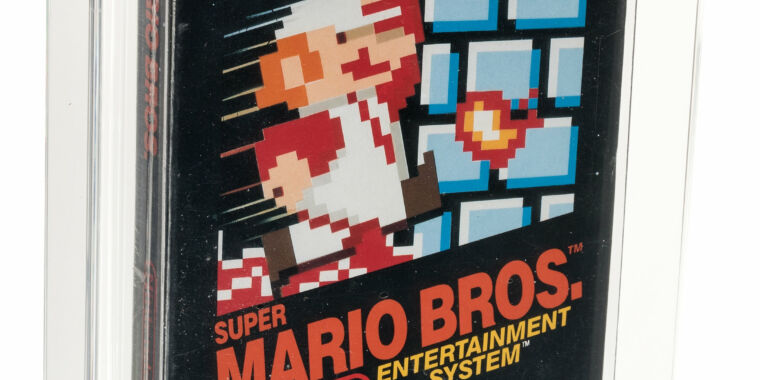
Most boxed copies of Super Mario Bros. look a lot like this at a quick glance. But they won’t sell for $114,000.
That cardboard hangtab in the back is a big part of the reason this copy sold for such a premium.
Heritage Auctions
A sealed, early copy of Super Mario Bros. for the NES sold for $114,000 Friday at specialist house Heritage Auctions, setting a new record for the sale price of an individual video game.
For context, the Guinness World Records certified the world’s largest video game collection sold at auction for $750,000 in 2014. That collection contained over 11,000 games, including over 8,300 in their original box.
Why’s it so valuable?
Heritage Auctions video game specialist and consignment director Valarie McLeckie, who helped shepherd this record sale, tells Ars that this “3-code variant” of Super Mario Bros. dates back to mid-1987. That makes it “slightly more attainable to find” than the very earliest test-market editions of the game, from late 1985 and early 1986, which were only sealed with a small circular Nintendo sticker (the earlier $100,000 sale came from that earliest batch). That also means it’s not among the very first shrink-wrapped copies of the game, which date back to mid-1986.
Still, the fact that this copy of the game features a cardboard hangtab inside that shrink-wrap, “speaks to a level of vintage” that puts it in a rarefied class. “I would suspect sealed cardboard hangtab copies [still available today] number in the single digits,” McLeckie said.
Remaining copies that are in good enough condition to earn a Wata Games certified rating of 9.4 out of 10, as this one was, are even rarer. “In this grade especially, it’s quite an impressive piece,” McLeckie said.
“Strangely, the addition of the plastic wrap came before the box cutting die was altered to remove the cardboard hangtab,” as the Heritage Auction site points out. “This rendered the functionality of the cardboard hangtab completely useless, since it was under the plastic seal.”
“Considering this game was printed from late ‘85 until the early ‘90s, the number of [mid-‘80s] cardboard hangtab copies to those later ‘90s copies are very few and far between,” McLeckie told Ars. “Most of those earlier copies were purchased and opened, because they were closer to the time of the game’s release.”
Wata Games’ chief grader examines a sealed copy of Super Mario Bros. (from a much-later printing than this record sale).
The grader looks through a jeweler’s loupe to identify any signs of resealing, restoration, color touching, or tampering.
Wata Games
Checking for seal and box authenticity.
Wata Games
Yup, the box has a back. That checks out.
Wata Games
Wata Games grading labels sit ready to be placed in their banners before the games are encapsulated.
Wata Games
Snapping a label banner in place as part of the encapsulation process.
Wata Games
Finally, the game is safe from routine handling damage (and from any chance of actually being opened and played any time soon).
Wata Games
Of the millions of copies of Super Mario Bros. ever sold, this is the rarest and most valuable known to still exist.
While Heritage is protecting the anonymity of the seller at their request, McLeckie said this ultra-valuable copy of the game “came from outside the collecting hobby,” which she described as “very curious… an attic find scenario.” McLeckie said she suspects it was simply “purchased [in 1987] and put somewhere and forgotten about. Whoever had it was lucky enough to keep it in a safe space.”
“When I told [the seller] what they actually had, I wanted to be conservative when I gave the estimate, to not give false hope,” McLeckie continued. But then another sealed hangtab copy of Super Mario Bros.sold for $40,200 despite a Wata rating of just 8.0. “So… I was like, ‘Well, if an 8.0 sold for that, I wouldn’t be too surprised if this one sold for six figures.’ But I was trying not to actively anticipate it.”
Are we in a classic-game pricing bubble?
Friday’s record sale is the continuation of a trend that has seen some sharp, quick inflation in sale prices for certain sealed games in recent months. NES games in particular have seen their sale prices shoot up of late; a sealed copy of Mike Tyson’s Punch-Out!recently sold for over $50,000, for instance. Games for later systems have been bid up heavily as well; an early sealed copy of God of War for the PS2 sold for $2,640.
That represents a shift from earlier days in-game collecting, when ultra-rare game variants like Nintendo World Championships and Stadium Events tended to command the highest prices. Now, instead, “from what we’ve seen, [collectors] tend to gravitate most towards what they loved most as children,” McLeckie said. And that means sealed copies of well-known (and often heavily produced) games in hard-to-find, top-quality condition.
“There’s a shift to what people are looking to add to their collections these days,” McLeckie continued. In the earlier days of game collecting, when graded condition was not as much of a focus, “it was easier for people to find what resonated with them as kids. Then they moved on to the next thing; people wanted to complete system sets. From that perspective, people are going to look for some games rather than others. The rarity factor played a much bigger role than it has been recently. I wouldn’t be surprised if [rarity] comes back around in importance the future.”
With sealed game prices shooting up so quickly, some collectors and observers see the beginnings of a bubble developing in the market, and expect prices will come back down to more reasonable levels eventually. But McLeckie disagrees.
“I fully believe that this is just as respectable a form of collectible as comics,” she said. “We’ve just now started to dip a toe into formalizing this market. By and large, people are just starting to tune into the fact that there is a rarity-based system involved.”
“Things will change over time,” she continued. “Where we’ll see fluctuation, only time will tell. [But] I fully believe in the strength of this market. Video games have been solidified as an important piece of popular culture, and we all like to celebrate the beginnings of our favorite pastimes. I have no doubt that people will continue to do that.”