Microsoft’s next Xbox Series X game showcase coming July 23
Enlarge/Halo Infinite is still slated to launch close to Xbox Series X’s “holiday 2020” launch window.
Our next look at new games for the Xbox Series X will be coming on July 23. That’s when Microsoft will be holding its next Xbox Games Showcase, the company announced today, streaming on multiple digital platforms starting at 9am Pacific Time.
Unlike Microsoft’s May promotional event, which focused on third-party launch titles for the upcoming console, the July 23 event is expected to discuss first-party exclusives from Microsoft’s own Xbox Game Studios. That likely includes new footage of Halo Infinite, which saw a new teaser trailer a few weeks ago.
“Xbox Series X is now in the hands of our 15 Xbox Game Studios teams and the biggest names from our network of game development and publishing studios worldwide, ensuring Xbox Series X will power a new generation of blockbuster games, like Halo Infinite,” Microsoft said in a blog post last month.
Back in February, Microsoft confirmed that all Xbox Game Studios titles will use Smart Delivery to “[ensure] you only have to purchase a title once in order to play the best available version for whichever Xbox console [you] choose to play on.” In a January interview, head of Xbox Game Studios Matt Booty noted that this means Xbox Series X won’t feature any true “next-generation” exclusives for its first year or two of availability. https://arstechnica.com/?p=1689640
F1 2020 reviewed—Codemasters takes another racing game win
In the real world, F1 is having a truncated, socially distanced season that only just started in July. But in F1 2020, you get to pretend the pandemic never happened.
For example, you can race at Zandvoort in The Netherlands, which was due to hold its first F1 race in decades in 2020. Now we have to wait until next year for the cars to turn up here for real. I don’t know if it will be the best track to overtake on, but it’s a lot of fun to drive.
Codemasters
You might be wondering why the lead car has a crap yellow-and-white livery—that’s because there’s a new feature to F1 2020 called My Team, which lets you create a new F1 team of your own.
Codemasters
The car you build in My Team looks quite a lot like last year’s Ferrari.
Other career modes are also available. Please see our earlier reviews—linked in the text below—for how those work.
Codemasters
You can choose from some predesigned liveries or make your own.
Codemasters
My Team requires you to control what your team does in between each race event.
Codemasters
Team-building exercises can improve department morale, but maybe you’d rather spend the time bringing in money?
Codemasters
Choose your sponsors wisely, based on what you think you can deliver.
Codemasters
As in F1 games of years past, you’ll need to complete various test programs at each race event to gain resource points, which you use to make your car faster.
Codemasters
There are 16 playable classic F1 cars, from 1988-2010, as well as 2019 F2 cars and the 2020 F1 teams. This Jordan 191 is often called the prettiest F1 car of all time, and it’s the car Michael Schumacher made his F1 debut driving.
Codemasters
There’s information on all the historic and current cars for you to nerd out on.
Codemasters
When you start your own F1 team, your facilities are a little basic, like this attempt at a wind tunnel.
Codemasters
But if you’re successful, you can upgrade that facility to something like this.
Codemasters
As simulators go, this one is about on the level with my rig at home. Again, you can upgrade this to something more professional as your team earns more money.
Codemasters
Splitscreen multiplayer is back.
Codemasters
The new Hanoi street circuit is a lot of fun to drive, with some very fast straights and a great complex of sweeping turns.
Codemasters
Even F1 driver George Russell was full of praise for the improvements made to F1 2020 over last year’s game.
Codemasters
In the before times, pre-pandemic, the annual installment of the officially licensed Formula 1 game would arrive about midway through the championship. But we’re not in the long-long ago anymore, and in our 2020, F1 started an abbreviated, socially distanced season at the Red Bull Ring in Austria. So when F1 2020 launches this week—tomorrow for the Deluxe Schumacher Edition, Friday for the standard edition—it takes players to an alternate universe where there is no COVID-19 and where F1 racing started as usual in Australia, in March.
The team at Codemasters probably didn’t intend for a multiverse angle for F1 2020, but if this year has taught us anything, it’s to make the best of the cards we’re dealt. The upside to this digital release is that it means you can race wheel-to-wheel at new tracks in Hanoi in Vietnam and Zandvoort in the Netherlands almost a year before they’ll host their first F1 events in meatspace. But the addition of a couple of new circuits isn’t the only way that Codies have kept things from getting stale—no mean feat for an official franchise for a sport that doesn’t really change a huge amount year-to-year.
Whose team? My team
Probably the biggest new addition to F1 2020‘s gameplay is a new career mode. This one is called My Team, because instead of joining one of the existing 10 teams, it puts you in the role of a new team owner (as well as F1 racing driver). You get to pick the team name, design a livery and logo, find a title sponsor, and choose a second driver for the team. Then, in between races, you’ll manage the team, which (hopefully) involves bringing in more money than you spend, all the while keeping each department happy.
As in the past couple of F1 installments, there are also RPG-like elements involving in-game interviews with the media. How you answer their questions affects the morale of different departments in the team as well as your standing in the sport.
These additions don’t quite make the game as much of a strategy sim as something like Motorsport Manager, but they do add an extra dimension to the game beyond “drive car around and around, preferably faster than everyone else.” If you don’t feel like going the My Team route, the other career-mode pathways from F1 2019 are still present and correct—refer to that review for more information. For more on how the gameplay works during each race weekend, please check out our review of F1 2018, since it is largely unchanged here.
Another new feature compared to recent F1 games is the return of split-screen (local) multiplayer, which joins the online multiplayer and esports modes for those who don’t want to just race against the AI.
F1 driver says the handling is much better
Driving an F1 car at the limit is obviously not easy—there’s a reason it’s considered the pinnacle of motorsport. But a game like F1 2020 needs to appeal to a much wider audience than the very best drivers in the world. To that end, Codemasters has added a “casual mode,” which simplifies menus, makes driving off-track easier, and adds some extra assists for players who don’t want to concentrate too hard. (This mode is only for offline play, however.)
But for those who do want a more realistic sim experience, you can configure the various assists to your liking, all the way to “pro mode,” which makes you do all the work yourself. For those who question how well the game simulates actually driving a real F1 car, take note of the praise issued for F1 2020 by George Russell, who is a member of Mercedes-AMG’s young driver program and currently in his second year with Williams F1 as one of its two racing drivers. Russell said on Twitch that he was shocked by the improvement to the way the cars handle in the game, and other current F1 drivers have reportedly helped Codemasters improve the realism of F1 2020.
I’ve not driven an F1 car in real life, but I do get to play a fair few different racing games each year, and I’m happy to report that F1 2020 is up there with the best of them in terms of fun. It’s incredible engaging with a wheel and pedals, and you can customize the game to match the difficulty level you’re looking for. It looks good and sounds as good as you can hope a turbocharged hybrid F1 car to sound. If you’re a fan of the sport, it’s probably worth picking it up.
The Good:
Brilliant physics, and the F1 cars are fun to drive
Does a good job simulating just how much multitasking goes into driving a modern F1 car
Career Mode is engaging and offers several different ways to race through an entire season
As difficult or as easy as you want it to be
The AI is rather good
The Bad:
Actual F1 won’t visit Hanoi or Zandvoort at all this year because of the pandemic
Coming up with something new to write every year in these reviews
Morpheus speaks with the voice of James McAvoy in The Sandman audio drama
[embedded content]
Neil Gaiman narrates The Sandman audio drama, coming July 15 on Audible.
We’re just a week or so away from the official release of The Sandman, a multi-part audio drama adaptation of Nail Gaiman’s seminal graphic novel series, via Audible Original. And we also have a new teaser for the drama, directed by Dirk Maggs. Maggs also directed the audio drama adaptations of Good Omens and Gaiman’s novel Anansi Boys.
For the uninitiated, the titular “sandman” is Dream, also called Morpheus, among other names. He is one of seven entities known as the Endless, and he is seeking to set right his past mistakes. The other Endless are Destiny, Destruction, Despair, Desire, Delirium, and Death, portrayed as a perky punk/goth young woman—they became almost as popular as Dream himself and were featured in several spinoff comics.
The audio drama will cover the first three of the series’ ten volumes: Preludes and Nocturnes, The Doll’s House, and Dream Country. The series opens when Morpheus, the King of Dreams, escapes from a 70-year imprisonment by an occultist (who actually wanted to capture Dream’s sibling Death but trapped the Sandman by mistake). From there, per the official synopsis:
When The Sandman, also known as Lord Morpheus—the immortal king of dreams, stories and the imagination—is pulled from his realm and imprisoned on Earth by a nefarious cult, he languishes for decades before finally escaping. Once free, he must retrieve the three “tools” that will restore his power and help him to rebuild his dominion, which has deteriorated in his absence. As the multi-threaded story unspools, The Sandman descends into Hell to confront Lucifer (Michael Sheen), chases rogue nightmares who have escaped his realm, and crosses paths with an array of characters from DC comic books, ancient myths, and real-world history, including: Inmates of Gotham City’s Arkham Asylum, Doctor Destiny, the muse Calliope, the three Fates, William Shakespeare, and many more.
In May, Gaiman confirmed that he will serve as the story’s narrator, and he announced the cast’s principal players: Riz Ahmed (Venom, Rogue One) as The Corinthian, Kat Dennings (2 Broke Girls) as Death, Taron Egerton (Rocketman, Kingsman series) as John Constantine, Andy Serkis as Matthew the Raven, and Sheen (Good Omens) as Lucifer, with James McAvoy in the middle of it all as Morpheus.
This being an audio drama, the 30-second trailer is light on visuals, focusing on McAvoy’s sonorous voiceover. “I am a passenger,” McAvoy/Morpheus intones as sand swirls across the screen. “I am moving through your dreams. All your dreams. And you never knew.”
There is also, of course, a TV adaptation of Sandman in development at Netflix, with Gaiman serving as an executive producer for the series, along with David Goyer, whose filmography is nothing to sneeze at. But we learned back in April that—along with pretty much everything else—production on the series had been halted due to the coronavirus pandemic.
“The scripts for the first season are written, casting had started, directors hired, sets were being built. Everything was ready to go into production, and then we moved into a pause,” Gaiman wrote on Tumblr in response to a fan’s query. “As soon as the world is ready to make TV drama, Sandman will move smoothly back into being made. In the meantime, we are taking the opportunity to get the scripts as good as we can.”
The Sandman audio drama will be released on July 15, 2020, exclusively on Audible. Fans can pre-order the collection as a standalone $35 purchase or receive the whole thing as part of a paid, ongoing Audible subscription.
EarthBound got a nice Nintendo Power push. But in retrospect, Nintendo of America, you could’ve tried a lot harder with this trailer.
Give me 10 minutes. I need to defeat five giant moles so the miner can find the gold… which I need to get $1 million and bail out the rock band… who can arrange a meeting with the evil real-estate-developer-turned-mayor I need to beat down.
My partner doesn’t get it, which I completely understand. When I first tried EarthBound, I didn’t either. The now-cult-classic SNES title first arrived in the United States in June 1995. And I, a nine-year-old, had no chance. I craved action as a kid gamer, and that largely meant co-op, multiplayer, and sports titles (a lot of NBA Jam, Street Fighter, and Turtles in Time). Nothing about EarthBound, particularly when only experienced piecemeal through a weekend rental window, would ever speak to me. As one of the most high-profile JRPGs of the early SNES era, it embodied all the stereotypes eventually associated with the genre: at-times batshit fantastical storylines; slow, s l o w pacing; virtually non-existent action mechanics.
Frankly, I wasn’t alone. Based on its sales, not many gamers seemed to understand EarthBound, and it’s not clear Nintendo did, either. What on Earth does the trailer above say to you? In the late 1980s and early 1990s, the company again and again (and again) tried to find a hit JRPG in the States without much success. Nintendo literally gave away games like Dragon Warrior—as a Nintendo Power pack-in—and still couldn’t find an audience. Even the heralded Final Fantasy franchise struggled initially, as Nintendo brought it stateside with a big, splashy map-filled box that no one seemed to care about in the moment.
But a quarter-century later, I can’t stop pushing the power switch on my SNES Classic to spend time with Ness and company. Part of it is me; I’m much older and, in theory, have more patience despite how things like social media and smartphones may be slowly destroying our collective ability to focus. People liked EarthBound better in 2013, too, when Nintendo finally re-released the game for the first time in decades on the WiiU Virtual Console. But part of my newfound appreciation is inevitably the timing of this recent play-through. The compounding pandemics of 2020 have changed the way we all approach the world; FOMO has all but evaporated. (Do I need to constantly doomscroll on Twitter to get all the depressing news as it happens? Should I plan a vacation so I can sit inside doing nothing particularly active somewhere more scenic?) In some ways, there is nothing but time, meaning an indulgent, leisurely, complex game suddenly offers a new value proposition.
More than any of that, however, all my time spent homebound with EarthBound—nearly 20 hours and counting despite a newborn and no work stoppages around the Orbital HQ—comes down to the game itself. To a subset of modern gamers, EarthBound‘s legacy may simply be introducing Ness to legions of Super Smash Bros. disciples. But on the 25th anniversary of this game’s arrival, it actually seems more suited for our current moment than ever.
My parents had no idea what kind of game I was renting at age 9.
Nathan Mattise (yes, photographing his living room TV)
Excuse me, what is happening here?
This cop has watched way too much Elliot Stabler in his life.
Nathan Mattise (yes, photographing his living room TV)
At least the pro at the Onett Times captured the moment: “Police attack innocent boy!!” Evidently it was caught on videotape by a bystander and will air on the local news.
The Insane Cultists are obsessed with blue but really look like they prefer white.
Does Scientology involve beatdowns?
Nathan Mattise (yes, photographing his living room TV)
Why are the kinda crazy ones obsessed with having their name on the building?
Nathan Mattise (yes, photographing his living room TV)
A plot for 1995, a plot for 2020
If it’s been a while or (like me) you never bothered in the first place, EarthBound takes place in a not-so-subtly veiled version of the US, literally called Eagleland in-game. Our hero (whose name defaults to “Ness” but can be changed as you see fit) grew up in the sleepy and seemingly mundane suburb Onett. Other “numbered” suburbs like Twoson soon follow.
Things are not as idealistic as they first appear. In these shining cities on various hills, an alien called Giygas has landed and seeped an evil influence into everything. You have to fight Runaway Dogs and Cranky Bag Ladies now. And post-invasion, every town has developed a problem for you to work through, each feeling eerily prescient in 2020.
In Onett, for example, bad cops feature prominently. Even after you rid the town of a pogostick-riding gang called the Sharks, you can’t just leave Onett because Captain Strong and his police force instead threaten to beat you down for trying. EarthBound originally came out within years of the beating of Rodney King, and it features four cops ganging up on a kid. Captain Strong literally attacks you with submission chokeholds. Nine-year-old me must have been confused if I even got this far, but adult me did a double take as society continues to grapple with the tragic deaths of Black Americans like George Floyd, Breonna Taylor, Rayshard Brooks, and Elijah McClain at the hands of police.
The cops of Onett merely come first, but that’s far from the only blunt observation on American life awaiting EarthBound players. In Twoson, your future friend and squadmate Paula has been abducted by a religious cult called the Happy Happy Religious Group. The group obsesses over turning everything blue, but, uh, they resemble a much whiter real-world analogue and maintain a similar disposition toward others (“Your existence is a problem for me and my religion,” says cult leader Mr. Carpainter before he attempts to dismantle you). EarthBound‘s creator Shigesato Itoi may have again been responding to events of his day, as the Boss Fights Book on EarthBound points out the game was developed during the feds’ siege on the Branch Davidian compound in Waco.
But with their character design and dialogue (“I think those who won’t paint everything blue are opposed to peace,” another says), the Happy Happy Religious Group probably doesn’t remind players of David Koresh anymore. Instead, my mind wandered to a much different modern-day cult, draped in white sheets or Stars and Bars, that pushes red on everyone instead. (As EarthBound’s subtle commentary-cherry on top, Paula’s “pray” ability during battle proves unpredictable and often detrimental if used.)
These storylines, rich in social commentary, come up again and again, and I’m barely approaching EarthBound‘s halfway mark. In fact, I just arrived in the big city of Fourside where a “regular unattractive real estate” developer named Geldegarde Monotoli has risen up the political ranks to become mayor. The guy’s name has been emblazoned on a big skyscraper acting as a de facto city hall. He takes political and economic advice from a privileged, bratty neighborhood kid. And Monotoli tries (and apparently succeeds) at both forcing police to do his bidding and manipulating the media in his favor—The Fourside Post’s lead story when I entered town was “Over 70% of Fourside citizens support Monotoli.” Hmm. Perhaps, as Cord Jefferson (a writer on HBO’s Watchmen) recently put it on a podcast: “History is prescient. The things we touch on are just things that have been complaints of my parents, my grandparents, and my great-grandparents.”
Listing image by Nathan Mattise (yes, photographing his living room TV)
https://arstechnica.com/?p=1686381
We traced Namco’s “new” Pac-Man demake to its source: A 2008 fan ROMhack
[embedded content]
This 2017 video of “Pac-Man CE for NES” bears a striking resemblance to a “new” demake Bandai Namco released on Switch last month.
Last month, Bandai Namco announced a special bonus for Switch players who invested in the new Namco Museum Archives Vol. 1. In addition to 10 emulated Namco classics, the game’s official Nintendo store page notes it includes “a newly created 8-bit demastered version of Pac-Man Championship Edition” (emphasis added).
That bonus game combines the gameplay of the 2007 Xbox 360 Championship Edition release with the graphics and sound effects of an NES title for a doubly nostalgic dose of retro appreciation. And this was no faux-retro demake either; shortly after release, hackers managed to extract the Pac-Man CE ROM from the Namco Museum collection and found it actually works on real NES hardware.
As it turns out, though, the “newly created” part of the game’s promotion isn’t quite accurate. Bandai Namco has confirmed to Ars Technica that its much-lauded Championship Edition demake is actually based directly on an obscure NES/Famicom ROMhack created over a decade ago by a Japanese fan going by the handle Coke774.
“Throughout Pac-Man’s 40-year history, he has inspired countless fans to take on game development as either a hobby or a career,” the development team said in a statement provided to Ars Technica. “In the case of Coke774, his work was highly appreciated by our team and we worked with him officially to implement his design into our game.”
Follow the videos
In discovering the hidden source of Bandai Namco’s latest retro treat, we owe a huge debt to Matt Hawkins over at the Attract Mode blog. About a week ago, Hawkins publicly gathered together multiple disparate bits of evidence that suggested the Pac-Man CE demake might not be quite as new and original as Bandai Namco implied in its marketing materials.
That evidence includes two extant videos, one posted to YouTube in 2017, the other posted to Vimeo way back in 2008. Both show largely identical gameplay on what’s labeled as an “FC Ver.” (short for “Famicom version”) of Pac-Man CE. And both bear an uncanny resemblance to the demake Bandai Namco would eventually release last month.
[embedded content]
This shorter video of “Pac-Man CE for NES” was posted to Vimeo way back in 2008!
To be sure, there are some differences between the older videos and Bandai Namco’s “official” Switch release. For one, the “FC Ver.” has been removed from the Switch release title screen, and a “1980 2007 NAMCO BANDAI Game Inc.” copyright notice has been replaced with “2020 BNEI.” For another, the Switch release includes much better music and more authentic sound effects than the “FC Ver.”
Aside from those changes, though, the videos and Bandai Namco’s later release look utterly identical. Everything from the attract mode to the fonts to the smallest animations matches up perfectly.
The real tell, though, is the way both the “FC Ver.” and the Switch demake feature ghosts whose eyes disappear when they’re facing upwards (almost as if the ghost had turned away from an isometric camera). That behavior is so specific—and not apparent in the Xbox 360 original—that it would take an incredible coincidence for it to occur naturally in two unrelated demakes (FWIW, there is already a fan-made patch that “fixes” this behavior for the extracted ROM).
Finding Coke774
Videos aside, actual information about the earlier “FC Ver.” demake of Pac-Man CE is hard to come by. The strongest initial clue to its provenance came from a comment on the YouTube video from user wartax5:
Nobody has the rom/patch because the creator, Coke774, never released it, just the footage. He did some minor patches found over at romhacking but not a lot. I suspect it wasn’t released for legal reasons.
From there, it is relatively easy to find Coke774’s page on ROMhacking.net. That page includes an NES port of the PC-8801 action RPG Sorcerian as well as an improvement patch for the NES version of Lode Runner. But there’s no mention of Pac-Man.
An archive of Coke774’s personal webpage, circa 2017, showing screenshots that match Namco’s recent “official” demake almost precisely.
An archived copy of a Coke774’s Niconico video page, circa 2018, describing a “demonstration of Famicom software I made myself running on real hardware.”
An archived version of Coke774’s YouTube page, circa 2018. Note the “Pac-Man CE for NES” video with nearly 150,000 views.
A little more Web digging, though, turns up Coke774’s Twitter page, which boasts 932 followers as of this writing and describes interests including “homebrew games for older consoles.” A bit of backwards searching through Coke774’s feed finds this Japanese tweet, which translates to read “It’s been a while since I got a mail from a foreigner asking for the Pac-Man ROM.” (Thanks to Andrew Vestal for the translation help throughout this piece).
The Twitter page in turn brings up links to Coke774’s YouTube page. Though there are no Pac-Man mentions on there, an Internet Archive copy from 2018 includes a thumbnail for “Pac-Man CE for NES” from 10 year prior (and with nearly 150,000 views).
Twitter also includes a link to Coke774’s Japanese Niconico video page, which includes two videos that have been set to “private.” An Internet Archive copy of the first video, first posted in 2008, includes a description that translates to “Looks like (someone) made Xbox 360 Pac-Man CE for the NES. It’s pretty close. The music is borrowed. It uses MMC3. It’s confirmed working on real hardware.”
An archived copy of the second private video, posted in 2012, features a thumbnail with the “FC Ver.” running on a CRT. The translated description mentions a “Demonstration of Famicom software I made myself running on real hardware. However, since it was lonely to play the video, I slowly add commentary like voice.” (Unfortunately, the Internet Archive did not capture the videos themselves).
As if that wasn’t enough evidence, the Niconico page also includes a link to Coke774’s personal website. Though it’s currently down, archived versions of that page include screenshots from the “FC Ver.” demake, including an Achievements page that looks exactly like the one found in Bandai Namco’s official demake.
But while Coke774 provided direct links to download his Sorcerian and Lode Runner hacks, his personal page appears to have never included a link to the “FC Ver.” Pac-Man CE demake. Coke774 did not respond to attempts to contact him through Twitter.
Why hide it?
Even if Bandai Namco hadn’t acknowledged Coke774’s role in its Switch demake, this would all be more than enough evidence to show that the ROM in question was actually largely the work of a lone Famicom hacker working over a decade ago. What’s baffling, then, is how much Bandai Namco and supporting developer M2 downplayed that association before now.
[embedded content]
Gameplay from Bandai Namco’s official Pac-Man CE demake. Compare and contrast with the videos above.
Take M2 director Naoki Horii, who expounded on the demake on Twitter last month (as translated by SiliconEra). There, Horii talks about first working on a 3DS version of the game five years ago, before the team “basically further replaced and remade many things even beyond just the soundtrack” for the Switch version.
“We worked hard to make this a Famicom game on Nintendo Switch where you can move to the rhythm of the music and the graphics,” he writes. “While there are some people who knew about this project beforehand, I bet even they will still be surprised at the finished game!”
Nowhere in there does Horii mention that the game they worked on was originally created by a lone hacker working outside of M2 back in 2008 (M2 did not respond to a request for comment from Ars Technica).
Or take Bandai Namco’s own press release for the collection, which describes the Pac-Man CE demake as “an exciting ‘new’ title developed specifically for Namco Museum Archives.” Despite the Bandai Namco’s use of scare quotes around “new,” that announcement gives every implication that this was a “specific” Namco creation, not a touch-up to a decade-old unauthorized fan work acquired by the company years later.
In any case, with Bandai Namco now publicly acknowledging Coke774’s work, this solitary hacker can finally get his due public credit for the creation of a masterful retro port. The whole affair brings to mind last year’s Genesis Mini, which included a similarly licensed fan-made port of Darius to round out its offerings. Or you could go back to the creation of Ms. Pac-Man itself, which started as the fan-made hack “Crazy Otto” before becoming an officially licensed sequel (that is now caught up in some messy legal battles).
While we’re at it, we’d like to know more about the origins of the “new” NES port of Gaplus included in the recent Switch Namco Museum Archives collection. Bandai Namco has not yet responded to our request for comment on that one.
Hopefully, the Pac-Man CE revelation will lead to a greater appreciation of the wider community of fan games that push the boundaries of what’s possible for well-loved retro game properties, despite frequentlegalthreats.
Review: fierce and fun Warrior Nun is a perfect Fourth of July binge-watch
Ava (Alba Baptista) finds herself resurrected by an angelic halo in her back, and is recruited by a group of nuns in the Order of the Cruciform Sword.
The nuns have just suffered a devastating loss of one of their own.
Ava just wants to live a little with her new hip friends.
Sparks fly between Ava and JC (Emilio Sakraya)
JC’s friends don’t know quite what to make of Ava.
Father Vincent (Tristan Ulloa) tries to win Ava over to the cause.
Mother Superion (Sylvia De Fanti) has her doubts about Ava’s potential.
Sister Lilith (Lorena Andrea) and Sister Beatrice (Kristina Tonteri-Young)
Sister Camila (Olivia Declan)
Cardinal Duretti (Joaquim de Almeida) questions the stability of the order.
A romantic interlude.
Shotgun Mary (Toya Turner) and Sister Lilith are both on the hunt for the missing Ava.
Shotgun Mary finds Ava
Jillian Salvius (Thekla Reuten) is a wealthy scientist and entrepreneur whose work might be a threat to the Catholic Church
Sister Beatrice in fight mode is fierce.
A young woman gains extraordinary powers when a divine artifact is accidentally embedded in her back, and finds herself reluctantly battling demons on Earth in Warrior Nun, a new Netflix series based on the comic books by Ben Dunn. It sounds like a cheesy premise, but this adaptation is anything but. It’s a fiercely fun, entertaining, occasionally thought-provoking series that will have you hooked and eager for a second season.
(Mild spoilers below, but no major reveals.)
As we previously reported, the first issue in Dunn’s manga-style comic book series, “Warrior Nun Areala,” debuted in 1994. The series largely features Sister Shannon Masters, a modern-day crusader for the Catholic Church’s (fictional) Order of the Cruciform Sword. In the series mythology, the Order dates back to 1066, when a young Valkyrie woman named Auria converted to Christianity. Renamed Areala, she selects a new avatar every generation to carry on her mission of battling the agents of hell. Sister Shannon is the Chosen One. It’s like Buffy the Vampire Slayer got religion.
Dunn has said he was inspired to create the series after learning, via a New York Times article, about the Fraternity of Our Lady, which established a chapter in Harlem in 1991 to run a soup kitchen. One of the nuns (the fraternity has both nuns and priests), Sister Marie Chantel, trained in the martial arts (judo and Tae Kwon Do), and many of her fellow nuns also practiced self-defense, albeit mostly for sport. Dunn envisioned a world with nuns as superheroes, where heaven and hell are real dimensions.
Sister Shannon isn’t dominant in the Netflix adaptation—she only appears in a couple of episodes, played by Melina Matthews. Instead, the show focuses on a young woman named Ava (Alba Baptista). Per the official premise:
Caught in the middle of an ancient war between good and evil, a young girl wakes up in a morgue with inexplicable powers. Her search for answers brings her to The Order of the Cruciform Sword, a secret society of warrior nuns sworn to protect the world from evil. While juggling her responsibilities as the chosen one with the normal obstacles of a teenage girl, this mysterious fantasy drama is full of mystery, action, adventure, and teenage romance, proving our main character might fight in the name of good, but she’s no angel.
We meet Ava after she has just died in a Catholic hospital, having been there since she was crippled (a paraplegic) in a car accident at the age of seven. Her body is laid out in the church morgue by Father Vincent (Tristan Ulloa), when his crew of warrior nuns returns from what should have been a routine mission. Sister Shannon has been mortally wounded and they must remove the angelic halo from her back that grants special powers, and insert it into the next “Halo Bearer.”
But they are interrupted by a supernatural beast intent on retrieving said halo for itself. As the sisters scatter, one of them slips the halo into Ava’s body. The halo’s power brings her back to life, and also restores her mobility. But Ava is not a nun, nor is she particularly devout, and honestly, after a lifetime paralyzed in a hospital bed, the 18-year-old just wants to live a little. This rankles Cardinal Duretti (Joaquim de Almeida): “How did our greatest weapon against evil end up in an unbeliever?”
The whole armor of god
Ava and Shotgun Mary take refuge in a village that has seen more than its share of demons.
Ava comes to terms with her calling.
There could be another personal motive behind Jillian’s research.
Warrior nuns suited up for a mission.
Tending to a wounded warrior.
Shotgun Mary stands firm in the face of evil.
There is tension in the nuns’ ranks
Lilith returns to her sisters.
Ava has a vision.
Ava decides upon a course of action.
The team marches out to infiltrate the Vatican.
Nah, not suspicious behavior at all.
Sister Camila’s mad hacker skills come in handy.
Sister Lilith ready to do her part.
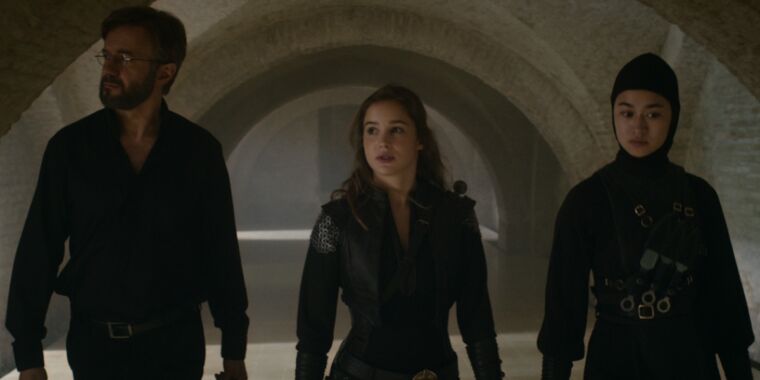
Warrior nuns, assemble!
Father Vincent argues that Ava must have been chosen for a reason, and tries to convince her to take the role of Halo Bearer seriously. Mother Superion (Sylvia De Fanti) doesn’t think Ava has what it takes, while Sister Lilith (Lorena Andrea) was supposed to be next in line for the honor and resents being passed over in favor of Ava. Sister Beatrice (Kristina Tonteri-Young) and Sister Camila (Olivia Declan) are a bit more welcoming, while Shotgun Mary (Toya Turner) is grieving the loss of her BFF Sister Shannon and intent on revenge upon whoever betrayed the Order that fateful day.
There are also greater machinations afoot, starting with scientist and tech entrepreneur Jillian Salvius (Thekla Reuten), who has been using a mysterious material known as “divinium,” found on certain holy relics stolen from the Vatican, to create a prototype inter dimensional portal. She thinks this will usher in a new Age of Enlightenment: “Heaven exists, and I discovered a gateway to it.” This puts her at odds with the Cardinal and the Church—she has desecrated holy relics, after all. And the Cardinal himself seems to be intent on remaking the Order to serve his own ambitions within the Church. Ava clearly needs time to process and come to terms with her new situation—but that might be a luxury the Order can’t afford, as the beast is still hunting for the halo, leaving carnage in its wake.
The entire cast give stellar performances, but Baptista is luminous as Ava. The character could easily have come across as a spoiled brat in the early episodes, given that her learned defense mechanisms involve flippant irreverence and keeping people at a distance. Instead, you genuinely feel for this young woman who has suddenly been granted a second chance at life, able to feel sensations, to walk and run and feed herself, for the first time in 11 years. But the gift comes with a price: she is thrust into a spiritual war she doesn’t understand, with people she has no reason to trust after years of abuse at the Catholic hospital. There’s also her raging teen hormones and a super-cute boy (Emilio Sakraya) drawing her away from the Order.
The series is expertly plotted, with twists and turns that will keep you guessing until the final reveal.
We naturally expect there to be heroes and villains, but Warrior Nun takes a much more nuanced, less black-and-white approach to this than the original comics. In the comics, for instance, Julius Salvius is a Satanist and arms dealer whose minions regularly battle the Order. But his gender-swapped counterpart in the TV series, Jillian, is a more complicated figure—someone who seeks to rise above the longstanding the tension between science and religion for motives that might just be more personal (and less overtly evil) than one might otherwise expect.
Likewise, the heroic figures have all-too-human flaws that lead to ill-advised decisions at times: entitlement and resentment (Sister Lilith), jealousy (Mother Superion), anger management issues (Shotgun Mary), and being a bit too naively trusting (Sister Camila) and overly obedient to Church authority (Sister Beatrice). Another welcome departure from the comics: the nuns actually dress modestly, like nuns, rather than the silly cleavage-centric habits and loin cloths worn by the nuns in Dunn’s earlier comics.
The series is expertly plotted, with twists and turns that will keep you guessing until the final reveal. There is a rich historical mythology, and plenty of action and killer “Nun-Fu” moves, especially when Sister Beatrice lets out her inner ninja. (Watching her effortlessly take out a crew of Jillian’s security forces who assumed she was too small and weak to pose any threat is glorious.) And there are welcome moments of sly comic relief and contemplative reflection to break up the action now and then. Ava and her sister Warrior Nuns are definitely worthy to join the ranks of Buffy, Wynonna Earp, and Witchblade‘s Sarah Pezzini as flawed-but-fierce women who fight against evil, in all its forms, for the greater good.
Warrior Nun is now streaming on Netflix, and makes for an excellent holiday weekend binge.
Listing image by Netflix
https://arstechnica.com/?p=1688912
How mobile games crushed consoles
Enlarge/ Apparently, enough people bought Fortnite‘s wholly optional outfits and dance moves to fuel $100 million of prizes for the game’s first year of esports tourneys.
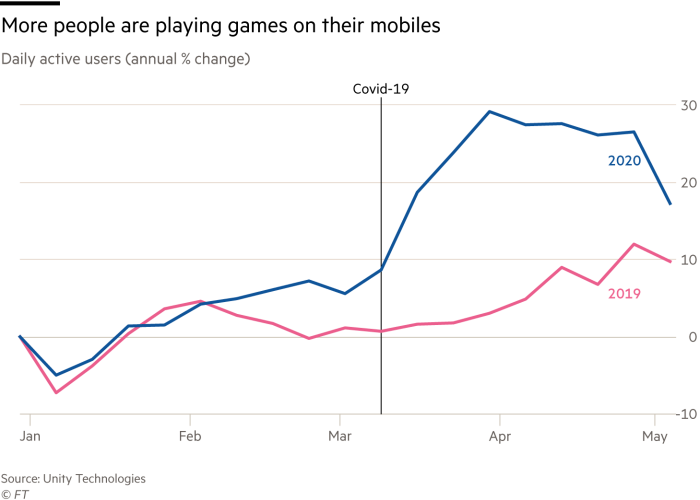
The coronavirus crisis has proved a bonanza for video game makers, as shut-in consumers turn to digital distractions in greater numbers and for longer sessions than ever before.
But while the sector’s big listed groups such as Nintendo, Activision Blizzard, and Take Two have enjoyed share price rises of more than 25 percent since early March, a clutch of mobile gaming studios, many privately held, have enjoyed the real windfall. Along with the sudden rise in leisure time among a ready market of more than two billion smartphone owners, they have reaped the rewards of a plunge in mobile advertising prices as other corporate sectors slashed their marketing budgets.
“That gave a huge opening for companies like ours,” said Alexis Bonte, group chief operating officer at Stillfront, a free-to-play gaming group based in Stockholm whose share price has more than doubled since mid-March. “We got a double effect—the increased organics [usage growth] but also the effect of more efficient marketing . . . It was huge.”
Mobile gaming revenues, which already dwarf spending on PC and console titles, are now set to top $100 billion this year, according to data groups App Annie and IDC, more than triple the combined sum for Nintendo Switch, Xbox One, and PlayStation 4 titles. Companies such as Fortnite creator Epic Games, puzzle app specialist Playrix, and mobile games maker Playtika were each spending upwards of $2 million a day on digital ads in late March, April, and into May, games industry insiders say.
Financial Times
“Every other developer is looking at this as something that is unprecedented,” said Stephane Kurgan, former chief operating officer at King, makers of Candy Crush Saga.
Kurgan, who recently joined tech investor Index Ventures, says sheer scale gives mobile games companies greater upside from the pandemic than console publishers, outside the very biggest hits such as Nintendo’s Animal Crossing: New Horizons, Activision Blizzard’s Call of Duty: Modern Warfare, and Take Two’s Grand Theft Auto V.
“A large majority of PC and console titles haven’t really benefited,” he said. “It’s more the mobile free-to-play industry which has seen very material revenue spikes.”
US spending on console games—including physical discs and downloads from the Xbox, PlayStation, and Nintendo digital stores—jumped to $662 million in April, up 55 percent year on year according to market researchers NPD, with sales in May up 67 percent to $438 million.
But in Europe alone, spending on mobile games grew 12 percent between February and March to $740 million, according to Sensor Tower, setting a new monthly record for the region at a time of year typically characterized by a post-Christmas decline.
Globally, daily “in-app” payments for mobile games—for the likes of extra lives, virtual items, and outfits for avatars—have jumped 24 percent since the pandemic began, according to gaming technology provider Unity. Smartphone users, meanwhile, have installed 84 percent more apps than the same period a year ago.
At the same time, Unity found that the average cost per install—the price games publishers must pay for ads that persuade new players to download their app—fell by an “unprecedented” 33 percent from March to April.
This set up a land-grab that powered up the lockdown gaming boom just as much as bored iPhone fiddlers. As many other marketers pulled their dollars out of the online auctions that determine most ad pricing, games companies swooped in to take advantage of the tumbling costs of reaching millions of eyeballs on Facebook, Google, and other networks.
In recent years, publishers of free mobile games have become among the most adept online marketers, fine-tuning a system that relies on constant testing and measurement. The goal is to ensure that the cost per install on each new player’s phone is exceeded by that gamer’s predicted lifetime value, usually generated through in-app purchases of extra lives, virtual items, and outfits for avatars.
Tracking CPI and LTV has become as much an obsession for games publishers as Roblox is for tweens.
“The whole mobile games industry has centred on those two key figures,” said Thor Fridriksson, chief executive of Teatime Games, a Reykjavík-based start-up that launched a new quiz app, Trivia Royale, in mid-June. “It’s basically an arbitrage money machine. That’s the whole business right now.”
Boosting marketing budgets at a time of huge global uncertainty was nonetheless a multimillion-dollar gamble.
“It was a very stressful period,” said an executive at one leading mobile games developer who was splurging more than $2 million a day on ads at the peak of the pandemic. “You were spending a lot of money and you didn’t know whether the world would end.”
Financial Times
The bet appears to have paid off for top-grossing games such as PUBG Mobile, Roblox, Candy Crush Saga, Gardenscapes, Fortnite, and, in China, Tencent’s Honor of Kings—which all featured among Sensor Tower’s top games by worldwide revenues for March and April.
“If you look at the league tables, what is striking today is that many of the games in the top 10 were there five years ago,” said Kurgan. “Nobody expected that.”
For years, investors viewed games as a hit-driven business, where today’s Angry Birds would be toppled from the charts by tomorrow’s Flappy Bird. The emergence of “live operations,” where games are constantly enhanced with new levels, features, or seasonal events, has challenged that view. It is now seen as easier to sustain an existing hit on mobile than come up with another.
“Look at the top games studios: the number of them that actually produce a successful second, third, or fourth title is extremely low,” said Paul Murphy, a partner at venture firm Northzone and the founder of mobile game developer Dots.
That is driving up valuations for studios with breakout intellectual property that bigger publishers can put their marketing muscle behind. Multiples for a mobile developer have risen from five times earnings before income, tax, depreciation, and amortization to as much as 10 times, or even more for a company that has come to define a particular niche.
Dealmaking, meanwhile, has continued. This month Zynga acquired Istanbul-based Peak, best known for the game Toon Blast, for $1.8 billion.
“They are buying their way to growth—all the big mobile studios are doing that,” said Murphy. “It’s cheaper to buy a company than it is to build something.”
While the science of using CPI and LTV metrics to milk venerable franchises such as Candy Crush is well understood, nobody knows what will happen now that lockdowns are starting to ease. Many in the industry see social networking features as key to retaining players.
“Another thing that did well [during the pandemic] is everything related to community-building,” said Bonte. “We are not seeing those people leaving.”
Teatime Games’ Trivia Royale is engineered to foster connection through a cartoonish avatar, similar to Snap’s Bitmoji or Apple’s Animoji, which uses the smartphone’s front-facing camera to mimic the player’s reactions and expressions. Trivia Royale shot to the top of the US iPhone App Store charts last weekend, according to App Annie. But Fridriksson admits that launching his new game during the lockdown was more coincidence than strategy.
“Usage in mobile phones has risen dramatically in the last few months, so that would look like a good thing for our title,” he said. “But maybe people are also bored to death of playing all these games on their mobile and want to go out in the sun.”
Stellar deepfake thriller The Capture lands in USA thanks to NBC Peacock
NBC Peacock, the 370th streaming service to debut in the past 12 months, will publicly launch on July 15 after an Xfinity-exclusive soft launch earlier this year. That means it’s time to review the service’s exclusive series—though in the case of The Capture, one of Peacock’s most captivating launch options, that “exclusivity” is regional.
Unlike Peacock offerings like Brave New World and Intelligence, The Capture is an import for American viewers, having already aired on the online-only BBC Three in autumn 2019. But it’s still decidedly current: a mystery thriller that revolves around deepfake technology and government distrust.
Due process versus “real” videos
Holliday Grainger shows us how to make staring at security camera footage more compelling in her performance as DI Rachel Carey.
Callum Turner as Shaun Emery in The Capture‘s pilot episode.
NBC Peacock / BBC
Chances are, a security camera is watching Grainger here.
NBC Peacock / BBC
Ron Perlman steals his every scene as token American Frank Napier.
NBC Peacock / BBC
By turns enthralling and suspenseful, The Capture is the sort of show one could easily binge in an afternoon. (In fitting BBC fashion, the series’ first season runs a lean six episodes.) It stars Holliday Grainger (Strike) as DI Rachel Carey, an SO15 officer on loan to Homicide & Serious Crime, who finds herself embroiled in the case of former Lance Corporal Shaun Emery, played by Callum Turner (Fantastic Beasts: The Crimes of Grindelwald).
Like many popular British imports, The Capture is a police procedural—in this case, one with counterterrorism overtones. Emery, who just got acquitted of murdering an unarmed Taliban insurgent during his tour in Afghanistan, is accused of kidnapping his barrister, Hannah Roberts (Laura Haddock), after she refused to go home with him after celebrating his release. The case seems open and shut—the abduction was videotaped on a well-lit street and facial-recognition software positively identifies both parties. But Emery is perplexed by the charges, and when he’s shown the security cam footage, he begins to freak out. This very believable-looking video is not him. This incident did not happen.
The manipulated footage leads down rabbit holes into a vast network of government plots. It’s quite a feat how the show turns this conceit into a conspiracy thrill ride, especially when so many plot points continuously return to people standing around watching events on CCTV (you know, the high-tech version of watching paint dry). The technology has been omnipresent in British life; London has been referred to as “the most-watched city in the world,” a claim The Capture repeats in its first episode. But the series focuses its attention more sternly on the rising, real-world issue of “deepfake videos,” in which computer-generated imagery can make people appear to say and do things that never happened.
Topical
The Capture arrives at a moment when criticism of police procedurals is growing. The good news is this series focuses on the corruption behind the badge—and when government forces bend the concept of “justice” to their whims. That angle transforms in The Capture thanks to its deepfake story angle: why demand due process if the video footage can create whatever evidence is necessary to convict? Without spoiling some of the twists, I will say that the show takes a clever path to explaining away both how and why faked videos are used; the episode revealing how it’s all done is the series highlight. And the answers turn out to be just as much about government, bureaucracy, and state forces going some morally iffy routes in their aim to do “good” for the world as it is about this technology.
But The Capture is not without controversy. By the end, the series seems to sympathize with at least one government position, claiming the ends justify the means. Though the production understands deepfakes have the power to change the world, it wants us to believe this technology in government hands isn’t something we, the good people, need to worry about.
[embedded content]
The Capture, season one trailer.
One reason The Capture works as well as it does is the gripping performances by Turner and Grainger. Graniger’s DI Carey has to do most of the heavy lifting here, attempting to find evidence that proves a time- and date-stamped section of CCTV footage didn’t actually happen, only to turn around and find that every time she sits down to watch something happening live, it doesn’t match up with what those on the scene are telling her. As the patsy in this scheme, Turner’s character also spends much of the season questioning his own perception of reality—though his best moments come once he does find out the truth and has to confront why he’s become an apparent pawn in someone’s scheme. Ron Perlman also deserves special mention as the evil token American Frank Napier, who dominates every scene he’s in.
A world of various feeds from the Beeb
Whether a single series as good as The Capture makes Peacock worth subscribing to is another question. And to that point, lovers of British TV must contend with yet another streamer to add to the ever-growing list. (Peacock also will have all the seasons of Downton Abbey seasons as well as its 2019 film when it launches on July 15.)
From Netflix’s entire subsection of BBC Two fare to various acclaimed Amazon Prime exclusives to HBO Max’s deal with BBC America, UK-based series are scattered all over the landscape. And that’s not including niche streamers like AMC’s Acorn TV or PBS Passport, the subscription service your local public television station offers alongside mugs and tote bags as part of a yearly membership.
What’s most perplexing about this is that both the BBC and competitor ITV already have a streaming service of their own in America: BritBox. The service arrived in 2017 with tons of old British shows, including every Doctor Who episode that could be reasonably rounded up from 1963-1989. The service continues to add content every month, but rarely anything current. It does sometimes offer direct feeds from the Beeb, like live coverage of the Queen’s Speech at Christmas, but that’s extremely niche viewing. The result is that BritBox has struggled to make a dent with mainstream audiences for lack of keeping shows like The Capture for itself.
American streaming networks’ growing reliance on international series to keep a constant flow of new titles is proof of how much power the BBC has right now for eyeballs. Moreover, British TV is legendary for the quality it produces. Perhaps licensing deals to the highest American streaming bidders have been too enticing—arguably more than if the BBC and ITV were to pool all their content for Britbox and create yet another subscription service. As it is, we’ll just have to keep piecemealing our streaming crumpets-and-tea together and signing up for streamers like Peacock (with both paid and free, ad-filled tiers) for shows like The Capture. We’ll have to wait and see whether Peacock opens its virtual doors to the series’ eventual, recently announced second season.
EVO 2020 game tourney canceled, co-founder fired [Updated]
EVO—the long-running video game tournament dedicated to fighting-game series like Street Fighter and Tekken—was rocked by departures on Thursday in the wake of startling allegations lodged against its co-founder.
Capcom announced its decision to withdraw all participation from EVO 2020 on Thursday evening, minutes after NetherRealm Studios, the developers of the Mortal Kombat and Injustice series, did the same. That means tentpole games Street Fighter V and Mortal Kombat 11 will no longer be played; the latter game figured largely into EVO’s transition to an online-only event, owing to its reputation for superior netcode. Mane6, the developers behind new EVO participant Them’s Fightin’ Herds, followed suit shortly after.
“Evo is run by a team and not a single individual,” James Chen wrote on Twitter shortly after EVO’s announcement. “But a single individual can stain the entire event. Until Joey ‘MrWizard’ Cuellar is removed from Evo, I can no longer participate.”
Shortly after various game studios and participants distanced themselves from EVO 2020, Cuellar posted a brief statement on Twitter that appears to acknowledge Pham’s Wednesday accusations:
I’m sorry. I never meant to hurt anyone. I was young and reckless and did things I’m not proud of. I have been growing and maturing over the past 20 years, but that doesn’t excuse anything. All I have been trying to do is become a better person. Once again, I’m truly sorry.
[Update 2, 9:25pm ET: Cuellar’s statement may have been the straw that broke the EVO’s back. The tournament’s official social media channel has since confirmed that Cuellar is out, telling fans: “Effective immediately, Joey Cuellar will no longer be involved with EVO in any capacity.” The organization has installed a new CEO, and it has gone so far as to outright cancel the entirety of EVO 2020. “We will work to issue refunds for all players who chose to purchase a badge,” the statement says.]
The accusations against Cuellar, and his acknowledgement of them, followed a wave of stories and allegations that came out over the past few days of sexual abuse within the world of fighting-game tournaments. At least one allegation led to a Smash Bros. pro player, Anti, claiming he was “innocent” of charges of sexual assault against a minor, only to admit he’d engaged in sexual acts with a minor. This confession was deleted hours after it went live.
https://arstechnica.com/?p=1689350
2K breaks gaming’s de facto $60 ceiling, asks $70 for next-gen NBA 2K21
Enlarge/ Artist’s conception of consumer reactions to NBA 2K21‘s $70 asking price.
A new generation of video game consoles may come with a new standard price point for big-budget games. That’s the impression 2K Games is giving, at least, with today’s announcement that the Xbox Series X and PlayStation 5 versions of NBA 2K21 will come in at an MSRP of $69.99.
That price point is $10 higher than the $59.99 asking price for the Xbox One and PS4 versions of the same game, which are due to launch September 4. And an NBA 2K spokesperson confirmed to Ars Technica that the premium pricing is based on what it sees as the increased value represented by the power of new consoles.
“We believe our suggested retail price for NBA 2K21 on next-generation platforms fairly represents the value of what’s being offered: power, speed, and technology that is only possible on new hardware,” the representative told Ars Technica. “While we are confident that NBA 2K21 will be a monumental leap forward for the franchise and a standout visual showcase on next-generation consoles, we recognize that it’s our responsibility to prove this value to our fans and NBA 2K players.”
When asked whether the $69.99 price point represented a new standard for 2K’s console games, the representative kept the focus squarely on today’s pricing decision. “2K’s suggested retail prices for its games are meant to represent the value being offered,” the rep said. “With nearly endless replay value and many new additions and improvements only possible on next-generation consoles, we believe our updated suggested retail price fairly represents the value of NBA 2K21.”
2K also confirmed that NBA 2K21 won’t be supporting Microsoft’s Xbox Smart Delivery system, which lets players buy a game once and download versions across multiple console generations. That said, 2K is offering a $99.99 “Mamba Forever Edition” for NBA 2K21, which includes a current-generation version and a download code to upgrade to a next-generation version in the future.
Raising the roof?
The last time the game industry saw a generalized price increase for big-budget, high-end games was the mid-’00s. Back then, the $40 to $50 asking prices for PS2 games increased to a $59.99 standard for games on the PS3 and Xbox 360.
Major publishers have been reluctant to break through that ceiling for the last 15 years, through two entire console generations (two and a half if you count recent mid-generation console upgrades). Meanwhile, inflation has slowly eaten away at the “real” value of that price ceiling—a $59.99 game in November 2006 was worth the equivalent of $76.33 in today’s dollars, according to the BLS inflation calculator. In fact, thanks to inflation, high-end games are now cheaper than they’ve ever been in real-money terms (especially when compared with the ’90s era of $70 to $80 cartridge-based games).
Enlarge/ Asking $69.99 for SNES Ultimate Mortal Kombat 3 in 1996 is equivalent to asking about $113 in today’s dollars.
To make up for that slow erosion of value, some publishers have relied on Collector’s Edition packages, raising the average asking price by throwing in optional art books, statues, limited edition scarves, or, uh, luxury cars. Other publishers have increasingly leaned on microtransactions to provide a continuing income stream from players past an initial $59.99 purchase, often with annoying results.
A $10 increase in the top-end asking price for major games isn’t going to lead to the death of microtransactions or anything. But it could help fill in the bottom line for publishers and developers who are already worrying over higher development costs necessary to create the more realistic graphics in new console games.
“I think, to the extent that the technology enables the graphics side of it to become more interesting and life-like, [the games] will become slightly more human intensive and capital-intensive to produce,” Sony Interactive Entertainment CEO Jim Ryan said of PlayStation 5 development in a May interview with GamesIndustry.biz. “So yes, we think there probably will be an increase in development budgets.”
Then there’s the question of whether players will accept a world where new big-budget games approach $70 as a matter of course. Again, the real inflation-adjusted value of that price suggests there’s some slack in the buying power available to today’s gamers. But today’s video game market is also absolutely flooded with free orheavily discountedhigh-quality gaming alternatives in a way that wasn’t really true 15 years ago. Those cheap games could end up looking about $10 more appealing in a world where the top-end competition starts regularly selling for $70 instead of $60.
In any case, a new console generation (with the optional capability to carry games across multiple generations) could serve as just the excuse major publishers need to raise their standard asking price. We’ll keep an eye out to see if 2K’s move today ends up as the beginning of a trend or a one-off experiment.