If Buffy found religion: A Catholic order battles evil in Warrior Nun trailer

[embedded content]
Alba Baptista stars as Ava in the Netflix adaptation of Ben Dunn’s comic series Warrior Nun.

A young woman wakes up in a morgue and finds she now carries an embedded divine object in her back in Warrior Nun, a forthcoming fantasy drama from Netflix, based on the comic series by Ben Dunn. Not only has the divine brought her back from the dead, but she now has superpowers and a new mission to fight hell on Earth.

The first issue in the manga-style comic book series, “Warrior Nun Areala,” debuted in 1994. The series features Sister Shannon Masters, a modern-day crusader for the Catholic Church’s (fictional) Order of the Cruciform Sword. In the series mythology, the Order dates back to 1066, when a young Valkyrie woman named Auria converted to Christianity. Renamed Areala, she selects a new avatar every generation to carry on her mission of battling the agents of hell. Sister Shannon is the Chosen One. It’s like Buffy the Vampire Slayer got religion.

Dunn has said he was inspired to create the series after learning, via a New York Times article, about the Fraternity of Our Lady, which established a chapter in Harlem in 1991 to run a soup kitchen. One of the nuns (the fraternity has both nuns and priests), Sister Marie Chantel, trained in the martial arts (judo and Tae Kwon Do), and many of her fellow nuns also practiced self-defense, albeit mostly for sport. Dunn envisioned a world with nuns as superheroes, where heaven and hell are real dimensions. It’s a fun series, because it’s not Catholic proselytizing, despite the Christian themes and the nuns’ sincere faith—unlike those infamous Jack Chick tracts and comic books. (I grew up reading the Crusader series, which honestly explains a lot about my rather warped psyche.)

There had been some preliminary work on a possible film, updated for the modern world, but then Netflix acquired the TV rights, and those plans were shelved. Simon Barry (Continuum, Van Helsing) signed on as series creator and showrunner, while Counterpart producer Amy Berg serves as a consulting producer and penned two of the S1 episodes. Oh, and all the episode titles are Bible verses, because why not?

Sister Shannon isn’t dominant in this adaptation—per IMDb, she only appears in a couple of episodes, played by Melina Matthews. Instead, the show focuses on a young woman named Ava (Alba Baptista). Tristan Ulloa plays Father Vincent, Sylvia De Fanti plays Mother Superior, and Joaquim de Almeida plays Cardinal Duretti.

Per the official synopsis:

Caught in the middle of an ancient war between good and evil, a young girl wakes up in a morgue with inexplicable powers. Her search for answers brings her to The Order of the Cruciform Sword, a secret society of warrior nuns sworn to protect the world from evil. While juggling her responsibilities as the chosen one with the normal obstacles of a teenage girl, this mysterious fantasy drama is full of mystery, action, adventure, and teenage romance, proving our main character might fight in the name of good, but she’s no angel.

The trailer opens with Ava’s voiceover, explaining how she’s dreamt of being dead for her entire life, leaving her body and viewing it from above, relieved that she looks like a normal girl. “Until I wake up and realize I’m still the freak I’ve been my whole life.” But life, as she observes, “has a really effed-up way of making your dreams come true.” She is dead—at least until the Order revives her as the new Chosen One. It looks like she slays a demon pretty soon after being revived, too. Buffy would be so proud.

Father Vincent gives her a rundown of the Order’s history: it’s a group of “devout women who have dedicated their lives to fighting an ancient evil. Whoever bears the halo is the champion.” That halo has been absorbed into Ava’s back, giving her superpowers—apparently enhancing whatever natural abilities she already possesses. There’s just one problem: Ava isn’t particularly devout, something that rankles the cardinal: “How did our greatest weapon against evil end up in an unbeliever?”

But perhaps the halo knows best. Plot details remain appropriately vague, but we do see a woman named Jillian Salvius (Thekla Reuten) announce the dawn of a new Age of Enlightenment: “Heaven exists, and I discovered a gateway to it.” And we meet Ava’s sisters-in-arms: Sister Beatrice (Kristina Tonteri-Young), Shotgun Mary (Toya Turner), Sister Lilith (Lorena Andrea), and Sister Camila (inexplicably not listed among the cast).

So, mystical portals to heaven (and/or hell)? Check. Badass nuns steeped in the martial arts? Check. A hot young love interest for Ava? Check. Lots of demon slaying and a bit of comic relief? Check. Warrior Nun debuts on Netflix on July 2, 2020. It could make for an entertaining holiday-weekend binge.

Listing image by Netflix

https://arstechnica.com/?p=1684543


Rockstar stops hackers from spawning KKK members in Red Dead Online

Hackers had been spawning these character models from the single player version of <em>Red Dead Redemption 2</em> in the multiplayer Red Dead Online.
Enlarge / Hackers had been spawning these character models from the single player version of Red Dead Redemption 2 in the multiplayer Red Dead Online.

Rockstar has closed a loophole that let hackers spawn white-hooded Ku Klux Klan members in the “Red Dead Online” multiplayer portion of Red Dead Redemption 2, even as other hacking problems in the game persist.

The models for the KKK members come from the single-player portion of the game, where the Klan features in a number of in-game plotlines. But Red Dead Online players had been inserting the characters into the multiplayer game world through the use of mod menus. These tools essentially take full control of the PC version of the game, doing anything from spawning infinite items to changing weather patterns for entire lobbies.

Players using KKK spawning to grief and/or terrorize other players has been reported numerous times on Reddit and other forums in recent weeks. Screenshots also show hackers accompanying these spawns with racist invective broadcast to the game lobby by taking control of the “Rockstar message” channel.

On Tuesday, data miner Tez2 said this particular use of mod menu is now disabled thanks to a patch that instantly deletes the KKK character model as soon as its detected in an online game. Rockstar confirmed that removal in a comment to Polygon.

Rockstar has been stuck in a long-standing battle with hackers in its incredibly popular online games, which use a simple P2P mesh network that is particularly susceptible to exploits. That battle has included legal action against the makers of mod menus for Grand Theft Auto Online, as well as occasionally overzealous threats against makers of single-player mods for the company’s games.

Rockstar Games was among many game companies to offer public support for the Black Lives Matter movement in the wake of the police killing of George Floyd in Minneapolis. The company shut down access to its online games for two hours earlier this month in a move the company said was to honor Floyd’s legacy. https://arstechnica.com/?p=1684452


Over 21 years later, Pokémon Snap is coming back on Switch

We don’t often write about mere game announcement teases here on Ars Technica, mainly because doing so with any frequency would leave little time for writing about anything else. But we’ll make an exception for today’s surprise announcement that Pokémon Snap is finally getting a Switch-based sequel, over 20 years after the original became a cult classic on the Nintendo 64.

The announcement of New Pokémon Snap, which came this morning as part of a Pokémon Presents YouTube presentation, was light on details but full of “not final” gameplay footage “from a game under development,” as the fine print disclaimers warned. What we can see of the gameplay in the short clip should be familiar to those who played the Nintendo 64 cult classic back in 1999.

Using a first-person camera viewfinder perspective, players aim to get the best shots of Pokémon cavorting about environments ranging from sandy beaches to clear blue waters, grasslands, and dense forests. Pokémon lures also make an appearance, letting players draw monsters out from hiding for better shots as they scroll automatically through the islands. Players will presumably be rated on their ability to frame and compose interesting shots, as in the original.

Pokémon large and small from throughout the series’ history feature in the trailer, confirming that this isn’t a mere remaster of the original game (which only featured monsters from the original selection of 151). There’s no release date yet for the Bandai Namco-developed game, which is “Under Construction!” according to the teaser trailer.

Photo modes have become a relatively standard feature of big-budget games in the decades since Pokémon Snap‘s debut. But those modes are usually intended just for a player’s personal aesthetic appreciation and not integrated deeply into the game’s own reward structure (even when the game seems to be begging for it). PlayStation 3 safari simulator Afrika is one of the only games to draw direct inspiration from Snap‘s photo-based gameplay.

Elsewhere in its presentation, the Pokémon Company announced a themed tooth-brushing app called Pokémon Smile, a tile-matching game called Pokémon Café Mix, and upcoming DLC for Pokémon Sword and Shield.

[embedded content]

https://arstechnica.com/?p=1684413


Talking about Tiberium: Our Command & Conquer remaster livechat is underway

This probably won't shape up like a battle between the GDI and Brotherhood of Nod, but if you want to suggest an ion cannon-caliber question, go for it, readers.
Enlarge / This probably won’t shape up like a battle between the GDI and Brotherhood of Nod, but if you want to suggest an ion cannon-caliber question, go for it, readers.
Aurich Lawson

The 25th anniversary of real-time strategy game Command & Conquer landed earlier this month with a nuclear-sized explosion of content. C&C Remastered Collection was pretty much everything we’d hoped for: faithful in mechanics, massive in scope, tasteful in redesign, and broken wide open for the community to mod and update.

But how exactly did the new collection’s developers, including a contingent of original Westwood Studios devs, bring two classic RTS games (C&C: Tiberian Dawn, C&C: Red Alert) back to life? What complications arose while rebuilding the originals, even before the coronavirus altered the final months of development? How did the team’s solicitation of fan input change the project’s scope? And what is that wacky supreme leader Kane really like behind closed doors?

EA, the series’ handlers, has been kind enough to throw lead producer Jim Vessella into our own veritable Temple of Nod for a video Q&A tomorrow—Tuesday, June 16, at 1pm ET—to be livestreamed right here on Ars Technica. I’ll begin the conversation with my own questions, based on my experience with the Remastered Collection, before shifting to hand-selected questions as chosen from the below comments section. Once the interview goes live, we’ll also keep an eye on Twitter users who reply to @arstechnica with interesting questions containing the hashtag #arslive.

And yes, we want the devoted fans from Command & Conquer‘s bustling subreddit to come by with questions of their own, as well. The nitpickier, the better. Should you miss the livestreamed event, be sure to return here for a recorded archive. We’d love for you to watch it live, of course, but as a wise man once said: “The choice, my friend, is yours.”

https://arstechnica.com/?p=1683803


Nintendo issues cease-and-desist for Switch modchip installation service

Last month, Nintendo went to court in an effort to stop retailers from selling an upcoming line of internal Switch mod chips, which the company says enable and encourage piracy. Now, Nintendo is expanding its efforts by sending a cease-and-desist letter to one company that merely offers to install mod chips obtained elsewhere.

Connecticut-based Logistics Consulting LLC has offered a “Nintendo Switch SX CORE SX LITE Mod Chip Service” on its website for a few weeks, according to founder Ben Van Rheen. As noted on the site, the $60 offering is “NOT for the purchase of the Nintendo Switch SX CORE or SX LITE mod. We don’t make the mod or sell the mod, just the installation service.”

That offering has now been suspended, according to the page, as Logistics is “currently in talks with Nintendo and their lawyers from New York.”

“Nintendo will not tolerate such baldly unlawful conduct”

In a cease-and-desist letter sent on Nintendo’s behalf, dated June 12 and obtained by Ars Technica, Jenner & Block lawyer Alison Stein argues that Logistics’ installation service violates the anti-circumvention and anti-trafficking clauses of the Digital Millennium Copyright Act.

“Through the mod service you are offering, you literally break open a customer’s Nintendo Switch, and then solder the SX Core and SX Lite into the console,” Stein writes. “By offering to the public an installation service for the modchips, you are offering a service that is primarily designed to circumvent Nintendo’s measures and thus violating the DMCA.”

Logistics’ page previously linked to outside vendors that were willing to sell Team Xecutor’s SX mod chips, which allow for the installation of custom, piracy-enabling Switch firmware from an SD card. But those links were removed when those outside vendors “cancelled and refunded pre-orders presumably by Nintendo intervention,” according to Logistics’ page. Nintendo’s lawyers cite those links and their removal as evidence that Logistics was “well aware of the unlawful nature of your entire operation.”

“You are aware that my client has brought a lawsuit against certain resellers of these modchips and aware that certain resellers have canceled orders for the modchips and refunded their customers, and yet you are continuing to provide a service to install those very same modchips in Nintendo Switch consoles,” the letter continues. “Nintendo will not tolerate such baldly unlawful conduct.”

Asked for comment, Jenner & Block directed Ars Technica back to Nintendo. “Nintendo consistently protects the creative works of game developers and publishers who expend significant time and effort to create fun experiences,” Nintendo of America said in a statement provided to Ars Technica. “Nintendo is passionate about protecting those creative ideas and will vigorously enforce its intellectual property rights to allow the continued delivery of unique and original entertainment experiences to our consumers.”

“All I’m doing is putting the solder on”

Van Rheen, who said he has been repairing electronics as a hobby since he was 12, started Logistics in 2010 as a two-person computer repair business run by him and his wife. Modding services for systems ranging from the PS1 to the GameCube only make up 5 to 10 percent of the company’s business, he told Ars.

About 20 people had pre-ordered Logistics’ Switch modchip installation service in the two weeks it had been available, Van Rheen said. None of those installations have actually been performed, Van Rheen said, pending actual delivery of the chips by others.

While buyers are able to install the SX modchip line themselves, Van Rheen said his service is for people who might not have the experience or tools necessary for that fairly involved process. “If you’re just starting out soldering, I wouldn’t recommend it because it’s so small,” he told Ars. “I don’t think it’s hard, but for someone who’s never done it before… there are like 20 pins you have to line up [and solder].”

“You could buy a knife—it has the capability to kill someone, or you could just use it to chop up onions.”
Modchip installer Ben Van Rheen

After receiving the cease-and-desist letter and talking to Nintendo’s legal representation, Van Rheen said he’s still seeking more information about the legality of his service.

“[The lawyer] wouldn’t get into what law I broke, she kept referring back to the letter,” Van Rheen told Ars. “I said, ‘I read the letter, I see your point, but how is this breaking the law?’ [They said,] ‘You’re circumventing the copyright,’ and I’m like, ‘All I’m doing is putting the solder on, how is that breaking the copyright?'”

Though Van Rheen said he understands the SX chip’s potential for enabling pirated games, his main interest in the device is the ability to let players export save data to an external SD card. “My argument for this device’s existence is that it lets you export your saved games, whereas the regular Nintendo Switch does not,” he told Ars. “You have to subscribe to Nintendo’s service [for cloud saves] or you’re done.”

“Being able to obtain your personal data off the device, I think it’s [an exception] that’s nullified [in the DMCA],” he added. “I’m not a lawyer, I’m just following logic-based arguments.”

As far as piracy is concerned, “It’s not like the thing comes with all the games on it,” he said. “You have to load the games on an SD card. It’s not like I’m selling them a pre-loaded SD card with all the Nintendo Switch games on it. That’s over that line. This just has the capability to play pirated games. You could buy a knife—it has the capability to kill someone, or you could just use it to chop up onions.”

“Nintendo is in the right…”

Legal theories about knives aside, Van Rheen and other modchip installers are probably on the wrong side of the law on this matter.

“The DMCA is a bit of an odd animal that gets tweaked and adjusted over time,” said Mark Methenitis, a Dallas attorney and former author of the Law of the Game blog. “But even with some of the 2015 rule changes, what we’re looking at here is still pretty cut and dried, and in this case, Nintendo is in the right…”

“These chips are designed for circumvention, and the service to install them would be ‘trafficking in’ that anti-circumvention technology.”
Attorney Mark Methenitis

Avoiding direct sale of the chips themselves isn’t relevant here, Methenitis said, because of the anti-trafficking provisions in the DMCA.

“Anti-circumvention basically says that you can’t circumvent a technological measure designed to protect a copyrighted work, and anti-trafficking says you can’t offer those anti-circumvention technologies to others,” Methenitis said. “These chips are designed for circumvention, and the service to install them would be ‘trafficking in’ that anti-circumvention technology.”

“I wouldn’t expect Nintendo to back down on this,” he added. “They’ve got a pretty strong incentive to attack every part of the supply chain for these kinds of chips, and an installer is just part of that chain. They’ve also got a pretty long history of going after this kind of thing.”

“If [Nintendo is] persistent enough, obviously I have to take it down,” Van Rheen said of his plans going forward. “But I’m still failing to see what law is being broken. I can see if you were selling the device with games…”

Listing image by Team Xeceuter

https://arstechnica.com/?p=1684156


Boomshakalaka: How the original NBA Jam caught fire through chaos

[embedded content]
Directed by Justin Wolfson, edited by Aulistar Mark and Jeremy Smolik. Click here for transcript.

How did NBA Jam overcome a rocky launch and become one of the arcade era’s all-time biggest hits? How did its developers move past a serious “digitization” screw-up? And where’s the legendary original version featuring Michael Jordan and Ken Griffey, Jr?

On the eve of NBA Jam‘s latest home release—this time as an Arcade1Up cabinet (Best Buy, Walmart) featuring the series’ first three arcade versions—we asked series lead programmer and designer Mark Turmell to join us from his home to answer these questions and more. The result is our most “on-fire” War Stories video yet, complete with original development footage provided by Turmell himself.

“Geeking out on digitized graphics”

As he explains in our interview, Turmell’s game development history began with early consoles and home computers before he “shifted to the coin-op business” in 1989 with Williams, a Chicago arcade game and pinball manufacturer. (Two years later, the company’s arcade division was re-branded “Midway,” since Williams had bought Bally/Midway in 1988.) Shortly after his hire, the company began focusing on a trend that would eventually define many of its hits: “We were geeking out on the digitized graphics concept, the new technology, if you will,” Turmell says.

But that meant figuring out a whole new way to represent video game characters, and Turmell explains some of the biggest development headaches that came as a result. In one example, he describes a pivotal video-capture session that revolved around actors playing basketball in front of a blue screen. Uniforms were supposed to arrive in a bland, gray color, but “the uniforms came in and they were blue,” Turmell says. “We had no time to repaint. We were paying for studio time.” The development team had to carve “every single frame” by hand to import them into the game, instead of neatly blocking out a bright color like green.

Another issue came from the game’s early version confusing testers, in terms of having four similar-looking NBA stars cluttering a single screen. As Turmell explains, one young player at a live testing location posted up on the “player 3” position of a cabinet, even though he had pressed start on “player 2.” The developers were standing by to examine how players responded to the game’s in-development version, and they were stunned to learn that this player, even after being told he was controlling the wrong character, shifted back to the P3 controls (which didn’t actually affect the game) because he thought he was playing better that way. “He was not interacting with the game at all and preferred that, so that was a big red flag for us,” Turmell says. He eventually explains some solutions, including the game’s “big head” cheat code as a clear indicator of which NBA star was being controlled.

Turmell goes into detail about other development experiments, including “rubber-banding” of the game’s under-the-hood stats and how the developers sourced images of real NBA players. We tried—once again—to convince Turmell to provide us with the legendary Michael Jordan EPROM, which he again confirms was used in a select few special cabinets provided to celebs like MJ himself. Though Turmell says that this rare EPROM is in the wild, we haven’t been able to find it as of press time, though Turmell himself has claimed that he still has a copy of it somewhere. (Our video instead includes fan-created ROMs for the Sega Genesis version with MJ inserted.)

Mark, please: We know you’re a lifelong Detroit Pistons fan, but after a stunning documentary series like ESPN’s The Last Dance, we think it’s time to deliver the real 23 to NBA Jam‘s fans.

https://arstechnica.com/?p=1683933


The PlayStation 5 looks to be the biggest game console ever made

Last week, Sony finally gave us our first look at the unique design of the PlayStation 5 hardware, leading to plenty of Internet mockery (the company also showed some PS5 games, I guess). For all the ethereal coolness of hardware shots shown on an amorphous white background, though, Sony’s promo images didn’t provide much external context for judging the actual size of the PlayStation 5 box (and Sony hasn’t provided official measurements yet, either, in response to our queries).

That hasn’t stopped Internet sleuths from figuring out their best estimates of the PS5’s size, though. Reddit user GREB07 was among the first to judge the dimensions by using the standard sizes of the disc drive and USB ports as reference. Users on ResetEra did a similar analysis, using the size of the d-pad on the PS5 DualSense controller (which is presumably the same size as on the PS4 controller) as additional context. Twitter user EvilBoris and the folks over at IGN added their own estimates using similar methodologies.

The precise results vary a bit depending on the source—and based on precisely where you start and end the measurements on the PS5’s wavy design. That said, the consensus estimate puts the PS5 at anywhere from 15 inches to 16 inches wide (all measurements in this piece assume a horizontal orientation for the console, for simplicity). That’s easily the largest single dimension for a video game system on record, outpacing the 12.8-inch width of the PS3 or the 12.6-inch width of the original Xbox.

The PS5 also stands a few inches wider than the upcoming Xbox Series X, which runs 11.85 inches in its longest dimension, according to Digital Foundry. But the Series X ends up more short and squat, with a 6-inch height (and depth) that easily overwhelms the estimated 3.5- to 4-inch height of the PS5 at its tallest point (the version without a disc drive is a little shorter).

Getting an accurate measure of the PS5’s depth is a little trickier, since Sony hasn’t shown any shots of the console from directly overhead. Using contextual measurements from this isometric shot, though, gives an estimate of a console somewhere between 8- and 9-inches deep. That’s roughly in line with other consoles, historically.

The PS5’s total volume is a little harder to measure, since the system isn’t a perfect rectangle. That said, dimension estimates would put the system somewhere on the order of 550 cubic inches, or a little bigger than both the PS3 and original Xbox. The Xbox Series X, meanwhile, clocks in at just 418 cubic inches, according to Digital Foundry’s measurements.

Product shots like this one also suggest that the PS5 might need a small round base when set horizontally to allow its curved body to lie “flat.” In that horizontal configuration, the system’s 15-inch+ width could also easily overwhelm the storage capacity of some entertainment center compartments, which have generally been designed with smaller electronics in mind.

Long story short, if you’re in the market for a PS5 this holiday season, now’s the time to break out the tape measure.

Listing image by ResetEra

https://arstechnica.com/?p=1683835


An ancient Roman city has been fully mapped using ground-penetrating radar

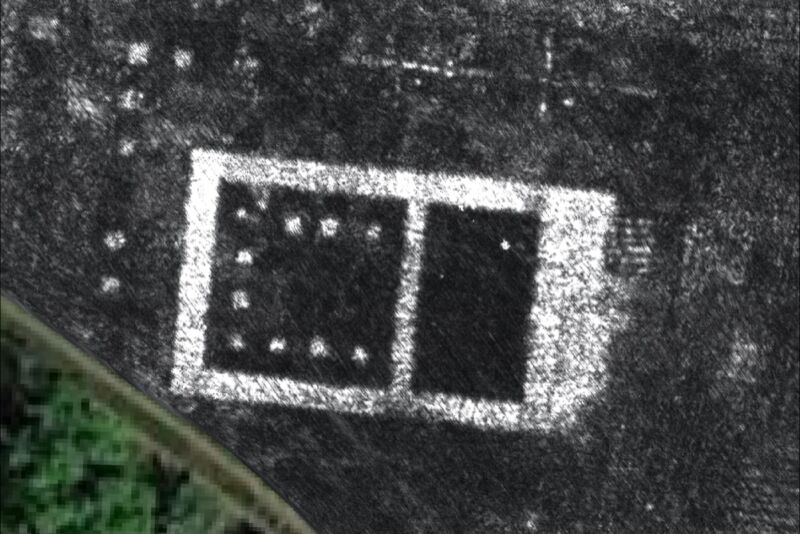
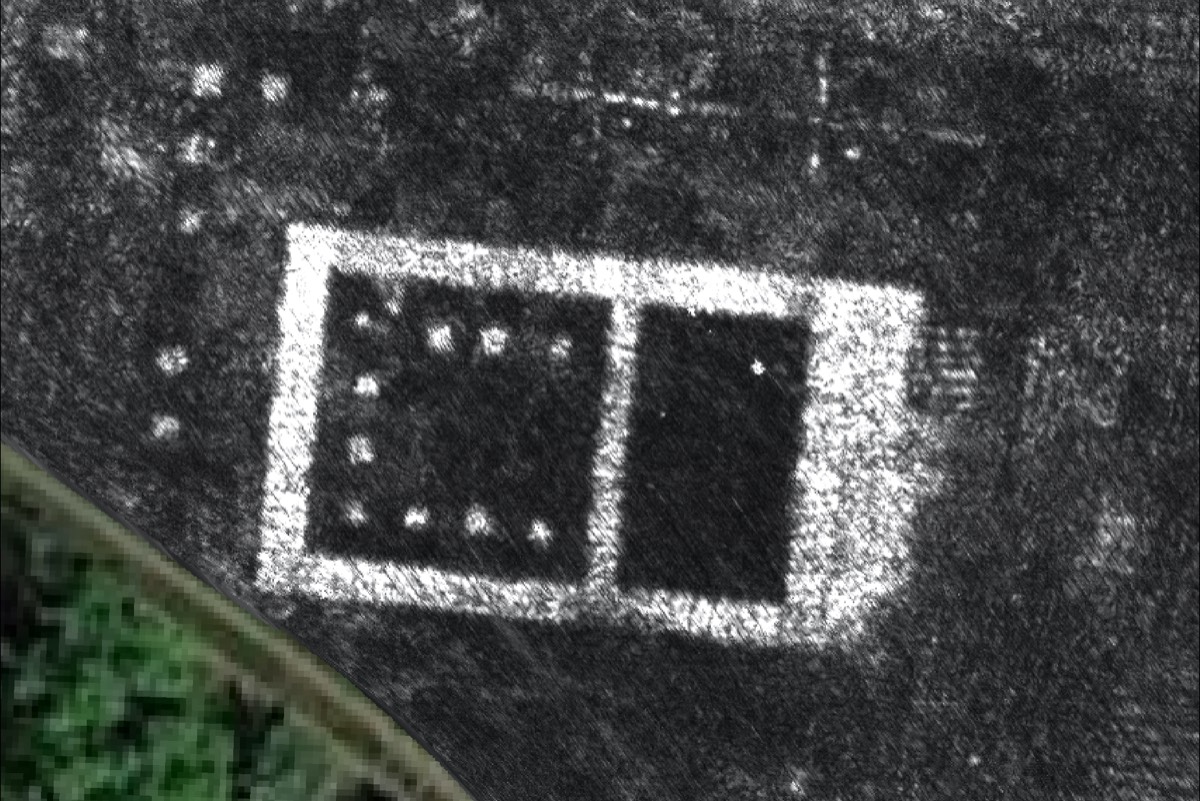
Ground-penetrating radar map of the temple in the Roman city of Falerii Novi, Italy.
Enlarge / Ground-penetrating radar map of the temple in the Roman city of Falerii Novi, Italy.
L. Verconck

Falerii Novi was once a walled town just north of Rome, likely founded around 241 BC as a relocation site for a Falisci tribe that had rebelled against the Romans. Located on a volcanic plateau, archaeologists surmise that the new site was chosen because it wasn’t as easy to defend, thereby discouraging further uprisings. There were likely some 2,500 residents during the third and fourth centuries BC. The ruins are deep underground, but a team of archaeologists from the University of Cambridge and Ghent University in Belgium have used ground-penetrating radar (GPR) to map the complete city. They described their findings in a recent paper in the journal Antiquity.

Dating back to 1910, when the first patent for a radar system to locate buried objects was filed, GPR has been used to measure the depth of glaciers, to study bedrock and groundwater, and to locate unexploded land mines, buried sewers, and utility lines, among other applications. The 1972 Apollo 17 mission—the final moon-landing mission of NASA’s Apollo program—used a GPR system called the Apollo Lunar Sounder Experiment (ALSE) to record depth information of the lunar surface. The method has also emerged in recent years as a powerful tool for archaeological geophysics, since it is a non-invasive means of detecting and mapping artifacts, features, and key patterns beneath the surface.

GPR is distinct from another popular method, LIDAR, which relies on infrared light from lasers rather than radio waves to map terrain. An electromagnetic pulse is directed into the ground, and any objects or layering (stratigraphy) will be detectable in the reflections picked up by a receiver, just like regular radar. How long it takes for the echoes to return indicates the depth, and different materials will reflect the incoming waves differently. The data can then be plotted to create detailed maps of those underground features.

Falerii Novi was first excavated in the 1990s, and over the ensuing decades archaeologists have identified warehouses, shops, market places, a theater, and a forum using various non-invasive techniques, including magnetometry—a method that measures the direction, strength, or relative change of a magnetic field at a given location to reveal details beneath the surface. But the use of GPR by the British and Belgian team has yielded a much more detailed and complete picture of the site, enabling them to study how the town evolved over several hundred years.

The authors attached their GPR system to the back of an ATV in order to more efficiently survey the 30.5 hectares (about 75 acres) within the ancient city’s walls, taking a reading every 12.5 centimeters. In 2017, using their method, the team found the remains of a large Roman temple, several feet below the town, that would have been roughly the same size as St. Paul’s Cathedral.

This latest analysis revealed a large rectangular structure connected to a network of water pipes, leading to the city’s aqueduct. The authors surmise that it is the remains of an open-air pool (natatio), part of a large public bathing complex. They were also surprised to see two large structures facing each other within a covered passageway (porticus duplex) that they believe was once part of a large public monument near the city’s north gate. It seems to be part of a “sacred topography” of temples around the town’s periphery, previously revealed by magnetometer surveys.

GPR works very well in certain conditions, like uniform sandy soils, but the high electrical conductivity of clays and silts, for example, can significantly dampen signal strength. And rocky sediments will scatter the signal, making it more difficult to pick out the patterns in the noise. “At Falerii Novi, the generally dry conditions in the summer months were well-suited to GPR survey,” the authors wrote, noting, however, that when it did rain, “up to seven days were needed before the ground was sufficiently dry to yield optimal data quality.”

Falerii Novi was a good site to demonstrate the potential of GPR because it is not buried beneath modern buildings, unlike other ancient cities. GPR, particularly when combined with magnetometry, could be a useful tool to study such towns. “Neither [GPR or magnetometry] is able to produce a complete picture of the archaeology,” the authors wrote, noting that the shop units of Falerii Novi, for example, show up in the magnetic data but not in the GPR survey. And while the city’s theater shows up in the magnetic data, the GPR survey provided a much clearer view, including at different depths, yielding insight into its structural form, as well as evidence of the removal of walls via stone-robbing.

The biggest challenge going forward is the sheer amount of data produced by this high-resolution mapping. According to the authors, they have collected a whopping 71.7 million readings from Falerii Novi, equivalent to 28.68 billion data points, or about 4.5GB of raw data per hectare (2.47 acres). It can take as long as 20 hours to document a single hectare, which is why the team is developing automated techniques to speed up the process with computer-aided object detection.

“The astonishing level of detail which we have achieved at Falerii Novi, and the surprising features that GPR has revealed, suggest that this type of survey could transform the way archaeologists investigate urban sites, as total entities,” said co-author Martin Millett of the University of Cambridge, adding that it should be possible to use GPR to survey major ancient cities like Miletus in Turkey, or Nicopolis in Greece. “We still have so much to learn about Roman urban life, and this technology should open up unprecedented opportunities for decades to come.”

DOI: Antiquity, 2020. 10.15184/aqy.2020.82  (About DOIs).

https://arstechnica.com/?p=1681990


PSA: This year’s confusing, virtual E3, condensed in a single handy site

In recent years, the annual Electronic Entertainment Expo has left gaming fans reeling with an abundance of trailers and announcements. We usually like to help Ars readers make sense of the noisy deluge by flying to California and going hands-on with E3-timed game previews, but that obviously didn’t happen this year. Without that kind of access, we, too, are scrambling.

Thus, on a weekend full of smaller-than-Sony game reveals, we wanted to turn your attention to e3recap.com, a site that has spent six years streamlining and interpreting a deluge of YouTube trailers. Right now, its 2020 landing page contains over 250 individual game trailers, and they’re organized in a clean, neat way that blows away other options.

Instead of having to jump from one live-streamed archive to the next or seek out individual game publishers, e3recap.com lets you scan through each revealed game in a tidy series of clickable boxes. By default, they’re sorted in a reverse-chronological order of reveals, so everything shown during this weekend’s events (Guerrilla Collective, PC Gamer Show, Future Games Show) appears in the order of those streams. This site doesn’t go to the trouble of copying-and-pasting each game’s sales pitch; instead, you’ll see simple facts like expected platforms and release dates.

As a bonus, this sorting system will let you expressly filter out any games by platform—so if you only want to know what’s been announced for PC, instead of being teased and disappointed by “console-exclusive” fine print, this site has your back. Though, obviously, details like platforms and release windows are subject to change, and this is a completely unofficial site, so caveats about accuracy and timeliness apply.

Still, we’re leaning on e3recap.com’s interface to keep track of every “E3-like” stream and reveal this summer, and it includes the archived reveals of games from recent Xbox and PlayStation events—along with a handy calendar to remind you of other events to come, including those from EA, Ubisoft, and CD Projekt Red. Some intriguing indie games we’ve seen this weekend, to help you pick through the noise, include the metal-infused rhythm-FPS Metal Hellsinger, the Thief-with-guns sneaking of Gloomwood (its free playable demo is live), and the gothic pencil-art tactics of Inkulinati.

Listing image by e3recap.com

https://arstechnica.com/?p=1683716


Review: Artemis Fowl is a crushing disappointment

Artemis Fowl fans loudly trumpeted their displeasure online when the second trailer for the film adaption of the beloved YA books dropped in March, in advance of its debut on Disney+. Their objection: It looked like a significant departure from the evil boy genius of the novels in favor of a more Disney-friendly heroic figure. At the time, I adopted a “wait and see” attitude, since it’s generally a good idea to see the actual film before passing judgement. Alas, that optimism was ill-founded. Artemis Fowl, the movie, is a spectacle-filled pointless slog that will be a crushing disappointment for book fans. The young criminal mastermind has been watered down and “Disney-fied” beyond recognition, just as fans feared.

(Spoilers below.)

There are eight books in the Artemis Fowl series, detailing the extensive exploits of the titular character. The debut novel received generally positive reviews and a few comparisons to J.K. Rowling’s Harry Potter series, although Eoin Colfer’s books have never achieved the same stratospheric commercial success. The comparison irritates Colfer, who describes his novels as being more like “Die Hard with fairies.” As I wrote when the first teaser dropped way back in November 2018, “That’s a fairly accurate description. Artemis is the anti-Harry Potter. He’s a thief and a kidnapper, among other misdeeds, and he is largely untroubled by remorse. That’s part of his charm.”

In the first book, 12-year-old Artemis is living mostly unsupervised in the Fowl home. His father (Artemis Fowl I) is missing, and his mother has gone mad with grief. He relies on his loyal protector, Butler, for companionship. They stumble across a portal to the fairy underworld: a magical place that includes a Lower Elements Police Reconnaissance (LEPrecon), trolls, dwarves, and goblins, all located beneath the “real” human world.

Artemis decides to kidnap a fairy and hold her for ransom to fund his search for his father. The fairies retaliate, and Artemis must pit his wits against their magical powers. It’s fiction, so he naturally succeeds, plus his mother is cured of her madness. Artemis goes on to rescue his father from the Russian mafia in the second book (Artemis Fowl and the Arctic Incident) and ends up in an alliance with the fairies he battled originally to help them defeat a goblin army.

Director Kenneth Branagh’s film adaptation takes its key elements from those first two books. Per the official premise:

[The film] follows the journey of 12-year-old genius Artemis Fowl, a descendant of a long line of criminal masterminds, as he seeks to find his father who has mysteriously disappeared. With the help of his loyal protector Butler, Artemis sets out to find him, and in doing so uncovers an ancient, underground civilization—the amazingly advanced world of fairies. Deducing that his father’s disappearance is somehow connected to the secretive, reclusive fairy world, cunning Artemis concocts a dangerous plan—so dangerous that he ultimately finds himself in a perilous war of wits with the all-powerful fairies.

Although Colfer told the Guardian, “I’ve seen about a third of it and it does look pretty close [to the books],” there are some pretty significant departures. I am not a stickler for accuracy when it comes to adapting books to film or television; different mediums have very different requirements. But Branagh and screenwriters Conor McPherson and Hamish McColl appear to have utterly misunderstood everything about Artemis Fowl that appealed to fans in the first place.  Die Hard with fairies? Not even close. Did they even read the books?

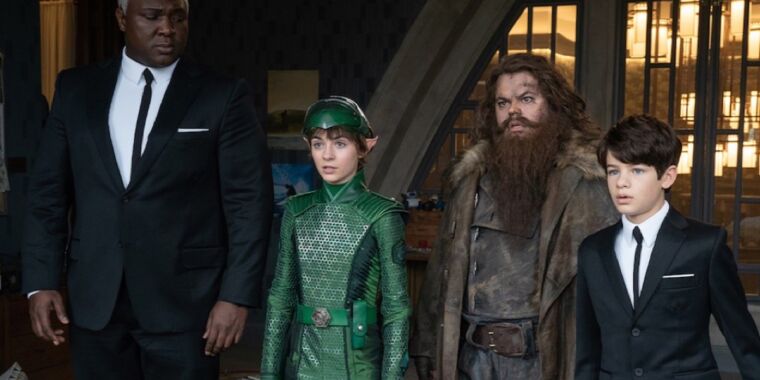
Let’s start with Artemis (Ferdia Shaw) himself, who is already a full-fledged criminal mastermind in the first book, having taken over the family business when his father went missing. Branagh tried to turn the film into more of a traditional origin story, so Artemis is not even aware of the true nature of the family business when we meet him. His worst behavior is being insolent and arrogant with the school counselor. We are also treated to several rather maudlin scenes of the father teaching his son about the fairies prior to his disappearance. (Unlike in the books, his mother is dead.) Sure, the boy genius has some daddy issues, but nobody wants an emo version of Artemis Fowl. Alas, that’s mostly what Branagh has given us.

Most maddening of all, the Fowl family enterprise has been reimagined as a secretly heroic endeavor. While everyone assumes Artemis Fowl I is a thief of rare artifacts, we learn that he was actually just trying to save the world from a malevolent pixie named Opal Koboi (the villain in the second book) who wants an all-powerful device called the Aculos (entirely invented for the film). What does the Aculos do? It’s not entirely clear, but opening portals to other dimensions and/or teleportation seem to be involved. Holly, too, is ostracized because her fellow fairies assume her own father, Birchwood (another invention for the film) was a traitor. But of course, he joined forces with Artemis Fowl I to keep the Aculos from falling into the wrong hands.

Die Hard with fairies? Not even close.

There are some decent performances here, most notably Colin Farrell as Artemis Fowl I and Josh Gad as Mulch Diggums, a freakishly large kleptomaniac dwarf (“Dwarfus giganticus!”) who also narrates the story for some reason. Lara McDonnell makes a likably plucky Holly Short, an elvenreconaissance officer for LEPrecon who is kidnapped by Artemis and ends up joining forces with him to foil Opal’s scheme. There are a couple of solidly entertaining action scenes, such as when Holly battles an escaped troll crashing a human wedding, and some decent special effects—although the style is generic fantasy that really doesn’t capture the fairy world’s intriguing mix of science and magic from the books.

Those small bright spots can’t save the film. There’s not much world-building to speak of, and the characters exist solely as quickly drawn sketches; they are not developed in the least. So it’s hard to buy into the sudden bond between Artemis and Holly over their lost fathers, for instance. The narration is ham-fisted, the plot is nonsensical, and the dialogue is leaden and often cheesy. A slow-motion scene of young Artemis dropping a glass of milk in shock when he learns his father is missing is laughably inept.

It’s hard not to wonder if part of the problem has something to do with the many delays of the film’s release. It was originally slated for last August, until Disney’s merger with 20th Century Fox prompted a major reshuffling. Unlike The New Mutants, there were no rumors (confirmed or otherwise) of reshoots requested for Artemis Fowl. So the studio didn’t seem to have any issues with the actual film. Then the pandemic happened, and Disney decided to release the film on Disney+ and cut their losses, which I think was the right decision.

As I noted in March, “Branagh is a gifted director who has shown he can handle mythical fantasy realms (Thor) and knows how to create a ruthless yet vulnerable villain/antihero (cf. the enormous popularity of Tom Hiddleston’s Loki in the MCU). He’s perfectly capable of doing the same for Artemis Fowl.”  But this doesn’t even feel like a Branagh-directed film. The editing is clumsy and choppy, and so many plot points seem to be missing—including an entire scene that featured heavily in the first trailer—that this feels like half a film. I wouldn’t be surprised at all to learn that additional heavy edits were made to accommodate the streaming platform.

Artemis Fowl is currently streaming on Disney+. I’d recommend giving it a miss and reading (or re-reading) Colfer’s books instead. No disappointing film adaption can take their magic away.

[embedded content]
Bringing Artemis Fowl to life featurette.

Listing image by Disney

https://arstechnica.com/?p=1682873