Audi parks driver for using a ringer in charity esports race
Enlarge/ Daniel Abt in happier times, taking part in a sim race at this year’s Santiago ePrix in Chile. After doing unusually well in a sim race this weekend, it turned out Abt had brought in a ringer.
Audi Communications Motorsport / Michael Kunkel
The combination of racing drivers and esports is turning out to be full of drama. When COVID-19 put a stop to real-world racing in March, professional series moved the action, using sims like iRacing and rFactor 2 along with streaming platforms like Twitch to give drivers something to do and fans something to watch. But the transition hasn’t been a smooth one for some of the professional drivers, particularly those who had little interest or experience in the simulation side of things before the pandemic.
Audi’s Daniel Abt is the latest to discover that it’s not just a game when you’re being paid to show up. The latest incident took place on Saturday in Formula E’s Race at Home challenge, where the sport’s real-world stars show up to compete in rFactor 2to raise money for UNICEF. Set in a virtual version of Berlin’s Tempelhof airport, Abt qualified well and raced to third place, a performance that was in stark contrast to his previous esports races. This, and the fact that he was obscured from view in his video feed, raised suspicions among some of the other drivers.
Rage-quitting, racist remarks, now a ringer
Those suspicions had merit. When the esports race organizers investigated, they checked IP address data and discovered the presence of a ringer—sim racing professional Lorenz Hoerzing, who raced pretending to be Abt. Disqualified from the race, Abt was ordered to donate $10,817 (€10,000) to charity. (Hoerzing was also stripped of his sixth-place finish in the companion event held for professional sim racers, and banned from competing in that series again.) After admitting he swapped in Hoerzing, Abt apologized in a statement on Sunday.
“I would like to apologize to Formula E, all of the fans, my team and my fellow drivers for having called in outside help during the race on Saturday. I didn’t take it as seriously as I should have. I’m especially sorry about this, because I know how much work has gone into this project on the part of the Formula E organization. I am aware that my offense has a bitter aftertaste, but it was never meant with any bad intention. Of course, I accept the disqualification from the race. In addition, I will donate 10,000 Euros to a charitable project,” he said.
On Tuesday, the other shoe dropped when the Audi Sport ABT Schaffler team announced that Abt has been benched with immediate effect. “Integrity, transparency and consistent compliance with applicable rules are top priorities for Audi. This applies to all activities the brand is involved in without exception. For this reason, Audi Sport has decided to suspend Daniel Abt with immediate effect,” it said in a statement. (The irony of this from one of the companies involved in dieselgate was not lost on everyone.)
By my count this is now the fourth case of a professional racing driver coming unstuck online. At the beginning of April, NASCAR’s Bubba Wallace lost a sponsor after rage-quitting an esports event. A week later, Kyle Larson was fired by his team and Chevrolet for dropping the N-word in another NASCAR esports event. And at the beginning of May, drama flared between fans of IndyCar and Formula 1 when rising F1 star Lando Norris got wrecked on purpose when he was invited to take part in IndyCar’s pro-driver esports series, embarrassing that series’ regulars in the process.
The start of an anti-esports backlash?
For some drivers, this is all too much. On Tuesday morning, fellow Formula E star Antonio Felix da Costa told Twitter he was done with Twitch streaming, a sentiment echoed—then deleted—by one of Porsche’s professional racers, Laurens Vanthoor.
A now-deleted tweet from Porsche factory driver Laurens Vanthoor
A tweet from Techeetah racing driver Antonio Felix da Costa.
While these esports sim racers might just be a game to some, racing drivers are professional athletes under contract to big organizations. And when you’re being paid to represent a big brand, there are consequences for making it look bad. Unsporting conduct, smoking weed, and even speaking out politically will get you in hot water in professional esports, and although Abt wasn’t signed by Audi to play rFactor 2, he was still representing the organization—which bears his family name, no less—on Saturday. At a time when Twitch streams are bringing many racing stars closer to their fans, it seems like a shame that drivers of the caliber of da Costa and Vanthoor are retreating over someone else’s mistake.
https://arstechnica.com/?p=1678802
Minecraft Dungeons review: A smashing good Diablo clone for any age
Enlarge/ Redstone golems are a real pain in the Minecraft Dungeons butt.
When Microsoft acquired the game studio Mojang in 2014 for a whopping $2.5 billion, fans of its biggest series, Minecraft, immediately wondered what would happen next. Would this be the end of Minecraft on rival platforms like PlayStation? Was the Java version toast? Would we have to suffer through some ill-fitting abomination like Minecraft: Kinect Dance Party?
Turns out, Microsoft has largely been a solid shepherd for the blocky series. The traditional Minecraft game continues receiving regular free updates across every platform imaginable, and its cross-platform builds sit alongside the original Java incarnation. Also, we didn’t wind up with a bunch of annoying spin-off games; so far, there has just been a well-reviewed Telltale adventure and a decent Pokemon Go clone.
Microsoft and Mojang’s combined ambitions grow this week with Minecraft Dungeons, the first series spin-off to germinate from within Mojang’s offices. At E3 2019, the studio admitted to having run a skunkworks division for some time, focused on finding the right game concept for its mega-hit universe. Its first spinoff salvo comes in the form of a family-friendly action-RPG.
Should you get caught up in the game’s apparent sales pitch—a dungeon crawler in the shadow of titans like Diablo III and Path of Exile—you’ll arrive at Minecraft Dungeons a little disappointed. Yet what’s interesting here is that Mojang’s design decisions, which revolve around adapting the genre to something that thematically fits the series’ universe, totally worked. This is a unique offering for the well-trodden genre, which is a remarkable feat. And while it lacks the “endgame” punch of its inspirations, Minecraft Dungeons is easier to sell when described as follows: a beefier, more addictive take on the LEGO action series.
To arms! As in, blocky, stubby arms
On the milder end of the combat spectrum: a single creeper. And it’s comin’ right t’wards us!
On the more hectic side of combat: the Nameless One as a mob-spawning boss.
Seriously, this redstone golem is a pain in the blocky butt.
This forest biome is one of the game’s more boring zones, but it sure looks pretty in Unreal Engine 4.
Enderman is one of the game’s trickier enemies, and it usually pops up in the middle of a normal wave of mobs to make things trickier.
The “multishot” enchantment makes any crossbow that much more fun to shoot.
Enemies get enchantments, too, and you’ll find even more of these specially charged foes in increased difficulties.
Tap a button at any time to bring up a map overlay.
That is technically a “key golem” on the hero’s back. Should you take any damage while carrying it towards a door, it will scurry away from you. Cute stuff.
The plot keeps things simple. A new villain called the “Arch-Illager” (pronounced like “villager” but without the “V,” so, like, it’s ill, and not in a Beastie Boys way) is spawning an unprecedented number of “mobs” (the series’ monsters) and needs to be stopped. While vanilla Minecraft includes plenty of combat options, this scourge is too great both in power and in numbers for that moveset to suffice.
Hence, the blocky heroes of Minecraft Dungeons look familiar—complete with default characters Steve and Alex as options—but their new controls shamelessly pilfer from the Diablo archetype. Action is viewed from a top-down, isometric camera angle, and heroes have a mix of melee and ranged attacks, along with explosive spells, helpful pets, dodge-roll maneuvers, and a full-body equipment menu to click through. (All platforms support gamepad control, while many also let you swap in a mouse and keyboard.)
Continuing the Diablo theme: every level is randomly generated according to a theme (swamp, castle, dungeon, etc), with pre-made chunks fitting together to build your above-ground and underground journeys. They’re pretty much all action-oriented. Some of these pieces include requirements like “free five villagers from cages” or “get a key” to advance, but these are designed to direct your heroes into combat, not to strain your brain.
Up to four heroes can play in co-op, either on the same screen or connected online. Unfortunately, as of launch, cross-play is not enabled—apparently not even between players on Xbox One consoles and Windows 10, which is a break from Microsoft’s usual Xbox Play Anywhere pledge.
Make your own hero
MD‘s first major differentiation comes from its lack of discrete classes. Mojang’s developers explained during a pre-release press event that they wanted to let players “build” their play experience the way they might custom-build a traditional Minecraft instance, and that means your playstyle revolves entirely around your inventory.
Every character gets six inventory slots: one melee weapon, one bow-and-arrow, one suit of armor, and three “artifacts,” which I prefer to call “abilities,” because that’s what they are. These are the kinds of skills you’d expect from, say, a Diablo skill tree for a particular class. Unlike Diablo, MD lets you mix and match whichever ones you want. Maybe you want to have one tanky ability (a grappling hook that grabs and pulls baddies toward you and away from friends), one ranger ability (super-charged fireballs), and one necromancer ability (conjure a battle llama that spits at your foes). Find the respective items for each ability, then place them into your three slots. Most revolve around a cooldown timer instead of something like a “mana bar.”
Battle llama? Uh, heck yes.
Weapons and armor can be boosted with enchantments. Here, I had two options, and I’ve locked into both of them…
…but notice this armor has a diamond with three smaller icons. In this case, the player still needs to pick a favorite, which then makes the other two options disappear.
Another look at enchantment possibilities.
In addition to loot found in an average encounter, you can also use gems found in the campaign, and gems received for “scrapping” older items, to buy new, random gear. Sadly, this system is tuned a bit badly as of press time, as it mostly spits out worthless gear—although I’ve also gotten a couple of amazing exotics this way.
Weapons and armor come with their own built-in stat bonuses, and these favor particular play styles, whether by strengthening armor, making your arrows stronger, or shrinking your cooldown timers. On top of those, there’s also a new “enchantment” system. Pick up a new piece of armor, and you’ll see a little diamond in your menu with three options for perks. As an example of a possible trio, one randomly generates poisonous clouds; one generates lightning damage to nearby enemies whenever you dodge-roll; and one adds a straight damage bonus to your every attack. All three of those sound nice.
The catch is, once you pick one of those three, the other two vanish. Enchantments always work this way, where a new melee weapon, bow, or piece of armor will make you whittle down possible perks. You’re also spending a limited supply of enchantment points on all three equippable gear types, which further adds to your decision-making matrix. And you’ll do this a lot: Whenever you equip a new piece of gear, you can recover your old enchantment points by “scrapping” the older stuff (which you’ll likely want to do, since this is a loot-driven game, and there’s often better loot around the corner). This is how I learned I didn’t actually like the game’s electric-dodge-roll perk: I spent points on that with an early piece of armor, found I didn’t care for it, and opted to not choose it on future equippable items.
Rolling with the random-loot punches
In the game’s early stages, cycling through all six equipment slots and finding a preferred play style felt organic and fun. New weapon types typically emerged with a clear numerical lead over whatever I had equipped, so I’d switch from a massive, slow hammer to a frenzied, short-distance dagger and benefit, even if this meant retooling my general combat strategies.
The same goes for every other equippable element, and that quality multiplied when I had a co-op playmate by my side and bouncing off their new-loot acquisitions. At first, we were annoyed by a strict game limitation: no sharing of loot. Anything your character picks up is only for you, not to be traded or swapped. Uh, what? I thought we could build our characters however we wanted, Mojang! But as we dug further into the game, and our loot’s numerical jumps began to plateau, this rolling-with-the-punches loot mentality evolved. My co-op partner at one point got tired of her archetype and changed her loadout, which meant she would no longer serve as the party’s healer. “Oh, I’ve been holding onto a healing item,” I replied, and after equipping it, I swapped a bunch of other elements to go full ranged-mage while my cohort transformed into a damage-eating tank.
Compared to the genre’s stalwarts, MD is less about settling into a prescribed role and more about rolling with the random-loot punches, and for some players, the results may feel more fun and loose. For others, the fact that your existing loot cannot be numerically boosted a la Destiny could prove frustrating. You may have to give up on a particular hero archetype when the game’s incredibly random reward system denies you the high-valued gear you’ve been dreaming of.
One thing in MD‘s favor is how solid each weapon and item type feel. Some shine more when they’re matched with a perfect set of appropriate gear; the aforementioned grappling hook sucks if you’re not otherwise built to wipe out waves of melee foes, for example. But for the most part, melee, ranged, and magical attacks all feel fun to mash over and over and over (which matters in the repetitive, do-it-again genre of a procedurally generated dungeon crawler), and the enchantment system makes it easy to drizzle ridiculous bonus abilities on top. Want a crossbow that regularly shoots five bolts, which then explode in both burning flames and poisonous clouds? Make it happen, then watch those little damage-indicator numbers pile up on your foes as they melt away.
The “okay, folks, let’s get serious” switch
While the game’s opening trio of levels are a snoozer to play through—both in your first run-through and in subsequent higher-difficulty runs—the rest are full of life. A mix of familiar Minecraft foes and brand-new monsters fit together in satisfying action-RPG fashion to overwhelm players and force them to be mindful of their combined strategies. Careful juggling of splash-damage abilities, temporary invulnerability boosts, and other super-powered perks will be necessary once mobs start coming together in brutally choreographed waves.
What’s more, the levels themselves factor into where and how you can move, and the best ones include wacky, Minecraft-appropriate tweaks you might never see in Diablo. A castle level includes bouncy pads that launch you (and your foes) from tower to tower, which melee and ranged battlers alike can capitalize on. In a lava refinery, certain relics can be triggered to send out massive straight lines of laser damage, which are great to activate—so long as you don’t accidentally walk into their line of fire. I do wish MD delivered more of these wacky moments, because they powered some of my most memorable fights, but they only emerged roughly 10 percent of the time.
Enlarge/ One special thing worth mentioning is the game’s “souls” system. Certain items won’t function unless you gather souls from enemies you kill, which then fuels a special bar in the lower-left of the screen. Spend that bar on souls-specific items to trigger special attacks. Since these items work differently than others, they require a specialized build of weapons and armor to maximize the effect. It’s a cool later-game tweak, and I’m hopeful more wacky systems like this find their way into the game’s promised series of patches.
The game’s first “campaign” playthrough is paced with a nimble difficulty ramp-up, the kind that will let any age group and proficiency get the hang of the game’s mechanics and customization paths. After that, your future game runs are largely the same in terms of level generation… just with crazier waves of enemies to contend with. Once MD flips the “okay, folks, let’s get serious” switch, it’s at a point where nobody in a campaign should consider themselves a “casual” player. And for those players, MD‘s harder-challenge zones start slapping special enchantments on more of the bad guys you face. In practice, MD’s enchantment variety is solid enough, in terms of making the game’s finite enemy variety comparable to other “endless” dungeon crawl options.
But at least in my experience, “endgame” loot gathering was a slow crawl. I found myself beating level after level in increased difficulties, only to emerge from each with a bunch of low-powered loot and far fewer “exotic” drops than even the default campaign served. Hopefully, this is an issue with pre-release tuning, because when the game gives you enticing reasons to switch from one class to another, and to go to crazy-customization town in your new form, the results are a blast.
Blocks vs. bricks
I know, I mentioned “LEGO action games” at the top and haven’t spoken about that. It’s a loose comparison, but stick with me.
I like playing LEGO games with family members on occasion. The games are mindless, they’re satisfying, and they have good audio and visual feedback for laying waste to all kinds of bad guys. On a base level, Minecraft Dungeons nails this quality for the most part, because the sensation of default, button-mashing combat is identical.
In bad news, Minecraft Dungeons does not let you smash walls, punch trees, or otherwise deform the environment, which a LEGO comparison might lead you to believe. I understand why Mojang went this route: its randomly generated levels have to guide you into combat in a clear, fun way, and smashing or digging through terrain would make this style of game a mess. (If the LEGO series served wholly randomized levels and deformable terrain, I might throw a bigger fit, but their pre-set worlds make it easier for them to sneak block-busting moments in.)
[embedded content]
Minecraft Dungeons launch trailer.
But in great news, where LEGO games run out of steam pretty quickly (even unlocking new hidden characters doesn’t really change your tactics), Minecraft Dungeons does a wonderful job incentivizing experimentation without making it difficult to figure out. Get new item. Equip new item. See how new item makes you stronger, more explosive, or just plain weirder. Kill mobs. Repeat.
Thus, with a $20 price netting you a 7-hour base campaign, plus a deeper dive into harder difficulties, Minecraft Dungeons is a no-brainer recommendation for a simple-yet-nuanced co-op game. (It’s also, wouldn’t you know it, an Xbox Game Pass freebie.) Limit your expectations to the $20 level—with no microtransactions beyond a $10 DLC bundle for new future levels—and you’ll come away with a surprise hit, whether you’re soloing, playing with kids, or forming a dead-serious four-player clan.
The good:
Satisfying combat, as driven by solid controls and a satisfying audio-visual pop.
Make-your-own-class system keeps players bouncing between playstyles through the game’s campaign.
Wackier levels deliver the kinds of memorable, environment-driven moments you won’t find in Diablo.
The bad:
As of press time, the loot system needs tuning to keep endgame content more exciting.
If you’re the kind to get attached to a single class and stick to it, Mojang doesn’t give you a lot to work with.
The ugly:
Glitches during the pre-launch period caused our heroes to randomly die during critical battles. Fingers crossed this’ll be patched.
Verdict: It’s priced right for a clever, family-friendly alternative to Diablo. If you’re looking for a new co-op game, buy.
https://arstechnica.com/?p=1678753
I laughed a lot at Netflix’s Space Force, but my inner space wonk cried
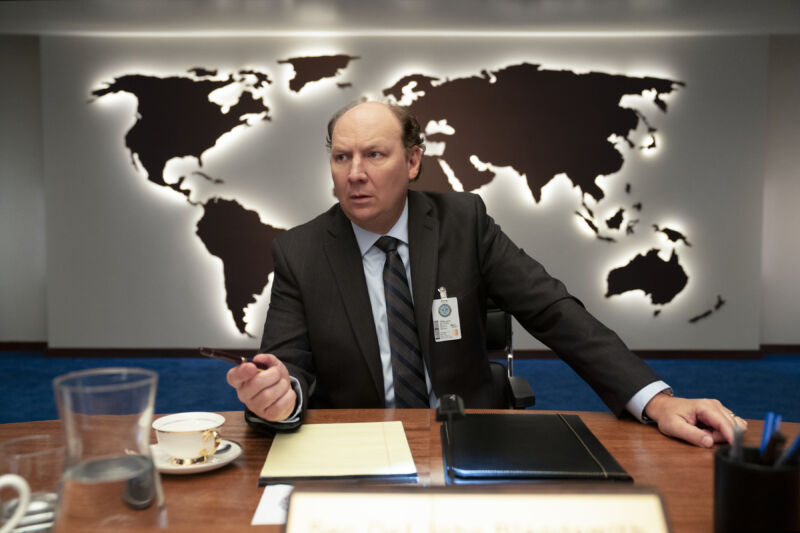
Enlarge/ Dan Bakkedahl as secretary of defense spells it out: Boots on the Moon by 2024.
Note: This is not a review of Netflix’s Space Force, but in discussing differences between the series’ first season and the real world, this article contains minor plot spoilers—but not enough to spoil 99 percent of the series’ jokes and plot developments.
One of the opening scenes of Netflix’s new comedy series Space Force hilariously depicts General Mark Naird (Steve Carell) at his first meeting as part of the Joint Chiefs of Staff.
This scene establishes the premise for the main story line of the show. Comedian Dan Bakkedahl (similar to his portrayal of a congressman in Veep) plays the part of Secretary of Defense John Blandsmith. After introducing Naird as a new four-star general, Blandsmith gets to the point:
POTUS wants to make some changes. He’s tweeting about it in five minutes, so let’s hope you like it. Our nation’s internet, including Twitter, runs through our vulnerable space satellites. POTUS wants complete space dominance. Boots on the Moon by 2024! To that end, the President is creating a new branch. Space Force. This is not a joke. His words, boots on the Moon in 2024. Actually, he said boobs on the Moon, but we believe that to be a typo.
For someone who spends most days thinking and writing about space, and space policy, this is simultaneously highly entertaining and painful. I mean, it’s funny. At times during the show, I howled. And there are vivid snippets of reality throughout the series that capture the state of play in modern spaceflight. But this show takes those pieces and scrambles them madly.
The launch
One of the central tensions of the first episode involves whether or not to launch Space Force’s first big mission, a satellite on its “Epsilon” rocket. (For the record, there is a real-world Epsilon rocket, a relatively small booster developed by the Japanese Space Agency.)
Space Force’s rocket appears to be the love child of two real-world rockets: an Atlas V rocket core (which is built by United Launch Alliance) and two side-boosters that look strikingly like Falcon 9 (SpaceX) first stages with a single engine. The performance of such a rocket is interesting to contemplate, and I will give the producers of Space Force credit for doing their homework. When I was at SpaceX’s factory about a year ago working on a project, Steve Carell was there with an entourage. We brushed shoulders while getting a fountain drink in the cafeteria.
Enlarge/ The Epsilon rocket seems like a love child of the Atlas V and Falcon 9 rockets.
But some of the TV version’s logical lapses are, for me, too difficult to swallow. For one, Netflix’s version of Space Force is established in Colorado, which is realistic enough given existing Air Force assets there. What is completely bonkers, however, is the notion of launching orbital rockets from Colorado. Big US rockets do not launch over land because of the potential for a) an accident shortly after liftoff, and b) unless it’s a reusable rocket like the Falcon 9, the potential for a first or second stage to fall down range after its fuel is spent. With its land-based launch sites, China has a real problem with this.
Another weird conflation is weather constraints for the Epsilon launch. While conditions such as thunderstorms or high winds—either at the surface or in the upper atmosphere—can delay a launch (check out this list of constraints for the upcoming Crew Dragon launch), Space Force instead goes with humidity. Humidity?!
For the Epsilon launch, the proper humidity is 40 percent, explains Dr. Chan Kaifang (Jimmy O. Yang, Silicon Valley). The actual humidity on launch day was 54 percent. “This can effect oxygenation and fuel burn,” Kaifang explains. “If the fuel is insufficient, the rocket returns to Earth without reaching orbit.” While, yes, a rocket needs a certain amount of fuel to reach orbit, humidity has nothing to do with it.
Weird, jarring details like this emerge throughout the series—space nuts will scratch their heads at the odd array of model rockets behind Naird’s desk in his office—that suggest the producers of Space Force ultimately cared little about the details.
A confused public
Oh Berger, you’re such a nerd. And it’s true. Most of the public won’t catch these details. Nor will they care that chimpanzees are performing spacewalks, or that the interior cabin of the crew spacecraft going to the Moon is about as big as my house. None of this is plausible, but it serves the plot, and it’s often damned funny, so it’s fine.
What sort of does matter, however, is the policy stuff. It is perfectly true that President Donald Trump called for the creation of a Space Force branch of the military early in his administration, but this required Congressional action, and Congress had already been moving toward this for several years. It is also true that one of the Space Force’s primary roles is protecting our “vulnerable space satellites.” And, to the chagrin of our allies, this administration has called for space dominance.
As for the boots on the Moon thing, in the real world, the White House set a goal for a human Moon landing by 2024. Specifically, Vice President Mike Pence gets credit for this, as Trump has at times seemed more interested in Mars than the Moon. Incidentally, the show’s characterization of POTUS, who goes unnamed and does not need to be, is spot on.
However—and this is important—Pence gave this task to NASA, not the US military.
The United States essentially has three major space segments. One is the military, responsible for launching large spy satellites, GPS, its own communications satellites, an uncrewed space plane, and ensuring the safety of those space assets. It does not entail anything like Starship Troopers, however. The second is civil space, which is NASA, and which operates transparently, works with international partners, landed on the Moon in the 1960s, and is responsible for the peaceful exploration of the cosmos. Finally, there is the commercial space sector, including traditional contractors like Lockheed Martin and Boeing, as well as important new players such as SpaceX and satellite companies like Planet.
But for a fleeting, dismissive mention of NASA, Space Force mostly ignores civil and commercial space. In this television show—and thus, I fear, in the public mind—it sets up the human exploration of the Moon as a purely military exercise. There are those of us who would like to see NASA as a force to unite the world, rather than divide it, and for humans to go forward into the next frontier together.
The eerily real stuff
The show gets some details shockingly right. It portrays China as America’s major rival in space, and this is accurate. China has not yet surpassed US spaceflight capabilities, as is suggested in Space Force. However, China is building a credible and stable program that will see development of a modular space station in a couple of years, and they’re working toward putting humans on the Moon in a decade or so.
Toward the end of the first season, China claims the large “Sea of Tranquility” region on the Moon for its own as a “territory of scientific research.” China informs Naird that his astronauts should not land there because it would disrupt Chinese experiments.
As I watched this, I was reporting on NASA efforts to finalize an initiative it calls the “Artemis Accords.” The goal of these accords is to establish 10 basic norms as part of the space activities, such as operating transparently and releasing scientific data. One of these was “Deconfliction of Activities,” which affirms that no one can own territory on the Moon or elsewhere but that NASA and its partner nations can establish “safety zones,” which they would ask other nations to respect and not interfere with.
The bottom line is that Space Force exists at the very edge of real-world spaceflight. While we’re laughing, I hope we’re also thinking about how we go into deep space in the coming decade. NASA’s vision, as outlined in the Artemis Accords, is a pretty good one. I’ll take partnerships over pistols any day.
Shortly before the series’ formal Netflix premiere on Friday, May 29, some of my Ars colleagues will post a more traditional TV review of the series. Until then, I’d like to briefly fake being a TV critic and salute John Malkovich as fake Space Force’s chief scientist. My God, he’s wonderful. Steals the show.
https://arstechnica.com/?p=1677703
Review: Revisit the controversial Biosphere 2 project with Spaceship Earth
[embedded content]
Official trailer for Spaceship Earth, a documentary about the controversial Biosphere 2 experiment in the early 1990s.
In September 1991, amid much media fanfare, eight people entered a closed experimental facility called Biosphere 2 for a two-year stint in total isolation. They endured hunger, a dangerous rise in CO2 levels, interpersonal squabbles, a media backlash, and sharp criticism from the scientific establishment. Today, most people might recall Biosphere 2 as a colossal failure. But the truth is much more nuanced than that, as we learn in Spaceship Earth, Director Matt Wolf’s self-described “stranger than fiction” documentary about the controversial experiment. The film made a splash at Sundance earlier this year and is now available for streaming on Hulu, Apple TV, and other select platforms.
Biosphere 2, a 3.14-acre facility located in Oracle, Arizona, has a long, colorful history tailor-made for the documentary treatment. Built between 1987 and 1992, its original objective was to be an artificial, fully self-sustaining closed ecological system—a large-scale vivarium, if you will. (It was called Biosphere 2 because the Earth itself is the original biosphere.) There were seven distinct “biome” areas: a rainforest, an ocean with living coral reef, a savannah grassland, a fog desert, mangrove wetlands, an agricultural system (i.e., a small farm), and a human habitat.
Spaceship Earth delves deep into the roots of the project, going back to the 1960s, when John Allen and several cohorts (some would later deem them cultish followers) moved from San Francisco to New Mexico and founded a commune called Synerga Ranch. They were inspired by surrealist/spiritualist French novelist René Daumal, among others, as well as Buckminster Fuller’s Spaceship Earth. They even built their own geodesic dome on the ranch, the better to hold communal gatherings and stage amateur theatrical productions. (They would later tour as the Theater of Possibilities.)
Once the ranch became self-sufficient, Allen grew bored and moved his core group to Berkeley, where they built a ship called the Heraclitus on the Oakland shore. Miraculously, given their lack experience, the Heraclitus proved seaworthy. Under the umbrella of what would become the Institute of Ecological Technologies, they also founded several successful business ventures around the world, in partnership with Ed Bass, the heir to a massive Texas oil fortune who was among those drawn to Allen and Synerga Ranch.
All that is prologue to Allen’s idea for Biosphere 2, inspired in part by the strong environmental themes of the 1972 post-apocalyptic film Silent Running. In that film, all plant life on Earth is becoming extinct, and a group tries to preserve as many specimens as possible in greenhouse-like geodesic domes, attached to a large spaceship just outside the orbit of Saturn. For his real-world project, Allen envisioned an enclosed, completely self-sufficient structure on Earth that could serve as a test module for setting up a colony on the Moon or Mars.
Down memory lane
A double rainbow seems to bode well for the start of the Biosphere 2 project.
YouTube/NEON
Visionary leader John Allen built a geodesic dome in the 1960s
YouTube/NEON
Communal living on Synerga Ranch. Some later called it a cult.
YouTube/NEON
John Allen holds court in that first dome.
YouTube/NEON
The Biosphere 2 mission generated considerable media interest.
YouTube/NEON
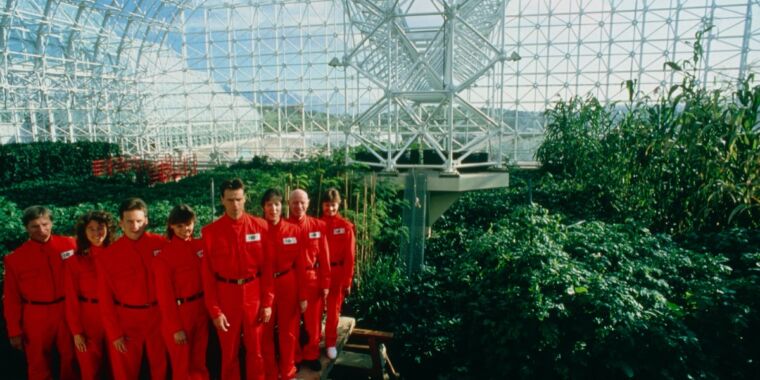
Crew poses for a publicity photo inside Biosphere 2.
A bit of indoor gardening.
YouTube/NEON
Tending to one of the many animals.
YouTube/NEON
The 9,100-square-foot “ocean,” complete with a coral reef.
YouTube/NEON
Monitoring one of the seven biome regions.
YouTube/NEON
An indoor “rainforest.”
YouTube/NEON
Perhaps the isolation is starting to get to him.
YouTube/NEON
A serious issue developed with CO2 levels.
YouTube/NEON
Oxygen was in short supply.
YouTube/NEON
There were a few health issues.
YouTube/NEON
The intrepid crew.
YouTube/NEON
That first two-year experiment produced mixed results. The biospherians managed to grow or produce 83 percent of their food, especially as their farming skills improved, but hunger was constant. A few ants and cockroaches snuck into the ecosystem before it was sealed and over time threatened the crops. Just 12 days in, biospherian Jayne Poynter accidentally cut off the tip of her finger in a threshing machine while winnowing rice. She had to be temporarily evacuated for surgery, returning a few hours later. But she brought back a duffel bag—purportedly containing circuit boards, plastic bags, and a planting plan—which fueled media speculation that she was sneaking in food and that the grand experiment had already been compromised.
Most seriously, oxygen levels began falling precipitously, down to just 14.5 percent (what one might experience at an elevation of 13,000 feet). When the team’s medical doctor became so impaired that he could no longer add columns of numbers, the managers intervened, pumping in pure oxygen to restore the balance. It was later determined that the primary culprits for rising CO2 were microbes in the enriched soils, which produced CO2 faster than the plants could produce oxygen. Making matters worse, the unsealed concrete in the habitat reacted with the CO2 to form calcium carbonate, effectively sequestering both oxygen and CO2.
The low oxygen levels no doubt contributed to the interpersonal tensions and overall low morale; ultimately the biospherians split into two factions that weren’t speaking to each other when they finally emerged after two years. But despite the infighting, they still managed to continue to cooperate for their shared survival. The same could not be said for management. Rifts emerged over the focus of the research, and Bass (frustrated by the massive cost over-runs, among other issues) ultimately took out a restraining order and ousted Allen and his team with the help of several police officers.
Some considered Biosphere 2 to be little more than “ecological entertainment.”
While Allen brought on several professional scientists as consultants for various aspects of the project, there were still those who considered Biosphere 2 to be little more than “ecological entertainment,” or, more harshly, “New Age drivel masquerading as science.” One early critic was Ghillean Prance, director of the Royal Botanical Gardens in Kew, who initially dismissed the project and claimed Allen et al.’s “interest in science is not genuine.”
But Prance later changed his tune, impressed by the group’s organization and passion, and went on to design the rainforest biome. “You shouldn’t hold their past against them,” he told the Phoenix New Times in 1991. Independent scientific assessments in 1992 and 1994 concurred that the project was a legitimate laboratory for investigating relevant ecological questions. Nonetheless, in 1999 Time included Biosphere 2 in a list of the 100 worst ideas.
There is much to like about Spaceship Earth. Given all the controversies that have erupted over the years, it’s an inherently fascinating topic, and Wolf approaches it with an even hand, whether he’s portraying the group’s early days as rather naive idealistic dreamers or chronicling the inevitable pain of disillusionment. Wolf has captured the essence of why Biosphere 2 proved to have such a strong hold on the public’s imagination—and just how impressive it was that Allen and his group managed to pull it off at all.
It’s easy to sneer at their hippie roots, or cringe at the amateur theatrics of the Theater of Possibilities, but you have to admire the ingenuity and sheer chutzpah of these people. The fact remains that they took on a daunting challenge and (mostly) got it done. There were setbacks and disappointments, but we really did gain some valuable knowledge from Biosphere 2. (Sadly, much of the original data collected from that two-year experiment has never been analyzed, and may be lost. ) As for the cult accusations, Allen is still living on Synerga Ranch with several members of that original group—friendships that have endured for some 50 years. Cults aren’t typically that enduring.
Biosphere 2 today
Biosphere 2’s distinctive architecture still stands out in the desert terrain.
Jennifer Ouellette
Entering Biosphere 2
Jennifer Ouellette
An ecosystem under glass.
Jennifer Ouellette
Living quarters
Jennifer Ouellette
The communal kitchen
Jennifer Ouellette
The rainforest biome.
Jennifer Ouellette
Divers in the ocean biome.
Jennifer Ouellette
The desert biome looks a lot like Oracle, Arizona.
Jennifer Ouellette
Nothing but blue sky.
Jennifer Ouellette
In the belly of the beast: entrance to the South Lung
Jennifer Ouellette
The South Lung.
Jennifer Ouellette
The original test module still stands.
Jennifer Ouellette
So do the original Quarantine Labs.
Jennifer Ouellette
There’s a gift shop, too.
Jennifer Ouellette
That said, at nearly two hours, Spaceship Earth is overlong; it would work better at a more nimble 85-90 minutes. It also hews a little too closely to a strict chronological timeline. After a short introductory 1991 segment, Wolf jumps back 25 years and spends a big chunk of the film reminiscing about the group’s earliest days. That period is vital to provide context for Biosphere 2, but it’s also frankly the least interesting. The material could have been trimmed back substantially—possibly even sprinkled throughout the documentary as flashbacks when that context was relevant—while still making Wolf’s major points.
Spaceship Earth ends rather abruptly with the premature termination of the second Biosphere 2 mission (which did manage to achieve total food sufficiency with no need for oxygen injections), the ousting of the original management team by Bass, and the dissolution of Space Biospheres Ventures. It spends very little time on what has become of the facility since then. Biosphere 2 is no longer a closed system experiment. Columbia University switched the research focus to that of a “flow-through” system when it took over operation in 1995, using it to manipulate and study shifting CO2 levels for global warming research—notably the impact of high CO2 levels and ocean acidification on coral reefs.
Today, Biosphere 2 is owned and operated by the University of Arizona. Some of the older structures outside are a bit worse for wear, like the old test module and original quarantine labs. But solid science is still being done on-site, and Ed Bass continues to supply occasional funding, most recently donating $30 million in 2017. The projects are smaller and more focused, including a lunar greenhouse, designed to explore how to grow vegetables on the Moon or Mars; a vertical farming project constructed in Biosphere 2’s west lung; and a Landscape Evolution Observatory, tracking how volcanic rock slowly develops over time into rich soil. Biosphere 2 also offers public tours and hosts space camps and small conferences.
For Wolf, the timing of his film’s release couldn’t be more relevant to our current predicament. “While making this film, I could never have imagined that a pandemic would require the entire world to be quarantined,” he said in a statement. “In light of COVID-19, we are all living like biospherians, and we too will re-enter a new world. The question is how will we be transformed? Now with a visceral sense of the fragility of our world, it’s on us to protect it.”
Listing image by NEON
https://arstechnica.com/?p=1670064
Deep Space Nine: The Trek spinoff that saved the day by staying put
Enlarge/ Chances are, you and your loved ones might get into anxious quarantine moments like this one, shared between Sisko (Avery Brooks) and Quark (Armin Shimerman) in the DS9 season two episode “The Jem’Hadar.”
When thinking about the above criteria, however, one not-so-scary show comes to mind as a fitting series to retread: Star Trek: Deep Space Nine. That prompts a fair question: how does a ’90s Star Trek spinoff about a space station in the 24th century relate to a coronavirus-driven pandemic in 2020?
Deep Space Nine turned the Star Trek paradigm upside-down when it debuted in 1993. Instead of going where no one has gone before, this show largely trapped its crew in a single place: aboard an isolated station located near the galaxy’s only stable wormhole, where any form of alien life—hopefully benign, though often scary and hostile—might suddenly appear and invade. Encountering never-before-seen threats was the norm, forcing the barebones senior staff and medical crew to solve problems they didn’t have either the skills or equipment for.
“Essential station operations”
While Trek series usually adopt a hopeful outlook on social and political issues, DS9 took a grittier approach, broaching decidedly tougher topics such as the fallout from a decades-long military occupation, racially motivated war crimes, and refugees escaping genocide. The station Deep Space Nine itself was created during a different kind of quarantine, built by slave labor during the Nazi-like occupation of the fictional planet Bajor by another alien species, the Cardassians. Because the characters couldn’t freely roam around to meet new people and find adventure, DS9 focused on developing narratives that were more inward-looking.
Just five episodes into the first season, a virus-causing fever and aphasia breaks out aboard the station, forcing the already anxious and frustrated new crew members to self-isolate in their quarters to slow the rate of infection. Despite the benefit of living in the technologically advanced 24th century (no need for takeout apps, thanks to food replicators), people on Deep Space Nine reacted how many people today have reacted to the emergency quarantine: by having big social gatherings.
“It looks like business as usual, but that’s impossible because all shops and businesses have been closed until further notice,” says Constable Odo (René Auberjonois), noticing a crowd at the bar owned by scheming saloon owner Quark (Armin Shimerman).
“Except, of course, for essential station operations,” Quark replies. “This quarantine has everybody on edge, constable. Would you deprive them of a little harmless diversion?” Later in the episode, while the virus is still at large, one ship pilot gets antsy and attempts to break quarantine by leaving the station, regardless of the risk it poses to unaffected populations on other worlds.
Sanctuary Districts, compared to the Tenderloin
The dehumanizing effects of humanity’s attempts to maintain order amid crisis is the central conflict in “Past Tense,” a two-part episode from DS9’s third season. Commander Benjamin Sisko (Avery Brooks) and Dr. Julian Bashir (Alexander Siddig) become trapped over 300 years in the past; specifically in San Francisco of 2024, when staggering economic inequality has led to the creation of walled-off “Sanctuary Districts” in cities across the United States. In the episode, what was originally intended to be temporary refuges providing free food, housing, and job placement opportunities for homeless Americans had degenerated into inhumane internment camps rife with violence. Sanctuary Districts quickly became overcrowded slums where social outcasts, the destitute, and mentally ill could be out of sight and out of mind for the rest of the country.
“Having seen a little of the 21st century, there is one thing I don’t understand,” Bashir says, after returning to the 24th century. “How could they have let things get so bad?”
As a comparison point: in the real 21st century, residents and business owners in San Francisco’s Tenderloin neighborhood filed a lawsuit in federal court earlier this month, demanding that the city take immediate action to clean up overcrowded streets and find housing for homeless residents after the number of tents and makeshift encampments in the area tripled amid the coronavirus pandemic. “We are set to be as aggressive as we can be,” promised new San Francisco Mayor London Breed in a press conference on May 6—where she unveiled a plan that included closing streets, moving people into a sanctioned encampment, and an increased police presence.
Enlarge/ Terry Farrell as Jadzia Dax in the season six episode, “One Little Ship.” If you’re wondering, no, this article does not compare our modern world’s pandemic with this episode’s Rubicon shrinking to microscopic size.
CBS / Getty Images
By DS9’s third season, a war is brewing between the United Federation of Planets (basically, the United Nations) and the Dominion, an alien empire from the other side of the wormhole, which includes a race of shape-shifting changelings that have the ability to impersonate anyone. This new threat forces characters to undergo mandatory, regular testing to make sure they haven’t been replaced by changelings; their options are to have a vial of blood drawn or use a blade to slice open one’s palm. Testing for COVID-19, meanwhile, is arguably less intrusive, whether that means getting a 6-inch long Q-tip inserted in both nostrils to swab nasal cavities or using milder take-home kits. “I find this whole procedure offensive,” observes Cardassian Gul Dukat (Marc Alaimo) in one episode, as he opts for getting his blood drawn.
Unfortunate commonalities between DS9 and real life
Despite the increasing threat against Earth’s population by changelings in DS9’s fourth season, the Federation president dismisses Commander Sisko’s suggestions for screenings and security sweeps: “Precautions may be advisable, but I will not disrupt the lives of the population… For all we know, there was only one changeling on Earth, and he may not even be here anymore.” President Trump echoed similar sentiments in an interview on January 22 (“It’s one person coming in from China, and we have it under control”), one day after the first US case of coronavirus was announced in Washington state. Both in real life and DS9, sweeping policy changes were ultimately put into effect only after thousands had perished on Earth.
DS9 may have debuted in the early ’90s, but it has uniquely become a show for right now, demonstrating that issues from biological testing to class (the Dominion’s societal hierarchy is determined by species) are as prevalent in the fictional 24th century as they are today. The show’s unique ability to look back on human history from “the future” offers a perspective that other pandemic-centered movies and shows available now simply can’t broach. DS9’s challenge: can we employ smart decision-making today to ensure that we’ll make it to tomorrow? “The question is,” Bashir wonders, after seeing the dismal conditions and tragedy in the aforementioned third-season episode, “how do we stop it from happening again?”
https://arstechnica.com/?p=1678438
Homecoming S2: The most fun you’ll have with an evil company this spring
Enlarge/ Name? Date of birth? Home address? “I don’t know.”
YouTube/Amazon Prime
Warning: This story references happenings from Homecoming S1 but tries to avoid any major spoilers for FX’s Devs and the new second season of Homecoming.
This spring, streaming TV got in on this strategy, too. A pair of shows centered on secretive, shady startups—companies doing almost otherworldly things that piqued government interest but really complicated an employee’s life—each arrived with star-boasting casts and filmmaking pedigrees behind the camera. Like a dutiful TV reviewer, I watched the first four episodes of both series. Despite each having oodles of style, one felt opaque and unnecessarily complex, like piecing together a puzzle without knowing what the full picture was at the start.
And the other is Amazon’s Homecoming, which hits Prime with seven new episodes this weekend. (Apologies to FX’s Devs, which I’ll likely never finish.)
[embedded content]
Janelle Monáe stars in Homecoming season 2, coming soon to Amazon Prime.
Still stylish
Though Homecoming lost some high profile talent ahead of S2—Julia Roberts’ character doesn’t appear and Sam Esmail did not direct any of these episodes—you wouldn’t call this show depleted after watching this new run of episodes. In her first starring TV role, Janelle Monáe is as captivating as ever. She plays a woman named Jackie who is struggling to remember how precisely she ended up alone and passed out on a boat in the middle of a remote lake. And instead of Bobby Cannavale representing our main corporate cog for the Geist behemoth, Hong Chau (the actor behind Lady Trieu of Watchmen) reprises her role as Audrey. Her corporate exec of few words was last seen as a pseudo-big bad at the very end of S1, but she gets fleshed out quite a bit here.
Jackie’s journey and the dynamic between Jackie and Audrey might be the most thrilling parts of these new episodes, similar to how the conversations between Roberts and Stephan James as Walter ended up as S1’s most riveting part. The only disadvantage for Chau and Monáe comes from circumstance: Roberts and James had the benefit of Geist’s overall product and scheme being a mystery that our two main characters learned and navigated together with the audience. This time around, audiences have a lot more info, taking away a bit of the show’s intrigue and tension. If story felt secondary at times to the performances for you in S1, that dynamic will be amplified here.
The chemistry between its leads, of course, was only half of Homecoming’s initial appeal. Mr. Robot creator Sam Email had generously applied his small screen cinematic lens, using different aspect ratios, lens filters, and a robust palette of ’70s film homages. New director Kyle Patrick Alvarez did previous work on Starz’ visually inventive Counterpart, so he appears to have the chops to carry over some of S1’s same visual language (with the emphasis on “some,” given how inventive Esmail has always been). For Alvarez, S2’s premier in particular feels delightfully Hitchcock-ian, as Jackie at times seems engulfed by large pines or encased in a spooky motel straight out of Twin Peaks.
As for the story unfolding in these episodes, well, that’s where Devs comes in.
Janelle Monáe stars as a mysterious woman who wakes up in a rowboat on a lake with no memory of who she is.
Geist Emergent Group, the company behind the Homecoming Initiative, might be involved.
YouTube/Amazon Prime
Stephan James reprises his S1 role as Walter Cruz.
YouTube/Amazon Prime
Also back: S1’s Audrey (Hong Chau), an assistant at Geist Emergent Group.
YouTube/Amazon Prime
Remember that S1 post-credits scene? It’s relevant to S2.
YouTube/Amazon Prime
The memory-erasing drug is gearing up for mass production, it seems.
YouTube/Amazon Prime
Chris Cooper plays Leonard Geist, who begins to have doubts about his company’s business.
YouTube/Amazon Prime
Prestige isn’t the point
Understanding the plot of Homecoming S2 absolutely requires a “previously on” montage. Rather than Shea Wigham detectiving into a new case (sidebar: nothing ever improves by losing Shea Wigham), these episodes revolve around the same basic happenings—just from new perspectives. We’re again watching the Geist signature product being cultivated and applied, the government still contracts with them to do unsavory things, Walter Cruz still endures some less-than-ideal circumstances.
As such, any mysteries (like, why is Janelle Monáe left out to sea again?) are a bit narrower in comparison to S1. We’re not watching plot gain momentum toward a grand conclusion; we’re largely learning about more of the plot’s mechanics, the stuff previously in the background.
This sounds bland when you spell it out like that, but some of the best television shows in recent memory have deployed this basic concept to an extent. Watchmen gave viewers multiple perspectives of the same events in consecutive episodes; Better Call Saul is entirely about the mechanics of how one bad guy lawyer grew into his sleeze. Homecoming is not of the same caliber, but this show knows the story it’s telling and commits to exploring it from new angles. S2 has a confined plot and commits to revealing it stylishly, succinctly (with this and I Am Not Okay With This, half-hour drama remains my favorite bingeable format), and with new likable characters. (In addition to Jackie and Audrey, Geist himself makes an appearance, played by Chris Cooper of “rage-y neighbor in American Beauty” fame.) This season ain’t cracking TV’s Mount Rushmore or Alan Sepinwall’s Top 20 of 2020, but it’s thoroughly enjoyable (think more Stranger Things S2 than Mr. Robot S2).
That bit of reflection kept taking my mind back to Devs. TV critics generally seemed smitten by that show’s ambition and perplexed by how small Homecoming has set out to be in S2, but I’ve come away feeling the opposite. Devs’ hourlong episodes could be a slog, as the show didn’t seem to know whether it cared more about the kinetic personal action (our “hero” employee trying to get the upper hand and figure out her sinister employer) or about some possibly magical machine with greater philosophical implications. The former is the stuff that kept you going through early episodes, but the latter had so much time devoted to it that you couldn’t help but feel “this must be the point” even as the series didn’t seem to understand how to translate it for everyone sticking with the show. So after four episodes, I stopped, and no “oh, you have to stick it out ‘til the finale!” rationale could suck me back in.
Homecoming, on the other hand, never feels overly weighty or chore-ish. The defined focus and faster run time (you could watch all of Homecoming’s two seasons in roughly the same amount of time as Devs’ one) means no sequences feel obviously aimless or like filler. The show has presented what Geist is doing as fact without some mind-occupying takeaway, so instead the series stays most interested in the action. After four episodes, I wanted to see how everything played out and had to stop myself from just “play next”-ing through the whole thing. (Amazon outlined a number of things reviewers couldn’t reveal, and it seemed a number of those things cluster in the season’s second half—temptation avoided.)
To borrow the Hollywood twins analogy once more, one of these evil corporation shows aimed for prestige glory and ended up as The Equalizer. The other knew it wanted to be a competent b-movie the whole time and delivered John Wick. And if being parked on my couch looking for a new show to watch mid-pandemic has taught me anything, it’s that sometimes it’s OK to put the pressure for ambitious greatness on hold for a minute and just enjoy something. As you’d expect, Janelle Monáe guarantees a certain base level of that.
https://arstechnica.com/?p=1678086
When COVID-19 is a joke: Stand-up comedy versus livestreaming’s limits
Aurich Lawson / Getty
“Was that a stinky DD coming from a big giraffe? It’s definitely not coming from our 14 different pooper dooper locations!”
Moments after stand-up comedian Meg Stalter drops this punchline, as part of a routine mocking the Disney Work Orientation process, her crowd of 11,400 viewers is silent. But she’s not bombing. Stalter is streaming her comedy set via Instagram Live, and as soon as the joke drops, her audience members begin furiously tapping their phone screens, thus sending a wave of pink, yellow, and blue diaphanous hearts up from the right-hand side of her own livestreaming interface.
“I’m about to puke this is so funny,” one fan types. It’s not the immediate feedback of a laughing crowd, but for Stalter, she’ll take it.
Comedy’s current migration patterns
This is live comedy in the COVID-19 era: raucous laughter replaced by hearts, as audiences thousands of miles away tune in. Comedy has migrated to social media, including Instagram Live, Periscope, and Twitch, as well as networking platforms like Zoom. But these millions-strong platforms have something in common: they were never built with the particular nuances of live comedy in mind, and comedians are doing their best to adapt. “I really miss all the energy of performing live, like the laughter,” Stalter admits.
The relief of live, participatory comedy is perfectly suited for something like a pandemic, ripe with awkward interactions and collisions of social norms. Yet it’s one of the few types of performance that require audience reaction to know if the art is working. Most social networks limit their audiences to time-delayed emojis and text messages, while Zoom’s default audio mixing means any mic’ed audience members can disrupt a performer pretty severely.
Stand-up performed to deafening silence is unsettling. When performing live, “there’s an immediate reaction: either it’s funny or it’s not, but [online] you don’t know,” comedian Noah Findling says.
Facebook Live and Instagram Live are trying to make their platforms more interactive, with features that allow performers to bring an audience member into their videos and incorporate live polls, says Addie Coronado, a communications manager at Facebook. Zoom, however, isn’t adding new features that specifically target live performers’ requests, according to a representative. And stand-up comedians in need of a paying gig—and eager to capitalize on entertainment-hungry fans sitting at home—are mostly forced to work within these popular platforms’ constraints instead of expecting fans to jump through hoops like installing or testing brand-new apps.
“A two-way conversation”
That hasn’t stopped enterprising tech-comedy fans from experimenting.
Two months ago, a new platform called Rally debuted with its own ideas on simulating the comedy club experience online, complete with live audience laughter. Rally was launched by three Toronto-based designers with live-performance experience: Ali Jiwani, Amy Liu, and Anson Kao. The idea came about when Jiwani, a comedian, and Liu, a musician, struggled to make money from performing after the COVID-19 crisis hit in March.
“How do we make it easier for everyone who’s just like us to still perform and get their talent out when people aren’t [physically] coming together?” Jiwani says. They also were frustrated with the lack of interactivity on many platforms, which particularly affected live comedy, which is a “two-way conversation,” Liu says. “You can’t just be taking to a screen to a group of muted individuals,” she says.
Enlarge/ A mock-up of Rally’s interface, as provided by its creators.
Within the Rally app, around 15 minutes before the show starts, participants are invited to pick a “seat” in a 2D interface filled with tables and chairs. Viewers can opt into a pre-show video chat with their table neighbors if they want, which is subtly encouraged by the audio of other viewers piped through everyone’s feeds.
Once the show begins, it largely resembles a Zoom video conference, with one major difference: the comedian is center stage, and the audience appears as icons whose voices are audible but at a much lower volume than the comedian. This addresses the default Zoom issue of when a laughing audience member ruins a comedian’s joke by having their face take over the screen. Rally’s current interface also includes moderator tools: if an audience member becomes unruly, a moderator can boot them into a five-minute time-out. If they heckle again, they can be permanently kicked out.
Status update, via crowd banter
Rally’s team says it’s trying to correct another one of the larger issues with live online performances: latency, or the time delay between a joke and the audience laughter. But Rally alleges that its latency is less than a second—that’s roughly the same as Zoom, which can feel like an eternity when a performer relies on the rhythm of punchlines and laughter.
I watched one of the first Rally comedy shows last month, which featured performers in Toronto, San Francisco, and London. The lag wasn’t too bad. I heard the toned-down laughter of other audience members, which didn’t overwhelm the performers’ voices. It wasn’t perfect—one performer’s feed froze and had to be booted mid-act—but there was something great about hearing a comedian ask the audience, “How many of you are single?” and hearing multiple audience members reply, “I am!” in a way that didn’t wrest mic control away from the comedian “on stage.”
A few audience members hung around afterwards to chat with comedians just as they would at a real-life comedy show. It seemed more similar to a comedy club than an Instagram Live show. I felt like I was part of an audience of real people, not of disembodied Instagram handles endlessly tossing up emojis.
Rally’s founders claim they’ve gotten interest from the agents of popular, touring comedians, but the company’s incredibly limited online presence as of press time has us wondering if this experimental platform is built to scale up in a way that performers and audiences alike can easily access. (Cursory searches for “Rally comedy” on search engines and social media tends to bring up stories about political rallies, not a burgeoning live-performance interface.)
Some comedians seem to have successfully adapted to these platforms. Stalter, for one, has turned interacting with her audience into an art form. Recently, when she used a livestreamed performance to satirize the Home Shopping Network, Chelsea Peretti (Brooklyn 99) jumped into Stalter’s comments in character to sell the door to her home. “Everybody was commenting to her and not listening to me,” Stalter says, which the comedians were able to play off as a back-and-forth fight over video chat. The bit worked, latency be damned.
Findling has turned to more pre-recorded bits online, although he does some Instagram Live shows as well. “It’d be really helpful to hear the audience [online],” he says, not only because laughter lets him gauge what jokes are working but also because laughter is contagious. “When you have a packed room, it makes people want to laugh more, because they can hear people laughing.”
But while Facebook has been bullish on letting users send real-world money to each other via its Messenger app, the company has not yet implemented this system in its livestreamed video platforms—a curious omission, considering they can streamline the money-sending process and get a cut of that pie. “[Comedians on Facebook] are not able to charge [audiences] through ticket sales, but that’s how they make a living,” Rally’s Amy Liu says.
Amazon’s Twitch service is currently in the lead in this department with a range of built-in subscription and donation options, but that popular service has its own fatal flaw: latency. Even an unwieldy Zoom call, full of the laggiest international viewers you can think of, has a quicker audience-response capacity than Twitch’s default, delayed-response system.
It’s hard to imagine this report aging well, honestly. This many months into a pandemic, some performers may very well transition into more frequent livestreamed performances, particularly to tap into the online world’s unlimited crowd sizes, as opposed to cramped comedy clubs. And Hollywood is already eager to snap up the biggest streaming-exclusive hits of the pandemic, with John Krasinski’s Some Good News turning into a CBS exclusive this past week. With momentum like that, a startup like Rally won’t be alone in the space for long.
https://arstechnica.com/?p=1678400
Ars’ summer reading guide for our very surreal summer
Look, we’re admittedly biased around the Ars Orbital HQ. Whether the best of times or worst of times, we routinely find comfort in a good book. COVID-19 has changed so much about our day-to-day lives, including some of our entertainment habits around things like gaming or streaming TV and film. But when it comes to precious reading time in between work and busy personal lives, we’re continually drawn to the stories that grip us—as grim as some of those may be.
This year’s staff summer recommendation/To Be Read list has a few newer releases, plenty of old classics, and a lot of alternate reality/sci-fi. Ars’ book tastes remain nothing if not on-brand, meaning we may never get through one of these without Douglas Adams being mentioned. Here’s everything, Hitchhiker’s Guides and others, we’ve been escaping to.
Sci-fi fans who enjoy engaging characters and story driven more by human interaction than technical wharrgarbl will enjoy John Scalzi’s latest trilogy, The Interdependency. The third book just released last week, and it ties things up neatly—a first, for Scalzi. The Interdependency is an old-school galaxy-spanning empire, with a twist—habitable planets are almost impossibly difficult to find, and in an effort to curtail war, the Interdependency was designed so that no system can survive without trade with the others.
This arrangement is fine, until systems begin being inexorably—and permanently—cutting off from access to one another, heralding a collapse of civilization itself. Scalzi lightly channels the kind of wry humor the late, great Douglas Adams was best known for, though never going over-the-top into outright comedy.
If you’re looking for something a little further off the beaten path, I’ve also been enjoying a series called The Murderbot Diaries, by Martha Wells. I’m only a couple of books into the five-book series, but Wells’ description of a confused rogue AI in a cyborg body, with absolutely everything designed, maintained, and forcibly supplied by the lowest bidder, is both charming and engaging. The Murderbot has its own desires, needs, and goals—it’s just not too clear what those are, beyond doing as half-assed a job as possible in order to leave more time for trashy soap-opera consumption. —Jim Salter, Technology Reporter
Sci-fi, lots of sci-fi
I read, um, kind of a lot—between 50 and 100 novels a year, most years—and I’m always happy to talk books. In these quarantimes, leaning in and running away seem to be the two big categories in my reading. Sticking to books that were published in the last decade (so leaving out annual comfort re-reads of Lloyd Alexander and Terry Pratchett), I have some thoughts.
If you like motley crews in space: Becky Chambers’s Wayfarer series, starting with The Long Way to a Small, Angry Planet. Chambers’s books are optimistic, character-driven science fiction; stories about people and how they feel in a strange and exciting future. Soft and cozy reading.
Just this week I also finished the two books to date in Alex White’s Salvagers series, starting with A Big Ship at the Edge of the Universe. Motley crew of talented space pirates, but also with magic and a set of moral codes. Zippy reading, genuine fun.
If you like cities: I cannot recommend N.K. Jemisin’s latest, The City We Became, highly enough, especially if you love cities and double especially if you’ve spent any time in New York. I haven’t lived in New York City since 2008, and I still could smell and feel and hear every single page. Cities have souls, and this is their story.
If you liked Hidden Figures: Mary Robinette Kowal’s Lady Astronaut books, The Calculating Stars and The Fated Sky. As a Washington, DC, resident, I didn’t love my home being wiped off the map at the start of the apocalypse, but for all that a story of doom kicks off the tale, it is optimistic, Right Stuff spacefaring fiction at its finest.
And if you really want to lean into the apocalypse: Chuck Wendig’s Wanderers poses a pandemic from an animal-borne virus striking humanity right against the landscape of a US presidential election year. It’s the wrong book to read in our actual 2020 if you’re prone to giving yourself nightmares, but it’s still a very good book. —Kate Cox, Tech Policy Reporter
[embedded content]
Jordan Peele and J.J. Abrams are among the executive producers of HBO’s Lovecraft Country.
Two greats set in the past
Now is the perfect time to read Lovecraft Country, the 2016 dark fantasy/horror novel by Matt Ruff, since HBO’s adapted series will debut in August. Set in the Jim Crow era of the 1950s, it’s structured almost as a series of short stories, although everything is inter-related and hangs together beautifully as a whole. The first quarter focuses on Atticus, a black Korean war veteran and big H.P. Lovecraft fan, despite the author’s notorious racism. When his estranged father disappears, leaving a cryptic message, Atticus sets out on a road trip from Chicago’s South Side to rural Massachusetts. He’s accompanied by his Uncle George—publisher of The Safe Negro Travel Guide—and his childhood friend Letitia.
There are plenty of sly references to the works of Lovecraft for the astute reader, as we encounter a secret cabal called the Order of the Ancient Dawn, a haunted house, a strange pocket universe, time shifting, shape-shifters, an evil mannequin, and a cursed book. What makes the book so ingeniously subversive, however, is that the worst monsters are not eldritch terrors or a Shoggoth in the woods; it’s the stark racism and bigotry our protagonists encounter along the way.
Beyond that, I’ve got one other recommendation: Iain Pears‘ sprawling 1997 novel, An Instance of the Fingerpost. Part historical murder mystery, part philosophical rumination on the unreliability of human memory and personal narratives—aka the “Rashomon effect” after Akira Kurosawa’s classic 1950 film— the novel remains one of my all-time favorite reads that I return to every few years. The title refers to a quote from Francis Bacon, who held that all evidence is fallible, and yet there can be “one instance of a fingerpost that points in one direction only, and allows of no other possibility.”
Pears is a former BBC reporter who garnered early success with his art-history mysteries featuring fictional detective/art historian Jonathan Argyll. Those novels are light and quite fun, but with Fingerpost, Pears attains a whole new level of thematic complexity. It’s almost as if he started out writing a simple tale of a 17th-century Oxford murder, only to be carried away as that world and its denizens came alive for him. It’s been justly compared to Umberto Eco’s 1980 bestselling novel The Name of the Rose, although I prefer Fingerpost.
This was a tumultuous period of enlightenment, when new scientific ideas were flourishing and conflicting with religious institutions, and political intrigue was everywhere. There are four sections, each narrated by a different character, each remembering their version of the 1663 arsenic poisoning of a man named Robert Grove many years later. A servant girl confessed, but the four witnesses—an Italian physician, the son of an alleged Royalist traitor, a cryptographer, and an Oxford archivist—each identified a different culprit, and only one will ultimately reveal the truth about what really happened. Pears masterfully evokes Restoration England, as Charles II regained the throne after Oliver Cromwell‘s short-lived attempt at a republic, and his characters (historical figures and fictional ones) are richly detailed. It’s a long book but so riveting that you’ll be tempted to devour it as fast as possible, and you’ll be pondering the nature of truth entirely by the end. —Jennifer Ouellette, Senior Writer
https://arstechnica.com/?p=1677768
After 12 years, Clark Gregg prepares to bid farewell to Agent Coulson. Maybe.
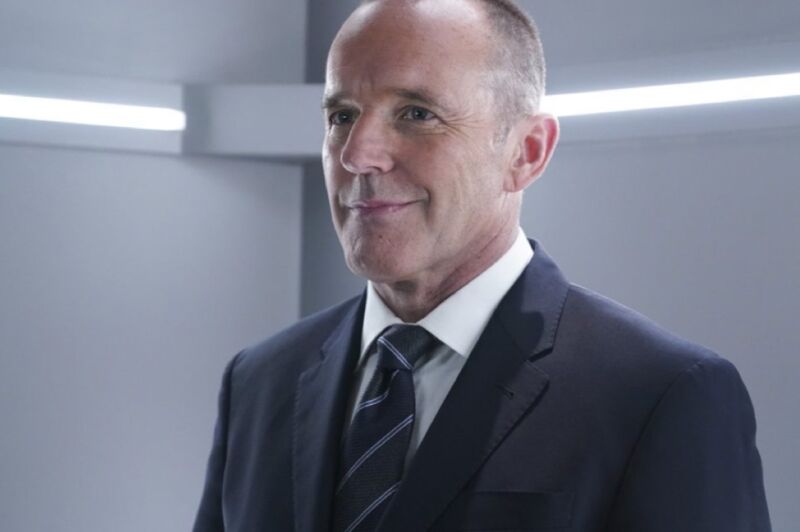
Enlarge/ Clark Gregg never imagined that Agent Phil Coulson would become such an emotional touchstone in the MCU, and beyond, when he first signed on for the role.
Get ready to bid farewell to another Marvel property when the seventh and final season of Agents of S.H.I.E.L.D. premiers next week. Over the course of six seasons, the team has battled Hydra, hostile Inhumans, and alien species, and traveled through time—sometimes aligning with the broader MCU, sometimes sticking to its own separate storylines. It’s been an equally eventful journey for actor Clark Gregg, who plays team leader Agent Phil Coulson.
(Spoilers for The Avengers and prior six seasons of Agents of S.H.I.E.L.D. below.)
First introduced in 2008’s Iron Man, Coulson quickly became a fan favorite, appearing in Iron Man 2 (2010) and Thor (2011), before Director Joss Whedon broke our hearts by unexpectedly killing off the character in The Avengers (2012). Agents of S.H.I.E.L.D. brought Coulson back from the dead to lead an elite squad of agents to take on the terrorist group Hydra, eventually incorporating the superhuman race called Inhumans into the storyline.
Many expected Agents of S.H.I.E.L.D. to end after S5, especially since Coulson died (again) in the finale, spending his last days alone on a romantic tropical beach in Tahiti with Agent Melinda May (Ming-Na Wen). Instead, ABC renewed it for a shortened sixth season of 13 episodes, adding a surprise renewal for a seventh and final season before S6 had been released. Gregg returned in S6 as “Sarge,” a hardened, bounty-hunter who turned out to be a non-corporeal being who confused his own memories with those of Coulson when he took on the latter’s form.
S6 found our heroes battling the “Shrike,” planet-invading parasites that enter human hosts and cause them to explode into crystalline structures. There were also some aliens called Chronicoms request the help of Fitz (Iain De Caestecker) and Simmons (Elizabeth Henstridge) in solving the problem of time travel so they could save their home planet, Chronyca-2—until there was an internal coup and their focus changed to taking over Earth as their Chronyca-3.
Enlarge/ The original team on Agents of S.H.I.E.L.D.
The S.H.I.E.L.D. team ultimately defeated the Shrike invasion (and Sarge), but May was mortally wounded. So our heroes placed May in a stasis pod, and an upgraded, time-traveling version of their ship, the Zephyr One, zapped them several decades into the past, where they are trapped going into S7. Meanwhile, Simmons built a Life Model Decoy (LMD) of Coulson, replete with knowledge about the entire history of S.H.I.E.L.D., to help them navigate through history and hopefully save the future from the Chronicoms.
That’s were we stand going into this final season. Ars sat down with Gregg to learn more about his experience playing this beloved character over so many years and incarnations.
Ars Technica: Did you have any idea when you got the role of Agent Coulson that this character was going to blossom into what he’s now become?
Clark Gregg: Not at all. I think it was just one of those happy accidents for an actor where, as they were putting together this giant story that they were telling across all these movies, they realized that there was something about having this very normal person in the midst of all these superpowered people. They gave him a little bit of a snarky attitude, not taking it all too seriously, which was really hiding how much of a secret fan boy he was. It gave the audience a connection through an onscreen point of view. And it just kept being the gift that kept on giving.
Agent Coulson in the MCU
Coulson tries to set up a meeting with Tony Stark via Pepper Potts in Iron Man
Marvel Studios
Coulson realizes they’ve uncovered an unusual artifact.
Marvel Studios
Coulson hangs with Thor in The Avengers
Marvel Studios
Fan-boying over meeting Steve Rogers/Captain America
Marvel Studios
Nick Fury comforts a dying Coulson.
Marvel Studios
Coulson’s loss served as a catalyst to finally bring the Avengers together as a team.
Marvel Studios
A young Coulson and a young Fury in Captain Marvel, set in the 1990s.
Marvel Studios
CGI is a magical thing.
Marvel Studios
Ars: It was so devastating for fans when Loki killed Coulson in The Avengers. Were you expecting to get a call back for a TV series after that?
Gregg: It was such a fantastic bunch of scenes and a great exit for the guy. It was very emotional, because I’d already been playing Coulson for six years or so by that time. The writers were giving Coulson a lot of great character moments. And I thought, “Because they’re killing him. You want people to care when he gets iced.” They made a lot of jokes. I mean, how dead can you be? It’s Marvel. I asked, “Don’t you want to do one take where it looks like I’m just wounded a little?” They said, “No, we don’t need to do that.” So it was really clear I was dead.
The fan-driven #CoulsonLives movement really made an impact. I don’t think anybody was thinking about doing anything to undermine the import of what had happened in The Avengers. Then Joss called [about a possible series] and said, “He [Coulson] thinks he had a close call and all of season one is him having to delve into the mystery of why he doesn’t feel right, unveiling the truly fiendish dark magic, performed against his will, to bring him back that has not left him himself.” I thought, “Wow, that’s a mythology I can get behind.” And next thing you know, Phil Coulson is running a new team in a new arena on a new medium and trying to figure out a way to bring some of that Marvel magic to network TV. It was a hell of a seven-year ride.
Ars: Coulson has obviously changed as a character from those early days. There’s an innocence, a purity to him that slowly gets chipped away over the course of six seasons of Agents of Shield. What do you see as the central element to his narrative arc?
Gregg: People who make that sacrifice to put the safety of others first, they don’t get to have a normal kind of family. I would say that of all the various threads Coulson goes through. There’s some really deep points about his disenchantment with secrecy after having had this secret kept from him about his own fate. And being in command of this team and the family that it becomes—his relationship with Melinda May, with Daisy Johnson/Quake (Chloe Bennett), as Skye would become, with Simmons and Fitz and all the rest of them—he becomes driven by that. How do you have a family when you have to put these people in danger? The changes that come over him, a lot are driven by the chaos of the world around him. But [the arc] is really about becoming a family man to a certain extent.
Ars: So many people expected the series to end after S5. Instead you got to stretch yourself a little bit as an actor to play Sarge. You still had to channel Coulson to some extent, but in a new, fresh way.
Gregg: It’s hard to talk about this journey without talking about the ways that our experiences as artists bled back and forth, with a very porous membrane between the experience of Coulson and company, and the cast. At the end of every mission, and every season, we never knew if we’d see other again, not knowing if we’d be picked up [for another season] or if that was that. It was a weird time to be on a network, because their metrics weren’t really working. We knew that our show did really well with people recording it and watching later, but not by the metrics the networks still really wanted, which was watching it live with commercials.
At the end of S5, it was no different. The [final] episode was called “The End,” and the writers had made the choice that this time, the Coulson we knew was going to die. We thought the show was ending, so we all said our goodbyes. It was one of the most emotional days ever on the set. Then we got a call: “Actually we’re going to do two more 13-episode seasons.” It was a little jarring.
They had ideas about who Sarge was going to be, but they were figuring it out on the fly. There were a lot of questions that they couldn’t answer for me about who this guy is, and why he was wearing this skin. He sounds like me. He looks like me. But how different is he? What does he know? Who does he think he is? That was really the conundrum. It was very uncomfortable to not really know much about the new character. And yet it was very liberating to be free from Coulson’s desire to find the moral way to do very dark things. Sarge had an agenda and was willing to do whatever it took in any given moment. That was really fun.
All in the family
Coulson befriended a young hacker named Skye (Chloe Bennett) in the first season of Agents of S.H.I.E.L.D.
His new team is starting to mesh.
Skye (aka Daisy, aka an Inhuman named Quake) learns there may be some consequences to Coulson’s unusual resurrection
Some fear the Inhumans. Coulson sees their potential.
Coulson’s relationship with Melinda May (Ming-Na Wen) deepened into romance over five seasons.
Coulson and May spent his last days together in Tahiti.
He looks like Coulson, but he’s actually Sarge, an incorporeal being who has taken Coulson’s form. For reasons.
The LMD Coulson looking dapper in 1930s New York City.
Ars: As we head into S7, Coulson is back again—this time as a Life Model Decoy (LMD). He’s essentially had his consciousness uploaded into an artificial being. So there have to be some questions of identity going forward.
Gregg: We’ve dealt with this idea of sentient artificial beings [on the show]. The setup for this version of Coulson is that he is an LMD in name only. He’s a much more advanced version using Chronicom technology that is beyond anything we’ve seen so far. So when we meet him, he’s very much wrestling with, “Wait a minute, I gave very specific instructions that this was not to happen. I’m not sure I want to be here in this form. And what am I, by the way?” At the same time, the team is once again in a situation where how humanity exists within these timelines is under assault, so duty puts them in an unfortunate position.
Ars: As an actor you play a role and you infuse so much of yourself into it. How have you changed, and what have you learned, from playing Coulson all these years?
Gregg: That’s a really good question. In the first season, Coulson was running a team of misfits who didn’t feel quite like they belonged anywhere and it was chaotic and seemed to be going poorly. It wasn’t until two-thirds of the way through the season that they discovered, “Oh, it’s Hydra, I see.” And things really started to click into gear. It was so parallel to what we were going through [as a cast]. It was bumpy and strange trying to be on a network Iron Man. I would have days where I felt so upset, so frustrated and betrayed by the cast or crew, and then I’d realize, “Oh, this isn’t them. This is what’s happening in the episode.” And they would realize, “Oh yeah, he’s not upset right now at me. This is because he’s being torn apart in this machine right now.” That was really amazing—how much it just starts to live in you after awhile.
I would say that there are ways that being a father to my wonderful daughter, Stella, who’s now 18 and getting ready to strike out on her own—that felt very influenced in both directions by my relationship with Chloe and Elizabeth. They were very new to this at the beginning, and they were very much teaching me things by the end. Like Coulson, there were people I got very close to in that [AoS] family. There’s just no substitute. We have something together because of what we went through that I don’t have with anybody else.
Ars: This is the series finale. Given that this is the Marvel Universe, where death isn’t necessarily permanent, do you foresee Coulson showing up somewhere else in the future?
Gregg: The only way they’ve brought him back so far has been in flashbacks in Captain Marvel. I don’t know what the future holds. But I’ve learned at this point to say, “Never say never.”
The final season of Agents of S.H.I.E.L.D. begins at 10 PM/9 Central on Wednesday, May 27, on ABC.
[embedded content]
Marvel’s Agents of S.H.I.E.L.D. season 7 sneak peek.
https://arstechnica.com/?p=1678129
6 board games I’m playing during the pandemic
Nate Anderson
Welcome to Ars Cardboard, our weekend look at tabletop games! Check out our complete board gaming coverage at cardboard.arstechnica.com.
What’s keeping me grounded in our current pandemic? Board games, for one. But I’m not reaching for the latest and the greatest at the moment; I’ve found myself reaching for shorter titles that don’t melt my brain, and I’ve been digging deeper into my collection for those criminally underplayed treasures. In part that’s because I’ve been playing with family rather than a gaming group, but—and perhaps you know the feeling—it’s also because I can’t concentrate on a two-hour strategy fest when the world feels like it’s on fire.
I’ve enjoyed digging up some older titles during this time, and I’ve been reminded of how terrific some of them are. When I played Sanssouci with my 13-year old daughter, for instance, we had such a blast that we immediately played it again. And Keltis—what a gorgeous presentation, even if you do have to order it direct from Germany and download an English rules translation from BoardGameGeek.
Anyway, here are six titles that I’ve been playing at home over the last couple of months. Hopefully they inspire you to get some gaming in—and to share your own quarantine board games in the comments.
The delightful aesthetics—there’s just so much glorious green!—elevate the solid gameplay, while a second map on the back side of the board offers a thinkier experience. If you’ve played Lost Cities, you’ll grok the gameplay right away: play one card per turn, building up piles that can only move in a single direction (each card must be higher or lower than the one before). Whatever color you play conditions the piece you can advance on the board. But don’t start too many pieces down their respective paths—moving only a few spots or less results in negative points. Mix in some very light set collection and you have a terrific way to spend 45 minutes. I’m not alone in this opinion; Keltis won the prestigious Spiel des Jahres prize in Germany back in 2008.
A recent title from master designer Stefan Feld, this one really hits my sweet spot. You have tons of ways to earn points and plenty to think about, but gameplay couldn’t be simpler: grab a tile each turn and place it on your ancient Roman country estate, then take points and bonuses. At the end of each round, you’ll even choose your own scoring conditions. The result is thinky without being rules-heavy, and the delightful grape and fish meeples add a pop of color. Much more accessible than Feld’s masterwork, The Castles of Burgundy.
A classic. I hadn’t played this in some time, but lockdown provided a great opportunity to teach this set-collection and route-building train title to my 8-year old son. The iPad app for this is great—and waaaaay faster to play—but the tactility of the giant map, the plastic trains, and the presence of three trash-talking opponents made our in-person game a blast.
An old-school abstract from Reiner Knizia that sees you placing paired hexagons around a board, scoring points based on how many identical colors touch the five open lines radiating away from each of the paired hexes. (Okay, so the scoring takes a moment to wrap your head around.) The gameplay is fast and fun, and it requires you to value every color alike—because your final score is equal to the score of your lowest color.
A new game from designer Uwe Rosenberg (Agricola, Patchwork), this one has about as much to do with Robin Hood as I have to do with the Sheriff of Nottingham. But what it does have is easy-to-teach gameplay in which your horse meeple moves around like a chess knight, snagging bits of loot. You collect this loot in order to satisfy a long series of conditions placed randomly around the edges of the play area—and you can move as far on a single turn as your loot allows. It’s set collection meets racing, and though we enjoyed our initial play of it, I’ll need a few more games to see how well it holds up.
Sanssouci
2-4 players, 30-45 minutes, ages 8+, $70 on Amazon (because it’s out of print)
A terrific tile-layer, this Michael Kiesling design has been criminally overlooked. No dungeon crawls here, D&D lovers—this is a game about building a European formal garden while moving your nobles down the garden path so they can smell the roses (and earn you points). It’s fast, it’s fun, and it’s extremely relaxing. The rules are simple to teach, turns are fast, and everything looks great. The game even includes a small expansion module in the box for slightly more complex play. The biggest downside? It might be hard to find new right now.