Failure is not an option in latest Space Force trailer
[embedded content]
Latest trailer for Space Force.
Netflix must be feeling pretty good about Space Force, its forthcoming sci-fi comedy series starring Steve Carell (The Office), because it just released an entertaining second trailer, with over three minutes of mostly new footage.
The show marks Carell’s first major return to TV comedy since The Office wrapped seven years ago. Created by Carell and Greg Daniels (who also created Parks and Recreation and the new comedy series Upload), Space Force was inspired in part by the Trump administration’s announcement that it would establish a national Space Force.
Netflix was purportedly so keen on the series—ratings for The Office on its streaming service remain consistently high—that it snapped it up immediately. The cast also includes John Malkovich (The New Pope), Ben Schwartz (Jean-Ralphio from Parks and Recreation), Jimmy O. Yang (Silicon Valley, Crazy Rich Asians), Noah Emmerich (The Americans), Lisa Kudrow (Friends), and Jane Lynch (Glee, Marvelous Mrs. Maisel), among others.
Per the official premise:
A decorated pilot with dreams of running the Air Force, four-star general Mark R. Naird (Steve Carell) is thrown for a loop when he finds himself tapped to lead the newly formed sixth branch of the US Armed Forces: Space Force. Skeptical but dedicated, Mark uproots his family and moves to a remote base in Colorado where he and a colorful team of scientists and “Spacemen” are tasked by the White House with getting American boots on the moon (again) in a hurry and achieving total space dominance.
In the first trailer, we saw Mark, freshly promoted, getting stuck with the assignment to establish a new military branch known as Space Force. Granted, it wasn’t the promotion he was hoping for, but like a good soldier, he throws himself into the task. In the process, he must navigate the political waters. His archrival, General Kick Grabaston (Noah Emmerich) is rooting for him to fail. And his chief scientist, Dr. Adrian Mallory (Malkovich), has a pacifist bent not entirely suited to a military branch. In a line destined to become an instant classic, Mark tells Mallory: “As a scientist, you have a loyalty to reason, which makes you a little untrustworthy.”
Welcome to Space Force headquarters.
YouTube/Netflix
It’s headed by General Mark Naird (Steve Carell).
YouTube/Netflix
The first launch does not go well.
YouTube/Netflix
“Space is hard.”
YouTube/Netflix
This congressperson looks suspiciously like US Rep. Alexandria Ocasio-Cortez (aka AOC).
YouTube/Netflix
“This is the moon. Flat, desolate…”
YouTube/Netflix
“Well, actually….” Dr. Adrian Mallory (John Malkovich) is That Guy.
YouTube/Netflix
Mark’s archrival, General Kick Grabaston (Noah Emmerich).
YouTube/Netflix
Just a “friendly” competitive training exercise.
YouTube/Netflix
Demonstrating a potential new kind of rocket fuel.
YouTube/Netflix
The head media manager (Ben Schwartz) is looking for American heroes. “No uggos.”
YouTube/Netflix
Lisa Kudrow plays Mark’s wife, Maggie.
YouTube/Netflix
Encouraging words from Mark’s teenage daughter, Erin (Diana Silvers).
YouTube/Netflix
Car dancing to J-pop, as one does.
YouTube/Netflix
Space monkey!
YouTube/Netflix
Taking a spacesuit out for a spin.
YouTube/Netflix
Apparently there’s finally cause to celebrate.
YouTube/Netflix
A congenial toast.
YouTube/Netflix
We get to see even more of this tension between Mark and Mallory in the new trailer, as Mallory’s insistence on hard science repeatedly throws cold water on the optimistic aspirations of Space Force. When Mark draws a straight line to illustrate the surface of the moon (“flat, desolate”), Mallory chimes in: “The surface is actually a complex topography….” In another scene, Grabaston brings his own team to take on the Space Force recruits in a competitive training exercise (“We’re going to eat your guts”), prompting Mark to muse, “So the game of mental chess has begun.” Mallory can’t resist a bit of snark: “It’s Hungry Hungry Hippos at best.”
But we also see the two men, polar opposites in so many ways, warm to each other through the inevitable ups and downs of getting a fledgling Space Force off the ground. We get glimpses of lazy recruits, an embarrassing congressional hearing after a failed rocket test, and even a space monkey throwing a bone to a space dog. Certainly the stakes are high. “If we don’t get this right, it will be the most cataclysmic failure in the short history of Space Force,” Mark frets. But then his innate optimism kicks in: “There will be setbacks. But if you fall on your face, you get back up.”
Space Force lands on Netflix on May 29, 2020.
Listing image by YouTube/Netflix
https://arstechnica.com/?p=1677089
Madden NFL’s technical problems were on full display in ESPN championship
As sports fans clamor for something—anything—to watch in the wake of public safety closures, video game publishers like EA Sports have enjoyed increased exposure on cable stations like ESPN—where virtual sports are better than no sports at all. This weekend, that didn’t necessarily work out in EA’s favor.
Madden Bowl 20, the latest “world championship” for players of the annualized Madden NFL game series, hinged so much on a massive, unpatched issue in the game that its winner sported an in-game username that seemed to spit in EA Sports’ face: “iRUNyouPASSiWIN.” The winner, Raidel “Joke” Brito, played the entire week-long tournament without running a single pass play—this despite Madden being a series that traditionally features quarterbacks on its covers. This all culminated in a Saturday broadcast on ESPN2 of Brito cruising to victory in the tournament’s semifinals and finals.
How could an American football simulator be so exploited that its winner forgoes half of the sport’s options? Did Brito discover a tiny loophole that caught EA Sports unaware until the last minute? Not even close.
Instead, Brito already favored the series’ running game, which has been criticized as overpowered and imbalanced for some time. This led him to a clever exploit of Madden Bowl 20’s “Salary Cap Ranked” rules. Each participant gets a certain amount of in-game currency to pick players from various official NFL teams and combine them as they see fit. Traditionally, this means you spend more on things you want to emphasize (run defense, fast wide receivers) and sacrifice certain categories in exchange.
Run, run, run as often as you can
But this gave Brito license to spend a bare minimum on the quarterback position, and for much of the competition, he opted to put a dirt-cheap punter in the QB’s place. Bingo: this gave him more points to spend on every other crucial position, particularly an offensive line (in order to create gaps for his endless running game to blast through) and a dominant defense. He built the rest of the team accordingly—why pick wide receivers with great “catch” stats if he only needs them to block?—and then marched through game after game in the tournament, starting on May 9 and finishing this past Saturday, May 16.
In prior tournaments for the Madden NFL 20 esports cycle, Brito was forced to contend with a more randomized “Madden Ultimate Team” draft mode, a mode that might otherwise be considered more “unfair” in terms of making players contend with out-of-nowhere player rosters. In those matches, Brito held his own, proving that his exploit-driven win in the Madden Bowl 20 tournament wasn’t exactly a fluke. Still, his exploit of the Salary Cap Ranked ruleset led to ESPN2 commentators dryly remarking on Brito’s running-only dominance, either unwilling or unable to comment on the fact that a punter was taking the snap on every single offensive play.
The fact that Brito could call running play after running play and still leave his opponents unable to win by simply tapping “of course he’s about to run again” coaching decisions is among the more astonishing game-balance fails we’ve ever seen at Ars Technica. That would be embarrassing enough as hosted to tens of thousands of Twitch users, let alone millions of ESPN2 viewers.
This weird series of events comes months after EA Sports’ ironclad hold on the NFL’s exclusive video game license came to an end. The sim-football genre used to include multiple major contenders, particularly the innovative NFL2K series at the turn of the century, but EA secured an exclusive license for NFL games beginning in 2005. The NFL opted not to renew that contract after it expires this season, which led the 2K Sports game-publishing group to immediately announce its interest in returning to the genre—though whether that will include simulation-style football games remains to be seen. https://arstechnica.com/?p=1676854
Take a virtual tour of the Museo Galileo in Florence, Italy
Entrance to the Museo Galileo in Florence, Italy.
Jennifer Ouellette
“And yet it moves”: Galileo’s index and middle fingers, lovingly preserved.
Sean Carroll
A closer look at Galileo’s middle finger.
Sean Carroll
Collection of early telescopes.
Sean Carroll
A large armillary sphere (1588-1593) built for Ferdinand I de’ Medici.
Jennifer Ouellette
A close-up of the armillary sphere.
Sean Carroll
A 16th century astrolabe used by Galileo for astronomical calculations.
Jennifer Ouellette
A circle-dividing engine (1762) used to mark scale divisions on arcs of circles while making astronomy or nautical instruments.
Sean Carroll
An apparatus for experiments with elastic and inelastic collisions from the mid to late 18th century.
Sean Carroll
A 20th century replica of the 14th century bas relief from Giotto’s bell tower.
Sean Carroll
The Writing Hand (1764), a clockwork mechanism that moves a hand, dipping a pen in the inkstand to write phrases.
Sean Carroll
An 18th century chemistry cabinet that belonged to Grand Duke Peter Leopold, who did chemistry experiments as a hobby.
Sean Carroll
Tabula Affinitatum (circa 1766), a table of the chemical affinities between substances.
Sean Carroll
Wise words from 19th century physicist James Clerk Maxwell.
Sean Carroll
Visitors to Florence, Italy, invariably line up in droves to tour the world-famous Cathedral of St. Mary of the Flower, most notable for its soaring dome designed by Filippo Brunelleschi in the early 15th century. The lines frequently snake around the block, even in sweltering summer heat. For those who find the lines a bit too daunting, Florence is also home to another priceless gem: the Museo Galileo, housed in the 11th century Palazzo Castellani along the River Arno.
As the name implies, the museum is dedicated to Galileo Galilei, but the vast collection features all manner of historical scientific instruments and experimental apparatus from the Medici Collection, as well as later artifacts donated by the Lorraine dynasty. Many of them are so expertly made, they qualify as genuine works of art.
The first floor displays all the Galileo artifacts; most notable are two telescopes and a framed objective lens from the telescope through which he first observed the moons of Jupiter. There are also lots of smaller instruments—thermometers, sextants, astrolabes—and plenty of globes, as well as an enormous armillary sphere, designed and built by the Italian astronomer Antonio Santucci.
Among the more fascinating, albeit morbid, artifacts are two of Galileo’s fingers, removed from his corpse (along with a tooth and vertebra) by Galileo fans sometime in the 18th century. The two fingers were rediscovered when they turned up at an auction in 2009. Legend has it that after Galileo was forced to recant his views regarding the Copernican system, he defiantly muttered, “E pur si muove“ (“And yet it moves”). The story is probably apocryphal, but the phrase pairs nicely with the display of the scientist’s middle finger.
The Lorraine Collection is housed on the second floor, with a wide array of instruments and apparatus showcasing the explosion of research into electricity, electromagnetism, and chemistry. Here, one can find beautifully constructed machines illustrating various fundamental physics principles. For example, there is a model of a device known as an Archimedes screw. The concept dates back to ancient Egypt, where it was used to move low-lying water into irrigation ditches. Today the device is used in chocolate fountains, among other applications.
One of my personal favorite items is a so-called Brachistochronous fall from the mid to late18th century, because it illustrates a knotty mathematical conundrum. Assuming two fixed points, one higher than the other, what shape would a curved path between those points have to be for a rolling ball to reach the lower point the fastest? The solution is a cycloid, which is the curve created by a rolling wheel in a circle. Turn that path upside down and you will get the path of fastest descent. The model on display in the Museo Galileo allows one to test this result by building two tracks: one shaped like a cycloid, the other shaped like the arc of a circle, for comparison. If you roll two balls down each track simultaneously, the one on the cycloid path will reach the bottom first, regardless of where one starts the ball along this curved path.
There is so much to savor in the Museo Galileo collection: a model of a Gravesande column (an intricate pulley system to lift a weight six times greater than the effort applied); a lens-grinding lathe; and several large machines designed for experiments with electricity. There are also several wax models of a baby in the womb in various positions, the better to train doctors to deal with birthing complications, and an elaborate chemistry cabinet that belonged to Grand Duke Peter Leopold. These galleries should give you a taste of what’s on offer, until it’s once again safe to travel to Florence to see the exhibits firsthand.
Collection of larger telescopes.
Sean Carroll
A quadrant (1667) built by Carlo Renaldini, used for astronomical observations and measurements.
Jennifer Ouellette
Collection of vintage microscopes.
Jennifer Ouellette
Boxes of mathematical instruments (calipers, compasses, rulers, quadrants, protractors, astrolabes, etc.) for surveying purposes, from the late 18th to early 19th century.
Jennifer Ouellette
A Brachistochronous fall from the mid to late 18th century.
Jennifer Ouellette
A model of a weight lifting device known as an Archimedean screw, mid to late 18th century.
Jennifer Ouellette
A Gravesande column apparatus, late 18th century.
Jennifer Ouellette
A 19th-century globe for experiments with bladders in a vacuum (top), and a small single-barrel air pump (bottom) from the late 18th century.
Jennifer Ouellette
A lens-grinding lathe from the mid to late 18th century.
Jennifer Ouellette
A Winter plate electrical machine, the largest of its kind still in existence, mid to late 19th century.
Jennifer Ouellette
An early 19th-century frictional electrical machine with glass disk rubbed by four leather cushions.
Jennifer Ouellette
A modification of a Carre electrical machine combining friction and induction, circa 1890.
Jennifer Ouellette
A portable pharmacy, late 18th to early 19th century.
Jennifer Ouellette
The man himself: a bust of Galileo by Carlo Marcellini, 1674-1677.
Sean Carroll
Listing image by Jennifer Ouellette
https://arstechnica.com/?p=1545635
We now have more evidence that Galileo likely never said “And yet it moves”
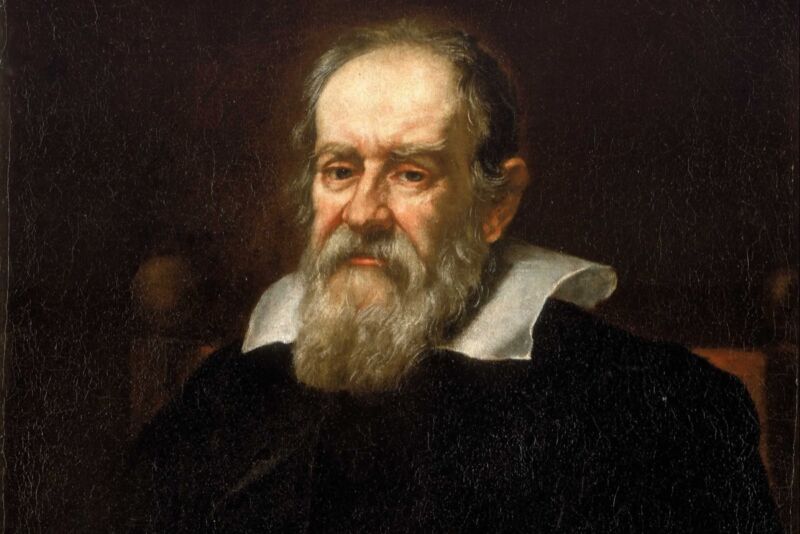
Enlarge/ Portrait of Galileo Galilei by Justus Sustermans, circa 1640.
Galileo Galilei famously stood trial for his insistence—based on astronomical observations through his telescopes—that the Copernican model of the Solar System was correct. The Earth revolved around the Sun, not the other way around, contrary to the Catholic Church’s teachings at the time. He was never formally charged with heresy, but he was forced to recant his stance. Legend has it that after he did so, he muttered, “E pur si muove“ (“And yet it moves”), meaning the Earth.
As with many such legends, it’s probably too good to be true. “It would have been crazy for Galileo to say that in front of the Inquisitor,” astrophysicist Mario Livio told Ars. Livio is the author of a new biography of the famous scientist, Galileo and the Science Deniers, and while researching the book, he found himself captivated by the longstanding debate about whether or not Galileo really spoke those words. It resulted in a separate academic paper about his findings.
The earliest biography of Galileo was written by his protege, Vincenzo Viviana in 1655-1656, with no mention of the phrase. According to Livio, the first mention in print is in a single paragraph in the 1757 book, The Italian Library, by Giuseppe Baretti, written over 100 years after Galileo’s death. That would point to the story being a myth. But then a science historian named Antonio Favaro spent four decades studying Galileo’s life and work, publishing a massive tome, The Works of Galileo Galilei. In 1911, he also published several articles detailing his efforts to determine the origin of the famous phrase.
Enlarge/ Portrait of Galileo in prison, often attributed to Murillo circa 1643. New evidence suggests it was painted much later by a different artist.
That year, Favaro received a letter from a man in Belgium named Jules Van Belle, claiming to own a painting, circa 1643—shortly after Galileo’s death in 1642—that depicted Galileo in prison, holding a nail in his right hand, having traced the Earth moving around the Sun. Written underneath was the famous motto. The painting was attributed to a Spanish painter named Bartolomé Esteban Murillo, and Van Belle thought it may have once belonged to an army commander named Ottavio Piccolomini, brother of the Archbishop of Siena. Galileo served the first six months of his house arrest at the archbishop’s home.
That raised the possibility that Galileo had said those words, just not in front of the Inquisitor. Yet the painting was never examined by any independent art historians. When Livio decided to follow up on Favaro’s work more than a century later, he found that nobody knew the current location of the Murillo painting. He consulted with four art experts specializing in Murillo’s art, and all determined, based on photographs of the canvas, that it was not the Spanish artist’s work.
After about a year hunting down various clues, Livio finally rediscovered Van Belle’s painting. It had been sold to a private collector in 2007 by one of Van Belle’s descendants. The auction house had dated the painting to the 19th century. So it is still far more likely that the famous phrase is just a legend that emerged sometime in the mid-18th century. But no final determination can be made unless the new owner agrees to let the painting be examined by art historians.
Nonetheless, “Even if Galileo never spoke those words, they have some relevance for our current troubled times, when even provable facts are under attack by science deniers,” Livio recently wrote at Scientific American. “Galileo’s legendary intellectual defiance—’in spite of what you believe, these are the facts’—becomes more important than ever.” Ars sat down with Livio to learn more.
Enlarge/ Cristiano Banti’s 1857 painting Galileo Facing the Roman Inquisition.
Public domain
Ars: Perhaps Galileo never actually said “And yet it moves.” But one of the most famous genuine quotes attributed to Galileo is this: “The book of Nature is written in the language of mathematics.”
Livio: That was one of his incredible intuitions. Today, this is so natural to us. We still don’t exactly understand it, but it’s very natural that all the laws of physics are written as mathematical expressions or equations. But in his time, those laws were not written in any way. So how did he get this intuition that it is all written in the language of mathematics? To me, this is absolutely incredible that he thought about that. In fact, he formulated the very first laws of physics, with the slight exception of Archimedes maybe.
Ars Technica: Galileo is one of the most famous scientists in history, and there have been so many books published about his life and work. What led you to write your own take?
Mario Livio: One reason is that all the existing biographies of Galileo, at least the serious biographies, were written mostly by science historians or science writers. None was written by an active researcher in astronomy or astrophysics. So I did think that I can perhaps put his discoveries in the context of what we know today. A second reason is that the very best biographies that exist are not that accessible for a general audience. They are scholarly biographies. So my goal was to write a somewhat shorter, more accessible, focused biography, but I did my best to still keep it entirely accurate.
Finally, I always knew this, but it just struck me even more so recently, that at the end of the day, Galileo was fighting science deniers, and we are unfortunately encountering a rampant science denial today. So I thought that this would be an important book to write. A fight that Galileo fought already 400 years ago, and truly, eventually won, it seems we somehow need to fight again.
Ars: Galileo is still a powerful symbol of intellectual freedom (scientific or otherwise). Why has Galileo captured our imaginations for so long?
Livio: There are many reasons for that. Galileo, by writing the Dialogue on the Two Chief World Systems, attracted a lot of attention. He was perhaps the best known scientist in Europe because of his discoveries in astronomy. So his book attracted the wrath of the Inquisition and the Pope, and he was put on trial for this and was humiliated and suspected of heresy and put on house arrest for eight and a half years. This is pretty incredible. We are now in lockdown for what, a couple of months, and we’re going crazy.
So he became the symbol for the fight for intellectual freedom. It was not, as sometimes it is portrayed, the fight between science and religion. Galileo was a religious person, like everybody else at that time. All his point was that the Bible is not a science book, and we shouldn’t therefore interpret literally what is said there as if these are scientific facts. “The Bible was written for our salvation,” he said, “Not as a science book.”
“His tongue could be sharp, and his pen even sharper.”
If there is an apparent conflict between a literal interpretation of the text in scripture and what experiments or observations tell us, then it means that we didn’t understand and we need to change the interpretation. As long as the conclusions of science concerning physical reality are accepted, with no intervention of religious beliefs and no denouncing of provable facts, no conflict between the two realms can exist.
It had also to do with his personal characteristics, of which stubbornness was a chief one, as well as a high degree of self-righteousness. Galileo advocated that there were only three things one needs to do to determine truths about the world: experiments, observations, and reasoning based on data from those. He also said that he didn’t believe that the same God who has given us our senses, intelligence, and reasoning wanted us to abandon their use. So his tongue could be sharp, and his pen even sharper.
Enlarge/ Astrophysicist Mario Livio says his new book holds lessons for what the life of Galileo can teach us about how to respond to science denial today.
Simon and Schuster
Ars: Conversely, Galileo’s example has been twisted by various cranks and crackpots into the exact opposite of what Galileo stood for. I’m reminded of Carl Sagan’s observation: “They laughed at Columbus, they laughed at Fulton, they laughed at the Wright Brothers. But they also laughed at Bozo the Clown.”
Livio: This is the Galileo fallacy. It is really a complete twist of logic. There are people who say, “Look, Galileo also was alone among all those people who disagreed with him, and he turned out to be right. So if I have my opinion and it’s against everybody else, then I am right too.” But that really doesn’t apply. Galileo was right because he was right, not because he was alone against everybody else. Most people who are alone against everybody else are wrong. Putting Galileo on trial, finding him guilty, and condemning him to house arrest would have been wrong even had he been wrong about his model of the Solar System. He expressed a different scientific view. So what?
Ars: Science builds on what came before, and we’ve come a long way since Galileo. So let’s talk about the connection between the past and the present in terms of his work.
Livio: Galileo wasn’t always right. For instance, because he was a mechanical person, it was very foreign to him to think of forces that act mysteriously across distance. So he didn’t really think about gravity the way we think about it today, not even in the way that Newton thought about it. Kepler, for example, had written about the moon perhaps having an influence on the tides, which is correct. Galileo ignored that. He suggested this model that had to do with the Earth’s speed and its revolution about the Sun, with those two motions combining to generate the tides. This was an interesting mechanical model, only it’s incorrect and didn’t really work.
He also never accepted Kepler’s elliptical orbits of planets, based on false impressions from the Greeks about things being perfectly symmetrical. So he thought orbits should be circles and not ellipses. But when you talk about symmetry, it’s not the symmetry of the shapes that counts, it’s the symmetry of the law. In other words, the orbit can be elliptical, but the ellipse can have any orientation in space.
Trust in science. That’s my main message. What is good about science is that it self-corrects. The self-correction sometimes takes a very short time and sometimes take a very long time. It could take sometimes decades, or maybe even centuries, but eventually it self-corrects. It is generally not wise to bet against the judgement of science. In a case such as climate change, or a pandemic, when the fate of life on our planet is at stake, it is absolutely insane.
https://arstechnica.com/?p=1676609
When audio deepfakes put words in Jay-Z’s mouth, did he have a legal case?
Enlarge/ This is not an article about Daft Punk remixing or mashing up Jay-Z classics. It’s a photo illustration about machine learning models being applied to famous people’s voices. (But, hey, we’re ready for that Daft Punk + Jay-Z collab over here.)
In late April, audio clips surfaced that appeared to capture Jay-Z rapping several unexpected texts. Did you ever imagine you’d hear Jay-Z do Shakespeare’s “To Be, Or Not to Be” soliloquy from Hamlet? How about Billy Joel’s “We Didn’t Start the Fire,” or a decade-old 4chan meme? All of these unlikely recitations were, of course, fake: “entirely computer-generated using a text-to-speech model trained on the speech patterns of Jay-Z,” according to a YouTube description. More specifically, they were deepfakes.
“Deepfakes” are super-realistic videos, photos, or audio falsified through sophisticated artificial intelligence. The better-known deepfakes are probably videos, which can be as silly as Green Day frontman Billie Joe Armstrong’s face superimposed on Will Ferrell’s, or as disturbing as non-consensual porn and political disinformation. But audio deepfakes— AI-generated imitations of human voices—are possible, too. Two days after the Jay-Z YouTubes were posted, they were removed due to a copyright claim. But just as quickly, they returned. The takedowns may have been a first attempt to challenge audio deepfake makers, but musicians and fans could potentially be grappling with the weird consequences of machine-generated voice manipulations long into the future.
Here’s a breakdown of Jay-Z’s copyright dispute, the laws around audio deepfakes, and what all this could mean in the years to come.
Jay-Z “covers” the Billy Joel song “We Didn’t Start The Fire,” as posted by YouTube channel Vocal Synthesis
On April 26, in a new video posted to the channel, the simulated voices of Barack Obama, Donald Trump, Ronald Reagan, JFK, and FDR claimed that YouTube had taken down two Jay-Z clips at the request of his company Roc Nation. Two days later, both of those videos—the Jay-Z-ified snippets from Hamlet and “We Didn’t Start the Fire”—were back in place. A YouTube spokesperson told us that the takedown requests were found to be “incomplete” but did not specify who filed them. The spokesperson said the videos have been “temporarily reinstated” pending more information from whoever filed the claims. The ball now seems to be in Jay-Z’s court. A spokesperson for the rapper has not responded to our requests for comment.
Does Jay-Z have a winning case?
Probably not. According to the anonymous creator of the Voice Synthesis channel, Roc Nation’s takedown requests claimed, “This content unlawfully uses an AI to impersonate our client’s voice.” But legal experts think that using an AI to impersonate someone’s voice does not violate existing copyright law. “Their copyright claim is ridiculous,” says Bill Hochberg, a music and media lawyer whose clients have included the Bob Marley estate. “You can’t copyright a vocal style.” Adds Jim Griffin, managing director of digital music consultancy OneHouse and a former Geffen Records tech executive, “I do not see rights issues here.”
If Roc Nation had taken legal action against the creator of Voice Synthesis, that would be a matter of public record, and it doesn’t appear that’s the case. YouTube’s takedown process isn’t so transparent. “The most important part, to complainants, seems to be that DMCA provides a quick tool to get something off the Internet,” notes Meredith Rose, policy counsel at Public Knowledge, a nonprofit that advocates free expression, citing the Digital Millennium Copyright Act. “Now that the videos are back, I’m curious to see how far they push the issue.”
Could audio deepfakes of rappers or singers violate laws other than copyright?
It depends. Some states have a right of publicity, which allows an individual to control the commercial use of their name and likeness. In California, the entertainment industry has been lobbying for updating publicity-rights rules to address deepfakes. A handful of states have recently enacted laws against deepfakes used for non-consensual porn or to interfere with an election.
A deepfake of Jay-Z rehearsing for Hamlet is unlikely to run afoul of current laws against soundalikes. Tom Waits won a $2.5 million verdict against Frito-Lay in 1990 over a Doritos ad that had an impersonator rumbling in Waits’ recognizable style. But the Voice Synthesis clips are clearly labeled as fakes, and their creator has maintained that they were “intended as entertainment,” not for any malicious purpose. “‘Weird Al’ Yankovic didn’t get sued for imitating the top pop stars he targeted,” Hochberg observes.
How are audio deepfakes different from sampling?
The self-described “hobbyist” behind the Voice Synthesis channel told the blog Waxy that the Jay-Z deepfakes were created with Tacotron 2, a text-to-speech program developed by Google. The software has to be “trained” with audio samples and text transcripts. The actual voice is used in the creation but from there it’s all ones and zeros from the AI. Musicians sue all the time over unauthorized samples of their work in other artists’ songs, so it may not seem unreasonable that they could sue for unauthorized samples in a simulator of their own voices. It seems, though, the algorithms may have the law in their favor. Recently, a judge ruled that Drake’s use of jazz musician Jimmy Smith’s 1982 song “Jimmy Smith Rap” on the opening of his track “Pound Cake/Paris Morton Music 2,” from 2014’s Nothing Was the Same, “adds something new” and is “transformative.” Jessica Meiselman, a lawyer who has written for Pitchfork.com, says, “This one smacks of that.” That Drake song’s featured guest, in fact, was Jay-Z.
What might be next for music and audio deepfakes?
More experimentation and more legal challenges. AI research group OpenAI recently unveiled Jukebox, where you can hear such creepy-yet-fascinating, machine-generated lyrics as a Frank Sinatra-style Christmas carol about hot tubs, or an Elvis Presley-style rockabilly jaunt with lyrics about cell division. It’s not hard to imagine the estates of deceased artists seeing potential in audio deepfakes as the technology matures, just as it’s easy to see lawsuits being filed over deepfake “guest appearances” from featured artists who never agreed to collaborate. How long until a SoundCloud rapper has “Jay-Z” on their track?
“Deepfake is very democratizing,” says Peter Martin, CEO of virtual reality-focused creative agency V.A.L.I.S. Studio, which has worked with Janelle Monáe and Run the Jewels. “There’s a load of strange kids from Serbia in their bedroom recreating Hollywood. They haven’t really touched music yet.”
The creator of the Voice Synthesis channel tells me that he expects to get more takedown requests. If necessary, he plans to switch to another video platform and keep sharing links on Reddit. An improved version of OpenAI’s jukebox, he said, could generate realistic audio of any singer, living or dead, covering any song of one’s choice, allowing for unique combinations of performers and styles. “So far we’ve barely even scratched the surface in terms of the possibilities in this space,” he says. “I’m really excited to see how it develops over the next few years.”
The creators of the surreal animated series Tooning Out the News had Rudy Guiliani on the show multiple times during their first week on air. They also had a six-year-old hang up on the former New York City mayor. Like many people around the world, the people behind Tooning Out the News are working from home during the COVID-19 pandemic. For RJ Fried, that involved turning an iPad over to his young son while the showrunner sat in his bedroom, calling Guiliani every hour to see if he’d pick up, computer at the ready to record on short notice. What he didn’t realize was that, through the vagaries of the cloud, Guiliani’s calls were being routed to the iPad his son was using, and that his son had hung up on him (and also Stephen Colbert).
“I tried to explain the enormity of hanging up on the attorney of the president, who the president was, that this was his good friend,” Fried says. The explanation didn’t really take—his son just became convinced that he himself was now famous—but for Fried, the story has become emblematic of his bizarre-yet-productive time in quarantine.
Were Tooning Out the News a live-action series, neither the gaffes nor the triumph of luring Guilani onto the show in the first place would have been possible. It’s basically impossible to film a conventional television program while social distancing, which is why so many have paused production. Animated shows, however, from newcomers like CBS’ Tooning Out the News and Hulu’s Solar Opposites to veterans like The Simpsons, Bob’s Burgers, Big Mouth, and Family Guy, along with Hollywood animation studios like Paramount, have been able to keep working, largely thanks to innovative technological workarounds. “All of us feel incredibly fortunate that we’re in this industry at this time,” Fried says.
Of course, the animated shows you’re watching now weren’t built for quarantine, not even shows like Tooning Out the News and Solar Opposites which have premiered during the quarantine period. Solar Opposites, a sitcom about aliens from Rick & Morty co-creator Justin Roiland, was largely finished before lockdown went into effect. Tooning Out the News, however, had to change strategies abruptly when they were told they’d no longer be able to work in the studio they’d built inside the Ed Sullivan Theater equipped for motion capture and high-speed, fast-turnaround animation. “Now we have this virtual animation studio that exists somewhere in the atmosphere,” Fried says.
Nobody’s virtual animation studio is running seamlessly. Fried and others have noted that one of the toughest challenges to overcome is also one of the most mundane: large file sizes. Studios are experimenting with ways to boost remote staffers’ internet connections and further compress files, but Fried says that they’ve also worked to simplify characters and backgrounds as much as possible, and accept that sometimes, file transfer is just going to be glacial. Tooning has added an extra hour onto their day just to allow for it. “We’re working a 20-hour day, minimum,” Fried says. “It’s super fun.” The other major difficulty beyond computing power is one anyone working remote should be familiar with: Zoom-induced awkwardness. While shows like Big Mouth have found comedic success doing virtual table reads and video conferencing is better than nothing, there’s no denying that it’s harder to create chemistry through a screen.
Still, going virtual has also afforded animated shows with new opportunities. The relative speed of voiceover work has always been a benefit for actors, but now voiceovers can be done not just quickly, but without leaving one’s home. “There are a lot of newsmakers sitting at home who can, by pressing a button, hop on and do a live interview with us,” Fried says. “We can get guests from anywhere. We can take talent from anywhere in the world as long as they have a good internet connection, and a lot of people are looking for work right now because live-action shows have pressed pause.” Previously, Tooning Out the News had been largely limited to New York-based guests and staff who could come to the Ed Sullivan Theater on short notice. For some people, this could be a career-making proof of concept that helps geographically democratize an industry usually clustered tight in two coastal cities.
Quarantine has also been the perfect testing ground for new animation experiments that shows were already working towards. This Friday, Twitter hosted a live-animated Solar Opposites Q&A as part of the show’s promotional rollout, a first for the platform. On the same day, Tooning Out the News aired its second-ever live-animated show. According to a Hulu spokesperson, the Solar Opposites Q&A was barely even impacted by the limitations of social distancing, apart from having the voice actors recording from home. “End of the day, we don’t ever have a lot of time to interrogate what we do. It’s like a late-night show,” Fried says of Tooning. “I can’t imagine the lawyers love it, but live animation is the next frontier.” It doesn’t seem to matter much that the people marching out to settle that frontier are virtual.
Have a Good Trip is a gateway drug to de-stigmatizing psychedelics
[embedded content]
Sting, Sarah Silverman, Ben Stiller, and the late Carrie Fisher and Anthony Bourdain are among the celebrities interviewed for the new Netflix documentary Have a Good Trip: Adventures in Psychedelics.
Carrie Fisher had a psychedelic-induced encounter with a talking acorn. Grateful Dead drummer Bill Kreutzmann recalls the time he dropped too much acid and his cymbals began melting mid-set, forcing him to leave the stage. Ben Stiller admits he only dropped acid once, and had such a bad trip that he called his parents, Jerry Stiller (who died just this week) and the late Anne Meara. These are just a few of the celebrity psychedelic experiences recounted in the entertaining new documentary film, Have a Good Trip: Adventures in Psychedelics, now streaming on Netflix.
(Mild spoilers below.)
Psychedelics get their name from the Greek root words for “mind revealing,” since they can alter cognition and perception. LSD (lysergic acid diethylamide) is perhaps the best known, along with its popular siblings psilocybin (the active ingredient in magic mushrooms); 3,4-methylenedioxymethamphetamine (MDMA), aka ecstasy (or molly); peyote, made from the ground-up tops of cacti that contain mescaline; and ayahuasca, a bitter tea made from a Brazilian vine with the active ingredient dimethyltryptamine (DMT). Most are classified as Schedule 1 substances by the U.S. Drug Enforcement Agency, meaning they are not deemed to have any potential medical benefits. But this is largely a remnant of the “culture wars” that raged in the 1960s and 1970s.
The Swiss chemist Albert Hoffman discovered LSD while working with chemical compounds derived from ergot, a type of fungus that grows on rye, because he was interested in potential drug therapies. The fact that LSD’s molecular structure is similar to serotonin means that it can bind to serotonin receptors in the brain. A pharmaceutical company called Sandoz launched an LSD-based drug called Delysid in 1947 for the treatment of psychiatric disorders, and from 1950 to 1965 some 40,000 people were treated with LSD, including such Hollywood luminaries as Cary Grant.
The CIA also notoriously experimented—unsuccessfully— with LSD as a possible mind-control drug during the Cold War with the MKUltra project. And over time, fears began to grow about the unpredictability and safety of psychedelics. Stories of bad trips, temporary psychosis, and traumatic flashbacks began to proliferate, and the drugs became negatively associated with the counterculture Beat movement of the 1950s. Harvard psychology professor Timothy Leary was dismissed from his position in 1963 for conducting experiments on students by giving then LSD and magic mushrooms. He set up his own private research program, and drew the attention of the FBI, culminating in his arrest and imprisonment. Then-president Richard Nixon declared Leary “the most dangerous man in America.” And ultimately LSD and its fellow psychedelics were classified as Schedule 1 under the 1970 Controlled Substances Act.
The ideal dinner party
It’s within this historical context that Have a Good Trip director Donick Cary decided, some 11 years ago, that he wanted to film a documentary of famous people telling stories about their experiences with psychedelics. “I thought, wouldn’t it be wonderful to have a long dinner party where you go around a giant table with all your favorite people and they share a story about hallucinogens?” he told Ars.
Cary was just a little ahead of the curve, since this was a period where many people were still pretending that they never experimented with such substances. “That’s where pop culture was for the 1980s and 1990s, unless you were at a [Grateful] Dead show or something,” he said. Nonetheless, he started filming celebrities telling stories in his spare time—which was limited, given his work on The Simpsons, Parks and Recreation, and Silicon Valley, among other projects—fitting them in whenever everyone’s schedules lined up. And because the project took so long, public attitudes toward psychedelics began to shift, and the stigma associated with those drugs started to lift, as word about the potential therapeutic benefits began to spread beyond academic circles.
The stark honesty and deeply personal nature of these celebrity stories of being under the influence of psychedelics provide a big part of the film’s appeal. “They’re sober when they’re telling their stories, so it’s real reflection,” said Cary. “They’re very intimate, because this is a taboo subject, but they’re also doubly intimate because they’re revealing what their brain reveals on this powerful substance. It’s like their subconscious is being revealed.”
Nick Offerman schools us in the science of psychedelics.
Adam Scott plays devil’s advocate as the host of a mock anti-drug after school special.
Unsuspecting teens don’t know there are DRUGS at this party.
YouTube/Netflix
Time for a magic carpet ride
Pro tip: it’s probably not a good idea to look in the mirror.
Rob Corddry playing Paul Scheer
A re-enactment of Carrie Fisher’s encounter with a talking acorn.
Chill out and just become the Kelp Monster, Nick Kroll.
For AS$P Rocky it was all about love, man.
YouTube/Netflix
Full disclosure: like Stiller, I have dropped acid exactly once, as research for a chapter in my 2014 book, Me, Myself, and Why: Searching for the Science of Self. (I am hardly the first writer to do so, nor am I the last. Michael Pollan wrote an entire book, How to Change Your Mind, about his exploration of psychedelics and the ongoing research renaissance into their properties.) I experienced many of the same things related by the subjects in Cary’s film.
Boulders seemed to breathe. When I laid down on an Oriental rug, the patterns laced up my arms like a fluid tattoo. Closing my eyes and listening to music produced an explosion of vibrant colors and patterns. At one point my spouse morphed into a giant purple dinosaur. I tried to take notes, but my hand kept melting into the paper, and what little I did manage to scrawl was embarrassingly inane, because things only seem to be more profound when you’re tripping. The real insight comes later.
And as we discovered when my spouse tried to capture part of the trip on video, it’s incredibly boring to watch someone on acid, because you can’t see what they are experiencing. I literally spent ten minutes staring fixedly at a wooden slat in a deck chair, before sagely pronouncing to the camera, “You have to go into the wood, down to the molecules.”
New realities
That was also a challenge for Cary. Since he didn’t want to just have a bunch of talking heads in his film, Cary opted for an eclectic mix of re-enactments and animated sequences to illustrate the various stories. “I wanted to bring each story to life in different ways, giving each person their own little short film with their own style and tone,” he said. “I also wanted to play with the transition between this reality, and the reality that your brain reveals on psychedelics. Animation was a really good way to morph between those.”
Nick Offerman appears, clad in a white lab coat, to offer occasional science-y tidbits. There’s also a recurring skit featuring a deadpan Adam Scott playing devil’s advocate as the host of a 1980s-style anti-drug After School Special, in which strait-laced teens accidentally ingest psychedelics at a party, freak out, and repeatedly jump through windows. (Spoiler alert: They get kicked out of the party after breaking one too many.) It’s an amusing send-up of a classic anti-drug film, Desperate Lives (1982). “That was my impression as a kid growing up, if you take psychedelics, it’s 50/50 you’re going to jump out a window,” Cary said.
A visual tribute to Albert Hoffman and “Bicycle Day”
YouTube/Netflix
Sting recalls encountering a dragon during an ayahuasca ceremony.
YouTube/Netflix
Ben Stiller had a bad trip and called his parents, Jerry Stiller and Anne Meara.
YouTube/Netflix
Road trip! Channeling Hunter S. Thompson
YouTube/Netflix
Grateful Dead drummer Bill Kreutzmann once had to leave the stage mid-set after dropping a bit too much acid
YouTube/Netflix
Sarah Silverman is ready for a psychedelic adventure.
YouTube/Netflix
Rosie Perez melded with her mattress.
YouTube/Netflix
It might sound like Have a Good Trip is just a random collection of celebrity psychedelic stories, but Cary is too skilled a professional for that. He sifted through more than 70 interviews, looking for recurring themes and potential through lines to connect the various segments and set up new ideas, whittling it all down to just 10 or 15 interviews. “The good side of having 11 years is that we could try different things, see if they worked, what was entertaining, what kept you interested,” he said.
That meant leaving a lot of amazing footage on the cutting room floor to keep the documentary to a reasonable 90-minute running time. “I talked to Carrie Fisher for two and a half hours,” said Cary. “She shared incredible stories, and it was hard to let those breathe, because we weren’t doing an hourlong special about Carrie.” The vast majority of those interviewed didn’t make it into the film at all. (One could envision many of those being turned into a spinoff half-hour animated series on Adult Swim or similar outlet.)
The overall scientific content of the film is relatively light, mostly provided by UCLA psychologist Charles Grob , who has been involved with FDA-approved research into potential therapeutic benefits of psychedelics (MDMA and ayahuasca). For instance, a compound found in ayahuasca called banisterine shows potential for treating Parkinson’s disease, since it latches onto dopamine receptors in the brain—the same receptors that Parkinson’s destroys. LSD and psilocybin can be used to treat cluster headaches and severe migraines. Peyote has shown promise as a treatment for alcoholism. MDMA has been used to treat PTSD and terminal cancer patients; the latter subjects reported feeling less fear and anxiety about their approaching death as a result.
Only a fraction of this is mentioned in passing in Have a Good Trip. But that’s okay. It’s not that kind of documentary. With its breezy conversational tone, perhaps the film is best viewed as a gateway drug for learning more about these complicated substances. Not that Cary is suggesting everyone should be dropping acid or other psychedelics. He is a fan of Grob’s vision of licensed professionals walking people through the experience, determining the correct dosage in a carefully controlled setting. “It’s powerful stuff, so don’t just blindly take one, because it could lead to some really bad things,” Cary said. “Go cautiously and do your work. But I hope, in a weird way, that we came away with a very practical user’s guide for anyone even considering this stuff.”
“I think the real message for me was, let’s not live in a world where there’s just scare tactics [surrounding psychedelics], where we dismiss them just because they make us uncomfortable,” Cary concluded. “Let’s talk about them and figure out what the good is we can take from them as a society, and remind people that these are powerful tools that can be used in positive ways.”
Have a Good Trip: Adventures in Psychedelics is now streaming on Netflix.
Listing image by YouTube/Netflix
https://arstechnica.com/?p=1674630
A brief ode to Seinfeld’s Frank Costanza, terrible computer salesman
In October 1997, computers had already become a proven commodity. Incoming freshmen on college campuses owned ‘em in droves. And for the masses, AOL had existed for a while and already passed 3 million users two years earlier. (As a matter of fact, Ars Technica would be founded in just over a year.) The market didn’t exactly look ripe for the taking. But when you possess the kind of perseverance to never take your shoes off for others—whether at their homes or in a swimming pool—then to hell with what conventional wisdom says.
And so, as chronicled in what I’ve always presumed to be a documentary calledSeinfeld, Frank Costanza got to work. Well, first he sat on his couch and channel-surfed through cable.
Estelle Costanza: (from other room) Get George to put those boxes in the garage.
George Costanza: Dad, what’s all this?
Estelle: (from other room) It’s junk.
Frank: My computers. I’ve been selling them for two months now. Shut up!
George: You’re selling computers?
Frank: Two months ago, I saw a provocative movie on cable TV. It was called The Net, with that girl from the bus. I did a little reading, and I realize, it wasn’t that farfetched.
George: Dad, you know what it takes to compete with Microsoft and IBM?
Frank: Yes, I do. That’s why I got a secret weapon… my son.
To clarify, not even Steve Jobs returning to Apple and the introduction of the iMac and its Pantone powers could compete with IBM and Microsoft at this time, as once detailed on this very site.
Might be an approximation, but not much of one.
Costanza himself seemed to understand this: his house appears filled with nothing but gear from potential PC competitors, after all. Spectre FT156 monitors, Microsoft Natural Keyboards, familiar cow-spotted Gateway 2000 packaging, even an Apple box or two. But again, visionary at work—Costanza and Son wouldn’t become another Windows-collaborating OEM. They were going after fatted calves like Circuit City and CompUSA as another third-party retailer. If these computer things moved like marble ryes, why not get in on the action directly?
Like all great tech startups, Costanza and Son started in Frank’s garage. And like all great startup CEOs, he didn’t give damn about your formal background (or potential personal-life red flags) if you could hit the ground running and make money.
The company’s approach could be called disruptive. In between ample amounts of (literally disruptive) shouting, its people relied on disconnected phones to sell direct to consumers as opposed to operating any retail space. Company compensation weighed heavily toward sales incentives, leading to an epic showdown between the founder’s son George and employee No. 1, Lloyd Braun. It resulted in tens of (self-reported) sales, Braun moving eight whole machines to take the initial lead before Costanza closed deals on 25.
My family never purchased a computer over the phone, but who could argue with persuasion like this?
[embedded content]
Don’t even have to wait till Prime Day with deals like this.
…or this?
George: You’ve got “shiksappeal.” Jewish men love the idea of meeting a woman that’s not like their mother.
Elaine: Oh, that’s insane.
George: I’ll tell you what’s insane: the price that I could get you on a new desktop computer.
Elaine: I am not buying a computer from you.
George: There’s porn.
Elaine: (pausing) Even so.
George: Damn it!
Sadly, Costanza and Son may have ultimately been ahead of its time. The company burned brightly but flamed out fast—a tragic, Office Space-style tech slaughter took down much of the company’s inventory before a bitter ex-spouse-turned-spouse-again literally ran over the rest. Cementing its legacy in tech retail, Costanza and Son achieved perpetual existence on the brink of bankruptcy long before competitors like Best Buy or Radio Shack ever could.
Frank Costanza (known outside the tech world as legendary comedian Jerry Stiller) died at the age of 92 this week. His “son” said every interaction was a “warm, delicious treat” and that everyone adored him. The NBC series’ namesake said you never wanted to “disturb [his work] in any way,” it was too perfect. We’ll simply add no one ever did dumb computer startup strategies better. And in these times, humanity needs his signature catchphrase now more than ever: “Serenity now.”
For more on Jerry Stiller, you can read about his remarkable life and career in this New York Times obituary among many other tributes. TBS is airing a best of Frank Costanza Seinfeld marathon today, Saturday May 16, starting at 4pm ET. “Serenity Now” will air today at 8pm. The series remains available on-demand through Hulu.
Game devs hold virtual meeting from hell in Mythic Quest: Quarantine teaser
[embedded content]
Teaser for Mythic Quest: Quarantine dropping next week on Apple TV+.
With production temporarily halted on so many films and television shows, casts and crews are getting creative about bringing new content to all the people fighting off ennui while sheltering in place. Late night hosts are putting together mini-talk shows from home, the main cast of Parks and Recreation virtually reunited for a special episode, and performers from various Hairspray productions (stage and screen) put together a show-stopping group performance of “You Can’t Stop the Beat” to benefit the Actor’s Fund. Now an Apple TV+ comedy series is getting into the game by teasing a very special episode, Mythic Quest: Quarantine, dropping next week.
Mythic Quest: Raven’s Banquet is a sitcom set in the offices of a game development studio; it debuted earlier this year, to mostly positive reviews. Co-creator and star Rob McElhenney (It’s Always Sunny in Philadelphia) got the idea for the series after chatting with representatives from video game publisher Ubisoft about building a sitcom around gaming. The company even designed some of the fictional video game characters and game world used on the show, as well as serving as consultants for small details and technical jargon.
McElhenney plays Ian Grimm, creator of an epic fantasy game called Mythic Quest, with a story written by an aging hippie novelist, C.W. Longbottom (F. Murray Abraham). In S1, the company is planning the first narrative expansion for the game, Raven’s Banquet. Community‘s Danny Pudi plays the “head of monetization,” Brad, with David Hornsby (another It’s Always Sunny alum) playing executive producer David Brittlesbee. There’s also chief engineer Poppy (Charlotte Nicdao, A gURLs wURLd ), Dana (Imani Hakim, Everyone Hates Chris), and Rachel (Ashley Burch, Borderlands 2), whose job is to test the games for bugs.
In many ways, the show is a standard workplace comedy in the vein of Silicon Valley, The Office, or Future Man. But the writers have woven in lots of sly in-jokes and Easter eggs for eagle-eyed gamers, and by the end of the season, the show had largely found its voice. Apple renewed the series for a second season just before S1 premiered, but that’s currently on hold until Hollywood reopens for business. In the meantime, McElhenney and his co-creators saw an opportunity to build a special episode around the shared virtual work experience.
Just hoping all your team members have remembered to put their pants on for the virtual meeting.
YouTube/Apple TV+
Of course Ian (Rob McElhenney) is checking in from the hot tub.
YouTube/Apple TV+
There’s always one person who can’t figure out how the system works.
YouTube/Apple TV+
Danny Pudi plays Brad, “head of monetization.”
YouTube/Apple TV+
Lead engineer Poppy (Charlotte Nicdao) is keeping it casual
YouTube/Apple TV+
“Is this meeting over yet?”
YouTube/Apple TV+
“Lots of workplaces are figuring out this whole working-from-home thing, and the gaming industry is no different. Virtual meetings are a new and special kind of hell, so I think people will relate,” said McElhenney. “Yes we’ve all had low points, but there have also been incredible moments of triumph and we wanted to celebrate that.”
The premise of the special episode is short and sweet: “As the MQ staff works from home, Poppy struggles with solitude while Brad and David start a charitable competition.” The teaser doesn’t provide many more details, but we do get to see Ian chillaxing in a hot tub, while Longbottom shows his age by not being sure which buttons he’s supposed to press or how to find the correct camera distance. “Obviously the quarantine has been tough on everyone,” Dave narrates as he tries in vain to get his employees to focus.
“We needed to shoot this episode fast without sacrificing quality,” said McElhenney. “Thankfully, we’re living in a time when everyone’s got a camera in their pocket. Having an iPhone coupled with the ingenuity of our crew, allowed us to make this unique piece of television in just days. We hope people enjoy it as much as we enjoyed making it.”
Mythic Quest: Quarantine will debut on Apple TV May 22, 2020.
Listing image by YouTube/Apple TV+
https://arstechnica.com/?p=1676469
Epic Games’ biggest PC game sale yet is a coupon frenzy, lasts until June 11
Epic also announced plans this week to roll out a comprehensive, platform-agnostic toolset for game makers, complete with useful developer resources like cross-platform matchmaking tools and achievement systems—which will even work on PC ecosystems like Steam. While we’re still waiting to see that whole system bear fruit—particularly in terms of achievements and friend lists, which still lag behind Steam’s comparable services—we’re hopeful that EGS might finally stand toe-to-toe with Steam in the near future, in terms of average features offered in a given game.
With that in mind, I’ve taken a moment to pluck out the most interesting discounts in this week’s aggressive Mega Sale, along with notes about whether the EGS difference is worth the savings. Each entry includes a guess about if/when each game might eventually land on Steam, which is never guaranteed. EGS exclusivity agreements with game publishers typically expire after a year.
One important note: these prices all assume you’re playing nicely with EGS’s coupon promotion. All EGS users can claim a coupon with no strings attached, and this knocks $10 off the price of anything $14.99 or more. EGS will also dole out a new $10 coupon during the Mega Sale promotional period whenever a single game costs $14.99 or more pre-tax and pre-coupon. (Meaning, if you use a coupon to buy something, and its promotional pre-tax price is below $14.99, you do not get another $10 coupon to stack on your next purchase. Any “coupon dead-end” scenarios in this list are labeled accordingly.) That price complication is one reason I went to the trouble of compiling this list, because this is EGS’s first coupon-based sale to include DLC.
This article has been updated to correct pricing errors about “coupon dead-ends.” The promotion is more generous than previously understood, and we apologize for the error.
Those floating bodies? Yeah, they’re everywhere. And sometimes they fight back.
Telekinesis may not be a real thing, but in Control, it’s really fun.
When possessed enemies are defeated in Control, they explode in pretty satisfying fashion.
More oil-smear effects when enemies go kaboom. Though don’t kid yourself; this game is rated M for a reason, primarily thanks to all the dead, scattered bodies around this Federal Bureau of Control (FBC) facility.
Jesse has important business to attend to as the newly appointed chief of the FBC.
Whenever players enter a new section of the FBC, a dramatic, all-caps logo announces it.
A better look at a similarly eerie, glowing-red hallway full of monsters.
The FBC’s former director somehow talks telepathically to you.
Optional video sequences explain some of the FBC’s studies and experiments.
Or you can watch them on old CRT TVs.
Ahti has a lot to say throughout the game. Very rarely does he make sense.
At least Jess acknowledges how weird he sounds.
This children’s series about the effects of supernatural forces is darkly hilarious.
C is not for “cookie.”
Some dramatic sequences end with Jesse removing the “Hiss” effects from everyday objects.
I’m always a fan of video game signage that takes fictional catastrophes really seriously.
Control: $20 (marked down from $60) Standalone expansion pass: $15 (marked down from $25) Steam status: Unknown, one-year expires on 8/27/2020
Control is one of our favorite action-adventure games of the past few years, and a weird fake-out by Xbox chief Phil Spencer led a lot of us to believe it’d become an Xbox Game Pass offer earlier this year. That never came to pass, so if you’re looking for an affordable path to playing the game, EGS’s latest offer is as good as we’ve yet seen on PC—especially if you’re itching to keep the game going after you resolve its primary plot. (Plus, the PC version is particularly handsome, whether you turn on ray tracing or not.)
We won’t lie: the first half of the expansion pack, which launched in March, is “more of the same” as opposed to a must-have addition. But the Alan Wake fanboys at Ars were delighted to learn this week that the expansion pack’s upcoming second half digs specifically into Remedy’s classic series. We don’t blame anybody for taking a 40 percent discount and biting on the expansion pack as a whole this week.
Climbing on rooftops for the 11th time—but I had more fun than ever this time around.
Samuel Axon
One of Odyssey‘s many varied environments.
Samuel Axon
The scale of this game is ludicrous, but in this case, it works.
Samuel Axon
I might have played a bit of this game.
Samuel Axon
Assassin’s Creed Odyssey: $9.79 (marked down from $60) Assassin’s Creed Odyssey + expansion pass: $23 (marked down from $100) Standalone expansion pass: $10 (marked down from $40) Steam status: Available now
The promise of 2017’s AC Origins was paid off with more depth and breadth, and our own Samuel Axon waxed poetically about why it’s one of his all-time favorite games in an Ars feature. Quite frankly, you don’t need the expansion pass to get a ton of mileage out of this game, but if you start playing Odyssey this week and find yourself hungry for more content before June 11, the piecemeal price is actually lower than the combined bundle.