Amnesiac Janelle Monáe tries to recover her past in Homecoming S2 trailer

[embedded content]
Janelle Monáe stars in Homecoming season 2, coming soon to Amazon Prime.

Janelle Monáe plays an amnesiac woman with a mysterious past who suspects that everyone around her is covering up a dark secret in the second season of Homecoming, Amazon Prime’s critically acclaimed psychological thriller. The first season, starring Julia Roberts, was an adaptation of the popular podcast of the same name, developed for television by showrunner Sam Esmail.

(Some spoilers for S1 below.)

The first season alternated between early 2018 and 2022. In the earlier time period, Heidi Bergman (Julia Roberts) is a caseworker with a secret government facility known as the Homecoming Transitional Support Center, in charge of treating a young veteran named Walter Cruz (Stephan James), recovering from trauma experienced during his last deployment. In 2022, Heidi is living with her mother in Tampa and working as a waitress. She is approached by a Department of Defense investigator named Thomas Carrasco (Shea Whigham) about a past complaint that Cruz had been restrained at the facility against his will. But Heidi has no recollection of Cruz or anything pertaining to his case.

We soon learn that the “treatment” at the Homecoming facility consists of gradually increasing dosages of memory-erasing drugs in the patients’ food. Clearly, something very bad happened there involving Walter and Heidi, and Carrasco is determined to uncover the truth, leading to a tense final confrontation.

Homecoming S1 earned rave reviews, particularly for Roberts’ understated performance. It currently holds a 98 percent approval rating on Rotten Tomatoes. Amazon had ordered two seasons of the show, so we were always going to get a S2, even though S1 wrapped up its story quite neatly.

Per the official S2 premise: Monáe’s as-yet-unnamed character “wakes in a rowboat adrift a lake, with no memory of how she got there—or even who she is. Her ensuing search for identity will lead her into the heart of the Geist Group, the unconventional wellness company behind the Homecoming Initiative.” That doesn’t give much away. But Esmail told TVLine last year that S2 will deviate substantially from the original podcast.

Esmail also said that a post-credits scene in the S1 finale—showing Geist employee Audrey Temple (Hong Chao) rubbing the memory-wiping drug onto her wrists to calm her nerves—was “a hint of things to come.” We do know Chao is returning for S2, along with James’s Walter Cruz, whose post-S1 efforts to rebuild his life hit a snag when, per Amazon, “he begins to realize that there’s an even more insidious version of the program underway—if only he can remember.”

Now we finally have a full trailer to shed a bit more light on what we can expect. We see the mysterious woman wake up in her rowboat, and a voiceover asks a series of questions about who she is, where she lives, her birthday, and so forth. Each time she responds, “I don’t know.” We catch snippets of the woman being treated in a hospital, entering the Geist lobby, and participating in some kind of strange support group. “I knew something was wrong with me, but I couldn’t explain it to anyone,” she says in another voiceover. “It was like the people around me were keeping a secret. Like we were in a movie. And everyone knew we were in a movie except for me.”

The amnesiac woman’s plight is almost certainly related to the memory-erasing substance Audrey was rubbing onto her wrists in that post-credit scene. It’s apparently derived from the fruit of a strange plant being cultivated on a farm, as part of a military R&D program. (That’s Joan Cusack in uniform declaring, “This is all critical military technology.”) Meanwhile, Audrey has been warned that an investigation is underway over a complaint—it’s unclear whether it’s related to the complaint filed about Cruz in S1 or to a new case.

We do see Walter Cruz visit the Department of Veterans Affairs in search of assistance, but the bureaucrat he’s speaking to just says “I’m sorry” and then freezes. It’s almost as if something is messing with Walter’s perception of time. And of course, Monáe’s character is clearly intent on asking too many uncomfortable questions as she tries to figure out what happened to her, despite being warned, “If you keep picking at this, it’s gonna start bleeding.”

What does it all mean? We’ll have to wait a few weeks to find out, but it’s a fair bet that S2 will employ the same strategy of alternating between two different time periods to tell its story, since the trailer seems to switch between past and present. Homecoming S2 debuts on Amazon Prime on May 22, 2020.

Listing image by Amazon Prime

https://arstechnica.com/?p=1671593



Want free games on Epic Games Store? Now, that will require 2FA

Epic Games logo next to a lock.

Since December 2018, the Epic Games Store has maintained an aggressive weekly campaign of free game giveaways. That campaign changes this week, though not with any plans to stop offering freebies.

Instead, Epic has updated the promotion with its first security-minded rule: if you want to claim EGS giveaways going forward, you’ll have to turn on two-factor authentication (2FA).

The news appeared on Tuesday at both the EGS official site and as an automatic alert for EGS users on Windows and Mac. It explained that EGS will “periodically” confirm account credentials with a 2FA notice when a user attempts to claim free games between now and May 21. The company’s only explanation for the change came as follows: “We understand that this is a minor inconvenience for some, but we want to provide the best possible solutions to protect your Epic account.”

2FA notices now pop up in the Epic Games Store interface.
Enlarge / 2FA notices now pop up in the Epic Games Store interface.
Epic Games

We reached out to Epic Games asking if it had launched this campaign due to its own security breach or if the campaign came as a response to other recent gaming-service breaches, particularly last week’s leak of “160,000” Nintendo accounts. In an email to Ars Technica, Epic Senior PR and Communications Manager Nick Chester replied to both questions with a flat “no.” Chester did not immediately clarify why Epic is only implementing this restriction until May 21.

Last week, Nintendo urged all of its users to activate 2FA on their Nintendo accounts, which proved to be an effective block against an exploit that apparently targeted the dated Nintendo Network (NNID) account system. Nintendo has since removed the ability to link NNID accounts to modern Nintendo accounts.

Before EGS launched in earnest, Epic Games had already dangled a carrot to encourage its users to adopt 2FA. That came in the form of a free “emote” dance move for its popular online shooter Fortnite, which could be claimed starting in August 2018 by following the same steps encouraged in today’s EGS news. Fortnite uses the same Epic account system as EGS, which originally only supported email as a 2FA protocol; that has since expanded to supporting TOTP apps like Duo, LastPass, and Authy (which we suggest) and SMS (which we do not). https://arstechnica.com/?p=1671650


Penny Dreadful: City of Angels walks a fine line between realism, the supernatural

Simmering racial tensions and a brutal quadruple murder—not to mention a supernatural conflict between a demon and a saint—are making life very interesting for a newly minted Latino LAPD officer in Penny Dreadful: City of Angels. It’s Showtime’s spinoff series of its award-winning, critically acclaimed series, Penny Dreadful, which ended its run in 2016 after three seasons.

Created by John Logan, the original Penny Dreadful took its name from the lurid and sensational popular 19th-century British novels known as “penny dreadfuls.” Sweeney Todd, aka “the Demon Barber of Fleet Street,” highwayman Dick Turpin, and Varney the Vampire were among the notable fictional characters who first appeared in these cheap periodicals.

Logan drew heavily on more literary figures from that era for his main plots and characters: Oscar Wilde’s The Picture of Dorian Gray, Bram Stoker’s Dracula, Mary Shelley’s Frankenstein, and The Strange Case of Dr Jekyll and Mr Hyde, by Robert Louis Stevenson, primarily. While the first season occasionally took the macabre horror to ridiculous heights, the show soon found its tonal footing, and the second and third seasons earned widespread critical raves, racking up numerous Emmy nominations and several BAFTA awards.

(Some mild spoilers below, but no major reveals.)

City of Angels takes place nearly 40 years after the original series, in 1938, and as such trades in the gothic horror of its predecessor for a more Chandler-esque film noir aesthetic, infused with traditional Mexican-American folklore. This period coincides with the so-called Golden Age of Hollywood. But Los Angeles was also a cauldron of simmering racial tensions between white residents and the local Mexican-American population, augmented by an influx of German immigrants just as Adolf Hitler’s Third Reich was reaching the apex of its power.

This is the broader canvas on which a shape-shifting supernatural demon, Magda (Natalie Dormer), conspires to bring out the worst in humanity and ensure their self-destruction. Magda’s “sister,” Santa Muerte (the saint of death in Mexican-American folklore), played by Lorenza Izzo, also plays a central role, since it is she who welcomes human souls to the afterlife upon their death.

“You take our heart, we take yours.”

There’s a lot going on in the first two episodes we screened. Our main human protagonist is Santiago “Tiago” Vega (Daniel Zovatto), who has a brush with Santa Muerte as a child on the day his father and many other migrant workers died in a tragic fire (caused by Magda, of course) in the opening scene. Fast forward to Tiago as an adult, as he becomes the first Mexican-American detective at the LAPD. And his first case with partner Lewis Michener (Nathan Lane) is a doozy: a brutal quadruple murder, in which the corpses have had their hearts removed and are ritualistically painted in Day of the Dead fashion. Written in blood nearby is a chilling message in Spanish: “You take our heart, we take yours.”

This is interpreted by the detectives as a reference to the city’s planned razing of a revered church in the Latino community of Belvedere Heights to make way for what will one day become the 110 freeway. The residents are furious, and Tiago’s brother, Raul (Adam Rodriguez), is among the leaders of an uprising against the planned destruction after the community’s petition to the LA City Council Transportation Committee to stay the project is denied.

Lighting the fuse

Meanwhile, a German pediatrician named Peter Craft (Rory Kinnear, who played the Creature in the original Penny Dreadful) is organizing public demonstrations with his fellow Nazi sympathizers to spread propaganda and encourage the US to stay out of the war in Europe. In short, the city is a powder keg waiting to blow. And Magda is there in various incarnations (all played to perfection by Dormer) to light the fuse.

The episodes we screened were particularly noteworthy for how well they evoked the period details of Los Angeles, right down to the racial tensions surrounding the construction of the 110 freeway and the demographics of the various local neighborhoods. That accuracy was a top priority in designing the look and feel of the series, according to VFX supervisor John Heller.

“We relied on a lot of historical footage of what downtown LA looked like at the time,” he told Ars. “We did months and months of research for accuracy, even changing the topography of where we shot to reflect how things were laid out.” For one major scene later in the season, they had to replace most of present-day Broadway in downtown Los Angeles, adding trolley cars and recreating buildings as they would have appeared in the late 1930s.

“We relied on a lot of historical footage of what downtown LA looked like at the time.”

The conflict between Magda and her sister Santa Muerte is central to the show. The opening scene, where Magda starts the fire that kills Tiago’s father and so many others, sets up that conflict and stands in stark contrast to the more grounded aspects of the show. “It’s her way of bringing souls to her sister,” said Heller.

The fire itself is CGI—setting an actual fire in drought-ridden California would not have been wise, to put it mildly—but there was much discussion on how it should look. It’s almost a character in its own right, or rather, an extension of Magda and her destructive power. “It follows her and peaks around her, like a cape,” said Heller. “We wanted to keep it realistic but also show that this is something that’s part of her toolset.”

The biggest challenge, according to Heller, was maintaining that delicate balance between the realistic and other-worldly aspects of the show, since Logan was adamant that he didn’t want the series to veer too much into science fiction. The 1973 film The Exorcist proved a handy reference point. “There are things that happen in The Exorcist that are very supernatural, but we recognize that maybe there’s a world in which these things do happen,” said Heller. “There’s a subtlety to it. We had to keep things grounded, yet still be able to occasionally shock audiences”—especially in the later episodes.

The first episode of Penny Dreadful: City of Angels, “Santa Muerte,” was released online and on demand by Showtime on April 23, 2020. It makes its broadcast premiere on Sunday, April 26, 2020.

[embedded content]
The Many Faces of Magda on Showtime’s Penny Dreadful: City of Angels.

Listing image by YouTube/Showtime

https://arstechnica.com/?p=1671068


Music theory meets game theory in 400+ episodes of a great game-music podcast

Subtle profile photo there, Brueggemann brothers. But we'll allow it.
Enlarge / Subtle profile photo there, Brueggemann brothers. But we’ll allow it.
Super Marcato Bros,

If you need entry points for a new podcast, the eight-year-old Super Marcato Bros. Video Game Music Podcast has quite a few.

If you’re a video game fan, then its 400+ episodes probably include a few of your favorite series. If you’re not a video game fan but appreciate good music, the eclectic catalog of episodes posted over its eight-year history is likely to include your favorite genre—and a deep dive into musical theory through refreshing eyes. Beyond the show’s longevity, Super Marcato Bros. is noteworthy because of the journey its hosts have taken from simply appreciating video game music to becoming game-music composers themselves.

How many three-brother podcasts are there, anyway?!

Brothers Karl and Will Brueggemann started their podcast as college students practicing music theory by applying their knowledge to the video game music they’d grown up loving, particularly their favorite NES and SNES soundtracks. Their early episodes highlighted favorite game series, like Castlevania; explored the similarities between music in the same context, such as boss battles, across games; and brought their music theory experience to bear on the jazz harmonies of Super Mario Bros. They also introduced the Show and Tell series, now a regular fixture on the podcast, in which Karl and Will introduce each other to unfamiliar music.

One of Super Marcato Bros.‘ great early episodes is “Breakdown and Analysis Vol. 1.” Karl and Will dig deeper into the music theory behind some of their favorite video game music from the ’80s and ’90s with the help of third Brueggemann brother Marty, who has since become a regular guest on the show, and who sits down at the piano for this episode to walk listeners through the structure of the songs he and his brothers discuss. Their analysis contextualizes video game music in the broader history of 20th-century composition. Super Mario Bros.‘ overworld theme is built on classic jazz harmonies and rhythms expertly compressed into the Nintendo Entertainment System’s simplistic sound production system, while pieces from The Legend of Zelda and The Secret of Monkey Island draw on elements of film scores to set the scene. This was the first time I’d thought of video game music as more than just accompaniment for a game, and it got me excited about what else the Marcato Brothers might have planned.

“Final Fantasy 4-6” is another of their most memorable episodes. The sequel to an episode about the first three Final Fantasy games, this episode includes a discussion of how Final Fantasy music developed in the move from the NES to the SNES and how the games’ themes draw on musical tropes from both Japanese and American films to convey the emotions associated with their plots. These three games tell distinct stories in distinct settings, and the Brueggemanns discuss how the series’s composers balance the need to present each game as unique with the need for continuity between them through variations on shared themes.

From homages to jobs, from interviews to spin-offs

We'll admit it, we're charmed by photos of video games in scenic locales without electricity.
Enlarge / We’ll admit it, we’re charmed by photos of video games in scenic locales without electricity.
Super Marcato Bros.

The podcast grew as the Brueggemanns’ musical careers developed, starting with Original Showcase episodes dedicated to their own chiptune homages to their favorite games, including the Metroid-like album Child of the Chozo and a Sonic-esque series of albums appropriately named Sonicesque. They also began sharing pieces composed by the chiptune music community Overclocked Remix, discussing the cultural context of both the music they showcase and the technology used to make it. Later on, they opened their set lists to fan submissions, allowing their listeners to introduce them to new music through the Listener Show and Tell series and giving their Patreon supporters the chance to suggest episode topics.

And hosting the podcast has allowed the Brueggemanns to develop their musical careers in turn. They’ve interviewed some of their favorite video game composers for the show and performed live at game conventions. They’ve started a second podcast, Underscore, which explores the musical structure of classic movies. They’ve even achieved their dream of writing music for original video games, with pieces in indie games such as the mythical side-scroller Askr and retro-horror game Occultus.

The Brueggemanns’ interview with Manami Matsumae is a standout example of their interview episodes. Matsumae composed scores for Mega Man and Shovel Knight, among other iconic games, and she’s one of Karl and Will’s musical heroes. Their love and respect for her music is clear in the showcase of her work that begins and ends the episode, as well as in the interview itself, which discusses everything from Matsumae’s professional history to her favorite chord progression and the impact her music has on its audience. Karl and Will come away from the interview inspired by the language-transcending connection they’d made with one of their favorite composers through her music.

Super Marcato Bros. began as a show about the Brueggemann brothers’ nostalgia for the games they enjoyed (and listened to) as children. It has grown up along with the hosts and their careers, but it’s still a nostalgia show at heart, just one that incorporates the fond memories of everyone who has gone on the journey with them. And if there’s one thing Super Marcato Bros. has taught me, it’s that there’s a lot to learn from other people’s nostalgia. https://arstechnica.com/?p=1671116


The best board games to play with your quarantined housemates

The best board games to play with your quarantined housemates
Aurich Lawson

Trapped indoors? Brain turning to mush? Can’t bear to watch another minute of TV? We’ve got a few suggestions: modern board games well-suited to the most common quarantine scenarios of solo play, two-person gaming, and family time. Save the meetups and conventions for when the world gets back to normal; for now, play with the ones you’re locked up with.

Board games have enjoyed a massive resurgence in the last decade, and our fellow fans no doubt have personal libraries already. But for anyone newer to the hobby, we’ve pulled together some recommendations that should keep you away from coronavirus news for an hour—while giving your brain a gentle workout.

Most of the games below are available on Amazon, but some might require a visit to your friendly local gaming store’s website—and right now is the perfect time to support a local shop, if you can!

Family games

These are not “kids’ games” but legitimately engaging titles capable of being played (and enjoyed) by whole families. Most aren’t suitable for kids under 6, but they have all been tested in our own families. Even the most complex on this list—which is ordered from easiest to most challenging—can be enjoyed by a sharp 12-year old.

Dixit

3-6 players, 30 minutes, age 8+, $28 on Amazon

Dixit is in some ways a slightly more complex Apples to Apples or Cards Against Humanity, but the cards here are all wordless pictures. In each round, one player is the “storyteller” and says a word or phrase that represents a card from their hand. All the other players try to match the idea with a card from their hands, and then all the cards are shuffled together and spread out by the storyteller. The non-storytellers then vote on what they think the storyteller’s card was. If nobody—or everybody—figures out the storyteller’s card, the storyteller gets nothing and all other players score 2 points. The storyteller must give a good clue but not make it too obvious—if they’re able to do this, both they and the correct-guessers get 3 points. Meanwhile, non-storytellers get a point for everyone who voted for their card.

The game works because there are many different elements on each (delightfully strange) card, and they’re all open to wild interpretation. We like to take things a step further by allowing clues to be anything—noises, a dance, whatever gets your point across. Dixit works wonderfully in some groups and not at all in others, and you probably know if it’s right for your group from the description. For a more “gamey” version of the same concept, check out Mysterium.

Kingdomino

2-4 players, 15-20 minutes, age 8+, $18 on Amazon

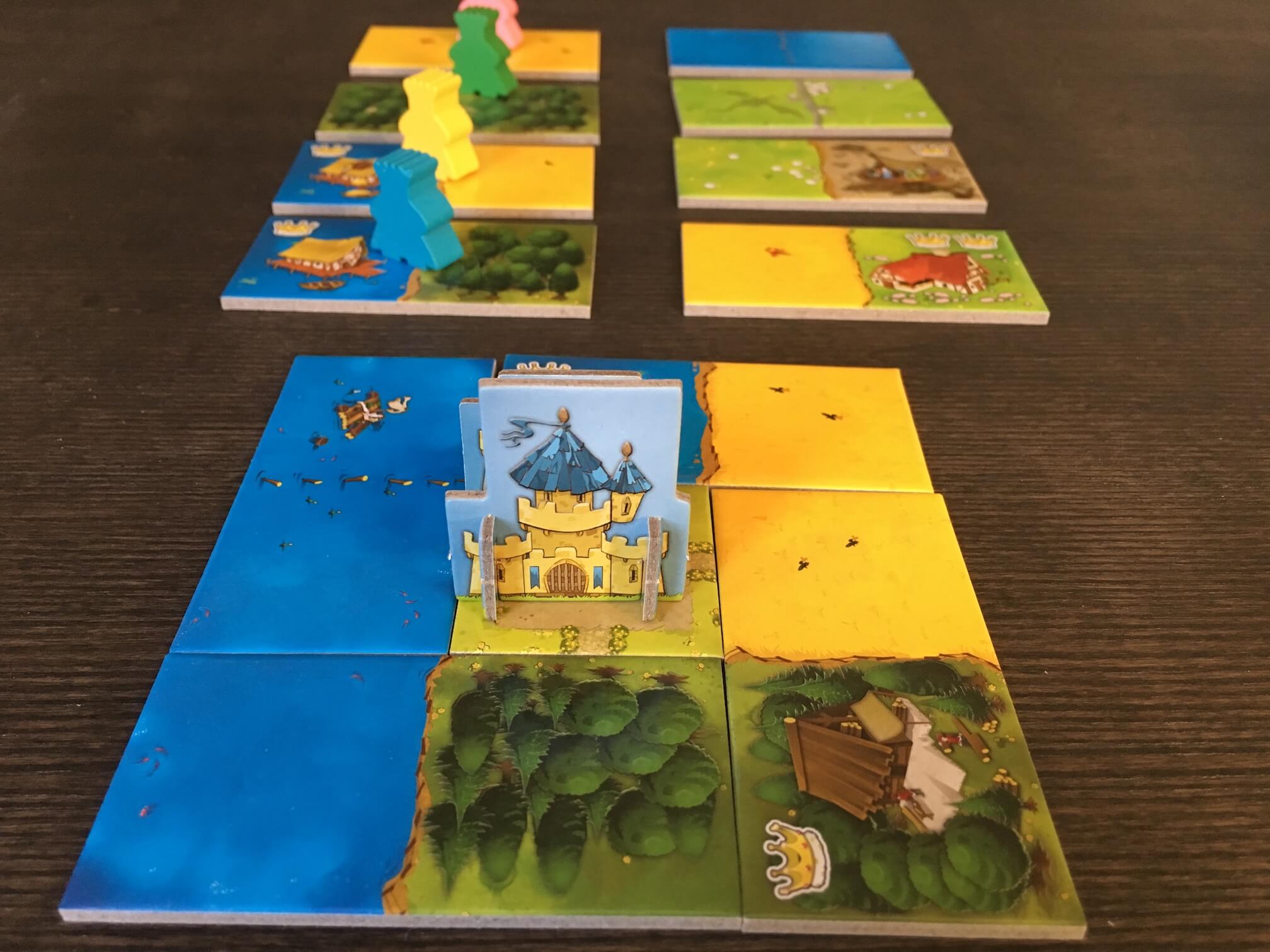
Kingdomino is a dead-simple tile-laying game in which you try to group different areas—ocean, wheat field, mine, etc.—of your kingdom in order to score points. Some tiles have crowns on them. At the game’s end, each set of contiguous area tiles is scored by multiplying the size of that area by the number of crowns on its tiles. Simple? Sure, except that you have to keep your kingdom within a 5×5 grid, and every area tile must be placed such that it touches an existing tile of that type. To make this even trickier, new tiles come out of the box and are chosen in player turn order—but the tile you take in one round determines your player order in the next. Take the better tile now and choose last in the next round? Or grab something not quite as good that will still get you first or second pick next time?

This is a smooth, quick-playing game that has worked well with both kids and adults—even providing some surprisingly decent choices for seasoned gamers. A worthy winner of 2017’s important Spiel des Jahres (Game of the Year) award in Germany.

Splendor

2-4 players, 30 minutes, age 10+, $31 on Amazon

We’ll take any chance we can get to recommend the 2014 classic Splendor. A staple of game nights everywhere, this accessible “engine-building” game tasks players with collecting gems (represented by poker chips) to buy cards, so that they can buy cards worth points, so that they can be the first to 15. You can teach Splendor to almost anyone, and it plays in a breezy and always-escalating 30 minutes. If you already have the base game, consider picking up the expansion.

Azul

2-4 players, 30-45 minutes, age 8+, check your local store

Nate Anderson

The words “instant classic” are overused in board gaming, but if Azul doesn’t fit the bill, no game does. The title took home the prestigious Spiel des Jahres (Game of the Year) award in Germany, and it has quickly solidified its place in the “gateway” games pantheon.

Based on Islamic-inspired Portuguese tiles called azulejos, this family-weight abstract involves collecting sets of similar tiles and slotting them into rows on your personal game board. When a row is completely filled, one of its tiles is moved over into the square pattern to the right, garnering bonuses depending on placement. Turns are quick, and each set of tiles you grab creates both problems and opportunities for other players. There’s a tinge of “meanness” for players who are sensitive to that sort of thing, but it’s essential to Azul‘s wonderful interactive tension.

Gorgeous bakelite-style tiles seal the deal on a beautiful production. Read our full review here. (If sold out, you might consider the well-regarded sequel Azul: Summer Pavilion.)

Welcome to…

1-100 players, 25 minutes, age 10+, $24 on Amazon

One of the hottest trends in board games over the past few years has been the “roll and write” genre, in which players roll and draft dice, then mark the results on a scoring sheet. We’ve played a ton of these games, and the unfortunately named Welcome to… is easily one of our favorites.

The game has you and your friends building up your own little suburban neighborhoods. You don’t roll dice here, though; instead, a big deck of cards gets split into three piles, and in every round, a card from each pile is turned over. Players then pick one card to mark down on their sheets (multiple people can pick the same card). The cards each display a number and a symbol. On your player sheet are three rows of houses and a few other scoring trackers. You write the number on a house to essentially “build” it, keeping in mind that the numbers must ascend numerically from left to right in each row—which, believe me, is way harder to manage than it sounds. The symbols provide special effects—take the “fence” symbol and you can clump your houses into estates, for example, or install a pool on spaces with the pool symbol.

The game presents some surprisingly difficult decisions—I really need to pick that fence card to finish my estate, but the number on that other card is PERFECT for me—and it is easy enough to teach to even board game novices. There’s no minimum or maximum player count; anyone with a sheet can play. And with its 25-minute playtime, it’s a perfect little filler.

Dice Forge

2-4 players, 45 minutes, age 8+, $32 at Amazon

Pure engine-building fun with chunky plastic dice. On each turn, you roll your dice, store up resources, and then purchase cards that give you special abilities or—and here’s the game’s “gimmick”—buy even better die faces. That’s right: much of the game consists of buying more powerful resources from a large tray of faces, then replacing an existing face on one of your dice. By game’s end—about 45 minutes—you’re rolling killer combos every time.

Dice Forge has one of the most gorgeous presentations I have ever seen in board gaming, the die faces come off with a satisfying “pop,” and there are more available card powers than you can use in a single game. Terrific family entertainment.

https://arstechnica.com/?p=1663794


The psychology behind that tempting quarantine makeover

The psychology behind that tempting quarantine makeover
Jessy Blain | Getty Images

Cue the montage: It’s quarantine makeover time. People practicing social distancing during the Covid-19 pandemic are itching to change up their looks. The evidence is all over social media: With hair salons shuttered, people have resorted to chopping at long locks with craft scissors or full-on shaving their heads, or dying their hair blue or pink with box dye. Many men, from Jim Carrey to your uncle, are growing out lumberjack beards.

For some, mere hair manipulation isn’t enough. If you can keep your eyes open long enough, you could watch YouTube and TikTok videos of people piercing their own ears and noses at home, or letting equally unqualified family members do it for them. Perhaps most adventurous are those contemplating giving themselves quarantine stick-and-poke tattoos with kits they bought on Facebook.

Many people, of course, are taking their appearances into their own hands purely out of necessity. They’re sick of showing up to Zoom meetings with grays, dark roots, split ends, and bangs straggling into their eyes. (If that’s you, WIRED has some tips for avoiding DIY haircut disasters.) But others, the ones on the more extreme end of the stay-at-home body modification spectrum—the drastic cuts, the wild dye jobs, the piercings and tats—give reasons that are far more emotional and nebulous. “PIERCED MY EAR AT HOME **QUARANTINE MADE ME DO IT**” screams one YouTube video title. Regardless of why you do it, though, the urge to make yourself over right here, right now isn’t just your brain reacting to simple boredom. It’s actually a much more complicated coping mechanism.

No one has actually studied mass makeovers during a prolonged global pandemic—we’re in uncharted territory here—but people like Christopher Oldstone-Moore think there’s much to glean from personal expressions of the past. Take beards. According to Oldstone-Moore, who studies gender and hair at Wright State University, beards are associated with warriors in ancient and medieval times, and, you know, manliness. At times like these, growing one can be a show of resilience. “Psychologically, it can be a sort of declaration of fortitude and heartiness,” he says. “It’s a way of saying, ‘I’m tough. I can withstand adversity.’” Makeover elements that require suffering actual physical pain, like piercings and tattoos, may be serving a similar function: thumbing your nose at a trying time just to remind yourself and others that you can.

The urge to change your appearance might also be a desire to change the one thing about your situation that’s actually changeable. According to Kim Johnson, professor emerita at the University of Minnesota, where she studied the social psychology of fashion, giving yourself a makeover after a catastrophic event is somewhat common. “Women who were sexually assaulted often change their appearance after the assault. It’s a renewed sense of control,” says Johnson. “Applied to coronavirus, the reasoning could be ‘I cannot control the virus, but I can control my appearance.’” People’s quarantine health kicks and fitness journeys could be understood in similar ways.

For others, especially those growing out beards, the motivation for their quarantine makeover could be as simple as a way to mark the passage of a significant time. Oldstone-Moore calls this kind of facial hair a “quest beard”—it’s common among athletes heading into the playoffs, or groups of bros collectively participating in No Shave November. Often, these beards are shaved off once the playoff season is over, but other people use a more permanent dramatic change to their appearance to signal that they’ve somehow crossed a threshold. “It says ‘I’m new now, I’m not the way I used to be,’” Oldstone-Moore says. “It’s the Al Gore beard, the David Letterman beard.” People are spending a lot of time on their own, reflecting, so a few aesthetic epiphanies were bound to come along.

The stakes are also low right now. “Person-to-person contact is limited and is under control, and you can control who does and does not see you,” says Johnson. “It is a good time to experiment with appearance changes, and with being in quarantine for over a month, appearances could go back to what they were previously and no one would know.” This too has precedent: The annals of beard history show that many choose to experiment with facial hair while on vacation.

“One of the most interesting questions for me is how much of what we experiment with in this time will we latch onto and keep after this is over,” Oldstone-Moore says. “It could even lead to whole new trends.” So go ahead, style yourself like nobody’s watching.

This story originally appeared on wired.com.

https://arstechnica.com/?p=1670978


Review: Chris Hemsworth shows his dramatic acting chops in Extraction

Chris Hemsworth plays a ruthless mercenary whose latest mission calls for rescuing a drug lord's kidnapped son from Bangladesh.
Enlarge / Chris Hemsworth plays a ruthless mercenary whose latest mission calls for rescuing a drug lord’s kidnapped son from Bangladesh.

Chris Hemsworth gets a chance to stretch his acting chops as a hardened mercenary hired to rescue the kidnapped son of a crime lord in Mumbai, India, in Extraction, a new original action thriller from Netflix. The film is produced by the Russo Brothers (Avengers: Infinity War, Avengers: End Game), which is probably how the film snagged Thor himself as the star. (We can probably thank Netflix for Stranger Things‘ David Harbour’s cameo appearance.)

(Some spoilers below, but no major reveals.)

Joe Russo penned the script, and the duo tapped stunt coordinator Sam Hargrave to make his directorial debut. Hargrave’s stunt work has been featured in several MCU films (Captain America: Civil War, Thor: Ragnarok, for example), as well as The Hunger Games franchise and Atomic Blonde.

The official premise is short and sweet: “Tyler Rake (Hemsworth) is a fearless black market mercenary who embarks on the deadliest mission of his career when he’s enlisted to rescue the kidnapped son of an international crime lord.” 

Compounding matters is the fact that Rake has lost his own son and is dealing with the grief and depression one might expect from such a tragedy—namely, by drinking heavily, popping lots of oxycontin, and taking crazy stupid risks. “You’re hoping if you spin the chamber enough times, you’ll catch a bullet,” his perceptive fellow merc and partner, Nik Khan (Golshifteh Farahani) tells him.

The extraction of the kidnapped Ovi (played by newcomer Rudraksh Jaiswal), proves significantly more difficult than originally anticipated. Ovi’s father is currently in prison, with his financial assets frozen. So when henchmen of Bangladeshi drug lord Amir Asif (Priyanshu Painyuli) kidnap Ovi, he can neither pay the ransom, nor the fee for hiring Tyler, Nik, and their crew. Instead, the crime lord’s top aide, Saju (Randeep Hooda), tries to take Ovi back after Tyler completes the initial rescue to avoid paying him for the job.

Soon Asif has shut down the entire city of Dhaka to prevent Ovi’s escape. In addition to the drug lord’s forces, Tyler must battle local police and military forces in league with Asif to get Ovi across a bridge to (relative) safety. The odds are heavily against them. “That kid is a walking corpse,” Harbour’s Gaspar, a former teammate of Tyler’s now living in Dhaka, tells him. “And there’s no way to protect him. The best thing you could do for that kid would be to put a bullet in his brain.”

There’s much to like about Extraction, most notably the high-octane, beautifully choreographed action sequences, courtesy of Hargrave’s hard-earned stunt expertise, in which Tyler channels his inner John Wick to even out the odds a bit. Thanks to a generous $65 million budget from Netflix, the production values are very high, on par with many theatrical releases, and while the plot is occasionally muddled, things move along at a brisk pace.

Hemsworth is more than capable of the physicality required to play Tyler, and also brings the right amount of dark emotional intensity to his portrayal of the grief-stricken merc. He’s supported by an equally strong cast, most notably Hooda’s Saju and Jaiswal’s Ovi, a shy, sensitive kid who just wants to hang out with his friends after school, and instead finds himself fighting for his life.

That said, the film feels a bit thin. There isn’t much in the way of surprising plot twists, and while there are nods at deeper emotional resonance—most notably a brief bonding moment between Tyler and Ovi while holed up in a temporary shelter—those quickly give way to another violent action sequence. Extraction is also unrelentingly grim. Granted, the John Wick franchise also leans into its dark themes and subject matter without apology. But ultimately Extraction just isn’t having as much fun.

Still, it’s a solid, entertaining action thriller, and a nice addition to Netflix’s growing catalog of original films. In fact, that might be the most significant aspect of Extraction: it was made specifically for digital distribution, rather than a broad theatrical release—even before the coronavirus pandemic shut down movie theaters around the world. The Russo brothers, who cut their teeth in television with the series Community, have fully embraced the changing media landscape, shuttling easily between blockbuster theatrical releases like Avengers: End Game and digital releases like Extraction.

“The greatest thing that Netflix has done is take away box office from defining the success or quality of a film,” Joe Russo told Deadline Hollywood in a recent interview. “Movies are having trouble being funded in the old way and models don’t support it anymore.” While he thinks there will always be a place for the communal experience of going to a movie theater, he thinks that will be reserved for big-budget blockbuster releases, where the economics are more favorable. Streaming services like Netflix can provide a much-needed platform for mid-level films like Extraction.

“Frankly I’m hoping the prejudice between digital and theatrical distribution disappears because I don’t find it helpful,” Joe Russo added. “And I don’t think the audience, especially the young audience, cares. Some of the best quality storytelling we’ve ever had is on television right now through digital distribution.” Well said.

Extraction is currently streaming on Netflix.

https://arstechnica.com/?p=1671060


Games getting us through COVID-19—blocks, roguelites, whatever Death Stranding is

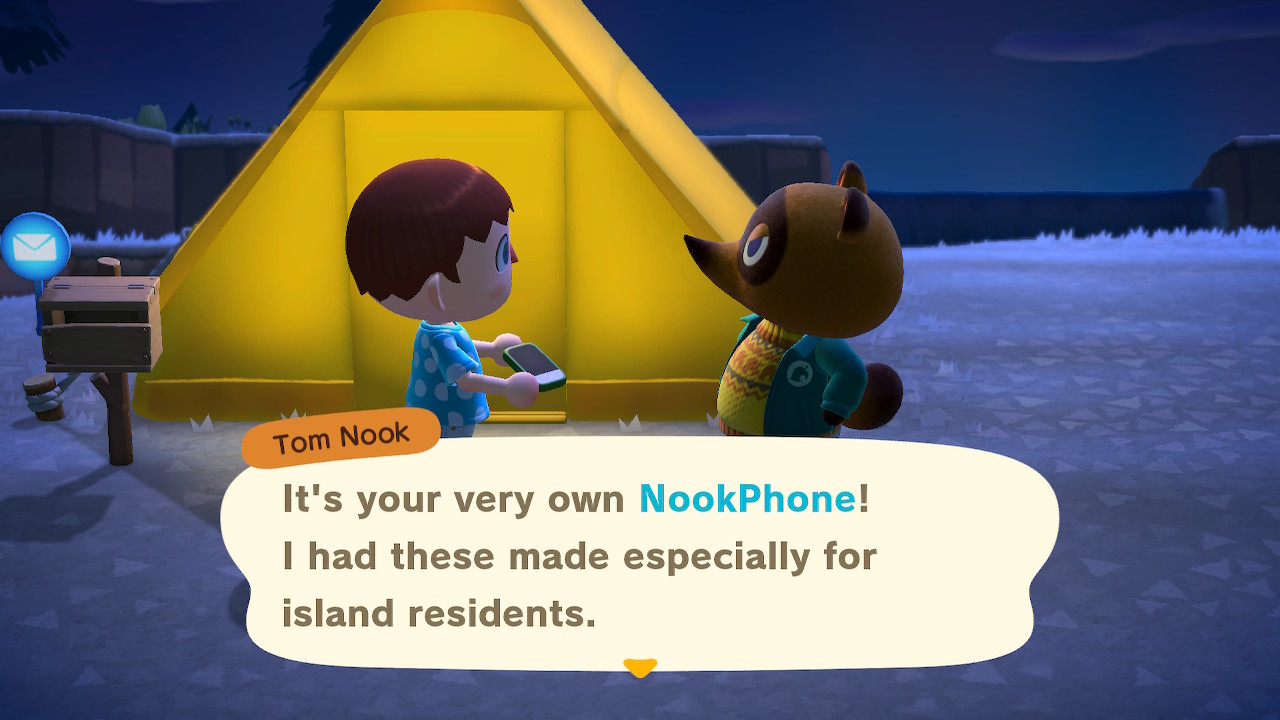
Like much of the world, we took have a love/hate relationship with Tom Nook at this point..
Enlarge / Like much of the world, we took have a love/hate relationship with Tom Nook at this point..

While it’s hard to see much upside in our current COVID-19 pandemic, there’s at least one group for whom maybe quarantine life isn’t all that bad—gamers. Maybe you finally have the time (and nothing else to do) to work your way through some 100-hour plus campaign or to retrieve every star in Mario 64. Or, as someone with a partner/roommate/kid, maybe you suddenly never get a chance to game by yourself and have newly been embracing the joys of co-op and multiplayer more than you ever imagined. (Alternatively, maybe you’re sticking to whatever handheld isolation you can find instead under such circumstance.) Heck, maybe you’re just so bored you decided to finally torture yourself through Dwarf Fortress’ initial learning curve.

No matter how you slice it, video games have been one of the most reliable forms of at-home entertainment in both the best of times and the worst of times. So although sheltering-in-place has altered many aspects of life in unquestionably negative ways, around Ars we’ve stumbled into some gaming silver linings over the last month-plus. Here’s what’s been keeping our thumbs active in these quartan-times when the work keyboards have retired for the day.

[embedded content]
Srsly, how can you say no?

Transporting back to 1994

My name is Nathan, I’m one of the fools who waffled on acquiring a Switch and now lacks any modern gaming device mid-quarantine. I’ve forever been a console player, and over the years as consoles gained connectivity they’ve become one of the easiest ways to regularly connect with my younger siblings. But here we are. I guess we’ll have to… talk? Scattergories works over video chat, at least.

As for my gaming fix, I’m not entirely without console-access luckily. The first gaming system I ever had was the SNES, a 1992 Christmas gift that my parents still discuss due to the new heights my seven-year-old vocal pitch reached out of excitement. So last year for my birthday, my sister sent the modern incarnation, the Super NES Classic.

Life right now has undoubtedly been hard, and I’m no masochist—Super Ghouls n’ Ghosts and Contra 3 remain untouched. I’m also not a gaming historian (sorry, Star Fox 2) and will never understand why Secret of Mana (a third RPG behind Earthbound and Super Mario RPG) had to be included over a big popular mid-90s port like NBA Jam or Mortal Kombat or even Dr. Mario.

Instead, I’ve spent my limited solo-TV time playing through a familiar side-scroller that’s fun with juuuust a touch of challenge: the original Donkey Kong Country.

The positives here probably don’t even need naming after 25-plus years, but here we go: The soundtrack remains filled with sneaky bangers. The game prominently features the perennially underrated DK (and his expanded universe) as opposed to the milquetoast Mario. The game’s animal mechanics felt revolutionary at the time and remain downright charming today (try smacking some gophers as a rhino right now and see if you feel better, I’ll wait). And the overall game play has the exact blend of ease and challenge I’m looking for—maybe I can breeze through the first eight levels without stopping to sip my coffee, but then “Mine Cart Carnage” hits and suddenly my accumulated extra lives are teetering on single digits and my right thumb is in pain from trying to time jumps over abandoned mine carts juuuuusssst right (I’m not the only who can’t handle this level effortlessly as an adult, thank you Kotaku). If the Switch Lite (I want that and not the docked version, right?) ever comes back in stock, rest assured this never-owned-a-Wii gamer will be Tropical Freeze-ing the worries away soon after.
—Nathan Mattise, Features Editor

[embedded content]
A video game of sorts that everyone can enjoy

Zoom gaming hour

I stay on top of the latest and greatest games, indie to AAA, for a living. But as shelter-at-home orders have kept me separate from friends and family, I’ve found the various Jackbox Party Packs have provided the perfect way to stay connected. These collections of casual party games run the gamut from trivia to word games to secret-information investigations to straight-up popularity contests, all with the slightly off-kilter humor you might expect from the team behind You Don’t Know Jack.

The Jackbox Party Packs satisfy all the requirements necessary for a successful online multiplayer experience with pretty much any group:

* The instructions are simple enough to explain quickly for newcomers.
* It’s not reflex-based, so no worries about Internet lag affecting player performance.
* It works on pretty much any platform; all you need is a videoconference that can “share your screen” and a smartphone web browser for each player.
* It encourages creativity and laughter in a mostly non-confrontational way.

We started with a weekly Friday night Jackbox meetup with a group of college friends but have since expanded to post-Seder games with the extended family just as easily. Even my five-year-old has gotten in on the act, laughing her way through a family-friendly edition of the Pictionary-like Drawful just before bedtime.

D tend to get self-conscious just looking at my reflection during video conference calls, and I think the idea of drinking alone together at a “Zoom Happy Hour” sounds excruciating. But a Jackbox game provides the perfect focal point and excuse to catch up with far-flung friends and family while doing something fun together.
—Kyle Orland, Gaming Editor

Free time is now game time

Two weeks before the lockdowns began, my wife and I moved from LA to Chicago to be closer to friends and family. Sadly, all this means we’re even more socially isolated now than we were in LA.

Or, are we? Through games, we’ve been more social than we have been in years. Our more gamer-lite friends who used to not have much time to play games online are now suddenly all-in. We started a Discord server with everybody and have been playing Minecraft, Call of Duty: Modern Warfare, or Animal Crossing: New Horizons multiple nights per week. It’s been a blast.

On my own, I’m in the final chapters of the Final Fantasy VII Remake. I wasn’t expecting to like it, but I’ve been surprised and delighted.

I’ve been a Fallout 76 player since launch, and between the new folks coming in with the just-launched free Wastelanders expansion and old 76 friends playing more because they have more time at home now, the most positive game community I’ve ever been a part of has been hopping like never before. Haters can hate all they want, but Fallout 76 has its fans and we’re having a great time.

Also, I collect PlayStation games—all generations, to the tune of more than 1,000 games—and I’ve been casually poking around in some classics I never got around to playing before. For example: it turns out Dino Crisis is a roaring good time, if you’re into all the tropes and trappings of cheesy survival horror games from the late 90s—which I absolutely am.

On top of all that, I’ve been competing in the Kusogrande bad games speedrunning competition on Twitch, and I’ve made good progress on a text-based game development project I’ve been working on for the past year.

All this is to say that I have spent most of my free time with games since the shelter-in-place order came down. Everyone has their own way of staying sane amidst all this, and this is mine. It’s working well for me.
—Samuel Axon, Senior Reviews Editor

When play is for work…

I’ve been fortunate to write about some very big, time-sucking video games for you, dear readers, over the past few months. Some of the resulting reviews have already gone live at Ars Technica: Final Fantasy VII Remake, Resident Evil III Remake, Animal Crossing: New Horizons, Half-Life: Alyx, and Valorant. If that’s not enough, I have a few other game reviews in the works for this coming week.

So that changes the conversation on my end. What do I play to “wind down” when I’m not playing games for work? Nothing, really. Animal Crossing is a brainless exception when I partake in my state’s variety of legal inebriants. But mostly, during my downtime, I watch other people play games.

Twitch streams are my sweet relief. Within these feeds of familiar games, conversations between streamers and their chat rooms remain beautiful, shiny, and crystallized, like they were frozen in resin before the rest of the world joined their “stay home in front of a screen” party. Because, really, these folks were already prepared. They already set up immaculate green-screen rigs, paid for quality microphones and webcams, and erected secondary and tertiary monitors for things like monitoring chat rooms and managing their friends lists.

Twitch is a simpler place for me. It’s where I go when I want to hear people talk about something other than… *gestures around mildly*. (If you’re wondering about my favorites, they include the Apex Legends battles of NiceWigg, the Super Mario Maker 2 explorations of GrandPooBear, the fighting-game ruminations of Maximilian_DOOD, and the caffeinated exaltations of Viking_Blonde.)
—Sam Machkovech, Culture Editor

https://arstechnica.com/?p=1670921


Our favorite boardgames that model the natural world

<em>Photosynthesis</em>, the game.
Enlarge / Photosynthesis, the game.
Dan Thurot
Welcome to Ars Cardboard, our weekend look at tabletop games! Check out our complete board gaming coverage at cardboard.arstechnica.com.

The other day, I thought my six-year-old was about to pop one of those questions every parent dreads answering. With a reverentially serious tone, she asked, “Daddy, I have a question I been thinking about a long time…”—cue a pause long enough to stop my heart—“Do snails leave their slime on rocks forever?”

Whew. So she wasn’t awake during last week’s parent-on-parent hour.

Before becoming a father, I was aware that tiny humans don’t come prepackaged with much knowledge, but I never thought I’d have to discourage gleeful littering or pry little hands free from the dog’s ears. We may still be animals, but respect for nature doesn’t always come naturally to kids (or adults).

Curiosity, though, is easy to foster, especially once the kids figure out that board game night means staying up late and filling their bodies with unhealthy snacks. So, with Earth Day happening this last week, here are some of my preferred board games for inspiring curiosity about the planet and our role on it.

The roots: appreciating nature

<em>Planet</em>, with some very cool (and magnetic) dodecahedrons
Enlarge / Planet, with some very cool (and magnetic) dodecahedrons

Let’s start with the basics: the Earth is pretty, animals and bugs are cool, and we should probably take care of things here if only so those statements remain true.

For little fingers that love to tinker, there aren’t many better games than Planet. The game itself is perfect in its simplicity, letting you add magnets to a dodecahedron as you attempt to create suitable habitats for a number of different species. There are only three priorities to remember: creating lots of habitats, big habitats, or big habitats that aren’t near other habitats. Even my six-year-old quickly mastered the art of ensuring that every single tundra-dweller flocks to her planet. As a bonus, you get to admire your three-dimensional globe when you’re finished.

More experienced players will likely appreciate Wingspan and Parks. There’s a good chance you’re already familiar with the former’s clever combo-building and gorgeous illustrations; if not, check out our review from last year. Parks is less known but every bit as beautiful. Its artwork is licensed from the Fifty-Nine Parks Print Series, and it lets players tour some of the most dazzling destinations across the United States, rationing resources and campfires while snapping pictures and gazing at wildlife. Despite being competitive, it’s a serene, almost meditative experience.

If you’re more interested in actually putting yourself out in nature, Hive is one of the finest modern abstract games—and it’s entirely waterproof, perfect for playing in the grass or tucking into a fanny pack. Gameplay revolves around trapping the opposing queen by using bugs such as the far-ranging grasshopper, beetles that crawl over the top of other insects, or the power-sucking mosquito. I once played this against a mustachioed river guide who immediately announced, “Board games are cool these days, man!”

The trunk: sturdily connected

<em>Ecos: First Continent</em>
Enlarge / Ecos: First Continent

“We may be apart, but we’re also more connected than ever.” This year’s Earth Day slogan both acknowledges the current pandemic while also reminding us of our shared responsibility to the world we inhabit. The following games emphasize that sense of interconnection—and its fragility.

Like Planet but with more room to explore, Ecos: First Continent is about forming a landmass and populating it with roving species. Here the appeal revolves around a delicate balance between your own goals and those of your opponents. Everyone is working with the same grasslands, savannahs, and seas, and each player can easily riff on another’s tiles and tokens—or even consume them for points. Nothing is exactly “yours,” belonging instead to the rest of the developing ecosystem, which produces a process of creation that’s both competitive and collaborative.

<em>Oceans</em>, the most recent game in the <em>Evolution</em> series
Enlarge / Oceans, the most recent game in the Evolution series

On the more carnivorous end of the spectrum lies Evolution and its offshoots, including Evolution: Climate and the more recent Oceans, which we reviewed earlier this year. There are some significant differences between each entry, but all are alike in two major regards: first, they contain some of the sharpest card play you’ll ever encounter, and second, you win by chowing down on as much food as possible—including the creatures evolved by your friends. This spurs an evolutionary arms race that sees everybody running (or swimming) as fast as they can to outpace predators, parasites, and even cataclysmic climate changes or asteroid impacts.

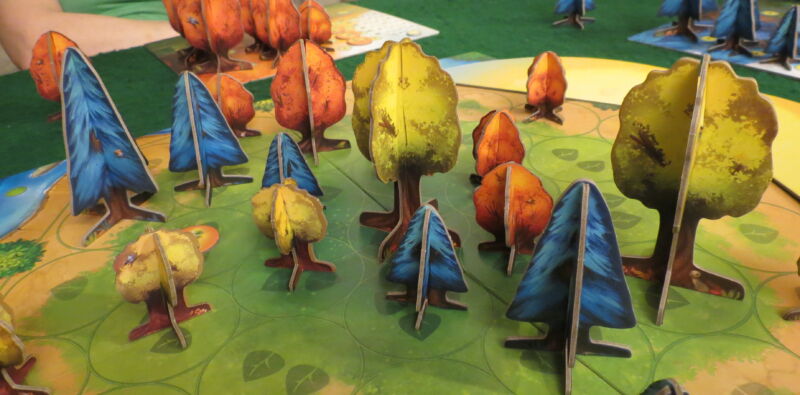
Arbor Day also happened this week, and the game Photosynthesis throws shade (sorry) at the notion that plants don’t make for hot board gaming action. You hope to grow your forest from lowly seeds to mighty trees, but you are competing for space and sunlight, while trying to keep out of the shade cast by rivals. The trick is that each turn rotates the direction sunlight shines in from, rewarding planning and ensuring that no one angle is entirely superior. Like the Evolution series, everything here is connected—you even earn points by having your largest trees decay, making room for a new generation of saplings. Hopefully your own, of course.

The branches: reaching beyond

<em>Bios: Megafauna</em>
Enlarge / Bios: Megafauna

If appreciation for nature doesn’t seem sufficient, plenty of titles delve deeper into the workings of the Earth’s climate, geological processes, and history. Unsurprisingly, some of these offerings are significantly “heavier” than the games discussed above. But the best of them justify their increased rules and play time with involved gameplay, interesting details, and even some insightful commentary.

Perhaps the most ambitious project is the Bios trilogy. Consisting of Bios: Genesis, Bios: Megafauna, and Bios: Origins, this series traces the evolution of life from primordial ooze to the present day. Each entry tackles a different subject and can be played either individually or strung together. At times, their concepts, rules, and terminology can feel like a crash course in that entry-level biology course you slept through in college. Genesis, for example, casts its players as amino acids, lipids, pigments, and nucleic acids as they invest in various environments and chemical processes to achieve unicellular reproduction and eventually multicellular life. Megafauna is the most accessible of the trio, as the same creatures (or plants, mollusks, and fungi) that you evolved in Genesis crawl onto land and compete for limited space, even as the Earth’s atmosphere is altered by your respiratory processes. By its conclusion, someone will likely have developed the rudiments of emotion, segueing directly into Origins, a civilization game unlike any other. Neanderthals struggle against Homo sapiens, language groups and religions are formed and fought over, and cultures are defined by the philosophical concepts and technologies they embrace.

What makes the Bios trilogy so thrilling is the way it intermixes setting and gameplay. While each entry fits neatly with the others, none of them play the same way. Genesis is about choosing what to invest in, reflecting the long odds of nucleotides bonding together to form RNA. Megafauna is a fast-paced race to develop new traits and claim territory, always struggling to be on top of the food chain—or on the bottom, if you’re a herbivore. Origins, meanwhile, is about charting your own course as your variety of humankind develops consciousness and decides which values to pursue—and eventually comes into conflict with other worldviews. The result is breathtaking in its scope and packed with enough ideas to dive down a hundred different search engine rabbit holes.

Sol: Last Days of a Star

<em>Sol: Last Days of a Star</em>
Enlarge / Sol: Last Days of a Star

Finally, no list about nature, conservation, and our shared responsibility to our planet would be complete without Sol: Last Days of a Star, a parable about the eventual destruction of our sun due to unsustainable energy mining. This might seem like a strange inclusion for Earth Day, since it steps beyond our blue marble’s atmosphere. (Farther, even, since your entire goal is to build an ark to carry you beyond the Solar System.) But as we fill our night sky with so many satellites that observatories struggle to study the stars, worry about the switch to green energy, and consider the long-term effects of Kessler Syndrome—orbiting space garbage, basically—it’s useful to remember that whether we’re tackling climate change or rocketing into outer space, we carry our baggage with us.

In Sol, the sun’s days are numbered and exodus is the only solution; Sol’s parable urges action. Perhaps if we act today, we can prevent the dire necessities of tomorrow.

In other words, the 50th Anniversary of Earth Day is the perfect time to spread appreciation, understanding, and education about this world we inhabit. And there are plenty of board games ready to pitch in.

https://arstechnica.com/?p=1670987


Newly unemployed and labeling photos for pennies

Newly unemployed and labeling photos for pennies
Getty Images

B.C. Kowalski, a writer at the local weekly in Wausau, Wisconsin, was expecting a boost to his income this spring. He was set to begin selling ads for local businesses on a podcast he’d launched on the side, Keep it Wausome. Then coronavirus restrictions shut down the town and its businesses.

To keep some extra dollars coming in, Kowalski has turned to Amazon’s crowd-work platform Mechanical Turk, where companies offer cents or dollars for small tasks such as labeling photos, transcribing audio clips, or answering survey questions.

Diane Brewer, who lives in Florida, is also counting on Mechanical Turk, as well as another crowd-work site called Prolific, where workers are paid to fill out surveys for academia and market research. She previously turned to crowd work during spells as a stay-at-home mom and convalescing after a car crash. Covid-19 convinced Brewer it was time to start again “to add some dollars to an uncertain future,” she says. Her long-term boyfriend works as a carpenter. “That may be an issue in the near future, because who is going to buy a house anytime soon?” she asks.

Brewer and Kowalski are among a global surge of people logging on to crowd-working sites due to the economic contagion of Covid-19. Millions of people are suddenly out of work or facing reduced hours, with many stuck at home sheltering in place. Crowd work can be done from anywhere with an internet connection.

UK-based Prolific saw 13 percent more workers in March than in February, according to its CEO, Katia Damer. Damer says that on average each crowd worker filled out more surveys, driving the value of transactions on the platform up more than 50 percent.

Hive, a crowd-work platform that specializes in tagging photos and other data for training machine-learning software, has also seen its workforce swell. Kevin Guo, the startup’s CEO and cofounder, says the daily count of new accounts on the service has more than doubled over recent weeks. A rush of new workers from Brazil and the Philippines has been particularly noticeable.

Amazon did not reply to a query about activity on Mechanical Turk, but Panos Ipeirotis, an NYU professor who has studied Mechanical Turk workers, says he’s seen more Turkers recently from Canada, Italy, and Brazil in particular. A spokesperson for Our Hit Stop, a discussion site for Mechanical Turk workers that sells a Chrome extension for finding the best paying tasks, says it has seen new memberships increase 20 percent and 30 percent of inactive members return.

Crowd work is generally not well paid. A 2018 study led by Carnegie Mellon University pegged the median wage at around $2 an hour although workers can push that higher by being careful about the tasks they select and using tools like Our Hit Stop’s that flag or snag the best work. Kowalski of Wausau says he uses those to select tasks that pay the equivalent of $9 to $15 per hour, but workers who need to take as much work as possible may not be able to be so choosy. Prolific markets itself to workers by promising that surveys pay at least $6.50 an hour.

The surge of crowd workers will increase the competition to land jobs, and could prompt those posting tasks to reduce their already low rates. But Kerri Reynolds, a vice president at Appen, which offers crowd-work jobs annotating images, text, or other data for clients including Microsoft and eBay, says she still has plenty of work to go around because Covid-19 has increased the supply of crowd work as well as crowd workers.

Reynolds says that might be because US companies have lost access to large pools of workers offshore as outsourcing companies have closed offices. “Perhaps with those shutting down, companies are looking for alternatives,” she adds.

Guo of Hive says some of his company’s usual high-volume tasks, like spotting logos on sports videos to help companies track sponsorship deals, are less plentiful. But he notes that the company has more work than ever from clients that use crowd workers to help moderate social content and check user profiles.

“We have seen a dramatic uptick in new customers, as well as existing customers sending in much higher volumes of content to be moderated,” Guo says. He believes that’s partly due to social sites seeing more traffic from people stuck at home, and also because companies have shuttered offices where moderation staff worked. Some companies, such as Facebook, are wary of the privacy risks of sending content for moderation outside their own facilities, but others are turning to crowd workers to help, Guo says.

Companies turning to Hive for moderation typically use machine-learning algorithms to take a first pass at content, and use crowd workers for trickier tasks or to handle surges. One Hive customer, live streaming app Yubo, which has 30 million users, has seen time spent in livestreams increase fourfold and daily signups more than triple.

The coronavirus that has driven more people to crowd work has also created a new, somewhat ironic, stream of work on Amazon’s Mechanical Turk. Longtime Turkers have noticed that the site has seen its own epidemic of surveys posted by psychologists, economists, and other researchers asking people about their Covid-19 related thoughts, feelings, and experiences. “If the disease is anything like the surveys,” one person noted on a Turker forum, “it’ll wear you down just thinking about it.”

https://arstechnica.com/?p=1670982