Ars analysis: ~80% of Steam games earn under $5K in first two weeks

It has been roughly two years now since Valve shut off the source of Steam Spy’s huge, randomly sampled sales estimates and promised a “more accurate and more useful” replacement to come. We got our first glimpse of what that replacement might entail today, as Valve gave a rare glimpse into its treasure trove of aggregate sales data across thousands of PC games.

The blog post sharing that data correctly points out that the raw number of games finding some minimum level of sales success on Steam has increased vastly since 2012 (when Valve launched Steam Greenlight and loosened its tight control of what games could appear on the storefront). But Valve’s selective view of the data leaves out a huge mass of games that make less than $5,000 in their first two weeks on Steam’s virtual shelves. An Ars analysis finds those titles have made up the vast majority of Steam releases for the last five years.

Filling in the holes

To get at that data for the charts above, we started with the graphs Valve itself provided in its blog post today. These lay out the number of games making over $5,000, $10,000, $50,000, $100,000, and $250,000 in their first two weeks, respectively, by release year. I used photo editing software to measure and convert the bars in those graphs into raw numbers, but the actual numbers may be off by a fraction of a percentage point from Valve’s internal benchmarks (we didn’t decipher the graphs for 2005 and 2006, when the total number of Steam releases was too small to draw much meaningful data).

We then compared those numbers to the total number of Steam releases for each year, as collected by Steam Spy (I removed non-game software and free-to-play games from consideration, as Valve did in its data). Using that, we were able to figure out the one number that Valve pointedly failed to mention for all of these years: the games making less than $5,000 in that two-week launch period.

As you can see in Fig. 3, this lowest tier of sales made up well under half of all Steam releases through 2014, a year when Steam still saw less than 1,400 total games hit the storefront. By 2015, though, the raw number of releases had ballooned to over 2,300, and our data shows that increase came almost entirely from games that were struggling to make any significant sales impact at launch.

Since 2015, both the annual growth rate in Steam releases and the proportion of those releases that struggled at launch continued to increase exponentially, before leveling off in 2019. At this point, though, the ratio of Steam releases that can’t hit $5,000 in initial sales has hovered around 80 percent for the last three years.

As Valve acknowledges in its blog post, these launch window revenue cutoffs are somewhat arbitrary. A game that makes $4,000 in a couple of weeks could be considered a huge success for a hobbyist programmer just getting their solo start. Initial sales also don’t always capture the full picture for games that may find success long after launch, as well.

But Valve also points out that “most recent games earning around $10,000 in the first two weeks earned between $20,000 and $60,000 over the course of 12 months following release.” Convert that to an annual revenue number for a struggling indie developer, and you can see how launch window sales of under $5,000 can easily be considered a commercial failure (though the calculus changes if a developer can crank out multiple games per year or keep sales steady for a multi-year period).

What does it mean?

There are two ways to look at these numbers. The first, which Valve focuses on in its blog post, is the raw number of games in those “high initial revenue” groupings (i.e. above $5,000). As you can see in Fig. 2 (and below), the number of such titles generally rose slowly after Steam launched, absolutely exploded in 2014 amid looser Steam Greenlight standards, and continued to rise from that expanded number since then. Many more total games are quickly finding a significant audience on Steam than ever before, and Valve can rightly feel good about that.

But even as the number of successes on Steam has increased, the number of failures has increased even more, both on an absolute and relative basis. For developers, that means just getting a game on Steam isn’t anything close to a guarantee of being able to find a significant audience these days. For players, that means sifting through Steam storefront listings full of a lot of crap that apparently very few people want to buy.

Valve is constantly tinkering with its “discovery” algorithms to help with both sides of this equation, and those algorithms do the best they can to direct deserving games to their deserving audiences. But on a platform with increasingly hands-off submission guidelines and dozens of games launching every day, there are inevitably going to be a lot of losers in Steam’s sales lottery.

There are signs that things are improving, though. As Valve points out in its blog post, the proportion of games reaching that $10,000 initial sales milestone ticked up 11 percent from 2018 to 2019, slightly reducing the “failure rate” for a generic Steam release in the last year. And the average initial earnings for Steam games increased from 2018 to 2019 at all but the lowest percentile levels.

Those numbers suggest that quality games are starting to find even larger audiences on Steam these days, while weaker titles are proving even less lucrative. That doesn’t mean we’ll be getting back to the relative “all killer no filler” world of early Steam any time soon, but maybe we’re starting to get a little closer with each passing year.

Listing image by Getty / Aurich Lawson

https://arstechnica.com/?p=1666282


War Stories: How Homeworld brought the third dimension to real-time strategy

[embedded content]
Video shot by Justin Wolfson, edited by Aulistar Mark. Click here for transcript.

We’ve gone in-depth on the complexity of real-time strategy with a past War Stories episode—one featuring Command & Conquer: Tiberian Sun and focusing on the complexity of pathfinding—but classic space strategy title Homeworld is a bird of another color entirely. Its creation in the late ’90s was a drawn-out process that required years of crunch time and repeated requests for additional funding from the publisher—but as any gamer who lived through its release can tell you, the results were spectacular.

Homeworld is one of the most famous examples of the genre, not necessarily because it was the first RTS to move the battleground into space—though it did indeed do that, and well—but because the game’s implementation of unit-level combat in a 3D playing field was so well done that the UX and game mechanics fade into the background. Zooming in and out of the game’s sensor manager map is a slick experience that manages to pull back your view without pulling you out of the game, and even if wrangling your little spaceships did eventually get awkward late in the game, the interface itself feels like the right kind of interface.

Do more with more

So when we sat down with Relic co-founder and Homeworld designer Rob Cunningham, it was a bit surprising to learn that from his perspective the Homeworld we got in 1999 was less a refined and polished set of ideas and more like a minimum-viable proof-of-concept—what Rob describes as a series of sketches rather than full paintings. The small team, buoyed by Sierra’s publishing dollars, pulled together an iconic game and invented new gameplay systems more or less by the seat of their pants, finalizing working concepts without really having the chance to iterate and refine them. Even during a development cycle that took three times as long as originally planned, there just wasn’t time to do anything more.

The problem of how to translate the core concepts of a unit-based real-time strategy game from a flat playing field into a three-dimensional playing field ate up a lot of time—in fact, it’s the thing we focus on in the above video. As with many of our previous War Stories, there wasn’t a single solution to the problem. Rather, the designers had to take a step back and develop a string of fixes that adapted to the new challenges of strategic command in 3D. Playing in space had its advantages, of course—with no terrain to render, the developers could plow their entire polygon and texture budgets into the units themselves, allowing them to have sharply detailed spaceships with multiple levels of detail depending on distance. On the other hand, with no ground for orientation, helping the player not become disoriented and lost within the map (and even how to draw the map in the first place!) was a major issue.

What’s next?

We hope you all are enjoying the latest batch of War Stories—we’ve got more in the pipe after this, too! The next set of videos we’re focused on delivering will be the extended cut of this Homeworld interview with Rob, along with extended cuts of our talks with Dead Space‘s Glen Schofield and Star Control creators Fred Ford and Paul Reiche.

So stay tuned for more episodes of War Stories soon. We’ve got a ton of new eps cooking—stuff I’m really proud of. You could almost say that we‘re on fire!

https://arstechnica.com/?p=1666318


500-year-old manuscript contains earliest known use of the “F-word”

"Your mother was a hamster and your father smelt of elderberries!" <em>Monty Python and the Holy Grail</em>'s family-friendly approach to swearing handily avoids the F-word.
Enlarge / “Your mother was a hamster and your father smelt of elderberries!” Monty Python and the Holy Grail‘s family-friendly approach to swearing handily avoids the F-word.

Scotland has much to recommend it: impressive architecture, gorgeous Highlands, and a long, distinguished intellectual tradition that has spawned some of the Western world’s greatest thinkers over several centuries. It’s also, apparently, home to a medieval manuscript that contains the earliest known usage of the swearword “F#$%.”

The profanity appears in a poem recorded by a bored student in Edinburgh while under lockdown as the plague ravaged Europe—something we can all relate to these days. The poem is getting renewed attention thanks to its inclusion in a forthcoming BBC Scotland documentary exploring the country’s long, proud tradition of swearing, Scotland—Contains Strong Language.

The Bannatyne Manuscript gets its name from a young 16th-century Edinburgh merchant named George Bannatyne, who compiled the roughly 400 poems while stuck at home in late 1568, as the plague ravaged his city. It’s an anthology of Scottish literature, particularly the texts of poems by some of the country’s greatest bards (known as makars) in the 15th and 16th centuries. According to a spokeswoman for the National Library of Scotland (where the manuscript is housed), “It has long been known that the manuscript contains some strong swearwords that are now common in everyday language, although at the time, they were very much used in good-natured jest.”

The five sections to the compilation are devoted to religious themes, moral or philosophical themes, love ballads, fables and allegories, and comedy, especially satire. The latter section is where one is most likely to encounter the swears, particularly in the poetry of William Dunbar and Walter Kennedy. Both poets feature in the poem where the notorious F-word appears: “The Flyting of Dunbar and Kennedie.”

WTFlyting?

Flyting is a poetic genre in Scotland—essentially a poetry slam or rap battle, in which participants exchange creative insults with as much verbal pyrotechnics (doubling and tripling of rhymes, lots of alliteration) as they can muster. (It’s a safe bet Shakespeare excelled at this art form.)

Dunbar and Kennedy supposedly faced off for a flyting in the court of James IV of Scotland around 1500, and their exchange was set down for posterity in Bannatyne’s manuscript. In the poem, Dunbar makes fun of Kennedy’s Highland dialect, for instance, as well as his personal appearance, and he suggests his opponent enjoys sexual intercourse with horses. Kennedy retaliates with attacks on Dunbar’s diminutive stature and lack of bowel control, suggesting his rival gets his inspiration from drinking “frogspawn” from the waters of a rural pond. You get the idea.

And then comes the historic moment: an insult containing the phrase “wan fukkit funling,” marking the earliest known surviving record of the F-word.

Of course, as the BBC Scotland documentary notes, that first “F#%$” is nothing compared to author James Kelman’s 1994 stream-of-consciousness novel, How Late It Was, How Late. The work is noteworthy not just because it won the Booker Prize and is written in a lowbrow Scottish dialect, but also because it uses the F-word over 4,000 times. Bannatyne would be proud of the legacy his first “F$#%” wrought.

[embedded content]
Game of Thrones‘ Tyrion Lannister tries to negotiate with the insulting Frenchman from Monty Python and the Holy Grail in this mashup from Funny or Die.

https://arstechnica.com/?p=1666058


British government starts pushing social distancing via in-game ads

Why would you ever go outside when you have <em>Dirt Rally</em> to play inside?
Enlarge / Why would you ever go outside when you have Dirt Rally to play inside?

As governments around the world urge their citizens to “Stay at home, save lives,” the UK Department for Digital, Culture, Media and Sport is using in-game advertising to get that message in front of a younger audience of video game players.

The messaging is already appearing through in-game banners in Codemasters’ Dirt Rally 2.0, which will be offered as a free PlayStation Plus title this month. Rebellion titles like Sniper Elite and Strange Brigade, meanwhile, will display the message before the start of each game. And King’s Candy Crush Saga will insert the PSA amid the usual interstitial advertising for millions of free-to-play players.

“At Codemasters we came to realize that technology within our games, which enables the remote updating of banners within the virtual environment, could be repurposed to assist with the coronavirus communication effort,” Codemasters VP of Business Development Toby Evan-Jones said in a statement. “It’s fantastic to see conversations already being sparked amongst our community.”

Public service announcements in games aren’t a completely new phenomenon, as anyone who remembers the arcade-era “Winners Don’t Use Drugs” campaign can attest. The Scottish government was putting drunk-driving PSAs into Xbox 360 titles as early as 2007. More recently, the US Ad Council gave out free in-game T-shirts to Guild Wars players to promote a nationwide suicide prevention campaign.

Still, using video games for public health messaging has taken on added urgency as officials urge citizens to avoid unnecessary trips and large gatherings to prevent the spread of the novel coronavirus. “Getting through the crisis will require a collective national effort, and every generation has a role to play,” the UK Department for Digital, Culture, Media and Sport notes in an announcement. “Young people spend more time playing video games than the rest of the population, which is why in-game messaging represents a creative, targeted, and immediate way to help reinforce the government’s Stay Home, Protect the NHS, Save Lives message, to gamers.”

Contextual in-game advertising exploded in popularity in the mid-’00s as publishers saw a potential new revenue stream from always-online gamers. Research suggests that even subtle environmental advertising in video games can have a significant impact on players. Being immersed in a virtual world “disrupts counter-arguing among individuals who might otherwise resist real-world influence attempts,” according to a 2015 University of Connecticut study. https://arstechnica.com/?p=1666022


Quibi, day one: This phone-focused TV service really isn’t that bad

They want us to pronounce it "kwib-ee." We're going to pronounce it "kee-bee" to spite them. But silly as the name is, the service isn't that bad.
Enlarge / They want us to pronounce it “kwib-ee.” We’re going to pronounce it “kee-bee” to spite them. But silly as the name is, the service isn’t that bad.

If you’re a frequent TV watcher, you may have noticed a significant change in daily and weekly series over the past month. TV crews have scrambled in the face of coronavirus shutdowns to generate content without their usual tools or studios, and, gosh, it’s been sloppy. The results from most major networks have featured problems with lighting, microphones, camera resolutions, and editing across the board as hosts transition to filming themselves from home.

Even as of press time, many of these shows still feature awkward pauses and silences, not to mention grainy, compression-filled video feeds captured from online chat platforms. It seems like networks don’t know what to do in a world where “social distancing” means not taping in front of a live studio audience, and the results look quite bad compared to home-filmmaker stars on YouTube. Major TV networks have long been accused of not understanding the streaming landscape, and that accusation has rung all the more true recently.

Which brings us to the latest streaming-exclusive service: Quibi. Unlike most other streaming services of the past few years, which have largely battled over which classic TV exclusives they can secure, this one has been built out of new, celeb-filled series with one thing in common: the “mini-sode” concept. Every Quibi video clocks in at 10 minutes or less.

We know: there are serious questions here, and the most important one is, doesn’t a ridiculous acronym immediately disqualify any upstart service? (If that’s the start and end of this review for you, we don’t blame you.) But in an era where TV as we know it is changing before our very eyes, this new service’s long-in-the-works experiment has shown up with serendipity on its side. Quibi may not be for you, and I went into its preview catalog utterly skeptical. But I came out of it surprised by how charming its scattershot launch lineup has mostly turned out to be.

But hold on, WTF is a “Quibi,” anyway?

Get your barf bags ready. Quibi is the result of two words squished together: “quick bite.” Yeah, okay, hold on, erp, oof, hrm… gulp. Okay, I can keep it together here. I hate that word combination for a few reasons, but most importantly because it undersells the platform’s biggest success.

The public sales pitch of “quick bite” television sounds like a slew of fast-forwarded throwaway videos, perhaps full of bad production values and clickbait concepts. Sure enough, one of the platform’s launch series has come up in Ars Technica’s TV-review chat channel quite a bit in the past few weeks, though not necessarily for good reasons. We’ve privately poked fun at Murder House Flip, which revolves around homes that are infamous for murders and crimes… and then having decorators swoop in and fix the homes up. All in nine minutes or less!

My assumptions got worse when I looked at the series list, which arrived without any explanations. “Gayme Show.” “Memory Hole, Hosted by Will Arnett.” “Cup of Joe, featuring Joe Jonas.” Ugh.

Once I got access to Quibi’s launch slate, as shared in a dump of video files in a Web browser (as opposed to the official Quibi app), I came to realize what was really going on here. Quibi isn’t an attempt to dumb down television by shrinking full episodes into tiny, moronic chunks. No, Quibi plays out more like something surprising: a grown-up version of Sesame Street.

The MTV of old, only shorter and gayer

That’s not to say Quibi has some gang of friendly faces stitching concepts together with a letter of the day. Rather, its series producers all got the memo to follow the pacing of an average Sesame Street “short,” which, as you may recall, lands somewhere between “a Muppet hangs out with a little kid to learn and reinforce a silly lesson” and “a camera crew follows someone around in their real lives and takes their minutiae seriously.”

Take The Shape of Pasta. In this series of miniature documentaries, a chef travels to remote corners of Italy to learn about forgotten pasta-making techniques, usually tucked away in small villages as passed down from generation to generation. It’s a cute hook to see parts of Italy you might never otherwise care about, and its three episodes’ pasta lessons are actually pretty appetizing stuff. By going with a weirdly specific premise, The Shape of Pasta avoids feeling like another freakin’ TV cooking series. Each eight-minute chunk allows you to get into a region, see its history, see its one prestige dish, and get the heck out.

Or let’s go with Gayme Show, which sarcastically pits two straight comedians against each other in a mix of trivia questions and flamboyant dance-offs. This would have worn me out in a 22-minute format, but condensing this over-the-top, gay-as-hell comedy show into eight-minute blasts means we get it all: laughs every minute and an exit when the time is right.

Time after time, I found myself clicking on things I never would have bothered watching, like a docu-series about concert production staffers or quick-hit dance-offs between street dance crews or mini-sodes about up-and-coming high school athletes, and coming away charmed. The “big” names on Quibi, on the other hand, didn’t sway me as much, including MTV’s nostalgia one-two punch of Singled Out (a ’90s dating series, only now much gayer) and Punk’d (the ’00s prank show, only now, much shorter).

From tiny, kid-friendly street cars to… oh… oh goodness

But it’s also a weird, all-over-the-map lineup, meaning you shouldn’t look at Quibi as the equivalent of a single TV channel. Tastes and series concepts vary wildly on Quibi.

One minute, I’m watching a “street racing” show in which little kids ride in Hot Wheels versions of expensive cars. The next, I flip to Game of Thrones‘ Sophie Turner in a gut-wrenching scripted series, Survive, which is broken up into five mini-sodes. But I couldn’t get through its first eight minutes without pausing and walking away, due to its graphic portrayal of a character’s battle with mental illness, as portrayed by her character’s bloody self-harm fantasies. How’d I get from “cute kids in fake cars” to “dramatic actress cutting herself” that fast?

So long as you go into Quibi with that kind of warning, you’ll be fine. Only Survive includes a stark warning before each of its mini-sodes about “viewer discretion advised for issues surrounding mental health,” and the network isn’t otherwise a smorgasbord of self-harm content.

Also, once I got over Survive‘s shocking intro, I otherwise felt underwhelmed by this “Quibi movie” approach. At a grand total of roughly 43 minutes, this series played out more like a British TV special with a single, extra-long episode. The same could be said for the enjoyably silly Flipped, starring Will Forte (SNL) and Kaitlin Olson (It’s Always Sunny)—a quality series, but not due to being stretched over a few mini-sodes.

Quibi is at least in a position to deliver arbitrary series lengths, instead of being beholden to a TV-mandated amount of time, which may prove more compelling if the service catches on as filmmakers and TV producers come up with inventive ways to play with the format. At least one scripted series at launch leans nicely into the Quibi premise: Most Dangerous Game, which fast-forwards to its whackadoodle premise within four minutes. By that, I mean four minutes after hitting the “play” button, with no long credits sequence or character-driven exposition. Archetypes emerge, and Liam Hemsworth begins immediately facing off against the calm-yet-menacing acting prowess of Christoph Waltz. Right, let’s cut to the chase. This service isn’t “Slow-bi.”

All in all, Quibi’s preview slate left me entertained enough to recommend installing the service’s generous 90-day free trial at launch, even if Murder House Flip wound up being one of the platform’s more boring “this could’ve been on normal TV” options in the end. After trials run out, the service costs $5/mo with ads, or $8/mo without them—and by then, we’ll see how its daily, news-driven content (unavailable in preview form) fits into the Quibi promise of entertainment designed around smartphone consumption. And in the meantime, I hope Quibi doubles-down on that Sesame Street-like quality and cranks up the nerdy content. YouTube is proof positive that the eight-minute format can work great for gadgets, games, science, and health, which Quibi sorely lacks as of press time.

(Full disclosure: my preview slate of content didn’t include Cup of Joe, and in spite of my surprise appreciation for much of Quibi, I’m not ready to raise my hopes for that one.)

https://arstechnica.com/?p=1665929


Final Fantasy VII Remake spoiler-free review: Our kind of Cloud gaming

We're going back to Midgar.
Enlarge / We’re going back to Midgar.
Square Enix

This week’s Final Fantasy VII Remake, in spite of its flaws and oddities, does the unimaginable: it delivers to just about any audience who might be interested in this specific RPG series and this specific game. That’s good news for anyone who has awaited this popular game’s return for 23 years. But big as that niche may be, it’s still a niche.

Are you a series veteran who has followed the Warriors of Light since the NES era? Maybe you’re a JRPG diehard who knows your way around every inscrutable Final Fantasy spinoff (VII or otherwise)? Or, what if you’re a lapsed player who got swept up in 1997’s FFVII fever hoping this new game will be a cool, modernized reason to return to your PlayStation 1 heyday?

If so, you count among the millions who will likely enjoy what FFVIIR has to offer. The production values, at their best, are exhilarating. The updated combat system sees Square Enix get its closest yet to nailing battles in a JRPG, with a system that runs at a bombastic-yet-smooth clip. And it’s nice to get to know some familiar faces in a stretched-out return to the iconic fantasy city of Midgar. Even better, you can rest assured that Square Enix has avoided two of its usual sins this time around. FFVIIR doesn’t “take 10 hours to get good,” and its plot doesn’t devolve into a Kingdom Hearts-like mess of indecipherable gibberish.

If the idea of a refreshed-yet-faithful JRPG leaves you cold, on the other hand, FFVIIR‘s 35+ hours of combat, plot, and polished set pieces probably won’t move the dial on your personal Active Time Battle meter. The dialogue is far from perfect—and, at least in English, it misses the mark too often. The old game’s transition to a 3D, control-your-own-camera universe can get unwieldy. Its reliance on the original game’s archetypes won’t seem endearing for newcomers. And while this isn’t nearly as padded a game as a ’90s JRPG, in terms of making players grind through hours of random combat, FFVIIR suffers from a few obvious “let’s stretch this section out for no reason” seams.

My bias is that of a lapsed JRPG fan, someone who kicked Final Fantasy games to the curb in the early ’00s and rarely looked back. And at its worst, FFVIIR had me either shouting “what the heck” at the story or “go #${& yourself” while throwing a controller at a frustrating boss battle. It’s not a perfect return to Midgar by any stretch.

But the ambition, the scope, and the highlights kept me gripped. FFVIIR feels like it left its development studios kicking and screaming until the very end—and the fact that this hotly anticipated, highly scrutinized game turned out well might be the craziest part of all.

What is a remake, really?

The first huge thing to get out of the way is the game’s title, because it could leave you with the wrong impression of what to expect. The word “remake” implies a few things in English: a start-from-scratch recreation, like Disney’s recent Lion King CGI film or a reboot of familiar characters and history into a new plot universe, like Spider-man films every six years or so.

Square Enix’s take on the word lands somewhere between those definitions. To make my point, I’ll refer to its free demo, which you can download right now to any PlayStation 4 console—and while this description qualifies as a spoiler, it’s quite mild, and you’ll see what I mean.

(Before I continue: FFVIIR does not include the entire plot of FFVII. Square Enix has already announced that FFVIIR‘s story comes to a halt at the moment the game’s heroes escape the game’s first massive city of Midgar. The developers have hinted at future games, but nothing has been formally announced. Got it? Okay.)

The game’s hour-long demo contains most of what you’ll find in the retail game’s first chapter, and in some ways, it’s a note-for-note retelling of the 1997 game’s opening sequence. A camera follows a flower girl through a city, zooms out to marvel at the mechanized city of Midgar, then zooms in to another part of town, where a train pulls into a power reactor’s station. At this point, players take control of familiar heroes Cloud Strife and Barret Wallace. Leap off the train, fight some guards, and descend to the reactor’s core, where players must then place a bomb, fight a boss, and get out before it blows.

In FFVIIR, that basic description plays out, but everything surrounding it is different. The most obvious change comes from remastered 3D graphics, all running in real-time and looking far superior to the original game’s “full-motion video” sequences. (If you want to see what 23 years of 3D-rendering progress looks like, here you go.) There’s also the refreshed combat, which I’ll get to.

But the biggest difference, in terms of this game’s “Remake” status, is how the story flows, expands, and outright changes. In this mission’s case, three helpers from the original game (Biggs, Wedge, Jessie) tag along once again, only this time, they have a lot more to say. Most of the time, they join fully voiced dialogue sequences, where we see this team, the eco-terrorist group “Avalanche,” sort out its mission. Occasionally, they yammer within earshot, their dialogue appearing as a neat column of text on the side of the screen for you to peruse or ignore as you march forward. This chapter sees the game’s voice actors and scriptwriters put their best foot forward for all its characters, in terms of delivering “polished anime” levels of likable cheese.

Then there’s the mission’s conclusion, which includes a brand-new dose of dramatic irony. Avalanche’s biggest foe, the mega-corporation Shinra, appears in FFVIIR‘s version of events as a watchful eye. In the original game, Shinra was caught unaware. This time, its leaders watch Cloud and Barret set the bomb on their precious reactor’s core. Then they add to the bomb. The explosion is noticeably bigger than Avalanche had expected.

It’s that kind of remake—and mostly good

This is where the demo ends, but the retail version picks up with Avalanche asking questions about that very explosion and following those threads. Think of Shinra’s meddling with the bombing as a trampled butterfly beneath a time traveler’s otherwise careful steps. It’s the first crack in the timeline (but not the last) on which everything moves.

Thus, the rest of the Remake follows the first chapter’s archetype: following slight schisms in the original game’s events to entirely new sequences and diving more deeply into the existing game’s cast to expand on their relationships and lead players through new, connected quests. If an event, location, character, or enemy appeared in the original FFVII, it’s probably here—but in hugely expanded form. Maybe a place you quickly ran through in the PlayStation original has become a bustling town, complete with errands and side quests. Maybe one simple problem in the original game has been turned into a laundry list of tasks. Or maybe an entirely new problem creates new quests for Avalanche (and introduces new, weird allies and adversaries along the way).

Hence, if you laugh at the idea of a “spoiler-free” review of a 23-year-old game’s remake, I insist that you hold your chuckles back. I will say the spoilable stuff plays out in a few ways. Sometimes, you’ll discover completely new elements, which stretch on for 1- or 1.5-hour stretches of content; these stretches are usually pretty cheesy, in line with what you’d expect from an average JRPG’s side quests. Other times, a familiar scene from the original game will emerge at a different time than in the original—usually with the added bonus of additional emotional resonance, if not a smarter logical connection to the characters in question. I like how these two extremes of “new” content play out alongside each other in the course of the campaign, especially since neither requires that players have the original game memorized to appreciate them.

Opinions are obviously going to be mixed when it comes to Square Enix shuffling the series’s events and characters of old, but I’d rank the shuffling’s execution as one of the game’s successes. With each expanded sequence, the game’s designers figure out how to add the right kinds of rises or falls in excitement, whether by injecting entirely new action sequences, putting intriguing new characters into the spotlight, or slowing the stakes down with wholly optional errand quests between higher-stakes moments. In the latter cases, players are asked to run through towns and find nearby, dungeon-like paths, which usually contain hidden trinkets and varied monster battles. If you’re a JRPG purist, you’ll appreciate these excuses to flex your combat muscles; these missions feel like condensed takes on the “run around and grind through random combat” exercises of old, and they very rarely spam the same enemy types too much.

https://arstechnica.com/?p=1665825


We now know the effect of altitude on classic “Diet Coke and Mentos“ fountain

A well-coordinated Mentos-and-Diet-Coke explosion filmed in slow motion for The Slow Down Show in 2013.
Enlarge / A well-coordinated Mentos-and-Diet-Coke explosion filmed in slow motion for The Slow Down Show in 2013.

Back in 2006, Fritz Grobe and Stephen Voltz—the self described mad scientists behind Eepybird—ignited an Internet sensation with their viral video of an elaborate version of the Diet Coke and Mentos fountain experiment, recreating the choreography of the Bellagio’s world-famous fountain display in Las Vegas. The underlying physics and chemistry of the fountain effect is well-known.

But an intrepid pair of scientists at Spring Arbor University in Michigan wondered whether altitude, and associated changes in atmospheric pressure, would have any measurable impact on the intensity of the foaming fountain, and performed a series of experiments to find out. They reported their results in a recent paper in the Journal of Chemical Education. The upshot: If you really want to get the most foaming action for your buck, conduct the Diet Coke and Mentos experiment at high altitudes.

Grobe and Voltz didn’t invent the basic demo. That’s been around since at least the 1980s, although originally creative science teachers used Wint-O-Green Lifesavers threaded onto a pipe cleaner to induce the fountains of foam in soda bottles. In 1990, the size of the Lifesavers changed, and were too big to fit into the bottle mouths. So science teachers switched to Mint Mentos candy to achieve the same effect.

More physics than chemistry

The effect is commonly misunderstood to be a chemical reaction, on par with mixing baking soda with vinegar, but the underlying mechanism is actually a physical reaction: namely, bubble nucleation. A standard two-liter bottle of Diet Coke at room temperature usually contains about 12 grams of dissolved CO2. Release that seemingly insignificant 12 grams of dissolved CO2 into the gas phase at room temperature, however, and it will expand to fill three times the total volume of the original soda bottle, or about six liters. That satisfying whooshing sound when you open a fresh soda bottle is the result of CO2 escaping. Then bubbles start to form in the liquid and float to the top.

This usually happens slowly, making your soda go flat over time, because the surface tension of the water in the soda helps trap the gas in place. Drop several Mentos candies into the freshly opened bottle, and it will happen very rapidly. That’s because the surface of the candy has lots of tiny bumps. Dissolved CO2 will diffuse into the bubbles that inevitably form on the rough surface of the candy, breaking the bonds with the water much more quickly. The result is a towering geyser of foam.

Fritz Grobe and Stephen Voltz perform the "Diet Coke and Mentos Experiment" on 53rd Street outside the Ed Sullivan Theater on the <em>Late Show with David Letterman </em>in 2006.
Enlarge / Fritz Grobe and Stephen Voltz perform the “Diet Coke and Mentos Experiment” on 53rd Street outside the Ed Sullivan Theater on the Late Show with David Letterman in 2006.
Jeffrey R. Staab/CBS via Getty Images

Co-author Thomas S. Kuntzleman first encountered the experiment at an elementary school science fair in 2005, and he has been interested in the underlying physics and chemistry ever since. For instance, he has found that various beverage additives such as sugars, citric acid, and natural flavors can enhance fountain heights. Most recently, he decided to test the hypothesis that the intensity of the fountain effect would be greater at higher altitudes, since one would expect atmospheric pressure to play a significant role in bubble nucleation.

Kuntzleman and his student co-author, Ryan Johnson, purchased bottles of Diet Coke from the same store, and made sure the bottles all had the same expiration date. For each experiment, they dropped a single Mentos candy into a bottle via a one-inch PVC pipe, and then watched the reaction work its magic. They used a graduated bottle/tornado tube to measure the mass lost from the liquid over time. The measurements were all taken within one week of each other, and the team made sure to keep all the bottles at roughly the same temperature.

One set of experiments was performed at different altitudes during a climb of Pikes Peak; another set took place during a drive across North Carolina; and a third set of experiments was performed during Kuntzleman’s family vacation, driving through multiple national parks in California, Nevada, and Utah. All told, they performed the experiment at altitudes ranging from below sea level (Death Valley, CA) to more than 14,000 feet (Pikes Peak). As expected, they found that more foam was produced at higher elevations.

However, the impact of altitude is not due entirely to a simple application of well-known gas laws, according to the authors—namely, that gases expand in lower atmospheric pressures. It was simple enough to test this with data collected on Kuntzleman’s family vacation, because the soda bottle temperature in that set of experiments had been carefully controlled and measured. The gas laws hold that the product of gas pressure and volume should be constant at constant temperatures, yet the data showed an increase in the product of pressure of volume with rising elevation.

“While it is very likely that the gas laws do contribute to the effect observed, the data presented suggest this is not the only explanation for the increased foaming,” the authors wrote. “Therefore, additional kinetic effects that enhance the foaming at higher elevation, such as increased bubbling frequency and increased ulceration sites (due to smaller critical radius) on the candy are likely at play.”

It’s a useful addition to Kuntzleman’s teaching repertoire; the basic demo can be connected to such central concepts as chemical kinetics, surface science, gas solubility, and chemical equilibria, for example. He has had undergraduate students in both non major science courses and general chemistry courses recreate this latest series of experiments as a small research-based project, and arrive at the same conclusion. “That the popular Diet Coke and Mentos experiment works better at higher elevations is a memorable way to remind nonmajors and students of general chemistry the important idea that atmospheric pressure decreases with altitude,” the authors wrote.

For those chafing at extended sheltering-in-place orders, it also provides a possible fun DIY group experiment. Identify people in your social circles who live at different altitudes. Each person can do the Mentos and Diet Coke demo—outdoors highly recommended—wherever they are, taking note of the relative heights of the foaming effect, so everyone can then compare their respective results. (Scientific American has helpful instructions, as does Eepybird.)

If you’re really feeling ambitious, everyone can do the experiment live simultaneously via Zoom or similar conferencing tool. Just protect your electronic equipment. And be sure to use Diet Coke or Coke Zero, not just because they make the biggest reaction—the aspartame lowers the surface tension of the water—but because they are less sugary and sticky. Trust us, you’re going to get soaked.

[embedded content]
A spectacular mint-powered version of the Bellagio Fountains in Las Vegas, brought to you by the mad scientists at EepyBird.com.

DOI: Journal of Chemical Education, 2020. 10.1021/acs.jchemed.9b01177  (About DOIs).

https://arstechnica.com/?p=1665748


The party goes on in massive online worlds

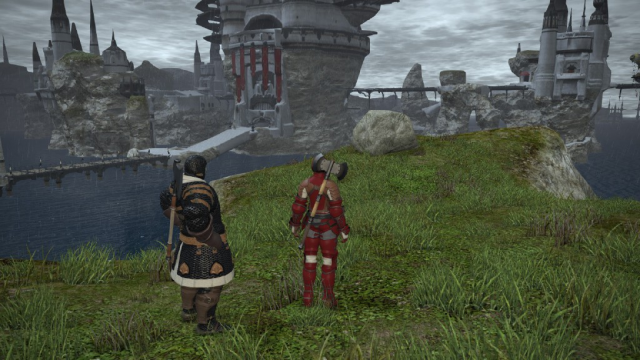
You don't have to be so socially distant when playing <em>Final Fantasy XIV</em> online.
You don’t have to be so socially distant when playing Final Fantasy XIV online.

My friends and I were taking a pit stop after an aimless drive when we heard a stranger loudly invite anyone within earshot to her friends’ party. Our plans had ended at “go for a drive;” before that, we were loitering between some collapsed columns in a crystalline wasteland.

We debated whether to attend from inside our car. The party seemed a little raunchy—its promoter, Nina, a minuscule woman with pink blush marks painted on either side of her button nose, advertised “drinks and good company” but also “ERP,” which stands for “erotic role-play.” That’s not generally our thing. We’re more stand-outside types than the types to cast a flashy glamour spell and chat up the nearest cat girl. But, hey, it’s Final Fantasy XIV online, and where my body sat in New York, the epicenter of America’s Covid-19 outbreak, there certainly weren’t any parties.

On Fridays, Saturdays, and basically any given weeknight, my Brooklyn neighborhood is alive with throbbing house music, over-earnest open mics, DJ sets, roiling apartment bashes, and cars blasting reggaeton. In this new-normal world, events as we know them no longer exist, unless you count texting your 20 closest acquaintances a DRINKS ON ZOOM!!!! invite, give or take a couple of cloying emojis. With all of this newfound time to overthink the mundane, I recognize now that social outings are dedicated units of time for self-expression, coloring-book pages onto which we and our friends draw outlines that we pour ourselves into. Social distancing has separated us from our social contexts; without them, all the color drains out.

It quickly became apparent that those of us whose social lives revolve around online videogames had a fail-safe for staying entertained indoors. Floating on my back in a virtual fountain lined with turquoise Byzantine-style tiles, I let a new gratitude wash over me for massively multiplayer online role-playing games, or MMORPGs. For weeks, I have been compulsively playing Final Fantasy XIV and World of Warcraft Classic, online games in which my meticulously customized characters battle monsters and complete quests in huge, biologically diverse, digital worlds. On my Final Fantasy XIV server, 13,000 strangers, plus a couple of my real-life neighborhood friends, roam the ancient forests, the thronged cities and the cramped, rocky caves.

One of them was Cid, who lives a 20-minute walk from me in Brooklyn. On a catwalk in someone’s virtual basement, we had just put on an impromptu two-person fashion show. (She posed slouchy and with a pout in her reindeer onesie.) Once we we tired of that, she found me in that fountain and entered in the “/waterfloat” command nearby me. The sun shone down.

It’s easy to wax poetic about how videogames let you do things that you can’t in real life anymore. You can host house parties in Animal Crossing. You can play basketball with your friends in NBA 2K20. Whatever. The easy sell for MMORPGs in the time of pandemic is simply that you can exist together, even /hug. Maybe that’s not entirely distinct from Zoom happy hours or Skype trivia at a time when there are plenty of digital channels for connecting. To feel like myself again, I needed to vector my personality off a new experience, and do it alongside people who know me.

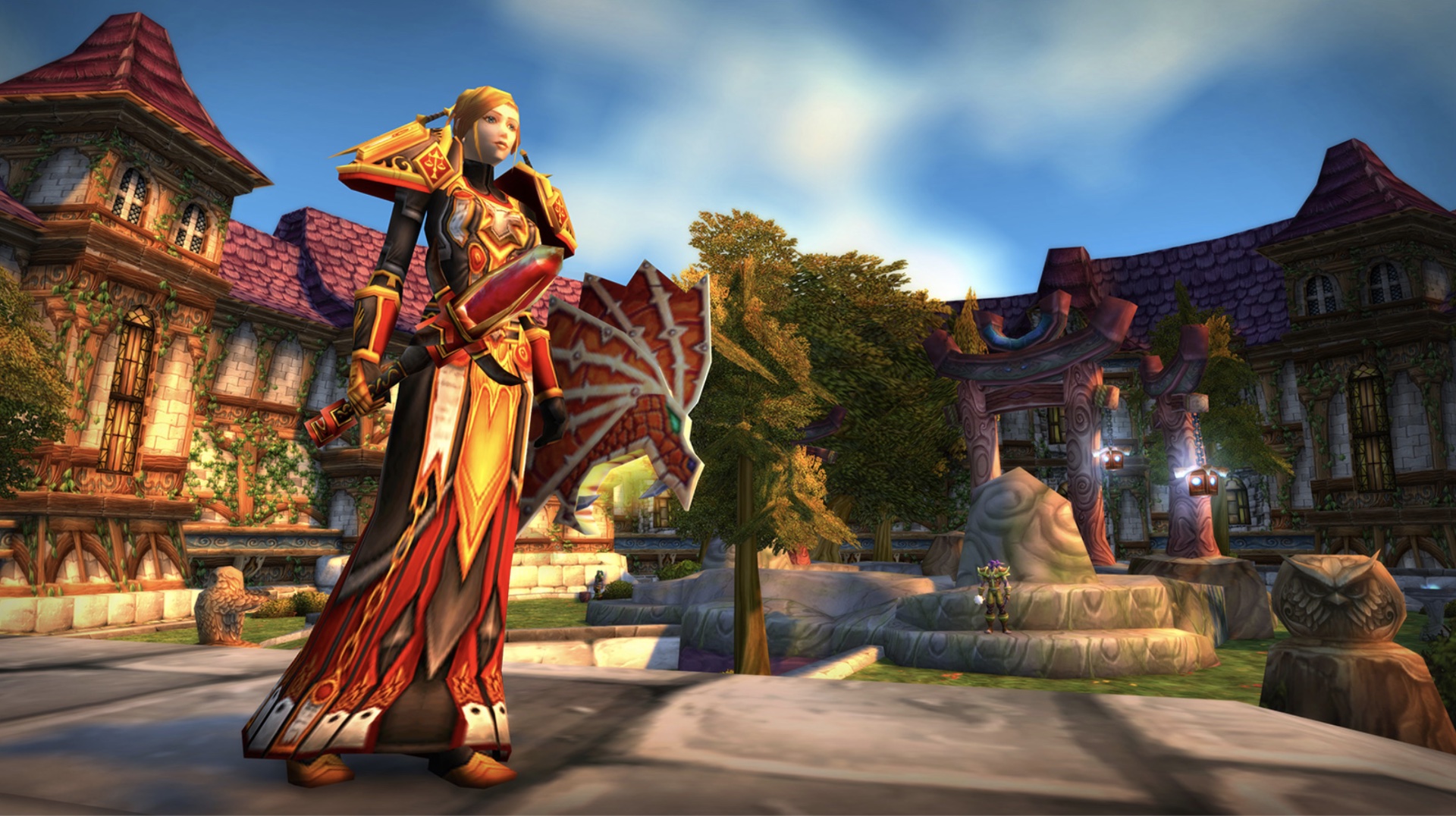
Now is as good a time as any to bust out your OG armor sets in &lt;em&gt;WoW Classic&lt;/em&gt;.
Enlarge / Now is as good a time as any to bust out your OG armor sets in <em>WoW Classic</em>.

A group of us were slogging through a checklist of mundane quests in World of Warcraft Classic when our undead friend Baen Chunch—named for Martha Stewart’s pony, Ben Chunch—suddenly started toward the mountains. As she sprinted, she rotated herself toward the tallest ridge we could see, a jagged, tannish peak looming over a massive desert. Over the Discord app’s voice chat, we egged her on and, one by one, enthusiastically followed suit.

Because the game replicates the experience of World of Warcraft as it was in 2001, climbing isn’t a straight shot up. Most craggy geometries only offer a small window for forward movement, and to find it, players rhythmically alternate between the space bar, which makes them jump, and the W key, which is “forward.” While the rest of us climbed in this frenzied zigzag, Trollthan the troll happened upon a rare smooth trail and gunned it. Meanwhile, Baen Chunch and the rest of us were missing jumps and falling downward.

One by one, we all eventually made it to the summit. It was beautiful to look out together onto the dusty desert, but not consequential, like a for-the-sake-of-it hike. It was just a thing we had all decided to do.

Transferring my social energies into MMORPGs has been surprisingly seamless. In World of Warcraft, I can /burp and /cackle. My partner, if he’s feeling tolerant, might /chuckle. In Final Fantasy XIV, I can magick my high-level armor into the sort of outfit I’d purchase at Urban Outfitters. Then I might beg Cid to meet me in the city and assess whether my orange leggings are too loud. It’s an embarrassing thing to admit, but the social validation of others is something I desperately miss; expressing myself in a void is not so satisfying. A question I keep having, locked inside and isolated, is who I am without the connections that normally define me, and to what extent this sense of self I’m accessing in MMORPG is a viable substitute.

In-game, Cid looks much like herself: androgynous, with short hair and an all-black outfit that could have come from a trendier Army surplus store. Cid’s been on Final Fantasy XIV a lot recently since the cafe she works at closed, and along with my partner and our friend Responsible, who is sheltering in place 20 minutes from either of us, we drove over to Nina’s party.

We pulled up to a mansion in the Lavender Beds, a quiet residential area separate from the monster-filled landscapes that Final Fantasy XIV is known for. We walked through the garden and the tall double doors, where we noticed the receptionist, played by another person, standing in the opulent, burgundy foyer. It was oddly quiet. After welcoming us in, he told us that the party was in the basement and to head downstairs for some fun.

When Cid and I manage to get together in Brooklyn, we meet at a tiki bar that serves too-strong cocktails in ridiculous inflatable flamingos. Responsible and I like to go to dive bars with cheap well drinks, and when we get sick of the crowds, we’ll sit in my small yard and drink cold vodka. Downstairs in this digital mansion, through the room packed with dancing cat boys and shirtless beastmen, we zeroed in on the four open stools at the bar. The music was pounding. Embarrassed that I showed up in battle gear, I quickly changed into a tank top and leather pants.

When we found our seats, we attempted to flag down the bartender, another cat boy. He was taking his sweet time serving the other partygoers, likely regulars. Impatient, I begged my partner to get his attention. When he finally turned to us, he offered us his signature fruit slush cocktails, which he sold for an exorbitant 5,000 gil each. We immediately inhaled them. For the duration of the party, we didn’t dance with or talk to anyone, except for the one human woman whose pants I complimented. (She obligingly /smiled.)

We were bored and it was getting late, so we wove our way back toward the stairs. It was a mediocre outing. Not really our scene, plus the service was lousy and the drinks were expensive. Exiting the mansion, again with no plan, I turned to my friends and asked: “Wanna break into some houses?”

This story originally appeared on wired.com

https://arstechnica.com/?p=1665786


Xbox architect sues Atari over unpaid work on crowdfunded console

Rob Wyatt, perhaps best known as the system architect on Microsoft’s original Xbox, has filed a lawsuit against Atari Gamebox LLC. The suit, filed in a federal court in Colorado, alleges that the company has failed to pay Wyatt and his firm Tin Giant nearly $262,000 invoiced for work on the long-delayed Atari VCS microconsole.

The project now known as the Atari VCS was first announced as Ataribox back in 2017, and it was originally targeting a spring 2018 launch. But despite a $3 million IndieGogo campaign in 2018, Atari’s hybrid PC/microconsole has since limped through production pauses and delays over the months. Most recently, the company wrote that supply chain issues caused by the coronavirus pandemic may delay a planned March 2020 rollout to initial backers and pre-orderers.

Wyatt says in his lawsuit that he and Tin Giant have been unfairly defamed as “scapegoats” for these development troubles to the press. “The fact that Atari’s Console Project was or is delayed has nothing to do with the quality of Tin Giant’s work but is the fault of Atari’s own mismanagement of the Console Project,” Wyatt alleges in his suit. “The architecture being used by Atari on the Console Project is exactly what Plaintiffs designed under the Agreement.”

The long and winding road

Wyatt was present when Ars got a glimpse of VCS hardware models and interface mock-ups at an E3 2019 demo, which went a long way to convincing us the project might not end up as total vaporware. Wyatt was enthusiastic about the Linux-based project during that demo, telling Ars that Atari was aiming to create “a box where you can develop an app for the living room… We want to be the Raspberry Pi of the living room.”

By October, though, Wyatt had left the company in acrimony. In an interview with The Register at the time, he alleged those same unpaid invoices forced him to “pursue other opportunities,” such as Kickstarter. Wyatt also alleged at the time that the mismanaged Atari VCS project might never see the light of day.

“For decades… the Atari Group had little to no experience relevant to advanced hardware development,” Wyatt writes in his lawsuit. “For example, the Atari Group had not developed or brought to market a gaming console for more than 20 years.”

The company currently known as Atari bears very little relationship to the company responsible for lines of game consoles and computers from the ’70s through the ’90s. The current incarnation’s messy corporate lineage can be traced back to French game publisher Infogrames, which acquired the rights to the name in the late ’90s through a chain of acquisitions.

Wyatt’s complaint echoes that of Feargal Mac Conuladh, who served as the first General Manager for the “Atari Gamebox” project. In 2018, Mac Conuladh left Atari and sued the company for breach of contract over unpaid crowdfunding bonuses. The case was later settled out of court.

Atari representatives weren’t immediately available to comment on Wyatt’s suit. But the company has in recent months posted photos of prototype boards and factory manufacturing shots in an attempt to prove that production is finally moving along.

But there are still questions about what kind of content will be available for the Atari VCS if and when it does finally ship to early adopters. In September, Atari announced an exclusive partnership with retro-focused streaming company AntStream to bring hundreds of classic games to the platform via the cloud. And in December, the company said developers would get anywhere from an 80 to 88 percent royalty on all software sold in the Atari VCS digital store, depending on exclusivity.

In November, Atari COO Michael Arzt promised that the hardware would fully support the Unity Engine and said there are “several studios lined up for the VCS launch window.” But he also said the initial OS and software for IndieGogo backers would be in “early access” on day one and still need “early feedback from a heavily engaged and invested community of passionate users prior to our official launch.”

At this point, we’ll be somewhat impressed if and when the new Atari VCS even gets to that day one.

https://arstechnica.com/?p=1665713


Haunting Tales from the Loop brings ’80s alternative timeline to vivid life

[embedded content]
Tales from the Loop trailer.

Residents of a rural town find themselves grappling with strange occurrences thanks to the presence of an underground particle accelerator in the new series Tales from the Loop, inspired by the stunningly surreal neofuturistic art of Swedish artist/designer Simon Stålenhag. The eight-episode series was originally slated for a limited premiere at SXSW last month; the coronavirus pandemic scuttled those plans, along with our collective social lives. But now everyone can watch the series on Amazon Prime, and I highly recommend that you do so. It’s visually arresting, with powerful performances from a very talented cast, and brings out the underlying humanity and hope of all great science fiction.

(Mild spoilers below.)

Tales from the Loop has its roots in Stålenhag’s 2014 narrative art book of the same name. That book, and 2016’s Things from the Flood, centered on the construction of a fictional particle accelerator dubbed “the Loop” and its impact on the surrounding people and environment. (A third book, The Electric State, focused on a young girl and her robot companion traveling across the western US, which in that reality is known as Pacifica.) A child of the 1980s, Stålenhag grew up on the rural outskirts of Stockholm, a witness to the decline of the Swedish welfare state. That sense of decline infuses his Loop-based work, which sets rural settings and easily recognizable common objects like Volvo cars alongside mysterious structures and mechanical robots.

In 2017, Stålenhag collaborated with Nils Hintze and game writer and author Matt Forbeck to produce a Kickstarter-funded science fiction tabletop role-playing game, also called Tales from the Loop. The hit Netflix series Stranger Things had debuted the year before, whetting people’s appetite for ’80s nostalgia, and the RPG reflected that sensibility. The game’s alternate reality was set in the 1980s, just west of Stockholm. (A second setting, in a city based on Boulder City, Nevada, was added once stretch goals had been reached.) The story focuses on a group of kids between the ages of 10 and 15 tasked with solving Loop-connected mysteries, and players choose to play as Types: Bookworm, Computer Geek, Weirdo, Jock, or Hick, for example.

“I saw a chance to tell poignant human stories with a bit of hope in them.”

In other words, the RPG leaned heavily into the Stranger Things ethos. So it was both surprising and gratifying to discover that the TV adaptation hews more closely to the mood and tone of Stålenhag’s original work. It’s more reflective, occasionally somber—thanks in part to a recurring understated piano theme by composer Philip Glass—focusing more on quiet emotional moments than technological wizardry or intense action.

That’s probably because Executive Producer Nathaniel Halpern was never exposed to the RPG, only Stålenhag’s art, although he was aware that the game existed. “This was a direct line to the paintings,” Halpern told Ars. “There was a tone and an emotion that I was really drawn to in the work. So often science fiction can be somewhat cynical or serve to induce anxiety or fear or anger. With Simon’s work, I saw a chance to tell poignant human stories with a bit of hope in them, and maybe provide a bit of comfort, which I think we could use a little bit of right now.”

Per the official premise, “Tales from the Loop explores the mind-bending adventures of the people who live above the Loop, a machine built to unlock and explore the mysteries of the universe—making things previously relegated to science fiction possible.” The stories stand alone, but they are all interconnected, with each episode taking the viewpoint of one of the town’s primary residents—many of whom work at the Loop—and focusing on a specific science fiction conceit: time travel, parallel worlds, or a strange kind of anti-gravity, to name a few.

Unlike in most TV adaptations, Halpern and his team were faced with the challenge of creating a series out of visual art. “There’s this wonderful marriage in Simon’s work of the ordinary and the extraordinary,” said Halpern of the experience. “Essentially it boiled down to looking at a painting and thinking, what is the story that leaps out at me? Each episode can be tied to a painting, or two paintings, that were a direct inspiration for the story that came to me. So often the hard part is the tone and mood and look of a world, and Simon had already done so much of the legwork on that. It was a gift to have that and to fill it in with stories.”

Tales from the Loop is the antithesis of shows like Black Mirror (which deals explicitly with the unintended negative consequences of digital technology) in its focus on period-appropriate analog technology. There are no cell phones, no laptops—just ’80s-era desktops with bulky CRTs—and definitely no home Internet. And any technology remains largely in the background, never interfering with the human narratives.

“I think there’s something emotional about the human endeavor of that analog technology, where you can really see all the effort that went into making it,” said Halpern. “The tactile nature of it was crucial in terms of being able to tell those emotional stories. My intention was not to fetishize the science fiction. It’s there to amplify the characters’ stories, not the other way around.”

“We’ll never run out of stories or corners of the town that we can explore.”

One episode in particular deals explicitly with a recurring character’s impending death, and how others, especially family members, react to the inevitability of mortality–even in a world where so many people work in a place that makes the impossible possible. “Somehow the genre makes the audience feel safe enough to entertain it and explore those emotions, whereas they might a little gun-shy if it was presented as a straightforward drama,” said Halpern. “Here, it kind of takes them by the hand, [adding] that bit of wonder, which allows them to contemplate mortality in a way they might not otherwise.”

So will there be more seasons to come, and even more interrelated stories of the people who live around the Loop? Halpern certainly hopes so. “It’s designed to be an ongoing series, because the structure is a storytelling-generating device,” he said. “This is not a mystery show. It’s not hinging on an answer to a question. We’ll never run out of stories or corners of the town that we can explore.”

There is one central mystery, however: a mysterious artifact known as “the Eclipse” that serves as the heart of the Loop and is responsible for many of the surreal happenings about town. But it’s there primarily to shore up the fictional world’s premise. We see it in the very first episode, which Halpern said was a deliberate choice. “This is what justifies everything you’ll see above ground, and let’s take that question off the table,” he said. “On-screen, I was trying to signal to the viewers, this is not what this show is about. Look at the people.”

Tales from the Loop is now streaming on Amazon Prime.

[embedded content]
Behind the Scenes: Tales from the Loop, from paintings to the screen.

Listing image by Amazon Prime

https://arstechnica.com/?p=1662784