The actual allegations and counter-allegations between Crytek and Cloud Imperium get pretty labyrinthine pretty quickly. But a core part of Crytek’s argument is that its original agreement with Cloud Imperium only covered the use of CryEngine in Star Citizen and not the single-player Squadron 42 spin-off (Cloud Imperium disputes this characterization of the original license).
Technically, though, any supposed breach of Crytek’s license won’t actually take place until and unless Squadron 42 is actually released. And with that game’s “staggered development” beta test recently pushed back to the third quarter of 2020, Crytek this month filed a motion to voluntarily dismiss its own lawsuit “without prejudice to re-filing those claims upon the actual release of Squadron 42.” In essence, this “dismissal” would just delay the trial from its currently planned June start date to October 13 (if Squadron 42 has indeed come out by then).
Cloud Imperium also wants the lawsuit dismissed, but permanently and with Crytek shelling out at least some of the $900,000 Cloud Imperium says it has already paid in court costs.
Crytek should not be allowed to aim its car at CIG’s storefront window, stomp the accelerator, smash through, do doughnuts for years, then back out and drive away to maybe circle around and crash CIG again another day. Crytek richly deserves having its keys taken away for all time, so that CIG can conduct responsible business without further interference from Crytek or its series of lawyers.
The only reason Crytek is seeking a dismissal without prejudice now, Cloud Imperium argues, is to “hobble towards the exit” and avoid the “inevitable reckoning” of “a near-certain adverse ruling.”
Cloud Imperium also continues to argue that the lawsuit is no longer relevant given the company’s move to Amazon’s Lumberyard engine in 2016. The company notes that Amazon has confirmed its deal includes access to prior versions of CryEngine. Crytek, meanwhile, argues that, despite public statements, Cloud Imperium actually hasn’t switched engines at all and still needs to provide fair credit to Crytek’s engine in its games.
With both parties seeking a dismissal of the case (and a pending summary judgement deadline still approaching in March), we may finally get a resolution to this long legal saga before much longer. Whether we’ll get Squadron 42 or a fuller release of Star Citizen any time soon still remains to be seen.
https://arstechnica.com/?p=1646217
Tremors turns 30, the most perfect B movie creature feature ever made
The first casualty: Edgar Deems (Sunshine Parker).
Universal Pictures
Val (Kevin Bacon) and Earl (Fred Ward) check with Doctor Jim (Conrad Bachmann) and his wife Megan (Bibi Besch) to determine Edgar’s cause of death.
Universal Pictures
Old Fred (Michael Dan Wagner) becomes a graboid’s lunch.
Universal Pictures
Roadworkers Howard (John Goodwin) and Carmine (John Pappas) scoff at Val and Earl’s warnings.
Universal Pictures
Burt (Michael Gross) thinks it’s some kind of snake.
Universal Pictures
PhD student Rhonda (Finn Carter) notices some odd seismic readings.
Universal Pictures
“That’s how they get you.”
Universal Pictures
Earl and Val realize the threat is underground.
Universal Pictures
That’s a lot bigger than a snake.
Universal Pictures
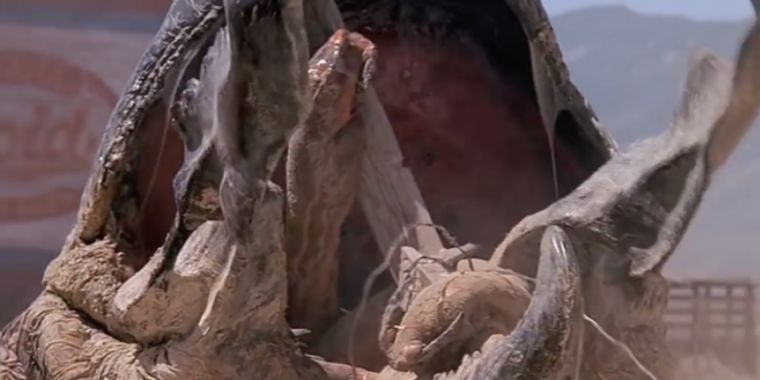
The graboid opens its gaping maw.
Universal Pictures
“I found the ass end!” One graboid down, three to go.
Universal Pictures
Pole vaulting to Rhonda’s truck, being sure to stay on the residual boulders.
Universal Pictures
Give Rhonda a hand with the driving, guys.
Universal Pictures
It has been 30 years since the release of Tremors, an unabashed love letter to the B-movie creature features of the 1950s that remains as fresh today as it was three decades ago. The film is sheer perfection and ranks among my personal favorite films of all time. As Ars’ own Nathan Matisse wrote last year, “If B-movie horror with flashes of comedic brilliance and a few edge-of-your-seat scares interests you, viewers likely can’t do much better than Tremors.”
(Major spoilers below, because it’s been 30 years.)
Writers S.S. Wilson and Brent Maddock came up with the initial idea for Tremors in the early 1980s while making educational safety videos for the US Navy. They climbed a desert boulder for a shot and pondered what they would do if, for some reason, they were stuck there due to some outside force they eventually dubbed “Land Sharks.” A friend of theirs, Ron Underwood, was a documentary director for National Geographic and helped them develop a believable creature for what would become the script for Tremors. Wilson and Maddock hit the big time with their 1986 film Short Circuit (directed by John Badham), which enabled them to finally bring Tremors to the silver screen.
The story takes place in the tiny fictional desert town of Perfection, Nevada—population 15, at least at the start of the film. Local handymen/BFFs Val (Kevin Bacon) and Earl (Fred Ward) are eking out an existence doing odd jobs for the residents in exchange for all that personal freedom. Said residents include Walter (Victor Chong) who runs the local market; teenaged horror Melvin (Bobby Jacoby); single mom Nancy (Charlotte Stewart), who sells pottery and has a daughter, Mindy (Ariana Richards); a doctor, Jim (Conrad Bachmann), and his wife, Megan (Bibi Besch); rancher Miguel (Tony Genaro); a survivalist couple, Burt and Heather Gummer (Michael Gross and Reba McEntire); Nestor (Richard Marcus); and two elderly residents: Edgar Deems (Sunshine Parker) and “Old Fred” (Michael Dan Wagner), a farmer.
There’s also a grad student, Rhonda (Finn Carter), who is spending the summer monitoring her university’s seismology equipment. She soon picks up on some very strange readings, right about the time Perfection’s residents start dying under mysterious circumstances. Eventually, everyone discovers the culprits: four giant subterranean creatures that Walter dubs “graboids,” since they “hunt” by sensing vibrations and shooting snake-like protrusions out of their mouths to grab their prey. From then on, it’s humans vs. graboids in a battle of wits to determine the survival of the fittest.
Tremors debuted in theaters on January 19, 1990 and grossed a mere $3.7 million opening weekend, eventually eking out $16.6 million domestically against its modest $11 million budget. Both Maddock and Wilson criticized the marketing of the film, with Maddock calling the theatrical trailer “cringeworthy.” (It actually is pretty bad.) Critics generally liked the film, praising the performances and how well the film walked the tonal tightrope between horror and humor.
Val saves Little Mindy (Ariana Richards) and mom Nancy (Charlotte Stewart).
Universal Pictures
Rhonda in a tight spot.
Universal Pictures
R.I.P. Walter Chang (Victor Wong).
Universal Pictures
Val and Earl are distraught that they couldn’t save Walter.
Universal Pictures
Melvin (Bobby Jacoby) panics.
Universal Pictures
You want survivalists Burt and Heather (Reba McEntire) on your side in a gunfight.
Universal Pictures
Second graboid bites the dust.
Universal Pictures
Victory lap: “Picked the wrong goddamned rec room to break into, didn’t ya!”
Universal Pictures
The survivors end up cornered on a cluster of boulders by the graboids lying in wait.
Universal Pictures
Preparing to go graboid fishing with homemade bombs.
Universal Pictures
Kabloom! Three down, one to go.
Universal Pictures
“This one ain’t dumb…”
Universal Pictures
Val offers himself as bait.
Universal Pictures
“Can you fly?”
Universal Pictures
Answer: nope.
Universal Pictures
Tremors really took off with its release on home video (and, subsequently, DVD and streaming), gaining a substantial cult following. Numerous bad sequels followed, all straight-to-video/DVD. In style and tone, they had more in common with the Sharknado franchise than the original film. There was Tremors 2: Aftershocks (1996), Tremors 3: Back to Perfection (2001), Tremors 4: The Legend Begins (2004), Tremors 5: Bloodlines (2015), and Tremors: A Cold Day in Hell (2018). A seventh installment, Tremors: Island Fury, is rumored to be in development. There was even a short-lived SyFy TV series in 2003, set just after the events of Tremors 3, that was abruptly cancelled after just 13 episodes.
I enjoy a cheesy SyFy flick as much as anyone, but none of the sequels even comes close to capturing the magic of the original Tremors. It’s got a terrific cast of characters, for starters, all types one would expect to find in a town like Perfection. Burt’s “UZI 4U” license plate and impassioned rants about eminent domain are just one example of many delightful details. The actors all nail their portrayals. (Special shoutout to Finn Carter’s Rhonda, who is that rare gem in film: a believable working scientist.) It has an equally terrific script, with on-point dialogue that illuminates the intricate relationships among the residents, especially the inevitable tensions and arguments. (“I know, I know, he thinks he knows everything,” Heather says soothingly to a disgruntled Burt after a face-off with Earl.)
Director Ron Underwood (who went on to make City Slickers and Mighty Joe Young) set the narrative up like a mystery, introducing us to the main characters and setting as they realize the threat that is coming for them. We don’t see the graboids at all at first, just their victims. Val and Earl find Edgar Deems perched on an electrical tower, dead of dehydration. Something terrified him so much, despite his trusty Winchester rifle, that he chose to die slowly over days rather than come down.
Next, we see Old Fred working the hoe as his sheep start bleating in terror. The ground rumbles, and poor Fred is yanked underground. Val and Earl find his head and assume a serial killer is on the loose—especially when they discover the gory remains of two road workers. They find what appears to be a dead snake attached to the underside of their truck and finally encounter the first full-sized graboid while riding for help in nearby Bixby.
Underwood expertly boosts the suspense by revealing there are actually four graboids, then blocks off the one road out of town and takes away each alternate option as the creatures close in. Eventually the surviving residents of Perfection find themselves trapped on a cluster of boulders in the desert—the scenario that inspired the film—while the last two graboids lie in wait for them to either die of thirst, like Edgar, or attempt to run for safety and become lunch.
But it’s the ingenious design of the graboids that really make the film for me—how the characters figure out the monsters’ characteristics. Above all, the graboids are smart and capable of learning about their human prey and adapting accordingly. When humans hide in a car, they dig around the surrounding soil so the whole vehicle sinks underground. They do the same thing to loosen building foundations when the residents take refuge on their roofs. They dig a trap just as the humans are almost safely to the mountains, and so forth. The humans have to keep upping their game to survive, and the ingenious ways they outwit the monsters is a huge part of the film’s delight.
Several years ago, SyFy attempted to revive the TV series, with Blumhouse Productions behind the project—even signing on Bacon to reprise his role as Val, focusing on what happened to him 25 years later. (Footloose might have catapulted Bacon to stardom, but Val ranks among his most career-defining performances). As Nathan Matisse wrote:
Val has clung to his hero days while the town of Perfection struggled to determine its next move. The show’s Graboids’ World theme park more closely resembles an aging regional destination than Disney World, and even the local cafe probably regrets changing its name to an inevitable Instagram thirst trap, Grab-A-Coffee.
But the network ended up passing on the pilot, although footage was shown at the 2019 ATX Television Festival last year. And it’s sadly unlikely to find a home elsewhere. Ah well, at least we still have the original to watch and re-watch, hopefully for decades to come.
Listing image by Universal Pictures
https://arstechnica.com/?p=1643249
Apple TV+: Can it be saved before everyone’s free trials run out?
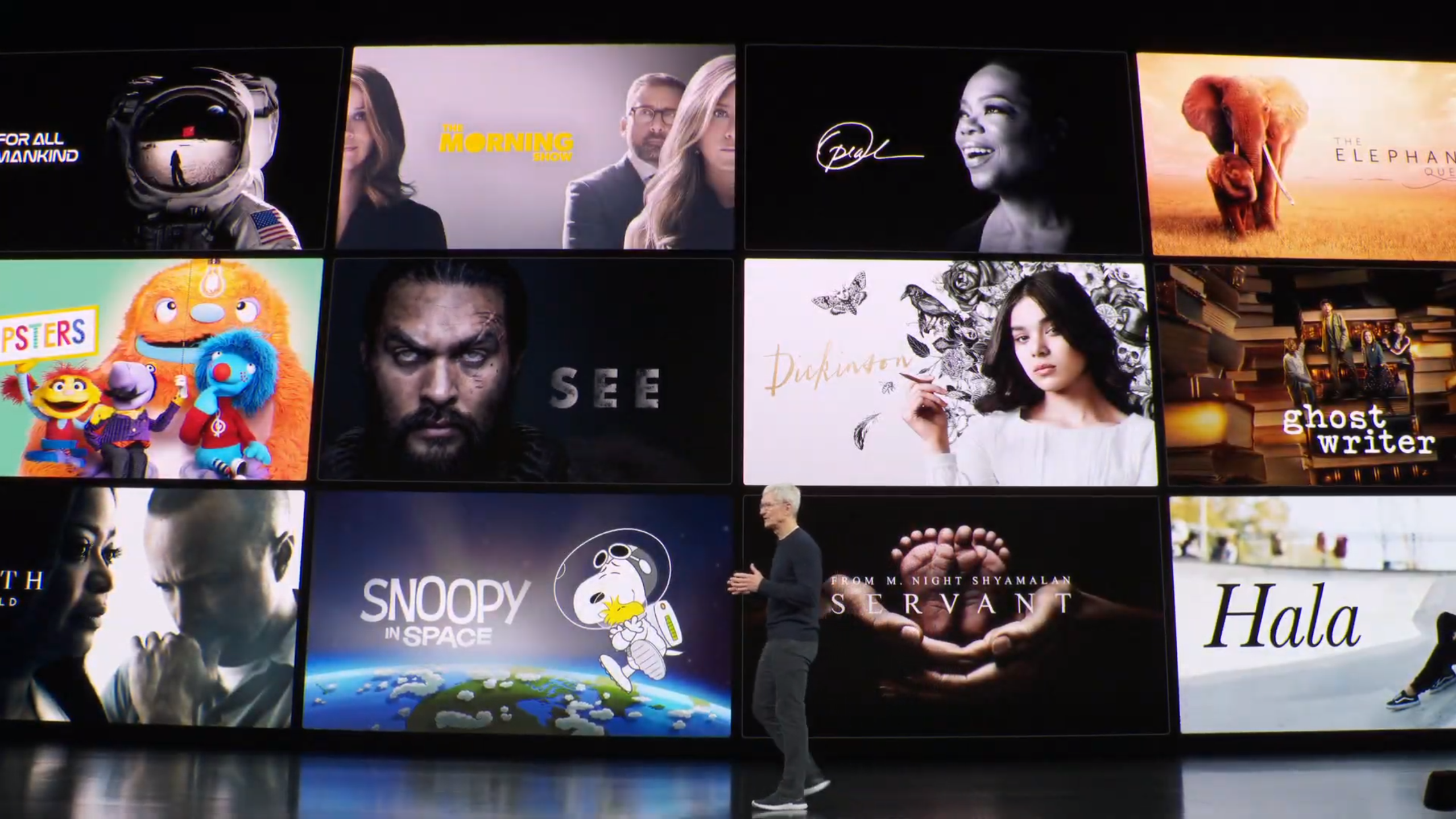
Enlarge/ When Apple TV+ landed on November 1, it did not include all of these original series, thanks to its “soft launch.”
When Apple TV+ launched in November 2019, it was the first of four major video-streaming services that would launch between then and May of the next year. It was also one of the riskiest of the set, coming from a company that had zero experience in creating entertainment. With the service’s 90-day mark fast approaching, it’s time to take Apple TV+’s temperature.
And, yes, it’s ice-cold. But is Apple TV+ really as dead in the water as it appears? And what do we expect for the rest of its first year?
So many devices, so little excitement
From the jump, Apple seemed an odd addition to a lineup of players, all of whom were already in the content-creation business. Apple has never been interested in producing its own fare so much as using others’ content to promote its closed hardware ecosystem. But that hardware component was Apple’s claim to enter the derby. The company boasts two billion devices in pockets around the world. If just 10 percent of those users signed up after getting a free year of Apple TV+ with the purchase of a device, it would give the company 200 million subscribers worldwide, dwarfing Netflix’s 158 million.
But 10 percent may be an ambitious reach. Disney+ (launched two weeks after Apple TV+) or NBC Peacock and HBO Max (starting in April and May of 2020 respectively) have or will arrive with vast libraries of movies and TV series, highlighting their family-friendly fare to bolster their appeal for subscription dollars. (Disney+ is the most obvious one aiming for “family” right now, but both NBC and HBO have focused on kiddie offerings on their upcoming services as well.) Apple TV+, in contrast, launched with just four shows, all brand-new originals targeting an adult-level audience, with nothing as backfill that might appeal to an all-ages crowd.
Apple TV+ was also run over by Disney+’s far more successful launch with The Mandalorian. The first-ever Star Wars live-action series sucked the oxygen out of the streaming room, leaving Apple struggling to catch anyone’s attention with follow-up shows like Servant, despite a stellar cast and M. Night Shyamalan’s name plastered all over it. (The lawsuit that followed Servant’s first season isn’t helping either.) Perhaps the most damning issue is that Apple did not build itself to be a nimble player, despite the light load of shows. Convinced it had the next big things, the company greenlighted second seasons of all of the launch shows beforehand, essentially committing itself to these vaguely dud titles for at least another year.
Now the service is launching what is inarguably its best series to date, Little America, from The Big Sick writers Kumail Nanjiani and Emily V. Gordon along with Lee Eisenberg of The Office fame. The docu-series is “inspired by true stories featured in Epic Magazine” of the immigrant experience in modern America. For the first time on Apple TV+, all 10 episodes will drop at once, instead of a weekly release schedule, in the hopes of getting it more attention.
But once again, the timing is terrible: Little America arrived all of 12 hours after Peacock shook up the streaming landscape by undercutting what had been Apple TV+’s rock bottom cost of $4.99 with the even lower subscription price of free. (As in, free with ads, or $5/mo for more content and fewer ads.)
What Apple TV+ needs now is a return to its parent company’s comfort zone: the hardware. Apple TV+ has its own “free” tier: a year of service to anyone and everyone who buys or updates their Apple-branded product. The average upgrade timeframe for a smartphone is roughly every 2.8 years, and in the case of Apple products, that timeframe can be even longer. But iPhone and iPad users are likely to do it sooner if Apple rolls out a must-have product. MacRumors suggests this is the year the company goes 5G and all-OLED. (We know why 2019 wasn’t.) Apple’s Tim Cook can use the company’s regularly-scheduled product-reveal events to stir consumers into purchases. That would put Apple TV+ in front of them at no charge; it could be enough to let shows like Little America catch on via word of mouth.
HBO Max’s loss is…
Meanwhile, Cook recently took the first step in righting this ship in the longer term: hiring Richard Plepler. After 25 years with HBO, Plepler, who had a hand in greenlighting everything from Game of Thrones to Succession, left the company in the wake of AT&T’s acquisition of parent company Time Warner. Cook snapped him up in one of the first significant entertainment news announcements of the new year, and it’s the first good news Apple TV+ has had since before it launched. The streaming service while take a while to turn around, but there is hope for it yet.
In the meantime, 2020 is going to be a long, hard slog, filled with dodgy-looking shows like the forthcoming Mythic Quest: Raven’s Banquet. (One can only pray the show is better than the trailer.) Here’s hoping a free year with purchase/upgrade will slowly build the base, so when content worth subscribing shows up, Mac, iPad, and iPhone users are there to start streaming.
This article has been updated to reflect studies about average users’ hardware upgrade cycles.
https://arstechnica.com/?p=1645667
Real or fake: New NBC Peacock shows
Enlarge/ NBCUniversal kicks off its new Peacock streaming service on TODAY at 30 Rockefeller Plaza
Nathan Congleton | Getty Images
This July, NBCUniversal and Comcast will launch a new streaming service, Peacock. (Xfinity cable customers will get an advanced version in April.) It will house NBC classics like Parks and Recreation, Frasier, and Law and Order: SVU, as well as a wide array of movies, reality shows, and current programming, including live events from the upcoming Tokyo Olympics. It will offer reboots of nostalgia-triggering shows like Saved by the Bell, Punky Brewster, and Battlestar Galactica. And of course, as there are now a ton of streaming television services competing for eyeballs in the US, NBC is also planning to roll out an ambitious lineup of originals to compete with rivals like Disney+, CBS All Access, and Quibi.
To that end, it has ordered dozens of pilots and several full seasons of new shows to lure viewers into adding yet another paid subscription into their monthly budget. (There will be a free version of Peacock, but it will have a limited roster.) Some of the shows sound great. Some of the shows sound questionable. A large number have summaries that sound like they came from a robot programmed to spit out Hollywood development Mad Libs. And thus, a challenge: Can you tell the difference between the 100 percent real upcoming Peacock offerings and the 100 percent fake shows WIRED made up? Let’s find out.
Expecting: One woman. One gay best friend. One … baby? From Mindy Kaling, this comedy looks at what happens when your GBF becomes your GSD (gay sperm donor).
Brave New World: An adaptation of Aldous Huxley’s famed 1932 dystopian novel, starring Alden Ehrenreich for some reason.
The Adventure Zone: A comedy based on a wildly popular Dungeons & Dragons podcast run by a tight-knit but quirky family.
Clean Slate: A comedy about an Alabama car wash owner who is thrilled when his long-lost child decides to return home, but is flummoxed when he finds out his child is a trans woman, played by Laverne Cox. (Executive producer: Norman Lear.)
Moby-Dick: An animated dramedy based on the classic novel, with Chris Kattan as the titular whale. Three words: Female Captain Ahab.
The Brothers Bongo: Two brothers find unexpected fame as a bongo drumming duo. Turns out success is easy, but keeping the rhythm of family life on the road? That’stough. With Topher Grace as the boys’ manager.
Making It Work: Christina Aguilera in her first lead television role—and her second, as she plays identical twins who inherit a bed and breakfast in Louisiana.
Hatching Twitter: Literally a television show about Twitter.
Girls5Eva: Former ‘90s girl group Girls5Eva decide to reunite and give teenybopper stardom one last shot … even though they’re closer to menopause than puberty!
Pod Save This TV Show: Based on the podcast of the same name, the Pod Save America boys host a humorous but insightful talk show.
Dr. Death: Based on the podcast of the same name, Jamie Dornan smolders as a doctor who is bad at his job—lethally bad.
Intelligence: David Schwimmer stars as a brash maverick NSA agent who moves to England and clashes with his dweeby British colleagues.
Becker 2: Back to Beckin’: Ted Danson reprises his role as Becker from Becker, who is up to his old tricks.
Psych 2: Lassie Come Home: The gang from the show Psych are back, and this time they will explore the topic of marriage in a made-for-television movie.
Law and Order: Oz The latest addition to the Dick Wolf library, Law and Order: Ozsees a familiar face, Finn (Ice-T), begin a new chapter of his career in Sydney, Australia. They do things a little differently Down Under!
Welcome to Ars Cardboard, our weekend look at tabletop games! Check out our complete board gaming coverage at cardboard.arstechnica.com.
You’re roused early from cold sleep. The ship’s hibernatorium—and likely the remainder of the ship—is running on half power. There’s a body nearby. More accurately, there’s a body all over. For a moment, your sleep-fogged brain assumes somebody has splashed BBQ pork all over the floor and walls. Nope; that’s the crew member who was supposed to be on watch while everyone else slumbered.
Welcome to Nemesis, a board game with strong (but decidedly unofficial!) echoes of Ridley Scott’s Alien. It raised millions on Kickstarter—but is it any good?
At the table, everybody can hear you scream
Generally, board games don’t do horror very well.
Oh, they’re plenty good at tension. Setting up a climactic play over multiple turns, waiting to see if somebody undoes all your hard work by taking that card you’ve been eyeing, wondering whether your spouse is secretly Hitler… these are the moments board games create almost effortlessly. One time, I realized I’d been holding my breath during Exploding Kittens. Here was a game I wouldn’t ordinarily confess to playing, and yet my entire body was rigid was apprehension. (Granted, this was because I hoped the game would end as soon as possible, but still.)
Nemesis takes that tension and weaponizes it. From its very first moments, this is a game about the terror of the known, the half-known, and the unknown. Such is its dedication to that prickle you get when somebody threatens to jab you in the kidney that the game even features player elimination. Note that I’m saying Nemesis “features” player elimination, not that it suffers from it. Getting knocked out of a three-hour game within the first 40 minutes is a design decision, not an oversight. Sure, it’s a bummer. But don’t you think Executive Officer Kane was bummed when that chestburster did precisely what its name implies? I’ll bet he was totally bummed. I’ll bet he wishes he could have stuck around until the ending and helped Warrant Officer Ripley jettison that bastard alien out the airlock. I’ll bet he thinks it’s unfair that a single lapse of judgement resulted in having his sternum ruptured by an unknown lifeform. Too bad.
The same thing can happen in Nemesis, leaving a puddle of raspberry jelly and a freshly hatched creeper where once stood a human being. So it goes when you don’t head to the surgery room as soon as a space monster roots around your esophagus with its multi-jawed proboscis.
Of course, even this doesn’t come across as truly horrific. When your character makes too much noise and summons a queen from the depths of the ship’s utility level, you won’t kick your chair to the floor and leap from the table. Maybe you’ll swear. But scream? That’s a tall order.
Still, when it comes to tension, there’s plenty to go around here. And while you’re creeping through corridors to avoid drawing the attention of the game’s aliens, Nemesis is leveraging an even more potent agent—its players.
Fires, broken computers, and the cold hard vacuum of space
At first, the business of surviving feels pretty much as you’d expect. When you start, you don’t actually know the specific layout of the ship. The helm is located up front and the engines are back at the stubby end, but beyond that you can’t seem to recall whether the hibernatorium is adjacent to the cafeteria or the escape pods. Is this amnesia? Awakening sickness?
OK, it’s a little silly—even on a regular airline flight they take pains to point out the exits, and there you’re just sitting in a plain aluminum cylinder rather than a sprawling space vessel—but the gameplay in Nemesis actually benefits from this sense of dislocation. For the most part, your job is to uncover the ship, scrounge together the stuff you need to survive, and ensure you get home with all your bits attached. This usually entails checking the engines, fixing some stuff, maybe reentering the ship’s coordinates, and climbing back into hibernation. But because the ship’s layout is unknown, you’re feeling your way through the dark. Nothing is certain.
The obvious problem here is the aforementioned aliens, called “intruders,” and Nemesis smartly pitches them as unknowns. Successive plays see you growing more accustomed to the differences between creepers and adults, breeders and the dreaded queen, but the aliens’ aura of threat and mystery is never fully dispelled. For one thing, they lack firm details. You won’t find any stat cards or damage pips. Instead, their behaviors are dictated by card draw. Does an encounter with an adult intruder pose bodily harm, threat of contamination, or the possibility of a new hitchhiker in your stomach? In each case, the answer is “maybe.” Will a shotgun take apart an adult in one hit? Possibly, but also possibly not.
Even worse, the buggers appear at random from a draw bag as your exploration of the ship makes more of a ruckus. This gives every decision some bite, especially when you need to reach a room that’s hemmed in with noise tokens, you’re already hurt, and you suddenly remember just how many monstrosities have been added to the draw bag over the past hour. When your life is on the line—that is, your elimination from the game—do you really need to accomplish your objective?
One of the game’s many characters.
Behold the sprawling ship!
An unpleasant confrontation.
You won’t know who to trust
Speaking of objectives, there are more subtle (but also more important) shakeups to the game. Much like in Dead of Winter, each character has their own goal card. Two, actually. At a certain point, each player is forced to choose one over the other; this decision comes after you’ve explored a portion of the ship, but not so early that the decision isn’t a bit of a gamble. Even tougher, you’re always given both a personal and a corporate objective. Maybe you want to burn the intruder hive or pilot the ship to Venus so the company can take the aliens into its possession. When the time comes to pick your goal, you often push for whatever seems most within reach
I’m not superstitious, but it almost goes without saying that objectives have a spooky way of flip-flopping in the middle of each play, with your long-discarded option suddenly seeming like a good idea compared to whatever you actually picked. Murder a fellow shipmate? What were you thinking?
That’s right—murder. Not directly, of course. But it’s possible to shut your companions behind doors, spark fires, draw intruder attention to a nearby shipmate, or vent somebody into the vacuum of outer space. This is the true source of paranoia in Nemesis. The unknown is all around, but the real terror is the unknown right beside you. There’s no guarantee anybody at the table will behave in such a manner. But in Nemesis, there’s no guarantee they won’t. That somebody isn’t an android or a company stooge. That they aren’t nursing a hidden grudge or a desire to leave everybody behind while they board an escape pod. Without trust, where are we? Trapped in a burning shower room with an alien who’s got limbs like switchblades, that’s where.
True, Nemesis has the occasional catching edge. That’s deliberate. Rather than elegant, the game is evocative. Don’t let the piles of plastic fool you—this is one of the most carefully arranged storytelling games of the past year.
https://arstechnica.com/?p=1645507
New Star Wars movie to be made by Thor: Ragnarok director?
Aurich Mandalorian Ragnarok
Over the past few years, New Zealand’s Taika Waititi has become one of our favorite directors here at Ars. And with good reason—his back catalogue of feature films includes Eagle vs Shark, Boy, What We Do in the Shadows, Thor: Ragnarok, and last year’s controversial-but-excellent, Oscar-nominated Jojo Rabbit. And soon, we’ll be able to add a Star Wars movie to that list. Unnamed sources have told the Hollywood Reporter that Waititi has been approached by Lucasfilm to develop a film that takes place in that galaxy far, far away.
This news follows a surprise tweet earlier this week from Phil Tippett, the stop-motion innovator whose work could be found all over the original Star Wars trilogy. He used the social media platform to laud the first season of Disney+ exclusive The Mandalorian, then implored showrunner Jon Favreau to hire Tippett to work on future episodes. As massive fans of Tippett’s work and of The Mandalorian’s focus on practical effects, we hope Favreau takes the tweet seriously (embedded below).
Congrats @Jon_Favreau on the amazing success of @themandalorian. It’s really something. Reminds me of our adventures making the original trilogy back in the day, shootin’ from the hip. I tell you, I’d love to come back on board and get my hands dirty with you guys!
Meanwhile, Waititi is no stranger to the Star Wars universe. He not only appears in The Mandalorian—as assassin droid IG-11—he also directed the final episode of the first series. The Hollywood Reporter also speculates that The Mandalorian is being used by Lucasfilm and Disney as a training ground for new talent; Director Deborah Chow directed episodes 3 and 7 of the space western/space ronin show and is now going to direct an Obi-Wan Kenobi series starring Ewan McGregor, which will also air on Disney+.
Obviously, Waititi’s fans here in the Ars Orbiting HQ are excited for the prospect of a Star Wars film under his direction. But will Disney see it through? The studio famously fired similarly quirky directors Philip Lord and Christopher Miller from the movie Solo, replacing them with Ron Howard to the film’s detriment. We might also be in for a bit of a wait if it does happen. Waititi first has to direct Thor: Love and Thunder, which is set to be released in November 2021 and is also linked to an adaptation of the nerd-canon anime Akira for Warner Brothers.
https://arstechnica.com/?p=1645369
Game dev union leader: “Dream job” passion “can open us up to exploitation”
Enlarge/ The logo for the newly formed Campaign to Organize Digital Employees.
But while nearly half of developers supported the idea of unionizing in a GDC survey published last year, no major game studios have thus far announced formal plans to form a workers’ union.
The industry’s stalled labor effort got a potential shot in the arm last week, though, when GWU announced it is partnering with the Communication Workers of America (CWA) to form the Campaign to Organize Digital Employees (CODE). The move puts one of the country’s biggest unions—with a reported 700,000 members represented across telecom, IT, news media, education, and more—squarely behind the effort to bring tech and gaming workers together for collective bargaining.
“CWA has decades of deep experience, knowledge, and expertise that are invaluable in helping level up the organizing ability of workers in the game industry,” GWU co-founder and CODE lead organizer Emma Kinema told Ars in a recent interview. “CWA’s history of organizing national campaigns across many locations all over the continent is invaluable, when thinking about the sprawling nature of many of our corporations.”
Improving a “dream job”
Kinema says the CWA reached out to the nascent Game Workers Unite movement soon after it was formed and has spoken with various local chapters of the organizing effort over the last two years. In that time, and through discussions across the industry, Kinema says that developers have generally been “curious or open to the idea of unionization,” in her experience.
“Ultimately, every person comes to work with some grievances and some issues they wish to be fixed or improved,” she told Ars. “As folks get to know that union organizing really means coming together with your coworkers to support one another, care for one another, and improve conditions for one another, folks are usually really responsive to that.”
That said, there are some unique issues in the game industry that may make it harder for workers to organize a union effort. “The vast majority of game workers are in the industry because it’s our dream job, and working on games is our passion,” Kinema points out. “Unfortunately, that passion can open us up to exploitation by our bosses, because we are simply grateful or content to have the job we have.”
Kinema said the union is also pushing back against “the impression that unions are only for blue-collar industrial-style jobs,” and that highly paid tech professionals don’t need such protections. But that impression doesn’t take into account the “outsourcing firms, temporary employment schemes, and low-wage positions of all sorts” that are “as essential to the industry as the more publicly visible developers at name-recognition studios,” Kinema said. “The industry is not a single monolith, and we need to care about and organize all workers throughout the industry.”
Enlarge/ Blizzard employees participating in a walkout to protest the company’s Hong Kong protest policies last year.
Even for developers with steady, salaried positions, “no one comes to work at a perfect place, with no problems, and nothing to be improved or optimized,” Kinema said. “All workers have issues they face and reasons to organize. So even workers with relatively affluent positions still can benefit and effect real positive change in the world through unionization.”
“Dream job” or not, Kinema says developers have expressed concern about issues like regularmasslayoffs across the industry and the persistent use of “crunch time” to get games out the door. Wage gaps and discrimination, poor healthcare, job instability, and inclusion and supportive policies for workers also rank high among the issues identified by union-curious developers, Kinema said.
What’s taking so long?
So when will we see the first major game company announce a unionization vote? Kinema didn’t want to speculate on a timeline, which might be wise after a late 2018 Polygon interview where Kinema made the failed prediction that “by the end of 2019, you’re going to see some public campaigns.”
That said, Kinema told Ars that current union campaigns are “coming further along than any previous efforts in the North America region.” Even before the announcement of CODE, she said, the CWA “has been helping organize game workers… at a few companies we don’t discuss [publicly] presently.”
Around the industry, Kinema said there has already been “a fair amount of internal messaging and retaliation” from managers to try to quash any potential unionization efforts. And some studios might be waiting for others to take the first step before moving forward with their own union plans—Kinema admitted there is “nervousness for some to be at the beginning of the game industry labor movement.”
But Kinema also expressed confidence that all of these barriers could be overcome. “Labor organizing simply takes time, whether you are organizing a small coffee shop, a grocery store, or a large multinational tech corporation,” she said. “It’s personal, one on one, conversation-based work, and it takes time, patience, and empathy. And those first public campaigns will come.”
Author’s Note: Some Ars Technica staffers are members of the NewsGuild of New York, which is a subsidiary of the CWA.
https://arstechnica.com/?p=1645309
Goop’s Netflix series: It’s so much worse than I expected and I can’t unsee it
Enlarge/ This is the exact moment in the goop lab‘s third episode in which Gwyneth Paltrow admits she doesn’t know the difference between a vagina and a vulva. She’s making a hand gesture to say what she thought the “vagina” was.
Disclaimer: This review contains detailed information about the Netflix series the goop lab with Gwyneth Paltrow. If you plan to watch the show (please, don’t) and do not wish to know details in advance, this is not the review for you. Normally, we would refer to such information as “spoilers,” but in our editorial opinion, nothing in this series is spoil-able.
In the third episode of Goop’s Netflix series, a female guest remarks that we women are seen as “very dangerous when we’re knowledgeable.” [Ep. 3, 33:35]
“Tell me about it,” Gwyneth Paltrow knowingly replies amid “mm-hmms”—as if she has a first-hand understanding of this.
But after watching just a few minutes of any of the six episodes of the goop lab—or knowing pretty much anything about her pseudoscience-peddling “contextual commerce” company “Goop”—one might be skeptical that Paltrow has ever borne any such burden of knowledge in her life.
In fact, earlier in that same episode, we learn that the 47-year-old actor didn’t even know what a vagina is.
“It’s our favorite subject—vaginas!” Paltrow proclaims gleefully [Ep.3, 3:05]. Then the same guest, feminist sex educator Betty Dodson, corrects her: “The vagina is the birth canal—only. You want to talk about the vulva, which is the clitoris, and the inner lips, and all that good shit around it.”
Paltrow giggles before responding, “The vagina is only the birth canal? Oh! See, I’m getting an anatomy lesson that I didn’t—I thought that the vagina was the whole…”
“No, no, no, no,” Dodson cuts her off.
To be fair, a lot of women might not be clear on this particular anatomical point. But for Paltrow, who claims to help empower women while touting dubious and dangerous products and treatments for said body part—ahem, vaginal steaming, cough, jade eggs—you’d hope she had a tight understanding of what a vagina is—or isn’t in this case.
But sadly, she didn’t. And throughout the rest of the series, her ignorance and lack of critical thinking skills are on full display as a parade of questionable “experts” and ridiculous claims about health and science march across the small screen unchallenged.
(To be clear, Dodson was not among the dubious guests I’m referring to here; she is knowledgeable and respectable and was probably the most interesting and informative guest on the show.)
The show overall
I’ll go through each episode in more detail below, but for those who want to spare themselves from the bulk of the absurdity, I’ll summarize here:
In so many ways, the goop lab with Gwyneth Paltrow is exactly what you’d expect based on what we already know about the Goop brand. The series provides a platform for junk science, gibberish, and unproven health claims from snake-oil-salesmen guests. It’s a platform on which respected, trained medical experts are not considered the authorities on health and medical topics; where logic and critical thinking are enemies of open-mindedness; where anecdotes about undefined health improvements are considered evidence for specific medical treatment claims; where the subjective experiences of a few select individuals are equivalent to the results of randomized, controlled clinical trials; and where promoting unproven, potentially dangerous health claims is a means to empower women.
Paltrow and Loehnen sit in Goop’s headquarters for an interview.
Members of the “Goop gang” convene in Jamaica to convince themselves that magic mushrooms are a crucial part of a therapeutic journey.
This woman isn’t crying because she’s on the goop lab. Instead, the tears are apparently coming on because she took a dose of psilocybin as part of a “therapy retreat” in Jamaica.
A Gooper lies on the floor while tripping.
These are often paired with anecdotes about participants in limited clinical trials. We hear their success stories without context about how the associated study at-large turned out or whether any positive results came with side effects or issues with bias.
A Gooper gets a hug while tripping.
Just another day in Jamaica, where Goopers gather to take shrooms, cry, and hug.
The problem with this boilerplate statement is that most of the goop lab is full of one-sided, anecdotal claims that standard Western medical practice is all wrong. Right or wrong, that is most certainly a type of “medical advice,” Gwyneth and co.
But, beyond all of that, the show is just, well, boring.
Each episode uses the exact same structure. Each presents one of six health topics, which are (in order): psychedelics; “iceman” Wim Hof’s breathing and cold-treatment method; female pleasure; anti-aging; energy healing; and psychics.
In each episode, you see Gwyneth Paltrow and Goop’s chief content officer, Elise Loehnen, interview a couple of people involved in the episode’s topic. The interviews take place in an airy, stylishly decorated office at Goop’s Santa Monica headquarters. Interspersed between snippets of those interviews, you see groups of Goop-employee volunteers subject themselves to some therapy or experience related to the episode’s topic. The interview dialogue from Goop headquarters is used to essentially narrate the Goopers’ experiences. The Goopers’ results are, in turn, intended to back up whatever claims the interviewees make.
It’s a tiring structure for six straight episodes, and it’s often not done well. The pacing is slow at times; some of the Goopers’ experiences are just not engaging and seem like filler; some of their personal stories are introduced at the start of episodes and then inexplicably abandoned at the end; the interviews at Goop headquarters can seem drawn out and dry; and there are random tangents about Gwyneth Paltrow’s life and the office environment at Goop headquarters.
Even if you’re interested in the topics, getting through the episodes can feel like a slog—and they’re each only 30-35 minutes long.
It feels like the momentum of each episode is supposed to be driven by anticipation of how the Goopers’ experiences match what the interviewees are saying. But we hardly ever get satisfying conclusions on that front—and we wouldn’t be convinced even if we did. Instead, the show seems to move each episode along more by leaning on shock content that might best appeal to middle schoolers—showing glimpses of a woman having an orgasm, a Goop staffer getting a face lift using string that pulls her smile toward her ears, and a group of Goopers tripping on mushrooms.
Meanwhile, the goop lab makes no effort to question or critically evaluate any of its claims. There are no fact checks or counterpoints offered. There’s no mention of any criticism and little to no warnings of potential harms.
In all, it’s a show that you can safely skip. But, if you still want to know more about why the goop lab is so bad, let’s run through the six episodes.
Goop on shrooms
The first episode covers psychedelics and their potential to improve mental health. Paltrow and Loehnen sit down with Will Siu (a psychiatrist who supports “psychedelic Integration” in therapies) and Mark Haden (executive director of MAPS Canada, which is an affiliate of the Multidisciplinary Association for Psychedelic Studies, a nonprofit created in 1985 to advocate for the medical benefits and use of psychedelic drugs, such as MDMA and LSD). Siu received training at MAPS.
The episode references the fact that reputable academic researchers—many associated with MAPS—are exploring in clinical trials whether certain psychedelics can aid in addressing specific mental-health conditions, such as clinical depression and post-traumatic stress disorder (PTSD). The early trials on these subjects have provided some positive results.
“Being the person that people perceive me to be is inherently traumatic.”
For instance, in 2016 the Food and Drug Administration greenlighted the first Phase III trial to assess whether or 3,4-Methylenedioxymethamphetamine (MDMA)—known as “molly” or “ecstasy”—can improve the symptoms of PTSD. And treatments with psilocybin, the psychedelic component of “magic” mushrooms, has yielded positive results in small trials on people struggling with depression.
While that research is legitimate and interesting, the Goop episode approached the topic in the dumbest possible way: a group of four Goop employees hop on a plane to Jamaica to trip on mushrooms. Two of the Goopers weren’t trying to address mental health. One Gooper said she wanted to feel more creative and like her “authentic self,” and Loehnen, who went, said she wanted a “psychospiritual experience.” The other two were trying to “process some personal trauma.”
While the clinical trials are evaluating specific drug doses to treat well-defined symptoms in tightly controlled, weeks-long programs, the Goopers drank mushroom tea once, in a “more ceremonial setting,” surrounded by what they described as “psychedelic elders.”
You’d think watching people trip on mushrooms might be fun. It was, in fact, boring. You mostly just see them lying on the floor, laughing or crying to themselves. The episode shows little else of what goes on and hardly any dialogue among the “elders” and the Goopers.
Meanwhile, the interview back at Goop headquarters starts rambling, with discussion around vague mental health issues, the value of “connecting people,” harmful societal norms, and how basically everyone is suffering. Paltrow notes at one point that she, too, suffers mental-health problems despite her wealth and status, and she adds that “being the person that people perceive me to be is inherently traumatic.” [Ep.1, 29:00] Poor Gwyneth.
At the end of the episode, some of the Goopers talk about how the experience was intense—well, yeah. We don’t hear back from the woman who wanted to be more creative, so we can only hope things worked out for her. But one of the Goopers processing trauma (in his case, trauma of having an emotionally distant father) said in a final one-on-one discussion with Paltrow that he felt more of an “openness” after the experience. He thanked Paltrow for letting him go.
Yeah, OK.
NEXT.
https://arstechnica.com/?p=1645047
Video: YouTuber Mark “Markiplier” Fischbach reflects on his video history
[embedded content]
Video directed by Morgan Crossley, edited by Dylan Blau & Louville Moore. Transcript will be available in the next hour or so (it’s still processing).
The Condé mothership informed us late last month that they had gotten some time with Markiplier and wanted to know if we were interested in filming something with him—and we took the plunge. Markiplier has a loud personality and is best known for his mugging at the camera while doing “Let’s Play” videos on jump-scare games, but we wanted to see if we could capture a calmer, more introspective Markiplier than most folks might be used to seeing, looking over the past several years of the YouTube content creator landscape and discussing his successes—and his not-so-successes. It’s an interesting glimpse into a world that a lot of regular Ars readers (myself included) might not be that familiar with—an alternate reality of content creation, where YouTube comments actually matter and trying to figure out how to maintain engagement is critical to success. Markiplier comes across as a well-grounded guy—and he maintains a powerful connection to the fans who put him where he is. He clearly enjoys taking a trip down memory lane and looking at the videos and comments that built his present-day juggernaut channel, and I have to admit it’s pretty wild watching him talk without any shouting.
And what’s next?
Though this video sets the stage for some more (and more Ars-focused) celebrities to pop up on camera, our next couple of videos will be a little more old-school. We’re almost ready to run a War Stories piece on a certain cyan-colored publishing house, and just this week we had a developer in the studio to shoot a video on what I would describe as a princely classic game.
You’ll have to live with my obfuscations for another week or so, but trust me: awesome things are coming!
https://arstechnica.com/?p=1644513
Cyberpunk 2077 release pushed back to September 17, 2020
We opted to only share images from the game’s gussied-up trailer that actually resemble what we saw in the hands-off demo.
The protagonist V lives in this sprawling apartment complex, which resembles modern-day LA buildings, though with grimy, tech-loaded tweaks like broken biometric scanners on people’s front doors.
The game’s opening mission sees you rescue an apparently high-ranking civilian from a kidnapping ring. Insurance in Cyberpunk 2077 seems to revolve around private companies showing up with military squads and medical personnel to help LA’s elites.
In the demo, V finds and makes an offer to this rich, powerful “corpo” character. A dangerous mission follows in which everyone seems to stab everyone else in the back.
Frankie is V’s accomplice during the demo and offers a lot of chatter and dialogue-tree options for V to pick through.
We saw a taste of open-world driving, but it was the least impressive part of the demo.
CD Projekt Red announced via tweet this afternoon that the heavily anticipated Cyberpunk 2077 would be released on September 17, 2020. That’s a five-month delay from the April 16 release date that was announced last June.
“We are currently at a stage where the game is complete and playable, but there’s still work to be done,” the company wrote. “Night City is massive—full of stories, content, and places to visit, but due to the sheer scale and complexity of it all, we need more time to finish playtesting, fixing, and polishing.”
“We want Cyberpunk 2077 to be our crowning achievement for this generation and postponing launch will give us the precious months we need to make the game perfect,” the message continues.
Delays for high-profile games like this are far from rare, even this close to the expected release date—the PC version of Grand Theft Auto Vsaw at least four “official” delays, for instance, including one just 14 days from the planned launch. But Cyberpunk‘s new release date will come more than two years after a playable slice of the game was first shown to select industry members at E3 2018 (and later to the public).
Cyberpunk‘s delay comes a few months after the delay for Doom Eternal. Publisher Bethesda Softworks announced in October that the game was being delayed from a holiday 2019 release to an expected March 20, 2020 launch.