How modern tech has powered our favorite superheroes through the years

a small sampling of Lee's work
Enlarge / Just a small sampling of Stan Lee’s work. Indisputably, he was the creator or co-creator of some of the most iconic comic book characters of all time
Marvel Comics

From Wonder Woman to Watchmen, it’s not easy to envision what pop culture would be like today without the impact of superheroes. It’s also not easy to comprehend how any comic book about a flying alien, or a furious green monster, or a super-soldier who defeats a whole army by himself has anything to do with the worlds of technology and science. But as we all know, appearances can be deceiving.

Although the influence of superheroes on modern culture is undeniable, the influence of modern culture on many superheroes remains hazy to this day. Comic creators, perhaps often wanting to maintain a little mystique, have historically been hesitant to get explicit about their inspirations. But when thinking through 80-plus-years-and-counting of our favorite caped crusaders changing slightly with the times, their real world analogues become clearer and clearer.

Science and science fiction

One of comics’ most iconic heroes might also be the perfect example of this. Since his first appearance in Action Comics #1 in 1938, Superman has adapted to the times. The “Man of Steel” we saw in 2017’s Justice League didn’t just happen overnight, after all. Superman’s long term evolution is the result of many transformations and technological advancements throughout the decades.

Back in the beginning, his creators, Jerry Siegel and Joe Shuster, were huge fans of pulp science fiction and adventure magazines. As a result, some of the first clear influences seen in Superman come from such stories’, which often featured characters who possessed incredible abilities such as superhuman strength, telepathy, and clairvoyance. Some of these early influences include John Carter of Mars, a character from the sci-fi novels by Edgar Rice Burroughs; Hugo Danner, the main character in the novel Gladiator by Philip Wylie; actors Johnny Weissmuller, Douglas Fairbanks, Harold Lloyd, and Clark Gable; and several strongmen of the early twentieth century, whom Shuster idolized as a child.

Given its heavy influence on society at the time, religion also seemed to appear on the long list of things that informed the birth and evolution of the first mainstream superhero. Both Siegel and Shuster were Jewish, for instance, and this led many comic book fans (including Rabbi Simcha Weinstein and the British novelist Howard Jacobson) to the disputed conclusion that Superman’s main influence was Moses.

Siegel and Shuster never confirmed this claim, suggesting that the idea of Superman falling to Earth from the sky simply seemed like the coolest possible idea at the time. Instead, the only sources of inspiration for Superman’s initial powers that Siegel and Shuster openly admitted to were those of animal science and Newton’s law of universal gravitation. For instance, they accentuated that because Earth is a much smaller planet than Krypton, the lighter gravitational pull further enhanced Superman’s strength. They also borrowed feats from the animal kingdom, drawing a parallel between Superman’s amazing strength to that of an ant’s incredible ability to carry hundreds of times its own weight. And the duo compared a grasshopper’s ability to leap great distances with Superman’s ability to leap from one place to another.

Wait, he was just jumping at first?

Tall buildings in a single bound via transportation

Many newer fans of Superman might not know that he couldn’t always fly. He only started flying in the early 1940s—which, coincidentally, is shortly after Heinkel He 178, piloted by Erich Warsitz, became the world’s first aircraft to fly purely on turbojet power on August 27, 1939.

Some may think that this is a mere coincidence and that the developing technology behind high-speed flight had nothing to do with Superman’s newfound superpower. Some may even suggest that leaping simply wasn’t appropriate stylistically or even practical anymore, as the stories of Superman began to migrate into the worlds of animation and radio during the early 1940s. This is partly true. In the very first Fleischer Superman film, The Mad Scientist, Superman leaps rather than flies. But the result wasn’t very good, aesthetically speaking. In addition, the technical difficulties of having Superman “jump” around made editing a strenuous task for the films’ producers, as they didn’t have the proper editing equipment to do so back then.

A poor initial film aesthetic wasn’t the only reason Superman soon started flying, though. In fact, the dynamic progress in flight technology during the late 1930s and early ’40s and the rapid evolution of the turbojet gave Superman more than the ability to fly—it also gave him a new home. In his debut, Superman is a nameless baby appearing from an unnamed doomed planet. His father was a scientist who put his son in a spaceship to save him from the ensuing destruction. One day this spaceship lands on Earth, and this is the only description provided by DC Comics about Superman’s days on Krypton for pretty much the next seven years.

But in 1945’s More Fun Comics #101, which introduced us to Superboy, we learn more details about Superman’s technologically advanced planet and his birth name: Kal-El. We also learn that his previously undescribed spaceship didn’t just randomly land on Earth; Siegl and Shuster upgraded it to an experimental rocket that violently crashed to Earth before it was discovered in Smallville by Jonathan and Martha Kent. All this creative reconstruction of Superman’s background became possible because of the advancements in flight of that era, especially the period from 1936 to 1943. During that time, aviation engineers solved most technical difficulties and launched the age of the mass production of the Junkers Jumo 004, the world’s first production turbojet engine in operational use and the first successful axial compressor turbojet engine.

So as he jet-propelled forward, Superman didn’t only become the first superhero to go viral, he also became the archetype by which the industry would define itself. The golden age of comics, which basically launched with Superman in 1938, produced several iconic superheroes and villains in the years that followed. As they continued creating heroes to follow Superman, DC Comics continued to leverage their initial formula, drawing on some combination of animal science, religion, and mythology for the creation of superheroes like Wonder Woman, the Flash, and Aquaman; even for notorious villains such as Catwoman and the Penguin.

There was a bright exception to this rule, however—an exception going by the name of Batman. Unlike other superheroes of his time (and despite a very nature-y name), Batman was all about technology. And his “fathers,” artist Bob Kane and writer Bill Finger, made sure to heavily emphasize this by not giving him any superpowers at all.

For the unfamiliar: In contrast to Superman, Batman is all man and from here on Earth. He’s an ordinary guy with a lot of money and a very specific goal: He’s determined to avenge the terrible loss of his parents, who were murdered right in front of his innocent young eyes. In this battle for truth and justice, Batman relies solely on technology and his combat skills. Unlike Siegel and Shuster, Batman’s creators were pretty clear about their influences from the very first moment they imagined Batman.

Inspired by Leonardo da Vinci’s sketch of a bat-winged flying machine—a technological marvel of its day—Batman makes up for all the superpowers he doesn’t possess with a wide variety of interesting gadgets, including a utility belt, batarangs, and every high-tech device you can think of. His entire presence and activity in comic books (and subsequently on TV shows, in cartoons, and films), closely follows the advancements of twentieth-century technology. It wouldn’t be much of an exaggeration if someone were to claim that no other fictional character in history has promoted speedy cars, computers, cell phones, unrealistic-looking planes, and numerous other hi-tech devices, the way Batman does has his frequent use of bleeding-edge tech. Maybe unnamed Big Tech corporations in the headlines use this stuff for nefarious reasons, but Batman does all this in his quest to be a step ahead of his enemies and every dangerous criminal that threatens Gotham City.

Is it a tank or a Batmobile? Maybe that's the point.
Enlarge / Is it a tank or a Batmobile? Maybe that’s the point.
Nathan Mattise

Military technology changes comics

When it comes to specific types of tech, Batman is also the first major superhero whose appearance has been so heavily inspired by military tech. This may be most obvious in how his costume has changed throughout the decades, from a cloth suit to an impermeable combat gear in films like Christopher Nolan’s Dark Knight trilogy.

Of course, fans of one Tony Stark’s willl probably disagree with that last Batman statement, which is the reason I made sure to say how Batman was the first and not the only, or the best, superhero created utilizing military technology. That honor belongs to Iron Man, and rightfully so, but Iron Man made his first appearance in Tales of Suspense #39 back in 1963, 24 years after Batman. This could mean that Stan Lee and Larry Lieber were inspired by Batman as much as the tech itself when they were creating the most hi-tech superhero in history.

Lee never admitted such a thing openly, and he instead cited a real-life personality, Howard Hughes, as Stark’s only influence. Nonetheless, like Batman, Iron Man comes from a wealthy family. They both mourned the loss of their parents at a young age and inherited a vast fortune. Bruce Wayne owns Wayne Enterprises, while Tony Stark is the absolute boss of Stark Industries. Bruce Wayne has Alfred, while Tony Stark has Jarvis. They both love armored suits and gadgetry and they both use science and technology against crime. Just like Batman, Iron Man lacks superpowers. The only difference is that the time Bruce Wayne spent learning martial arts, Tony Stark dedicated it to study engineering and physics. He entered MIT at age 15 and received his master’s before age 20. His extremely high IQ and highest-level education is his only “superpower.”

Even if the similarities with Batman were only coincidental, Lee and his colleagues could never deny the immense influence of modern technology on the development of Iron Man. (The famous metallic superhero was really kind of a “human satellite” not long after NASA launched Telstar, the first commercial satellite, in 1962.) An influence that became more obvious than ever before in 2013’s Iron Man 3. Here we see Stark controlling several robotic Iron Man suits that fight for him, but without him being inside the suit as we were used to seeing until that moment. In reality he pilots the first drone superhero in history by just using a joystick. Apparently, Marvel Comics and the film’s production team wanted to make it as obvious and blatant as it gets about their technological source of inspiration behind that scene: drones.

https://arstechnica.com/?p=1635349


Academic paper in comic form explores ethics of treating torturer with PTSD

Martinique-born psychiatrist Franz Fanon explored the bioethics of studying and treating trauma in his 1961 book, <em>The Wretched of the Earth</em>. An academic paper written in comic form examines one case study in particular from a modern perspective.
Enlarge / Martinique-born psychiatrist Franz Fanon explored the bioethics of studying and treating trauma in his 1961 book, The Wretched of the Earth. An academic paper written in comic form examines one case study in particular from a modern perspective.
tupungato/Getty Images

Is it possible to ethically treat someone with post-traumatic stress disorder (PTSD) developed as a result of inflicting torture on others? That’s the question posed in a paper published last summer in AJOB Neuroscience, but there’s a twist. The paper is written and illustrated as a comic book by Lehigh University artist and neuroscientist Ann E. Fink.

Fink is part of a growing movement called “graphic medicine,” a term coined back in 2007 by physician and comics artist Ian Williams to describe the use of comics to enhance both professional and general public discourse on healthcare issues. Comics may be a form of visual rhetoric ideal for medical education and patient care, and proponents include M.K. Czerwiec, aka “Comic Nurse,” who worked in an HIV hospice at the height of the AIDS epidemic. When the clinic closed in 2000, she struggled to find an outlet to express the bittersweet emotions she was feeling, but she found the comic format was perfect.

“I realized that the combination of image and text in sequential fashion really helped me organize my thoughts,” Czerwiec told the University of Chicago News last year. “It just worked.” Now an artist in residence at Northwestern University’s Feinberg School of Medicine, she published a graphic nonfiction memoir/oral history, Taking Turns: Stories from HIV/AIDS Care Unit 371, in 2017. Czerwiec and Williams, along with Penn State University’s Michael Green, were among the first attendees in 2010 of what is now an annual international graphic medicine conference. They published The Graphic Medicine Manifesto, a collection of scholarly essays with visual narratives, in 2015.

Like many in the graphic medicine community, Fink has a longstanding interest in comics, although her early training was in psychology and neuroscience, with an emphasis on the larger social and ethical questions surrounding learning, memory, and mental health. During a fellowship at the University of Wisconsin-Madison, she met comic art legend Lynda Barry and a group called the Applied Comics Kitchen. That’s when Fink started using comics to teach topics in biology and health. “A lot of this is really about centering the personal narrative, the experience of the patient, the experience of the provider,” she told Ars. But the AJOB Neuroscience paper is her first academic essay in comic form.

A case study in torture

In the paper, Fink revisits in comic form a bioethical dilemma described by psychiatrist and political philosopher Franz Fanon in his seminal 1961 book, The Wretched of the Earth. Born on the Caribbean island of Martinique (then a French colony) and educated in France, Fanon described the dehumanizing effects of colonialism on the colonized people in his book, offering numerous case studies he’d encountered in the final chapter.

The most well-known is the tale of a white male police inspector in Algeria whose job involved torturing prisoners of the colonial government for many hours each day. He would likely have been diagnosed with PTSD today, since the stress of his day job led to the man regularly beating his wife and children at home—including a 20-month-old infant. He sought treatment, Fanon wrote, to deal with the stress and guilt he felt over torturing human beings so that he could continue torturing people at work with “total peace of mind”—and thereby curb the impulse to inflict physical abuse on his own family.

This posed an ethical dilemma for Fanon. The police inspector is both victim and perpetrator: he inflicts abuse on Algerian prisoners and his family, but he himself is also a pawn and a victim of the larger sociopolitical pressures and mental trauma incurred on the job. So should Fanon treat the man and make him a better torturer, thereby sparing his wife and children while Algerian citizens continue to suffer? Or, should he refuse to treat him and let the family continue to suffer? And was it even possible to treat the man in any meaningful sense, if he continued to work in the context of an inherently violent colonial regime?

Fink’s interest in learning and memory—particularly her early experiments on the plasticity of individual neurons in the amygdala region of the brain—led to an interest in PTSD. “I always wanted to put it in a broader context,” she said. When she read Fanon’s police inspector case study in The Wretched of the Earth, the psychiatrist’s ethical dilemma struck a chord. “How do you think about PTSD as a reducible biological phenomenon in the context of a society that’s sick, violent, and inhumane?” she said.

“How do you think about PTSD as a reducible biological phenomenon in the context of a society that’s sick, violent, and inhumane?”

For Fink, the case is a useful starting point to explore the larger ethical issues surrounding the social dimensions of traumatic stress. She developed a “decision tree” to help clarify the complex ethical issues involved. “You can think of PTSD as a biological entity, or something socially contextualized,” said Fink. “And you can think of it as a personal narrative issue.”

But there are no easy solutions to the dilemma. “I don’t have an answer, and that is kind of the point,” Fink told Ars. “It wouldn’t be a good ethical dilemma if it had a pat answer. The narrative shows us what the problems are.” Fanon’s own solution wasn’t a solution at all. He quit his job at the hospital and joined the Algerian resistance. “This situation wasn’t tenable for him in the long run,” she said. “HIs ultimate conclusion is that you can’t treat PTSD. There’s no healing you can do in this inhuman context.”

The comic trend might be spreading beyond the health and medicine arena. Last fall, a PhD candidate at the University of Iceland produced a comic version of the abstract for his doctoral dissertation on a famous 13th century Icelandic saga. The Ljósvetninga saga has multiple versions, and scholarship has typically focused on dating the various versions to determine which might be the earliest. But Yoav Tirosh chose to explore how the saga’s construction has constantly changed. His comic abstract is in the form of a dialogue, in which a fictional version of Tirosh meets the ghost of one of the saga’s central figures (Guðmundr inn ríki, a goði, aka a priest or chieftain) in the restroom of a hotel in Reykjavík.

“I liked the challenge of trying to interpret visually something that is very text-based like a PhD thesis, and initially even intended it to be incorporated into the thesis itself,” he told Medievalists.net. “This, however, would have delayed my submission in at least a month and time was pressing, so I decided to do it during my post-submission ‘vacation.'” It also served as preparation for a bigger goal: Tirosh hopes to produce an introduction to Old Norse literature in comic form one day.

DOI: AJOB Neuroscience, 2019. 10.1080/21507740.2019.1632970  (About DOIs).

https://arstechnica.com/?p=1638357


Final Fantasy VII Remake demo has leaked, is packed with teases, spoilers

Shortly after a database leak, this official image from the upcoming <em>Final Fantasy VII Remake</em> demo was taken down. And, gosh, did this leaked demo contain a lot of stuff.
Enlarge / Shortly after a database leak, this official image from the upcoming Final Fantasy VII Remake demo was taken down. And, gosh, did this leaked demo contain a lot of stuff.
Though the headline mentions “spoilers,” we’ve taken care to hide them after a certain point in the article, in case you’d like to read about how this leak happened while otherwise remaining ignorant to its most tantalizing contents.

With less than three months to go before its announced March release date, the upcoming game Final Fantasy VII Remake has already kicked the year off with a bang—though likely not the way its creators at Square Enix intended. Hours before the end of 2019, the game’s playable teaser demo leaked before it had even been announced as a freebie for fans. (Most of its 45 minutes of content can still be found at YouTube as of press time, though we’ve grabbed screens of its 720p footage just in case.)

Once Square Enix gets down to takedown business, however, there’s also the matter of what else came packed into the leaked demo’s file set: a ridiculous amount of uncleaned code from the rest of the upcoming retail release, including hours of music and apparent spoilers.

And you thought Patapon 2 was news…

The story began on Christmas Day with a hint of this very Final Fantasy VII Remake demo. Gamstat, a public depository for updates to the PlayStation Network’s newest products, posted an official image for both this demo and another unannounced game: a remastered version of the portable PSP classic game Patapon 2. This one-two punch of classic-gaming fan service could have ended there, but days later, the FFVIIR files found their way to impatient users.

Scattered reports suggest that those users simply employed a spoofed IP address to access the demo ahead of its public launch and were even able to download the resulting files on average Windows PCs. Such a method suggests that Sony may not have a credentialed system in place to protect pre-release files on its PlayStation Network system, though users still needed to use either a “debug” developer PS4 or a modded one to play the game.

The demo ends with users being invited to pre-order the game’s PS4 version via PlayStation Network, which suggests that this demo was meant for public consumption.

The resulting demo runs a bit longer than what we both saw and played at E3 2019, and it includes a few new cinematic sequences that previously hadn’t been revealed—in particular, footage of the classic game’s villains at Shinra Corp watching and commenting on the actions of familiar heroes Cloud, Barret, and Wedge. Mechanically, not much has changed compared to what I described from this past summer; the action still looks like a refined action-RPG system that builds upon the good ideas from 2017’s Final Fantasy XV, and its real-time rendering of classic characters looks fantastic within Unreal Engine 4.

Once the demo’s earliest downloaders exported its files to PCs, however, and picked them apart with readily available tools, they found that its 10GB package was stuffed with content that’s otherwise impossible to find in the course of the demo.

Spoilers from here on out—you’ve been warned

I’ll go in order from mildest to wildest, in terms of hidden demo content that could be considered a spoiler.

A whopping four hours of music was unearthed from the package, though that raw runtime is a bit inflated with some repeating music. Half of the audio is dedicated to the soundtrack from the game’s first “chapter,” while the other half is tagged with “jukebox” and contains a mix of new and previously released remixes and rearrangements of classic Final Fantasy VII songs. Previous Final Fantasy games have come with bonus songs that can be played in the game’s cars and bars, and this dump of audio suggests the same could be coming to FFVIIR.

Because the game is rendered in Unreal Engine 4, some of the included .PKG files are already being loaded and run on PC UE4 instances. Some users are already pulling out individual character files and renders so that they can animate familiar characters like Cloud (and we’re sure that will get weird before long). Other users managed to get a folder titled “MINIGAMES” running, with one resulting demo showing off a rhythm-based button-tap game that sees Cloud “dancing” to dodge enemy attacks.

If you want to estimate the length of the game, you might be able to do so based on an attached “chapters” list, which currently contains 18 entries. (The game’s first chapter, which appears to comprise the entirety of the demo, runs about 45 minutes.) This list is part of a larger dump of text that includes dialogue hints from the larger game, tutorial text, and even explanations of how certain familiar characters fit into this “remake” project.

This text, by the way, includes mentions of various pixel resolutions and frame rates, along with references to AMD and Nvidia hardware. Whether this is confirmation that Square Enix is planning a PC port of FFVIIR is unclear, however, since such text could be a holdover from pre-release Unreal Engine 4 tests.

The most tantalizing content comes from a series of storyboards and renders, some more complete than others. Some look like near-final versions of how the classic game’s cast has been reimagined to run on PlayStation 4 consoles. Others appear to be flat-out reveals of how certain characters do (or don’t) appear in different places than we saw them in the original game, which thus hint to some plot crossover tying the threads of other Final Fantasy VII-related media (particularly the 2007 PSP game Crisis Core). And if you’re wondering: Yes, according to these images, Cloud will once again dress as, and pretend to be, a woman to trick the crime baron Don Corneo.

This slew of images deserves the most grains of salt in part because many come from unoptimized, incomplete renders with a severe lack of proper lighting, textures, and shaders. There’s also the possibility that any of the images or text hints in the current leaked demo have since been updated or jettisoned due to the nature of video game development.

Though Square Enix has not formally commented on the leak as of press time, Square Enix scenario writer Kazushige Nojima used Twitter on Thursday to offer a sad, vague statement about “leaks.” https://arstechnica.com/?p=1638149


2020 reminder: Donate to win swag in our annual Charity Drive sweepstakes

Just some of the prizes you could win by entering our Charity Drive sweepstakes.
Enlarge / Just some of the prizes you could win by entering our Charity Drive sweepstakes.

Did you forget to make a donation to the Ars Charity Drive before the end of 2019? Good news! You still have a few days left to give money to a good cause and get an entry into our annual Charity Drive Sweepstakes (no purchase necessary for entry).

So far, nearly 400 readers have donated over $23,000 to the latest incarnation of our charity drive. That’s already past the roughly $20,000 we raised last year but still well under the nearly $39,000 we raised in 2015’s record-setting drive. I know if our readers dig deep we can crush that record this year!

If you haven’t had a chance to give yet, follow the instructions below to get your donation counted and your entry logged for the sweepstakes. If you’ve already given, our deepest thanks from everyone at Ars.

How it works

Donating is easy. Simply donate to Child’s Play using PayPal or donate to the EFF using PayPal, credit card, or bitcoin. You can also support Child’s Play directly by picking an item from the Amazon wish list of a specific hospital on its donation page. Donate as much or as little as you feel comfortable with—every little bit helps.

Once that’s done, it’s time to register your entry in our sweepstakes. Just grab a digital copy of your receipt (a forwarded email, a screenshot, or simply a cut-and-paste of the text) and send it to ArsCharityDrive@gmail.com with your name, postal address, daytime telephone number, and email address by 11:59pm ET Monday, January 6, 2020. (One entry per person, and each person can only win up to one prize. US residents only. NO PURCHASE NECESSARY. See official rules for more information, including how to enter without making a donation. Also refer to the Ars Technica privacy policy.)

We’ll then contact the winners and have them choose their prize by January 31 (choosing takes place in the order the winners are drawn).

Remember to check out the sweepstakes launch post for a list of all the potential prizes, and thanks in advance for your donation!

https://arstechnica.com/?p=1638033


Start the new year right with terrifying trailer for A Quiet Place Part II

[embedded content]
Emily Blunt reprises her role as Evelyn Abbott in A Quiet Place: Part II.

Things haven’t gotten much better for the beleaguered Abbott family, judging by the first official trailer for A Quiet Place: Part II, the sequel to director (and star) John Krasinski’s 2018 breakout sci-fi/horror hit, A Quiet Place. It’s an auspicious year for a sequel, given that the original film was set in 2020.

(Major spoilers for the 2018 film A Quiet Place below.)

A Quiet Place had a simple premise: in early 2020, sightless extraterrestrial creatures have wiped out most of the humans and animals on Earth. They hunt by sound, thanks to their hypersensitive hearing, and are difficult to kill because they sport a tough armored skin. (The creature’s design was inspired by animal echolocation, prehistoric fish, and the infamous bog people: mummified bodies found in the bogs of northern Europe in particular. They look a bit like the Dementors from the Harry Potter films.)

The film centers on the Abbott family, struggling to survive a few months after the initial invasion. Dad Lee (Krasinski) is an engineer focused on keeping his family alive each day. Wife Evelyn (Emily Blunt) is a doctor, pregnant with their fourth child. Eldest daughter Regan is deaf—played by deaf actress Millicent Simmonds (who helped teach the rest of the case American Sign Language, since that’s how the Abbotts communicate when out in the open). Then there are her brothers: Marcus (Noah Jupe) and four-year-old Beau (Cade Woodward), who is tragically killed early on by a creature, devastating the entire family (and the audience). Eventually the family figures out the aliens’ weak spot, and the film ended with Evelyn, Regan, and Marcus armed and ready for an approaching pair of creatures.

Krasinski originally intended A Quiet Place to be a one-off, standalone film, but it was a critical and box office hit, ultimately grossing $340 million globally against a modest $17 million budget. That was good incentive to think about how one might expand the fictional universe for a sequel. Details have been scant, but Blunt, Simmonds, and Jupe are all reprising their original roles. Krasinski returns as director, but isn’t starring in the sequel, given that his character, Lee, sacrificed himself to save his children in the first film. Cinematographer Polly Morgan told CNET in October that the sequel would be “more about the children growing up, exploring the world, and learning to protect themselves.”

Paramount dropped a 30-second teaser for A Quiet Place: Part II in December, and featured it in previews before screenings of Black Christmas. Per the official synopsis: “Following the deadly events at home, the Abbott family must now face the terrors of the outside world as they continue their fight for survival in silence. Forced to venture into the unknown, they quickly realize that the creatures that hunt by sound are not the only threats that lurk beyond the sand path.”

The trailer opens with what appears to be a flashback to Day 1 (Beau is in the back seat), with Evelyn driving her kids down a town street where everyone is fleeing in panic from the extraterrestrial creatures. Cut to a shell-shocked and exhausted Evelyn emerging from the family farmhouse with Regan, Marcus, and her newborn baby. They make their way down the sand path past a corn field as the house burns behind them, signaling that we really are on the cusp of a new adventure. The aliens are still out there, of course, and probably getting pretty hungry, having wolfed down so much Earth’s population in the first film.

As the family makes their way through a deadly silent landscape, Evelyn accidentally sets off a trip wire, rattling a bunch of tin cans as an alarm. They flee into a abandoned structure and are met by another survivor (Cillian Murphy, whose character is as yet unnamed), who covers her mouth as an alien creature slowly crawls down the side of the structure. “I don’t know why you came all the way up here,” he tells her when they are finally safe again (at least temporarily). “There’s nothing left.”  The baby apparently convinces him to help the Abbott family.

Evelyn insists “there are people out there worth saving.” But Murphy’s character tells her, “The people who are left, they’re not the kind of people worth saving.” Is he right? Those who, apparently, are worth saving include a father (Djimon Hounsou) and his son, plus another young boy. All in all, it looks like another thrilling, occasionally gut-wrenching ride—although could anything ever top the tense scene where Evelyn must give birth in absolute silence, despite painful contractions, because of a lurking alien? Here’s hoping the remaining Abbott family members survive, because frankly, they’ve suffered enough.

A Quiet Place: Part II hits theaters March 20, 2020.

Listing image by YouTube/Paramount

https://arstechnica.com/?p=1637799


NIST digitized the bullets that killed JFK

[embedded content]
Courtesy of the National Institute of Standards and Technology.

It has been more than 50 years since the assassination of President John F. Kennedy shocked the nation, but the case still generates considerable public interest—particularly fragments from the bullets that killed the president, which have been preserved in a temperature and humidity-controlled vault at the National Archives and Records Administration in Washington, DC, for decades. Scientists at the National Institute of Standards and Technology (NIST) recently teamed up with forensic experts at the National Archives to digitize the bullets, the better to preserve their features for the conspiracy theorists of tomorrow. All the data should be available in the National Archives’ online catalog sometime in early 2020.

There are two fragments of the bullets that killed JFK—one that hit him in the neck and another that hit him in the back of the head—as well as the so-called “stretcher bullet.” That’s the bullet that struck the president and also Texas Governor John Connally, found lying near the latter’s stretcher at the hospital. Also in the archives: two bullets used in a test firing of the assassin’s rifle for forensic matching purposes.

The curators from the National Archives were on site while all the analysis was being done, locking up the precious artifacts in a safe every night to ensure their safety. The biggest challenge, according to NIST’s Thomas Brian Renegar, was figuring out how to make measurements in sufficient detail to create the kind of 3D models they needed. For instance, “How do we hold the artifacts safely and securely?” he told Ars. “We don’t want them moving while we’re doing the scans, but we need to hold them carefully so as not to damage the artifacts.” The fragments in particular are also badly warped and twisted, making surface scanning difficult.

A typical ballistic analysis might focus primarily on the striations or markings to connect them to the firearm that produced them. The NIST team was much more thorough for their digital scans, measuring billions of points on the surface and generating some 360GB of data in the process. “Our task was to digitally preserve the entire object as best we could,” Renegar told Ars. “So we tried to scan the entire object as much as possible to preserve every nook and cranny on the bullets.”

There were two separate sets of measurements. First, the team used confocal microscopy to take high-resolution images of selected regions on the fragments. Next they used a focus-variation microscope to create a series of images from the surfaces of the bullet fragments at different focal distances. Finally, they used specially designed software to merge all the data together into one 3D model for each artifact. Renegar compared it to “solving a super-complicated 3D puzzle.”

The result: “The virtual artifacts are as close as possible to the real things,” said Martha Murphy, deputy director of government information services at the National Archives. “In some respects, they are better than the originals in that you can zoom in to see microscopic details.”

It’s part of ongoing work at NIST that introduced an open-access online database for ballistic tool marks in 2016. The organization is developing 3D surface mapping methods for future forensic analysis, employing a less subjective statistical approach, enabling forensic analysts to quantify how similar two bullets might be, rather than trying to make a visual match. The standard method is to view pairs of bullets side by side under a split-screen microscope to see if the striations line up.

Even though it was primarily done for historical preservation, and no forensic analysis was conducted, the process of digitizing the JFK assassination bullets tested and validated these new methods for ballistic analysis, on extremely distorted samples—by far the most difficult to analyze.

“A lot of the work [Renegar] did is important to the future because these are very difficult and singular types of samples,” NIST forensic firearms specialist Robert Thompson told Ars. “He was able to develop ways that will be helping forensic scientists and firearms examiners in the future, when this technology becomes more embedded in the crime laboratory. These are actual evidence specimens that are typical of what crime laboratories see all the time and have to analyze.”

Listing image by Bettmann / Contributor via Getty Images

https://arstechnica.com/?p=1629771


The one video game my kids played all year long

The one video game my kids played all year long

I was cooking this weekend when my eight-year-old son looked up from the couch, where he was listening to the Stardew Valley game soundtrack on Apple Music.

“Dad,” he announced, “I’m going to read you the name of every song on this album.”

“Cool,” I said as I minced the garlic.

“Stardew Valley Overture,” he began. “Cloud Country. Grandpa’s Theme. Settling In. Spring (It’s a Big World Outside). Spring (The Valley Comes Alive). Spring (Wild Horseradish Jam). Ha ha!”

He liked the phrase “Wild Horseradish Jam” so much that he read it again before going on.

“Pelican Town…”

As a parent, I have acquired the finely honed ability to tune out my beloved offspring, and I put it to use now. This was a good decision, because the Stardew Valley soundtrack has a whopping 70 different tracks. Minutes passed before he finally made it to track 70: “Load Game.”

He then lay still, listening to the “Dance of the Moonlight Jellies,” and I listened to it, too. The music in Stardew Valley can feel buoyant, melancholy, or numinous—sometimes all three at once. Underlying its many moods are feelings of stillness and calm; even “Mines (Danger!)” lacks the frenetic element found in so much video game music.

Like its music, Stardew Valley does not agitate or arouse, but neither is it boring, sappy, or simple. It is, nominally, a farming simulator, in which you inherit a patch of land from grandpa and head out to the country to clear trees and grow pole beans. But then you find the nearby town, and the mines, and the locals, and a strange tower, and a branch of the evil JoJoMart corporation, and you pick up a fishing pole and some geodes and a strange key… Indeed, the game turns out to be surprisingly complex, and my kids have become experts at using the Stardew Valley Wiki to figure out how the game works and what you can do within its world.

Because our kids get enough screen time during the week—the two oldest kids use Chromebooks constantly at school and for homework—we limit their time on the PlayStation 4 to weekends. Which has meant that every Saturday morning of 2019 in Casa Anderson has been permeated by the sounds of the Stardew Valley soundtrack as the kids build, explore, unlock, and interact within the game.

https://arstechnica.com/?p=1637547


The 2010s were a veritable golden age of opening credits in television

Our picks for the decade's best TV main title sequences include <em>Jessica Jones</em>, <em>Star Trek: Discovery</em>, <em>Manhattan</em>, and <em>The Chilling Adventures of Sabrina</em>.
Enlarge / Our picks for the decade’s best TV main title sequences include Jessica Jones, Star Trek: Discovery, Manhattan, and The Chilling Adventures of Sabrina.
Collage by Sean Carroll

The era of peak TV has brought with it a veritable Golden Age of distinctive, innovative main title sequences. So much so, in fact, that there is an entire website, The Art of the Title, devoted to this burgeoning art form, featuring in-depth interviews with the creative people behind all those stunning title sequences. (Fair warning: it’s way too easy to lose yourself down the rabbit hole on that site.)

We made a list of our favorite opening credits over the last decade and quickly noticed that two production houses in particular dominated our selections: Imaginary Forces—which produced the main titles for Counterpart, Stranger Things, and Jessica Jones, among others—and Elastic, the creative minds behind the title sequences for Halt and Catch Fire, Masters of Sex, Game of Thrones, and so forth. Along with Prologue (Star Trek: Discovery, Elementary), it’s fair to say that these houses have played a major role in shaping the art form over the last ten years.

HBO had already flirted with an artier approach to opening credits with its Emmy-award winning sequence for Six Feet Under in 2001 (produced by Digital Kitchen) and the main title sequence for The Sopranos. “It was the premium networks, like HBO in the late 1990s, that began to set a higher standard for viewer expectations,” Alan Williams, a director with Imaginary Forces, told Ars. “TV could be more than just TV. It could be more like film. That type of thinking translated over into other networks.”

“A good title sequence is one that completely honors and encapsulates the story—not the designer or the creator.”

But it was the emergence of streaming giants like Netflix and Hulu and the explosion in original content that really raised the bar for innovative main title sequences and also expanded how such titles are used. “People are now using them before the TV shows come out, as marketing tools,” said Williams. It’s not unusual for a pre-release title sequence to rack up a million or more views on YouTube. And smaller production houses like Imaginary Forces now have access to digital tools to create big-budget special effects at much lower cost.

A main title sequence can serve any number of functions, but first and foremost, it primes the audience for the viewing experience. “A good title sequence is one that completely honors and encapsulates the story—not the designer or the creator,” said Williams, likening the psychological effect to that of a curtain rising in a theater. “It can set rules and boundaries of what the show is going to unfold, you set a mood and a tone. If it doesn’t prepare you and make you want to watch the show, then to me that’s a failed title.” His own personal favorite title sequence actually dates back to the 1980s: the wacky, surreal stop-motion animation at the start of the opening credits for Peewee’s Playhouse.

Without further ado, here are our 15 picks for the best TV main title sequences of the 2010s, presented in chronological order.

Mad Men (2007-2015)

[embedded content]
Mad Men main title sequence.

Yes, Mad Men technically debuted in 2007, but it ran until 2015, and its main title sequence arguably heralded the golden age that was to come, although its short, 37-second duration was more typical of broadcast TV. Series creator Matthew Weiner came up with the basic concept of a businessman walking into an office, setting down his briefcase, and jumping out the window. It was the folks at Imaginary Forces who turned that into the stylish, sophisticated final product—kind of an updated tribute to the 1960s style of Saul Bass—that captured Don Draper’s dual existence: 1950s family man vs. philandering advertising executive.

The team sought out vintage ads from the 1960s and used them as a backdrop to the sequence, although one in particular didn’t make the final cut. “We had a Sophia Loren image, where our guy was literally falling through her cleavage, and it was just brilliant,” Creative Director Mark Gardner told Art of the Title. Alas, Loren’s agent nixed the idea outright. The biggest challenge was tastefully depicting a man falling from a skyscraper in a post-9/11 world. The solution was to have the falling man “snap out of it,” as if awakening from a bad dream, and return to a composed seated position at the end.

Game of Thrones (2011-2019)

[embedded content]
Game of Thrones season 1 main title sequence.

With its elaborate 90-second main title sequence, Game of Thrones transformed the TV landscape in terms of opening credits. The design was spurred in part by the sheer vastness of George R.R. Martin’s many-faceted fictional world. Showrunners Dan Weiss and David Benioff approached Elastic about presenting viewers with a map of the key geographical regions to help orient them to the series. Originally, the relevant piece of the map was intercut whenever an episode moved from one location to the next, but this interfered too much with the narrative flow. So that cartographic tour became the now-famous main title sequence, with its raven-eyed view of the physical landscape as towers rise out of the surface and weirwood trees blossom, with cogs and gears constantly turning below.

The design team found inspiration in the drawings of Leonardo da Vinci, the illuminated manuscript known as the Book of Kells, and Dyson spheres, among other influences. And sharp-eyed fans soon noticed that the bands of the astrolabe featured imagery associated with the prehistory of the events of the show. “Our goal was to try to replicate something that looks and acts like a physical object,” Creative Director Angus Wall told Art of the Title. “You’re going to see this ten times during the first season, and we wanted to make sure that there was room for people to see new things with each viewing.”

Elementary (2012-2019)

[embedded content]
Elementary main title sequence.

We were all wild about Sherlock Holmes in the 2010s, a decade that gave us Sherlock (2010), the BBC’s modern interpretation of Sir Arthur Conan Doyle’s famous detective, starring Benedict Cumberbatch. Two years later in the States, CBS debuted its mystery series, Elementary, in which Holmes (Jonny Lee Miller) is a recovering addict who moves to modern-day New York City—complete with a gender-swapped Dr. Joan Watson (Lucy Liu).

The 30-second main title sequence features an elaborate Rube Goldberg machine, depicting a clear marble rolling along the tracks and setting off a chain reaction of events. “I wanted to communicate how Sherlock Holmes’ mind works in the non-traditional sense of detective work,” Creative Director Simon Clowes of Prologue told Art of the Title. “This is what separates his style from that of other detectives. I thought about how I could playfully represent one thing leading to another, a chain reaction, scenarios becoming the catalyst for something else to happen.”

For Elementary’s title sequence, the team built five pieces of the contraption, incorporating potential murder weapons (rope, a pistol). The chain reaction ends with a small cage falling on top of a human figure—the detective capturing his prey. The idea to use a marble came from a scene in the pilot, in which Holmes uses a marble to determine a building’s floor is slanted. Clowes was also inspired by OK Go’s video for “This Too Shall Pass,” featuring a giant, room-sized Rube Goldberg machine running for the duration of the song.

https://arstechnica.com/?p=1427879


“Loonshots” and phase transitions are the key to innovation, physicist argues

Vannevar Bush seated at his desk, circa 1940-1944. During President Franklin Roosevelt's administration, Bush built a national science policy based on a new structure for innovating quickly and effectively.
Enlarge / Vannevar Bush seated at his desk, circa 1940-1944. During President Franklin Roosevelt’s administration, Bush built a national science policy based on a new structure for innovating quickly and effectively.

Few people these days are familiar with the name Vannevar Bush, an engineer who played a significant role in fostering the developing of key technologies that helped the Allied Forces win World War II.  He also spearheaded a highly influential federal report, Science: The Endless Frontier. Presented to President Franklin Roosevelt in 1945, the report famously argued for federal  funding of basic research in science, calling it “the pacemaker of technological progress.” It shaped national science policy in the US for decades, and helped usher in an unprecedented explosion of economy-boosting scientific and technological innovation. (On the downside, Bush took a very dim view of the humanities—including science history—and social sciences.)

Physicist Safi Bahcall first learned about Vannevar Bush when he joined the President’s Council of Advisers on Science Technology in 2011, charged with producing a version of that 1945 report for the 21st century. The experience dovetailed nicely with his longstanding interest in the arc of human thought over the course of history, and his background as both a physicist and a biotech entrepreneur. (Bahcall comes by his physics bona fides naturally: his father is the late John Bahcall, best known for helping to solve the solar neutrino problem.)  The result: an intriguing new theory about fostering innovation, based on the physics of phase transitions, that led to his first popular science book: Loonshots: How To Nurture the Crazy Ideas that Win Wars, Cure Diseases, and Transform Industries.

“I think business people are really tired of the thousands of more or less identical business books produced every year, saying more of less the same stuff,” Bahcall told Ars about his fresh approach to the topic. “And most economists have never seen the inside of a real company, so their models have no connection to reality. I happen to be in the middle of a very weird Venn Diagram of someone with condensed matter physics experience, someone with business experience, someone who likes to tell stories, and likes to think about history.”

According to Bahcall, the most significant breakthroughs comes from what he calls “loonshots,” as opposed to “franchises”: ideas that seem a bit crazy and are hence often dismissed outright, with anyone championing it labeled unhinged. There are two types. An S-type loonshot introduces a novel strategy or business model that no one believes can ever make money. When Sam Walton founded Walmart in 1962, for instance, he did so in a small town far away from major cities, bucking conventional thinking about the best locations for major retail. Walmart is now the largest corporation in the world by revenue, per the Fortune Global 500 list.

Sam Walton's original Walton's Five and Dime Store in Bentonville, Arkansas, now serves as The Walmart Museum
Enlarge / Sam Walton’s original Walton’s Five and Dime Store in Bentonville, Arkansas, now serves as The Walmart Museum

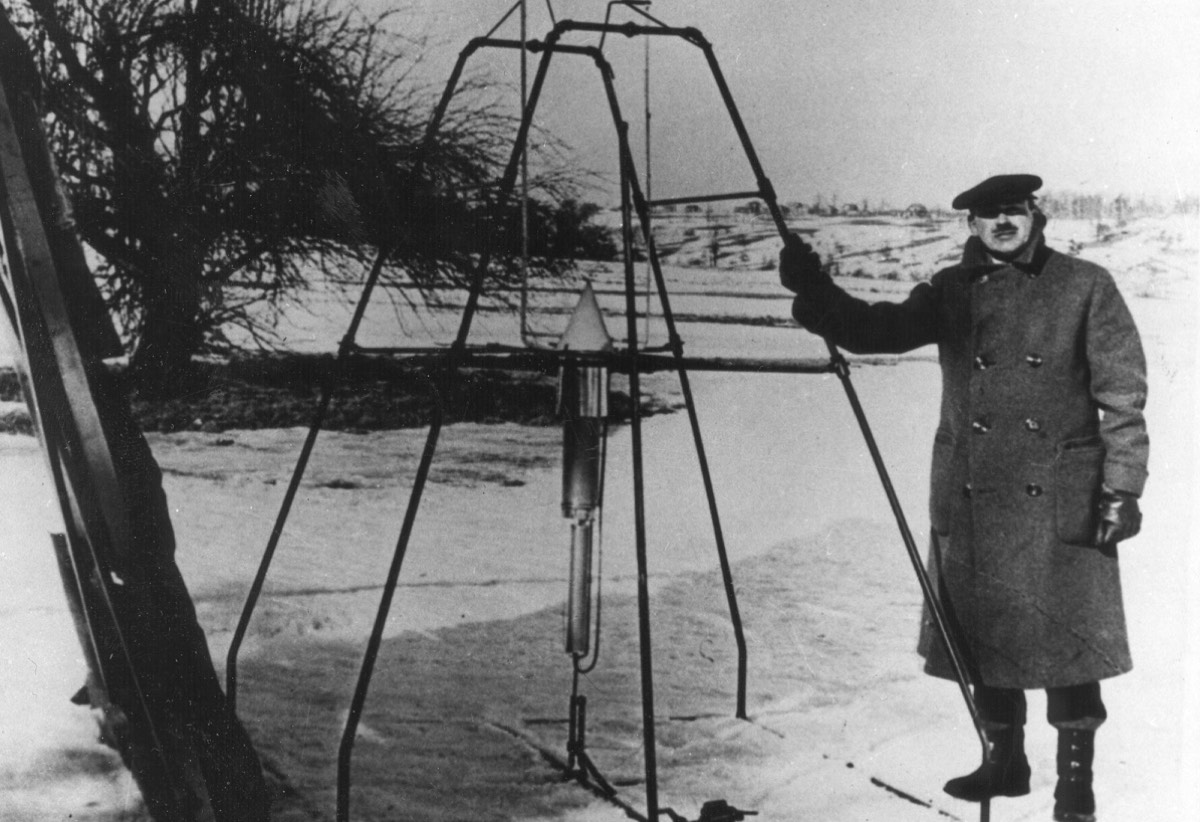
A P-type loonshot introduces a new product or technology that nobody believes will work. Business leaders once thought the telephone was little more than a toy, and foolishly passed on investing in what would become the Bell Telephone Company. Similarly, physicist Robert H. Goddard‘s design for a liquid-fuel rocket in the 1920s was dismissed by academic and military experts at the time. Decades later, his invention helped usher in the era of spaceflight.

Understanding the science of phase transitions can nurture loonshots faster and better, according to Bahcall, so groups can achieve a harmonious balance between radical innovation (loonshots) and “operational excellence” (stable franchises). Instead of trying to change corporate culture, he maintains that small changes in structure can help transform group behavior, much like making tiny structural changes in a material can change its phase (water freezes into ice, or boils away as vapor). That was the secret to Vannevar Bush’s success: US military culture was resistant to taking risks on radical new ideas, so instead of trying to change the culture, he changed the structure, creating a separate research branch (eventually leading to the establishment of  DARPA), where those radical “high risk, high gain” ideas could find a home.

Bahcall’s theory rests on three fundamental concepts familiar to any condensed matter physicist: phase separation, dynamic equilibrium, and critical mass. No two phases can co-exist in an organization—say, being good at loonshots (eg, original independent films) versus excelling at franchises (eg the Marvel Cinematic Universe)—unless they are poised right at the critical edge of a phase transition. “At the cusp of a phase transition, blocks of ice co-exist with pockets of liquid,” he writes. The phases break apart but stay connected, cycling back and forth to maintain a state of dynamic equilibrium—teetering on the edge of chaos.  Ars sat down with Bahcall to learn a bit more about his intriguing new theory.

Ars Technica: Most people associate the critical threshold of a phase transition with Malcolm Gladwell’s 2000 bestseller The Tipping Point. How does your book differ from Gladwell’s take, almost 20 years later?

Bahcall: The Tipping Point is simply a qualitative discussion of the concept that the spread of ideas is governed by a phase transition. That’s well known in the literature, and [Gladwell’s book] weaves popular stories around the concept that the spread of ideas is like the spread of a virus. Gladwell pioneered the idea of translating academic science through compelling personal stories for a popular audience. That field, which was N=1 when he did it, is now N=5,000 people imitating him.

Robert H. Goddard, bundled against the cold weather of March 16, 1926, holds the launching frame of his most notable invention — the first liquid-fueled rocket, an example of a "P-type" loonshot.
Enlarge / Robert H. Goddard, bundled against the cold weather of March 16, 1926, holds the launching frame of his most notable invention — the first liquid-fueled rocket, an example of a “P-type” loonshot.
NASA/Public domain

But there’s no underlying new theory there. Loonshots is written by a scientist, and it’s based on an underlying original theory that hasn’t existed in the world of economics. No one has ever suggested the concept of an organization having a phase transition based on underlying incentives. People have been working on this problem literally for 200 years, since Adam Smith first asked, “Well, how might incentives affect behavior in organizations?” There’s a straightforward underlying academic paper I could write, which is essentially appendix B of the book. Here’s the model. Here’s why it’s reasonable. Here’s why I’m making these approximations, and here’s how you analyze this model. And here’s what you extract from it.

Ars: Let’s talk a moment about “disruptive innovation” versus “loonshots,” because you draw a distinction between these two concepts.

Bahcall: So many people are sick of hearing about disruptive innovation. The flaw with that is that it’s a hindsight problem. Disruptive innovation is all about the effects of something on a market. If you’re talking about a new idea, the market might be two years, five years, ten years, or 20 years away. The even bigger flaw is that if it’s a very early stage idea, any experienced entrepreneur knows you have no idea where it’s going to be not only a year from now, but even next week. It could morph into something totally different. So you talk about disruptive innovation to analyze history. Otherwise, we should rip that word out of the dictionary. 

A loonshot is about testing an embedded belief, those things that you are sure—as a manager, or a business leader running any kind of group—are absolutely true about your world, your market, your products. But what if you’re wrong? Do you want to hear about that new idea about as much as a bullet coming at your head, or do you want to nurture loonshots to challenge your beliefs?

Ars: How does the concept of phase transitions in physics translate into a viable model for human organizations? 

Bahcall: The underlying idea is that there are phases of human organization driven by the underlying interactions. So whenever you organize people into a group, the only precondition you need is that there is a mission for that group and a reward system, meaning an incentive system tied to that mission.

It can seem to a general audience to be a little crazy. How could you possibly apply physics to people? But it really is no different than economics. A market is just people interacting with incentives. The buyers want to get the lowest price, and the sellers want to get the highest price. Those are the interaction rules. The laws of supply and demand, or the “invisible hand” of the market, emerge simply from those rules. I’m just taking economics and applying it to a different system: an organization.

“The underlying idea is that there are phases of human organization driven by the underlying interactions.”

If you’re interacting within an organization, it’s not buyers and sellers, it’s employees and managers. And instead of buying and selling goods, wanting higher or lower prices, they want to maximize their incentives, their reward systems. It’s really the intersection of three things: organizational behavior, economics, and physics. Physics is only brought in as a way of thinking about collective behavior in language that economists don’t usually think about. Ultimately this is a sub discipline of economics, organizational economics, which is understanding the influence of incentives inside an organization.

The tools, or techniques, of phase transitions are a simple set of shortcuts to extract useful insights from a system. You have people in this construct of an organization. You make a simple model. The goal is to make a model that keeps it simple, but not simplistic. You want to capture enough of the underlying interaction so that you can probe the features of the system you’re interested in, but not so much that the problem becomes intractable. So that’s what I did. I found a not very complicated model of an organization and the incentives inside of an organization that was tractable.

Ars: Can you explain how organizational structure changes and a phase transition might occur as a company grows in size?

Bahcall: Whenever you organize people into a group you instantly create two forces on any individual member of that group. One is their stake in the outcome of the project that they’re working on. And the other is the perks of rank within the hierarchy. So if you’re a two-person group, let’s say each person has 50 percent stake in the outcome. Whether you call A, or B, the captain, and the co-captain, is irrelevant. If the project works, everybody is happy, and if it fails, they’re depressed and unemployed. With four people, you’re now at 25 percent stake. You’re probably going to have a team captain and three team members, but it still doesn’t matter very much.

But when you’ve a hundred people, your stake becomes, let’s say, 1 percent. You can’t have one person with 99 people reporting to them. That just doesn’t work. So you have one CEO, five VPs, 25 SVPs, and the rest are the associates or worker bees. Now, if your stake is 1 percent, what’s your reward for getting promoted? It’s probably more than 1 percent. All of a sudden we’ve had a shift. Somewhere between four and a hundred, there is a shift in balance between these two forces.

That’s the phase transition. That’s the qualitative aspect. You can write down what that looks like more mathematically, with realistic incentives. You get cash: that’s how much your base salary goes up in the hierarchy. And you get equity. That’s your stake. You write those two terms down, and then you see what the break even point is, where the derivative is zero. That gives you the equivalent of the critical point. It also tells you what controls that size. Those are the dials that you can adjust. By cranking up the size, you’re effectively making a more innovative group.

Safi Bahcall applies the tools and techniques of phase transitions to making science and technological breakthroughs.
Enlarge / Safi Bahcall applies the tools and techniques of phase transitions to making science and technological breakthroughs.
St Martin’s Press

Ars: You also talk about how having a “system mindset,” versus an “outcome mindset,” can help an organization maintain the balance between radical innovation and operational excellence.

Bahcall: I took that idea from one of [chess grandmaster] Gary Kasparov‘s books. The process that helped him achieve world champion status is that, when he lost a game, he wouldn’t just analyze why a particular move was a bad one. That’s an outcome strategy. Why did my outcome not achieve what I wanted? A more interesting level is one step up, where you look at the process behind the decision. Why did you make that decision? What set of rules were you following?? That has leverage far beyond that one move. It could apply to hundreds or thousands of games in the future.

Now let’s translate that to teams, groups, or companies. A team launches a product. The product flops in the marketplace. Some teams will say, “All right, let’s sit down and figure out what happened here,” post mortem. “Well, this product didn’t have this feature. Our competitor clearly had that feature. It was superior. So let’s make sure next time we launch a product we look at these features and we don’t launch until it’s at least as good as our competitor.” That’s the lazy, lower level, outcome mindset.

The more sophisticated meta level is, how did we as a group arrive at the decision? If you use that as an opportunity to analyze your decision-making system inside a company, you can gain far more leverage. If you want to maintain this delicate balance between loonshots and franchises, you want to understand the process by which you make those decisions. Key to the success of that system is maintaining life at the edge—maintaining balance between these two groups. To maintain life on the edge, on the cusp of the phase transition, you need to be constantly probing your system.

https://arstechnica.com/?p=1507555


How much of a genius-level move was using binary space partitioning in Doom?

Cutting edge at the time, we swear.
Enlarge / Cutting edge at the time, we swear.

In 1993, id Software released the first-person shooter Doom, which quickly became a phenomenon. The game is now considered one of the most influential games of all time.

A decade after Doom’s release, in 2003, journalist David Kushner published a book about id Software called Masters of Doom, which has since become the canonical account of Doom’s creation. I read Masters of Doom a few years ago and don’t remember much of it now, but there was one story in the book about lead programmer John Carmack that has stuck with me. This is a loose gloss of the story (see below for the full details), but essentially, early in the development of Doom, Carmack realized that the 3D renderer he had written for the game slowed to a crawl when trying to render certain levels. This was unacceptable, because Doom was supposed to be action-packed and frenetic. So Carmack, realizing the problem with his renderer was fundamental enough that he would need to find a better rendering algorithm, starting reading research papers. He eventually implemented a technique called “binary space partitioning,” never before used in a video game, that dramatically sped up the Doom engine.

That story about Carmack applying cutting-edge academic research to video games has always impressed me. It is my explanation for why Carmack has become such a legendary figure. He deserves to be known as the archetypal genius video game programmer for all sorts of reasons, but this episode with the academic papers and the binary space partitioning is the justification I think of first.

Obviously, the story is impressive because “binary space partitioning” sounds like it would be a difficult thing to just read about and implement yourself. I’ve long assumed that what Carmack did was a clever intellectual leap, but because I’ve never understood what binary space partitioning is or how novel a technique it was when Carmack decided to use it, I’ve never known for sure. On a spectrum from Homer Simpson to Albert Einstein, how much of a genius-level move was it really for Carmack to add binary space partitioning to Doom?

I’ve also wondered where binary space partitioning first came from and how the idea found its way to Carmack. So this post is about John Carmack and Doom, but it is also about the history of a data structure: the binary space partitioning tree (or BSP tree). It turns out that the BSP tree, rather interestingly, and like so many things in computer science, has its origins in research conducted for the military.

That’s right: E1M1, the first level of Doom, was brought to you by the US Air Force.

The VSD problem

The BSP tree is a solution to one of the thorniest problems in computer graphics. In order to render a three-dimensional scene, a renderer has to figure out, given a particular viewpoint, what can be seen and what cannot be seen. This is not especially challenging if you have lots of time, but a respectable real-time game engine needs to figure out what can be seen and what cannot be seen at least 30 times a second.

This problem is sometimes called the problem of visible surface determination. Michael Abrash, a programmer who worked with Carmack on Quake (id Software’s follow-up to Doom), wrote about the VSD problem in his famous Graphics Programming Black Book:

I want to talk about what is, in my opinion, the toughest 3-D problem of all: visible surface determination (drawing the proper surface at each pixel), and its close relative, culling (discarding non-visible polygons as quickly as possible, a way of accelerating visible surface determination). In the interests of brevity, I’ll use the abbreviation VSD to mean both visible surface determination and culling from now on.

Why do I think VSD is the toughest 3-D challenge? Although rasterization issues such as texture mapping are fascinating and important, they are tasks of relatively finite scope, and are being moved into hardware as 3-D accelerators appear; also, they only scale with increases in screen resolution, which are relatively modest.

In contrast, VSD is an open-ended problem, and there are dozens of approaches currently in use. Even more significantly, the performance of VSD, done in an unsophisticated fashion, scales directly with scene complexity, which tends to increase as a square or cube function, so this very rapidly becomes the limiting factor in rendering realistic worlds.

Abrash was writing about the difficulty of the VSD problem in the late ’90s, years after Doom had proved that regular people wanted to be able to play graphically intensive games on their home computers. In the early ’90s, when id Software first began publishing games, the games had to be programmed to run efficiently on computers not designed to run them, computers meant for word processing, spreadsheet applications, and little else. To make this work, especially for the few 3D games that id Software published before Doom, id Software had to be creative. In these games, the design of all the levels was constrained in such a way that the VSD problem was easier to solve.

For example, in Wolfenstein 3D, the game id Software released just prior toDoom, every level is made from walls that are axis-aligned. In other words, in the Wolfenstein universe, you can have north-south walls or west-east walls, but nothing else. Walls can also only be placed at fixed intervals on a grid—all hallways are either one grid square wide, or two grid squares wide, etc., but never 2.5 grid squares wide. Though this meant that the id Software team could only design levels that all looked somewhat the same, it made Carmack’s job of writing a renderer for Wolfenstein much simpler.

The Wolfenstein renderer solved the VSD problem by “marching” rays into the virtual world from the screen. Usually a renderer that uses rays is a “raycasting” renderer—these renderers are often slow, because solving the VSD problem in a raycaster involves finding the first intersection between a ray and something in your world, which in the general case requires lots of number crunching. But in Wolfenstein, because all the walls are aligned with the grid, the only location a ray can possibly intersect a wall is at the grid lines. So all the renderer needs to do is check each of those intersection points. If the renderer starts by checking the intersection point nearest to the player’s viewpoint, then checks the next nearest, and so on, and stops when it encounters the first wall, the VSD problem has been solved in an almost trivial way. A ray is just marched forward from each pixel until it hits something, which works because the marching is so cheap in terms of CPU cycles. And actually, since all walls are the same height, it is only necessary to march a single ray for every column of pixels.

This rendering shortcut made Wolfenstein fast enough to run on underpowered home PCs in the era before dedicated graphics cards. But this approach would not work for Doom, since the id team had decided that their new game would feature novel things like diagonal walls, stairs, and ceilings of different heights. Ray marching was no longer viable, so Carmack wrote a different kind of renderer. Whereas the Wolfenstein renderer, with its ray for every column of pixels, is an “image-first” renderer, the Doom renderer is an “object-first” renderer. This means that rather than iterating through the pixels on screen and figuring out what color they should be, the Doom renderer iterates through the objects in a scene and projects each onto the screen in turn.

In an object-first renderer, one easy way to solve the VSD problem is to use a z-buffer. Each time you project an object onto the screen, for each pixel you want to draw to, you do a check. If the part of the object you want to draw is closer to the player than what was already drawn to the pixel, then you can overwrite what is there. Otherwise you have to leave the pixel as is. This approach is simple, but a z-buffer requires a lot of memory, and the renderer may still expend a lot of CPU cycles projecting level geometry that is never going to be seen by the player.

In the early 1990s, there was an additional drawback to the z-buffer approach: On IBM-compatible PCs, which used a video adapter system called VGA, writing to the output frame buffer was an expensive operation. So time spent drawing pixels that would only get overwritten later tanked the performance of your renderer.

Since writing to the frame buffer was so expensive, the ideal renderer was one that started by drawing the objects closest to the player, then the objects just beyond those objects, and so on, until every pixel on screen had been written to. At that point the renderer would know to stop, saving all the time it might have spent considering far-away objects that the player cannot see. But ordering the objects in a scene this way, from closest to farthest, is tantamount to solving the VSD problem. Once again, the question is: What can be seen by the player?

[embedded content]

Initially, Carmack tried to solve this problem by relying on the layout of Doom’s levels. His renderer started by drawing the walls of the room currently occupied by the player, then flooded out into neighboring rooms to draw the walls in those rooms that could be seen from the current room. Provided that every room was convex, this solved the VSD issue. Rooms that were not convex could be split into convex “sectors.” You can see how this rendering technique might have looked if run at extra-slow speed in the video above, where YouTuber Bisqwit demonstrates a renderer of his own that works according to the same general algorithm. This algorithm was successfully used in Duke Nukem 3D, released three years after Doom, when CPUs were more powerful. But, in 1993, running on the hardware then available, the Doom renderer that used this algorithm struggled with complicated levels—particularly when sectors were nested inside of each other, which was the only way to create something like a circular pit of stairs. A circular pit of stairs led to lots of repeated recursive descents into a sector that had already been drawn, strangling the game engine’s speed.

Around the time that the id team realized that the Doom game engine might be too slow, id Software was asked to port Wolfenstein 3D to the Super Nintendo. The Super Nintendo was even less powerful than the IBM-compatible PCs of the day, and it turned out that the ray-marching Wolfenstein renderer, simple as it was, didn’t run fast enough on the Super Nintendo hardware. So Carmack began looking for a better algorithm. It was actually for the Super Nintendo port of Wolfenstein that Carmack first researched and implemented binary space partitioning. In Wolfenstein, this was relatively straightforward because all the walls were axis-aligned; in Doom, it would be more complex. But Carmack realized that BSP trees would solve Doom’s speed problems too.

https://arstechnica.com/?p=1635925