Warning: This story discusses a handful of specific moments from TV in 2019. There are major spoilers for the final season of Game of Thrones. Although we’ve otherwise done our best to avoid spoiling anything too major, please note this list includes specific references to The Mandalorian, The Good Place, The Orville, Barry, Fleabag, Counterpart, Mindhunter, The Santa Clarita Diet, Daybreak, and Russian Doll, among others.
Is it possible to out-peak peak TV? If so, 2019 might just have attained that goal. This year saw the launch of two new streaming platforms into an already crowded market: Apple TV+ and Disney+, along with so much original programming that it was easy for promising fledgling shows to simply get lost in the firehose of fresh content. There’s bound to be some shakeups and consolidation in the years ahead, because the current explosive rate of growth is likely unsustainable. But for now, let’s revel in the glorious smorgasbord of quality shows—offered below in no particular order—that captured our heads and hearts this year.
Enlarge/ Anson Mount plays the tough but fair Captain Pike on Star Trek: Discovery.
CBS/All access
Stellar cast shines on Star Trek: Discovery
Star Trek: Discovery‘s second season isn’t perfect. The heavy amount of retconning around the original Star Trek series feels contrived at times, and certain romantic pairings the show tries desperately to sell have all the chemistry of a pile of wet sand.
But when Discovery shines, it’s like a supernova against the night sky—and much of that light comes from the stellar cast. Michelle Yeoh’s scene-chewing as Georgiou is a pure delight to watch; Doug Jones defies who-knows-how-many layers of makeup and prosthetics to make us feel every one of Saru’s deep emotions; and Mary Wiseman continues to radiate infectious joy and enthusiasm as Tilly grows and matures as a character and a leader.
The unexpected heart of season two, though, came not from the core cast but from a surprising quarter: Captain Christopher Pike (Anson Mount). Before, Pike was best known for using a space-age wheel-free wheelchair and beeping yes or no. Discovery does not change his ultimate fate but, instead, takes an appropriately science fictiony device and fleshes Pike out enormously, ultimately making him a hero who chooses repeatedly—at enormous personal cost and with full understanding of the weight of those costs—to do the right thing.
Pike’s arc is a standout example of Star Trek‘s most consistent and loftiest goal: setting the tone from the captain’s chair, having the leader live up to Starfleet’s highest ideals even when doing so feels impossibly hard, and trusting the rest of the crew to rise to the occasion.
Enlarge/ The Soul Squad is back for a final season on The Good Place
NBC Universal
Entering the endgame on The Good Place
The Good Place has always kept us guessing, from the pilot episode in which Eleanor (Kristen Bell) realizes she’s been admitted to paradise by mistake, to the heartbreaking S3 finale setting up this fourth and final season. Much of S3 took place back on Earth, where the Soul Squad—Eleanor, Chidi (William Jackson Harper), Tahani (Jameela Jamil), and Jason (Manny Jacinto)—had been given one more chance to become better people on Earth.
It was a bold move by the writers, although the first few episodes were a bit lackluster. Earth just isn’t as interesting as the crazy surreal illogic of the show’s brilliant conception of the afterlife. But S3 soon hit its stride. In the finale, reformed demon Michael (Ted Danson) convinced Judge Gen (Maya Rudolph) to repeat the original experiment of S1 with four new humans, chosen by the Bad Place. The Soul Squad would be on hand to assist. But there’s always a catch when the Bad Place gets involved, and this one was particularly heartbreaking for fans of the Eleanor-Chidi soulmate coupling. Chidi was rebooted along with everything else, which removed his memories of Eleanor.
S4 brought everyone back to the afterlife, with all the cheesy puns and comic absurdity that comes with that goofy eternal realm. (A game of Pictionary in which the images come to life ends in chaos, thanks to a terrifying mutation produced by Chidi’s crude drawing of a horse.) Eleanor is now running the Good Place, with four new test subjects: John (Brandon Scott Jones), a former gossip columnist who wrote nasty things about Tahani back on Earth; uber-douche male chauvinist Brent (Benjamin Koldyke); Chidi’s Australian neuroscientist love interest from S3, Simone (Kirby Howell-Baptiste); and Chidi himself (a replacement for Linda, who turned out to be a demon in disguise). There are twists and double crosses and daring rescues, ending with Judge Gen concluding in the midseason finale that, yes, the afterlife’s point system is flawed. But her solution is to wipe out all humans from existence in a reset to start over—not the outcome the Soul Squad was hoping for.
The writing is still so fresh and the philosophical rumination still so sharp and witty, one might be tempted to keep the show going as long as possible. But I think it’s a wise move to wrap things up after four solid-gold seasons. Will Judge Gen relent on her decision to reset the human experiment and give the Soul Squad a chance to redesign the afterlife? Will there be a happily ever after for Eleanor and Chidi? Will Jason’s beloved Jacksonville Jaguars ever win a championship without Blake Bortles? It’s anyone’s guess how things will end for this always surprising and thought-provoking series.
Earlier this week, alarmed in the middle of the night by a noise downstairs, a North Carolina man named Thomas sent his wife to “a safe place” and then grabbed his phone to flip on some smart lights in the kitchen. He picked up his gun and joined his wife, who called the police. As they were waiting, the couple listened to the intruder below.
“We heard more noises downstairs and were increasingly alarmed,” wrote Thomas on social media the next day. “All my military training came back to me, I started analyzing the path the intruder would take, their line of fire if they entered the room in certain ways, and where we should be to decrease our risk of getting hurt. All I kept thinking about and listening for was my little 2 year old next door to us, alone, and sound asleep. I was ready to do whatever I needed to do if I heard her door open.”
The cops arrived and entered the lower level of the house. Thomas had his gun pointed at the bedroom door as he listened to the cries of “Sheriff’s office!” below. The 911 dispatcher, who was still on the phone, soon told Thomas to put down his weapon and go talk to the police. Thomas left the bedroom.
The police all had their lights shining up the stairs, I put my hands so they could see me, I was only in my boxers, lovely…I know.
They all started holstering their weapons and said “Sir, I have one question…”
Me with adrenaline flowing rapidly, “Sure.”
Police, “Is this ROOMBA yours?”
Yes, it was the family’s new Christmas Roomba robotic vacuum, which had “somehow turned itself on and was vacuuming our house without us having scheduled it.” It had gotten stuck and was making some terrible bumping noises. The police were good sports about it, though Thomas noted that “4 police officers got body cam footage of an almost nude and ashamed home owner.”
We like to think of it as a little Christmas parable about technology, which has given us guns, Alexa, smartphones, bodycams, and Roombas—but which still hasn’t found a way to shut off that stab of fear when you hear something strange go bump in the night. Happy holidays, Ars readers—and stay safe out there.
https://arstechnica.com/?p=1637203
Ars Technica’s best films of 2019
Enlarge/ Yes, we liked Avengers Endgame, but its poster template left room for other favorite film characters from 2019.
Aurich Lawson
While we’d love to neatly sum up the year in nerdy cinema with some sweeping trend or generalization, 2019 wasn’t so easily categorized. You’ve seen this list before: Superheroes, big-budget action, nerdy franchises, sequels, clever documentaries, and memorable twists on horror.
Meaning, this year didn’t explode with significant trends or revolutionary takes on cinema (unless we count recent hand-wringing about high-profile directors going straight to streaming… which we don’t). But that still left us with plenty of quality films to watch, including some welcome surprises, so we come to you with many of your 2019 favorites as lumped into separate categories. (If you’re wondering: nope, the latest Star Wars film didn’t rise to our list’s ranks.)
Though this list is mostly unranked, each category gets a number-one pick, and the article concludes with our collective choice for Ars Film Of The Year.
Family fare: Heroes for all ages
Most of our favorite family-friendly films arrived in 2019’s first half, perhaps because they were all terrified of launching anywhere near Frozen 2. (They shouldn’t have been.) And these films mostly stuck to a superhero-film formula of unwitting heroes thrust into universe-saving stakes.
Lego Movie 2 kicked the year off by making the most of a world where everything is no longer awesome. It saw the writing-directing duo of Lord and Miller essentially get their version of Solo onto big screens–and arguably trounce their former employers at Lucasfilm in the process. From Tech Culture Editor Sam Machkovech’s review:
Lego Movie 2 is everything I hoped for from a film that comes with established characters and setting, and its comfort with the first film’s gimmicks means it spends less time trying to prove itself and more time letting its varied characters grow and explore in exciting new territory. It’s also the rare family film where a totally obvious plot resolution feeds the emotional appeal that much more. As lead characters Emmet and Wyldstyle separately struggle to recognize their true personalities, the movie heaps on foreshadowing and dramatic irony in ways that let it breathe for what Lord and Miller do best: crack wise and witty.
Captain Marvel followed with one of Marvel Studios’ better “origin story” films in recent years; the same couldn’t be said for Thor or Captain America’s solo-film bows. As Machkovech wrote in March:
Captain Marvel is a great superhero film for many reasons, but one of them is that it sees Marvel Studios tell its best origin story yet—not just of that one character getting some powers, but of that character discovering her destiny, her reason to get back up when the world tries to shove her down. The character of Captain Marvel may have been granted powers in a supernatural manner, but the film she stars in gets its powers from a rich, human story fueled by delightful twists and impeccable acting.
The most I’d like to give away about the film’s plot and framework is that it resembles some of the absolute best Captain Marvel comics in recent years, particularly the works of writer Kelly Sue DeConnick. Before going into a Captain Marvel screening, I strongly suggest you pick up trade paperbacks like Higher, Further, Faster, More or In Pursuit of Flight—not because they are required reading at all (they’re not). Rather, those books’ time-hopping techniques have been paid forward in this film’s script, both in blatant and subtle ways. I really enjoyed noticing the through line as I chomped on popcorn.
And, wouldn’t you know it, DC Comics finally earned some universal acclaim at the box office by brazenly co-opting ’80s-movie nostalgia in Shazam!. Machkovech again with the praise-filled review:
Shazam! is in no position to “redeem” DC Comics’ reputation in comparison to Marvel Studios’ fare, and it succeeds the most by wearing that fact on its giddy-teen sleeve. Of course, Marvel comparisons are inevitable, so I’ll start with one: the resulting film lands somewhere between the first and second Ant-Man films. It’s fun. It’s funny. It’s fine. Shazam! can easily be criticized for issues and lapses, but its worst issues are nitpicks, not damning reasons to steer clear.
The end result is a superhero film that leans brazenly into an Indiana Jones vibe (complete with a John Williams-caliber score) along with a healthy dollop of Deadpool-for-kids gags about the wider DC Comics universe. Shazam! is the kind of family-friendly movie that feels like it’s made for older teens—something a 10-year-old could watch and feel like they’re being sneaky—without leaving older fans bored.
How do you know it’s Detective Pikachu, not just standard Pikachu? Clues: the hat, the magnifying glass, the lush fur.
Warner Bros. / The Pokemon Company
Kathyrn Newton, Justice Smith cram with their companion Pokemon into an adorably tiny car to solve a mystery.
Their fateful meeting. “You can talk!” “You can understand me!”
Tim (Justice Smith) makes a curious discovery at an apparently empty office.
Bill Nighy plays Howard Clifford, the man who put Ryme City together as a bold experiment in human-Pokemon relations.
Ryan Reynolds’ version of Pikachu is an adorably caffeinated helper.
Kathryn Newton’s spunk and cheesiness lands a bit in Disney Channel territory, but if we’re talking about hard-boiled detective films as a source point, then that’s not entirely out of line.
You can expect at least one “battle” in the film, but it’s not exactly traditional in game-series terms.
Psyduck bein’ Psyduck.
But it was Pokemon: Detective Pikachu that took all of us at Ars by surprise and won this category for 2019. If you’re annoyed by Pikachu voice actor Ryan Reynolds for any reason, or can’t overlook a few intentionally hokey actors, you may not necessarily agree, but no 2019 “nerd cred” film is as riotous for parents as it is for kids. Machkovech reviewed it in May:
Pokémon: Detective Pikachu is the best video game adaptation I’ve ever seen in a theater. And it’s even better than that weak praise might imply. One thing that gives me shivers is how well Detective Pikachu skips past the usual Pokémon-cartoon baggage. What is each Pokémon’s superpower? How should you best counter a certain creature in a battle? What do you need to effectively capture or evolve an elusive character?
Detective Pikachu doesn’t care. Dozens of Pokémon characters whiz by with their animations, actions, and goofy voices pulling the weight of comedy and excitement, and you don’t need to know squat about the series to appreciate any of it. Think of A New Hope’s cantina scene, where mystery and goofiness set plenty into motion, and then imagine a film letting that perspective ride for its entire runtime. It’s awesome.
If Pokémon has become a part of your life for any reason—you played it, your kids play it, or you got hooked on Pokémon Go for a few months—go see this hilarious, sweet, and wide-eyed film. If not, prepare to have a perfectly good time while being confused by whatever the heck a Gengar is.
https://arstechnica.com/?p=1632025
88% of Americans use a second screen while watching TV. Why?
Eric Audras | Getty Images
When it comes to tech, I like to think I’m a pretty hoopy frood. I added the System Tuner UI to my Android phone’s settings. I’ve crimped my own ethernet cables. I got Wing Commander III running, back when that required the dark arts of HIMEM.SYS tweaking. What I’m trying to say is: I am with it!
Except when it comes to staring at screens while staring at other screens. I just don’t suss it. But apparently 88 percent of Americans do.
Bond Capital | Mary Meeker
One of the little info-nuggets that has been ricocheting around my brain this year came from Mary Meeker’s annual “Internet Trends” report. Meeker, a venture capitalist with Bond Capital, presented her research at the Code Conference back in June, amid the heat of the Arizona desert. Her presentation was, as usual, a massive (300+ slides!) data dump of interesting information on all things Internet, but the item that most intrigued me was right there in the lower-left corner of slide 38.
According to data from Nielsen, the TV metrics company, 88 percent of Americans “use a second digital device while watching TV.” Seventy-one percent of Americans “look up content related to content they are watching,” while 41 percent of Americans are busy messaging “friends/family about content they are watching.”
Can this possibly be true? And can it be good for us?
In which things get really existential
Ars has reported on human brains and multitasking for more than a decade, and the general consensus seems to be: we don’t, as a species, do it very well. Sure, we can handle two tasks at once, but only after we have learned one so well it can be handled almost unconsciously. (Think driving down the interstate while having a conversation, then bringing your attention back to the road and realizing you’ve been on mental “autopilot” for the last five minutes.) But attempting to do two new and/or creative tasks at once just doesn’t work well.
Couple this research with the more recent concern over screens, “screen time,” and the importance of attention, and I’m surprised at Nielsen’s findings. My attitude, when watching TV, is that a show you pay attention to precludes the use of phone or laptop; if you’re using another screen, you’re not actually watching the show. Pick better shows to watch, people! And then watch them!
But this approach quickly acquires moral dimensions: I am superior to you because I watch better television in a more attentive way. No CSI: Cyber in this house! But is this “entertainment as elitism”?
I got to thinking about the ways in which we use television, and not all of them involve watching dark prestige dramas with 80+ Metacritic scores. Perhaps you’re watching (ugh) live TV, either because you are a masochist or you love sports. (If you are watching baseball, perhaps it’s both!) Picking up a smartphone during commercial breaks is arguably better than being bombarded with the consumerism of late-stage capitalism.
Say you use your TV not as a way to consume compelling crafted content, but as background noise that helps you relax. (I highly recommend Sunday afternoon golf for this purpose.) Tooling around on a laptop while the TV plays in the background is now not quite so odd.
Or perhaps you watch TV simply as a way to kill time. Perhaps you’re in pain, or recovering from illness, or simply bored out of your mind. The goal is not necessarily to direct your full and undivided attention to the screen; it is to get through the day until something better comes along. Using a second screen here, too, makes sense.
Or maybe you are alone but want TV to be a more social experience. For whatever reason, in-person socializing won’t work, so you keep up a running group text with friends who are watching the same episode. My wife and I recently tried this when she was away for a week, watching episodes of Seinfeld together on Hulu while attempting to keep up a run of clever commentary by text. It went… okay.
Still, I can’t shake the feeling that the majority of time spent using one digital device while another displays video content nearby is low-quality time, where we aren’t really paying attention to what’s on either screen and so are using the planet’s resources, cluttering our lives with extra noise, and reinforcing our slavish devotions to screens for little to no benefit.
In my darker moments, I suspect that mental clutter is the point of it all, as we seek to be “distracted from distraction by distraction.” We are “filled with fancies and empty of meaning” in order to keep ourselves from the terror of our own deeper thoughts, our own loneliness and boredom, our own existential despair. Those inner voices can terrify—so the lengths we go to blot them out are remarkable. “Not here,” we tell ourselves. “Not here the darkness, in this twittering world!”
Yet one key point of T.S. Eliot’s poem is that—if we can bear them—silence, negation, and the “dark night of the soul” may lead us not to death but to transformation and even salvation.
This holiday season, I’ve been paying closer attention to my own use of screens (and of audio content, which is a whole other thing that can serve some of the same purposes). The results of this scrutiny are not always pleasant, so I’m trying to be more deliberate about what I watch and listen to. I’m trying to cultivate more silence and stillness, and I’m especially trying not to use two screens at once except in emergencies… or during the most dire Christmas specials that my family wants to watch on TV. After all, there’s an exception to every rule.
How’s it going? I’ll let you know next year. But for now, I’d love to hear from you. Why do you use two (or more) screens at once? Are you happy with the results, or does this generally feel like “lost” time? Join the discussion in the comments below.
https://arstechnica.com/?p=1636881
This timeless piece of “body art” of people having sex in an MRI turns 20
[embedded content]
Video courtesy of Improbable Research
Christmas just wouldn’t be the same for lovers of science without the annual Christmas issue of the British Medical Journal (BMJ). The tradition began in 1982, originally as a one-off attempt to bring a bit of levity to the journal for the holidays. While the papers selected for inclusion evinced a quirky sense of humor, they were also peer-reviewed and scientifically rigorous.
Some of the more notable offerings over the last 37 years included the side effects of sword-swallowing; a thermal imaging study on reindeer offering a possible explanation for why Rudolph’s nose was so red; and an analysis of the superior antioxidant properties of martinis that are shaken, not stirred. (Conclusion: “007’s profound state of health may be due, at least in part, to compliant bartenders.”)
But by far the most widely read Christmas issue paper was a 1999 study that produced the very first MRI images of a human couple having sex. In so doing, the researchers busted a couple of long-standing myths about the anatomical peculiarities of the male and female sexual organs during sex. Naturally, the study was a shoo-in for the 2000 Ig Nobel Prize for Medicine.
Leonardo da Vinci famously studied cadavers to learn about human anatomy. He even drew an anatomical image of a man and woman in flagrante delicto, noting “I expose to men the origin of their first, and perhaps second, reason for existing.” However, “The Copulation” (circa 1493) was based not on his own studies, but on ancient Greek and Arabic texts, with, shall we say, some highly dubious assumptions. Most notably, Leonardo depicted a ramrod straight penis within the vagina.
The Copulation as imagined by Leonardo da Vinci.
Midsagittal image of the anatomy of sexual intercourse envisaged by RL Dickinson and drawn by RS Kendall
W.W. Schultz et al./BMJ (1999)
Left: Midsagittal image of the anatomy of sexual intercourse (labelled). Right: Midsagittal image of the anatomy of sexual intercourse.
W.W. Schultz et al./BMJ (1999)
The modern era of the science of sex arguably began in the 1930s with gynecologist Robert Dickinson, who sought to dispel the absurd notion of “coital interlocking,” whereby the penis penetrates the cervix like a key fitting into a lock. Dickinson’s experiments involved inserting a penis-sized glass tube into the vaginas of female subjects aroused via clitoral stimulation, as well as making plaster casts of women’s vulvas and vaginas. (His work influenced Alfred Kinsey, whose own research produced the famous Kinsey scale to describe sexual orientation.)
Masters and Johnson revolutionized the field in the 1960s with their own provocative series of experiments on sexual response. Volunteers would have sex while hooked up to instruments in the lab. Masters and Johnson famously participated personally in their experiments, becoming lovers—a development that inspired the 2013 Showtime series Masters of Sex. They identified four stages of the Human Sexual Response Cycle: excitement, plateau, orgasmic, and resolution. Most relevant for the current discussion: they used an artificial penis for some experiments, noting among their findings that the volume of a woman’s uterus increased by as much as 50-100 percent during orgasm. However, they acknowledged this might not be accurate due to the artificial nature of their experiments.
The 1999 study was the brainchild of Dutch physiologist Pek van Andel, who co-invented the artificial cornea and hence had a solid academic reputation that enabled him to persuade a hospital in Groningen, the Netherlands, to let him use an MRI machine after hours. But his original intention was to produce a piece of “body art.” He’d been inspired by the image of an MRI cross-section of a singer’s mouth and throat as she sang and thought it might be possible to use an MRI to take images of human coitus.
His co-authors included gynecologist William Schultz, radiologist Eduard Mooyaart, and anthropologist Ida Sabelis. Sabelis was an actual participant in the first experiment, conducted with her then-boyfriend, identified only as “Jupp.” (Others would follow in her pioneering footsteps, including popular science author Mary Roach, who memorably persuaded her husband to participate in an ultrasound imaging sex study for her 2008 book, Bonk.)
Enlarge/ Co-author Pek van Andel accepting an Ig Nobel prize for his 1999 MRI study.
YouTube/Improbable Research
The first experiment, with Sabelis and Jupp, took place in 1992. While the latter had some concerns about whether he’d be able to adequately perform while being packed into a noisy metal tube with his partner, he managed to rise to the occasion. The experiment lasted 45 minutes, and the incredible detail of the resulting images rendered Sabelis momentarily speechless. Van Andel was delighted to note that the penis took on a boomerang shape during sex—disproving what Leonardo had depicted in his sketch centuries before. The images also disproved Masters and Johnson’s finding that female sexual arousal increases the size of the uterus.
Convinced the images were scientifically relevant, van Andel submitted their findings to Nature. The journal rejected the paper outright. Controversy erupted when the Dutch tabloids got wind of the experiment, and the hospital balked at letting him use the MRI for additional experiments, although van Andel persuaded them to let him continue in the end. Between then and 1999, eight couples and three single women participated in 13 experiments. (Sabelis recently boasted to Vice that she and Jupp were the only couple who’d managed the feat without the aid of Viagra.)
The paper finally found a publisher in the British Medical Journal, whose editors thought the study made a fine addition to their annual Christmas issue. (In the final paper, the authors thanked “those hospital officials on duty who had the intellectual courage to allow us to continue this search despite obtrusive and sniffing press hounds.”) Former BMJ editor Tony Delamothe recalled the thought process behind the decision:
Twenty years on, any paperwork relating to the decision to publish is gone, and the memories of editorial staff are hazy (one remembered discussion about how thin the participants must have been to manage intercourse in a 50cm diameter tube). It was possibly the close fit with the da Vinci drawing that swung the decision. Nobody thought the study was particularly useful clinically or scientifically, but it contained “a striking image using a new technology, and everyone agreed that readers might be interested to see it.” Sandy Goldbeck-Wood, the journal’s paper editor at the time, said: “I remember our conversation about it as serious (if wry), rather than ribald. I think the Christmas issue was the only place it would properly have fitted.”
Delamothe puzzles over the enduring appeal of the paper, and he seems to conclude that it’s mostly due to the public’s prurient interest at “seeing coitus on screen (for free).” But there is now tons of free pornography all over the Internet, yet these images continue to attract interest, and even admiration. Van Andel created a timeless piece of “body art” after all. The sexual act is, as Leonardo observed, “the origin of [our] first, and perhaps second, reason for existing”—and hence a thing of beauty.
The 2010s were full of video games we’ll gladly revisit for decades to come
Enlarge/ Very nature-oriented color scheme to our 2010s video gaming favorites.
Microsoft / Jonathan Blow / Riot Games / Derek You
As the 2010s come to a close, looking back on the thousands and thousands of video games that were made over the last ten years is a daunting task. It’s so daunting, in fact, we need a little more time—we’ll be narrowing down that massive list to a selection of the most important games of the decade in the near future.
In the meantime, though, we thought it would be interesting to poll the Ars Brain Trust for some more personally relevant “Game of the Decade” picks. These titles might not rank as the objectively best games of the decade, or the most innovative, or influential, or even the most well-made. But each one stands out to a member of our staff as the most memorable and impactful gaming experience of the last ten years; the one that meant the most to us for one reason or another.
The results run the gamut from 100-hour epics to mindless mobile phone time-wasters, and everything in between. It may not quite form a comprehensive accounting of the decade in games, but altogether and individually, these are the titles that will stick with us most when we look back on the 2010s.
The Binding of Isaac is a game about a boy named Isaac fleeing into his basement to escape his mother, who has been convinced by religious television that Isaac is an unrepentant sinner who must be murdered. Isaac delves deeper and deeper into the labyrinth under his house, eventually somehow making it into his mother’s womb—and then Hell itself—while shooting at piles of poop and distorted visions of his own psyche. His weapon is his own tears. The game is full of hopelessly dated memes and endless toilet humor.
Look, I don’t love that this is my favorite game of the decade, but sometimes a game chooses you.
The Binding of Isaac (including all of its DLC, of course) has been my gaming comfort food since it got its hooks into me in 2014. I love the sense of progression you get from a good RPG, and with the Binding of Isaac, I can feel that power curve rev up to ridiculous levels in less than an hour, as many times as I want. The game’s huge variety of items—and the way they interact in unique and interesting ways—is still unmatched in modern roguelikes. No two runs ever play the same. Sometimes RNG is a pitiless god who saddles you with a lousy loadout you have to do your best with, and sometimes (OK, often) you become a disgustingly overpowered hurricane of destruction.
There’s no game I’ve put more hours into (no, I will not be checking my “Wasted on Destiny” stats), and I can’t imagine a time I won’t want to return to it for just one more run.
In 2011, after months of hectoring from my spouse and a friend, I caved and tried Mass Effect. They were right, of course; I loved it and quickly dove into ME2 after. But then I hit a wall: it would be months before the third game came out, and I desperately wanted something to scratch that itch. So when I found this game on sale called Dragon Age 2 from the same studio, I figured for $15 it was worth trying.
I played it. Then I immediately played it again. And a third time. A different Hawke every time, following the script in this three-act play, this three-season TV arc doomed to a tragic ending. I was basically in love with it both despite and because of its flaws, in the same way my fannish heart fell in love with Star Wars in my teen years or Lord of the Rings in college. I wanted to talk about it, with everyone, all the time—so I took to my little blog to do just that.
The big surprise? Finding that people were listening. Suddenly, my name was out there. The rest was luck: lightning struck and the universe miraculously developed open full-time game journalist jobs at exactly the same time. I got hired into one and quit my office job in Feb. 2012, and I’ve had the incredible good fortune to be working as a full-time journalist ever since.
All the negative arguments about backgrounds, assets, and combat in DA2 are valid, but they never meant a damn thing personally. To me, the game was and is all about the stories, the people, and the world in which they are trying to do right against a history of prejudices and injustices. And it changed more than just my career: I’m now four years deep into a Dragon Age tabletop campaign with four lovely, amazing, and talented people that I feel lucky every day to be able to call my friends, none of whom I ever would have met without it.
https://arstechnica.com/?p=1634571
The surprisingly complicated physics of why cats always land on their feet
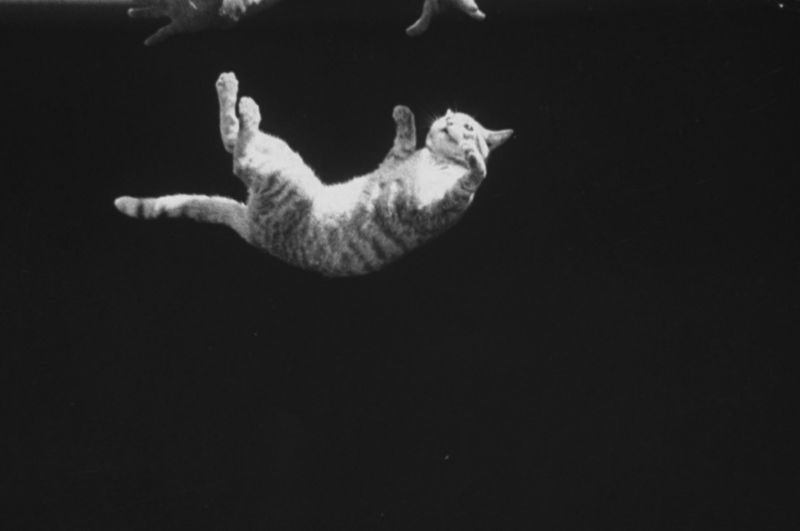
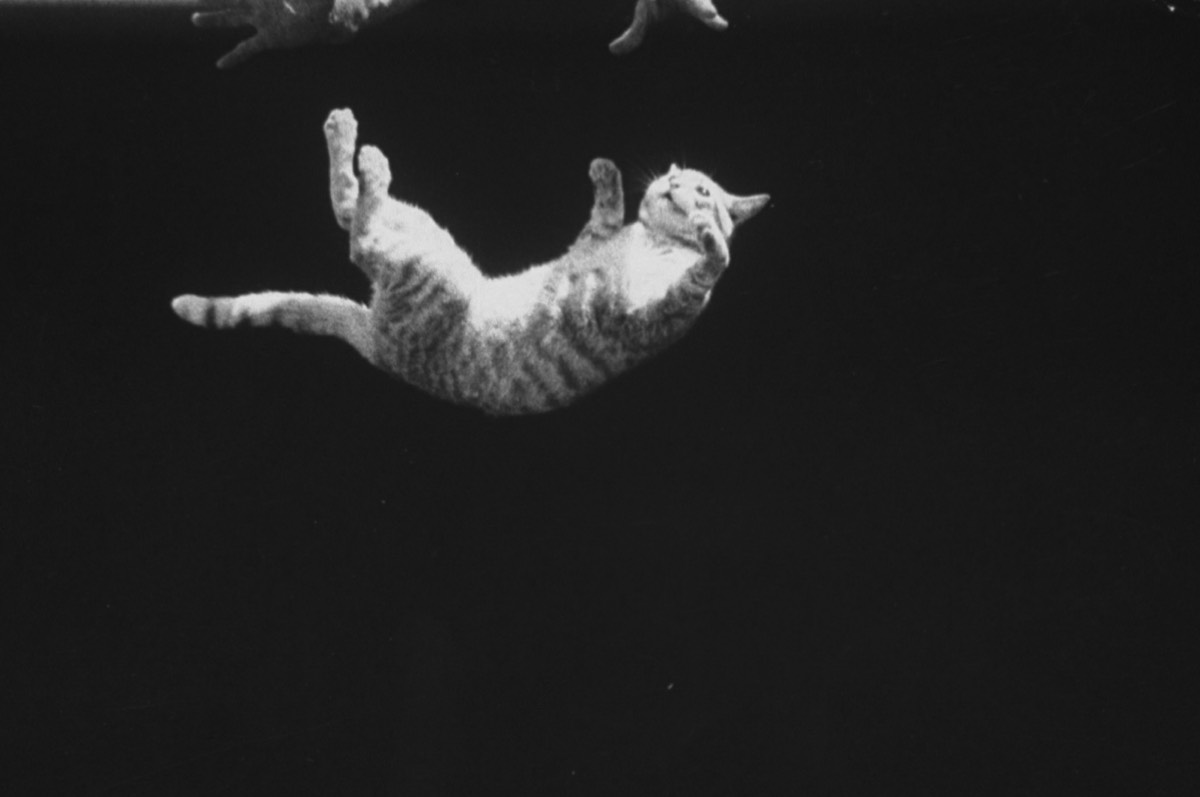
Enlarge/ A cat being dropped upside down to demonstrate a cat’s movements while falling
Ralph Crane/The LIFE Picture Collection via Getty Images
Scientists are not immune to the alluringly aloof charms of the domestic cat. Sure, Erwin Schrödinger could be accused of animal cruelty for his famous thought experiment, but Edwin Hubble had a cat named Copernicus, who sprawled across the papers on the astronomer’s desk as he worked, purring contentedly. A Siamese cat named Chester was even listed as co-author (F.D.C. Willard) with physicist Jack H. Hetherington on a low-temperature physics paper in 1975, published in Physical Review Letters. So perhaps it’s not surprising that there is a long, rich history, spanning some 300 years, of scientists pondering the mystery of how a falling cat somehow always manages to land on their feet, a phenomenon known as “cat-turning.”
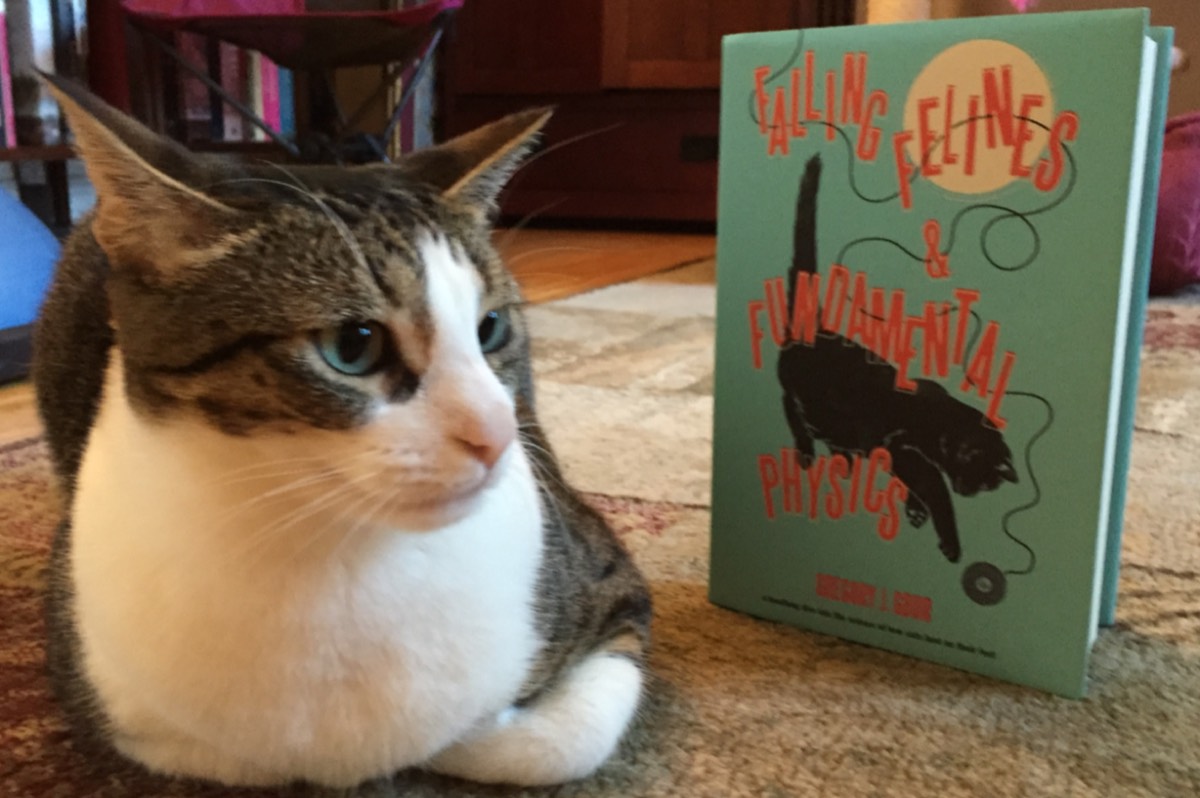
“The falling cat is often sort of a sideline area in research,” physicist and cat lover Greg Gbur told Ars. “Cats have a reputation for being mischievous and well-represented in the history. The cats just sort of pop in where you least expect them. They manage to cause a lot of trouble in the history of science, as well as in my personal science. I often say that cats are cleverer than we think, but less clever than they think.” A professor at the University of North Carolina, Chapel Hill, Gbur gives a lively, entertaining account of that history in his recent book, Falling Felines and Fundamental Physics.
Over the centuries, scientists offered four distinct hypotheses to explain the phenomenon. There is the original “tuck and turn” model, in which the cat pulls in one set of paws so it can rotate different sections of its body. Nineteenth century physicist James Clerk Maxwell offered a “falling figure skater” explanation, whereby the cat tweaks its angular momentum by pulling in or extending its paws as needed. Then there is the “bend and twist” (not to be confused with the “bend and snap” maneuver immortalized in the 2001 comedy Legally Blonde), in which the cat bends at the waist to counter-rotate the two segments of its body. Finally, there is the “propeller tail,” in which the cat can reverse its body’s rotation by rotating its tail in one direction like a propeller. A cat most likely employs some aspects of all these as it falls, according to Gbur.
Gbur is quick to offer a cautionary word of advice to anyone considering their own feline experiments: “Please don’t drop your cats!”—even in the name of science. Ars sat down with Gbur to learn more about this surprisingly prolific area of research.
Enlarge/ Cats are cautiously fond of physics, as Ariel can attest.
Jennifer Ouellette
Ars Technica: What led you to write an entire book about the physics of falling cats?
Greg Gbur: It really started with my love of the history of science and writing about it on my blog. One day, I was browsing old science journals, and I came across an 1894 paper about photographs of a falling cat landing on his feet. I wrote a blog post about it. But I wasn’t completely satisfied with the explanation, and I realized there were more papers on the subject. Every time I did a search, I found another paper offering another angle on the problem. Even in the last few weeks of writing the book, I still kept coming across minor little papers that gave me a little bit of a different take on the history. It was surprising just how many papers there were about the falling cat problem. The more you look, the more you find people intrigued by how a cat lands on his feet. It seems like a problem that would be readily solvable.
Ars: Surely one of the issues was that photography hadn’t been invented yet, particularly high-speed photography.
Gbur: Yes. Maxwell did his own preliminary investigations of the subject, but he pointed out that when you drop a cat from roughly two feet, it can still land on its feet, even if you’re dropping it upside down. That’s a really short period of time. The human eye simply can’t resolve that. So it was a problem that was largely not solvable until the technology was there to do high speed photography.
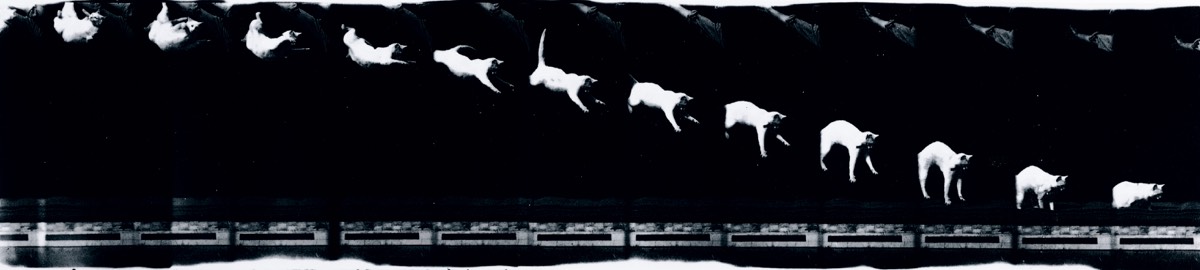
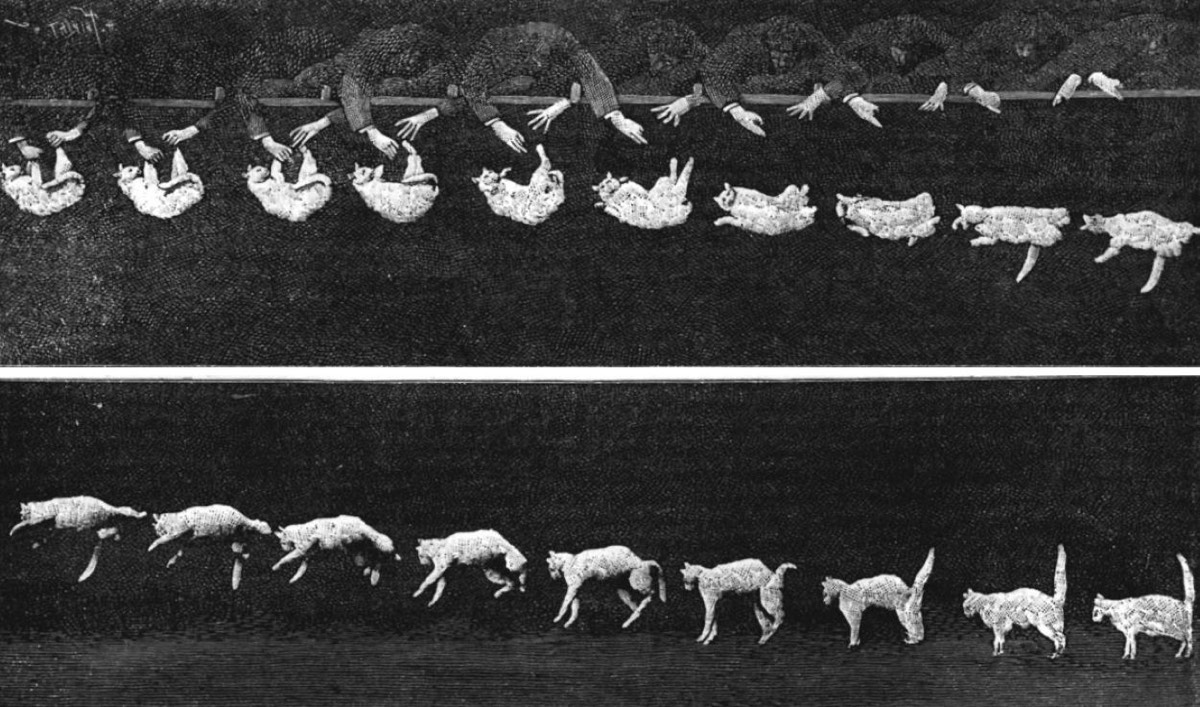
Étienne-Jules Marey did the first high speed photographs of falling down. It was almost an afterthought for him. He was doing all these different high-speed photographs of different animals, because that was his research, studying living creatures in motion. He presented the images of a falling cat, and it genuinely shocked the scientific community. One of the members at the meeting where the photographs were presented, said (and I paraphrase), “This young Marey has presented us with a problem that seems to go against the known laws of physics.”
The motions that are depicted in the photographs are quite complicated. The explanation given is part of the truth, but it seemed incomplete. It was good enough to convince physicists that a cat wasn’t violating the laws of physics, but it wasn’t good enough to convince everyone that it was the right explanation, or the complete explanation.
Ars: You summarize four distinct hypotheses offered at various times to explain the phenomenon of cat turning. So what is the best explanation we have so far for how a cat can turn and fall and land on its feet?
Gbur: This is part of why it was such a challenge: all these different motions play a role. If you’re looking at a series of photographs or a video of a falling cat, it becomes almost a psychological problem. Different people, their attention is going to be drawn by different aspects of a motion. But the most important is a bend and twist motion. The cat bends at the waist and counter rotates the upper and lower halves of its body in order to cancel those motions out. When one goes through the math, that seems to be the most fundamental aspect of how a cat turns over. But there are all these little corrections on top of that: using the tail, or using the paws for additional leverage, also play a role. So the fundamental explanation comes down to essentially bend and twist, but then there’s all these extra little corrections to it.
Enlarge/ Chronophotograph (circa 1893) made on moving film consisting of twelve frames showing a cat falling, taken by Etienne-Jules Marey (1830-1904).
SSPL/Getty Images
Ars: After all these studies, do we now know know exactly what’s going on with a falling cat, or is this still an area of active research?
Gbur: I don’t know that there’s anybody actively studying the cat model to try and get the finer details. It’s reached a point where understanding how a cat does it has reached, as a 19th century physicist once said, “hunting for higher decimal places.” Part of the catch is that every cat may do things just a little bit differently, because they are living creatures. You have heavier cats and lighter cats. I’ve got varieties of both at home. Longer cats and shorter cats. Each of them may twist and bend and tuck and turn just a little bit differently.
If you watch videos of falling cats, you will see that a lot of them use their tails to turn over. But we also know that cats without tails can turn over just fine. So from a physics point of view, the problem has reached a level where the details depend on the specific cat. People will still argue about it. I think a lot of physicists don’t realize how complicated the problem is, and they’re often just looking for a single simple solution. Physicists have an instinct to look for simple solutions, but nature’s always looking for the most effective solution. And those two approaches are not always the same.
“From a physics point of view, the problem has reached a level where the details depend on the specific cat.”
The emphasis these days is in that robotics area. Can we actually make a robot that can flip over like this, in as effective a way as a cat can. You can design a robot that, if you drop it upside down, can land right side up, but a cat can flip over and land right side up regardless of how it started— whether it’s upside down, whether it’s spinning, whether it’s on its side. There’s a video clip of a cat leaping up to grab a toy and it ends up flipping partially end over end as it leaps. And it does multiple twists and nevertheless manages to still land on its feet. That’s the sort of thing that I don’t think anybody has managed to get a robot to do yet. “Hey, I’m just gonna throw this robot up in the air with any sort of spinning motion I want, and nevertheless, have it still land perfectly on its feet.”
Two different approaches to the falling cat problem intersect in robotics. You can use mechanical models to try and understand what a cat is doing, and then you can also use robotics to try and replicate the cat’s motion properly. One is an analysis problem, where you’re saying, “I want to understand what’s going on.” The second part is a synthesis problem where you say, “I’m going to try and make a machine that can accurately reproduce it.”
Ars: You also discuss a 2003 paper by physics philosopher Robert Batterman, in which he examines falling cats in terms of geometric phases, which in turn connects to a Foucault pendulum. Can you elaborate a bit on this particular connection?
Gbur: The basic idea is that there are a lot of physics problems where you can cycle the system. You start with the system and one condition, and you bring it through some change of behavior back to its original condition. But nevertheless it ends with a different behavior than it started. The falling cat is a good example. The cat starts upside down with his back straight, ends up right side up with his back straight. Even though it’s twisted and turned along the way, it ends up with a straight back again, but it’s now rotated 180 degrees.
Foucault’s pendulum is where you have this pendulum oscillating on the earth, a full day goes by, and the earth has done a full revolution. So the pendulum is spatially back where it started at the beginning of the previous day, but it is swinging in a different direction. The really remarkable thing is that the mathematics is structurally similar for all these different problems. So if you understand the falling cat problem, you understand a little bit about Foucault’s pendulum and how it works. Batterman also ties falling cats to polarized light and parallel parking as manifestations of the geometric phase in physics.
Ars: It sometimes seems like physicists don’t always appreciate how important their own history is to understanding current research.
Gbur: One reason I always emphasize learning a lot of science history is that it gives us a better understanding of how science is done. In basic physics classes, we’re often taught a very abbreviated and abridged version of the history, where you’re given the straight line path that leads to the end. I think of science history as sort of a maze. You’ve got a bunch of people wandering through this maze and a lot of people hit dead ends. That’s very natural, because nobody knows what they’re looking for. When we’re taught the history of science in class, we’re often only taught about the person who made it to the end of the maze without making any mistakes.
For students, that can give a very false impression that science is always about, “Yes, I know exactly what I’m doing and I know exactly where I’m going.” That isn’t the case. For the general public, it’s often useful to realize that, yes, science is always moving forward, but there are these dead ends, there are these mistakes along the way. It’s not perfect. That is not a condemnation of science, but the natural way things work.
https://arstechnica.com/?p=1636625
Ars Technica’s best games of 2019
Enlarge/ Wait—this image seems to be missing the Kojima baby proton packs, no?
Simogo / Nintendo / Remedy / House House
Before we get on to the list, don’t miss this year’s Ars Technica Charity Drive sweepstakes. You can win part of nearly $5,000 in prizes, including limited-edition gaming collectibles, all while helping out a good cause. Entries are due by January 6, 2020, and there’s no purchase necessary. Thanks in advance for your entry!
Today’s gamer is faced with an embarrassment of riches when it comes to choices. Every day there are literally dozens of new titles being released across consoles, PCs, mobile phones, VR platforms, and more. Usually that includes at least a couple of games that would be worth your time, if only you had the time to sort through them all.
We can’t say we’ve played through all the thousands of titles big and small that have come out this year. Of the ones we have played, though, these are the ones that we’d feel comfortable recommending to anyone.
The basic story in Telling Lies wouldn’t be all that interesting if it was told as a standard, linear movie plot. But Sam Barlow’s follow-up to 2015’s excellent Her Story once again proves that the storytelling function can grow out of a newly relevant interactive form.
Players experience the narrative of Telling Lies via one-sided pieces of two-way video conversations, accessed via semi-random searches through a hard drive database. There’s an immense intimacy to experiencing a story like this, via characters talking directly to the camera, to you. You see these people utterly exposed, interacting with unseen partners, reacting to unheard provocations, and pausing to listen to long-unheard monologues, with no knowledge that someone else will be spying on them much later. Getting to know these people in this way almost feels intrusive, like you’re intruding on private moments that might better remain hidden.
There’s a certain puzzle-sorting joy in piecing together the larger plot from these disjointed conversations, and every newly discovered clip has the potential to serve as a “twist” that recontextualizes information from the past (or the future, depending on the order in which you view it all). While the conclusion feels a little cliche and not entirely earned, the strong acting and tightly written characterization keeps it all engaging until the very last clip is discovered. We can only hope Barlow’s work inspires others to keep experimenting with what is still a largely unexplored storytelling format. -Kyle Orland
More Destiny? Meh. More Borderlands? Nah. Give us more Remnant: From the Ashes.
This modest third-person combat game takes all of the lessons a development team could possibly learn from Destiny 2, Monster Hunter, and Dark Souls, then funnels them together into a co-op combat experience that I keep returning to with my favorite online battling buddies. There’s a real grace to Remnant’s semi-randomized combat onslaught. You’ll march through a randomly generated town instance one moment, picking through its every corner for useful loot while contending with surprise-spawn enemies, then find a door that warps you to either a randomized or pre-made instance of more intense foes (or even one of its many incredible boss battles).
After every particularly brutal battle, the game is wise enough to drop an accordion-squeeze cool-down of traversal and simpler combat before ramping things up again. And at any point, it’s easy for a trio of friends to warp to a base and unpack a mix of weapon purchases and plot reveals in ways that should particularly embarrass the devs who famously bungled the very same thing in Anthem.
This basic formula, which constantly keeps a group of friends exploring and fighting without any aimless wandering through open worlds, is anchored by a tremendous mix and balance of ammo-limited firearms and brutal-and-slow, Souls-like melee implements. Remnant is generous enough to let players customize their loadouts to specialize in either gunplay or swordsmanship, but you won’t get far without juggling each weapon extreme. Plus, it’s easy enough for friends to bring on a random partner or newbie thanks to intelligently scaling combat, so it’s that much easier to party up and play Remnant in its ideal, three-fighter state at any given moment. -Sam Machkovech
Tabletop games continue their push into the electronic space, with at least a dozen digital adaptations released in 2019—and that’s not counting the numerous games in Early Access (like Gloomhaven) or approaching beta (Charterstone). Below, I’ve ranked my eight best of the year based on app quality, play experience, and purchase price.
Other games were either too buggy or just not good enough to include. I’ll give an honorable mention to Takenoko, which was released in early December and looks fantastic… but is just too buggy to recommend right now. For example, if you switch out of the app mid-game, the app usually restarts and loses your progress, and the app requires you to tap too many times during AI opponents’ moves. (Surprisingly, it’s from Asmodee Digital, who typically does such great and bug-free work, so I expect these problems will eventually be resolved, but for now I’d say hold off on purchasing even if you love the tabletop version.)
But these eight are each worth your time. We’ll kick things off with…
8. Mystic Vale (Nomad Games)
Enlarge/ This one showcases the game’s great artwork.
Mystic Vale is a “card-crafting” deckbuilder, where you buy cards from the market and use them to enhance cards that are already in your deck. Each card has three slots you can upgrade, and you can only add a new card to an existing one if the right slot remains unused. As with most deckbuilders, you’re trying to acquire as many victory points as you can, mostly through card values, but here there are additional points in a shared pool that you can acquire through the right card combinations.
The digital version does a great job of letting you scroll through the two rows of the market and through your two rows of cards (cards in play and permanent cards), expanding or removing focus as needed and highlighting what cards you can legally purchase and play on each turn. My one quibble with the app is that the game ends so abruptly—there’s no warning unless you’re watching the victory point stash to see that it’s nearly exhausted.
7. Aeon’s End (Handelabra Games)
Enlarge/ You can’t let something that ugly defeat you!
I wouldn’t have given Aeon’s End a second thought prior to trying this app—which is at the high end of the price range for board game apps at $9.99—but this implementation really sells the game itself and does a fantastic job of making it clear to the player what the available options are. A co-operative deckbuilder, Aeon’s End pits players against a single opponent that operates from its own deck and must be defeated over a course of many rounds while it counterattacks and adds harmful cards to player decks. The enemy might have 60 hit points that players must deplete, while the enemy can win by depleting the hit point value of the players’ home of Gravewell, which starts at a much lower number. The player decks comprise just two card types (beyond what the enemy adds), attack spells (which, err, attack the baddies), and currency cards (which help you buy better cards from the market).
You’ll get your tail kicked the first few rounds, but eventually you get more powerful cards, open more “breaches” so you can cast more attack spells, and start to see the tide shift in your favor. The app works beautifully, and the in-game help is incredibly useful; there were some rare cases where I didn’t grasp immediately what the app wanted me to do, but by my second play-through I had it down.
This app release received little fanfare despite the cardboard game’s exalted status as the top-rated two-player game on BoardGameGeek. (Ars also highly recommended it in our own two-player board game guide.)
7 Wonders Duel reimagines the great 3-7 player game 7 Wonders as a more interactive two-player conflict. In each of three rounds, players deal out a tableau of cards in a specific shape to the table between them, then alternate buying cards from the visible unblocked cards in that tableau. Some of these cards grant resources, some grant points, some grant military strength, and many give you free cards in later rounds. You can win 7 Wonders Duel by gaining the most points—or you can shut the game down early by gaining a big military advantage or by collecting six unique science tokens.
The app makes the cost to build each card clear via a number in the upper left that changes color if it’s beyond your means. The game is playable on small screens as well, so long as you’re fine with frequent tap-and-press moves to get closer looks at various cards. The one flaw is that building Wonders is not intuitive—you must click on your Wonders to activate a pop-up screen, then drag a card from the tableau to the Wonder you wish to build. The AI players seem strong—or I’m just not very good—and move quickly so you can play a complete game against the app in just a few minutes.
Raiders is Shem Phillips’ first worker-placement game in a trilogy of worker-placement games that has since been followed by two more games in another trilogy of worker-placement games (got that?), all of which have the same goofy yet wonderful artwork. Raiders of the North Sea was perfect for a port to the digital space because it’s a game of a lot of pieces, so setup and cleanup are a bit of a chore. Players gather provisions in the village, placing one worker to use an action space and picking up another worker to use a second action space, and collecting coins to hire a crew for raiding ships. Once they meet the requirements to raid a space on the top portion of the board, players can go raiding, gathering rewards and victory points—but often losing one or two crew members in the process.
The app doesn’t just look great, it moves well, and the developers let you jump from the village to the raiding section so that it’s always clear what action spaces are available and what they do or cost. There is a campaign mode that forces you to play with some variants and stretch yourself a little, but I didn’t find it challenging enough. The AI players were too weak in the initial release, but they’ve at least been ramped up a little bit in subsequent updates.
https://arstechnica.com/?p=1636335
The five best new podcasts to help nerds escape the news cycle
Enlarge/ Chill in bed this holiday by catching up with the best of 2019’s new-this-year nerdy podcasts.
Aurich Lawson / Getty
I’ve spent enough time immersed in the 2019 news cycle to start feeling a little like the world is ending. Maybe that’s why I’m always plugged into podcasts—and not necessarily for mindless escapism. Instead of news broadcasts and current events, I prefer to fill my ears with nerdy knowledge and stories of scientific research. By year’s end, I was surprised to find myself with five terrific series, all new this year, to recommend to anybody else in a similar situation.
Spacebridge
So if 2019 was spent searching for news-cycle relief and hope, let’s begin with a docu-series about another time the world seemed to be on the brink of destruction.
Enlarge/ Khryusha the Pig and Kermit the Frog chat on a popular Soviet children’s show.
Spacebridge, a four-part miniseries from Radiotopia’s Showcase, tells the story of a collaboration between an American astronaut, a researcher of psychic phenomena, and a Russian utopian activist who tried to end the Cold War in the mid-1980s. The titular Spacebridges were satellite video calls between television studios in the United States and Soviet Union designed to allow ordinary people to become “citizen diplomats” and make peace simply by learning to care about each other’s lives.
The process did not go smoothly. Spacebridge is careful to explain for younger listeners (read: myself) how an entire generation felt living in the shadow of the Cold War and how little Spacebridge really affected international politics. The calls were plagued by technical failures, and when they did go through, popular disaster movies and careless remarks by President Ronald Reagan kept people on both sides wary of engaging with the enemy. Even at the best of times, mutual culture shock between American and Soviet Spacebridge participants created chaos and threatened plans for future calls.
So Spacebridge didn’t bring about world peace all by itself. But it did lead to some transcendent moments, like the performance of a musical written to account for broadcast delay over the satellite link, as well as a hilarious Muppets special featuring a call-in from a famous Soviet television puppet. The successes of Spacebridge, intermittent though they were, reminded everyone involved—including me, listening to recordings decades later—that world peace is possible.
Enlarge/ Hmm. It’s really hard to tell what this podcast is about based on the title. (Kidding.)
Somethin’ Else
David Tennant Does a Podcast With…
At the extreme other end of the excellent-podcast spectrum, sometimes I just like to listen to people talking about things they enjoy. And while we’re at it, why not listen to one of my favorite actors talk with some of his favorite actors about things they enjoy.
In David Tennant Does a Podcast With…, the titular Scottish actor (Doctor Who, Harry Potter) interviews other actors about their careers. Tennant brings wonderful enthusiasm to the show, especially when interviewing people he’s worked with or who he admires, but he also does a great job of making space for interviewees to tell their stories, and asking questions that get to the emotional cores of their most famous roles.
You don’t have to like celebrity gossip to enjoy Tennant’s podcast. The show is full of great moments in film and television history, as well as autobiographical deep dives into the careers of some wonderful people. If you love Doctor Who, start with the episodes featuring Catherine Tate, Jodie Whittaker, and James Corden. If you like Lord of the Rings, start with Ian McKellen. If you like comedy news, start with Samantha Bee. And if you’re not sure where to start, I recommend the fun- and chemistry-filled episode with Whoopi Goldberg.