Ars’ favorite movies of the 2010s (John Wick most definitely included)

I’ll say this much—it’s been an unusual decade for movie fans in the Ars Orbital HQ.
Sony Pictures | produced by Jennifer Hahn
Peter Opaskar

Ars Technica turns 21 at the end of this year, but film coverage on site can’t exactly purchase synthehol at the liquor store yet. Quietly, we’ve been reviewing movies on the Internet for 11 years now—a baker’s dozen years if reviews of 3D experiences count—starting with this Max Payne piece that certainly qualifies as criticism. But beginning in 2014, we made film a regular topic on site. And these days we annually bounce from SXSW to Fantastic Fest with plenty of regional film events in between.

Now, this ain’t Variety, and we do not write about everything (though we have covered Beauty and The Beast and The Jungle Book somehow). But Ars has quite a few highlights in the 2010s beyond just starting a dedicated culture section. We failed at Vulcan salutes with Jake Gyllenhall and Ryan Reynolds. We caught the premiere of a Academy Award-nominated movie at NASA’s Johnson Space Center. Somehow, we even helped save a Star Wars-adjacent movie from obscurity (earning an IMDb credit and inspiring a full-length remake in the process).

So with the end of the decade rapidly approaching, we felt it was OK to indulge our film list-making impulses. This is not necessarily a Best Films of the decade list—undeniably great things like Lady Bird, Moonlight, The Master, Bridesmaids, et al. are fantastic films that do not really fall within our narrow wheelhouse of science, technology, and genre fare. It is not a list of the Most Important films, either, as this decade of streaming’s rise, female directors taking the reins, continued globalization of cinema, and a golden era for documentaries can likely be better explained elsewhere in the cinema-centric press. But the following is definitely a list of the stuff from the last decade that continues to come up in conversation around the Orbital HQ years later, and presumably these films will be forever fixtures of our streaming queues going forward.

So with apologies to the many close calls that felt too small (Anna and The Apocalypse, The Guilty, Love & Saucers, Who Is Arthur Chu?), too popcorn-y (pick your Fast and Furious installment, Stuber, Annihilation, Pacific Rim), or just too-good-but-not-great in the face of this competition (Zootopia, Inception, The Lobster), here are Ars’ “ten” favorites, in alphabetical order:

Arrival (2016) / Gravity (2013) / Hidden Figures (2017) / The Martian (2015)

A new space race

It’s probably not a coincidence that during a decade when the most important and impactful technological change may prove to be the rise of the private space industry, audiences were treated to a renaissance of space cinema, too. It turns out a great space movie does not have to involve intergalactic war or precise period piece drama (though we all underrated First Man, folks).

If you want utter spectacle in the most realistic way possible, Alfonso Cuarón’s Gravity may have been the in-theater experience of the decade. The vastness of space has never been more vivid, even if some of the details may have irked our resident space purists. The Matt Damon-led The Martian somehow made the intricacies of growing crops in space exciting, continuing the trend of excellent science fiction that leaned heavily into the science.

No one knew linguistics was this fascinating back in 2016, but Arrival just might be the overall best movie of the decade with the way it cleverly examines what we believe while simultaneously delivering a tense, gripping sci-fi story. And Hidden Figures puts the familiar period-piece lens on an overlooked part of space history without glossing over the ugly bits while still feeling hopeful for what science and technology can achieve when the best and brightest can participate. Add any number of other fine space movies to this lot—Interstellar, Ad Astra, etc.—but this quartet revived a cinematic subset Ars will always have a fondness for.

Black Panther (2018) / Logan (2017) / Mad Max: Fury Road (2015) / Wonder Woman (2017)

Something different in a decade of superheroes

The 2010s will undeniably go down as the decade of superheroes. By no means did it start here (the Nolan Batman trilogy began in the 2000s, as did the MCU with Iron Man in 2008), but it became an expanded universe, cinematic event these last 10 years. The first Avengers hit in 2012, and box offices haven’t looked back since.

Picking favorites among the standard superhero fare feels impossible. Your preferences of memorable Spider-Man (Into the Spider-Verse), Iron-Man (Iron Man 2), Captain America (Winter Soldier), or other regulation superhero flicks (Ragnarok ever-so-slightly over the original Deadpool?) may just depend on which hero your childhood allegiances line up toward. The true superteam event releases marked something slightly different and spectacular (Avengers: End Game over the original Guardians by a hair). But the caped crusades we’ll remember a decade or two from now all busted out of the familiar formula to some degree.

Black Panther showed not only was there audience appetite for a big-budget black superhero flick, but there was appetite for one that grappled with modern societal challenges like isolationism, oppression, and technological disparity. Logan took a hero long familiar to film-goers and turned the tropes of a superhero film into a Western that comments on universal themes like aging and the human condition in the process. And while Wonder Woman may be the most straightforward super-hero-y of the three, it showed a female-led comic book conquest was worth doing, especially when it leveraged well-executed period-piece elements with delightful sidekick chemistry. For the future of the then-beleaguered DC Comics entertainment arm, Wonder Woman also proved everything didn’t have to be dark and brooding in order to reach an audience (all the fun being had in HBO’s Watchmen seems to indicate DC took the hint).

And, OK, it’s not a traditional superhero movie, but we couldn’t make an of-the-decade film list and exclude Mad Max: Fury Road entirely. Like more traditional caped-crusader flicks, this is an existing IP with an established hero that got a reimagining decades after the original. It starts with a very super villain-y evil plot (our titular hero is being sucked for blood to heal the bad-team War Boys; another hero has to help a group of women known as the Five Wives escape forced procreations). The film also offers extremely satisfying set pieces and action, plus ultimately some reveals that change how we previously understood our main character. Finally, perhaps most like the trio above, this newest Mad Max film took a decidedly different approach to its familiar post-apocalyptic world. Max Rockatansky may be back (invigorated by Tom Hardy), but the star of the show is Imperator Furiosa (Charlize Theron), the post-apocalyptic female hero sci-fi action fans deserve.

Listing image by Peter Opaskar

https://arstechnica.com/?p=1624699


How the scourge of cheating is changing speedrunning

A familiar screen to many.
Enlarge / A familiar screen to many.

When an Australian gamer called “Anti” completed a full playthrough of Grand Theft Auto: San Andreas in a scant four hours, the feat almost seemed impossible. Yet any fans of speedrunning—an activity where die-hard players jockey to complete the game as quickly as possible, with different rulesets forming discrete “categories” of competition—could see this incredible “run” for themselves on the game’s leaderboards. Anti had posted the entire thing online.

An old saying may be coming to mind, and yes: it was too good to be true. A fellow competitor started analyzing Anti’s videos to optimize their own in-game routes, but they noticed that several vehicles in these runs left a faint smoke trail when they accelerated. Since no other runs on the GTA: San Andreas speedrun leaderboard evinced this telltale exhaust, this competitor began to wonder: was Anti somehow messing with the game in order to pull off this record-breaking time?

In the PC versions of the GTA games, after all, the files that control the way cars perform are easily accessible via a plain text editor like Windows Notepad. Game fans know this. And by slightly boosting certain variables to make cars accelerate ever-so-slightly faster, this fellow speedrunner was able to recreate the smoke effect in Anti’s runs. Soon, several runners started complaining to the greater community; someone even created a slick montage full of evidence that Anti had modified the game in order to shave vital seconds from their records.

In August 2018, the leaderboard moderators finally felt compelled to act, announcing a one-year-ban for “Anti” due to suspected cheating. The decision sent shockwaves reverberating through this tiny clique of GTA speedrunners, especially since Anti was an accomplished runner in the scene. At the time, Anti held several world records in each game in the series.

Gotta go fast

Ever since the first two hopeless MIT geeks battled it out in primitive progenitors like Spacewar!, video game players have cast their hobby as a form of heated competition. But while it’s the behemoths like Valve that finance the glittering million-dollar tournaments for esports like Dota, on the grassroots side of the spectrum, there’s a vibrant scene of gamers who pour their hours into an entirely different competition: that of “speedrunning.”

Since the mid-2010s, speedrunning has exploded in popularity as a pseudo-spectator sport, thanks largely to the annual charity event Awesome Games Done Quick (celebrating its tenth anniversary this January), where runners are invited to show off their skills on-stream to raise funds for organizations like Doctors Without Borders. Outside the outsized spotlight of this biannual spectacle, however, the competition rages on platforms like Twitch, where determined runners stream their attempts to break into the all-important leaderboards hosted on Speedrun.com. However, in certain walled-off corners of this tiny world, members of the community have begun to publicly question the legitimacy of certain competitors and records, wrenching open a Pandora’s box of controversy that some runners feel threatens the entire foundation of the hobby as they know it.

In many ways, Anti’s faked GTA runs might stand as a microcosm of the ever-present spectre of cheating that has lurked under the surface of the hobby for years now. Speedrunning fans know the script: first came the announcement, then a half-hearted apology, where Anti admitted that at least some of the runs were cheated. Next came the backlash against the moderators from fans of Anti’s streams, who stated that the apology was a sign of growing maturity. That was, of course, followed by the backlash to the backlash, when the moderators decided to make the ban permanent after analysis of Anti’s older runs concluded that the speedrunner’s confession was far from complete and that the cheating was far more widespread than initially claimed. Eventually, after the initial explosion of drama, Anti’s runs were scrubbed from the GTA charts, and the controversy ebbed away.

According to YouTuber Ben “Apollo Legend” Smith—himself a divisive figure in the world of speedrunning, largely due to his fiery fusillades against some of the biggest players in the space like GDQ—incidents like these are part of a growing trend of trusted, even prominent runners being exposed as fraudsters in sub-communities that they themselves helped build. But while the level of scrutiny that Smith and fellow content creators bring to bear on these alleged cheaters is certainly a new development, the concept of cheating is not. In fact, it’s almost as old as the hobby itself; one GoldenEye 007 runner was faking his runs as early as the late ‘90s. So as the world of speedrunning continues to grow larger and larger today, Smith worries that the methods that cheaters employ will only grow more sophisticated—and, with enough time, perhaps they will become entirely undetectable.

“I think people have probably been cheating as long as speedrunning has existed,” Smith says. “I think it’s only natural. But as more people come into the hobby, that number only grows. It’s a pretty big problem, in my opinion.”

https://arstechnica.com/?p=1635307


Nick Farmer knows dozens of languages, so he invented one for The Expanse

Linguist Nick Farmer tells us more about some of his favorite Belter words. (Video edited by Jennifer Hahn)

OAKLAND, Calif.—It all started when Nick Farmer bought George R. R. Martin a drink, but the plot really thickened when the linguist met Martin’s then-assistant Ty Franck. Franck was one half of the writing team behind the novels that fuel SyFy’s incredible new series, The Expanse. And the author soon discovered that Farmer was a talented polyglot, a master of over two dozen languages who worked as a linguistic sellsword for financial research companies desperate to translate global business news for analysts. Farmer also happened to be just the kind of expert that Franck and his co-author Daniel Abraham needed to bring their novels to the screen.

The Expanse series takes place two centuries from now in the Belt, a ring of asteroids that orbit the Sun between Mars and Jupiter. People who have migrated to the Belt come from all over Earth speaking dozens of languages, and they’re often isolated for years at a time on remote mining stations. To communicate, they evolve a creole called Belter, which becomes the lingua franca for what is essentially the solar system’s new proletariat. The problem? In the book, Belter could be referenced. But now that The Expanse was coming to television, people would actually have to speak the damn thing. SyFy suddenly needed a linguist who could build a language out of dozens of parts. Luckily, Franck knew a guy. He soon recommended Farmer, who delivered a lot more than they bargained for.

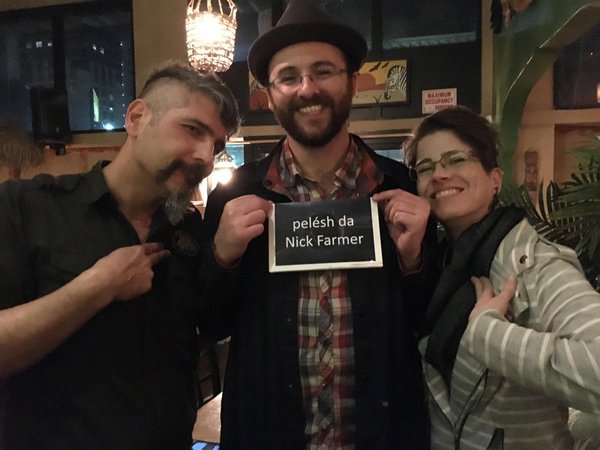
 Nick Farmer (center), flanked by Pirate (left) and Lexi Breed (right).
Nick Farmer (center), flanked by Pirate (left) and Lexi Breed (right).

Last week, we interviewed Farmer about Belter at an Ars Technica meetup in Oakland’s Longitude bar—a place where the bartender, Pirate, is such a fan of the show that he’s taught himself to speak Belter. Farmer’s language has become so integral to the plot of the show that we hear it in every episode. It appears in graffiti, in background songs, and in key conversations between members of the Belter separatist group OPA. Fans of the show have gone nuts for it, trying desperately to figure out what each word means. And Farmer feeds the fire on Twitter, releasing a word every day. In fact, Farmer first met Pirate after offering to trade new words for free drinks at Longitude.

Bullshit, but with less gravity

Farmer told us that he spent quite a while thinking about how a creole—usually a blend of a couple “substrate” languages and one dominant “superstrate”—would evolve in space. He used Haitian creole as his guide, because its speakers all came from elsewhere to work on the island. Slaves taken from Africa combined their own native languages with the dominant French, and the result was a shared tongue that only the slaves understood. Like Haiti, the Belt is dominated by a wealthy class of colonizers (in this case, Earthers who speak English). But all the labor is done by what Farmer calls “economic slaves” who risk their lives in mines. The resulting Belter creole is a crazy mix of English, Chinese, romance languages like French, German, Persian, Hebrew, Zulu, and a few other surprises. Farmer says he has over 1,000 Belter words in his personal dictionary, and he keeps adding more as the show’s producers and fans request them.

There is a simple, regular grammar that is typical of creoles. If you’re building a lingua franca, there’s no point in filling it with Latin-style declensions and crazy irregular structures. But Farmer says there are complex levels when it comes to speaking Belter. Some characters speak pure Belter, but most speak about half-English, half-Belter, adjusting their vocabulary for each situation. If they’re holding a separatist rally to protest Earther rule, Belter is the order of the day. If they’re trying to talk to a boss, English makes more sense. In everyday chit-chat, they’ll probably switch back and forth without thinking about it.

Farmer gave us the backstory on several of the words he’s invented, including “well walla,” a mix of English and Hindi. Well walla is a disparaging term for a Belter who acts like an Earther (well is for the “gravity well” of Earth, and walla means person in Hindi). He also decided that Belters wouldn’t use the term “bullshit,” because there would be no bulls in the Belt. Instead, they would come up with a uniquely Belter curse, “kaka felota,” a term for what happens when your toilet backs up in low gravity and shit floats all over the place. (“Kata felota” literally means “floating shit.”)

At the event on Wednesday, Farmer regaled the Oakland crowd with a discussion of the Belter gestures. While they aren’t part of the spoken language, they do form a crucial element of Belter culture—they’re sort of like shrugs or handshakes, which aren’t exactly words but do mean something. Like the spoken elements, Belter gestures are included without translation in the show.

One gesture Farmer’s added to the show comes from Colombian culture—an elbow pointed down with the other hand rubbing the elbow joint. Like its Earther origin, it means someone who is a cheapskate. But over time in the Belt, the gesture has come to mean any person who is generally awful.

The Expanse has already finished its first season (we liked it as much as Farmer’s fans at Longitude last week), but don’t fret if you missed all the Belter thus far. SyFy has already greenlit a second season set to debut in 2017, meaning Farmer will have more additions to make to his dictionary. In the meantime, start studying with this bunch of #WowtLangBeltafoTudiye (Words of the Day).

Listing image by SyFy

https://arstechnica.com/?p=822023


TV changed a lot in the 2010s, and the decade’s best reflects that

This is how everyone does it, right? Apple TV on a vintage TV cabinet?
Enlarge / This is how everyone does it, right? Apple TV on a vintage TV cabinet?

It’s hard to imagine, given what makes for TV news these days, but just 10 years ago no one had heard of Netflix originals, Amazon Prime series, YouTube TV, Apple TV+, Disney+, or even HBO Go. Most American households, for instance, still defaulted to cable, and we watched on dedicated sets (even if the push for multi-screen experiences and laptops/computers as primary consumption devices had already started). TiVo existed and felt cutting edge.

Perhaps more than any other entertainment medium, TV has really changed a lot in the last decade. And that makes trying to piece together a Best Of list for the 2010s extremely difficult. To start, there’s simply more stuff than ever before. When even Facebook consistently debuts original “TV shows” at this point, keeping up with everything may literally be impossible. The breadth of what’s available is also at an all-time high. How do you compare some 10-episode, 12-minute sketch comedy show on a streaming service to something on traditional cable drama with 10 seasons and many, many hours of thought put into it? Well, you probably can’t in any authoritative or comprehensive way—but that won’t stop us from trying.

For an Ars-y Best TV of 2010s list, know up front this isn’t an all-encompassing “best” exercise. Many undeniably great things (Justified, Mad Men, The Crown, Parks & Rec, Insecure, Treme, Veep, Mindhunter, et al.) do not fall within our narrow wheelhouse of science, technology, and genre fare. And to make things slightly simpler, we only considered scripted TV (so no Tidying Up or The Grand Tour, but no Last Week Tonight, United Shades of America, or Parts Unknown, either). Instead, the following shows are some combination of stuff from the last decade that changed what we think of as “TV” and stuff we’ll certainly be thinking about and returning to in our maybe-cable-less future.

So with apologies to the many close calls that felt too small (American Vandal, Nathan 4 You, The Knick), too uneven (Mr. Robot seasons 1 and 4 could definitely be here; same for American Gods S1), or just too-good-but-not-great in the face of this competition (The Handmaid’s Tale, Master of None, Twin Peaks, The Americans), here are Ars’ “ten” favorites, in alphabetical order:

Tech on TV: Better Call Saul (with some Breaking Bad bonus insight). Click here for transcript.

Breaking Bad (2008-2013)

What more can you say about Breaking Bad at this point? It delivered the most anti-anti hero of a Golden Age of TV riddled with such characters. Its fourth season featured perhaps TV’s greatest villain. And it features immensely clever applications of science and tech both on-screen (“Science, bitch!”) and off.

But Breaking Bad should perhaps be remembered just as much for how influential it was in changing the way TV worked for many of us. Though this is the lone series on this list to start outside of the 2010s, most fans likely didn’t see it until after 2011. That’s when Netflix reached a deal with AMC Networks to exclusively carry the network’s programming for a bit. The star of that deal at the time was, of course, The Walking Dead, but Breaking Bad quickly became the big benefactor. Maybe AMC marketing couldn’t get a massive fan base for a show about a chemistry teacher selling meth, but—whether it was word of mouth or critical recommendations driving it—Netflix seemed up to the task. The show’s S4 premiere reached 5.9 million viewers, more than double the show’s previous best. With all-at-once drama releases not yet the norm, Breaking Bad may have represented the first major bingewatch of the decade.

Many other soon-to-be TV-culture norms would follow. Expanded universes? Look to the (equally great) Better Call Saul and (perfectly enjoyable) El Camino to start. Miss TV monoculture and “everybody’s watching” moments? The Breaking Bad finale hit 10.3 million viewers (that’s at least in the conversations with industry heavyweights like The Walking Dead and Game of Thrones). And enjoy a good aftershow? Both Breaking Bad and Better Call Saul inspired a tremendous one—no, no, not Talking Saul (which is a totally real thing AMC aired). Creators Vince Gilligan and Peter Gould take listeners behind the scenes of the writer’s room and production effort of each episode in their official show-companion podcast.

Chernobyl (2019) / Watchmen (2019) / … and Game of Thrones (2011-2019)

Yes, yes, this decade of TV can’t be discussed without a mention of Game of Thrones. Its early seasons felt revolutionary for how they subverted audience expectations, it propelled much of the show’s female-centric cast to stardom, and its VFX may very well be the best we’ve ever witnessed on TV. And yet… those later seasons, right? After George RR Martin’s books ended, the show’s mojo seemed to follow. It may have still constituted event TV, but in retrospect that was based on the strength of the fan community and massive marketing more than the material itself. We’ll remember GoT for its immense cultural capital, not as a show with something immense to say about culture.

But if TV watchers felt concerned about the next era of HBO when corporate behemoth AT&T took over and stalwarts like Thrones, Veep, and Silicon Valley signed off, 2019 should provide some comfort. With Chernobyl and Watchmen, the network showed that its penchant for innovative and kinetic storytelling is alive, well, and adapted for the current TV landscape. Definitely a one-season limited series, Chernobyl showed audiences the dangers of authoritarian governments that refuse to acknowledge reality and insist on the narrative above all else. In what might also prove to be a one-season series, Watchmen somehow spun a nearly four-decades-old comic franchise rapidly into the 2020s, asking questions about nostalgia, inherited tragedy, and race and authority in America. Each show has powerhouse performances (Jared Harris as Valery Legasov; Regina King as Angela Abar), each show looked like little else on TV, and each displayed a level of creativity and thought that the writers behind Westeros’ late seasons could only dream of. (You’ve listened to Chernobyl writer Craig Mazin’s podcasts about each, right?) Having any of these titles on your network would be an accomplishment in any decade; HBO aired all of ‘em within a matter of months.

https://arstechnica.com/?p=1632925


Netflix’s 6 Underground is Chocobo Racing without the Final Fantasy

After a week of the preview blaring at me each time I opened the app, I finally watched Netflix’s new film 6 Underground last night. With Ryan Reynolds starring and a couple of funny wisecracking moments in the trailer, it’s easy to get your hopes up—but, for the most part, it’s a mistake. I don’t want to pan the movie too hard—I watched all two hours of it reasonably engrossed—but it’s not going to be something I remember next year, and it probably won’t be for anyone else, either.

Reynolds plays a disaffected tech billionaire who decides he’s had enough of evil in the world. So he recruits a batch of misfits, each with a special talent, and takes on the bad guys—specifically, the fascist, dictatorial regime of semi-fictional country “Turgistan.” The real Turgistan was a province of the Sasanian Empire, located in present-day Pakistan, and it quit being a thing in 651 AD. This bears little relation to 6 Underground‘s Turgistan, which is a thinly veiled pastiche of Syria and Abu Dhabi—complete with the chemical-weapon-deploying dictator of the former and the insane opulence of the latter. Reynolds and his motley gang are on a self-assigned mission to kill the amoral, evil dictator and replace him with his moral, good brother. Subtle.

6 Underground tries very hard to be at least four different movies and never quite lands any one of them. The first twenty minutes are one stupendous urban car chase—effectively, an homage to 1998’s Ronin, but with lots more shiny stuff, CGI, and things that go boom. But where Ronin delivered jaw-droppingly satisfying technical driving, 6 Underground just fakes it with camera cuts, revving noises, and iffy jokes. Later, the film takes desultory, half-hearted stabs at being Ocean’s Eleven, Deadpool, and Jarhead—but it can’t land any of those, either.

Ryan Reynolds does manage to deliver a few of his trademark edgy barbs well enough for a chuckle, and some of them weren’t even in the trailer. The extended parkour sequences, delivered by parkour collective Storror, also deliver some real thrills. But the “oh, snap” moments are few and far between, sandwiched between failed jokes, thin plot, and stuff going boom. None of the other actors really get their characters far off the ground, but it’s hard to blame them—they weren’t given much to work with.

I’d be pretty upset if I’d shelled out $10 for a ticket and another $12 for snacks to see this movie in a theater. But for all the negativity, it’s worth remembering that 6 Underground is a free watch, if you’re already a Netflix customer—and viewers who enjoy Michael Bay’s signature bang-boom-camera-cut style of action direction might find it more enthralling than I did. Either way, at the low price of “free with subscription,” it’s hard to stay mad at it, and there are worse places—such as the entirely awful Blackbear—to land in your endless Netflix scroll.

Listing image by Netflix

https://arstechnica.com/?p=1634903


Tenet marks Christopher Nolan’s return to high-concept sci-fi thrillers

[embedded content]
John David Washington stars in Christopher Nolan’s forthcoming film Tenet.

A pair of international spies must prevent the outbreak of World War III in the first trailer for Tenet, a forthcoming science fiction thriller from Director Christopher Nolan (Memento, The Dark Knight), who also gave us the mind- and reality-bending futuristic thriller Inception in 2010. Their secret weapon: a futuristic technology called time reversal.

Hardly any details about the film leaked out during production. No character names are listed on IMDB, and co-star Robert Pattinson has said that he was only allowed to read the script once, while locked in a room, when considering his role. Nolan wrapped principal photography in September after shooting in seven different countries, including Denmark, Estonia, Italy, Norway, and India. (Apparently the crew foiled a suicide attempt while shooting a scene near the Gateway of India in Mumbai.) A brief teaser was shown to audiences who went to see Hobbs and Shaw in theaters this summer, and anyone who has already seen Star Wars: The Rise of Skywalker in an IMAX theater has likely seen a special nine-minute prologue as a sneak peek.

The trailer sets up the premise immediately with a shot of two men rappelling up a building, in seeming defiance of the laws of physics. “We all believe we’d run into the burning building,” a voiceover tells us. “But until we feel that heat, we can never know.” A man (John David Washington) is undergoing what appears to be a grueling trial to join an elite international team of spies, ending with a choice: give up his colleagues, or die. He chooses death and wakes up in a hospital to learn he has passed the test (“Welcome to the afterlife”).

The man’s new assignment: prevent World War III and save the world—not from nuclear holocaust, but from “something worse.” He’s given one code word, “tenet,” to open the necessary doors—and yes that is a palindrome, meaning it reads the same backward and forward. We see glimpses of backward movement in time: a ship’s wake in reverse and a car un-crashing on a busy freeway during a chase scene. “You have to start looking at the world in a new way,” the man is told. “Don’t try to understand it. Feel it.”

Fresh off his Oscar-nominated World War II drama, Dunkirk, Nolan seems to be returning to his high-concept sci-fi roots with Tenet. He explored memory and identity in Memento and expounded on those concepts in Inception, which set up an elaborate bank heist in the world of dreams within dreams within dreams. Inception also played with physics in the dream realm in some eye-popping, conceptually interesting ways. Who could forget that hallway fight scene or Arthur (Joseph Gordon-Levitt)—faced with a freefall microgravity situation on one dream level—exploiting the equivalence principle in an elevator to “kick” his colleagues out of their dream states? So if anyone can pull off a film about being able to selectively reverse time, it’s Nolan.

The film also features Kenneth Branagh (Murder on the Orient Express), Michael Caine (Inception, Interstellar), Clémence Poésy (Fleur Delacour in the Harry Potter films), Himesh Patel (Yesterday), Elizabeth Debicki (The Man from U.N.C.L.E.), Martin Donovan (Ant-Man), Aaron Taylor-Johnson (Kickass), and Indian film stars Dimple Kapadia and Denzil Smith.

Tenet opens in theaters on July 17, 2020.

Listing image by YouTube/Warner Bros.

https://arstechnica.com/?p=1635489


Star Wars: Rise of Skywalker spoiler-free review: Kylo, Rey save the film

Promotional image for Star Wars Episode IX.
Enlarge / The best new-trilogy actors awaken in Rise of Skywalker.
Ars Technica takes spoilers seriously in film reviews. After this article’s opening section, minor plot details are revealed to explain certain opinions, but we otherwise do not include any “major” spoilers. Deeper spoilers will likely appear in the comments section upon the film’s launch, usually posted with spoiler tags.

The best thing about Star Wars Episode IX: The Rise of Skywalker is that it concludes the latest trilogy much in the same way it began. This new trilogy has all the trappings you’d expect in a Star Wars film wishlist: droids, Wookiees, blasters, lightsabers, epic space battles, wacky new characters, and on and on.

But the beating heart of this film, and the biggest reason I recommend it, is the evolving and intriguing relationship between Rey (Daisy Ridley) and Kylo Ren (Adam Driver). Rise of Skywalker is often a turbulent ride, usually to its detriment, but the storytelling conclusion for these eternally linked rivals (and the performances that carry these characters to their most powerful moments in the Star Wars series) eke this film across the “good enough for fans” line.

Without that quality (an admittedly large percentage of the film), Rise of Skywalker might otherwise serve as proof that director/co-writer J.J. Abrams was the wrong person to finish the latest trilogy. The film rushes between plot points, overuses certain characters, and wastes others. And whether you loved, tolerated, or hated 2017’s The Last Jedi, it’s easy to conclude that the previous film’s most intriguing developments and concepts were abandoned—and without any convincing proof that Abrams had better ideas in store.

“I’ll go without your blessing”

From here on out, the review is more specific about Rise of Skywalker‘s successes and failings, so while it is mindful of spoilers, you’ve been warned.

Let’s begin with the biggest failing of the film by far: how the character of Princess Leia awkwardly fits into the plot.

Shortly after the tragic passing of actor, writer, and activist Carrie Fisher, Lucasfilm announced that she would appear in Rise of Skywalker as Leia and that the film would use her real-life footage, as opposed to a CGI-ified Fisher. The resulting footage is perhaps the worst-case scenario Star Wars fans could have imagined: cookie-cutter dialogue against a green screen that could conceivably be slapped into any plot, devoid of the heart or humor that consistently marked Fisher’s work in the role of Leia.

One example of her toothless dialogue, transcribed verbatim from the film: “This mission is everything. We cannot fail.” Notice how spoiler-free that sentence is? Sure, that sounds like something Leia might say while serving as a general on a Resistance outpost. She offers slightly more specific dialogue in one interaction in the film, to set a major plot point into motion, but even that sequence has a jarring disconnect between herself and the character in question—and fails to sew together her character picking up a baton that was dropped at the end of Last Jedi. Everything about Leia’s appearance in Rise of Skywalker is rough, and it forces at least one other character to awkwardly produce the exclamation point that she was clearly set up to do herself.

In late 2017, I suggested recasting the role of Leia. I really wish someone at Lucasfilm could have either done that or jettisoned certain plot threads.

Instead, in order to make Leia’s limited appearance work, the film begins with a blur of fetch-quest activity. A pair of early sequences include striking visuals as heroes whiz through a variety of worlds, but these differ from the slowly unfolding opening sequences that have marked the best Star Wars films. Abrams frames every major player on their own separate journey, instead of letting us take our time to see each hero’s progress since the last film and how their individual progress has affected the others. We see a brief in-fighting outburst that hints to this sort of dynamic, but it’s quickly interrupted by a forced Leia-nization of the plot. https://arstechnica.com/?p=1634059


This “essential piece of computing history” just sold for $43,750

This Jacquard-driven loom, circa 1850, is considered an early predecessor of the first computers.
Enlarge / This Jacquard-driven loom, circa 1850, is considered an early predecessor of the first computers.

Charles Babbage is widely recognized as a pioneer of the programable computer due to his ingenious designs for steam-driven calculating machines in the 19th century. But Babbage drew inspiration from a number of earlier inventions, including a device invented in 1804 by French weaver and merchant Joseph Marie Jacquard. The device attached to a weaving loom and used printed punch cards to “program” intricate patterns in the woven fabric. One of these devices, circa 1850, just sold for $43,750 at Sotheby’s annual History of Science and Technology auction.

“Technically, the term ‘Jacquard loom’ is a misnomer,” said Cassandra Hatton, a senior specialist with Sotheby’s. “There’s no such thing as a Jacquard loom—there’s a Jacquard mechanism that hooks onto a loom.” It’s sometimes called a Jacquard-driven loom for that reason.

There were a handful of earlier attempts to automate the weaving process, most notably Basile Bouchon’s 1725 invention of a loom attachment using a broad strip of punched paper and a row of hooks to manipulate the threads. Jacquard brought his own innovations to the concept.

Per Sotheby’s auction website:

Jacquard… conceived of developing a semi-automatic tone-selection device, which would be integrated onto the loom, resulting in quicker production and more intricate patterns. Jacquard’s punch-card system worked much in the same way as a fax machine: each punch in the card directed a black or a white thread into the headstock of the loom, pinpointing the desired thread into place.

The invention was not popular with loom operators, many of whom lost their jobs and took to smashing Jacquard looms in protest.

The mechanism just sold at auction belonged to one of Hatton’s former clients, now deceased. The collector had been trying to establish a museum on the history of computing, grounding his vision in the early attempts to mechanize computation by Jacquard, Babbage, and others. The loom “was his pride and joy,” said Hatton. “He bought the original mechanism and then commissioned somebody to make the loom and a second [mechanism] so he could use it. So the loom is fully operational.”

The piece comes with a large box of accessories, including the original 19th-century punch cards—everything one would need to operate the machine.

Jacquard’s machine was capable of programming patterns with such precision, it was even used in 1886 to create a prayer book woven entirely in silk, using black and gray thread. Only around 50 copies were made. The Sotheby’s auction didn’t offer any rare prayer books this year, but there was a portrait of Jacquard—woven in silk on a Jacquard loom—with a mini-loom and punch card on his desk, as well as another woven silk portrait showing several men in front of a loom holding the aforementioned portrait (so very meta). Those portraits sold for $10,625 and $11,875, respectively.

https://arstechnica.com/?p=1633943


New Top Gun: Maverick trailer shows that other old star—the F-14

Do you remember where you were when the first official trailer for Top Gun: Maverick showed up on the Internet in July? I do. I was on a plane, about to take off, and while I had a lot of feelings about it I valiantly swallowed them as Tech Culture Editor Sam Machkovech had all the fun. Well, Slack tells me that Sam is still asleep, and there’s a new trailer out for the return of Top Gun, so this time he can be my wingman.

This summer’s trailer raised plenty of questions. Why was Pete “Maverick” Mitchell still in the Navy, decades after we saw him in the first movie? And what was that weird pressure suit he was wearing at one point? And can an entire movie about naval aviation still be cool if all the planes are F/A-18 Super Hornets with their goofy looking (and drag-inducing) canted pylons?

This new trailer clears up some of those questions, and obviously there will be spoilers to a degree, so stop reading now if that’s something you want to avoid before you see the film next year.

An admiral, played by Charles Parnell, has the answer to the first question: “they’re called orders, Maverick.” That weird pressure suit goes with a weird-looking stealth plane that Maverick gets to fly for reasons that remain unexplained. The final one was a trick question, because there are at least two F-14 Tomcats (albeit one is a gate guard) and a P-51 Mustang that get air time alongside the US Navy’s current workhorse.

There’s some new stuff to see—air-to-ground counts as diversity compared to the first movie, but we also get to see women fly fighter jets and also play beach volleyball. But as has become the way with Hollywood and its inability to deviate from what worked the first time around, there is plenty of fan service on display. Maverick riding his bike as the sun sets. Maverick and a special lady friend riding his bike as the sun sets. Dudes playing beach volleyball. Air combat maneuver training in the desert. It’s all there and looks predictably gorgeous.

There’s also a character who at first glance looks like a CGI’d Anthony Edwards, but it’s not Goose, it’s his son Brad Bradshaw, played by Miles Teller. Upon hearing the news this morning, “his daddy bequeathed his mustache to his son before he died” was all Senior Technology Editor Lee Hutchinson had to say.

[embedded content]

Listing image by Paramount/Skydance

https://arstechnica.com/?p=1633341


Watchmen, not Game of Thrones, proved to be HBO’s show of the decade

Do you recognize this mask?
Enlarge / Do you recognize this mask?
Warning: This story references events in the HBO series Watchmen and Game of Thrones, including their final episodes.

“Just do it. We don’t want to hear your little speech. Fucking do it. “

“Do what?” Lady Trieu asks her assembled audience of white supremacists.

“You’re gonna kill us, right?”

“Oh yeah, of course I am.”

And with that, the best show of 2019 went out with a literal atomic bang. Watchmen capped off its nine-episode run in striking fashion last night, simultaneously tying up several loose ends (How does Veidt fit in to all of this? What’s Lady Trieu’s plan? Can anyone stop the Kalvary?), delivering deep sentiment, and forcing a superhero/villain who killed millions to actually deal with an arrest. This show killed it.

Yet I watched the show alone from my couch, and only a few coworkers and a neighbor seemed ready and excited to chat about it today. There were no red-carpet screenings, impromptu community watch parties, or nearby bars advertising a highly anticipated viewing like some other HBO season finales this year.

That’s a shame, because one of these series is perhaps the network’s finest work of the decade—and the other is Game of Thrones.

Game of Shade

Both Thrones and Watchmen benefited from a new TV era. Execs were not just open to but thirsty for genre, and they sought the kind of material that may only attract a small niche of fans—but it’d be a rabid, passionate, subscribed-yesterday-and-forever type of fan. Both shows started out with a bit of a bang, a little high-profile misdirection casting, and unexpected character exits. And, perhaps most importantly and most obviously, both series were borne out of existing (and paper-based) IP.

The differences begin from there. Thrones by and large stuck to its source material until it literally couldn’t. And even the most supportive fans could agree that the show lost something when George RR Martin’s road map reached its (maybe-still-in-progress?) conclusion. Suddenly the riveting female characters the show had become known for were taking actions more stereotypical characters would, contemplating if love was the number one motivator above all (see Brienne and Jamie) or acting out of rage-filled hysteria even if it contradicted prior character traits (goodbye to the merciful and justice-championing Queen of Dragons, Freer of Slaves). The show still delivered spectacle like nothing else, but it seemed to lack storytelling. Its “anything can happen” feeling suddenly left, allowing for things like keeping Jamie alive despite coming under heavy enemy (dragon) fire or for the hugely successful conqueror Daenerys to suddenly make puzzling decision after puzzling decision with her scaly, strategic advantages.

But perhaps even more frustrating than its story line slip ups, Thrones also seemed to lose its ability to conjure up deeper questions and thought without Martin’s source material. This was a show that had interesting things to say about gender in society and politics, the weight of history and family, and the ability to make decisions in spite of destiny. Heck, even The Night King might have represented something much deeper (the inevitability of mortality?) than a zombie bogeyman. Did Thrones’ final two seasons complicate those questions or move the ideas forward in any significant way? In Ars’ eyes, at least, the show pivoted to more of a saccharine delivery system. Does the show Annalee Newitz wrote about in her review of Game of Thrones S7 feel like a monumental piece of art?

Watching Game of Thrones now feels like mainlining a bunch of CW shows like Arrow or Vampire Diaries—or even, sometimes, Jane the Virgin. The pacing is so fast that there are multiple reversals of fortune in one episode, and people go from “hey so we are kind of friends” to “we are totally boinking” in 40 minutes. I should say that I love a lot of CW shows, and I’m definitely not opposed to fast pacing. But part of Game of Thrones‘ appeal was a stately, complex layering of circumstances that gave us a sense of the tragic loss so many characters have suffered. So this season’s choices felt like stylistic whiplash.

https://arstechnica.com/?p=1632929