Tapestry: Has the mythical “2-hour civ-building board game” arrived?
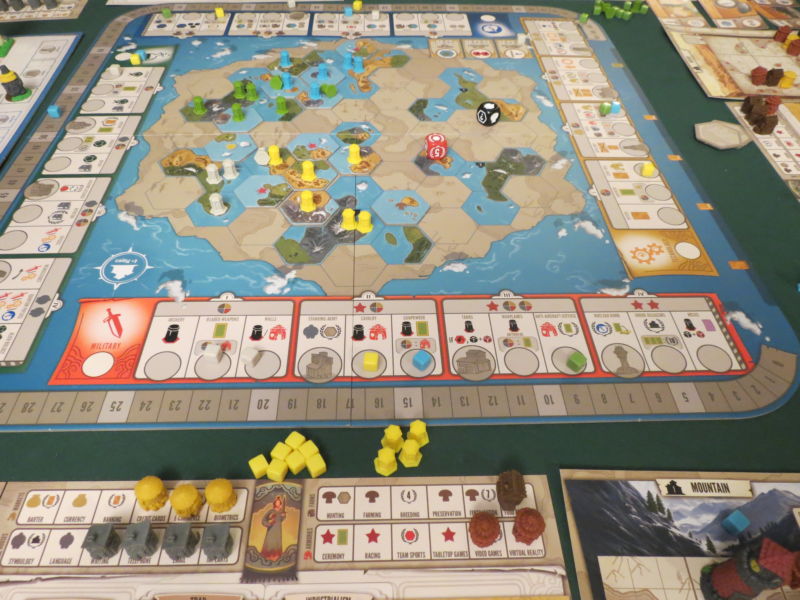
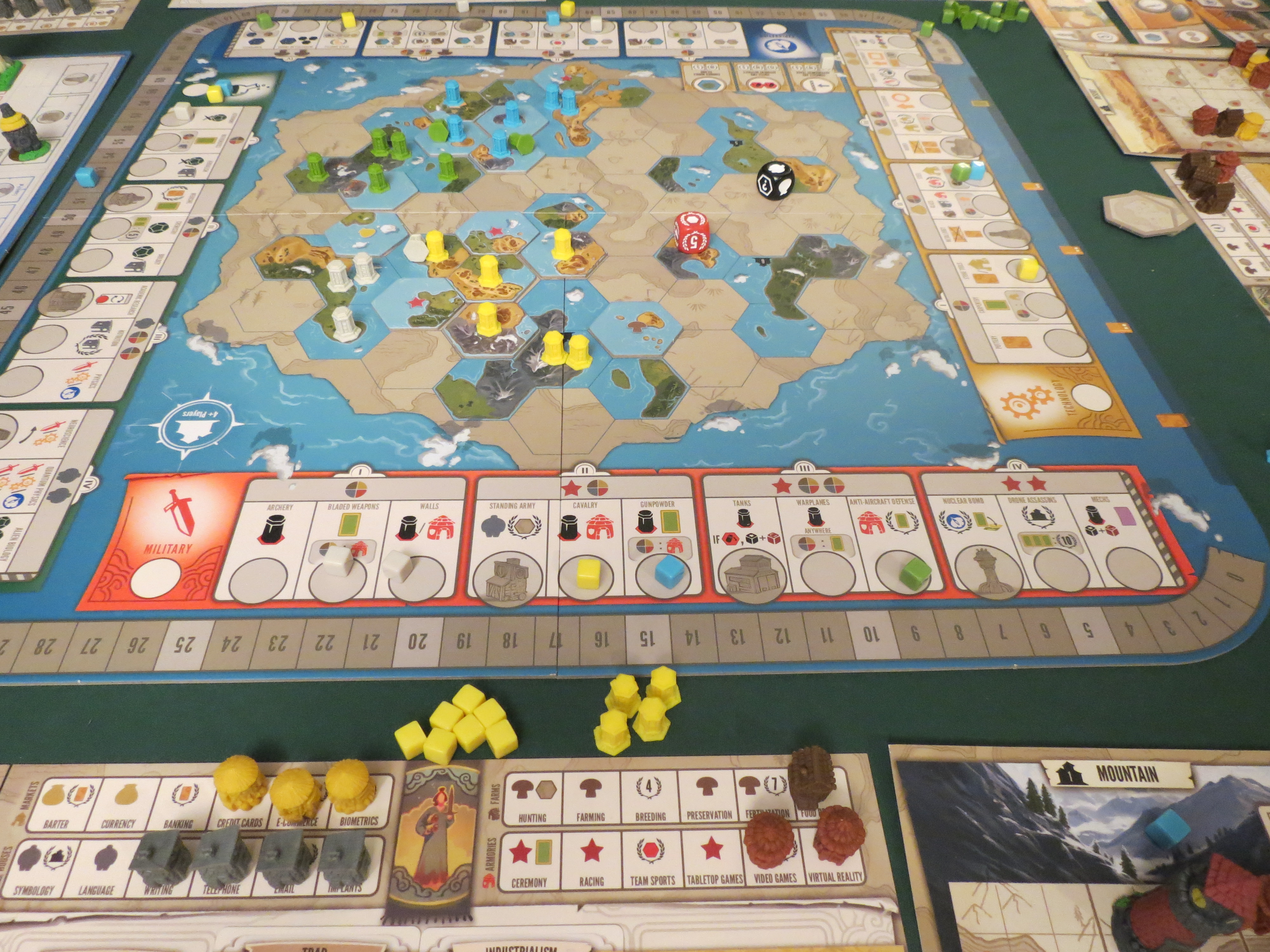
Enlarge/ Gettin’ ready for some two-hour civ building.
Dan Thurot
Welcome to Ars Cardboard, our weekend look at tabletop games! Check out our complete board gaming coverage at cardboard.arstechnica.com.
As a longtime player of cardboard civilization games, I’m always looking for titles that break the mold. From the moment it was revealed, Jamey Stegmaier’s Tapestry looked like it might fit the bill. With its pre-painted buildings, non-historical civilizations, and the hieroglyphic script that runs the perimeter of the board, it seemed to promise a civilization game that wasn’t quite like any other.
And, well, it certainly delivers on that front. Tapestry is indeed unlike most of its civ-game peers.
But not everyone loves it. A couple months after its release, the game has proved surprisingly divisive. And there’s a reason for that—it just happens to be more complicated than “this game is good” or “this game is bad.”
A (non-traditional) civilization game
Stonemaier Games
Let’s start with the positive. In a genre packed with over-complicated (and over-long) entries, Tapestry fulfills its promise of a two-hour civilization game with minimal rules. To some extent, the low learning curve is a smokescreen; the rulebook is only four pages long, but it offloads a number of concepts onto a dense double-sided reference sheet. And as anyone who’s shared a table with a friend named Geoff knows all too well, two hours can quickly stretch to three once some decisions need making.
Still, that’s pretty slim. For the most part, Tapestry really is lean. Nearly every turn is neatly handled by pushing yourself up a single space on one of the board’s four advancement tracks. These are the hieroglyphs I mentioned earlier, representing concepts like warfare, exploration, science, and technology, and they’re even more important than the hex-grid map that dominates the board. You pay a resource or three to move into your chosen track’s next space, gain a benefit, and occasionally pay for a bonus. Easy. All the better that these tracks spit out incremental rewards faster than any free-to-play app.
This is also where Tapestry’s non-traditional nature begins to show through, along with some of the issues that have proven disappointing to those who want “theme” in their board games. The advancement tracks exist in isolation, freeing the player to move along any track of their choosing as long as their resources hold out. This can feel liberating when it comes to potential combinations, letting you maximize your returns as often as possible. But there’s really nothing stopping you from developing neuroscience before stone tools, or boarding a space shuttle to distant worlds before figuring out that exploding powder can hurl objects at lethal velocities in an enemy army’s direction.
Is this a problem? It depends on whether you play games to knock systems against each other for points or because those systems support a coherent narrative. One of the hallmarks of the civilization genre has always been the sweeping narratives it produces, often leading to those aforementioned complicated rules.
If the point hasn’t already been firmly stated, Tapestry avoids this traditional direction. There are tech cards, but they don’t create a “tech tree” like any you’ve scrutinized before. Inventions like eyeglasses and anesthesia are cool to see on the table, and they raise questions over which technologies were crucial to human development. Was the wheel really such a big deal? Tapestry isn’t actually interested in such musing, just as it isn’t interested in explaining why plumbing gives you an armory or why warships dole out extra workers.
Perhaps the most overt indicator of this approach comes in the form of your capital city. As your civilization grows, new buildings are gradually added to your personal board, transforming it from swampland to city. Or, from mountaintop to metropolis. Or, from desert to deserted, if you’re too slow to grab the right landmarks. (Speaking of which, landmarks are awarded for being the first to hit certain spaces on the advancement tracks. Train stations and tank factories, lighthouses and shuttle launch pads—these stand out as a momentous reward for your hustle.)
What do these landmarks do? Fill space. Really, that’s what they do. Don’t get me wrong, filling space in your capital city is an important process. When sectors are completely filled, you get an extra resource. Completed rows and columns, meanwhile, award points. Some gamers are disappointed that an “academy” landmark does nothing more thematic than block off a 4×2 grid. Fair enough. (Although it wouldn’t be the first government project that did little more than clog up some city’s downtown.)
Like everything else in Tapestry, the city building is perfectly functional, if weirdly remote from its subject matter. It’s possible to target landmarks that will propel you ahead of the competition, whether economically or score-wise. Unfortunately, your capital might also resemble a circuit board, a weird latticework settlement that no human mind would ever willingly create or inhabit.
Cities are certainly colorful.
Stonemaier Games
Dan Thurot
Unraveling the tapestry
At this point it would be easy to argue that Tapestry is mechanically sound but narratively empty. Easy, but an oversimplification.
Both assumptions are undermined by the titular “tapestry” cards. Think of them like a national identity, something that lingers across generations to form the backbone of your culture. Maybe you’ll host the Olympics and bask in their prestige, or marry into another player’s royal family to leech off their advancements, or embrace terraforming to make your capital city look less like a Borg cube. Each player uses just three of these cards over the entire game, and the cards endow each civilization with a sense of identity and history. A diplomatic neighbor can genuinely feel like an old pal, while dictatorial oil barons with a history of pillaging are best avoided. (Bet you didn’t see that one coming.)
But tapestry cards are also wildly divergent in their effects. You’ll draw many more than you can play, but not always in time and not always with options that mesh well with the shape of your civilization. Bad draws alone don’t make the game unwinnable, but Tapestry does seem to set different point ceilings for the cultures clashing at the table. In other words, these cards take a wrench to any easy statements about the game, providing both much-appreciated dashes of narrative spice while also frustrating the best-laid plans.
Tapestry is complicated to assess. I’m certain its ideas are clever, even innovative, and it effectively reduces the civilization formula. But that word carries a double meaning. The game is reduced to essentials—a point-chaser that rewards both careful planning and outright chance. But it is also reduced to its bones, stripping away the interactions and narrative that make a two-hour civ-game such a holy grail among board gamers.
The game is divisive, then, and likely to stay that way. I’m glad Stegmaier tried to take the civilization game beyond its comfort zone. Experiments are worthwhile, even when their results are imperfect, and this may be right for you. But when it comes to the reasons I play board games—the interactions between players, the narratives that arise from play, the thematic statements—this Tapestry is bare of the threads I value most.
https://arstechnica.com/?p=1602811
The science of audio: How a podcast reveals the pleasant mysteries of hearing
The first episode of audio-obsessed podcast Reasonably Sound that made me stop and think was an early entry called “Whisper Quiet.” As my introduction to Autonomous Sensory Meridian Response (ASMR), and the specific auditory cues related to its reported physical reactions, I felt like someone had taken the top off my head, rummaged around in my brain, and found something overlooked inside that was suddenly useful. And not just in an ASMR sense, though the sample clips of Bob Ross hit all the right notes for that, as did host Mike Rugnetta getting into the spirit of ASMR by whispering the end credits.
Reasonably Sound is a podcast about audio and about the historical and cultural context of particular sounds and sonic experiences. In his episode about ASMR, Rugnetta not only introduces his audiences to what ASMR is, but he also contextualizes the rise of ASMR culture on YouTube within the broader history of communication technology, starting with an AT&T advertising campaign from the 1970s promoting long-distance calls as a medium for emotional intimacy. He also digs into the jargon of ASMR culture, comparing the pleasant “triggers” found in ASMR videos to the more serious triggers of trauma responses.
Research into the causes of ASMR didn’t start being published in earnest until 2015, months after the release of “Whisper Quiet,” so Rugnetta mentions in a later episode that he’s skeptical of the phenomenon’s existence. But, real or imagined, he acknowledges ASMR’s memetic status and delights in exploring the cultural context that produced it.
Do you hear what I hear
Every episode of Reasonably Sound follows a similar structure before delivering audio-related revelations. Rugnetta starts by focusing on a single sonic concept, then dives into that concept’s cultural context. For example, “Taylor Swift’s White Noise” begins by explaining how white noise works and goes on to dig into the cultural distinction between noise and music, centered on an incident in 2014 in which Swift accidentally released eight seconds of white noise as a song on iTunes. “For Whom the Whistle Blows” is about dog whistles, both as literal canine-directed noisemakers and as a political metaphor from the United States’ 2016 election season.
And “Molly’s Misophonia” mirrors “Whisper Quiet” by explaining the opposite of ASMR: a psychiatric condition called misophonia, in which certain sounds, like chewing or paper rustling, are physically unbearable. To complete the reflection, this episode gets personal instead of exploring a broader context.
Rugnetta interviews his partner Molly Templeton about how her misophonia affects her life. Misophonia is triggered not only by sounds, but by sounds in context, and a person’s misophonia is most often triggered by their family and close friends. By interviewing Templeton about her experience, Rugnetta learned how the everyday household noises he produces accidentally contribute to her discomfort.
A reasonable idea about sound
Reasonably Sound grew out of Rugnetta’s previous project, a video series for PBS called Idea Channel that ran from 2011 to 2017 and explored pop culture topics in similar depth. The original idea for Idea Channel revolved more around sound and audio, Rugnetta tells Ars Technica, but the scope of the project gradually broadened. The idea for a sound-focused show was shelved until a friend of Rugnetta’s at American Public Media invited him to work on his original idea as part of APM’s podcast network starting in 2014.
In the mid 2010s, as Rugnetta became busier with other projects, Reasonably Sound became the podcast he worked on for his own edification and peace of mind. He returned to what he’d always seen as the show’s goal: to “explore the less obvious ways sound frames and informs the human experience,” from sound design in cinema (“The BRAAAM™“) to the cultural context of applause and booing (“Put ‘Em Together” and “Boo Who?“) to the public safety hazards of silent electric-car engines (“Vrooms and the Lack Thereof“).
While episodes of Reasonably Sound became less frequent as other projects took precedence and the research for Reasonably Sound itself increased in depth and complexity, new episodes remain “a rare treat” for fans. They’re released when they’re ready and not before; they’re full of solid research, reasoning, and sound design; and even the most potentially stressful topics are narrated in Rugnetta’s soothing voice.
Rugnetta recommends that new listeners start with his most recent episode and work backward. As of press time, his most recent episode—and the one he’s most proud of—is “The World Remade,” which explores the environmental impacts of vinyl record production and online music streaming. He also recommends “Helpful Mom Voices,” about the history of machines that speak and the cultural reasons why Siri, Cortana, and other digital assistants sound the way they do, as a good example of the perspective the show takes about its subjects.
I come to this review with years of fandom as a bias, I admit, but I’d argue that Reasonably Sound might be the podcast for people who yawn at the concept of podcasts. Its variety of topics, depth of research, and wonderfully pleasant production make it an all-in-one audio destination in which you can plug your ears into every detail of the audio experience.
https://arstechnica.com/?p=1602133
The version of Star Wars on Disney+ changes the canon once again
Drew Stewart got the call at around 2am: They broke the universe again, you should check it out.
So Stewart did something he’s done countless times before; he has no idea how many. He turned on Star Wars. But this time was different—literally. The galaxy had changed, like a glitch in the Matrix (if you’ll allow a mixed cinematic metaphor). And it wasn’t the first time.
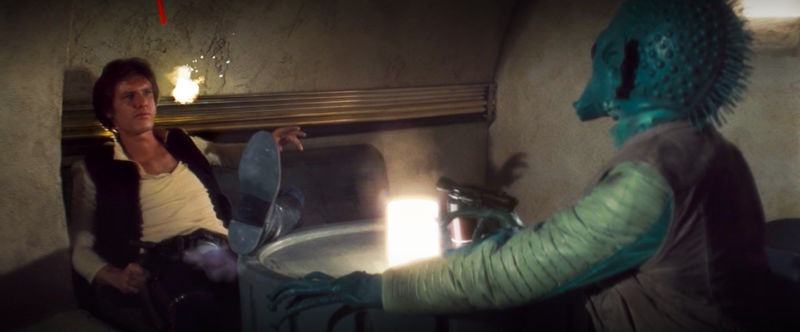
As the person behind a Twitter account called Star Wars Visual Comparison, Stewart is a kind of unofficial keeper of apocrypha, of the sometimes subtle, sometimes extraordinary changes wrought by their makers upon three Star Wars movies: A New Hope, The Empire Strikes Back, and The Return of the Jedi. These alterations to the canon are the stuff of many nerd debates, and Stewart has followed them closely. That’s why, at 2:50am on the day Disney+ launched with the whole Star Wars catalog in 4K resolution (pretty!), he found himself watching A New Hope yet again. What he found was yet another wrinkle: an all-new, all-different shoot-out between Han Solo and the lizardish bounty hunter Greedo.
Having just spent a week on the changes made to this scene since 1977—when, originally, Han kills Greedo in cold blood in the Mos Eisley cantina—Stewart knew he was seeing something extraordinary. He took to Twitter with word of his findings, and you can hear the existential despair in his voice: “Oh my god. This is not a joke.”
So what’s going on here? Well, the first Star Wars movie came out in 1977. And then things went kind of joojoofloopy. In 1981, Lucasfilm added the title “A New Hope” to the opening crawl, signaling that Star Wars is a genus, not a species. Recreating that crawl necessitated a new starfield behind it, so the giant spacecraft you see in the opening scene had to be recomposited. OK. Then, in 1997, the “special editions” came out with all sorts of new visual effects—new X-wings and a digital Jabba the Hutt in A New Hope, expanding shock wave rings around explosions, stuff like that. And, maybe most controversially, Greedo gets a shot off before Han. “It lasts like 20 frames or something. Greedo shoots, and Han just kind of sits there and then fires back eventually. Twice? He shoots twice. I don’t know how they animated that and got it through quality control,” Stewart says.
“Then we have the DVD version, which came out in 2004, and it had a myriad of changes,” Stewart says—including retiming the shoot-out. “And then the Blu-rays came out in 2011, and there were more things.” Like, for example, they cut the pause altogether.
And the version that’s on Disney+ now? “It’s a whole new thing. I just don’t understand,” Stewart says. “The insert shot of Greedo? That’s just the shot of Greedo from a few seconds before, but zoomed in poorly. Then he says a nonsense word, and then they shoot at the same time. And he explodes.” That nonsense word doesn’t even get translated in the subtitles. It’s something like “maclunkey,” and it launched memes, as things do now.
As a nerd, even I’ll allow this seems like small beer, in a way. Star Wars creator George Lucas tinkered on his stuff for decades before Disney bought his company, nominally locking the prints. One more change shouldn’t come as a huge surprise, especially since, as a Lucasfilm spokesperson confirmed, Lucas himself made the changes to the Han/Greedo scene after the Blu-ray release in 2011 and before the Disney acquisition in 2012. For fans, though, it’s something that makes the movie one more step removed from what hit theaters 42 years ago.
From a certain point of view
Put another way, the Disney+ version of Star Wars means the canon now includes 1977’s A New Hope and its 1981 revise, 1980’s Empire, and 1983’s Jedi. The 1997 special editions, on film and in 2K resolution. The 2004 special editions on DVD, from a 1080p master. The 2011 special editions, again in 1080p, for Blu-ray. And now … this. Which is what, exactly?
Stewart went back to his computer and his TV screen and did a rewatch, and he has some concerns. After we spoke, he DM’d me to say that he thought the Disney+ versions had too many color corrections to merely be a Greedo-tweaked, uprezzed 2011 Blu-ray version. “According to anonymous sources, this is what Lucas worked on after the Blu-ray, a 4K cut with all these changes,” Stewart says—an all-new edition made from the original negatives of the 1997 special edition. “It’s not a revision,” he wrote. “It’s a whole new fork.”
A Lucasfilm representative sort of denied this. “The 4K are from the Blu-ray releases,” the person said.
So I asked: Just to make sure, then, Stewart’s guess is wrong? It’s not a new fork, the Disney+ movies are revisions of the 2011 releases and not entirely new versions made from the 1997 special edition negatives, with redone visual effects? No response.
This isn’t the only weird choice Disney+ made. At the same time as the Greedo thing was unfolding, Simpsons fans were gnashing their terrible teeth and roaring their terrible roars about the decision to show early-days episodes cropped to fit new, hi-def screens instead of presenting them in their original 4:3 standard-def aspect ratio. You lose a lot of visual jokes that way, like (perhaps most famously) learning on a widening shot that the three kinds of Duff beer (Duff, Duff Lite, and Duff Dry) all come from the same pipe. The originals are readily available, unlike the earlier rounds of Star Wars revs; FXX showed them. The 4:3 eps just … aren’t there.
Why?
But why? Why not just load everything onto the servers and let subscribers choose, as a reward for paying to be part of the broader Disney ecosystem? Matthew Ball, a media analyst who has written a lot about Disney+, tells me he suspects it was probably a technical issue more than a content choice.
For Star Wars, though, it’s a significant one. Star Wars has a rigidly enforced canon; the movies are its backbone. So having different versions of the movies on people’s shelves presents a problem for the hegemony. Like the various translations and apocrypha that Christianity has had to declare, at various moments across millennia, in or out, differing movie versions offer different gospel truths. If Han Solo murdered Greedo, then his decision to return at the climactic moment of A New Hope to help the Rebellion represents an epiphanic change in character. If Han killed Greedo in self-defense, he was always a good person hiding his emotions. (Han manifestly shoots first in the prequel Solo.)
Having multiple iterations of that gunfight—it’s like having multiple stories about what happened to Paul on the road to Damascus. Someday, a long time from now, in a castle far, far away, someone is going to have to excavate Drew Stewart’s Twitter feed and make some hard decisions about canon and what’s apocrypha now.
Ford v Ferrari review: A big-budget, big-screen take on racing in the 1960s
Matt Damon (L) as Carroll Shelby and Christian Bale (R) as Ken Miles star in Ford v Ferrari, a new film about Ford’s attempt to win the 24 Hours of Le Mans in the 1960s.
20th Century Fox
Shelby was forced to retire from a successful racing career because of a heart condition. He turned his attention to building sports cars, and Ford picked him to help sort out the GT40.
20th Century Fox
Miles was a successful racing driver, winning events for Shelby in the 1960s.
20th Century Fox
Tracy Letts plays Henry Ford II, who is snubbed by Enzo Ferrari and wants to beat him at his own game.
20th Century Fox
The villain of the piece is Leo Beebe, played by Josh Lucas.
20th Century Fox
The racing footage is good, but not as good as Steve McQueen’s Le Mans.
20th Century Fox
It’s definitely a one-sided view of history, and an incomplete one at that. You’d never know from watching the film that Miles actually raced the GT40 there in 1965 as well as 1966.
20th Century Fox
Noah Jupe plays Miles’ son Peter, who provides the audience with some exposition as needed.
20th Century Fox
Caitriona Balfe is Miles’ wife, Mollie.
20th Century Fox
There are enough inaccuracies and omissions to annoy me, but it was still a better racing movie than Ron Howard’s Rush.
20th Century Fox
In the early 1960s, the Ford Motor Company was in need of a little pizzazz. Its then-General Manager Lee Iacocca had some ideas on how to do that. One of them was the Ford Mustang, which invented a new class of car that looked cool but was both cheap to buy and profitable to sell, thanks to heavy use of the corporate parts bin. Another was to get FoMoCo some racing glory, this being back in the days when “win on Sunday, sell on Monday” really worked. What happened next is the topic of Ford v Ferrari, the latest attempt by Hollywood to translate motorsport to the silver screen.
As the name might suggest, the film tells the story of a Detroit auto giant taking on the tiny but extremely successful Italian sports car maker at its own game. Ford tried to buy Ferrari, you see, until Enzo Ferrari pulled the plug over concerns that his potential new master could veto his eponymous race team’s participation in races like the Indianapolis 500. Incensed with having been led up the garden path, Ford president and scion Henry Ford II commissioned a full factory-backed race program with the goal of beating Enzo at his own game, specifically at marquee endurance races like the 24 Hours of Daytona, the 12 Hours of Sebring, and the most important race of the year, the 24 Hours of Le Mans. To do it, Ford would develop a purpose-built race car, one that has entered the pantheon of the greats: the GT40.
Ford vs Ferrari stars Matt Damon as Carroll Shelby and Christian Bale as Ken Miles. Shelby was a larger-than-life Texan who won Le Mans with Aston Martin in 1959 before his driving career was sidelined due to atrial fibrillation. For his next act, Shelby turned his hand to building cars, finding plenty of success when he married the lithe but underpowered AC Ace roadster with Ford V8 power, starting a relationship with the Blue Oval that carries on today. Bale takes on the role of Ken Miles, a British engineer and racing driver who relocated to California in the ’50s and raced for Shelby in the early ’60s.
The danger of knowing too much
It’s always a worry when Hollywood comes to visit a topic you know well. Historical accuracy, much like scientific accuracy, is often the first casualty of storytelling, and so it is the case here. Students of motorsport history will need to steel themselves, because there is much that Director James Mangold excised from the GT40’s story. We see little to nothing of Eric Broadley, whose Lola Mk6 was chosen as the forerunner of the GT40. Nor John Wyer, legendary team boss at Aston Martin, then Ford, then Gulf Racing. We don’t get to see Ford stumble at its first attempt in 1964, although we hear Miles listening to the race on the radio from Shelby’s race shop in California.
And for a film named Ford and Ferrari, we don’t see much of Ferrari at all. There’s a brief visit to Maranello in Italy (where Ferrari is based), then nothing again until the final act of the film, which takes place at the 1966 running of Le Mans. (In some markets the film is called Le Mans ’66, probably a more accurate title.)
I won’t lie, I also had trouble suspending disbelief on a few occasions. For one thing, racing drivers can’t shout at each other mid-race, not when their cars are powered by extremely powerful and mostly unsilenced V8 engines. Enzo Ferrari famously didn’t speak English, although he manages a few words here, which I don’t entirely buy. And I had real problems with one scene where Miles intentionally drives into another GT40 on track. That kind of behavior is (sadly) more common now but was much rarer in the days when racing was “a professional bloodsport,” to quote Steve McQueen’s character in Le Mans.
For the racing nerd, Le Mans always lurks in the background. It was McQueen’s passion project, filmed at the height of his stardom in a costly and undisciplined shoot that took place on the actual French roads used for the race. McQueen starred alongside a whole gaggle of actual Porsche 917s and Ferrari 512 race cars, with carefully choreographed racing scenes that have never quite been matched. A true cinematic love-letter to racing, it’s true that the plot is weak and the dialogue ropey, but that doesn’t stop people like me from popping the Blu-Ray into the machine every year or two anyway.
If you count yourself among that crowd, know that Ford vs Ferrari‘s racing scenes won’t quite live up. You can do a lot with CGI, and the production used real cars for plenty of physical effects, but there’s only so many times Road Atlanta in Georgia can stand in for Le Mans. On the other hand, it’s a much better portrayal of racing than that other recent big budget take on the sport, Ron Howard’s Rush.
A tired trope
But it still falls prey to the tired trope where a driver pushes his accelerator pedal extra hard to eke out an on-track pass. Please, cinematographers—stop this, because at Le Mans back then you were flat on the loud pedal on the exit of Tertre Rouge all the way until a possible lift at the Mulsanne kink two miles down the road. And while we’re on the subject, why just show someone’s feet changing gear really hard when you could film the balletic footwork that is heel-and-toe shifting?
A less racing-literate audience will probably have no such complaints. Bale is wonderful as Miles, and his Brummie accent is note-perfect. Damon chews less scenery but holds his own, and you get a great sense of the camaraderie between the two men. Josh Lucas does a great job as the film’s real villain—not Enzo Ferrari but Leo Beebe, head of Ford’s racing activities and a man who is a little hard done-by in this dramatization. The film doesn’t capture what it must have been like to race these fragile and dangerous cars at 200mph+ quite as well as Le Mans, but it’s a damn sight more entertaining than Driven, or Michel Valliant, or even the aforementioned Rush.
Listing image by 20th Century Fox
https://arstechnica.com/?p=1602489
Ars To-Be-Read: Five books we’re most excited to read in 2020
As “best of 2019” lists flood in, we’re looking toward the future—the literary future, to be precise. After another solid year of reading in 2019, we’re excited for new releases to come in the early months of 2020. Below are some of our most anticipated reads that you can get your hands on within the first three months of 2020.
Hugo-award-winner N.K. Jemisin will be releasing the first novel in a new series in March, while German author-songwriter Marc-Uwe Kling has a satirical novel about our addiction to convenience coming out in English for the first time. We know setting New Year’s resolutions can be hard, but we think you’ll want to put all five of these upcoming releases at the top of your TBR list.
Note: Ars Technica may earn compensation for sales from links on this post through affiliate programs.
The City We Became by N.K. Jemisin
N.K. Jemisin returns with her first new novel after her three-year Hugo-winning streak for her Broken Earth trilogy. New York, Jemisin’s hometown, is the setting for The City We Became (out March 24, 2020), but it’s not the New York that we’re familiar with. Five New Yorkers are brought together as avatars of the city, destined to fight together to defend their home from a supernatural, ancient evil.
The New Yorkers don’t know what lies ahead of them, and nor do they know that the city they call home faces an existential threat that could wipe out everyone and everything in it. However, the severity of the situation becomes apparent when the city begins fighting against them as the evil lurking throughout its streets and back alleys starts taking over.
An extension of a short story in Jemisin’s collection How Long ‘til Black Future Month (which can be read at Tor.com), The City We Became is the first in a new series in which major cities become characters themselves, and those who live in them must fight for the soul of their hometowns. While the subject matter is very different from Jemisin’s Broken Earth trilogy, lovers of fantasy will get lost in Jemisin’s signature, lyrical prose, and those who gravitate to stories imbued with the age-old struggle between good and evil will also enjoy The City We Became.
Qualityland by Marc-Uwe Kling
QualityLand
Welcome to QualityLand, the best nation on Earth—because it was built for you. In QualityLand, everything is automated to make your life more convenient: digital personal assistants find everything from the best food to the best friends for you, a universal ranking system decides which social class you’ll excel in and what career you should pursue, while advanced algorithms from the most successful company on Earth, TheShop, deliver necessities to your door without you needing to order them. Everything is easy, everything is personal, everything is quality.
But one day, a resident of QualityCity in QualityLand named Peter Jobless receives a package from TheShop he definitely knows he does not want. He decides, against his better judgement, to return it—and thereby call into question the foundations of QualityLand as a whole.
Translated from German into English for the first time, Qualityland (out January 7, 2020) is full of laugh-inducing absurdities that come dangerously close to a possible, not-too-distant future. Some of the features of QualityLand (like TouchKiss, a “more forge-proof” method of biometric authentication that makes citizens kiss their tablets when they need to pay for food at a restaurant, receive delivered packages, and the like) are both ridiculous and uncanny because they are totally feasible, albeit unlikely, things that could happen in our world today. Kling’s witty, satirical look at technology and our dependence on it is a must-read if you’re intrigued by dystopian futures that hit a little too close to home. HBO will also turn Qualityland into a series in the future, so be sure to check out the book before that happens.
Bagels, Bumf, and Buses by Simon Horobin
Oxford University Press
Wordsmiths will relish reading Bagels, Bumf, and Buses: A Day in the Life of the English Language (out January 1, 2020) by Simon Horobin. A professor of English and literature at Oxford, Horobin takes readers through a typical day in a typical person’s life, examining all of the ubiquitous words that we encounter on the way. Have you ever wondered, while munching on your Wheaties, where the word “cereal” comes from? Has the origin of the word “pants” ever struck you while you got dressed to go to work? Even if these thoughts are foreign to you, Horobin’s informative-yet-engaging writing style will make you curious.
Most of us take the English language for granted, but Bagels, Bumf, and Buses will give you a new appreciation for the words you likely use many times each day. Horobin fascinatingly takes commonplace words like “office” and “gymnasium,” as well as new lingo like “meme” and “hashtag,” and traces their origins back to multiple languages and associated words from the past.
He also explains how words have evolved and changed over time (like how “lunch” used to be a fancier version of “luncheon,” not the other way around) and shows how evolutionary language was and continues to be as we humans use and abuse it. Anyone with a passion for language or a burning desire to learn more trivia should check out Bagels, Bumf, and Buses.
A Witch in Time by Constance Sayers
Recently divorced Helen Lambert goes on a first date with a man who’s clearly not her type. But this man, Luke, talks to Helen as if he has known her for years—decades even. Readers of A Witch in Time (out February 11, 2020) are then thrown into Helen’s story, which is also the story of Juliet LaCompte, a woman living in late 19th-century France who’s having an affair with a married Parisian painter. The decision by Juliet’s mother, a witch, to curse her daughter’s lover inadvertently ties Juliet to him through time—dooming her to relive the same love affair over and over for centuries to come.
Juliet lives multiple different lives since her first one in France, all of which have been watched over by Luke, who’s actually a demon in charge of maintaining this botched curse. But Luke isn’t merely a passive observer as he follows Juliet (and Nora, and Sandra, and Helen, and all the names she takes over the years) through time—he’s more attached than she knows. But as Helen starts to remember some of the details of her past lives, she discovers that she might be able to break the curse once and for all.
While A Witch in Time has a romanticism akin to that in Outlander and The Time Traveler’s Wife, it’s also an intriguing romp through history and an interesting look at one woman’s identity as it literally changes as the decades come and go. Sayers balances a lot of elements in this story—it’s part historical fiction with a time-travel twist, part romance with a supernatural kick. Readers who enjoy stories chronicling one person’s life (however many lives they have) will want to read A Witch in Time.
The Wolf of Oren-Yaro by K.S. Villoso
Talyien is a woman devoted to her people and her nation of Oren-Yaro. In order to bring peace to the factions of her nation, Talyien is promised to the son of her father’s rival. But the night before she’s crowned queen, Talyien commits a startling act, and her husband leaves.
Fast forward a few years and Queen Talyien is struggling to rule on her own when she receives a request to meet her estranged husband in a distant nation. Knowing that the consequences of not going would be worse than anything else, Talyien leaves with only her most trusted guards to meet her husband. But things quickly turn sour when their secret meeting is ambushed and assassins attempt to kill Talyien. Now, stuck in a foreign nation, Talyien must find her way home and rescue her husband without losing her own life.
Fans of Villoso’s existing Agartes Epilogues series will find similarities between it and The Wolf of Oren-Yaro (out February 18, 2020). But the new series is by no means derivative—Villoso is an expert at world-building, and the pace of the novel forces you to move as quickly as Talyien does from one precarious situation to another. The Wolf of Oren-Yaro is a high-fantasy thrill ride that fans of the genre will appreciate, particularly those thirsting for a strong female main character.
https://arstechnica.com/?p=1593377
Jedi: Fallen Order game review: More like, the Force goes back to sleep
If you do nothing but look at images of this game in action, you’ll wonder why I have anything ho-hum to say. At its best, Jedi: Fallen Order is one of 2019’s prettiest games. (All images in this article are captured from real-time PC gameplay.)
EA / Respawn / Lucasfilm
Cal and BD-1 discover a long-forgotten relic of Jedi history.
EA / Respawn / Lucasfilm
Jedi secrets await.
These Imperial soldiers are on the hunt for remaining Jedi.
Quite early on, Cal faces off against one of the game’s biggest villains.
Hanging out.
Get ready to walk on thin rails in linear missions.
Saber-rattling.
The opening sequence’s setpieces are something to behold.
By the end of the game, however, environments are sometimes more generic and low-poly. This forest, in particular, can look a bit crummy, depending on the area and camera angle.
I accidentally had the gamma setting too low here, but I still enjoy the dramatic lighting and staging of this “run across a moving train” sequence.
“Let’s shake things up a bit. I am going to say something, and this time, don’t respond with bleeps and bloops.”
“…Blaap?”
Sadly, there’s no music mini-game to be found.
Years after EA paid ridiculously for the rights to Star Wars‘s gaming universe, the game publisher has finally arrived with what fans wanted from it in the first place: a solid single-player adventure. Low as that bar might be, that’s the archetype that the most beloved ’80s and ’90s Star Wars fare delivered on, and it’s the kind of experience we haven’t seen for nearly a decade.
Really, 2010’s Star Wars: The Force Unleashed II is an appropriate reference point as we peel back the EA-ization of Star Wars games—from MMO-related bloat to cancellations to loot boxes—and dive into Star Wars Jedi: Fallen Order. Respawn Entertainment’s new game, out now on PCs and consoles, pits you (and a suite of Force powers) against armies of AI-controlled foes. Sounds familiar, right? And is that a good thing?
After playing its 12-hour campaign, I can only muster a shoulder shrug as a response. I guess. Sure. If you want.
That’s not to say Fallen Order isn’t polished or, at times, quite impressive. But it’s also a painfully safe game, built to check a list of “hardcore gamer” boxes instead of forging particularly new paths for the Jedi power fantasy. Respawn was given the unenviable task of winning back some of the most opinionated fans in the world, and the developer charted a tried-and-true course of doing so: a third-person adventure that combines lightsaber waving and a healthy mix of Force superpowers. (You know, like Force Unleashed II.)
Because it hews to a safe archetype, Jedi: Fallen Order may not earn much patience from players for its issues and slip-ups. Every time the game’s dialogue turns hackneyed, that stands out in an otherwise fine-if-rote Star Wars adventure. Every time combat glitches on a bad hitbox or polygon collision, that stands out among otherwise been-there-slashed-that combat. And every time a level suffers from a back-and-forth retread or an unsatisfying puzzle, that stands out from a bunch of levels that borrow liberally from games we’ve played before: Uncharted, Metroid Prime, and Dark Souls.
Worst of all, Fallen Order‘s brief campaign doesn’t land in short-and-sweet territory. Just short.
Is that a lightsaber in your pocket, or…
We begin in the shoes of Cal Kestis, a young-and-plucky mechanic working on an ornate Empire outpost. We meet him after the events of the film series’ Episode III, and we hear banter about the great Jedi Purge while Cal jumps, scampers, and wall-climbs his way to fix a particularly broken machine at his workplace. It’s a tough job, he’s warned, but he makes quick-if-dramatic work of it.
Unfortunately, this sequence turns deadly, which forces Cal to reveal the secret he’s been harboring amongst the Empire’s faithful for years: he’s a Jedi, and a trained one at that. How was he not sniffed out all this time? How was he hiding a lightsaber in his pocket for so long? And how come a Resistance crew happens upon his location, there to save him, the moment his lightsaber is belatedly discovered by troopers? The abruptness of his identity’s reveal is a bit patchy in the logic department, and it sets a tone for too many wait-hold-on jumps in logic or abrupt fast-forwards in the plot’s timeline.
Cal’s rescue comes with a catch: the human soldier Cere wants to reboot the Jedi Order, and she has a few vague clues to uncovering other Jedi who survived and escaped the Purge. She needs a true Jedi’s help to unlock their meaning and move forward. Help her, Cal Kestis. You’re her only hope.
You do so by following the Force Unleashed series’ archetype of lightsaber combat and force tactics, as mashed up with the outdoor-world traversal of Uncharted, the get-powers-and-backtrack formula of Metroid, and some Dark Souls-inspired combat tweaks. It’s sometimes easy to ignore the failings of this game-inspiration mash-up, seeing as how each major landscape, tomb, catacomb, fortress, prison, and crash site looks so danged good.
Cal will need to remember all of his lost Jedi training before he can expect to defeat the Second Sister.
Spend experience points to progress through the game’s skill-tree system. Many of these slots won’t open up until you flash back in time and remember Cal’s Jedi training sequences.
EA / Respawn / Lucasfilm
Cal walks through a flashback to remember crucial lessons from his past.
Once you unlock the Force push ability, you can send back attacks like this rocket launcher’s blasts.
Yeah, the explosion is much better over there.
Need to get through a dark passageway?
Hold down the “block” button outside of combat, and it turns your lightsaber into a flashlight.
EA / Respawn / Lucasfilm
It’s hard to capture in a screenshot, but here, Cal uses the controller’s dedicated “reflect” button to send a droid’s photon blast back in explosive fashion.
In order to board this AT-AT, you’ll need to swim to it first.
Shadow of the Colossus? More like Shadow of the Empire, amirite?
If Cal stands high enough above a foe and jumps towards it, sometimes a button icon will appear, indicating that you can pull off an insta-kill swipe of your lightsaber as you land.
Dramatic ship take-off moment.
This underground crypt becomes ground central for a surprisingly solid puzzle that involves rolling massive orbs around the floor and toggling strong gusts of wind.
Rogue One character Saw Gerrera makes an appearance, and yes, he’s voiced by Forest Whitaker.
Much of the time, the game’s use of Unreal Engine 4 looks quite solid. But occasionally, animations will fall into weird territory, like this cocked-head issue when Cal speaks to NPCs.
These Wookiees look a little more awkward when they move around, thanks to odd fur physics.
Respawn was freed from the usual EA restriction of making 3D games out of the Frostbite Engine (developed primarily by EA subsidiary DICE), and its pivot to Unreal Engine 4 has paid off in terms of massive, architecturally rich, and foliage-filled environs. Volumetric light shafts cut through dramatically lit skies and bounce realistic, material-based lighting off every surface. Cal’s lightsaber glows impressively in dark chambers and caves, whether held at his side or aloft as a makeshift torch. And massive structures tower in the distance of every new planet, served on a platter of impressive draw distances as a preview of Cal’s next adventuring destination.
An Uncharted climb through charted territory
That visual bounty carries Jedi: Fallen Order‘s opening hours impressively. Once that sheen faded, however, my patience with the gameplay’s fumbles dwindled quickly—a fact that wasn’t helped when the visuals in later levels began to suffer from serious copy-and-paste syndrome. One forest moment, in particular, saw my character soar above a tree-filled world, but the vast view from above suffered from minimal geometry, badly baked geometry, and a derpy, super-sized companion that showed up in that moment.
In terms of failings, let’s start with the new game’s Uncharted inspirations. Do you like climbing on clearly marked walls of moss or girded metal? J:FO has these in spades, and on a rare occasion, these moments are delightful—like when you have to board an AT-AT and must climb the grassy patches on its legs and torso as it marches in formation through murky waters toward a combat zone. But most of the time, these moments feel like overlong padding, and they miss the point of Uncharted‘s climbing sections. In J:FO, there’s no dramatic pulling-back of the camera while climbing to set any cinematic scope of a new zone or tomb. You’re zoomed on Cal’s butt, following automatic climbing lines. Meh.
More critically, J:FO breaks up its combat sections with a few Uncharted-esque puzzle sections, which usually revolve around triggering or moving the right objects in the right order. The first significant puzzle requires moving giant orbs with your force powers and triggering gusts of wind to shoot them to the correct puzzle-solving locations. Its careful balance between tricky challenge and clear progress got my hopes up for more clever puzzle coolness to come.
But there really aren’t many of these puzzles here, and the others either play out too automatically or come with agonizingly unclear solutions. I lost nearly an hour to one puzzle because the game’s “clue” button kept dispensing advice that relied on terminology I’d never heard before and wasn’t in the game’s pause-screen glossary. I eventually came up with a solution that in no way resembled the spoken advice I was given. I’m still not sure whether I solved that puzzle as Respawn intended.
Combat has Souls, not soul
Then there’s combat, which only comes in two flavors: wimpy peons, or Dark Souls-caliber death traps. With the former, you can ignore most of your cool Force powers and mash the “quick slice” button to mow down waves of foes. Once you unlock the Force-push move, you’ll appreciate how often the game’s basic enemies stand near ledges; the modeling of their “AAHHHHhhhh…” yelps never gets old. But generally, you can ignore most of your useful Force powers in these cases—especially because the game is painfully stingy about letting you use them.
Every time you activate any Force-related power, you drain a huge percentage of Cal’s “Force meter.” Even the prototypical “strong attack” for your lightsaber requires the Force. Use one time-dilation, one Force-pull, and one strong attack, and… that’s it for at least 10 seconds. Your Force meter is toast. This issue persists throughout the campaign, even as you dump level-up stats into options like a Force meter upgrade. Battling the game’s wimpy peons could’ve been more fun if Respawn had been more generous with Force powers or the meter’s recharge. Instead, the constant nag of a “meter’s empty” notice aggravated me so much that I redirected my fanboy energy to just tapping the “quick attack” lightsaber button.
The tougher fights exacerbate this annoyance. Most of your coolest Force powers are worthless against big-league foes, who are identified by a different on-screen interface when they appear. They ignore your temporary time-freeze and your Force-push powers, and that means you’re reduced to a wimp, forced to study movement patterns and get into a dodge-and-react pattern. That’s fine on its face, but no other combat in the game emphasizes tactics, and the game never sits down with players to clarify that it will abruptly switch from kill-all-the-dummies simplicity to pause-and-study brutality. (Plus, you only get one weapon “upgrade” option in terms of strike timing, and it feels absolutely meager compared to the combat specialization that great Souls-like combat often revolves around.)
If you hand J:FO to a young gamer who’s only played LEGO Star Wars games, this aspect alone will be the most frustrating, as these fights are obnoxiously tough even at “normal” difficulty.
As if to support this Souls-ification of occasional harder combat, the game also comes with an “every enemy respawns when you pause to ‘meditate’ and heal” system. That’s much like the bonfires found in Dark Souls. But as I’ve already pointed out, this combat isn’t in the same realm as Dark Souls, not by a longshot. (All of this ignores some glaring issues with combat hitboxes, by the way; on too many occasions, the game’s toughest creatures either swiped through Cal without causing damage or knocked him down over a good foot away from contact. And that’s not even speaking of the polygon glitching through geometry I faced when a tough foe pinned me against a wall.)
Why did Respawn implement this when roughly 80% of J:FO‘s combat is through annoying waves of simple peons? Did the creators not sit and play Dark Souls games enough to understand what its bonfire risk-and-reward system was really about? The fact that J:FO bonfires exist, yet never mesh with the combat on offer, leads me to believe that something in the game’s production cycle got rushed or streamlined. Maybe Respawn had a clearer Souls-like vision once upon a time, but something got lost in a rush to meet a Q4 deadline and get “Souls-like” on the box.
Backtrack for a new… coat of paint?
The game revolves around four explorable planets. Most of their zones are gated off by required Force powers, which you unlock over the course of the campaign.
“Greez, set it to ludicrous speed.” “Ludi-what? Kid, you better not put any more wisecracks into this gallery.”
“Hey Greez.” “Yeah, Cal?” “Want me to use the Schwarz?” “…”
“Cal, can you do something about that Imperial cruiser over there?” “Sure, I have an idea.” “Great, whaddya got, kid?” “I was thinking… strawberry jam.” “Kid, I swear, I am going to put you in the airlock.”
You might think of Star Wars plus Metroid as the action-adventure mash-up of your dreams, where you unlock cool new Force powers, then return to previous worlds to expose new traversal and battling possibilities. To some extent, this plays out as advertised. You’ll find blocked entrances or weird-looking obstacles early in the game, and you’ll salivate the first time you get an upgrade like the Force push, which is clearly designed to tear through blocked doorways.
But once you go back to those doors and passages and rip their barriers open, you’re rewarded with garbage. Nearly every hidden, tricky, and Force-gated treasure chest in J:FO comes with one of three cosmetic items: a new color of cloak for Cal, a new paint job for your robo-companion BD-1, or a coat of paint for the ship that auto-flies from one level to the next. As a very rare exception, you’ll actually find hidden upgrades to your health or Force meters, but these are always marked as floating purple orbs, not treasure chests.
As a result, whenever I saw a treasure chest around a corner or through a blown-open doorway, I found myself loudly sighing. These things don’t add experience points (which I can use to unlock new Force powers), let alone the Force meter upgrades I so desperately want (which are still way too meager for the sake of fun, Force-juggling combat). You’ll also often find brief plot details in the game’s hidden corners, which at least dole out tiny experience-point boosts, but the stories attached are snoozers. None revolve around interesting new characters, let alone flesh out details about popular Star Wars locations or film-series events.
Back to that Metroid comparison: yes, you’re backtracking to previously visited planets to unlock new zones and complete new objectives, but the result is that the game is inherently reduced to roughly eight “levels” of content, and every new zone is clearly demarcated as a separate straight-line path. Respawn hasn’t arrived to reinvent the wheel of compelling criss-crossing zones or play fancifully with how old and new paths might intersect in interesting “oh, now I see what’s happening” ways. Worse, while each of the four planets include landing zones that sparkle with incredible and unique environs, each of their revealed-later paths suffers from that copy-paste syndrome I mentioned earlier.
Respawn at least makes sure to include 1-2 wholly new enemies with each zone, which is absolutely welcome. But the new heavies don’t spice combat up very much, and they certainly don’t make up for the newer zones’ blatant reuse of temple assets, similar-looking tunnels, or a gratuitous lean on repetitive wall-climbing and mud-sliding sequences.
My opinion was not Force-pushed in a good direction
Star Wars Jedi: Fallen Order has incredibly good elements, and they play out exceptionally well in its first three hours. Force-power diversity, combat animations, beautiful opening zones, clever puzzles, and Jedi-salvation stakes could lead anybody to believe they were in for a Star Wars single-player epic worth investing in.
The trouble is, the game begins to run on fumes after those three hours. The presentation declines. The combat suffers from a hamstrung approach to difficulty balance and Force-power generosity. The plot becomes a painfully telegraphed “morality tale,” burdened in particular by terribly sold “conflicts” between Cal and his accomplices. The incentives for so much backtracking get bungled.
Each of those issues would be easier to swallow if it appeared in isolation, surrounded otherwise by a game that turned out to be solid-but-redundant in its 12-hour romp. But as a combo platter, the whole package misses its “three great tastes taste great together” sales pitch. I left J:FO unmoved as both a Star Wars fan and an action-adventure gaming fan. Despite its polish and best ideas, I wish I’d just reinstalled both Force Unleashed games, and I encourage anybody eager for a fun, Force-filled, third-person Star Wars experience this year to do the same.
The good:
The game’s opening hours combine a promising story, accessible combat, beautiful setpieces, and a lovable new droid in masterful fashion.
The bad:
12-hour campaign would be easier to stomach if it didn’t run out of steam so quickly.
Dark Souls-ification of combat feels more like a ticked-off box than a fitting system for this game’s combat.
By the end of the game, the story feels rote and utterly disposable in the Star Wars universe, and it loses its logical train of thought along the way.
Metroid-like backtracking system feels annoying thanks to mostly worthless, cosmetic loot.
The ugly:
I hope Respawn issues a patch that increases players’ access to Force powers during encounters; in its current state, the game taunts Star Wars fans with such meager access to Jedi superpower juggling.
Glitchy hitbox issues make the game’s tougher combat sequences harder to swallow.
Stadia what? Xbox game streaming will become part of Game Pass in 2020
Enlarge/ This controller attachment was shown in Microsoft’s xCloud promo video, and Bluetooth wireless controller support is also planned.
At Microsoft’s annual X0 fan conference in London on Thursday, Microsoft confirmed a huge piece of news for its game-streaming platform, Project xCloud. The service will launch with full compatibility for all Xbox software in “2020,” meaning that it will work with “all games you own, or games you purchase in the future,” according to xCloud reps.
What’s more, Xbox may have just thrown the gauntlet down in the game-streaming price wars by announcing a clear tie between the Project xCloud streaming service and the paid Xbox Game Pass subscription service.
“Next year, we will bring game streaming to Xbox Game Pass, so that you are free to discover and play anywhere and everywhere,” xCloud General Manager Catherine Gluckstein told the X019 crowd on Thursday.
Xbox representatives did not directly answer Ars’ questions about pricing information—particularly whether this “free to discover and play” statement means Xbox Game Pass will come with unfettered streaming access to its 100+ game library at no additional charge. Instead, they responded to our questions with the following statement: “We want to offer choice in how players stream games from the cloud. We’ll have more details to share at a later date.”
If Game Pass winds up including free game streaming as an option, that would put Xbox’s $10/month service in an entirely different tier of value and convenience than Google Stadia. Google’s upcoming service, set to launch November 19 in an early Founders Edition bundle, currently requires its users to pay full retail price for each of its titles, which can then be streamed to compatible devices. At launch, this will be limited to compatible Chromecast Ultra devices, though options will broaden to mobile devices, Chrome Web browsers, and more.
Stadia users can also pay $10/mo for a “Stadia Pro” tier, which adds free games at a “regular cadence” and upgrades its streaming signal to 4K resolution. Next year, Google will roll out a “Stadia Base” tier, which will let users buy and stream games at 1080p resolution without paying an additional monthly fee.
Today’s X019 announcement also included news that Project xCloud will arrive on Windows 10 PCs in 2020, on top of its current beta-test availability on Android devices. Next year will also see xCloud reach more regions for both its testing phase (which is currently live in the United States, Korea, and the UK for invited beta users) and its live, final version. That’s good news for hopeful streaming players in Canada, India, Japan and Western Europe. And controller compatibility with xCloud will be broader by 2020, as well, including discrete support for Sony’s DualShock 4 controller via a Bluetooth connection.
Current beta testers, meanwhile, just got a new slew of games to test today, jumping from the initial test’s four-strong selection to over 50 games. It’s a meaty library, too, full of some particularly recent games—and while it’s not a mirror of the Xbox Game Pass library, it certainly stands in stark contrast to the 12 games available for early Stadia users starting next week. The full xCloud testing list is below, with previously available games marked with asterisks.
Absolver
Ace Combat 7
ARK: Survival Evolved
The Bard’s Tale IV: Director’s Cut
Battle Chasers: Nightwar
Bloodstained: Ritual of the Night
Borderlands 2
Borderlands: The Pre-Sequel
Brothers: A Tale of Two Sons
Conan Exiles
Crackdown 3 (campaign)
Darksiders III
Dead Island Definitive Edition
Devil May Cry 5
F1 2019
Forza Horizon 4
Gears of War: Ultimate Edition
Gears 5*
Halo 5: Guardians*
Halo Wars 2
Hellblade: Senua’s Sacrifice
Hello Neighbor
Hitman
theHunter: Call of the Wild
Just Cause 4
Killer Instinct*
Madden NFL 20
Mark of the Ninja: Remastered
Mutant Year Zero
Ori and the Blind Forest: Definitive Edition
Overcooked
Puyo Puyo Champions
RAD
Recore
Sea of Thieves*
Shadow of the Tomb Raider
Sniper Elite 4
Soul Calibur VI
State of Decay 2
Subnautica
Tales of Vesperia: Definitive Edition
Tekken 7
Tera
Vampyr
Warhammer: Vermintide 2
West of Dead (beta)
World of Final Fantasy Maxima
World of Tanks: Mercenaries
World of Warships: Legends
World War Z
WRC 7 FIA World Rally Championship
WWE 2K20
Yoku’s Island Express
https://arstechnica.com/?p=1602287
Stadia launch dev: Game makers are worried “Google is just going to cancel it”
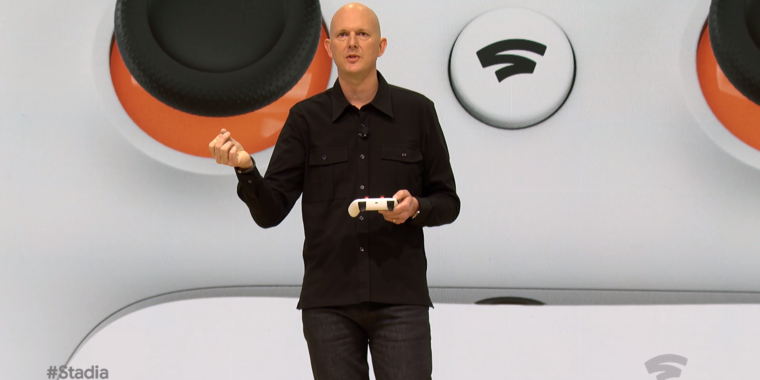
Google’s Phil Harrison (you may remember him from his days at Sony).
The YouTube-to-Stadia interface, as shown at GDC.
Specs for Google’s Stadia data centers.
How many screens can you play Assassin’s Creed Odyssey on?
Stadia on a laptop.
Stadia on a smartphone.
Stadia on, well, another system.
The logo for Google’s new gaming service.
Google CEO Sundar Pichai appears at his company’s GDC keynote presentation at GDC 2019.
“Everyone” is a pretty big potential market.
Promises of crazy-high performance for the upcoming Doom Eternal on Google Stadia.
A hint at how “multi-GPU” options will boost performance and graphical options.
Big promise there, Google.
Great news.
Google has a long and well-documented history of launching new services only to shut them down a few months or years later. And with the launch of Stadia imminent, one launch game developer has acknowledged the prevalence of concerns about that history among her fellow developers while also downplaying their seriousness in light of Stadia’s potential.
“The biggest complaint most developers have with Stadia is the fear that Google is just going to cancel it,” Gwen Frey, developer of Stadia launch puzzle gameKine,told GamesIndustry.biz in recently published comments. “Nobody ever says, ‘Oh, it’s not going to work,’ or ‘Streaming isn’t the future.’ Everyone accepts that streaming is pretty much inevitable. The biggest concern with Stadia is that it might not exist.”
“Working in tech, you have to be willing to make bold moves and try things that could fail,” Frey continued. “And yeah, Google’s canceled a lot of projects. But I also have a Pixel in my pocket, I’m using Google Maps to get around. I only got here because my Google Calendar told me to get here by giving me a prompt in Gmail. It’s not like Google cancels every fucking thing they make.”
Google itself has made similar arguments in the past. Stadia Director of Product Andrey Doronichev said in July that Google’s commitment to Stadia is comparable to services like Gmail, Docs, Music, Movies, and Photos. “Nothing in life is certain, but we’re committed to making Stadia a success… Of course, it’s OK to doubt my words. There’s nothing I can say now to make you believe if you don’t. But what we can do is to launch the service and continue investing in it for years to come.”
Worries over Stadia’s continued existence aren’t exactly academic for potential consumers, though, since Google is primarily asking players to pay full price for Stadia games that only exist on Google’s own servers. Anyone who similarly bought games for streaming service OnLive years ago knows what can come of that kind of investment if and when the service goes under.
Slow start, grand potential
Elsewhere in the interview, Frey said she sees Google’s Stadia launch strategy as a limited one that “is pushing Stadia in a direction to compete with consoles.” That means ports of console-style games that don’t take full advantage of the power of Stadia’s cloud data centers, as Google says future Stadia exclusives may do.
It also means a focus on “territories where there are a lot of consoles and where the Internet is very good, so in the short-term I think it won’t reach its potential,” Frey said. “I don’t even think they want to have a super-strong launch. I get the sense that they want to scale slowly and see where this goes.”
In the longer term, though, Frey said she has some undisclosed ideas about how to use Stadia’s cloud power for unique experiences in the future. And she said she’s excited about the impact cloud gaming could have once high-speed mobile Internet access really goes worldwide.
“I’m not sure what implications this has in a place like Africa, where everything’s mobile,” she said. “When 6G drops, is this going to suddenly be a big deal? What does this mean for places where everyone goes to Internet cafes, like in Brazil? Who knows.”
[Update: The sub-headline to this article has been changed to more accurately reflect the context of Frey’s statements. In a series of tweets after this article was published, Frey reiterated her own bullishness on Stadia, saying, “If the worst thing you can say about a service is that it might not exist then that sounds like a really good service to be a part of.”]
Pokémon Sword and Shield review: A big adventure with a small Pokédex
Making new friends in Pokemon Sword and Shield.
Andrew Cunningham
Battles are familiar, but the game’s UI is clean and looks great on a big screen.
Andrew Cunningham
Battles happen in giant stadiums, and you suit up just like you would for any other competitive sport.
Andrew Cunningham
The game isn’t pushing the graphical bar much, but it’s often quite nice-looking, and it’s a big step up from the 3DS versions.
Andrew Cunningham
Per usual, you battle eight themed Gym Leaders to progress through the story mode.
Andrew Cunningham
Clothing options add customization and show off the game’s bright, clean art style.
Andrew Cunningham
Sending Pokemon out to do jobs earns you experience points, items, and cash. It’s a good use of monsters that might otherwise be idling in your PC box.
Andrew Cunningham
Finally: a true Pokémon game on a flagship Nintendo console.
Last year’s Pokémon Let’s Go games were technically the Switch’s first Pokémon RPGs, but those remakes of the original Red and Blue were greatly simplified and softened up to cater to newer and younger players who got their start with Pokémon Go. Pokémon Sword and Shield, on the other hand,are “real” mainline Pokémon games, serving as direct sequels to 2016’s Sun and Moon and continuing the franchise that began with Red and Blue in 1998 (1996 for Japanese players).
That means Sword and Shield feature the same basic skeleton that has grown into a Pokémon tradition over the past 20+ years. You pick a starter Pokémon and then travel around the region, catching more monsters and earning eight badges so you can earn the right to challenge the region’s Champion and become the very best, like no one ever was. Along the way, you encounter and vanquish a team of bumbling low-level criminals, repeatedly battle with a rival who helps you hone your skills, and solve a regional mystery that ends with you capturing one or more ancient legendary creatures.
Because Sword and Shield throw you into the deep end pretty quickly, they’re not great introductions for newbies; try the Let’s Go games for that, or even Pokémon Go. But for series fans, these are the sequels you’ve been waiting for… with one substantial caveat.
Pokémon without all the Pokémon
Any discussion of what has changed in Sword and Shield needs to start with the games’ most controversial subtraction: for the first time in the series’ history, a mainline Pokémon game won’t actually include all the Pokémon.
Every Pokémon game has a “regional” Pokédex that blends the region’s new creatures with a cross-section of monsters from older games. But after you beat the main quest, previous titles opened up a “national” Pokédex, letting you collect all of the Pokémon from every title and (eventually) letting you import Pokémon from previous generations. In Sword and Shield, a mix of 400-odd monsters, old and new, are the only ones available for the entire game—meaning hundreds more are not available at all. Mega Evolutions are gone, as are most of the regional Pokémon forms from Sun and Moon. The Pokémon Home app will still recognize all existing Pokémon when it comes out next year, but you can’t pull them into Sword or Shield, and Game Freak isn’t planning to add them in later.
The bottleneck is, supposedly, a lack of development time and resources. And before you casually dismiss that rationale, the monsters that are in Sword and Shield are clearly more than just refurbished versions of the models used in the 3DS games. Every Pokémon that makes the jump to the Switch needed to be retextured and tweaked and made usable in the mega-sized Dynamax mode (more on that in a moment). It’s clearly a non-trivial amount of work, especially when multiplied across a sprawling history of 800-plus monsters.
When you’re playing the single-player campaign, the amount and variety of Pokémon available actually feels pretty good. For longtime players and monster collectors, though, it’s hard not to feel a bit resentful. Suddenly, a series that has focused on catching ‘em all for more than two decades has decided that hundreds of Pokémon are not actually essential to the Pokémon experience after all. I’ve been importing certain individual Pokémon from game to game since 2003, and I always appreciated that Game Freak encouraged this kind of sentimental attachment. Not anymore.
With half of all existing Pokémon gone, the “long tail” of Sword and Shield—the stuff that players have always done after the main single-player story has been cleared—has been dramatically reduced in size and scope relative to previous games. The reduced Pokédex also seriously limits the variety of possible monster teams and strategies that make the competitive circuit interesting.
Maybe Pokémon Home will include a battling component, or maybe a re-release of Sword and Shield a couple of years from now will fill in the rest of the monster roster. But despite Sword and Shield‘s many improvements, I’d imagine many competitive players will continue to use Sun and Moon just for the larger roster.
A console-size Pokémon
Now let’s focus on the good stuff, because there is a lot of it, national ‘dex controversy aside.
It starts with some console-scale world-building. In previous Pokémon games, the environments have always looked more or less like our own, And while we’re told that Pokémon vary widely in size and weight, small portable screens have always (by necessity) sort of flattened the monsters out so that a tiny Caterpie looks not all that different from a 21-foot-long Gyarados. Thanks to the extra power of the Switch, Sword and Shield can finally show us a world that’s big enough to show us what a Pokémon-centric society would really look like—Sun and Moon attempted this, but they were held back by the aging hardware of the 3DS.
[embedded content]
The best example of this is the game’s “Wild Area,” a wide-open field between cities with a free-range camera where dozens of Pokémon of different shapes and sizes roam free. Not only does this make an unprecedentedly large and varied roster of Pokémon available from very near the start of the game, but if you’re not careful you can run into high-leveled monsters that will absolutely wipe your fledgling team out if you’re not ready to deal with them.
The game’s cities and battles feel bigger, too; each city is built around a gigantic stadium where battles can happen in front of thousands of spectators. And these cities all have distinct and memorable designs that usually complement the Pokémon type used in the stadium. Sadly, though, there’s not much reason to come back to most of these cities once you clear the stadium challenge and break into everyone’s homes to look for items.
Like most Switch games, Sword and Shield deploy some graphical trickery to keep things running smoothly—shadows lose resolution quickly as you move away from objects, for instance, and far-off objects can often pop into existence (the way that Pokémon actually spring up as they pop in makes this graphical artifact more playful and intentional-looking). These aren’t the best-looking games on the Switch, or even the best-looking RPGs (Dragon Quest XI running on the Switch manages better draw distance and more detailed environments, for instance, though the resolution is often visibly lower). Still, the monster designs, environments, and big, colorful character models all look good. This is definitely the look that Sun and Moon were going for but executed more successfully on new hardware.
That said, this does look and feel a bit like a scaled-up portable game in a lot of ways. Text size and the information density of the game’s UI all seem tuned for play on the handheld screen rather than a TV screen. The game seems marginally better-optimized for handheld mode, too—the only times I noticed small framerate dips were exclusively in docked mode. On the other hand, the game retains all of the handy and quick-to-access local multiplayer features from the previous 3DS versions.
Listing image by Andrew Cunningham
https://arstechnica.com/?p=1600607
Only 12 games will be available on Google Stadia in time for Nov. 19 launch [Updated]
The hardware you get with the $129.99 Stadia “Founder’s Edition.”
Close-up of the exclusive Founder’s Edition Controller.
Shoulder buttons!
Extra Stadia Controllers will be available for $69 in three colors, including “Just Black”…
…”Clearly White”…
…and “Wasabi.”
A Chromecast Ultra is the easiest way to stream Stadia games to your TV.
Fourteen additional titles are promised to launch on Stadia before the end of 2019:
A number of legacy titles that were previously promised as part of the Stadia “launch window” are currently not included in Google’s list of 2019 Stadia releases. Those include:
Major publishers Capcom and EA are also absent from Stadia’s current planned 2019 lineup, though both were listed as participating in Stadia’s “launch window” as recently as August. Google has not yet responded to a request for comment on those omissions. [Update: A Google spokesperson told Ars that “‘launch window’ conveyed the first few months after launch. What we announced today was the first 6 weeks.”]
A handful of other unreleased titles that were promised for the Stadia launch window have simply been delayed into 2020. Those include:
Of the 26 titles planned for Stadia release this year, Tequila Works’ horror game Gylt is the only one that won’t be available on other platforms concurrently (though Google has an internal development studio working on more exclusives in the coming months and years). Darksiders: Genesis is due to launch simultaneously on PC and Stadia on December 5.
Looking at the 24 remaining 2019 Stadia games, 15 were first released on other platforms sometime in 2019, and five more were first released in 2018. The list of 2018 releases includes Farming Simulator 19, even though an updated “2020” version of the franchise is due for release on other platforms December 3. And while Football Manager 2020 will also be launching on other platforms November 19, developer Sports Interactive has said the Stadia version will offer “the fastest way to experience Football Manager” thanks to Google’s cloud data centers.
At launch, Stadia is only available via the purchase of a $130 bundle that includes a Stadia controller and a Chromecast Ultra for TV play. A free tier, which does not require a separate hardware purchase or a $10/month “Stadia Pro” subscription, is planned for next year.