Marvel’s Midnight Suns gets a big boost on PC when 2K’s launcher is removed
Enlarge/ 2K’s launcher does the important work of halting Midnight Suns from launching after you click “Play” on a green button in Steam so you can acknowledge their brand and click “Play” on a red button.
Kevin Purdy
Publisher-made game launchers are usually just a minor annoyance, a speed bump for those who just want to play the game they bought. 2K’s launcher, popping up by default when you launch Firaxis’ newest XCOM-meets-superhero-friendship Marvel’s Midnight Suns, does something worse, hindering performance significantly for some players.
RockPaperShotgun’s James Archer measured his higher-end PC’s performance while playing Midnight Suns, both with the default 2K launcher left in place and with it bypassed through a Steam command option. Archer saw a nearly 62 percent improvement in average frames per second without the 2K launcher active. On a system with a Core i9-10900K, RTX 3090, and 32GB of DDR4 memory, running at 1400p with ray tracing and the graphic quality set to “Epic,” Archer’s average frames per second jumped from 90 fps to 146. The only difference was disabling a launcher that essentially reminds you who published the game, markets other titles to you, and requires more clicks.
I’m playing through Midnight Suns myself and had noticed some aggravating stutter, especially when streaming the game for couch-based TV play. I turned on Steam’s built-in FPS counter, then compared performance between sessions both with and without the 2K launcher running. I’m running a decidedly lower-end system than the one tested by RockPaperShotgun: AMD Ryzen 7 3800X, RTX 3050, and 16GB of DDR4 memory. I am, however, playing at 3840×2160 resolution, with graphics set to “High.”
With 2K’s storefront tollgate turned off, I, too, saw a notable bump. Standing in the same place on the Abbey grounds, letting the torches flicker, the stream wisp by, and the framerate settle, I went from 48 to 58 frames per second, a nearly 21 percent increase with the launcher disabled. And the hitching I experienced before—easily noticed through audio stutter—seemed either missing or far less noticeable.
Here’s Midnight Suns running on my system, with the 2K launcher still in place. Note the “48 FPS” in the upper-right corner.
Kevin Purdy / 2K Games
And here’s Midnight Suns with the 2K launcher disabled, on the same system, in the same location, at 58 frames per second.
Kevin Purdy / 2K Games
Details on how to launch Midnight Suns directly from Steam without the 2K launcher are included in RockPaperShotgun’s post; it’s essentially browsing the game’s files, finding the core launcher a few folders in, and asking Steam to launch with that file path in the “Launch Options” field. There are, sadly, no similarly simple workarounds for those who purchased the game on the Epic Games Store (or, of course, through the 2K launcher).
Mercedes built a concept car for Avatar, and we drove it
Enlarge/ Many concepts are static models, but Mercedes-Benz built one that works. At low speed, anyway.
Mercedes-Benz
When you think of the future of transportation, you probably don’t think of water dragons like those in director James Cameron’s newest Avatar movie, Avatar: The Way of Water, which will be released on December 16. You might think of something more along the lines of the Mercedes-AVTR, which Mercedes debuted just before the pandemic at CES in 2020.
The collaboration between the producers and directors of the newest Avatar movie and the automobile company may seem like an unlikely one—after all, there are no cars in the movie, and the Vision AVTR does not appear on-screen. Yet, after spending an afternoon driving this out-of-this-world concept and getting a behind-the-scenes look at the new movie, it makes pretty good sense.
“Avatar as a movie as an IP across all the things we do, has something that a lot of movies don’t have, which is an ethos,” Jon Landau, COO of Lightstorm Entertainment and Academy Award-winning producer of Avatar, said via video conference at the event we attended in Manhattan Beach, California.
“We believe these movies are about something. That they challenge us to look at our world a little bit differently, to understand that our actions have an impact on people around us and the world around us, and we were looking for partners who share in that same type of ethos. And I think Mercedes really has a vision for a sustainable future,” Landau told Ars.
Enlarge/ The AVTR’s interior design has shown up in recent production Mercedes EVs like the EQS and EQE.
Mercedes-Benz
Sustainable luxury has been the Mercedes buzzword for some time now—ever since the launch of the Mercedes-Benz EQS in 2021. It’s easy to see the through-line between the AVTR and Mercedes EQ line, since designers and engineers were working on both in parallel. As it turns out, the joint project between Cameron’s Avatar movie franchise and Mercedes has yielded a wealth of inspiration and future design direction for the German luxury brand, as well as some things that are already being implemented in real-life vehicles.
A new design of the human-car interface
As a result of COVID, the launch of the Avatar sequel was pushed back, which meant that Mercedes had some time to consider the rolling concept. The company created a cockpit buck—a full-scale model—to show off some of the features of the future that integrate everything from gesture control to the utilization of machine vision to extend the human in the cockpit to the world outside.
If you know anything about Avatar, you know that the Na’vi people on Pandora connect, via their braids, to the dragons called Banshee that they ride. Similarly, the human in the AVTR concept connects via their heartbeat, using biometrics. While the buck we sat in to learn about the joystick-like steering of the AVTR (more on that below) didn’t have the sensors necessary for biometric feedback, engineers had designed it to simulate a heartbeat and use machine vision to see the human in the seat.
As you walk up to the car, it “wakes up” and seems to almost breathe with you. The pulsating lights seem to breathe or beat with your heart rate, much like your Apple Watch does when it’s sleeping. It gives the machine a lifelike effect and, as Mercedes spokespeople say, makes it feel more like a living, breathing thing than a vehicle. The fins at the rear of the vehicle—which are used both for outward communication (stop, go, turn, accelerate, etc.) and as a modular fluid wing for wind resistance reduction—flutter and move.
Each of those scales and their movement were designed in collaboration with a university in Lausanne, Switzerland, that specializes in carbon fiber and organic robots. Apparently, when Mercedes engineers started working on the tiny actuators that move the scales, the movement was too robotic for designers, so they brought in the university. Seeing the scales flutter and move gives the AVTR a completely organic feel, almost like you are approaching an animal and not a machine.
Once you climb in and place your hand on the only control-like interface in the vehicle on the center console, the car starts. The controls look like a stack of breathing stones, and Mercedes calls it Merge Control. It acts as the joystick (there is no steering wheel) for the car, and it’s based on current adaptive technology that allows people with disabilities to drive cars in the real world.
Enlarge/ The full-width screen is reminiscent of the one Mercedes used in the EQXX concept, except more otherworldly.
Mercedes-Benz
When the car is on and ready to drive, the screen that stretches like fabric across the front and middle of the vehicle lights up. Since this is a concept created in close partnership with the producers of the Avatar films, the scenes on that screen are those of Pandora, and, in the buck, driving the AVTR is like flying through a video game. The experience is immersive and complete with audio that is targeted for each side of the vehicle to help better connect the occupants with the world outside.
Of course, no concept vehicle would be complete without the addition of gesture control, because there are no buttons anywhere. Raise your inboard hand, and an image is projected on your palm. Move your palm left or right, and you can see the other available icons. To choose an option, you close your hand into a fist like you’re grabbing the icon. In the buck, I changed the scenery we were flying through just by opening and closing my hand. While this may seem like simple projection technology, Mercedes says that it used machine vision to map thousands of different hand colors, shapes, orientations, and sizes to ensure that the feature would work consistently.
https://arstechnica.com/?p=1903641
“Fake” Roman coins authenticated, bearing likeness of lost Roman emperor
Enlarge/ This Sponsian gold coin, circa 260-c.270 CE, was part of a cache discovered in Transylvania in 1713.
The Hunterian, University of Glasgow
In 1713, a cache of Roman coins was discovered in Transylvania, several of which bore the portrait and name of Sponsian—but there are no historical records of a Roman emperor with that name. The coins largely have been dismissed as forgeries for more than a century, but a re-analysis using a variety of physics-based methods has yielded evidence that they might be authentic, according to a recent paper published in the journal PLoS ONE. So Sponsian may have been a real emperor after all.
One of the Sponsian coins is now in the Brukenthal National Museum in Sibiu, Romania; another is part of the Hunterian collection at the University of Glasgow. “This has been a really exciting project for the Hunterian and we’re delighted that our findings have inspired collaborative research with museum colleagues in Romania,” said co-author Jesper Ericsson, curator of numismatics at the Hunterian. “Not only do we hope that this encourages further debate about Sponsian as a historical figure, but also the investigation of coins relating to him held in other museums across Europe.”
Sponsian (or Sponsianus) seems to have been an obscure Roman military commander in the Roman province of Dacia, an isolated gold mining outpost that overlaps with modern-day Romania. Per the authors, he was most likely active during a critical period of unrest during the 3rd century CE. After the assassination of Emperor Severus Alexander—by his own troops, no less— the Roman Empire was besieged by barbarian invasions, peasant rebellions, civil wars, a pandemic (the Plague of Cyprian), and the rise of multiple usurpers vying for power. Due to the resulting currency debasement and economic collapse, by the 260s, there were three competing states: the Gallic Empire, the Palmyrene Empire, and the Italy-centric Roman Empire caught between them. Things didn’t stabilize politically until Diocletian rose to power and restructure the imperial government in 284.
Sponsian is so obscure that the coins bearing his name are the only concrete evidence of his existence. At the time of their discovery, the coins were deemed authentic. But doubts about their authenticity grew over time, and in 1868, French numismatist Henri Cohen declared the Sponsian coins to be “very poor quality modern forgeries”—possibly the work of a Viennese forger who thought inventing an emperor would better catch the attention of collectors. So Sponsian, by extension, may never have existed. The coins were heavier than usual, with inscriptions inconsistent with other Roman coins. Others have argued that there were so many self-proclaimed rulers during that chaotic period and their time in power was so fleeting that the discrepancies shouldn’t be surprising.
Enlarge/ One of the Sponsian coins shown in both visible and UV light.
P.N. Pearson et al., 2022/PLoS ONE
Co-author Paul Pearson of University College London spearheaded this latest project—the first time a Sponsian coin has been subjected to scientific analysis. Pearson saw photographs of the Hunterian coin while researching a book on the history of the Roman Empire during the pandemic. He noted small scratches on the surface and thought this could be evidence that the coin might have been in circulation since coins carried about in purses or pouches tended to get scratched.
Pearson and his co-authors employed a range of analytic techniques for four of the coins from that 18th century cache in the Hunterian collection, including the Sponsian coin and coins inscribed with the names of Plautius, Philip the Arab, and Gordian III. (The coins once belonged to one William Hunter, who likely acquired them from the estate of a well-known Viennese antiquarian named Joseph de France.) Those methods included classic light microscopy, ultraviolet imaging, scanning electron microscopy, and reflection mode Fourier-transform infrared spectroscopy. They did the same for two other Roman coins whose authenticity had been confirmed for comparison purposes.
The analysis confirmed the presence of scratches and other signs of wear and tear commonly seen in genuine Roman coins. Further, the chemical analysis indicated that all four coins had been buried in soil for centuries before being exposed to air. Based on the analysis of Pearson et al., the Brukenthal National Museum has placed a Sponsian coin on public display as a genuine artifact.
“I believe we have established with a very high degree of confidence that they are genuine,” Pearson told the Guardian, although he admitted that the question of Sponsian’s identity was “more speculative.” However, the authors believe Sponsian may have assumed command as imperator (“supreme military commander) of Dacia when the population was cut off from the rest of the empire, surrounded by hostile enemies. Given their mining resources, Dacia could have minted their own coins with Sponsian’s image, which would have helped cement his authority and maintain economic stability and social order until the area was finally evacuated between 271 and 275 CE.
The research has received mixed responses from other experts. Adrastos Omissi of the University of Glasgow told the Guardian that it was a “brilliant piece of work” and that he found the argument both for the existence of Sponsian and his role as a self-appointed ruler of Dacia quite convincing, especially since, at the time, “the bar for being an emperor was very low.” But Richard Abdy, curator of Roman and iron age coins at the British Museum, did not mince words about his skepticism. “They’ve gone full fantasy,” he told the Guardian. “It’s circular evidence. They’re saying because of the coin there’s the person, and the person therefore must have made the coin.”
Aliens-inspired Returnal is coming to PC, and you should probably play it
[embedded content]
Returnal PC trailer
A lesser-known PlayStation 5 game called Returnal is coming to PC, and while it hasn’t had as much fanfare as big-ticket titles like Spider-Man, The Last of Us, or Horizon, it’s definitely one you should try. It’s simultaneously a throwback to classic arcade action games, a PC-style Roguelike, a technical showcase for modern systems, and an homage to the moody science fiction novels and films of the 1970s and 1980s. But most importantly, it’s a good game.
Published by Sony and developed by (now Sony-owned) Finnish studio Housemarque, Returnal was one of the earliest PS5 exclusives when it launched in early 2021, and it was a major step up into the triple-A game big leagues for Housemarque, which had previously released arcade-style games like Super Stardust HD and Resogun.
During The Game Awards on Thursday, Sony announced that, like many of its other recent first-party titles, Returnal will launch on PC with as-yet-unnamed PC-specific enhancements. The port is being handled by Climax Studios, and the release window is “early 2023.”
While it was a PS5 game first, Returnal‘s DNA can be traced to multiple PC gaming traditions—and its themes and aesthetic draw from some of the same background those PC games leaned on, too.
Returnal‘s retro and PC gaming influences
The game’s gimmick, if you will, is that your protagonist is trapped in a time loop akin to the one in the Star Trek: The Next Generation episode “Cause and Effect.” Each time she dies, the cycle starts over, and you’re mostly back to square one. But some of the knowledge you gain (and a very limited number of other character-level improvements) carries on from cycle to cycle, allowing you to win a hard-fought war of attrition against your circumstances through many, many deaths.
The environments, enemies, and loot are (largely) randomized, and the player regularly faces difficult choices with clear pros and cons for each option that will follow them for the rest of the cycle. These are, of course, all the elements of a Roguelike, a genre that goes back to the made-of-ASCII Rogue on personal computers way back in 1980. Rogue went on to inspire multiple genres, including Diablo-style action RPGs.
A screenshot of Returnal showing a comparison between the stats of two weapons
Ars Technica
A screenshot from Returnal showing an optional pick up with negative and positive effects
Ars Technica
The main pause menu of Returnal
Ars Technica
Returnal borrows significantly from contemporary Roguelikes that have thrived on Steam, in particular games like Nuclear Throne—yet another way it’s firmly in a PC gaming tradition.
Beyond that, Returnal plays like something from a very specific lineage of PC-based third-person shooters—a tradition that includes everything from MDK to Max Payne to Star Wars Jedi Knight: Jedi Academy and Control. Sure, most of those games also came out on consoles, but they always felt most at home on their lead development platform, the PC.
Housemarque is known for making arcade-style games that are inspired by the likes of Galaga, and some of that DNA survives in Returnal, so there’s a hard retro bent here. Basically, if you like retro or PC games, Returnal might have your number—especially if you’re into the science fiction of the 1970s and 1980s, whose influence underpinned many of those classic games.
Aliens, Solaris, and classic sci-fi horror
Ultra-fast-paced action games aren’t usually heavy on atmosphere or even storytelling, but Returnal is an exception. The game draws its aesthetic, themes, and general presentation from moody or horrific science fiction like the Alien films and the works of Russian director Andrei Tarkovsky, who made atmospheric films like Solaris and Stalker.
You spend most of the game battling enemies in grim environments like the decrepit, damp forests of an unknown world or the sandblasted ruins of alien civilizations lost to the innumerable eons. These are conceived more to set a mood—an unsettling vibe even—than to tell an explicit story, but they draw heavily from science fiction horror novels and films of the 1970s and 1980s. The game’s aesthetic has some similarities to more contemporary science films, too, like Edge of Tomorrow and Annihilation.
A Returnal screenshot showing a strange statue in an alien ruin
Ars Technica
A Returnal screenshot showing a tentacled alien in a blood red sky
Ars Technica
The actual storytelling mostly takes place in an eerie rendition of protagonist Selene’s home, somehow generated anachronistically on this alien world. For these scenes, you go into first-person perspective and explore Selene’s life through cryptic and incomplete glimpses. The unsettling oddness of these sequences is clearly inspired by author Stanislaw Lem’s and filmmaker Andrei Tarkovsky’s renditions of Solaris, a story about an unfathomable alien intelligence that communicates with the protagonist by producing baffling, dreamlike renditions of events, places, and people locked away in the annals of his memory.
Some of that feels unusually poignant because the game features a middle-aged female protagonist, which is quite unusual in big-budget video games. It’s an interesting and welcome departure from the default in these sorts of games, and it contributes to the personal nature of the story. There’s also the outstanding soundtrack by Bobby Krlic, which couldn’t possibly be more inspired by Blade Runner. Enough said, right?
Returnal was already a technical showcase
Among other things, the PC gaming platform is about cutting-edge tech. Many games native to the platform more or less exist as showcases for expensive hardware. Returnal was that on PS5, of course—the 60-frames-per-second action game never could have been the same experience on PS4—but it could be that on PC, too.
A screenshot of Returnal on PC
A screenshot of Returnal on PC
A screenshot of Returnal on PC
Yes, Housemarque claimed some very limited ray tracing for Returnal on PS5, and the maddening complexity and scale of its bullet-hell-esque battles is something you don’t often see in a 3D game with this level of detail and production values. But Housemarque—and by extension, Returnal—is also known for its frankly bonkers particle effects, which are used for things like a transporter that disintegrates the character into thousands of strange, tiny blobs. It’s hard to describe, but when you see it in the game you’re likely to at least say, “Huh, that’s neat.”
Sony, Housemarque, and Climax Studios haven’t detailed what will be unique to the PC version, but we’re hoping for more robust ray-tracing support, Nvidia DLSS or AMD FidelityFX, and more. Also, the game’s ultra-fast-paced, twitchy combat lends itself well to high-refresh-rate monitors. The PS5 supports those, but the PS5 version of Returnal doesn’t, so the PC could be a place for this game to really shine.
One big caveat: Returnal is not for the weak-willed
There’s one reason Returnal might not be a slam dunk with some PC gamers: it’s viciously difficult. The game is about learning from failure, and you will fail many times. The battles can be overwhelming, and small mistakes may be punished with massive damage that’s hard to come back from. Combine that with the fact that some late-game lives last as long as 45 minutes, and you have a potential recipe for frustration.
The game gathered some comparisons to the likes of Dark Souls when it first came out because, well, Dark Souls has become shorthand for “punishingly difficult game.” But in truth, Returnal bears little resemblance to Dark Souls. From Software games like Dark Souls and Elden Ring are difficult, but their worlds and encounters are mostly deterministic, and they’re all about building muscle memory and tactics to respond to clear, recurring patterns.
There’s some of that in Returnal also, but the game has a larger random element. So while players who die in Dark Souls can almost always brush that death off, knowing it was because of a mistake that they can learn from, Returnal can feel capricious and unfair sometimes.
As long as you’re able to accept the premise—that you will die a lot, and sometimes it’s just bad luck—there’s a lot to enjoy. I recommend giving it a shot. Just… brace yourself. Returnal is very challenging. But then again, so were the classic and contemporary games that inspired it.
Listing image by Ars Technica
https://arstechnica.com/?p=1903398
A Schoolhouse Rock! tribute to honor the passing of its last surviving creator
<img src="https://rassegna.lbit-solution.it/wp-content/uploads/2022/12/a-schoolhouse-rock-tribute-to-honor-the-passing-of-its-last-surviving-creator.jpg" alt="Now he's a law! "I'm Just a Bill" is one of the most popular and best-known animated shorts featured in Schoolhouse Rock!“>
Enlarge/ Now he’s a law! “I’m Just a Bill” is one of the most popular and best-known animated shorts featured in Schoolhouse Rock!
Kari Rene Hall/Getty Images
Ars readers of a certain age grew up in the 1970s and 1980s watching Saturday morning cartoons and singing along to Schoolhouse Rock!, a series of whimsical animated shorts setting the multiplication tables, grammar, American history, and science to music. We were saddened to learn that George Newall, the last surviving member of the original team that produced this hugely influential series, has died at 88. The cause of death was cardiopulmonary arrest, according to The New York Times. The series turns 50 (!) next year.
Newall was a creative director at McCaffrey and McCall advertising agency in the early 1970s. One day, agency President David McCall bemoaned the fact that his young sons couldn’t multiply, yet somehow they remembered all the lyrics to hit songs by the Rolling Stones and Jimi Hendrix. He asked Newall if it was possible to set the multiplication tables to music. Newall happened to know a musician named Ben Tucker who played bass at a venue Newall frequented and mentioned the challenge to him. Tucker said his friend Bob Dorough could “put anything to music”—in fact, he’d once written a song about the mattress tag admonishing new owners not to remove it under penalty of law.
Two weeks later, Dorough presented Newall with “Three is a Magic Number,” the song featured in the pilot episode of Schoolhouse Rock! Everyone at the agency loved the tune, including art director and cartoonist Tom Yohe, who made a few doodles to accompany the song. That one song—meant to be part of an educational record album—turned into a series of short three-minute videos. (Today we’d just put them on YouTube, and you can indeed find most of the classic fan favorites there.) They pitched the series to ABC’s director of children’s programming, Michael Eisner (future Disney chairman and CEO). Warner Bros. animator Chuck Jones was also in the meeting and was so impressed he advised Eisner to buy the series in the room.
And Schoolhouse Rock! was born. The pilot episode debuted on September 2, featuring an extended cut of “Three is a Magic Number” that has never been re-broadcast and wasn’t included in the eventual home media releases.
“Three is a Magic Number”
[embedded content]
Dorough performed this and many of the other tunes in the first season (Multiplication Rock). Famed jazz singer Blossom Dearie performed “Figure Eight,” a slow-paced song about multiples of eight accompanying a cartoon showing a little girl ice skating on a cold winter’s day. Jazz drummer and vocalist Grady Tate performed the vocals on “I Got Six” and “Naughty Number Nine.”
The latter featured a portly cat version of pool hustler Minnesota Fats, playing a game of nine ball to torment a mouse. This short was initially rejected by ABC because it violated the Public Health Cigarette Smoking Act, prohibiting cigarette advertising, because the kitty pool shark smoked a cigar throughout. But the network soon relented after being assured that the cat was a villain and therefore unlikely to encourage kids to smoke. Other classics from this season include “My Hero Zero,” Elementary, My Dear” (about multiples of two), and “Lucky Seven Sampson.”
“Interjections!”
[embedded content]
Multiplication Rock was a smashing success, so ABC quickly ordered a second season, Grammar Rock, which originally aired in 1973-74. This season expanded the pool of vocalists, with songs performed by Lynn Ahrens, Zachary Sanders, Jack Sheldon, and Essra Mohawk, in addition to Dorough and Dearie.
Grammar Rock was another smashing success—and also my childhood favorite, especially “Interjections!”, “Conjunction Junction,” and “A Noun’s a Person, Place, or Thing.” Newall wrote “Unpack Your Adjectives” and “Lolly, Lolly, Lolly, Get Your Adverbs Here,” with Dorough and Ahrens splitting the rest of the songwriting duties for that season. (Newall eventually wrote a total of 10 songs for Schoolhouse Rock!) In the 1990s, two more shorts were added: “Busy Prepositions” and “The Tale of Mr. Morton” (focused on the subject and predicate of a sentence).
As the United States was gearing up for its bicentennial celebration, ABC commissioned a third season focused on American history and the structure of the US government. America Rock originally aired in 1975-1976 and gave the world what is arguably the most famous and popular of the shorts: “I’m Just a Bill” (performed by Sheldon and his son John), following an animated congressional bill as it makes its way through the convoluted process of becoming a law.
https://arstechnica.com/?p=1903226
Nvidia GeForce RTX 4080 review: Second only to the 4090—for now
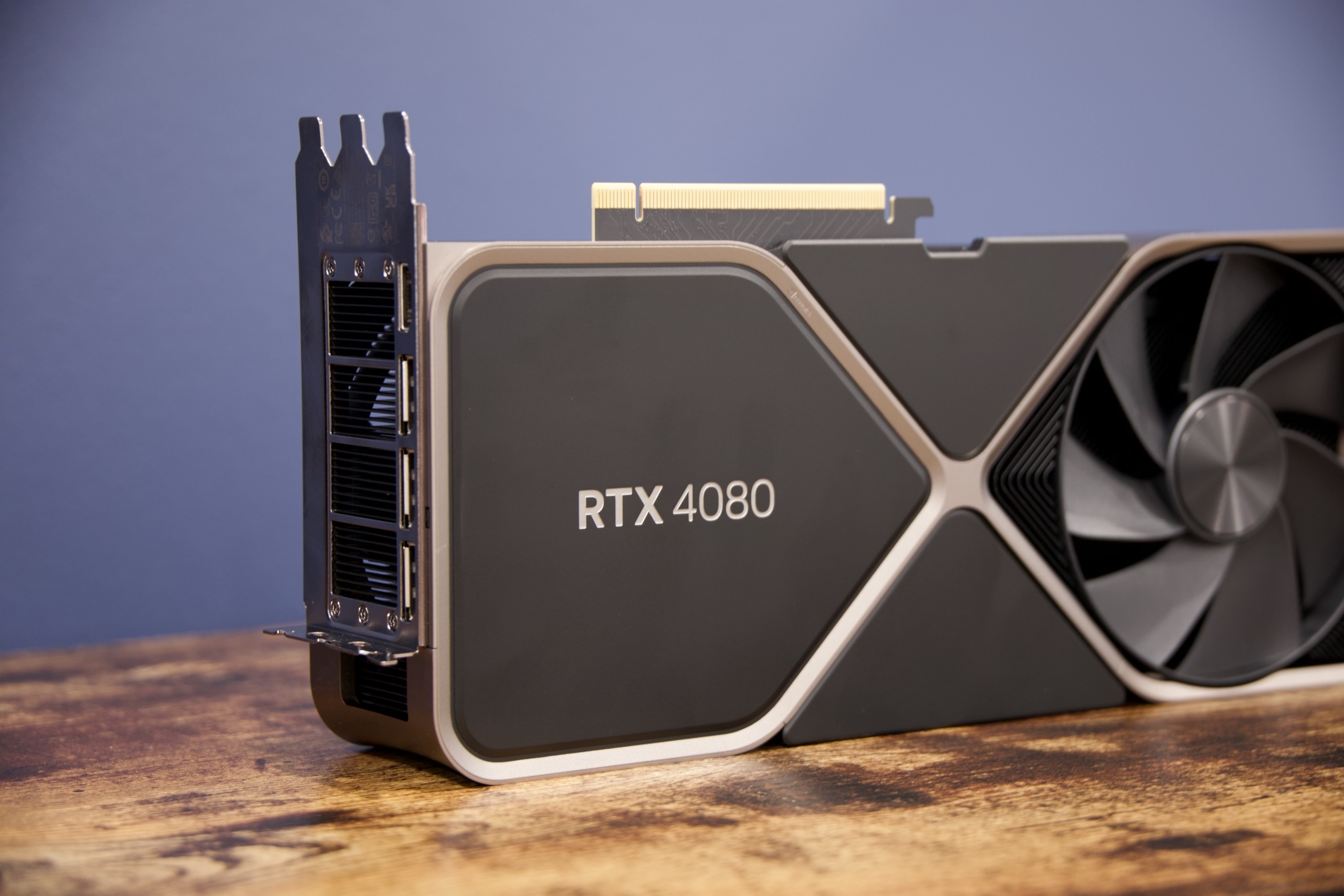
Very little about Nvidia’s GeForce RTX 4080 is surprising—especially now that the confusing, scrapped 12GB version is being renamed. In pretty much all of our performance tests, it slots in right where you’d expect it to, comfortably ahead of the RTX 3080 Ti but trailing the $1,500 RTX 4090 by enough to justify the $300 price gap. It’s usually capable of hitting or exceeding 60 fps at 4K, and games with DLSS support (or some other kind of upscaling tech) can buy you a solid frame rate increase. And its power requirements aren’t as stratospheric as the 4090’s, either, so most people with an existing xx70 or xx80-class gaming PC shouldn’t need to switch out their power supply.
The major downsides, as of this writing? As a group, the cards are often just as huge and cumbersome as the RTX 4090 (the Founders Edition is identical, and partner cards largely follow suit). The $1,200 starting price is historically high—the 3080 Ti launched with a GPU-shortage-inflated MSRP of $1,119 GPU, but the 2080 and 3080 were both a mere $699 at launch. And even if you are willing to pay that price—surprise, surprise—it’s basically impossible to find in any form anywhere close to MSRP.
Which means, hooray: another GPU review that exists mostly as a theoretical exercise! If you could buy this GPU for the amount of money it’s supposed to cost, and if its competitors were also available for what they were supposed to cost, then here’s how it would stack up. That world doesn’t exist right now, but if you’re reading this in a few months, circumstances may have changed. In the meantime, imagine with us, won’t you?
About the size—and that power connector
Enlarge/ From left to right and largest to smallest: GeForce RTX 4080 (which is the same physical size as the RTX 4090), Radeon RX 7900 XTX, and Radeon RX 7900 XT.
Andrew Cunningham
The 4080’s physical dimensions are 12.3×5.35×2.13 inches, same as the 4090, and our 4090 review has several images comparing it to various objects so you can get an idea of just how large that is. It’s a GPU that’s roughly the same size as an entire Xbox Series S.
That does have ramifications for upgraders, particularly those using more space-efficient cases. Plenty of gaming-focused mini ITX cases won’t fit a 4090 or 4080 at all, and although the case I use for my testbed fits full-size ATX motherboards (a Lian Li O11 Air Mini), I can’t put the side panel back on with the card installed because the included power adapter sticks out too much. Once you factor in the front-mounted radiator and tubing for the CPU cooler, it’s a tight fit, and it’s something to keep in mind when upgrading an existing PC rather than building a new PC specifically designed to accommodate the card.
On the subject of that power adapter, the 4080 still uses a 12VHPWR power connector, the same as the RTX 4090—the adapter just wants three 8-pin power adapters plugged into it instead of four. This connector has been the subject of some controversy because of overheating and melting issues that some users have experienced. The bad news is that the 4080’s adapter is likely susceptible to the same issue, but the good news is that, in most cases, Nvidia and third-party testers have found that this overheating is created when the cables aren’t quite plugged in all the way, something most people should be able to avoid with a little care.
Enlarge/ Nvidia’s 12VHPWR power cable adapter on an RTX 4080.
Andrew Cunningham
The best way to check the firmness of your connection is to give the adapter a couple of firm tugs to make sure it doesn’t come unseated—it may pull back a millimeter or two while you’re doing this but not enough to cause the heat problems that some people have been seeing. Push the connector back down after you’ve done this and try to be careful not to pull the cables around too much or bend them at an extreme angle.
In terms of power draw, the Founders Edition of the RTX 4080 is rated at around 320 W, the same as the last-generation RTX 3080 and lower than the 4090 (450 W) and the 3080 Ti (350 W). In practice, we found it to be even better behaved, drawing an average of just under 300 W during a Hitman 3 benchmark run and averaging a relatively cool 59.8 degrees Celsius. The hulking heatsink and fans are overkill, but they do their job. Nvidia recommends a 750 W power supply, the same as the RTX 3080 and 3080 Ti, and you might be able to get away with less if you’ve paired it with a modest 6- or 8-core CPU.
https://arstechnica.com/?p=1900915
“The Game Awards” Awards: Picking the night’s best new game trailers
[embedded content]
If you have over three hours to spare, feel free to watch the entire Game Awards presentation. If not, check out some of the best trailers below.
Thursday night’s annual presentation of The Game Awards was ostensibly about recognizing the best games that came out in the last year, and titles like God of War: Ragnarok and Elden Ring ended the night as big winners. But anyone who’s watched any of the annual Geoff Keighley-led award presentations in the past knows The Game Awards aren’t really about the awards. They’re all about the countless “World Premiere” trailers and announcements for games coming in the next year and beyond.
In that spirit, we present Ars Technica’s first-ever “The Game Awards” Awards. The below list comprises our picks for the most exciting, interesting, confusing, or otherwise noteworthy trailers of the night, all presented without the need to sit through over three hours of awards show padding. Best of all, we get to make up the categories as we go, ensuring we can give a prize to any worthy trailer we want.
So, without further ado, on to the awards:
Hades II
Best Unexpected Sequel
[embedded content]
Platforms: PC (w/ early access), consoles Planned release: TBD Links:Steam | Official website
Supergiant Games’ short history has only featured four games so far, and all of them have been instant classics, from 2011’s Bastion to 2020’s Hades. What none of them have been, though, is sequels; Supergiant tends to start from scratch each time, crafting a new, strikingly original game from the ground up. So when a trailer for a proper Hades sequel popped up at The Game Awards, it was easily the night’s most pleasant surprise.
This time around (according to an accompanying FAQ), you’ll be controlling Melinoë, a princess of the underworld who’s trying to stop Chronos, the seemingly unstoppable Titan of Time itself. The settings and basic gameplay look awfully familiar in this trailer, even for a sequel. Then again, when you’re making a followup to our favorite game of 2020, maybe you don’t need to change all that much.
Even without the introductory text screaming that it’s “from the creator of Bioshock,” it would be easy to clock Judas as a spiritual successor to Ken Levine’s popular franchise. Everything about this trailer screams “BioShock in space,” from characters who can “load” flame powers into the back of their hand to the use of recontextualized folk music and old-timey scenery design to set the mood.
The trailer ends with a message of “Fix what you broke,” and doesn’t give a whole lot of context for what exactly that means. But the quick cuts between gameplay scenes feature enough heavily mechanized robots, destroyed space transports, and vaguely steampunk weaponry to pique our interest. Now that we’re approaching 10 years since Bioshock Infinite, we’re eager to see what Ken Levine and his new team at Ghost Story Games can pull off in this totally new setting.
The DS2 trailer starts off a little more comprehensible, with a scared mother figure cradling a baby as she tries to escape a shadowy threat on some sort of motorized unicycle. After she’s knocked down by a bullet, dropping the baby on the ground, we cut over to Death Stranding protagonist Sam Porter Bridges, watching a huge metal hover-fortress rise up from the black muck. “It’s time for you to hit the road and start a new journey,” we hear.
Seems relatively straightforward for Kojima, and despite the utter perplexity of the first game, we still somehow can’t wait to see what wild ridiculousness he has in store for us this time around.
https://arstechnica.com/?p=1903238
FTC files suit to stop Microsoft’s $69 billion Activision purchase
The Federal Trade Commission has filed a lawsuit seeking to block the proposed $69 billion merger between Microsoft and Activision Blizzard. By a 3–1 vote, the regulatory commissioners approved the filing of an “administrative complaint” showing they have “reason to believe” antitrust law is being violated and will argue as much in front of an administrative law judge.
Microsoft’s acquisition of Activision “would enable Microsoft to suppress competitors to its Xbox gaming consoles and its rapidly growing subscription content and cloud-gaming business,” according to an FTC statement.
The FTC’s lawsuit specifically calls out Microsoft’s previous acquisition of Bethesda Softworks parent company Zenimax, saying it’s part of a “record of acquiring and using valuable gaming content to suppress competition from rival consoles.” The decision to make Bethesda’s upcoming Starfield and Redfallexclusive to Microsoft platforms came “despite assurances [Microsoft] had given to European antitrust authorities that it had no incentive to withhold games from rival consoles.”
Microsoft has taken pains to suggest that the Activision Blizzard acquisition would be different on this score, promising to ship Activision’s bestselling Call of Duty franchise on competing PlayStation platforms “as long as there’s a PlayStation to ship to.” And just yesterday, Microsoft announced it reached deals with Nintendo and Valve to guarantee Call of Duty on those companies’ platforms for at least 10 years.
Those promises haven’t seemed to allay the FTC’s antitrust concerns, though. “With control over Activision’s blockbuster franchises, Microsoft would have both the means and motive to harm competition by manipulating Activision’s pricing, degrading Activision’s game quality or player experience on rival consoles and gaming services, changing the terms and timing of access to Activision’s content, or withholding content from competitors entirely, resulting in harm to consumers,” the government regulator wrote.
Ready for a fight
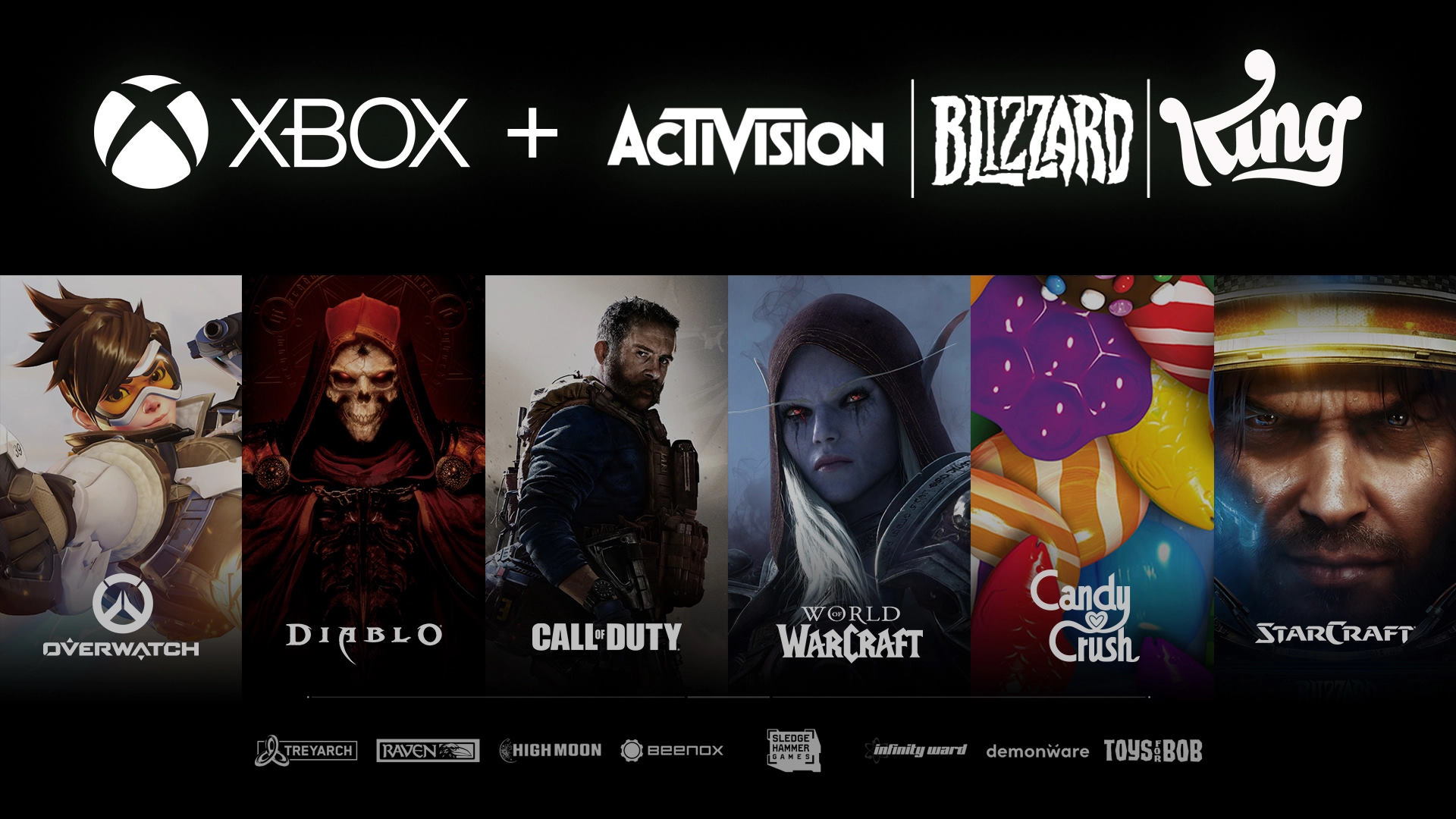
Enlarge/ Just a few of the Activision franchises that will become Microsoft properties if and when the acquisition is finalized.
Microsoft / Activision
Microsoft has said that it is fully prepared to defend its acquisition in court. “We have been committed since Day One to addressing competition concerns, including by offering earlier this week proposed concessions to the FTC,” Microsoft Vice Chair and President Brad Smith tweeted in the wake of the lawsuit news. “While we believe in giving peace a chance, we have complete confidence in our case and welcome the opportunity to present it in court.”
In a Wall Street Journal op-ed published this week, Smith stressed that it is currently in third place behind Sony and Nintendo in the game console business and has “no meaningful presence in the mobile game industry.” Sony’s loud objections to the deal are akin to Blockbuster complaining about “the rise of Netflix,” as Smith put it.
In a message sent to Activision Blizzard employees and shared with Ars Technica, CEO Bobby Kotick acknowledged that the lawsuit “sounds alarming” but expressed “confidence that this deal will close. The allegation that this deal is anti-competitive doesn’t align with the facts, and we believe we’ll win this challenge… despite a regulatory environment focused on ideology and misconceptions about the tech industry.”
Microsoft’s acquisition still faces potential headwinds from overseas governments as well. Last month, the European Commission said it was moving on to an “in-depth investigation” of the deal. And in the UK, a similar “Phase 2” investigation by the country’s Competition and Markets Authority has scheduled a hearing this month. Those international investigations are expected to wrap up in March, when those bodies will decide whether to file their own attempts to stop the deal.
The filing of the FTC lawsuit was widely expected, with reports from insiders describing its filing as “likely” as recently as last month. A group of four US Senators wrote an open letter strongly urging the FTC to take a close look at the deal back in April, three months after Microsoft’s plans were formally announced. https://arstechnica.com/?p=1903011
A quick look at AMD’s Radeon RX 7900 XTX, which is smaller than an RTX 4080
From left to right and largest to smallest: GeForce RTX 4080 (which is the same physical size as the RTX 4090), Radeon RX 7900 XTX, and Radeon RX 7900 XT.
Andrew Cunningham
The 7900 XTX looks a lot more like a current-generation GPU than the hulking RTX 4080.
Andrew Cunningham
Xbox Series S for scale. The 7900 XTX is smaller than the 4080, but that doesn’t make it tiny.
Andrew Cunningham
From another angle.
Andrew Cunningham
The Radeon RX 7900 XTX’s three-fan cooler.
Andrew Cunningham
AMD’s next-generation Radeon RX 7900 XTX and 7900 XT graphics cards launch next week on December 13. Powered by the chiplet-based RDNA3 architecture, these $999 and $899 GPUs will compete with Nvidia’s $1,200-and-up RTX 4000-series and will attempt to address some of the shortcomings of the outgoing RX 6000-series (lackluster real-time raytracing performance, for one).
One thing you’ll notice about the cards—and one that may please people building in smaller cases—is that the cards are considerably smaller than current RTX 4080 and 4090 GPUs, and they don’t use the 12VHPWR connector that has given Nvidia some trouble.
Enlarge/ The RX 7900 series still uses 8-pin power connectors, the same as older GPUs.
Andrew Cunningham
We can’t say anything about whether the cards’ performance is larger or smaller than the RTX 4080’s until our review runs next week. But in the meantime, we can show you that the 7900 XTX (and the even smaller 7900 XT) are next-gen GPUs that will fit into most of the same cases as current-gen GPUs.
Neither GPU uses a two-slot fan and heatsink, but they do stick to 2.5-slot coolers that are similar to the ones used for the 6900 XT series and plenty of partner cards. And power continues to be supplied by a pair of 8-pin plugs, so you don’t need to worry about adapters or running additional wires if your PC is already set up to provide power this way.
Enlarge/ The 2.5-slot 7900 series is still thicker than 2-slot cards like the Radeon RX 6800 (top).
Andrew Cunningham
The flagship 7900 XTX measures 11.3×4.8×2.1 inches (287×121.9×53.3 mm), and the somewhat smaller 7900 XT is 10.9×4.4×2.1 inches (276.9×111.8×53.3 mm). Nvidia’s first-party RTX 4090 and 4080 designs are both 12×5.4×2.4 inches (304×137×61 mm), and the 12VHPWR adapters that come with them add a bit of additional width on top of that. The upshot is that the 4080 and 4090 may be difficult to fit in some PC cases, especially alongside a large CPU cooler or other components, while the 7900 series should be able to slot into any case that can handle a 6900- or 3090-series card.
Of course, it doesn’t matter if the Radeon cards are smaller if they can’t keep up with the 4080 or 4090—we’ll be looking at performance, heat, and power efficiency in more depth when our review goes live next week.
Listing image by Andrew Cunningham
https://arstechnica.com/?p=1902931
Two months of Intel Arc driver updates begin to fix low performance in old games
Enlarge/ Intel is talking up big performance gains in some old, but noteworthy, games.
In the run-up to the launch of Intel’s Arc graphics cards, the company emphasized for months that the cards might not perform well in games that didn’t use newer graphics APIs like Vulkan and DirectX 12. The GPUs are actually quite price-competitive with aging midrangers like Nvidia’s GeForce RTX 3060 if you’re playing newer games, but performance in older games is mixed.
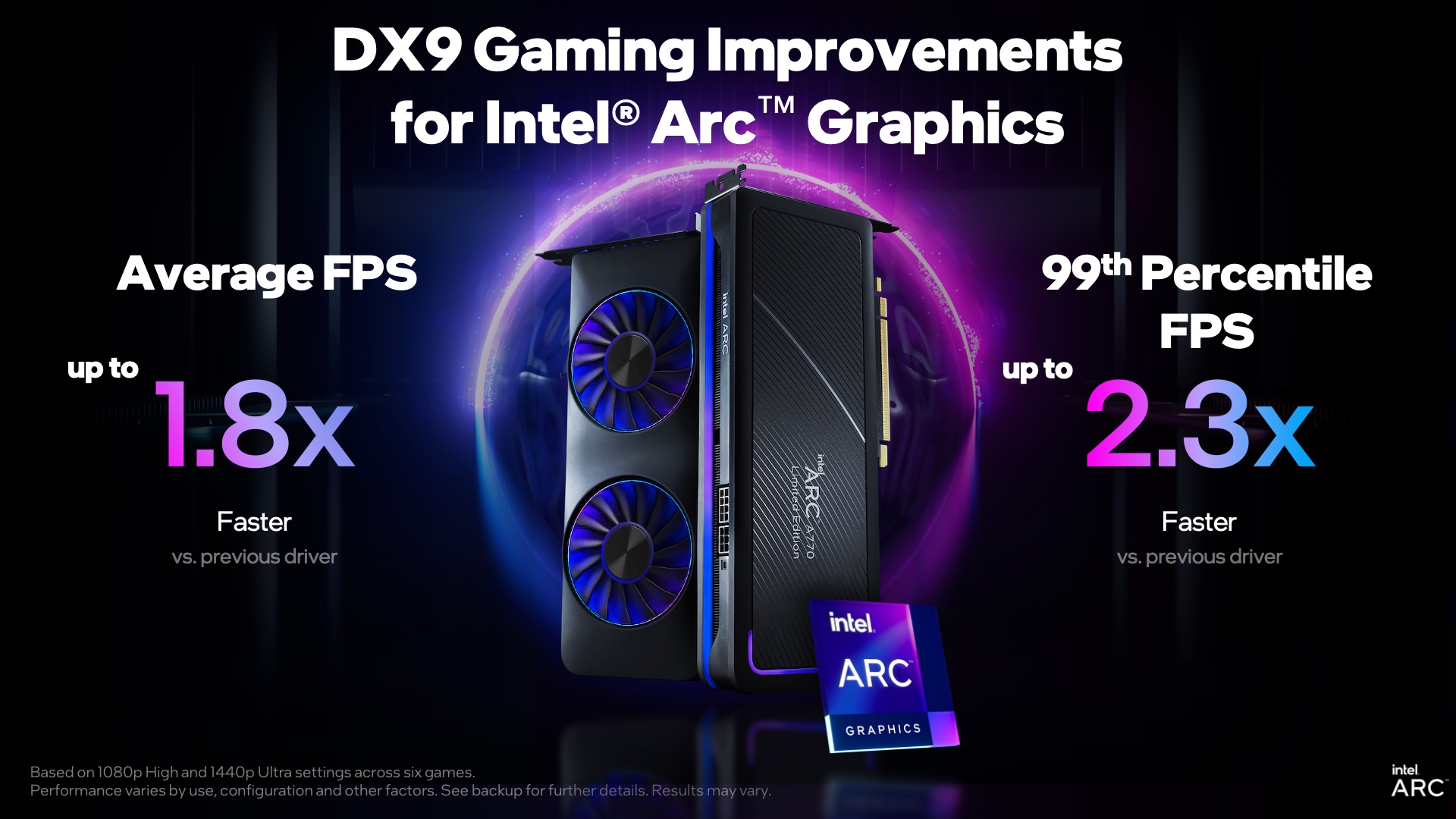
For Intel Arc owners attracted to the cards’ price, salvation may come in the form of continued driver updates. Since the October launch of the A770 and A750, Intel has released a handful of driver updates, each of which fixed specific bugs or provided small performance improvements in individual games. But in today’s beta driver release (31.0.101.3959, for those keeping track), Intel is offering a “significant” boost in older DirectX9 titles, with frame rates that can improve by as much as 80 percent.
DirectX9 was the graphics API of choice in the Windows XP era, and the Windows XP era lasted for a very long time. The API is also used in still-popular multiplayer games like Counter-Strike: Global Offensive, League of Legends, Team Fortress 2, and Starcraft II, making performance improvements in DirectX9 games particularly noteworthy.
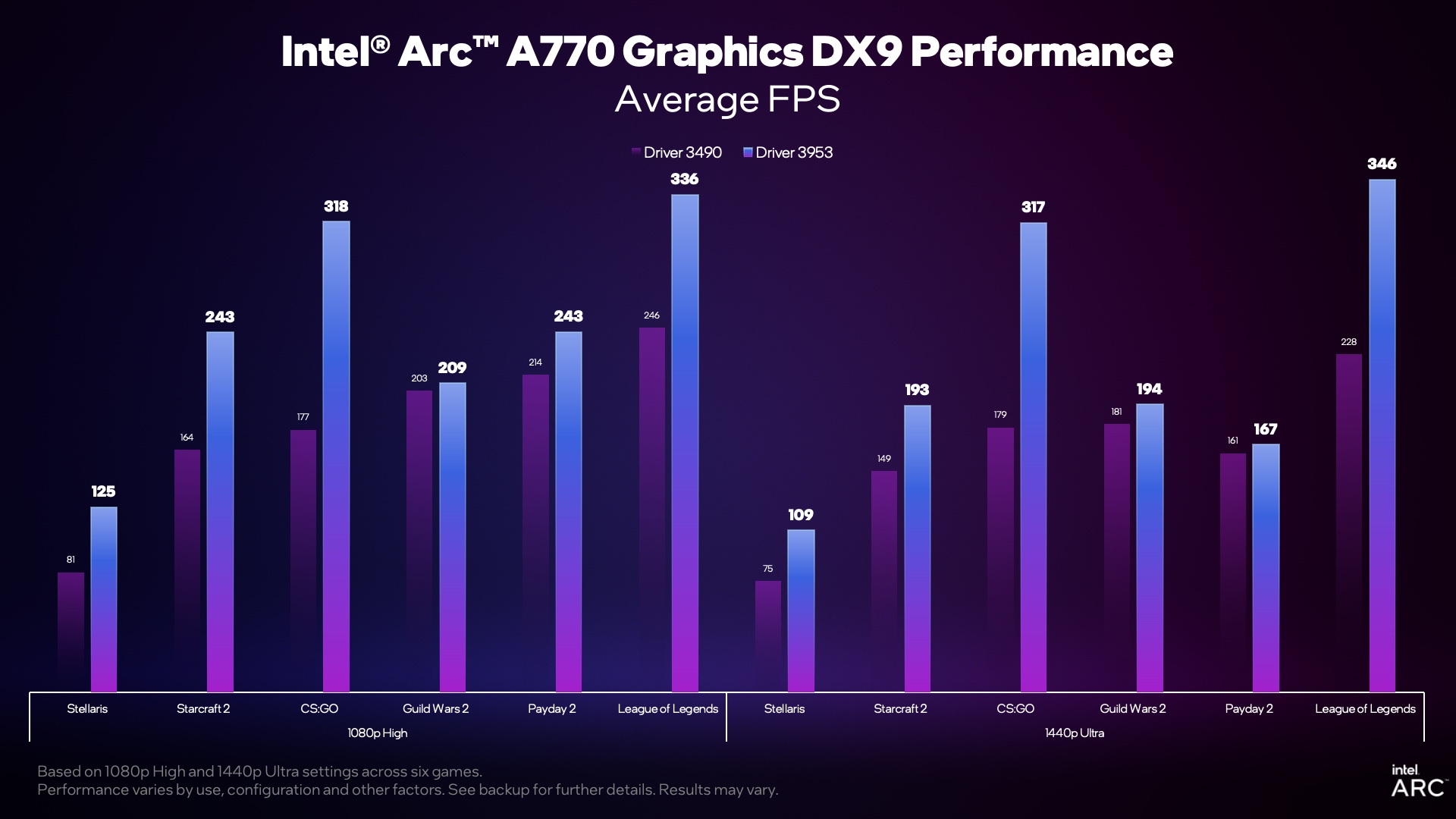
Enlarge/ Specific performance numbers. This isn’t the difference between playable and unplayable, but they might be noticeable on monitors with super-high refresh rates.
Because these are pretty old games we’re talking about, these performance improvements aren’t necessary to hit 60 frames per second on the A770 (though the improvements also apply to the entry-level Arc A380 GPU, which might need the extra help. These increases will mostly benefit competitive players, for whom super-high frame rates and low response times are critical. Some of the increases from the new driver are minor, but at 1080p, Intel says Stellaris and Starcraft II frame rates improved by around 50 percent, while League of Legends improved by 37 percent and CS: Go went up by 80 percent.
Intel had previously said it used a Microsoft-provided translation layer to support DirectX9 games. With these improvements, the company says it’s introducing a “hybrid” approach, using the D3D9On12 layer “when a better experience can be delivered” and a native implementation when it benefits performance. This makes some sense—Intel can use translation for any given 15-year-old DirectX9 PC game while providing a more optimized native implementation for the DirectX9 games that lots of people are still playing.
Intel will decide when to switch individual titles over to the native DirectX9 implementation rather than the translated one and will deliver those changes via driver updates along with other improvements.