Guests get more than they bargained for in trailer for Fantasy Island reboot

[embedded content]
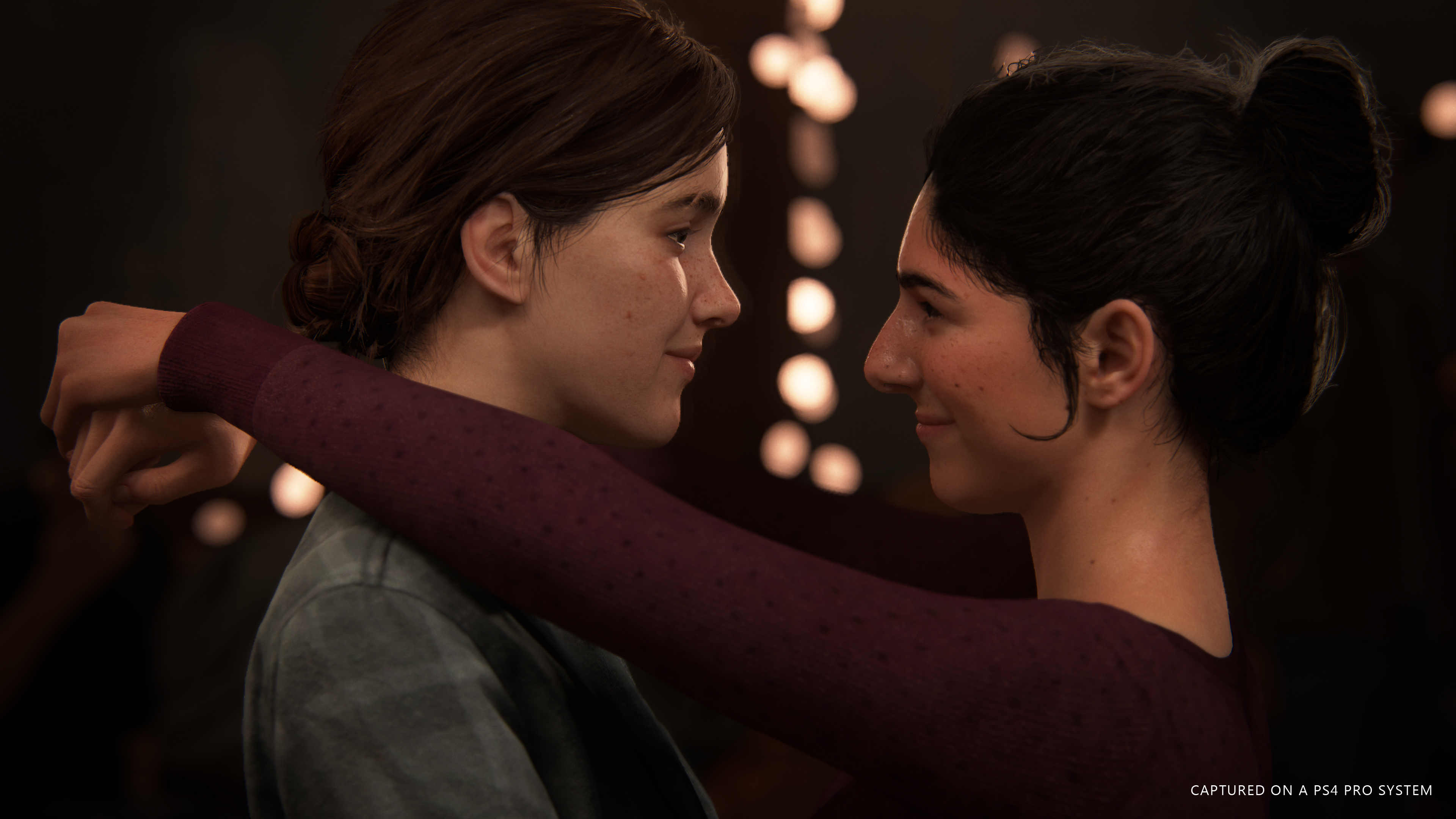
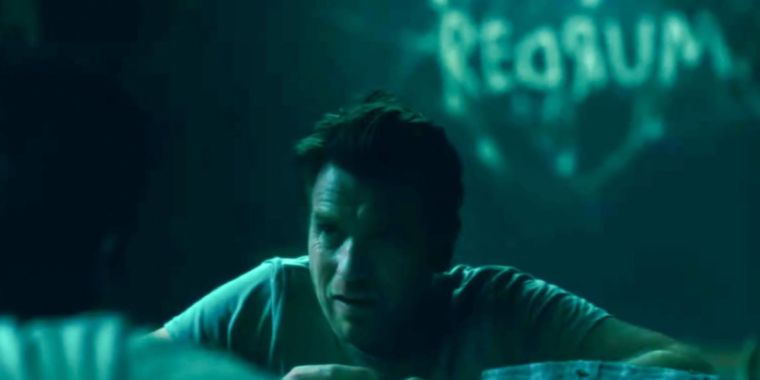
Michael Peña and Lucy Hale star in Sony Picture Entertainment’s Fantasy Island.

Ze plane! Ze plane! OK, there’s no Tattoo, but the mysterious Mr. Roarke is still offering select guests a rare opportunity to make their dreams come true in Sony Pictures’ big-screen reboot of Fantasy Island, based on the popular TV series of the same name that ran from 1977-1984. This 21st-century update plays up the horror aspects and is being touted as a cross between Westworld and The Cabin in the Woods—perhaps with a little bit of Lost thrown in for good measure.

Fantasy Island was always kind of a terrific storytelling concept, despite its cheesier elements. Apparently, creator Aaron Spelling pitched the series to ABC executives as a joke after they’d rejected all his other ideas—and the network loved the idea. The ultra-urbane Ricardo Montalban played the dashing Mr. Roarke, proprietor of the titular island, providing guests the chance to live out their fantasies for a suitable price. He was aided by his trusty sidekick Tattoo (Hervé Villechaize). Every episode opened with Tattoo shouting the catchphrase, “Ze plane! Ze plane!” and ringing a bell in the island’s main tower as guests arrived.

There were usually two to three subplots per episode, focusing on the different fantasies of specific guests, who inevitably found things did not play out quite the way they’d imagined. And while the rules of engagement held that guests must see their fantasies through to the end, no matter what, Mr. Roarke always intervened if things got too dangerous. The series had certain supernatural elements (time travel was common, and ghosts, genies, and the devil himself made appearances), particularly in later seasons, with hints that Mr. Roarke was quite possibly immortal. Spelling has never revealed anything about the character, but Montalban later admitted that he viewed Mr. Roarke as a fallen angel presiding over an island purgatory. That would explain his fondness for moralizing and teaching guests a valuable lesson by fulfilling their fantasies in unexpected ways.

An attempted revival of the series in 1988 leaned even harder into the supernatural aspects. It starred Malcolm McDowell as Mr. Roarke, aided by a female shapeshifter named Ariel (Mädchen Amick) and his adoptive daughter Miranda—obvious allusions to Shakespeare’s The Tempest. Fantasy Island was presented as a kind of limbo and a source for Mr. Roarke’s supernatural powers, while the many assistants worked there to pay off some unnamed debt. That reboot bombed and was mercifully canceled midseason.

This latest reboot seems to preserve much of the original premise—with a twist. Per the official synopsis: “The enigmatic Mr. Roarke (Michael Peña), makes the secret dreams of his lucky guests come true at a luxurious but remote tropical resort. But when the fantasies turn into nightmares, the guests have to solve the island’s mystery in order to escape with their lives.” Maybe there are shades of The Most Dangerous Game here as well. The tagline is “You deserve it,” so the moralizing aspect is probably intact, too.

The trailer opens, per tradition, with guests arriving via plane to the island and being greeted by an as-yet-unnamed host, played by Parisa Fitz-Henley (best known as Luke Cage’s deceased wife in Netflix’s Defenders series). “Here, anything and everything is possible,” she tells the guests, although it doesn’t take long for Melanie (Lucy Hale) to complain about the lack of cell phone service. She’s also convinced that the “fantasies” are created using realistic holograms, “like Tupac.”

Roarke greets his guests and outlines the rules: “There is only one fantasy per guest, and you must see your fantasy through. No matter what.”

One of the guests, played by Maggie Q, is a grieving mother longing to be reunited with her dead daughter—and it seems Roarke has indeed managed to bring the little girl back to life, or something so like her, her own mother can’t tell the difference. Another guest seems to find himself in a soldier-of-fortune/military-type fantasy. But it’s Melanie’s fantasy that is the main focus here: taking revenge on the girl who bullied her in school. She finds herself in a dungeon with said bully tied to a chair, ready for torture, but soon realizes it is not a hologram. That’s really the girl who bullied her, and there’s a creepy masked Surgeon (Ian Roberts) standing by to inflict unspeakable torments.

It’s the ultimate fulfillment of the adage “Be careful what you wish for.” As one male guest complains, “The island’s twisting what we asked for.” And our grieving mother notes, “We weren’t brought here to have our own fantasies. We were brought here to be a part of something else.” Forget about escaping the island by plane: we see it explode in mid-air upon approach. Who will solve the puzzle and make it off alive?

Fantasy Island hits theaters on February 14, 2020.

Listing image by YouTube/Sony Pictures

https://arstechnica.com/?p=1600215


A personality quiz for fans of math and history: Are you a Newton or a Leibniz?

Arch-rivals Isaac Newton and Gottfried Leibniz famously fought over the credit for inventing calculus.
Enlarge / Arch-rivals Isaac Newton and Gottfried Leibniz famously fought over the credit for inventing calculus.
Math teacher Ben Orlin writes and draws the (aptly named) blog Math With Drawings and is the author of a new book, Change Is the Only Constant: The Wisdom of Calculus in a Madcap World. To mark its publication, he devised this entertaining accompanying quiz. You can read the Ars interview with Orlin here.

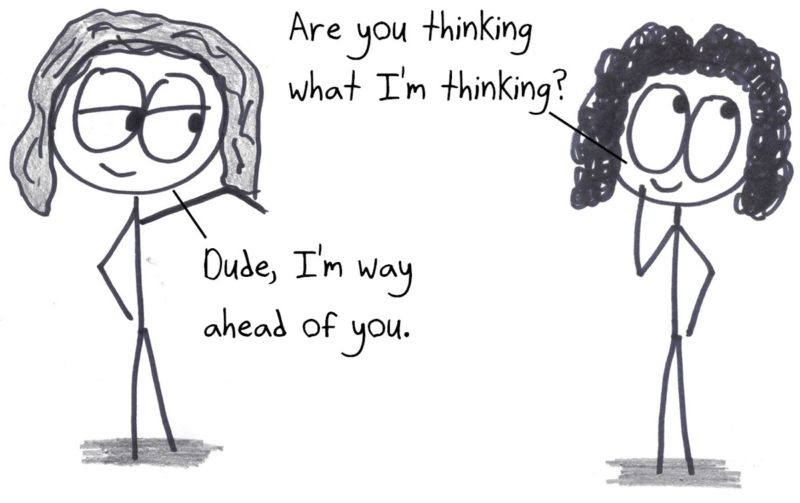
Isaac Newton and Gottfried Leibniz have a lot in common. Birthdates in the 1640s. Fatherless childhoods. Colossal egos. Show-stopping wigs. Most of all, each had the honor of bringing calculus into the world. But when it comes to personalities, Newton and Leibniz are like night and day, or England and France, or derivatives and integrals. They’re rivals. Opposites, even. Do you belong on #TeamNewton or #TeamLeibniz? Take this quiz to find out!

What do you like to do online?

(a) Engage in civil debate with my fellow Wikipedia editors
(b) Write long, password-protected blog posts about my intricate conspiracy theories
(c) Go on social media; read the news; maybe watch some YouTube

What makes you feel the smartest?

(a) Explaining things so that everyone else understands
(b) Knowing things that no one else understands
(c) The smartest? I’m just happy not to feel the stupidest

Where would you rather live?

(a) A big, vibrant city full of interesting people
(b) A quiet backwater where no one will bother me
(c) Just someplace warm

How many different people did you text yesterday?

(a) 11 to 1,000
(b) 0 to 1
(c) 2 to 10

How many browser tabs do you have open right now?

(1) 11 to 1,000
(b) 1
(c) 2 to 10

How do you prefer to deal with your enemies?

(a) Persuade them to see the light
(b) Keep my hands clean while my friends annihilate them
(c) I try not to make enemies

What does your ideal wig look like?

(a) Curls of black smoke rising
(b) A cascading river of silver
(c) Honestly, I’d rather be bald

What is the solution to our current political troubles?

(a) Learn to reconcile and seek compromise
(b) Punish the bad actors and wrongdoers
(c) Stop paying so much attention to politics

What is the greatest embarrassment of your youth?

(a) The time I got canceled for saying we live in “the best possible world”
(b) The time I threatened to burn my mom and stepdad alive
(c) Youth is one big embarrassment, and I’m glad mine was not well recorded

After mathematics, what is your favorite subject?

(a) Philosophy
(b) Science
(c) More mathematics

What are you procrastinating on, and what’s your excuse?

(a) A report for my boss. I’ve just got a lot on my plate right now, and…
(b) Publishing my ideas. Why bother? No one grasps my genius.
(c) More or less everything. I’m even procrastinating on my excuse.

Finally, and most important: when did you develop the ideas of calculus?

(a) First
(b) First
(c) I believe that trying to rank discoverers and establish priority does violence to the true, collaborative nature of intellectual progress. (Also: not first.)

RESULTS:

If you answered mostly A’s, then congratulations: you are a LEIBNIZ!

You are a polymath, a renowned scholar, and one of those philosophers who loves to tell everybody how important it is to do philosophy. You’re not perfect—one time, you wrote in a think-piece that we live in “the best of all possible worlds,” an argument that Twitter nobodies are still dunking on 300 years later—but in general, your thinking is rich, bold, and abstract. You write beautifully and love to share ideas. You have a profound faith in collaboration and the impartial search for truth.

Unfortunately, you suck at academic knife-fights. Too naïve; too optimistic. Case in point: in your dispute with Isaac Newton, you accepted the British Royal Society as an impartial mediator, despite knowing that its leader at the time was literally Isaac Newton. Oh well. Your strategic stupidity may cost you in the short term. But sooner or later, history will appreciate your genius.

If you answered mostly B’s, then congratulations: you are a NEWTON!

You are viewed as an intimidating and extraordinary genius. Renowned poets are constantly dropping laudatory verses about you. Even when we know you’re wrong—like when you spent decades on crackpot theories of alchemy—we’re too awed to give you crap about it. You can also become, when the occasion demands, a stone-cold bitch. You refuse to lose any dispute, and you make quick knifework of your rivals (or, better yet, you have your loyal allies do the dirty work for you).

Is this ego run amok? Sure, in part. But it’s also single-mindedness. You’re not here to make friends; you’re here to solve problems and kick ass. It’s frustrating when “little baiters and smatterers” (your phrase, not mine) come pestering you with questions, or—even worse—trying to claim credit. You just want to think your thoughts. And even your rivals must admit: You think some darn good thoughts.

If you answered mostly C’s, then congratulations: you are ONE OF THE MANY NAMELESS OTHERS WHO CONTRIBUTED TO THE DEVELOPMENT OF CALCULUS!

You lay the foundations for the Newtons and the Leibnizes. Or perhaps you extend and elaborate on their work. Or perhaps you solve the same problems, but in a different place, at a different time, as part of a different tradition. In any case, you’re a vital part of the history. Part of the history—yet not part of the story. A few heroes get starring roles; you get left on the cutting room floor. They get lionized; you get lost.

But hey, don’t let the cult of celebrity get you down. Calculus is yours as much as theirs. Ideas (like the ones that comprise calculus) are neither pure nor absolute. They draw their hues and shades from the intellectual context, the way crystals draw their color from trace elements. Each time a new person grasps calculus, something novel and irreproducible emerges; in short, calculus is discovered all over again.

https://arstechnica.com/?p=1599805


Limits, schlimits: It’s time to rethink how we teach calculus

Twenty-eight tales make up this entertaining, illustrated exploration of the intersection between calculus and daily life.
Enlarge / Twenty-eight tales make up this entertaining, illustrated exploration of the intersection between calculus and daily life.

Calculus has a formidable reputation as being difficult and/or unpleasant, but it doesn’t have to be. Bringing humor and a sense of play to the topic can go a long way toward demystifying it. That’s the goal of math teacher Ben Orlin’s new book, Change Is the Only Constant: The Wisdom of Calculus in a Madcap World, a colorful collection of 28 mathematical tales connecting concepts in calculus to art, literature, and all manner of things human beings grapple with on a daily basis.

His first book, Math with Bad Drawings, after Orlin’s blog of the same name, was published last year. It included such highlights as placing a discussion of the correlation coefficient and “Anscombe’s Quartet” into the world of Harry Potter and arguing that building the Death Star in the shape of a sphere may not have been Darth Vader’s wisest move. We declared it “a great, entertaining read for neophytes and math fans alike, because Orlin excels at finding novel ways to connect the math to real-world problems—or in the case of the Death Star, to problems in fictional worlds.” And now, he has taken on the challenge of conveying the usefulness and beauty of calculus with tall tales, witty asides, and even more bad drawings.

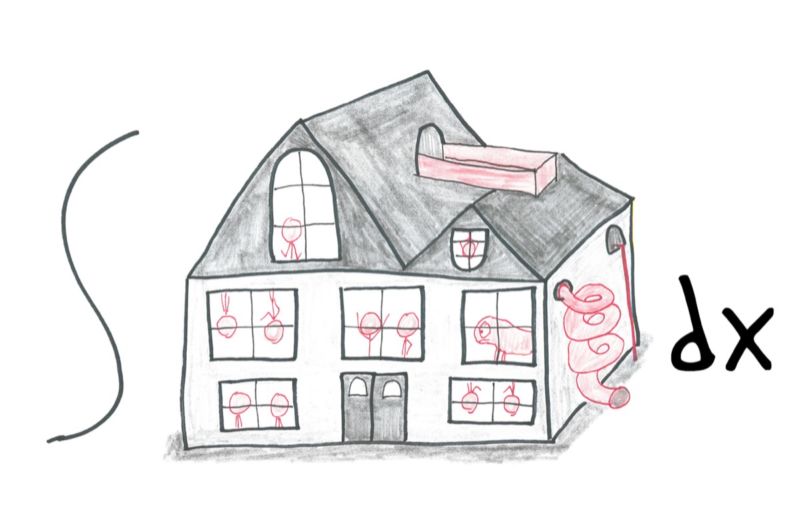
Calculus boils down to two fundamental ideas: the derivative, which is a way of measuring instantaneous change, and the integral, which describes the accumulation of an infinite number of tiny pieces that add up to a whole. “The derivative is all about isolating a single moment in time, and the integral is all about gathering together an infinite stream of moments to develop a holistic picture,” Orlin told Ars.

I like to think of the derivative and the integral as the two ends of a hammer: one is for pounding in the nails, and the other is for pulling them out. The first is a process of subtraction and division; the second, a process of multiplication and addition. Each “undoes” the work of the other. And the fundamental theorem of calculus makes it possible to change one problem into another problem. For instance, if we have an equation that tells us the position of a falling apple, from that we can deduce the equation for the velocity of the apple at any given moment of its fall.

If calculus is so simple and straightforward, why does it strike fear and trepidation into the hearts of so many? It likely has something to do with the way in which it is traditionally taught. The experience of writing Change Is the Only Constant helped Orlin refine his ideas on how one might move away from longstanding dogma and rethink that traditional approach.

That said, while there are teaching notes included as appendices, this is not a textbook. “The book doesn’t do much in the way of computation,” he said. “It’s more about telling stories about the concepts and applications.” A Sherlock Holmes story, for instance, demonstrates how to use tangent lines to figure out which direction a bicycle was traveling from the tracks left in the mud.

A cat named Caliban contemplates the wonders of calculus in everyday life.
Enlarge / A cat named Caliban contemplates the wonders of calculus in everyday life.
Jennifer Ouellette

Ars Technica: Why did you choose to write about calculus for your second book?

Ben Orlin: I was excited about calculus before I had an idea of how to tell the story. The first inklings of this book were probably back around 2012. I was working on a book that I called The Riemann Calculus Textbook, written in Dr. Seuss style rhymes. It didn’t quite pan out. It might have been okay as a companion text for a course, but it wasn’t really a good way of popularizing calculus, because it was just too slavishly following the way the material is presented in a course.

Then I had a different approach: a book I called The Poet’s Calculus, which was going to connect each idea in calculus to a different connection in the humanities. So the poetry of Adrienne Rich would be a metaphor for limits, and the paintings of Edgar Degas would be connected to derivatives of motion, velocity, and acceleration. But that was a little too over-conceptualized. There were about three or four chapters that really worked and then the rest were pretty strange connections.

Finally, I decided to build it around all my favorite stories that touched on calculus, stories that get passed around in the faculty lounge, or the things that the professor mentions off-hand during a lecture. I realized that all those little bits of folklore tapped into something that really excited me about calculus. They have a time-tested quality to them where they’ve been told and retold, like an old folk song that has been sharpened over time.

Ars: You write that you found yourself moving away from the dogma of how calculus is traditionally taught—for example, not teaching limits first and foremost. What are your thoughts on how we can better teach calculus?

Orlin: The way we teach calculus is shaped by two considerations. One is that we use calculus as a gatekeeping course very often. So even students who won’t in their careers need calculus, wind up having to pass through it as this gauntlet to gain access to these selective educational opportunities. For that purpose as gatekeeper, we tend to really play up the pencil and paper, computational problem-solving aspects of it. To be fair, that’s an important aspect of calculus; you need to move through in a certain sequence. It’s very clear you need to do derivatives before integrals, because to take an integral is to take an antiderivative, and that’s a harder process. That winds up putting pretty firm constraints on how you can sequence things.

Since the early to mid-20th century, teaching calculus has also been driven by the desire for a rigorous axiomatic development—that is, wanting to start from first principles and make sure every theorem is proved and that every rule is justified in a way that is satisfying to mathematicians. Axiomatic proof is great for showing things are true in one sense, but it’s not particularly resonant to students. That’s why limits are really foregrounded—because in some abstract sense, all of it is philosophically grounded in limits. But you really don’t have to start with limits and make them the center of everything.

“You don’t have to start with limits and make them the center of everything.”

Ars: I think most people who take calculus find that derivatives are pretty easy—the same process over and over, with a few exceptions that need to be memorized—but integrals are much harder, requiring a kind of intuition, or a bit of guesswork.  How do you teach something that is almost an art?

Orlin: To me, the dichotomy you’re talking about is one of the most interesting things about calculus: that we have this complete and well-developed theory of derivatives that is quite mechanical. It’s not hard to tell a computer how to take derivatives. With integrals, you can do it in one direction, but trying to do the reverse is very hard. And with derivatives there are maybe eight types of problems that you have to learn, while when it comes to integrals, there are essentially a limitless supply. So how do you teach it? I think it just takes a lot of patient practice.

There’s an event called the MIT Integral Bee, founded by a professor at Harvey Mudd named Andy Bernoff when he was an undergrad at MIT around 1980. Integrals are like English spellings, where they have a hundred different etymologies, and two that sound identical can actually be spelled very differently. Similarly, integrals that look almost identical might have very different solutions, so they have this fun puzzle-y aspect to them.

Bernoff’s observation is that integral skills have gotten a lot worse over the last 30-40 years for probably the same reason that our spelling has gotten a lot worse: we don’t need it anymore. Computers are pretty good at fixing it. I think understanding the limitations of our theory of integrals is important, but learning a lot of the integration techniques maybe aren’t worth such a featured spot in our secondary math curriculum.

Ars: There have been calls about revamping high school mathematical curricula to teach statistics, for example, as opposed to algebra and calculus. What are your thoughts on that?

Orlin: The questions are fair. And they demand that we reawaken our sense of the beauty and power of calculus. I think the different subjects accomplish different things. The kind of thinking you do in a calculus course is different from the kind of thinking you do in a good statistics course. I definitely don’t like the idea of abolishing calculus. But I taught in the UK for a few years, where there are not separate courses for algebra and geometry and calculus and so on. It’s an integrated math curriculum. Most countries work that way. You could move more of the math education into other subjects that are currently users of mathematics, like physics. In the UK, at least, the university system tends to work this way. If you’re majoring in the sciences, you’ll have math courses taught by the scientists. You won’t go to the math department to take those courses.

There’s something peculiar about the US where we stratify math. We carve out math as a separate discipline, with its own instructional approach. The US system winds up putting calculus on this pedestal as the culmination of secondary math education, when really, yes, it’s a beautiful field of math, but it’s just one important thread in a larger tapestry.

Ars: One last question: how would you make the case for calculus to someone who is skeptical of its relevance, and maybe even a little math-phobic?

Orlin: Calculus takes the most vexing and mysterious things imaginable—motion, change, the flow of time—and boils them down to ironclad rules of computation. It takes this world of flux, which is totally ineffable, and reduces it to symbolic procedures and equations you can solve mechanically. That’s a kind of magic that has inspired thinkers for generations. It inspired [Leo] Tolstoy, [Jorge Luis] Borges, and David Foster Wallace. It shaped visions of history, ethics, and the powers of the human mind. Calculus is the canonical example of turning the impossible into the routine, and its ideas have nourished not only science, but economics, philosophy, and even literature, too.

That’s the case I wanted to make in this book. Not a defense of calculus as it’s currently taught—heaven knows we could do better—but an exploration of the human side of calculus, what it has meant over the years to everyone from scientists to poets to philosophers to dogs. If calculus is going to remain a fixture of math education—even for those not pursuing STEM careers—then we need to bring out its humanity, to find a version of calculus that speaks to everyone.

https://arstechnica.com/?p=1599817


World of Warcraft: Shadowlands impressions: Leveling alts is about to get a lot more fun

World of Warcraft: Shadowlands marks the eighth major expansion pack for the storied MMO. Judging from a half-hour playing it at BlizzCon this year, it seems like a natural evolution of modern WoW that will run alongside the very-different WoW Classic experience for the foreseeable future. That said, the biggest change wasn’t part of my hands-on demo—but don’t worry, that won’t stop me from geeking out about it in extreme detail.

Let’s be clear where I’m coming from, here: I’ve been playing World of Warcraft almost continuously for 15 years. (I lapsed for a big chunk of the Wrath of the Lich King era for IRL reasons.) While I understand the appeal of WoW Classic, I am very much a proponent of modern WoW; the game has evolved over time to be more accessible for me to play just a couple of hours a week, as real life now dictates. But I tend to play solo or just with one or two friends on a sporadic basis, which means I’m looking for something very different than the hardcore raiding or PvP crowd.

Within that framing, I feel WoW has gotten more and more fun over the years. There have been some missteps, sure (I’m looking at you, Warlords of Draenor), but I felt that the semi-recent Legion was the best expansion Blizzard has ever done. My hopes are high for Shadowlands.

It’s hard to get a sense of an entire World of Warcraft expansion from 30 minutes of play. In my short demo, I recreated my main (a Beast Mastery Hunter) and played through the introductory quests from the Bastion zone, a heaven-like plane from Azeroth’s afterlife. The minute-to-minute gameplay very much followed the formula of modern WoW questing, with a variety of tasks like challenging specific enemies to duels, helping craft things in timed minigames, and of course, killing 10 rats (well, not rats, but they might as well be).

From what I could tell, not much had changed about my character’s build; my DPS rotation was the same as it is in Battle for Azeroth. But we’re a year out from launch, and past expansions have taught us that plenty of that small stuff can and will change in the coming months.

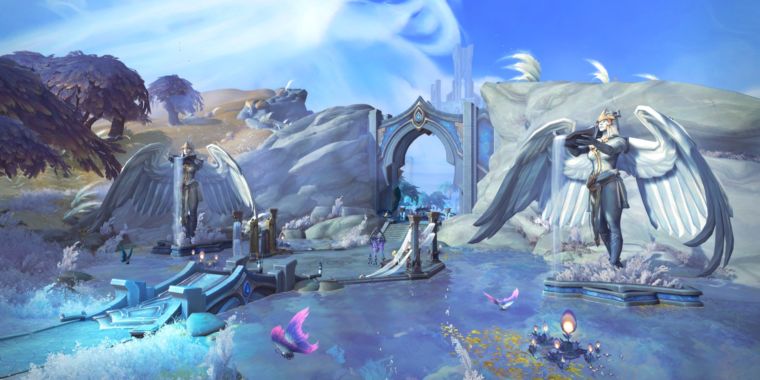
As always, though, Blizzard really delivered on the art front. Bastion is striking, with big, beautiful skies, banners realistically waving in the wind, and fascinating characters, like a humanoid, owl-like race that inhabits the zone. Blizzard artists told me that they plan to support RTX raytracing, as well as new kinds of real-time lighting, in the expansion. I’m surprised by how good modern WoW looks on a high-end PC these days, given that it originally came out in 2004, and it looks like that work will continue.

Since this was an early questing experience and not an endgame one, I didn’t get much sense of how Covenants—Shadowlands’ new Order Hall, Garrison, or War Campaign-like systems—work. Neither did I have much time to dive into the story, though I saw enough to know that, if you like the flavor of the recent WoW expansions, you’ll probably like this one, too. (I, for one, am glad we’re going to get a brief respite from the Alliance vs. Horde war storyline.)

But the most interesting thing Blizzard is changing wasn’t part of my demo.

Taking it to a new (well, old) level

Frankly, the aspect of Shadowlands I’m most excited about is an overhaul of the leveling system—something that wasn’t a part of this demo in a major way. This kind of breaks the rules of a hands-on article, but I want to take an opportunity to talk about it and why I think it’s interesting, regardless, since it came up in my interview with WoW developers.

After rumors about this possibility for the last several expansions, Blizzard has finally followed through on a level crunch. Whereas characters in the current Battle for Azeroth expansion cap out at level 120, the cap in Shadowlands will be 60—just as it was when the game first launched and just as it is in World of Warcraft Classic. Level-120 characters will be scaled down to level 50 when Shadowlands launches.

That might seem odd or negative to those who aren’t currently playing WoW, but it’s actually something a great number of today’s WoW players have been asking for. As the levels rose in this 15-year-old game that frankly wasn’t designed with a 15-year plan in mind, Blizzard encountered all sorts of frustrating game design problems that players have been cranky about, too. The WoW team has already crunched player stats like health and mana down on multiple occasions as a way to postpone fully solving the problem, so this is the culmination of something that has been underway for a few years now.

And few things were more problematic from a design perspective than the experience of leveling a new character up from level one. A level-based MMO this late in life seemingly has had three options:

  • Never raise the level cap, and try to entice players with other rewards besides linear power progression in the endgame. WoW opted not to go with this, though some other MMOs (like The Elder Scrolls Online) have adopted it to varying degrees.
  • Keep raising the level cap with no changes to the leveling experience up to that point. This leads to ever-lengthening leveling ramps that make it extremely difficult for new players to get to current content. That’s because each expansion adds another several dozen hours to how long it takes to get from the start to being able to play with friends in the endgame. (Final Fantasy XIV has this problem to some degree, even though it’s nowhere near as old as WoW.)
  • Keep raising the level cap but crunching how much experience is required per level as you do. This is the approach WoW has historically taken. But as this happens, levels start to seem meaningless. You gain them ultra-quickly, and only a smattering of them actually introduce new abilities or other perks. It also means that you blast through the leveling content at such a pace that you never finish individual zone stories; you only finish a small portion of an area before you have outleveled it and are ready to move on.

Blizzard’s new solution in Shadowlands is to return the level cap to its original value of 60 and to make current content appropriate for levels 50 through 60. New players start at level one, and they all play through a new introductory zone built for Shadowlands based on the quest design lessons Blizzard has learned over the years. Once they play through that introductory experience, they can then level up to 50 to catch up with current content by playing through the previous expansion (Battle for Azeroth) right away (from around level 10).

This skips all the content before the previous expansion to give players the most modern experience from a quest design POV (and to make sure the players are connected with the current storylines). It also ensures new players have a shorter leveling ramp—Blizzard says it will be as much as 70% shorter than it is currently to get from level one to the cap.

Below: Shadowlands concept art.

But it gets even more interesting when you look at how it will work for alts (second or later characters made by existing players). New characters made by existing players will have the option of leveling up the old way in all the same old zones from the start. But they will also be able to go through the new-player starting experience if that’s what players prefer.

Further, once the new character has completed the starting zone, the player can then choose to level up to 50 in any previous expansion of their choice—vanilla/classic, The Burning Crusade, Wrath of the Lich King, Cataclysm, Mists of Pandaria, Warlords of Draenor, or Legion. The expansion’s content will scale perfectly with the character level, and each is tuned so that reaching level 50 involves playing through the content at a similar pace to a similar level of completion as those expansions offered when they were current content.

So, I could create a Mechagnome Hunter, play through whichever starting area I want, and then pick either Mists of Pandaria or Legion as my leveling expansion for that character. Once I finished leveling through that expansion, I’d be ready for current content.

Blizzard hasn’t talked about what it plans to do after Shadowlands. I speculate that the longterm solution would be to do this every expansion—so in the next expansion, Blizzard might move Battle for Azeroth into the multitude of choices for new character-leveling experiences and push level-cap characters back down to 50 to start whatever expansion comes after Shadowlands—an odd hybrid of traditional MMO and a seasonal model common in plenty of modern multiplayer games.

The result is that leveling up new characters will be a lot more fun, and it will be easier than it has been in years for new players to pick up the game.

A new expansion is exciting, but WoW‘s strength is arguably in its history—and revisiting that history is about to get a lot more fun. More than new zones, raids, or endgame-progressions systems, this is what has me excited to play WoW when Shadowlands launches late next year.

Listing image by Blizzard

https://arstechnica.com/?p=1599473


Diablo 4 impressions: Soaking in dark atmosphere and feel-good combat

ANAHEIM, Calif.—This year’s BlizzCon was a big one in many ways, but among them was the presence of playable demos for Diablo 4, World of Warcraft: Shadowlands, and Overwatch 2. I attended the show this year and played all three.

While there was some tension in the media coverage and social conversation around this BlizzCon after the company’s decision to temporarily suspend a pro Hearthstone player for making a political statement during an official stream, it was not the dominant mood on the ground. From the keynote through the community events, it was clear most people were a lot more concerned about the games than anything else.

And there were a lot of games. I’ve been to many a BlizzCon, but this was by far the most eventful in terms of announcements. There was the long-awaited Diablo 4, a new World of Warcraft expansion called Shadowlands, a sequel-of-sorts to Overwatch, and a new Hearthstone mode that marks Blizzard’s entry into the popular auto-battler genre.

I actually started my career as a writer writing for a World of Warcraft news site called WoW Insider (now titled Blizzard Watch). For years, though, I had mixed feelings about Blizzard games. I often felt like every Blizzard game had a more sophisticated, more compelling, more hardcore alternative. But as I grew older, and especially as I experienced games through the eyes of my then-girlfriend (now wife) who was new to gaming, I began to appreciate Blizzard’s focus on accessibility, onboarding, and polish.

Based on how it’s designed, it’s much easier to keep up with Diablo 3 if you work full time and have a family than it is to follow Path of Exile. The same goes for modern World of Warcraft compared to many other MMOs. Also, Blizzard games became a regularly shared activity between my wife and I over time. We leveled WoW characters together, each on our own desktops; we gathered Diablo 3 sets in the couch co-op PS4 version; we formed Overwatch teams with my brother-in-law and secured many, many plays-of-the-game; we cheered for our favorite players in Hearthstone esports.

So I went to BlizzCon 2019 as a fan with deep, deep history in these games. And these are my (largely positive) impressions of arguably the biggest new game at the show: Diablo 4.

Atmosphere and vibe

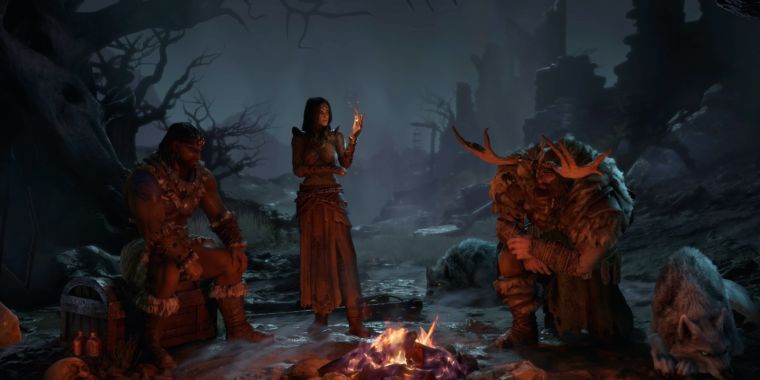
Let’s get this out of the way first: despite modern game design concepts and very modern rendering tech, Diablo 4 looks a lot more like Diablo 2 than it does Diablo 3. It’s not cartoon-ish or colorful; it’s dark, grim, muted, and painterly. If you’re in the cadre of players who were disappointed by Diablo 3‘s lighter, campier tone, you’ll be pleased to see a return to form here.

Every asset in the area I played was created to convey a sense of decay, despair, and violence. And Blizzard has implemented cinematic transitions between areas. Instead of simply clicking on a dungeon entrance and teleporting to a starting point for that dungeon as in previous titles, your character will do something like get on their hands and knees to push vines aside and crawl through a cramped crawlspace, emerging on the other side. The game goes into a Tomb Raider-like cinematic camera view to depict these transitions, then it returns to the standard top-down view once the transition is complete.

There are a lot of bells and whistles like that intended to give the game a bit more gravity and counter the cartoony floaty-ness (for lack of a better term) of Diablo 3. We interviewed two members of the art team at the show, and they enthusiastically listed the major graphical improvements and engine features they’ve introduced this time around. For one thing, Diablo 4 employs physically-based rendering. It also has environments with slopes and hills in a way that even Diablo 3 didn’t, and player characters seamlessly transition between animations in more realistic ways. (Prior iterations simply canceled the current animation when starting a new one, but Diablo 4 follows a model represented by a lot of more modern triple-A games).

It all looks great, but as is usually the case with Blizzard titles, it’s the art that really sells the experience. The technical stuff is in a supporting role.

The look of Diablo 4 was what struck me most about it, but it’s also the hardest thing to convey in writing—so you’ll just have to go off of screenshots, concept art, and videos.

How it plays

There’s no question that it feels a bit like Diablo 3 to play. Class skills have a similar cadence, similar effects, and fall into similar categories to those in 3; which is a good thing, because Diablo 3 feels great to play.

I played as a Druid—a class that shapeshifts at will. The left mouse button attacked in one form (a werewolf of sorts), the right mouse button in the other (a bear). In addition to that, there was an action bar of other abilities—standard Diablo stuff. Like Diablo 3, many abilities involve very clear movement like leaps or charges; it even brings the dodge mechanic over to the PC from the console version of Diablo 3.

It’s tight and fast to play, but fundamentally, if you’ve played any other Diablo-like action RPG, you’ve played this one to some degree. It’s worth noting that there are public events and that it phases players in around you at relevant moments similar to Destiny and its ilk. I fought one large world boss and participated in one random event—both were very similar to what you’d see in modern MMOs.

While the demo was too short for me to really sink my teeth into progression systems, I was able to confirm that it’s something of a hybrid of Diablo 3 and earlier titles. One panel has you picking between options for each ability slot, much like Diablo 3, but the other is a more oldschool talent tree with each point giving marginal advantages like +X% to the crit rating of some ability, or what have you. It seems like it should appeal to oldschool and newschool fans alike.

That said, it’s very clear that this is an early demo. Reports indicated that Blizzard rebooted its work on Diablo 4 back in 2016, and knowing the way the company normally works, having a playable demo only three years into this iteration is quite surprising. You’d be forgiven for suspecting Blizzard rushed to this point to alleviate fan anxiety over the lack of an announcement last year. Because it’s clearly a demo pushed out for having-a-demo’s sake, we can’t be sure much of anything we saw here will stick all the way to launch two or more years from now.

But, what’s here now is already fantastic—a perfect blend of Diablo 2 and Diablo 3 with modern nu-MMO (Destiny, The Division, Path of Exile) sensibilities.

Improving on Diablo 3

When Diablo 3 first launched, I played the campaign but stopped there. It just didn’t grab me; the itemization seemed all out of whack, and the idea of repeating story chapters to grind for legendaries didn’t appeal to me. However, all that changed with the launch of Reaper of Souls, and later, the console version. I began playing Diablo 3 with my wife (then girlfriend) in co-op splitscreen (which Blizzard confirmed to be will also be a feature in the console versions of Diablo 4) for hours a week, and the redesigned endgame (including Adventure Mode, Greater Rifts, and all that good stuff) had us seriously hooked.

Between the two of us, we ended up building every class to max level, reaching embarrassingly high Greater Rift levels, and securing every set for every class. Ultimately, I played Diablo 3 more than I ever played Diablo 2. It became one of my favorite games of all time. But I didn’t love everything about it.

For one, the game didn’t have the same sense of atmosphere that Diablo 2 did. For another, I felt the over-reliance on set-based builds made the endgame a little bland. Sure, seasons could mix it up a bit, but it really meant there was a relatively limited set of viable builds, as there were usually one or two set builds per class that were way better than the others for running rifts, and the majority of your equipment slots were unmovable since it was all about sets.

So does Diablo 4 address both of those concerns? It seems like the answer to both is tentatively “yes.”

While my demo time wasn’t long enough to give me a real sense of what min-maxing in the endgame would be like, Blizzard designers said during Diablo 4‘s BlizzCon panels that this game will de-emphasize sets in favor of legendaries to some degree. They also mentioned that there will be a ton of legendaries, but at a somewhat lower drop rate than modern Diablo 3. That said, legendary drop rates were too low at Diablo 3‘s launch, but the game ended up being a legendary piñata with too-high drop rates later in its life. So it stands to reason that Diablo 4 will evolve too.

As for atmosphere, as noted above, the game has that in spades—in fact, in this very early build, that right there is my main takeaway. It’s dripping, oozing, soaking with weary, hazy, gothic, horrific atmosphere. In that respect, it borrows a great deal more from Diablo 2 than it does from Diablo 3. And while I enjoyed Diablo 3 more than some series die-hards, on that point I believe Diablo 2 has more to offer, so this is a welcome development.

All of this is to say that my short time with Diablo 4 made the game seem promising—but things are so early, it’s hard to say much with certainty. Nevertheless, I’ll be watching this one closely until it releases “Blizzard soon.”

Listing image by Blizzard

https://arstechnica.com/?p=1597871


Night Has Come is remarkable work of genuine found-footage horror

AUSTIN, Texas—Even for fans of experimental cinema, Night Has Come—a 56-minute black-and-white pandemic film made entirely of officially archived Belgian footage—may feel quite experimental. This is not a straightforward virus narrative along the lines of 28 Days Later.

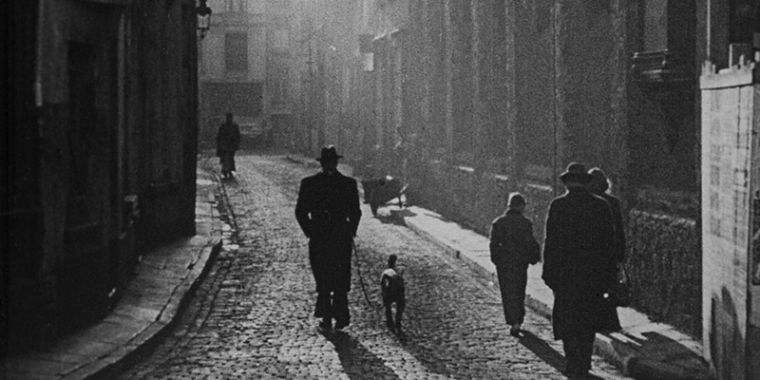
But around 2014, Peter Van Goethem found himself in a very relatable position: the PhD student at the Free University of Brussels had been working on a big doctoral project for two years, yet now he felt stuck. Van Goethem’s original proposal centered on documenting Brussels’ evolution over the years—its modernization, its rise on the International scene, its sociopolitcal changes throughout the great wars—and he had done a lot of research. Working with the Royal Belgian Film Archive Cinematek, Van Goethem perused no fewer than 1,268 films to assess various archival content spanning avantgarde experiments, journalistic productions, educational films, propaganda, prior documentaries, and more.

But something just didn’t work. And Van Goethem couldn’t shake one particular thought, something he repeatedly lingered on while poring through the archives.

“After two years of analyzing footage, it became clear I wanted to do something else with the footage. The archive felt like a gatekeeper—they decide whose memory we’re talking about, they choose the selection of items you can find in the catalog,” he told Ars this fall. “So I didn’t want to make a documentary about the city of Brussels anymore, because there isn’t one history—there are many histories. I needed another approach to the footage, a way that decontextualized things. An archive decides not just what’s remembered, but what’s missed. I wanted to make a movie that could reflect that, a movie about how we use footage of the past and how we look at it.”

It took another handful of years, some understanding academic advisors, and money beyond what Van Goethem’s original educational research grant encompassed. But the resulting work not only helped Van Goethem complete his doctoral work, it eventually turned him into a bonafide first-time filmmaker. That’s because, after failing to get his PhD project into some local festivals, Van Goethem received an email seemingly out of the blue from a little event called Fantastic Fest. And this fall he found himself some 5,000-plus miles away from home to witness the world premiere of Night Has Come at the biggest genre film event in the US.

What’s going on here?

The basic premise of Night Has Come reveals itself quite slowly, as an unnamed narrator begins by seemingly reflecting on his life while struggling to connect the pieces. An old man appears, so things seem fine—age has a funny way of making memory hazy, after all. But a lot of the images don’t look like the type of thing you’d want to remember: people fleeing a damaged city, some kind of dust slowly engulfing an empty landscape, chaotic movement depicted on a cellular level. On top of this, the narrator’s musings become increasingly peculiar early on. “Everything is going to be fine, I say to myself. I have to trust the treatment.”

“In Brussels, our city changed a lot during my PhD,” Van Goethem explains. “It became about militarization and control—you had those terrorist attacks in France a couple of years ago, and there was also an attack at the airport in Brussels. The state started implementing rules like requiring your ID or placing military tanks in the streets. So I used footage of the past to create a future that reflects our present-day society. I also wanted a metaphor for the archive, so the memory of the guy reflects the archive itself. History is not chronological, it’s our memory—uncertain and unpure in a way. I wanted to deal with those kind of issues.”

Throughout Night Has Come, Van Goethem’s ideas become clearer and clearer but never overt. Some kind of memory-wiping pandemic may be sweeping the country, and the governmental science community responds through quarantines and antidote development… or has the government been spreading this condition, leveraging it to control what the population does and doesn’t remember of recent not-so-rosy history? On top of all that, the old man simultaneously wrestles again and again with what his life might be if it’s based on only partial memory. “The panic is that your life now consists solely of what you have forgotten,” he muses. The philosophical grappling of Eternal Sunshine of the Spotless Mind meets the Big Brother concerns of 1984 and gets presented through a distinct art house lens.

[embedded content]
The film festival trailer for Night Has Come.

And make no mistake, Night Has Come definitely belongs wherever art house cinema gets housed today. When considering how Night Has Come came to be, Van Goethem’s creative exercise here seems downright daunting in its scope and miraculous in execution.

To start, think about how a film gets edited together—typically, a director has shot a finite amount of footage, all with intent behind the images and often with some larger sequences in mind. Van Goethem, by contrast, had an almost endless amount of raw material to work from. The only parameters around Night Has Come involved what he could and couldn’t secure the rights to use from the Belgian film archive.

“It involved a lot of trial and error, hundreds of cuts,” he tells Ars. “I had to really—I think for two years—edit, and it wasn’t going how I wanted. It’s like a brick puzzle—when one piece isn’t there, nothing works.”

Van Goethem worked with practically infinite puzzle pieces. Sometimes the themes and plot he imagined would drive his image selection; at other times some stunning visual would help direct where the filmmaker wanted the narration or plot to go next. And that’s merely the story and visuals; eventually Van Goethem needed to create a cohesive soundscape as well, since Night Has Come opted to eschew all original sound from the archival footage. “[Composer Guy Van Nueten] was trying to compose to what he was seeing, but I was always…’Sorry I can’t use that footage,’” Van Goethem adds. “You can make so many stories, there are so many hidden stories in the archive.”

Rightfully, then, this film repeatedly flexes its clever composition. A seemingly happy bit of archival footage may depict a couple walking in the woods toward a wind ensemble filling some scenic amphitheatre, but Night Has Come recontextualizes this visual to be downright sinister after Van Goethem has sequenced it among his archival finds and laid in an eerie soundtrack. Another memorable passage suggests that maybe this memory wiping ultimately does a society good—a sequence of intense, kinectic visuals of nothing but flashing entities (streets, cars, neon signs, a girl laughing as the camera zooms in uncomfortably close) plays out rapidly over a synth-y soundtrack that would make Trent Reznor proud. The freneticism of that whole thing makes it seem like life itself may be a disease in need of treatment for clarity. Van Goethem has somehow stitched together such disparate things—documentary footage of the city post-war, propaganda, seemingly random home videos of kids enjoying a lake—into a singular thought-provoking experiment, breathing new life into these archival bits that may have otherwise never even seen the light of day again.

[embedded content]
Composer Guy Van Nueten posted a scene from Night Has Come to showcase his electronic composition, and it happens to include one of the film’s standout visual sequences (with all the various flashing images propulsively passing across the screen).

One film fest begets others

Van Goethem quickly points out that this passion project only became possible through a lot of generosity. His PhD advisors said yes to a crazy idea. A lot of heavyweights in the Belgian film world—actor Johan Leysen (The American with George Clooney), writer Peter Verhelst, composer Van Nueten—donated their talents (some literally) because they liked the premise so much. He found inspiration in books he’d been reading (Empire, Tribalization) and in the work of Chris Marker, who famously made a short film out of old still photos that eventually inspired 12 Monkeys. And the film itself only saw the light of day because some genre diehards across the world so admired its ambition. Night Has Come hadn’t screened outside of a PhD jury before Fantastic Fest took a chance on programming it; Van Goethem has since booked his film at events like Gent Film Festival in Belgium and the International Festival for Documentary and Animated Film DOK Leipzig in Germany, one of Europe’s premiere documentary events.

So it may not have been easy and didn’t happen quickly, but this filmmaker certainly enjoys how his debut has worked out thus far. Van Goethem even hopes to make another film, though he’d advise against an entirely found-footage approach for the sanity of future filmmakers. For now, he’ll continue to take Night Has Come wherever he can to hopefully share his version of Belgian alternate history and provoke the same thought experiments for an audience that the Belgian inspired in him.

“It’s not easy to understand the movie when you see it the first time; you’ll leave with a lot of questions,” Van Goethem says. “It’s not always easy to tell what you’re looking at, but that’s the purpose. I didn’t want to give the answers; I wanted to raise questions. And if people see a different story, that’s OK to me… They would’ve never seen that footage—it’s just sitting in the archive. We need to rethink how we’re using this archived material and our history.”

Night Has Come continues to play the film festival circuit. New screenings can be found through the Facebook page for Inti Films.

Listing image by Peter Van Goethem / Fantastic Fest

https://arstechnica.com/?p=1596241


The best science and math moments in Sesame Street’s first 50 years

Counting through 50 years of <em>Sesame Street</em>.
Enlarge / Counting through 50 years of Sesame Street.
Sesame Workshop / Aurich Lawson

Happy 50th birthday, Sesame Street. One of the most beloved American television series has changed a lot since premiering on November 9, 1969, but in fantastic news, one thing hasn’t: its core mission of teaching children and instilling in them a love of learning.

Even today, Sesame Street remains the leader in this department. In a modern world of Paw Patrol and Calliou, TV series aimed at the toddler-and-preschool set can feel less educational and more like reasons for parents to light their hair on fire. Shows like Doc McStuffins and Wallykazam! bring targeted lessons, but not to nearly as diverse an age group, and their singular focuses mean one is either focusing on literacy or science, not both.

There was nothing on television like Sesame Street when it premiered 50 years ago, and the truth is, there’s still nothing quite like it now. (That’s a big reason why it was such a valuable acquisition for HBO in 2015.) Throughout the years, the show has always been on the front lines of what’s important to teach children. And as some of the show’s greatest hits demonstrate, long before educational advocates began popularizing the STEM acronym (Science, Technology, Engineering, and Math), Sesame Street was already there with silly characters promoting serious lessons.

The Yip-Yips

[embedded content]
The Yip-Yips discover a telephone

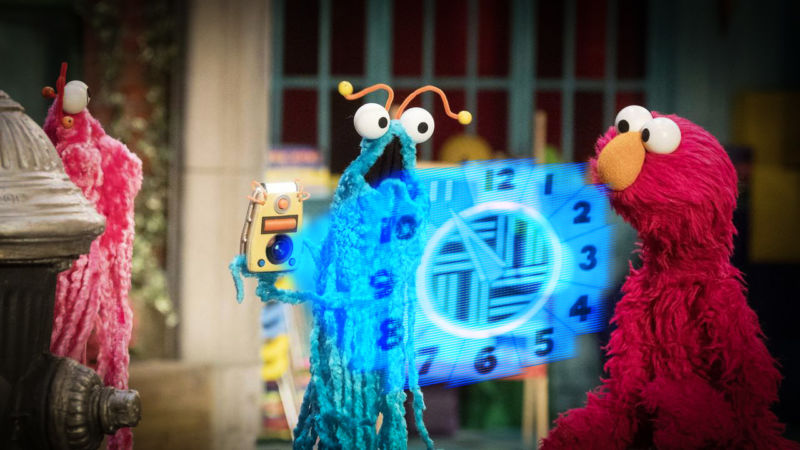
The “Yip-Yips,” a pair of blue and pink Martian explorers, were two of Sesame Street’s early characters. In their quest to figure out how things work, they would interact with different pieces of technology. Starting in 1971, they turned up to interact with devices children would need to learn how to use: telephones, clocks, radios, etc.

As technology moved on, the Yip-Yips began interacting with other devices, such as computers. In the year 2000, Sesame Street aired entire episodes focused on getting children comfortable with home PCs, and the Yip-Yips were there to help. As two of Sesame Street’s most memorable muppets (start yipping at someone between the ages of 25-50, they’ll hopefully know the reference immediately), that was only right.

Pinball Number Count

[embedded content]

Before you can add, you must count. The Count has been preaching this gospel for five decades, but the most effective counting short the series ever did was this one. This animated segment had 12 versions, celebrating the numbers one through 12. With a funky earworm sung by The Pointer Sisters, it was the kind of thing that a kid could easily remember long after the TV turned off, later singing to themselves even if they hadn’t put the song’s words and the concept of counting together quite yet. It’s so memorable, modern pop music references it, such as the riff line on Janelle Monae’s “Many Moons.”

Monsterpiece Theater

[embedded content]
Monsterpiece Theater: Twin Beaks

Around the same time as the Pinball segments, Sesame Street introduced “Monsterpiece Theater,” a spoof of the neighboring program Masterpiece Theater on PBS, which gained household name status back in the 1970s with the Emmy winning Upstairs Downstairs. The earliest clips were straight parodies of whatever was airing (“Me Claudius”) or classic films (“The 39 Stairs”). But these soon became shorts about math, a slightly surprising turn considering the host was not the Count, but “Alistair Cookie.”

He introduced such fare as “1 Flew Over The Cuckoo’s Nest,” “Hill Street Twos,” “Lethal Weapon 3” (complete with that film series’ stars), and “Gone With The Wind” (subtraction). Fans today know and love Sesame Street for recent parodies of prestige TV such as “Game of Chairs,” “Sharing Things,” or the ever-popular “Star S’mores,” all of which have millions of views on the official YouTube channel. “Monsterpiece Theater” is where the show got its start doing such work.

“Put Down The Duckie”

[embedded content]
Put Down The Duckie

How does one teach holistic concepts like cause and effect problem-solving and “if this, then that”? It’s a hard concept for small kids to grasp, but the sooner they do, the easier it is to understand basic programming. It’s the part of STEM that doesn’t get mentioned in the acronym, but it’s probably one of the most important connections for kids to make.

It’s a difficult idea to teach in a three- to four-minute TV segment. Sesame Street not only figured it out, but the series did it with one of the show’s most memorable songs of the 1980s: the big-band Hoots The Owl-led song “Put Down The Duckie.” The chorus—“You gotta put down the duckie if you wanna play the saxophone”—isn’t just fun to sing, it’s an entire philosophy on reason that applies to many of life’s problems. It wound up being so popular that the show did a second, celebrity-heavy version for the 1988 “Sesame Street Special.” (Best part: the song still slaps all these years later.)

Prairie Dawn, Scientist

[embedded content]
Prairie Dawn explains air

In the 1990s, Sesame Street became more conscious of inherent biases built into the original program, particularly its lack of leading female muppets. In response, it added the “Around the Corner” set, introduced muppets like Zoe and Natasha, and produced segments where female muppets hosted explicitly STEM-angled concepts. For the latter, they brought in long-running character Prairie Dawn to host segments that were first called “The Little Blonde Scientist Show.” Thankfully, they were rechristened “Prairie Dawn, Scientist” in subsequent sketches.

Like many of the ’90s and early ’00s additions, these didn’t necessarily bring a new spark to the show. Instead, they fit in perfectly with what was already there, just with a female muppet as the central figure (one who had been with the program since the beginning, in fact). No fanfare, no fuss. It’s just another funny segment, and it doesn’t make a big deal about the casual inclusion, so children watching wouldn’t think it remarkable, either.

https://arstechnica.com/?p=1599249


Goldeneye 007’s lost remaster emerges again via massive, polished video leak

Goldeneye 007 is arguably the biggest example of a late-’90s gaming sensation that has remained trapped in its era. Unlike other hits from the same period, which have received remasters and digital-download options ad nauseum, this 1997 Rare game has laid dormant on the N64, likely due to a tangled web of licenses and company-ownership issues.

Three years ago, however, we finally saw hard proof of what many had suspected: that original developers at Rare worked on, and nearly re-released, an Xbox 360 remaster of the 1997 original. (Don’t get that confused with the ho-hum Goldeneye “reimagining” on the Wii in 2010.) We took a hard look at a 2016 leak, which confirmed the Xbox 360 project’s existence. At the time, we had ourselves a hard cry and moved on.

But this week, a massive video leak has reopened the wound of wondering what could have been—and it comes during arguably the most amicable period that license holders Microsoft and Nintendo have ever shared.

The most exciting footage is a pair of documentary videos, which add up to 30 minutes of polished, professionally edited interviews with members of the original Goldeneye 007 development team. One of the video files is titled “Rare Replay: The Making of Goldeneye 007,” and it has been put together in a nearly identical format as the documentaries in that Microsoft-published Rare gaming anthology from 2015. While the video footage isn’t dated, one interview includes a mention of fans thanking the development team “17 years later,” which would pin at least one of its interviews to 2014—arguably a reasonable window to have prepared a video for that disc’s launch the following year.

Some of these development stories have made the rounds over the years, including information about its SNES side-scrolling origins and how its four-player mode came near the end of development as a lark. But many of the stories will likely still be new to series fans, including stories about Rare’s photography of the film’s original sets and the allegation that a slew of skins for the series’ original actors as multiplayer characters nearly made it in… until Sean Connery’s licensing hold-up meant all other classic actors had to be removed. Original producer Ken Lobb also offers some interesting business minutiae: that he convinced Nintendo to send extra rental copies of the game to Blockbuster Video stores in order to boost the game’s visibility (a crazy move, considering how anti-rental Nintendo had been for years) and that the game’s Christmas 1999 sales outsold the game’s sales during Christmas 1997 and Christmas 1998… combined.

“We’ve always given up”

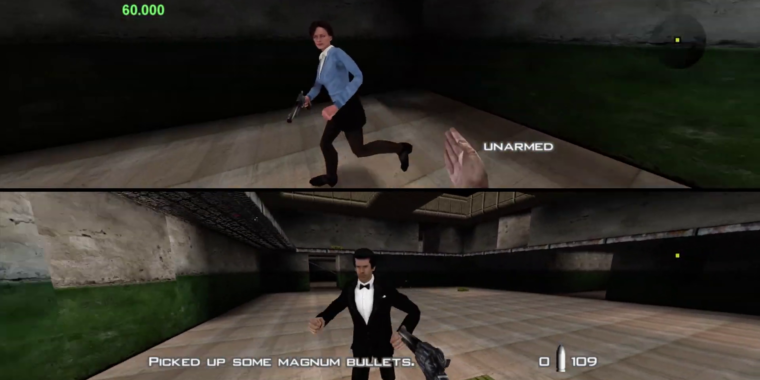
This week’s leak paired these documentary clips with a 30-minute explosion of B-roll taken from the Xbox 360 port of Goldeneye 007, which is even clearer and more demonstrative than the 2016 leak. After running through the entirety of the game’s opening level, the gameplay footage revolves around the port’s “graphics toggle” button, which would have allowed players to swap between the original N64 version’s textures and an updated slew of higher-res textures. Most impressively, this toggle showed a serious reworking of every major character’s face so that each film character now actually looks like his or her real-life actor.

But why would Rare and Microsoft have produced a substantive documentary about a game that didn’t see inclusion in Rare Replay? The collection included documentary snippets about unreleased games, and the company uploaded one mini-doc onto YouTube about a single game not on Rare Replay (the Game Boy Advance curio It’s Mr. Pants). But by and large, Rare Replay‘s documentary content centered on games on the disc as opposed to missing games like Wizards & Warriors, Donkey Kong 64, or Taboo. Did Microsoft expect the stars to align for Goldeneye in time for Rare Replay‘s mid-2015 launch?

Neither Microsoft nor Rare have publicly commented on the classic game being close to retail launch on Xbox consoles, beyond Xbox chief Phil Spencer saying in late 2015 that “Goldeneye rights are so challenging” and “we’ve always given up.” After Goldeneye‘s 1997 launch, EA picked up the film series’ gaming rights, which Activision consequently grabbed in a deal meant to expire in 2014 (which possibly expired a bit earlier). There’s really no telling exactly why the licensing powers that be haven’t joined forces to print money with a Goldeneye re-release, other than the likely answer that everybody wants a piece of the pie.

If it’s just a matter of Nintendo and Microsoft butting heads, that conversation takes on a different tone in 2019, a year in which former Xbox-exclusive releases like Ori and the Blind Forest, Cuphead, and Super Lucky’s Tale have found their way onto Nintendo Switch. But this week’s leak doesn’t include substantive information about why things didn’t quite work out, nor does it include any speculation on whether there’s an increased likelihood of a future Goldeneye remaster coming out.

Listing image by Rare

https://arstechnica.com/?p=1599221


Sony has a PlayStation Now problem

Sony has a PlayStation Now problem
Aurich Lawson

Today, every major gaming company and its subsidiary cousin is aiming to be the “Netflix of games” in some form or another. Xbox Game Pass, Apple Arcade, Google Play Pass, Ubisoft’s UPlay+, EA Access, and even Nintendo’s Switch Online all bundle together access to dozens or hundreds of games for one low monthly fee.

And then there’s PlayStation Now. Sony’s service started offering monthly subscription game bundles back in the beginning of 2015, long before most of the competition. But a mix of confused marketing and limited access to Sony’s own first-party catalog has left the service to languish with just one million subscribers (compared to a reported 9.5 million monthly subscribers for Xbox Game Pass) [Update: Replaced outdated 700,000 subscriber number for PS Now from May]. Despite its head start, PlayStation Now runs the risk of being lapped by the subscription competition in the market and the public consciousness.

When PS Now was PS Then

Many of PlayStation Now’s problems can be traced back to its launch. Back in 2014, the service introduced itself by charging ridiculously high, single-game, time-limited rental rates for streaming access to a small selection of PS3 classics. After just a few months, that changed to an all-you-can-stream subscription model that included functional streams of 100 PS3 games for $15 to $20 a month.

Today’s PlayStation Now bears only a casual resemblance to the version you could subscribe to nearly five years ago. For one, the price was recently reduced to as low as $60 a year. For another, the library of available games now includes over 800 streamable titles across the PS2, PS3, and PS4 libraries (playable on PS4 or PC).

Finally, and perhaps most importantly, PlayStation Now isn’t exclusively a streaming service anymore. A subscription now also includes access to downloadable versions of over 300 PS4 and PS2 games.

PlayStation

That last feature was rolled out just over a year ago and seems like a pretty important addition for the significant segment of the audience that might be worried about streaming gaming’s potential latency and quality issues (or those who don’t have a sufficiently robust broadband connection). By and large, though, PlayStation Now’s partial pivot to downloads doesn’t seem to have filtered down to the intended audience. Last month, an informal poll of my Twitter followers found 54% of respondents (who all said they had heard of PlayStation Now) still didn’t know the service also offered downloads.

That’s not a scientific result, of course, but it suggests a large part of the potential audience still sees PlayStation Now primarily as an expensive streaming service for legacy PlayStation titles, as it was when it launched. Turning a brand with that kind of baggage into an Xbox Game Pass competitor is an uphill battle to say the least.

Work the exclusives

Public perception is only part of the problem for PlayStation Now. The service has also suffered because Sony, unlike Microsoft, has proved unwilling to use high-demand, first-run, first-party exclusives as an incentive for players to subscribe.

Sure, Sony-produced console exclusives like The Last of Us and Bloodborne have been on PlayStation Now for a while. But a good chunk of the games Sony uses to set the PS4 apart still aren’t offered to subscribers. PlayStation Now members who want to play Spider-Man, Detroit: Become Human, Horizon: Zero Dawn, Ratchet & Clank (2016), The Tetris Effect, or any MLB: The Show titles still have to buy them a la carte, to name just a few.

While Xbox Game Pass subscribers get Microsoft exclusives on day one, <em>The Last of Us: Part 2</em> will not be available to PlayStation Now subscribers at launch.
Enlarge / While Xbox Game Pass subscribers get Microsoft exclusives on day one, The Last of Us: Part 2 will not be available to PlayStation Now subscribers at launch.

Sony is beginning to show small signs of change in this regard, announcing last month that it was adding God of War (2018), Uncharted 4, and Infamous: Second Son to the PlayStation Now lineup for a limited time. At this point, though, those games are 1.5, 3.5, and 5.5 years old, respectively, and are available for an MSRP $20 or less as “PlayStation Hits” as well. The vast majority of PlayStation Now subscribers who had any interest probably bought and played through these games months ago, and their addition at this late date might be too little, too late to serve as a major subscription incentive.

Compare that to Microsoft, which pledged in early 2018 that every first-party Microsoft Game Studios release would be available to Xbox Game Pass subscribers from the first day of their original release. Since then, subscribing to Game Pass has meant day-one access to Sea of Thieves, State of Decay 2, Forza Horizon 4, Crackdown 3, and Gears of War 5, in addition to hundreds of older first- and third-party titles across all three Xbox consoles.

It doesn’t look like Sony will be following Microsoft’s lead in this regard any time soon. When asked about adding more first-party titles to PlayStation Now, PlayStation CEO Jim Ryan told GamesIndustry.biz that “the nature and scale of some of the first-party games that we are making leads us to think that, right now, it’s better to spend energy on making sure that the launch of those games is a massive entertainment event.” Ryan added that “The Last of Us 2 next year will fall into that category.”

PlayStation Plus Plus

Ryan did leave some wiggle room in the company’s PlayStation Now plans, noting that “our stance on the inclusion of first party games in PlayStation Now… is very different to our stance 12 months ago. I don’t want to say this is what PlayStation Now is going to be like forever.” However, Ryan said, “certainly right now, given how some of our first party IP is incredibly special and valuable, we just want to treat them with amazing care and respect and have those launches be clean and pure.”

In other words, Sony doesn’t want PlayStation Now “free riders” to eat into the initial sales for its major exclusives. That is an interesting position, as Microsoft data suggests Xbox Game Pass has actually led to an increase in pre-orders and franchise sales for games outside the service. But it’s somewhat understandable given the market-moving power of a big exclusive game launch.

<em>Spider-Man</em> may not have set sales records if it was available for free with a PlayStation Now subscription last year...
Enlarge / Spider-Man may not have set sales records if it was available for free with a PlayStation Now subscription last year…

In a sense, the disparity between Microsoft and Sony in terms of subscription exclusives shows nothing more than the vast gulf in market position between the two companies. With over 100 million PS4 systems sold worldwide, Sony is probably still seeing decent “legacy” sales even for older first-party titles. Microsoft, which has seen Xbox One hardware sales suffer on a relative basis, probably has more interest in using first-party titles (and even console hardware itself) as a kind of loss leader to attract more regular revenue through subscriptions.

But as Microsoft and Sony both prepare to launch new consoles next year, the relative value of their competing game subscriptions could play a big role in consumers’ purchasing decisions. Why spend a bunch of money up front on PS5 games when Microsoft’s “Project Scarlett” hardware and a monthly subscription include instant access to Halo Infinite and all future exclusives, in addition to every Xbox One exclusive and hundreds of other legacy titles.

If Sony wants to match Microsoft’s Xbox Game Pass success, it needs to do so separately from the PlayStation Now branding and the baggage still leftover from its streaming-focused launch. For a monthly fee, a newly rebranded “PlayStation Plus Plus” (or, you know, a better name) could include access to practically everything in Sony’s impressive collection of first-party PlayStation exclusives from the past, present, and future. That would help cement PlayStation brand loyalty and lock new PS5 buyers into a cycle of paying Sony money every month, instead of just when a hot new game comes out.

The coming launch of the PlayStation 5 is the perfect opportunity for Sony to regain the ground it lost since launching with a head start in gaming’s burgeoning subscription wars. If it waits much longer, that ground could end up much harder to regain.

https://arstechnica.com/?p=1599109


Review: Doctor Sleep joins IT as one of the best Stephen King adaptations yet

Horror master Stephen King continues to have a banner year in Hollywood. We’ve had the release of a (disappointing) Pet Sematary remake earlier this year, IT: Chapter 2 in September, the Netflix adaptation of In the Tall Grass last month, and a new season of Castle Rock currently airing on Hulu. Closing out this annus mirabilis is Doctor Sleep, adapted from King’s novel of the same name, a sequel to The Shining. Along with 2017’s spectacular IT, Doctor Sleep is one of the best film adaptations of a King novel yet.

(Major spoilers for The Shining—film and book—below; mild spoilers for Doctor Sleep.)

King published The Shining in 1977. It became his first hardback bestseller and was adapted into a film by Stanley Kubrick in 1980, starring Jack Nicholson as struggling alcoholic and aspiring writer Jack Torrance. Initial reviews weren’t particularly favorable—King himself was not a fan of the film, going so far as to produce his own adaptation in a 1997 miniseries—but it’s now considered a horror classic.

For those not familiar with the story, Jack Torrance takes a position as the winter caretaker of the remote Overlook Hotel in the Colorado Rockies, bringing his wife, Wendy (Shelley Duvall) and young son Danny (Danny Lloyd). Danny has a psychic gift, called “the shining,” which lets him communicate telepathically with the hotel cook, Dick Halloran (Scatman Crothers). The hotel is haunted, and the previous caretaker went mad and murdered his family. As a snowstorm hits and the isolation takes its toll, Jack ultimately succumbs to the same madness, chasing Wendy and Danny through the empty hotel with an axe (“Heeere’s Johnny!”) as the Overlook’s ghosts look on approvingly. Mother and son barely manage to escape with their lives.

In the follow-up novel, Doctor Sleep, King sought to continue Danny’s story as the boy grows up and struggles to recover from the psychological trauma he experienced at the Overlook Hotel. The ghosts have followed him from the hotel, but he has learned to contain them in a mental “lockbox.” He still spends years as an alcoholic—the drinking suppresses the shining—wandering from town to town. Now in his 40s, Dan finally gets sober and settles in a New Hampshire town called Frazier. He gets a job at a hospice, where he uses his newly re-emerged psychic gift to comfort patients who are terminal, earning him the moniker Doctor Sleep. He’s aided in this by a cat, inspired by a real-life therapy cat named Oscar who some claimed could predict the deaths of the terminally ill.

Dan also forms a psychic connection with a young girl, Abra Stone, whose powers are even stronger than his own. When she witnesses the murder of a boy by members of a local cult called the True Knot, she turns to Dan for help. The True Knot members feed off “steam,” a psychic essence that comes from people with the shining who die in pain—although they can also contract illnesses from their victims. After feeding off the boy, clan members contract the measles and begin dying (the steam lengthens their life spans but does not make them immortal). The True Knot targets Abra, believing they can torture her indefinitely to give them a steady supply of “steam” before the entire clan succumbs to disease. It falls to Dan to protect her, culminating in a showdown at—where else?—the Overlook Hotel.

Back to the Overlook

Mike Flanagan, who wrote and directed last year’s stunning adaptation of The Haunting of Hill House, also wrote and directed Doctor Sleep. In so many ways, he is the perfect choice. Flanagan has proven he can handle the psychological complexities of classic horror with Hill House, and he is no stranger to the Stephen King ouevre. His 2017 adaptation of King’s psychological horror thriller, Gerald’s Game—long considered unfilmable—earned the approval of King himself, who called it “hypnotic, horrifying and terrific.” So naturally Flanagan was drawn to the challenge of adapting Doctor Sleep. “It touches on themes that are the most attractive to me, which are childhood trauma leading into adulthood, addiction, the breakdown of a family, and the after effects, decades later,” he told Collider last year.

Flanagan has also said his version of Doctor Sleep would be a direct adaptation of the novel, and the film definitely hews closely to the source material for the most part. There are changes, some rather significant—the fates of certain characters, for instance, or condensing Dan’s descent into alcoholism and hitting rock bottom, which takes up the entire first third of the book. That’s as it should be when adapting a sprawling novel to the big screen. Most of the omissions, like trimming the cast or making the more internal psychological aspects more concrete, work very well.

There are only two aspects of the book I truly missed in the film. One was the True Knot contracting measles from one of their victims. It’s what adds an extra frisson of desperation to their hunt for Abra; capturing her is literally an urgent matter of life and death, and not just because of how difficult it has become to find quality steam these days. The other—well, let’s just say that it bears on how Jack Torrance’s fate differs in the book and film versions of The Shining, and how that factors into adult Danny finally making peace with his past trauma at the Overlook. But only book readers are likely to notice.

“These empty devils, they’ll eat what shines. And they’ve noticed that little girl.”

Flanagan has managed to thread a tricky needle, since King wrote Doctor Sleep as a sequel to the novel, not the film version, of The Shining, and there are some small but significant differences between the two. Yet his adaptation still takes place in the same cinematic universe as Kubrick’s film. For instance, the hotel cook, Dick Halloran (played by Scatman Crothers in the first film), who shares Danny’s gift, survives in the book and is killed by Jack in the film. And the Overlook burns down in the book and remains intact in the film.

In Doctor Sleep, the True Knot owns a campsite where the Overlook once stood; in Flanagan’s film, it’s still standing, in keeping with the film. Halloran makes an appearance (now played by Carl Lumbly) via supernatural vision. He warns Dan about the True Knot and the danger they pose to children like Abra: “These empty devils, they’ll eat what shines. And they’ve noticed that little girl.” Of course, there are plenty of callbacks to famous scenes: a young Danny riding his tricycle through the Overlook Hotel’s maze-like hallways, the creepy twins (“Come play with us”), the ghost in the bathtub, and the torrents of blood pouring out of the hotel elevators.

Perhaps most controversially, there is a pivotal scene between Dan and the ghost of his dead father, tending bar as “Lloyd” in the Overlook lounge, played by Hill House alum Henry Thomas. Nicholson’s performance has defined the character for decades, and Thomas wisely avoids attempting a straight Nicholson impression, relying on just a few telltale mannerisms to convey the character. It was a risky choice on Flanagan’s part, but that scene is key to Dan’s psychological journey; after all, the ghost of his father has haunted him his entire life. Now Dan faces the same choice Jack Torrance did all those years ago: to resist or succumb to the Overlook’s sinister power. And Abra’s life depends on him making the right choice.

It’s Ewan McGregor’s nuanced performance as Dan that anchors the film, along with that of his young co-star Kyliegh Curran, who plays Abra in a way that brings out both her innocence and her inner ferocity. She is stronger and more daring—and more ruthless—than young Danny ever was. That makes her a formidable threat to the True Knot. Every horror film needs a good villain, and Rebecca Ferguson is mesmerizing as Rose the Hat, equal parts seductive and sinister. It makes for a very tense and satisfying finale when all three finally face off at the Overlook for the final showdown.

Doctor Sleep opens this weekend in theaters.

[embedded content]
Doctor Sleep featurette: Danny’s journey.

Listing image by Warner Bros.

https://arstechnica.com/?p=1596195