“The Switcher” is real: Witcher 3 on Switch is a blurry, tolerable compromise

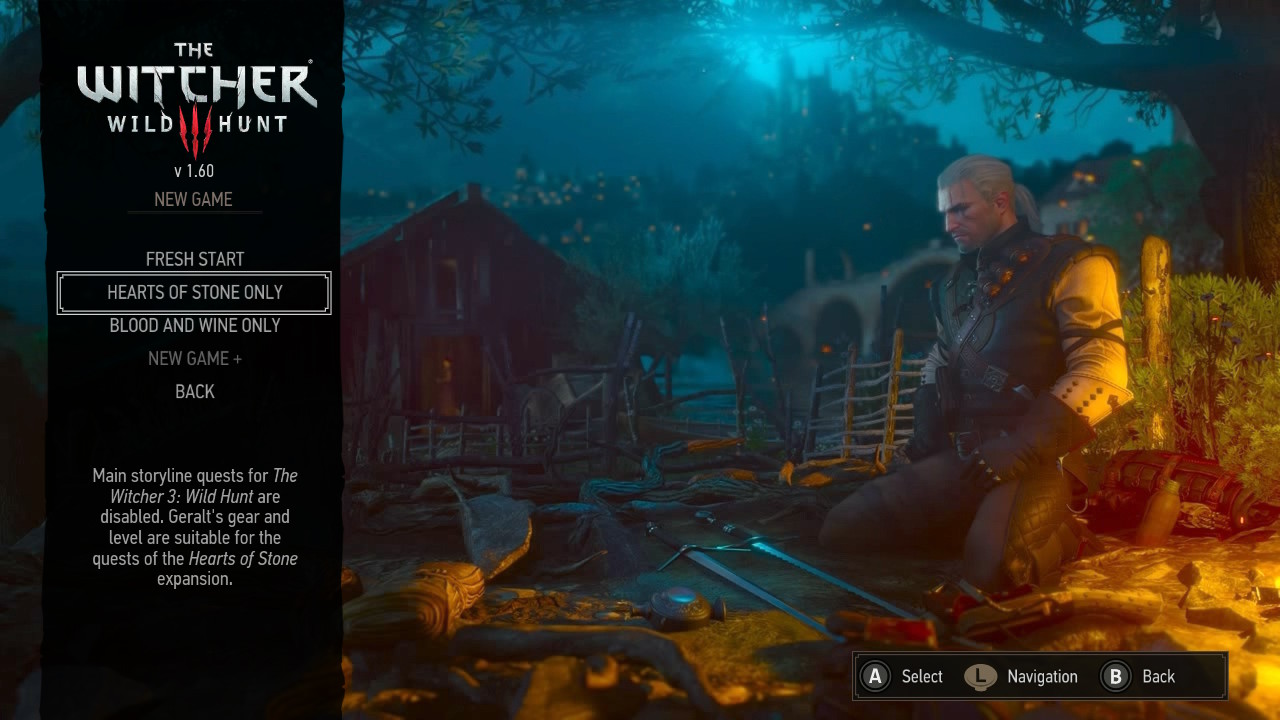
In good news, you can boot straight into expansion content when loading this version of <em>The Witcher 3</em>. I imagine more than a few fans of the game will use this Switch version to dive deeply into either or both of the expansions.
Enlarge / In good news, you can boot straight into expansion content when loading this version of The Witcher 3. I imagine more than a few fans of the game will use this Switch version to dive deeply into either or both of the expansions.

Since Nintendo’s Switch console launched in 2016, we’ve seen no shortage of holy-cow ports of games we never thought would work on what turned out to be the most underpowered console of this generation. Doom 2016, Dark Souls, Elder Scrolls V: Skyrim, Wolfenstein: The New Colossus—that’s a list of demanding 3D games I never expected to launch on Switch, let alone games I’d actually recommend for the system.

But I do so with a pretty hefty asterisk attached. The charm of these games on Switch comes almost entirely due to them being playable on the go, at which point their severe compromises (image quality, rendering resolution) become much more acceptable. What looks iffy on a full-sized TV is easier to shrug off when seen on a six-inch 720p panel.

This week marks the arrival of arguably the most holy-cow port yet on the portable console: CD Projekt Red’s 2015 action-RPG The Witcher 3. This is a game, after all, whose other console versions required quite a few patches to get their most troublesome spots up to a locked 30 frames per second. We went hands-on over the weekend with the game’s final retail version (which launches for Switch on Tuesday) to answer a crucial question: could we expect playability in CDPR’s acclaimed adventure game on an even weaker system?

Not every polygon came through unscathed

The good news is that our initial impressions reveal a mostly locked 30fps refresh rate—stable enough to where the slightest frame rate hiccups have been nigh unnoticeable in our first few hours of play. The most crucial moments of battle and enemy management aren’t ruined by the on-screen action herking and jerking. This is met by some seriously quick loading times; getting from a cold boot to a loaded game save is rarely more than 60 seconds, and loading times between parts of the world are even faster.

The bad news, as can be seen in the gallery above, is that Witcher 3 on the Switch looks a lot more like Witcher 2. For starters, its apparent resolution is some of the blurriest we’ve ever seen on Switch in both docked and portable modes. While the results look comparable to Doom 2016, Witcher 3 is a much slower game, and it demands that you let your eyes linger over massive, dramatically lit landscapes and towns. The blur draped over all of that scenery is more noticeable than, say, a rapid-fire pulse of shotguns through demons’ faces.

Those landscapes are covered in foliage, a fact that impressed back in 2015 with CDPR’s dense rendering system working nearly as well on console as it did on PC. But that system’s polygon count and texture density have both been scaled back dramatically to get trees, shrubs, and other greenery working on Switch. This was probably done to preserve facial detail on pretty much every human character in the game, which is certainly a preferable compromise, but the disconnect between an emotionally brooding Geralt and a dinky, PlayStation 2-era wall of vines is one fans will have to accept if they want to marathon this version of Witcher 3 on the go.

Other major settings like shadow resolution, ground textures, and hair physics have also been scaled back, which you can argue is acceptable or annoying based on your personal preferences. The lower resolution of the Switch screen makes these downgrades a little more tolerable, in my opinion. But enough of the game’s geometry has been noticeably de-tuned that it stands out in the game’s lengthy, well-written cinema scenes (which, I should note, often struggle in the frame rate department, sometimes dipping into 10-15fps range).

One moment, the game will smother its scenery in some of the most handsome, pre-baked lighting effects you may have ever seen on Switch. The next moment, a tight zoom on Geralt and his allies stutters with texture pop-in and grungy foliage effects nearby. That kind of startling visual contrast shows up in this Switch port more than I expected.

Totally playable—just be warned

I don’t mean to say Witcher 3 is unplayable or ruined by the effort spent getting it into Switch-compatible shape. However, completely new players should be warned that CDPR’s cinematic vision for the game is compromised just enough to take this port out of my running for a clear-cut recommendation. If you’ve already played Witcher 3 and want an excuse to burn through it anew on the go, complete with convenient “fast forward to the expansions” shortcuts, then yes, this port is a great reason to return to Nilfgaard. If you don’t have any other consoles or a decent gaming PC, then “Switcher 3” is absolutely playable. (Plus, in my personal opinion, it’s better than Switch’s Skyrim as an on-the-go RPG, even with low resolutions and other visual compromises.)

But if you do have another hardware option and aren’t necessarily itching for a purely portable RPG, take a breath and look at other systems’ heavily discounted versions before making this your very first way to play the game.

https://arstechnica.com/?p=1584349


Video: How (and why) Blizzard finally ported Overwatch to Switch

[embedded content]
Video shot by Ross Buran and edited by Aulistar Mark. Click here for transcript.

Two weeks ago, Ars visited Blizzard Entertainment’s headquarters in Irvine, California, to get hands-on time with popular hero-based, multiplayer shooter Overwatch on Nintendo’s portable Switch game console.

We also talked with game director Jeff Kaplan and Overwatch Switch producer Wes Yanagi about why Blizzard decided to do this now, what the challenges were, and what players should expect to be different about the Switch version from launch into the future.

For the interview, check out the video above. For impressions, keep on reading.

First impressions

I’ve played more than a thousand hours of Overwatch on PS4, plus a few dozen more on PC. I’ve played so much Overwatch that the ultimate meter got permanently burned into my OLED television.

A lot of people reading this have probably played Overwatch, too, so I don’t think we need to spend much time talking about gameplay, modes, or anything like that. At least at launch, the Switch version is identical to the game on other consoles, which in turn only has very minor differences with the PC version.

Instead, let’s talk about how the Switch version differs from playing on PS4 or Xbox One. That means a few things: graphics, performance, portable play, and the addition of gyroscopic controls.

Graphics-wise, it’s hard to notice a big difference on the Switch’s small screen in portable mode. I got the impression that it targets 720p with variable resolutions to maximize performance. I never had trouble seeing things, and image wasn’t noticeably fuzzy; it just looked like so many other Switch games. I did, however, notice that textures on character models were a bit lower than I’m accustomed to when really close up. And Blizzard told me it made some changes to animations and environmental physics (neither of which really impacts gameplay) for performance reasons. I didn’t notice, though.

When I played in docked mode, it was unfortunately in a small viewport in screen-capture software OBS on a computer monitor. The low resolution looked just fine, but I can’t speak to how it will look on a 65-inch TV. Worse than on Xbox One X, I’d imagine, but probably fine regardless.

Overwatch played nicely in portable mode; even on the Switch Lite, the screen wasn’t too small for me to keep up with the action. I don’t love the thumbsticks on the joycons or the Switch Lite for this type of game, but we’ll talk more about that in a minute.

Does 30fps cut it?

As a pretty serious PS4 player, I was a bit skeptical about Overwatch on Switch for two reasons: first, I’d heard the game runs at 30fps, and while I think that’s just fine for certain kinds of single-player or non-twitchy games, I have felt for a couple of years that competitive first-person shooters have to run at at least 60fps to be enjoyable.

A higher frame rate has long been a standard for PC players, and the PlayStation 4 and Xbox One have almost universally run online shooters at 60fps since they launched. There are only a few exceptions, most notably Destiny 2. And Overwatch has run at a minimum of 60fps on all platforms (except very old PCs, I guess) since it launched in 2016. This is the first time any version of Overwatch has targeted just 30fps.

<em>Overwatch</em> running on the Nintendo Switch.
Enlarge / Overwatch running on the Nintendo Switch.
Samuel Axon

First up, 30fps didn’t bother me as much as I thought it would; it helps that everyone you’re playing against is also playing at that frame rate, so you’re not at a disadvantage. And in my time with the game, it locked at 30fps. Frame rate variance in competitive shooters is a no-go. Fortunately, it’s not an issue in most cases here.

I think you could also make the case that the Switch Overwatch scene is simply not going to be as competitive. Let’s be real: if you’re really into Overwatch for the serious competition, you’re going to play on another platform. There’s a certain culture to Nintendo players, and competitive shooters don’t quite fit in. It was telling that game director Jeff Kaplan mentioned that he’s looking forward to Switch players experiencing casual seasonal events like Junkenstein’s Revenge, and he didn’t talk a lot about Competitive mode.

To be clear, 30fps is a compromise. But I’m not sure it’s a big one for the target audience on this platform. If you want to be at the top level of competitive play, this isn’t the platform for you, and you already knew that. I thought the Switch was just fine for jumping into QuickPlay, a seasonal event, or an Arcade match. And I feel that framerate consistency is more important than higher framerates, and Overwatch on Switch delivers on that front.

Thumbsticks and gyroscopes

The other reason I was skeptical about this Switch port was that, while the Switch joycon’s analog sticks are fine for many kinds of games, I’ve generally found them frustrating to use with first-person games. The Pro controller is another story, of course, but not everyone has one of those. And you obviously can’t use it in handheld mode.

Fortunately, I was able to play in a variety of modes during hands-on time: docked with the Pro controller, undocked with joycons, and, briefly, on a Switch Lite—my personal Switch of choice. And that gave me a strong sense of how the game plays in different players’ situations.

The sticks were a real problem for me. I didn’t feel like I was playing as well as I do on PS4.

And when I first started playing on the Switch, I immediately disabled the gyroscopic controls. I’ve played for so long without them, I initially had no interest in them. But I was talking to one of the other attendees at Blizzard’s event, a skilled Splatoon 2 streamer who goes by MissClick, and she extolled their virtues. Apparently Splatoon 2 players play with a similar gyroscopic aiming option turned on—with practice, it allows them to reach near mouse-and-keyboard levels of precision for a higher skill cap than analog sticks. Not having played Splatoon 2, I had no idea. But she convinced me to give the motion controls a shot.

Even in less than an hour of play, I began to recognize their value. You do your broad and decisive motions with the sticks, but you augment those moves with precision aiming via the motion controls. The motion controls helped me get some headshots that would have otherwise been difficult. With enough practice, I could see motion controls becoming indispensable. They’re just not easy to learn; it’s already challenging for console players to keep track of two analog sticks, and this was essentially like adding a third.

Not everyone wants to relearn all their muscle memory to get sweet headshots. You can play without the motion controls, but I have a feeling that the same hierarchy of gyroscope players outplaying thumbstick-only players that happened in Splatoon 2 may emerge. So if you want to stay on top, you might have to learn. Just be aware of that going in.

A worthy port for a certain audience

I liked Overwatch on Switch more than I thought I would, and if you’re a casual player, I can recommend it. It’s especially attractive for players totally new to Overwatch; like so many massively popular games, it can be intimidating to start playing after everyone else has been developing their skills for a couple of years already. But on Switch, I imagine you’ll face off against some other newbies, too, making it a better place to get on board.

If you’re looking for top-level competitive play, though, the existing platforms are a better fit.

Still, Overwatch remains one of the best multiplayer shooters I’ve played in years, and I’m impressed with how well it translates to the Switch—especially if you’re open to the gyroscopic aiming. And with playing the game mobile and undocked now an option, maybe I can avoid making that OLED burn-in worse with my next thousand hours of Overwatch.

Listing image by Samuel Axon

https://arstechnica.com/?p=1582363


When practical effects ruled the world: VFX legend gets his due in new doc

[embedded content]
The trailer for Phil Tippett—Mad Dreams and Monsters

No matter what the Criterion collector in your life says, DVDs have been slowly fading away from our lives these last few years. Losing films as a self-contained thing you can acquire has many ramifications, but chief among them for film nerds is the transformation of “extras.” Where should things like deleted scenes, director’s commentary, bloopers, or behind-the-scenes vignettes exist if they can no longer be packaged right alongside the film? Maybe today’s YouTube videos, oral histories, or podcasts work well enough in many situations, but frankly, some innovators in film history deserve more.

Luckily, this type of content in 2019 has increasingly found a new streaming-era-friendly home: the standalone documentary. From Hayao Miyazaki: Never-Ending Man (essentially extras for Boro the Caterpillar) to The Director and The Jedi (that’s The Last Jedi), these projects show that what would’ve been extras in the past can work as their own feature-length entities able to play to crowds of film lovers at festivals or exist as algorithmic suggestions alongside original films on Netflix, Amazon Prime, et al.

At the 2019 Fantastic Fest, this budding format proved to be just right for Phil Tippett, a film effects legend whose work you’ve seen even if his name doesn’t ring any bells. From Star Wars to Jurassic Park with Robocop in between, Tippett is the stop-motion savant behind so many landmark “effects” films from the era before CGI took over. And the long time industry hero finally has the spotlight on him in Phil Tippett—Mad Dreams and Monsters, a new documentary delivering that familiar behind-the-scenes feeling in the best way possible.

Of craft and creatures

If you recognize the name Phil Tippett, then you already know documentary directors Gilles Penso and Alexandre Poncet had plenty of material to work with for their latest feature (and not so coincidentally, this duo previously produced a full-length doc on VFX pioneer Ray Harryhausen’s work). For everyone else, Mad Dreams and Monsters serves as a crash course on the work of perhaps the greatest VFX artist of the last 50 years. Tippett has done Oscar-winning and film-standard-redefining stop-motion animation and VFX work for decades; his iconic work on Star Wars (from cantina creatures to Jabba the Hutt) and Jurassic Park (the original T-Rex) merely represents the tip of the iceberg.

Penso and Poncet structure their new doc chronologically in roughly five equal parts, outlining Tippett’s upbringing/entry into VFX, his work on three industry-changing films (RoboCop gets the microscope in addition to what’s noted above), and his recent years spent on passion projects and transitioning into the CGI-age. Any one of those five individual aspects could absolutely be a self-contained vignette on DVDs of yore based on the material these filmmakers have gathered (a few amusing puppeteering bloopers included). But together, this material paints a deeper picture of both Tippett the artist and his larger industry impact than any single portion could’ve alone.

For many, this documentary will sing most when it focuses on a film the viewer adores. Tippett walks viewers through the ideation process for some very iconic sequences and characters. Star Wars’ famous holochess, for instance, was originally set to be filmed with actors in costume (aka how the film Futureworld had done it a few years earlier), but George Lucas saw Tippett’s puppet work and changed course. That change of heart had ripples decades later when Lucasfilm brought the gang back together for a scene in Solo.

Or with Jabba the Hutt, for instance, Tippett’s original vision more closely resembled a slug, but Lucas didn’t care for it (Tippett in retrospect thinks it was a bit too much like Flash Gordon’s Ming the Merciless). “It was too gross, so I eventually asked, ‘If you can cast a character, who would it be?'” Tippett reveals. I’d never heard of actor Sydney Greenstreet (Casablanca, Maltese Falcon), but a quick Google Image search certainly shows the resemblance. This same granular creation process detail  comes out for Robocop (Cain from the sequel existed to complicate life for unlicensed model-makers after ED-209) and Jurassic Park (lots of Dinosaur-Input-Device insight), too.

But for folks only semi-familiar with any of the tentpole films of Mad Dreams and Monsters, the information about Tippett himself is more likely to stay with you. Tippett describes his upbringing as quiet and pretty singularly focused on art, the kind of thing where looking back he suspects his parents quietly worried about him (maybe more so because of the otherworldly creatures Tippett continually created). “It’s a reflection of the world I live in and the craziness of it,” Tippett says of his interests and iconic stylings. “But I have to find some kind of expression to make sense of stuff that doesn’t make sense to me.”

He first did stop-motion animation work for a film at the age of the 15, literally writing to filmmakers he admired and asking to contribute. And interestingly, Tippett enjoyed a commercial career before entering film full-time, working at Cascade Pictures, a firm that produced ads for brands like Pillsbury. (“It was like a graduate program because the commercials turned over so quickly,” he says in the film.)

For all of his incredible creative prowess, throughout Mad Dreams and Monsters Tippett appears to be kind of reserved and not totally comfortably talking about himself. In that light, it makes perfect sense why Penso and Poncet would divvy up their documentary in this way. Focusing more on the work and these films allows many others to sing Tippett’s praises in more colorful terms—people like fellow VFX legend Dennis Muren, director/collaborator Paul Verhoeven, Tippet’s wife and Tippett Studios partner, Jules. The variety helps balance out the occasionally dry direct interviews with the man in focus.

But for anyone passionate about a craft—be it writing, painting, playing an instrument, or stop-motion animating creatures you’ve dreamt up and sculpted—Tippett shows what dedication to growth and belief in yourself can potentially do. Even in the face of changing demands, shifting industry norms, and new generations of tools, he possesses such a solid foundation in his field—that once-in-a-generation vision, his fundamental understanding of movement, an innate creativity and curiosity—that he’s been able to evolve right alongside the work. It’s Dylan going electric or Miyazaki picking up a Wacom, just applied here to some type of alien.

Depending on the subject matter, these new extra-length versions of extras sometimes work better. Never Ending Man can get into more granular detail about Miyazaki’s philosophy and process on animation. Director and The Jedi shows a rounded picture of Rian Johnson’s personality and ability to deal with the weight of an iconic franchise. And Mad Dreams and Monster gives us a glimpse at the man and mad genius behind so many iconic cinematic sequences. This film guides fans to better understand how Phil Tippett’s mind works and to discover what has allowed the VFX legend to enjoy such longevity in what can be a very rapidly turning over industry (film technology). Some 50 years after he started, he’s still producing iconic works within the last decade: Cloverfield, Harry Potter, Twilight, etc.

“There’s a reason I did Starship Troopers,” as producer Jon Davison puts it toward the end of the film, reflecting on the bug-like war creatures he witnessed Tippett create firsthand. “I wanted to do a movie with Phil Tippett. I wanted to do a giant bug movie with Phil Tippett.”

Phil Tippett—Mad Dreams and Monsters is currently playing the festival circuit. Stay up to date on future screenings through the film’s Facebook page, but production house Frenetic Arts states the film will be “coming soon to VOD, DVD, and Blu-ray.” 

Listing image by Gilles Penso and Alexandre Poncet / Fantastic Fest

https://arstechnica.com/?p=1580261


Ranked: Every Ticket to Ride map

Ranked: Every Ticket to Ride map
Welcome to Ars Cardboard, our weekend look at tabletop games! Check out our complete board gaming coverage at cardboard.arstechnica.com.

You may have played one of the most successful titles in tabletop gaming, Alan Moon’s Ticket to Ride. But have you tried all of the game’s expansions and standalone spinoffs? These additions introduce new boards and rules that tweak the basic format of drawing train cards and then placing trains to connect cities across each map with the goal of connecting more distant cities so you can complete Destination Tickets for more points.

I’ve counted 17 different maps so far (not counting Japan and Italy, which will be released in Europe at Spiel 2019 in late October and worldwide in January 2020. Also, the Märklin map is no longer available and won’t be included in this exercise). That’s a lot for anyone to digest. So to help any Ticket to Ride faithful looking to expand, Ars has compiled this overview—along with my personal ranking—of all existing maps, some of which are also available in the wonderful mobile app version of the game. And if something below doesn’t quite ride for you, let us know your favorite maps in the comments.

New Yawk, baby!
Enlarge / New Yawk, baby!

17. Ticket to Ride Express: New York

The first standalone “Express” version of Ticket to Ride has players build taxi “routes” in Manhattan (plus one generic Brooklyn stop), with just 15 pieces per player and a tiny board. There’s only one direct connection between stops of four spaces, with everything else connected by one to three spaces. You score for destination tickets and gain one more point if you connected any of the board’s nine Tourist Attractions to any of your routes. I’m not really sure why the Fonz appears on the cover, since Happy Days took place in Milwaukee.

London calling.
Enlarge / London calling.

16. Ticket to Ride Express: London

The second Express game has players build bus routes—not the Tube, sadly—across London, again with just 15 pieces per player and a tiny board. There are bonuses for hitting every stop in a district (worth one to five extra points), no routes over 11 spaces long, and no direct connections over four spaces. Games take about 15-20 minutes, and the box is highly portable.

The Switzerland map.
Enlarge / The Switzerland map.

15. Switzerland

Even more claustrophobic than the Nordic Countries map, the Switzerland map has similar rules on locomotives, lots of one-train tracks and very short route cards. It also features new route cards that score when you connect a city to any of the four bordering countries of France, Germany, Austria, or Italy, or when you connect any of those countries through Switzerland to another country. The result is that once you’ve created routes into two of the four countries, you can nearly always draw new route cards and find one you’ve either completed already or can finish within a turn. Tabletop version is bundled with the India map. Available on the app.

The Netherlands.
Enlarge / The Netherlands.

14. Nederland

One of my favorite things about Ticket to Ride is that it doesn’t include money as part of the game play. Some eurogames do, and many of them are great, but as a general rule board games that involve money take longer to play (especially between turns) and deter new players (because we’re all traumatized by Monopoly). The Nederland map is the first Ticket to Ride map to incorporate money, as players must pay tokens to build across the many bridges on this board. Almost all routes are doubled, and unlike with every other map, both routes are in play even with two or three players. The first person to build on a route pays the toll to the bank; a second player building on that same route pays the toll to the first builder. If you want to build but can’t pay, you take a Loan card, worth -5 points at the end—and you can never repay it. There are big bonuses for finishing the game with the most toll tokens remaining, as long as you don’t have loan cards. The rules recommend using a neutral (dummy) player if you play with two people.

https://arstechnica.com/?p=1584113


Blizzard reinstates Hong Kong protestor’s prize, says “China had no influence”

After four days of mounting public pressure, Blizzard Entertainment took a late Friday opportunity—8:30pm ET, where press releases go to die—to partially undo its ban on three members of the Hearthstone esports community for making statements in support of Hong Kong.

The outright ban applied to professional Hearthstone player Ng “blitzchung” Wai Chung has since been changed to a six-month suspension from official Hearthstone esports tournaments. The original decision to strip him of the associated tournament’s prize money has been reversed.

Additionally, the two Chinese broadcasters who interviewed (and possibly egged on) blitzchung during his shout of “Liberate Hong Kong, revolution of our age!” had been fired; they, too, have had their punishment changed to a six-month suspension from their jobs as official Hearthstone esports “casters.”

“Keep official channels focused on the game”

The announcement also includes an attempt by Blizzard President J. Allen Brack to explain how the terms of the existing punishment fit into the company’s set of “core” values: “Think Globally; Lead Responsibly; and Every Voice Matters.” While Brack’s letter includes repeat defenses of its fans’ and players’ “different cultures and backgrounds,” it points specifically to the belief that blitzchung’s statements about Hong Kong were “in violation of rules he acknowledged and understood.”

To clarify what this violation was, Brack wrote:

Every Voice Matters, and we strongly encourage everyone in our community to share their viewpoints in the many places available to express themselves. However, the official broadcast needs to be about the tournament and to be a place where all are welcome. In support of that, we want to keep the official channels focused on the game.

Brack’s letter did not acknowledge exactly where Blizzard draws its line for when a player or caster’s mid-tournament comments step outside this “focus on the game.” A note later in the letter hints to harsher control of players’ comments in tournaments from here on out: “Moving forward, we will continue to apply tournament rules to ensure our official broadcasts remain focused on the game and are not a platform for divisive social or political views.”

This would imply that the message’s content was indeed the point of contention. Yet in a section titled, “Were our actions based on the content of the message?” Brack tries to imply otherwise.

“The specific views expressed by blitzchung were NOT a factor in the decision we made,” Brack wrote. “I want to be clear: our relationships in China had no influence on our decision.” However, Brack did not acknowledge a statement made by Blizzard China earlier in the week which read, in part: “We are very angered and disappointed at what happened at the event last weekend and highly object to the expression of personal political beliefs in any of our events. As always, we will defend the pride and dignity of China at all cost.”

Listing image by Wenqing Yan

https://arstechnica.com/?p=1584209


Disney’s Jungle Cruise looks like an entertaining rehash of The Mummy

[embedded content]
Emily Blunt and Dwayne Johnson star in Jungle Cruise.

A scientist hires a down-on-his-luck riverboat captain as her guide on an Amazon adventure in Jungle Cruise, a forthcoming Disney film inspired by the classic Disneyland theme park ride. Yes, Disney’s ride-inspired films have largely been forgettable apart from the hugely successful Pirates of the Caribbean franchise. And yes, the trailer does seem eerily similar to the 1999 film The Mummy in many respects, with a soupçon of Tomb Raider thrown in for good measure. It also looks like good old-fashioned escapist fare, a perfect summer offering.

Emily Blunt plays Lily Houghton, a scientist who is keen to locate the Tree of Life somewhere in the wilds of the Amazon. It’s purported to hold “unparalleled healing powers.” She’s already located a mysterious arrowhead she believes is the key to unlocking those powers, and now she just has to find the tree. Her younger brother McGregor (Jack Whitehall) accompanies her on the mission, and they hire a colorful riverboat captain, Frank (Dwayne Johnson), to guide them.

Frank is a bit on the shady side, manufacturing all kinds of fake thrills on his standard riverboat cruise to delight (and sometimes disgust) his clients. He’s in this for the money—and his price for guiding Lily and McGregor tends to fluctuate along with their fortunes. “All the while,” per the synopsis, “the trio must fight against dangerous wild animals and a competing German expedition.” Not to mention, there might also be some kind of mythical cursed creature standing in their way.

The parallels to The Mummy —which starred Rachel Weisz as Egyptologist Evie Carnahan and Brendan Fraser as American adventurer Rick O’Connell—are striking. An early 20th century setting? Check. Attractive young woman with a scholarly background, plummy British accent, and a yen for adventure? Check. Traveling to an exotic land with her brother as a sidekick? Check. A competing expedition? Check. Hiring a ruggedly handsome, rakish bad boy with a heart of gold as a guide? You betcha. Hell, there’s even a scene early on where Lily teeters precariously on a ladder in a library, which just has to be a deliberate nod to Evie’s major “oopsie” early on in The Mummy (“I’ve just made a bit of a mess in the library”).

And you know what? That’s OK by me. The formula may be well-worn, but it works. I loved The Mummy—a perfectly executed action/adventure comedy, despite some troubling ethnic stereotypes—and Blunt and Johnson clearly have the same kind of high-octane onscreen chemistry as Weisz and Fraser. Disney has struggled to recapture the magic of the original Pirates of the Caribbean: Curse of the Black Pearl (2003) in its slate of films inspired by popular theme park rides. (Even the Pirates sequels have gotten progressively worse from a quality standpoint, despite their box office success.)  With its adorably bickering leads and sense of adventurous fun, Jungle Cruise looks like it might just succeed on that score.

Jungle Cruise is scheduled to hit theaters July 24, 2020.

Listing image by YouTube/Walt Disney Studios

https://arstechnica.com/?p=1583861


Alien’s origin story chestbursts anew in stirring new documentary

[embedded content]
Trailer for Memory: the Origins of Alien.

Ridley Scott’s timelessly evocative sci-fi/horror mashup Alien celebrated its 40th anniversary this year, so what better way to mark the occasion than with an in-depth documentary exploring the film’s origins? Memory: The Origins of Alien does just that, with a mythological twist: Director Alexandre O. Philippe has framed his narrative around how certain films (like Alien) tap into our collective unconscious, particularly our most deep-seated fears, and this new documentary makes some surprising—and thought-provoking—connections in the process.

On Alien and film docs

Alien grossed between $100 million and $200 million worldwide upon its release in 1979. Critical reviews were initially mixed, but the film snagged an Oscar for best visual effects—the gross-out chest-burster scene and H.R Giger‘s nightmare-inducing designs for the various alien life cycles alone were worthy of the honor. Now, of course, the film is considered a classic. The American Film Institute ranked it the seventh best science fiction film of all time in 2008. And naturally it spawned an equally lucrative franchise of sequels, none of which have ever quite achieved the same level of artistic vision. (I’d argue that James Cameron’s 1986 sequel Aliens came close, though.)

The film’s success was all the more remarkable given that it was released just two years after Star Wars: A New Hope, more of a classic space opera action film. Alien was darker, moodier, grittier, and more constrained. Much of the action takes place aboard the spaceship Nostromo, with doomed crew members getting picked off one by one by the monster in fine horror-trope fashion. Meanwhile, Sigourney Weaver’s Ellen Ripley challenged conventional gender roles in both genres, transcending the stereotypical Final Girl to become the ultimate nerd-culture icon.

Philippe may be particularly suited for a documentary deep-dive in retrospect. To start, the director has a pronounced affinity for horror. “I’ve been fascinated with horror since I was kid,” he told Ars. “It’s an essential genre. It’s the one genre that makes you confront your fears, and I think that understanding one’s fears is a way to understand yourself better.” And with his prior work, Philippe has shown he’s capable of revisiting a beloved film icon and finding new angles. He made a splash in 2017 with 78/52, a smart, fascinating deconstruction of the infamous shower scene in Alfred Hitchcock’s Psycho. Another of his documentaries, Leap of Faith, debuted at the Venice Film Festival last month, and that film is a deep dive into the making of William Friedkin’s 1973 horror classic The Exorcist. It consists largely of extensive interviews with Friedkin himself interspersed with clips from the movie—very much focusing on Friedkin’s perspective.

But Memory takes a different approach from both of those films. Philippe initially wanted to do something similar to 78/52, theoretically deconstructing Alien‘s chest-burster scene, but he soon realized it wouldn’t work. “I realized that Alien and Psycho resonate with audiences for completely different reasons,” he said. “What was it about the chest-burster that shocked audiences? I think it goes back to our ancient past. So my film had to be an origin story, a mythological take on Ridley Scott’s Alien.”

“There are storytellers who can tune in on the frequency of a particular myth.”

Memory mythos

Memory opens with an odd, almost theatrical sequence depicting the three Furies at the Oracle of Delphi in ancient Greece—our first clue that Philippe is exploring much more than just a behind-the-scenes look at the making of a film (much of which is detailed on the film’s extensive Wikipedia page anyway). According to Philippe, opening with such an idiosyncratic scene, so atypical of your standard documentary, was a means of conveying his central theme of our shared cultural dreams and collective mythological unconscious. Certain images, narratives, and other elements in the film resonate with us in ways we can’t quite put a finger on.

At one point, Philippe likens the concept to cymatics, in which plates or membranes vibrate in resonance with sound waves to produce patterns on their surface that reflect the substrate’s modal vibrations. (Chladni plates are the most well-known example of the phenomenon, where sand is sprinkled on the surface and the grains arrange themselves along those nodal lines.) For Philippe, cultural resonances work in a similar way. “None of this is conscious, for Scott, for Giger, or for [screenwriter] Dan O’Bannon,” he said. “To me, this proposes the idea that myths are alive on a certain level and that stories periodically come back to us at times when we need to see them or to be told them again. And there are storytellers out there who can tune in on the frequency of a particular myth.”

That said, the mythical connection between the Furies and Alien does not become fully clear to the viewer until later in the film. While doing research, Philippe stumbled across an account of Scott showing Giger a 1944 triptych by the artist Francis Bacon (Three Studies for Figures at the Base of a Crucifixion). “I realized the three figures in the triptych are in fact the Furies, and that the Furies keep [recurring] in Bacon’s work,” he said. That triptych influenced Giger’s design for the chest-burster version of the titular alien.

It also works narratively. In myth, the Furies were known for tormenting those who turn on their creators—children against parents, usually, but it’s been argued that the film’s alien is serving a similar purpose, punishing the hubris of humanity. And perhaps it’s not a coincidence that we owe the film’s existence to another triptych: the creative trio of O’Bannon, Giger, and Scott. “Dan started it, then Giger made it his own, and then Scott executed it,” said Philippe.

For Philippe, Alien was a product of its time—and yet somehow, by tapping into our most deep-seated fears, it was very much ahead of its time. “I think there’s a real communion that happens between a film that is of its time and audiences,” he said. “It’s almost like looking at yourself, at our times, in the mirror. It’s a way for audiences to gain a greater understanding—an awakening. People were responding to Alien on a gut level, not on an intellectual level.  Yet it found a way to connect by creating a world that seemed realistic: the idea of blue collar workers in space. There was something tangible that anchored Alien in a reality that people could connect to on that level. But the magic of Alien was happening on an unconscious level.”

Memory: The Origins of Alien premiered at Sundance earlier this year and continues to play the festival circuit (Ars caught it around Fantastic Fest). The film is now also playing in select theaters and available as VOD through Amazon Prime and the Google Play Store.

Listing image by 20th Century Fox

https://arstechnica.com/?p=1578213


“Troll Factory” turns disinformation campaigns into teaching game

You, too, can become a Director of Disorder.
Enlarge / You, too, can become a Director of Disorder.

Half of the battle against disinformation campaigns is educating people about how they work. And that’s why the Finnish public broadcasting company Yle—Finland’s equivalent of the BBC—has created a game called Troll Factory. The game, which recently won the European Journalism Centre and Google News Initiative’s Global Youth and News Media Prize for promoting media literacy, puts the player in the role of a disinformation operative working for an Internet Research Agency-like organization with an anti-immigrant agenda.

The gamification of education on disinformation campaigns has been shown to help build up a resistance to fake news in the past. The University of Cambridge conducted a study in 2018 using a browser game called “Bad News” and found that completing the 15-minute game increased “psychological resistance” to fake news on social media, reducing the perceived credibility of fake news headlines by an average of 21 percent across 15,000 participants.

Troll Factory takes Bad News’ approach a step further by using real samples of memes, conspiracy theories, and fake news articles used in such campaigns that infect social media and heighten the polarization of public discourse around the world—and in the US and Western Europe in particular. With the increasing reliance on social media for news, Yle’s interactive team sought to create more awareness of how weaponized social media has become and more understanding among social media users of how they could be drawn into unintentionally spreading false information.

“We did deep background research on different social media platforms to understand different forms of information operations,” Jarno M. Koponen, head of AI and Personalization at Yle, told Ars. “The example content is pulled from Instagram, Twitter, and other social networks, as well as from different online fake news sites based on a journalistic evaluation,” he explained.

Yle conducted research on a number of different topics related to information operations, including anti-vaccination, climate change, and anti-immigration. While the samples were not drawn from a specific identified disinformation campaign, they came from what Koponen said were “organized activities related to anti-immigration in Europe and US.”

The real-world social media content in the game is, to say the least, extremely offensive. “Journalistically, we had deep discussions about using or not using genuine real-life examples,” Koponen explained. “But at the end of the day, those real world examples are needed to educate people about the reality of information operations, and indeed, they are the very gist of the whole experience.”

The result can be somewhat eye-opening for those who haven’t tracked disinformation campaigns. “People have described Troll Factory experience to be ‘scary awful’ but informative and enlightening,” Koponen said, “something that’s needed in order to illustrate the reality, motives, intentions and potential effects, of different forms of information operations.”

https://arstechnica.com/?p=1583541


Gay World of WarCraft guild forced to change name because of user complaints

What's to become of the <em>WoW Classic</em> guild "GAY BOYS"?
Enlarge / What’s to become of the WoW Classic guild “GAY BOYS”?
Aurich Lawson / Blizzard

Public scrutiny of game developer Blizzard’s relationship with free speech was already high this week. It intensified on Thursday, but the latest Blizzard story has nothing to do with punishing players for statements about Hong Kong. Instead, it’s about the names of guilds in World of WarCraft.

We’ve heard lots of acronyms, but never “ZFXPK”

Ars Technica received word on Thursday that the “GAY BOYS” guild within the recent World of WarCraft Classic fork had its name changed late Wednesday to the machine-generated gibberish “Guild ZFXPK.” An email, apparently sent by Blizzard Customer Service, indicated that the guild’s name-change process began because “your fellow players reported your in-game name as inappropriate multiple times.” From there, the email cites “a thorough investigation” that also led to the guild’s creator receiving a temporary account suspension. The suspension was later overturned, but the guild’s name remains “Guild ZFXPK.”

A cursory scan of existing WoW guilds shows another one named “GAY BOYS,” which had a temporary name change in 2016, followed by a Blizzard forum thread asking why it had been changed. After acknowledging that general user forums weren’t the place to properly dispute customer service issues, a WoW forum moderator offered some advice for choosing a new name: “Picking a name that you can identify with without also using words that would illicit [sic] a reaction from other players would be far more beneficial.”

A member of the guild affected this week says that he is not surprised about the new round of user complaints. In an emailed statement, “GAY BOYS” member Ahmil Jilani wrote:

If you reviewed my chat logs, you would see multiple messages from individuals through my recruitment process of getting us to where we are today, with individuals messaging “Fuck the gays, reported,” amongst other extremely hateful and discriminating comments… These are the individuals that find our name inappropriate. Giving in to their demands only means that you are siding with them as a company, which, after a decade of playing your games, is a surprise to me.

“To say there is anything inappropriate about the words GAY or BOYS is, in and of itself, inappropriate, childish, and discriminatory,” Jilani said. “Individuals that found the name inappropriate should be the ones taking a good look at themselves in the mirror, because this is 2019, and we have a right to exist as a community.”

Blizzard’s End User License Agreement includes the following wide-ranging clause about what content is or is not acceptable in the company’s online games:

You further represent and warrant that you will not use or contribute User Content that is unlawful, tortious, defamatory, obscene, invasive of the privacy of another person, threatening, harassing, abusive, hateful, racist or otherwise objectionable or inappropriate. Blizzard may remove any User Content and any related content or elements from the Platform at its sole discretion.

The guild’s members are awaiting a response to their appeal of the automated name change; they plan to march as their virtual selves on their WoW Classic server Blaumeux as an “in-game protest.” Jilani forwarded Blizzard’s notice about the guild’s name change to Ars Technica, and it did not include any clarification about what rules the guild’s name may have violated.

Blizzard did not immediately respond to Ars Technica’s questions about the affected guild’s automatic name change or about how coordinated reports may have been gamed by abusive users to target a minority group within WoW. https://arstechnica.com/?p=1583251


Steam’s next big feature will make any “local multiplayer” game work online

With Steam's new upcoming feature, dubbed Remote Play Together, you can turn any "local multiplayer" game into a connected experience.
Enlarge / With Steam’s new upcoming feature, dubbed Remote Play Together, you can turn any “local multiplayer” game into a connected experience.

On Wednesday, Steam sent a stealth news update to developers about a surprise new feature coming to Steam as soon as October 21: “Remote Play Together.” The feature will transform any “local multiplayer” video game into an online one, and this will work by having the primary player stream their game to up to three other friends—meaning, other players won’t have to buy a copy to join in.

As of press time, the emailed update has been posted on a Unity development forum, and it spells out how the feature will work, along with how developers can opt in to its upcoming public beta. The news was later confirmed by Valve developer Alden Kroll as authentic. Valve has yet to otherwise post its own announcement.

How it works

Once the beta goes live, players can pull up the Steam Overlay (shift + tab on a keyboard) while playing a Steam game with any form of “local multiplayer” support and load their friends list. Once you send a Remote Play Together invite, “it’s just like handing a second controller to a friend,” according to the Valve email.

On a more technical level, the host’s computer renders the game in question while also shouldering two other burdens: it must stream its game video to other participants, and it must juggle all incoming buttons and commands from other players. Valve’s email promises that this will support a 1080p video signal sent to other players at a 60 frames-per-second refresh, though all players must have at least a 10Mbps connection for “a successful low-latency connection.”

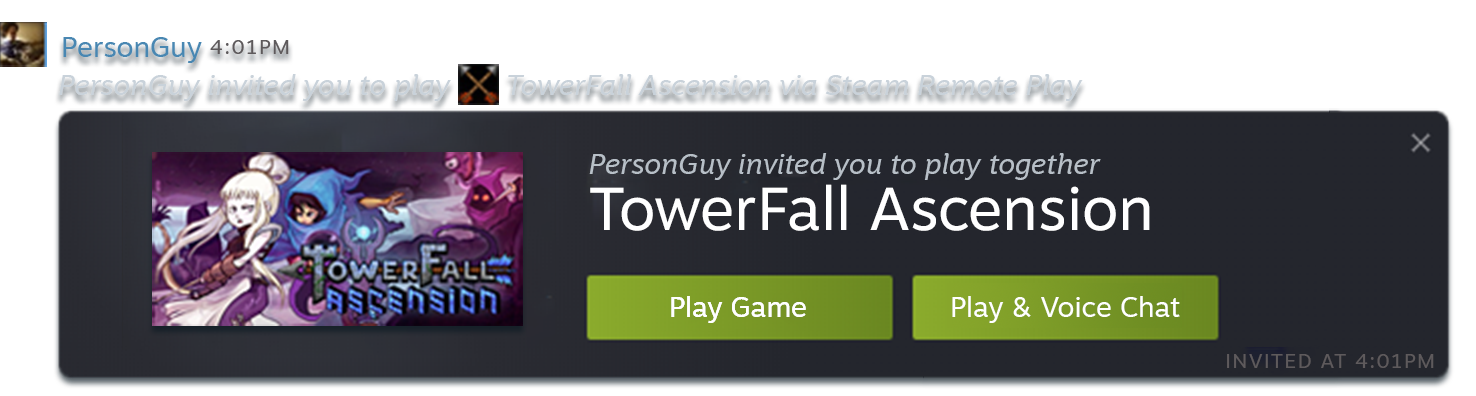
Valve provided this sample of how the invite interface will work. Should you join someone else's session, you can automatically add your connected chat headset to the game's audio or just jump into the game. In either case, whatever input Steam recognizes on your computer (gamepad, mouse+keyboard, steering wheel, whatever) will start beaming to the host's computer, recognized within its Steam Client as another connected controller on that host PC.
Enlarge / Valve provided this sample of how the invite interface will work. Should you join someone else’s session, you can automatically add your connected chat headset to the game’s audio or just jump into the game. In either case, whatever input Steam recognizes on your computer (gamepad, mouse+keyboard, steering wheel, whatever) will start beaming to the host’s computer, recognized within its Steam Client as another connected controller on that host PC.

For a better sense of how this will work, imagine a multiplayer game like Rocket League, which has a local split-screen mode for four players. Using Remote Play Together, the host computer will render that game’s default split-screen content, immediately stream that signal to three other machines, and process the other players’ button taps as if their gamepads or keyboards were directly connected to the host. All players will see the exact same gameplay screen. This differs from normal online Rocket League, which gives every player their own dedicated screen, because Remote Play Together simulates the “everyone on the same couch” experience.

But how will Remote Play Together feel in action? We’ve tested upcoming game-streaming services like Microsoft Project xCloud and Google Stadia, which bounce video and button taps between your home device and an assumedly optimized server farm. In those demos, which we tested in controlled expo halls, we’ve noticed everything from near-perfect connections to noticeable, tolerable latency. Can Valve’s version possibly keep up, especially when it will ask “host” PCs to juggle game rendering, video streaming, and input translation?

There’s a reason that many latency-sensitive games have landed on Steam without online support; if you have to wait for packets to bounce back and forth between a host and a client, then all the fun can get sucked out, especially for twitchy versus games. (Indie couch co-op games, in particular, tend to skip online modes due to the headache they can be for a small studio to code and implement.) But Valve is clearly bullish on the idea that its feature will be fast enough; one of the biggest local-multiplayer games of the past decade to never receive an online mode, Towerfall, is clearly shown in one of the company’s sample images.

Valve’s explanatory email says the beta will launch “the week of October 21” for all users of the Steam Client Beta (which can be opted into in Steam’s settings menus). So long as a shipped Steam game includes a tag for “local co-op,” “local multiplayer,” or “split-screen,” it will automatically be supported. After confirming that only one participating player needs to own a particular game, Valve’s email offers an assurance in terms of game sales: “We don’t believe it’s feasible to use Remote Play Together to avoid purchasing games on Steam entirely, and like other promotional tools and features, we believe the additional exposure and fun players have will lead to additional revenue and player growth.” If that’s not comfort enough, developers must contact Valve to opt out of their games automatically appearing in this beta.

Should the email’s release date come to fruition, we won’t need to wait long to see how well this mode works, whether its image quality suffers, and whether it’s superior to existing options like Parsec.

https://arstechnica.com/?p=1582725