Doom Eternal joins this year’s game-delay club, will launch March 2020

Doom Eternal—the highly anticipated sequel to the hell-shooter series’ 2016 reboot—has left our list of most anticipated games of 2019. On Tuesday morning, game publisher Bethesda announced that Doom Eternal needs another four months in the oven. That means it will launch on PC, Xbox One, and PlayStation 4 on March 20, 2020.

That list of supported platforms is missing a big name: Nintendo Switch. Tuesday’s delay includes an additional, indefinite delay of the sequel’s port to Nintendo’s weaker console, thus breaking the developer’s original promise that Switch buyers would get to rip and tear into Doom Eternal the same day as everyone else. “We will announce [the Switch port’s] date in the future,” the company’s statement vaguely reads.

Publisher Bethesda took the opportunity to delay another related game out of November 2019, as well: Doom 64. This first-ever port of the 1997 shooter onto non-N64 platforms is still coming to PC and modern consoles, Bethesda says, but it, too, will launch on March 20, 2020. Now, at least, that port will become a free pre-order bonus for buyers of Doom Eternal. But we’re not sure why Bethesda and id Software couldn’t get Doom 64 ready by this holiday season to tide series fans over during the bigger game’s delay. (In the meantime, if you own a legitimate copy of the N64 original, we suggest ripping its files and launching them on PC via the incredible Doom 64 EX mod.)

The scope of the delay seems substantial, as the entire game won’t even be ready by March 2020, according to today’s statement. The new game’s “Invasion Mode,” which lets online players become the bad guys in other real players’ single-player campaigns, will be delayed as “a free update shortly after launch.” id Software isn’t saying exactly how “shortly” that will be.

This delay is a particular bummer, considering how polished Doom Eternal‘s gameplay world premiere felt at a pre-E3 event this summer. As I wrote:

I don’t often get as jazzed about an in-development video game the way I have about Doom Eternal. After playing its 20-minute E3 demo to completion for my first time, I yelled, “AGAIN! AGAIN!” like a child unwilling to get off of a rollercoaster (and was thankfully granted another go at the fun). Upon getting home and preparing this article before Bethesda’s E3 press conference, I combed through a full playthrough video provided by the developers like a sad ex flipping through a photo album. I had to look again. I wanted to remember.

I guess I’ll have to watch those old video clips for another few months to wait out this return of the game. Here’s to hoping the delay helps id Software fulfill the demo’s promise: more of the same Doom 2016 action, only with more open skies, fewer claustrophobic corridors, and a perfectly ramped-up combination of new monsters and new weapons alike.

If you’re keeping score, Doom Eternal joins a high-profile list of games originally promised to launch in 2019. These include Animal Crossing: New Horizons, Wasteland 3, and Psychonauts 2. (We’re still wondering whether Valve will join that list with its repeatedly promised “VR game,” currently slated to launch in “2019.”)

Even though it’s not a game, you’re also welcome to add the upcoming Sonic the Hedgehog film onto that list. It, too, received a high-profile delay into 2020 after an outcry over its premiere live-action trailer earlier this year.

Listing image by id Software

https://arstechnica.com/?p=1581953


Sony confirms the PlayStation 5 is coming in 2020, reveals new hardware details

Sony's DualShock 4 controller for the current-generation PlayStation. The report says the new controller looks similar but has major new haptic features.
Enlarge / Sony’s DualShock 4 controller for the current-generation PlayStation. The report says the new controller looks similar but has major new haptic features.

Sony representatives have revealed substantial new details about the company’s upcoming PlayStation 5 console in an interview with Wired. New features and improvements will include sophisticated haptics in the controller, hardware ray tracing, and a UI that lets users see in-game information before launching a game. Additionally, Sony confirmed that the console will be called the PlayStation 5 and that it will launch before the holidays in 2020.

Mark Cerny, the architect of the PlayStation 4, has returned as chief architect for the PlayStation 5. Earlier this year, he sat down with Wired to demonstrate Sony’s work to eliminate load times with extremely fast solid-state drives and improved software stacks and I/O to accompany them. In that demonstration, a fast-travel load in Spider-Man went from 19 seconds on current PS4 hardware to less than one second on new hardware.

Today’s interview touched on SSDs again, expanding upon the previous discussion to highlight additional benefits of the next-generation SSD—something that Microsoft has said it will include in its own next-generation console as well, also due in late 2020.

Cerny pointed out that game developers often duplicate data at multiple points on a disc or in a hard drive installation in order to make it easily accessible on traditional drives. In one example, an art asset that occurs repeatedly throughout an open-world city might be stored hundreds of times on the hard drive so it can quickly be loaded from any point in the game. Cerny says this new storage solution could allow developers to end that practice, either making room for more assets in the same installation size or freeing that space up on users’ drives.

And since games are getting quite large (Red Dead Redemption 2 took up nearly 100GB; The Elder Scrolls Online is even larger), the PlayStation 5 will use 100GB optical discs. It will support the 4K Blu-ray disc format.

The above-mentioned SSD implementation means that players will be able to jump into specific points in a game very quickly. And that home screen is seeing some changes that synergize with that capability. According to the interview, the home screen will be able to show in-game data from a game even if that game is not running and will facilitate the player opening the game directly to any part of it based on what data is presented.

To invent some examples that demonstrate how this could work: in a multiplayer shooter like Call of Duty, the player may see that there’s a double-XP event for the Nuketown map and launch right into a Nuketown match from the home screen rather than having to go through all the introductory menus. Or the player could see a list of their available quests in an open-world RPG like Fallout 4 and opt to launch the game directly into a conversation with the in-game quest-giver.

Sony will also make it possible for developers to identify specific chunks of a game that can be installed or removed as needed. For instance, you could delete just the single-player mode from your drive to free up space if you’re done playing it but you want to continue with multiplayer.

A substantial portion of the Wired article focuses on the controller, though it does not go into too much detail about its design or layout other than to say it closely resembles the existing DualShock 4 controller that is packaged with the PlayStation 4. The emphasis of all this controller talk is on haptic feedback, a more sophisticated relative of rumble technology. This is the same technology that provides realistic feedback on a Mac trackpad click and that Nintendo offers a version of in the Nintendo Switch’s joycons—a feature that players and critics have shared a lot of appreciation for since the Switch launch.

The article’s author describes several simulated surfaces and experiences that use haptic feedback, such as a car driving with wheels on one side on the dirt and the other on pavement—he writes that he can feel both surfaces through the controller’s haptics. He also notes that the controller’s triggers (dubbed L2 and R2 on the DualShock 4) can provide variable resistance to simulate the drawing of a bow-string, among other things.

As is often the case with proprietary technologies in consoles, developer adoption may depend on whether both major competing consoles—Microsoft’s Project Scarlett and Sony’s PlayStation 5—support them. For example, the PlayStation 4’s DualShock 4 controller has a touchpad that provided some interesting gameplay and input possibilities in some first-party Sony games and other early releases on the console, but over the years it has been used less, in part because most games are developed cross-platform, and Microsoft’s controller does not have the same capability.

The SSD improvements, too, require active planning by the developers in terms of how data is stored and delivered from the disk in their games. That one is more likely to see widespread use, though, because the player and developer benefits are clear, and both consoles will include the feature.

Sony skipped E3 this year, so these articles have been our main source of information about the upcoming console. But expect to learn a whole lot more about both Sony and Microsoft’s new consoles sometime next spring or summer.

https://arstechnica.com/?p=1581801


Hulu finally catches up with Netflix and Amazon, offers video downloads

Closeup photo smart phone with Hulu app.
Enlarge / The downloadable content page in the iOS Hulu app.

For the first time, Hulu will allow users to download episodes for offline viewing. The feature is available today for iOS users who have subscribed to Hulu’s ad-free on-demand tier.

Users will be able to download as many as 25 videos on up to five unique devices. Unwatched downloads will remain available offline for 30 days. If users begin watching a video, it will only remain available for two days. But in either case, users will be able to renew the license by going online again, provided the episode or film has not left Hulu since they first downloaded it.

Hulu rivals Netflix and Amazon have long offered this feature, with similar terms for download limits and license renewals. Hulu may have faced a more difficult time rolling it out, not because of technical limitations or lack of will but because of the complexities surrounding content that is currently airing on broadcast networks, which is Hulu’s primary focus. By contrast, most non-original Netflix and Amazon content is backlog content.

However, Hulu’s blog post announcing this new feature indicates that—as is also the case with Netflix and Amazon—not all content will be available to download. The platform will have an “Available for Download” view to see highlighted shows and films that can be downloaded. Users will also be able to search for individual shows or films and tell from series and movie pages whether the item they’ve searched for can be downloaded.

Some content that Hulu has already said is available includes episodes of Family Guy, How I Met Your Mother, Desperate Housewives, and Hulu originals.

iOS users need only update their apps in the App Store to start downloading videos today. Unfortunately, Android users will have to wait a while longer. “Downloads will be coming to Android users soon,” Hulu wrote.

https://arstechnica.com/?p=1581435


World of Warcraft celebrates 15 years with a $100 Firelord statue

World of Warcraft Classic has been live for a few months now, and its operators at Blizzard are celebrating the milestone (and the original game’s 15th anniversary) with a new $99 box set. We’re not a comprehensive toy-unboxing site by any stretch, but we couldn’t skip this opportunity to marvel at a handsome statue of Ragnaros, one of the original WoW‘s most memorable raid bosses.

The above gallery breaks down everything else in the box set (which has since sold out at Blizzard’s official site). In good news for anybody who missed the box’s sale but still harbors a WoW addiction, there’s not much in the way of exclusive in-game items or any DLC tie-ins with other Blizzard games.

You may feel differently if you’re obsessed with fetching rare mounts for your journeys across Azeroth and neighboring fantasy lands, as this set does include two mounts (one for Horde, one for Alliance). Otherwise, this is a set for the series’ biggest toy-collecting fans, not a way to pick up expansion packs or other crucial in-game content. Be warned: those mounts only work with the modern version of WoW, not WoW Classic.

The box set starts shipping this week for anyone who successfully preordered it earlier this year.

Listing image by Sam Machkovech

https://arstechnica.com/?p=1581363


Neo Cab is the dystopian gig-economy Crazy Taxi we’ve always wanted

Yes, this passenger pukes in your cab's backseat. It's both the least and most of your concerns as a near-future gig-economy driver in the surprisingly stirring <em>Neo Cab</em>.
Enlarge / Yes, this passenger pukes in your cab’s backseat. It’s both the least and most of your concerns as a near-future gig-economy driver in the surprisingly stirring Neo Cab.
Chance Agency

Before I go into how much I really like the new video game Neo Cab, I want to speak to the clever new way that some people can pay for and enjoy it.

Last month, I gave a nod to the video game Gears of War 5 as a no-brainer reason to throw a few bucks at Xbox Game Pass. Instead of paying $60 and going into the game with high expectations, you could jump into the XGP subscription service at a promotional rate, sample the variety of Gears 5 solo and online modes, and get out unscathed, if not quite entertained.

This comes to mind when I recommend Neo Cab as a perfect bonus for the new, $5/month Apple Arcade subscription service. Do you own an iOS device and want an awesome, not-too-long game that leans into the limits of a tablet or smartphone? Neo Cab is arguably the coolest game outside the subscription service’s premiere deluge of quick-burst, twitch-and-tap games, and its brief, genre-blurring impact is easier to suggest within a reasonably priced subscription.

The other option, a $15 standalone purchase, adds just enough friction to a universal recommendation. (It’s this version I tested, launching this week on Windows, Mac, and Nintendo Switch after an Apple Arcade exclusivity period.)

Though the game swims in incredible atmosphere and hinges on a cool premise—you’re a gig-economy taxi driver in a dystopian future, determined to uncover a mystery—this isn’t a steering-wheel drive through busy streets. Think of Neo Cab as “Emotional Conversation Taxi,” not the arcade classic Crazy Taxi. The result is one of the most unique and self-assured games of 2019, but its niche appeal is worth minding.

Capra’s in control

How many years in the future does Neo Cab take place? It’s not entirely clear. Some of its citizens’ faces are smothered in high-tech headsets, which generate “augmented reality” grids of data or cover people’s faces with “digital beauty filters.” (That seems a bit more futuristic than even a folding smartphone.) And the game’s dense, handsome cities resemble the neon-lined vistas of your favorite far-future sci-fi. Yet the populace of Los Ojos relies so heavily on smartphone apps and handing data over to massive corporations that its conversations could easily be copied and pasted from the year 2019.

The mix makes for a dramatic setting to drive into as Lina, a struggling young woman who has moved to the nearest big city to reboot her life. She’s a rare breed: a human gig-economy driver, as opposed to the automatic robo-driving fleet operated by a massive corporation (Capra) whose robo-claws are planted into every facet of Los Ojos’ infrastructure. (Capra runs the city’s gas stations, capsule hotels, apps, and even a surveillance force made up of everyone from robotic cops to gig-economy spies.)

Thus, the game opens with Lina setting up her Neo Cab driver account in the new city, then giving her day’s first ride to Savy, a longtime friend and new roommate. Lina and Savy immediately get into a fraught conversation, and an hour after their shared ride ends, Savy disappears. Whoops: there goes Lina’s sole connection to a giant new city, not to mention her free bed.

Thus, players spend the game as a car operator with a few priorities: find clues leading to Savy’s whereabouts, make enough money to pay for gas and sleeping accommodations, and maintain a high driver rating to continue pulling customers and fares. You might expect a resulting video game to revolve around a steering wheel, but in Neo Cab, the focus is on a conversation wheel and an emotions wheel.

Every interaction with a cab passenger brings up at least two conversational reply options, if not three or four, and players get a few context hints about how to reply. First is a high-tech mood ring. While it represents a giant range of emotions, it revolves around two axes: from sadness to happiness, and from lethargy to excitement. Depending on the intensity of either axis, Lina could feel furious, terrified, or even alarmingly neutral, and the answers you choose can lead Lina into any of these directions.

While managing Lina’s emotional state, smart Neo Cab players will also keep an eye on their passengers’ words and faces, which are equally emotive. The game’s realistic-cartoon aesthetic benefits from an advanced facial-emotion system, and this makes it easy to read your passengers’ moods, from neutrality to anxiety, and from glee to gloom. Do you want to curry favor with your passenger, either for a nice financial tip or a really useful piece of intel? Start with emotional empathy, and you may have more success. This matters because certain conversational options only unlock if you nudge Lina’s emotions in a particular direction.

A game for any mood

The resulting chat system is more advanced than the likes of Telltale’s The Walking Dead, and it makes room for some particularly tense and surprising conversations. What kind of person are you supposed to be to each passenger to curry their specific kind of favor?

In some cases, that means leaning into your dry, cutting wit while making fun of the omnipresent Capra corporation. In others, that means expressing interest and delight in the latest high-tech nonsense, because your passenger is a near-religious convert (if not a developer of said tech). And then there are those rides where you have to fake like a therapist—all while occasionally slipping into your own emotional truths because the passenger dragged your mood wheel into “blue” territory.

This is where Neo Cab avoids the biggest sci-fi clichés. You’ve seen these ruminations before, about the exponential growth of technology and its impact on feeble, emotional humans. What’s unique here is how the game smoothly asks you to mind characters’ emotional responses to so much rapid, high-tech change. And, yes, it’s significantly interactive; a second playthrough proves that some conversations diverge in meaningful ways.

That doesn’t always happen; some passengers’ spiels are meant to be linear, but when these emerge, they are welcome respites from the tension and stakes of the game’s more common conversations. Not only are these simpler chats funny and touching, they also build rapport for possible repeat customers, which can lead to plot breakthroughs down the line.

All of this would be a tougher sell if Lina didn’t cement the narrative-driven game as a believable, likable mess of a young person. We immediately learn about Lina’s harsh edge via a doodle-filled journal, which grows over the course of the game based on conversations and choices. Her backstory is left a little more open and unexplained than I wanted, but Lina’s sense of “reluctant hope” is consistent, and it grounds her many temporary emotions—which is to say, the game makes room for her edge cases of anger, happiness, and despair in conversation without betraying her core traits.

Few games offer so much believable elasticity in their lead characters, and that is the electric future-car fuel that makes Neo Cab stand out from so many other narrative-driven games over the past decade. The resulting gameplay scales well to touchscreen devices like an iPhone or Nintendo Switch—you’re just tapping on dialogue choices while beautiful scenery and finely rendered characters whiz by—and that’s honestly the biggest consideration you should mind before diving in.

Does your definition of “a good video game” include a dialogue-focused rumination on corporations, the gig economy, and how a rapidly evolving workforce can land on a populace like a bomb? Then the brief-but-compelling Neo Cab is a 2019 must-play. If not, consider the $5/month Apple Arcade path as an excuse to play this game for at least 10 minutes and let its finely tuned twists charm you into sticking with its mix of solid writing and compelling choices for a few hours.

https://arstechnica.com/?p=1580203


It’s just one big ST:TNG reunion in latest trailer for Star Trek: Picard

[embedded content]
Jean-Luc Picard (Patrick Steward) comes out of retirement in Star Trek: Picard, coming soon to CBS All Access.

Star Trek fans have been eagerly awaiting the debut of new series Star Trek: Picard, slated to debut in January 2020. It was first announced at the Las Vegas Star Trek Convention in August 2018, and a nice long trailer just debuted at this weekend’s New York Comic-Con. It’s practically a Star Trek: The Next Generation reunion, featuring plenty of familiar faces alongside the new cast.

Rumors began swirling about a Picard-centric spin-off series shortly after Star Trek: Discovery showrunner Alex Kurtzmann signed a five-year development deal with CBS to further expand the franchise for its streaming service. One potential snag was whether Patrick Stewart, who created the character, would reprise his role. Kurtzman envisioned a more contemplative tone, describing the series as “a more psychological show, a character study about this man in his emeritus years.” The concept was sufficiently unique that Stewart signed on.

“I truly felt my time with Star Trek had run its course,” Stewart said at the 2018 convention. But he professed himself “humbled” by the stories from fans about how much the character of Picard and ST:TNG had comforted them during difficult times in their lives. “I feel I’m ready to return to him for the same reason—to research and experience what comforting and reforming light he might shine on these often very dark times.” There are ten episodes in the first season, with plans for two additional seasons if the series succeeds.

The first trailer debuted at San Diego Comic Con in July. Picard has retired to the family vineyard, filled with regret because Data sacrificed his life to save him in Star Trek: Nemesis. (The series is set about 20 years after those events.) His bucolic existence is interrupted by the arrival of a mysterious woman named Dahj (Isa Briones), who pleads, “Everything inside of me says that I’m safe with you.” It’s unclear who she is, but she has shapeshifting powers and is quite the athlete. Clearly Picard has his suspicions, telling an admiral at what appears to be a Starfleet outpost, “If she is who I think she is, she is in serious danger.”

We caught glimpses of of Seven of Nine (Jeri Ryan) and Data (Brent Spiner). And the SDCC unveiling included confirmation that at least two other regulars from ST:TNG would at least make an appearance on Picard: Hugh (Jonathan Del Arco) and William Riker (Jonathan Frakes). We do indeed catch sight of Riker in the latest trailer, along with Deanna Troi (Marina Sirtis). The new cast members include Christobal (Santiago Cabrera), a skilled thief who becomes the pilot of Picard’s ship; Raffi (Michelle Hurd), a former intelligence officer and recovering addict; Dr. Agnes Jurati (Alison Pill); and two Romulan refugees, Elnor (Evan Evagora) and Narek (Harry Treadaway).

The new trailer opens with a dream sequence, as Picard encounters Data in the vineyard working on a strangely haunting painting of a woman. He offers to let Picard complete the painting but Picard responds he doesn’t know how. “That is not true, sir,” Dream Data replies, handing him the paintbrush. As images of past tragedy flash by, Picard wakes up next to his trusty dog, Number One. “I came here to find safety,” he says in a voiceover. “But one is never safe from the past.”

When the mysterious Dahj shows up, he travels to Federation headquarters to convince them to help her. But he’s been gone a long time, and his entreaties are rebuffed. Never one to admit defeat, Picard amasses his own crew, both old and new faces, for a top-secret unauthorized rescue mission. “The past is written,” he intones. “But we are left to write the future,”

Star Trek: Picard premieres January 23, 2010, on CBS All Access. Feel free to toast the occasion with a nice glass of Star Trek Wine.

Listing image by YouTube/CBS All Access

https://arstechnica.com/?p=1580421


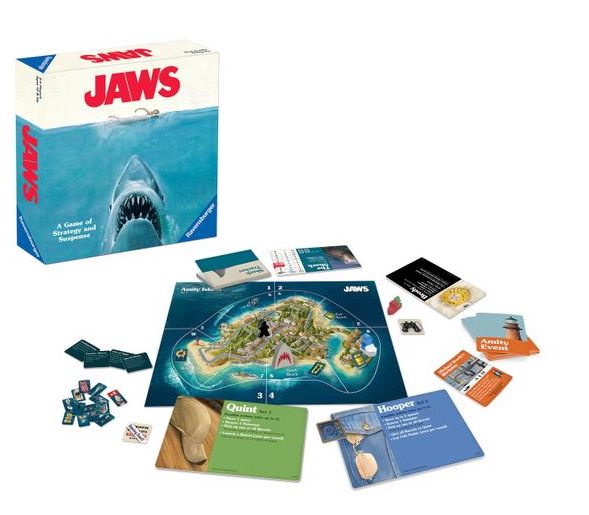
Review: Jaws is a much better board game than we had any right to expect

Jaws and its components.
Welcome to Ars Cardboard, our weekend look at tabletop games! Check out our complete board gaming coverage at cardboard.arstechnica.com.

If I had predicted a brand new Jaws tabletop game in 2019—one that would actually be excellent—you might have called me crazy. And yet here we are: Jaws the board game is a marvel.

Leave it to the design studio Prospero Hall to resurrect this 44-year old film in a new cardboard format. This group of designers has been responsible for recent hits such as Horrified, Jurassic Park: Danger!, and even the Funkoverse Strategy Game. They design mass-market titles that bridge the gap between gaming hobbyist and random Target shopper.

But Jaws may be Prospero Hall’s best. It’s a game of cat and mouse (or “shark and swimmer”), where one participant plays the film’s antagonist and the rest work together as Hooper, Brody, and Quint. By the end, you could be ripped in half like Quint—or you could haul the carcass of the Great White up the beach in triumph. Either way, the surf will shine crimson and screams will pierce the clear Amity Island air.

“Is that $3,000 bounty on the shark in cash or check?”

At a bare minimum, this kind of licensed game must provide context for you to shout out your favorite movie quotes at opportune times. Jaws does that and much more. This is an evocative experience that captures the suspense of the film while punctuating events with clever nods towards individual scenes and characters.

Mechanically, Jaws is a “hidden movement” design. That means the shark player tracks their own position on a special pad, moving from space to space with the goal of devouring swimmers who pop up over time.

The rest of the group takes on individual characters from the film, and each character has asymmetric abilities and specific functions. Brody can shut down beaches by pleading with the mayor. Hooper can use his fish-finder to locate the predatory shark. Quint can drive his Orca around the island.

It all feels absolutely gripping. From the majority’s perspective, you’re hunting in the dark. Swimmers keep taking to the various beaches of Amity, and your team must pool its efforts to locate and nab the beast. (You will need to combine efforts to set a workable trap for the shark.)

The shark, meanwhile, is hunting. The shark player can trigger one of several special powers at opportune times. It’s a bit of a mind game as you seek to elude your pursuers and attack where their defenses are weak. Or, perhaps you strike right into their position with a surprising charge.

This portion of the game can play out in many ways. The shark’s goal is to devour nine swimmers, while the other players try to land two barrels onto the predator. As each swimmer perishes, the team feels the weight of failure; you can almost hear each swimmer’s family members cursing your ineptitude.

Anyone who has played games like Fury of Dracula or Scotland Yard knows the drill. But the advantage Jaws has over its peers lies in its pacing and atmosphere. The game never lets up, and the action is focused and cinematic. It also has the advantage of a structured arc which results in an explosive climax.

“You’re gonna need a bigger boat.”

The most novel aspect of this release is its two-act structure. Once a side has accomplished their goal, we move to the climactic showdown at the Orca. The board is flipped over, revealing the iconic vessel, and violent conflict ensues.

It suddenly feels as if you’re playing an entirely different game. This portion of the game switches from a large-scale hunt to a more focused battle. That sense of climbing into your opponent’s skull and deciphering their tactical approach still exists, albeit in altered form.

Here the shark must choose one of three locations to attack. These areas of the Orca are dictated by a row of cards. The shark objective is now to destroy the vessel or kill the three crew members, while Brody and company want to fell the beast and get home by supper.

The violence increases, too. Now characters can be attacked directly if they end up in the water, each chunk of flesh torn from their body resulting in a loss of health and possible death. The upside is that the crew now wields weapons. Crew members may have a rifle, pistol, a bucket of chum, or the explosive canister featured in the final moments of the movie.

Ah, the old "cardboard fin hoax" card...
Enlarge / Ah, the old “cardboard fin hoax” card…

Your performance in act one dictates the amount of gear the crew receives and the amount of special attack cards the shark holds. If you can tag the monster with two barrels when he’s only devoured four or five Amity citizens, for instance, you get to hold a few more weapons.

It’s a pretty wobbly scale that doesn’t always feel as tightly woven to the first part of the game as you’d like. And this is perhaps the game’s greatest stumble, in that the first act can sometimes feel inconsequential. The effectiveness of the bonus cards earned from the first round varies—several can give zero benefit based on failing a die roll—and you might feel that your performance in the first portion of play was irrelevant. But at other times, a well-played card can pay out immensely as you nail the shark with an explosive or take a huge chunk out of the boat with your massive jaws.

The balance between the two sides feels quite “directed” by the designers. The first act favors the predator, as players will often see the maximum number of nine swimmers being devoured. The second half, on the other hand, swings back in favor of the crew, with games more often than not resulting in tender shark flesh floating among the Orca wreckage. You can buck these averages, of course, and unexpected outcomes like to poke their fins out of the water, but you will have your work cut out for you.

There’s also the small issue of player scaling. With less than four, participants will need to control more than one character—possibly even all three crew if playing a two-player game. This is not overly difficult, but it results in a more cerebral, quiet experience with less discussion. Strategic play may rise, but the overall joy of play diminishes as those fevered discussions to deduce the shark’s position disappear.

Yet those blemishes are small. Jaws reliably delivers a level of enjoyment that competes with a trip to the beach. This is a top-shelf hidden movement design and is a great experience for those who are fans of the film. You can even juice up the experience by playing Quint’s death on a nearby screen between acts, and your play group will eat it up like an enormous Great White munching on swimmers.

The game’s impact will not be as strong for those unfamiliar with the source material, but the mechanisms at work still provide a hell of a ride. Bottom line: this is not only a great IP-derived game, it’s absolutely one of the year’s best titles.

https://arstechnica.com/?p=1580229


Boldly going where no palate has gone before: A Star Trek wine tasting

The inaugural collection of Star Trek wines includes a 2016 Chateau Picard Cru Bourgeois Bordeaux and a 2017 Special Reserve United Federation of Planets Old Vine Zinfandel.
Enlarge / The inaugural collection of Star Trek wines includes a 2016 Chateau Picard Cru Bourgeois Bordeaux and a 2017 Special Reserve United Federation of Planets Old Vine Zinfandel.
Jennifer Ouellette

What is it about alcohol and Star Trek? We’ve had the Star Trek: The Next Generation 30th anniversary beer, the James T. Kirk Reserve straight bourbon whiskey, and Ten Forward vodka, named after the Enterprise lounge, with each bottle containing traces of “vodka from space” (technically Earth’s mesosphere).

But arguably the most anticipated Trek happening of 2019 involved the announcement of a new series—Star Trek: Picard. Slated to debut in early 2020, the show picks up with the beloved captain retired to his vineyards before life intervenes. So naturally, in honor of the series and Picard’s true passion, we now have Star Trek Wines, a collaboration between CBS Consumer Products and Wines That Rock.

Obviously, Ars had to sample these wines—for you, our readers, because we’re selfless like that. We recently ordered a bottle each of the two featured wines, even snagging the last of the sold-out limited edition Collector’s Pack. From there, we put out some cheeses and charcuterie, and the Los Angeles-based Ars Technica contingent set about putting our palates to work.

Now, like one’s preference in Trek series, one’s taste in wine is highly subjective. Samuel Axon and I prefer earthy, grassy, smokey notes (“I like to feel like I’m tasting the dirt”), while Anna Washenko is more of a fruit-forward, “berry in the face” person. (Also on hand for the tasting: my spouse, Caltech physicist and Star Trek fan/wine aficionado Sean Carroll.)

Ready the corkscrew, engage!

First up: a 2017 Sonoma Valley zinfandel produced under the United Federation Special Reserve Label. They’re really leaning hard into canon for this one. The back label gives a brief history of the founding of the United Federation of Planets, claiming that the wine has been “blended by our intergalactic sommelier and designed to fit the palates of multiple planets.” The grapes are 87% zinfandel, blended with petite sirah and just a hint of syrah.

“Blended by our intergalactic sommelier and designed to fit the palates of multiple planets….”

The winemakers describe the tasting notes like this: “Elegant, stately and dignified are but a few words to describe the wine that Federation dignitaries might enjoy at their gatherings. It has aromatics of concentrated strawberry, blackberry and plum preserves with a chewy-layered mid-palate filled with hints of white peppercorn, sweet red and black fruit.” (The back label adds “Andalorian spice” to the description just for fun.)

Ars survey says: This is a fairly typical robust California zinfandel, light, smooth, and fruit forward—in other words, very much to Anna’s taste. It’s young, with a fairly high alcohol content, and it pairs nicely with cheeses and charcuterie. As a bonus, the bottle design is terrific, even though clear glass is not conducive to long-term storage for wines. Drink the wine now and save the bottle if you’re keen on collectibles.

Next up: a 2016 Bordeaux blend from Chateau Picard (although the label claims it’s a 2386 vintage). This is a bona fide winery, with a centuries-old vineyard in the St.-Estephe region. It just so happens that Jean-Luc Picard’s family has long run a fictional vineyard of the same name, albeit in the Burgundy region rather than Bordeaux. But the real winery agreed to collaborate on a special edition of their 2016 cru bourgeois vintage. Again, in the new series, Picard has retired to the family vineyard, filled with regret because Data sacrificed his life to save him in Star Trek: Nemesis. We got several glimpses of his retired life at a fictionalized Chateau Picard  in a trailer that dropped in July:

As one would expect, the Chateau Picard bottle is a classic Bordeaux blend, 85% cabernet and 15% merlot. Chateau Picard’s tasting notes describe it thus: “Toasty American Oak integrates with blueberries, dark plum and blackberries. Bold, sweet tannins hold up a velvety mouthfeel, leading to a juicy finish with dark cherries, violets and baking spice.”

Ars survey says: It’s a solid, tasty Bordeaux blend, dryer than the zinfandel, with a longer finish and more interesting spices, even if lacks that “Andalorian spice.” It is, in short, quintessentially French, and proof that even in the 24th century, terroir still matters.

There’s an important caveat to this important testing: the Star Trek Wine experience won’t come cheap. A bottle of Chateau Picard retails for $60, while a bottle of the United Federation zinfandel will cost you $50. These are perfectly respectable, quaffable wines, but you can get much better bottles at that price point. Unless you’re a diehard Star Trek fan, these are not really the best bang for the buck. Still, as Samuel Axon pointed out, both wines are definitely better than “synthehol.”

For those discriminating Star Trek fans looking for something a bit more canonically outre, there’s always the option of mixing your own Romulan ale. McCoy famously gives a bottle to Kirk in Star Trek II: The Wrath of Khan, and it’s appeared periodically in the franchise ever since. The defining features of Romulan ale, per How To Drink host Greg, are “it’s blue. It’s strong. It’s illegal in the Federation. It causes a vile hangover.” What’s not to like? Here’s his recipe (video embedded below):

Romulan Ale

1 oz. -or- 30 ml. Simple Syrup
1 o.z -or- 30 ml. Lime Juice
1 oz. -or- 30 ml. Blue Curaçao
2 oz. -or- 60 ml. Plantation 3 Star
Shake and Strain

[embedded content]
How To Drink demonstrates how to mix your own Romulan ale.

https://arstechnica.com/?p=1579921


Upgraded Red Dead Redemption 2 hits PC, Stadia in November

PC gamers will finally have a chance to try out Rockstar’s best-selling Red Dead Redemption 2 on November 5, the company announced today. The game will also be a launch title for the planned November launch of Google’s Stadia streaming service.

Rockstar is using the marquee release as a promotion for its new proprietary PC game launcher. Pre-orders on that platform—which will begin on October 9—come with a free upgrade to the Premium Edition, including a number of story-mode DLC bonuses and 50 Gold Bars for use in the Red Dead Online mode. Those pre-orderers will also receive two free legacy Rockstar titles from the following selection:

  • Grand Theft Auto III
  • Grand Theft Auto: Vice City
  • Grand Theft Auto: San Andreas
  • Bully: Scholarship Edition
  • L.A. Noire: The Complete Edition
  • Max Payne 3: The Complete Edition

For PC players who don’t want to use Rockstar’s launcher, the game will also be available via the Epic Games Store, Green Man Gaming, the Humble Store, and GameStop on November 5. Pre-orders on those platforms, starting October 23, will include 25 Gold Bars for Red Dead Online.

Rockstar announced that the game will also be available on Steam, but not until December.

After shipping 23 million copies on consoles in just 100 days, the console version of Red Dead Redemption 2 plateaued at 25 million in August. That puts the game well behind the astronomical sales pace of Rockstar’s Grand Theft Auto V, which sold 29 million units in 72 days back in 2013. That game went on to approach 110 million total sales as of May 2019, with 15 million of those sales coming in the 12 months following May 2018. Following a long and frustrating series of delays, the PC version of Grand Theft Auto finally launched 19 months after the game’s 2013 release on Xbox 360 and PS3. Red Dead Redemption 2, on the other hand, is poised to hit PCs just over 12 months after its console debut.

Rockstar says the PC version of RDR2 “features a range of graphical and technical enhancements for increased immersion along with new Bounty Hunting Missions, Gang Hideouts, Weapons, and more.”

https://arstechnica.com/?p=1579903


When “easy mode” isn’t enough: An analysis of unclear lessons in video games

Photoshopped image of Q-Bert video game.
Enlarge / Even the most renowned video games don’t teach their players as well as we all assume, according to a surprisingly comprehensive video cited in this article.

For years, we at Ars Technica have discussed how the video game industry might benefit from tearing down its oldest traditions. This November’s Death Stranding will ship with a “very easy” mode, and that inspired us to wonder whether other video games should do the same thing. And we loved how the Halo: Master Chief Collection launched in 2014 with an option to hop to any moment within its multi-game library. That prompted us to suggest that more games should let their owners flip to any “page” in a game as they please instead of forcing players to earn their way via challenge.

This week, a gaming and pop-culture critique channel on YouTube looked at the existential question of “video game access” from a wholly different perspective: a year-long analysis of an adult trying video games for the first time in her life. The results, as posted by the channel Razbuten, have been embedded below, and the 20-minute analysis is fascinating on both a macro and micro level.

Even Mario could learn a thing or two

[embedded content]
“What Games Are Like For Someone Who Doesn’t Play Games,” posted by YouTube channel Razbuten.

Instead of calling the video “I made my wife suffer through video games for her first time ever,” Razbuten opted for a title that speaks to the inherent learning curve for anyone new to the hobby. “What Games Are Like For Someone Who Doesn’t Play Games” came as a result of a full year of the host’s wife testing nine video games she’d never played before: Super Mario Bros., Celeste, Shovel Knight, Portal, Doom (2016), The Elder Scrolls V: Skyrim, The Last of Us, Uncharted 2, and Dark Souls.

Those nine games were chosen due to their “diverse set of genres and gameplay mechanics, and, well, I liked them,” Razbuten said. The host made clear that no guidance would be given to the player. (This was followed by a joke about the couple’s marriage ending, along with a quickly stated asterisk of “That’s not true.”)

While we’ve seen essays and thinkpieces about the obfuscating “language” of video games and how that can be a barrier for those who didn’t grow up with the hobby, Razbuten’s video shines because it collects and presents clear video proof of his concerns. It starts with SMB‘s Level 1-1, often cited as a masterstroke in game design to teach players how to do things like jump, run, face enemies, and collect a power-up. Razbuten’s video points to the lack of clear “running” instructions inherent in the act of play, however, while he also examines one way that players could organically misunderstand how the iconic Super Mushroom moves around.

The other side-scrolling games in the test revealed their own awkward moments. In Celeste, the crucial act of air-dashing, required to reach distant ledges, is taught to the player with a seemingly innocuous prompt: press a button and an up-diagonal direction at the same time. As a result, the tester thought this was the only direction she could dash in, until an accidental button tap showed otherwise. And in Shovel Knight, the death condition of having a bag of money appear as a “ghost” confused the tester and left her thinking this was an enemy to be avoided or attacked, not a helpful way to recoup lost items.

Overload

Meanwhile, the tester unsurprisingly got lost in 3D games for various reasons, most commonly due to information overload and unclear onscreen markers. (The video also noted confusion over the fact that, in one computer game, a mouse was needed to move the tester’s perspective, which she didn’t realize was required for nearly five minutes of play.)

More surprising than that was the tester’s issues with a lack of openness and possibility in terms of completing apparent objectives. In Doom 2016, an onscreen marker hints to a required step: walk up to an object, then press the “interact” button to move along. But this test’s player saw the onscreen marker on top of a scary-looking object and tried something else: awkwardly kicking an explosive barrel in the direction of said object, then blowing it up. It didn’t work.

To be fair, a huge number of genres, particularly puzzle, strategy, and sim games, are missing from this video, as are examples of touchscreen games whose inherent tactile perks may solve some of these concerns by default. Still, the video does an interesting job of selling the tester’s familiarity with computers, phones, and technology but not necessarily with the dense, underlying language of how traditional video games work. What’s an “L3” button? Do all games have “run” or “sprint” options built in? If something in the game world looks destructible, why can’t it be destroyed?

The resulting perspective is an interesting mix of rigid and wide open, and it speaks to how even seemingly “accessible” games can stand to make a little more room for brand-new eyes, especially as services like Apple Arcade, Google Stadia, and Microsoft Project xCloud loom as gaming entry points for people who have otherwise never owned a console.

https://arstechnica.com/?p=1579329