The rights to Ms. Pac-Man are caught up in a messy legal battle
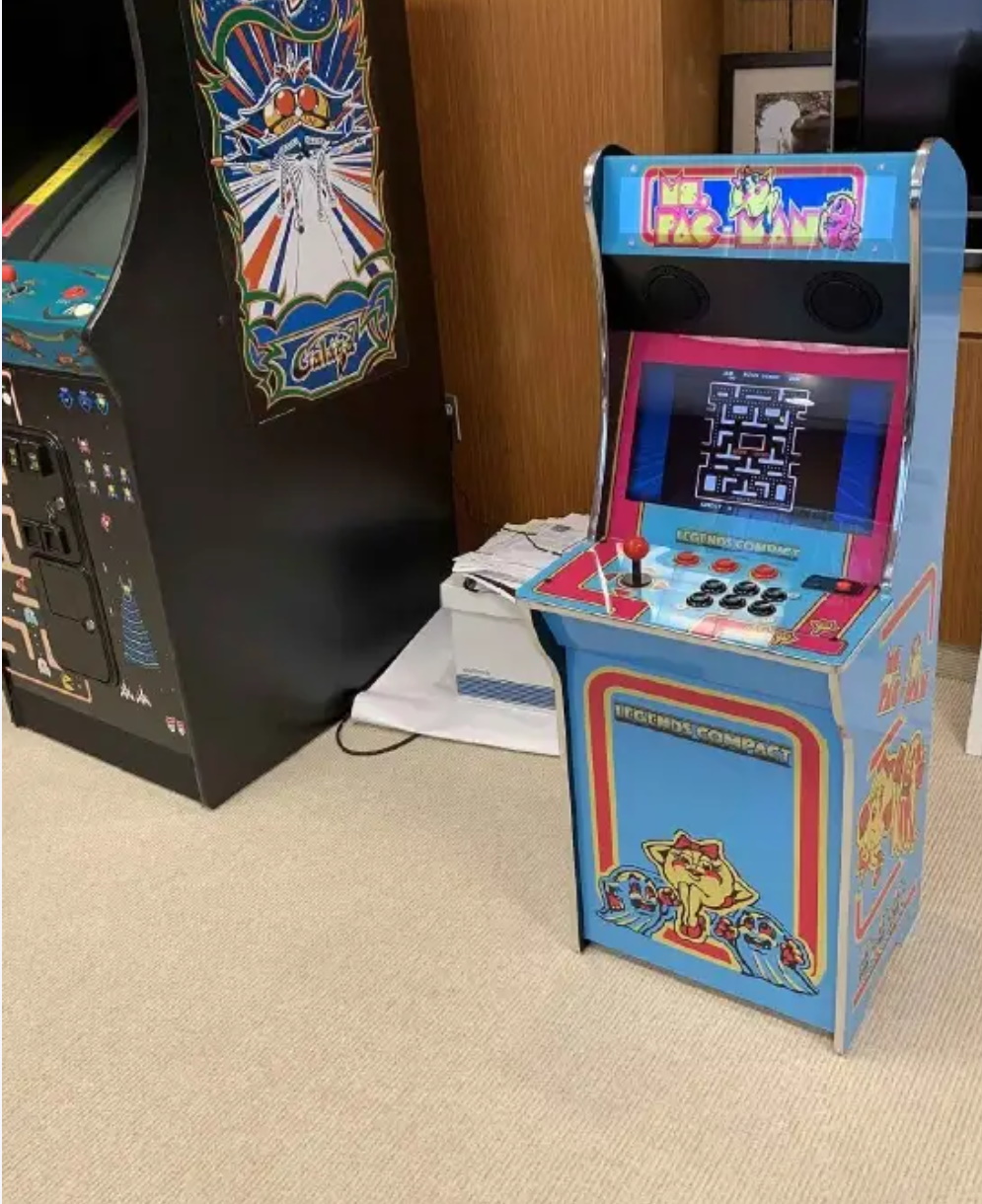
Enlarge/ This AtGames prototype cabinet is at the heart of a legal battle over the rights to Ms. Pac-Man.
The complicated rights situation behind Ms. Pac-Man is at the heart of a legal battle between Bandai Namco—which owns the Ms. Pac-Man trademark and copyright—and retro hardware maker AtGames—which has now purchased the separately held royalty rights to the game.
The strange situation dates back to 1982, when a group of MIT students created an unauthorized “enhancement kit” named “Crazy Otto” for Bandai Namco’s arcade hit Pac-Man. The MIT group, which organized under the name General Computer Corporation, then reached out to US Pac-Man distributor Bally Midway to develop that modification into the officially licensed Ms. Pac-Man.
As part of the Crazy Otto licensing deal, GCC received the right to a perpetual royalty payment whenever a Ms. Pac-Man game was sold. Bally Midway retained the copyright and trademark rights to the game and its characters, though, which Bandai Namco eventually reacquired in the intervening years.
According to a federal lawsuit filed by Bandai Namco this week, the company had been negotiating with the successors to that GCC deal in order to “resolve the relationship” the two companies had with the game (presumably to acquire the royalty rights under the Bandai Namco umbrella). That agreement was on the verge of being signed, Bandai Namco says, when AtGames swooped in and acquired GCC’s royalty rights for itself this fall.
“As part of our ongoing initiative to be caretakers of important cultural touchstones, we are privileged to gain these valuable rights pertaining to the iconic Ms. Pac-Man arcade game,” AtGames CEO Dr. Ping-Kang Hsiung said in a statement.
AtGames alleged bad acts
If you recognize the name AtGames, it’s probably not for good reasons. The company has a reputation in the game industry for bargain-basement retro hardware releases like the Sega Genesis Flashback console (which preceded the much-improved Sega Genesis Mini that AtGames had nothing to do with).
AtGames was also embroiled in controversy last year when it sent a misleading version of its Bandai Namco Flashback plug-and-play console to reviewers. That early review version contained authentic emulated arcade ROMs of a selection of Namco classics, while the final release contained only downgraded NES versions (“The early review version could not make it to production, even though it was anticipated it would,” AtGames said in a tweet at the time). In its lawsuit, Bandai Namco says it never approved the release of those modified NES versions, and it cites this as an example of AtGames’ “improper and wrongful conduct.”
Bandai Namco also says AtGames made at least one prototype Ms. Pac-Man miniature arcade cabinet, using Bandai Namco’s trademarks without the company’s authorization, and showed it to at least one of the GCC successors as part of its negotiations. AtGames has also allegedly been contacting retailers like GameStop and Wal-Mart about selling that Ms. Pac-Man cabinet without the involvement of Bandai Namco. Bandai Namco also believe AtGames made false statements about its access to the IP.
“Not only are AtGames’ false statements likely to damage Bandai Namco Entertainment America’s relationship with its current and prospective licensees, retailers and/or distributors, but they are also likely to cause severe harm to BNEA’s reputation and goodwill,” the lawsuit reads.
In a letter obtained by Polygon, AtGames’ lawyer called Bandai Namco’s lawsuit “another transparent effort to punish AtGames for entering into its August 2019 agreement with the GCC individuals, to sully AtGames’ reputation, to disrupt AtGames’ business relationships and to artificially manufacture leverage in the ongoing negotiations between the parties. To wit, [Bandai Namco Entertainment America] is so irritated by the fact that AtGames has entered into a contract with the GCC Individuals—an arrangement BNEA hoped to exploit for its own benefit through deceit and bad faith—that it has ordered its lawyers to attack AtGames by any means possible.”
As the complicated case winds its way through the courts, it seems unlikely anyone will be able to navigate the licensing issues at play and release any new official Ms. Pac-Man products in the near future. Luckily for retro arcade fans, there are already a number of licensedMs. Pac-Man games still on store shelves.
https://arstechnica.com/?p=1575947
We put Oculus Quest’s two craziest new VR features through their paces
So much Quest attention is due to promising sales figures: “over $20 million” of games and apps have been sold on Quest’s digital marketplace since its May launch, Oculus announced on Tuesday, as opposed to “over $80 million” of Rift-specific software since that platform’s March 2016 launch. Four months versus three-plus years? We don’t need a graphing calculator to plot which platform is kicking more software-sales butt.
With that momentum in mind, I cut a few lines to see the two intriguing features slated for Quest’s near-future: a wired PC-VR connection, launching this November, and a full hand-tracking API, launching in “early 2020.”
Oculus Quest Link: A killer perk, not a Rift S replacement
Oculus Quest as connected to the official Oculus Quest Link cable.
Sam Machkovech
A better zoom at the new plastic clench that’ll pair with the official Quest Link Cable.
Yes, my test was indeed running from a PC with a connected, wired tether.
The comment sections in every Oculus Quest article at Ars have included a common refrain: wireless VR is cool, sure, but is there a way to plug it into a more powerful computer to get a two-in-one device?
That question got an answer on Wednesday, when Oculus unveiled the new “Quest Link” feature, coming via a firmware update in November. This will allow anyone to connect a Quest headset to a gaming-caliber PC via any wired USB Type-C cable (so long as it’s rated highly enough for data transfer), then use the Quest as if it were the Oculus Rift. Meaning: it will load the PC-exclusive Oculus Home and Oculus Dash interfaces, and it will support “every” Oculus Rift game and app with the Quest’s paired Oculus Touch controllers.
Hours after the announcement, Oculus researchers hosted a panel to explain why the feature wasn’t ready at launch. Long story short: the data throughput of USB Type-C might be high, but it’s not high enough for the demands of high-resolution, low-latency visuals strapped to a person’s face. Without optimization, any VR video sent to a Quest via Oculus Link suffered from two key problems: obvious visual artifacts (pixellation, noise), and increased latency between your real-life motions and what appears in VR.
The box on the left is the native PC’s VR render. The box on the right is what’s being sent to Oculus Quest via Quest Link. It’s a little tricky to tell, but if you do a before-and-after comparison of this gallery’s slides…
…you’ll see the outer radius’s pixels are reconstructed and de-warped upon building the final frame of VR data.
Oculus admits the USB Type-C pipeline isn’t fast enough for a pure 1:1 VR video signal. So the team had to develop a process to compress and encode the VR action coming from a PC, then decode that information on a Quest. The biggest compression point that the team could work with wasn’t a full-scene shrinking of resolution—that would introduce obvious pixel blur within a VR game or app. Instead, Oculus opted for a custom version of foveated rendering. The center portion of any Oculus Link video signal will be closer to a 1:1 resolution compared to the PC version, Oculus says, while the outer radius is shrunken on the PC side with a downscaling of pixels and a fish-eye effect. When that’s decoded on the Quest side, that information is re-stretched and upscaled.
Soon after the presentation, I strapped into an Oculus Quest connected to a PC via Oculus Link, and I played the upcoming adventure game Asgard’s Wrath for 10 minutes. I devoted most of my demo time to wildly moving my head and hands around while squinting at the Quest’s peripheral, outer-radius pixels. I went searching for obvious artifacts in the region that I’d been told was most compressed. I spent my time in a colorful “hub” restaurant full of large characters and lighting effects, and I honestly couldn’t perceive significant issues with corner-radius pixels.
That might be because Oculus’ official line might undersell how much compression is applied to the entire Quest panel, not just its outer radius. Though Quest comes with an appreciably high-res OLED display, rated at a 2,880 x 1,600 resolution, any Link-driven image appears to come with a mild-but-noticeable smoothing effect. Ultimately, it looked more detailed than native Quest content, but I could anecdotally confirm that a neighboring Oculus Rift S game station looked noticeably sharper, even though its LED display is rated at 2,560 x 1,440.
That sense of improved smoothness might be due to Rift S running at a slightly higher refresh rate of 80Hz, compared to Quest’s refresh maximum of 72Hz. There’s also the matter of movement latency, which Oculus Link researchers confirmed was a problem that needed solving before Link could go live. The researchers’ solution was to break down the required encoding-and-decoding transfer from PC to Quest in a process they call “sliced image transfer.” Basically, each frame of visual data is sent in horizontal strips, one on top of the next, to be decoded and displayed, instead of doing that process for one discrete frame at a time.
Smooth: That’s how we do it
That sounds like a recipe for “screen tearing,” in which different parts of a screen’s image slam together as broken-apart strips. But I didn’t perceive anything of the sort in my demo. However, when using this week’s test version of Quest Link, there are clearly an extra few frames of latency between when I wave my hand or press a button and when that happens in the VR world in kind. That irregularity is perhaps on par with the latency found in wireless systems like the HTC Vive Wireless Adapter or maybe a hair faster than those. I’ll need more time to test before feeling confident on that call.
But as I’ve already reported, Oculus Quest’s built-in array of sensors is solid, and my natural head and hand movement didn’t get lost just because I’d switched from a Rift S to a Quest. That’s promising.
I also conducted my test with the official Oculus Link Cable (seen in an above gallery), which is fiber optic and runs five meters long. I agreed with the Oculus call that this cord is designed specifically to distribute its extra plastic bulk in a way that barely feels noticeable, as opposed to a standard, sticking-straight-out Type-C cable you might buy from Monoprice. But Oculus hasn’t announced a price for this cable, which doesn’t inspire confidence. (Hopefully Oculus didn’t hire someone from Monster Cable to pick a price.)
The Quest Link presentation ended without a Q&A portion, so I didn’t get to ask questions about compatibility with other VR software platforms like SteamVR. The good news is that the Quest Link connection wholly emulates a standard Rift S headset, and that hardware already works great with existing SteamVR software. So I’m optimistic.
There’s always a chance that my test experience from this week will be superseded by more tweaks and updates to Quest Link before its November launch. Even so, I left my demo feeling confident in two things. First: Oculus clearly went to engineering trouble to make this work without any additional hardware. That’s great news for existing and future Quest owners, in terms of future-proofing its device to some extent.
Second, Quest Link introduces obvious, acceptable compromises, and that means anyone who prefers PC-VR and ponied up for a dedicated computer VR system should chill out on their buyer’s remorse. Quest Link is cool in a pinch, not the ultimate PC-VR option.
Quest hand tracking: Fine as a free update, not yet a game-changer
Zuckerberg announces the first official hand-tracking product from Oculus, coming to Quest in “early 2020.”
A brief demo video includes footage of how hand tracking may look in an Oculus Quest game.
Another peek at how Oculus Quest’s camera array translates hand and finger data.
Whoosh, analyze those hands, Oculus.
Oculus also invited me to test two implementations of its first-ever hand-tracking solution, coming to Oculus Quest in “early 2020” without any additional hardware. That’s the kicker: Quest’s version of tracking real hands in VR isn’t good enough to recommend paying additional money. But as a wholly free option, it’s pretty darned good.
The best news about Oculus Quest hand tracking is that, when it works, it’s nearly instantaneous. Hold your hands out, flip them around, wiggle your fingers, and make common hand gestures—and they’ll appear as remarkably accurate representations in the VR world. So long as your hands aren’t touching each other, Oculus Quest’s inside-out array of tracking cameras (“Oculus Insight”) models them quite well.
My first test was to flip the bird, which the Quest modeled correctly. (Meaning, Oculus isn’t actively censoring your silliest gestures.) But I was more intrigued by how well Quest modeled my fingers when they pinched or clenched. This kind of gesture—in which fingers come together like a bird’s beak, faced outward—could be difficult for Quest’s built-in cameras to perceive. But Quest never stumbled in that respect; its sensors always understood my desire to pick things up. I could never say the same thing about the LeapMotion add-on for standard VR headsets.
The catch? Neither app I tested allowed me to pick up, carry, or drop objects in VR. One of them was an incredibly simple training app with Farmers Insurance branding, and it simply had me point to “water damage” spots in a kitchen and determine whether they looked like something to repair or something to mop up. It was as mild of a hand-tracking experience as they come. (I suppose it also throws more evidence onto the research pile that video games are actively training our children to become… insurance adjusters.)
The second app, Elixir, was far more impressive, even though it, too, didn’t include true “physics” interactions with VR objects. Instead, I could put my hands into various pools of water, lava, poison, or electricity, and then my virtual hands would transform with strange mutations. The best one made my hands resemble those of X-Men’s Wolverine; when I clenched my fists into a ball, claws bolted, “fwwwwsh”-style, out of my knuckles. As my hands mutated, they exploded with visual effects and made convincing sound effects. Without the haptic rumble of a controller, that audio-visual feedback was crucial in selling hand tracking as an immersive VR experience.
But, again, I couldn’t put my hands together. That’s when they’d vanish. Quest hand tracking constantly scans for some sort of skeletal pattern, and it likely punts the touching-hands conundrum to lighten its processing load. I’m happy to concede that for the sake of VR usability, but the larger current issue is that the Oculus Insight tracking system struggles to keep track of hands outside of a central visibility point. Take either hand outside of your forward-vision cone and it vanishes pretty quickly; worse, that hand requires nearly a half-second to reappear in VR once it’s back in the cone.
Should Quest hand tracking continue to suffer from this vision-cone issue, that will likely nix it as a reliable control option for active video games. (It’s a good thing Oculus Touch works so darned well, in terms of tracking and speed.) But I’m hopeful that the features that do work in this early stage—occluded finger tracking, high-speed hand recognition, and grabbing and pinching—are paid forward with apps on the education, training, communication, and accessibility fronts before long, especially as a Quest default. (Say it with me: sign language as a built-in VR standard.)
Listing image by Oculus
https://arstechnica.com/?p=1574991
Facebook’s new VR chat app will throw paid staffers at “on-boarding” trolls
Enlarge/ Mark Zuckerberg reveals Facebook Horizon at Oculus Connect 6 in San Jose, California.
SAN JOSE, Calif.—The fusion of Oculus and Facebook continues apace at this year’s sixth annual Oculus Connect conference, with this year’s biggest example coming in the form of Facebook Horizon: a new VR chat app exclusive to Oculus whose mix of cartoony avatars, social spaces, and playable games resembles current VR mega-hit Rec Room. The app won’t premiere until “early next year” as a closed beta, but in the meantime, we got a chance to test it out—and learned about the crazy plan Facebook has for its first foray into social VR.
After testing the solid-if-early app, I asked two Facebook representatives about existing social-VR apps like Rec Room and VRChat, which have their own creative, organic approaches to making strangers meet each other in VR. Facebook says it’s going to try something we haven’t yet seen in any chat app, VR or otherwise: a fully staffed concierge service.
After going through Horizon‘s tutorial, “you’ll encounter humans that are part of our team in the product, known as ‘Guides,'” Facebook’s AR/VR experiences director, Eric Romo, told Ars Technica. “Those are the people who will be trying to set the tone of what the environment is.” When asked to clarify whether these would be paid Facebook staffers, sitting in microphone-equipped headsets and waiting for new users to appear, Romo answered, “Yeah!” He added that these staffers would be “saying, ‘How can I help you? What can I show you to do?'”
VR “time out?”
This is arguably Facebook’s most intense plan yet to introduce users to a new product. No existing Facebook feature or associated app (i.e., WhatsApp, Instagram) has ever included an expectation that a live human will appear as a greeter, host, and assistant upon first boot, as opposed to serving in a formal customer service or technical support position.
I asked what Facebook’s approach would be should a user hop into this onboarding process with trolling or abuse in mind. Might the meanest Horizon users get put into VR “time out,” or worse, for lashing out at official Facebook humans?
Facebook AR/VR content marketing head Meaghan Fitzgerald made clear that Horizon‘s VR greeters are “not going to be moderators, they’re not going to be enforcers of rules.” She added that FB will rely largely on built-in blocking and reporting tools to assess whether or how users might be restricted for abusive behavior (and she was careful not to describe any types of Horizon-specific discipline in the works).
“But [Horizon Guides] model the behavior,” Fitzgerald continued. “People who come into these environments—a lot of research shows they’re not intending to go in—sometimes they are, sometimes people want to cause trouble. But more often, they don’t know how to behave. If you see someone running around and screaming, you’re going to run around and scream. If you see someone having a conversation about, ‘Hey, here’s a new activity, want to go check it out?’, that changes the tone of the space. People are really influenced by that.”
When I pressed on this question of how Facebook is preparing to enter the intimate world of VR chat spaces (with its own employees in the social crosshairs, to boot), Romo conceded that the “closed beta” descriptor was crucial this far ahead of the app’s launch. “It’s completely fair to say that we have a lot to learn, which is why we’re starting slowly,” Romo said. “There are lots of vectors for potential challenges that we need to face, and we need to learn them slowly as we move forward.”
Dogfighting as a Trojan horse
Facebook provided a sneak peek at Horizon in a reveal video, but this is not actual app footage. Since it’s built to run on the weaker Oculus Quest, expect lower-poly worlds and characters that somewhat resemble this bubbly, cartoony style.
This is closer to what the app looks like in action on Oculus Quest hardware. This is a hint of the chat app’s built-in Rock ‘Em Sock ‘Em Robots mini-game. (It has another name that does not violate copyright.)
Weirdly, this is another example of Facebook dumping a VR avatar system in place of another entirely new one.
A peek at the solid dogfighting game. You can’t see from this angle how its “VR third-person” camera works, but it’s awesome in action.
As far as the app itself, which I tested within Oculus Quest, make no mistake: this is Facebook’s version of Rec Room. That means it revolves around social spaces and mini-games as ways for friends and strangers alike to meet and hang out in VR.
The app already includes one incredible Trojan horse to usher people into social VR: a dogfighting-meets-soccer game in which your handheld Oculus Touch controller becomes a fighter plane. Use your hand’s position to manually steer the plane in relative space, and the third-person camera around you will move in kind, as opposed to magically warping a fighter plane around.
The effect might sound uncomfortable as described, but I was floored by how remarkable this “paper plane” flight model felt and worked in action. The connection I felt to a plane in my hand arguably helped my brain translate how much a VR battlefield moved around me. Between my hand’s position and a joystick, I was able to smoothly and carefully maneuver a plane through cave doors and under other large objects while aiming weapons and items in a two-on-two “plane soccer” game.
When I wasn’t piloting a plane, I was walking around, waving hello, talking to nearby strangers, and making finger-gun and thumbs-up gestures with my hands. (Make a thumbs-up and your avatar will smile; thumbs-down, you’ll frown.) In one social space, I saw a Facebook staffer pick through a built-in inventory of geometrical shapes, then copy, paste, and manipulate the shapes to build nearby geometry like a tree. That same staffer also made a very simple if-then programming note to govern a silly prop in a beachside lobby: toss three fruits into a basket and an umbrella would pop out. I could hold that umbrella while chatting with folks on the beach.
“We definitely want you to meet people you don’t know,” Romo insisted during our interview, and a mix of open social spaces, mini-games, and world-building possibilities makes sense for that ambitious goal. But that mission statement, about hanging out with strangers, is a sharp detour from the company’s previous VR-chat app, Facebook Spaces, which Horizon‘s team confirmed is being sunsetted in favor of Horizon. Nobody had an estimate for when Spaces will be powered down.
Facebook has clearly put a ton of work into the friendly-yet-not-uncanny look of its cartoon avatars. In particular, I noticed “resting nice face” and lively virtual eye contact in all of the VR avatars I talked to during my test. But this is yet another combination of VR apps and avatars that Facebook is resetting to present a whole new chat interface in a span of only a few years. Between that fact and the team’s repeated warnings about “early days” for the app, we’re still waiting for Facebook to inspire confidence that it will launch a social-VR app and stick with it for more than two years.
https://arstechnica.com/?p=1574987
Hands- and legs-on with Nintendo’s mildly diverting Ring Fit Adventure
The new hula hoop?
The Switch Joy-Con slides in quite easily.
This thigh strap kept sliding down my leg as I moved, no matter how tight I cinched it
For some reason I find it hilarious how much bigger this box is than the actual Switch system itself.
Finally, a dragon that can give you body-image issues.
The worst thing about regular exercise, in my book, is just how boring it can be. At their best, exercise video games can help alleviate this boredom, giving you a distracting and entertaining goal to chase that makes you forget you’re exercising at all.
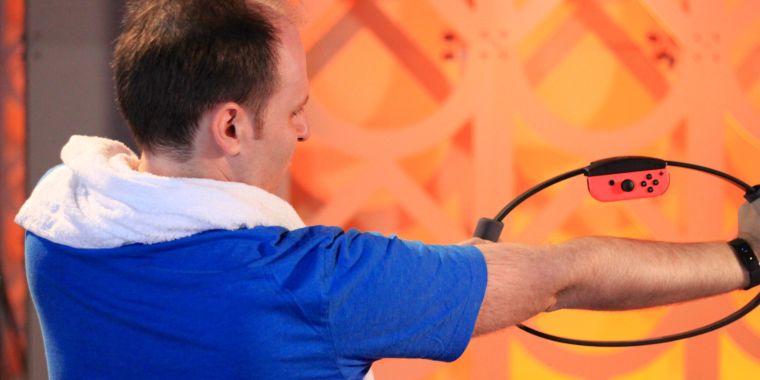
After spending an hour with Ring Fit Adventure—Nintendo’s recently announced pilates-ring-meets-RPG for the Switch—I found it to be, most often, a mildly engaging distraction from the tedium of exercise. Occasionally, it even became an all-encompassing focus that made me forget my body’s movements entirely. But I’m still skeptical that it will remain engaging enough to carry me through weeks and months of regular workouts.
Put a ring on it
From the first moment I held the Ring Fit itself, I found it to be surprisingly solid. It has a decent amount of heft and gives a fair amount of resistance both when pushing in and pulling out on the comfy cushioned grips (you can adjust just how much pushing and pulling is necessary to register via the game settings). And unlike some other (cheaper) Pilates rings I’ve tested, the Ring Fit doesn’t twist or bend in unexpected directions as you push and pull on it. It doesn’t feel like it’s going to snap apart or succumb to wear and tear through normal use.
Diving into the game itself, it starts with a short five-minute video introducing you to a world that seems to revel a bit in its self-aware silliness. A ripped, bodybuilding dragon has taken over the realm, and your player-character has to help a sentient ring (which, of course, mimics the Ring Fit) take the dragon out by feeding it “exercise energy.” Building up enough exercise energy sets your hair on fire, for some reason, which should give you some idea of the less-than-serious lore surrounding everything about the candy-colored world.
“Letting people see pictures of me exercising” was not in my Ars Technica job description. Yet here we are.
Doing my best “Link with a bow and arrow” impression.
Nintendo’s lamaze classes leave something to be desired…
OK, in this improv game you’re going to pretend to drive a car…
How I look after a particularly successful bowel movement.
And twist. And squeeze. And twist. And squeeze.
Moving through the world of Ring Fit Adventure means actually walking or running in place in the real world, where a Joy-Con strapped to your thigh registers your levels of movement pretty quickly and accurately. This feels immediately more natural than the old Wii Fit Balance Board, where you simply rose up onto your toes rather than lifting your legs to “walk” in most games. The thigh strap allows for much more freedom of movement and natural motion, though there is a “silent mode” where you don’t actually have to lift your feet off the floor.
Don’t expect a wide-open world to explore, though—on screen, my character was limited to a single straight-line path for the entirety of my demo. You can interact slightly with items and objects in your path and just to the side, tilting the Ring Fit to aim and squeezing to blast them with a puff of air or pulling to suck them up like a vacuum. You can also collect mid-air coins or reach higher platforms by jumping, which requires not a real-world jump but a downward-facing squeeze of the Ring Fit.
While it’s nice to have something to do while running in place, navigating Ring Fit Adventure thus far feels more like a chore than a trip to a magical world of wondrous exploration. Even in a single play session, this minimal diversion felt like a weak excuse to string together the enemy battles, where the more serious exercise forms take place.
Let’s get physical
The turn-based battles let you pick which kind of exercise you want to perform for each attack, and it looks like there will be dozens to choose from (though many become unlocked only slowly as you progress). In my short play sessions, I attacked enemies by doing leg lifts, pretending to sit on an invisible chair, squeezing my thighs together, doing “plank” push ups, and stretching the Ring Fit out like a bow and arrow. You can’t just lean on a favorite exercise, either; each attack needs to cool down for a while before you can choose it again.
For all of these actions, I was asked to do multiple reps in time with an on-screen indicator, which speeds up as the attacks continue. The game makes some small effort to evaluate your form and encourage correct movement (by increasing damage potential), but it doesn’t seem like a major concern, as long as you’re actually moving. And in between attacks, I had to squeeze the Ring Fit against my abs to put up a shield from the enemy’s counter-attacks.
As an excuse to test out a bunch of different exercise forms, these turn-based battles seemed sufficient, I suppose. But I ended up so focused on the timing and form of each exercise that I barely noticed the effect I was having on the enemies, or that there was an external “game” going on at all. As a distraction from the difficulty and tedium of exercise, the battle system is pretty much a failure, so far.
Get up and move!
The foreign policy implications of this are immense.
“An evil body-building dragon named Drago” is the antagonist. You can’t make this up… unless you’re Nintendo.
To run, you run.
To swing, you squat.
To jump, you point down and squeeze the Ring-Con.
HOOOOOOOOLD!
To block enemy attacks, you press the Ring-Con against your abs.
Who doesn’t love a good mini-game?
Ring Fit Adventures launches October 18 for $80 with included accessories.
Aside from the core “Adventure” mode, I also got a chance to try out some mini-games that use the Ring Fit as an interesting new control method. My favorite of these was a kind of whack-a-mole-style game that required turning the Ring Fit like a steering wheel and squeezing or pulling to send out mole-squashing hammers. This was the high point of my demo, providing 30 seconds where I was so focused on my task (and reaching a high score efficiently) that I didn’t realize the strain on my muscles (and my heart rate) until it was over.
I also tried a game that involved aiming at crates and taking them out with puffs of air, which suffered a bit from the imprecision of the Ring Fit’s motion-sensitivity. Yet another game just had me squeezing the Ring Fit in and out as quickly as possible, which ended up feeling more painful than diverting.
There’s definitely enough novelty and verve to Ring Fit Adventure‘s presentation to get through a single one-hour exercise session without succumbing to exercise tedium. But it’s far from clear whether the game’s simplistic design and “watch the numbers go up” leveling will provide enough diversion to encourage reaching long-term exercise goals. We’ll know more when we try out the $80 package at home ahead of its October launch.
https://arstechnica.com/?p=1575369
Oculus announces plans to build augmented reality glasses
After showing someone awkwardly hold a smartphone up to have a video chat, the demo video transitioned to this: a chat where a distant friend appears in the same room.
Most of the demo video revolved around alerts appearing in your normal world, like movie times and reviews. (This is similar to a Facebook reveal of augmented reality designs via the Facebook app on smartphones.)
This empty bamboo forest suddenly had a virtual bird appear, along with information about its species.
Reminders might pop up when you’re rushing out of the house. The demo video didn’t include any pop-up advertisements appearing, but it’s hard not to assume that Oculus or Facebook could add those.
A brief peek at the treasure trove of data Facebook is leveraging to render and manage 3D content on the fly, without having to manually scan your surroundings at full fidelity.
However, the demo video also showed a creepy room-scanning sequence. How will Facebook and Oculus leverage so much locally harvested data if the companies launch augmented reality glasses?
Oculus / Facebook
SAN JOSE, Calif.—At the sixth annual Oculus Connect conference, a lengthy video presentation confirmed the virtual reality company’s intention to build the device we’ve all assumed was in the works: “augmented reality glasses.”
The demo video revolved around the shared Oculus and Facebook vision of contextual data appearing in the real world while a user is wearing a pair of glasses. The demo video featured pop-up reminders (movie times, calendar reminders), along with a virtual conversation with a real-life friend who appears as a realistic, 3D version (as opposed to a cartoon avatar).
Curiously, this demo video included zero visible glasses or hardware on anyone’s face. Oculus made clear that its plans for this hardware mission were still quite early, and no timeline was announced.
The presentation resembled the vision that Facebook CEO Mark Zuckerberg laid out during a 2017 presentation, which had previously revolved around looking at the nearby world through a smartphone’s camera lens. Today’s announcement acknowledged what we at Ars were thinking two years ago: “Today, interactions with our phones split our attention. You can’t look at your phone without looking away from what’s around.”
While AR hardware plans aren’t solidified just yet, Oculus representatives confirmed that the company, as part of Facebook Reality Labs, is already building a massive “Real World Index” system to collect photo scans of indoor and outdoor spaces and associated metadata. Oculus hinted at this system being used to natively render real-world visual data as virtual 3D content, perhaps within either a VR headset or a pair of augmented reality glasses so that headsets won’t have to devote energy and resources to scanning and translating all nearby environs.
Still, a very Matrix-like “scanning” sequence made clear that any Oculus AR glasses will likely read and translate whatever is around the wearer. The privacy concerns associated with such a live data-collection project will certainly raise eyebrows among digital privacy-minded folks.
This presentation followed a peek at a VR demo experience where two distant friends can sit in the same “real-life” room and do things like watch TV and have a conversation. But this conversational experience requires one VR headset per person, and Oculus admitted that this would make for a very awkward social experience if an additional non-VR person was hanging out with either VR participant.
Listing image by Oculus / Facebook
https://arstechnica.com/?p=1574455
Oculus Quest’s secret trick: It can double as a wired PC VR headset
Enlarge/ Not pictured here: the USB Type-C cable needed to connect the Quest to a gaming PC to take advantage of today’s announced news.
Occulus / Getty / Aurich Lawson
SAN JOSE, Calif.—At Wednesday’s Oculus Connect conference, the virtual reality company took the wraps off a secret that it had apparently hidden in its recent high-quality Oculus Quest headset all along. The $400 device has been marketed as a standalone wireless VR system, but thanks to an incoming “Oculus Link” update, coming in November, it will soon double as a wired-PC option.
Should you have a lengthy USB Type-C cable handy, you can expect to plug a Quest VR headset into a compatible “gaming”-caliber PC, then use that computer to power whatever VR games and software you want to run, as if it were the PC’s Oculus Rift system. It’s an official alternative to using the Quest’s built-in hardware, which revolves around a Snapdragon 835 system-on-chip (SoC) like the ones used in the Google Pixel 2 smartphone.
Since Quest already has an array of inside-out tracking cameras, this PC use case won’t require additional cameras or sensors. You should expect to plug a Quest into a compatible PC, run a room-calibration test, and be on your way—just like with certain Windows Mixed Reality headsets and this year’s Oculus Rift S.
Enlarge/ Mark Zuckerberg announces Oculus Quest’s upcoming new feature at Oculus Connect 6.
Facebook CEO Mark Zuckerberg took the Oculus Connect stage to confirm that the update will work with most any USB Type-C cable, though Oculus itself will release a longer cord suitable for the full-room movement you might expect from Quest’s wireless default use case.
If your only PC-VR experience came with the original Oculus Rift, you’ll likely appreciate the Quest’s 2880×1600 combined resolution (up from the first Rift’s 2560×1440 count). Just remember, the Quest’s OLED panel has a lower maximum refresh rate than other PC-VR options, running at 72Hz (as opposed to most headsets’ 90Hz maximum, let alone the Valve Index’s 120Hz and 144Hz modes).
To be clear, the Quest still defaults as a wireless, all-in-one VR option; despite its smartphone-caliber hardware, it handles fully 3D worlds and high-speed action quite well, and this PC bonus is in no way required. But while major Oculus VR games have made their way to Quest’s limited marketplace, some of those Quest ports are a bit rough (the otherwise stupendous Moss comes to mind); other impressive games, particularly Brass Tactics, may never appear as native Quest apps.
Thus, today’s news means you can conceivably dive into the entire Oculus marketplace of games and apps with one headset, as opposed to needing to own a Quest and a Rift. What’s more, platforms like SteamVR already support Oculus Rift. Today’s news may very well mean that Quest owners just got a path to playing Valve’s upcoming “2019” VR game.
One more thing: Hand tracking in Quest
Zuckerberg announces the first official hand tracking product from Oculus, coming to Quest in “early 2020.”
A brief demo video includes footage of how hand tracking may look in an Oculus Quest game.
Another peek at how Oculus Quest’s camera array translates hand and finger data.
Whoosh, Analyze those hands, Oculus.
Shortly after unveiling this November 2019 Quest update, Zuckerberg announced a new feature coming to Oculus Quest in “early 2020”: hand tracking. A brief demo video showed both skeletal analysis as seen through Quest’s array of cameras and in-game hand and finger tracking. Zuckerberg told Oculus Connect attendees that they can expect to test this feature on the show floor later today, and we’ll report back with exactly how this built-in hand tracking system works in its preview state.
Oculus did not announce hand tracking support for other VR hardware, particularly the Oculus Rift S. We’ll use our demo time later today to find out whether we should expect the feature in any other Oculus products.
https://arstechnica.com/?p=1574249
Microsoft launching public xCloud streaming test on Android in October
Enlarge/ Who needs a portable Xbox when you can stream Gears 5 to your Android phone? That seems to be Microsoft’s proposition with an upcoming xCloud streaming test.
Roughly one year after announcing plans for its Project xCloud game streaming service, Microsoft will roll out a public test of xCloud next month for Android users in the United States, United Kingdom, and South Korea.
Interested players can sign up for the preview now and look for potential invites in the coming weeks. But Microsoft stresses that the test will initially be open only to “a limited number of participants,” with invitee totals “slowly increasing” over time.
Invited testers will need a device running Android 6.0 or higher with Bluetooth 4.0 compatibility, a Microsoft account, and an Xbox One wireless controller to use the free streaming test app, Microsoft said. Testers will be able to stream via Wi-Fi or mobile networks, and Microsoft has partnered with various mobile carriers to analyze and optimize the experience.
The preview will include access to Halo 5: Guardians, Gears 5, Killer Instinct, and Sea of Thieves to start, and Microsoft is promising more titles will be added as the preview progresses. All games will be available to invited testers for streaming free of charge during the preview.
Past the free limited test, Microsoft didn’t provide any information on launch timing or pricing for the formal xCloud launch. But the company did say that testing will continue “until customers are consistently reporting a great, fun experience and the technology meets our internal quality standards… Project xCloud is a technology, and these trials serve as our opportunity to test, improve and garner feedback.”
The xCloud test comes as Google prepares the formal rollout of its Stadia streaming service. At launch, that service will only be available with a $130 investment and a $10 monthly fee on top of primarily à la carte game purchases—a Stadia tier with no upfront or monthly costs is planned for sometime in 2020. We last saw Project xCloud at a controlled show-floor demonstration during this year’s E3 trade show, where we were impressed by the visual fidelity and general lack of additional apparent latency over local play.
In an August interview with Gamespot, Microsoft’s Phil Spencer talked up the “convenience” and “inevitability” of game streaming in the medium term while stressing that Microsoft would focus on “choice” between streaming and local play in the short term. “I think [streaming] is years away from being a mainstream way people play,” he said. “And I mean years, like years and years… To me, it’s about what you as a gamer want to do, and I’m not trying to tell you that owning a box that plays video games is a bad thing or that somehow that’s not needed.”
https://arstechnica.com/?p=1573723
The Last of Us Pt. II headlines PlayStation event with trailer, Feb. 2020 launch
Joel’s back in The Last of Us Pt. II.
The trailer’s closing moment sees someone grab Ellie. Her face immediately melts upon realizing who’s there.
The rumored release date is true.
The trailer opens with Ellie and her apparent new partner sharing a joint and talking about a nice kiss.
A rare moment of sheer bliss on Ellie’s emotive face.
This is one of the apparent opening towns in the game.
Ellie traverses these lands by horse.
The trailer doesn’t clarify exactly how the original game’s scourge has changed or evolved since last time around, but clearly, things are still bleak.
That’s a full 2-liter bottle of “nope” right there, mm-hmm.
Ellie loses track of someone.
The trailer leads her to this eerie home, where an ominous clicking sound plays.
Ellie doesn’t like what she sees there.
Thus, it’s time to hitch a ride back to more familiar environs.
And boat around through dystopian swamps.
The trains are down, but the tunnels are apparently alive with some sort of military force.
What’s this hostage situation all about?
Ellie has a showdown with multiple humans, from soldiers in full attire to apparent raiders.
That’s gonna leave a mark.
I’m going to assume Naughty Dog is aiming for an “M For Mature” rating on this game.
Most of the trailer’s monstrous baddies were too blurry to capture in clear fashion. But this gets the point across.
Sony’s latest “State of Play” video event ended with a release-date unveil for the highly anticipated PlayStation-exclusive game The Last of Us Part II: February 21, 2020.
The release date came at the end of a new, revealing trailer for the Naughty Dog game, which finally showed original hero Joel in real-time gameplay as opposed to his brief cameo in a 2016 Part II teaser. Every trailer since the game’s 2016 reveal has focused on Ellie as the lead character, and Tuesday’s trailer opened up with more backstory about Ellie and her apparent new partner, an unnamed woman, surviving in a snowy outpost.
After embarking on horseback and taking on apparent open-world missions, Ellie suffers a vague setback, prompting her to return to the jungle-overgrowth cities that marked so much of the 2013 original. The trailer includes a smattering of new, dangerous foes, human and monster alike, along with a vague call by Ellie to face a rising, unexplained threat: “I have to finish it. You can’t stop this.” Once Joel appears, he seems to be in agreement with this plan: “You think I’d let you do this on your own?”
Today’s reveal follows social media alerts emanating from games journalists at a Last of Us Part II-branded location, which seems to hint at more information to come about the 2020 game before long.
Enlarge/ The cast of heroes, old and new, leading the new Call of Duty: Modern Warfare campaign this October.
The rest of Sony’s State Of Play video revolved largely around the console’s end-of-2019 slate of video games, though it wasn’t packed with other surprise blockbusters for this year. A new campaign trailer for next month’s Call of Duty: Modern Warfare went into further detail than what we learned during this summer’s E3, though mostly in a superficial, movie-trailer way: war’s afoot, a Middle Eastern country has been wronged and poisoned by outsiders, and a soldier from that unnamed nation is uniting with Western military forces to fight back.
We also learned that Civilization VI is coming to PS4 on November 22, though publisher 2K Games immediately clarified that it’s coming to Xbox One the same day. On the PlayStation VR front, Sony announced two games we hadn’t yet heard of for the platform by “Winter 2019:” the sci-fi flight sim Stardust Odyssey and the stealth-action game Espire 1: VR Operative. Sony’s presser didn’t make clear whether these would be PSVR exclusive, but they’ll be joined on PSVR before year’s end by a port of the solid VR melee-brawler Gorn and a new Space Channel 5 VR game.
For the rest of the announcements, which mostly include looks at indie games like Wattam, check out the embedded 22-minute video below.
First full trailer for El Camino picks up where Breaking Bad left off
[embedded content]
Aaron Paul reprises his role as Jesse Pinkman in El Camino.
Jesse Pinkman is on the lam and looking for revenge in the first full official trailer for El Camino: A Breaking Bad Movie, Vince Gilligan’s much-anticipated coda to his seminal TV series, Breaking Bad. The series won multiple Emmys during its five-year run, among other awards, and the series finale, “Felina,” has been touted as one of the best series finales of all time by critics. The spinoff prequel series, Better Call Saul, saw national treasure Bob Odenkirk reprise his role as shady lawyer Saul Goodman and has also enjoyed critical acclaim. So it’s not surprising that there was considerable interest in further exploring Breaking Bad‘s fictional world.
(Major spoilers for Breaking Bad TV series below.)
Breaking Bad starred Bryan Cranston as high school chemistry teacher Walter White, who is diagnosed with stage 3 lung cancer. Assuming his death is imminent, he frets about providing for his wife and kids, especially his oldest son, Walter Jr. (RJ Mitte), who suffers from cerebral palsy. So he decides to put his chemistry expertise to use making methamphetamine, with the help of his former student, Jesse Pinkman (Aaron Paul).
Initially, they produce small batches of the stuff, but its high quality and telltale blue tinge soon mean White’s product is in high demand. This naturally draws the attention of Albuquerque’s criminal underworld: not just local dealers, but the Mexican drug cartels as well. Complicating matters even more is Walter’s brother-in-law, Hank (Dean Norris), an officer with the Drug Enforcement Administration intent on tracking down this mysterious new player nicknamed “Heisenberg.”
The show quickly earned fans with its dark humor, memorably complicated characters (with equally complicated inter-relationships), and moments of crushing heartbreak. Over the course of five seasons, viewers witnessed Walter White’s gradual transformation from a mild-mannered science teacher cooking meth in his tighty-whities to a manipulative, cold-blooded killer.
The science wasn’t too shabby either, thanks to the efforts of Donna Nelson, an organic chemist at the University of Oklahoma, who consulted on many of the technical aspects of the series. Yes, certain liberties were taken, particularly when it came to how the meth was made. Prof. Nelson told NPR in 2011 that there are multiple pathways to make the drug, and Gilligan deliberately mixed up different aspects of each. “If you just simply followed the one synthesis as it’s presented, you wouldn’t come out with methamphetamine,” she said.
The manhunt continues with a long string of police cars.
Most wanted: Jesse Pinkman.
YouTube/Netflix
Jesse Pinkman (Aaron Paul) been through a lot, y’all.
YouTube/Netflix
A moment of self-reflection.
YouTube/Netflix
Jesse’s former compatriots are worried.
YouTube/Netflix
A clean-shaven Jesse cautiously emerges.
A clandestine meeting.
YouTube/Netflix
Buried treasure?
YouTube/Netflix
Armed and dangerous.
YouTube/Netflix
Kill it with fire.
YouTube/Netflix
Jesse is ready for a showdown.
YouTube/Netflix
Gilligan was already thinking about a possible follow-up while filming the final season of Breaking Bad, but he didn’t tell anyone about it until the 10th anniversary of the series premiere was approaching. He first approached Paul—since the film would focus on what happened to Jesse after the bloody finale—who eagerly signed on. Sony Pictures Television gave the project the green light, with Netflix and AMC signing on as distributors. But details were kept under wraps, even while filming took place in Albuquerque (under a working title of Greenbriar). Netflix didn’t reveal the real title until last month, when it also released the first brooding teaser.
A second teaser aired during the televised Emmy Awards ceremony last Sunday, but neither teaser revealed many details. It’s reasonable to assume the few characters who survived the finale are likely to return, like Saul Goodman (who fled to Nebraska). Skinny Pete (Charles Baker) and Badger (Matt Jones), Jesse’s friends, are listed among the cast, along with Mike Ehrmantraut (Jonathan Banks), who was mortally wounded by Walter in season 5. Perhaps he survived or will appear via flashback, raising the possibility that other fan favorites, presumed dead, might make cameos, too.
This latest spoiler-free trailer won’t do much to assuage everyone’s curiosity, since details are still scant. But it’s clear that the film does indeed take place in the immediate aftermath of the Breaking Bad finale. As a refresher, the walls are closing in on an increasingly desperate Walter White, whose cancer has returned. A gang of white nationalist drug dealers has killed his brother-in-law Hank and kidnapped his estranged former partner, Jesse. Walter puts some affairs in order—including leaving $9 million in cash for Walt Jr. once he turns 18—and he rigs an M60 machine gun to open fire automatically. Then he goes to meet the gang that is holding Jesse. In the ensuing shootout, pretty much everyone is killed. Jesse strangles one surviving gang member, and Walt shoots the gang leader who killed Hank. He begs Jesse to shoot him, too, but Jesse refuses and takes off in a Chevrolet El Camino as sirens approach. The police arrive right after Walter dies from his gunshot wounds.
Scarred and bearded
In the trailer, we see a scarred and bearded Jesse fleeing the scene as the police approach. While the manhunt intensifies, he takes refuge with Badger and Skinny Pete. There’s a brief glimpse of two men meeting secretly by a river, but their faces are too blurry to make out. Jesse makes a trip to the desert, possibly to dig up his hidden earnings from the meth business. And it looks like he’s out for revenge against someone, with a showdown looming. About the only bit of meaningful information we learn is that Jesse’s middle name is Bruce. And Breaking Bad fans wouldn’t have it any other way.
El Camino will begin streaming on Netflix on October 11, 2019, with a limited theatrical release from October 11-13. It will air on AMC at an as-yet-unspecified later date.
Horror film Jennifer’s Body bombed 10 years ago; now it’s a cult classic
Enlarge/ Megan Fox starred in the 2009 film Jennifer’s Body. It underperformed at the box office, but has since become a horror cult classic.
20th Century Fox
Typically, when we think of cult classic films and TV series that get a second lease on life via VHS, DVD, or streaming, we think of a nerd’s club of mostly boys: Blade Runner, Office Space, Freaks and Geeks, and so on. There are obviously exceptions, and this weekend marks one of the the best ones in the horror space: the 10th anniversary of the criminally misunderstood Jennifer’s Body.
This 2009 film, penned by Diablo Cody and starring Megan Fox, has prompted lots of fond reminiscences from cast and crew recently, as well as several glowing tributes. That’s quite a shift from the film’s debut, when Jennifer’s Body received decidedly mixed reviews and underperformed at the box office. Count me among those who have long appreciated this smartly subversive, multi-layered horror/fairy tale about toxic female friendship.
(Major spoilers for the film below, because it’s been 10 years, people.)
Anita “Needy” Lesnicki (Amanda Seyfried) is a shy, nerdy “nice girl” in the small town of Devil’s Kettle. Her best friend since childhood is inexplicably the gorgeous cheerleader Jennifer Check (Megan Fox). “Mean girl” Jennifer drags Needy to a local bar dive bar one night to see an indie band called Low Shoulder; she has designs on the lead singer, Nikolai (Adam Brody). After a fire destroys the club and many of its patrons, Jennifer (still in shock) numbly agrees to drive off with the band in their van, against Needy’s protests.
When Jennifer shows up at Needy’s house hours later, she is covered in blood and vomits a black fluid over the kitchen floor, before running out into the night.
The next day, Jennifer seems like her usual selfish, callous self. But soon high school boys start showing up ripped to shreds and partially devoured. Jennifer has become a succubus who must consume human flesh to feed the demon within, thanks to a Satanic ritual gone wrong. (Low Shoulder needed to sacrifice a virgin in exchange for fame and fortune, and, well, Jennifer hasn’t been a virgin since junior high.) Needy must face the fact that her best friend is a monster, and it’s up to her to take Jennifer down before she chows down on more boys—like Needy’s own boyfriend, Chip (Johnny Simmons).
So much subtext
So much more is going on in Jennifer’s Body than its basic premise might suggest. Screenwriter Cody deliberately set out to make a horror film that honored the conventions while upending them in interesting ways. She started with the character of Jennifer, who would typically be the doomed “First Girl” in your average slasher film: beautiful, bitchy, promiscuous, and flushed with the power she thinks her sexuality confers.
She is victimized, thanks to the members of Low Shoulder, who brutally stab her to death in the woods while singing “867-5309/Jenny.” The twist is that she doesn’t stay dead, using those same seductive wiles to lure unsuspecting young men to their gruesome deaths—none of whom, it must be said, really deserve that fate.
This pretty much captures the initial dynamic between Needy (Amanda Seyfried) and Jennifer (Megan Fox).
Jennifer has fruit-punch mouth.
20th Century Fox
A succubus about to feed is not a pretty sight.
20th Century Fox
Needy has an alarming vision of Jennifer.
20th Century Fox
Jennifer tells Needy the truth about what happened to her that night.
20th Century Fox
The infamous kiss.
20th Century Fox
Snacking on Chip.
20th Century Fox
A hardened, wiser Needy.
20th Century Fox
Needy is also an atypical Final Girl. Scream reminded us all about the importance of virginity if a young woman is to survive a slasher film, but Needy and Chip have a normal, healthy sexual relationship, so that ship has long since sailed.
The script’s humor is subtle and muted, and the teen slang has a nastier edge compared to many other comic horror films. While we get the requisite jump scares and gore galore, the film’s best moments typically occur in the quiet interludes in between: the sweetly awkward sex scene between Chip and Needy, for instance, or the impassioned graveside rant by the grief-stricken mother of one of Jennifer’s victims—not to mention the film’s clever use of the ending credits to deliver one final twist.
What went wrong?
Jennifer’s Body premiered at the Toronto Film Festival in 2009 and hit North American theaters on September 18 that same year. Alas, critical reviews were mixed, and audiences didn’t flock to theaters in nearly the numbers the studio had hoped for. The film grossed about $31.5 million worldwide against a $16 million budget—not a total box office bomb, but hardly a breakout hit. That led to a great deal of handwringing over what had gone so wrong.
All the elements for success were there, including a major star at the peak of her sex-symbol fame and an Oscar-winning writer penning the script. Was it because Megan Fox couldn’t open a movie? (It’s hands-down Fox’s best performance.) Was it because the film was marketed to teens yet rated “R”? Or was it just a bad box office weekend overall? (The number one film that weekend was Cloudy With a Chance of Meatballs, with around $30 million.)
Certainly, the marketing was tonally at odds with the film from the get-go. Cody has lamented that the studio specifically targeted boys who were fans of Fox because of the first two Transformer films, when she had intended it to appeal just as much to girls. Cody has a valid point, judging by the original trailer:
[embedded content]
Original trailer for Jennifer’s Body.
The film’s poster, featuring a tarted-up Fox in a schoolgirl’s uniform, perched on the teacher’s desk with the words “Hell yes!” scrawled on the chalkboard, didn’t help matters. The trailer and poster made the film look like just another teen slasher B-movie, with the stereotypical high school hot girl as a murderous monster targeting horny teenaged boys, plus a bit of girl-on-girl action for some extra gratuitous titillation. There is none of the sly humor and sharp dialogue that makes Jennifer’s Body such a nerdilicious delight, and there is no indication of just how well the film handles the intense and complicated relationship between Jennifer and Needy.
Even at the start of the film, they border on “frenemies,” calling each other “Monistat” and “Vagisil.” When Needy playfully punches Jennifer’s arm for making a crude sexual joke, Jennifer responds by shoving Needy violently into a wall—a hint of things to come. We also get a sense of why Jennifer hangs out with Needy, who is pretty but not so much that she will ever upstage Jennifer. Needy, of course, idolizes her glamorous friend, but there’s also a hint of worry whenever Jennifer mentions Chip.
Chip is the one thing Needy has that Jennifer doesn’t, and that simmering tension and competitiveness boils to the surface after Jennifer’s transformation. She targets emo-Goth guy Colin (Kyle Gallner) solely because Needy thinks he’s cool, and it’s only a matter of time before she goes after Chip. That’s when we see how empty and insecure Jennifer—the girl behind the monster—really is, demanding Chip tell her she’s better than Needy when they kiss. It adds yet another dimension to the girls’ twisted relationship. As for that infamous same-sex kiss in Needy’s bedroom, the way it plays out in context is far less gratuitous than the trailer makes it seem.
Patience and time
At some point over the last 10 years, people began rediscovering Jennifer’s Body via DVD/Blu-Ray and streaming services. And the narrative surrounding the film slowly started to shift; it’s now being touted as an iconic feminist horror cult classic. (Fox also starred in the 2010 critical and box office failure, Jonah Hex, based on the DC Comics antihero, which did not experience the same redemptive arc—probably because it is a genuinely bad movie.)
I might quibble with those who interpret Jennifer’s Body as a straight-up #MeToo era revenge fantasy about female empowerment. Needy and Jennifer’s friendship is clearly the primary driver and the power dynamics are constantly shifting between them. And apart from the evil band members, male characters are treated sympathetically. But it’s very much a thinking person’s horror film, and I’m pleased that more folks are starting to appreciate just how twisted and clever Jennifer’s Body actually is.