Doom II RPG is what it says on the label, and it’s ready for PC 13 years later
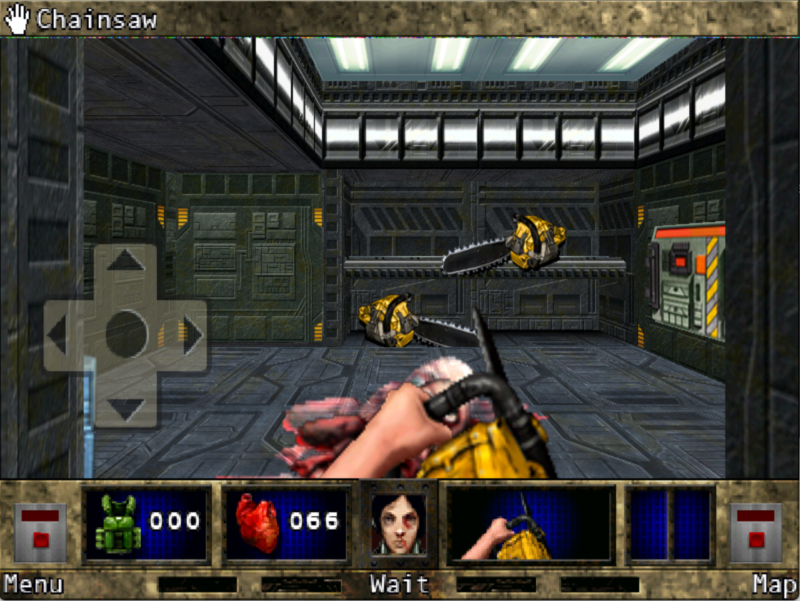
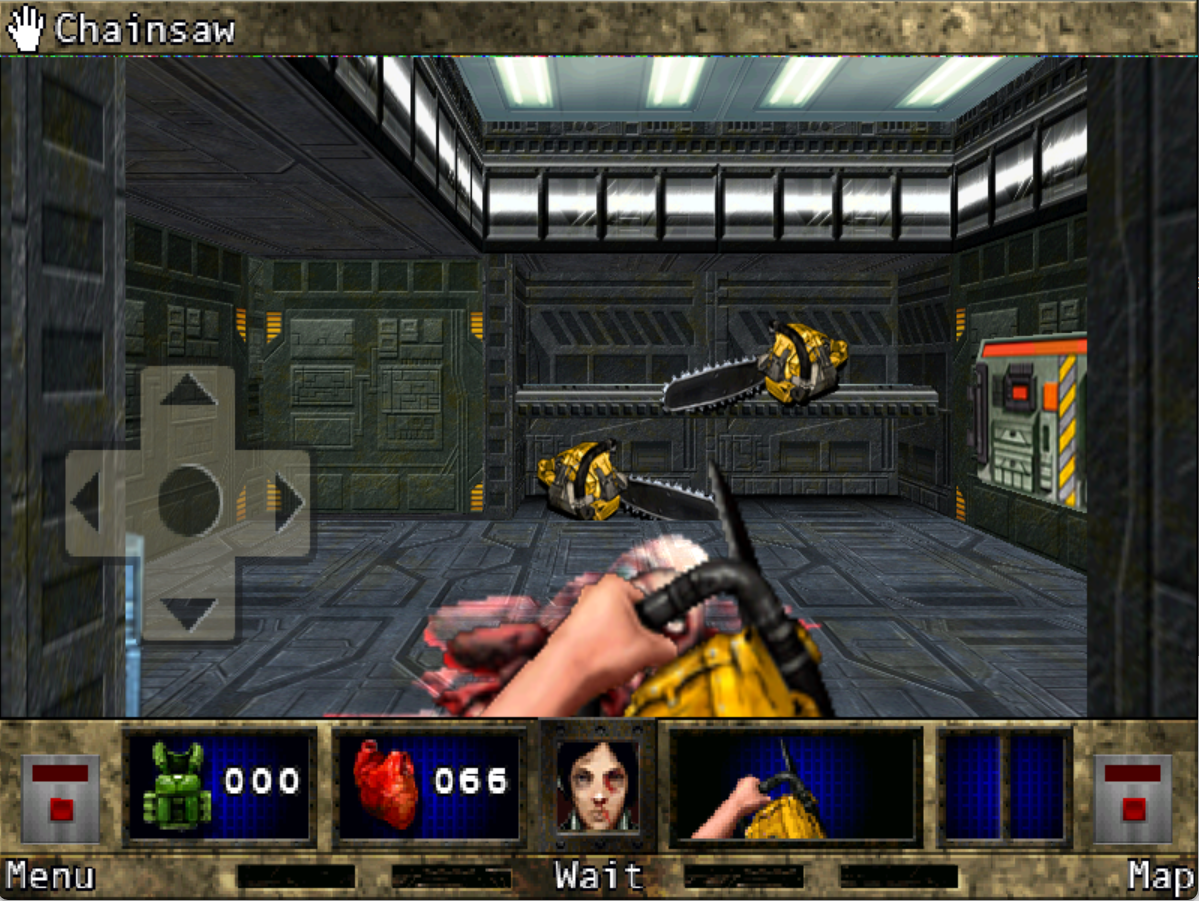
Chainsaw held up by player character
Enlarge / Doom II RPG isn’t exactly like Doom, but you can’t accuse it of lacking chainsaws.
id Software

“Mobile games” were something else entirely in 2005, a time in which Windows Mobile was a viable platform, the only Apple phone was a Motorola ROKR, and none of them had a shot at running Doom, let alone its sequel. That’s why id Software made Doom RPG, the weirdest official Doom game that is also still a bit fun. A group of fans known as GEC.Inc ported that game to modern PCs, and they’ve finally gotten around to its sequel.

Doom II RPG, the iOS version from 2009, is playable the same way Doom RPG was: with an understanding that you, a person in 2023, will somehow have access to the original, potentially still copyrighted assets of the game. The instructions lead you through setting up OpenAL, then loading in an .ipa iOS file (the Internet Archive has a copy). You can use a touchscreen, most modern game controllers, or just your keyboard and mouse. You’ll then get to play a Doom II that’s not quite like what you’re thinking of when you think of Doom II.

How does it play? A bit awkwardly, unless you’re used to the turn-based, grid-moving, RNG-dominated RPGs of earlier eras. With each turn, you can move in one of four directions, attack with a weapon, or perform some other action, like ripping a toilet fixture off the wall for later throwing (if you’re strong enough). If you end up face to face with an imp, there’s not much else to do except trade blows, hoping the random hit/miss mechanics are in your favor or that you have enough health packs or snacks to hold out.

This makes the broader gameplay a risk/reward exercise. Sure, you have the blue keycard now, so you could move forward in the narrative, but there’s a second path you didn’t take—wonder what’s in there? It could be a chainsaw. You definitely want a chainsaw early in this game since it is far more effective up close, and most enemies will end up in your face.

[embedded content]
Demo of Doom II RPG from the GEC.Inc team.

It’s fun to dip into, though, and as a piece of games archaeology, Doom II RPG is more than worthwhile. You can read John Carmack’s blog post about working on Doom RPG. You can see how someone might decode files made specifically for a Sony Ericcson k800 into a modern PC game. You can ponder whether Doom RPG games take place in the same universe as the mainline Doom 1-3 games, as one Wikipedia editor posits. Most of all, you can see what made sense for a mobile Doom game just before the iPhone arrived and changed everything.

An official App Store version of Doom II RPG exists, but it was targeted at iOS 2.0 and hasn’t been updated for current devices in quite some time. Thanks to some clever, dedicated code warriors, yet another Hell-ridden research base has been preserved with all its bloody contents intact. Next up may be Wolfenstein RPG. (A tip of the hat to PC Gamer, where we initially saw this news).

Listing image by id Software

https://arstechnica.com/?p=1937668


Nintendo, ticked by Zelda leaks, does a DMCA run on Switch emulation tools

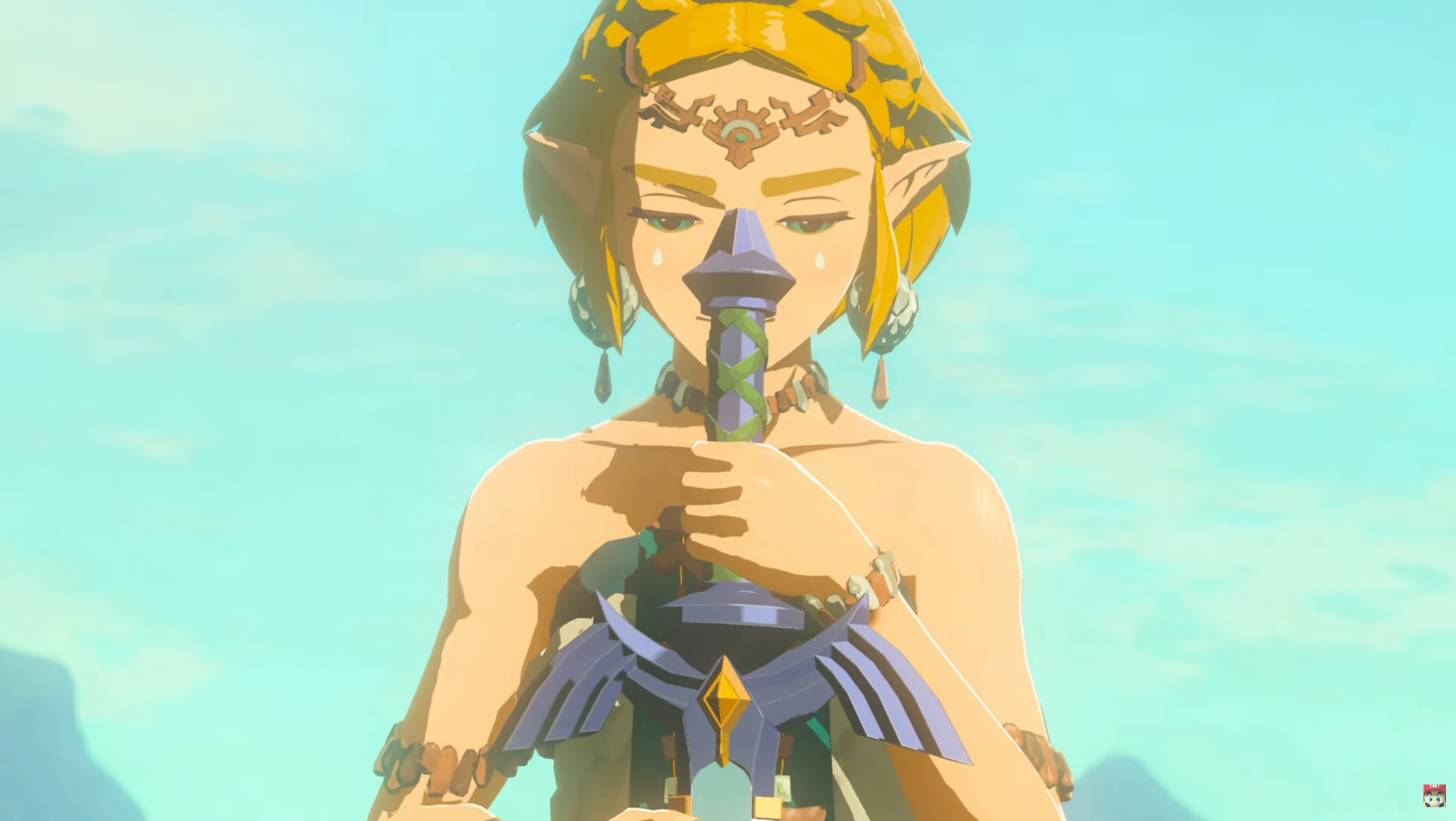
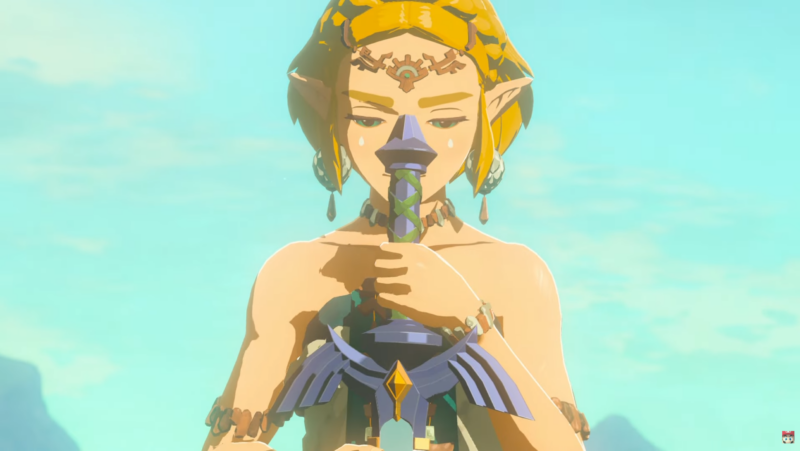
Princess Zelda holding a Master Sword
Enlarge / Tools with great potential often require great effort to unlock. In Zelda games, that usually means a number of Heart Containers. In the emulation underground, you need title keys, shader caches, hotfixes, and a willingness to download from some sketchy sites.
Nintendo/YouTube

Perhaps woken by news of its next premier first-party title already looking really impressive on emulators, Nintendo has moved to take down key tools for emulating and unlocking Switch consoles, including one that lets Switch owners grab keys from their own device.

Simon Aarons maintained a forked repository of Lockpick, a tool (along with Lockpick_RCM) that grabbed the encryption keys from a Nintendo Switch and allowed it to run officially licensed games. Aarons tweeted on Thursday night that Nintendo had issued DMCA takedown requests to GitHub, asking Lockpick, Lockpick_RCM, and nearly 80 forks and derivations to be taken down under section 1201 of the Digital Millennium Copyright Act, which largely makes illegal the circumvention of technological protection measures that safeguard copyrighted material.

Nintendo’s takedown request (RTF file) notes that the Switch contains “multiple technological protection measures” that allow the Switch to play only “legitimate Nintendo video game files.” Lockpick tools, combined with a modified Switch, let users grab the cryptographic keys from their own Switch and use them on “systems without Nintendo’s Console TPMs” to play “pirated versions of Nintendo’s copyright-protected game software.” GitHub typically allows repositories with DMCA strikes filed against them to remain open while their maintainers argue their case.

Still, it was an effective move. Seeing Nintendo’s move on Lockpick, a popular Switch emulator on Android, Skyline, called it quits over the weekend, at least as a public-facing tool you can easily download to your phone. In a Discord post [Edit, 5pm Eastern: Previously described as removed, but now linked], developer “Mark” wrote that “the risks associated with a potential legal case are too high for us to ignore, and we cannot continue knowing that we may be in violation of copyright law.”

Prior to Nintendo’s DMCA request, Skyline’s team had believed that using keys from your own Switch console, to emulate games you legally purchased, was legal. Skyline remains as an open source project, though the core team will not update or otherwise work on it as of Sunday. Other popular Switch emulators for PC, Yuzu, and Ryujinx, remain online, with the Ryujinx team issuing a statement on their Discord that they would not be shutting down, according to news reports.

Lockpick, which remains up as of this writing, has been in development since early 2019. Nintendo’s sudden interest in ensuring that people can’t rip keys from their Switch or emulate Switch games regardless of provenance likely stems from this week’s May 12 launch of The Legend of Zelda: Tears of the Kingdom. Physical copies of Tears began circulating shortly before May 1, leading to the game being dumped, pirated, played, and streamed, although usually for only moments before Nintendo moved to shut down Discord servers and Twitch streams.

Nintendo has been fighting uses of its hardware beyond anything it intended for nearly its entire life, at least as a video game company. The DS, 3DS, Wii, and even the Game & Watch novelty release have all seen hacking and homebrew scenes. The Switch, in particular, has seen Nintendo work hard to avoid widespread piracy, setting up online blockers for pirates, releasing new hack-resistant hardware, targeting online mod retailers, issuing ISP-level blocks, and, most recently, following through on criminal prosecution that will leave one hack-team member likely paying the company for the rest of his life.

Every time Nintendo clamps down on the tools used to enable piracy, it also disrupts the ecosystems that produce Linux installations, homebrew games and tools, and emulators for legally purchased games. That said, Tears of the Kingdom is rather easy to find online at the moment, as are exhaustive guides to getting the game running in PC emulation tools. The cat seems entirely out of the bag, but this cat also requires hours of effort to get running smoothly on even the most upgraded PC and requires lots of downloads from sites that push ad blockers to their limits.

Most people who want to really play and enjoy Tears will do so with a Switch and a purchase. Nintendo will mostly succeed at making any other approaches harder to pull off.

https://arstechnica.com/?p=1937396


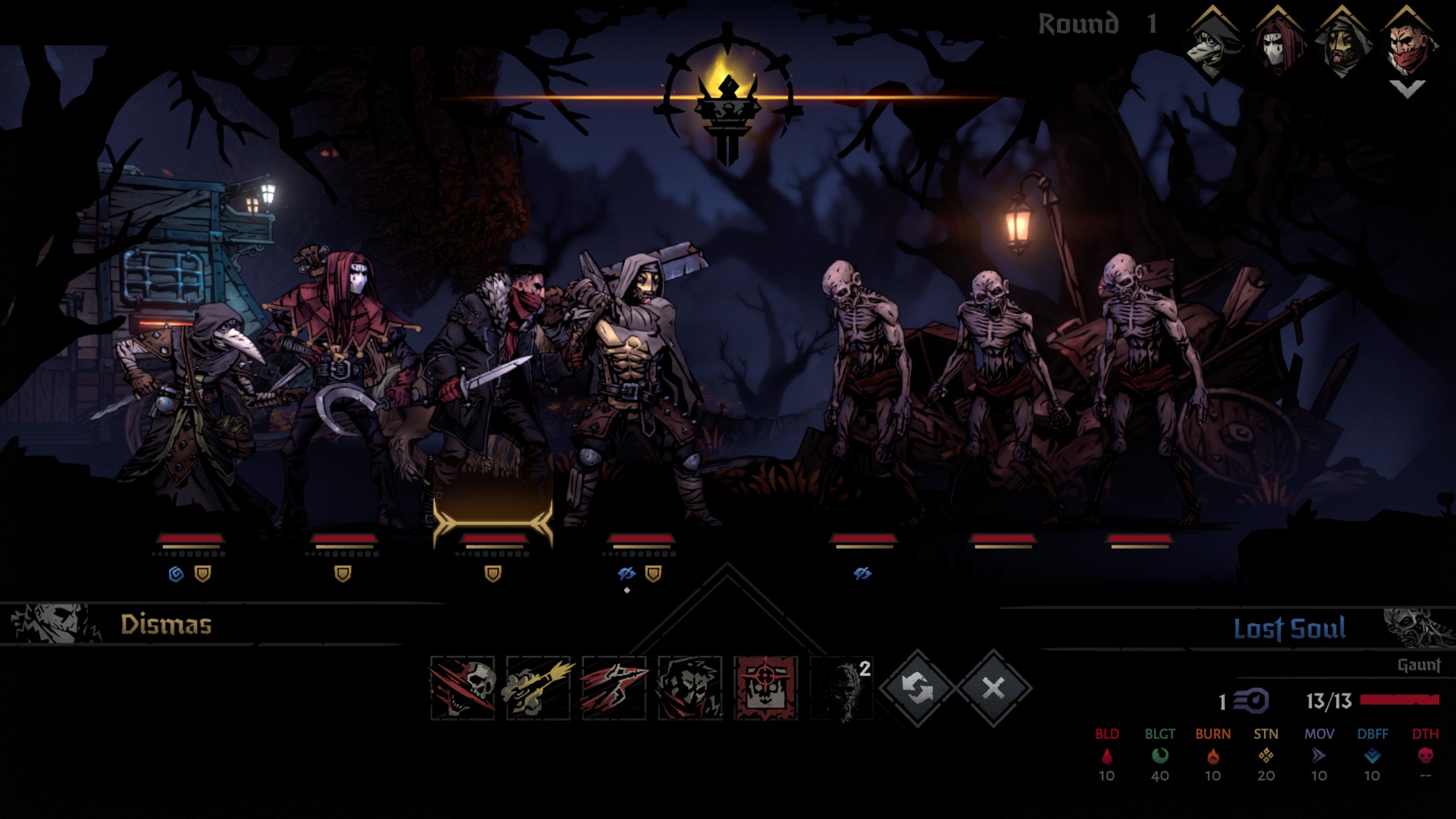
Darkest Dungeon 2 is an awkward sequel, but I can’t stop playing it

Darkest Dungeon 2 is an awkward sequel, but I can’t stop playing it
Red Hook Studios

The worst thing you can do when playing Darkest Dungeon 2 is compare it to its beloved 2016 predecessor. Darkest Dungeon was essentially a 2D XCOM, complete with a base that you managed and upgraded over a long campaign.

Darkest Dungeon 2 is decidedly not that. Instead, it’s a roguelite.

Rather than embarking on a long campaign filled with dozens of units to manage and upgrade as you did in the first game, here, you go on one-and-done “runs” with a stable cast of characters. As you play, you collect a meta-currency to unlock new items and upgrade your characters, stats, and stagecoach between runs.

Returning is the excellent combat and unmatched gothic fantasy aesthetic from the first game. The world of Darkest Dungeon 2 is grim and brutal, with pestilent Lovecraftian horrors teaming up with horrific beasts and crazed cultists to pummel you into submission. The 2D-illustrated characters of the original have been replaced with 3D models—an excellent upgrade—but the general tone of the game is the same, just with improved visuals across the board. Voice actor Wayne June’s deep, mournful narration is back and excellent as ever.

Don’t make me turn this thing around

Wait, you said something about a stagecoach? Yep.

This time, instead of delving into the famously dark dungeons of the first game, your party of four adventurers drives a stagecoach through an apocalyptic landscape that is, to be fair, still quite dark. The corruption that plagued your estate in the first game has spread over the wider kingdom, and it’s up to your team to bring the “flame of hope” across several environments to reach “the Mountain,” where they’ll fight a boss and save the world. Ideally speaking, of course.

Tap the W key to set your cart bumping down the road, and you’ll automatically stop at points of interest along the way. These stops include battles, of course, but also random encounters where you’ll need to make decisions. Do you offer aid to the hapless denizens beseeching your kindness, or do you simply take all their stuff? Your party members all have their own ideas, and going with one over another may cause intra-group strife. As they travel, your heroes may bicker, making the whole endeavor more unpleasant for everyone.

You’ll make decisions about which way to go at forks in the road, with a “scouting” stat offering you a limited preview of what’s to come on the Slay the Spire-style map. I’m a sucker for this style of map in roguelites, and it’s implemented excellently here. Runs can be won or lost depending on the route you take.

After making your way through an environment, you’ll pull up to an inn, where you can rest up, level up, and buff your characters for the road ahead. And boy, will you need it.

https://arstechnica.com/?p=1936877


Apple Arcade still exists, adds 20 new games—and some of them sound neat

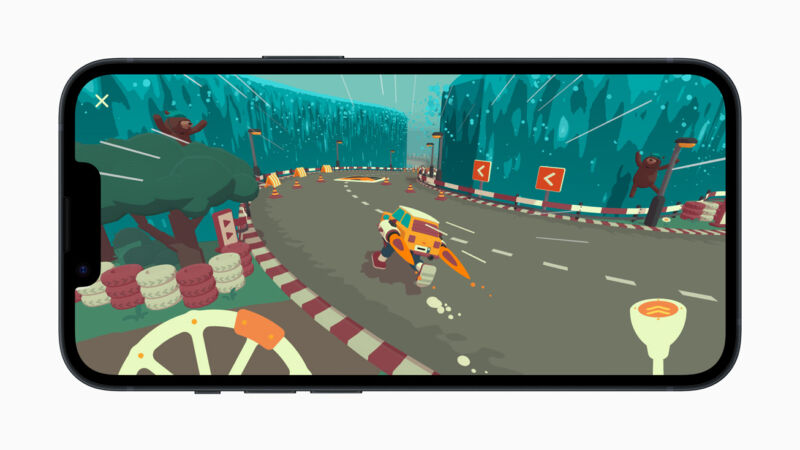
An iPhone 14 Pro displaying a low-poly driving game
Enlarge / A screenshot from What the Car?, one of the more intriguing games from Apple’s new Arcade additions.

Apple Arcade is still around, and it’s still a priority—at least, that’s the message we imagine Apple’s surprise launch of 20 new games on the same day seeks to send.

The new games include (but aren’t limited to) a Teenage Mutant Ninja Turtles-branded battler titled TMNT Splintered Fate, a Disney-themed Scrabble-like game called Spellstruck developed in partnership with a Words With Friends co-creator, a city builder called Cityscapes: Sim Builder, and a follow-up to the Arcade smash hit What the Golf? titled What the Car? (If you haven’t played What the Golf? yet, you probably should—it’s available on other platforms now, too.)

There are also a few updated versions of classic premium games from prior eras of iPhone gaming, like LIMBO, Kingdom Two Crowns, Farming Simulator 20, Octodad: Dadliest Catch, Temple Run, and Bennett Foddy’s Getting Over It—think of those like Apple’s equivalent of a TV-streaming service also offering episodes of classic TV shows like The Office or Star Trek.

It’s the biggest haul we’ve seen come out for Arcade in quite some time. The service has recently seen more of a trickle, with one or a small handful of games popping up here and there.

As in Apple Arcade’s recent past, the content strategy here seems to be to try to take the best ideas and the best talent from the open App Store marketplace and leverage them to prove the idea that “mobile games are bad” is entirely wrong—in one part by curating for quality to counter mobile’s signal-noise-ratio problem on that front, and in the other part to strip games of microtransactions—even in genres that were initially developed around that monetization model.

Apple correctly diagnosed that mobile games’ reputation problem comes from users’ inability to wade through a whole lot of bad games (whether they’re bad because the content itself is bad or because monetization sabotages what would otherwise be a good experience) to find the good stuff. There were always good mobile games; users just struggled to find them, and many threw their hands up and stopped trying after having too many bad experiences in the process.

Still, Apple Arcade’s growth has been limited, in part because the statement that “mobile games are bad” was always wrong to begin with. There are hundreds of outstanding mobile games on both iOS and Android, including many free-to-play ones with reasonable and non-intrusive monetization—so many that it may have proven difficult to upsell iPhone owners on even Arcade’s ultra-cheap $4.99 monthly price tag. If there are a dozen games out there that you already enjoy, and they’re all free, why would you pay $5 a month for others?

Essentially what Apple is providing here is a curation service. Arcade is like having a mobile game personal shopper; you don’t have to spend hours trying mediocre games in the App Store and Googling to figure out where to start. You can just join Arcade and expect a certain minimum level of quality. But you might argue that the same people with enough of a desire for great mobile games to pay a monthly fee for that are often the same people who were already willing to put in the work themselves.

Apple Arcade is not the only game subscription service doing this, though. There’s also Netflix Games, which has rapidly grown over the past year and is pushing out titles from popular iOS developers. That includes some that used to put their new games on Arcade, like Alto’s Odyssey developer Snowman, which launched the new game Laya’s Horizon via Netflix this week.

Games like Laya’s Horizon are playable on the iPhone and downloadable via the App Store, but they require a Netflix subscription to play. Recently, Netflix Games have been generating more buzz among influencers and the press than what Apple has been putting out on Arcade.

Of course, media buzz doesn’t necessarily equal success, and neither Apple nor Netflix has made many details about individual games’ performance public.

While Apple Arcade got some buzz early after it launched in 2019, reports over the ensuing months suggested Apple was struggling to gain as much ground with it as it would like, and much of the buzz quieted down. The company likely hopes this new barrage of games will rekindle some interest, but the competition is fierce, so we’ll have to wait and see.

https://arstechnica.com/?p=1937188


Luke’s Awakening fan art merges Star Wars with Zelda to delightful 8-bit effect

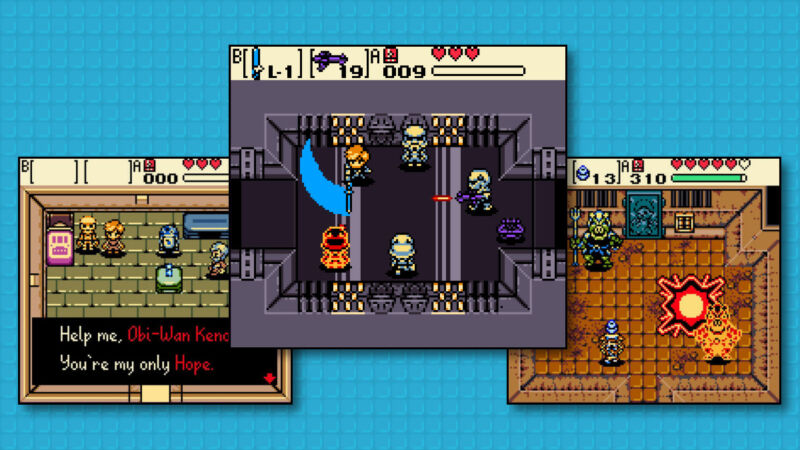
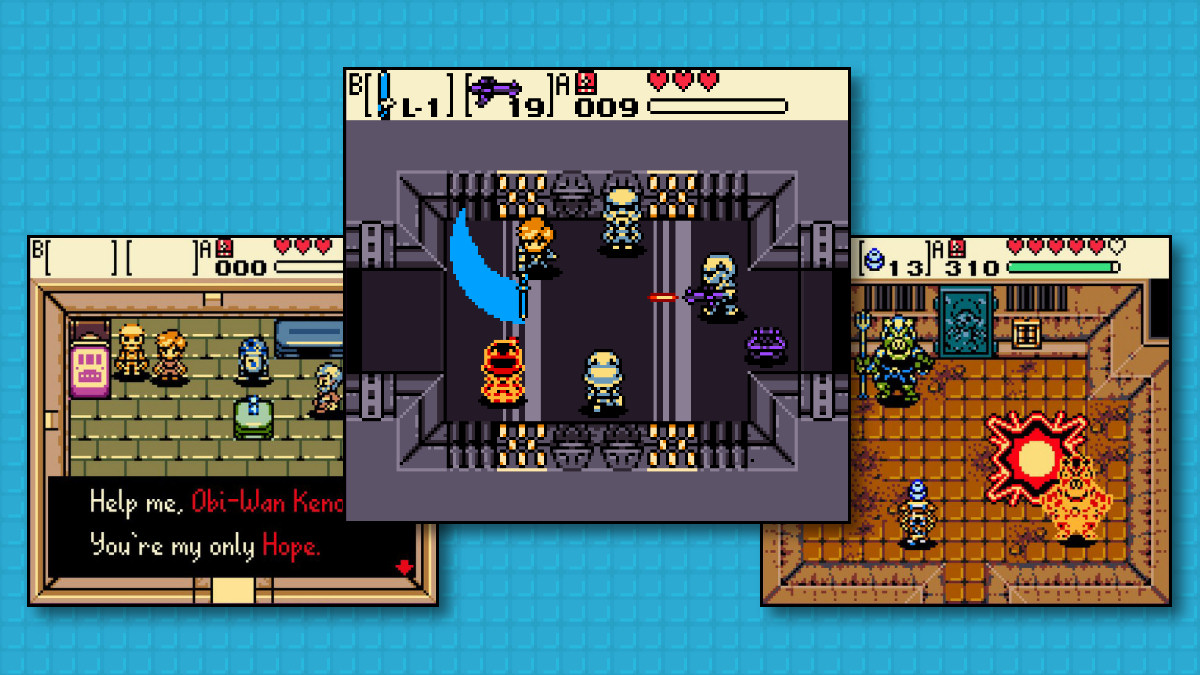
A trio of fan-made Game Boy Color-style images for a game that never was.
Enlarge / Star Wars: Luke’s Awakening imagines a Game Boy Color game that never was.

Just in time for Star Wars Day, Irish pixel artist and indie game developer Shoehead debuted nine delightful mock-up images of a non-existent Game Boy Color game called Star Wars: Luke’s Awakening. It’s a fan tribute that melds the design sensibilities of the 1993 Game Boy classic Zelda: Link’s Awakening with the storyline of the original Star Wars trilogy.

In the pixel art, Shoehead depicts a title screen and eight key scenes that reflect important events in A New Hope, The Empire Strikes Back, and Return of the Jedi. The scenes include watching the “Help me, Obi-Wan Kenobi” sequence with the Jedi master, an encounter with a Wampa on Hoth, a Darth Vader boss battle, evading the Rancor monster, getting zapped by the Emperor, and seeing the Force ghosts of Anakin, Yoda, and Obi-Wan at the end of Return of the Jedi.

The images abound with delightful details, such as choices of weapons appropriate for each scene and how Shoehead perfectly adapted the “chibi” style of Zelda’s Game Boy adventures to Star Wars.

Shoehead’s artwork borrows the palette restrictions of Nintendo’s 1998 Game Boy Color handheld, which hosted a color-upgraded version of The Legend of Zelda: Link’s Awakening DX, as well as Oracle of Ages and Oracle of Seasons.

Link’s Awakening DX was the first game I ever bought with my own money,” Shoehead told Ars. “I got it the year it came out so I could finally play a Zelda game by myself instead of at a friend’s house. So I have a lot of nostalgia for that, as well as the Oracle games.”

Shoehead’s love for the Game Boy Color’s visual aesthetic runs deep. In 2022, he created several “demake” scenes inspired by Elden Ring. “The way a lot of sprites will share a light tone and black and usually only one unique color makes everything mesh together so well. It’s a really unique style, and I think it might only exist because of the jump from the original Game Boy’s palette to the Game Boy Color’s.”

Tools of the trade

Shoehead says he learned to edit sprites in RPG Maker 2003 as a kid around 20 years ago. Today, he uses Aseprite to draw pixel-art images. “I grabbed it back when it was super cheap in the early days because I couldn’t find a program that clicked with me and I was trying everything,” he says. “I usually use both a mouse and an XPPen tablet to pixel, but this one was 100 percent drawn with a mouse.”

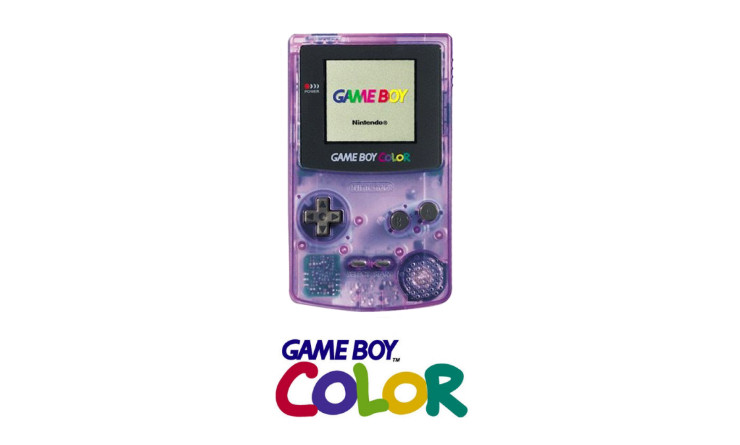
1998's Game Boy Color offered handheld Nintendo games in color for the first time and also played host to three Zelda adventures.
Enlarge / 1998’s Game Boy Color offered handheld Nintendo games in color for the first time and also played host to three Zelda adventures.

Shoehead says he started working on the Luke’s Awakening artwork on April 6, so the nine-image set took less than a month to complete. “I was originally going to reskin a Zelda-like game I’m working on and try to cut a trailer from some scenes for fun,” he says. “But I got some bad news like immediately after planning it out, so I settled for pixelling some screenshots and taking it easy.”

While Luke’s Awakening exists only in the artist’s mind (and these nine images), surely Shoehead, an indie game developer, has been tempted to turn it into a real game? “Oh, no way, I don’t want to deal with Nintendo lawyers AND Disney lawyers,” he said. “I have my own Western Zelda-like I’m working on, so this is more like practice for making more of that.”

https://arstechnica.com/?p=1936707


Snoop Dogg on AI risk: “Sh–, what the f—?”

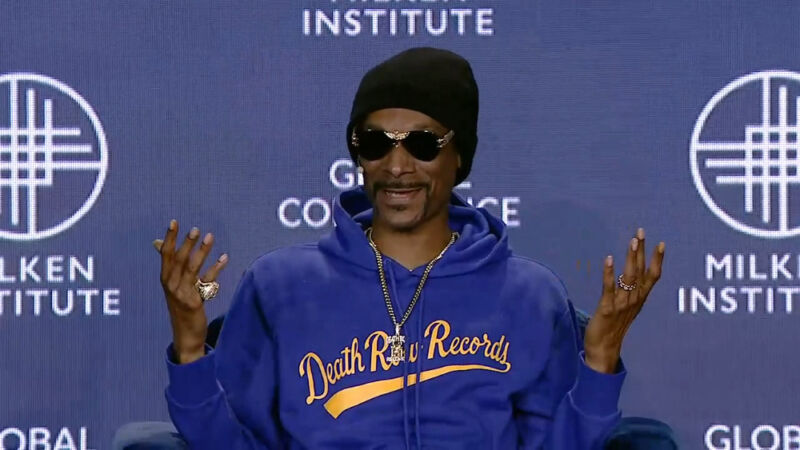
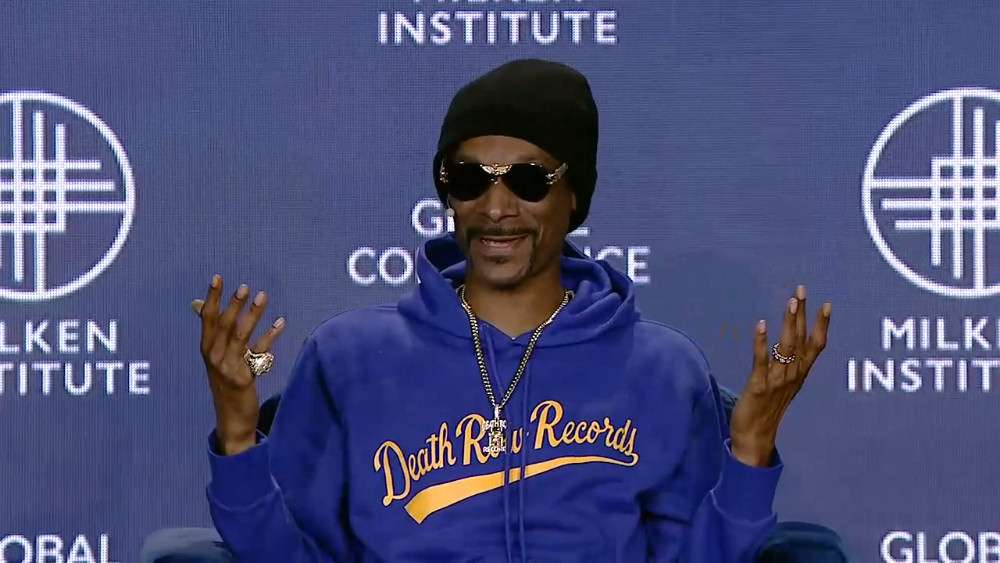
Snoop Dogg talking about AI at the 2023 Milken Institute Global Conference on May 3, 2023.
Enlarge / Snoop Dogg talking about AI at the 2023 Milken Institute Global Conference on May 3, 2023.
Milken Institute

On Wednesday, celebrated multi-platinum recording artist Snoop Dogg took part in a panel at the Milken Institute’s 2023 Global Conference in Beverly Hills, California. After fielding a question by Variety editor Shirley Halperin about AI in relation to the 2023 WGA writers’ strike, Snoop expressed his bemused feelings on AI in a genuinely funny exchange, resulting in convivial laughter from the audience.

During his response, Snoop described how conversing with a large language model (such as ChatGPT or Bing Chat) reminds him of sci-fi movies he watched as a kid. Showing that he keeps up with current events, Snoop also referenced Geoffery Hinton, who resigned this week from Google so he could speak of the dangers of AI without conflicts of interest:

Well I got a motherf*cking AI right now that they did made for me. This n***** could talk to me. I’m like, man this thing can hold a real conversation? Like real for real? Like it’s blowing my mind because I watched movies on this as a kid years ago. When I see this sh*t I’m like what is going on? And I heard the dude, the old dude that created AI saying, “This is not safe, ‘cause the AIs got their own minds, and these motherf*ckers gonna start doing their own sh*t. I’m like, are we in a f*cking movie right now, or what? The f*ck man? So do I need to invest in AI so I can have one with me? Or like, do y’all know? Shit, what the f*ck?” I’m lost, I don’t know.

Snoop’s confusion over today’s AI systems reflects what may be a common sentiment among people who are trying to understand and follow the latest developments in generative AI, which have unfolded rapidly over the past year. His unguarded observations on AI are notable coming from a highly respected multi-award-winning musical artist and entrepreneur.

The Milken Institute is a nonprofit, nonpartisan economic think tank that is focused on “accelerating measurable progress on the path to a meaningful life.” Every year, the Institute hosts the Milken Institute Global Conference. In 2023, according to its website, the conference convened “the best minds in the world to tackle its most urgent challenges and realize its most exciting opportunities.”

During the same Snoop Dogg panel, which took place with music label CEO Larry Jackson of Gamma Records, Snoop also expressed solidarity with striking members of the WGA. And he took umbrage over what he sees as the lack of fair compensation for artists through music streaming services: “Can somebody explain to me how you can get a billion streams and not get a million dollars? That sh*t don’t make sense to me.”

You can watch the full Snoop Dogg panel on the Milken Institute website.

https://arstechnica.com/?p=1936767


The first action-packed trailer for Dune: Part 2 is finally here

[embedded content]
Timothee Chalamet and Zendaya are back for Dune: Part 2.

We’ve been waiting to catch a glimpse of Dune: Part 2, the second part of Denis Villeneuve’s visually stunning, ambitious adaption of Frank Herbert’s seminal sci-fi novel. Warner Bros. dropped the first official trailer today, featuring Timothee Chalamet’s Paul Atreides riding a sandworm to win the respect of the Fremen, as well as the introduction of the nefarious new villain from House Harkonnen.

(Some spoilers for Dune: Part 1 below.)

As we’ve reported previously (also here and here), Herbert’s novel Dune is set in the distant future and follows the fortunes of various noble houses in what amounts to a feudal interstellar society. Much of the action takes place on the planet Arrakis, where the economy is driven largely by a rare, life-extending drug called melange (“the spice”). Melange also conveys a kind of prescience and makes faster-than-light travel practical. There’s betrayal, a prophecy concerning a messianic figure, giant sandworms, and battle upon battle, as protagonist Paul Atreides (a duke’s son) contends with rival House Harkonnen and strives to defeat the forces of Shaddam IV, Emperor of the Known Universe.

Dune is notoriously difficult to adapt—as David Lynch discovered when he directed his critically panned 1984 film adaptation—but Villeneuve found the trick was to split the novel in half. The first film covered events in the first half of the novel, and Dune: Part 2 covers events in the second half. But Part 2 wasn’t automatically guaranteed; it depended on how well the first film performed, and Dune: Part 1 had the misfortune to run headlong into the COVID-19 pandemic, resulting in several delays in its release date. Villeneuve wrote an op-ed for Variety, sharply criticizing the studio’s decision to release Part 1 simultaneously in theaters and on HBO Max (for a 31-day period), predicting this could result in the film underperforming at the box office (“piracy will ultimately triumph”), leading to a cancellation of the planned sequel.

Despite the stacked odds, Part 1 grossed over $400 million globally against a $165 million budget, earned critical acclaim (you can read the largely positive Ars review here), and snagged 10 Oscar nominations, including for Best Picture. It won six Oscars: Best Sound, Original Score, Film Editing, Production Design, Visual Effects, and Cinematography. So naturally, Warner Bros. greenlit the sequel.

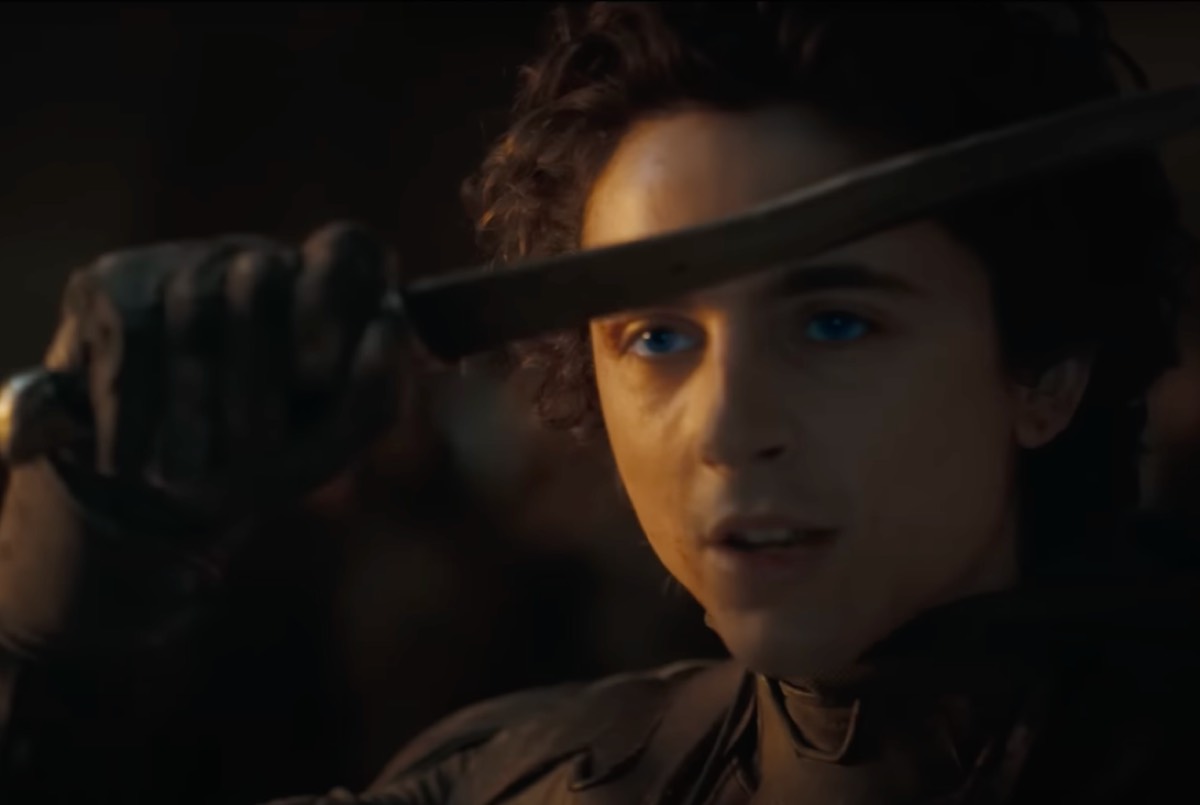
Timothee Chalamet as Paul Atreides: "May thy knife chip and shatter."
Enlarge / Timothee Chalamet as Paul Atreides: “May thy knife chip and shatter.”
YouTube/Warner Bros.

Part 1‘s finale left Paul and his mother, Lady Jessica (Rebecca Ferguson) presumed dead in the harsh desert of Arrakis, having fled their home when Baron Vladimir Harkonnen (Stellan Skarsgård) betrayed the family and killed Paul’s father, Leto (Oscar Isaac). They were taken in by the Fremen, the planet’s native inhabitants, who include Chani (Zendaya) a girl who had been appearing in Paul’s dreams/visions.

All the surviving principles from Part 1 reprise their roles in Part 2: Chalamet, Zendaya, Ferguson, Skarsgård, Javier Bardem as Stilgar, Josh Brolin as Gurney Halleck, Dave Bautista as Glossu Rabban Harkonnen, Charlotte Rampling as the Reverend Mother Mohiam, and Stephen McKinley Henderson as Thufir Hawat. New cast members include Christopher Walken as Shaddam IV, emperor of House Corrine; Florence Pugh as his daughter, Princess Irulan; Austin Butler as Harkonnen’s younger nephew, Feyd-Rautha, presumed heir on Arrakis; Lea Seydoux as Lady Margot, a Bene Gesserit who is tight with the Emperor; and Souheila Yacoub as a Fremen warrior named Shishakli.

Per the official premise:

Dune: Part Two will explore the mythic journey of Paul Atreides as he unites with Chani and the Fremen while on a warpath of revenge against the conspirators who destroyed his family. Facing a choice between the love of his life and the fate of the known universe, he endeavors to prevent a terrible future only he can foresee.

Variety recently unveiled an exclusive sneak peek at Part 2, coinciding with an exclusive showing of the full trailer during Cinemacon in Las Vegas. (It was not released to the public until today.) Villeneuve described Part 2 as “an action-packed, epic war movie,” more dense and less contemplative than Part 1, and the entire film was shot in IMAX (compared to 40 percent of the first film).

Austin Butler joins the cast as Feyd-Rautha Harkonnen, younger nephew to Baron Harkonnen.
Enlarge / Austin Butler joins the cast as Feyd-Rautha Harkonnen, younger nephew to Baron Harkonnen.
YouTube/Warner Bros.

We barely saw Zendaya’s Chani in Part 1, so it’s nice to see her getting a lot more screen time in the trailer, as her romance with Paul blooms. It looks like there’s some tension brewing between Paul and Lady Jessica (now sporting facial tattoos), and we see Pugh’s Princess Irulan speculate that perhaps this is not the end of House Atreides since there’s a chance Paul might still be alive—which of course he is. There’s also a fiery scene that just might be Harkonnen’s forces burning Caladan, the homeworld of House Atreides.

While Paul was young and still very much a student in the first film, in Part 2, he is now well on his way to becoming Muad’Dib, prophet of the Fremen. The obvious highlight of the trailer is the sequence showing Paul’s first ride on a sandworm—basically waterskiing across the sand, in defiance of Stilgar’s advice to keep things simple and avoid fancy moves. It’s a major rite of passage in Fremen culture. In another scene, he prepares for a crysknife battle with Butler’s Feyd-Rautha (“May thy knife chip and shatter”), his eyes now the same icy blue hue of the Fremen due to regular spice consumption. The trailer ends with Paul acknowledging the cheers of thousands of Fremen.

Dune: Part 2 is slated to hit theaters on November 3, 2023.

Warner Bros.

Listing image by YouTube/Warner Bros.

https://arstechnica.com/?p=1936124


AI vs. Hollywood: Writers battle “plagiarism machines” in union talks

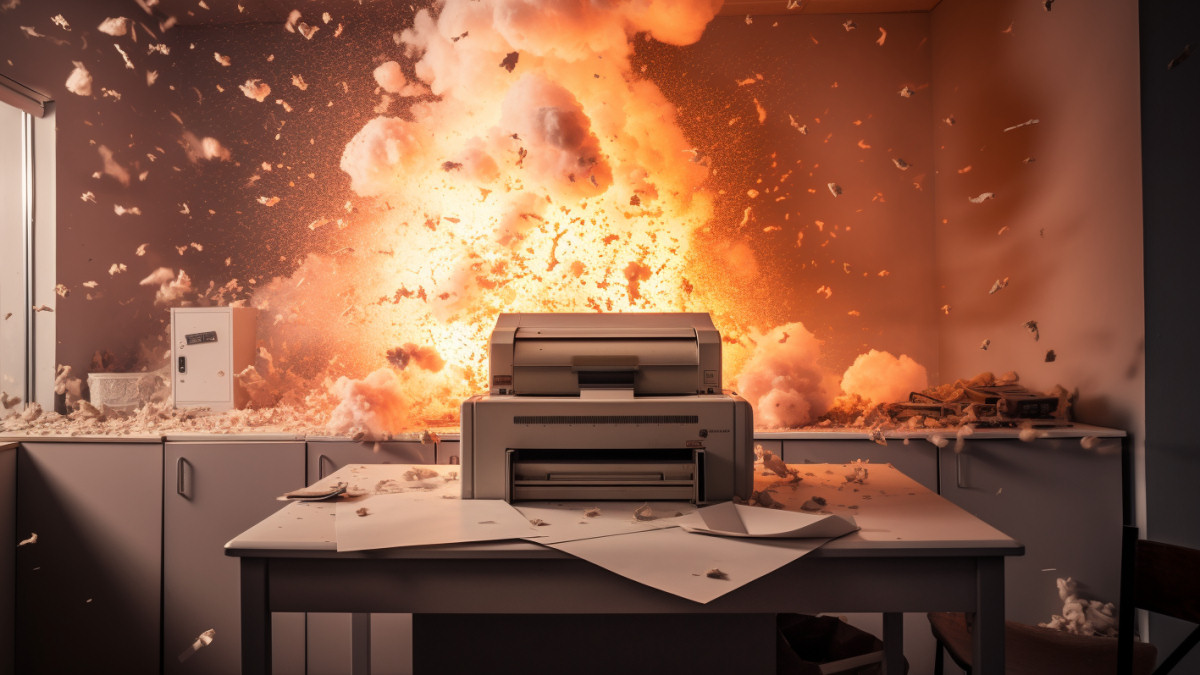
An AI-generated image of
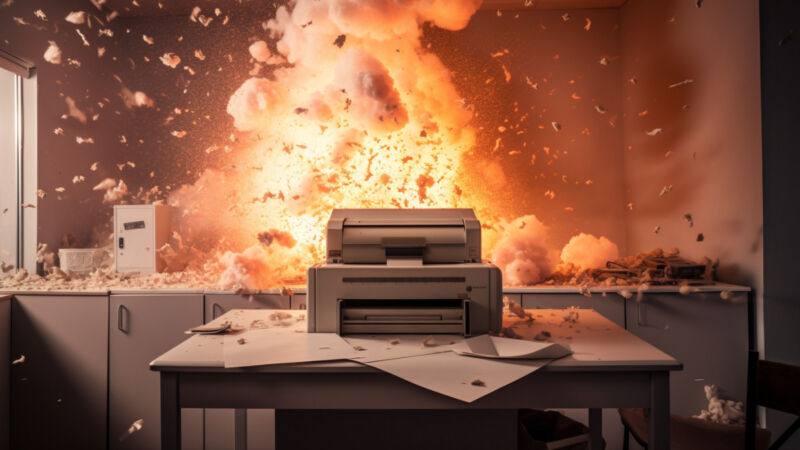
Enlarge / An AI-generated image of “an office copy machine in front of a hollywood-style explosion.”
Midjourney

The Writers Guild of America (WGA) is seeking to restrict the use of generative AI in writing film and TV scripts as part of an ongoing strike, reports Reuters. The concerns come at a time when anxiety over the economic impact of tech like ChatGPT looms large in the minds of many.

The WGA strike is the first in 15 years, and it’s taking place over issues beyond just AI. But in particular, Reuters reports that WGA writers have two main concerns about automation in writing, quoting screenwriter John August, who is part of the WGA negotiating committee: They don’t want their material to be used as training data for AI systems, and they don’t want to be tasked with fixing AI-generated “sloppy first drafts.”

An excerpt of the WGA's position on AI, as posted by novelist Hari Kunzru and several others on Twitter. MBA stands for "Minimum Basic Agreement," the name of the union's collective bargaining agreement.
Enlarge / An excerpt of the WGA’s position on AI, as posted by novelist Hari Kunzru and several others on Twitter. MBA stands for “Minimum Basic Agreement,” the name of the union’s collective bargaining agreement.

That’s because writers who are hired to polish first drafts get paid at a lower rate, and WGA writers are fighting to make sure that a ChatGPT-generated first draft would not be counted as “literary material” or “source material,” which are terms defined in their contract.

On Twitter, screenwriter C. Robert Cargill expressed similar concerns, writing, “The immediate fear of AI isn’t that us writers will have our work replaced by artificially generated content. It’s that we will be underpaid to rewrite that trash into something we could have done better from the start. This is what the WGA is opposing and the studios want.”

Additionally, the WGA argues that existing scripts should not be used to train AI systems, to avoid potential IP theft. WGA chief negotiator Ellen Stutzman said some members have referred to AI as “plagiarism machines.”

While accusations of plagiarism in the training of AI models like ChatGPT still haven’t been settled in courts, the models absorb millions of documents scraped from the Internet without permission from content creators. By recombining statistical “knowledge” about those works in new ways, large language models (LLMs) can create novel material.

So far, Hollywood studios have rejected the WGA’s proposals, instead offering to discuss new technologies annually. As the strike is still underway, the outcome of these negotiations remains uncertain, but it’s a notable sign of the growing pains of integrating new technology like generative AI into an existing creative field.

https://arstechnica.com/?p=1936380


AI-generated beer commercial contains joyful monstrosities, goes viral

A still image from
Enlarge / A still image from “Synthetic Summer,” an AI-generated beer commercial.
Privateisland.tv

While many fear a future where AI-generated media becomes indistinguishable from traditional media, destroying society and/or civilization in the process, we aren’t quite there yet. Exhibit A comes in the form of a surreal AI-generated beer commercial that went viral over the weekend.

Titled “Synthetic Summer,” the 30-second video first appeared on Instagram about a week ago, created by Helen Power and Chris Boyle of a London-based production company called Privateisland.tv. The pair were not available for comment before this story was published, but judging by the look of the video, it appears they likely created it using Runway’s new Gen-2 AI model, which can create short video clips based on written prompts similar to how Stable Diffusion can create still images.

In the video, set to a raucous crowd backing track and Smash Mouth’s “All Star,” we see simulacra of people partying at a stereotypical American backyard barbecue, occasionally physically merging with impressionistic beer vessels. Women laugh, jaws flaring. Beer glasses turn into beer cans. Flaming grills achieve columnar fire tornado status and arc across the yard. It’s a vision of surrealistic hell that is at once familiar and impressively alien.

Why is it so weird? Currently, AI video generators are still primitive. As their creators train the models, they’re working from a much smaller set of source material than still image AI synthesis models, and the models are dramatically more computationally expensive to run. The impressionistic view of beer commercials likely comes from absorbing the essence of real beer commercials in Gen-2’s data set. Runway has not disclosed the data set used to train Gen-2, but in the paper for Gen-1 (an earlier model), it cited “an internal dataset of 240M images and a custom dataset of 6.4M video clips.”

We’ve experimented with Gen-2 (which is currently in a closed testing phase), and generating even weirdly alien clips like these still require human persistence, running through and discarding many generations to get even an OK result. Even then, the resulting clip is only a few seconds long. In the case of Synthetic Summer, Privateisland.tv generated the clips, selected the best ones, and pieced the segments together in a sequence, adding music and sound effects.

But wait, beer isn’t the only product being fictionally advertised by AI for memetic purposes. On April 24, someone called “Pizza Later” tweeted a largely AI-generated video for a fictional restaurant called “Pepperoni Hug Spot” that includes distorted video clips of people eating pizza generated by Runway’s Gen-2. In addition, its creator reportedly generated the script with GPT-4, used Midjourney for still images, and a voice-over by Eleven Labs. They pieced it all together using Adobe After Effects.

Both these human-initiated and human-assembled pieces show that generative AI still has a long way to go before it has autonomously bedazzled the masses with society-altering memes. People are still behind the wheel of these alien works, and from that, we can potentially take some semblance of comfort. Maybe.

Still, neither video can match the purity and majesty of AI-generated Will Smith eating spaghetti, which will forever live in our hearts as our first AI-generated video meme nightmare.

https://arstechnica.com/?p=1936137


Here’s what caused black stains on Leonardo da Vinci’s Codex Atlanticus

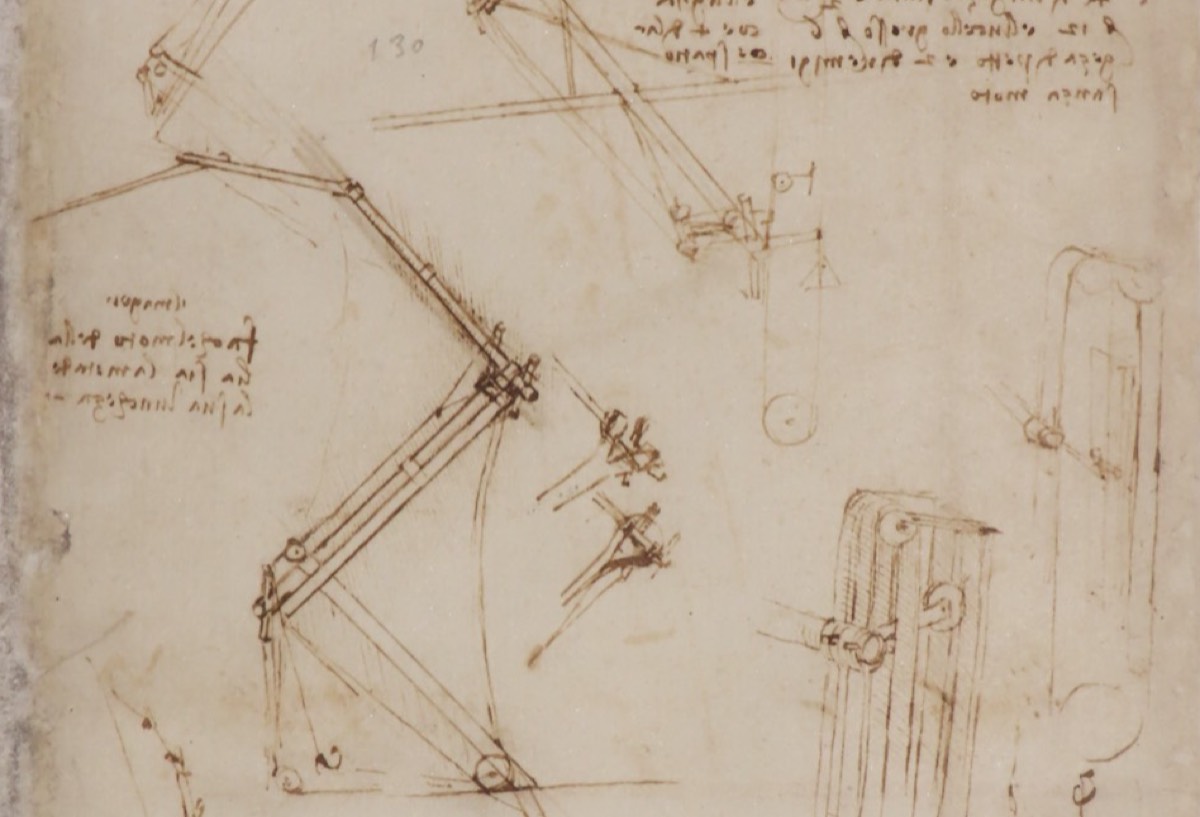
Folio 843 of Codex Atlanticus
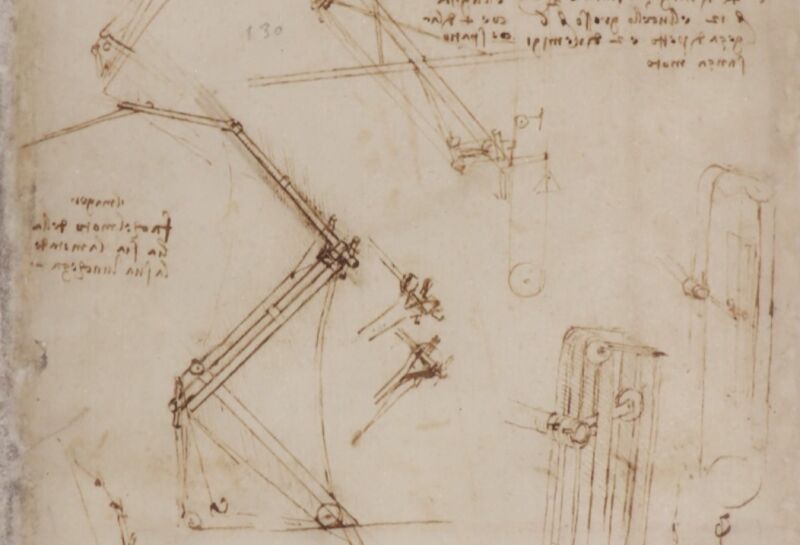
Enlarge / Researchers examined folio 843 of Leonardo da Vinci’s Codex Atlanticus to determine the cause of mysterious black stains.
Veneranda Biblioteca Ambrosiana, Milan

Researchers at the Politecnico di Milan in Italy examined mysterious black stains on a folio of Leonardo da Vinci‘s Codex Atlanticus and confirmed the presence of starch and vinyl glues in the affected areas. The glues were most likely applied during an earlier restoration effort some 50 years ago, according to a recent paper published in the journal Scientific Reports. They also identified a likely cause of the dark stains: nanoparticles of a mercury sulphide called metacinnabar in the protective paper holding the folio, although it is unclear how this unusual black crystalline phase might have formed.

Da Vinci produced more than 13,000 pages in his notebooks (later gathered into codices), less than a third of which have survived. The notebooks contain all manner of inventions that foreshadow future technologies: flying machines, bicycles, cranes, missiles, machine guns, an “unsinkable” double-hulled ship, dredges for clearing harbors and canals, and floating footwear akin to snowshoes to enable a man to walk on water. The notebooks also contain da Vinci’s detailed notes on his extensive anatomical studies. Most notably, his drawings and descriptions of the human heart captured how heart valves can ebb blood flow 150 years before William Harvey worked out the basics of the human circulatory system.

The largest single set is the 12-volume Codex Atlanticus, in which (among other observations) da Vinci foresaw the possibility of constructing a telescope when he wrote of “making glasses to see the moon enlarged”—a century before the instrument’s invention. The codex was subjected to a major 10-year restoration effort from 1962 to 1972, in which each individual folio in the 12 volumes was framed by a “passe-partout”: a protective paper cover consisting of three modern paper layers glued to each folio so they could be more easily handled and displayed. It also enabled the double-sided documents to be read and examined. The codex is currently housed in the Biblioteca Ambrosia in Milan.

In April 2006, a representative from New York City’s Metropolitan Museum of Art was alarmed to discover what appeared to be red, black, and purple molds invading the Codex Atlanticus, as well as swelling of some of the pages—despite the fact that the codex had been stored in a carefully controlled micro-environment since 1997. A conservation institute in Florence, Italy, promptly launched an investigation.

The concern was well-founded. Studying the microbial species that congregate on works of art may lead to new ways to slow down the deterioration of priceless aging artwork. In fact, scientists analyzed the microbes found on seven of da Vinci’s drawings in 2020. Researchers at the University of Natural Resources and Life Sciences in Vienna, Austria, used a third-generation sequencing method known as Nanopore, which uses protein nanopores embedded in a polymer membrane for sequencing, and combined the Nanopore sequencing with a whole-genome-amplification protocol.

They found that each drawing had its own unique microbiome. But they were surprised to find that, overall, bacteria dominated fungi in the drawings’ microbiomes, contradicting widespread belief that fungi would be more dominant, given their higher potential to colonize on paper-based works. Much of those bacteria are typically found in human microbiomes, suggesting they found their way onto the drawings while being handled during restoration—although one could speculate about whether it came from the artist himself. (The Austrian/Italian team was unable to conclude definitively whether any of the microbial contaminants date back to da Vinci’s time.) Other bacteria were typical of insect microbiomes and may have been introduced long ago by flies depositing excrement on the drawings.

https://arstechnica.com/?p=1934263