Kylo Ren makes a cameo in trailer for Star Wars Resistance season two
[embedded content]
The second and final season of Disney’s Star Wars Resistance takes place between the events of The Last Jedi and The Rise of Skywalker.
It’s safe to say that Star Wars: The Rise of Skywalker, which drops right before Christmas, is the most hotly anticipated film release of the year. In the meantime, hardcore fans can sate their hunger for all things Star Wars with season two of Star Wars Resistance. And it looks like the animated series will be coming to an early end. Along with the release of the first trailer, Disney announced that this second season will be the last for Star Wars Resistance.
(Some spoilers for season one below.)
The animated series—inspired by Japanese anime—has largely flown under the radar since its debut in October 2018, in part because it explores a part of the mythological timeline that coincides with events in the current trilogy-in-progress. Oscar Isaac and Gwendoline Christie even reprised their film roles of Poe Dameron and Captain Phasma, respectively, to voice those characters in the series. (Carolyn Hennesy voiced General Leia Organa, since we have tragically lost Carrie Fisher.)
Season one opened six months before the events of The Force Awakensand crossed over with the events in that film by the end of its first season. In the pilot, Poe recruits a young New Republic pilot named Kai (Christopher Sean) to the Resistance, sending him on a mission aboard an aircraft refueling station called the Colossus on the ocean planet of Castilon. The objective: figure out who is secretly working with the First Order. He’s aided by Poe’s friend Jarek Yaeger (Scott Lawrence) and butts heads with mechanic Tam Ryvora (Suzie McGrath), who is unaware of his true identity.
A desperate jump into hyperspace.
YouTube/Disney
Emerging from hyperspace.
YouTube/Disney
All hands on deck.
YouTube/Disney
Could this icy world be a new home?
YouTube/Disney
Watch out for giant flying fish creatures.
YouTube/Disney
The First Order’s best chance at finding the fugitives.
YouTube/Disney
Cute comic relief.
YouTube/Disney
Not so cute and far more threatening.
YouTube/Disney
A door to the secrets of the past.
YouTube/Disney
The First Order attacks.
YouTube/Disney
Kylo Ren is seriously displeased.
YouTube/Disney
Season one concluded with an all-out battle against the First Order, a tragic loss, and the defection of Tam to the First Order. When a Star Destroyer appears, the Resistance fighters realize they are outmatched and use the Colossus to jump into hyperspace to escape, taking everyone on board on the run with them. The final twist: Neeku (Josh Brener) isn’t able to enter the complete coordinates to join the Resistance on D’Qar before making the jump. So the ship could land anywhere in the galaxy once they exit hyperspace.
So what can we expect from season two? Per the official synopsis: “The concluding season takes place during the events of The Last Jedi leading up to The Rise of Skywalker, as Kaz and the team continue to fight against the threat of the First Order, culminating in an epic series finale.” In other words, it takes place during and immediately after the First Order’s invasion of the galaxy. Lending their voices for guest roles this season are Daveed Diggs, Lucy Lawless as the Aeosian Queen, Joe Manganiello, and Matthew Wood as none other than Kylo Ren.
The trailer reveals that the Colossus did indeed not emerge from hyperspace at D’Qar and finds Team Fireball (as our heroes have been dubbed) struggling to find a new home while evading the First Order and dealing with shortages of food, water, and other necessities on board. They also must combat despair: “Entire planets are giving up” rather than fight the First Order. Meanwhile, the First Order sees Tam as the key to finding the fugitive Resistance fighters—but she’s probably going to struggle with where her true allegiance lies. The trailer ends with the appearance of Kylo Ren in hologram form, displeased that Team Fireball has thus far eluded capture: “If you are not capable of dealing with them, then I will find someone who can.”
The second and final season of Star Wars Resistance debuts October 6, 2019, on The Disney Channel.
Listing image by YouTube/Disney
https://arstechnica.com/?p=1551601
Sigourney Weaver, Mark Hamill lend voices to Dark Crystal: Age of Resistance
[embedded content]
A trio of Gelflings must save Thra in the new Netflix prequel series The Dark Crystal: Age of Resistance.
Netflix has released the first full trailer for its new fantasy series, The Dark Crystal: Age of Resistance. It’s a prequel to the 1982 cult classic fantasy/adventure film The Dark Crystal and features a star-studded cast that includes Sigourney Weaver as the narrating Myth Speaker and Mark Hamill—fresh off voicing Chucky in the Child’s Play reboot—as The Scientist.
(Some spoilers for the original film below.)
The original film was a marked departure for Jim Henson and his co-director Frank Oz, significantly darker in tone than his previous work. It tells the story of the planet Thra, which gets its power from a magical Crystal. That crystal cracks, producing two new species: the evil Skeksis and kindly wizards called the Mystics. The task of restoring a missing shard to heal the crystal falls to a young Gelfling named Jen, aided by a wise astronomer named Aughra and his fellow Gelfling Kira. And he’s on a tight schedule: the shard must be restored before the planet’s three suns align or the Skeksis will rule forever.
The film struggled at the box office opening weekend, hammered by competitors Tootsie and E.T.: The Extra-Terrestrial. But it went on to gross over $40 million, turning a small profit, and gradually became a cult favorite as new generations discovered it. The American Film Institute even nominated The Dark Crystal to its Top 10 Fantasy Films list in 2008.
Henson had plans for a feature-length sequel, The Power of the Dark Crystal, but it languished in development hell for many years. Eventually, Director Louis Leterrier re-envisioned the project as a prequel series, based on all the backstory material Henson and Oz had created for the original film. They used the “Wall of Destiny” as a jumping off point and decided to explore that early Gelfling civilization that had been lost.
At last year’s New York Comic-Con, Leterrier said the series would be true to the original in the use of animatronic puppetry rather than CGI, with green screens to remove the puppeteers from the final footage. But there have been many technological advances since 1982: this new batch of puppets boasts remotely operated mechanical parts (via a modified Wii controller), and hence each only requires two puppeteers to operate rather than four.
The planet Thra in an earlier, peaceful time.
YouTube/Netflix
Behold the Dark Crystal, power-giving source of all life on Thra.
YouTube/Netflix
Looks like the Skeksis are experimenting with the Dark Crystal’s powers.
YouTube/Netflix
An unfortunate Gelfling loses his essence to the Skeksis experiments.
YouTube/Netflix
A handy storage device for that soulful essence?
Brea (Anya Taylor-Joy) has a vision of The Darkening to come.
YouTube/Netflix
Mysterious ancient texts? Check.
YouTube/Netflix
Cute little furry pets? Check.
YouTube/Netflix
Creepy worm-like creatures straight out of Star Wars or Tremors.
YouTube/Netflix
Their spidey-sense is tingling.
YouTube/Netflix
Could this be skekSil, the Chamberlain?
YouTube/Netflix
Rian (Taron Egerton) is a Gelfling crystal castle guard who looks like he might lead the resistance.
YouTube/Netflix
Hopefully they’ll get some guidance from wise elders.
YouTube/Netflix
Preparing to resist.
YouTube/Netflix
Behold the fires of resistance.
YouTube/Netflix
Dreaming of a better world.
YouTube/Netflix
In the new prequel, the Crystal of Truth has been corrupted by the Skeksis, and a plague spreads across Thra. It’s up to three Gelflings to save it: Rian (voiced by Taron Egerton of the Kingsman series), Brea (Anya Taylor-Joy), and Deet (Nathalie Emmanuel). Per the official synopsis, the Gelflings “inspire a rebellion against the Skeksis when they discover a horrifying secret behind their power that threatens their world of Thra.”
What is this horrifying secret? Judging from the trailer, it might involve using the crystal to extract the life force from Gelflings—possibly the result of The Scientist’s ongoing experiments with the Dark Crystal. It’s likely to bring about an ominous-sounding event dubbed The Darkening. Brea has a vision of what’s to come, but her mother dismisses her fears: “You read too many stories.” But she finds an ally in Rian, who tells her, “Everything the Skeksis told us was a lie, and now everyone and everything is at risk.” Their only hope is… well, hope, which “catches the light, splitting the darkness, revealing your destiny.”
Among the many other major names lending their voices to The Dark Crystal: Age of Resistance are Eddie Izzard, Helena Bonham-Carter, Lena Headey, Alicia Vikander, Natalie Dormer, Mark Strong, Simon Pegg, Awkwafina, Benedict Wong, Andy Samberg, Harvey Fierstein, Toby Jones, Olafur Darri Olafsson, and Keegan-Michael Key. And, oh yes, there will be a tie-in video game: The Dark Crystal: Age of Resistance Tactics, slated for release later this year across multiple platforms (Nintendo Switch, Xbox One, Playstation 4, Microsoft Windows, and macOS).
The Dark Crystal: Age of Resistance debuts on Netflix on August 30, 2019.
Listing image by YouTube/Netflix
https://arstechnica.com/?p=1550777
After two years of delays, Minecraft’s visual upgrade has been canceled
This gallery serves as a reminder of the Minecraft that could have been. It looked incredible.
Mojang / Sam Machkovech
A panning shot over a blocky world bathed in a sunset.
Go to your favorite search engine and type “define:crepuscular rays” if you want to know more about the visual trick used here.
Click back and forth between this image and the next for a good look at the pack’s dynamic lighting model.
Notice the appropriate mix of shadows and ambient occlusion here.
That’s a pretty advanced example of screen-space reflections, what with the lanterns’ glowing effect not appearing in the water below.
Oh, and it would have all run in “4K!”
If this had launched, we would’ve operated a server that ran exclusively in “sunset” time.
A final pan over the tree-lined world.
Nice view. Shame.
After announcing a plan to completely overhaul Minecraft‘s visual engine in 2017, the game’s developers at Mojang have finally come clean: the “Super Duper Graphics Pack” is no longer coming to the hugely popular sandbox game.
The update’s E3 2017 announcement sent tongues wagging thanks to an incredible trailer, which bathed the game’s familiar, blocky environs with a newly dynamic shadow-and-light model, crepuscular rays, screen-space reflections, material-based lighting, and more. Keeping in line with its description as a “pack,” the update left the game’s raw assets untouched, which made it seem similar to other existing “texture packs” sold within modern Minecraft games. All of this would even run in 4K resolution on supported hardware, Mojang said, and it promised a free launch by “fall 2017.”
Once that date slipped, Mojang became wholly mum about the pack’s existence until Monday. That’s when Mojang confirmed the project’s cancellation in a brief, official blog post. In it, the company told fans, “Unfortunately, the pack proved too technically demanding to implement as planned.” Instead of offering technical details, Mojang went on to blame the update’s problems on “how the pack performed across devices.”
Thanks to this brief statement, we’re forced to read between the lines and remember that the Super Duper Graphics Pack was originally announced as a free update for Minecraft on Windows 10 and Xbox as opposed to power-starved platforms such as Nintendo Switch or smartphones. And we learned in December 2018 that Microsoft was officially done supporting the game on Xbox 360 consoles. This may very well have been a crucial brick to lay in moving forward on “Xbox One-only” console support for the pack.
So that “across devices” line may very well point to the non-X version of Xbox One as a performance sticking point. But neither Mojang nor Microsoft is saying.
Shortly after the pack’s 2017 announcement, Microsoft rolled out a Minecraft “beta test” channel via the Xbox One Insider channel. But that test version of the game never included any hints of Super Duper Graphics Pack bonuses or even a jump to 4K resolution. However, that doesn’t mean Microsoft is done pushing Minecraft‘s limits on its existing platforms. The Monday blog post included a tease of some technical upgrade possibly coming: “We’re constantly trying to make the most of the technical architecture of each [platform]. We’ll be able to share more on that subject very soon.”
And in good news, some of the Super Duper update’s graphical touches appear to have found a home in the promising spin-off game Minecraft Dungeons, slated to launch sometime next year.
Listing image by Mojang / Sam Machkovech
https://arstechnica.com/?p=1550143
First trailer for Dolemite Is My Name pays tribute to a blaxploitation legend
[embedded content]
Eddie Murphy stars as controversial comedian Rudy Ray Moore in Dolemite Is My Name, coming to Netflix this fall.
Eddie Murphy is all pimped out and ready to rid his community of evildoers in the first trailer for the comic biopic, Dolemite Is My Name. It’s Director Craig Brewer’s tribute to Rudy Ray Moore, a singer, dancer, and comedian in the 1960s and 1970s who went on to make a classic of blaxploitation film. (NB: The trailer is not entirely safe for workplace viewing.)
Moore claimed he got the idea for the Dolemite character while working in a Hollywood record store, where one of the locals used to tell obscene tall tales about a man named Dolemite. Moore adapted the persona into his act and released three albums of his frequently raunchy material accompanied by jazz and R&B musicians. Because of his delivery style (which typically involved rhyming lyrics), Moore is often called the “Godfather of Rap.” (Snoop Dogg, who has a cameo in the biopic, has said, “Without Rudy Ray Moore, there would be no Snoop Dogg, and that’s for real.”)
Moore slowly built up a cult following, despite the fact that his albums (including the cover art) were much too vulgar to be publicly displayed in record stores. With the rise of “blaxploitation” films in the early 1970s, Moore saw an opportunity to bring the character Dolemite to the moviegoing masses. He financed his first film himself with royalties from his record sales. The result was the instant blaxploitation classic Dolemite, released in 1975, about “the ultimate ghetto hero” in the tradition of Shaft. Dolemite knew kung-fu, was a sharp dresser, was known for his sexual prowess, and was committed to ridding his neighborhood of criminal influences. The film’s success spawned several sequels, although Moore’s material never really made it to the mainstream.
1970s comedian Rudy Ray Moore (Eddie Murphy) comes up with his best character yet: Dolemite.
Any Snoop Dogg cameo is a bonus.
YouTube/Netflix
Would you give this money for a cheesy action movie?
YouTube/Netflix
Moore is pretty confident he can learn karate.
A film needs a star, in this case, D’Urville Martin (Wesley Snipes).
That’s pretty much the plot of Dolemite Is My Name, judging by the trailer. We see Moore (played by Murphy) creating the character of Dolemite, right down to picking out an exciting lime-green suit for his act. We also see his growing frustration when his various unapologetically raunchy albums prove to be unmarketable through the usual channels. “A man slam a door in my face, I just find another door,” he declares.
Then Moore goes to the movie theater and has an epiphany: he’ll make his own film, with Dolemite as the central character. “If I get up in that light with my own movie, I could be everywhere at once,” he says. He even recruits a bona fide film star, D’Urville Martin (Wesley Snipes), by promising to let Martin direct. Who cares if Moore doesn’t actually know karate or kung fu? He declares himself a fast learner. From the looks of it, all does not go as planned, from a slightly bigger car explosion than expected, to the set actually falling down around the actors mid-sex scene. (Bonus points for the cheesy fake entrails.)
The cast also includes Chris Rock, Craig Robinson, Tituss Burgess, Ron Cephas Jones, Mike Epps, Da’Vine Joy Randolph, and Keegan-Michael Key.
Dolemite Is My Name will debut at the Toronto Film Festival in September and will screen in select theaters this fall. It will also be available on Netflix. That gives you a little time to prepare, should you wish, by rewatching the original Dolemite and its sequels, The Human Tornado (1976) and The Return of Dolemite (2002), as well as the 1999 quasi-sequel, Shaolin Dolemite (1999).
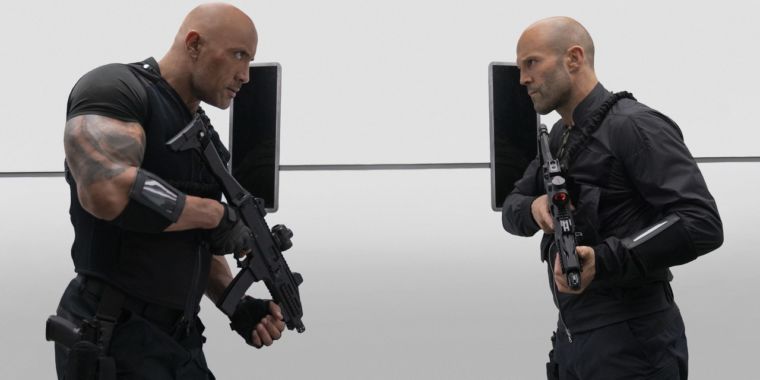
How my favorite designer ended up being featured in Hobbs and Shaw
Dwayne Johnson and Jason Statham star in Hobbs and Shaw. But so does the work of designer Errolson Hugh.
Universal Pictures
He’s The Rock, so of course he looks better in those pants than I do.
Universal Pictures
I really don’t need another jacket right now, but Statham’s Acronym J73-WS is on my shortlist for when I do. If I’m ever able to find one.
Universal Pictures
Brixton’s outfit is a custom design. According to Hugh there were two versions, one where he could move his arms (pictured), and one that looked cool.
Universal Pictures
Vanessa Kirby plays Hattie Shaw. And the gear that she and her MI6 team are wearing here counts as techwear.
Universal Pictures
One of Eteon’s evil scientists. This is also a techwear look.
Universal Pictures
C’mon, don’t they look badass?
Universal Pictures
Have you been to see Hobbs and Shaw yet? It’s the latest installment from the Fast and Furious franchise, a spinoff starring Vanessa Kirby, Jason Statham, Dwayne “The Rock” Johnson, and Idris Elba, and it’s pretty darn good as far as mindless summer action flicks go. Now, I know what you’re thinking: he only really likes it because it’s got some cool cars. But here’s a secret—I’m far more in love with the way everyone is dressed in the movie.
Much of the credit for that goes to Sarah Evelyn, the film’s costume designer. But there’s another influence at work in the wardrobe department, that of techwear luminary Errolson Hugh. Hugh has been called “your favorite designer’s favorite designer,” although more recently you might know him from having started that bottle cap challenge earlier this summer.
It’s fair to say Hugh’s attitude towards design, particularly with his label Acronym, is uncompromising. In fact, it reminds me a lot of Gordon Murray’s approach to designing the McLaren F1. Like Murray, Hugh’s work is heavy with the latest technology—it is called techwear after all. But instead of ultra lightweight composites (the McLaren F1 was the first production road car to be made completely from carbon fiber), it’s cutting edge fabrics from companies like Schoeller, Gore, and Nextec.
Of course, it’s more than just clever textiles—after all you can use those and still make clothes that let you blend in; you know, normal-looking stuff. About the only place you’ll blend in wearing head-to-toe Acronym might be at a conference for space ninjas from the future, which is probably what drew Evelyn to his work. But we’re not talking cosplay outfits here—form follows function, and every detail has a reason behind it. A keen martial artist, Hugh often credits his first karate gi as the inspiration for his pattern designs that restrict your movement as little as possible, as demonstrated in a series of “Acronymjutsu” videos that are the closest the cryptic brand ever gets to advertising.
I had an inkling that Acronym was going to feature in Hobbs and Shaw when the first trailer showed our eponymous heroes wearing jumpsuits. These featured a rather distinctive style of pocket, almost identical to the ones you find on a pair of Acronym P24A pants. (All of Acronym’s designs have alphanumeric designations rather than names.) And although a big-budget action movie was the last place I expected to see the label show up, it wasn’t that far-fetched. Statham is a high-profile fan, along William Gibson, John Mayer, and the late Robin Williams (yes, really).
Hobbs and Shaw, along with Shaw’s sister, get their wardrobe upgrade after visiting Madam M, a Russian friend of Shaw’s who helps the trio in their plan to break into the bad guys’ HQ. First, there are those custom jumpsuits; once on the ground our heroes stick with the techwear vibe. After all, who doesn’t want to look like a space ninja? In fact, the techwear look extends to the assorted evil scientists and muscle working for the evil Eteon group, although Idris Elba’s transhuman villain Brixton owes a lot more to motocross.
I had to know for sure, so reached out to the Berlin-based designer. Here’s what he told me:
“The whole thing happened because Jason walked into wardrobe one day and was like ‘”Oh I know that guy.” We were on the mood boards for a lot of the stuff. But they were motivated and were really keen to get us to do the main outfits for Jason and Dwayne. The whole thing was super smooth. We sent patterns and materials and they built all the iterations. They needed 15 of each in like five weeks. I have no idea how they pulled it off.”
Statham’s ensemble was almost strictly off-the-shelf. “Statham rocked stock P10As and a J73 with an arm patch! Looked great and fit perfectly,” Hugh told me. It probably helped that the actor already knew his size; for his substantial costar they had to get a bit more creative. That black vest is one Hugh designed for Stone Island’s Shadow Project collection, modified to fit The Rock. “Dwayne’s vest was a rebuild—we only had medium—and his pants were refitted extra-large P24As,” he said.
As techwear devotees will already know, wearing a lot of black water-resistant fabric works pretty well when it’s cold and wet outside, but less so when the climate gets tropical. So it’s not really a surprise that by the time our film reaches its conclusion in Samoa our heroes are back in more normal outfits. But that’s OK—not every car in the film can be a McLaren 720S either.
Listing image by Universal Pictures
https://arstechnica.com/?p=1549605
Terrifying tales spring to vivid life in Scary Stories To Tell in the Dark
[embedded content]
Reading a book brings all manner of ghosts and monsters to life in Scary Stories To Tell in the Dark.
Monstrous creatures from terrifying tales come to life for a group of teens in Scary Stories To Tell in the Dark, the new horror film produced by Guillermo del Toro. The movie is based on a series of children’s books from the 1980s by the late amateur folklorist Alvin Schwartz (he died in 1992), who drew upon common folklore and popular urban legends for his anthologies.
(Some spoilers below.)
Technically, Schwartz was a curator, collecting scary stories from all over and preserving those oral traditions on the page. Remember that classic campfire ditty, The worms crawl in the worms crawl out/the worms play pinochle on your snout? So did Schwartz. You’ll also find variations on the killer with a hook for a hand who preys on couples necking in parked cars. So, too, the hapless babysitter who discovers the call is coming from inside the house, along with plenty of other frightening fare. It’s all delivered in a breezy, conversational format, complete with tips on how to most effectively read the stories aloud to scare your friends. (The 2018 documentary Scary Stories delves more into Schwartz’s source material.)
While the books are technically aimed at kids, the material can be pretty dark, which is why the series has often been listed among the most challenged books by the American Library Association. People (parents especially) have objected to the violence in the Scary Stories series—and illustrator Stephen Gammell’s disturbingly surreal images only add to the potential nightmares. In fact, publisher Harper Collins released a new 30th-anniversary edition in 2011 that didn’t include Gammell’s original illustrations, causing an uproar among longtime fans.
Kids absolutely love these books, precisely because they are scary.
What those objecting adults seem not to understand is that kids absolutely love these books, precisely because they are scary. As Laura Miller observed in Slate, “What would-be regulators… want is not to protect children from books that might harm them, but to protect themselves from the knowledge that many children seek out and delight in the macabre,” adding, “To claim your right to deliberately scare yourself (even if it gives you nightmares) is to make a bid for self-determination.”
In short, the books are perfect fodder for del Toro, whose visually distinctive work has often centered on fairy tales and fantasy (Pan’s Labyrinth), classic horror (Crimson Peak, Mama), monsters (Hellboy, The Shape of Water), and the like. He signed on with CBS Films in 2016 to develop and produce a feature film adapted from Schwartz’s Scary Stories series, and he eventually tapped André Øvredal (Trollhunter) to direct.
Mill Valley in 1968 seems like such a sleepy, innocent town.
YouTube/CBS Films
The old Bellows mansion naturally is a magnet for curious teens.
YouTube/CBS Films
Family portrait of the Bellows family.
YouTube/CBS Films
Stella Nicholls (Zoe Colletti) finds a curious book.
The book of Sarah Bellows is nothing to trifle with.
YouTube/CBS Films
Reading this book could bring trouble.
YouTube/CBS Films
No! You must not read from the book!
Something spooky lurks in the old Bellows mansion.
YouTube/CBS Films
Stella can’t resist taking a peek.
YouTube/CBS Films
YouTube/CBS Films
Chuck (Austin Zajur) finds there is no place to run.
YouTube/CBS Films
The Pale Lady makes an appearance.
YouTube/CBS Films
Harold the Scarecrow just hanging out in the corn field.
Not even the corn rows are safe.
YouTube/CBS Films
The book taps into your own fears and anxieties. For Ruth (Natalie Ganzorn) it’s… a huge zit?
YouTube/CBS Films
Augh, don’t TOUCH it!
YouTube/CBS Films
A ghostly presence.
YouTube/CBS Films
Bringing out the dogs to scour the local fields.
YouTube/CBS Films
Stella, Ramon (Michael Garza), and Chuck try burning the book.
YouTube/CBS Films
Stella thinks her days might be numbered.
YouTube/CBS Films
But Scary Stories is also a challenging series to adapt for the silver screen. Del Toro has said his adaptation is not a standard anthology film. “Anthology films are always as bad as the worst story in them—they’re never as good as the best story,” he said during a panel at San Diego Comic-Con on July. “I remembered in Pan’s Labyrinth, I created a book called The Book of Crossroads. I thought it could be great if we had a book that reads you, and it writes what you’re most afraid of. Then the theme became the stories we tell each other.”
The first trailer dropped in March, revealing that various tales from the books are embedded within a broader narrative that combines a classic haunted house mythology with a historical murder mystery. The movie is set in the small American town of Mill Valley on Halloween 1968. High school nerd and aspiring writer Stella Nicholls (Zoe Colletti) and her friends Auggie (Gabriel Rush) and Chuck (Austin Zajur) hatch a plan to ambush head bully Tommy Milner (Austin Abrams) and his gang in revenge for torments of Halloweens past. They bump into Ramón (Michael Garza) while on the run from Team Tommy, and the four take refuge in the local haunted house: the abandoned Bellows mansion.
“I thought it could be great if we had a book that reads you, and it writes what you’re most afraid of.”
As Stella tells Ramón, the Bellows family had a daughter named Sarah who was “different” in some mysterious way. They kept her locked up in a basement room, and her only contact with the outside world was telling her scary stories through the walls of her room to curious local children who came snooping around the house. Many of those children mysteriously disappeared. Sarah eventually hanged herself, and the house has been vacant ever since.
But Stella and Ramón find the secret room where Sarah lived, along with her book of stories, said to have been written in the blood of the children she purportedly killed. And a curious Stella takes the book home, awakening Sarah’s vengeful spirit. Anyone who was in the Bellows house at the time is a target—not just Stella, Ramón, Auggie, and Chuck, but also Tommy and Chuck’s older sister, Ruth (Natalie Ganzhorn). One by one, new stories featuring each of them appear as if by magic in Sarah’s book. Then the stories come to life in the real world, from Harold the scarecrow and a corpse looking for its missing big toe, to the Jangly Man and the Pale Lady (all fan favorites).
Scary Stories is rated PG-13, the better to appeal to the book series’ younger fan base, so it isn’t as gruesome as one might find in a typical horror film. There’s an innocence here, not something you’ll usually find in the genre. Other than the metaphysical musings on the power of stories, it’s not a particularly profound film, which is in keeping with the deliberately simple prose of the books. But there are plenty of ominously foreboding scenes, classic jump scares, and genuinely gross and/or terrifying moments to delight fans. The only surprising thing is that the studio released it now instead of holding it for Halloween. I think Schwartz would be pleased at how well the film captures the spooky campfire sprit of his books.
Universal pulls The Hunt after most recent deadly mass shootings [Updated]
Enlarge/ In The Hunt, Betty Gilpin plays Crystal, a woman who must fight for her life when she’s hunted by wealthy “elites.”
YouTube/Universal
[Update: 1:35pm ET, August 10, 2019] Universal Pictures has now pulled the planned September 27 release of its satirical thriller, The Hunt, Deadline Hollywood reports. Here is the studio’s statement:
While Universal Pictures had already paused the marketing campaign for The Hunt, after thoughtful consideration, the studio has decided to cancel our plans to release the film. We stand by our filmmakers and will continue to distribute films in partnership with bold and visionary creators, like those associated with this satirical social thriller, but we understand that now is not the right time to release this film.
Co-star Hilary Swank, appearing at the Locarno Film Festival, declined to discuss The Hunt or the surrounding controversy, according to Variety. However, she did say, “No one’s seen the film. You can’t really have a conversation about it without understanding what it’s about.”
My take: Swank is correct that it’s a bit unfair to pass judgement on a film few people have actually seen. Trailers are just marketing tools and can often be quite different in tone from the actual film. That said, this is probably a smart move on the part of Universal, given the current socio-political climate.
Original story 1:45pm ET, August 8, 2019:
Deadline Hollywood is reporting that Universal Pictures has temporarily ceased its marketing campaign for its upcoming satirical thriller, The Hunt, in the wake of three recent US mass shootings that claimed the lives of more than 30 people. The film stars GLOW‘s Betty Gilpin and Oscar winner Hilary Swank as two women from opposite ends of the political spectrum hunting each other—essentially a modern update of the classic short story, “The Most Dangerous Game.”
“Out of sensitivity to the attention on the country’s recent shooting tragedies, Universal Pictures and the filmmakers of The Hunt have temporarily paused its marketing campaign and are reviewing materials as we move forward,” a representative for the studio told Deadline.
Delays like this have become something of a standard operating procedure for Hollywood over the last 20+ years as the industry grapples with how to navigate the dark reality of gun violence in America. Back in 1999, for instance, Buffy the Vampire Slayer postponed airing the episode “Earshot” in the wake of the Columbine High School massacre. Warner Bros postponed the release and recut a scene for its 2012 film Gangster Squad because of the Aurora shooting. And just last year, the television adaptation of Heathers was pushed back, recut, and nearly cancelled in light of the Parkland shooting. When writing about Universal’s decision with The Hunt,Deadline notes even more examples—from Arnold Schwarzenegger’s Collateral Damage shifting after September 11, 2001 and the 2017 Death Wish remake delayed following the mass shooting in Las Vegas.
Written by LOST‘s Damon Lindelof and Nick Cuse, The Hunt may have been primed for controversy even before real-world tragedies occurred. The film is about 12 strangers who wake up in a clearing with no idea where they are or how they got there. They soon discover they are “prey” at an exclusive resort called The Manor, where the uber-wealthy come to hunt human beings—although Hilary Swank’s high-end executive (who masterminded the whole thing) scoffs that they should hardly be considered “beings.” Things really get interesting when the “hunted” get their own weapons and start fighting back.
It’s not a particularly new idea since Richard Connell’s “The Most Dangerous Game” was first published in 1924 and has spawned countless film and television interpretations of the basic concept over the ensuing decades. But there’s of course a twist in this case: the hunted all hail from red states (“deplorables”), and the hunters are purportedly “liberals”—albeit of the super-entitled uber-wealthy variety. “We pay for everything so the country belongs to us,” Swank’s character declares in the film’s trailer. Various teasers had previously aired on TV (including on CNN during the recent Democratic debates) and remain online (embedded below).
It’s worth noting that this character’s statement, and her refusal to see the hunted as fully human beings, are not even remotely representative of a liberal stance—nor a traditionally conservative one.
Needless to say, Fox News has been having a field day with the film’s story. We’ll wait to see the film and judge for ourselves whether it ultimately works as satirical entertainment or not, and whether it does, indeed, cross any cultural lines. As always, “good taste” can be very subjective—is The Hunt any better or worse than The Purge franchise, for instance? (Jason Blum produced both, along with Get Out.) But given the current political environment headlined by peak partisan tensions and a nation trying to simultaneously grieve and seek solutions following recent mass shootings in El Paso, Texas; Dayton, Ohio; and Gilroy, California, Universal’s decision to pull back on its marketing campaign seems like a wise business decision.
For now, The Hunt will still open as originally scheduled on September 27, 2019.
[embedded content]
Universal’s The Hunt trailer.
https://arstechnica.com/?p=1548213
“Blast processing” in 2019: How an SNES emulator solved overclocking
[embedded content]
A stock Gradius III ROM running without slowdown? The new version of bsnes makes it possible.
When it comes to emulator design, there’s something to be said for trying to capture the workings of the original system as accurately as possible, warts and all. But there’s also something to the idea that emulators can improve on the original hardware, smoothing problems like frame rate slowdown that plagued the underpowered processors of the day.
That brings us to the latest update for storied, accuracy-obsessed SNES emulator bsnes, which adds the ability to overclock the virtual SNES processor. While bsnes is far from the first SNES emulator to allow for simulated overclocking, it does seem to be the first that does so “without any framerate or pitch distortion, and without harming compatibility in 99% of games,” as bsnes programmer byuu puts it.
Fast, but not too fast
Most SNES games were locked to a 60fps frame rate, and designers of the time tuned their games so the SNES hardware could maintain that frame rate. But in some in-game situations, when the screen got too full of moving sprites, the processor could fail to create the next frame within the 16.66 ms window, leading to noticeable display lag.
Today’s beefy PCs can of course simulate the SNES’ RICO RA22 CPU at a rate much faster than its original 3.58MHz. But because the system’s games were designed with that particular clock rate in mind, that kind of overclocking has a tendency to speed up the video and audio, too, which can in turn make the games difficult or impossible to play (or even run, in some cases).
To fix this side effect, byuu borrowed a technique from elsewhere in the emulation community. “For many years, NES emulators had a method of overclocking where additional scanlines are added for the CPU for each video frame,” byuu tells Ars Technica. “Which is to say, only the CPU runs on its own for a bit of extra time after each video frame is rendered, but the video and audio do not do so… This new(ish) overclocking method gives games more processing time without also speeding up the video and audio rates… and so the normal game pace of 60fps is maintained.”
The result, for most standard SNES games, is the complete removal of the infamous frame rate slowdown that showed up when too many sprites clogged up the screen. Byuu has posted side-by-side video examples showing how this improvement shakes out in Contra III and Gradius III.
(Emulation fans may remember another slowdown-free version of Gradius III that was released in May. But while that version required extensive hardware and software hacking, the bsnes addition should work on most any SNES software without modification).
There are some limitations to this new overclocking method, stemming mostly from SNES cartridges’ many enhancement chips. “SuperFX games are kind of a special case,” byuu says. “Since they tend to not run at 60fps due to the demands of software rasterizing entire screens on the SNES, the game logic is designed around the frame rates. So even if you speed up StarFox, the game engine will appear to be running too fast now.”
[embedded content]
SuperFX games like StarFox animate more smoothly with overclocking, but the gameplay also gets noticeably faster.
You can see this side effect in this comparison video of SuperFX title StarFox. While the game animates much more smoothly with overclocking enabled, the gameplay ends up noticeably faster as well, adding to the game’s twitchy challenge.
“I suppose you can think of the SuperFX like older 80286 DOS games that run way, way too fast on modern PCs,” he continued. “It’s as if they don’t have Vsync, and just run as fast as they can. This new overclocking technique can’t really fix that: if you speed the game up, the game logic runs faster. But for most cases, you could assume they’re more akin to modern games that rely on Vsync to keep a consistent, smooth framerate.”
Enlarge/ A sea of gamers prepares to storm the hall to snatch up the most coveted games before they sell out at Gen Con 2019.
Aaron Zimmerman
INDIANAPOLIS—If it’s early August, you can count on one thing: we’re gonna be in downtown Indianapolis with 70,000 other board gamers, forgoing sleep, food, and general wellbeing to play a truly ridiculous amount of new tabletop games at Gen Con, the self-described “Best Four Days in Gaming.” Gen Con is America’s largest and longest-running tabletop games convention. 2019 was the con’s 52nd year, bringing with it a record-breaking 538 exhibiting companies and a truly impressive 19,600 ticketed events. (If you want some sense of what that cardboard chaos looks like, our Gen Con 2019 image gallery is a good place to start.)
And then there are the games—more games than you could play in a lifetime, all being released at once. We sifted through the chaos to bring you a big list of games we think you should be paying attention to going into the last few months of the year. With such a massive amount of games on offer, we couldn’t get to everything we wanted to—your correspondent is just one man!—but we think our list has something for everyone on it. Roleplaying games were sadly outside the scope of this article, so be sure to check out our coverage of perhaps the most anticipated roleplaying title at this year’s Gen Con: Pathfinder. Developer Paizo debuted the game’s second edition at this year’s conference more than a decade after the beloved RPG debuted.
But back to our list—these games should largely be available soon. If a specific title catches your eye, make sure to check in with your favorite local or online game store in the near future for info on when they’ll be getting it in. And if you’re really one to plan out your play in advance, it’s never too early to consider it: next year’s Gen Con returns to Indy and runs July 30 through August 2, 2020.
Parks
Henry Audubon, Keymaster Games, 1-5 players, 40-60 min, age 9+
Parks: for my money, the best-looking game at Gen Con 2019.
Players travel along the bottom path to collect resources and special abilities.
Cute little hikers.
Gorgeous artwork from the 59 Parks Print Series.
If Parks were a bad game, I’d still be tempted to recommend it based solely on the strength of its stunning presentation. Thankfully there’s no need for such silliness; the underlying game is also great.
Parks is a game about US national parks that’s a little like Tokaido, in that players all move along a path to pick up various rewards from each spot. But whereas Tokaido is a set-collection game, Parks focuses on resource management. The resources here are sunlight, water, trees, mountains, and wildlife—or, I guess, the memories of those things that you collect as you go along your travels. When you reach the end of the trail, you can “visit” a national park by trading in the correct resources and securing a beautifully illustrated card of the park (the thematic underpinnings get a little shaky here, but just go with it). You can also take pictures, fill your canteen up with water to get special actions, and pick up gear cards that give you ongoing bonuses.
The game features gorgeous art from the Fifty-Nine Park Print Series, and the rest of the components are equally handsome. An all-around lovely little game that could easily serve as a gateway game for newbies or a chill night-ender for seasoned gamers.
Pandemic: Rapid Response
Kane Klenko, Z-Man Games, 2-4 players, 20 minutes, age 8+
Pandemic: Rapid Response is a frantic, real-time dice-game version of the co-op classic.
Each character has a special ability, just like in Panemic.
Do you love the panicked feeling you get trying to save humanity from a world-ending epidemic in Pandemic but wish the game was more hectic? Friend, have I got a game for you.
Pandemic: Rapid Response, a new Target-exclusive game, puts a “real-time” spin on the co-op classic, trading Pandemic’s globetrotting card collecting for frantic, desperate dice rolling. Players in Rapid Response are an elite team of scientists, doctors, and specialists traveling around the world in a specialized plane while cooking up cures to the diseases popping up in the world’s major cities. Each turn, players roll six dice—and can then reroll them Yahtzee-style—in order to generate resources that are used in the cures. Resources are then moved to the plane’s cargo hold and are ready to be dropped off in the cities around the board containing outbreak cards (assuming you can roll enough plane icons to get you to the desired location). Watch out, though, as generating resources also causes waste—create too much waste and you lose.
Of course, you’re doing all of this under the watchful eye of an always-depleting two-minute sand timer. Every time it runs out, you add an outbreak card and lose a time token. Lose all your time tokens, lose the game. Cure a city to get back a time token; cure all the affected cities to win. Pandemic is a cooperative game that’s notorious for its potential for “quarterbacking”—an alpha gamer telling everyone else what to do on their turns—and while that element could still be present here, the game’s fast pace makes it less of an issue. If you’re ready for a 20-minute panic attack, this is your game.
Black Angel
Sébastien Dujardin, Xavier Georges, & Alain Orban, Pearl Games, 60-120 minutes, age 12+
There’s a lot going on in Black Angel a new Eurogame in the vein of the designers’ previous game Troyes.
Aaron Zimmerman
You also get your own player board.
The Black Angel: savior of humanity?
Adorable little robots in adorable little spaceships.
Well, we’ve gone and done it. Humanity’s reckless ravaging of Earth has reached its inevitable conclusion: a spent planet and the end of human habitability. But before we go, the nations of the world have gotten together one last time to load our genetic heritage on an intergalactic frigate and send it on its way to Spes, the planet most likely to sustain life for a new human civilization. Who’s crewing the ship on this long journey? You are, of course, and you’re an AI.
Black Angel is semi-cooperative in the sense that if you and your opponents succumb to the aliens attacking your ship and never make it to new-Earth, things will go badly for you. But every player is competing to prove that he or she is the most worthy AI to head up operations on the new planet (the other AIs will be summarily shut down). There are a ton of interlocking mechanics here; you’ll be going on missions, fending off attacking aliens, upgrading your technology, and grabbing end-game scoring opportunities.
The game bears some similarity to a game that two of the designers previously worked on, the well-loved medieval France sim Troyes. But man is Black Angel‘s theme cooler. The game was one of the most hyped-up of the con, and it’s the one I’m most looking forward to exploring in the coming months.
Marvel Champions: The Card Game
Michael Boggs, Nate French, & Caleb Grace, Fantasy Flight Games, 1-4 players
Marvel Champions: The Card Game is a new co-op living card game from Fantasy Flight.
You have to defeat the big bad—but also keep an eye on thwarting his or her schemes.
Your character card can be flipped between hero and alter-ego sides.
When I first heard that Fantasy Flight Games was releasing a new Marvel living card game (a somewhat wallet-friendlier collectible card game), I was instantly bored. But when I heard it was going to be a cooperative game, I knew I had to get a demo in. Co-op CCG-type games are few and far between, and the ones that FFG has released in the past (Lord of the Rings: The Card Game and Arkham Horror: The Card Game) have been generally excellent and a nice change of pace from the countless two-player card battlers choking the market.
Marvel Champions seems to take inspiration from both of those earlier FFG games while injecting some Marvel thematic flair into the mix. The base game—which for the first time in an FFG LCG includes a complete set of cards—comes with five heroes (Spider-Man, Iron Man, She-Hulk, Black Panther, and Captain Marvel) and three villains (Rhino, Klaw, and Ultron). Scenarios pair a villain with a deck of scheme cards, and you and your friends can pick from among the heroes to try to save the world yet again. The villains use their turns to advance their evil schemes and attack the players; the players, of course, use their turns to thwart the schemes and fight back through the usual card-game combo-rific antics. Once per turn, players can flip their character card between hero and alter-ego sides to gain access to different abilities, a cool little thematic and mechanical flourish.
The game looks like it might be a bit lighter than some of the other FFG card games we’re used to (understandable, given the broad appeal of the subject matter) but we’re hoping it will still be a fun, continuously updated co-op (or solo) romp.
Listing image by Aaron Zimmerman
https://arstechnica.com/?p=1548321
Walmart, ESPN pull violent game marketing following shootings
Enlarge/ ESPN feels its audiences don’t want to see Apex Legends scenes like this “given the swirl of that moment.”
Some of the biggest corporations in the United States are scaling back their display of violent games in the wake of recent mass shootings in El Paso and Dayton.
As reported by Vice, employees at Walmart stores arereporting receipt of a notice to “remove signing and displays referencing violence.” These directions include turning off “any video game display consoles that show a demo of violent games” and “remov[ing] any [signs] referencing combat or third-person shooter video games.” Employees are also instructed to “cancel any events promoting combat style or third-person shooter games that may be scheduled in Electronics.”
The memo also says “movies displaying violence” and “hunting season videos” should not be displayed in stores for the time being.
At ESPN, the taped broadcast of an Apex Legends tournament planned for this weekend has been postponed. The delay, first reported by esports journalist Rod Breslau and later confirmed to Ars Technica, was “made out of respect for the victims and all those impacted in the immediate aftermath of the shootings,” according to a source with direct knowledge of the decision. “It seemed the prudent thing to do given the swirl of that moment,” the source added.
The tournament, which took place last weekend, will still be recapped on the ESPN3 online streaming service this weekend, though plans for coverage across ABC, ESPN2, and ESPNEWS have been postponed.
Bad timing?
Decisions surrounding the display of video game violence have taken on some added weight as multiple prominent politicians discuss exposure to games as a potential cause of real world violence. But there’s some evidence that these corporations are making changes out of perceived sensitivity to viewers rather than sensitivity to political pressure.
At Walmart, for instance, there has been no indication that stores will halt the sale of violent games, or even pull their boxes down from shelves. Walmart has also resisted calls to limit sales of actual guns in its stores, telling USA Today that “there’s been no change in policy.”
The retailer has long taken part in the ESRB’s voluntary Retail Council program, which as a whole attains 80 to 90 percent effectiveness in preventing sales of M and AO-rated games to minors. Walmart has not responded to a request for comment from Ars Technica.
Similarly, ABC and ESPN haven’t announced any changes in their overall policy toward broadcasting violent games as part of their esports coverage. Instead, the “swirl of the moment” seems to be leading to a temporary change in the way the network perceives its audience’s sensitivities. Given the sheer frequency of mass shootings in recent years, though, there’s no guarantee that the postponed October airdate will be any further removed from a similar “swirl” of sensitive news coverage.
The game industry writ large isn’t immune to these kinds of considerations following reports of real-world violence. In 2016, the Entertainment Software Association told Ars Technica that participants in the annual Electronic Entertainment Expo were taking steps “to be sensitive to the national mood at the moment” in the wake of the Pulse Night Club shooting in Orlando, Florida. Subsequent E3 conventions seem to have reverted back to form, though, prominently featuring plenty of violent content as usual. Many games makers were also forced to change content, marketing, or release schedules following the terrorist attacks of Sept. 11, 2001.
Though studies have shown that exposure to virtual violence doesn’t lead to real world violence, pushing that kind of content to your audience takes on a different tone in the wake of a prominent national tragedy. Not to worry, though; our collective memory and sensitivities always seems to revert back to the media violence status quo before too long.