Beware the friendly neighborhood devil worshippers in Satanic Panic trailer
[embedded content]
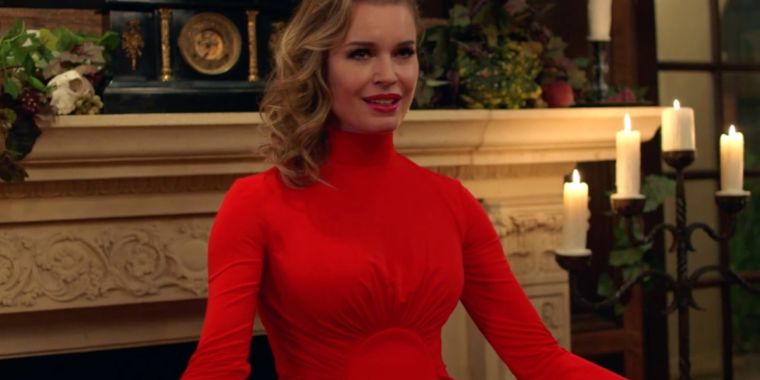
Rebecca Romijn stars as a high society devotee of the devil in need of a virgin sacrifice in Satanic Panic.
A pizza delivery girl runs afoul of a wealthy socialite and her satanic cult in Satanic Panic, a new horror comedy from Director Chelsea Stardust. Yes, it’s kind of a bonkers premise, but the trailer is a lot of fun, mining the same cheekily irreverent vein as the Happy Death Day films.
Samantha “Sam” Craft (Hayley Griffith) is a pizza delivery girl with regrets. She took this job for the tips, which turned out to be a bad business decision. “In four hours, my total earnings are an expired Applebees coupon and a sweater that smells like racism,” she complains. But when an order comes in from the well-heeled enclave of Mill Basin, she takes on the job, even though its technically outside the joint’s delivery zone—apparently on the assumption that she’ll finally get a decent tip. What she gets instead is captured by a satanic cult in need of a virgin sacrifice so they can summon Baphomet, a demon from hell, thereby ensuring they stay rich and on top. “Death to the weak, wealth to the strong!” cult leader Danica Ross (Rebecca Romijn) declares.
Sam doesn’t seem to be entirely without, er, allies. The skeevy, lecherous Samuel Ross (Jerry O’Connell) helpfully offers to deflower her to save her skin: “No virgin, no sacrifice. Let me protect you.” Her best bet is Danica’s rebellious daughter Judi (Ruby Modine), who warns, “My mom and her butt buddies are booty-calling Baphomet. And they’re not gonna stop til you’re strapped to a barbed wire altar.” Sure, Danica and her acolytes have all the power, but Sam and Judi have youthful spunk and a keen desire to live. This being a comedy, I like their chances.
Of course, “satanic panic” is a genuine real-world phenomenon of mass hysteria that reached its peak in the 1980s, and is no laughing matter—certainly not for those falsely accused of ritual abuse. But as Thomas Browne once observed, “The devil… the proud spirit cannot endure to be mocked.” So maybe Satanic Panic is doing the Lord’s work by holding the whole tawdry mess up for well-deserved ridicule.
Satanic Panic opens in theaters on September 6, 2019.
Sam (Hayley Griffith) is unhappy with the lack of pizza delivery tips.
YouTube/RLJE Films
She rides a motorbike so you know she’s cool.
YouTube/RLJE Films
Surely someone this rich will tip well.
YouTube/RLJE Films
Danica Ross (Rebecca Romijn) is more interested in Sam’s presumed virginity.
YouTube/RLJE Films
“That’s a very personal question…”
YouTube/RLJE Films
“Are you ready to fully commit yourselves to Satan?”
YouTube/RLJE Films
Weird occult talismans? Check.
YouTube/RLJE Films
“Hail Satan!”
YouTube/RLJE Films
Whatever this thing is, it wants blood.
YouTube/RLJE Films
A skeevy encounter
YouTube/RLJE Films
Danica’s daughter Judi (Ruby Modine) becomes an unlikely ally.
YouTube/RLJE Films
The cult wants to summon a demon named Baphomet
YouTube/RLJE Films
On the altar.
YouTube/RLJE Films
“Maybe I should stop drinking.” “You really want to face this sober?”
Listing image by YouTube/RLJE Films
https://arstechnica.com/?p=1545541
Console Wars—a book about the Genesis and SNES—will become a TV show
One of the great tech and gaming stories of a generation will be told on the small screen soon. Deadline reports that Blake Harris’ 2014 non-fiction novel Console Wars will be adapted into a documentary and a short-run TV series, both of which will air on CBS All Access.
The book tells the behind-the-scenes story of the business and technological rivalry between the Sega Genesis and Super Nintendo Entertainment System (SNES) video game consoles in the late ’80s and early ’90s. The story is told largely from Sega’s perspective—specifically that of ex-Mattel CEO Tom Kalinske, who joined Sega’s American division to lead pivotal moments in the Genesis’ product lifecycle and rise to popularity.
The book is based on interviews with key players in the actual events, but it was written in a novel-like, narrative prose style. It proved popular with readers, though critics felt the author’s prose writing style sometimes detracted from the story’s impact.
Legendary Television Studios (The Expanse, Colony, Lost in Space 2018) is producing the content while CBS will distribute. The feature-length documentary will be produced by actor Seth Rogen (who also supported the book), Point Grey Productions, and Scott Rudin Productions, among others. The limited-run TV series will come from writer Mike Rosolio and be directed by Jordan Vogt-Roberts (Kong: Skull Island, You’re the Worst).
The show is likely to be similar in theme to the ’90s limited-run Pirates of Silicon Valley—albeit hopefully, well, better—with a focus on the personal stories of executives who battled one another in a frontier industry.
At the time of the Sega Genesis’ launch, Nintendo had near total dominance of the home game console market thanks to the runaway, analyst-defying success of the Nintendo Entertainment System (NES). The Genesis launched in close timing with NES-successor SNES, and it ran with marketing campaigns like “Genesis Does What Nintendon’t,” stoking the flames for decades of console wars to come, for better or for worse.
The book not only tracks that rivalry, but it chronicles the eventual wave-inducing entry of Sony into the market with the PlayStation. Along with Nintendo’s Nintendo 64 console, the PlayStation famously and thoroughly outplayed Sega’s Genesis successor, the Saturn, in the market.
https://arstechnica.com/?p=1545461
Why the gaming world will be worse once GameStop is gone
Enlarge/ Artist’s conception of a customer virtually experiencing a world without GameStop.
GameStop’s COO and CFO departed the company after multi-decade tenures earlier this year. And the bad fortune continued yesterday as news broke that GameStop was laying off 50 of its “field leaders,” including regional managers, HR staff, and loss prevention leaders. This move comes as part of a “Gamestop Reboot” program designed in part to rebuild stores as gathering places for esports and retro gaming fans.
For many consumers, the seemingly imminent demise of GameStop is not a cause for sadness. The company has a reputation in many corners for poor prices on trade-in games, high-pressure sales tactics for extraneous add-ons, unfriendly staffers, poor return policies, and, in recent years, stores filled with toys and Funko Pop figures instead of games. (RIP to GameStop subsidiary ThinkGeek, by the way.)
But when I put the question of GameStop’s eventual demise to my Twitter followers a few weeks ago, I was somewhat surprised at how many people say they’ll be sad to see it go. This isn’t mere nostalgia for the retail brand that has subsumed stores like FuncoLand, Babbage’s, and Software Etc. I heard from a significant portion of gamers who think the gaming world will be markedly worse off without GameStop in it.
Here’s what they said they’ll miss.
Browsing the aisles
By far the most common reason my Twitter respondents want GameStop to stick around is the store offered a convenient place just to browse aisles full of physical games.
“Having a shop dedicated to gaming is something I’ll always want,” user @Under10Hours wrote. “I live in New Orleans, and GameStop is the only place that fits that description. Sure I can buy games at Best Buy or Target, but the selection is way more limited.”
The relatively limited gaming selection at big box stores, compared to GameStop, was a common refrain. “Target, Best Buy, Walmart just provide goods and games happens to be one of them,” @EPlaysChords said. “Best Buy carries only the 10 newest games,” @AlexQRyan added.
Online retailers like Amazon and eBay might have a better selection, but looking through the physical aisles of GameStop allows for more “serendipitous discovery,” as @ConanOfLibraria put it. “Amazon can do some of that, but the reality of picking it off the shelf with that range of older games will become that much rarer [without GameStop]. That I’ll miss.”
@Omahdon echoed this same sentiment of self-discovery. “If I’m shopping online, I know what I want to get and the price I’m shooting for? But wandering a shop is like a crapshoot of ‘Oh, this is neat! I never considered picking this up before but I might get it for the funsies.'”
GameStop can also be a gaming bargain-hunter’s paradise if you’re not too picky. “It’s the only place I can reliably go to find an old used game for like $3 in any city I’m in,” @zachheltzel said. “I’m impulsive and will spur of the moment want to try out a game I never got around to from years back, but they’re often still $20, $30, $40+ on digital storefronts. I can almost always count on GameStop to deliver when I randomly decide today’s the day I play Darksiders 2.”
“I will [miss GameStop] the same that I miss Toys ‘R’ Us and Blockbusters,” @ZacGunnell said. “They held a significant role as the places that people went to to explore for new stuff and talk to people face-to-face about our favorite hobby.”
Talk to me
Enlarge/ WEST HOLLYWOOD, CA – JUNE 11: Writer/director James Gunn participates in the Warner Bros. Interactive Entertainment And Grasshopper Manufactures Lollipop Chainsaw Launch Party held at GameStop on June 11, 2012 in West Hollywood, California.
While generalized gripes about rude or ignorant GameStop employees are not hard to find, many respondents said the staff at their local stores provided a friendly face and sense of community that they’d hate to see go.
“I’ve always really enjoyed going in-person to preorder a game or buy a Nintendo console or whatever, and having a little excited conversation at the register,” @Jennatar said. “The employees are fans of games, and their enthusiasm is infectious. … GameStops have that ‘human touch.’ If you’ve never been to a record or book store where an employee said “huh, interesting choice”—if you’ve never been judged on a purchase by a peer, basically—you’ve missed out on a crucial moment of social connection.”
For some, GameStop took the place of the neighborhood bar. “My local one is like my ‘Cheers,'” @Gamera_Heisei said. “Everyone knows my name, we chew the fat. They will flat out tell me if a game is worth it or not cause they know my taste… I will miss it.”
That kind of advice and personal attention from a knowledgeable GameStop employee can be invaluable. “The day Sekiro came out I walked into a GameStop and the guy at the counter asked me if that’s what I was there for (yes). It was nice, and I don’t think it would have happened at Target.”
“When I first ordered Bioshock [Infinite], Amazon was out of stock, so I hit pickup at my GameStop store,” @WildLibrarian25 said. “When I went in they had changed it out for the Limited Edition with 1&2, plus all the DLC and Infinite with the DLC. For the same price.”
Some GameStop fans seem to realize their local employees are succeeding despite the pressures from their corporate parent. “While the upper management of GameStop is terrible, local people at the shops are usually great,” @thenerdyarch said. “Employees that are working at my GameStop are cool, chill, and self-aware of all the annoying GameStop policies, which makes it better,” @TheTubbymora added.
“I’ve heard the horror stories and I too remember being aggressively asked to preorder games, but most GameStops I go to are pretty chill and have employees who actually like video games,” @Twilight5parkle said.
And the rest
Besides losing the retail shops themselves, some worried about the knock-on effects of a world without a GameStop.
“[I’m] definitely worried about Game Informer,” @metallicaisrad said. “I’m not sure how much of their size is directly related to GameStop’s rewards program. If that goes away, does GI lose a massive amount of its subscription base?”
Enlarge/ Pretty much every part of that “Buy Sell Trade” sign is suffering recently.
Others worried about the larger economic impact of yet another major retailer going under. “I’d miss them, as I miss anywhere that still employs people,” @OakalyDokaly said. “Some who celebrate the demise of businesses forget hundreds, if not thousands, rely on them to pay the wages which feed and provide for them and their families worldwide.”
“I honestly don’t get the anti-GameStop crowd,” @Rumbles82 said. “It’s gonna fast track the demise of physical media. Sure trade-in [value] is never tons. But how do they stay profitable? They don’t need that 80th copy of Destiny 2 so yeah, dude, it should be $0.25.”
One of the most surprising pre-mourning sentiments for GameStop came from someone who you’d think would benefit from the chain going under. “Having a generally reliable ‘mainstream’ version of what we do available only makes us more relatable and attractive to customers,” writes Kelsey Lewin, co-owner of Seattle-area retro game shop Pink Gorilla. “[Especially] if they’re looking for a more personalized experience/service/selection. It also pushes us to be better.”
For a lot of customers, though, they’ll miss the promise of GameStop more than the state of the stores as they currently exist. “I think I’ll miss the idea of GameStop more than the reality of it,” @Nick_Tylwalk said. “I’ll miss the idea of Gamestop,” @HorrorGeek added. “A store devoted to games. A better selection than the big box stores. Used games. All that. The thing is, that GameStop is already dead.”
https://arstechnica.com/?p=1545127
HBO Max secures exclusive US streaming rights for Doctor Who, other BBC series
Enlarge/ Jodie Whittaker, who plays Doctor Who‘s 13th Doctor, is seen here contemplating her future fate chained to HBO Max.
AT&T Time Warner’s upcoming video-streaming service, HBO Max, has already been announced with an ambitious content plan ahead of its “Spring 2020” launch window. That plan grew ever larger on Thursday with the news that its American debut will include a major non-AT&T library of content: a wealth of BBC America series, particularly the complete “modern” run of Doctor Who.
This will mark the first time American viewers will have streaming-subscription access to the series’ 11th season, which wrapped in December 2018 and introduced the world to the 13th Doctor, who is the first female actor in the role, Jodie Whittaker. (As of press time, your legitimate access to these 2018 episodes has been limited to subscribing to a cable-TV plan or buying episodes a la carte.)
HBO Max’s deal with BBC America, as announced by WarnerMedia, will include every previous episode in the most recently rebooted Doctor Who series, dating back to 2005, and “future seasons after they air on BBC America.” Since HBO Max will have the “exclusive streaming rights” to the series, that means existing Amazon Prime Video users will assumedly lose their existing subscription-based access to seasons 1-10 ahead of the rival streaming service’s launch.
In addition, WarnerMedia has licensed “700” episodes from other BBC America series (yes, exactly “700,” not “over 700”) to stream on HBO Max. These include the network’s complete runs of The Office and Luther, along with “multiple seasons” of car enthusiast series Top Gear—including both the classic hosting lineup of Clarkson-and-co and the newer Matt LeBlanc-fueled cast. (Between that news and HBO Max’s acquisition of every Friends episode, AT&T Time Warner has certainly locked down a LeBlanc collection; will the company try to acquire Showtime’s LeBlanc series Episodes next?)
While the announcement includes news about HBO Max hosting five BBC America series that haven’t yet premiered, it also excludes a number of popular existing series, including Broadchurch (whose American remake aired on Fox), Orphan Black, and Killing Eve.
Up until today, HBO Max’s impending launch lineup has mostly been full of native series to the AT&T Time Warner entertainment portfolio, which is already ridiculous enough. The list requires a deep inhale before reading out loud: Warner Bros., HBO, New Line, DC, CNN, TNT, TBS, truTV, The CW, Turner Classic Movies, Cartoon Network, Adult Swim, Crunchyroll, Rooster Teeth, Hello Sunshine, Looney Tunes, and Warner Bros. Television. The latter is what accounts for HBO Max swiping TV series like Friends, Fresh Prince of Bel-Air, and Pretty Little Liars away from other streaming services as HBO Max exclusives.
By advertising any of these streaming-video content options as HBO Max exclusives, AT&T Time Warner appears to be contradicting testimony given by then-AT&T CEO Randall Stephenson to the US Senate in 2016. As he said during that hearing about anti-trust concerns:
Nor is there any reason to believe we could use Time Warner programming or AT&T networks to hurt related markets. Simply put, it would be irrational business behavior to do so. Time Warner’s programming is more valuable when distributed to as many eyes as possible. Moreover, in order to have great programming, it is imperative that we attract great creative talent to develop it. The best way to attract that talent is through widespread distribution of Time Warner content.
The service has yet to receive a more formal launch window beyond “Spring 2020.” Neither has HBO given any indication of a price as compared to its existing standalone streaming service, HBO Now, which costs $15/month in the United States. The news follows months of concern over AT&T Time Warner’s approach to HBO’s content and release schedule, along with news that the corporation’s DirecTV and AT&T Now services have suffered from subscription lapses following a price increase and technical issues. https://arstechnica.com/?p=1544815
Ninja’ed: Microsoft swipes top game-streamer from Amazon’s Twitch
Enlarge/ Tyler “Ninja” Blevins sends his love to Microsoft’s Mixer.
Mixer / Ninja
Over the past three years, Microsoft has been relatively quiet about growing Mixer, the game-streaming site it acquired in 2016. All that changed on Thursday when the site announced a move that might finally turn the tide in its direction: the site’s first major talent acquisition.
Effective immediately, Tyler “Ninja” Blevins—arguably the most “household” name in the game-streaming universe—will stream his gameplay of popular shooters like Fortniteexclusively on Mixer. That means Blevins has left the West’s largest game-streaming service, Amazon’s Twitch.tv, after more than eight years on that site.
While at Twitch, Blevins racked up some of the site’s biggest simultaneous viewership numbers. That includes an explosion of activity after he hosted a surprise streaming session in March 2018 with musicians such as hip-hop phenom Drake. His Twitch run ends with a “follower” count of over 14 million, along with a continued run in the site’s top-20 ranks in terms of simultaneous viewers and number of viewer hours accrued. However, Ninja’s prior reign as Twitch’s number-one streamer has faded in recent months, all while he continues to rack up endorsement deals and promote a series of upcoming books.
In an announcement video posted Thursday, Blevins hosted a faux press conference in which every attending journalist was Blevins in a costume. This video, and a follow-up webcam explanation, repeated a call to Blevins to “get back in touch with my roots” as an explanation for the switch from Amazon’s platform to Microsoft’s. Blevins’ announcements did not explain whether a financial deal was brokered, and he did not offer existing Twitch users any recourse for paid subscription-based perks on that site being moved to his new streaming home.
Neither Mixer nor Microsoft issued an official announcement about the deal. Instead, Mixer’s official Twitter channel was littered with GIF replies to followers about the announcement. Meanwhile, Mixer.com loudly trumpeted the news on its home page by offering all users a free one-month subscription to Ninja’s channel (a $5.99 value). (Update: Shortly after this article went live, Microsoft declined to answer our questions about either any deals brokered with Blevins or any plans to add Mixer-based perks to its other subscription services.)
Under the hood, Microsoft’s Mixer has been building up a set of tools to differentiate itself from Twitch. Mixer’s most obvious differentiator is its focus on “experience points.” This system rewards viewers for participation instead of charging them money—though, like Twitch, Mixer also lets viewers donate real money to their favorite streamers in a variety of ways. Mixer also comes preinstalled as a no-friction game-streaming option in Xbox One consoles.
Yet Mixer’s viewership numbers continue to pale compared to Twitch’s. An embedded fanbase may contribute to that, but there’s also the matter of Amazon Prime’s Twitch–exclusiveperks, which may entice any $120-per-year Amazon user to stick to Twitch. Microsoft has yet to attach any similar Mixer perks to either its Xbox Live Gold or Xbox Game Pass subscription services. Even so, today’s news will likely drive thousands of new eyes to Mixer, which may be the tipping point needed for other streamers to consider dumping the crowded world of Twitch in favor of Mixer as a viable money-making option.
No marshmallows here: Veronica Mars season 4 pulls no punches
Enlarge/ Hulu’s poster and key art for the new season. It’s been surreal seeing public transit ads for this long-dead, personal favorite show around town.
Ah, the optimism of youth. Sure, 2004 Veronica Mars, your best friend was murdered, your high school sweetheart dumped you, your family was publicly shamed, your father lost his job, your mother ran out on you, and your friends have all banished you from the inner circle forever—all before your first episode even began.
But those rock-and-roll clothes, that air of earned cynicism and suspicion, and your don’t-mess-with-me attitude aren’t fooling anyone. Deep down, you’re a marshmallow, and you always rise above. And if you can focus on the fun and sweetness even amidst all that, maybe all of us watching can, too. It’s a big part of the appeal for your cult following.
Now, 2019 Veronica Mars—a long time ago we used to be friends, but I haven’t heard from you lately at all. And as we’re reunited, you seem, well, bitter. There’s nothing sweet about you. Don’t get me wrong—it makes perfect sense. But it hurts when we have to watch someone we love struggle.
Veronica Mars’s fourth season—the first time the once-teen private investigator has appeared on screen since 2014, and the first new season for the TV series since 2007—pulls no punches, and it’s brutally honest about its characters.
No, it wouldn’t make sense if contemporary Veronica Mars was full of that classic, youthful energy and potential after spending her late 20s and early 30s in a dead-end PI job in a dead-end town surrounded the proverbial ghosts of dead friends. So she’s not. It makes for good, modern, prestige television. It’s gripping, emotionally powerful, and poignant. But it’s not any fun at all; it’s not even trying to be.
Veronica Mars is—and there is no hyperbole whatsoever here—my personal favorite TV series of all time. I have a poster signed by the entire cast in my home office. I can’t overstate my level anticipation for the return of this series on Hulu, and I’m not alone.
So does Hulu’s season four relaunch satisfy longtime series fans like me, and maybe you? It depends on what those fans liked about seasons one through three, because this run zeroes in on the darkest aspects of the show and its central character above all else. It’s excellent and worth a watch for fans new and old, but it’s not filling the same shoes that the first three seasons did.
Note: This review contains no spoilers for season four, but it does spoil some of the developments in the 2014 movie.
Hulu’s Veronica Mars isn’t interested in being a fun-quip-filled retread, an escapist fantasy, or an inspirational, feel-good bout of fan service—that’s what the fan-backed 2014 movie was for. Instead, it extrapolates the themes and characters of the original series with piercing honesty into a later phase of life and a wholly different world, often to heartbreaking effect.
If you’re coming in looking for upbeat ’00s nostalgia, you’re not getting it here. But what you get instead is an excellent and authentically written exploration of one of TV’s best characters—Veronica herself.
In the course of the 2014 movie, Veronica left behind almost-guaranteed success at a big New York City law firm to take up a private investigator practice in her troubled hometown of Neptune. Part of that was driven by her rekindled relationship with old flame Logan Echolls, and part of it was because it’s simply in her nature to fixate on the pains of the past.
And fixate on those season four does. Veronica has reached a point where she’s not growing as a person, she’s not happy, and she’s kind of just over everything. She is often emotionally shooting herself in the foot with the people who are trying to love and care for her.
As much as it is a murder mystery, Veronica Mars season four is a character study of a Veronica Mars who has entered her 30s without any interest in dreaming of a better future. That makes for a different show than what we watched in the ’00s. Part of the appeal of Veronica’s character was always her indomitable courage and moxie in the face of horrible circumstances. As a hero, her super power wasn’t just her sleuthing skills—it was her ability to stay focused on what matters in the midst of a mess.
A would-be mugger is about to meet Veronica’s trusty taser.
YouTube/Hulu
Capturing the moment for Instagram.
YouTube/Hulu
Veronica’s troubled high school sweatheart, Logan Echolls (Jason Dohring), is still a hottie.
YouTube/Hulu
The spark is still there for these crazy kids.
YouTube/Hulu
It’s spring break in Neptune, and everyone’s getting into the spirit.
YouTube/Hulu
An explosion ruins the mood.
YouTube/Hulu
The city hires Mars Investigations to find the culprit.
YouTube/Hulu
Father and daughter make a killer PI team.
YouTube/Hulu
“Follow the money.” Patton Oswalt’s pizza delivery guy offers some advice.
YouTube/Hulu
Clyde Prickett (J.K. Simmons) is a fixer for the Casablancas family.
YouTube/Hulu
Yeah, nothing suspicious about this at all.
YouTube/Hulu
The violence escalates.
YouTube/Hulu
And escalates even more.
YouTube/Hulu
Trading in her taser for a gun.
YouTube/Hulu
That’s not the Veronica we see here. Rather than try to replicate that youthful energy in the first run of the show, this relaunch is honest about how a character with the kind of history and personality Veronica has would end up after the choices we’ve seen her make. It’s hard to watch, but I admire the show’s no-BS commitment to the character. The new season is gripping from one episode to the next. You find yourself desperately rooting for her to rediscover her old self.
Maybe this season hit me particularly hard because it was so relatable. When I was in my 20s—when I watched and loved the first run of Veronica Mars—I predicted my 30s would be the best years of my life. I’d have established myself, I’d have nothing left to prove, and I’d finally feel comfortable in my skin.
It turns out that, like Veronica, I’ve instead accumulated enough damage to spend half of my 30s struggling not to despair as I’ve tried and often failed to muster the courage to address what I don’t love about myself or the choices I’ve made. The parallels are uncomfortably strong. Chances aren’t too bad that if you enjoyed the original series during its first run, you’re at just the right age now to have a similar experience. It’s a powerful one, if so, and one worth having. My favorite shows are those that manage to feel personal like that. This is one of them.
This season has an even more profound an effect on me than the first run did. It has already embedded itself into my psyche, like those rare other works of art that became contextual keystones for understanding one’s own life. By fiercely challenging the characters I love like friends, it has forced me to challenge myself.
Season 4 is exquisitely written, directed, and performed. It’s extremely good. I didn’t enjoy it exactly like I did the original run; I enjoyed it in a different way. But maybe TV isn’t something we should expect to always enjoy in the same way as we used to.
Turning pre-prestige TV into prestige TV
There have been no shortage of TV reboots and relaunches lately, but I don’t think many of them take as hard a turn into new territory as Veronica Mars does here. The formula of popular, critically acclaimed television has changed since Veronica Mars season three aired back in 2007, though it was among the shows hinting at what was to come.
In many cases, gone today are the mystery-of-the-week shows, at least where cable and streaming networks are concerned. Series are serial sagas, with resolution in any individual episode other than a mid-season, season, or series finale uncommon.
Whereas most TV dramas in the ’80s and ’90s sought to comfort audiences with static characters who felt like home, today’s TV often looks to challenge and shock. Heroes are rarer than before; anti-heroes are the norm. Shows revel in the pain endemic in their characters’ personal flaws—that is, if they don’t kill them off first.
Some TV relaunches are developed on the assumption that viewers want the comfort food of the earlier era. But others, like this one, throw out the old formula in favor of what’s trendy in TV today. Audiences have evolved, the argument goes, and so too must the shows.
To that end, the teen-oriented, mystery-of-the-week B-stories from Veronica Mars of yore are gone. It’s all about the big bad now. And as mentioned, Veronica is different, too. She’s not so much inspiring anymore as she is relatable to anyone else who has ever felt short on hope.
Kristen Bell (who plays Veronica across the series) gave an interview not long before the new season premiered claiming that the world needs heroes like Veronica, who we can root for as we sit in the shadow of a real world that feels more grim and less optimistic than it has been in recent memory.
I felt that interview set up me up for a surprise, because that is not how I would describe this new season. And there’s one major shocker in the final episode that, while profoundly effective today, might not have been well-received in that lost era of comfort TV.
The route showrunner Rob Thomas and Hulu take with this season is undoubtedly the truest to the characters, though. It might have felt insincere to try and recapture the feeling of the original run, which was in more ways than one from another age.
And for a show that so smartly covered issues like gentrification, America’s deep racism problems, class warfare, sexual assault, tech and privacy, and so many more problems that are even more critical now than they were then, it makes sense to tackle those issues directly with a modern voice in the new season. For example, the new season develops villains who feel disturbingly similar to the toxic people we grapple with every day in 2019. It’s too real, I lament, even as I nod with emotional and intellectual resonance with everything that happens on screen.
I used to believe in the theory that, when the world around us gets grimmer, uplifting escapism (like, say, classic Star Trek) is called for and rises in popularity. When things around us appear to be going relatively well (at least for those of us in the viewing audience), we have more emotional energy for dark, emotionally draining tales like Breaking Bad.
So far, the past couple of years have proven that theory wrong. The world has gotten darker, and TV has just kept on getting darker with it. I miss the mystery of the week. I miss the youthful moxie. And I think Veronica’s character was most compelling with the juxtaposition between the direness of her circumstances and the humor and spark she had in her younger years.
Season four is just as successful as its predecessors in other ways. But it’s so different it doesn’t feel like the same show, despite numerous allusions to its past peppered across its eight episodes. But—and I’m not just talking about this show alone—this is TV now. I like modern TV, but I also don’t, because I wish there was more room for both modes at the Netflixes and Hulus of the world.
Veronica Mars season four is extremely good. Its final moments left me in stunned, emotional silence for nearly an hour—a sign of a well-executed and powerful work of art, to be sure. It’s entirely worthy of its legacy. But like 30-something Veronica, it’s not messing around. She grew up—so viewers have to, too.
https://arstechnica.com/?p=1543029
Gore-filled Little Monsters red band trailer is delightfully demented fun
[embedded content]
Lupita Nyong’o plays a kindergarten teacher protecting her kids from a zombie outbreak in Little Monsters.
It’s turning out to be a very good year for zombie comedy. We had Jim Jarmusch’s deadpan The Dead Don’t Die in June, and the long-awaited Zombieland 2: Double Tap is coming this fall. And now we have the red band trailer for Little Monsters, Australian Director Abe Forsythe’s new black comedy that debuted at the Sundance Film Festival earlier this year.
Kindergarten teacher Miss Caroline (Lupita Nyong’o) takes her young charges on a school field trip to Pleasant Valley Farm. Tagging along as a chaperone is Dave (Alexander England), a failed musician whose nephew is in her class. Dave has a romantic interest in Miss Caroline and is chagrined to discover that he has a rival for her affections: a famous children’s TV personality, Teddy McGiggle (Josh Gad), who also happens to be at the farm organizing all the planned activities.
But something has gone terribly wrong at a nearby military base, and a zombie outbreak turns the innocent excursion into a bloody fight for survival. Miss Caroline, Dave, and Teddy join forces to make sure the kids don’t get eaten—and hopefully aren’t traumatized for life by the sight of the ravenous undead.
The red band trailer is pretty graphic in terms of zombie gore, as you might expect from the genre, but it’s also wickedly funny in a gloriously demented way. It opens at the military base, with soldiers being called for duty: “It’s zombies again,” the lieutenant sighs. And since these soldiers know their zombie lore, one asks, “Fast ones, or slow ones, sir?” Fortunately, it’s the slow ones, but they’re still sufficiently mobile to wreak havoc at Pleasant Valley Farm.
Then we get some heartwarming idyllic scenes of Miss Caroline and her charges enjoying the delights of the farm—just before they encounter a ravenous zombie blocking the road so their tram can’t pass. And the clever Miss Caroline keeps her chin up and her face perky, the better to protect the kids, turning zombie avoidance into an elaborate game of tag (all the zombies are “It”). A few rounds of “If You’re Happy and You Know It” make for a soothing nighttime balm. It should be noted that Teddy doesn’t acquit himself admirably, earning a well-deserved punch from Miss Caroline. We’re liking Dave’s chances with her, assuming they all survive.
Little Monsters hits theaters in the UK and Ireland November 15, 2019, and hopefully everywhere soon after. Following Sundance, NEON and Hulu won an intense bidding war for the rights, purportedly with the plan to combine a theatrical release with cross promotion on Hulu’s streaming platform.
Listing image by YouTube/Altitude Films
https://arstechnica.com/?p=1544083
Putting the PS4’s 100 million sales in context
Fig. 1: The PS4 is the fastest home console to reach the 100 million sales milestone, though the Nintendo DS was a bit faster.
Fig. 2: The PS4’s sales pace is dwarfed by that of more general consumer electronics, but not by as much as you might think.
Fig. 3: Comparing console sales to games sold across multiple platforms is inherently unfair. At the same time, only the very best-selling games of all time even compete with the PS4’s sales pace and level these days.
Fig. 5: A paid subscription is a bigger lift in many ways than a one-time hardware sale. Still, only a few streaming services can match the overall reach of the PS4.
Fig. 5: Some games hit 100 million users and slowly fizzle out. Others take a while to get there but prove they can stand the test of time.
Here at Ars, we haven’t been putting a lot of regular time and effort lately into updating Ars readers on the continuing sales battle between Sony’s PlayStation 4 and Microsoft’s Xbox One. It has been abundantly clear for a while now that Sony’s system is heavily outpacing Microsoft’s in worldwide sales. In fact, the PS4 is also still outselling the Nintendo Switch on an annual basis despite being many years older.
But with Sony announcing last night that the PS4 had passed the 100 million sales mark in under six years, we thought it was worth putting that nine-figure milestone into some context. Here are some comparisons to help your mind grasp how significant this sales level (and pace) really is.
67 months: Time for the PlayStation 4 to sell 100 million units worldwide. (Source)
69 months: Time for the PlayStation 2 to sell 100 million units worldwide. (Source)
79 months: Time for the Wii to sell 100 million units worldwide. (Source)
113 months: Time for the original PlayStation to sell 100 million units worldwide. (Source)
51 months: Time for the Nintendo DS to sell 100 million units worldwide. (Source)
134 months: Time for the Game Boy (and Game Boy Color) to sell 100 million units worldwide. (Source)
31 months: Time for the iPad to sell 100 million units worldwide. (Source)
44 months: Time for the iPhone to sell 100 million units worldwide. (Source)
50 months: Time for Amazon to sell 100 million Alexa-enabled devices worldwide. (Source)
61 months: Time for Grand Theft Auto V to sell 100 million copies worldwide. (Source)
85 months: Time for Minecraft to sell 100 million copies worldwide. (Source)
~90 months: Time for mobile phone versions of Tetris to sell 100 million mobile phone copies worldwide. (Source)
123 months: Time for Netflix to obtain 100 million paid streaming subscribers. (Source)
127 months: Time for Spotify to obtain 100 million paid subscribers. (Source)
158 months: Time for Amazon Prime to obtain 100 million paid subscribers. (Source)
36.2 million: Number of paid PlayStation Plus subscribers as of June 30, 2019.
1 month: Time for Pokemon Go to reach 100 million monthly active users. (Source)
1.5 months: Time for Cityville to reach 100 million monthly active users. (Source)
15 months: Time for PUBG Mobile to reach 100 million monthly active users. (Source)
107 months: Time for League of Legends to reach 100 million monthly active users. (Source)
155 months: Time for Roblox to reach 100 million monthly active users. (Source)
94 million: Monthly active users for PSN as of May, 2019. (Source)
Listing image by Mark Walton
https://arstechnica.com/?p=1543357
Soon you’ll be able to watch PBS on YouTube
Enlarge/ PBS, the United States’ public TV service, focuses on educational content, dramas, and childrens’ programming, among other things.
PBS and YouTube have announced that PBS and PBS Kids will join YouTube TV’s channel roster. The two partners made the announcement this week at the summer Television Critics Association’s (TCA) press tour. Three hundred and thirty member stations will be available to users, based on their markets.
PBS already offers a robust on-demand streaming service of its own at video.pbs.org, with content tailored to individual markets. And PBS launched a channel on Amazon Prime Video with special on-demand content earlier this year. But this will be the first time viewers will be able to stream live programming from PBS through a digital service, excepting some anomalies over the years like the now-defunct Aero service and the like.
In a statement, PBS Chief Digital and Marketing Officer Ira Rubenstein said:
Our goal is to reach as many Americans as possible with content that educates, inspires, and entertains. As a broadcaster that is rooted in communities, we appreciate YouTube’s commitment to local content, and we are pleased that this service provides audiences with access to programming that is produced and distributed by our member stations.
Given the PBS goal of reaching “as many Americans as possible,” it makes sense to bring the stations to a platform like this. That said, though, YouTube TV pricing starts at $49.99, and a key part of the PBS pitch has always been to make quality content freely available to users regardless of their location or socioeconomic status.
We’re in a strange limbo period where live PBS is still free on broadcast TV, but broadcast TV is declining. So that means PBS is coming to Web streaming, but not for free. That might change in the future, but this is an awkward position for PBS to be in right now.
It’s also interesting that YouTube is investing in local content—something that is rarely discussed in big conversations about where TV as a medium, business, art form, and technology is going. Advocates for local TV have expressed fear that local programming will be left behind. Yes, CBS All Access also offers live-streaming TV from local CBS affiliates in some outlets, and some cable-replacement digital-streaming services offer major broadcast affiliates, too. But as habits change, the vast financial and operational infrastructure that supports local programming is endangered.
And for PBS—which faces repeated threats of defunding from above and threats of lost viewership to digital from below—it’s going to take aggressive action and forward thinking to adapt to the new landscape without losing anything important along the way.
https://arstechnica.com/?p=1543037
Bethesda says online requirement for Doom re-releases was a mistake
Enlarge/ Bethesda is working to remove this login dialog from its recent re-released versions of the first three Doom games.
Late last week, Bethesda surprised QuakeCon attendees and retro gamers worldwide with the re-release of the first three Doom games on Nintendo Switch, PS4, and Xbox One (that last one with some issues of its own). It also surprised potential players by requiring a Bethesda.net login and an active Internet connection to play. That state of affairs led to a fair share of online joking imagining other classics given similarly restrictive DRM.
Over the weekend, Bethesda promised users that the situation was a mistake and that the company is working on patching it out. “The BethesdaNet login requirement was included for the Slayers Club, to reward members for playing the classic Doom games,” Bethesda tweeted. “The login should be optional, and we are working on changing the requirement to optional now.”
There’s no public timeline for the fix rolling out, but Bethesda adds that it “will update everyone when a fix is ready.”
Back in 2017, the PC release of Sonic Mania faced a similar issue that required an online connection to play. Sega fixed what they called a “particular bug” relatively quickly. And Microsoft infamously said it would require an online “check-in” every 24 hours for the Xbox One before quickly reversing course over fan outcry. https://arstechnica.com/?p=1542809