Patent detects in-game “collusion” by tracking “external connections”

Call it a hunch, but something tells me these two players are working together...
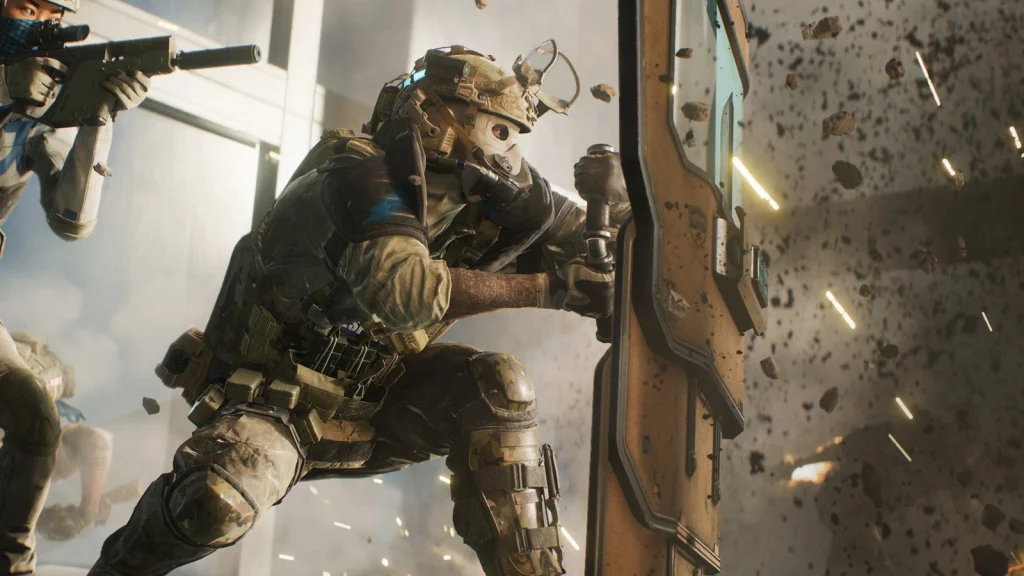
Enlarge / Call it a hunch, but something tells me these two players are working together…

Do you ever feel like your opponents in a free-for-all online game are trying to get you, specifically? It might not just be paranoia; it might be collusion among your opponents. And in a newly published patent application, Electronic Arts details some potential tools and data points—both inside and outside the game—that it could use to detect and root out this unfair practice.

EA’s simply titled “Detecting Collusion in Online Games” patent, published earlier this month, defines collusion as when two or more players/groups that are “intended to be opponents” instead “contribute to a common cause” to “gain an unfair advantage” over others. In battle royale shooter, for instance, a small group of players communicating outside the game could stay together and gain a decided firepower advantage against their single opponents.

Many of the patent’s potential methods for discovering this kind of collusion use simple and obvious in-game data. If two or more ostensibly opposed players or teams show abnormal amounts of “time spent in proximity… without engagement,” for instance, there’s a good chance they’re working together. Even if those players show some cursory opposition at points, metrics like damage per second can be compared with the average to see if this is just opposition “for appearance sake.”

Dropping items that another team or player consistently picks up is another potential sign of collusion, as is the same player or players showing up on opposing teams consistently in match after match. Colluding players may also tend to finish in similar ranked positions during their matches, especially “once the unfair advantage provided by colluding is nullified” as some of the colluding players are eliminated.

Big Brother is watching (for collusion)

Beyond easy-to-detect in-game data, though, EA’s patent details other signs of collusion that can be gleaned from things like “social relationships and communications” and “third-party system connections and interactions” outside the game. That kind of data ranges from simple relationships like a “friends list” provided by the gaming platform to completely external relationships like “social media connection data.”

The patent mentions “a cross team shared community metric” that counts “the number of group or community memberships… where players from both teams are members.” Things like “the number of posts by a player in a particular community” shared with another player could also signify potential collusion.

Just some of the internal and external factors that EAs patented method could use to detect collusion among players.
Enlarge / Just some of the internal and external factors that EAs patented method could use to detect collusion among players.

Even “the content of extra-game communication” could be fed into the algorithm, according to the patent, such as “messages to a forum which players from both teams are participating.” A “machine learning algorithm” could be used to glean any collusion-related context from this kind of out-of-game communication, or a simple keyword search could be used, according to the patent.

To be clear, the patent is upfront in saying that any player data used in any of these detection algorithms “would be in compliance with privacy policies that respect players’ privacy, and in accordance with player privacy settings or preferences.” That said, there’s something a little Big Brother-y about the prospect of a publisher like EA scanning your Twitter posts and Reddit community memberships to see if you’re trying to coordinate cheating in their online game.

Then again, in a world where players will go to extreme lengths to hide their cheating using external devices, maybe this kind of external social graph analysis is needed to root out some of the worst colluders (or at least some of the least-careful ones).
In any case, having a patented design doesn’t mean EA is (or ever will) use this kind of system in the wild. For now, it’s just an interesting look at how one company is thinking about potential ways to detect the human side of online cheating as well as the technical side. https://arstechnica.com/?p=1900502


Nvidia AI plays Minecraft, wins machine learning conference award

MineDojo's AI can perform complex tasks in Minecraft.
Enlarge / MineDojo’s AI can perform complex tasks in Minecraft.

A paper describing MineDojo, Nvidia’s generalist AI agent that can perform actions from written prompts in Minecraft, won an Outstanding Datasets and Benchmarks Paper Award at the 2022 NeurIPS (Neural Information Processing Systems) conference, Nvidia revealed on Monday.

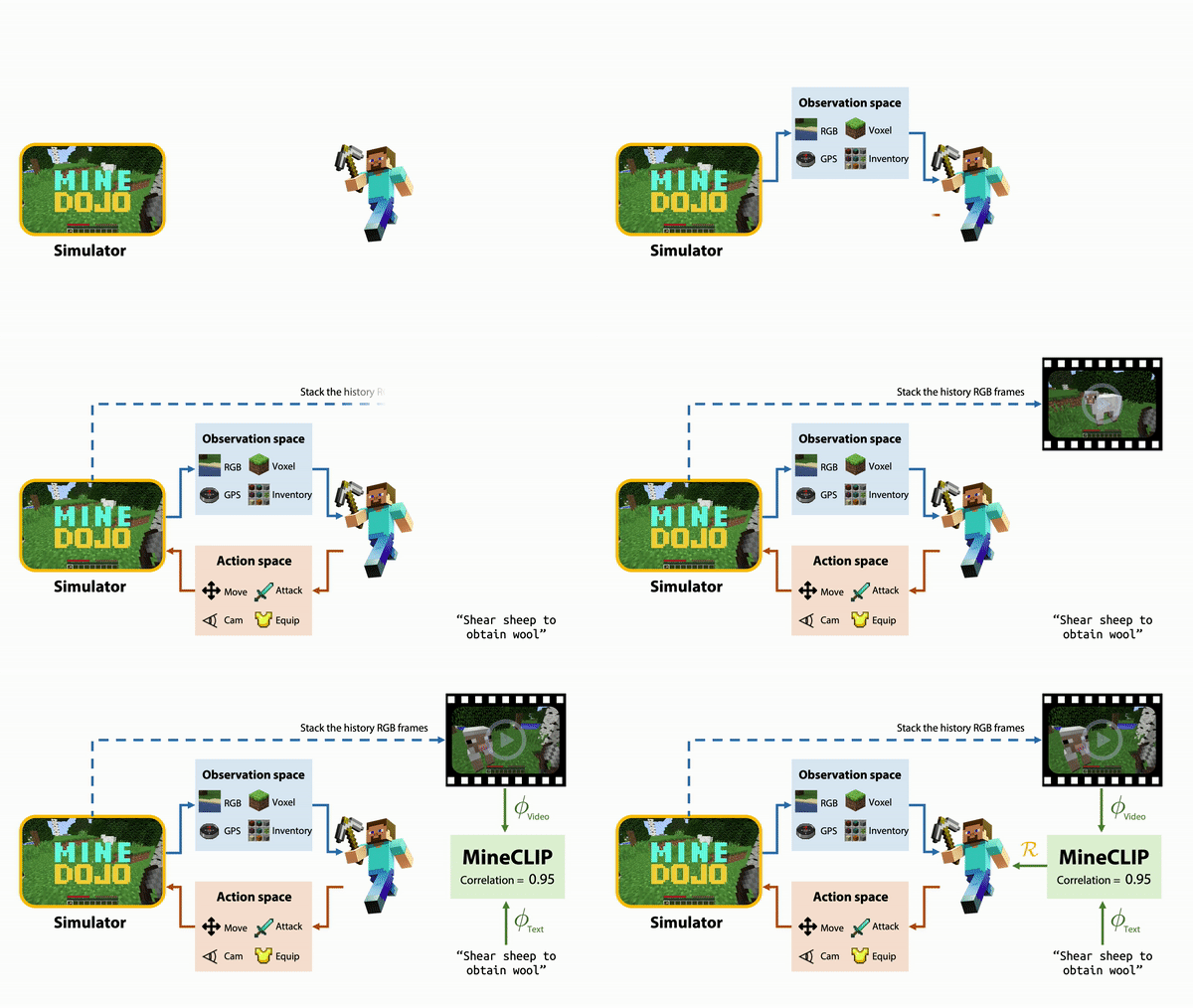
To train the MineDojo framework to play Minecraft, researchers fed it 730,000 Minecraft YouTube videos (with more than 2.2 billion words transcribed), 7,000 scraped webpages from the Minecraft wiki, and 340,000 Reddit posts and 6.6 million Reddit comments describing Minecraft gameplay.

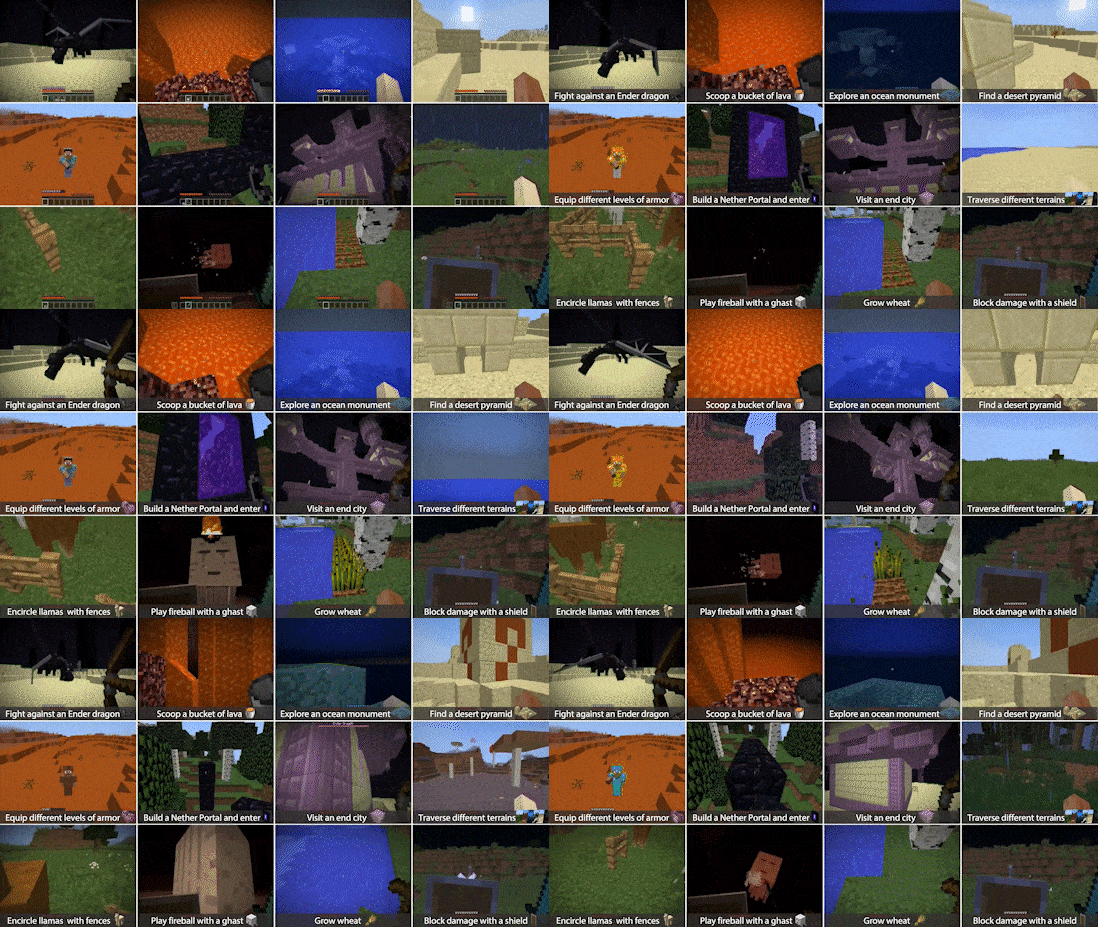
From this data, the researchers created a custom transformer model called MineCLIP that associates video clips with specific in-game Minecraft activities. As a result, someone can tell a MineDojo agent what to do in the game using high-level natural language, such as “find a desert pyramid” or “build a nether portal and enter it,” and MineDojo will execute the series of steps necessary to make it happen in the game.

Examples of tasks that MineDojo can perform.

MineDojo aims to create a flexible agent that can generalize learned actions and apply them to different behaviors in the game. As Nvidia writes, “While researchers have long trained autonomous AI agents in video-game environments such as StarCraft, Dota, and Go, these agents are usually specialists in only a few tasks. So Nvidia researchers turned to Minecraft, the world’s most popular game, to develop a scalable training framework for a generalist agent—one that can successfully execute a wide variety of open-ended tasks.”

The award-winning paper, “MINEDOJO: Building Open-Ended Embodied Agents with Internet-Scale Knowledge,” debuted in June. Its authors include Linxi Fan of Nvidia and Guanzhi Wang, Yunfan Jiang, Ajay Mandlekar, Yuncong Yang, Haoyi Zhu, Andrew Tang, De-An Huang, Yuke Zhu, and Anima Anandkumar of various academic institutions.

You can see examples of MineDojo in action on its official website, and the code for MineDojo and MineCLIP is available on GitHub.

https://arstechnica.com/?p=1900448


Regulatory filings suggest Nvidia’s scrapped RTX 4080 will return as the “4070 Ti”

Regulatory filings suggest Nvidia’s scrapped RTX 4080 will return as the “4070 Ti”

Last month, Nvidia took the unusual step of “unlaunching” a previously announced product. The 12GB version of the GeForce RTX 4080 graphics card was, by the company’s admission, “not named right” and was delayed and rebranded to avoid confusion with the 16GB version of the RTX 4080 that launched. Besides having less RAM, the 12GB version of the RTX 4080 also offered less memory bandwidth and fewer GPU cores than the 16GB version.

Nvidia didn’t announce exactly what branding it would use for the revived RTX 4080, but regulatory filings submitted by Gigabyte (as reported by VideoCardz) suggest that the company has settled on calling it the “4070 Ti.”

This isn’t guaranteed to be the actual name—regulatory filings like this can be placeholders rather than actual products—but this branding would be more consistent with how Nvidia has named past GPU generations. The xx80 cards usually use the same physical GPU die as the flagship xx90 cards but run at lower clock speeds and with parts of the die switched off; this allows Nvidia to use GPU dies with defects rather than tossing them out. The xx70 cards generally use a smaller, less-performant GPU die based on the same architecture.

Nvidia made the rebranding decision late enough in the process that it reportedly caused Nvidia and its partners to throw out finished packaging and other elements with “4080” branding. Redesigning and then re-manufacturing those things takes time, as does re-flashing the BIOSes on already-manufactured graphics cards so that they identify themselves as 4070 Tis rather than 4080s.

Nvidia still hasn’t said whether the price of the cards would also come down along with the model number; the 12GB version of the RTX 4080 was originally slated to launch for $899, while the RTX 3070 Ti was originally launched at $599. But existing RTX 4090 and 4080 cards are already difficult to get anywhere near their already-high $1,600 and $1,200 starting prices. It may be that an RTX 4070 Ti with decent 4K gaming performance, DLSS 3 support, and the other RTX 4000-series architectural bells and whistles would still sell out even with a big generation-over-generation price hike.

https://arstechnica.com/?p=1900465


Report: FTC “likely” to file suit to block Microsoft/Activision merger

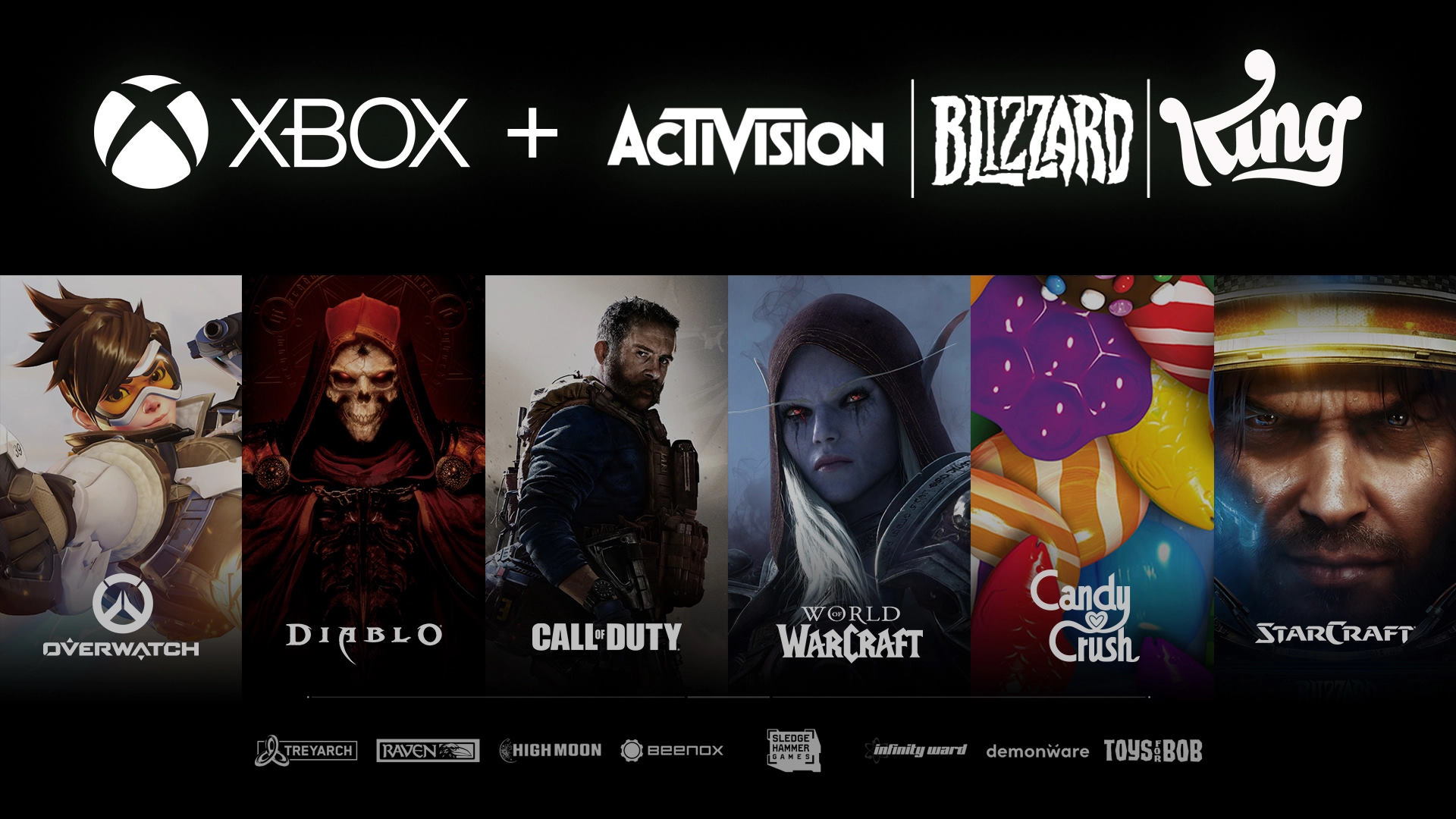
Just a few of the Activision franchises that will become Microsoft properties if and when the acquisition is finalized.
Enlarge / Just a few of the Activision franchises that will become Microsoft properties if and when the acquisition is finalized.
Microsoft / Activision

The Federal Trade Commission will “likely” move to file an antitrust lawsuit against Microsoft and Activision Blizzard to block the companies’ planned $69 billion merger deal. That’s according to a new Politico report citing “three [unnamed] people with knowledge of the matter.”

While Politico writes that a lawsuit is still “not guaranteed,” it adds that FTC staffers “are skeptical of the companies’ arguments” that the deal will not be anticompetitive. The sources also confirmed that “much of the heavy lifting is complete” in the commission’s investigation, and that a suit could be filed as early as next month.

Sony, the main opponent of Microsoft’s proposed purchase, has argued publicly that an existing contractual three-year guarantee to keep Activision’s best-selling Call of Duty franchise on PlayStation is “inadequate on many levels.” In response, Microsoft Head of Xbox Phil Spencer has publicly promised to continue shipping Call of Duty games on PlayStation “as long as there’s a PlayStation out there to ship to.” It’s not clear if the companies have memorialized that offer as a legal agreement, though; The New York Times reported this week that Microsoft had offered a “10-year deal to keep Call of Duty on PlayStation.”

Numerous statements from Microsoft executives, including Spencer, have suggested the company is less interested in bolstering its position in the “console wars” and more interested in boosting its mobile, cloud gaming, and Game Pass subscription offerings. Beyond Call of Duty, Politico reports that the FTC is concerned over how Microsoft “could leverage future, unannounced titles to boost its gaming business.”

Microsoft “is prepared to address the concerns of regulators, including the FTC, and Sony to ensure the deal closes with confidence,” spokesperson David Cuddy told Politico. “We’ll still trail Sony and Tencent in the market after the deal closes, and together Activision and Xbox will benefit gamers and developers and make the industry more competitive.”

Plenty of speed bumps remain

The reports of a potential FTC lawsuit add to a growing list of troubling signals about the proposed purchase from various international governments. Earlier this month, the European Commission said it was moving on to an “in-depth investigation” of the deal. In the UK, a similar “Phase 2” investigation by the country’s Competition and Markets Authority has scheduled hearing for next month.

Those international investigations are expected to wrap up in March, ensuring the proposed deal won’t close before then and giving the FTC some time before it would have to file suit. Any such lawsuit would need to be approved by a majority of the four current FTC commissioners and would likely start in the FTC’s administrative court. And whatever the outcome, legal maneuvering in the case could easily delay the planned merger past a July 2023 contractual deadline, at which point both companies would have to renegotiate or abandon the deal.

An FTC lawsuit in this matter would also be a the strongest sign yet of a robust antitrust enforcement regime under FTC chair Lina Kahn, a big tech skeptic who was named to the post in June. Back in July, Kahn announced an antitrust lawsuit against Meta (formerly Facebook) and its proposed $400 million purchase of Within, makers of VR fitness app Supernatural.

Three months after Microsoft’s proposed purchase was announced in January, a group of four US Senators wrote an open letter strongly urging the FTC to take a close look at the deal. Last month, merger news site Dealreporter said FTC staff had expressed “significant concerns” about the deal. And this week, the New York Times cited “two people” in reporting that the FTC had reached out to other companies for sworn statements laying out their concerns about the deal, a possible sign of lawsuit preparations.

https://arstechnica.com/?p=1899979


Meta researchers create AI that masters Diplomacy, tricking human players

A screenshot of Diplomacy provided by a CICERO researcher.
Enlarge / A screenshot of an online game of Diplomacy, including a running chat dialog, provided by a Cicero researcher.

On Tuesday, Meta AI announced the development of Cicero, which it claims is the first AI to achieve human-level performance in the strategic board game Diplomacy. It’s a notable achievement because the game requires deep interpersonal negotiation skills, which implies that Cicero has obtained a certain mastery of language necessary to win the game.

Even before Deep Blue beat Garry Kasparov at chess in 1997, board games were a useful measure of AI achievement. In 2015, another barrier fell when AlphaGo defeated Go master Lee Sedol. Both of those games follow a relatively clear set of analytical rules (although Go’s rules are typically simplified for computer AI).

But with Diplomacy, a large portion of the gameplay involves social skills. Players must show empathy, use natural language, and build relationships to win—a difficult task for a computer player. With this in mind, Meta asked, “Can we build more effective and flexible agents that can use language to negotiate, persuade, and work with people to achieve strategic goals similar to the way humans do?”

According to Meta, the answer is yes. Cicero learned its skills by playing an online version of Diplomacy on webDiplomacy.net. Over time, it became a master at the game, reportedly achieving “more than double the average score” of human players and ranking in the top 10 percent of people who played more than one game.

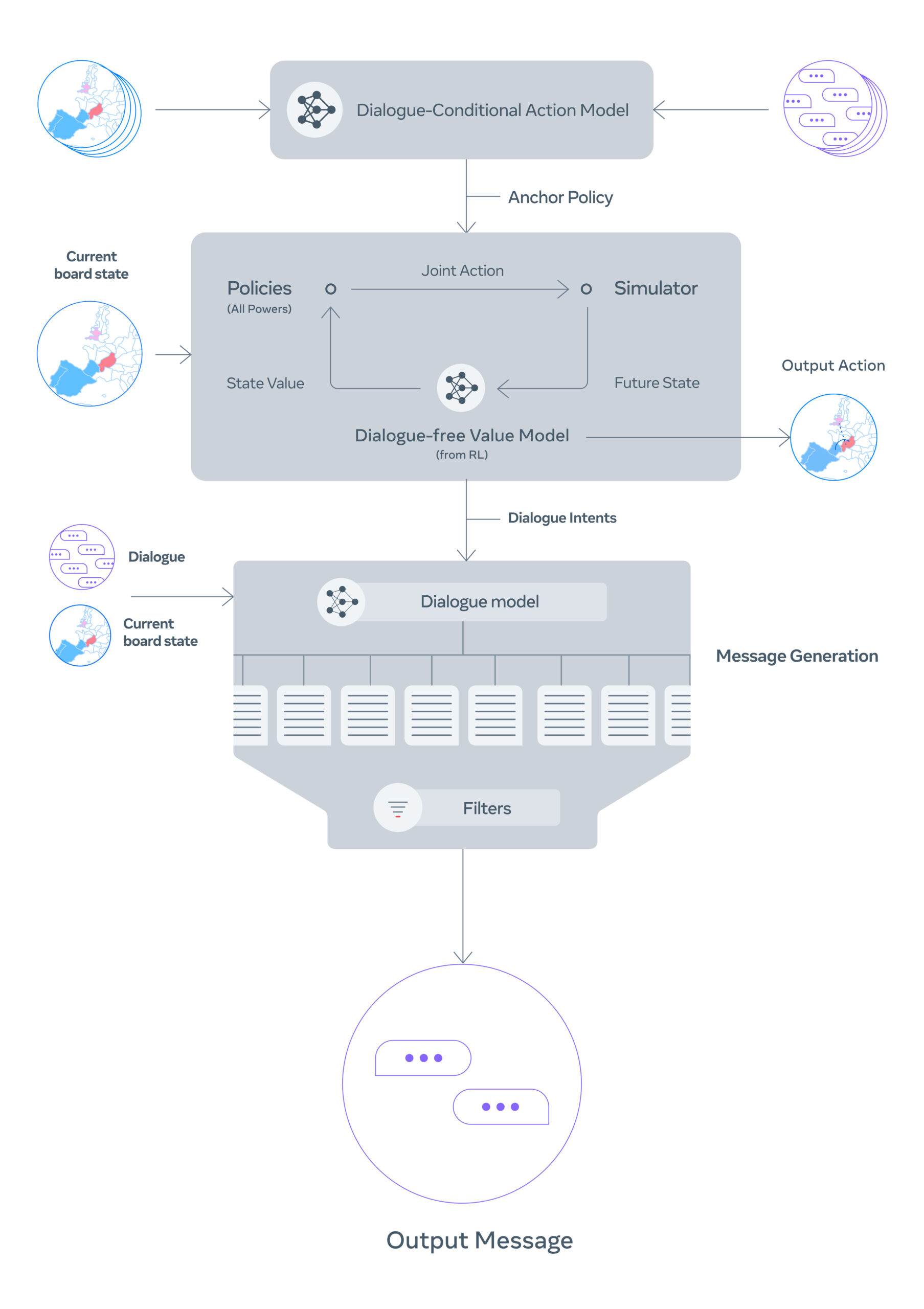
To create Cicero, Meta pulled together AI models for strategic reasoning (similar to AlphaGo) and natural language processing (similar to GPT-3) and rolled them into one agent. During each game, Cicero looks at the state of the game board and the conversation history and predicts how other players will act. It crafts a plan that it executes through a language model that can generate human-like dialogue, allowing it to coordinate with other players.

<a href="https://cdn.arstechnica.net/wp-content/uploads/2022/11/Visual_UnderTheHood-scaled.jpg" class="enlarge" data-height="2560" data-width="1807" alt="A block diagram of Cicero, the Diplomacy-playing bot, provided by Meta.”><img alt="A block diagram of Cicero, the Diplomacy-playing bot, provided by Meta.” src=”https://rassegna.lbit-solution.it/wp-content/uploads/2022/11/meta-researchers-create-ai-that-masters-diplomacy-tricking-human-players-1.jpg” width=”640″ height=”907″ srcset=”https://rassegna.lbit-solution.it/wp-content/uploads/2022/11/meta-researchers-create-ai-that-masters-diplomacy-tricking-human-players-2.jpg 2x”>
Enlarge / A block diagram of Cicero, the Diplomacy-playing bot, provided by Meta.

Meta calls Cicero’s natural language skills a “controllable dialogue model,” which is where the heart of Cicero’s personality lies. Like GPT-3, Cicero pulls from a large corpus of Internet text scraped from the web. “To build a controllable dialogue model, we started with a 2.7 billion parameter BART-like language model pre-trained on text from the Internet and fine tuned on over 40,000 human games on webDiplomacy.net,” writes Meta.

The resulting model mastered the intricacies of a complex game. “Cicero can deduce, for example, that later in the game it will need the support of one particular player,” says Meta, “and then craft a strategy to win that person’s favor—and even recognize the risks and opportunities that that player sees from their particular point of view.”

Meta’s Cicero research appeared in the journal Science under the title, “Human-level play in the game of Diplomacy by combining language models with strategic reasoning.”

As for wider applications, Meta suggests that its Cicero research could “ease communication barriers” between humans and AI, such as maintaining a long-term conversation to teach someone a new skill. Or it could power a video game where NPCs can talk just like humans, understanding the player’s motivations and adapting along the way.

At the same time, this technology could be used to manipulate humans by impersonating people and tricking them in potentially dangerous ways, depending on the context. Along those lines, Meta hopes other researchers can build on its code “in a responsible manner,” and says it has taken steps toward detecting and removing “toxic messages in this new domain,” which likely refers to dialog Cicero learned from the Internet texts it ingested—always a risk for large language models.

Meta provided a detailed site to explain how Cicero works and has also open-sourced Cicero’s code on GitHub. Online Diplomacy fans—and maybe even the rest of us—may need to watch out.

https://arstechnica.com/?p=1899693


Crypto and NFTs aren’t welcome in Grand Theft Auto Online

<img src="https://rassegna.lbit-solution.it/wp-content/uploads/2022/11/crypto-and-nfts-arent-welcome-in-grand-theft-auto-online.jpg" alt="Cold hard (virtual) cash only in GTA Online, please.”>
Enlarge / Cold hard (virtual) cash only in GTA Online, please.

Cryptocurrencies and NFTs have been formally disallowed from Grand Theft Auto Online‘s popular role-playing (RP) servers. That’s according to a new set of guidelines posted on Rockstar’s support site last Friday.

In the note, the game’s publisher says its new RP server rules are aligned with Rockstar’s existing rules for single-player mods. Both sets of rules prohibit content that uses third-party intellectual property, interferes with official multiplayer services, or makes new “games, stories, missions or maps” for the game. This means RP servers based on re-creating Super Mario Kart in the Grand Theft Auto world, for instance, could face “priority in enforcement actions” from Rockstar.

But the new RP guidelines surpass the existing single-player mod guidelines in barring “commercial exploitation.” That’s a wide-ranging term that Rockstar says specifically includes selling loot boxes, virtual currencies, corporate sponsorships, or any integrations of cryptocurrencies or “crypto assets (e.g. ‘NFTs’).”

It’s all been done before

The new guidelines seem to directly respond to “The Trenches,” a role-playing community launched in September by OTF Gaming and rapper Lil Durk. That server advertised integration with both “endemic and non-endemic brands in the gaming space” and a “Trenches Pass” NFT drop to access specific on-server content.

“We’ve been asked to cease all operations of Trenches,” OTF Gaming said in a statement on social media. “We have no choice but to comply with their demands, as we intend to do right by Take-Two and Rockstar. We will be working with them to find an amicable solution to this matter.”

If this situation sounds familiar, it might be because developer Mojang similarly barred NFT integration from its online servers in July. At the time, Minecraft-based crypto project NFT Worlds said it was hoping to work with Mojang to “find an alternative outcome that’s beneficial to the Minecraft player base.”

Days later, though, NFT Worlds said it gave up on that and began work on a new game that will be “based on many of the core mechanics of Minecraft” but which will be “completely untethered from the policy enforcement Microsoft and Mojang have over Minecraft.”

In Minecraft‘s case, Mojang said that the “scarcity and exclusion” inherent to NFTs “does not align with Minecraft values of creative inclusion and playing together.” That reasoning applies less to GTA Online, though, a game that rakes in hundreds of millions of dollars annually by selling in-game currency and exclusive items for use by players.

If anything, things like NFTs and loot boxes could be seen as competition for GTA Online‘s official monetization efforts. With that competition cut off, though, Rockstar sounds eager to allow RP servers to continue to operate within reason.

“Rockstar Games has always believed in reasonable fan creativity and wants creators to showcase their passion for our games,” the company writes. “Third-party ‘Roleplay’ servers are an extension of the rich array of community-created experiences within Grand Theft Auto that we hope will continue to thrive in a safe and friendly way for many years to come.”

https://arstechnica.com/?p=1899726


Light, shadow, reflections, and terror: How a scary game does scary lighting

Directed by Sean Dacanay. Produced by Justin Wolfson. Edited by Jeremy Smolnik, with Billy Ward. Click here for transcript.

A couple of weeks back, we joined up with Glen Schofield of Striking Distance Studios to have him walk us through some behind-the-scenes previews of his studio’s upcoming game, The Callisto Protocol. In our series so far, we’ve explored Callisto’s gameplay and its audio design, and this week we’re continuing our sneak peek with a look at the look of the game—the lighting and visuals.

Humans are primarily visual creatures, and clever game designers take advantage of that by using a game’s visuals as not just a way to show the player what’s happening, but also as an opportunity to extend and express the game’s style—games, like so many other forms of art, can communicate themes and emotions to a player through constrained use of color or through the emphasis of specific imagery or through the use of light and shadow to emphasize and hide aspects of a scene. And Glen and his crew at Striking Distance—folks like art director Demetrius Leal and lighting director and Dead Space veteran Atsushi Seo—are definitely clever game designers. During the preproduction phase of the game, the team deluged Glen with images showing both visual examples of how they wanted the game’s architecture and monsters to look, and also of interesting and effective lighting techniques.

Combined with Glen’s horror-filled imagination and artistic skill, the designers came out of preproduction with an extremely detailed art bible, which was the guiding force behind the game’s visuals. These were realized in 2020-era photorealisticity through the Unreal Engine, which at this point can create truly complex and beautiful lighting on PCs and consoles. And the results are scary indeed.

We’ll be back next week for the final piece in this four-part series, where we’ll be looking at motion capture and wrapping things up. Stay tuned!

https://arstechnica.com/?p=1899437


“Just a bunch of idiots having fun”—a photo history of the LAN party

<img src="https://rassegna.lbit-solution.it/wp-content/uploads/2022/11/just-a-bunch-of-idiots-having-fun-a-photo-history-of-the-lan-party.jpg" alt="The burned-in timestamp, the water-cooled PC tower, the chaotic configuration of monitors and peripherals—this is what LAN Party aims to capture.”>
Enlarge / The burned-in timestamp, the water-cooled PC tower, the chaotic configuration of monitors and peripherals—this is what LAN Party aims to capture.
Kiel Oleson

“I guess I am thinking a lot about the early 2000s lately, like a lot of people, I think, in their 30s.”

That’s one of the first things writer, game designer, and podcaster Merritt K said to me in early November. At this moment, everything about gaming, and being online generally, was fundamentally easier than it was at the turn of the century. You can now play intensive triple-A games on a cheap phone, given a cloud gaming subscription and a decent wireless connection. You can set up a chat room, build an online presence, even publish videos, instantaneously, for free. Performance-minded and customizable PC gaming hardware is just a few clicks and a couple days away from showing up at your door.

And yet we’re both hopelessly wistful for something else entirely: LAN parties. Merritt K so much so that she’s writing, compiling, and crowdfunding a book: LAN Party. It’s a collection of original amateur photos—many upscaled through AI—and short essays on a period when multiplayer gaming meant desktop towers, energy drinks, and being physically present in some awkward spaces. It’s been in the works for more than a year, but she’s been thinking about it much longer.

“Some reasons for that are just nostalgia, like, ‘Remember when you were a teen, listening to emo music, going to LAN parties and stuff.’ But there is another aspect of it, where the Internet that I think a lot of like, Gen X, elder millennial, or mid-millennial-aged people grew up with, is basically falling apart,” Merritt K said. “We’ve felt like this thing that was so important to me, Internet culture and being online and tech and all this stuff—it was so hard to be growing up, and it gave me a way to talk to people and make connections.

“And now it’s like the opposite of that. Real life is where you can have meaningful interactions with people, and online is where you have to present this brand, this manicured identity. I think one thing that appeals to people, and to me, about LAN parties is they’re kind of emblematic of this earlier era of tech, when things were a little rougher around the edges.”

Lewis van den Berg-Shaw

From late-night tweet to AI upscaling

The decline of truly DIY consumer tech, the 20-year nostalgia window, the isolation of COVID-19—some or all of these guided a late-night tweet of Merritt K’s in September 2021 to nearly 100,000 likes. Over four harshly lit images of people wearing patently millennium-era clothing: “I want to produce a coffee table book that’s just pictures of LAN parties from the 90s and 2000s.” Two minutes later: “Do not steal this idea it’s mine someone please publish this.”

Someone is indeed publishing this: the UK-based videogame history publisher Read-Only Memory. Merritt K sought out original photos and heard from hundreds of eager fans. Some had to dig through old media and hope entropy had yet to set in. Some still had image folders sitting on long-neglected but public web servers. Merritt K had seen many of the famous LAN party memes—the San Antonio Spurs playing StarCraft on a plane next to their NBA championship trophy, the guy duct-taped to a ceiling—but was taken aback by how rich the lesser-known photos she received were.

“The composition in some of these is, accidentally, so good,” Merritt K said. “They just reveal so much about the era in terms of the fashions, the food, the drinks, even the interior decor. I think that resonated with a lot of other people, too.”

The people who frequented LAN parties tended to be early adopters, and that included digital photography—grainy, yellow-timestamped, single-digit-megapixel, point-and-shoot digital photography. Untrained photographers shooting with Y2K-era gear in dimly lit spaces lent the photos Merritt K collected a lot of charm but also made many of them impossible to publish in high-resolution print.

<a href="https://cdn.arstechnica.net/wp-content/uploads/2022/11/Gigapixel_AI_upscaling-scaled.jpg" class="enlarge" data-height="1600" data-width="2560" alt="LAN Party uses Gigapixel AI to upscale the low-res, grainy, often dimly lit photos of the titular events.”><img alt="LAN Party uses Gigapixel AI to upscale the low-res, grainy, often dimly lit photos of the titular events.” src=”https://rassegna.lbit-solution.it/wp-content/uploads/2022/11/just-a-bunch-of-idiots-having-fun-a-photo-history-of-the-lan-party-2.jpg” width=”640″ height=”400″ srcset=”https://rassegna.lbit-solution.it/wp-content/uploads/2022/11/just-a-bunch-of-idiots-having-fun-a-photo-history-of-the-lan-party-5.jpg 2x”>
Enlarge / LAN Party uses Gigapixel AI to upscale the low-res, grainy, often dimly lit photos of the titular events.
LAN Party / Read-Only Memory

Enter Gigapixel AI, learning software that can upscale images up to 600 percent. Gigapixel upscaled famous 1896 films of trains arriving, helped another AI claim a controversial art fair win, and further blurred the line between digital photo and illustration. Some interesting photos had to be left out because they were just too dark or blurry, even with AI help. Others made Merritt K and her editors question the line between the dark-basement reality and needing images that worked in a physical book. It was a tricky balance, Merritt K said, but the overall spirit was enlightenment and entertainment, not light-balance accuracy.

James Joplin

https://arstechnica.com/?p=1898593


Hobbyist adds a hinge to the Game Boy Pocket, delighting everyone

This custom-built Game Boy Pocket SP can fold in half like a feisty clam.
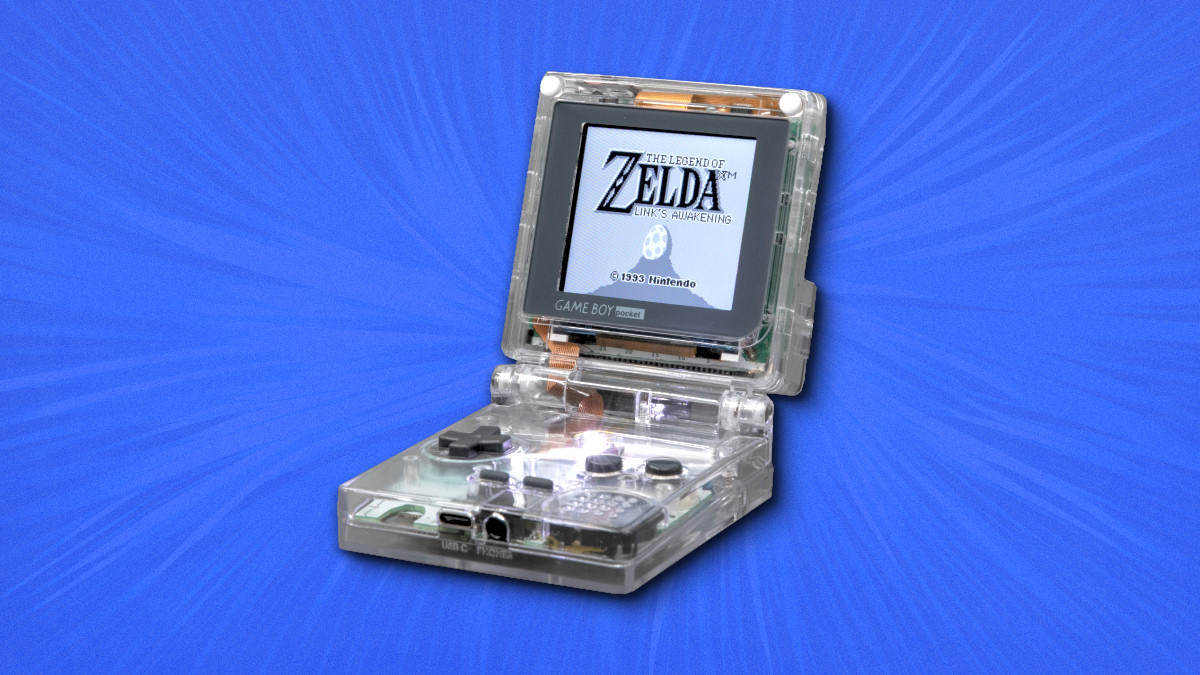
Enlarge / This custom-built Game Boy Pocket SP can fold in half like a feisty clam.

Earlier this month, a programmer and hobbyist named Allison Parrish debuted a compact hack of the 1996 Nintendo Game Boy Pocket handheld game console. Taking inspiration from the later Game Boy Advance SP, she fabricated a custom plastic shell with a hinge so the older monochrome Game Boy can fold shut. She calls it the Game Boy Pocket SP.

In Parrish’s extensive write-up of the mod, she explains that her hack began as something of a joke. The Game Boy modding community is popular right now, and one currently trending mod involves transplanting the circuitry of a folding Game Boy Advance SP (from 2003) into a non-folding custom shell. So she thought, “If y’all can take the hinge out of an SP, why can’t I add a hinge to a Game Boy that never had one?”

Parrish, who is an assistant arts professor at NYU, built her complex folding mod over the summer using tools at her university department’s ITP/IMA shop and the NYU Makerspace. Its unique clamshell design comes courtesy of a Game Boy Pocket motherboard she cut in half, along with custom-design flex PCBs (printed circuit boards) that route signals between the two folding halves. To pull it all together, Parrish designed a 3D-printed plastic shell using FreeCAD.

An exploded CAD view of the Game Boy Pocket SP's custom shell, designed by Allison Parrish.
An exploded CAD view of the Game Boy Pocket SP’s custom shell, designed by Allison Parrish.

Additional parts, such as the backlit screen, label, buttons, and rechargeable battery, came from hobbyist shops.

The finished product is compact, backlit, rechargeable via USB, and it plays original monochrome Game Boy games. Cartridges plug in just behind the screen, like in the original Game Boy Pocket. After announcing a rough prototype of the mod in September, the Game Boy Pocket SP won first place in the “Technical” category in r/gameboy’s modding contest on Reddit.

Currently, the Game Boy Pocket SP remains a one-of-a-kind device because of the intense effort involved in making it. “The research and development process was also very expensive,” Parrish writes. “In addition to the costs of materials and manufacturing, there’s also the cost of my own labor.”

Still, if you’d like to attempt to replicate her feat, Parrish has provided PCB and shell design files on GitHub and an almost step-by-step write-up of the build process on her website.

https://arstechnica.com/?p=1898074


This year’s ugly Microsoft sweater has a suggestion for you: It’s Clippy

Microsoft's newest ugly sweater is Clippy- and Office-themed.
Enlarge / Microsoft’s newest ugly sweater is Clippy- and Office-themed.

I’m not always a fan of corporate whimsy—like when brands’ Twitter accounts have “attitude” or when companies put together cringe-worthy April Fools’ Day pranks—but I do enjoy Microsoft’s now-yearly tradition of releasing ugly sweaters with retro Windows patterns printed on them. Two years ago, the patterns were MS Paint- and Windows logo-themed. Last year’s pattern paid homage to Windows 3.1-era Minesweeper. And this year’s brings back an old frenemy: Clippy.

Though his days as a ubiquitous Microsoft Office mascot ended when Office 2007 was released, Clippy has found a second life as Windows 11’s version of the paperclip emoji. Clippy was not, unfortunately, open-sourced along with the rest of Microsoft’s emoji designs over the summer, owing to his status as a copyrighted character.

Clippy is the hero of the new sweaters, but there are other little Office- and Windows-themed touches, too—an old-school Windows logo on the back, the Office ruler on the top, some formatting buttons on the sleeves, and falling stacks of paper throughout.

The Clippy sweater is available in sizes small through 3XL and costs $75 no matter what size you get. That’s a bit on the pricey side, but unlike a lot of ugly sweaters, the Clippy one does appear to be an actual knit sweater and not a sweatshirt with a pattern printed on it. As part of its promotional efforts around the sweater, Microsoft also says it will donate $100,000 to the College Success Foundation.

There’s no word on whether we can expect sweaters honoring the many other Microsoft Office Assistant designs, like the red dot or the Einstein-looking guy or the little robot. Rover, the yellow dog from Microsoft Bob and the Windows XP search dialog, is also MIA.

Ars Technica may earn compensation for sales from links on this post through affiliate programs.

https://arstechnica.com/?p=1897926