Once again, engage: Picard trailer feels like the next Next Generation
“Engage!” Yes, that’s what Sir Patrick Stewart says in this moment, and yes, it’s as delightful in action as that sounds.
Seven of Nine returns quite a few times in this trailer.
We also see Data join Picard for a bittersweet game of cards.
That’s not to be confused with the part where we see Data spread out like a deck of cards himself.
This Halloween’s hot new costume: disassembled Data.
Despite the familiar faces, the latest Picard trailer mostly revolves around Picard happening upon a woman in need of help.
We see this new woman fight a few times, though this screen doesn’t show her most interesting power: the ability to vanish in thin air.
I guess it’s time for Picard to leave the comforts of the vineyard…
…and go back to Starfleet in search of help.
“I don’t see why we have to do this every year.”
“Sometimes, I worry that you’ve forgotten who you are. Do not.”
‘You need help. Protection. You need a crew.”
My money is on this guy arguing with Picard about logic.
Also ominous.
“She has no idea who she truly is,” this man remarks.
Alison Pill, seen here looking as excited as we are that Picard is back.
All eyes were on San Diego Comic Con’s Star Trek panel this year, as anticipation continues to build for Star Trek: Picard, the first Trek entry to feature Sir Patrick Stewart since the 2002 film Star Trek: Nemesis. And on Saturday, the series’ handlers at CBS didn’t disappoint.
A whopping two-minute trailer went well past “teaser” status with a smorgasbord of story, action, and detail for this CBS All-Access exclusive, all clarifying what little we knew from the first teaser in May. Picard’s retirement to a vineyard was further clarified: it came, in part, because “Commander Data sacrificed his life for me.” (This plot point is emphasized in the new trailer by Picard examining Data’s body parts, all spread out and disconnected in a storage facility.)
Roughly two decades after that calamity, however, a mysterious, unnamed woman (Isa Briones) finds Picard on his retirement grounds and pleads with him: “Everything inside of me says that I’m safe with you.” The woman’s shapeshifting powers and athletic prowess are put on display before Picard returns to an apparent Starfleet outpost. That’s where he declares his hunch to an admiral: “If she is who I think she is, she is in serious danger.”
From there, the trailer yadda-yadda-yaddas to a point where Picard takes interstellar travel into his own hands—and is supported by a brand-new cast of shipmates, all while facing dire-sounding cries about the woman in question. “She has no idea what she truly is,” one crew member says. “She’s the end of all!” a pinned-down Vulcan later declares.
We get hints of Picard taking off and landing on various outposts. In one of these sequences, he pours a drink in a dimly lit office before being greeted by a familiar voice, “The hell are you doing out here—saving the galaxy?” This voice comes from Seven of Nine (Jeri Ryan), who pops up in other brief trailer moments as if to indicate she’s not relegated to single-cameo status. The same cannot be said for Data (Brent Spiner), who we only see briefly play a game of cards with Picard. We can only speculate how much that beloved character will appear in the new TV series.
The trailer’s reveal at SDCC included confirmation that a few other ST:TNG stars will feature in the series, including Jonathan Del Arco (Hugh) and Jonathan Frakes (Riker), although those stars’ Picard reveals will have to wait for another day. Until then, we at least get a peek at new cast members Alison Pill (The Newsroom), Michelle Hurd (Netflix’s Daredevil), Harry Treadaway (Penny Dreadful), and Santiago Cabrera (Heroes).
One additional fun reveal came at the event: a new CBS All-Access animated series titled Star Trek: Lower Decks. This series’ announcement did not come with a trailer, but we shouldn’t have to wait long to see more, as Lower Decks is expected to drop in 2020.
Operation Avalanche, the only good conspiracy—fake the Moon landing, get promoted
With this weekend’s 50th anniversary of the Moon landing, it’s worth remembering most conspiracy theories are more-or-less the same: a shadowy cabal of all-powerful, all-knowing elites comes together to manipulate us commoners, for whom they have nothing but contempt. The cabal changes—globalists, Lizard People, the media, the Vatican, whatevs—but the song remains the same.
So a few years back when I heard someone had made yet another a low-budget mockumentary about faking the Apollo 11 Moon landing, that’s what I was expecting. Maybe even Kubrick would be evoked again. Instead, imagine my surprise when 2016’s Operation Avalanche turned out to be light on conspiracy against the sheeple and heavy on a bumbling, baby-faced doofus who comes up with a plan to fake the Moon landing as basically a way to impress his boss.
Psychologists speculate that people are drawn to conspiracy theories because a world controlled by dark forces is still preferable to a world in which no one is at the controls. But truthers will find cold comfort in Operation Avalanche‘s view that the masters of the universe are more likely to be a grinning nincompoop whose best friend’s wife greets him with “Don’t touch me.”
Not your typical conspiracy
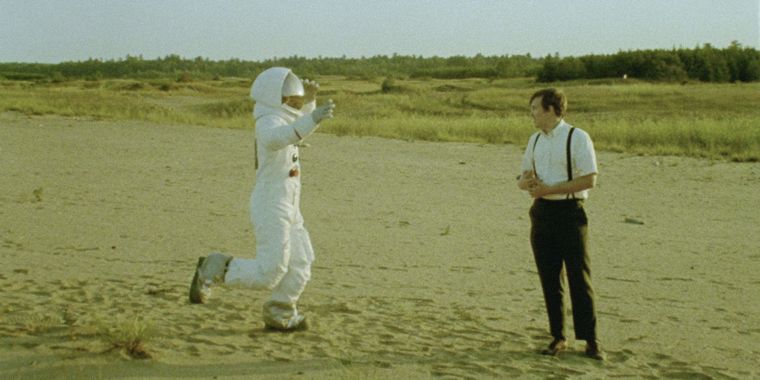
Operation Avalanche opens in the late 1960s and follows BFFs Matt Johnson and Owen Williams (played by director/cowriter Matt Johnson and Owen Williams, natch) who are lackeys in the CIA’s audiovisual department. Through a combination of bravado and BS, Johnson talks his perpetually irritated superior into letting them hunt for a Soviet mole that has burrowed into NASA. Instead of posing as scientists or engineers, they’ll pose as a documentary film crew in order to gain access to the Manned Spacecraft Center in Houston. (Fun fact: the real-life filmmakers were able to film on location with NASA by using this exact same lie. When NASA found out after the fact, it was not pleased.)
Watching how an undercover mission leads Johnson to, almost by accident, back into a scheme to fake the Moon landing is too much of a hoot for me to spoil. From there, our heroes pick up another superior (cowriter Josh Boles) who has even less patience with the barely suppressed emotional neediness that is so clearly driving Johnson. They eventually end up turning a warehouse into a makeshift studio where they play all the Moon truthers’ greatest hits: cutting photos, setting up cameras, hammering together a lander, etc.
Fast-paced
As director, Johnson uses his previous experience helming the mockumentaries The Dirties and Nirvana the Band to keep Operation Avalanche light on its feet. A few sight gags aside, most of my laughs aren’t from the characters doing or saying funny things but from how their situations become progressively more dangerous and asinine at the same time. Along the way, Avalanche morphs into one of those ’70s-style paranoid thrillers that are usually about a man who’s about 15% less clever than he thinks he is getting in over his head. (Think Warren Beatty in The Parallax View or Gene Hackman in The Conversation, Night Moves, and probably a few other flicks.) As someone who is deathly afraid that I’m not as capable as I think I am, I have no idea why I can’t get enough of stories like this. Maybe they’re cathartic.
Speaking of The Conversation (and its spiritual cousins Blow Up and Blow Out), Operation Avalanche is interested in process. Unlike Capricorn One, a conspiracy film in which the entire fake landing is planned and built before the movie even starts, the protagonists in Avalanche can’t just snap their fingers and know how to fake low gravity and the lunar surface. Their quest for locations, filming techniques, and special effects frustrates them when it yields multiple dead-ends. While labor intensive, actually building the phony lander might be the least complicated thing they do.
[embedded content]
The trailer for Operation Avalanche
Handheld
Operation Avalanche‘s low budget doesn’t hurt it for a couple reasons. First, of course, is how much of it was shot at Johnson Space Center (which was the Manned Spacecraft Center until 1973, although the filmmakers may have goofed and shown the big JSC sign that’s off NASA Road One). And second: despite what movies have taught us, the interiors of most government buildings look like public high schools. The film also makes liberal use of era-specific stock footage in which our characters are occasionally inserted a la Forrest Gump and Citizen Kane.
The Blair Witch Project turns 20 this year, so we all know what found-footage films look like. Still, because Avalanche‘s CIA agents are often covertly filming their subjects, themselves, and each other, the movie has some lovely frames within frames, and the filmmakers have fun hopping between aspects ratios and going from black-and-white to color. The kind of cinephile who fetishizes scratched film, blown-out lighting sources, and shots that are temporarily out of focus will not leave disappointed.
As for those scratches, IMDb says that Operation Avalanche was shot digitally using Red One and Blackmagic cameras. That means (sad face) that the scratches and grain were added by the filmmakers to mimic beat-up old films. They aren’t real, and they aren’t always convincing either, but we appreciate the effort. That also means that, when the CIA guys are talking about shooting film to look like video, we’re watching them on video that’s been made to look like film. Cram your brain into that Möbius strip for a few minutes.
But they don’t believe this crap, do they?
I have yet to scour the Internet for interviews with Matt Johnson to see if he actually believes the Apollo 11 landing was faked (he clearly believes that the bundle of unmet emotional needs he plays would be more than eager to fake anything). My gut says the movie is tongue-in-cheek, but I might be projecting because I enjoyed it.
You may be asking, if the filmmakers don’t believe Apollo 11 was faked, isn’t it irresponsible to make a movie that says it was? Won’t conspiracists use Operation Avalanche as a way to spread misinformation? Why throw jet fuel (which can’t melt steel beams) on that fire? What’s next, a thriller about vaccinated children roving the streets in search of human flesh?
And if the filmmakers do think the Moon landing was faked, wasn’t it irresponsible for festivals like Sundance to show Operation Avalanche? Isn’t it irresponsible of Amazon to carry it? Should we protest Alamo Drafthouse Film Club for screening it? Aren’t I making the world a worse place just by writing this review?
WHAT HAVE I DONE?
Operation Avalanche is currently available for streaming on Amazon.
The new Terminator board game is actually worth your time
Welcome to Ars Cardboard, our weekend look at tabletop games! Check out our complete board gaming coverage at cardboard.arstechnica.com.
Even Terminator has a board game now. In the “golden age” of tabletop gaming, companies and licensing have brought us a wealth of titles, including those that no one was asking for (I’m looking at you, Ghostbusters and Wacky Races). Is Terminator Genisys: Rise of the Resistance something to get excited about?
Thankfully, yes.
Board gaming Terminator fans, your time has come.
Charlie Theel
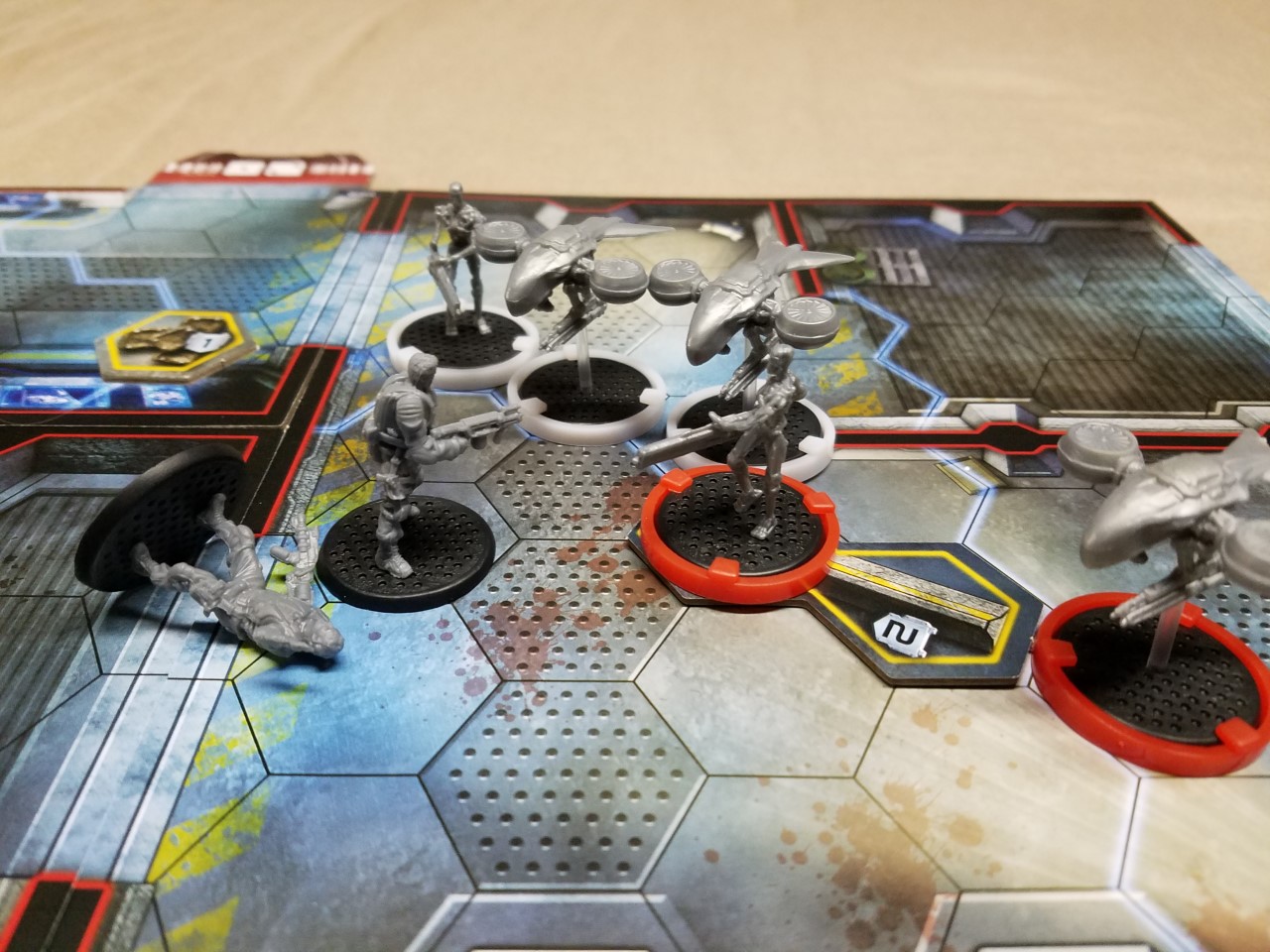
The game’s contents.
Charlie Theel
The game in action.
Charlie Theel
A player board and associated goodies.
Charlie Theel
Stay away from me.
Charlie Theel
Set in the confusing Genisys timeline, the game provides plenty of apocalyptic destruction for players to wade through, but it also feels like we’re being kept on the fringes of the main Terminator series—removed from the most iconic situations. This created a challenge for the design team to work through, but it’s one they handled well.
As a cooperative dungeon crawler, the game performs. There are various types of enemy “Endos,” drones, and even several bosses such as the invincible T-1000. The result is a miniatures-based adventure injected with a touch of narrative… and plenty of carnage.
Cyberdyne Systems, Model 101
The backbone of the game is solid. Skynet’s forces are appropriately run by a very simple set of AI priorities. The horde of T-800s and “Hunter-Killer Drones” will doggedly approach and seek to overwhelm players with sheer volume. Players will beat back the machines by using resistance forces composed of noteworthy heroes such as John Connor, Kyle Reese, and Arnold Schwarzenegger’s “The Guardian” from Terminator 2. The game smartly balances confined corridor fighting with the big personalities of beloved characters.
The core action system is smooth. Players roll six-sided dice and then assign the results to various action spaces on their asymmetric character boards. Dice pips can modify the effectiveness of your actions, allowing you to move further, heal more, or hit harder. Equipment—which is surprising in its diversity—also relies on these action spaces, fueling more outrageous and effective attacks. Plopping down a six on your advanced plasma rifle and throwing a fistful of attack dice is empowering. It’s reminiscent of a similar function in the spectacular dungeon crawler Claustrophobia.
Rise of the Resistance is an amalgamation of great ideas we’ve already seen in gaming. Primarily, it’s a scenario-based crawler with an optional campaign mode, and it’s equally gear and character focused. The dice-based combat is quick and clean. Characters and villains have a touch of asymmetry and a bit of personality.
When the game does veer slightly off the beaten path, some wonderful things happen. Engaging narrative vignettes are triggered when players move characters around the map, but the entry you read from each time is randomized. This adds a touch of surprise while including a quirky personality to each mission.
How this works in play is relatively simple. Tokens are randomized and placed in different sectors of the map. As soon as you gain line of sight to a token, you flip it over and read from the associated entry. So the “E” encounter may contain a couple of sentences explaining that prisoners are being executed by a group of T-800s. This spawns the group, immediately presenting you with an opportunity to halt the slaughter. When replaying the mission, however, you might draw a different token at this exact spot; the “A” encounter could result in a heavy ambush on your position.
The design team also made a clever decision to include enemy reactions to player-initiated attacks. There’s a little skull symbol on the combat dice that can turn up and cause havoc. It can make the 800s move ever closer, like impervious executioners, or it can make the HK drones twist and dodge from your attacks. The flamethrower Endos, the T-1000, and other bosses each have their own formidable set of reactions and counters. This mechanism adds a touch of appreciated risk to the proceedings while also adding enemy diversity.
One of the game’s strongest elements is character growth. As you push through the campaign, you’ll grab gear scavenged along the way—but you will also acquire new skills and abilities. These are spread across cards and are linked to class descriptors that fit specific roles, such as “medic” or “commander.” They allow you to extend your asymmetric suite of powers and mold your play style over time, giving the game some good replayability. Flying back through old scenarios and trying new builds is absolutely worth exploring here.
I need your clothes, your boots, and your motorcycle
Enlarge/ Bit of a pickle we’ve gotten ourselves into.
Rise of the Resistance’s mechanisms may not be as innovative as those seen in something like Gloomhaven, but its handling of setting is first-rate. When you encounter a T-1000, you have the wind appropriately expelled from your lungs. The liquid Terminator is absolutely terrifying; instead of dealing damage to it, you merely stagger the machine and knock it backward to slow its pursuit. It’s relentless, and it will proceed to hunt you down through the twisted wreckage and sprawling ruins of the dead future. This action blends into the progressive narrative of the game to offer a satisfying plot which functions as the prequel to the iconic second film. Everything feels authentic. The narrative events peppered throughout the missions are surprisingly well written, particularly for a board game. They provide just enough structure to the proceedings while allowing you the freedom to construct your own story. Like the mechanical framework, everything feels tight and purposeful. This is a lean game on the whole and one you can pull off the shelf and get going with just a touch of setup and a 90-minute commitment. It even scales well as the enemy pool adapts to the participant count and keeps everything chugging along like a semi on the freeway.
For those particularly enamored with the game, it launched with a full-sized expansion titled Fall of Skynet. The add-on includes a new character hauling a minigun, new map tiles and enemies, and an additional campaign of linked scenarios. Most significantly, the designers tossed in a random scenario generator that works quite well, partially alleviating the issue of scripted content. The base game offers many hours of play and a wealth of material to engage, but the expansion is appreciated—and it feels like a natural extension of the original product.
Terminator Genisys: Rise of the Resistance is a quality design that overcomes the shortcomings of its Genisys timeline to absolutely nail the high points of the setting. It’s an action-heavy game that won’t blow your hair back with cool new innovations, but it’s one that will keep your blood pumping as you immerse yourself in costly firefights and glorious last stands.
https://arstechnica.com/?p=1539263
Blizzard’s bad-news year continues with another co-founder’s departure
Blizzard Entertainment
Frank Pearce, one of Blizzard Entertainment’s three original founding staffers, announced his intention to leave the game-making company on Friday, effective immediately.
Pearce’s announcement came via a Friday blog post at Blizzard’s official site, which was appended with a note from current Blizzard president J. Allen Brack. The combined blog post indicates that last year, Pearce “stepped into an advisory role to help with the transition,” which seems to indicate that his departure has been some time coming. It’s unclear whether this advisory-transition period began anywhere near the time another Blizzard co-founder, Mike Morhaime, left the company in October 2018.
The departure of Pearce as chief product officer leaves only one of Blizzard Entertainment’s original co-founders, Allen Adham, at the helm. Adham returned to Blizzard in 2016 after a ten-year game-development hiatus to become the company’s senior vice president. Adham, Pearce, and Morhaime founded the company, which was first named Silicon & Synapse, in 1991. Their first video game under the S&S label was RPM Racing for the SNES.
Additionally, the news comes well after the very, very cool response by fans to Diablo Immortal, the series’ first official smartphone entry, at Blizzcon 2018. Whether we see any hint of that game in 2019, let alone the long-teased Diablo 4, remains to be seen. (Perhaps at Blizzcon 2019?)
“[Blizzard’s] efforts were always guided by well-intentioned purpose,” Pearce wrote on Friday. “We made games that we wanted to play, believing that like-minded people would also want to play those games. Today we characterize it more specifically with the ambitious vision of bringing the world together through epic entertainment. I am so proud to have had the chance to positively impact the lives of so many people through the experiences we have created.” The letter goes on to describe a retirement-like transition to hobbies like exploring the outdoors and learning a musical instrument, and his passing-the-throne statement includes a belief that the company’s remaining leadership “truly understand[s] what is foundationally most important for Blizzard and our community.”
https://arstechnica.com/?p=1539283
Journey creator’s Sky debuts on iPhone and iPad
Sky has a beautiful, dreamy, and minimalist art style.
Samuel Axon
Unsurprisingly, members of Sky‘s dev team worked on the gorgeous 2009 game Flower. They sure do look similar.
Sam Machkovech
Flying feels great, and it’s one of the core mechanics of the game. You upgrade your flying capacity over time.
Samuel Axon
Making friends is a multi-step process, and collaboration (while not required) is an important part of the experience.
Samuel Axon
Tap a “hold hands” icon when you’re near another player, and you can do things like fly in unison.
Sam Machkovech
Find semi-transparent spirits from a past era to unlock new emotes and abilities. This spectral traveler teaches you how to point, which you’ll likely need to use if you cooperate with other online players.
Sam Machkovech
This mysterious, robed man waves a wand around for a while before bestowing upon you the power of flight.
Sam Machkovech
You can customize your characters with numerous cosmetics; collecting these is one of the main tasks in the game.
Samuel Axon
You can leave messages for other players Dark Souls-style.
Samuel Axon
Sky‘s built-in screen-capture button lets you tap on the screen to get a nice-looking image. When you do this, your on-screen avatar will temporarily hold a tiny camera. It’s a cute touch (but it doesn’t appear in your screen caps).
Sam Machkovech
The game has in-app purchases. So far, we haven’t seen these as essential for getting through the game in a fun way, but time will tell.
Samuel Axon
The environments in the game are varied and lovely.
Samuel Axon
This week marks the launch of Sky: Children of Light, a game from famed designer Jenova Chen and beloved studio thatgamecompany, on iOS devices. Intended as an entry point to gaming that upends conventions and seeks new ranges of emotional expression, Sky was revealed during Apple’s iPhone keynote in 2017 as a mobile-first game and an iOS exclusive at launch.
The game is expected to arrive on Android, Mac, Apple TV, Windows PC, and consoles sometime in the future, though. Its initial wide launch this week follows a long soft-launch period and a launch-date delay as the game went through some big changes in testing to get its social aspects—a key part of the experience—just right.
In Sky, you play as a nondescript, child-like being who walks and flies through varied 3D environments collecting light, helping beings, solving puzzles, and working with friends to bring light back to your world.
The game is laid out like a theme park—thatgamecompany President Jenova Chen told the Los Angeles Times that he explored Disneyland for inspiration—with a central hub connected to numerous other areas, some essential to the story and others not. As in Journey, you will come across other players in your travels, but the social and communication systems in the game are much deeper now. You can make friends by sharing light, using emotes, hugging, and performing other joint activities to establish a bond of friendship. Ultimately, you can even chat with them—something you couldn’t do in Journey.
[embedded content]
Welcome To Sky: A Traveler’s Guide by thatgamecompany
The goal is to explore emotions that are not often part of games but are common in other media. “In terms of the emotional range of interactivity, games are very biased toward younger men,” Chen told the Los Angeles Times. “So when I started the company, our mission was to create more emotions that a game can communicate.”
It took several phases of testing to reach this point. In an interview with The Verge, Chen said the game had to be designed to combat players’ worst natures:
In childhood psychology, any gamer that goes to a virtual world immediately reverts to baby mode. The morality, the moral value, does not carry into a virtual space. In any virtual space, people are seeking maximum feedback. If I can get you frustrated and you display that emotion, that’s way more exciting than just me helping you out.
The team that made Sky went through a series of iterations to not only make a game where collaborative play is more central than competitive play or trolling, but where it comes from a place of sincerity rather than necessity.
Chen and his team believe that games like this could bring more people into the hobby. “I want gamers to be able to show their skeptical friends that games are more than what they think,” he said to Variety. “If there are 200 million consoles in the world, there are 2 billion smartphones. Well, if you’re trying to reach the most people possible, then it’s an easy decision to make.”
Sky is free to play, but it comes with a few in-app purchase options. In some cases, you can buy currencies—these currencies could also be acquired through normal play without too much friction, based on our experience so far—and in others, the game’s scheme resembles the seasonal model found in popular free-to-play titles like Fortnite and Apex Legends. Buying a season pass gives you access to more content and more options for progression.
In the Los Angeles Times interview, Chen described most mobile games as “predatory” with gambling-like mechanics. “I felt really, really sad,” he said. “All the work we’ve been doing trying to make games appeal to more people and make games look like a respectable industry, suddenly went backwards… Now new people, their impression of games is this completely different picture. We want to use our game to change more people’s opinion of what games can be.”
Sky will be updated over time. We played it for a couple of hours over the past day and found it to be gorgeous and engaging, if a little overwhelming with its numerous systems. It feels in some ways like Journey meets Destiny, and it is substantially more ambitious than its predecessors, even though it has a similar aesthetic of pastel-colored, minimalist 3D art and sweeping orchestral music.
thatgamecompany hasn’t revealed when Sky will be released on other platforms. It was initially pitched as part of Apple’s Apple TV 4K game lineup, but that version has been delayed for now.
Listing image by Samuel Axon
https://arstechnica.com/?p=1538631
Top Gun: Maverick world premiere trailer: It’s not just F-18s this time
It’s happening… in “2020.”
Tom Cruise is back as Pete “Maverick” Mitchell, and this many years later, he’s apparently still just a captain in the Navy. But, uh, what’s with this outfit?
Take a closer look here. Does the plot revolve around Cruise stealing and piloting an enemy aircraft?
Ed Harris lets Cruise know that “your kind is headed to extinction.”
A brief look at Jon Hamm as a cast member. We don’t know what his role in this film will be.
The same lack of information goes for Jennifer Connelly, who also stars.
The trailer includes Cruise apparently taking off from a Navy aircraft carrier. As in, 100% flying the freaking thing.
The resulting maneuvers, even in teaser-trailer form, are breathtaking.
Pull those Gs, Cruise. (Though how are you doing that with a pair of JDAMs hanging off the wings?)
It’s not a Tom Cruise film without a gratuitous motorcycle sequence.
How fast is he driving?
Keeping pace with an F-18, that’s how fast.
The trailer ends with this apparent F-14 fly-by… but who’s flying it?
San Diego Comic Con’s tentpole Thursday morning panel, dedicated to the Paramount and Skydance film Terminator: Dark Fate, saw an interruption from another big face at that combined film company: Tom Cruise. Tom, apparently, couldn’t let Arnold Schwarzenegger have all the fun, as he used the opportunity to reveal the first public footage of next year’s Top Gun: Maverick.
The two-minute trailer is at its most impressive when we see Cruise continuing his streak for performing his own stunts, as he’s established in so many Mission: Impossible films up until now. Unless Cruise and company have figured out a whole new level of CGI and green-screen trickery, that sure looks like the actor himself piloting an F-18 as it takes off from a Naval aircraft carrier at sea—and then pulling some serious Gs while flying over a snowy mountainside in formation.
In terms of plot, we see a face-off with a rear admiral played by actor Ed Harris. Harris is angry about Cruise’s unwillingness to retire after “30-plus years of service” and his continued status as a Navy captain. “You should at least be a two-star admiral by now,” Harris says. Eventually, Harris insists that “your kind is headed for extinction,” which might hint to the Navy’s increased emphasis on automation or remotely controlled crafts.
“Maybe so, sir,” Cruise replies. “But not today.”
The most tantalizing plot hint in the trailer comes from Cruise’s choice of attire in two snippets: a pressure suit, which isn’t standard-issue attire for sitting in an F-18. Sure enough, at one point, Cruise is seen sitting in something other than the iconic Navy aircraft. We may very well be missing a good angle on an otherwise standard-issue Navy aircraft option, but knowing Cruise’s flair for the dramatic, Occam’s razor likely does not apply.
Everything else notable in the trailer, including our first look at Jon Hamm and Jennifer Connelly as new Top Gun characters, can be seen in the above gallery. Or you can watch the dramatic trailer below.
Losing yourself in virtual worlds can have good as well as negative effects
Enlarge/ A visitor holds a hand control unit to play Minecraft during the EGX gaming conference in London, September 2014.
As a teenager, Pete Etchells lost his father to motor neuron disease, and often, when the anniversary of his death rolled around, he found solace in playing video games, like hunting for the elusive Time Lost Proto-Drake in World of Warcraft. Gaming started as an escape, but over time, he found those virtual worlds helped him grapple with the difficult questions of human mortality and death. He even recreated a log cabin in Minecraft, drawing on memories of where he’d stayed at Yosemite on vacation with his father.
Now a psychologist at Bath Spa University in England but still an avid gamer, Etchells specializes in understanding the behavioral effects—both positive and negative—of video games. He chose that focus after going on an alcohol-fueled pub rant as a graduate student, annoyed by a fear-mongering newspaper headline claiming that computer games cause dementia in children. He knew from personal experience how gaming had helped him process his grief, and his research has helped bring concrete evidence to bear on the lingering debate about whether video games are bad for you.
Etchells explores all this and more in his first book, Lost in a Good Game—part personal memoir, part cultural history, part popular science. Ars sat down with Etchells to learn more about how gaming can be a force for good, instead of rotting our collective brains.
Ars: Your book is being touted as a vigorous defense of video games, after years of pearl-clutching media coverage about the presumed dangers of gaming, particularly on young people—fostering addiction, depression, violent aggression, for instance. Isn’t gaming, just like any technological innovation, a double-edged sword? It’s how you use the tool that imparts a positive or negative effect.
Etchells: A lot of people seem to think that I’m trying to act as an apologist for video games, [dismissing] all these scary things because I like playing video games. And it’s not that at all. There is an area of psychological research that tries to look at the positive effects. If you play video games, do they improve your reaction times, or do they make you better at decision-making? If you play loads of car simulators, are you a better driver? Are you more creative? If you believe the positive effects, then you’ve got to accept that the negative effects are there as well. My feeling is that video games might have a slight effect on us, either good or bad, but they’re not massive effects, and they’re not really worth worrying about either way.
Ars: What are some examples of games designed to promote positive effects?
Etchells: There was a game that came out a few years ago called Re-Mission, a third-person perspective game, where you get shrunk down and go inside somebody’s body, and you’re tasked with fighting off cancer. It’s specifically designed for adolescents who are going through chemotherapy. There’s a big problem with that group in terms of understanding what’s going on and why they have to go through various treatment regimens. So this game was designed to explain all of that in a relatively safe environment. It’s one of the few video games where someone’s actually done a randomized control trial on it, and they found that the kids who were given this game to play showed better adherence to treatment regimens.
Ars: In the book you talk about another third-person perspective game called Last Day of June, designed to help people process grief. A couple, Carl and June, are in a car accident that kills June and leaves Carl crippled and wheelchair bound. But he is able to relive their past memories whenever he touches one of the paintings she left behind.
Etchells: I don’t want to spoil the story for people, because there are twists in it, but it absolutely broke me when I played it. There’s also a new game called Apart of Me, similar to RE:Mission, in that it’s directed at younger children who’ve lost a parent. It’s a way to understand what’s going on and explore their grief in a relatively safe space. And there’s a game [that just came out], by Electronic Arts, called Sea of Solitude. The underlying theme for that is coping with depression.
There’s also a game called Hellblade: Senua’s Sacrifice that came out [in 2017/2018]. It’s set in the Viking era, and the main character, Senua, suffers from psychosis. There’s tons of games where you have main characters that have schizophrenia, or some sort of psychopathy, and they’re really badly done. It’s all the classic negative, cliché tropes about mental health—horror games set in mental health asylums. But Hellblade was partly funded by the Wellcome Trust. They matched up the developers with researchers and psychiatrists with expertise in psychosis, so that they could accurately portray what it’s like to have a psychotic episode.
The researchers have gotten emails from people who’ve played it, who have psychosis, thanking them: “It’s the first time I’ve been able to show somebody else a game and say, ‘Look, this is what it’s like for me, sometimes. This is what happens when I have episodes.'” I think mental health issues lend themselves really well to these sorts of games, because it’s something that a lot of people can relate to. Intrinsically, it will have a human element to the story, and that makes it easier to bring an interesting narrative to the game.
Ars: Gamification has become something of a buzzword in certain academic circles. Is that what we’re talking about here?
Etchells: I really dislike the term gamification. To me, gamification is a scientist who wants to get a lot of data about something and [decides to] turn a lab experiment into a game. The simplest way to do that is to create a game with levels, or give somebody points for every trial they go through. Or there are citizen science projects, where you’re using people as computers to crunch data for you, because people are really good at pattern matching. You play some of these games, and they’re terrible. They’re so boring. Games like Hellblade and Sea of Solitude are games first and foremost. They’re designed to be an entertainment experience, with the stuff around mental health as an added extra. That side of things needs to be led by game developers, because they know how to make experiences that draw people in and make people want to come back to those games.
Ars: Many years ago, there was a famous virtual outbreak in World of Warcraft, dubbed the Corrupted Blood incident. It was a disaster for the game, but studying what happened and how different players responded has actually helped epidemiologists interested in better understanding how diseases spread.
Etchells: You just reminded me that I meant to write about it in the book and I completely forgot. The Corrupted Blood incident is a really good example of where things need to go in order for us to improve this relationship between game developers and scientists. There were a couple of epidemiology papers that came out, where they mapped what happened in the game and said “Look, this is basically what happens when there is a real-life epidemic. Wouldn’t it be cool if we could tap into these games more?” You could get point-by-point data on where players move, every second, who they interact with—really fine-grain data, to try and improve models of how disease spreads. It was really exciting, and then that was it. There was nothing else after that.
Ars: Is there an optimal way to use that data for research that you’d like to see?
Etchells: The Corrupted Blood incident happened by accident, and scientists were coming in afterwards saying, “Can we look at what happened here?” What would be nice, is [to] say to a developer like Blizzard, “Look here’s proof of principal, with this thing that happened, we know that we can get some amazing data. Can we build some quests into World of Warcraft, where we can collect specific data? We’re not collecting everything that people do in the game, it’s just if they play these certain quests, then we end up collecting data from that, and that will help us answer this research question.” We could build in things like informed consent before the event actually happens.
I think that’s where a real power of video games could lie, but at the moment, it’s nearly impossible to do. I’m sure game companies are doing this in-house. Riot Games have been doing this for a long time. They have an entire behavioral psychology team doing research on, for example, if you tweak the color of a warning message in games, does it make people behave less aggressively? But the idea of generating answers to interesting research questions is at odds with the fact that, inherently, you would have to release corporate data. You’d have to open up these games, and then competitors can see what you’re doing, and they can nick that stuff for free. It’s a problem for all sorts of collaborative industry research.
Enlarge/ The 2005 Corrupted Blood incident in World of Warcraft attracted the interest of epidemiologists, who hoped to use the data to improve their models for how diseases spread.
Ars: Video games have been around for several decades now, making them a unique part of our cultural history. Your book explores the equally unique challenge of preserving vintage games for posterity.
Etchells: The question is, how do you present the past to people in a meaningful way? With video games, the most obvious thing you can do is stick them in a museum, put them behind a glass panel, and in 100 years’ time, [unveil] a video games exhibit. This is what a Nintendo 64 looked like, or a Nintendo Switch. You can look at it for a second and then you move on. That’s a really boring experience, because these things were designed to be played. So, the next level is to have copies of these things that people can actually play. Power Up Gaming does this every year—they have games consoles from the 1970’s to the present, and kids can play whatever they want. But if you take somebody who’s grown up only ever knowing Xbox or PlayStation, and you give them a ZX Spectrum, they just don’t get it at all.
I was watching somebody load up a game on an older console from a cassette; it takes five, maybe 10 minutes for it to load. And then you get this blocky, pixellated game. Plus, games were really hard back in the ’70s and ’80s. Iain Simons, director of the National Videogame Arcade, [told me] they have kids who start playing the original Donkey Kong and absolutely hate it, because it’s a really hard game and very few people get past the first level. It was designed for that because there was limited memory. You couldn’t have that many levels, so every level that does exist is really hard. That’s not the kind of video game experience that we’ve got nowadays. When you throw somebody into that, without any context, they hate it and think it’s rubbish.
Ars: Is there a solution to this conundrum?
Etchells: James Newman, who is a video game historian, has some neat ideas on how to explain to people what the original Super Mario Bros. game was like [to] somebody who’s never known anything other than Xbox One and PS4’s. You can turn it into a much more interactive multi-dimensional experience. Maybe give them an original NES controller to use, so that they’ve got something tactile to connect to the game with, but they can use that, not just to play the game, but to navigate around an environment that explains the culture that was around that game at the time.
That’s been done with Super Mario, where you’ve got this big interactive screen that shows you one level of Super Mario Bros. You can zoom in and out of different bits of it, and there’s videos that are attached that explain how these games were developed, how people actually played those games at the time, and how that sort of game play evolved. Hopefully, you can get a little richer experience if you then get a chance to play the game afterwards.
Ars: Video games continue to evolve, especially with the emergence of augmented or mixed reality games like Pokémon Go. What might future gaming be like?
Etchells: I remember seeing a demo of the Microsoft HoloLens, where you put the glasses on and you look at an empty coffee table, and Minecraft appears on it. If you drop a block off the table and it rolls underneath, you’ve got to look under the table to pick it up and get it. So it’s combining the world around us with something virtual. I could see in 20 years’ time, where [instead of] cinemas, you have these spaces where you and your friends rent a room, for an hour or two hours. Maybe it’s like a football pitch. You’ve got a team of 11 friends, you all put these glasses on, and suddenly you’re transported to Wembley Stadium, playing in the World Cup Final against Brazil. Or rather than watching a TV show, like Stranger Things, you are part of the show, so you can interact with characters and try to drive the story forward.
All these worries that people have about video games making us sedentary would go away, because you would have to move around your environment and interact with it in a more physical way. All the worries about whether games isolate you would also probably go away, too, because they would be inherently social experiences.
https://arstechnica.com/?p=1532297
Apple celebrates Apollo 11 anniversary with a new peek at For All Mankind
The key art for For All Mankind.
The series’ cast includes Joel Kinnaman of Altered Carbon fame.
Executive Producer Ronald D. Moore, best known for Battlestar Galactica.
Maril Davis, also best known for Battlestar Galactica.
Michael Okuda, who led art direction on multiple Star Trek series.
Ars Technica’s Lee Hutchinson insisted that this author point out that if observers were really this close to a launch, they would not survive.
As you’ve probably gathered from the Internet today, this is the 50th anniversary of the historic launch of Apollo 11. Tech giant Apple, which has recently gotten into TV production, has released a new, short sneak-peek video for its space-themed For All Mankind series to tie in with the milestone.
This marks the second trailer for the show, but this one has a different focus than the one we saw last month. In it, the showrunners discuss the motivation behind making For All Mankind, the themes it will cover, and more in a series of interviews interspersed with footage. Some of the clips are new, but many are recycled from the previous trailer.
However, those interviewed include (among others) co-creator and executive producer Ronald D. Moore—best known as the creator and showrunner of 2004’s Battlestar Galactica, Outlander on Starz, and a longtime writer and producer for Star Trek: The Next Generation and Star Trek: Deep Space Nine—Maril Davis (who wrote many of Battlestar Galactica‘s best episodes), and Michael Okuda, who famously headed up art direction for the 24th-century-era Star Trek series. Those are obviously sci-fi fan favorites, so it’s good to hear them talking about how space exploration can inspire.
[embedded content]
The new video preview.
For All Mankind takes place in an alternate recent history wherein the Soviet Union beat the United States to putting a man on the Moon. The show depicts the fallout and ensuing greatly amplified space race, which apparently plays out very differently than it did in history. The series will premiere on Apple TV+, the streaming TV subscription service Apple announced at its services-focused event in March.
We still don’t have a premiere date for the series, but the trailer makes it appear that much of For All Mankind has already been shot. So we’re guessing that it’s just a matter of when Apple launches the service itself. The company promised to launch Apple TV+ this September.
We’re getting a fourth Thor film, and Taika Waititi is directing it
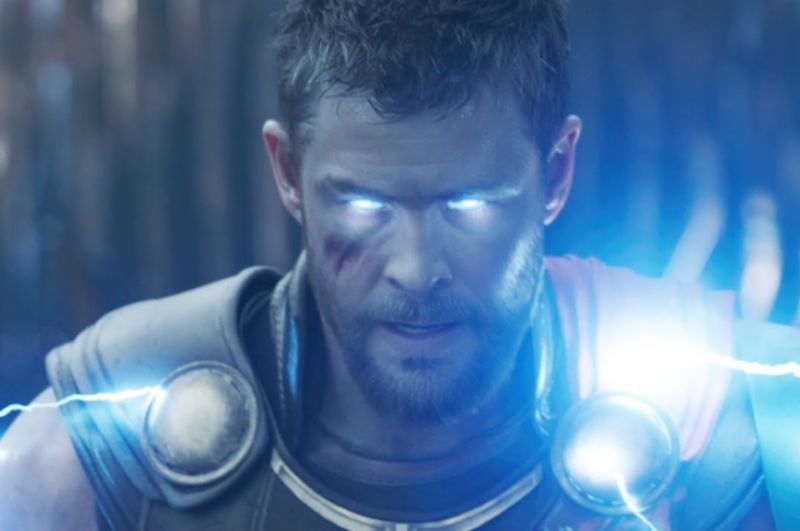
Enlarge/ Chris Hemsworth will return as the Norse god of thunder in the as-yet-untitled Thor 4.
Director Taika Waititi is a hot commodity in Hollywood these days, with no sign of his star fading any time soon. He’s just signed on with Marvel Studios to direct Thor 4, according to the Hollywood Reporter, and Chris Hemsworth is expected to return as the titular god of thunder.
(Some spoilers for first two Thor films and Avengers: Infinity War and End Game below.)
The first Thor was mostly good, blending action and comedy in a winning mix, although it wasn’t quite as strong as other origin stories in the MCU. The second? Well, The Dark World suffered from early pacing problems and an overly elaborate plot, bolstered primarily by terrific performances by Hemsworth and Tom Hiddleston as Loki. Their complicated relationship remains the heart of the franchise. Then Marvel, in a savvy move, hired relative newcomer Waititi to direct 2017’s Thor: Ragnarok.
At the time, the director was best known for his cult hit, What We Do in the Shadows (now a half-hour comedy series on FX) and 2016’s, Hunt for the Wilderpeople—a charming, poignant comedy-drama that deserves a much wider audience. Waititi’s Ragnarok proved to be a game-changer, elevating the Thor franchise to an entirely new level with its skillful blend of humor, action, tragedy, and a final whiff of hope—only to have that hope snuffed out ruthlessly by the Russo brothers in the first few minutes of Avengers: Infinity War.
We know nothing about Thor 4, given that Waititi just inked the deal, but no other standalone superhero in the MCU has yet warranted a fourth film. Will he hook up with the Guardians of the Galaxy (whose next big adventure is also in the works)? When End Game concluded, Thor had lifted himself out of alcoholic depression—while keeping the extra pounds, at Hemsworth’s insistence—and handed over leadership of New Asgaard to Valkyrie (Tessa Thompson), who I’d wager will figure into the new film. We may even see some version of Loki, given the timeline shenanigans of End Game. (My Ars colleague, Sam Machkovech, is hoping for a narrative arc along the lines of Fat Thor: The Great Triumph Over Gilligan’s Island Reruns. Hey, it could happen.)
Of course, that means Waititi’s live-action adaptation of Akira for Warner Bros. will be put on hold, although the troubled project had already experienced delays. (The original manga-inspired anime film celebrated its 30th anniversary last year.) Script concerns had been largely addressed, but per Deadline Hollywood, “The project had been on the rocks for weeks, with word in town that it is a difficult film to cast ethnically at its high budget, in this moment of political correctness.” Warner Bros. has been trying to make a live-action version since it acquired the rights in 2002, so the studio’s bad luck on that front continues.
https://arstechnica.com/?p=1537151
Nintendo deletes popular Mario Maker 2 level for unexplained reasons
Enlarge/ A scene from the creation of the since-deleted “Kai-Zero G” in Super Mario Maker 2.
The unexplained removal of one of the most popular, ultra-difficult Super Mario Maker 2 courses is raising concerns about Nintendo’s moderation policies for the popular Switch title.
David Hunt, a popular Mario speedrunner who goes by GrandPooBear online, noted this morning that his level “Pile of Poo: Kai-Zero G” had been unceremoniously removed from Nintendo’s Super Mario Maker 2 servers. Since its upload on July 5, the low-gravity course—which took its name from the ultra-hard set of Mario ROM hacks known as Kaizo games—had received over 1,200 “hearts” from over 10,500 players as of last night. This was enough to put it on the first page of popular “Super Expert” courses in the game.
But today isn’t the first time GrandPooBear has faced the seeming caprice of Nintendo’s online moderation. Three years ago, he found all of his popular levels in the original Super Mario Makerhad been deleted, a state of affairs Nintendo was not able to adequately explain in a recorded call with the streamer at the time.
Nintendo maintains a Code of Conduct that allows it to remove Super Mario Maker 2 courses for a number of reasons, including exploitation of in-game bugs, inappropriate content “such as offensive language,” and explicit advertising or promotional materials. In an email from Nintendo that GrandPooBear shared on Twitter, the company cites “inappropriate and/or harmful content” as the reason for the removal of “Kai-Zero G,” which represents the company’s “final decision” on the matter.
[embedded content]
GrandPooBear narrates the creation of his level, “Kai-Zero G,” which was mysteriously deleted from Nintendo’s servers this morning.
While “Kai-Zero G” doesn’t appear to have any obviously explicit content, the word Poo does appear in the title and spelled out in block gaps during one part of the level (seen at about 0:30 here). Hunt says that’s a reference to Nintendo’s Earthbound character of the same name, which served as the inspiration for his handle, and shouldn’t serve as a cause for deletion.
“All of my Maker 1 levels, that contain the same name [Poo], are still up today after we re-uploaded them years ago,” GrandPooBeartweeted. “[The] Pile of Poo series is still alive and well in Mario Maker 1… They were re-uploaded after deletion and have stayed uploaded for years. I can’t express enough how not a problem they have with the name of my levels.”
Nintendo’s move comes as Reddit user zach2thefuture reports his Super Mario Maker 2 level, “Storm Area 51,” was also removed for “inappropriate or harmful content.” The level was an apparent reference to a popular meme which has thus far attracted over 1.3 million people to sign up on Facebook to attend a “Storm Area 51” event purportedly focused on a mass infiltration of Nevada’s Area 51 military base to “see them aliens.”
“I would rather make a ROM hack”
Speaking to Ars Technica over email, GrandPooBear says he thinks he’s the victim of players abusing Nintendo’s in-game course reporting system for fun. “I think it’s just a situation where, because I am a [popular] streamer, we get a lot of false reports,” he told Ars. “Since my other two levels are training levels and get lots of hearts, the threshold for deleting those is probably much higher than a crazy-hard Kaizo level which won’t get as many plays. I was told this is what happened to me in [the original Super Mario Maker] when they deleted all of my levels.”
It’s unclear whether or to what extent human moderators are involved in level deletion decisions for the millions of levels that have been uploaded to Super Mario Maker 2 thus far. Nintendo has not responded to a request for comment from Ars Technica.
“If there is something that Nintendo could point me too that caused this, I would gladly fix that given the opportunity,” GrandPooBear added on Twitter. “Given the fact there is no opportunity to do so, not I have no idea what actually caused it, im left feeling like they just hate me.”
“Nintendo should never, ever, ever, be deleting anyone’s levels unless they contain obvious language or blatant dicks,” he continued in an email to Ars. “Take them out of the endless rotation so they don’t show up for random players, but deleting people’s hard work is never a good idea. It erases history of the game and potentially useful information, plus it can lead to mistakes like this, which causes players to not want to be a part of the community anymore.”
After being hit with Nintendo’s unexplained moderation a second time, GrandPooBear seems resigned to his fate. “I am not going to upload any new real levels anytime soon,” he told Ars. “I will probably just stick to dumb tech levels to get my Maker score back up. But this is the second time this has happened to me… It feels like there is little point to me being a creator in this game if this is going to continue to happen. I would rather make a ROM hack that will last forever.”