Judge drops DMCA claims that Bungie reverse-engineered Destiny 2 cheats

Using Bungie's own licenses against it worked once for the makers of Aimjunkies, but this time a judge ruled that a bit more finesse (i.e. evidence) was required.
Enlarge / Using Bungie’s own licenses against it worked once for the makers of Aimjunkies, but this time a judge ruled that a bit more finesse (i.e. evidence) was required.
Bungie / Ars Technica

Months after failing to prove that Destiny 2 cheat makers had infringed their copyright, Bungie has surged ahead in the late game, as a quirky counterclaim accusing Bungie of “hacking” the cheat makers’ computers has been dismissed.

AimJunkies, a division of Phoenix Digital, makers of cheating tools for many popular games, including Destiny 2 (since removed but archived), had survived the typically effective claim that their cheat software illegally copied aspects of an original game to function. It was a tactic successfully used by the makers of Grand Theft Auto Online, Overwatch, Rainbow Six, Fortnite, and other properties.

Western District of Washington Judge Thomas Zilly had struck down most of those claims in late April, ruling that Bungie had “not pleaded sufficient facts to plausibly allege that [the cheat maker] copied constituent elements of Bungie’s work.” Zilly also ruled at the time that Bungie’s own license agreement for Destiny 2, which forces arbitration for circumvention and other disputes, meant that its claims could not go forward in federal court before first trying arbitration. Zilly did, however, allow Bungie time to restate its case, and it focused on trademark infringement, reverse engineering, and code copying.

AimJunkies fired back with subpoenas and press releases in August and, remarkably, counterclaims under the Computer Fraud and Abuse Act (CFAA) and the anti-circumvention clauses of the DMCA. Once again, the claims sprang from Bungie’s own licenses, specifically its Limited Software License Agreement (LSLA).

Bungie’s current LSLA, updated August 21, 2021, gives its BattleEye software the right to scan a computer for cheating tools. AimJunkies’ James May states in counterclaims that Bungie accessed his computer “on at least 104 occasions” between fall 2019 and May 2021. AimJunkies also claimed that Bungie had “decompiled, reverse engineered and/or otherwise inspected the internal workings” of its cheat software, in violation of the DMCA.

Zilly’s ruling (PDF), obtained by TorrentFreak, largely agreed with Bungie’s responses. May’s evidence of Bungie accessing his computer was unexplained, Zilly writes, and he also failed to prove that the harm from such access would have exceeded the $5,000 necessary for a CFAA claim. “Although detailed factual allegations are not required … additional factual content is necessary,” Zilly writes.

As for the DMCA circumvention claim, that, too, lacked evidence, Zilly ruled. Neither May nor Phoenix Digital offered proof of Bungie working around digital protections, nor that anything Bungie might have accessed was copyrighted. Bungie’s breach of Phoenix Digital’s license for AimJunkies similarly lacked both evidence and proof of damages, Zilly writes. Zilly adds that Phoenix Digital’s delays and unfounded claims could have resulted in dismissing their claims with prejudice, preventing amendment and refiling, but upcoming deadlines in other case matters prevent him from doing so.

Phoenix Digital has until November 21 to amend its counterclaims. Bungie’s pursuit of trademark claims is still pending.

https://arstechnica.com/?p=1897896


How “Wordle editor” became a real job at The New York Times

How “Wordle editor” became a real job at The New York Times
Aurich Lawson | Getty Images


On the surface, there are few word games that would seem to need active editing less than Wordle. After all, the daily Wordle puzzle boils down to just a single five-letter word. Picking that word each day doesn’t exactly require the skill or artistry of, say, crafting an entire crossword puzzle or designing a more algorithmic game like Knotwords.

Despite this, on Monday, The New York Times announced that “Wordle finally has an editor.” Which kind of leads to an obvious follow-up question: What does a Wordle editor actually do all day?

The answer, it turns out, is more than you might think. In a conversation with Ars Technica, newly named Wordle editor Tracy Bennett said that picking the daily Wordle word involves balancing difficulty, variety, and potential player frustration, while keeping an eye out for derogatory hidden meanings and player complaints.

A word curator

To start, Bennett clarified that “Wordle editor” is not a full-time job in and of itself. Bennet has been an associate puzzles editor at the Times since 2020, and that role continues to fill most of her professional time. Editing Wordle currently takes up an average of 30 minutes to an hour a day, Bennett said, a “startup rate” that will help “build a [word] list for the year going forward into the future.”

Working from Josh Wardle’s original list of about 2,300 five-letter words (which were previously assigned randomly to different days), Bennett said she starts by just “looking at the list and seeing things pop out… I’m still choosing words in a kind of arbitrary way, but also in a well-informed way. … I would call it intuitive, but it’s really based on years of experience working with words from other puzzles.”

Unlike a completely random sorting algorithm, Bennett said she’s focused on making sure a week’s Wordle solutions are “varied lexically and semantically. … I don’t want to have a week’s worth of nouns, and I don’t want to have a week’s worth of words that start with A, that sort of thing.”

Bennett, as seen in a 2019 New York Times illustration.
Enlarge / Bennett, as seen in a 2019 New York Times illustration.

Bennett said her process might include scheduling a week’s worth of words in a one-day session, then spending time over the next four or five days “researching the etymologies and histories of those words as carefully as I can.” That kind of deep research is key, Bennett said, in order “to see if there are any secondary meanings that are unsavory, or potentially offensive or hurtful.”

“Even if it’s defensible as a legitimate word aside from that secondary meaning, we have so many words to choose from that it’s not necessary to take that chance and choose that word,” she continued. “Even if I assume that I know what it means and that there are no secondary meanings, I still look.”

Bennett said there were two recent Wordle solutions (which ran before she officially took over on November 7) that received some complaints from users for potentially offensive hidden meanings. She wouldn’t specify those words to Ars, as “they aren’t obvious to everyone as derogatory terms, but when you do look them up, you see that it’s there and it’s findable. And if that’s the case, we’re probably just going to not run this.”

Then there are words that aren’t offensive in and of themselves, but still might come across as inappropriate sitting next to the news of the day. That was the case in May when “FETUS” was randomly set to run as the daily Wordle solution just as news of the Supreme Court’s abortion-related Dobbs decision was leaking.

Bennett said the NYT puzzle team had “mixed opinions” about what to do about that happenstance, “but ultimately, it was decided [it] could be … upsetting or might feel like it was chosen intentionally, or be suspect in some way. … There is an element of scheduling the words that is an editorial issue, too, so that’s something that I would want to be thinking about, if the timing is right.”

https://arstechnica.com/?p=1897094


Control, one of ray tracing’s first killer apps, is getting a sequel

<img src="https://rassegna.lbit-solution.it/wp-content/uploads/2022/11/control-one-of-ray-tracings-first-killer-apps-is-getting-a-sequel.png" alt="Concept art for Control 2.”>
Enlarge / Concept art for Control 2.
Remedy Entertainment

Control 2, the sequel to the 2019 third-person shooter that showcased many high-end gaming PCs, has been announced by developer Remedy Entertainment in a blog post.

It’s just entering pre-production, and it has no release date, but the announcement sets up some high expectations. The game’s “initial” development budget is 50 million euros (currently around $52 million), suggesting that this will be a triple-A, big-budget action game at a large scale. For comparison, the first game’s budget was just 30 million euros. Budgets for games like this often expand over the course of development, so it’s possible Control 2 will cost double or more than Control to make.

Control 2‘s target platforms are Windows PCs, PlayStation 5, and Xbox Series X|S. Remedy will self-publish the game on the PC, but 505 Games will act as the publisher for the console releases.

While the first Control launched on last- and current-generation consoles, there was no question that it was, first and foremost, a PC game. That’s partly because Control was among the highest-profile games to support ray-traced shadows and lighting as well as DLSS, which were not supported on the PlayStation 4 or Xbox One. Even on the PlayStation 5 and Xbox Series X|S, the ray-tracing features were substantially scaled back compared to what players with high-end gaming PCs with RTX graphics cards could enjoy.

Control‘s developer, Remedy Entertainment, is also famous for the Max Payne series, another third-person shooter franchise that made its way to consoles but that shined particularly bright on PC.

On one hand, you might ask how Control 2 could raise the bar on consoles when the PlayStation 5 and Xbox Series X|S versions of its predecessor were already somewhat compromised compared to the PC release. But Control was one of the earliest titles on those consoles, and the technologies and techniques used by game developers to get the most out of the current-generation consoles are expanding over time, so you never know. Today’s announcement also confirmed that Control 2 would use Remedy’s proprietary Northlight engine, which was also used for the first game.

Control 2 is not the only new game in the Control franchise that Remedy has announced. Last year, the company revealed that it was working on two new Control games, and that one of them would be a cooperative multiplayer game. The multiplayer title is codenamed Condor, but we don’t know much about it at this stage. Control 2 is now confirmed to be the other of the two titles the studio had previously discussed.

https://arstechnica.com/?p=1897331


The future exists now: Bringing William Gibson’s The Peripheral to television

Chloë Grace Moretz stars as Flynne, a young woman who may or may not have witnessed a real murder.
Enlarge / Chloë Grace Moretz stars as Flynne Fisher, a young woman who may or may not have witnessed a real murder.
Prime Video

Sci-fi legend William Gibson’s 2014 densely layered novel The Peripheral ingeniously combines elements of noir murder mystery, time travel, and the author’s trademark cyberpunk futurism. It’s those features that make the novel so challenging to adapt for television, but Prime Video managed to pull off that feat with its new nine-episode series, The Peripheral, starring Chloë Grace Moretz.

(Minor spoilers below, but no major reveals.)

There are obviously some key divergences from the source material, as befits a TV adaptation. But as with Gibson’s novel, there are two plot lines that eventually begin to converge in the series. The first arc takes place in our near-term future and is centered on a young woman named Flynne (Moretz). Flynne works at the local 3D-printing shop in a small town. Flynne’s brother Burton (Jack Reynor) is a veteran of the US Marine Corps’ elite Haptic Recon force and suffers from brain trauma resulting from his cybernetic implants. Burton works security for a video game/virtual world maintained by a company called Milagros Coldiron. Flynne sometimes substitutes for Burton, and one day, he asks her to try a new kind of headset that introduces her to a virtual reality so vivid, it seems like she’s really there. The twist: She actually is “there,” but “there” isn’t where, or when, she thinks it is.

The second arc takes place in a futuristic and desolate London in the aftermath of an apocalyptic event dubbed “the Jackpot,” which wiped out 80 percent of the population. This world is essentially ruled by Russian oligarchs (“klepts”). The link between the two timelines is the titular black market technology, “peripherals,” which are favored by hobbyists known as “continua enthusiasts.” Running on “quantum servers,” the peripherals digitally link the users to the past, and the moment they make direct contact, the past splits off into an alternate timeline called a “stub.” The increasingly convoluted and interconnected plot involves a hunt for a missing woman named Aelita (Charlotte Riley), corporate espionage, political corruption, timeline shenanigans, and multiple attempts on Flynne’s life.

Flynne Fisher (Chloë Grace Moretz) works in a 3D-printing shop to make ends meet.
Enlarge / Flynne Fisher (Chloë Grace Moretz) works in a 3D-printing shop to make ends meet.
YouTube/Prime Video

Director Vincenzo Natali was a huge fan of Gibson’s seminal 1984 novel Neuromancer and had worked on developing a film adaptation. That film never got made—a common Hollywood occurrence—but he became friendly with Gibson from their frequent email exchanges. So Gibson sent him a copy of The Peripheral when it was published. Natali knew the novel was far too complex to ever work as a feature film, but his producing partner suggested it would make an excellent TV series.

Around the same time, Natali directed his first episode of Westworld. He thought Westworld producers Jonathan Nolan and Lisa Joy might be interested in an adaptation of The Peripheral and sent them a copy of the book. He was shocked when Nolan and Joy signed on right away. But Nolan was also a big Gibson fan—ever since he was 14 and stole his brother’s copy of Count Zero (1986). (It’s the second novel in Gibson’s Sprawl trilogy that started with Neuromancer and concluded with Mona Lisa Overdrive in 1988.) “The second Vincenzo said William Gibson, I’m in from the jump,” Nolan told Ars.

Showrunner Scott Smith, on the other hand, didn’t have much of a science fiction background, so the material presented a whole new world to him. He signed on to adapt Gibson’s novel on the strength of its characters and its heavy noir vibe. “Gibson is so renowned for the science part of the science fiction, that I think his naturalistic writing, his skill at creating characters, is sometimes overlooked or sold short,” he told Ars. “We always talked about Flynne’s superpower being empathy. She can enter this world that’s divided by all this time from her own and encounter people who are real to her. She treats them like fellow humans. Often technology can have the exact opposite effect, where it dehumanizes. This is about humanity triumphing over the tech.”

https://arstechnica.com/?p=1891572


Ancient wisdom: Oldest full sentence in first alphabet is about head lice

Archaeologists excavated this engraved ivory comb at an ancient site in Israel.
Enlarge / Archaeologists excavated this engraved ivory comb at an ancient site in Israel.
Dafna Gazit, Israel Antiquities Authority

Several years ago, archaeologists unearthed a small ivory comb at Tel Lachsich in Israel, once a major Canaanite city-state in the second millennium BCE.  But it wasn’t until last December that someone realized the comb had an inscription using early pictograph symbols of the first alphabet. Once deciphered, the inscription turned out to be a spell for preventing an infestation of head lice, according to a new paper published in the Jerusalem Journal of Archaeology.

“This is the first sentence ever found in the Canaanite language in Israel,” said co-author Yosef Garfinkel, an archaeologist with the Hebrew University of Jerusalem. “There are Canaanites in Ugarit in Syria, but they write in a different script, not the alphabet that is used till today. The Canaanite cities are mentioned in Egyptian documents, the Amarna letters that were written in Akkadian, and in the Hebrew Bible. The comb inscription is direct evidence for the use of the alphabet in daily activities some 3,700 years ago. This is a landmark in the history of the human ability to write.”

While early writing systems emerged in Mesopotamia and Egypt over 5,000 years ago, they used symbols rather than a bona fide alphabet, which appeared significantly later, around 1800 BCE. Accordingly to the authors, little is known about this first alphabet because so few inscriptions have survived that predate the 13th century BCE—just a few letters, maybe a word or two, usually lacking context. “Thus, it is very likely that most writing was carried out on perishable materials that have decayed over time,” Garfinkel et al. wrote. Since the 1930s, the Lachsich site has yielded a dozen or so inscription fragments from between the 13th and 12th centuries BCE, suggesting the city-state and surrounding region played a leading role in the alphabet’s early history.

Much of the current excavation fieldwork at the Lachsich site took place between 2013 to 2017, and the ivory comb was unearthed in summer 2016. Considered a “prestige object,” per the authors, it was found in the highest central area of the site, near a Persian-period Solar Shrine, an Iron Age palace-fort, an Acropolis Temple from the Late Bronze Age, and a Middle Bronze palace.

Aerial view of Tel Lachish, the archaeological site where the ivory comb was found
Enlarge / Aerial view of Tel Lachish, the archaeological site where the ivory comb was found
Emil Aladjem

The comb measures just 3.5 by 2.5 centimeters (roughly 1.38 by 1 inches), with teeth on both sides, although only the bases remain; the rest of the teeth were likely broken long ago. One side had thicker teeth, the better to untangle knots, while the other had 14 finer teeth, likely used to remove lice and their eggs from beards and hair. Further analysis showed noticeable erosion at the comb’s center, which the authors believe was likely due to someone’s fingers holding it there during use.

The authors also used X-ray fluorescence spectroscopy, Fourier-transform infrared spectroscopy, and digital microscopy to confirm that the comb is made of ivory from an elephant tusk, suggesting it was imported. The team sent a sample from the comb to the University of Oxford’s radiometric laboratory, but the carbon was too poorly preserved to accurately date the sample.

The inscription consists of 17 letters (two damaged) that together form a complete seven-word sentence. The letters aren’t well-aligned, per the authors, nor are they uniform in size; the letters become progressively smaller and lower in the first row, with letters running from right to left. When whoever engraved the comb reached the edge, they turned it 180 degrees and engraved the second row from left to right. The engraver actually ran out of room on the second row, so the final letter is engraved just below the last letter in that row. Still, said engraver had to be fairly skilled, given the small size of the lettering.

Drawing of the comb's inscription
Enlarge / Drawing of the comb’s inscription
Y. Garfinkel et al., 2022

Translated, the inscription reads, “May this tusk root out the lice of the hair and the beard.” It’s the first discovery in the region where an artifact’s inscription refers to the actual purpose of the object. This purpose was confirmed when the authors searched for evidence of head lice on the comb under a microscope, and found some remains on the second tooth, still in the nymph stage of development. (Apparently, the climate of Lachish is not conducive to the good preservation of head lice.)

“Early alphabetic inscriptions are generally very brief—just a handful of letters—and often consist of the name of a person or the name of an object,” Christopher Rollston, an expert in Semitic languages and literature at George Washington University, who was not involved in the study, told New Scientist, calling it a “brilliant” decipherment. “Throughout human history, lice have been a problem. We can only hope that this inscribed comb was useful in doing that which it says it was supposed to do: Root out some of these pesky insects.”

DOI: Jerusalem Journal of Archaeology, 2022. 10.52486/01.00002.4  (About DOIs).

Go to discussion…

https://arstechnica.com/?p=1895815


First teaser for FX/Hulu’s Kindred miniseries plays up the horror elements

[embedded content]
An adaptation of Octavia Butler’s classic 1979 novel is coming to FX with Kindred.

First published in 1979, sci-fi author Octavia Butler‘s bestselling novel Kindred defies conventional genres, incorporating classic time-travel tropes, Antebellum South slave narratives, and historical fiction. Butler herself described it as “a kind of grim fantasy.” More than 40 years later, Kindred is now an eight-episode TV miniseries, coming to Hulu next month, and we now have our first look via a 90-second teaser.

(Spoilers for the 1979 novel below.)

Butler’s novel is told from the first-person perspective of a young Black writer named Dana, who moves to Los Angeles with her husband Kevin in 1976. On her 26th birthday, Dana suddenly becomes dizzy, and the walls of their LA home fade away. She finds herself at the edge of a wood near a river and promptly rescues a young, red-haired boy named Rufus Weylin. Another dizzy spell quickly brings her back to her present, but the attacks keep coming, and soon Dana is being transported back and forth on a regular basis, for varying lengths of time. (Time passes more swiftly in the past, further complicating matters.) She quickly learns there are certain compromises she must make, and cruelties she must endure, in order to navigate the Antebellum South. Eventually Kevin finds himself transported back to the same time period, too, and must learn to navigate the Antebellum South as a white man.

While no cause or mechanism is ever offered for Dana’s time travel, we eventually learn that there is a historical connection: young Rufus is actually Dana’s ancestor. Her trips back in time initially occur whenever the accident-prone boy needs rescuing—and, understandably invested in preserving her family lineage and future existence, Dana repeatedly saves his life. But as Rufus grows up, things become more complicated. He succeeds his father as master of the plantation and ultimately rapes his childhood friend Alice (born free but later sold into slavery as punishment) and forces her to become his concubine. One of their children is Dana’s ancestor, Hagar.

Dana James (Mallori Johnson) finds herself traveling back in time to rescue a young boy named Rufus (David Alexander Kaplan).
Enlarge / Dana James (Mallori Johnson) finds herself traveling back in time to rescue a young boy named Rufus (David Alexander Kaplan).
YouTube/FX

Kindred sold over 1 million copies after it was published; it’s a complicated novel with multiple themes and arguably Butler’s most influential and acclaimed work. There was a 2017 graphic novel adaptation, but for some reason it was never adapted for film or television—until now. FX ordered a pilot for the miniseries last July and picked Kindred up for a full series in January. Per the official logline: “As Dana, a young Black woman and aspiring writer, begins to settle in her new home, she finds herself being pulled back and forth in time, emerging at a nineteenth-century plantation and confronting secrets she never knew ran through her blood.”

Newcomer Mallori Johnson (We Crashed) stars as Dana, with Micah Stock (Deke Slayton in The Right Stuff series) as Kevin. Ryan Kwanten (True Blood) plays Thomas Weylin; Gayle Rankin (Sheila the She-Wolf in Glow) plays his wife, Margaret Weylin; and David Alexander Kaplan (“12” in Stranger Things S4) plays the young Rufus. It looks like FX/Hulu is sticking with late 1970s Los Angeles for Dana and Kevin’s “present-day” existence.

I re-read Kindred every few years or so, and I’m generally pretty open to taking a few creative liberties when adapting novels for TV. But frankly, I’m not particularly thrilled by this teaser, which makes the series look like straight-up time-travel horror, as if they were making American Horror Story: Antebellum. Granted, there are horrifying elements in Butler’s novel (although she deliberately toned down the gruesome violence contained in the historical records she studied to attract more readers). But it’s not a horror novel by any stretch of the imagination, so it’s… an interesting approach for the first teaser.

That said, I have to trust that the series will be well done and worthwhile, given that the showrunner is award-winning playwright Branden Jacobs-Jenkins (a producer on Watchmen and Outer Range), working with fellow producers Darren Aronofsky (Black Swan, The Wrestler), Joe Weisberg (The Americans), and Joel Fields (Fosse/Verdon). Perhaps the full-length trailer, when it drops, will give us a better sense of the true tone and scope of the series.

All eight episodes of Kindred begin streaming on Hulu on December 13. We’ll be watching.

Listing image by YouTube/FX

https://arstechnica.com/?p=1895995


After 15 years of failed attempts, there will finally be a Gears of War movie

<img src="https://rassegna.lbit-solution.it/wp-content/uploads/2022/11/after-15-years-of-failed-attempts-there-will-finally-be-a-gears-of-war-movie.png" alt="A still from 2019's Gears 5.”>
Enlarge / A still from 2019’s Gears 5.

Gears of War, one of the video games that helped make both Epic Games and Xbox what they are today, will become a movie after a decade and a half of false starts, according to The Hollywood Reporter.

The franchise will be picked up by Netflix, which plans both a live-action feature film and an animated TV series. If those are well-received by viewers, it could be just the beginning for the franchise on Netflix.

The first Gears of War game was released 16 years ago this Monday—on November 7, 2006. Since then, it has received four direct sequels up through 2019’s Gears 5, as well as a handful of spinoffs like 2020’s Gears Tactics.

Efforts to turn it into a movie date back to 2007, when New Line Cinema tried to produce it. It was later explored by Universal Pictures, but nothing ever came together, as so often happens in the studio system.

Funnily enough, Netflix’s current head of original films, Scott Stuber, was involved as a producer for Universal’s failed attempt at a Gears of War film. That said, no actors, directors, or writers have been announced for the project yet, and the film’s release is likely at least a couple years or more away.

The quest to turn Gears of War into a feature film has been going on for so long, the ownership of the video game series has changed since its inception. The game franchise was originally developed by Epic Games of Unreal and Fortnite fame as a tentpole game for the Xbox 360 console. Microsoft acquired the rights to the franchise in 2014, and Canadian game studio The Coalition—which borrows its name from within the Gears of War universe—has stewarded the franchise from 2016’s Gears of War 4 and onward.

Gears of War is a science-fiction war story that takes place on the fictional planet of Sera. An army of alien-like foes called the Locust Horde emerged from beneath the ground and decimated human civilization; the games follow soldiers like Marcus Fenix as they battle the Locusts and try to save what’s left of humanity.

Helmed by Unreal developer Cliff Bleszinski, the original games heavily emphasized action and were credited with popularizing the third-person, cover-shooter method of gameplay that dominated so many Western action games in the mid-to-late 2000s.

Gears of War‘s design influence has been felt since in several other popular game franchises, including Mass Effect, Uncharted, The Last of Us, and basically anything that has the player shooting at enemies from a third-person perspective while taking cover behind conspicuously ubiquitous chest-high walls. That said, Gears of War‘s story, characters, and visuals arguably haven’t left as strong a legacy as its design.

Below: The story of Gears of War’s development from a previous video published by Ars Technica.

Produced by Adam Davis-McGee, directed by James Herron, and edited by Patrick Biesemans and JC Scruggs. Click here for the transcript.

https://arstechnica.com/?p=1895809


Oculus co-founder makes a VR headset that can literally kill you

Looks comfortable...
Enlarge / Looks comfortable…

The idea that dying in a video game or simulation could cause your death in real life is a common trope that has appeared in dozens of fictional works in recent decades. Now, though, Oculus co-founder Palmer Luckey has made the concept real.

On his personal blog, Luckey writes of a new VR headset he has designed that uses three embedded explosive charges, planted above the forehead, that can “instantly destroy the brain of the user.” The lethal explosion is triggered via “a narrow-band photosensor that can detect when the screen flashes red at a specific frequency,” Luckey writes, making it easy to set off during a “Game Over” screen.

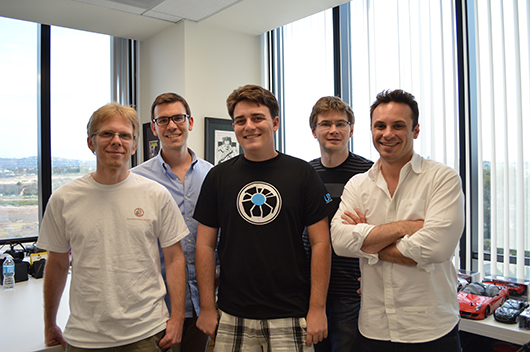
John Carmack (left) poses with Oculus founder Palmer Luckey (center) and other members of the Oculus team.
Enlarge / John Carmack (left) poses with Oculus founder Palmer Luckey (center) and other members of the Oculus team.

To be clear, Luckey says his deadly headset—which looks in images like a modified Meta Quest Pro—is “at this point… just a piece of office art, a thought-provoking reminder of unexplored avenues in game design.” At the same time, though, Luckey writes that “the idea of tying your real life to your virtual avatar has always fascinated me—you instantly raise the stakes to the maximum level and force people to fundamentally rethink how they interact with the virtual world and the players inside it.”

Luckey ties this fascination to Sword Art Online (SAO), a series of Japanese novels (and spinoff anime, video games, etc.) about a virtual reality MMORPG with the same name. In that fiction, November 6, 2022, marks the day when thousands of SAO players are trapped in their NerveGear headsets and threatened with death via a hidden microwave generator if they die in the game (or if they try to remove or tamper with the headset).

The Sword Art Online anime was just airing when the first Oculus Rift Development Kit launched on Kickstarter back in 2012, helping to drive what Luckey calls “massive otaku enthusiasm for Oculus, especially in Japan, which quickly became our 2nd largest market.” He says that “literally thousands” of fans have reached out to him over the year about Sword Art Online, asking, “When will you make the NerveGear [headset] real?!”

A history of consequences

More than realistic graphics, Luckey writes that “only the threat of serious consequences can make a game feel real to you.” He likens such consequences to a “long history of real-world sports revolving around similar stakes,” though it’s important to remember that most sports injuries fall well short of instant death.

But while Luckey writes that this is “an area of video game mechanics that has never been explored,” that’s not strictly true. Back in 2001, the PainStation art installation threatened players who lost a game of Pong with “sensations such as heat, punches and electroshocks of varying duration,” as Wired described it. That same year, the “Tekken Torture Tournament” provided a fighting game competition in which “32 willing participants received bracing but non-lethal electrical shocks in correspondence to the injuries sustained by their onscreen avatars.”

Those armbands deliver instant pain to anyone who got hit in 2001's "Tekken Torture Tournament."
Enlarge / Those armbands deliver instant pain to anyone who got hit in 2001’s “Tekken Torture Tournament.”

On the other end of the simulated pain equation, last year the Food and Drug Administration approved a virtual reality pain management system that uses “established principles of behavioral therapy intended to address the physiological symptoms of pain and aid in pain relief through a skills-based treatment program.”

In any case, Luckey cites “a huge variety of failures that could occur and kill the user at the wrong time” in explaining why he has “not worked up the balls to actually use” his deadly new headset. Still, the project shows that Luckey still harbors a deep interest in virtual reality more than five years after he was fired by Oculus parent company Facebook (now Meta) amid controversy over political donations.

In the years since, Luckey’s professional life has been largely focused on his military tech startup Anduril. In an April personal blog post, though, he wrote that the year of the 10th anniversary of Oculus’ founding was “the right time to finally unveil some VR technologies I haven’t been able to talk about for a variety of reasons.”

We’re guessing this deadly headset wasn’t what he meant by that, but it’s hard to know for sure…

https://arstechnica.com/?p=1895813


Carnival Row announces second and final season with briefest of teasers

[embedded content]
Orlando Bloom and Cara Delevingne reprise their roles as Philo and Vignette in the second and final season of Carnival Row.

Carnival Row, Prime Video’s lavish “Victorian neo-noir” fantasy series that premiered back in 2019, is coming back for one more season. (I called it “part murder mystery, part fairy tale, and 100 percent wholly original” in my review at the time.) The series was renewed for a second season even before the first season aired, but the pandemic delayed those plans. The streaming platform has now announced that the forthcoming second season, premiering in February, will be its last with the briefest of teasers.

(Spoilers for the first season below.)

As I wrote previously, Carnival Row is based on a feature film script by Travis Beacham (Pacific Rim), written when he was still in film school in North Carolina 17 years ago. He was working in the school library and found himself reading about everything from Celtic mythology to Jack the Ripper. All that fodder fed into a 10-page script for a short film about a constable in neo-Victorian London visiting a faerie brothel where a murder has taken place. His professor suggested the subject was better suited to a full-length feature. The finished script made the first Hollywood Black List in 2005, an annual list of the “most liked” screenplays not yet produced. It took another 14 years to make it into production. Legendary Entertainment ultimately bought the script in 2015 and reimagined it as a series for Amazon Prime.

Orlando Bloom stars as Rycroft “Philo” Philostrate, an orphan of the Burgue, a human city coexisting in a world with other exotic lands that are home to various mystical creatures: faeries (“Pix”), fauns (“Pucks”), trolls (“Trows”), centaurs, werewolves (“Morroks”), and so forth. The races used to live peacefully in their respective regions until war broke out with a mysterious group called The Pact. The humans of the Burgue sided with the fae to protect their homeland from the invaders.

During his military service, Philo met and fell in love with the faerie Vignette Stonemoss (Cara Delevingne). But the lovers were torn apart when the Burgue forces retreated. Knowing Vignette would never leave him willingly, Philo faked his own death so she would evacuate with her fellow fae. Many of them ended up in the Burgue as refugees to escape being murdered by The Pact’s occupying forces. And Philo became a police inspector.

Over the course of S1, Philo worked to solve a string of heinous murders, with anti-immigrant sentiment among humans in the Burgue on the rise. In the end, Philo solved his case, but not before being falsely jailed as a suspect himself—not to mention discovering that he was half-fae. His mother was a Pix singer named Aisling (Erika Starkova) who was reduced to scavenging to survive; she was also the first murder victim. Philo also learned that his biological father was none other than Chancellor Absalom Breakspear (Jared Harris). In the wake of fae uprisings, Absalom’s other son, Jonah (Arty Froushan), created a ghetto for the fae in the season finale, forbidding them from leaving or interacting with humans. Philo chose to join Vignette and the rest of the fae in the ghetto.

The teaser merely shows a tender kiss between Philo and Vignette—apparently in mid-air with Vignette wrapping him in her wings. Then she lets go and he begins to fall back to what looks like a burning Burgue. Beacham has said that at least some of the characters would be venturing beyond the Burgue to broaden the scope of the series in the second season—although the titular Carnival Row neighborhood will still be prominently featured. And it looks like there will be more murders for Philo to investigate. Per the official premise:

In a fantasy world where humans and creatures clash, season two of Carnival Row picks up with former inspector Rycroft Philostrate, a.k.a. Philo (Orlando Bloom), investigating a series of gruesome murders stoking social tension. Vignette Stonemoss (Cara Delevingne) and the Black Raven plot payback for the unjust oppression inflicted by The Burgue’s human leaders, Jonah Breakspear (Arty Froushan) and Sophie Longerbane (Caroline Ford). Tourmaline (Karla Crome) inherits supernatural powers that threaten her fate and the future of The Row. And, after escaping The Burgue and her vengeful brother Ezra (Andrew Gower), Imogen Spurnrose (Tamzin Merchant) and her partner Agreus Astrayon (David Gyasi) encounter a radical new society which upends their plans. With humans and fae folk divided and freedom on the line, each hero will face impossible dilemmas and soul-defining tests in the epic conclusion of Carnival Row.

The second and final season of Carnival Row will premiere on Prime Video on February 17, 2023.

https://arstechnica.com/?p=1895749


Benoit Blanc disses Clue as a “terrible game” in final trailer for Glass Onion

[embedded content]
Daniel Craig (and his Southern drawl) returns as Benoit Blanc in Glass Onion: A Knives Out Mystery.

We’ve been eagerly awaiting director Rian Johnson’s follow-up to 2019’s delightful Knives Out, and now we have the final trailer for Glass Onion: A Knives Out Mystery. Daniel Craig and his Southern drawl are back and in better form than ever as quirky detective Benoit Blanc, and he has an equally colorful all-star ensemble cast of suspects.

As we’ve reported previously, Knives Out premiered at the Toronto International Film Festival and was an instant hit, and word of mouth spread quickly. The film ended up grossing $311 million worldwide—the top-grossing film in 2019 not based on existing IP. It was my favorite film of 2019. In my review, I praised Johnson’s deft ability to mix dark subject matter with a lighter touch in his old-school classic whodunnit: “Think Clue meets Murder on the Orient Express—or any number of adaptations of novels by the grande dame of murder mysteries, Agatha Christie—both of which the director cited as influences via a 2019 Twitter thread of movie posters.”

So naturally there was going to be a sequel… or two. Lionsgate originally took on the project, but in 2021 Netflix won a bidding war for the rights to the film plus a second sequel, beating out both Amazon and Apple with a whopping $469 million bid. Johnson wrote the script for Glass Onion during the pandemic, inspired particularly by the Christie-based “tropical getaway” whodunnit Evil Under the Sun (1982), as well as a 1973 film called The Last of Sheila—an underappreciated gem.

In addition to Craig, and Edward Norton as tech billionaire Miles Bron, the cast includes Janelle Monáe as a tech entrepreneur named Cassandra “Andi” Brand; Kathryn Hahn as Claire Debella, an ambitious governor of Connecticut keen to run for the US Senate; Leslie Odom Jr. as one of Bron’s scientists, Lionel Toussaint; Kate Hudson as a former supermodel turned fashion designer named Birdie Jay; Jessica Henwick as Birdie’s assistant, Peg; Dave Bautista as a YouTube star named Duke Cody; Ethan Hawke as Miles’ assistant; Dallas Roberts as Claire’s husband; Jackie Hoffman as Duke’s mother; and Madelyn Cline as Duke’s assistant (and girlfriend) Whiskey. Natasha Lyonne, Hugh Grant, and Yo-Yo Ma will also make appearances, and the late Stephen Sondheim and Angela Lansbury play themselves in a video chat—the final film appearances for both.

Edward Norton plays tech billionaire Miles Bron, who invites a colorful coterie to his private Greek island.
Enlarge / Edward Norton plays tech billionaire Miles Bron, who invites a colorful coterie to his private Greek island.
YouTube/Netflix

The first teaser dropped in early September, showing the various guests attempting to solve different puzzles. This final trailer gives us a better sense of their larger-than-life personalities—a sharp contrast to the more intimate family dynamics featured in the original Knives Out. “They’re all performing,” Johnson told Netflix. “They’re all operating in an elevated way. It’s not a family in the middle of New England working their stuff out. These are people who are all making their living, whether it’s as politicians or as rock star scientists, or as fashion magnates.”

The trailer opens with the guests arriving on Miles’ island, beginning with Hudson’s Birdie, who is clearly a bit of a party girl. Then Benoit Blanc arrives, and Miles seems genuinely nonplussed to see him. One suspects someone else may have surreptitiously invited Blanc, but given that Johnson no doubt will employ twist after twist, who knows? At dinner, Miles explains the game he has planned for the weekend: he’s hidden clues all around the island, and his guests must solve his murder. “Once you’re dead, will we still be able to talk to you?” Duke Cody asks. Miles assures him he won’t be playing dead the whole weekend. Whoever can name the killer wins the game.

Of course, the lights unexpectedly go out, and an actual murder takes place. The guests are supposed to be friends, but it looks like those bonds are fairly fragile, and most of them probably have a motive, in fine whodunit fashion. And more killings might transpire if the murderer needs to cover his tracks. And Blanc turns out to have a powerful antipathy toward the classic board game Clue. Andi mentions that he must be good at the game. Apparently not. “I’m very bad at dumb things,” he says peevishly. “Ticking boxes, running around, searching all the rooms… It’s just a terrible, terrible game.” (One can’t help but recall that the Thrombey mansion in Knives Out was described as an elaborate Clue board come to life.)

Glass Onion: A Knives Out Mystery made its international debut at the Toronto International Film Festival on September 10. The film opens in select theaters for a limited run from November 23–29, 2022. It will begin streaming on Netflix on December 23, 2022, just in time for Christmas.

https://arstechnica.com/?p=1895683