Brad Pitt heads into space with mega daddy issues in first Ad Astra trailer
[embedded content]
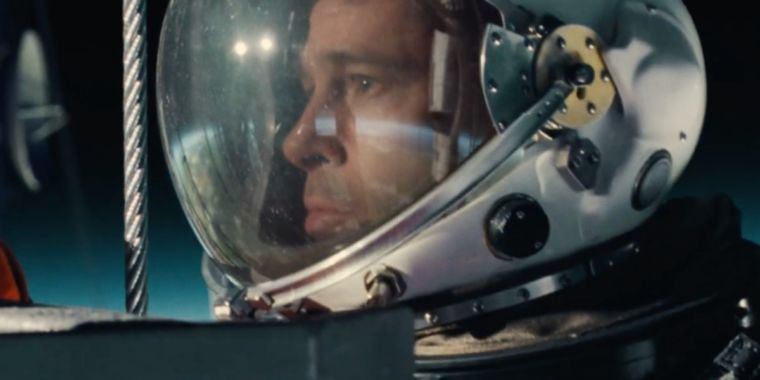
Brad Pitt stars as an astronaut in search of his long-lost father (Tommy Lee Jones) in Ad Astra.
An astronaut must venture to the edge of our solar system to save the planet in the first trailer for sci-fi drama Ad Astra.
Director James Gray (The Lost City of Z) has said he wanted to make a film that depicted space travel as realistically as possible “and to basically say, ‘Space is awfully hostile to us.’ It’s kind of a Heart of Darkness story about traveling to the outer edge of our solar system.” The official synopsis strikes just the right note of vague grandiosity: “Astronaut Roy McBride (Brad Pitt) travels to the outer edges of the solar system to find his missing father and unravel a mystery that threatens the survival of our planet. His journey will uncover secrets that challenge the nature of human existence and our place in the cosmos.”
Brad Pitt stars as astronaut Roy McBride.
YouTube/20th Century Fox
Roy’s father Clifford disappeared years before and is presumed dead.
YouTube/20th Century Fox
Crew excited to get to work.
YouTube/20th Century Fox
Up in the stratosphere.
YouTube/20th Century Fox
Free fallin’
YouTube/20th Century Fox
Liv Tyler plays Roy’s long-suffering wife.
YouTube/20th Century Fox
This is his serious face.
YouTube/20th Century Fox
When your missing dad is Tommy Lee Jones.
YouTube/20th Century Fox
Getting his swagger on.
YouTube/20th Century Fox
No really, psychologically, he’s fine.
YouTube/20th Century Fox
Buggy races on the moon?
YouTube/20th Century Fox
That’s one powerful surge.
YouTube/20th Century Fox
The trailer fleshes out a few of the details. The plot concerns something called the LIMA project, which Roy’s father, Clifford (Tommy Lee Jones), captained. The mission was meant to hunt for advanced extraterrestrial life, but it disappeared about 16 years in, with the crew all presumed dead. Apparently that might not be the case: Clifford McBride may be very much alive—and responsible for a series of catastrophic power surges on Earth that have killed a lot of people. It’s up to Roy to head into space in search of whatever remains of the LIMA project, with orders to destroy it completely if necessary. Since that would also mean destroying his own father, it’s no wonder the pre-flight psychological evaluation is so concerned with his emotional state.
The production values are high, there’s a big-name cast and a capable director, and the studio shifted the film’s release date from May to September, perhaps to better position it for awards season. Gray’s vision is certainly ambitious. But I can’t shake a nagging feeling that I’ve seen this exact film several times before, right down to the daddy issues, and it’s a shame to see the lovely and talented Liv Tyler reduced to playing yet another sad, abandoned space wife. We’ll have to wait until the fall to see what differentiates Ad Astra from all the other sci-fi space adventures that have come before.
Ad Astra is currently scheduled to hit theaters on September 20, 2019.
Listing image by YouTube/20th Century Fox
https://arstechnica.com/?p=1517265
War Stories: How Subnautica made players love being hunted by sea creatures
In the aftermath of the Sandy Hook school shooting, game designer Charlie Cleveland had a goal: he wanted to make a game that wasn’t built around guns and combat. The underwater exploration game he and the folks at Unknown Worlds Entertainment eventually built is a sleeper masterpiece—a game that manages to evoke awe and wonder while also not really requiring you to kill anything.
But getting from prototype to release took years of iterating, including an Early Access period for pulling in lots of player feedback. Cleveland’s core idea was to build a game focused on what he calls “the thrill of the unknown”—created by giving players a seemingly depthless underwater world to explore and by filling that world with wonder and mysteries and “creatures” rather than “monsters.” Cleveland names fellow designer Jenova Chen (of Flower and Journey fame) as a source of inspiration for Subnautica’s emotionally driven design, and those influences are definitely visible in the way the game calmly and cooly reveals its secrets to players.
“It wasn’t missing combat—it was missing excitement”
It seems perhaps a little silly to not have any guns in a survival/crafting game where the player is shipwrecked on an alien world (and, indeed, there are some gun-like tools that the player can eventually wield, including a stasis rifle that freezes creatures), but making it work required building an engaging world that gave players plenty to do. Being engaged turned out to be a lot more important than being engaged in combat, and so as the game iterated through design and Early Access, the developers came up with tons of extra bits to keep players busy.
Excitement turned out to be key to solving the “how do we make a game with no guns” riddle. The player is put into a position of not being the biggest, baddest apex predator on the block (Cleveland describes humans as being about in the middle of the food chain in the world of Subnautica). The game induces tension in the player both by emphasizing the unknown nature of the world around them and also by giving players some limited ability to evade detection by giant nasty underwater beasties. Hunkering down and hiding from detection evokes the emotional tone of classic underwater thrillers like Das Boot and The Hunt for Red October—except it’s not an enemy sub out there. It’s an enormous horned leviathan monster.
The blue, the fresh, the ever free
Humans have anthropomorphized the ocean to one extent or another for about as long as humans have been around. The sea is intertwined with our nature and has shaped the path of a whole mess of different cultures on Earth, after all. Cleveland couldn’t have picked a better environment for a survival-horror game—even early creature-free prototypes with placeholder graphics managed to be fun. “You get so much for ‘free,’ just being underwater,” he acknowledged.
Subnautica winds up being something of a blank canvas. Rather than bringing with it its own extrinsic motivations for players to take up—things like points, or loot, or levels, or killing piles of enemies to get experience points—it presents a world and some vague goals and allows players to make up their own intrinsic motivations. In replacing “combat” with “excitement,” Unknown Worlds created something very special.
https://arstechnica.com/?p=1517011
Did Fallout 76 launch too early or just in time to be saved?
You won’t find many human NPCs in the wasteland, but there are plenty of deadly robots.
Country railroads, take me home…
Fallout 76 is full of mutant monstrosities.
What did that poor radstag ever do to you?
For bigger baddies, you might need some help taking them down.
Appalachia is full of gorgeous views like this one.
Looks like someone missed their turn.
Late-game content will eventually let players drop nukes onto the map, because things weren’t quite irradiated enough.
Fallout 4‘s Red Rocket gas stations are back.
The terror that flaps in the night.
Vault 76 is home sweet home.
There’s a famous quote around the game industry often attributed to legendary Nintendo designer Shigeru Miyamoto: “A delayed game is eventually good, but a rushed game is forever bad.” That may have been true when he said it, but it seems a little outdated in today’s “launch now and patch it later” game industry.
I’ve been thinking about this a lot since listening to an IGN interview with Bethesda’s Todd Howard yesterday about what he admits was a “bumpy” rollout for Fallout 76 last year. In the interview, Howard acknowledges it was a “very difficult development on that game to get it where it was,” noting that “any time you’re going to do something new like that you know you’re going to have your bumps.”
Fallout 76 was savaged by critics (including our own) at launch for widespread glitches and half-baked content. Looking back, Howard now says he and his team knew “even from the beginning this is not going to be a high Metacritic game.”
That’s partly because “this is not the type of game that people are used to from us,” he suggested. But it’s also because “a lot of those [development] difficulties ended up on the screen,” Howard said. “[We knew] we’re going to get some criticism on it, and a lot of that is very well-deserved criticism.”
In practically the same breath, though, Howard also suggests that this knowingly half-baked launch was not a huge deal for a game like Fallout 76, in the long run. “All of the games like this… It’s not how you launch, it’s what it becomes,” he said. And Bethesda has indeed kept up with a string of updates that have helped sustain a core group of devoted players in the months since launch. “There’s no strategy [for fixing it] other than just keep making the game better,” Howard said. “People who play it will come back.”
We’ll do it live!
For many years now, developers and publishers have talked up the idea of a “minimum viable product” release cycle. You release a game when it fulfills the minimum requirements to attract a core of early adopters, then continue to patch and update it to attract more players. It’s an idea that has only become more prevalent as more gaming devices have become perpetually Internet-connected across the developed world.
Howard’s forthright assessment, then, puts a point on the question that’s front and center in the modern game industry: how good does a game have to be before it’s “minimally viable”? On the opposite side of the coin, how bad does a game have to be before you decide it isn’t ready to see the light of day in its current form?
Recent gaming history has plenty of examples on both sides of that coin. Back in 2013, EA’s SimCity reboot was never able to recover from a congestion-plagued launch featuring major gameplay glitches.
If there’s a pattern to be gleaned from all these examples, it’s that the games that succeed seem to have just enough core appeal in their basic gameplay experience for early users to overlook any launch-window growing pains. Figuring out if that core appeal is there pre-launch, of course, is not an exact science.
Maybe that’s why Howard says that his main takeaway from Fallout 76‘s launch is that “you have to let it bake with a large live audience for longer than we did. There’s certain things you can never see until it’s running 24/7 for a number of months. If there’s one thing I would have done differently [with Fallout 76], it’s find a way to let more people at scale play the game 24/7 before you say ‘everybody in, here we go, pay us.'”
So maybe it’s time to update Miyamoto’s famous quote. “A game that can survive a rocky ‘early access’ beta for long enough is eventually good, but a game that’s canceled after losing most of its player base to launch window issues is forever bad.” Not as catchy, but probably more relevant in today’s industry.
https://arstechnica.com/?p=1516669
Tesla’s next big feature is… a port of Cuphead?
Enlarge/ Access to playable scenes like this are why I bought a Tesla and not a PS4.
After March’s announcement that the hard-as-nails, retro-stylized platformer Cupheadwas coming to the Nintendo Switch, we wondered what platform might be the next to see a port. Anything from iOS or PS4 to Linux or Google’s upcoming Stadia seemed at least plausible.
We did not, however, think of the Tesla car line as the next Cuphead port platform. And yet here we are, listening as Elon Musk announced during a podcast interview this week that Cuphead is “working” on the car’s central-console touchscreen.
Maja Moldenhauer from Cuphead developer Studio MDHR confirmed the work on the limited port to IGN’s Ryan McCaffrey, saying Tesla only required that the game “play super, super clean” on the car’s internal hardware. For this reason, the game will only work by plugging in a wired USB controller rather than allowing for controls directly on the touchscreen itself (or with the Tesla’s steering-wheel buttons). And before you ask, the car has to be in park to play the game, a move that probably makes Tesla’s lawyers very happy.
Still, Tesla’s Tegra-powered central touchscreens don’t seem like they were designed with gaming in mind. As Musk notes on the podcast, “You have to decide what game you want to play, and then it will download… if you want to play other games you have to delete that one and download another one.” That limited storage space means that only the first level of Cuphead, Inkwell Isle One, will be available in the Tesla version, according to Moldenhauer.
In any case, work on gaming ports like Cuphead should serve as a fun diversion as Tesla continues to work out some potentially lethal kinks in the car’s Autopilot system.https://arstechnica.com/?p=1516255
Soviets beat US to first crewed moonwalk in For All Mankind trailer
[embedded content]
For All Mankind explores the question, “What if the global space race had never ended?”
Apple just dropped the first full-length trailer for its forthcoming sci-fi space-race series, For All Mankind. Developed by Battlestar Galactica creator Ronald D. Moore, the series is meant to explore an alternate reality where the global space race never really ended.
For All Mankind (not to be confused with the 1989 documentary of the same name) joins a host of other TV series in development for Apple TV Plus, a new video subscription service launching this fall that features Apple original programming—yet another contender in the streaming wars. At a conference in March, Apple CEO Tim Cook called the fledgling streaming platform “the new home for the world’s most creative storytellers, featuring exclusive original shows, movies, and documentaries.”
Details about the series are scarce, but it will star Joel Kinnaman (of Altered Carbon fame, fresh off his stint as Erik Heller in the TV reboot of Hanna) as Edward Baldwin, possibly a US astronaut, judging from the new trailer footage. It opens with a recreation of the first crewed lunar landing in 1969, with a twist: the first man to set foot on the moon is not NASA astronaut Neil Armstrong but Soviet cosmonaut Alexei Leonov. (The real Leonov was part of the Voskhod 2 mission, becoming the first man to perform a 12-minute spacewalk on March 18, 1965.) “The shock across the nation at this event is just… indescribable,” the trailer’s fictional news anchor intones.
We’re firmly in alternate-reality territory here: what would have been the US response if it had missed being first? In this case, it’s to regroup and think bigger in terms of goals. “We thought it was about being first,” NASA bigwig Gene Kranz (Eric Ladin) tells his team of scientists and engineers in the next scene. “Turns out the stakes are much bigger than that.”
Those stakes include the discovery of water on the Moon, but Kranz’s vision also includes eventual interstellar exploration. “This race will be ours to fight for and to win, and we are not stopping there,” he declares. “We’re going to Mars, Saturn. The stars. The galaxy.”
And hey, at least some of those astronauts seem to be women.
For All Mankind is expected to launch in fall 2019.
Listing image by YouTube/Apple TV
https://arstechnica.com/?p=1515307
Minecraft Earth gets first live demo, coming to iOS “this summer”
“Look, ma, I’m in Minecraft!” Play Minecraft Earth at a real-world scale…
… or play it in a shrunken, tabletop scale.
World-building actions look easier to manage when playing in tabletop mode. See how your nearby friends’ actions appear directly attached to their smartphone devices.
Though in both modes, virtual objects will occlude your view of real-life people.
How will the game manage movement down stairs and through different heights of terrain? That remains to be seen.
Mojang, the Microsoft-owned studio behind Minecraft, used Monday’s WWDC keynote to unveil the world’s first live gameplay look at its next smartphone-exclusive game, Minecraft Earth. This demo also included the firmest tease yet about when series fans will get their hands on the augmented-reality game: “coming this summer to iOS.” This specific tease didn’t include any indication of whether that means the game’s promised Android version will take longer to land as a public beta.
The onstage demo began with two Mojang employees aiming their iOS devices at a table, where a blocky Minecraft game world appeared that both users could simultaneously interact with. By walking around the table and aiming their devices’ cameras, the staffers could use items and weapons, interact with switches, and drop or plant items in their inventories. One staffer also placed her Minecraft-styled avatar into the game world like a doll, which she could then animate by moving her real-world body. iOS’s upcoming ARKit 3.0 appears to support body gestures like hand-waving, and we saw one-handed and two-handed waves in this portion of the demo.
This was followed by a world shift from the top of a table to all around the WWDC stage, which resulted in the Mojang reps appearing as real people inside the blocky, virtual Minecraft Earth world—and having their bodies occluded by virtual content (like when one staffer hid behind a freshly planted bundle of flowers). While the players could walk around the real-world space to reach new parts of the virtual world, they largely relied on aiming their phones’ views to manipulate distant objects or lay down torches.
This tweak to the game seemed nigh-essential when a giant, underground lair appeared beneath the players’ feet. How Minecraft Earth players will let players move around larger environments remains unclear; will we see a VR-like “teleportation” system, or will real-life steps toward stairs result in a potentially uncomfortable shift in altitude?
But for the most part, the demo’s use of the familiar Minecraft UI and clear controls for attacks, switch manipulation, and item usage makes the new game look like it’s quite far along in terms of translating the Minecraft experience to a “wow, it’s happening all around me!” sensation (albeit, only through the lens of your phone or tablet’s screens). And if you thought you were in for something more abstract, like Pokémon Go, this real-time footage should disabuse you of that notion. We look forward to seeing more Minecraft Earth gameplay soon (hopefully at next week’s E3).
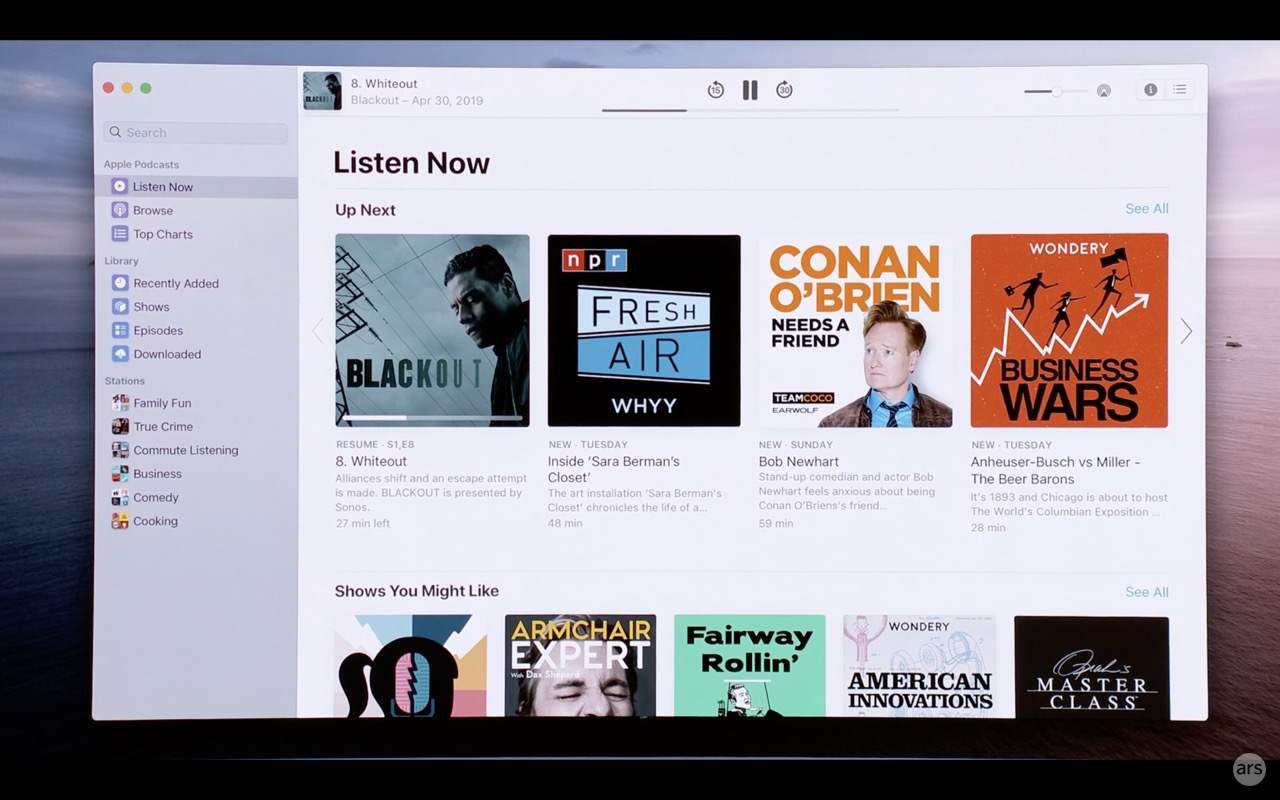
SAN JOSE, Calif.—As part of a slate of upcoming software updates, Apple will close the door on one of its most iconic pieces of software: iTunes. The company will split the application up into multiple, more-focused apps on the Mac: Apple Music for music, Apple TV for TV and movies, and Apple Podcasts for podcasts.
iTunes—a program for managing your media library, listening to songs, and buying new content—played a key part in the digital revolution of the 2000s after it first launched in 2001. Its impact started with music. iTunes was partly credited with slowing the severe bleeding to piracy the recording industry faced amid the popularity of the MP3 boom on peer-to-peer file-sharing applications like Napster. And the program was also the home base for the iPod, one of the first of many products CEO Steve Jobs oversaw when steering the company back to success after he returned to his leadership position in 1998.
It was lauded as a powerful tool for managing your music library in that it allowed you to not only sort, manage, and play music you bought from Apple’s online store, but it also let you import music files acquired from other sources and even sync them to your cloud-based library. Apple later introduced new media types to iTunes as it expanded its services and content offerings: movies, TV, podcasts, books, and audiobooks. iTunes was also the primary method for backing up, updating, and managing iOS devices like the iPhone, iPod touch, and iPad before iCloud took center stage in recent years.
However, as the features piled on, many users felt that the application became overcomplicated and unwieldy. Apple launched a streaming music service called Apple Music in 2015, which added even more layers, and some critics began pointing to the application as a leading example of unintuitive and even bad user-experience design—hardly something Apple wanted to be known for.
Apple has already spent a couple of years siphoning off some iTunes features to other apps in iOS, its mobile operating system for iPhones and iPads. But the app largely remained the primary hub on Macs until this new update, which is expected to launch for supported Macs later this year.
Going forward, Mac users will be able to sync their iOS devices’ music libraries in the Mac’s Finder. The backup-and-restore functionality for iOS devices that currently exists in iTunes will also be available in the Finder.
Apple did not say what will happen with iTunes for Windows. Apple also did not say how existing users will be able to port media libraries from iTunes to the new apps. Apple didn’t mention books today, but much of iTunes’ book and audiobook functionality was already moved to Apple’s Books apps.
While most functionality offered by iTunes will still be offered, just in different applications, the sunsetting of iTunes marks something of an end of an era for the music industry. Now, more and more users are moving forward into the streaming era—a landscape of kaleidoscopic subscription services for music, TV, film, and more. It’s in this landscape that Apple primarily sees its future—and the future of entertainment.
Review: Amazon’s Good Omens is every bit as entertaining as the original novel
Enlarge/ Michael Sheen and David Tennant star in Amazon Prime’s TV adaptation of the 1990 novel Good Omens.
Heaven and Hell prepare to face off in the long-planned battle of Armageddon, but an angel, a demon, and a rebellious Antichrist aren’t enthusiastic about the prospect in Good Omens. The six-part limited series is based on the original 1990 novel by Neil Gaiman and the late Terry Pratchett, and it’s every bit as entertaining as the source material.
(Some spoilers for the book and series below.)
Confession: I am an uber-fan, having read the book multiple times over the last 19 years. I’ll likely read it several more times before I kick off this mortal coil, so I’m very much in the target audience for the series. Good Omens is the story of an angel Aziraphale (Michael Sheen) and a demon Crowley (David Tennant) who gradually become friends over the millennia and team up to avert Armageddon. They’ve come to be rather fond of the Earth and all its humans with their many foibles, you see—not to mention the perks that come with our big blue orb, like sleek electronics and quaint little restaurants where they know you. The supernatural pair doesn’t really want the Antichrist—an 11-year-old boy named Adam (Sam Taylor Buck) who has grown up unaware of his pivotal role in the coming apocalypse—to bring an end to all of that.
I suspect Gaiman loves the book as much, if not more, than its most ardent fans, and that love shines through every scene of the adaptation. There’s a moment in Good Omens when Anathema Device (descended from a famous witch) tells Newton Pulsifer (descended from a famous witchfinder) about the town of lower Tadfield, where the Antichrist is prophesied to rise: “There isn’t any evil here. There’s just love. Something or someone loves this place. Loves every inch of it so powerfully that it shields and protects it. A deep-down huge, fierce love. How can anything bad start here?”
This is pretty much everything fans could hope for in a TV adaptation.
The same goes for Gaiman’s adaptation: it’s his deep-down huge, fierce love driving everything, and that is ultimately what makes the series a sheer joy to watch (even though season two of American Gods may have suffered a bit from Gaiman’s absence). The series almost slavishly follows the novel in many respects—right down to the soundtrack packed with the music of Queen, because a running gag is that any cassette tape (it was 1990, folks) left in the car for longer than a fortnight automatically turns into the band’s Greatest Hits compilation. And that’s just fine with me. Apart from a few minor quibbles, this is pretty much everything fans could hope for in a TV adaptation of Good Omens.
Among other strengths, the miniseries boasts terrific performances from a truly stellar cast. Tennant and Sheen were inspired choices for the two lead roles; they have incredible onscreen chemistry and bring those characters to vivid life. Gaiman admitted during a recent panel at SXSW that he was thinking of Tennant as Crowley while writing the script: “I thought, there’s no other human who could play Crowley.” Similarly, it’s hard to imagine a more perfect foil to Tennant’s brashly irreverent demon than Sheen’s sweetly anxious angel fretting over his divided loyalties.
As for the supporting cast, Jon Hamm is deliciously smarmy as the Archangel Gabriel, the ultimate not-too-bright bureaucrat, who scoffs when Aziraphale tells him there doesn’t necessarily have to be a war: “Of course there does. How else would we win it?” Michael McKean plays Witchfinder Sergeant Shadwell to perfection opposite an equally well-matched Miranda Richardson, who become mentors of sorts to unlikely lovers Newton (Jack Whitehall) and Anathema (Adria Arjona), keeper of the only accurate book of prophecies ever written.
The angel Aziraphale (Michael Sheen) and the demon Crowley (David Tennant) team up to avert the Apocalypse.
Amazon Prime
The beginning of a beautiful friendship.
Amazon Prime
Aziraphale and Crowley in days of old.
Amazon Prime
It all started with Eve and the apple.
Amazon Prime
The book that foretold it all: The Nice and Accurate Prophecies of Agnes Nutter, Witch.
Amazon Prime
Angry villagers converge on the cottage of Agnes Nutter, accused witch.
Amazon Prime
The quaint London bookshop owned by Aziraphale.
Amazon Prime
That is a disastrous haircut, Crowley.
Amazon Prime
What’s in the basket?
Amazon Prime
A nun of the satanic Chattering Order of St. Beryl.
Amazon Prime
A boy Antichrist and his Dog.
Amazon Prime
Dog in full-blown Hellhound mode.
Amazon Prime
Crowley and Aziraphale are in for a bumpy (and fiery) ride.
Amazon Prime
Signs and wonders: is that an alien spaceship by the road?
Amazon Prime
“The Earth isn’t just going to end itself.” Jon Hamm plays the archangel Gabriel.
Amazon Prime
“Start. The. War.” Anna Maxwell Martin is Beelzebub, leader of the forces of Hell.
YouTube/Amazon Prime
The Four Horsemen of the Apocalypse are ready to ride.
YouTube/Amazon Prime
War (Mireille Enos).
YouTube/Amazon Prime
Pollution (Lourdes Faberes) took over when Pestilence retired.
YouTube/Amazon Prime
Famine (Yusuf Gatewood) runs a fad diet enterprise, of course.
YouTube/Amazon Prime
And then there’s this guy. Death is everywhere. Always.
YouTube/Amazon Prime
That young Adam has a lot of the Old Adam in him.
YouTube/Amazon Prime
Adam and his gang, the Them, are the bane of Lower Tadfield.
YouTube/Amazon Prime
Witchfinder descendent Newton Pulsifer (Jack Whitehall) teams up with witch descendent Anathema Device (Adria Arjona).
YouTube/Amazon Prime
“We don’t get tornadoes in England!” “We do today!”
YouTube/Amazon Prime
Witchfinder Sergeant Shadwell (Michael McKean) and Madame Tracy (Miranda Richardson).
YouTube/Amazon Prime
“The boy is coming into his power.”
YouTube/Amazon Prime
Big Daddy Satan makes an appearance, voiced by Benedict Cumberbatch.
YouTube/Amazon Prime
Aziraphale and Crowley find common ground with Adam the Antichrist.
YouTube/Amazon Prime
Gaiman successfully fought to keep Agnes Nutter—author of The Nice and Accurate Prophecies of Agnes Nutter, Witch—in the series, despite the high cost of recreating a medieval English village in which to burn her at the stake. But true book fans will lament the absence of the four British bikers who run into the Four Horsemen (er, Bikers) of the Apocalypse—the original Hell’s Angels—in a pub and decide to ride with them. In the book, War, Famine, Pollution (who took over when Pestilence retired, “muttering something about penicillin”), and Death are joined by Pigbog (aka Really Cool People), Greaser (aka Cruelty to Animals), Big Ted (aka Grievous Bodily Harm), and Skuzz (aka Embarrassing Personal Problems, before changing to Things Not Working Properly Even After You’ve Given Them a Good Thumping But Secretly No Alcohol Lager). It’s already a sprawling cast of characters, so I get why Gaiman et al. chose to leave them out of the TV adaptation. But they are missed.
There are also a couple of notable additions. For instance, Gaiman’s script fleshes out Aziraphale and Crowley’s long history, as they meet up at various points through brief flashbacks: the Garden of Eden, of course, but also Noah’s ark, ancient Rome, the 1970s, and Elizabethan England, where they watch a rehearsal of Hamlet at the Globe by a struggling William Shakespeare. (Tennant’s various period-appropriate hairstyles are practically a special effect.) Most notably, there’s an extra plot twist in the later episodes that’s not in the book. It makes the pacing lag a bit toward the end. Ultimately, I think the twist works, but it might annoy hardcore purists.
Tennant’s various period-appropriate hairstyles are practically a special effect.
The friendship between Aziraphale and Crowley is very much the heart of the tale, and it mirrors that of Gaiman and Pratchett in many respects: marrying the dark vision of the former and light comic sensibility of the latter produced the best of both worlds in the novel. The two writers had long planned to adapt Good Omens into a film, yet the project never came together. By 2011, there were rumors of a TV series in the works, but then the author of the Discworld novels was diagnosed with Alzheimer’s disease and tragically died. Gaiman didn’t want to even consider moving forward without his friend of 30 years, but Pratchett himself urged him to reconsider in a letter shortly before his death.
“Terry, who never asked anything of me in all our years of friendship, wrote to me and said, ‘You have to do this. You’re the only person out there who has the passion and understanding for Good Omens that I have. You have to make it into television because I want to see it before the lights go out,'” Gaiman said during a Q&A at the May 28 World Premiere event in London. “I thought I had six or seven years of Terry left, but then he died, which suddenly turned [Good Omens] into his last request.”
There is even a small tribute to Pratchett in a scene set in Aziraphale’s bookshop, per Gaiman’s Instagram: “There’s a little area of Books by one of his favorite authors and a hat that one of the customers left behind and will be back for one day.” I’d like to think Pratchett is smiling in some version of an afterlife at what his great friend and writing partner has wrought.
Good Omens is now streaming on Amazon Prime.
https://arstechnica.com/?p=1496077
MAME for the masses? “Legends” arcade cabinet could thread that needle
I’m told this cabinet art isn’t final, but it gives some idea of what the cabinet might look like.
You get a bit better view of the crowded control panel from this angle.
The Legends Ultimate cabinet will fit right in to your stark white, lightly furnished bedroom
This front-end mockup looks pretty bare bones at the moment.
For gamers of a certain age, a real, playable arcade cabinet is one of the ultimate nostalgic conversation pieces/status symbols that you can have in your home. AtGames’ newly announced Legends Ultimate cabinet—which promises hundreds of built-in games and more available via download—sounds like it could be the ideal blend of authenticity, expandability, affordability, and convenience for that specific breed of nostalgic arcade fan.
The Legends Ultimate is far from the first “multicade” cabinet to hit the market or aim for home users. But this “all-in-one” cabinet, with pre-orders planned to start in July, differentiates itself in part with a console-level suggested retail price: $599 for a the full-sized 66″ cabinet, or $399 for a “compact” 44″ tall version. That’s a huge step down in cost from existing options that easilycostthousands of dollars for a full-sized upright cabinet.
At its three-digit MSRP, the Legends cabinet is more comparable to the Arcade1UP line, which launched last year as a variety of 3/4 scale arcade reproductions in the $300 to $400 range. But each of those miniature cabinets only contains three to 12 built-in titles, limited control options, and no official options for expanding the lineup (aside from buying an entirely new cabinet).
The Legends Ultimate press release, on the other hand, promises “200 to 400” included games, and it shows “350 games” on cabinet art provided by the company. That line-up will include at least a few well-known titles (see list below) from companies including Atari, ColecoVision, Data East, Disney, Jaleco, and The Tetris Company, as announced so far. AtGames has worked with companies like Activision, Bandai Namco, Konami, and Taito on past products, so it’s not unreasonable to expect some of their classic games might be announced in the future.
And with two sets of joysticks and buttons, a trackball, and two spinners, the standard Legends Ultimate cabinet should be able to play most classic arcade games without much problem (though the current spinner placement does look rather uncomfortable). The press release also promises Bluetooth compatibility and a coming light gun expansion, which will probably need some custom hardware to work with an LCD screen.
But the most interesting feature of the Legends Ultimate might be its built-in Wi-Fi hardware, which connects to a proprietary system being called ArcadeNet. Besides offering features like leaderboards, tournaments, network play, and “free DLC” (huh?) that system promises to also let players expand their libraries with additional game downloads or subscriptions. AtGames is also promising “cloud game streaming” and “BYOG” functionality that lets players “access PC libraries,” but details on this are pretty scant.
Right now, I can almost hear scores of a certain breed of commenter typing out that this kind of machine is pointless when you can just build your own MAME cabinet and load it with thousands of ROM files yourself. But even with pre-cut parts and pre-compiled emulators, building your own cabinet from scratch requires a level of tinkering that not every nostalgic gamer has the time or inclination for. The Legends Ultimate could provide a simple, cheap, no-nonsense entry point for retro arcade fans that just want to play a wide selection of classics in their original form-factor without taking on a do-it-yourself project (plus the officially licensed games are actually legal and provide money to the rights-holders, for those who care about such things).
AtGames doesn’t exactly have the best reputation in the retro games community—its plug-and-play consoles tend to have a bit of a slapdash quality to them. And there are still a lot of unanswered questions regarding the Legends Ultimate’s build quality, emulation, game expansion costs, and more that we hope to get answered at an E3 demo next month.
For now, though, we’re at least intrigued by what seems like an ambitious effort to build an all-in-one, expandable retro gaming cabinet that could thread the needle between authenticity and affordability. Honestly, we’re surprised no one has tried something similar before now.
Some of the games revealed for the Arcade Legends cabinet in press materials so far include:
Asteroids
Astyanax
Bad Dudes vs. Dragon Ninja
BurgerTime
Burnin’ Rubber
Centipede
City Connection
Fix-It Felix Jr.
Millipede
Missile Command
Joe & Mac
Pong
Pro Soccer
Side Pocket
Star Wars
Tetris
TRON
Listing image by AtGames
https://arstechnica.com/?p=1513069
Godzilla: King of the Monsters film review: *Fart noises*
Enlarge/ The way this film turned out, that blast of radiation should be coming out of the other end.
Godzilla: King of the Monsters will not be on our list of recommended ultra-monster films any time soon, if ever.
Instead, I’m holding out hope that this week’s sloppy, plodding, and logically bankrupt film eventually becomes the subject of a “how did this happen?” documentary, the kind that might explain why the film’s scriptwriters, director, and editors all seemed to abruptly quit working simultaneously.
Ecologically restorative radiation? Are y’all for serious?
[Warning: I go into plot-spoiler territory from here on out, in part to make you think twice about attending this film.]
“Mom?” “Yes, Madison?” “Does this movie get any better?” “I have a logically unsound answer to that, honey.” “Figures.”
Warner Bros. / Legendary
The cast, all at once, realize what a mistake they’ve made by taking part in this film.
Warner Bros. / Legendary
Charles Dance gets off easy by being the most likable character in the film… and he’s the villain dead-set on resetting all of humanity by releasing more than one dozen “Titan” monsters into the wild.
Warner Bros. / Legendary
Ken Watanabe has a few moments of charming dialogue, but these are not helped by his dramatically wooden delivery throughout the film.
Warner Bros. / Legendary
For starters, G:KotM wastes no time testing your patience with flimsy plot devices.
In the five years since the events of 2014’s Godzilla film, an American dark-ops project, dubbed “Monarch,” has secretly been examining and even capturing massive monsters called “Titans” from all over the world. Monarch’s leaders decide the Titans must be kept alive in order to preserve harmony on the planet. Somehow, the organization has gotten a full budgetary sign-off to build and maintain more than a dozen classified underground lairs, even though the film opens with a congressional hearing alleging that they’re a waste of money.
“We must find ways to co-exist with the Titans,” Ishiro Serezawa (Ken Watanabe, reprising his 2014 role) says in response to a furrowed-brow panel of senators.
Emma Russell (played by Vera Farmiga, Up in the Air), a major Monarch researcher, doesn’t quite agree with Ishiro’s stance. For the first third of the film, we’re led to believe she’s passionate about establishing a peaceful bond with these Titans via her “Orca” device, which combines various animal and human howl frequencies to create an “alpha” noise that will make the massive Titans docile. After successfully testing this device on Mothra, Emma and her teen daughter Madison (Millie Bobby Brown, Stranger Things) are apparently kidnapped in an early scene by a so-called “eco-terrorist” and led away by his armed goons.
Record-scratch time: a troop of roughly 20 armed guards somehow infiltrates one of Monarch’s ultra-classified mega-monster lairs (and many others as the film proceeds) with little more than semi-automatic rifles. If that’s all it takes to get access to the largest and most misunderstood monsters known to man, humanity deserves what’s coming to them.
Do what now?
By the time Emma’s estranged husband, Mark (Kyle Chandler, Friday Night Lights), is tapped by Monarch to help them track his wife and daughter and stop this terrorist squad, we learn the truth: Emma’s been in cahoots with the terrorists the whole time. (Which doesn’t explain why Madison has been utterly scared and confused by being captured by these terrorists, but, whatever.) Emma delivers a passionless, matter-of-fact speech about how Monarch’s monsters must be loosed and allowed to wipe out major metropolitan centers, because the radiation spewed by the monsters is… ecologically restorative? Makes forests magically regrow wherever Godzilla and its peers have been stomping around? Sure. That’s science right there.
If you’re wondering: yes, Emma totally changes her tune by the end of the film when she starts seeing citizens die or suffer, including her daughter getting caught up in a Titan fight. This leads to the eco-terrorist Charles Dance (Game of Thrones) responding with the kind of “seriously?!” that makes you respect his character’s consistent, Thanos-like villainy.
Although, really, it’s never quite clear who we’re rooting for in this film. The eco-terrorists? They never present a cohesive thesis about why they’re investing time, money, and human lives into the mission of unleashing a bunch of monsters. Monarch? They clearly have no idea what they’re doing with this network of caged monsters, nor any idea what the solution is once the beasts all get out. Godzilla? The film’s main characters begin rooting for Godzilla to be the solution to their problems simply because they discover one hieroglyphic drawing of ancient people worshiping something in its image.
A real waste of a Green Monster
This kind of city-smashing showdown between two legendary kaiju monsters is what you pay to see at theaters, right? But even in this cherry-picked photo, the nearby city environs look generic. Now imagine this entire fight whizzing by with jarring shaky-cam footage and very little memorable content. It’s a bummer in action.
Warner Bros. / Legendary
Another blurry shot of intense-looking monsters. I wish the film generally looked this cool.
Warner Bros. / Legendary
“It’s comin’ right t’wards us!”
Warner Bros. / Legendary
Many of you may not be surprised to learn that G:KotM has a cockamamie plot with logic holes big enough to drive a King Kong through. What if you just want to see Godzilla, Mothra, Ghidorah, Rodan, and friends slap each other around, shoot lasers, and set off explosions?
The film’s 130-minute runtime includes a grand total of three fight sequences, and they’re all utter bummers. Remember, Warner Bros. and Legendary Entertainment have designs on a Kaiju Cinematic Universe, and the studios proved that they could produce a killer monster battle with the ending of 2017’s Kong: Skull Island. But G:KotM‘s battles each cut corners with the bane of cheap action-movie cinema: erratic, shaky camera cuts to simulate, not reveal, brutal action. As a result, the weight and tension of a classic kaiju showdown never manifests, and Godzilla doesn’t come up with better ideas to make up for its heartbreaking lapse in battle design.
Worse, the one monster-on-monster fight that takes place in a real-world city, Boston, does not in any way use its real-world landmarks in compelling ways. Why doesn’t someone slam one of these green monsters into Fenway’s Green Monster? Or grab a giant monument like Bunker Hill and use it as a deadly implement? Or demolish the Wahlberg brothers’ Wahlburgers restaurants? Instead, most of the combat revolves around massive blasts of lightning, fire, or radiation, which conveniently fill the screen with distracting amounts of light so that the visual effects crew doesn’t have to render anything complicated, detailed, or compelling.
This may be why G:KotM‘s major action scenes happen with either open-sky backdrops or physical sets that look like they were carted out of Nickelodeon’s Legends of the Hidden Temple TV series.
Along the way to each fight, we’re left with an alarming lack of chemistry among all of the characters. Watanabe fires off a couple of stilted one-liners, but main star Chandler is frequently paired with Silicon Valley‘s Thomas Middleditch, who plays a very Silicon Valley-esque researcher, and these two actors seem to loathe each other in their every scene. Most of the film’s laughs instead come from disbelief.
Again: Do what now?
For example, here’s a baffling reveal that comes roughly 60 minutes in: Godzilla relies on a network of dozens of underground wormholes to swim across the entire planet, which Monarch has failed to disclose up until the point of world crisis for some reason (and thus leaves everyone confused and terrified when they lose track of Godzilla). Or there’s the fact that Madison disrupts the terrorists’ plot by stealing the most important device they own, left completely unguarded in a room with unlocked doors. And the US military’s best idea to take out the murderous, three-headed Ghidorah is to drop an “oxygen destroyer” bomb, which does nothing to the monster—and kills a roughly two-mile radius of marine life.
Also, two of the characters sacrifice themselves because they insist that they must stay behind to manually set off a bomb or distract a monster. In the case of the bomb, however, we watch its holder pilot a craft to a specific point, then place the bomb and… set a 60-second timer. A 60-second timer?! Why can’t you maybe wind the clock back another 180 seconds and keep pace with your allies, who are seriously not moving that much faster beyond the blast radius? The other sacrifice plays just as sloppily and unnecessarily, and the only saving grace for both of these scenes is that they guarantee the affected actors won’t have to come back to this franchise.
The loser of Godzilla vs. Anything: us
I did not have a good time watching, thinking about, or writing about this film. G:KotM is easily one of the worst films I have ever seen in terms of what I hope for from action films in general, let alone films that either abide by or blow up the kaiju-film archetype. My hopes for next year’s Godzilla vs. Kong weren’t all that high to begin with, but as far as I’m concerned, someone else at Ars can review that one. That’s how little I want to do with this series after G:KotM wasted my time and tested my patience so severely.