Spooky Midsommar trailer gives new horror rule: don’t trust Swedish hippies
[embedded content]
Dani (Florence Pugh) tags along with her boyfriend Christian (Jack Reynor) to a Swedish festival in a remote village that is not at all what it seems in Midsommar.
The seemingly harmless inhabitants of a remote Swedish village are harboring a terrible secret in Midsommar, a new film from Director Ari Aster, who brought us last year’s chilling horror film Hereditary. The official synopsis describes the film as “a dread-soaked cinematic fairytale where a world of darkness unfolds in broad daylight.” Judging from the trailer, that sounds about right.
Aster is a longtime fan of the horror genre and kicked off his career with a controversial short film called The Strange Thing About the Johnsons, in which a son develops a taboo incestuous relationship with this father. Hereditary, his first feature, also rooted its horror in dysfunctional family drama, with themes of trauma and grief—right before turning into a bone-chilling nightmare. It was lauded by critics as the scariest movie of the year and likened to such horror classics as The Exorcist and Rosemary’s Baby.
Dani and Christian are on the verge of breaking up.
YouTube/A24
The bros are on Christian’s side, of course.
YouTube/A24
Pelle (Vilhelm Blomgren) thinks his village’s midsommar festival is just what Christian needs to break away from Dani.
YouTube/A24
Dani tags along instead.
YouTube/A24
Such a pleasant pastoral scene. Not weird at all. Nope.
YouTube/A24
A toast to the visiting outsiders!
YouTube/A24
Always pay attention to the native art for clues to what’s really going on.
YouTube/A24
Maypole dancers form a symbol.
YouTube/A24
Dissecting a bear? Sure why not.
YouTube/A24
Not so innocuous now, is he?
YouTube/A24
A ball covered in runes can only bode ill.
YouTube/A24
There will be blood.
YouTube/A24
Midsommar seems like it owes more to the 1973 horror/mystery, The Wicker Man, in which a police sergeant investigates a missing girl on the remote Hebridean island of Summerisle, where the inhabitants practice a form of Celtic paganism. It’s a genuinely creepy, if dated and somewhat hokey, film. (The less said about the 2006 remake starring Nicolas Cage, the better.) Midsommar features the same bucolic setting with sinister undertones, and incorporates the same notion of a harvest festival featuring a maypole dance. It’s not a stretch to suspect that the same theme of pagan sacrificial rituals will appear.
In Midsommar, Christian (Jack Reynor) wants to go to a summer festival in Sweden with his buddies—at the invitation of native Swede Pelle (Vilhelm Blomgren) and over the objections of his girlfriend Dani (Florence Pugh). The couple is on the verge of a breakup after four years together, but then tragedy strikes Dani’s family and a guilt-ridden Christian invites her to join them.
“It’s sort of a crazy festival, with special ceremonies and dressing up,” Pelle explains to her. He neglected to mention all the nubile young Swedish girls in white dresses with flowers in their hair, making eyes at Dani’s boyfriend. And what’s with all the spooky drawings covering the walls inside the lodge? Add in a native drink with “special properties” (ie, hallucinogens), and things get super creepy (and bloody), super fast. Turns out Swedish hippies aren’t as harmless as they seem, although Pelle earnestly assures Dani, “We only do this every 90 years.”
Midsommar hits theaters on July 3, 2019,
Listing image by YouTube/A24
https://arstechnica.com/?p=1505039
One month later, $249 All-Digital Xbox One S still seems unsustainable
Psht, who needs ‘em?
It has been about a month since Microsoft announced its disc-drive-free, “All Digital” Xbox One S. At the time, we pointed out that the system’s $249.99 MSRP was unsustainably high given the fact that standard 1TB Xbox One S systems, complete with a disc drive and a bundled game, were selling for the same price or less at major retailers.
Now that the All Digital edition has been on store shelves for about a week, that state of affairs has continued. While the less-capable, disc-drive free system was officially supposed to undercut the price of its disc-drive equipped brethren, it seems the reverse is still happening at some major retailers.
Yes, major retailers like Target and Best Buy are sticking to Microsoft’s MSRP of $299.99 for a 1TB, disc drive-equipped Xbox One S bundle. That price does indeed make the $249.99 all-digital edition, complete with three downloadable games, look like a great deal.
But other retailers are not being so cooperative. At Walmart, for instance, you can get a 1TB Xbox One S, complete with disc drive, a downloadable copy of Minecraft, and a handful of the game’s DLC packs, for just $214.62. If you want a game that’s a bit more recent, Walmart is also offering a 1TB bundle with Forza Horizon 4for $246.79. Or if a Fortnite-themed bundle is more your speed, you can get a 1TB system with 2,000 V-Bucks (worth about $20) and a downloadable cosmetics set for $245.89.
True, that’s not quite an apples-to-apples comparison with the three titles in the All-Digital Edition. But those bundled games—Sea of Thieves, Forza Horizon 3, and Minecraft—are low-priced legacy titles that were released one year, 2.5 years, and 4.5 years ago, respectively. All three of those digital games are also available for free through an Xbox Game Pass subscription (which is included as a one month trial with all Xbox One S bundles).
This is the Xbox One S All-Digital Edition. Sure looks like an existing Xbox One S, doesn’t it?
The existing Xbox One S and its new, no-disc sibling. Other than that solid panel where the disc drive slot used to be, they’re identical.
It appears Microsoft forgot to put the French and Spanish translations on this North American box mock-up. English repeats three times in every slot for some reason.
If you’re willing to shop around a little and look for deals that are merely “fulfilled” by major online retailers, you can get an even better deal. A standard, 1TB Xbox One S without a bundled game is offered by WorldWide Distributors through Walmart.com for just $207.75. Or you can get a disc drive bundle with two games—Black Ops 4 and either Minecraft or NBA 2K19—for only $239.99.
At Amazon, there are also a number of “fulfilled by Amazon” offers that undercut the All-Digital Edition’s $249 price. Those range from the Minecraft bundle at $214 to a Forza Horizon 4 bundle at $246.79, and a few other offers inbetween.
Amazon and Wal-mart also offer directsales of a fewdisc-drive-equipped Xbox One S bundles that cost more than the All-Digital Edition but less than Microsoft’s $299 MSRP. That includes a $271.97 bundle with both Battlefield V and Devil May Cry 5 at Amazon—a system with two recent games for less than the official “one game bundle” MSRP.
For comparison, I couldn’t find a single new, 1TB PlayStation 4 at a major retailer that undercut the system’s current MSRP: $299. But the PS4 continues to sell at a brisk pace worldwide, suggesting that any supply Sony puts out is selling quickly without the need for more aggressive pricing.
What seems to be happening on the Xbox side, by contrast, is that some retailers are trying to clear out warehouse stock of their disc-drive-equipped Xbox One S bundles well below Microsoft’s suggested price (the fact that 1TB Xbox One S systems with disc drives were officially available for $249 just a few months ago doesn’t help much on this score). That’s a state of affairs that seems likely to continue until supply levels for the Xbox One S more closely match existing demand or Microsoft lowers the MSRP of the Xbox One line across the board.
Until then, the $249 MSRP for the disc-drive-free All-Digital Xbox One S is going to continue to look a bit unreasonable to anyone willing to shop around a bit.
https://arstechnica.com/?p=1505119
Epic’s store continues to absorb PC gaming exclusives large and small
Enlarge/Breakpoint is the first Ubsioft game in recent memory to never be made available on Steam.
The first newly announced exclusive, Ubisoft’s Ghost Recon Breakpoint, doesn’t come as much of a surprise. Following The Division 2‘s last-minute move to the Epic Games Store in January, Epic and Ubisoft announced in March that the publisher would be bringing “several major PC releases” to Epic’s store instead of Steam. Since then, Ubisoft moved historical real-time strategy title Anno 1800away from Steam to the Epic Games Store ahead of its April 16 launch.
For those two titles, Ubisoft was put in the awkward position of having to honor Steam pre-orders that were made before the store transition took place. Breakpoint will be the first Ubisoft title in recent memory to never be available on Steam, however. The game is currently available only via Epic and Ubisoft’s own UPlay store.
Enlarge/ In the universe of Outer Wilds, a mysterious banjo’s signal can be picked up from your home planet.
Alongside the Breakpoint announcement, long-delayed indie title Outer Wilds has also announced it will be coming first to the Epic Games Store on PC and to Xbox One on consoles. Developer Mobius Digital says additional platform support will be “coming later” and that “our goal is to bring the game to your preferred platform as quickly as possible.”
Mobius, which partially crowdfunded the buzzworthy time-looping space exploration game through Fig, had previously planned to release PC, Mac, and Linux versions of the game on Steam, even creating a preview page for the game on Valve’s platform. In announcing the move to Epic, though, Mobius said it “welcomed helpful partnerships with Annapurna Interactive, Xbox, and Epic to support us and keep our small studio running long enough to ship the game at the level of quality that it is today.”
That strongly suggests that Outer Wilds was part of Epic’s stated position of providing “some combination of marketing commitments, development funding, or revenue guarantees” to get games exclusively on its own platform.
Last month, Epic CEO and cofounder Tim Sweeney taunted Valve a bit by saying Epic would stop buying up exclusives “if Steam committed to a permanent 88% revenue share for all developers and publishers without major strings attached. Such a move would be a glorious moment in the history of PC gaming and would have a sweeping impact on other platforms for generations to come. Then stores could go back to just being nice places to buy stuff, rather than the Game Developer IRS.”
Massive Lego National Cathedral built with Vader, drones, Harry Potter wands
The inside of the Bethlehem Chapel replica, which is a small chapel in the basement of the cathedral. It is nearly complete except for the vaulted ceilings.
What the chapel looks like in real life from the same vantage point
The whole model, so far, seen from the front. The two front towers will rise from the front of the display.
The front of the cathedral in real life, which the replica will one day resemble.
Another view of the replica on its display table, with the Bethlehem Chapel seen in the back
The view of the front of the cathedral from the inside.
The view from the side of the cathedral
A few of the side of the real cathedral.
So far, just the foundation and support columns are built.
The inside of the real cathedral
Additional columns will be added, as well as floor panels (seen in hand)
What the floors in the cathedral actually look like.
Replica under constructions.
A close up of the columns, which include 700 pieces each.
The outer wall surrounding the Bethlehem Chapel.
A module of the vaulted ceilings for the Chapel is placed.
A close up of the build.
An above view of the chapel.
The tomb of Bishop Henry Yates Satterlee (the first Episcopal bishop of Washington and a key figure in the Cathedral’s construction)
The foot of the tomb has stone angels, represented by Star Wars drone heads in the Lego replica
Another view, where you can see the detail of each support column.
On the Chapel’s exterior, you can take a look at the stained-glass windows.
The back fo the cathedral in real life.
The walls are being built up in layers.
The strip of green along the foundation indicates the grass line.
The replica already has a replica of the replica.
A Lego carousel is added for fun. This picture was taken the week of the Cathedral’s annual flower mart festival, which includes a carousel.
A few from the backside of the model.
WASHINGTON, DC—As millions of dollars in donations stacked up for the Notre-Dame following the horrific fire last month, the Washington National Cathedral was quietly building its own restoration fund—brick-by-plastic brick.
Together with the Lego-building company Bright Bricks, officials at the cathedral have embarked on a project to build a massive replica of the cathedral out of Lego bricks. The project will raise money for much needed earthquake repairs. When complete, the towering yet detailed 1:40-scaled replica will be the largest Lego cathedral in the world. It’ll contain an estimated 500,000 bricks, weighing 612 kilograms, measuring nearly 4-meters long, 2.5-meters wide, and rising 3.35-meters from its elevated platform. It may also be the largest Lego structure ever built from instructions—officials at the cathedral are in talks with Guinness World Records.
Those instructions—created by the designers and professional Lego aficionados at Bright Bricks—are used by volunteers and kind donors who buy individual bricks and place them on the growing replica by hand. The bricks go for $2 each and all the money goes toward the $19 million needed to repair damage from a 5.8-magnitude earthquake in 2011.
The quake caused extensive damage to the neo-gothic structure, with seismic waves rippling through to the top of the church’s Indiana-limestone features. Stone pieces cracked, pinnacles rotated 20 centimeters on their bases, flying buttresses swayed and crumbled, a gargoyle was decapitated by a dislodged stone, and a 159-kilogram finial toppled, falling 20 stories to the ground—where it was later stolen. In all, there was $34 million worth of damage to the massive cathedral, the sixth largest in the world and second largest in the US (only Saint John the Divine in New York City is larger).
Scaffolding shows the location of heavy damage from the earthquake.
Scaffolding has been a prominent fixture on the Cathedral since 2011.
At the base, workers have lined up damaged and restored stone work.
You can see pinnacles and stone carvings damaged.
Informational signs explain the repairs.
The left pinnacle of this side tower is missing
The removed pinnacles had rotated on their base and were at risk of falling.
The flying buttresses were also damaged
Some stone carvings were able to be repaired, like the center piece here with a patch on the bottom right.
New stone pieces have been bought from the same limestone quarry in Indiana
The Cathedral closed for weeks following the quake and engineers have worked to stabilize the structure, in some cases removing pinnacles and adding supports. In-house stone masons have worked tirelessly, patching, restoring, and replacing damaged stone pieces. The Cathedral has been blotched by scaffolding ever since. But, so far, the cathedral community has only been able to raise $15 million for the repairs in the years since the quake and much work remains.
That’s where the Lego replica comes in, helping to raise additional funds and bringing in more visitors. Charles Fulcher, director of visitor programs got the idea during a visit to England a few years ago where he was inspired by the Durham Cathedral’s own fundraising Lego replica project, (~300,000 bricks, also done with the help of Bright Bricks).
After years of laying the groundwork, the Lego project launched earlier this year—in true Lego fashion. Cathedral Dean The Very Rev. Randy Hollerith and Cathedral Provost The Rev. Canon Jan Naylor Cope blessed the bricks as boy choristers sang a rendition of “Everything is Awesome.” In the months since, the cathedral has tallied well over 19,000 bricks on the growing replica. It’s expected to take two or three years to complete—a timeline that’s dwarfed by the 83 years it took to build the real thing, which spanned 1907 to 1990.
Ed Diment, Creative Director of Bright Bricks, tells Ars that in some ways, the National Cathedral—with it’s much more recent and better planned construction—is a bit easier to replicate than other historic churches that Bright Bricks has modeled. “It’s somewhat more regular,” he says. “It’s a little bit more symmetric and a little bit more even than most of the cathedrals in the UK, which tend to be built over several hundred years and people add on random bits all over the place or they change the architectural style halfway down the cathedral. What makes it more difficult, in some respects, is just the sheer size of the cathedral.”
https://arstechnica.com/?p=1503197
A tale of two “inside-out” VR headsets: The $400 Oculus Rift S, $600 HP Reverb
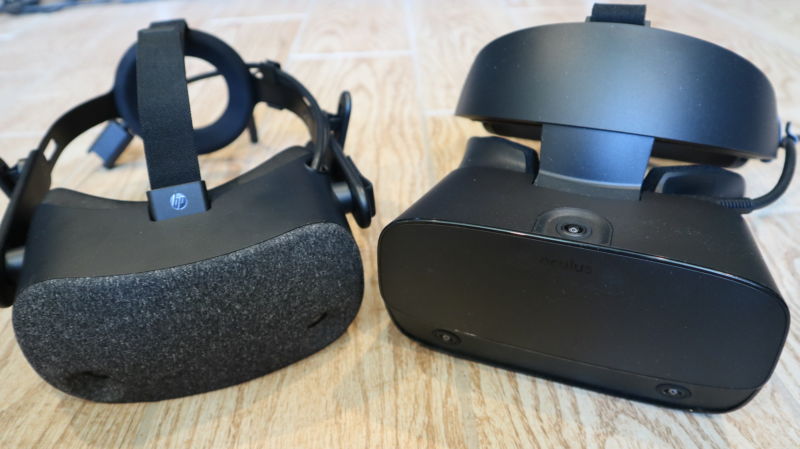
Enlarge/ The $600 HP Reverb (left) and $400 Oculus Rift S (right).
By the end of 2019, many major VR headset manufacturers seem poised to launch a new “statement” product for PCs. This month sees two such headsets reach store shelves: the Oculus Rift S (coming May 21, priced at $400) and the HP Reverb (out now, starting at $600).
In both companies’ cases, the statement from each headset is a mix of upgrade and compromise. Rift S sees Oculus take two steps forward, two steps back, from its three-year-old Rift headset to establish a new “baseline” PC-VR experience, particularly with active hand tracking in mind. Meanwhile, Reverb aims to deliver the most affordable “high-res” VR headset ever made—which, as you might expect, includes a few imperfections, ranging from the obvious to the surprising.
After living with both headsets, I can report that each headset’s sales pitch is totally fine, not game-changing, and both are worth scrutinizing—because neither is currently a slam-dunk recommendation.
HP Reverb: You say you want resolution
The cloth face of the HP Reverb is its best design element.
Sam Machkovech
Another look at that fabric front, and how it runs right into the rest of the plastic body. Also, you can see the downward angle afforded to one of the Reverb’s two front-facing sensors.
However, the actual head-fit of the Reverb feels a bit spartan, particularly thanks to this unwieldy fit of headphones and side straps.
Oh, look! “VR Headset!” I’ve always wanted one of those.
The Reverb in its box, with a pair of included Windows Mixed Reality controllers. These are the same as with other WMR headsets, and they rely on the sensors keeping an eye on the controllers’ very bright strip of LED lights.
Reverb from the top. This is the $650 model, which upgrades the face lining to a more comfortable leather option. (The standard $600 version comes with a cloth lining.)
The bottom of the Reverb, with a look at its plastic nasal rest. This angle does a good job showing how the back “halo” strap might fit neatly onto an average head. I’m a fan of it.
A peek at the lenses.
HP includes a way to detach the Reverb’s cable with a clamp pretty close to the headset itself. This is an unusual option for consumer VR headsets, but it’s sturdy enough that you shouldn’t worry about yanking it off if you step on a cord while within VR.
Let’s start with the HP Reverb, a headset that promises to exceed the screen quality and pixel density of the already-impressive HTC Vive Pro and Samsung Odyssey. Reverb’s total resolution weighs in at a combined 4,320×2,160 across its fast-switching LCD panels.
As a result, before HP agreed to send us a testing unit, we were asked to confirm a graphics card minimum of a GTX 1080 or AMD Radeon Pro WX 8200. Notice that their latter suggestion is designed for workstations, not consumer PCs. That’s the point. The Reverb is squarely targeted at an enterprise or development use cases where screen quality is paramount; this is not necessarily your headset for gaming or high-speed interactivity.
This is first made apparent by an awkward headstrap. Unlike the springy flex of the original Oculus Rift or the rotary dial of the PlayStation VR, Reverb’s strap is spartan. You get three velcro straps to adjust, which are all difficult to adjust while wearing the headset. This is all bound by a light-yet-wide halo, meant to fit against the back of the head, and it comes with two decidedly cheap-feeling over-ear speakers—with fuzzy material you’d expect from $5 airplane headphones. (You can’t detach these, but you can push them off your ears and plug in your own headphones with a 3.5mm jack.)
Yet this spartan approach means the strap system is under-engineered, a rarity in the sector. The headset is substantially lighter in mass than the over-engineered Vive Pro, which may be worth some inconvenience. Its back-halo design keeps more weight off your face than the original Rift. Plus, fit it onto your exact head shape once, and it’s simple enough to put on and take off from there.
The Reverb’s flip-up functionality is flimsy and bumps into your head, so it disappoints as a “peek at the outside world” option. Its cramped interior is not particularly glasses-friendly. And if your interpupillary distance (IPD) measures outside the “average” measure of 61-66mm, Reverb’s “digital IPD” adjustment option will leave you unsatisfied from a comfort level.
All of which is to say: If your expected business/enterprise use case includes mostly VR-savvy professionals of a perfect head shape and size, you’ll be fine. If you’re handing these to a variety of utter VR newbies, on the other hand, be ready to on-board them just to get the thing on.
Sweet spot, not-so-sweet result
As for the Reverb’s screens, the pixel resolution of 4,320×2,160 is incredible for the sector, well past the 2,800×1,600 measure of the Vive Pro and Odyssey. (And that’s even more than the Rift S, which we’ll get to.)
Reverb’s “sweet spot” visibility, in the center of a user’s field of vision (FOV), is the absolute winner in its price sector. After roughly one week of Reverb testing, I’m now convinced that this is the pixel count to count as “good enough” if you want to guarantee unobtrusive small-text legibility for the sake of VR’s research, education, and industrial design apps. (In Reverb’s case, this selling point is buoyed by the LCD panels’ dense subpixel resolution and 90Hz refresh.)
HP provided some sample “professional” apps during my testing period, and after wandering through a virtual replica of Helsinki and dissecting a frog in a classroom, I understood why. With my attention focused on front-and-center content, I could see the Reverb’s sales pitch damned clearly. HP has crossed an important VR-quality line at a reasonable business price point in 2019, and the rest of this review’s caveats and warnings can’t erase that fact.
One of those caveats, however, is my use of “sweet spot” as a qualifier. I struggled to understand why the high-res panel, all-in-all, looked a bit smeary (“a bit” is not a very scientific descriptor, after all). That issue became clearer once I set up a “VR desk” of a headset, a single hand-controlled WMR controller, a physical keyboard, and a floating VR replica of my PC’s 2D desktop.
Doing this confirmed my suspicions: the HP Reverb, like many other VR headsets, offers a clear view in its central FOV but is less successful at translating its peripheral pixels. Trying to read text in the periphery was a struggle compared to the same text appearing front-and-center. This was particularly easy to notice as I examined details spread across 16:9-ratio desktop windows and Web browsers. Without a physical IPD slider to work with, and only a “virtual” IPD adjustment option, I had no idea how to remedy this apparent blurriness. Countless attempts to re-fit the headset didn’t help.
To be fair, the fact that I could comfortably read Windows desktop content is its own VR revelation. That’s almost impossible to comfortably do on the first wave of 2016 VR headsets. But the Reverb’s arrangement of pixels and lenses does no favors to peripheral-view content, which leads to an uncanny valley-like issue: once some of the content is so damned crisp, why can’t all of it be? Additionally, why must the headset be so demanding of PC hardware if it blurs its peripheral pixels by default?
Some headset manufacturers are toying with foveated rendering, which reduces pixel resolution depending on what’s being displayed or how a user’s eyes are tracked. But nothing so efficient is happening here. The Reverb instead renders, then wastes, at least one fourth of its pixels, which I can tell by budging the headset awkwardly around until only its corner pixels become clear.
LCD concerns
That divide in clarity means all the comfort you might hope for from a higher-res headset dwindles in longer-term use. This is a shame because the fast-switching LCD panel lives up to a 90Hz refresh with fuller subpixel resolution than comparable OLED panels. However, the “halo” effect from its fresnel lenses is particularly noticeable within this headset.
Additionally, HP’s choice of fast-switching LCD panels means the Reverb simply suffers from imprecise color calibration—at least, compared to the rich, RGB-perfect results you can expect from a calibrated OLED panel. Part of that Vive Pro $1,100 price tag is an understanding that whatever content you bring in will enjoy nearly uniform color reproduction. But the Reverb’s “cold” blue-green wash, which is nigh indiscernible when looking at a standard CMYK color sheet, becomes apparent across a wider scene, particularly the pastoral, faux-outdoor environs of the hub spaces in Windows Mixed Reality and SteamVR.
In VR experiences that rely on moody color mapping (like the storybook-adventure of Moss), the color reproduction borders on problematic. Everything in that game looks darker and less alive than on the OLED-fueled HTC Vive Pro. A visible “mura” effect on our testing headsets resulted in uneven color reproduction across wide fields of pixels, as well. It was arguably the most intense mura effect I’ve ever seen on a consumer-grade VR headset, in fact. (To best explain this, think of a large website background color, which is supposed to be totally uniform, having an uneven smudginess to it. Next, imagine that smudginess moving in relation to where your head is aimed in VR.)
The usual Windows Mixed Reality caveat
If you’re fine with somewhat imprecise color reproduction, high system demands, and an asterisk on Reverb’s high resolution, you have one more pill to swallow: its merely adequate room-tracking powers. This is identical to most inside-out Windows Mixed Reality headsets, which rely on two forward-facing cameras and guarantee decent tracking, so long as you keep your hands generally in front of your face.
The short version: milder apps like TiltBrush and Vacation Simulator work just fine. (So did the educational apps that HP provided.) Highly active apps like Beat Saber and Space Pirate Trainer, on the other hand, have to compensate for Reverb’s poorly tracked hands on a pretty regular basis—as in, every 45 seconds in a high-speed Beat Saber song, a hand will noticeably disappear for a moment. Meanwhile, any games that rely on above- and behind-the-head hand action are out the window, as most WMR headsets (including the Reverb) don’t have upward-facing tracking sensors.
In good news, most popular VR fare expects lighter tracking, and as a result, WMR-style tracking will work in a pinch. But if the idea of randomly disappearing hands is too VR-breaking for you, then you’ll want to pony up for a fuller tracking experience.
https://arstechnica.com/?p=1500023
Detective Pikachu film review: This is how you adapt a video game for theaters
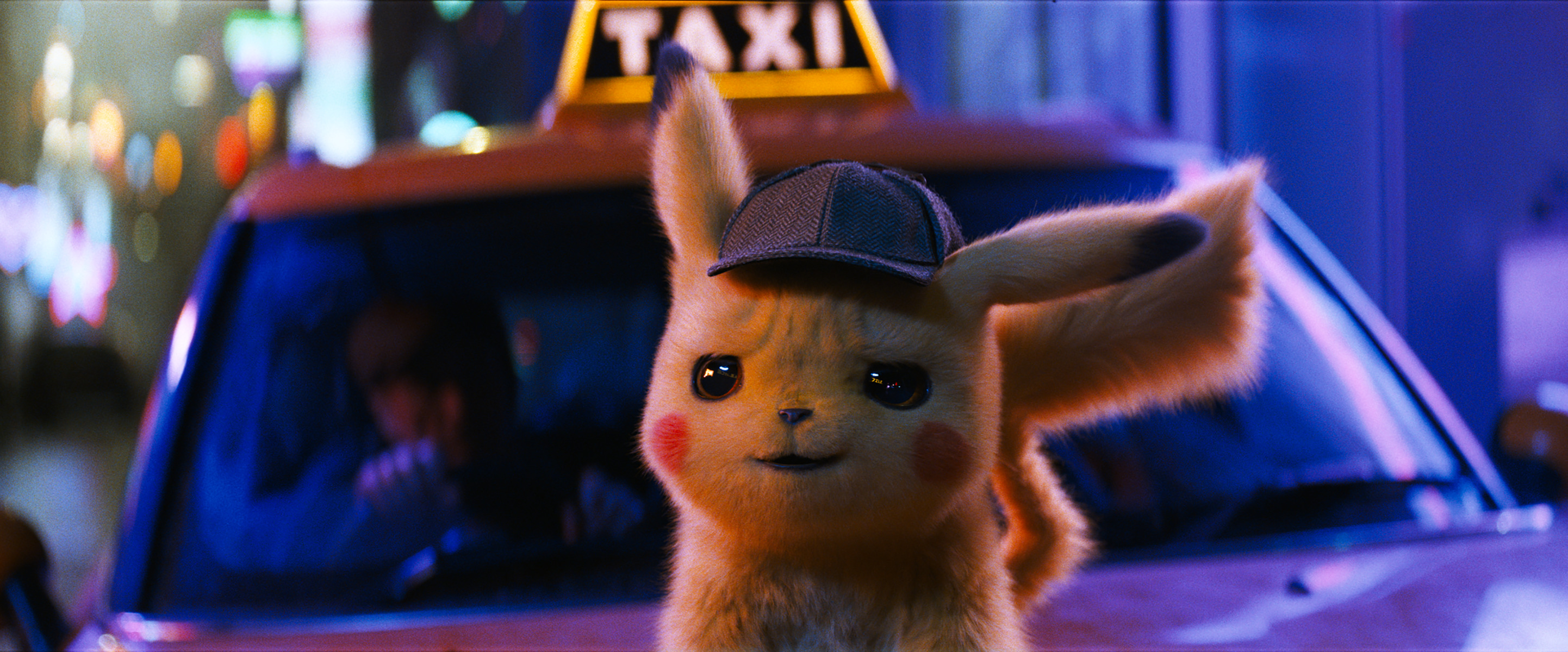
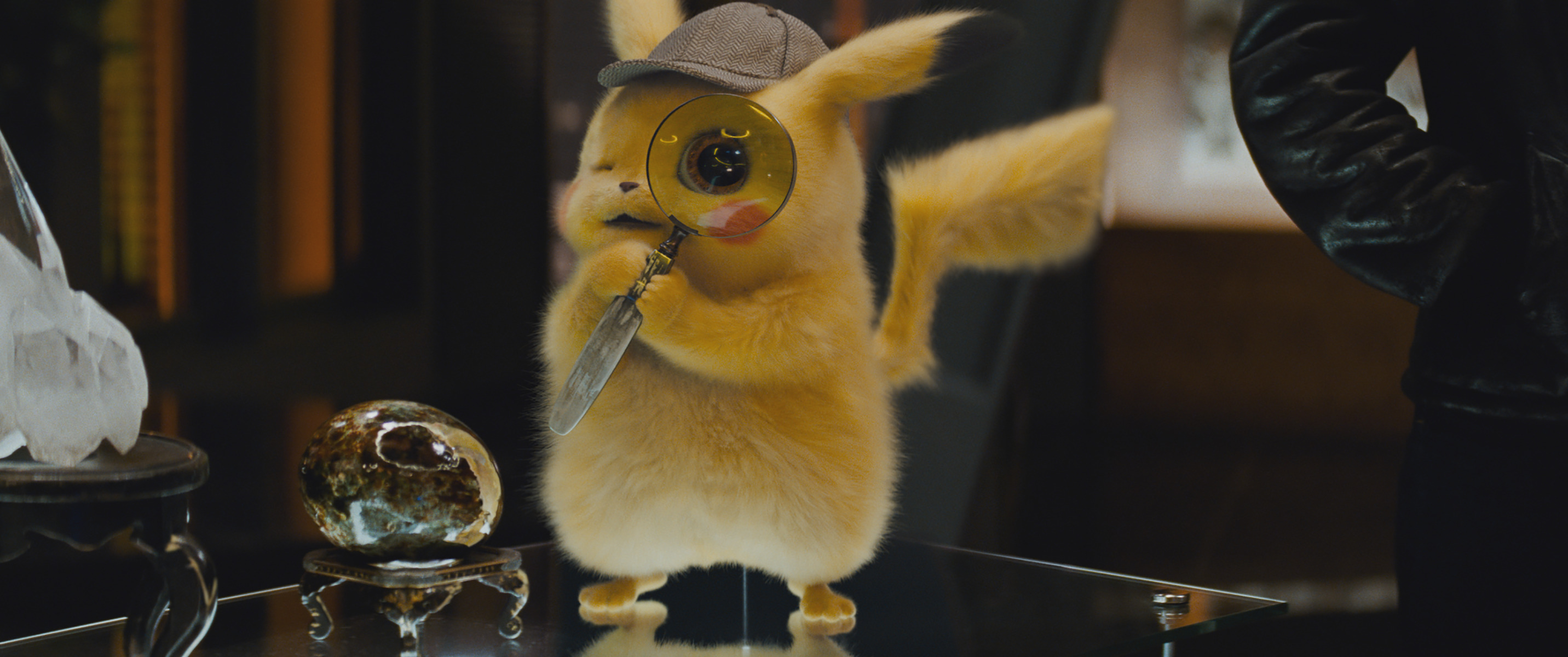
Enlarge/ How do you know it’s Detective Pikachu, not just standard Pikachu? Clues: the hat, the magnifying glass, the lush fur.
Warner Bros. / The Pokemon Company
Pokémon: Detective Pikachu is the best video game adaptation I’ve ever seen in a theater. And it’s even better than that weak praise might imply.
We could spend this entire article regretting the existence of Uwe Boll or arguing the merits of the Tomb Raider and Resident Evil film series, but Detective Pikachu is such a fun, polished film that those comparison points really don’t make sense. The more important comparison point is Pokémon itself—and the many feature-length cartoons that it has already been attached to.
Detective Pikachu is brisk, whimsical, and family-friendly, but it particularly wins out—and survives its pitfalls—by doing something really surprising: fully breaking from the Pokémon game-plot paradigm.
Take me down to Ryme City
Kathyrn Newton, Justice Smith cram with their companion Pokemon into an adorably tiny car to solve a mystery.
Their fateful meeting. “You can talk!” “You can understand me!”
Tim (Justice Smith) makes a curious discovery at an apparently empty office.
Bill Nighy plays Howard Clifford, the man who put Ryme City together as a bold experiment in human-Pokemon relations.
Ryan Reynolds’ version of Pikachu is an adorably caffeinated helper.
Kathryn Newton’s spunk and cheesiness lands a bit in Disney Channel territory, but if we’re talking about hard-boiled detective films as a source point, then that’s not entirely out of line.
You can expect at least one “battle” in the film, but it’s not exactly traditional in game-series terms.
Psyduck bein’ Psyduck.
The film emphasizes this quality by opening with a clever fake-out. We begin with the camera flying over a sleepy, pastoral town where Pokémon meander in fields of tall grass (you know, just like in the games). Our protagonist, a 21-year-old guy named Tim (Justice Smith of Jurassic World 2), is urged by a childhood buddy to get back into the catch-‘em-all swing of things—”relive the good ol’ days!”—and bumbles his attempt in comedic fashion.
No thanks, not for me, he says. Tim likes his job as an insurance agent. Series fans might expect the film to go down a “Pokémon trainer” path from here, where Tim has a revelation, invests in a carton of fancy Pokeballs, and competes to master the strengths and weaknesses of a cast of Pokémon, all while making friends along the way.
Instead, Tim gets some really bad news, and he has to pick up the pieces—in Ryme City, the one metropolis in a Pokémon-infested Earth where trainer battles don’t happen. It’s a “place where humans and Pokémon live side by side,” we hear in a newsreel description on Tim’s train ride. When he arrives, the whole Pokémon-infested city unfurls. And it’s glorious.
We get to Ryme City early in Detective Pikachu, which means most of the 100-minute runtime is spent in a place where roughly 50 Pokémon types hang out in city streets, at cafes, in underground nightclubs, and around nearby canyons and valleys—either commingling with their human companions (one per resident), wandering the world in richly animated herds, or working odd jobs. A four-armed Machamp directs car traffic around a passed-out Snorlax. A Loudred finds a comical opportunity to provide sound amplification at a “concert” of sorts.
As much as I enjoyed seeing Detective Pikachu in a theater, I cannot wait for this film to land on Blu-ray so that I can savor its massive crowds of people walking side by side with so many Pokémon. Each of these sequences can whiz by with only a few seconds of visible Pokémon, but the effort to individually animate each creature and have them blend so seamlessly with their environs is some of the most impressive stuff I’ve seen in a Hollywood production since I began reviewing films at Ars Technica.
This goes doubly for the scenes where we see major Pokémon characters hold onto and climb over their human allies. I’ve never seen CGI characters’ fur and other materials mesh so perfectly with human actors in their vicinity. I actually noticed some ho-hum applications of ambient occlusion and shadows in the film’s opening sequence, so I was heartened to see that visual annoyance prove an exception, not the rule.
Sorry, Pixar. The Detective Pikachu crew deserves your usual Oscar slot next year.
Don’t gotta catch ’em all
Enlarge/ You can almost see Ryan Reynolds’ face smirking in there.
But what really gives me shivers is how well Detective Pikachu skips past the usual Pokémon-cartoon baggage. What is each Pokémon’s superpower? How should you best counter a certain creature in a battle? What do you need to effectively capture or evolve an elusive character?
Detective Pikachu doesn’t care. It doesn’t even list most of the creatures’ names, let alone their battle strengths and weaknesses, because this production is not beholden to cartoon adaptations’ usual video game tie-in issues. Again: this is not the story of a burgeoning Pokémon trainer.
Dozens of Pokémon characters whiz by with their animations, actions, and goofy voices pulling the weight of comedy and excitement, and you don’t need to know squat about the series to appreciate any of it. Think of A New Hope‘s cantina scene, where mystery and goofiness set plenty into motion, and then imagine a film letting that perspective ride for its entire runtime. It’s awesome. That fun only multiplies if you’re familiar with a particular character’s game abilities and see how those are reflected in cute, blink-and-you’ll-miss-them moments.
This sense of constant, seamless visual candy is the difference-maker for a film whose plot is otherwise rote. This is a mystery movie that children can enjoy, after all, so you can expect all the twists and nuance of something like The Great Mouse Detective. Plot points fall all too conveniently into place. The protagonists take some questionable, not-at-all stealthy actions while uncovering an evil plot. Deceptions and twists reveal themselves pretty blatantly.
Tolerable flyover above Montana
Yet Detective Pikachu never really feels rote or predictable, thanks to how it slips two secret tricks into a mystery-by-numbers screenplay: silly Pokémon, and Pikachu voice actor Ryan Reynolds.
I admit, I had my reservations about Reynolds’ role after hearing his work as the murderous, foul-mouthed voice of Deadpool. Yet within two minutes of Reynolds manifesting as Detective Pikachu (whose voice can only be understood by Tim in this Poké-world), I was sold. There’s subtlety and nuance (if you can believe it) for how Reynolds voices the world’s most popular electric-mouse mascot, and his reimagining of the typically squeaky character fits.
Believe it: Pikachu makes sense as a friendly, over-caffeinated, and eager adult who can reflect with a somber tone one moment and turn wimpy and terrified the next. The slyness and dripping sarcasm of Deadpool’s voice is nowhere to be found here, and the whole thing benefits from Tim as a confused, straight-man partner. What’s more, since Tim and Detective Pikachu don’t go down the normal Pokémon-adventure route of master and monster, we get to see Tim “grow up” in subtle, surprising ways, as opposed to his transforming into an against-all-odds action star.
Thank goodness, because the rest of the live-action cast ranges from serviceable to obnoxious. Tim’s eventual foil, a perky reporter (Kathryn Newton), has all the subtlety and gravitas of a Hannah Montana guest-star, while a haughty, sneering business executive (Chris Geere) wallops viewers over the head with the idea that we’re not supposed to like or trust him. If either actor wants to reprise their exact performance in the future, they’d be incredible fits for an average Pokémon cartoon.
But their campy, overeager performances are still a good fit and certainly not worth getting hung up over. They’re good mid-film reminders that you’re not watching Detective Pikachu for a refreshing new twist on the usual mystery story. Instead, attend this film to savor what happens when a film crew leverages the strengths of a zany, massive cast of monsters while checking their plot-dragging, game-battling baggage at the theater door. Should every other upcoming video game film start by shamelessly copying Detective Pikachu‘s formula, the cinematic world would be the better for it.
If Pokémon has become a part of your life for any reason—you played it, your kids play it, or you got hooked on Pokémon Go for a few months—go see this hilarious, sweet, and wide-eyed film. If not, prepare to have a perfectly good time while being confused by whatever the heck a Gengar is.
https://arstechnica.com/?p=1502171
28 years later, hacker fixes rampant slowdown on SNES‘ Gradius III
[embedded content]
Behold, slowdown destroyed!
Many gamers of a certain age (this author included) remember the early ’90s disappointment of buying the SNES version of hit arcade shmupGradius III. In magazine screenshots, the game’s huge, colorful sprites were a sight to behold, comparable to the 1989 arcade original. In action, though, any scene with more than a handful of enemies would slow to a nearly unplayable crawl on the underpowered SNES hardware.
Now, Brazilian ROM hacker Vitor Vilela has righted this nearly three-decade-old wrong with a ROM patch that creates a new, slowdown-free version of the game for play on SNES emulators and standard hardware.
The key to Vilela’s efforts is the SA-1 chip, an enhancement co-processor that was found in some late-era SNES cartridges like Super Mario RPG and Kirby Super Star. Besides sporting a faster clock speed than the standard SNES CPU (up to 10.74 Mhz versus 3.58 Mhz for the CPU), SA-1 also opens up faster mathematical functions, improved graphics manipulation, and parallel processing capabilities for SNES programmers.
Unlike specialty chips such as the well-known Super FX, the SA-1 has the same architecture as the core SNES CPU, which makes porting code written for the base system easier. But that doesn’t mean you can just add the chip to any game ROM and get an instant speed boost. Vilela writes that it took “three months of researchment [sic], disassembly, code analysis, memory remapping, and code editing” to get to this point. The patch “changes most of the data structures [and] pointers and finally creates an intermediate system for calling SA-1 for most intensive routines and the SNES for the PPU/APU interaction routines and V-blank refreshing.”
The result, as is apparent in the comparison videos embedded here, is a version of Gradius III that Vilela says runs two to three times faster than the original. It also keeps its silky smooth frame rate no matter how many detailed, screen-filling sprites clutter the scene. That’s even true in the game’s notorious, bubble-filled Stage 2, which is transformed from a jittery slide show to an amazing showcase of the SNES’ enhanced power. As if that wasn’t enough, the patch even slashes the game’s loading times, cutting a full 3.25 seconds from the notably slow startup animation.
[embedded content]
Even the mightiest of bubbles is no match for the SA-1.
While impressive from a technical standpoint, one could argue this patch ruins the way Gradius III was meant to be played. Vilela notes that the lack of slowdown “makes it incredibly super difficult” and even suggests that “some arcade segments of the game do not look RTA (real-time action) viable with SA-1. But we shouldn’t underestimate the human capabilities.”
Real SNES hardware reportedly has no problem with the SA-1 patched Gradius III, even when running through a tool like SD2SNES. But while Vilela says “the most up-to-date SNES emulators including bsnes and Snes9x” will work with the patched version of the game, emulators like ZSNES are not compatible.
With the root work in place, Vilela is already fielding requests for other slowdown-prone SNES games that could benefit from the SA-1 porting treatment. For now though, he says he’ll return to work on Touhou Mario World 2, which is a “bullet hell” version of the platformer that shows off the SA-1’s capabilities.
Coming on the heels of a recent “HD emulation mod” that enhances the clarity of “Mode 7” SNES games, we have to wonder what other enhancements the modern hacking community can bring to the 16-bit gaming era.
[embedded content]
Twelve minutes of silky smooth SNES shmup frame rates. This must be what heaven feels like.
Final Fantasy VII remake finally looks like a video game—and it’s a pretty one
It’s back! Again!
Depending on where you freeze-frame the trailer, you’ll see different versions of the characters’ renders. We think this shot, with some slight fuzziness and smoothed-over details, is most representative of the mid-action character renders. And that’s pretty great.
Other real-time scenes include a bit more fidelity, so we can’t be sure whether they’re real-time or not.
Barrett barks orders.
Aerith says hello to Cloud.
Real-time combat in today’s trailer always includes two immediate action buttons and a hidden menu.
Aerith stands guard while Cloud does damage.
Weak points, maximum damage.
This is the least-blurry shot of Sephiroth in today’s trailer. That is still at least 300% sharper than his original PS1 cut-scene render.
Even without the attached dialogue, you can tell that Cloud is being a jerk here.
Sony’s latest promotional video for future PlayStation games (dubbed “State of Play”) concluded with a surprise peek at a long-awaited game: Final Fantasy VII Remake. In bad news, the Thursday trailer was clearly limited by publisher Square Enix’s intent to save a bigger reveal for “June,” possibly timed for the annual Electronic Entertainment Expo.
But in good news, the project, announced nearly four years ago, finally looks like an honest-to-goodness video game. At last, we can begin guessing what its final version might possibly look and play like.
The most apparent thing from the trailer, embedded below, is an active battle system that looks largely similar to that found in Final Fantasy XV and the wider Kingdom Hearts series. (We got a tease of this in a late-2015 trailer.) A low-angled camera sits behind whichever character is being controlled, and each fighter gets two immediate action buttons, along with a shortcut to a larger menu. (That menu wasn’t toggled in today’s one-minute video.)
Additionally, the high level of detail given to familiar characters like Cloud, Aerith, and Barrett seems to be maintained outside of cinematic, conversational sequences, as made evident by a few freeze-frame moments when the characters have a slight reduction in detail and increase in fuzziness. If this is indeed how the in-game, real-time rendering turns out, we’re in for one heck of a production, at least on a visual scale. But major characters like Sephiroth only get the briefest of teases, while others (particularly Tifa) do not appear to be visible.
No, there’s no release date yet attached to this game, which is still slated to be a PlayStation console exclusive whenever it comes out. And Square Enix has yet to clarify its plans for an “episodic” FFVII Remake release schedule, as was originally teased in 2015.
Senator Josh Hawley (R-Mo.) today announced plans to introduce “The Protecting Children from Abusive Games Act,” which would target “the exploitation of children through ‘pay-to-win’ and ‘loot box’ monetization practices by the video game industry,” according to a summary released by Hawley’s office.
As outlined, the bill would mirror the Children’s Online Privacy Protection Act in applying to games “targeted at those under the age of 18” and “games with wider audiences whose developers knowingly allow minor players to engage in microtransactions.” Under the bill, such games would not be allowed to have loot boxes, defined here as “microtransactions offering randomized or partially randomized rewards to players.”
The bill summary also takes aim at so-called “pay-to-win” mechanics that “manipulate a game’s progression system… to induce players to spend money…” or which alter the “competitive balance between players of multiplayer games.” The Federal Trade Commission and state attorneys general would be able to enforce the law.
“When a game is designed for kids, game developers shouldn’t be allowed to monetize addiction,” Hawley said in a statement. “And when kids play games designed for adults, they should be walled off from compulsive microtransactions. Game developers who knowingly exploit children should face legal consequences.”
In a statement, the ESA noted that “numerous countries, including Ireland, Germany, Sweden, Denmark, Australia, New Zealand, and the United Kingdom, determined that loot boxes do not constitute gambling. We look forward to sharing with the senator the tools and information the industry already provides that keeps the control of in-game spending in parents’ hands. Parents already have the ability to limit or prohibit in-game purchases with easy to use parental controls.”
Despite Hawley’s announcement, though, the Protecting Children from Abusive Games Act still has a long way to go before becoming law. First, the summary announced today would have to be translated into actual legislative language. That bill would then have to proceed through committee (likely following hearings), then pass the House of Representatives and Senate before being signed by the president. None of that seems especially urgent or likely in the near term, given other political priorities and continuing gridlock in the legislature.
State-based legislative efforts to rein in loot boxes in Washington state, Hawaii, and Indiana have yet to lead to any actual laws on the books. And despite the ESA’s citation of national governments that have explicitly okayed loot boxes, gaming commissions in the Netherlands and Belgium have already ruled that loot boxes constitute illegal games of chance.
In September, Washington state joined with 15 foreign countries in a declaration expressing concern “with the risks being posed by the blurring of lines between gambling and other forms of digital entertainment such as video gaming.”
HBO drops first teaser for its upcoming Watchmen series
[embedded content]
HBO’s new Watchmen series.
The clock is ticking faster and faster as the world escalates toward destruction in the first teaser for Watchmen, HBO’s forthcoming new miniseries based on the hugely popular graphic novel by Alan Moore and artist Dave Gibbons.
(Some spoilers below for 2009 film and Watchmen and Doomsday Clock comics.)
Watchmen is one of the most critically acclaimed comic book series, widely viewed as a harbinger of the genre reaching full maturity due to its dark vision of flawed superheroes in an alternate timeline who go into hiding when public sentiment turns against them. Set in 1985, the series opens with the murder of a man named Edward Blake, who turns out to be a superhero known as the Comedian. Some former superhero compatriots team up to discover who has begun offing their colleagues, culminating in a confrontation with entrepreneur Adrian Veidt (formerly the superhero known as Ozymandias). Veidt orchestrates a massacre of half of New York City’s population by a giant alien squid in hopes that it will unite warring nations against a common foe.
More recently, DC Comics has published a 12-issue sequel series called Doomsday Clock (written by Geoff Johns) as part of its Rebirth line. [corrected] The first issue debuted in November 2017; #9 was published in March, with the last three issues slated to run later this year. It’s set in November 1992, seven years after the events of Watchmen, with Veidt a fugitive after the publication of fallen superhero Rorschach’s journals revealed his hand in the massacre. And it takes advantage of the multiverse/alternate timeline trope yet again to essentially merge the worlds of Watchmen and the DC Universe.
Watchmen was long considered unfilmable (most notably by Terry Gilliam, who started developing an adaptation in 1991 and then abandoned the project). Director Zack Snyder accepted the gauntlet with his 2009 film of the same name, largely hewing closely to the source material with the exception of the giant squid. Reactions were highly polarized: Snyder’s film is either a masterpiece rivaling the best work of Stanley Kubrick or a boring, overly grandiose mess, although the director’s cut was more favorably received. (Personally, I think it falls somewhere in between: some truly compelling moments and characters that don’t quite hang together as a cohesive narrative.) The film grossed $185 million worldwide.
Tick tock. The countdown begins.
YouTube/HBO
Masked vigilantes.
YouTube/HBO
Mourning fallen comrades.
YouTube/HBO
A small army of Rorschachs.
YouTube/HBO
Even more massacre.
YouTube/HBO
Jeremy Irons plays an older version of Adrian Veidt (aka Ozymandias).
YouTube/HBO
I’m guessing this is Looking Glass (Tim Blake Nelson).
YouTube/HBO
Don Johnson’s Chief Judd stops by for a chat about the pending end of the world.
YouTube/HBO
Snyder was originally in discussions with HBO about producing a TV adaptation of Watchmen in 2015, but by the fall of 2017, Lost showrunner Damon Lindelof had taken over production duties, and Snyder was no longer involved with the project. Lindelof had turned down prior opportunities to adapt the graphic novel for TV, citing Alan Moore’s view that he wrote Watchmen for the comic medium, and trying to translate it into moving images would ruin it. In a five-page letter to fans posted to his Instagram last May, he explained how he came to change his mind.
Lindelof also confirmed that his series would not be a reboot or a sequel, but more of a “remix,” with some new characters joining some of the canonical ones. Per his letter:
We have no desire to ‘adapt’ the twelve issues Mr. Moore and Mr. Gibbons created thirty years ago. Those issues are sacred ground and they will not be retread nor recreated nor reproduced nor rebooted. They will, however, be remixed. Because the bass lines in those familiar tracks are just too good and we’d be fools not to sample them. Those original twelve issues are our Old Testament. When the New Testament came along it did not erase what came before it. Creation. The Garden of Eden. Abraham and Isaac. The Flood. It all happened. And so it will be with Watchmen.
It’s a bold move, and probably a wise one, since nobody wants a retread of the same ground Snyder’s film covered. I guess it’s Lindelof’s way of reconciling his desire to do the series with his respect for Moore’s antipathy toward adapting his graphic novel for film or television. We do know that there are several elements drawn from Doomsday Clock, notably the casting of Jeremy Irons as an older, possibly cancer-stricken Veidt, and the husband/wife criminal team known as Mime and Marionette (played by Tom Mison and Sara Vickers, respectively). Among the new characters is Looking Glass, played by Tim Blake Nelson.
The “tick-tock” theme throughout the teaser certainly evokes the Doomsday Clock sequel, and we get several shots of a small army of Rorschachs. (The original Rorschach died at the end of Watchmen, but in Doomsday Clock, a man named Reginald Long becomes Rorschach II.) “We are no one. We are everyone. And we are invisible,” their leader intones. That countdown seems to be leading to the end of the world, if Don Johnson’s smirking Chief Judd is to be believed—whether via the canonical nuclear showdown between the US and Russia in Doomsday Clock or another threat altogether.