I Like Scary Movies interactive horror exhibit is art for the Instagram era
Enlarge/ “Look dead. No, more dead.” Ars writer in a horror playground inspired by 2017 film adaptation of Stephen King’s It.
Horror-movie fans are known for their love of immersive “haunts:” special exhibits of events that pay tribute to their favorite films while letting the fans in on a bit of the scary action. That’s the thinking behind I Like Scary Movies, a pop-up interactive art installation that just opened in Los Angeles.
I Like Scary Movies is the brainchild of “experiential” artist Maximillian Castillo (who goes by Maximillian), well-known for his interactive immersive creations, like a Snakes on Plane installation or a Pirates of the Caribbean walk-through for San Diego Comic-Con. He’s also a horror-movie buff, and the current exhibit—housed in the historic art deco building The Desmond, along Los Angeles’ Miracle Mile—draws inspiration from five films in particular: The Shining, It, A Nightmare on Elm Street, Beetlejuice, and The Lost Boys.
“I wanted to do something that was more like an interactive art installation—something that isn’t your standard Halloween scare maze, which I love, but I feel like we can celebrate and interpret these movies over and over again,” Castillo said in an interview. “Other than going through a walk-through maze once a year during Halloween, there’s really no other way to really enjoy these movies and dive deeper into the content of these films and these worlds.”
The “I Like Scary Movies” interactive art exhibit runs in Los Angeles through June 16.
Jennifer Ouellette
A piece inspired by a famous scene from The Shining.
Jennifer Ouellette
“Come play with us…”
Jennifer Ouellette
Pause for a photo on Danny’s tricycle.
Jennifer Ouellette
Stick your head in Pennywise’s mouth, if you dare.
Jennifer Ouellette
“We all float down here.” Trying on the yellow coat is optional.
Jennifer Ouellette
A piece that cleverly evokes poor Georgie’s paper boat.
Jennifer Ouellette
A 2000-pound recreation of Freddy Krueger’s hand. Visitors can wrap hinged fingers around themselves for dramatic effect.
Jennifer Ouellette
A meta moment: mannequin snapping a selfie (unaware of the Hand of Krueger) in an exhibit where people snap selfies.
Jennifer Ouellette
The ghosts of Barbara and Adam Maitland from Beetlejuice do their best to scare off visitors.
Jennifer Ouellette
Here lies Betelgeuse… and maybe you.
Rachael Porter
Skeleton relegated to the smoking section.
Jennifer Ouellette
“They’re only noodles, Michael:” recreating a prank from The Lost Boys.
Jennifer Ouellette
At the entrance of I Like Scary Movies, visitors find themselves in The Shining‘s “redrum” hedges, moving to subsequent rooms from there. Also from The Shining: Castillo’s interpretation of the famous scene in which a torrent of blood pours out of The Overlook’s elevator—the bloodstream is made from strands of red movie tickets—and a chance to sink into the hotel’s signature carpeting after posing on a replica of Danny’s tricycle. Freddy Krueger’s “throne” is here, plus several set pieces from Beetlejuice: you can stick your feet in a shark’s mouth while lounging on a chair, for instance, like the sea diver ghost in the film.
The most compelling is the installation for It. Castillo created a creepy Pennywise teepee out of children’s toys and other similar found objects, alongside several models of the killer clown’s nightmare-inducing toothy maw that are large enough for visitors to stick their head inside. But it’s the hanging strings of paper boats (reminiscent of little Georgie, whose disappearance sets off the events in It) that set this feature apart. The piece is truly artistic, and it creates a winding path leading to the sewer lair, all while lighting creates caustic patterns on the floor to mimic the flow of water.
Each installation provides ample opportunity for visitors to snap pictures of themselves and their friends in their favorite horror scenarios: posing in a coffin in Pennywise’s underground sewer lair, perhaps, or hanging from the Santa Clara train tracks from The Lost Boys.Scary Movies is interactive art ready-made for the Instagram era, and it makes for a fun afternoon diversion. But the experience won’t come cheap: tickets are $39 each.
I Like Scary Movies should remain at The Desmond through June 16, before Castillo (hopefully) takes his scare-fest on the road.
https://arstechnica.com/?p=1487351
You call that EDM? Moritz Simon Geist’s robots make the most technical techno
Electronic engineer/robot-musician conductor Moritz Simon Geist performs at the SXSW Innovation Awards.
Nathan Mattise
Unlike other electronic/techno artists, Geist is obsessed with tactile instruments—he just builds them from old tech parts and then builds rigs to automate ‘em.
Nathan Mattise
Some of Geist’s robots are based on the simplest of DIY instruments, like a set of toned water glasses.
Nathan Mattise
During performances, Geist serves as conductor—he initiates various instruments/bots he has built and then occasionally bangs out rhythms on a MIDI controller to queue other noises.
Nathan Mattise
Geist chats up Ars during some SXSW downtime.
Nathan Mattise
Some of Geist’s press photos let you see more of his creations than being in the audience during a performance allows.
Here’s the Ikea-ish set of shelves hosting various glitch robots Geist created.
D. Pinzer / MagnumPR
Sparks on demand used to rhythmic effect.
David Campesino / MagnumPR
Motorized chugs and clangs utilizing old tech hardware.
David Campesino / MagnumPR
AUSTIN, Texas—If you find Moritz Simon Geist’s “Entropy” on Spotify, you might think nothing of it. The song is built upon repetitive, droning phrases that layer upon each other in ways you can’t help but move your head to. Along with the rest of the tracks on The Material Turn, it wouldn’t be out of place as deep cuts in the DFA Records catalogue, but they’re less obviously electronic—no soaring synths or flourishes of rhythmic glitches here. Instead, “Entropy” has that breathy groove of an early song from The XX along with an overall industrial aesthetic like what music fans loved about Nine Inch Nails. “Entropy” is a dance track, but sinister, something that could soundtrack a highly stylized sci-fi flick or a dungeon level in a cool side scroller.
All that to say, Moritz Simon Geist wrote a catchy song. But what makes this remarkable is—unlike Hot Chip or Trent Reznor or whoever—Geist’s music doesn’t start from a synthesizer or emanate from his computer. He’s “the world’s only techno producer playing entirely with his self-made futurist robots,” as the press release for his new EP, Speculative Machine, puts it. Glitchy tones on a track like “Maschyn” might come from a circuit board he printed himself. Sizzle sounds that listeners are accustomed to hearing from cymbals instead arrive from controlled bursts of pressurized air. The eerie melody of “Entropy” literally utilizes one of the oldest forms of a DIY instrument: water glasses filled with liquid to produce different tones, only this time they’re played by a motorized set of mallets. And unless you see him performing live—as several new fans did during Geist’s seven-performance run at SXSW 2019—you may never know something extraordinary is taking place.
[embedded content]
Moritz Simon Geist’s demo video for his music, showcasing the track “Entropy.”
“There’s a lot of experimental artists that put a lot of stress on the experimental part. For me, the music has to stand on its own,” he tells Ars. “This artwork has a technical aspect to how it’s made, but it has to be really good content-wise. I want to make this music good and on the same level as someone with a computer or synthesizer would program music. In the end, mine’s just made with robots, of course—and they add different layers or special sounds you can’t replicate with a synth or maybe replicate at all.”
Maker music
Geist describes himself as a “performer, musicologist, and robotics engineer,” but he’s a musician at the core if the orchestral intricacies of his work don’t give it away. He grew up with a classical music education—clarinet, piano, and guitar—and only started tinkering with electronics out of a desire to take those instruments further.
“I had no money, so I started building my own effects pedals for guitar,” he tells Ars. “And this got me hooked on electronics and the engineering aspect, though I was 14, so maybe you wouldn’t call it engineering. Eventually, I started studying electronic engineering and kept doing arts and music at the same time.”
Geist would go on to pursue his burgeoning love of engineering to the max. He worked as a research engineer, in fact, until deciding to pursue music full time starting in 2012. At that time, he still had the concept of robotic music—uniquely crafted noise-making devices that could be played on demand, automatically—but not quite the toolset.
“I wanted the physical aspect of playing piano—you’re touching things, you can touch the strings—it’s tactile. I wanted to bring that to electronic music, computer-generated music. I was searching for the way to do the electronic sound, the techno music I love, but with a more physical aspect,” he says. “[But to start,] I was crafting things in wood. When you do something once in wood, it’s nice, but if you need 21 pieces…”
Today, Geist does much more traditional engineering work, just specifically focused on building instruments and automated means to play them. His interest in music long predates any aspects of his work that might fall under the Maker Movement, but the musician relies on many of that community’s most common and popular hobbyist tools and techniques: laser cutters, Arduinos, 3D printers, printed circuit boards, etc. After a quick interview at SXSW, for example, he joined Ars to walk through the Exhibit Hall—and like a kid in a candy shop, he had to quickly split to chat up exhibitors offering up controllers in various form factors, from gloves to headsets.
“A good piece of art starts with a brilliant idea, but how you translate it into a full piece changes a lot depending on the techniques you have,” he says. “Today it’s very simple: the prototyping is very short. You have Arduinos, PCBs [printed circuit boards] made in China that you can ship over here… the development process is really quick and simple. It makes the fail-fast attitude in arts pretty easy.”
It’s hard to believe #SXSW was barely two weeks ago. We may have some more stories stemming from Austin soon to come—here’s a little preview of something that’ll be on site this weekend. https://t.co/OfdBE2oFdSpic.twitter.com/Td8XxIxD19
Geist’s music doesn’t leave much room for improvisation. Instead, he spends months creating his instruments—3D-printed kalimbas, salvaged hard drives or batteries now set up to click and spark—in order to build a specific set list or album. Sometimes, they’re obviously based on a real-world analogue (he once built a robo-replica of a Roland TR-808 drum machine, for instance), but that’s not always the case. One of his next instruments will be like a vibraphone, but “a futuristic version of that,” he says. Instead of differently toned bars arranged neatly on a flat playing surface, Geist imagines his bars, some three meters high, all over the physical space in a giant ambient robotic installation. Trips through places like the SXSW Exhibit Hall help him discover inspiration for how to do it.
While Geist’s more recent creations have obvious visual elements to them (LEDs or little bits of styrofoam to blast in sync), this isn’t a chicken or egg situation between his bots and his music. Geist starts with a sound, typically coming from a robot, and builds out from there.
“In the beginning, I was trying to replicate music I had in mind that came from pop culture or electronic music. But that doesn’t work well with robots because their capabilities are very limited,” he says. “So I realized when I started recording, I have to take the limited sound of the robot, listen to what it’s doing, and develop the track from that rather than having a brilliant idea for an orchestra and trying to do it with the limited capabilities of a robot—it doesn’t work out, that’s too far away. [Historically,] this is actually how electronic music was made—look back at the 808s and the big drum machine. It was very limited, but people took that sound and developed genres like hip-hop, electro, or techno out of that from a scope of limited sounds. Now it’s iconic.”
So far, the results seem to be speaking for themselves. Not only did Geist book seven performances during his first SXSW, he seemed to attract quite the audience. Ars saw NPR Music’s Bob Boilen sneaking in and out of the SXSW Innovation Awards where Geist provided the night’s music, and the musician landed in “Best of” festival lists everywhere from Variety (“your friends who go to museums might like him just as much as your mates who go to underground techno shows”) to Rolling Stone (“see-it-to-believe-it EDM”).
Ars also caught a show firsthand (see a few clips in the tweet above). We left impressed even though Geist couldn’t bring everything from his workshop (bless that airport baggage workforce) and had to work with a limited visual palette accordingly. And when we asked the performer how crowds reacted to his first weekend headlining gigs, he seemed pleased, too.
“Something futuristic is going on at the stage, but they aren’t sure what’s really happening—it’s like, ‘What the fuck is going on? It’s cool, but I don’t actually know what’s going on,'” he says. “I think that worked out.”
Period drama Warrior brings Bruce Lee’s vision to vivid life after 50 years
Enlarge/ Andrew Koji plays Ah Sahm, a master martial artist who comes to San Francisco’s Chinatown and gets drawn in the infamous tong wars.
HBO/David Bloomer
There’s juicy political intrigue, forbidden love, and plenty of kung-fu fighting in Warrior, a new ten-episode series from Cinemax. The series is adapted from a treatment developed by legendary kung fu master Bruce Lee nearly 50 years ago, and while it’s been updated to suit contemporary tastes and trends, it still manages to capture the essence of Bruce Lee’s philosophical worldview.
(Mild spoilers below.)
According to Hollywood lore,Bruce Lee pitched an idea in 1971 for a TV series about a martial artist in the Old West. Skittish studio heads passed on the project (and on Lee as its star), opting to make Kung Fu with David Carradine instead. Lee’s daughter, Shannon Lee, heard these stories, too. When she took over management of her father’s legacy in 2000 as president of the Bruce Lee Foundation, among the archived materials was Lee’s original treatment, along with several drafts and notes. It stayed in storage for several years, until Lee mentioned its existence to executive producer Justin Lin (The Fast and the Furious: Tokyo Drift). Lin loved the treatment and thought they could make the series that her father had always intended.
When Cinemax green-lit the project, they brought Jonathan Tropper on board as creator and executive producer. Tropper had just wrapped the final season of Banshee for the cable channel, and he was a Bruce Lee uber-fan, so he jumped at the chance to work on the project. “I could quote every [Bruce Lee] movie,” he said. “So the little boy in me was super excited.” He was surprised to find that the original treatment also featured numerous illustrations: Bruce Lee had an artistic bent and drew various characters and fight moves to augment his writing. The treatment was sparse enough that Tropper had freedom to flesh out the plot and create new characters. “All I had to do was be true to the integrity of the themes he wanted to explore,” he said—namely, the Chinese immigrant experience in 19th century San Francisco.
With a martial arts prodigy as its protagonist, Warrior boasts some impressive fight choreography.
In the pilot episode of Warrior, a young Chinese martial arts prodigy, Ah Sahm (Andrew Koji, Fast and Furious 6: HK Police), arrives in 19th-century San Francisco. He left China to find his sister but soon finds himself embroiled with the Tong Wars, a period of particularly violent disputes between rival Chinese gangs, called tongs, in the Chinatowns of several American cities. (There were as many as 30 tongs in San Francisco alone at the height of the Tong Wars.) Ah Sahm also must contend with rising anti-immigrant sentiment against the Chinese.
Tonally, the series is akin to shows like Peaky Blinders and Boardwalk Empire—all gritty period dramas centered on criminal pursuits of one kind or another. But with a martial arts prodigy as its protagonist, Warrior also boasts some impressive fight choreography. And it very much reflects a 21st century sensibility in its predominantly Asian cast; there’s not a trace of whitewashing in sight. There’s also none of the dated, cheesy aphorisms that made Kung Fu such a hit with mainstream white audiences in the 1970s. Rather, Lee’s personal philosophy is deftly woven into the fabric of the show.
Enlarge/ Ah Sahm’s tong brotherhood includes Bolo (Rich Ting, center left) and Young Jun (Jason Tobin, center right).
HBO/David Bloomer
Lee’s original treatment followed a typical 1970s episodic format, with a self-contained adventure in each. “TV is not really made that way anymore, so we definitely had to update it for how stories are told on TV nowadays,” said Shannon Lee. “But the bones of it are all in the treatment: the time period, the San Francisco setting, the politics of the time, the fact that [Ah Sahm] is looking for his sister.” The martial arts master did his homework on the history of the period, researching the Chinese Exclusion Act and other details of 19th century San Francisco. That historical element of the Chinese American experience was also a draw for Lin. It’s a key period in US history, and yet, “Growing up, we’re lucky to have two sentences in a history book,” he said.
Warrior puts the corrupt politics and simmering racial tensions front and center—something that might have been glossed over by Hollywood back in the 1970s. The Chinese immigrants are “onions.” The white folk are “ducks” who are shocked that Ah Sahm speaks impeccable English, and they still turn up their noses at having to share a stagecoach with “dirty” foreigners. There are opportunists like Wang Chao (Hoon Lee, Banshee, Iron Fist) who seek to play both sides, deliberately fostering hostility between the tongs for fun and profit. To quote Game of Thrones‘ Littlefinger, “Chaos is a ladder“—and Chao and Mai Ling (Dianne Doan, Vikings), Ah Sahm’s estranged sister, want to climb that ladder to wealth and power. On top of all that, there is no love lost between the Chinese immigrants and the Irish working class, who are competing for the same backbreaking jobs in an increasingly tight economy.
The same is true for the series’ unapologetic use of profanity, nudity, and explicit violence and sex (aka “getting sticky”), although Lee points out that Enter the Dragon was rated R for just those reasons (even if it’s still quite tame by contemporary standards). “My father was certainly not shy about any of that,” she said. That said, “He did not believe in [gratuitous] violence for its own sake, so the action in the show is all thought-out as to why it’s happening.”
https://arstechnica.com/?p=1485293
Game Pass “Ultimate” and Game Pass for PC rumored to be coming soon
Enlarge/ The arrow is pointing to a PC that’s just off-frame to the right.
Microsoft is reportedly planning a couple of new subscription services for gamers, per Brad Sams and WalkingCat.
First up is a “Game Pass Ultimate” that combines an Xbox Live Gold subscription with a GamePass subscription. Xbox Live Gold is routinely on sale, but it typically costs around $60 when bought annually or $10/month when bought month by month. Game Pass is a flat $10 per month (though there’s a special offer at the moment giving one month for one dollar). The Ultimate subscription is going to be $15/month, making it a break-even proposition for annual subscribers (or even a slight price increase, if you can get Gold for less than $60) but a nice discount for monthly subs.
Second, Microsoft will reportedly soon have a Game Pass subscription for Windows, too. Details are thin to non-existent at the moment, but with Microsoft’s increasing efforts to unify Xbox and Windows gaming and plans to bring the previously Xbox-exclusive Halo: Master Chief Collection to Windows, a Game Pass for Windows would make a lot of sense.
Steam’s “review bomb” fix is so far failing its first big test
It’s not hard to identify when the review bomb started for Borderlands 2.
It’s… not hard to find a pattern in the recent negative Steam reviews for Borderlands 2
The original Borderlands shows the same suspicious review patterns on Steam…
…as does Borderlands: The Pre-Sequel.
Even Borderlands DLC isn’t immune from the review bombing. This graph is for the BL2 “Psycho Pack.”
Last month, Valve announced a new policy intended to curb the problem of “off-topic review bombs” on Steam, wherein a horde of players post negative reviews of a game for reasons other than the game’s actual content. This month, that policy is so far failing to correct for some clear off-topic review bombs on Gearbox’s Borderlands games.
In the six months leading up to March 31, Borderlands 2 received a total of 412 negative reviews on Steam—a paltry 4.5 percent of all the reviews posted in that period. In the few days since April 1, by contrast, the game has received a flood of 2,156 negative reviews, or nearly 62 percent of reviews during that time. You can see similar recent review patterns on the Steam pages for the original Borderlands, The Pre-Sequel, and various series DLC packages as well.
Dive into the text of those recent negative reviews, and you’ll find practically no one criticizing the games themselves. Instead, you’ll find hundreds of people expressing their displeasure with Gearbox’s recently announced decision to release the upcoming Borderlands 3 exclusively on the Epic Games Store for a six-month period.
One characteristic reviewer with over 300 hours spent on Borderlands 2 writes that the game is “one of the few looter shooters that actually keeps me engaged.” But the reviewer then justifies their “thumbs down” rating “[because of] Epic Games exclusivity [for Borderlands 3], please don’t play into Epic’s game.” Plenty of other reviews use copy/pasted ASCII art of double middle-fingers to express their general distaste for Epic and Gearbox’s decision.
This would seem to be a textbook case of the kind of off-topic review bombing Valve is trying to combat. The company defined that kind of review bomb back in 2017 as “issue[s] players are concerned about… outside the game itself.” Valve restated that definition in March as a situation “where players post a large number of reviews in a short period of time, aimed at lowering the Review Score of a game [and] where the focus of those reviews is on a topic that we consider unrelated to the likelihood that future purchasers will be happy if they buy the game.”
This isn’t the first time Steam users have taken aim at companies that are making the move to Epic exclusivity. Games in 4A Games’ Metro series faced similar off-topic review bombs in the months after sequel Metro Exodus migrated away from Steam. Plenty of other Steam titles have faced review bombs for issues totally unrelated to the games’ content itself. But those games’ review bombs predate Valve’s announcement of a potential fix for the problem on March 15, making Borderlands the new system’s first real test.
We’re waiting
Valve says it has an automated tool that “identifies any anomalous review activity on all games on Steam in as close to real-time as possible.” But the final decision to remove such potential review bombs from the aggregate review score is up to “a team of people at Valve” who investigate the machine-identified anomalies.
If a review bomb is manually identified by Valve, the developer is notified and “the reviews within that time period will then be removed from the Review Score calculation,” Valve wrote last month. While such reviews will continue to exist and be visible, they will no longer factor into the top-line aggregate summaries (i.e. “Mostly positive”).
As of this writing, the apparent Borderlands review bombing has been going on for over 48 hours in a distinct pattern that should have been quickly identifiable. So far, though, there has been no apparent action by Valve. If there’s pending action in the works, Valve has failed to identify it in response to multiple unanswered requests for comment from Ars Technica.
(It’s also possible that Valve doesn’t see reviews focused on Borderlands 3‘s move to Epic Games Store as “off topic” to previous Borderlands games on Steam. But that would raise other questions.)
In the grand scheme of things, this isn’t a huge problem for Gearbox (which has sold over 41 million copies of Borderlands 2 alone) or Steam users themselves. Yes, the prominent “Recent Reviews” metrics for Borderlands games on Steam have been flipped from “Very” or “Mostly Positive” to “Mixed” or worse because of these review bombs. But those anomalies are still just a drop in the bucket compared to the tens of thousands of positive reviews the games have received over the years, as listed in their “All Reviews” summaries.
This will almost certainly end up being the kind of “temporary distortion of the Review Score” Valve called out in 2017, forgotten by all but obsessive fans. That said, this is also the very kind of temporary problem Valve said it was now equipped to quickly identify and combat with a combination of new policies and tools. Borderlands‘ Steam situation is the first high-profile test of that new system and, just over two days in, it’s a test Valve is failing.
https://arstechnica.com/?p=1486999
Shazam! review: Shameless mining of Spielberg, Big pays off for DC Comics
Enlarge/ How much fun is Shazam! at its best? This fun.
In order to have a reputation as a more fleshed-out film studio, DC Comics doesn’t just need the likes of Wonder Woman. It also needs films like Shazam!—one-off morsels that are free from the weight of a connected universe, that can unabashedly walk the same ground as the best ’80s kids-action films, that let us laugh with an infusion of Spielberg-ian heart.
Shazam! is in no position to “redeem” DC Comics’ reputation in comparison to Marvel Studios’ fare, and it succeeds the most by wearing that fact on its giddy-teen sleeve. Of course, Marvel comparisons are inevitable, so I’ll start with one: the resulting film lands somewhere between the first and second Ant-Man films. It’s fun. It’s funny. It’s fine. Shazam! can easily be criticized for issues and lapses, but its worst issues are nitpicks, not damning reasons to steer clear.
We have a Monster Squad apologist here
I was particularly charmed by the solid cast of kids and teens. If shameless mining of the ’80s well that brought us Big, The Goonies, and E.T. brings us more talented young actors having fun and kicking butt with magical powers while learning valuable friendship lessons, then, sure. I for one don’t really tire of that formula. (Gosh, I still like Monster Squad, which was already an unnecessary Goonies rip-off when it came out 30 years ago.)
There’s more plot than that going on in Shazam!—about a wizard defending an ancient temple from seven beasts who represent the deadly sins, and an evil force releasing said sins, and a brooding kid somehow hooking up with said wizard to claim his powers in the nick of time—but none of that would matter if we didn’t like the kid actors who dominate this film.
Billy in his superhero guise shows off for his new fans.
But before that, he and Freddie have to resolve their differences as new foster siblings.
“Kazoo! No, wait, uh, Shamwow! Dangit, I better remember the word before I fall to my—oh, yeah, Shazam!”
Sitting on a tall building in a single bound.
Warner Bros.
“Yes, I am totally an adult.”
Warner Bros.
Buddies see a crime.
Buddies stop a crime.
Warner Bros.
Teen protagonist Billy Batson (played by Asher Angel) and his accidental best bud Freddy (Jack Dylan Grazer) unite on opposite ends of the outcast spectrum, and it’s a good pairing. The film establishes Billy’s petty-crime streak and emotional reluctance, then introduces Freddy’s damaged enthusiasm. Their friendship isn’t automatic by any stretch, so Shazam! is mindful of that, letting each character tiptoe into niceness before teen Billy’s transformation into an unwitting, grown-up superhero (played by Zachary Levi). At this point, each eggs the other on as they becoming friendly jokesters, only to poke each other’s insecurities when they each see the whole superhero thing going in different ways than the other expected.
Meaning: the duo has its share of one-liners, including some delightfully Beavis & Butt-head-esque reactions. But buying into their friendship and watching it evolve is what elevates Shazam! beyond its best jokes (a few of which were already spoiled by trailers). This quality, by the way, makes Shazam! easy to watch if you know bupkis about its comic book history.
Zachary Levi also counts as a likable kid actor in this film, seeing as he’s doing the whole Tom Hanks thing (a fact that the film acknowledges in one laugh-out-loud moment). The biggest problem I have with his performance, however, is that he’s playing a different teenager than Billy’s character. The actual teen has gone through legitimate trauma and is equal parts hardened and wimpy, as appropriate. Levi’s take never reflects this crucial emotional content, and in many scenes, that makes sense—Levi’s the one with the cape and the bullet-proof skin.
This acting disconnect doesn’t sink the film by any stretch. Levi gets some much deserved laughs in doing the ol’ Hollywood grown-up-kid switcheroo. But it’s a clear example of Levi taking on a legitimately tougher role than Big‘s Hanks—of balancing a teen character’s pained backstory with the Red Bull sugar-rush of flight and lightning bolts—and thus paling in comparison.
One bad adult doesn’t spoil the teen bunch
In good news, the rest of Billy’s foster family consists of great young actors (including, of course, a 20-something as the “older teen”).
Warner Bros.
But the same can’t be said for the ho-hum script laid at the feet of Mark Strong.
Warner Bros.
“How many bald, menacing villains does DC Comics have, anyway?”
Warner Bros.
The rest of the kid cast comes in the form of Billy’s ragtag foster family, led by a precocious, enthusiastic little sister (Faithe Herman), who earns all of her laughs and “aww”s without straying into Mary-Kate and Ashley Olsen territory. She’s rounded out by a sensible older sister (played by Grace Fulton, doing a nice Linda Cardellini imitation) and a tech-addicted little brother (Ian Chen).
When Shazam! finally gets around to having all of its kids team up for a big moment, the effect is palpable enough to leapfrog over the same gimmick from The Goonies. This group of kids learns to become a family over the course of the film, and that milestone comes with good-natured jokes and weirdness, not the brutality of Goonies‘ kids picking on Chunk.
Sadly, the film severely lacks an appreciably oddball or memorable villain. Instead, we get Thaddeus Sivana (played by Mark Strong), a long-scorned researcher who obsesses over avenging his father and brother. His leap into pure evil is as one-dimensional as a Scooby-Doo villain’s, but Strong isn’t the right actor to take this character anywhere campy or wild, and he’s not helped by a script that basically guides him into being the example of how Billy could have turned out, in terms of his own family issues.
Sivana’s descent into supervillainy isn’t helped by a few gaping logic holes. First, a helpful wizard chews out Sivana’s childhood self within the first 10 minutes for seemingly no useful reason. Next, an older Sivana dumps years and millions of dollars into a research project only to astound his colleagues when he reveals that it has been a study of secret, supernatural forces all along.
Sneaky stuff for 10-year-olds
Even so, the end result is a superhero film that leans brazenly into an Indiana Jones vibe (complete with a John Williams-caliber score) along with a healthy dollop of Deadpool-for-kids gags about the wider DC Comics universe. Shazam! is the kind of family-friendly movie that feels like it’s made for older teens—something a 10-year-old could watch and feel like they’re being sneaky—without leaving older fans bored.
And in spite of some lapses and foibles, Shazam! crucially weaves two threads into one fabric: the emotional weight of its core teens, and a neatly paced streak of sweet and sarcastic laughs. I still ultimately think the Marvel universe has better entries in this camp (particularly the last two Spider-Man films), but that’s no reason to avoid DC’s successful stab at this superhero subgenre.
https://arstechnica.com/?p=1486027
VR modes coming to Super Mario Odyssey, Breath of the Wild on Nintendo Switch
Breath of the Wild in VR? I honestly have no idea how that’s going to feel, if it’s locked at a 30fps refresh.
This mode converts the entire game into a VR experience.
Thus, the game appears to look exactly the same as in non-VR modes (though we’ll have to wait for our own eyes-on with the mode to see how much its visuals have been downgraded).
This is the only footage of BOTW‘s VR mode thus far. Meaning, it appears to look identical to the flat-screen version, only with head control for the camera.
Tilting a head around to aim a bow could be cool in VR, at least.
And here’s a VR update for Super Mario Odyssey.
Unlike BOTW, Odyssey‘s VR mode is limited to specially made, “bite-sized” levels.
HE’S COMIN’ RIGHT T’WARDS US!
You know it’s VR because Mario is all up in your field of view.
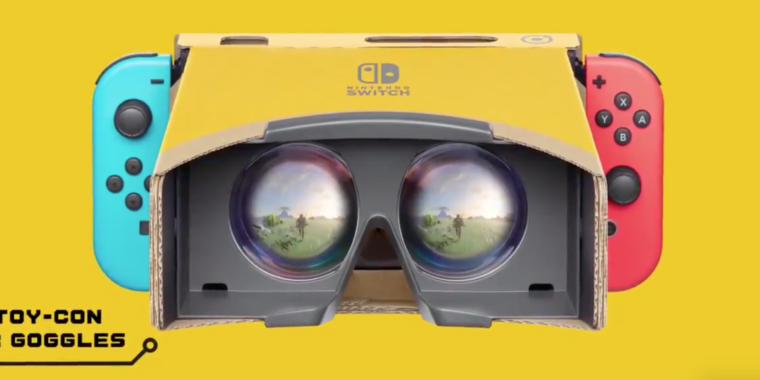
The Nintendo Labo VR Kit, launching later this month, is arguably the Japanese game maker’s first virtual reality product in 24 years. Up until today, the product (which starts at $40) was a self-contained collection of new mini-games, all designed around foldable cardboard controllers.
That changed with a Thursday night announcement: two of the biggest games on Nintendo Switch, Super Mario Odyssey and Legend of Zelda: Breath of the Wild will receive free VR-mode updates on April 25, two weeks after the Labo VR Kit’s launch date. Both will require said VR Kit, which includes a pair of lenses that affix to the Switch’s screen and turn it into a makeshift VR headset.
Odyssey‘s free update will open up three newly designed levels, all based on existing flat-screen worlds from the 2017 game. In these, players will look at Mario from a third-person perspective, which they can shift by rotating their head. This resembles existing VR platforming games like Moss, as opposed to a VR adventure viewed from the famous plumber’s first-person perspective. It’s unclear whether the camera will remain at a fixed, central point in these three levels or whether it will follow Mario’s movement a la the more dynamic Astro Bot: Rescue Mission.
Meanwhile, instead of creating specific VR zones, Breath of the Wild‘s upcoming update seems to attach a VR option to the full game. Meaning, players will still have full joystick control of where the game’s camera hovers around the character Link, along with a head-tracked option to more finely tune what angle you view him from. That head tracking may factor into series-specific actions like aiming a bow and arrow, but it doesn’t appear to put players into a first-person VR experience.
How comfortable either mode will be in practice remains to be seen. Anything short of a locked 60 frames-per-second refresh is notorious for causing motion sickness, and we don’t know if Odyssey will continue enjoying a 60fps refresh with a “doubled lens” display on the Switch’s screen (which would then be translated by the Labo VR Kit’s dual lenses). Breath of the Wild, meanwhile, hovers around a 30fps refresh before it factors its own doubled lens rendering for a VR mode.
We don’t yet have an indication of how either game’s visuals will be updated (or even downgraded) to accommodate for VR’s rendering burden. And we can only assume that VR players in both of these modes will have to hold a Switch up to their face like a periscope, then clutch the system’s Joy-Cons in that position to play the games. Unlike the Virtual Boy, this Nintendo Labo-ized VR rig does not include a stand that can comfortably press a headset to a player’s face.
Thursday’s news follows a similar Labo patch for a non-Labo game last year, when Mario Kart 8 Deluxe began supporting the Labo Vehicle Kit’s motorcycle set as a motion controller. We honestly wish Nintendo’s port of Captain Toad: Treasure Tracker had gotten this Labo VR update, as that puzzle game already includes motion controls for adjusting its cameras, which make the game’s clue-hunting thrust a lot easier to manage.
Listing image by Nintendo
https://arstechnica.com/?p=1486827
GameStop posts massive loss as pre-owned game sales plummet
Pretty much every part of that “Buy Sell Trade” sign is suffering in GameStop’s latest fiscal year.
One of the world’s biggest video game retailers just announced its worst annual performance in decades, raising renewed questions about the health of the physical video game market as downloadable games continue their ascent. Net sales for GameStop were down 3 percent for the 52-week period ending February 2, a slide that helped flip last year’s modest $34.7 million profit to a sizable $673 million operating loss. On top of that, the company expects sales to decline another 5 to 10 percent in the next fiscal year.
GameStop’s massive loss is the largest ever reported by the company, and only the third annual loss since it grew out of the corporate remains of FuncoLand in 2000. GameStop last posted a loss in 2012, when it lost nearly $270 million thanks in part to weak holiday sales near the end of that era’s console generation.
But more than the amount, the reason behind the new loss could be cause for long-term concern at the retailer’s thousands of worldwide storefronts. While hardware sales were roughly flat and new software sales fell about 4 percent year over year, pre-owned software sales cratered nearly 12 percent for the year, continuing a years-long slide.
GameStop has always relied on the high margins of buying low and selling high on used game discs to buoy an otherwise low-margin business. But the rise of downloadable games, which can’t be resold, has taken the wind out of those sails to a large extent. “We continue to see declines in pre-owned software, reflecting the decline in sales of new physical games and the increasing demand for digitally offered products,” GameStop COO & CFO Robert Lloyd said in an earnings call.
It’s a play we’ve seen before when digital distribution finally reaches a tipping point that makes previously strong brick-and-mortar businesses seem largely irrelevant. Tower Records filed for bankruptcy in 2006 after decades as a market leader in music. Book-based retailer Borders shut down in 2011, liquidating hundreds of stores as online and e-book competition grew.
GameStop is actually seeing some growth of its own selling of digital goods in its stores. That category was up 16.5 percent, “driven by continued strength in digital currency for free to play games like Fortnite and by downloadable content,” Lloyd said. Sony’s recent decision to stop selling digital game codes in retail stores may harm that going forward, though.
As far as physical goods, the only real bright spot for GameStop last year was in collectibles. That area of the business grew over 11 percent for the year, making the company’s 2015 purchase of nerdy collectible store ThinkGeek look somewhat prescient.
The loss is the latest bad sign for GameStop after the company announced it had failed to find a buyer in January. Earlier that month, GameStop had sold its Spring Mobile cell phone retail division for $700 million in an attempt to make the remaining company more appealing.
GameStop stock was down just over four percent in daily trading late Wednesday after plummeting 13 percent earlier in the day. The current $9.78 share price is the company’s lowest since early 2005, and well below a 2013 peak of over $56 a share.
https://arstechnica.com/?p=1485791
Joaquin Phoenix breathes new life into an iconic role in first Joker trailer
[embedded content]
Joaquin Phoenix plays Arthur Fleck, a failed stand-up comedian who goes insane in Warner Bros. Pictures’ Joker.
When Warner Brothers and DC Films announced they would be making a Joker film back in 2017, the reactions from fans were… mixed. Did we really need another film treatment exploring the origins of Batman’s clown-faced nemesis? But now the first trailer for Joker has dropped, and it goes a long way toward putting our doubts to rest.
Joker is intended as a standalone film, with no sequels planned—part of DC Films’ decision to move away from the shared-universe approach of their prior franchise films (aka, the Marvel model). So it has no relation to the Justice League films that came before. That freed Director Todd Phillips to create his own darker, gritty version of this iconic character, with a much smaller budget of $55 million.
Star Joaquin Phoenix was initially reluctant to take on the role, for various reasons. (Seriously, who wants to go up against Heath Ledger‘s legendary performance in Christopher Nolan’s The Dark Knight? Plus, Jared Leto was already playing the Joker in the DC Extended Universe (DCEU). But he ultimately decided that Phillips’ interpretation was sufficiently unique that he signed on. (It helped that it was for a standalone film; in the past, Phoenix has resisted committing to superhero films that would require him to play the same role in multiple films.) And we’re very glad he did, because Phoenix succeeds in breathing new life into this iconic role.
Arthur Fleck (Joaquin Phoenix) has such a genuine smile at first.
YouTube/Warner Bros.
He’s a devoted son, and his mother always encouraged him to smile.
YouTube/Warner Bros.
But he also dreams of a career in stand-up comedy.
YouTube/Warner Bros.
Open mic night?
YouTube/Warner Bros.
Stand-up isn’t really paying the bills.
YouTube/Warner Bros.
Joaquin Phoenix lost a ridiculous amount of weight for this role.
YouTube/Warner Bros.
A visit to Arkham Asylum.
YouTube/Warner Bros.
Rethinking his stage persona.
YouTube/Warner Bros.
YouTube/Warner Bros.
Spreading the “joy.”
YouTube/Warner Bros.
This might not be the show people are expecting.
YouTube/Warner Bros.
The Joker prepares for his grand entrance.
YouTube/Warner Bros.
Now a fully fledged super villain.
YouTube/Warner Bros.
In this version of the Joker’s origin story, Arthur Fleck (Phoenix) is a struggling aspiring stand-up comedian in Gotham City in 1981, taking care of his ailing mother, Penny (Frances Conroy). Since the trailer opens with Arthur talking to a therapist, we’re guessing something tragic happens to Mom. We learn that she always told him to “Smile and put on a happy face,” and assured him he had a purpose. She thinks it’s to “bring laughter and joy to the world.” But life has not been kind to Arthur: “Is it just me, or is it getting crazier out there?”
Stand-up comedy comes with constant rejection and, hence, is not for the faint of heart or frail of ego. Arthur’s side gig as a street clown holding an advertising sign is, shall we say, lacking in dignity—although he gives it his all. Alas, it gets him beat up by random hooligans. He also gets mocked and beaten up on the subway, and the young single mother he’s smitten with (Zazie Beetz) probably only sees him as a friend. So really, it’s society‘s fault that Arthur turns to the dark madness within.
The Wayne family is present here in the form of billionaire philanthropist Thomas Wayne (Brett Cullen), father to the future Batman and currently running for mayor of Gotham City. But it’s a far less sympathetic portrayal than we’ve seen before. I’m still not sure how I feel about this latest incarnation of the Joker, but I’m now genuinely intrigued to see the film. That’s the power of a good trailer.
Joker is slated for release on October 4, 2019.
Listing image by YouTube/Warner Bros.
https://arstechnica.com/?p=1485523
Microsoft kills off the book store you probably didn’t know it had
For reasons that were never entirely clear, Microsoft released a book store for Windows 10 back in 2017. The Edge browser was given support for EPUB books, and the Microsoft Store had a book category, offering a range of free and non-free books. No longer: yesterday the company ended book sales entirely.
We can’t imagine the book store was ever a major business. Combined with the decision to abandon its Edge browser and switch to Chromium, it’s not altogether surprising that maintaining support for electronic books was more effort than Microsoft wanted to make.
Those scarce few of you who have bought books will have until July to read them, at which point you’ll be given a full refund. All books ordered through the service are being destroyed, including free ones.
This marks the second major media area that Microsoft has given up on, after ditching the music business in 2017. This leaves the Xbox, with games, films, and TV shows, as the only remaining outlet for buying digital media from Microsoft. The game business is healthy—indeed, Microsoft is believed to be about to release a new Xbox that only supports digital downloads—and the TV and film section seems to get new titles regularly, so one assumes it’s going to stick around.
The loss of first music and then books underscores in many ways Microsoft’s inability to produce a mass-market mobile platform. An online music store and book store are table stakes for a smartphone platform; they’re bare-minimum offerings that need to be both present and integrated, because every other mobile platform has them. Music integration is also an important element for home digital assistant devices like the Amazon Echo; this represents another space where Microsoft has made some fumbled efforts, before retreating.
With Microsoft having neither a mobile platform nor any continued interest in the digital assistant market, the justification for the continued existence of these media services evaporates. Tight integration of these services is arguably less important in the desktop operating system world, so falling back on third-party options to fill the gap is a viable option.