Spielberg proposal to ban streaming from Oscars may be illegal, DOJ warns
Enlarge/Roma Director Alfonso Cuaron after winning Oscars for Best Director, Best Foreign Language Film, and Best Cinematography at the 91st Annual Academy Awards on February 24, 2019.
Getty Images | Dan MacMedan
US antitrust regulators have warned the Academy of Motion Picture Arts and Sciences that banning Netflix and other streaming platforms from the Oscars may violate federal competition law.
Legendary filmmaker and multiple-Oscar-winner Steven Spielberg has backed an effort to ban films primarily distributed via streaming platforms from the Academy Awards. The effort gained steam after Netflix movie Roma won Best Director, Best Foreign Language Film, and Best Cinematography and was nominated for other Academy Awards including Best Picture. Roma was shown in some theaters, but only for a few weeks.
The US Department of Justice’s antitrust division learned of the anti-streaming proposal from news reports and decided to warn the Academy in a letter before the awards organization makes any decisions at a meeting later this month. Spielberg is a member of the Academy’s Board of Governors and reportedly intends to push for a streaming ban at the upcoming meeting.
“In the event that the Academy—an association that includes multiple competitors in its membership—establishes certain eligibility requirements for the Oscars that eliminate competition without procompetitive justification, such conduct may raise antitrust concerns,” DOJ antitrust chief Makan Delrahim wrote in a March 21 letter to Academy CEO Dawn Hudson, which was obtained by Variety.
Section 1 of the Sherman Act “prohibits anticompetitive agreements among competitors,” the DOJ wrote. “Accordingly, agreements among competitors to exclude new competitors can violate the antitrust laws when their purpose or effect is to impede competition by goods or services that consumers purchase and enjoy but which threaten the profits of incumbent firms.”
An Academy decision to exclude streaming films could therefore violate US law, the letter said.
“If the Academy adopts a new rule to exclude certain types of films, such as films distributed via online streaming services, from eligibility for the Oscars, and that exclusion tends to diminish the excluded films’ sales, that rule could therefore violate Section 1,” the DOJ wrote.
The letter concluded by saying that the DOJ’s antitrust division “appreciates your attention to the Division’s concerns as you consider any changes to the eligibility requirements for the Oscars.”
If the Academy does ban streaming movies from the Oscars, the DOJ could file an antitrust lawsuit against the Academy.
Academy meets April 23
The Academy told Variety and other news organizations that it has received the letter and “responded accordingly,” but it did not say what its response was.
“The Academy’s Board of Governors will meet on April 23 for its annual awards rules meeting, where all branches submit possible updates for consideration,” the Academy also said.
Spielberg said in a recent interview that “once you commit to a television format, you’re a TV movie. You certainly—if it’s a good show—deserve an Emmy. But not an Oscar.”
Netflix responded indirectly to anti-streaming sentiment in a tweet on March 3, saying that streaming provides film access “for people who can’t always afford, or live in towns without, theaters,” “let[s] everyone, everywhere enjoy releases at the same time,” and “giv[es] filmmakers more ways to share art.”
https://arstechnica.com/?p=1485563
Inside look at BioWare explains exactly how fake E3 2017’s Anthem demo was
Enlarge/ This “javelin” suit could have starred in a game titled Beyond, but at the last minute, its name was swapped to Anthem. Find out about this story, and many more, in today’s lengthy Kotaku report.
In what has become a regular occurrence in recent years, a major story about game-development woes—full of insider sources and years of production hell—has emerged courtesy of Kotaku news editor Jason Schreier. In what has also become a regular occurrence in recent years, the article in question is about an EA game.
BioWare’s Anthem is the latest subject of a wide-ranging, years-spanning report that comes to a few conclusions, all trying to explain why the game shipped as such a critical flop. Perhaps the biggest takeaway is that BioWare staffers allege that the game’s production process didn’t truly begin in earnest until “12 or 16 months” before the game shipped.
The Kotaku report explains this timeline by chronicling how the game’s pre-production process was marked by indecision and technical headaches. The project was jolted from this morass after EA executive Patrick Söderlund played an early Anthem demo in December 2016. “This is not what you had promised to me as a game,” Söderlund allegedly told BioWare, and the article talks at length about how the game’s original design documents described something a little more like a cross between the likes of Dark Souls and Shadow of the Colossus—where co-op players would focus less on collecting loot and more on teaming up to “see how long you could survive” in brutally difficult, dynamically changing worlds.
That original plan also included promises of Iron Man-like jetpacks, but for some team members, the technical challenges of jetpack flight made such a feature a non-starter. Yet Söderlund’s demand to see an improved demo resulted in a six-week crunch period to build something new and impress the boss, which meant adding jetpacks back. The boss approved of the updated demo, which, as it turns out, set BioWare on a new trajectory to build a game that resembled the demo in question.
“The demo was not actually built properly—a lot of it was fake, like most E3 demos,” one source told Kotaku. “There was a lot of stuff that was like, ‘Oh, are we actually doing this? Do we have the tech for that, do we have the tools for that? To what end can you fly? How big should the world be?'”
“Unmemeable”
From there, the article breaks down a massive trove of woes. One of those, which has been echoed in other behind-the-scenes reports, involved issues with the DICE-developed Frostbite graphics engine. “Many of the ideas [BioWare Edmonton] had originally conceived would be difficult if not impossible to create on Frostbite,” Schreier wrote. One BioWare staffer described the engine as the worst of all worlds: “Frostbite is like an in-house engine with all the problems that entails—it’s poorly documented, hacked together, and so on—with all the problems of an externally sourced engine.”
Lack of access to Frostbite programmers didn’t help. Many of those EA staffers were allocated to helping the FIFA team, leaving BioWare in the lurch.
The cited sources are careful to point out that some critical complaints about the retail game (including those from yours truly) were echoed internally during the game’s development. Among those was the battle between feeding players plot and grouping them together as online playmates, which saw BioWare’s Edmonton and Austin studios clash.
“This is not going to work,” one BioWare Austin developer told the Edmonton team. “Look, these [story] things you’re doing, it’s gonna split up the player experience.” This developer told Kotaku that the Austin studio’s concerns were “repeatedly ignored.”
Staff turnover, loading screens, issues with plot, imbalanced weapons, an internal push to make the game “unmemeable” (as opposed to Mass Effect Andromeda and its viral GIFs), and a corporate directive to ship the game by March 2019: these details and more are chronicled in this must-read feature, which also acknowledges some of Anthem‘s technical successes and the fact that it crossed the finish line at all.
Also, from the sound of the story, EA’s pressure as a corporate boss didn’t apparently bleed over to demands for specific types of online transactions. The article includes a tease about another behind-the-scenes report to come, revolving around Dragon Age 4, but it does not mention that EA surprise-launched another major online game, Apex Legends, almost simultaneously.
The story ends with a statement from EA as opposed to answers to Schreier’s questions. The company includes a curious explanation for its non-participation with the story: “We felt there was an unfair focus on specific team members and leaders, who did their absolute best to bring this totally new idea to fans. We didn’t want to be part of something that was attempting to bring them down as individuals.” Schreier points out that this statement went live before his story was posted and doesn’t appear to align with his article, which includes very little “focus on specific team members and leaders.”
https://arstechnica.com/?p=1485125
Final countdown: Marvel drops one last teaser for Avengers: End Game
[embedded content]
Marvel’s Avengers: End Game trailer.
There’s just three short weeks before Avengers: End Game makes its hotly anticipated premiere, and Marvel is stoking the fires of anticipation with one last teaser, featuring our first glimpse of arch-villain Thanos, who seems more than ready for a rematch.
The first trailer for End Gamedropped in December, giving us a glimpse of the Avengers who survived the Snappening, in which Thanos wiped out half of all living beings in the universe with a snap of his fingers, including many of our beloved superheroes. That’s about all they could show us without giving too much away, although we did get a scene with Paul Rudd’s Scott Lang/Ant-Man showing up, having escaped the quantum realm where he was presumably trapped at the end of Ant-Man and The Wasp.
A second trailer aired during the Super Bowl, using footage from just the first 20 minutes of End Game. We saw the fallen/dusted in rapid succession, in striking black-and-white hues with red highlights. But we also see them finally starting to regroup. Last month, Marvel dropped yet another trailer, taking us back to the origins of the remaining Avengers and introducing Brie Larsen’s Carole Danvers (aka, Captain Marvel) into the mix for the first time.
A tearful reunion.
YouTube/Marvel Studios
Remembering a promising protege.
YouTube/Marvel Studios
A broken bond, finally healed?
YouTube/Marvel Studios
Man in the mirror: Cap ponders his choices.
YouTube/Marvel Studios
Thor ponders the group’s chances.
YouTube/Marvel Studios
Rocket and Nebula share a moment of sadness.
YouTube/Marvel Studios
Avengers, assembled.
YouTube/Marvel Studios
Captain Marvel gives the gang a lift.
YouTube/Marvel Studios
Ready for battle.
YouTube/Marvel Studios
Everything they went through has brought them back here.
YouTube/Marvel Studios
He’s baaack! Thanos gets a rematch.
YouTube/Marvel Studios
A fallen Captain?
YouTube/Marvel Studios
One final showdown with the Malthusian Titan.
YouTube/Marvel Studios
In this latest trailer, we get several heartfelt reunions: Tony Stark and his long-suffering fiancée, Pepper Potts; Black Widow and Hawkeye; and a mending of fences between Tony and Steve Rogers as they shake hands on their mutual renewed trust in each other. The team is formulating some kind of a plan, although the specifics are vague (because spoilers). “If we do this, we’d be going in short-handed,” Bruce Banner/The Hulk cautions. “Yeah, you mean because he killed all our friends?” War Machine retorts, stating the obvious.
Then Captain Marvel shows up with her spaceship and whisks everyone off to space, and they find themselves once again facing Thanos. “You could not live with your own failure,” he taunts. “And where did that bring you? Back to me.” Perhaps they’ll fail again. There’s certainly a chance some of our heroes won’t survive this installment in the franchise. But as Tony says, “We’re the Avengers. We have to finish this.”
Avengers: End Game hits theaters on April 26, 2019.
Listing image by YouTube/Marvel Studios
https://arstechnica.com/?p=1484815
NatGeo’s riveting series Hostile Planet puts you in the center of the action
Enlarge/ “This is not your mother’s natural history series.” Host Bear Grylls filming in the Swiss Pennine Alps for the “Mountains” episode of National Geographic’s new series, Hostile Planet.
National Geographic/Oliver Clague
It’s more than an hour into a whale-watching excursion organized to promote National Geographic’s new six-part series, Hostile Planet, and folks are starting to get restless. We saw our first Pacific gray whale before we’d even left the harbor. It swam right up to the boat to give us a good, long look at its telltale gray-white pattern over dark slate-gray skin. But now we’re in the open sea with not a whale in sight.
According to Executive Producer Tom Hugh-Jones (Planet Earth II), it’s just the tiniest taste of what it was like shooting this visually arresting series—except the intrepid camera crews and producers weren’t sipping mimosas on a balmy 70-degree day in March off the coast of Malibu as they waited for the animals to show themselves. It took months of preparation followed by weeks of tracking various species, all to capture that perfect unexpected shot. They endured the same extreme conditions as the animals, for more than 1,300 days of filming, on all seven continents. Out of the resulting 1,800 hours of footage came the six segments of Hostile Planet, each focusing on a distinctive biome: “Mountains,” “Oceans,” “Grasslands,” “Jungles,” “Deserts,” and “Polar.”
(Some spoilers for the series below.)
These biomes have always been extreme environments, but they are becoming even more so thanks to a rapidly changing climate—change so rapid that there isn’t much time for the creatures to learn to adapt their behaviors to survive. Yet life (to quote Jurassic Park‘s Ian Malcolm) finds a way. Despite this rather downbeat theme, the series never becomes overly didactic or preachy, preferring to leave the messaging in the background and simply tell compelling visual stories about the various animals’ struggle to survive. That’s a markedly different approach to how nature shows are usually produced, and the result is positively riveting. I say that as someone who, frankly, is not usually a big fan of nature documentaries. Yet at several points, Hostile Planet had me on the edge of my seat.
“The visual language is what takes over. It’s a much more immersive experience.”
“The old traditional way was pretty much a voiceover being illustrated with images,” said Executive Producer Guillermo Navarro. “Here, the visual language is what takes over. It’s a much more immersive experience. That’s the basic use of film language, how the power of an image can build emotion and connectivity. You can actually build a sequence and have an emotional connection with the journey of the species.”
Navarro won an Oscar for his cinematography in the 2006 film, Pan’s Labyrinth, and has worked on many more Hollywood hits, including the first two Hellboy films with director Guillermo del Toro. The biggest difference between producing Hostile Planet and Navarro’s usual work for film and television: he doesn’t have any control over the animals. “They don’t obey you here,” he said. “There’s a lot of luck involved in getting the right shots.”
And wow, did they luck into some amazing footage. The filmmakers captured Arctic wolves hunting a herd of muskox—the first time such a kill has been filmed—and a determined jaguar taking down a very large caiman along a jungle river bank. We get to see rare underwater shots of orca whales on a speedy hunt, and a jaw-dropping segment showing a snow leopard pouncing on its ibex prey, only to tumble several hundred feet down a steep, rocky hillside. It never lets go of its prey, and a few days later, it’s back on the hunt.
Whale of a tale
Hark! Is that the tail of a whale?
National Geographic
A gaggle of reporters trying in vain to capture gray whales in the distance with their smart phones.
National Geographic
Hostile Planet executive producers Tom Hugh-Jones and Guillermo Navarro spot a telltale ripple.
National Geographic
A Pacific gray whale off the coast of Malibu, California.
National Geographic
A whale of a water spout with bonus rainbow.
National Geographic
Navarro and Hugh-Jones strike a pose on deck.
National Geographic
The team made use of all kinds of innovative technology to capture this dramatic close-range footage, rather than relying on the long camera lenses typically used to shoot wildlife shows. “We always start with a story and then we find the technology that will enable us to tell that story,” said Hugh-Jones. For instance, he hired a racing drone pilot to maneuver a small camera-mounted drone through the mountains, speeding through narrow crags and along sharp ridges with the occasional spin, all to give viewers a literal birds-eye view of an eagle’s flight through the same mountains.
To capture what it feels like to move with a herd of 1,000 monkeys, Mateo Willis, who served as director and cinematographer on the “Mountains” episode, outfitted his camera operator with a stabilized rig that was exactly at head height of the monkeys. But one of the craziest camera angles he had to execute was capturing an approaching avalanche head-on with a plucky GoPro mounted on a stake right in the path of the cascading snow. The force of the avalanche was so strong, it ripped the locator beacon off of the pole, as the camera flew off in the opposite direction. The avalanche technicians managed to find both within ten minutes of being on the ground. Somehow both the GoPro and its precious footage survived.
Willis hired a helicopter pilot and ski safety instructor familiar with avalanche behavior who knew just how close the helicopter could get to the action safely. Still, “Even when you know you’re in the hands of an experienced pilot, when you feel that shock wave coming through the cabin and little bits of snow drifting in through the windows, your heart is just racing,” he said. “We really tried to take the audience on that roller coaster ride down the hill, to make them feel like they’re traveling with this avalanche.”
“You’ve only got one chance at this, and by the time it happens, your nerves are shot to shreds.”
One of the most white-knuckled sequences in the series focuses on a family of barnacle geese. The chicks hatch high up the basalt cliffs of Greenland but must move to where the food is on lower ground within a few days to survive. They can’t fly yet, so they do it by literally base jumping from the cliff and, if they’re lucky, landing safely in the snow below. Statistically, roughly half of the chicks survive the process. Hostile Planet follows the fortunes of three baby chicks. The first survives the jump but is quickly snatched by a hungry hawk—a bad day for the chick, a good day for the hawk, who must also survive in these extreme conditions. The second keeps bouncing off jagged rocks. It’s rather horrifying to watch, and this chick does not survive. The third lands safely, finds its waiting parents, and the family waddles off in search of sustenance.
Getting those spectacular 30-second base-jumping shots meant lugging a heavy kit for two hours up a steep mountain trail in the middle of June, when the region experiences 24-hour daylight, and setting up right at the edge of the cliff. Willis used a 26-foot crane with a camera on the end sticking out over the cliff’s edge. Then he watched and waited around the clock, since the chicks can jump at any point in the two days after they hatch. “You’ve only got one chance at this, and by the time it happens, your nerves are shot to shreds,” said Willis.
This is extremely rare footage, according to Willis, because it’s such a remote part of the world. It’s only been captured on film a few times over the last 40 years. “Everything has to be flown in by helicopter and once you’re dropped off, you’re completely isolated,” he said. The basalt rock that makes up the cliffs has been frozen and fractured over thousands of years, so it’s also not especially stable. “It’s like standing on top of a pile of bricks that could give way at any moment,” said Willis. “I’ve never felt so unsafe in my entire working career, although we were roped in and had safety harnesses.”
Caught on camera
Emperor Penguin colony at Cape Washington, Terra Nova Bay in Antarctica.
National Geographic/Tanja Bayer
Cameraman David Reichert filming the Emperor Penguins’ march to the ice edge.
National Geographic/Tanja Bayer
Cameraman Barrie Britton prepares to film barnacle geese on 400 foot basalt cliffs in Greenland.
National Geographic/Miguel Willis
Producer and cameraman Mateo Willis filming barnacle geese nesting.
National Geographic/Miguel Willis
Cameraman Miguel Willis filming gelada monkeys in the Simien Mountain National Park, Ethiopia.
National Geographic/Rob Morgan
Sloth in the flooded forest in Brazil.
National Geographic/Cristian Dimitrius
Camera operator Cristian Dimitrius, capturing an immersive landscape piece on the wettest time of year in the Amazon jungle.
National Geographic/Cristian Dimitrius
A pair of nosy killer whales spy hop to check out cameraman Didier Noirot and his filming team in Skjervoy, Norway.
National Geographic/Dan Beecham
After digging its way to the surface, this turtle hatchling must now run a gauntlet of predators to reach the ocean in Nancite, Costa Rica.
National Geographic/Kevin Flay
Cameraman Roger Munns captures the vicious bite of a male green turtle.
National Geographic/Jason Isley
A predatory lionfish stalks the shallows as it waits for nightfall to hunt in the Red Sea, Egypt.
National Geographic/Corinne Chevallier
Filming with a habituated ocelot to capture an immersive feeling for the clay lick sequence in Peru.
National Geographic/Adrian Seymour
A dead ant that has been taken over by a species of Cordyceps in the Rio Claro Reserve in Colombia.
National Geographic/Justin Maguire
Cameraman Tom Walker uses a gyro-stabilized camera to film meerkats in the Kalahari Desert.
National Geographic/Holly Harrison
Walker uses a gyro-stabilized camera to film Nubian ibex on the top of a steep cliff in the Negev Desert, Israel.
National Geographic/Matthew Wright
Jaguar hunting a crocodile on the river banks in the Pantanal, Brazil.
National Geographic/Adrian Seymour
There’s always an element of serendipity at work, but all those months of preparation, and learning to trust one’s gut instincts, honed over years experience, can make those lucky shots more likely. Hugh-Jones was on location for the timber wolves sequence, and the team couldn’t find the pack for the first week of shooting. Then an eagle-eyed cameraman noticed a paw sticking out from the trees, and they were able to track the wolves by helicopter for the next three days as the pack stalked a herd of musk ox, ultimately succeeding in making a kill.
The crew caught the snow leopard’s spectacular tumble with its prey in part because Willis, on a hunch, opted to extend the shoot beyond its original four-week limit, because there had been reports of a hungry male leopard in the area. All the footage for that sequence came from the last three days of the extended shoot, when a local spotter caught sight of the snow leopard behind a rock. That’s another secret to making your own luck on these shoots. “Our job would be nothing if it weren’t for the scientists and local people who live around and study these animals,” said Willis. “We are almost completely reliant on their generosity and goodwill.”
Hostile Planet debuts tonight at 9pm ET/8pm CT on the National Geographic Channel.
https://arstechnica.com/?p=1454325
No fooling: Reddit’s r/games goes silent for one day to call out hate, bigotry
Enlarge/ An official Reddit “Snoo” mascot was used to advertise the site’s gaming content in 2018. Today, it’s got duct tape on its mouth for a reason.
Reddit / Sam Machkovech
The Internet may have already begun exploding due to April Fools’ Day pranks, but one site’s April 1st gesture is decidedly not a joke: the temporary closure of Reddit’s “r/games” channel.
An 8pm ET post on Sunday confirmed a united front by r/games’ moderation team to shed light on the “condescending, dismissive, vindictive and pessimistic attitudes we see in our day-to-day activity.” Instead of being able to create new topics or post comments, the community’s 1.6 million subscribers will be left reading a locked moderator post that describes an average day’s discourse on the site—along with the mod team’s hopes for change.
“By showing disdain or outright rejecting minority and marginalized communities, we become more insular,” the moderation team wrote after describing the community’s “vitriolic” state in general. “In this, we lose out on the chance to not only show compassion to these people, but also the chance to grow our own community and diversify the demographics of those involved in it.”
The mods came with plenty of evidence in hand: a NSFW gallery of 71 bigoted, transphobic, racist, misogynistic, pedophilic, and otherwise hateful comments that the r/games team has moderated over a span of roughly six months (if its timestamps are to be believed). “These kinds of comments occur on a daily basis,” the moderators wrote. “From bigotry to vitriol, this merely scratches the surface of the magnitude of the problem.”
This disturbing gallery is rounded out by the mod team’s thanks to existing members who have previously deescalated angry comment threads or added a positive spin, along with a reminder that r/games is far from alone in terms of questionable user comments. But the team also adds that these poisonous trends are found “frequently in communities that center around the discussion of games.”
“The issue still persists”
The r/games one-day shutdown comes with an apparent understanding that the usual game of moderator whack-a-mole isn’t cutting it: “We remove those comments, we ban the perpetrators, but the issue still persists at a fundamental level: the notion that it’s okay or acceptable to ridicule and demonize traditionally disenfranchised and marginalized members in the gaming community.” This is followed by a list of non-profits and resources for women’s health, people of color, and members of the LGBT+ community—and a call for r/games members to “revel in what’s available to us, and also appreciate the myriad of backgrounds that we as gamers come from.”
Reddit’s moderating teams are famously run by unpaid volunteers, and previous examinations of the state of Reddit moderation have focused more on abuse aimed directly at moderators themselves. Sunday’s r/games post focused squarely on hate and bigotry directed by users at marginalized communities, as opposed to the site’s moderators. It did not include any indication that the team had requested specific resources from Reddit at large.
The r/games community was formed in 2008, roughly one year after the site’s significantly larger r/gaming subreddit (which boasts a subscriber base of over 21 million), as an alternative Reddit destination for “informative and interesting gaming content and discussions.” Its moderators loudly remind users to head to r/gaming for “lighter” content such as image-leading posts. As of press time, r/gaming had not posted anything that resembled an April Fools’ joke or post. Neither had Reddit itself, which last concocted its own official April Fools’ experiment two years ago—one that had designs on reducing hateful speech, to boot.
Reddit representatives did not immediately reply to Ars Technica’s questions.
https://arstechnica.com/?p=1484101
The Analogue Mega Sg answers why anyone would pay $190 for a new Sega Genesis
Enlarge/ The Analogue Mega Sg comes with none of these attached things. But if you can bring your own games and controllers to its blast processing party, you’re in for a very, very good time.
Sam Machkovech
To start any conversation about the Analogue Mega Sg—a new, $190 take on the original Sega Genesis (née Mega Drive in Europe and Japan) that’s available for “pre-order” but has already begun shipping—let’s identify a few classic gamer niches. This impressive device simply isn’t for everyone.
Are you a classic Sega devotee—as in, starting with the SG-1000, continuing through the Master System, Genesis, and Game Gear, ending with the Sega CD, and going no further? That’s the territory this classic-gaming box covers.
Are you the kind of Sega Genesis freak who abides by the gospel of pure, original gameplay, as opposed to emulation? The Analogue Mega Sg has you covered. It delivers the most authentic Genesis visuals, colors, control, and sound I’ve ever seen via an HDMI connection.
Are you already the proud owner of a pile of classic Sega games in their original cartridge form? Do you just want a way to get their pristine, lag-free action on a modern screen? The Analogue Mega Sg is also for you, because unlike a “classic” Nintendo console—or the disappointing, mini-sized AT Games Genesis—this new hardware doesn’t come with a dozens-strong library of classic hits pre-installed.
And finally, do you have any old controllers sitting a closet somewhere? With the Mega Sg, you get bonus points if you have old Genesis controllers, because the starting price of $190 here includes zero gamepads.
The Analogue Mega Sg.
Sam Machkovech
Another angle of the top. Not seen here: how annoying it can be to perfectly line up cartridges to insert.
All regions supported, as per a tiny, etched font.
HDMI goes here.
SD card goes here (but only to update the system’s firmware, as of press time).
A hard-to-see etching of the company’s name on the front.
That sweet, sweet 3.5mm headphone jack.
A Nintendo Switch, for a more modern size comparison. Meaning: if someone were to install a screen add-on to the Mega Sg and make it an all-in-one portable, it’d be pretty beefy.
Rubber pad on the bottom, which is crucial for making it easier to shove cartridges in.
I start with that list not to bum anyone out but to make clear that Analogue is a singular kind of retro-gaming company. The Mega Sg is the company’s third “FPGA” (field-programmable gate array) product designed to deliver near-perfect replication of an old gaming console experience. This one happens to be tailored to the HDMI video standard (scaling up to 1080p resolution, 60 frames per second).
Once again, Analogue has shipped an FPGA motherboard, tuned to replicate a piece of hardware that is no longer manufactured. We’ve spoken at length about this matter in the past, but let’s briefly recap: an FPGA board simulates the exact speeds and processes of original hardware as opposed to emulating old software on newer chipsets. And Analogue does this as an independent console producer in spite of, not because of, official support from any ’80s and ’90s console maker.
Thus, Analogue is not signing any deals to license your favorite games (or being weirdly selective in that “Why is my fave game missing?” way). The company is not contracting with Sega to build exact replicas of old controllers. And it’s not adding USB ports to support modern controllers or add-ons. If you’re buying an Analogue Mega Sg, you’re starting with a base expectation of a “pure” Sega Genesis experience.
But if you come to the Mega Sg with expectations accordingly, almost everything it adds to the classic Sega experience feels like a bright, red, Knuckles the Echidna-shaped cherry on top.
A Mega good time, by default
If you simply want to set-and-forget the Analogue Mega Sg to play old Genesis games, that’s easy enough. Plug in a power source via Micro-USB. Plug in a screen via HDMI. Plug in a cartridge and controller. Hit the power button. The hardware’s simple, clean design makes all of this clear. The more handsome elements include smooth, curved edges and a circle-on-top motif. But the Genesis always stood out with its bulgy, “aggro” design in the early ’90s, and I would’ve liked more shine, bulges, or hints of attitude here.
I still think the device looks cool—particularly with a cartridge stuck into the top. But I can’t help but feel like its relatively simple shape and plain, matte finish make the system look a little too much like the Analogue Super Nt.
After a brief splash screen plays with the Analogue logo, you can choose to boot your cartridge, go into a settings menu, or play one pre-installed game (we’ll get to that). By default, Mega Sg renders old Genesis and Mega Drive games at a “4.5x” upscale (not quite reaching the top and bottom edges of a 1080p screen) at a 4:3 ratio.
(If you’re curious: this is a region-free system, so any cartridge from any nation will work. What’s more, games will be automatically recognized, no option-changes necessary.)
All captures in this gallery are at the Mega Sg’s default settings, including a “4.5x” resize to 1080p resolution.
Sonic 2 is a great showcase for color accuracy. These images, grabbed using an ElGato HD60 capture device, are tasty.
Sonic 2 also ships with a weird two-player mode, which runs at an interlaced 320×448 resolution, and it’s a great test of system accuracy. The result: it runs with identical performance, and slowdown, as an original Genesis, and it renders cleanly (other than having native sprite flicker, which, again, you’d find on the standard Genesis).
All I want to do is play Gunstar Heroes, and Mega Sg lets me do so with incredible color accuracy and speed timing. It controls quickly and smoothly while still replicating the original game’s slight hitches.
Pro tip: managing screen captures while playing Gunstar Heroes is always a bad idea.
Time to roll the dice.
In addition to testing a litany of cartridges, we also used an Everdrive cartridge to load demoscene ROMs like the hardware-pushing “BadApple!!”, and its mix of full-motion video and high-fidelity audio is something to behold.
Mega Sg doesn’t flinch on the demands of “BadApple!!”, which was released by modders in 2012.
While working on this review, we received a ROM for a brand-new song made by a Genesis-obsessed musician who goes by the name Remute. The ROM doesn’t just play music. It also includes a lengthy, 30fps FMV sequence…
…followed by a fully 3D car-race sequence that looks as good as the PS1’s WipEout games. The Mega Sg runs this without breaking a sweat.
The high-speed chase moves into outdoor environs.
It ends with a robot surprise.
And at default settings, the Mega Sg nails many of the basics you’d hope for in a $190 Sega Genesis. Colors are bright, bold, and authentic—nothing is overblown, nothing is washed out. Sprites render crisply as opposed to being bathed in filters. And music and sound effects are utterly faithful—every analog noise and quirk of the original Yamaha sound chip being translated so sharply that Genesis diehards may recoil at the shimmer. These aren’t distorted sound effects. They’re quite the opposite.
But Analogue assumes you’re not paying $190 to settle on default settings. And there are a lot of settings to pick through.
https://arstechnica.com/?p=1483093
Zachary Quinto feeds off the souls of children in first trailer for NOS4A2
[embedded content]
A soul-sucking vampire preys on young children in AMC’s new supernatural horror series, NOS4A2.
Zachary Quinto plays a soul-sucking vampire who preys on children and traps them in an alternate dimension where it’s always Christmas in the new AMC series NOS4A2 (pronounced “Nosferatu,” after the classic 1922 vampire film). The series is an adaption of the 2013 award-winning horror novel of the same name by Joe Hill, and the first trailer just debuted earlier today at WonderCon in Anaheim.
(Some spoilers for the book below.)
Hill comes by his horror chops naturally; his dad is an obscure novelist named Stephen King. NOS4A2 is Hill’s third novel, about a woman named Vic McQueen with a gift for finding lost things, who discovers that children have been disappearing. The culprit is a supernatural child abductor named Charles Manx, who hunts for his victims in a 1938 Rolls-Royce dubbed the “Wraith.” He feeds off their souls in order to remain immortal, trapping whatever is left of them in a prison dimension in his imagination called Christmasland. The novel moves back and forth between multiple time periods: Vic as a young girl in 1986, Vic as a rebellious teenager in 1996, and an older Vic with a son in 2008 and 2012. Naturally Manx targets her son, and Vic must defeat him once and for all to save the boy.
Vic McQueen (Ashleigh Cummings) has a gift for finding lost things.
YouTube/AMC
The Shorter Way Bridge helps Vic find lost things.
YouTube/AMC
Can Vic find all these missing children?
YouTube/AMC
Zachary Quinto plays Charlie Manx, who feeds off the souls of children.
YouTube/AMC
Manx is tied to his Rolls-Royce, dubbed the “Wraith”
YouTube/AMC
Luring a young boy into the Wraith with Christmas gifts.
YouTube/AMC
Bing Partridge (Olafur Darri Olafsson) helps Manx abduct the children.
YouTube/AMC
Whatever remains of the childrens’ souls is stuck in a mysterious dimension called Christmasland.
YouTube/AMC
That’s not quite in the Christmas spirit.
YouTube/AMC
The kidnapped boy is radically changed.
YouTube/AMC
Can Vic defeat Manx and rescue the lost children?
YouTube/AMC
Judging by the trailer, the TV adaptation will stay true to several key features in the book, while seemingly focused on Vic’s youth and teen years (for now). Manx’s signature ride, the Wraith, is here, along with Vic’s love of motorcycles. We see the Shorter Way Bridge, which Vic discovers will take her wherever any given thing she’s seeking might be located. The supporting cast includes Maggie Leigh (Jahkara Smith), a librarian who uses Scrabble tiles for divination, and Bing Partridge (Olafur Darri Olafsson), a worker who helps Manx kidnap the children, believing they will be happy forever in Christmasland.
Quinto brings just the right amount of sinister charm to Charles Manx, who is disturbed by Vic’s ability to access Christmasland: “No one has ever been able to enter except me.” We see a boy lured into the Wraith by a host of Christmas presents, and we also see the same kid transformed into a vampire-like creature later on after admitting he doesn’t; feel so good—likely drawn from a scene in the novel where Vic tries to rescue one of the kids trapped in Christmasland. Vic thinks she knows what she needs to do to take down Manx: “I’m the only one with the power to stop him and I’m going to burn Christmasland to the ground.”
Incidentally, Hill also created the fantastic comic book series, Locke and Key, about the mysterious Keyhouse filled with portals to other dimensions that can be opened by various keys. There have been several attempts to adapt Locke and Key for television over the years, most notably pilots for Fox and Hulu, neither of which were picked up for a full series. Yes, we are still bitter, but Netflix took over after Hulu passed, so fingers crossed we’ll see it on our screens eventually. At least we have NOS4A2 until then.
NOS4A2 debuts on AMC June 2, 2019, after the Season 5 premiere of Fear the Walking Dead.
Listing image by YouTube/AMC
https://arstechnica.com/?p=1483763
The resurrection of an obscure, niche vinyl format: The 3-inch record
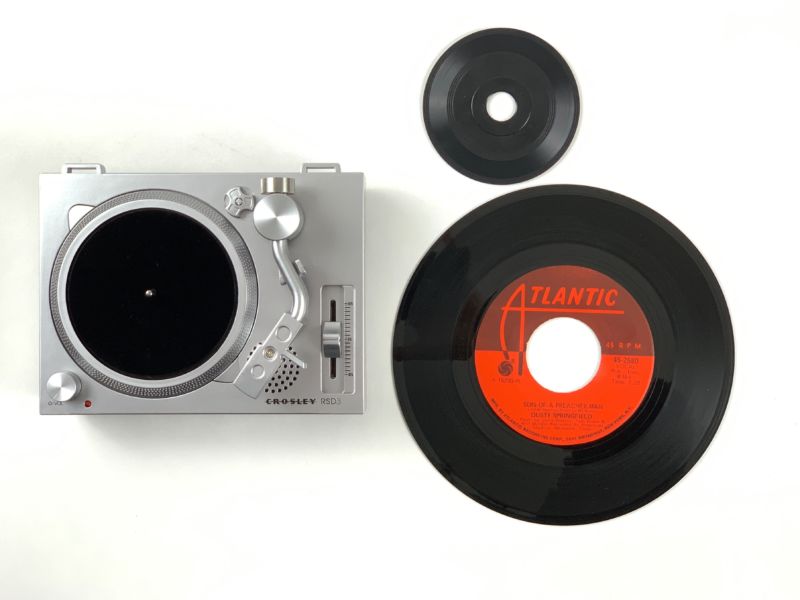
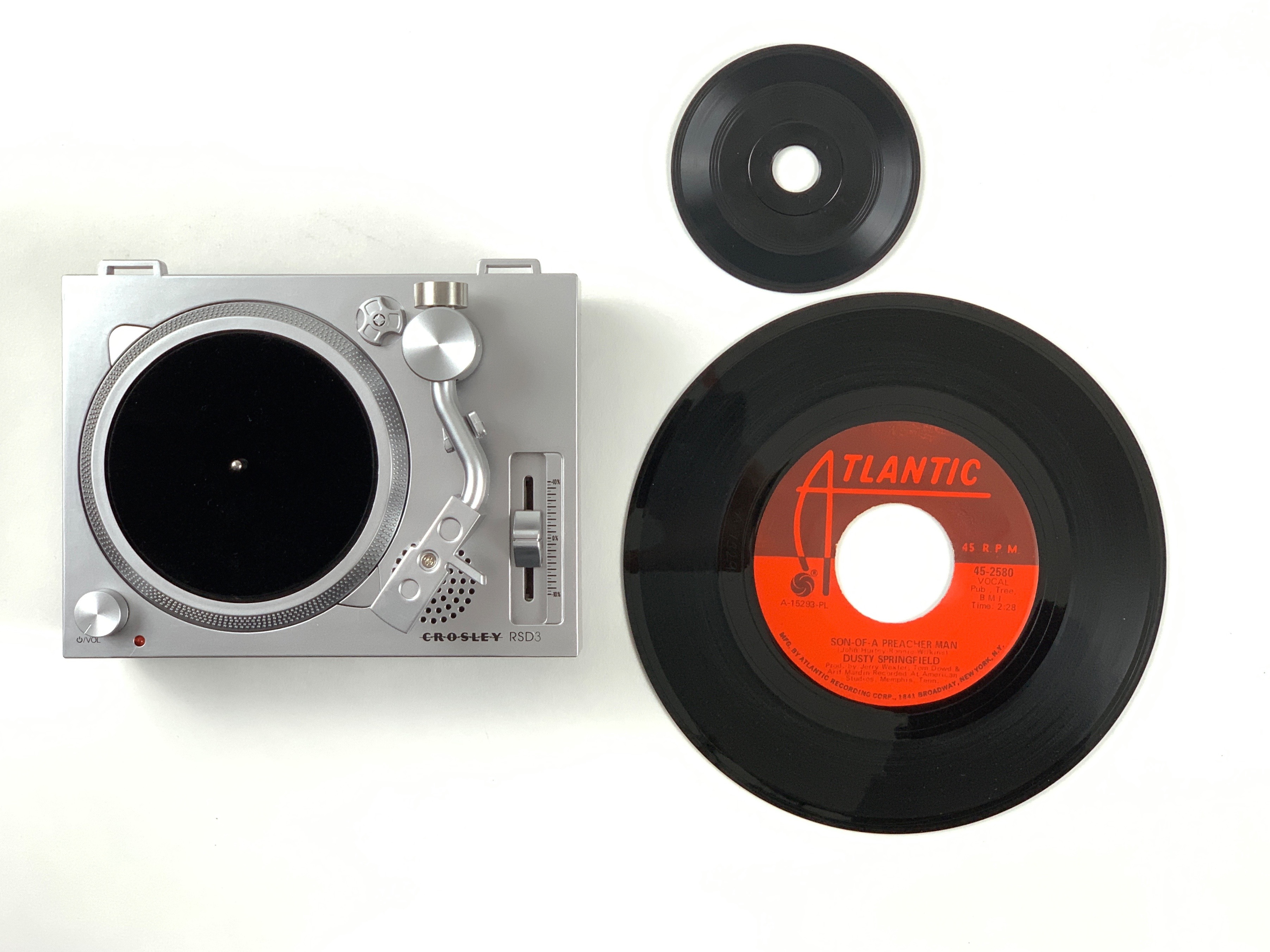
Enlarge/ This tiny turntable will be released, along with eight 3” singles from Epitaph Records and Third Man Records on April 13, 2019, aka Record Store Day.
Chris Foresman
History is littered with dead audio formats, from Elcaset to 8-track tapes, wire recording to “talking rubber.” Yet so far, vinyl has consistently resisted going quietly into that good night. Today, unit sales are up 800 percent from 10 years ago, and companies continue to produce turntables of all shapes and sizes (they even steal CES headlines from the latest Internet-of-whatever device).
So while we may no longer want them in our automobiles, in-home record players appear to be thriving whether due to an appreciation of physical media, tactile rituals, or multi-sensory experiences. And on this wave of modern record appreciation, one of the most obscure vinyl formats is getting a second lease on life thanks to Record Store Day.
If you’ve heard of 3″ vinyl singles at all, you have the enigmatic frontman of The White Stripes to thank for that. Jack White’s label, Third Man Records, imported the tiny format from Japan nearly 15 years ago for a limited series of White Stripes singles. The original player—a cheap toy from Japanese maker Bandai—was abandoned almost as quickly as it launched. Outside of a few rabid White Stripes fans or Japan-o-philes willing to part with anywhere from a few hundred to as much 2,000 dollars on eBay, few people in the United States have even seen one, let alone listened to it.
Enter Crosley, a consumer electronics company most known for their kitschy, retro-styled portable record players. For the 2019 edition of this spring vinyl holiday, the company is teaming up with Record Store Day in an attempt to revive the short-lived miniature record format with a portable player dubbed “RSD3.” The new player will launch on Record Store Day—Saturday, April 13—with four collectable singles each from Third Man and punk stalwarts Epitaph Records.
Though many vinyl collectors are known to be rather enthusiastic and the annual Record Store Day event generates tons of sales for independent record stores, for now the 3″ format remains a curious footnote in the history of vinyl formats. Technical limitations put an upper limit on its audio quality, the records themselves are quite rare, and this new turntable’s price isn’t far off from an entry-level, full-size model. Can vinyl’s surprising staying power really launch such a niche comeback in 2019?
Back in 2004, if you were a diehard White Stripes fan, 3″ singles were some of the rarest merch you could find. Now the format will be available again.
Third Man Records
Naturally, Jack White’s Third Man Records eventually made its own 3″ vinyl player to accompany the oddly formatted singles.
Third Man Records
For RSD this April, Third Man is offering 3″ singles from The White Stripes, The Ranconteurs, Jack White, and The Dead Weather.
Third Man Records
Epitaph’s 3″ singles for RSD2019 will feature The Interrupters, Culture Abuse, Rancid, and Bad Religion.
The short, short history of 3” records
It should be no surprise that the 3″ record format originated in Japan. Toyokasei, effectively the only record-pressing plant of note in Japan, came up with the format in the early 2000s. The discs are molded from a thin layer of vinyl, which is fused to an ABS plastic substrate for added durability. Because of this, they only have sound on one side. And because of size constraints, the maximum length that can be reproduced is about three minutes.
Toymaker Bandai—perhaps most well-known in the US for its Gundam mechs and Super Sentai/Power Ranger toys—developed the decidedly lo-fi 8ban Player (pronounced “eight-ban”) to play the diminutive records and launched it in 2004. (The records are nominally 8cm in diameter, hence the “8ban” name.) Made of white and red plastic in a decidedly retro style, the players sold in Japan for 3129¥, roughly equivalent to $28 at the time. At least seven series of 8ban records were planned, though only three—including “Oldies: The Hits” from the likes of Judy Collins, Otis Redding, and The Monkees; a series of theme songs from anime and other Japanese shows from the magazine Asahi Sonogram; and a series of songs from the Japanese kids show Hirake Ponkikki—appear to be easily found on eBay. The tiny records sold for 367¥, or about $3.25, and they came “blind-bag” style, in a thin box indicating what series they were from, as well as a list of possible titles on the back. Otherwise, there was no way to know before buying exactly which song you would get. In this light, the experience wasn’t unlike buying trading cards or those tiny Tsum Tsum figurines.
In a moment of music-nerd serendipity, Jack White had seen the 8ban player and the tiny records while on tour with The White Stripes in 2004. In a very idiosyncratic Jack White move, he came back from Japan and told his Third Man team that “we should press White Stripes singles in this format,” according to Third Man’s Ben Blackwell.
“We came up with a set of six White Stripes songs that fit the relatively short time limit of the format,” Blackwell told Ars. “We also planned to release a single that would exclusively be available in the 3″ format, called ‘Top Special,'” he explained. “And since the Bandai player was already white and red and black, we arranged to buy 1,000 of them from Bandai. It was Jack’s idea to call it the ‘Triple Inchophone,’ even though the records aren’t exactly three inches.
[embedded content]
Bless the Internet, where even a one-off single released on an obscure audio format is available on YouTube.
“We spent months coordinating with Toyokasei to order the records and make covers,” Blackwell continued. “But when we asked Bandai to ship us the players, they told us they had all been destroyed. Apparently, warehouse space in Japan is at such a premium that it makes more financial sense to get rid of overstocks than to let them sit in a warehouse.”
In other words, Bandai had discontinued the players already despite making a custom pink and black color for retailer HMV. Bandai had junked its remaining stock of the original red and white player that would’ve been perfect for The White Stripes brand at the time.
“We were like, ‘Oh, shit, we have 1,000 sets of singles!'” Blackwell said. “But Bandai came back and said they found 400 in a different warehouse, so we bought all 400. We got them just in time to debut them at the merch table at a White Stripes show at Coney Island in 2005. The player sold with six singles for $120, and the ‘Top Special’ single sold separately for $30.”
“But,” Blackwell said, “nobody bought any.”
Jack White posted a note about how the “Triple Inchophone” came to be on a White Stripes forum the next day, warning that “you can only buy them at our show so too bad, Internetists, you have to actually breath the same air as other people and converse and exchange currency in person.” The next night, fans swarmed the merch table. Interest was soon so rabid that the band had to limit how many sets it would sell each night.
Those 400 sets sold out, and the remaining 600 sets of singles eventually sold at White Stripes shows and at the Third Man Records storefront in Nashville. An eighth single, called “Denial Twist,” finally became available in January 2006. Since the players had long sold out, Jack White decided he would personally give them away to fans that he met at shows.
According to Blackwell, not all 1,000 have been given away. “It’s just a really cool treat, if you encounter Jack White in person,” he told Ars.
https://arstechnica.com/?p=1482971
Valve’s long-rumored VR headset is finally real: the Valve Index, coming in May
Enlarge/ What do we know about Valve’s new VR headset? Not much, beyond this image.
Valve Corporation’s long-rumored VR headset is finally real. After allying with HTC to launch the Vive as a SteamVR product in 2016, Valve has moved ahead with plans to launch its own headset, the Valve Index, in “May 2019.”
The news came on Friday in the form of a single teaser image, shown above, of a headset with the phrase “Valve Index” written on its front. The front of the headset is flanked by at least two sensors. This shadow-covered hardware matches the leaked headset reported by UploadVR in November of last year. That report hinted to Valve’s headset supporting a wider, 135-degree field-of-view (FOV), as opposed to the roughly 110-degree FOV of the original HTC Vive and Oculus Rift.
A high-contrast look at a few mysterious dots on the newly revealed Valve Index VR headset.
Since Valve’s official page includes so little information, we’re left picking at the single image to figure anything out. Jacking up the brightness and contrast (seen above) reveals a series of six dots on one of the headset’s surfaces. These resemble the faint dots used by HTC Vive, which may hint to this headset’s use of an outside tracking sensor, a la the HTC Vive’s infrared trackers. Even so, those two giant lenses imply that “inside-out” tracking, managed entirely by the headset without any extra webcams or sensors, may also be in the cards. Additionally, we can see a giant physical slider, which is likely linked to interpupillary distance (IPD), a precise measurement needed to ensure maximum VR comfort.
The “May 2019” window should put Valve Index on pace to launch right next to two new Oculus headsets. The wireless, no-PC Oculus Quest and the PC-connected Oculus Rift S are both slated to launch in “Spring 2019,” and we went eyes-on with bothheadsets at last week’s Game Developers Conference.
https://arstechnica.com/?p=1483509
Terrifying trailer for Scary Stories to Tell in the Dark will give you mega-chills
[embedded content]
It’s 1968 in the small town of Mill Valley, home to a haunted mansion and a mysterious book, in Scary Stories to Tell in the Dark.
All those frightening tales kids tell around the campfires to spook their friends come to terrifying life in Scary Stories to Tell in the Dark, a new film from producer Guillermo del Toro. It’s based on a series of children’s books from the 1980s by Alvin Schwartz, who drew upon common folklore and popular urban legends for his scary stories.
Remember that classic campfire ditty, “the worms crawl in the worms crawl out/the worms play pinochle on your snout”? So does Schwartz. It’s the basis for his scary story “The Hearse Song.” You’ll also find variations on the killer with a hook for a hand who preys on couples necking in parked cars. So too the hapless babysitter who discovers the call is coming from inside the house, along with plenty of other frightening fare. (The 2018 documentary Scary Stories delves more deeply into Schwartz’s source material.)
While the books are technically aimed at kids, the material is pretty dark, which is why the series has often been listed among the most challenged books by the American Library Association. People have objected to the violence in the Scary Stories series—and illustrator Stephen Gammell’s genuinely disturbing, surreal images only add to the potential nightmares. In fact, publisher Harper Collins released a new 30th-anniversary edition in 2011 that didn’t include Gammell’s original illustrations, causing an uproar among longtime fans.
Mill Valley, 1968, seems like such a sleepy innocent American town.
YouTube/CBS Films
The old Bellows mansion naturally is a magnet for curious teens.
YouTube/CBS Films
Family portrait of the Bellows family.
YouTube/CBS Films
Stella Nichols (Zoe Colletti) finds a curious book.
YouTube/CBS Films
The book of Sarah Bellows is nothing to trifle with.
YouTube/CBS Films
No! You must not read from the book!
Something spooky lurks in the old Bellows mansion.
YouTube/CBS Films
Stella can’t resist taking a peek.
YouTube/CBS Films
YouTube/CBS Films
Understandable impulse, but hiding under the bed won’t save you.
YouTube/CBS Films
What is this I can’t even…
YouTube/CBS Films
Not even the corn rows are safe.
YouTube/CBS Films
The book taps into your own fears and anxieties, like… a huge zit?
YouTube/CBS Films
Augh, don’t TOUCH it!
YouTube/CBS Films
A ghostly presence.
YouTube/CBS Films
Stella thinks her days might be numbered.
YouTube/CBS Films
In short, the books are perfect fodder for del Toro, whose visually distinctive work has often centered on fairy tales and fantasy (Pan’s Labyrinth), classic horror (Crimson Peak, Mama), monsters (Hellboy, The Shape of Water), and the like. He signed on with CBS Films in 2016 to develop and produce a feature film adapted from Schwartz’s Scary Stories series, and he eventually tapped André Øvredal (Trollhunter) to direct. Del Toro has said it’s not a standard anthology film; the various stories form a cohesive whole.
Based on the trailer, del Toro has more than done justice to this classic series. It hits all the right notes: the spooky mansion on the edge of town, possibly haunted by the Bellows family; a cursed book that belonged to young Sarah Bellows; curious pre-teens who can’t leave well enough alone; and oodles of terrifying ghosts and monsters, all apparently springing from the psyches of the targeted victims. “You don’t read the book. The book reads you,” a shaken Stella Nicholls (Zoe Colletti) says at one point.
Scary Stories to Tell in the Dark hits theaters August 9, 2019.