Everything you need to know before Apple’s March 25 “it’s show time” event
Enlarge/ The Steve Jobs auditorium on Apple’s new campus.
On March 25, Apple executives and partners will take to the stage in the Steve Jobs Theater at Apple’s Cupertino campus to talk about subscriptions, software, services, entertainment, and media. These are all things Apple has dealt with before, but never before has an event focused so completely on them as we’re expecting later this month.
That’s not to say it’s impossible that hardware will appear. The timing is right for an update to Apple’s base iPad model, and reports and rumors have been joined by developer beta evidence to imply that hardware refreshes are imminent for a few Apple products like the iPad, iPad mini, iPod touch, and AirPods. These would fit perfectly in an event focused on services like TV, Music, and News: they are media-consumption devices, first and foremost.
But this will be Apple’s first public event after it reported a marked decline in worldwide iPhone sales, worrying pundits, analysts, and investors that the iPhone-hardware-dependent company is in for difficult times. It is fitting (and perhaps telling) that the event will focus on services—the division Apple is happiest to boast about right now—rather than hardware.
Of course, you should be skeptical when you read hot takes on the Internet declaring that Apple is doomed because its iPhone sales are down primarily in China. It’s not good news, but other companies would give anything to have the financial and market position that Apple does in most of its worldwide business interests, even with that rare sign of weakness.
I write “most” because Apple is actually lagging substantially behind in the one area I expect the March event to emphasize the most: television.
The iTunes Store is a relatively successful platform for buying episodes of TV series, but many people these days prefer to watch TV shows that are part of a streaming subscription bundle like Netflix, Hulu, or Amazon Prime. And while we generally liked the Apple TV 4K as a media-streaming hardware solution when we reviewed it, Apple’s market share in that space is unimpressive. The cheaper, more accessible, less closed-off Roku platform dominates. That’s not to mention the fact that many of today’s TVs ship with Netflix and the like built right in, and more than half of US households own video game consoles with ample video streaming app libraries.
But the same story was emerging for music on iTunes before Apple launched the massively successful Apple Music service. Could the same happen again with television or with news? And what do we know about the new iPads that may or may not be announced? Let’s explore both the definites and the possibilities at Apple’s March 25 event.
Table of Contents
Definites
An Apple streaming TV service
The television industry perfectly fits the classic profile as a dilapidated industry ready for the kind of technological house-flipping that has previously led to Apple’s biggest successes. With the iPod, iPhone, Macintosh, AirPods, and other hit products, Apple has identified product categories that showed great promise but were badly handicapped by shortsighted design decisions or industry fragmentation. Television service is just such a product.
Television networks are the definitions of dinosaurs. Their business models and technologies are archaic and under threat from newer innovations. And thanks to near-monopolies held by local cable providers, poor bargaining positions with those cable providers on the part of networks, bloated subsidies for content like ESPN that not everyone wants, and glacial innovation, the user experience for cable television service is almost universally awful right now—and it’s badly priced, too.
It’s fitting that the TV industry itself, in which I have previously worked, calls streaming services “OTT”—”over the top.” Look right there in the name: the only way to produce a good user experience is to skip right over the entire infrastructure the industry has spent decades building and monopolizing.
Apple launched a major update to its Apple TV hardware with 4K support in 2017. New hardware is not needed right now, but the Apple TV 4K’s features can give us some background on Apple’s TV strategy.
Samuel Axon
Most notably, Apple’s TV app consolidates content from almost every Apple TV streaming app (Netflix is a notable exception) into one feed, and the app features some live sports and news as well. Apple’s new service will build on this.
Samuel Axon
The Apple TV also lets users pick a default TV provider for the device and manage subscriptions to networks like Showtime. The new service will be a provider of its own, and we’ve seen reports Apple is trying to secure add-on subscriptions like HBO for the new service, too.
Samuel Axon
Apple’s efforts with Apple TV just illustrate how bad the situation is. Even Apple, with its powerful bargaining position, couldn’t rally the entire industry behind the Apple TV 4K into a good solution built on top of the various streaming services. The channels all use different technologies, they don’t play nicely together, and their arcane and exclusive deals with cable providers mean that Apple can’t guarantee a universal experience for all its Apple TV users. Further, the brutal grip of cable providers chokes the networks that try to break ranks from the status quo.
A popular biography of former Apple CEO Steve Jobs by Walter Isaacson revealed that this TV problem was what most vexed Jobs as he approached his final days running the company. He was obsessed with solving it, the same way iTunes addressed a similar mess in the music industry in the early 2000s.
This month’s Apple event carries the tagline, “It’s show time”—a tagline used for an event years ago at which Apple first announced the future Apple TV product. Apple’s current leadership seems to believe it has finished the work Jobs started.
But whereas previous efforts looked to work closely with networks to simply provide a better tech platform for distributing those networks’ existing content, the new service appears to be more like Amazon Prime Video: an original-content machine augmented by licensed content and add-ons of premium channels like Starz or HBO Now.
Enlarge/ It doesn’t look like much, but this neighborhood/municipality in Los Angeles called Culver City is home to numerous film and TV companies—most famously Sony Pictures, and now, Apple’s growing LA campus as well.
Samuel Axon
https://arstechnica.com/?p=1473627
HBO’s Elizabeth Holmes documentary tells a bloody good story of a bad con job
AUSTIN, Texas—While watching new documentary The Inventor: Out for Blood in Silicon Valley, I constantly marveled at the film’s effort to do the seemingly impossible: to present Elizabeth Holmes, the founder and CEO of Theranos, as a likeable person.
For one, that’s an uphill battle for a Silicon Valley burnout whose crash-and-burn reputation precedes her. For another, this documentary comes from famed takedown artist Alex Gibney, who has previously focused his filmmaking lens on the obvious-villain likes of Enron and the Church of Scientology. Shouldn’t we expect the worst?
Things get savage in The Inventor, certainly. Theranos’ worst stories have previously been laid bare, and anybody familiar with the company’s original promises—transparent, affordable bloodwork for all—won’t learn much new in this documentary. (Though, yes, The Inventor is still a fine primer for anyone going into the story blind.) Rather, what Gibney really contributes is a better look at Theranos’ secret sauce: how Holmes got so far with so little.
U can’t touch this?
In this interview moment, Elizabeth Holmes is asked by an interviewer to “tell us a secret.” She takes a long pause and answers, “I don’t have many secrets.” The rest of the movie suggests otherwise.
Theranos used this image on a regular basis to promote its “nanotainer” concept.
A photo used in the film of a younger Holmes in Theranos’ earlier days.
Holmes in 2015 at an all-hands company meeting, not long before a WSJ report changed everything.
The film explores Holmes’ obsession with Yoda.
Unsurprisingly, Holmes didn’t agree to any interviews with Gibney or his crew. Yet HBO Films still presents plenty of direct footage of Holmes talking up her former company, usually in a promotional capacity. This footage emerges with a metric ton of context, either from the journalists who profiled her or the half-dozen former Theranos employees who are now free of non-disclosure shackles.
In some cases, this means hearing stories Holmes liked to recite on a regular basis, particularly one about her beloved uncle dying at a young age thanks to undetected cancer. In others, it means getting a front-row seat to “fun” Theranos company events, like one in July 2015 that saw Holmes, fresh off some dodging-and-weaving of prying regulators and investors, dance-walk into a company party to the tune of MC Hammer’s “U Can’t Touch This.”
But by and large, the most common version of Holmes on-screen is one of projected confidence—and selective engagement. In the film, we watch her align with countless politicians and investors while banging the drum of what might sound like a reasonable thesis. Massive blood draws, she said, are insane in a technology world where we’ve transitioned from “giant mainframes to smartphones.” And non-transparent blood-lab firms like Quest and LabCorp control 80 percent of the market using decades-old technologies.
“Change the paradigm”
“It’s time to change the paradigm,” Holmes said in response to that market reality. Her pitch was to let consumers take a much tinier draw of blood, then buy a Theranos box that would fit on a kitchen counter. The device, dubbed the Edison, could run roughly 200 tests on that sample as a solution to “the pain of traditional phlebotomy.” Users would control when and how often they got bloodwork results.
One of Holmes’ university advisers appears early in the film to talk about Holmes’ college-aged engineering idea to take advantage of microfluidics and nanotechnology and make her cutting-edge dream a reality. But that patent didn’t take medical realities into account, this source says. “There’s a reason you have a big IV bag,” Holmes’ adviser points out.
Shortly afterward, Holmes went in search of a new adviser, and she found Channing Robertson. He went on to quit his tenured Stanford job to help her start Theranos. (A 2014 Fortune feature about Holmes’ rise at Stanford only mentions Robertson, not the other advisor.)
“Blood spilled all over”
Enlarge/The Inventor includes this artist’s approximation of what a malfunctioning Edison machine might have looked like in action. It’s… not pretty.
Sadly, The Inventor skimps on detailing the scientific and medical questions that fueled early doubts in Holmes’ vision, though it does make clear that Holmes, and Theranos leadership at large, sure liked to skip that part while raising money. As previously reported, Theranos consistently pushed back on any employees who expressed doubts with the vision of the Edison device, including its prohibitively small size, its unrealistic testing time window, and its high number of targeted tests.
“We couldn’t regulate the temperature,” one former employee says of a prototype Edison device late in the company’s lifecycle. “We couldn’t transfer fluids.”
In another story, an ex-Theranos employee described the company’s slapdash approach to getting sample blood: paying $100 for anonymous donors. This largely attracted a homeless population, and the company source indicated that this led to a prevalence of hepatitis in the blood. That became a concern when early Edison machines acted up.
“Blood spilled all over,” the source says. “It got gunky.” This is shown in The Inventor with a CGI illustration of how the machine might look as its automatic blood-sorting systems went awry, complete with blood caked and dried on various parts. That’s when the ex-employee explains how, when the machine would freeze or stop-and-start, “I’d have to reach in with my hand,” thus putting himself at risk to getting pricked by the Edison’s exposed needles. This also meant that blood particles, and those of potentially contagious diseases, “dissolved into the air.”
When the company wasn’t silencing its concerned employees by saying, “you don’t believe in our vision,” it was operating in highly paranoid fashion. Internal email chains may not have included Holmes or CCO (and Holmes’ boyfriend) Sunny Balwani, yet the company’s leaders would regularly reply to them. A keystroke-tracking hack was installed on at least one internal Theranos computer: the receptionist’s. (She appears in the film to ask why, incredulously.) And a “culture of silos” meant various departments were instructed not to communicate with each other.
You can lead a horse to wellness…
Any sign of doubt or disagreement clashed with the Silicon Valley archetype that Holmes obsessed over, particularly Steve Jobs. This manifested both in an it’s-impossible-until-it’s-not mantra and a love of turtlenecks. (One “iconic” photo of Holmes, holding her “nanotainer” device, looks eerily like a classic photo of Jobs holding an early iPod.)
The film takes a roundabout route to giving Holmes some semblance of dignity and integrity—by essentially saying that she ran on sheer will, fueled by a belief in intelligence and hard work being able to surmount any obstacle. In one example of how The Inventor frames her, Holmes’ ability to focus her gaze without blinking could have been used to paint her like a villain. Instead, Gibney attaches this quality to her rise as a bright new star in the health-tech sector in the early ’00s.
At that time, her sales pitch was clear: an established healthcare system had gone wrong and needed saving. She quotes Thomas Edison’s line about thousands of failures before a success, and her harshest critics in the film readily concede that when Holmes was questioned about her comfort-zone topics of engineering and future-tech visions, she was an unflappable debater and persuader.
The most striking of these defenses comes from Tyler Shultz, the lead source for TheWall Street Journal‘s 2015 exposé about Theranos’ deceptions. He admits to going back and forth between looking at hard data and serious problems while working as an engineer, then speaking directly to Holmes concerning her convictions about Edison’s development being on the right track. “You want it to be true so badly,” Shultz says. “She could still convince me.”
Early on, The Inventor reminds viewers of what a questionable and even deceitful inventor the real Thomas Edison could be, including his own overpromises about light-bulb technology before he eventually had his, er, light-bulb moment. (During this time, he bought time in the public eye by giving journalists shares of his company’s stock.) The phrase “fake it until you make it” is echoed by journalists and Theranos employees all the way through the film.
But unlike Edison and Jobs, Holmes’ path to keeping Theranos afloat eventually put real human lives on the line. In order to convince anxious investors that Edison was on the right track, the company refused to show actual footage of how the Edison machines worked. One seemingly convincing PowerPoint presentation, revealed for the first time in this documentary, was presented to Walgreens without any offer to open up an Edison box and prove its details.
Enlarge/ This sales pitch turned out to be quite false, as the documentary explains.
But what was secret at the time was eventually exposed: Walgreens customers’ blood was driven away from these pharmacies, then regularly tested on competitors’ machines, which Theranos had secretly purchased. The remaining blood tests that were conducted on actual Theranos hardware were often alarmingly inaccurate.
One of the film’s most striking interviewees is a phlebotomist whose job it was to train standard Walgreens staffers with doing blood work. (“Nobody at Walgreens had handled blood!” this source points out. “What do you do if someone faints?”) This quirk of the Theranos-Walgreens relationship only got crazier when Theranos began demanding full venipuncture blood draws, which it needed to shift more of its tests to that secret stockpile of third-party blood-testing machines. Walgreens staffers were ordered not to inform customers of this bait-and-switch until moments before blood was drawn.
This phlebotomist confirms that she’d relied on Theranos’ tests for herself and her family. Once the WSJ‘s report came out, she rushed to have her entire family’s tests re-run at established firms, where she discovered she’d been lied to.
“If people are testing themselves for syphilis [using Theranos], there’s going to be a lot of undetected syphilis out there,” one former Theranos employee says in the film. And that’s nothing compared to the story of former Theranos chief scientist, Ian Gibbons, which is told in the film by his widow: “He was distraught over this stupid patent-misappropriation case [filed against Theranos]. That’s why he committed suicide.” (She then explains that she never heard from Holmes or Theranos after her husband’s death, except when they requested his confidential documents and laptop be returned.)
“Does not map to reality”
The Inventor‘s strength as a film, whether the Theranos story is old hat or brand new to viewers, comes from its breadth of sources eager to clear their names. Fortune writer Roger Parloff is the most visceral of these, having profiled Holmes for a major cover story in 2014, and by the film’s end, we watch him swallow his anger and curse Holmes’ name. “What comes out of her mouth does not map to reality as you and I know it,” Parloff says.
We also see at length the crazy, winding road that Theranos went down with that aforementioned WSJ source, Tyler Shultz, whose grandfather happens to be former Secretary of State George Shultz—a major Theranos investor and self-proclaimed adoptive grandfather of Holmes. (Tyler’s work at Theranos began in part because of how often Holmes would attend Shultz family gatherings, where she charmed Tyler into wanting to be a part of Theranos’ future.)
After the WSJ‘s report was published, Theranos figured out that Shultz was one of its sources… by combing staffers’ emails until finding a “42.7 percent” notation, which the WSJ had included in its article. Theranos began sending threatening letters to Shultz, which cost him and his parents roughly $500,000 in legal fees to deal with.
This legal battle ended in a sting operation that took advantage of Holmes’ association with the Shultz family: two Theranos lawyers were waiting for Tyler when he went to his grandfather’s house.
The resulting confrontation is described at length by George Shultz in a hearing that led to charges filed against Holmes and Balwani. His patience with Theranos ran out once he watched its lawyers “assault” his grandson, he testified.
Yet in that same hearing, the elder Shultz insisted that he believed and still believes that Holmes acted with the utmost of honesty and integrity as CEO and founder of Theranos. And The Inventor leaves enough breadcrumbs between its stories of blind ambition and dangerous, careless policies to show how Holmes swept everyone up—Joe Biden, Bill Clinton, Henry Kissinger, former US Defense Secretary James Mattis, and scores of excited, budding entrepreneurs, particularly women—with her determination to reinvent medical access.
“She was a good idol to have,” one ex-Theranos employee and Holmes admirer says in the film. “I drank the Kool-Aid too quickly.”
The Inventor: Out For Blood in Silicon Valley had its final preview screening at SXSW 2019, ahead of its cable television premiere Monday, March 18, on HBO.
https://arstechnica.com/?p=1473801
Steam Link Anywhere lets you take your PC gaming with you
Enlarge/ This kind of streaming setup now works anywhere with a good enough Internet connection, not just in the house.
In a major expansion to its years-old in-home game-streaming efforts, Valve announced today that Steam users can now stream games from their PC gaming libraries to devices outside the home as well.
The Steam Link Anywhere program, launched in beta today, lets users stream games from “any computer running Steam” to:
The only requirements for today’s “early beta” release, according to the announcement, are that “your computer has good upload speed and your Steam Link device has a good network connection.” Those are imprecise terms, of course, but Steam’s in-home streaming has previously shown a pretty good ability to scale visual quality up and down based on network conditions. Valve’s announcement comes just days before Google is expected to announce its own streaming gaming service and hardware at next week’s Game Developers Conference. But that service will likely mirror other subscription services like GeForce Now or PlayStation Now, which stream a selection of games running on powerful centralized servers. Steam Link Anywhere is more akin to Nvidia’s GameStream service, which essentially lets your home gaming rig serve as the server to stream games you already own.
Halo: Master Chief Collection is finally confirmed for PC, will include Reach
Enlarge/ It’s good to see some PC logos in this image.
After a seemingly endless run of rumors, the news Halo fans have been waiting for is here: the series is finally coming back to PC, and in pretty big fashion.
Halo: The Master Chief Collection will arrive on Windows PCs “later this year,” according to the official Halo Waypoint site, and fans will be able to buy the collection either via Steam or the Windows Store. (Anybody who’s dealt with Windows 10’s UWP woes will appreciate this rare example of Microsoft launching one of its first-party games on Steam at the same time as Windows Store, as opposed to delaying a Steam version for a few months.)
The game’s listing confirms that PC gamers can look forward to full mouse-and-keyboard control support, along with support for resolutions up to 4K and an HDR toggle. Whether this version will also include the kinds of tweaks that hardcore PC gamers crave—including ultra-widescreen ratios, higher frame rates, and fully remappable controls—remains to be seen. We highly doubt Microsoft will include official mod support beyond letting players use individual games’ built-in “Forge” creation tools.
If you’ve already torn through the Master Chief Collection on Xbox One, either in its original, buggy incarnation or its fixed, better-late-than-never build, one perk still awaits the Halo faithful: a port of Halo Reach will join the MCC on the day it launches on PC. The anthology’s Xbox One owners will also receive some of Halo Reach‘s content (meaning, its Halo 4 multiplayer maps and its “Theater” option) as a free update. Meanwhile, its campaign and “firefight” co-op modes will be sold as a paid add-on. Whether Reach‘s PC and console launches will happen on the same day is clear.
Speaking of “paid add-on:” buyers of MCC‘s PC version will get access to each MCC title one at a time, as opposed to seeing all six of its games at once, and as of press time, they’ll have to buy each game individually. Whether or not Microsoft will offer an “all six games” bundle at a discount is unclear. But either way, you’ll have to wait for all of the games to launch on PC in “chronological” order so that its developers at 343 Industries, Splash Damage, and Ruffian can “ensure each [port] is right, while giving players a chance to jump in right away, rather than having to wait for the entire suite of games to be completed.”
“Chronological”
Microsoft has advertised this launch strategy as “chronological.” Thus Reach, as a prequel, will be the first entry available for purchase on PC, followed by Halo: Combat Evolved, Halo 2, Halo 3, Halo 3: ODST, and Halo 4. (Meaning, the current dev team is releasing the “remastered” Halo 2 for PC, as opposed to just re-shipping the old Microsoft Game Studios port from 2007.)
To be clear: today’s news makes zero mention of Halo 5: Guardians either joining the MCC or receiving a PC port. The game launched before Microsoft’s “Xbox Play Anywhere” initiative made PC and Xbox One launches a simultaneous guarantee (and a free perk for digital game purchases).
We imagine this prolonged wait for (nearly) every Halo title’s arrival on PC will last just long enough to help fans bide their time until the launch of Halo Infinite, which rumors now peg as a launch title for the next Xbox console in 2020. Microsoft has not formally commented on that rumor; instead, the company recently insisted that Halo Infinite will launch for existing Xbox One consoles. It remains to be seen whether that statement and the rumor will line up—and how the future game might scale across such a broad spectrum of hardware power, if so.
https://arstechnica.com/?p=1472633
It’s definitely aliens: Teen girls save the world in genre-bending Snatchers
Enlarge/ Sara (Mary Nepi) and Hayley (Gabrielle Elyse) team up to save their Arizona town from an alien invasion in Snatchers.
A teen pregnancy goes horribly awry in Snatchers, a charming genre-bending send-up of B-movie creature features, infused with the anything-goes spontaneity of sketch comedy. The horror/comedy debuted last weekend at the SXSW Film Festival in Austin, Texas.
(Mild spoilers for Snatchers below.)
High school student Sara (Mary Nepi) is pretty and popular, but she’s also just been dumped by her hunky boyfriend, Skyler (Austin Fryberger) because she wanted to wait to have sex. He tells her he’s “changed” during his trip to Mexico over the summer and now has “different priorities”—essentially he’s turned into a mass of teenage hormones seeking any outlet for release. Desperate to hang onto her social status, Sara relents to his advances, but they don’t use protection. She wakes up a day later not just pregnant, but fully nine months pregnant. And what she’s carrying is definitely not a baby but some parasitic alien creature that shoots out from her uterus like a bloody cannonball. Things just get weirder (and gorier) from there.
Co-directors Stephen Cedars and Benji Kleiman are childhood friends with a shared love of movies and movie-making, especially the films of Steven Spielberg, Sam Raimi, Edgar Wright, and the Coen brothers. They started doing sketch comedy and improv in college and found audiences responded best to sketches that told a story of some kind. Storytelling also proved a natural fit for their love of genre.
“Genre tropes [are great] for setting up comedy expectations because everyone knows how certain moments in certain genres work,” said Cedars. “Subverting those conventions is how you generate a lot of comedy.”
“We knew we wanted to tell a story about a person getting pregnant with an alien.”
“When you make an audience so invested in the story they forget there might be another joke coming, that’s how those magic moments happen,” said Kleiman. “Making those sketches really did shape how we viewed the ability to set an audience up and then twist them when we wanted to.”
Snatchers started out as a short film at SXSW a few years ago before becoming a series on Verizon’s short-lived go90 app. But co-creators Cedars, Kleiman, and Scott Yacyshyn (known collectively as The Olde Money Boyz) always intended it to be a feature-length film. “We knew we wanted to tell a story about a person getting pregnant with an alien,” said Cedars, and everything else developed from there. It’s described in the promotional materials as Mean Girls meets Shaun of the Dead, but true fans of sci-fi monster movies will also detect notes of Gremlins,Species, the larval facehuggers from the Alien franchise, and similar fare. The homage is not always deliberate, either. Watch enough monster movies and you’ll start to absorb those influences through osmosis.
The creature’s biology is remarkably credible for a fictional alien pregnancy monster, especially its development cycle. That was no accident, according to Kleiman.
“We really wanted the only leap in logic to be that [the alien’s development] progresses so quickly, but we wanted all of the biology to make at least a semblance of sense,” he said. “So we looked at wasps and other parasitic creatures to figure out what a morphological life cycle would look like.”
Without giving too much away, the creature hacks the central nervous system by attaching itself to the back of a human neck. (“Sir, are you aware there’s a lobster on your neck?” a bemused policeman asks one of the snatched hosts.) This enables it to control the host’s body—much like those parasitic wasp larvae that turn unsuspecting ants into their zombie slaves.
Snatcher‘s success really rests on the young shoulders of its two leads, Nepi and Gabrielle Elyse as Sara’s nerdy ex-BFF Hayley, who goes above and beyond the call of duty to help her estranged pal.
The writers worked hard to avoid dialogue that sounds like 30-something men trying to imitate the language of teenaged girls. Cedars even contacted a local high school at one point asking if he could come and observe the students’ speech patterns for a day—he was flatly turned down. Only then did he realize the request was doomed to come off as creepy.
One thing Snatchers is not is a teen morality play in disguise, despite the possible metaphor of an STD (any girl Skyler beds is bound to become infected). Sure, Sara has sex and pays some consequences, but she blithely brushes aside all attempts to shame her—a refreshing stance for the genre.
“Horror has a long history of using sex as a taboo that gets violated and is punishable,” said Cedars. “We wanted to make sure we weren’t treating sex as a bad thing. We’re both very pro-sex. It wasn’t the sex that was [Sara’s] mistake—it was having sex for the wrong reasons,” i.e., to be popular.
The duo is already hard at work on their next film, although all Kleiman will say about it is that it combines comedy with a David Cronenberg-esque “body horror” sensibility. We’re betting they’ll pull it off.
[embedded content]
Snatchers trailer.
https://arstechnica.com/?p=1471497
Netflix’s Formula 1: Drive to Survive finds pressure at the core of F1
Enlarge/ Daniel Ricciardo is one of the best drivers in F1, and he absolutely shines in Formula 1: Drive to Survive, a new 10-part documentary on Netflix.
For much of this century, the sport of Formula 1 was trapped in amber. Its owners were more interested in sucking out profits than reinvesting them. As a result, the sport’s management was able to ignore the Internet for as long as possible, a fad that would soon surely die. But in 2017 Liberty Media bought F1 from the vultures, with a promise to embrace the Internet, not ignore it. And it has. F1’s YouTube content is great, and the sport got a bit more tolerant to people sharing their experiences on social media. Last year, Formula 1 launched a streaming platform in markets where TV contracts made that permissible. And now, F1 is on Netflix.
Formula 1: Drive to Survive is a 10-part series from the producer of the documentaries Senna and Amy. It’s officially blessed, which means cameras got access to everything in a sport that has spent years redefining the art of keeping people out. The series follows F1 across the 2018 season, one that I think was better than most of the recent hybrid era what with two teams vying for the title. Don’t expect to see much of that story, though. When Liberty asked all the teams to take part, Mercedes and Ferrari told them to pound sand.
That means no Lewis Hamilton trolling his haters or Vettel talking about pressure and unforced errors. Their loss is the rest of the sport’s gain, and the show is better because of it. Daniel Ricciardo shines, swearing like a trooper along the way. As does Guenther Steiner, the similarly foul-mouthed team principal for Haas, the sole American team in the sport. The title makes plenty of sense: each episode, we get a new example of the pressure one can feel at the leading edge of motorsport.
Enlarge/ Lewis Hamilton (L) and Sebastian Vettel (R) at the Russian Grand Prix in 2018. Neither of the title rivals appears much in the series, but that just lets some of the other drivers shine.
Charles Coates/Getty Images
Other than Red Bull Racing, none of the featured teams has a chance at a win. But points mean end-of-year prize money, so where you finish over the course of the year matters a lot. Particularly if you’re a once-proud team looking to rekindle former glory.
For the drivers, racing is often personal. They (mostly) get paid a lot but only if they perform, and repeated mistakes won’t be tolerated. Sometimes, you can be your own worst enemy, like Romain Grosjean. Sometimes, though, another driver is your worst enemy. Max Verstappen has made few friends with his driving, Kevin Magnussen even fewer.
The most vicious spat is probably between Christian Horner and Cyril Abiteboul. Horner runs the Red Bull team, while Abiteboul does the same at Renault. But in addition to fielding its own team, Renault also supplies Red Bull with engines. And Red Bull is not happy with its engine supply, not at all. In the days before F1’s current hybrid era, Red Bull and Renault were a great combination, winning the driver and team championships four years running.
Every year since 2014 has belonged to Mercedes. Red Bull was so embarrassed by Renault’s engines that, in 2016, it rebadged them as TAG Heuer; in 2018, Red Bull was clearly looking around for other options. Horner is vocal and effusive in his displeasure with the team’s powertrains, and a move to Honda (with works-status) is in the cards. Renault, meanwhile, wants to get back to its own winning ways, and Abiteboul has little time for Horner’s problems.
Little of this will be new to F1 junkies. But even if you’ve been a fan of the sport for decades, Drive to Survive is worth a go, if just for the spectacular footage.
https://arstechnica.com/?p=1471743
Richard Garfield leaves Valve, puts Artifact’s future in question
At the most zoomed-out level, every Artifact match begins like this: with three lanes of combat, across which you will arrange five heroes in a mission to destroy towers. Sure sounds a lot like how Dota 2 works, doesn’t it? (Not shown here: the “flop” of your creeps that are randomly added and arranged between every round.)
Now we’re zoomed in on a lane. Based on the attack, armor, and health stats on the board, the game will show you how the round will end should no other cards be played or mana/gold be spent. The bottom player has one unblocked hero, who will directly attack the top player’s defense tower. Both players still have all three points of mana for this lane, which they can spend on any three-or-less card in their hand that matches the color of any hero(es) in the same lane. The top player is out of luck if they don’t have any black cards in that value. Tap the “pass gong” in the bottom-right corner if you would rather not play any of your cards.
This flashy animation is a result of Luna’s incredible hero-specific ability “Eclipse.”
Sometimes, due to sacrifices in previous rounds, you may wind up with zero creeps or heroes in a lane, at which point your opponent can wail on your tower. (Much like when things go bad in a Dota 2 match.) But again, like that game, sometimes letting one tower go is worth it in terms of swinging your momentum to the two other lanes, as you only need to drop two towers to win. (When you destroy a tower, by the way, it comes back with 80 HP instead of the standard 40 HP. Your foe can just hang around and re-destroy that boosted “ancient tower” to count as a second downed tower and win a match.)
The top row represents equippable items that you can add to your heroes through the course of the game, and this zoom shows that the equipped sword and ring boost this character’s attack and health stats.
Richard Garfield, the legendary game designer behind Magic: The Gathering, says he has been laid off from Valve as part of a recent modest downsizing effort at the company. The move comes as Artifact, Valve’s Dota 2-based card game which Garfield worked on closely, struggles to find a continuing audience.
“We weren’t surprised by the layoff considering how rocky the launch was,” Garfield told Artifact-focused site Artibuff. “The team was enthusiastic about the game and were confident that they had a good product, but it became clear it wasn’t going to be easy to get the game to where we wanted it.”
Garfield goes on to suggest that a smaller Artifact team makes some sense now that the game has been launched and that Valve has probably already maximized the value to be gleaned from Garfield’s contract company, 3 Donkeys.
“The expertise that 3 Donkeys brought is less critical after listening to us for 4+ years,” he wrote. “Both [3 Donkeys co-founder] Skaff [Elias] and I remain optimistic about the quality of the game and have offered our feedback and advice in an ongoing gratis capacity simply because we would like to see the game do as well as we think it can. We enjoyed working with Valve, and I was impressed with their relentless focus on the quality of the game and experience being offered to the player.”
Garfield was a big part of Artifact‘s pre-release promotion, as the veteran game designer’s stamp of approval was put on Valve’s first new game in over five years. A year ago, Valve co-founder Gabe Newell touted Garfield’s four years of work on the project to that point and made the lofty promise that Artifact would be “to trading card games what Half-Life 2 was to single-player action.”
As Artibuff points out, Artifact has not received an update since January 28, and Valve has not updated the community on its plans for the game since that update promised the company was “still in it for the long haul.” Garfield’s departure certainly doesn’t inspire confidence for the future of a game that, as of now, looks like one of Valve’s more spectacular failures.
Breakthrough, the rare science documentary that feels like a miracle
The poster for Breakthrough, a 2019 SXSW documentary about scientific hero/occasional Willie Nelson harmonica player Dr. Jim Allison.
Nathan Mattise
Young Jim Allison, Texan to the core even if the world of science would take him around the country.
Jennifer Pearce / Uncommon Productions
Dr. Allison these days, where he leads a team in Houston.
Jennifer Pearce / Uncommon Productions
Srsly, the harmonica isn’t just some filmmaking gimmick—Dr. Allison can play.
Jennifer Pearce / Uncommon Productions
Portrait of scientist as hero.
Jennifer Pearce / Uncommon Productions
The two systems developed into therapies by today’s Nobel winners. For both systems, the APC is an immune cell that presents proteins to the T cell so that it can determine if they’re recognized. On the left, if CTLA-4 (yellow) is engaged on the T cell, it tones down the immune response. The same thing is true for PD-1 (right), except it can be engaged by the tumor cells (pink) as well.
AUSTIN, Texas—”It’s astonishing how few documentaries there are about gifted scientists,” filmmaker Bill Haney tells Ars about Breakthrough, his new documentary premiering over the weekend at South by Southwest. “Part of it is, most filmmakers don’t know much about science, they’re thinking about film. But science can be complex, and audiences can be overwhelmed by scientific subjects. If you’re not careful, you can make NOVA, which hits your head not your heart.”
Luckily for audiences, Breakthrough has both. And that’s because (luckily forHaney) recent Nobel-winning scientist Dr. James Allison agreed to be the film’s focal point. For those familiar with Allison’s groundbreaking work centered on empowering the immune system to battle cancer, the documentary spends ample amounts of time in the lab detailing everything from how the scientist first became fascinated by T cells to his years of work leading up to the potentially game-changing cancer drug, Ipi. (No less than Woody Harrelson narrates each of Allison’s scientific steps along the way.)
And while it may not pack in the same amount of information as reading an Allison paper directly, Breakthrough remains loyal to its academic source material in a way that’s clear enough for any viewer to follow. The film quite frankly feels a little bit like a science communications miracle in this regard.
For the majority of us out there unable to differentiate CTLA-4 from GTAIV, however, Breakthrough also gives equal attention to the parts of Allison’s life that didn’t involve data collection. His personality and personal journal prove to be every bit as awe-inspiring as his scientific record. Allison went from growing up in rural Texas messing with Gilbert chemistry sets (“I started doing more intelligent things, like making bombs,” he recalls in the film), to fighting with his middle school teachers about evolution, to standing up to the Texas Legislature over the same BS decades later. Delightfully, he recalls serendipitous run-ins throughout the years over Lone Star tallboys or his harmonica with another soon-to-be Texas dignitary, Willie Nelson.
Breakthrough shows that every step of the way, Allison had a willingness to be himself and defend his passion for belief in science, no matter what. Growing up a Texas boy and aging into an Einstein-ian type of elder scientist, those two core traits meshed together into one unique man at the core of this film. As colleagues in Breakthrough describe him: Allison could “go to the beer hall, kick back a few beers, go back and finish the experiment, go sleep and do it all over again.”
“First, I thought he was kidding,” Allison tells Ars about being approached for a documentary. “But one of the things I felt as a kid in South Texas, when I was 10 or 12, I decided I wanted to be a doctor or scientist—but there were no role models. In fact, it was the opposite. If you weren’t a jock or something, you weren’t cool. Looking back, I think, ‘Wow, that’s wrong.’ We need more role models. So if this movie can catch the attention of a few kids somewhere, it’d be worth it.”
“It’s astonishing how few documentaries there are about gifted scientists,” filmmaker Bill Haney said at #SXSW. How ‘bout one on a Texas tough Nobel winner who passionately defends his field against BS? #Breakthrough is the science film today’s world needs https://t.co/iE4hDWG1r2pic.twitter.com/0yQXWCd1fg
Learning about Allison, you get the sense that his story in the hands of anyone would be pretty compelling. In fact, Breakthrough features interviews with journalist Eric Benson, who recently profiled Allison for Texas Monthly (and it’s a great read). But Haney seems to have made all the right filmmaking choices, from balancing the science and sentimental to picking his subject at the perfect time—though the film inevitably includes some late triumphant sequences tied to the Nobel notification and award, for instance, Haney had already been long into making the film at that point. “The last day of filming was the last day before the Nobel Prize,” the filmmaker tells Ars. “We didn’t know that when we began this project; it was 18 months in the making.”
With this iteration of Allison’s story, Breakthrough viewers of all backgrounds will inevitably learn something. If you’re science-minded, the dedication to accurately describing Allison’s decade-spanning work will be enlightening, an invigorating validation of curiosity and the scientific process in the long run. But those not regularly following the field will see many of the ways science infiltrates the headlines today—legal battles over drug patents, politicians choosing the less logical route, etc.—are far from new phenomena. This film debuted at SXSW in front of an audience made from all walks of life, but future theatrical runs targeting the East Coast wouldn’t hurt.
“For most of my life, the idea of curing cancer was a joke, a tag line—’You’re not doing your work?! What are you, too busy curing cancer?'” Haney says. “At a time when the world seems faced with challenges we can’t imagine wrapping our mind around—what are we going to do about climate change, endangered species, economic development for the poor, the border—it can feel so overwhelming that people are inclined to bury their heads in the sand and hope it passes.
But Jim inspired and led a team of folks to solve in some ways perhaps the most unsolvable challenge of them all, and in some ways you can see the type of culture that can be used to solve great challenges: a gifted leader with a sense of purpose bigger than themselves, the capacity to engage warmly over a beer or in a lecture hall, a resilient team that works pragmatically together and uses facts to come to conclusions that benefit us all. For the theoretically political leaders that use fear and confusion to divide us, Jim’s story is an example that we can solve other diseases and lots of other things with this methodology.”
Disclosure: Ars science editor John Timmer once spent 10 weeks in Jim Allison’s lab at Berkeley. Timmer claims his only significant discovery was that he did not want to study immunology.
Listing image by Jennifer Pearce / Uncommon Productions
https://arstechnica.com/?p=1471471
Quacks of Quedlinburg deserves its “Board Game of the Year” win
Welcome to Ars Cardboard, our weekend look at tabletop games! Check out our complete board gaming coverage at cardboard.arstechnica.com.
Who knew that being a snake-oil salesman was so much fun?
Last summer, the board game Die Quacksalber von Quedlinburgwon a major award from the German press, and buzz was big on both sides of the Atlantic. Now out in English as The Quacks of Quedlinburg from North Star Games, we’ve finally had a chance to put this bag-building, press-your-luck game through its potion-making paces.
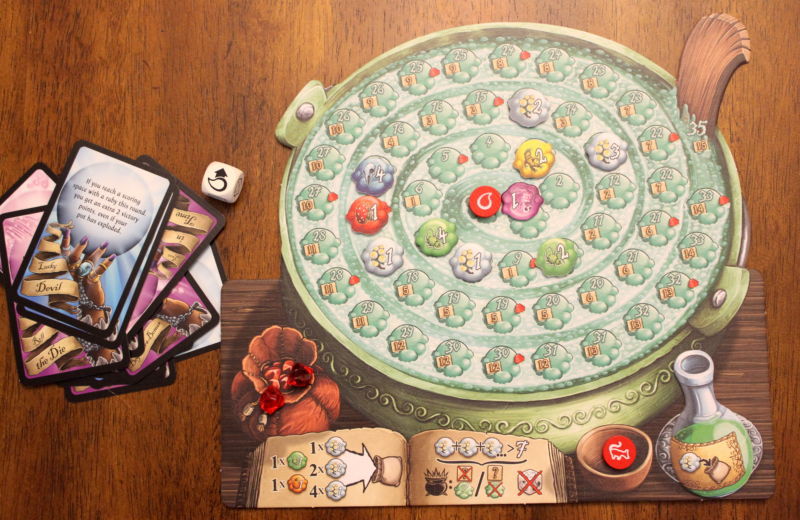
In Quacks, you play one of the titular quacks, a dubious doctor brewing and selling your wares at a pleasant-looking German festival. The festival runs for nine days, so you have nine chances to brew up something potent using ingredients pulled blindly from your bag o’ goodies. Pumpkins, crow skulls, toadstools, mandrakes, spiders, and even rat tails are positive contributions to the cauldron. But draw too many of the white “cherry bombs” (don’t ask—the picture on these chips appears to show snowberries) and your potion will explode—which means you lose out on some of the end-of-round goodies. But if you don’t push your luck, at least a little, you run the risk of being out-potioned by your fellow charlatans.
Once each player has either busted or halted, the potions are scored. Players gain both points and “money” depending on how far around the circular potion track they went that round, and “money” can be used to buy more and better ingredients for your bag going forward.
If it sounds simple at heart, it is—and that’s no criticism. I love me some bag-building, push-your-luck action. But what makes Quacks really shine are the ingredients, which offer all sorts of crazy powers and abilities. (And each ingredient comes as part of four different sets, with each having a completely different ability.)
For instance, the red toadstool chips in set one allow you to move extra spaces on the potion tracker depending on how many orange pumpkin chips are already part of your potion. But the red toadstool chips in set three provide extra movement only if the previous chip played was one of the white “cherry bombs.”
The yellow mandrakes in set two double the potion tracker movement points for whatever you next draw out of your bag. But the yellow mandrakes in set three change the threshold for potion explosions; the more mandrakes in the potion already, the harder it is to bust.
In addition to their different powers, most ingredients also come in three different “strengths,” the highest of which move you further along the potion track when drawn and provide more powerful forms of their bonus (but which also cost significantly more to buy).
Did I mention the bonus die you get to roll at the end of each round, providing some little goodie to whoever brewed the best potion? Or the fortune-teller cards that provide a unique bonus or power in each round of the game? Or the way that two additional ingredients come into pay after a couple of rounds? Or your “flask,” which lets you remove a single white “cherry bomb” from your potion and throw it back into your bag? Or the rubies you can acquire, which can then be cashed in to replenish an empty flask? Or the modest “catch-up” system using rat tails on the scoring board to give everyone behind the game’s leader a small per-round boost?
The combination of straightforward, exciting gameplay with so many small additions and variants gives you plenty to think about beyond the basic “should I pull another chip from my bag” question. You have to decide how to build your bag in a given game, buying up ingredients that combo well together or that steer you in a specific strategic direction. You have to decide if you value rubies and flasks or if you prefer to live without a safety cushion. And is it more profitable to hang right behind the leader until near the end?
The game’s six main ingredient colors.
You personal player board, where you brew your diabolical concoctions.
Some of the “fortune teller” cards that alter each round slightly.
If the gameplay starts to feel a little same-y, just swap out ingredients for another set and you will approach the game quite differently. (Quacks also includes a slightly more advanced variant on the back of each player board.)
Quacks is not a deep strategy game. But it is a terrific press-your-luck, choose-what-goes-in-your-bag experience. I have loved every minute of my playtime so far because everything about the Quacks experience is distilled “essence of fun.” Nothing is baggy or extraneous. There is no downtime, nor does game length increase much with player count. (Players all build their potions simultaneously, drawing ingredients as quickly as they like.) And the artwork is great.
While the game did win the German “Kennerspiel” award for a “complex” board game, don’t let that scare you if “complex” is not your jam. This is a family-weight title suitable for smart kids of 9+, not a two-hour strategy slugfest characterized by players glowering in concentration as they min/max resource conversion tables.
No, Quacks is a game of shouts and sighs, laughter and table-pounding. Its soundtrack isn’t silence but something more like “Draw draw draw YES draw CRAP draw draw draw YES draw YES raw BOO Draw draw draw DAMN YOU, CHIPS draw draw I SHOULDN’T DRAW AGAIN draw I SHOULD DEFINITELY STOP draw I BUSTED!” It’s fast, it’s fun, and penalty for busting isn’t so onerous that you’ll just want to quit the game, convinced you can never win. Unlike the potions you brew during player, Quacks won’t blow up in your face. Highly recommended—and if you like it, an expansion is coming this summer.
https://arstechnica.com/?p=1467939
Love, death, and spaceships: Lee Hutchinson’s Fangs concludes
I’ve never made any secret about my love for (and occasional frustration with) Frontier Development’s space combat/trading/exploration sandbox game Elite: Dangerous. In my 2015 review I called it “the best damn spaceship game I’ve ever played,” and four years later, it’s an opinion I still hold. Although it’s taken literally years for the developers to flesh out some of the game’s mechanics, there’s always been something special about Elite, even going all the way back to the beta when it was barely a game at all.
I love it so much, in fact, that a few years ago I started up an Elite: Dangerous Web comic called Fangs (many of the ships in Elite are named after snakes, so the title seemed appropriate). I can’t actually, you know, draw anything, but a couple of posts on the official subreddit gave me a neat idea: instead of illustrating panels, I could simply take screenshots directly from within the game and run them through a threshold filter to achieve a very distinctive film noir-esque feeling. Couple that with some clever framing and some snappy dialog, and I was in business.
Fangs originally started out as a series of short self-contained vignettes about various aspects of the Elite universe—I did a comic on exploration, on ship names, on smuggling, and a bunch of others.
The image that started it all—frame 1 from comic 1.
Lee Hutchinson
Most Fangs frames involve creating (or finding online) screenshots that roughly fit what I want to do, and then cropping and filtering.
Lee Hutchinson
Ship naming in Elite is still a somewhat-recent thing. Back when I made this comic, the ability to name your ship was still a ways off, but it was already a highly requested feature.
Lee Hutchinson
It made a great subject for a comic.
Lee Hutchinson
I also had to acquire some skill with the perspective transform tool to slap all those ship emblems on the right way.
Lee Hutchinson
Fangs isn’t above making pop culture references. I am nothing if not a child of the 1980s.
Lee Hutchinson
Probably my favorite chapter of Fangs book 1 is this one, on explorers.
Lee Hutchinson
The one on smuggling turned out really well, too.
Lee Hutchinson
The limited color palette means you end up prioritizing framing over almost every other aspect, but it also means you get cool shots like this.
Lee Hutchinson
This is one of my favorite frames.
Lee Hutchinson
Chapter ten, foreshadowing the return of the game’s big baddies, the Thargoids.
Lee Hutchinson
But after doing ten standalone chapters, the urge to actually tell a cohesive story had become overpowering. So I found an illustrator, worked out a plot, and started Fangs book two. It took a little longer than I was expecting to get it finished—in fact, it took two years—but as of this past Friday, it’s finally done.
Behold my pretensions laid bare
Book two—which you can read right here if you’d like to skip the bloviating—is titled “Every Man’s Wish On Board,” from the opening lines of Zora Neale Hurston’s Their Eyes Were Watching God. The quote provided the framework around which the story would coalesce:
Ships at a distance have every man’s wish on board. For some they come in with the tide. For others they sail forever on the horizon, never out of sight, never landing until the Watcher turns his eyes away in resignation, his dreams mocked to death by Time. That is the life of men. Now, women forget all those things they don’t want to remember, and remember everything they don’t want to forget. The dream is the truth.
With book two, I wanted to tell a story about the different ways in which men and women experience love, loss, grief, and memory. The idea was to utilize characters who are basically normal people without overwrought trope-filled backgrounds (so no Mysterious Brooding Ex-Space Marine With a Past, no Super-Smart-Techie-Hacker-Kung-Fu-Girl, and so on), and to have those characters go through something to change them emotionally, and to have them react at least somewhat realistically—again, without falling back on common science fiction storytelling tropes. (I don’t have anything against common science fiction storytelling tropes! But trying to skip as many as possible made for an interesting and challenging storytelling exercise.)
Most importantly, since book two has actual characters, I needed an artist. Here I lucked out: I wound up getting in touch with David Hall, whose work you might already be familiar with because he’s a full-time VFX artist in the video game industry, currently working at Riot Games. David was another Elite player, having found the game at about the same time I had back during Beta II. He even had his own Elite comic (which is sadly no longer online, though I’d like to see it return).
“As much as I love the actual gameplay,” he said when I asked him about his willingness to jump head-first into what quickly turned into a large pile of work, “I was fascinated by the thought of, ‘What’s behind this chair my Commander is sitting in?’ I’ve wanted to explore that area of the world ever since, and with Fangs, I got the chance to take a peek!”
I’m glad he said yes, because David’s stylus and tablet made the world and characters of Fangs real in a way that I never could have done with screenshots alone.
I was aiming for a more sophisticated style with Fangs book two.
Lee Hutchinson
The noir is turned up to 11—and the Elite universe proves surprisingly well-suited to it.
Lee Hutchinson
Fangs book two, of course, has actual characters—thanks to illustrator (and actual-for-real pro artist) David Hall.
Lee Hutchinson / David Hall
Lucy is also an important character in the story—she may not have any lines, but she’s every bit as central to the tale as the human characters are.
Lee Hutchinson
“Write what you know,” they say in writing workshops.
Lee Hutchinson / David Hall
David’s renderings of the main characters brings the story to life in a way that would have been otherwise impossible.
Lee Hutchinson / David Hall
Although the comic is in black and white, David produced this colorized frame as a fun Christmas present a few years ago.
David Hall
When there aren’t any characters in view, what makes Fangs work? Layout, layout, layout.
Lee Hutchinson
Of course, when there are characters in view, what makes Fangs work is how awesome David is.
Lee Hutchinson / David Hall
These are full-resolution source images, a little bigger than the crops I used in production. (Hence the lack of dialog.) I could look at this image all day.
Lee Hutchinson / David Hall
Though I can (and will, in the comments, if you’d like!) talk at excessive length about my writing process and the different layers of meaning and symbolism and stuff, stories are like kids—they must eventually stand on their own merit, without their parent helping. If I could leave you with just one takeaway, though, it’s that more than anything else the message I was going for is that life isn’t a movie and sometimes terrible things happen—but, at the same time, even when life is at its most Hobbesian, there’s beauty and wonder in the mundanity. (Which is also kind of the central point of The Office, but if one is going to steal, one should steal from the best!)
If this sounds like something you might be interested in reading, it would make me terribly happy if you’d give Fangs book two a read. You don’t have to know anything about Elite to enjoy it (though it doesn’t hurt!), and I’m not running ads on the site or making any money on this or anything. It’s been a project filled with frustration and passion, with lots of long nights spent awake talking to my wife about the ways in which men and women see the world, and endless chains of plot and art discussion e-mails between David and me. For a long time, I thought the ending would never see the light of day, but perseverance has paid off in the end.
I made this with my hands and I’m very proud of it. I hope very much that you all enjoy it.