In a golden age of SXSW brand activations, at least Game of Thrones draws blood
Uh, I’m here to donate blood?
Nathan Mattise
Can all future blood drives take place in recreations of the King’s Landing castle?
Nathan Mattise
After donating, visitors are ushered towards the “immersive experience,” which guides GoT fans through the tales of four people who “bled for the Throne.”
Nathan Mattise
So we’re talking Arya, Cersei, Jon Snow, and Tyrion…
Nathan Mattise
The motto of the Ars Technica Slack, 2019.
Nathan Mattise
For the experience, visitors get a pair of headphones attached to a stripped down smartphone. When you see the icon on your screen in real life, click and related audio narration guides you through a few themed rooms.
Nathan Mattise
“Enter if you’re ready to bleed for the Throne…” Uh, sure?
Nathan Mattise
Arya, doing her best Walking Dead look?
Nathan Mattise
For the Cersei room, you get the experience of being shamed by giant holographic heads…
Nathan Mattise
This is a curtain I need in my everyday life.
Nathan Mattise
For the Tyrion room, you get a sense of just how large The Mountain is.
Nathan Mattise
Once completing the immersive experience, you get perhaps the more impressive aspect of this installation: an interactive set of the throne room, complete with knighting ceremonies for donors…
Nathan Mattise
Oh, and there’s a 25-plus person choir with a chamber ensemble. They were singing names (of donors?) when Ars arrived.
Nathan Mattise
For the first SXSW band we caught in 2019, not bad: The King’s Landing Choral Society had high energy and a real orchestral knack.
Nathan Mattise
Outside of the Throne room, HBO also had a full campsite setting for visitors to walk through and interact with.
Nathan Mattise
The game of chess is like a sword fight…
Nathan Mattise
In another corner, a harp player…
Nathan Mattise
…and in a far-off tent, you could get Shake Shack of Westeros?
Nathan Mattise
In between choral performances, the most photographed item in modern TV history (maybe?) was open for more pictures.
Nathan Mattise
AUSTIN, Texas—The hottest ticket at South by Southwest 2019 may not involve a band or a film. Instead… it’s for blood donations.
Fresh off its much hyped SXSW 2018 Westworld experience, HBO partnered up with the American Red Cross this year for “Bleed For The Throne,” a blood drive held within yet another signature “immersive activation” at the festival. While people anywhere can participate in the overall Red Cross initiative, donors in Austin this week get the perk of walking through recreations of Game of Throne‘s King’s Landing Throne Room and an exterior camp site where everyday people from Westeros await to perform and interact. According to the event press release, 80-plus actors and musicians have been hired to bring it all to life, and they’re working from 100-plus pages of character script and backstory. A royal woman told us we had to listen to light inside us; a female soldier at the camp commented on the excellent mobility of our “armor”—aka, a bike helmet attached to a backpack.
If you’re attending SXSW and haven’t reserved a spot yet, don’t bother. After a Thursday media preview, HBO PR sent out an update noting all available appointments for the weekend had been reserved within two hours of opening. On the plus side, the GoT tie-in has led to a reported 40 percent increase in new donor appointments since the campaign announcement.
The whole thing will inevitably be enjoyable for any Thrones diehards or Instagram influencers that managed to save a spot early, but it does make us wonder: have we finally reached peak installation?
At SXSW, these kind of experiences have been happening for at least the past five years (GoT itself even has a multi-year history of SXSWesteros). In 2015, A&E recreated the Bates Motel for its then-new TV series based in the Psycho universe. Two years later, people lined up around the block for chicken nuggets and photos of a used car at Los Pollos Hermanos (of Breaking Bad/Better Call Saulfame) or to sip a damn fine cup of coffee at the Double R Diner (Twin Peaks). Food trucks from Kwik-E-Mart to Bob’s Burgershave done functional versions of these elaborative adver-activations. And after HBO rented an entire town and bused folks 45 minutes away to simulate the Westworld simulation IRL last year, SXSW finally created formal awards to recognize this increasingly elaborate and annual branding exercise.
Does any of this serve any purpose beyond marketing? You could probably ask the same thing about Harry Potter World or Disney’s upcoming Star Wars lands, and those require paid tickets. At least “Bleed The Throne” supports a good (albeit at times complicated) cause. It feels like fans increasingly want to interact with their favorite things—shows, chefs, bands, whatever—in a tactile way given our ever more digital reality, and these immersive setups do it in a different way when compared to cons or various art exhibits.
This year’s GoT installation is certainly smaller in stature than HBO’s 2018 effort, but the show’s cultural cache and reverence is much, much higher than its SXSW predecessors. People will line up all day just for a picture of the throne, or they’ll fly across the world to see sets. So an on-site mini-theme park before the show’s final season becomes maybe one of the last monocultural TV moments? It’s hard to imagine the SXSW-branded content experience finding another level—in terms of scale or fan enjoyment—in the coming years. That said, Netflix does have a Highwaymen speakeasy lined up at SXSW 2019 for one of its first entries into this competition.
(And for the most important question with all this: the whole thing had no spoilers… I think. But give the Internet a few days to figure it out. Game of Thrones’ final season debuts on HBO on April 14, 2019.)
Disney to close “vault” for good as it moves film library to streaming service
Disney is rapidly preparing to launch its own streaming service, dubbed Disney+, later this year. While the debut date is still unknown, we now know that the service will include the entire Disney movie library shortly after the service launches. According to a report in Polygon, Disney CEO Bob Iger explained the strategy to investors at a meeting in St. Louis, Missouri, pointing at the retirement of Disney’s longstanding “vault.”
“The service… is going to combine what we call library product, movies, and television, with a lot of original product as well, movies and television,” Iger said. “And at some point fairly soon after launch, it will house the entire Disney motion picture library, so the movies that you speak of that traditionally have been kept in a ‘vault’ and brought out basically every few years will be on the service. And then, of course, we’re producing a number of original movies and original television shows as well that will be Disney-branded.”
The Disney Vault has been a marketing and sales strategy for years. After a film’s initial release run, Disney would sequester the title in its vault for a long period of time. That meant that customers who didn’t buy a physical copy of the movie immediately would be out of luck until Disney brought it out of the vault as a new edition or a special release run.
This strategy allowed Disney to control film sales and drum up anticipation for titles that were coming out of the vault once the company decided the time was right. But it also frustrated customers who ended up paying high prices for copies of movies that were widely unavailable during their vault stints.
Disney has dozens of movies in its vault and in its entire collection—classics like Dumbo, The Little Mermaid, and 101 Dalmatians, and new favorites like Frozen. Locking those movies into the company’s own streaming service will make it that much more appealing to diehard Disney fans—and customers who have children.
This exclusivity will be an important factor for Disney as it competes with other streaming giants like Netflix, Hulu, and Amazon Prime Video. In 2017, Disney announced that it would remove its content from Netflix to prepare for the launch of Disney+ in 2019. The picture became clearer as Disney clarified that its movies and properties that it acquired, like Star Wars and Marvel films, would also disappear from Netflix. That content and other licensed properties will likely also stream exclusively on Disney+.
In addition to existing content, Disney is planning on making straight-to-series titles and live-action versions of popular films. Disney already signed director Jon Favreau (Iron Man) to make a live-action Star Wars series called The Mandalorian, which will stream exclusively on Disney+.
https://arstechnica.com/?p=1470525
Captain Marvel review: The hero we, and Marvel Studios, need right now
Enlarge/ Captain Marvel is here, and thank goodness.
This review contains as few plot spoilers as the author could muster. (We even chose not to use certain film images that could be construed as spoilers, just in case.)
As much as we at Ars Technica like a given Marvel Studios film, even we can get burnt out by hero-movie fatigue. Quirky heroes face insurmountable odds. Then, wouldn’tcha know it, the heroes surmount them. We’ve seen it before—cheered at the action scenes, smiled at the jokes, forgiven the formula.
After so many entries, all burning a path toward mega-events like last year’s boring Avengers: Infinity War, it’s easy to lose sight of something unique to the superhero genre: protagonists who swear to protect the world at all costs. That’s a big ask of any human, whether or not they’ve been granted insane powers.
Captain Marvel is a great superhero film for many reasons, but one of them is that it sees Marvel Studios tell its best origin story yet—not just of that one character getting some powers, but of that character discovering her destiny, her reason to get back up when the world tries to shove her down. The character of Captain Marvel may have been granted powers in a supernatural manner, but the film she stars in gets its powers from a rich, human story fueled by delightful twists and impeccable acting.
Move over, Downey Jr.
Not Captain Marvel’s best day.
Marvel Studios
All in a day’s work for Brie Larson.
Marvel Studios
Three things appear to factor into Samuel L. Jackson’s very youthful appearance: CGI, make-up, and Jackson’s own impeccable acting.
Marvel Studios
Larson’s character seems way more amused by her antics than Nick Fury is.
Marvel Studios
Jude Law and Brie Larson work out their differences.
Marvel Studios
Brie Larson’s character ups the ante of this conversation.
Marvel Studios
Brie Larson, seen here in era-appropriate attire.
Marvel Studios
Lashana Lynch (left) rises above potential “boring sidekick” status in Captain Marvel with equal parts dialogue and acting.
Marvel Studios
Any review of Captain Marvel must begin and end with Brie Larson, the actor tasked with holding a lot of moving parts together. A badass, a friend, a squadmate, a confused student, a wise mentor, a snarky action star, a terrified child, and a savior: this is how you unseat Robert Downey Jr.’s Iron Man 1 debut as the absolute best in any MCU film.
Really, any of the previous MCU films. Better than Chris Hemsworth’s dripping charisma in Thor: Ragnarok, better than Michael B. Jordan’s tortured villainy in Black Panther, and better than Chris Pratt’s series-cementing vulnerability in Guardians of the Galaxy Vol. 1. Larson smokes them all, as if blasted by two barrels of heat from her hands.
When Larson isn’t connecting with her costars in moving conversations, she’s juggling high-stakes comic-book gibberish. (Saying more would spoil some plot points.) But the script does a lot to spread the gibberish wealth among characters, thus letting each of them naturally react to new plot points that emerge. Sometimes, Larson is matter of fact in a stern, military-leader way about interstellar craziness, which results in awkward (and intentional) comedy. Other times, she leads characters on by playing dumb or innocent before offering delightfully snappy responses.
But best of all is the rapport she builds with actors at the top of their action-film game. Samuel L. Jackson is the obvious shining star in Marvel‘s ensemble, and it’s not just an effects team’s magical combination of CGI and make-up that turn him into a believably younger man. Jackson sells that twist by imbuing his portrayal of Nick Fury with chipper, good-cop energy the likes of which I’m not sure I’ve seen since alllll the way back to Do the Right Thing. Larson and Jackson share the screen for a few lengthy, entertaining sequences, each egging the other on for equal parts humor and action, and the result is the most organic on-screen chemistry I’ve seen in a superhero film in a long time.
Annette Bening’s turn as an apparent mentor and overseer suffers the most from over-serious, stakes-setting gibberish, yet it’s a credit to her acting ability that she conveys her material without sounding like an outtake from a Power Rangers episode. She eventually has to plant serious heart into the film’s proceedings, and at that moment, she does just enough to remind viewers of the “Academy Award-nominated” prefix on her resume. Meanwhile, actor Lashana Lynch could have been relegated to also-ran sidekick status, but the script affords her enough space to have three roles in the film: friend, mom, and badass. In spite of her limited screen time, she cracks open some waterworks (aided in no small part by actor Akira Akbar, her on-screen daughter and a total sparkplug).
Without going into spoilers, both Ben Mendelsohn and Jude Law do a phenomenal job of sacrificing potential acting beats in deference to the larger story. Law, in particular, sees his character turned on its head in one key moment that will have filmgoers roaring, and he rolls with it in seemingly effortless fashion.
DeConnick’s impact on the MCU
Enlarge/ You don’t want to be on the receiving end of that Captain Marvel action, especially when running on the top of a moving train.
Notice how I’ve spent a lot of time vaguely praising the film? There’s a reason.
The most I’d like to give away about the film’s plot and framework is that it resembles some of the absolute best Captain Marvel comics in recent years, particularly the works of writer Kelly Sue DeConnick. Before going into a Captain Marvel screening, I strongly suggest you pick up trade paperbacks like Higher, Further, Faster, More or In Pursuit of Flight—not because they are required reading at all (they’re not). Rather, those books’ time-hopping techniques have been paid forward in this film’s script, both in blatant and subtle ways. I really enjoyed noticing the through line as I chomped on popcorn.
Your allegiance to various Captain Marvel comic-book timelines won’t necessarily be paid off, as certain events in the character’s MCU origin tale don’t line up. (Instead, series fans will relish certain hilarious references, not to mention a chunk of nostalgia-worthy content.) I was fine with that, as the film opens in somewhat abrupt fashion in order to immediately set equal parts stakes and confusion. What is Larson’s character doing here? What is her purpose?
The simple answer of “saving the universe” doesn’t cut it for this script, and Larson’s character has to face off with various friends and foes to figure out an answer to that question that she actually believes in. Gosh, even typing that sentence makes me well up with emotion, thinking about the surprises and delights that Larson unearths for her character running up to the film’s bombastic conclusion.
The biggest criticism I have is that its action scenes simply don’t reach the same surprising heights. The diversity in scenery is absolutely beautiful, with elaborate sets on Earth and elsewhere seeing Marvel’s production designers going all-out to be equal parts sweeping and, er, era-appropriate. But once fists start flying and planes start whizzing, there’s a certain “been there, blasted that” pall that becomes all too apparent. One scene in particular feels ripped out of a lower-budget action film that simply wanted to parody the likes of Halo.
But as the rest of my wildly praise-filled text might suggest, that issue is easy to forgive. Captain Marvel is a must-see superhero film. When I told a friend that, he almost instantly replied: well, Sam, how does it rank in your numerical list of MCU films?
I paused upon hearing that, thought about it, and ultimately rejected the question. Captain Marvel does things that have been missing from MCU films for quite some time, and the result is a film that feels like an orange in a list of apples. Watching Captain Marvel made me believe in the unique power of superhero stories again, something that I haven’t felt since the first time I read a Wolverine comic book as a kid and saw something raw, challenging, and human in my action-driven storytelling.
I’m not a young woman looking for a hero that, for once, resembles me out there; that’s not my entertainment gap. But I am hungry for stories that give power to the powerless—that remind me of the reason my young, social-recluse self flocked to nerd-dom in the first place. For that reason, I look forward to seeing Captain Marvel again.
https://arstechnica.com/?p=1468159
You can now play PlayStation 4 games on your iPhone
As on other remote play devices, you can navigate the entire PS4 interface.
Samuel Axon
The touchscreen controls overlay is about as good as touchscreen controls overlays can possibly be.
Samuel Axon
You can use your iPhone’s microphone for voice chat.
Samuel Axon
1080p mode looks great on the iPhone XS’ OLED screen, I have to admit.
Samuel Axon
The Elder Scrolls V: Skyrim on iOS might hold you over until the long-delayed Blades finally hits, if you can deal with some input lag.
Samuel Axon
Thanks to that input lag, this is probably about as far as you’ll want to go in Apex Legends.
Samuel Axon
I did manage to get off a headshot in the training range, but it required some slow, careful aiming that would not be possible in a real game.
Samuel Axon
As expected, shotguns work a bit better.
Samuel Axon
Console players tend to like to play with very high sensitivities for great reaction times. In this case, don’t. I found games much easier to play with the touch controls if sensitivity is turned way, way down.
Samuel Axon
On the other hand, Dragon Quest XI—which has relaxing world exploration and turn-based combat—was a delight to play this way. No compromises here.
Samuel Axon
It was a similar story for Torment: Tides of Numenera, though that text is pretty small if you don’t have an iPad, iPhone XS Max, or maybe iPhone XR. (I tried it on an iPhone XS, and I could read it, but it was a bit squinty.)
Samuel Axon
I couldn’t figure out a way to safely disconnect without getting this error message. Oh well?
Samuel Axon
Today, Sony released its 6.50 firmware for PlayStation 4 systems. The tentpole feature of the update is support for remote play to iOS devices like iPhones and iPads. The release coincided with the release of a “PS4 Remote Play” app on the Apple App Store.
Remote Play has been around as a feature for years in one form or another—since the PlayStation 3, even. It allows you to stream games from your PS4 to your PlayStation Vita, Windows or Mac laptop, or other supported device, and it lets you control the game remotely, too. The recently deceased Vita had a custom control layout for playing PS4 games, while Windows and Mac users could connect the PlayStation’s DualShock 4 controllers to their computers.
Unfortunately, you can’t sync a DualShock 4 controller with an iPhone at present. You can use a MFi controller, but its layout is generally not optimal—for example, an MFi controller may not allow you to press down on the control sticks as buttons, which is labeled L3 and R3 on the PS4 and frequently used in games. In Apex Legends, L3 is sprint by default, and R3 is for the melee attack—kind of critical.
These buttons are accessible with the on-screen touch overlay that represents a PS4 controller, though, and this overlay is as good as such overlays can be. I found it adequate for controlling most non-action games, even if I constantly had to fight the temptation to tap on UI elements instead of navigating to them with a virtual control stick.
When you load the app, you’re greeted with this simple screen. Pressing start causes a one-to-three-minute search process unless you sync manually with your PS4 in front of you.
Samuel Axon
I tried playing over LTE, but it insisted on WiFi. Maybe that will change when real 5G eventually rolls out.
Samuel Axon
There’s a settings menu that lets you tweak all sorts of relevant stuff, pictured here.
Samuel Axon
Probably most relevant is the video-quality menu: it lets you set resolution and framerate, and the best settings here will vary a lot depending on your situation.
Samuel Axon
The resolution options run all the way up to 1080p, which worked great for me. But that requires a PS4 Pro.
Samuel Axon
What the framerate settings represent in actual numbers is unclear exactly, but “High” is obviously very preferable.
Samuel Axon
The app offers a range of quality settings for different connections. 360p, 540p, 720p, and 1080p resolutions are available, though the highest of those requires that you have a PlayStation 4 Pro rather than the base PS4. There are two framerate settings: standard and high. The menu doesn’t specify the numbers here, but high is obviously preferable if you can manage it.
On an iPhone XS sharing a local network with my PlayStation 4 Pro (which was connected to the router via Ethernet), I was able to max both of these settings with no issues. Unfortunately, you can’t play over LTE, and I wasn’t able to test playing over the Internet via another WiFi network today. It’s a safe bet that anyone trying that will have a rougher go of it, though.
I tried out a bunch of games and found that the experience was as good as you could expect on local Wi-Fi; it’s adequate for turn-based and slow-paced games like strategy games, traditional Japanese role-playing games like Dragon Quest XI, or walking simulators. But don’t expect to play Call of Duty or Bloodborne this way. There’s just too much input lag. On the other hand, visual fidelity is great.
Sony made this feature available on certain Android devices more than four years ago, but there’s a catch: the device list was limited only to a few of Sony’s phones. Now users of unsupported Android phones are asking for official parity with the iPhone. The iOS app works on any iOS device supported by iOS 12.1.
Sony hasn’t made any announcements about expanded Android support yet (though lackluster support is possible with third-party apps on that platform). But Android support doesn’t seem too unlikely. Meanwhile, Microsoft is planning on making streaming games to a variety of devices a key part of its console strategy for the future.
Listing image by Samuel Axon
https://arstechnica.com/?p=1470325
With Rape Day ban, Steam shows it’s not as “hands off” as it claims
Enlarge/ One of the few safe-for-work images of Rape Day offered on the game’s Steam page before it was taken down.
Since last June, Valve has claimed that “the right approach is to allow everything onto the Steam Store,” with only minor exceptions for content that is “illegal or straight-up trolling.” But Valve’s decision to block controversial upcoming title Rape Day from Steam shows its actual moderation policy is more reactive and restrictive than originally promised.
Rape Day attracted plenty of headlines over the last week or so for its pre-release description of a visual novel where you “control the choices of a menacing serial killer rapist during a zombie apocalypse.” Trailers and screenshots posted to the game’s (now-deleted, archived, extremely NSFW) Steam page show some very basic branching dialogue choices amid brutal static scenes of hardcore pornography and sexual violence.
Developer Desk Lamp said in a March 4 update that the game had been submitted to Steam for approval and that “the review process was taking longer than expected.” Yesterday afternoon, Valve posted a short blog post stating directly that “Rape Day will not ship on Steam”:
Much of our policy around what we distribute is, and must be, reactionary [Valve presumably means “reactive”]—we simply have to wait and see what comes to us via Steam Direct. We then have to make a judgment call about any risk it puts to Valve, our developer partners, or our customers. After significant fact-finding and discussion, we think ‘Rape Day’ poses unknown costs and risks and therefore won’t be on Steam.
We respect developers’ desire to express themselves, and the purpose of Steam is to help developers find an audience, but this developer has chosen content matter and a way of representing it that makes it very difficult for us to help them do that.
What are the rules?
Valve’s Rape Day statement is as notable for what it says as for what it doesn’t. For one, it doesn’t explicitly condemn the content in Rape Day, either generally or specifically. For another, it doesn’t argue that the game is either “illegal or straight-up trolling,” the two previously stated exceptions to its “allow everything” policy.
Depictions of rape and sexual violence are not illegal in the United States, as countless works of art and pop culture have shown over the years. “Straight up trolling” is more of a judgment call, but Valve has previously clarified that this generally applies to games that outright don’t work or are “just trying to incite and sow discord.” Valve has previously used this justification to remove games like AIDS Simulator and Active Shooter from Steam, the latter because it was “designed to do nothing but generate outrage and cause conflict through its existence,” according to a statement from Valve’s Doug Lombardi.
Enlarge/ While games like Active Shooter were rejected from Steam for “straight-up trolling,” that doesn’t seem to be the case with Rape Day.
The developer behind at Desk Lamp certainly don’t think his game is a mere troll intended to “sow discord,” though. On the game’s website, he cites inspiration from horror books and psychological thrillers, saying Rape Day is a dark comedy about “subjective value systems” and “gaining the acceptance of the loss of control… Or maybe it’s me trying to work through my own trauma/PTSD.”
Desk Lamp compares Rape Day to games like Grand Theft Auto, suggesting that “you can’t reasonable [sic] consider banning rape in fiction without banning murder and torture. Murder has been normalized in fiction, while rape has yet to be normalized.”
“Of course if Valve changes their policy again, I will sell this game somewhere else but as of now it is perfectly within the rules,” Desk Lamp said in a news update on the game’s Steam page in February. That said, in a statement provided to CNET this week, that developer said, “I think I might agree with Steam that my game is not the right fit for a distribution site that is marketed at the general masses and children.”
Maybe Desk Lamp is being too cute by half, trying to come up with an easy justification for a game that’s only meant to troll the storefront. But there’s some reason to believe he was at least trying to create a sincere piece of expression here, however shocking or abhorrent it might be.
Valve gives a damn ’bout its bad reputation
So if Rape Day ins’t illegal or “straight-up trolling,” how should we interpret Valve’s decision to block its Steam release anyway? There are some hints in Valve’s statement on the game, which cites “unknown costs and risks” to “Valve, our developer partners, or our customers” in making the decision.
Valve doesn’t go into detail on what those risks might be. Maybe the company is worried about the risk of players merely being exposed to Rape Day‘s content, but that kind of “think of the children” positioning is a line Valve has never used in the past. Perhaps Valve is worried about legal risks; even an unsuccessful civil suit against the company for offering the game would be rather costly.
Just as likely, though, the real risk Valve is worried about is reputational. Before Valve’s decision, a Change.org petition demanding the game come off of Steam attracted nearly 8,000 signatures in just a few days. That’s a drop in the bucket in the Internet outrage machine, but it reflects an outcry about the game that was starting to hit mainstream news outlets and social media commenters who aren’t usually immersed in the game industry.
In announcing its new policy back in June, Valve argued that “if we allow your game onto the Store, it does not mean we approve or agree with anything you’re trying to say with it.” But as I pointed out in an op-ed at the time, that sort of we-don’t-have-a-position position doesn’t prevent Valve’s brand from being dragged down by Steam’s worst content.
“By allowing practically the most hateful games imaginable on its storefront, Steam offers an implicit endorsement that amounts to much more than just a place on the digital shelf,” I wrote at the time. “[Valve’s position] lets anyone, with any point of view, essentially tie themselves to the Steam brand, complete with the explicit benefits and implicit endorsements that come with it… By refusing to define its own values, Valve will be letting anyone and everyone try to define those values by tying their content to Steam’s storefront.”
What can you do?
Enlarge/ When Apple briefly required the addition of undergarments in the iPad version of Papers, Please images, it had published guidelines it could point to justifying the decision.
Valve’s newest attempt to thread the needle on this issue, it seems, is an argument that “much of our policy around what we distribute is, and must be, reactionary [sic]—we simply have to wait and see what comes to us via Steam Direct.” But the rest of the game industry shows that’s not true. Game console platforms, mobile app stores, and even competing PC game distribution services all have predefined guidelines outlining what kind of content is and isn’t acceptable for the games they sell.
Rather than simply taking a “waiting-and-see” position, these storefronts all proactively try to draw the line between acceptable and unacceptable ahead of time. Those kinds of content guidelines are open to interpretation, of course, and there are plenty of edgecases for games that seem to skirt the line. But simply having a line in the first place helps prevent those storefronts from being merely reactive, as Valve claims it “must be.”
When controversial content wants to associate with these other storefronts, those platform-holders can at least point to their guidelines as justification for any decision they make. When such content tries to get on Steam, Valve can only be reactive, offering mealy-mouthed responses about unnamed “costs and risks.”
Valve’s ostensibly laissez-faire moderation policy for Steam games is becoming, in practice, more of a capricious, “I’ll know it when I see it” method of directionless, case-by-case decision-making. For Steam, it seems, there are now three types of content that are banned: illegal content; outright trolling; and an amorphous set of “content that makes us look bad.”
https://arstechnica.com/?p=1469913
Blizzard has handed Diablo 1’s keys to GOG, and you can buy it right now
That leaves one classic-minded Blizzard fanbase in the cold: the Diablo fans. These are the fans who, to some measure, let Blizzard have it after seeing the unveil of smartphone-only “freemium” game Diablo Immortal in place of any “Diablo IV” news at BlizzCon 2018. Which is to say: the word “Diablo” is a touchy one as of late.
Which brings us to today’s seriously surprising news: Blizzard has just put Diablo 1 on sale digitally, a first for that 1996 game, with no prior announcement. It’s not a remaster, per se, but it does come with some quality-of-life updates and is Blizzard’s first DRM-free game launch in years.
What’s more, Blizzard has handed the game’s keys to a completely different storefront: GOG.com. This famously DRM-free marketplace is run by CD Projekt Group, the Polish company that also owns game developer CD Projekt Red (The Witcher). You’ll have to go to GOG, not the Blizzard Launcher app, to purchase and download Diablo 1 (for $10, right here). Once you download the files, designed for Windows PCs, that’s it—no online check-ins or CD keys required. All of that is a first for a Blizzard game sold as a digital download.
And it won’t be the last. GOG has already announced that it will follow this Diablo launch with future re-releases of the first two WarCraft RTS games’ original files.
We received this news roughly a week ago, and we’re still doing that cartoon-like thing of shaking our heads rapidly, then rubbing our eyes, looking up, and saying, “huuuuuh?” But seriously, this out-of-nowhere release, mixed with an out-of-nowhere partnership, is real—and we’ve tested the results.
Diablo, meet “DX”
When you boot into GOG’s version of Diablo 1, the top black box appears. Below that is the optional “DX video settings” menu, explained in the article below. Click through the gallery for comparison shots of the effects.
(You’ll want to full-screen the gallery to perceive differences.) Integer scaling is enabled in this shot, to guarantee a proper pixel-placement ratio.
This image has MSAA and AFx16 enabled. It looks better in motion than in a still frame, but it’s still not a great look for Diablo. Thanks for the option, anyway.
Integer scaling enabled. I’d prefer to stay for a while and listen with more pixels.
MSAA/AF enabled.
Integer scaling enabled.
MSAA/AF enabled.
GOG’s bundle comes packed with two versions of Diablo 1. The first is a “vanilla” version, which runs on the game’s 1.09b codebase with only one noticeable tweak: a scaling fix to ensure that the game renders at its original 4:3 screen ratio, no matter your display size (even though it otherwise transforms your screen in a way that resizes background windows in Windows 10). In comparison, trying to run the game via a mix of the original CD-ROM and official patch files can lead to a stretchy screen, should you not install any third-party mods.
The second included version is a DirectX-fueled build of the game, whose extra tweaks were built entirely in-house by GOG. Among these are support for a variety of resolutions and refresh rates, a “borderless window” option, a v-sync toggle, a gamma slider, and a pair of visual filters: anisotropic filtering up to 16x and anti-aliasing up to 8x MSAA.
If a smeary-looking Diablo 1 experience sounds good to you, go ahead and toggle that MSAA. But purists will appreciate another option in the menus: “integer scaling,” which guarantees that the game’s original pixels map to a 1:1 ratio, in all of their pixellated, 16-bit color-depth glory. In GOG’s “DX” version of Diablo 1, the anti-aliased version does feel slightly smoother in motion, but the game’s art style and animations were never meant to be covered in pixel-obscuring Vaseline. Thus, make sure to enable integer scaling.
Should you wish to connect to online friends in the game’s original Battle.net implementation, that requires running the vanilla build… and opening up some ports. You’ll need to go through Windows menus and your router’s settings table to open ports (specifically, 6112-6119, both TCP and UDP) before you can matchmake with friends in the game’s ancient Battle.net chat-lobby system.
We’re going back… to Battle.net. (All of the other listed multiplayer modes work in the “DX” version, but you’ll need GOG’s vanilla build to get into D1‘s Battle.net system.)
A rare occasion in which I didn’t name my character “Butts” or something even sillier.
Read below for why we don’t necessarily recommend doing this.
These are not the same credentials you use on the modern Blizzard launcher. And they don’t require email authentication.
Use this IRC-like interface to connect with friends on Blizzard’s official service.
Yes, they’re still relying on this very antiquated “profile” page system.
Joining friends’ games is a bit clunky, but so long as my tester and I were in the same chat channel, our games appeared in each other’s interfaces. Just be warned: alt-tabbing out of Diablo 1‘s vanilla version is a pain, so get your VoIP of choice running before you launch a session.
I matchmade with another tester to confirm that, once those ports are opened, you can expect perfectly solid Diablo-over-IP performance, along with some glitches that seem era-appropriate. In particular, my tester and I each used items in our inventory, only to find (on a very rare occasion) that their effect hadn’t kicked in, yet we’d lost the item. Also, as the above gallery shows, the Battle.net interface of old is veeeery rudimentary. Gosh, it still includes “age,” “sex,” and “location” in its profile pages. The Internet-in-1996 jokes write themselves.
Punch a big hole in your firewall?
As for the security of playing this version of Diablo online via Battle.net, let me hand the proverbial mic to my Ars Technica colleague and Windows expert Peter Bright, who wrote the following portion:
No rose-tinted glasses required
Beyond that heavy-duty caveat, it’s classic Diablo, warts and all. This is 1996 we’re talking about, and back then, online play didn’t include niceties like the ability to see other co-op players on your mini-map. Meanwhile, 1996’s single-player campaigns didn’t automatically save their progress before you got your butt kicked on only the second floor of the dungeon.
And you don’t need rose-tinted glasses to respect how well much of Diablo 1 has aged. Its pixel art includes gleefully evil designs and moody, randomly generated levels, boosted with rudimentary lighting effects, while the sound design is unbelievably good. This soundtrack is an incredible combination of haunting melodies and crazy, atmospheric sound effects, and the voiced, snarling enemies all sound enjoyably insane.
But your heroes’ animation suite is painfully rigid, which makes the basic, constant action of clicking around for combat and loot a bit of a nightmare once you know how much better that action can feel. Honestly, after tooling around in this re-released version of Diablo 1 for a couple of hours (and realizing how many errant and imprecise clicks I burnt through along the way), I got the urge to play Diablo II instead. Diablo II fixed pretty much every quibble from the first game while adding even more ridiculously awesome pixel art.
Thanks to a 2016 Diablo II patch from Blizzard, that’s relatively easy to do on modern Windows PCs. Blizzard’s Web storefront sells CD keys for both D2 and its Lord of Destruction expansion pack ($10 each), and then you can download a standalone EXE for either/both. But that sequel has its own quality-of-life limitations on modern machines, including a lack of proper resolution scaling beyond 800×600.
“We were bummed”
GOG’s version comes with a few goodies, including FLAC and MP3 versions of the original soundtrack (yes) and a high-res scan of the original manual (yes). Enjoy a few of its pages in this gallery.
Get to know your classes.
Who does it from behind? Rogues do.
The opening page for the “spells” section.
The end of the spells section, up against the beginning of the Bestiary. (Blizzard can spell that word however it pleases, though.)
Sample beasts.
When asked for comment, GOG’s representatives referred us to the company’s press release on the matter—which only includes one statement from a GOG executive, merely reminding shoppers that Diablo 1 has ranked highly on GOG users’ request charts for some time. The same press release quotes Blizzard VP Rob Bridenbecker: “We were bummed that these iconic games weren’t available to our players, so we’re very happy to work with the crew at GOG.COM to rectify that.”
Thankfully, Blizzard had more direct answers to our questions, including one biggie: why partner with GOG, as opposed to launching classic games on the Blizzard Launcher?
“In order to have any [software] on the Blizzard launcher, it must be connected to the modern Battle.net stack,” Blizzard Global PR Manager Sara Zaidi said to Ars in an email interview. “Unfortunately, this means that some of our older titles, like Diablo 1, do not have that modern infrastructure that enables them to be on the Blizzard launcher. We didn’t think it was right that players couldn’t get access to these titles because they lack the necessary back-end framework, so we were very happy to work together with GOG to help make Diablo 1 available to our players on their platform.”
Zaidi didn’t go into specifics when asked why GOG built this week’s DirectX-flavored build of Diablo 1, as opposed to an internal Blizzard team, beyond lauding GOG’s reputation for “bringing updated versions of classic games to modern hardware.” She also didn’t have any news to offer about exactly when to expect news about GOG’s launches of WarCraft 1 & 2.
Blizzard’s official answers didn’t hint to our previous guess for this release’s timing: as an olive branch to the series’ loudest current critics. Diablo Immortal‘s late-2018 reveal unleashed a maelstrom of complaints, even from fans attending its BlizzCon event, and Blizzard has since gone into hiding about the game. Once it returns to the spotlight, there’s no telling whether it will still so loudly resemble the microtransaction-heavy, smartphone-only Diablo clones already made by its developer at NetEase. If that game is being delayed to get some smoothing over, then maybe Diablo 1 is a nice toy for fans to futz with in the meantime.
Let me be clear: I hold out hope that Diablo Immortal will deliver a faithful, engaging dungeon-crawling experience that’s worthy of the series’ name. That hope sits right next to my louder hope for a different kind of classic re-release: Diablo II, remastered, and based on that game’s original, incredible sprite-art foundation. Hiring from as far back as 2015 suggests Blizzard wants that, too. But other Blizzard Classic games are ahead on the release calendar. What’s a sullen Diablo fan to do in the meantime besides play Diablo III‘s solid Nintendo Switch port?
Blizzard’s answer—a digital re-release of the original Diablo files—could be seen as a bit lazy. Just like the 2016 Diablo II patch, this one does little beyond bringing the series’ first entry up to basic computer-compatibility standards (and even then, the albatross of ancient netcode remains). But there’s also something great about a company as big as Activision-Blizzard just letting this game go, completely DRM-free, and giving fans $10 worth of nostalgia that doesn’t require some modern game launching software. Like ma used to make.
https://arstechnica.com/?p=1468363
Anita Sarkeesian talks about exposing gaming’s most toxic trends with sheer data
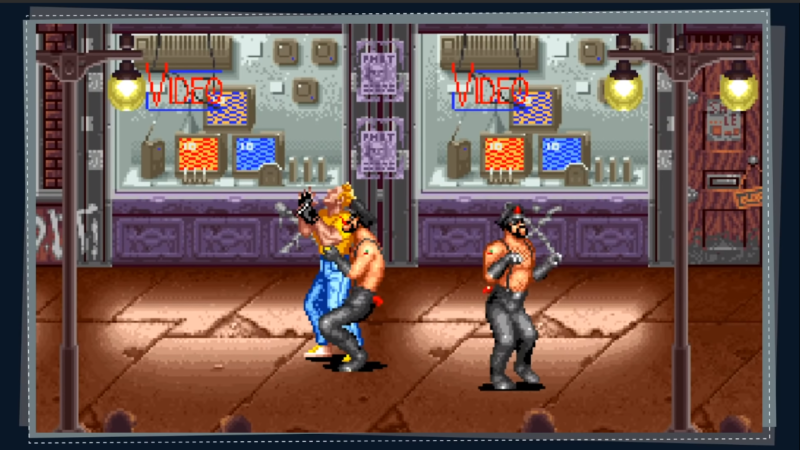
Enlarge/ In isolation, the “leather daddy” enemies in Sega’s Crime Fighters 2 (the Japanese version of Vendetta) could strike you as either offensive or harmless. But these “queer coded” enemies speak to a larger trend, and Feminist Frequency’s latest video series explores this fact with a deep, data-driven dive into the industry’s largely negative history with queer representation.
Six years ago, the nonprofit media organization Feminist Frequency debuted its “Tropes Vs. Women in Games” series, a comprehensive look at how the game industry characterized female characters in consistently negative ways. In hindsight, its creator, Anita Sarkeesian, describes that series as “a hit,” and not in the way you might think.
“I don’t mean ‘hit’ like a blockbuster hit, more like an attack hit,” Sarkeesian said in a phone interview with Ars Technica. Her Tropes Vs. Women series became a cornerstone of hateful Internet movements, but the videos’ allegiance to data and research—their bend-over-backward approach to proving points about largely negative portrayals of women in games—has endured. Now, Sarkeesian and her Feminist Frequency colleagues are taking that approach to gaming’s negative LGBTQ trends.
Anybody who has seen a gay stereotype in Grand Theft Auto or heard homophobic slurs in online voice chat may assume that LGBTQ representation in games isn’t very positive. But what if someone tried to catalog the full state of queer representation in games? What happens when a data-first approach goes beyond anecdotal impressions?
This week’s launch of “Queer Tropes” attempts to answer those questions. The 46-minute Feminist Frequency mini-series isn’t necessarily a definitive answer, but it’s a good step—an enlightening series that revolves around provable trends found in decades of video game history.
A different kind of game “coding”
[embedded content]
Queer Tropes, episode one: “Is Ghirahim Gay or Just Coded that Way?” hosted by Carolyn Petit. (Warning: all embedded videos in this article contain some NSFW language and descriptions of homophobic violence.)
The available data isn’t very positive. Some of the content that Queer Tropes’ three episodes label as trend-worthy—or indicative of repeating patterns—includes violent leather daddies who dry-hump anything they see; seductive “sissy” villains who lick your hero’s face before declaring their evil intentions; and deceitful, murderous cross-dressers players are encouraged to set on fire. But the new series, like Feminist Frequency’s prior output, comes with hope: by naming the worst stuff, future game makers might identify when they’re falling into bad trends, root them out, and hopefully make more interesting games in the future.
This week’s series could have stretched on even longer if it focused solely on negative LGBTQ representation in games, Sarkeesian tells Ars. But a glut of nasty, cherry-picked examples would have violated one of the nonprofit’s principles about video content.
“As we were going through the research and figuring out what tropes we can talk about, we realized, the history of video games doesn’t have that much queerness,” Sarkeesian says. “Like, it does, in really bad ways, but when we talk about tropes, we’re talking about examples that are plentiful. It’s not useful to talk about something that only happens once or twice when we’re looking for recurring patterns in a medium.”
That adherence to repeating data was paramount to Sarkeesian, she tells Ars, because Feminist Frequency’s various Tropes videos speak to a bigger issue than complaints about rude or unsavory portrayals.
“White male fans have always had media for them,” Sarkeesian says. “They’ve always had media where they could see themselves: they could be the heroes, the villains, the sidekicks. They could be whoever the hell they wanted in this world, because they saw themselves over and over and over again. Marginalized fans have always had to adapt and use their imaginations to picture themselves as the heroes or villains or whatever they wanted for themselves. People are always like, ‘Just stop playing the games or stop watching the movies.’ But we want to have that enjoyment as well. We want to get that validation.”
Hence, the central message of this week’s Queer Tropes videos, much like Sarkeesian’s Tropes Vs. Women video series, focuses on the bigger-picture impact that comes from patterns, not one-off calamities. For example, “queer coding,” or the act of implying gayness, is explored at length in Queer Tropes’ first episode. Host Carolyn Petit, with the help of researchers at the LGBTQ Video Game Archive, points out how queer coding is attached largely to villains in video games rather than heroes (and thus follows Western cinema’s decades with the practice).
Those three listed examples above, including the leather daddies, have something in common: they attach loud, one-dimensional LGBTQ stereotypes to game characters whose sole purpose is to antagonize or attack the hero. Worse, that implied queerness is the only indication we receive as players to explain the characters’ evil. You can try to explain away a single apparently queer-coded character if you’d like, but Feminist Frequency’s data points to a persistently negative trend in gaming—and a historically consistent one.
[embedded content]
Queer Tropes’ second episode, hosted by Carolyn Petit, revolves largely around the 2017 game <em>Dream Daddy</em>.
Sarkeesian admits that the series forges ahead at certain times without enough material to confirm an outright “trend.” The most blatant example is the series’ lack of positive examples of three-dimensional queer relationships, especially in terms of mixing dating into a game’s mechanics. Feminist Frequency only turned up one notable example of that specific trait: Dream Daddy, an award-winning relationship simulator released for PCs in 2017.
“We definitely provide positive examples, and I’m sure people are going to be disappointed that we didn’t talk about their favorite queer characters,” Sarkeesian says. “But it was really important to recognize that there’s still a huge limitation in the representations of queer characters in games. It’s only in the last few years that we’ve started to see sincere, genuine, non-offensive representations of queer characters, especially in triple-A games.”
What are games reinforcing?
This is Feminist Frequency’s first major video series since the last Tropes Vs. Women episode aired nearly two years ago. For this new series, Sarkeesian handed hosting duties to Feminist Frequency contributor Petit, a trans woman. One reason was to put FF’s “representation” money where its mouth was, but Sarkeesian points to another reason that might not be evident from outside the production process.
“Tropes [versus Women] nearly killed me,” Sarkeesian says. “I didn’t want Queer Tropes to be that way. I didn’t want to create an environment for my staff like I had when I was making Tropes [Vs. Women], because the pressure of the way that the public was engaging with us on this and the fear of getting things wrong made making Tropes [Vs. Women] so much more difficult in a lot of ways.”
Sarkeesian says that some of that pressure changed when she brought more collaborators on, including Petit, another co-writer (Christopher Persaud), and members of the LGBTQ Video Game Archive. The original intent was to shore up as much data and research as possible, but Sarkeesian says she noticed another side-effect: a more “communal” production nature, as opposed to the “isolating” work that Sarkeesian found herself in when she served as lead for much of Tropes Vs. Women.
There’s no arguing with Sarkeesian’s fears about Internet outrage, no matter how well or badly her channel’s content is researched and presented. (A cursory search of her name in YouTube brings up predominantly negative coverage about her as opposed to the wealth of videos made by her.) But Queer Tropes absolutely passes the sniff test in terms of clear theses, research depth, concessions to counter-arguments, and a deeper look at the ways these games’ negative examples do not exist in a vacuum.
[embedded content]
Queer Tropes’ final episode of three, hosted by Carolyn Petit.
In one Queer Tropes episode, Petit takes a moment for a sidebar explanation about sexist, anti-black attitudes (aka “misogynoir”) that are made more dubious in one classic game series by adding anti-trans attitudes to the mix. The game in question, 1993’s Leisure Suit Larry 6, sees its swingin’-bachelor hero duped and then raped by a presumably cisgender black woman who turns out to be a trans woman. In the video, Petit catalogs the unpleasant and outright hateful depictions of this game’s black trans character, then follows that up with anti-gay and anti-trans attitudes in various Grand Theft Auto games before making an important pivot.
“You may argue that [GTA] gives you the freedom to do this [kill and rob bystanders] to anyone, so there’s no problem,” Petit says in the episode. “These characters aren’t being singled out. We can take that line of thinking further and say that these games lampoon pretty much every aspect of our society.”
But Petit challenges this idea by pointing to power dynamics in our society. Leisure Suit Larry‘s protagonist, like those in GTA games, is lampooned on occasion, Petit acknowledges. “But even if we laugh at these men, they’re still centered in the story. It’s them we identify with and relate to when we take on the role of the protagonist in these games. Also, as white men, they aren’t members of a disadvantaged, marginalized group. Mocking them doesn’t reinforce harmful, limiting stereotypes, and it certainly doesn’t foster widespread hatred of white men as a group. And it doesn’t contribute to existing social prejudices or disadvantages that white men have to face.”
Thus, so long as video games at large have a repeating trend of their queer characters being one-dimensional bystanders, serving either as villains or as easily murdered members of a crowd, the “it’s just a joke” defense doesn’t give marginalized communities any other places to hang out comfortably.
The case of the sinister seductress
In our chat, Sarkeesian reminded me that Feminist Frequency designs its videos to work in standalone format—to be informative and impactful without requiring previous episodes for context. She admits that this can lead to some redundant re-explanations in videos, but it’s a cost she’s willing to pay to make her videos appropriate for classrooms and for parents to share with kids.
And that educational thrust is evident, though you’ll want to be sure anyone you watch these videos with is comfortable with curse words and violent, potentially triggering content. But when it comes to educating viewers about negative anti-gay trends, that language is par for the game-industry course. And Sarkeesian wants more members of the industry to be fluent in it so they can name it and avoid it in future games.
“If you can give people the language to name the thing that is sort of nebulous, it is so much easier to comprehend. So when I say ‘sinister seductress,’ you’re now going to have an idea of what that means [and examples]. As opposed to ‘why do I keep seeing these women who are like, kind of evil, but like, really sexy?'”
Beyond anecdotal and off-the-record stories about her videos being used at game studios, Sarkeesian confirms that Naughty Dog’s Neil Druckman and Arkane’s Harvey Smith have spoken about the insights they’ve gleaned from Feminist Frequency videos and used in their later games. In Arkane’s case, “Dishonored 1 was awful to women, like, in every way is so bad,” Sarkeesian says. “While I loved that game, I was very vocal about how bad that was, and so were many other people. [Arkane] heard that and they were like, ‘Damn, we fucked up,’ and then they fixed it [in future Dishonored games].” And The Last of Us‘ expansion pack, Left Behind, pops up in Petit’s new series as a positive example of three-dimensional representation of a queer relationship within an action video game.
“The international attention that Tropes Vs. Women got allowed a conversation to happen in games that was previously only happening in the shadows,” Sarkeesian says. “And it allowed space for more and more women and marginalized folks to start talking about what it means to be a fan of games, to make games, and yet to not see yourself represented in games. We can see today the progress that was made from that point, which again, is not that long ago.”
What’s next?
Sarkeesian clarifies that “games aren’t perfect—they’re not even fucking close to perfect, and we still have a long ways to go to get to a much more inclusive gaming space.” But while she recounts the game industry’s progress, she is led back to serious cognitive dissonance about her efforts, all while answering the basic question of “what’s next for Feminist Frequency?”
“Our initial [message] of ‘Hey, game industry, maybe have some female characters who aren’t sexualized, cool, thanks,’ turned into ‘How fucking dare you, you need to die,'” Sarkeesian says. “That happened. The fact is, now [the triple-A games industry] has more female characters, more women of color, more people of color in general, some representations of disability, some trans representations… some people’s stories being told that aren’t historically told.
“Like, that was the easy step,” she adds with a laugh. “And it doesn’t seem like it because of the world of shit we got just for saying, ‘Hey, maybe tell some other people’s stories occasionally.'”
Going forward, Sarkeesian identifies two areas where she’d like to apply more collaboration and groundswell efforts. Her first hope is that seeing wider representation will open the doors to more interesting games from a sheer mechanical level. “You might have a female character in your game, but it’s still the same goddamn mechanics that we’ve seen forever, right? So how do we marry narrative and mechanics in much more interesting ways? How do we use the interactivity in a way that’s uniquely special? Wecan’tkeeprelyingonviolenceasaprimarysolutiontoeverythingingames.”
But she also knows that wider representation won’t mean much if marginalized communities see a giant “you’re not welcome” sign on the gaming industry’s front door.
“It’s about validation”
“The game industry did not speak up when GamerGate happened. In fact, they were so silent, and we were just like, ‘Hey, it would be really nice if you could say that harassing women is not cool.’ And they were like, ‘Nah, we don’t want to do that. Because maybe those are our fans and we don’t want to piss them off.’ So what are they doing to build more welcoming, inclusive communities? To me, that means ‘How do you get marginalized folks who have felt like outsiders in the games industry and games communities to feel like they are important, and also to protect them and to create safer spaces where there are actual consequences for harmful toxic behavior.'”
When I ask, “Why stay in this toxic relationship with games publishers?” Sarkeesian immediately laughs with a loud, “I don’t know!” After collecting herself, she offers a firm statement: “Because we love media, and we have very limited options.” She proceeds to talk about loving stories and entertainment in ways that inspire online communities, fan fiction, lengthy videos, and other heartfelt attachment. Suddenly, she’s in a rapid-fire conversational zone, recounting her most positive connections not only with games but with fellow fans, then with the zeitgeist of gaming. Then she pauses.
“I keep saying words hoping I’m going to get to the word I want to say because… sometimes, it’s not about, like, fun, right? It’s not about enjoyment. It’s about validation. It’s about connection. It’s about being seen. It’s about imagining new worlds.” To this, Sarkeesian begins talking about the power of storytelling and shared cultural values in entertainment—about mythologies being handed down as much for fun as for building cultural values and lessons—before remembering the Feminist Frequency series’ anecdote about “transmisogynoir,” about older games offering only one kind of negative story about certain communities. “My brain immediately just went to like, ‘God, is it better to not be represented than to be represented like that?'”
Feminist Frequency’s answer seems to be that as fans of the medium, they can call out the industry’s past and speak in the language of gaming fandom about beloved characters and novel game mechanics. They can express hope for more interesting games and more welcoming spaces in the hobby.
“I hope to god we are turning a corner in our media representation—that this is a relic of the past that we can look at historically and be like, ‘Man, we really had some issues as a society back then. And we are not doing that again. We’re moving forward to humanize and validate everybody’s existence.'”
https://arstechnica.com/?p=1468869
Nintendo to smartphone game makers: You can only gouge our players so much
Enlarge/ If CyberAgent Inc had its way, this game would have tried to squeeze more money from its players.
Nintendo / CyberAgent Inc.
Here at Ars Technica, we’ve scrutinized Nintendo’s smartphone games with a frank conclusion: they’re often brutal about microtransactions. “Free-to-play” games like Fire Emblem Heroes, Animal Crossing: Pocket Camp, and Dragalia Lost all revolve around a variety of in-game currencies, and they don’t take long to poke players with paid shortcuts to either save time or unlock more loot boxes.
But as it turns out, those games could have been worse—at least, according to one Japanese smartphone game maker who blames Nintendo for reduced revenue.
Wall Street Journal reporter Takashi Mochizuki took a Wednesday opportunity to review one game maker’s financial reports: CyberAgent Inc, maker of smartphone games like the Nintendo-published Dragalia Lost. This report, published at the end of January, made vague allusions to a single smartphone game dragging the company down. Quoting from the company’s own English-language press release:
At the time of the original earnings forecast announcement on October 25, we looked a new game title made a good start [sic]. However, its performance is being slower than we expected as of today.
Enlarge/ A preview image of the game’s main-menu screen. Notice the whopping four meters at the top, which can all be managed and boosted with real-world money.
Nintendo / CyberAgent Inc.
That resulted in a whopping 20-percent drop in revenue expectations in the company’s gaming sector, from 50 billion yen to 40 billion. Mochizuki pressed the company to confirm which game that was, and CyberAgent confirmed the game in question was indeed Nintendo’s Dragalia Lost (which matches up with Nintendo’s massive advertising blitz for the game in its home country, as I saw on a recent vacation there).
The company clarified things even further to the WSJ, alleging that Nintendo responded to players’ complaints about Dragalia‘s loot box economy by asking the developer to “adjust the game” to reduce how much a player might spend in the game to progress normally.
“Nintendo is not interested in making a large amount of revenue from a single smartphone game,” a CyberAgent representative told the WSJ. “If we managed the game alone, we would have made a lot more.”
When asked by the WSJ, Nintendo’s Japanese arm replied with a statement that apparently confirms CyberAgent’s allegation. “We discuss various things, not just limited to payments, to deliver high-quality fun to consumers,” the Nintendo rep told the WSJ.
As Mochizuki points out, Nintendo’s revenue goals for its entire smartphone-gaming sector are considered modest compared to other large Japanese publishers. This may be thanks to Nintendo’s position as a cash-heavy company, though it might also be because its smartphone games are positioned less to make oodles of cash and more to raise awareness of Nintendo’s IP (which Nintendo will soon leverage with theme park attractions and a feature-length film). We’ll see whether that “conservative” approach to microtransactions persists when Mario Kart Tour launches for smartphones later this year.
https://arstechnica.com/?p=1469483
Latest trailer for Good Omens gives us our first look at the Antichrist
[embedded content]
Crowley (David Tennant) and Aziraphale (Michael Sheen) are a demon and an angel who join forces to avert Armageddon in the TV adaptation of Good Omens.
An angel and a demon team up to stop a reluctant Antichrist from ending the world in the latest trailer for Good Omens, Amazon Prime’s hotly anticipated adaptation of the 1990 novel by Neil Gaiman and Terry Pratchett. It’s glorious good fun and is bound to stoke enthusiasm among fans for the show’s debut in late May.
(Mild spoilers for the book below.)
Good Omens tells the story of angel Aziraphale (Michael Sheen) and demon Crowley (David Tennant) who gradually become friends over the millennia and team up to avert Armageddon. They’ve come to be rather fond of the Earth and all its humans, you see—not to mention the perks that come with it, like sleek electronics and quaint little restaurants where they know you. The supernatural pair doesn’t really want the Antichrist to bring an end to all of that.
The first trailer, released last year, focused predominantly on the bantering interactions between Crowley and Aziraphale, punctuated by Queen’s “You’re My Best Friend.” It proved that Tennant and Sheen were inspired choices for the roles; they have such good onscreen chemistry. “I don’t even like you!” Aziraphale declares at one point, only to have Crowley respond, “You do!” We only caught tantalizing glimpses of other details that would have struck a chord with hardcore fans of the novel.
The angel Aziraphale (Michael Sheen) and demon Crowley (David Tennant) have “gone native” during their time on Earth.
YouTube/Amazon Prime
“The Earth isn’t just going to end itself.” Jon Hamm plays the archangel Gabriel.
“Start. The. War.” Anna Maxwell Martin is Beelzebub, leader of the forces of hell.
YouTube/Amazon Prime
The Four Horsemen of the Apocalypse are ready to ride.
YouTube/Amazon Prime
War (Mireille Enos).
YouTube/Amazon Prime
Pollution (Lourdes Faberes) took over when Pestilence retired.
YouTube/Amazon Prime
Famine (Yusuf Gatewood) runs a fad diet enterprise, of course.
YouTube/Amazon Prime
And then there’s this guy. Death is everywhere. Always.
YouTube/Amazon Prime
That young Adam has a lot of the Old Adam in him.
YouTube/Amazon Prime
Adam and his gang, the Them, are the bane of Lower Tadfield.
YouTube/Amazon Prime
Witchfinder descendent Newton Pulsifer (Jack Whitehall) teams up with witch descendent Anathema Device (Adria Arjona).
YouTube/Amazon Prime
“We don’t get tornadoes in England!” “We do today!”
YouTube/Amazon Prime
Signs and wonders.
YouTube/Amazon Prime
Witchfinder Sergeant Shadwell (Michael McKean) and Madame Tracy (Miranda Richardson).
YouTube/Amazon Prime
“The boy is coming into his power.”
YouTube/Amazon Prime
Big Daddy Satan makes an appearance, voiced by Benedict Cumberbatch.
YouTube/Amazon Prime
Aziraphale and Crowley find common ground with Adam the Antichrist.
YouTube/Amazon Prime
This second trailer fleshes out those details nicely and keeps the Queen musical theme going by featuring “Under Pressure.” (A running gag in the novel is that any cassette tape—it was 1990, folks—left in the car for longer than a fortnight automatically turned into the band’s Greatest Hits compilation.) We finally get to see Jon Hamm’s deliciously smarmy Archangel Gabriel, who scoffs when Aziraphale tells him there doesn’t necessarily have to be a war: “Of course there does. How else would we win it?”
We also see the Four Horsemen of the Apocalypse (riding motorcycles, of course), Witchfinder Sergeant Shadwell (Michael McKean) and Madame Shadwell (Miranda Richardson), and unlikely lovers Newton Pulsifer (Jack Whitehall) and Anathema Device (Adria Arjona), keeper of the only accurate book of prophecies ever written: The Nice and Accurate Prophecies of Agnes Nutter, Witch.
Best of all, we get our first look at Adam Young (Sam Taylor Buck), aka the Antichrist, who grew up having no idea of the critical role he’s expected to play in bringing about Armageddon. Buck has the angelic features and curly hair, but it’s not golden, as described in the book. Still, he makes a pretty convincing reluctant Antichrist, ominously telling his gang of friends (known collectively as the Them) that they’re all going to the End of the World: “It’s not far.”
All in all, we’re hopeful this adaptation will do the novel justice.
Good Omens comes to Amazon Prime May 31, 2019.
Listing image by YouTube/Amazon Prime
https://arstechnica.com/?p=1469251
Here are the most popular PlayStation games, based on public trophy data
Enlarge/GTA, Call of Duty, and FIFA dominate PlayStation’s most popular games, according to new trophy-based public estimates from Gamstat.
Back in December, a holiday promotion for Sony’s PlayStation Network inadvertently leaked total player counts for hundreds of PlayStation titles. Now, one site is building off that work to create an ongoing database of player count estimates for every game on PSN.
Gamstat launched in December as a clearinghouse for information gleaned from that “MyPS4Life” data leak. But in recent weeks it has unveiled a new algorithm—as outlined on the about page and in more detailed discussions with Ars Technica—that takes inspiration from previous efforts like Steam Gauge and Steam Spy (before Valve shut off the data spigot, in any case).
Time traveling with trophies
First, the Gamstat algorithm takes a semi-random sample of the entire universe of PlayStation Network users. Gamstat’s administrator, who goes by Dennis, outlined this sampling procedure to Ars but asked that it not be shared to prevent potential meddling by Sony.
Sample in hand, the algorithm then examines the public trophy pages for those PSN accounts to see what games each account has played. This public trophy page also includes games in which the player hasn’t earned a single trophy, but not games that the account might own without ever having played (here’s mine as an example; you may need to log in to PSN to see it).
This sampling generates a rough estimate of the percentage of all PSN accounts that have played any specific game. But it goes deeper than that. What makes this data especially robust, Dennis tells Ars, is the fact that PSN also publishes the date that every trophy was earned for all public PSN accounts. By looking at the earliest trophy earned for each game on each account, Gamstat’s algorithm can effectively “time travel” to well before it was first run, generating player-ratio estimates for dates well in the past.
Enlarge/ See if you can pick out the moment Bulletstorm got added to PlayStation Plus.
Tracking trophy data at this level can give some incredibly detailed time series showing precisely when a game started becoming popular. On a sample page of Bulletstorm data, for instance, you can pinpoint the precise moment that the game’s availability on PlayStation Plus sent the game’s player base skyrocketing from about 110,000 in early November to over 1.5 million today.
This “time travel” data also means that, as new accounts are sampled each day, the sample size effectively grows for every day since that account’s inception. That means estimates for the past should only grow more robust and (hopefully) accurate as time goes on.
Compare and contrast
“Time travel” estimates in hand, Gamstat can then go back to compare its numbers to November 19, 2018, the earliest date from which the MyPS4Life data seems to have been derived. By combining the total player numbers from that leak with the ratio estimates from the Gamstat algorithm, the site is able to generate an estimate of the total number of PSN accounts that existed on November 19.
The algorithm can also see how many accounts registered their first trophy on a specific date before or after November 19 and use that ratio to estimate the growth in the total PSN account pool for other days. That total player population sat at about 357 million accounts in February, according to Gamstat, with the caveat that “on average, for every console sold there are two player accounts created.”
By going back to November 19, Gamstat can also compare its own estimates to those provided in the MyPS4Life leak as a sort of sanity check. For 90 percent of the MyPS4Life games, Gamstat’s November 19 estimate is within a 20-percent margin of error, according to data provided to Ars by Dennis. For half of the MyPS4Life games, Gamstat’s estimates are within a 7-percent margin of error.
There are some important limitations to the Gamstat algorithm, of course. The “time travel” methodology doesn’t work for players who haven’t earned a trophy yet, for instance, and may miss a few pre-trophy gameplay days. There are some potential issues with the absolute accuracy and timing of the MyPS4Life numbers as well that could mess with those comparisons. And some players end up setting their accounts to private, which could skew the results if those players are substantially different from others.
For now, Gamstat only provides a single public estimate as of February 11 for the thousands of PS3, PS4, and Vita games in its database. The site notes that it hopes to have detailed time-series data pages up for all games “eventually” but also that the site “is in alpha, so don’t expect frequent updates.”
Even now, though, and with all the caveats, Gamstat’s new algorithm provides an incredibly robust look at what has until now been extremely opaque data on PlayStation usage.