A new showrunner will bring Star Trek: Discovery back for season three
Enlarge/Discovery lead Sonequa Martin-Green as Starfleet officer Michael Burnham.
Star Trek: Discovery has been renewed for a third season, Varietyreports. Additionally, there will be a small shift in the show’s leadership. Current writer and producer Michelle Paradise will be promoted to co-executive producer, running the show alongside Alex Kurtzman.
In a statement, Kurtzman hyped Paradise’s credentials:
Michelle joined us midway through season two and energized the room with her ferocious knowledge of Trek. Her grasp of character and story detail, her drive, and her focus have already become essential in ensuring the Trek legacy, and her fresh perspective always keeps us looking forward. I’m proud to say Michelle and I are officially running Star Trek: Discovery together.
Kurtzman took over the show during season two after the previous showrunners departed amidst some workplace controversy. He previously co-wrote the 2009 Star Trek movie reboot directed by J.J. Abrams. Before that, he was a writer and producer on Alias, Hercules: The Legendary Journeys, Xena: Warrior Princess, Fringe, and a number of CBS broadcast procedurals like Hawaii Five-0, Limitless, and Scorpion. Paradise previously created the MTV series Exes & Ohs, worked as a writer on CW series Hart of Dixie, and was an executive producer for The Originals, also on the CW.
Discovery has seen a great deal of turnover in leadership since it was first announced, though that’s not irregular for Hollywood. To date, CBS has considered the show a success for its All Access subscription service. In fact, the network has announced plans for several new Star Trek series that will air alongside it in the coming months and years, including a spinoff about Michelle Yeoh’s Georgiou character and Federation secret spy agency Section 31, a post-Voyager series focused on Patrick Stewart as The Next Generation‘s Captain Picard, and an animated comedy titled Lower Decks—not to be confused with the decidedly not-hilarious The Next Generation episode of the same name.
To some degree, Kurtzman is likely to step back from Discovery as Paradise steps up, likely because he will be a leading figure across all Star Trek series at CBS. Julie McNamara, executive vice president for CBS All Access original content, published the following statement:
The massive success of Star Trek: Discovery‘s second-season launch exceeded our expectations in both driving subscriber growth and generating a phenomenal response from Star Trek fans. With Alex Kurtzman and Michelle Paradise at the helm, we look forward to continuing Star Trek: Discovery‘s journey, growing the Star Trek franchise on CBS All Access and bringing fans new Star Trek stories for many years to come.
CBS has not set a premiere date for the third season.
Disclosure: The writer of this article worked at CBS on CBS All Access and other initiatives related to the early development of Star Trek: Discovery briefly in 2015.
https://arstechnica.com/?p=1465597
First trailer for The OA looks as strangely surreal as its predecessor
[embedded content]
Netflix will release Part II of The OA, its critically divisive, genre-busting drama, on March 22, 2019.
Fans of Netflix’s 2016 surprise hit series The OA, rejoice—the first trailer for Part II just dropped. Be forewarned: it’s fairly spoiler-y for those who haven’t already seen Part I. Then again, there are probably people who are still puzzling over what, exactly, happened in Part I of this genre-busting show—is it science fiction? Fantasy? A supernatural drama? So perhaps a refresher would be welcome.
(Warning: major spoilers for season 1 of The OA below.)
Part I opened with an adopted young woman, Prairie Johnson (Brit Marling), miraculously returning home after being missing for seven years. Her adoptive parents are thrilled and perplexed, not just about where she’s been all this time, but because now their once-blind daughter can see. Prairie befriends several misfits from the local high school: four boys (Steve, French, Buck, and Jesse) and a teacher, Betty Broderick-Allen (Phyllis Smith), dubbed “BBA.” Over the rest of the season, she tells them her story, beginning with a near-death experience (NDE) when she was a child, the same accident that left her blind.
Prairie tells them she was missing all those years because she was being held captive with four others by a man named Hap Percy (Jason Isaacs), who was obsessed with NDEs. He routinely drugged them and performed weird experiments, hoping to trigger more NDEs that he believed were evidence of another parallel dimension. He was convinced that if five strong people performed a series of secret “five movements,” it would be possible to travel to that dimension. The forced NDEs were his way of figuring out what those movements were.
Prairie/The OA (Brit Marling) wakes up in a hospital, still in 2016.
YouTube/Netflix
But the nurse has never heard of Barack Obama.
YouTube/Netflix
Prairie finds herself with a new life in a different dimension.
YouTube/Netflix
Her new life definitely has its perks.
YouTube/Netflix
People are performing the “five movements in a field.
YouTube/Netflix
Her former kidnapper, Hap (Jason Isaacs), is also here, maybe a bit less evil? I wouldn’t count on it.
YouTube/Netflix
Is this Hap up to his old tricks, or something even more sinister?
YouTube/Netflix
A private investigator seeks her help regarding a missing teenaged boy.
YouTube/Netflix
It wouldn’t be The OA without charts laying out uncanny connections.
YouTube/Netflix
Also strange mystical symbols.
YouTube/Netflix
Prairie’s original crew from season one are still around, it seems. But in which dimension?
YouTube/Netflix
Prairie on the brink of finding another piece of the puzzle.
YouTube/Netflix
A vision might hold the key to how everything connected.
YouTube/Netflix
Prairie finds herself in a mysterious hallway straight out of science fiction.
YouTube/Netflix
3, 2 , 1… spotlight on Prairie tied to a chair.
YouTube/Netflix
Prairie tells her band of misfits that she escaped by this means, suggesting she was being held in some parallel dimension. She asks for their help in rescuing the other four. Entranced by her story, they agree to learn the movements. Over time, questions arise over whether Prairie is telling the truth, lying, or is simply delusional, especially when she insists she is “OA” (for “Original Angel”). The series ends ambiguously, with the misfits performing the five movements to distract a school shooter in the cafeteria and Prairie possibly being hit by a stray bullet before passing out (maybe even dying).
The OA caused quite a stir upon its release, with people torn between admiration for its gorgeous visuals and strong performances and annoyance at the occasionally overwrought dialogue and increasingly bizarre premise. Count me among those who had mixed feelings about the series. I was inevitably drawn in by the narrative; apparently, co-creators Marling and Mal Batmangli told each other the story out loud while developing the series to get that seductive flow, and kudos to them. But I was also frustrated by the overly portentous tone, and I was dissatisfied with the ending.
“Do you understand what we’re on the edge of here? It’s godlike.”
I suspect I may have similar mixed feelings about Part II, based on the trailer. It picks up where Part I left off, with Prairie waking up in a hospital. She can blink, figure out how many fingers the nurse is holding up, and knows it’s 2016 (still), but when she says Barack Obama is the president, the nurse has never heard of him. “I did it. I jumped,” Prairie realizes. And her life in this new dimension looks pretty swell, with a swanky pad in the heart of San Francisco that should make Bay Area viewers burn with envy.
It’s not perfect, though. Hap is here, for starters, pretending that he somehow isn’t evil. “We traveled into another dimension. Into another version of ourselves,” he tells Prairie. “Do you understand what we’re on the edge of here? It’s godlike.” We get a glimpse of her friends from the original dimension, as well as the others Hap held captive: Homer, Rachel, Scott, and Renata.
There’s also a handsome private investigator named Karim Washington looking into a teenaged boy’s disappearance, so Hap might be up to his old tricks again. And that teen looks an awful lot like someone Prairie knew in Michigan, so she begins to suspect that everything is connected. Naturally she’s determined to get to the bottom of things. Maybe this time, we’ll all get more satisfactory answers.
The OA: Part II will be released on Netflix on March 22, 2019.
Listing image by YouTube/Netflix
https://arstechnica.com/?p=1465435
Three hours after allying with 8chan, THQ Nordic goes into full apology mode
Enlarge/ The hero of THQ Nordic’s Darksiders series, as seen here fused with the Baghdad Bob meme, seems appropriate after today’s THQ-8chan blow-up.
Game publisher THQ Nordic concluded a rollercoaster of a promotional Tuesday by apologizing for its use of the controversial imageboard site 8chan as a host for an “Ask Me Anything” Q&A session.
On Tuesday morning, THQ Nordic’s Twitter account announced and linked to the AMA, saying, “We’re doing an 8chan AMA and we have no idea why.” The session had been announced nearly a day prior on 8chan’s “/v/” sub-board by its own moderators, but it was THQ Nordic’s official announcement that garnered wider attention—and drew responses about the site’s reputation for either outright hosting child pornography or skating on the edge of state, federal, and international laws on the matter.
I personally agreed to this AMA without doing my proper due diligence to understand the history and the controversy of the site. I do not condone child pornography, white supremacy, or racism in any shape or form. I am terribly sorry for the short-sightedness of my (!) decision and promise to be far more vigorous in my assessment of these activities in the future. This was not about being edgy, this blew up and I very much regret to have done it in the first place.
Before posting that apology, Brock tried explaining away his use of 8chan in a Twitter post: “the opportunity was here and we took it, we got apporached [sic] in a very friendly and polite manner and were assured, said person (shoutout to Mark) will take care of the nasty stuff. so, here we are.” The apology that followed appeared to acknowledge what many Twitter respondents pointed out: that the “nasty stuff” was inherent in the site’s reputation.
But THQ Nordic’s answers to various 8chan questions didn’t help matters. In one exchange, a questioner pleaded, “Please don’t censor any games nor appeal to the SocJus crowd, you guys are doing fine as is.” (“SocJus” likely refers to the phrase “social justice,” which is applied as a derogatory term to art and entertainment that embraces diversity of perspective.) THQ Nordic’s official response: “Thanks! We’ll try to stay that way.”
Another fan asked about the publisher’s long-dormant Destroy All Humans franchise, and THQ Nordic responded by saying, “We work it like an alien prostitute.” And when one 8chan user posted an image of a medieval knight that was captioned, “cease all f____,” which used a homophobic slur, THQ Nordic Business and Product Development Director Reinhard Pollice responded by saying, “That could be from one of our upcoming games.”
In spite of the apology, the aforementioned responses have not been removed from the 8chan thread. THQ Nordic did not immediately respond to questions about these quoted posts.
THQ Nordic came to be in 2016 after the Austrian game publisher Nordic acquired the rights to various THQ game properties in 2013 in the wake of a massive bankruptcy hearing. The publisher’s fused name change came three years later. Other franchises in the THQ Nordic umbrella include Darksiders, Timesplitters, Kingdoms of Amalur, and Red Faction.
This article has been updated to clarify a second THQ Nordic staffer’s identity.
https://arstechnica.com/?p=1464883
Video: How Command & Conquer: Tiberian Sun punished the computers of the day
When I was working at Babbage’s in the mid-’90s, I recall there being three specific PC games that sat in the “coming soon” column seemingly forever—like, for years—and generated ridiculous amounts of pre-orders and buzz: Mechwarrior 2, the original Diablo, and the original Command & Conquer. As fate would have it, I worked the launches of all three of those games, and although they all were special, Command & Conquer was to me the most surprising to play.
I wasn’t really big into the nascent real-time strategy genre at the time—perhaps unsurprising, since the “genre” prior to C&C’s release consisted basically of Dune 2 and Warcraft, but C&C blew me away. I was never any good at it, but I was fascinated by it—the strategy game genre was undergoing somewhat of a renaissance in the early-to-mid-’90s, and adding real-time decision-making into the mix was a wild twist on what had become an established formula.
The original C&C was successful, but the sequels established a bona fide gaming dynasty. For this episode of War Stories, we’ve arranged a nicely technical chat with Westwood co-founder Louis Castle (who also worked on the studio’s noir Blade Runner adventure) to dish on the challenges and issues the studio faced with developing Command & Conquer: Tiberian Sun, the direct sequel to C&C and one of the most well-regarded games in the entire series.
A path! A path!
And challenges there were. One of the goals with “TibSun” (as one calls the game when one is cool and in-the-know) was to have no limit or cap on the number of units players were allowed to build and control, and that goal had a huge string attached to it. More units on the screen meant more units for the computer to keep track of and control, and that meant lots and lots of pathfinding—that is, figuring out how to get those units from point A to point B. In spite of how simple it might appear to the human eye (“Just go from here to there!”) pathfinding is actually a murderously complex programming challenge—one that, depending on the path, might be NP-complete.
The “eureka!” moment came when Castle and team realized they didn’t have to build perfect—or even really great—pathfinding. Rather, they had to build pathfinding that didn’t look stupid to the player. This meant that instead of having to solve an effectively unsolvable NP-complete problem, they could instead apply several layers of edge-case mitigation and modifications over their basic algorithm. Eventually, after much iteration, they reached a point where units acted (mostly) sane and did (mostly) what the player expected (most of the time).
The most interesting thing, at least to me, is that pathfinding is still a difficult problem even for modern games, and simply throwing more CPU power at the problem doesn’t really help that much—such is the curse of NP-complete problems. The fixes developed by the Westwood devs are still applicable today—and will continue to be applicable, right up until the point when someone proves P=NP.
And if that ever happens… well, pathfinding algorithms will be the least of our worries.
https://arstechnica.com/?p=1464473
Microsoft takes a big step towards putting Xbox games on Windows
Enlarge/ Xbox One X. But what good is a monolithic box without some software to test on it?
The last few Windows 10 preview builds have included some vague instructions from Microsoft to install a special edition of a game, State of Decay, and report any problems with the process. There are no problems with playing the game but, rather, problems with installing and launching it. The instructions didn’t give any indication as to why or what to look for.
Naturally, people have been taking a closer look to see what’s special about State of Decay and figure out why Microsoft is having Windows Insiders test it. Nazmus Khandaker, Rafael Rivera, and the pseudonymous WalkingCat have been poking around both the special edition of State of Decay and a helper application called Microsoft Gaming Services that insider machines are running. Brad Sams wrote up his findings.
Ever since the first Xbox was released, an obvious question has been hanging in the air: Microsoft already owns one of the premier gaming platforms, the PC, and both the original Xbox and the current Xbox One are more or less PCs anyway, so when is Microsoft going to bring the two together and let us play Xbox games on Windows? With the new Windows 10 builds, it looks like the company is taking some big steps in that direction.
Microsoft has put big chunks of the Xbox infrastructure into Windows 10. This starts right from the moment you download the game: it’s coming from the Xbox distribution servers, not the usual ones for Store apps. The game package itself uses a format called .xvc, which is used for Xbox One games, and there are PowerShell commands to work with these .xvc files and install .xvc games. Microsoft Gaming Services includes portions of this Xbox infrastructure; it includes a couple of drivers (“Microsoft Gaming Filesystem Driver” and “Microsoft Gaming Install Filter Driver”), along with a number of libraries that provide Xbox APIs.
The State of Decay package does nonetheless contain PC-oriented elements. In particular, it tries to install and update the DirectX runtime during its setup. We the users don’t seem to be at the stage of simply running Xbox games unmodified on our PCs, or at least, not yet. But it looks as if the groundwork is being laid. The strange preview of a 2020 Windows release looks like it contains even more of this infrastructure, with signs of a layer to support Xbox’s Direct3D variant on PC.
Ars has written before about how Microsoft has built a common Windows platform, “OneCore” to drive Surface Hub, Xbox, HoloLens, and certain classes of IoT devices, as well as servers, PCs, and tablets. A similar effort is underway in the gaming space under the label GameCore. As part of the GameCore effort, Microsoft is building a common set of system services and APIs that should make targeting the Xbox easier for developers on the PC, or vice versa. This could shake out in a couple of different ways; Microsoft could go the whole hog and simply make a Windows 10 PC with a suitable hardware spec into an Xbox that can play any Xbox game; it might just be there as a simple option for developers to enable if they choose.
https://arstechnica.com/?p=1464287
We’ve got our first glimpse of BBC’s His Dark Materials and it looks glorious
[embedded content]
New adaptation of Philip Pullman’s <em>His Dark Materials</em> trilogy coming soon to HBO and BBC.
The BBC has dropped the first teaser for its forthcoming eight-part adaptation of Sir Philip Pullman’s beloved fantasy trilogy, His Dark Materials. It’s mostly just a quick glimpse of several major characters, but it does give us a sense of the glorious look and tone of the new series.
(Mild spoilers for the Philip Pullman trilogy below.)
First published in 1995, the three books in the series are The Golden Compass (published as Northern Lights in the U.K.), The Subtle Knife, and The Amber Spyglass. They follow the adventures of a 12-year-old girl named Lyra, who lives in a fictional version of Oxford, England, circa the Victorian era. Everyone has a companion daemon in the form of an animal—part of their spirit that resides outside the body; Lyra’s is named Pantalaimon. Lyra uncovers a sinister plot that sends her on a journey to find her father in hopes of foiling said plot. That journey takes her to different dimensions (the fictional world is a multiverse) and ultimately to her own coming-of-age.
The trilogy is often compared to C.S. Lewis’s The Chronicles of Narnia, a comparison that makes Pullman bristle, since he famously denounced the Narnia books as thinly disguised Christian propaganda, “blatantly racist,” “monumentally disparaging of women,” and “one of the most ugly and poisonous things I’ve ever read.” (Tell us how you really feel, Sir Philip.) He’s more of an anti-Lewis, even though he shares the latter’s appreciation for John Milton’s ParadiseLost, from whence his trilogy gets its title. Thematically, His Dark Materials can be said to explore the dark, toxic underbelly of dogmatic organized religion.
A stage adaptation of the trilogy debuted in London in 2003, followed by a feature film of the first book, The Golden Compass, in 2007. It starred Nicole Kidman and Daniel Craig as Mrs. Coulter and Lord Asriel, respectively, with Dakota Blue Richards in the lead role of Lyra. The visual effects won an Oscar, but critical reviews were mixed, and the film did poorly at the U.S. box office, earning just $70 million against its $160 million budget. The film did much better overseas with $300 million, but New Line Cinema was still forced to restructure in 2008 as a result. The planned two sequels were permanently shelved.
Dafne Keen plays Lyra Belacqua, who discovers that children are being kidnapped from Oxford.
YouTube/BBC
Lyra sees something she shouldn’t.
YouTube/BBC
Ruth Wilson plays Marisa Coulter, a cold, manipulative woman conducting research on “dust” for the Church.
YouTube/BBC
Hey, it’s Lin Manuel-Miranda as balloonist Lee Scoresby, who helps Lyra early in her quest.
YouTube/BBC
An apprehensive Lyra.
YouTube/BBC
Clarke Peters plays the master of the fictional Jordan College at Oxford.
YouTube/BBC
James McAvoy is Lord Asriel, Lyra’s uncle, who wants to challenge the Church’s Authority.
YouTube/BBC
Danger approaches.
YouTube/BBC
A desperate way out.
YouTube/BBC
Could this be Svalbard?
YouTube/BBC
This latest adaptation was first announced in 2015 as a joint production between the BBC and New Line Cinema, intended for a 2017 release, but production was delayed due to the challenges of adapting the trilogy to the small screen. Writer Jack Thorne told Radio Times that, among other concerns, he wanted to make sure the final series was true to the books—something the trilogy’s fans will no doubt appreciate.
We have almost no details about the new series, other than there should be eight episodes. And last year, we learned that Dafne Keen, who played the mutant Laura Kinney/X-23 in Logan, would play Lyra. Rounding out the leading roles are James McAvoy as Lord Asriel; Ruth Wilson as Marisa Coulter; Lin Manuel-Miranda as Texan balloonist Lee Scoresby; and Clarke Peters as the Master of Jordan College (US audiences likely remember him best as the wizened detective who made doll furniture as a hobby in The Wire).
This first teaser doesn’t add much to what we already know, but it looks spectacular and does seem to capture the tone and feel of Pullman’s beloved novels. What’s missing is any sense of the magical elements in the series—the daemons, the portals to other worlds, and the mysterious Dust. It’s definitely got us excited and hopeful about this latest adaptation, however.
We don’t yet have a release date, but it will air on HBO in the U.S, and on BBC in the U.K.
Listing image by YouTube/BBC
https://arstechnica.com/?p=1463603
Sentient rock gods, Hamlet, and a dash of LOTR: Ann Leckie’s The Raven Tower
Warning: Mild spoilers ahead.
Author Ann Leckie may not be the first to explore the consequences of ruling sentient beings and dueling AIs within a book, though her award-winning sci-fi novel Ancillary Justice and its sequels suggested there were still new storytelling ideas in the conceit. For instance, what if that dystopian-future lens was applied to the fantasy genre?
The answer comes in Leckie’s newest book, The Raven Tower, and it’s the first in a fantasy series that focuses on mysterious gods and the kingdoms they watch over. It’s a challenging first installment that will capture the interest of fantasy nerds if they can grasp all of this world’s moving parts—including some that the gods themselves don’t fully understand.
The Raven Tower follows our main character Eolo, an aide of the royal heir Mawat, as they both return to Mawat’s kingdom of Iraden. Mawat’s father is what’s known as the Raven’s Lease, the human ruler of the kingdom that’s guarded by the Raven god. In a plot straight out of the classic Hamlet, Eolo and Mawat return home to find Hibal, Mawat’s uncle, to be the new Raven’s Lease after Mawat’s father mysteriously disappeared.
The hot-headed Mawat accuses Hibal of foul-play and vows to take his rightful place as the Raven’s Lease. Eolo, unsure yet matter-of-fact and fiercely loyal to Mawat, is left to broker relationships between the brooding heir and the royal court as well as help solve the mystery of the disappearance of Mawat’s father.
The reader finds all of this out as if they were Eolo through the novel’s narrator, an unnamed “stone god” speaking in second person. Separately, this god also tells the story of its own birth and the birth of this fantasy universe, where big and small gods exist and where language holds immense power.
Not only are the gods of this world left to discover its rules and inner workings on their own, but they also must be careful what they say. Gods cannot speak falsehoods into the world, so the details (or lack thereof) of the truths they tell can have serious consequences for humans and gods alike.
The action and political intrigue in Eolo’s story was most compelling to me, despite being familiar.
Leckie impressively weaves the two alternating timelines together. It isn’t immediately clear how or when Eolo and the rock god will cross paths, but when they do, it sheds some light on the god’s true intentions and the fate of Eolo and Iraden as a whole. The rock god isn’t simply speaking to Eolo as a narrator of his life, but rather as an important piece to his life’s puzzle that Eolo will have to place in the right spot in order to (potentially) save the kingdom from total destruction.
However, the god’s story and Eolo’s story will appeal to two different readers. The god spends much of its time gaining awareness and philosophizing on the inner workings and moralities of the world, which makes for a slow read. Eolo’s story is much more fast-paced and, arguably, more interesting for those who look to plot to drive a narrative forward. Those distinctly different paces made it difficult for me to invest too much emotion into either timeline, and it will likely leave some readers feeling disconnected throughout the novel.
The action and political intrigue in Eolo’s story was most compelling to me despite this part of the plot feeling familiar. Leckie derives a lot from Hamlet, even including characters that mirror the dynamic duo Rosencrantz and Guildenstern. Fans of Lord of the Rings will be intrigued to see Eolo and Mawat make use of a strange pendant that, when held, makes the holder basically invisible to others around them (but without the eye of Sauron hovering over them). While much of Eolo’s and Mawat’s story hinge upon themes that have been explored before, Leckie throws in some unique elements like that, in addition to her own world-building and lore, make The Raven Tower feel fresh in more ways than one.
Leckie also plays with gender through Eolo’s character, who’s referred to most of the time as “him” or “he” but eventually gets called out as actually being a girl. Eolo denies being a woman, although the character’s gender is never explicitly explained (and sexuality never even uttered). The inclusion of a transgender main character is refreshing, particularly in a fantasy novel, and I hope Leckie develops Eolo’s character and sense of self even further in future installments.
The Raven Tower ends on a cliffhanger that will only generate anticipation for the second book in the series for readers who quickly take to the intricacies of this new fantasy world. Eolo’s story and the obvious plot of The Raven Tower are only one half of the broader narrative, and the speculative nature of the stone god’s story may alienate some. Nevertheless, The Raven Tower series could take Eolo and the stone god to many strange places, and undoubtedly fans of Ancillary Justice and Leckie’s writing style will want to come along for the ride.
The Raven Tower is published by Orbit, an imprint of Hachette Book Group, and will be available February 26, 2019.
This strange “paint disease” is putting Georgia O’Keeffe paintings at risk
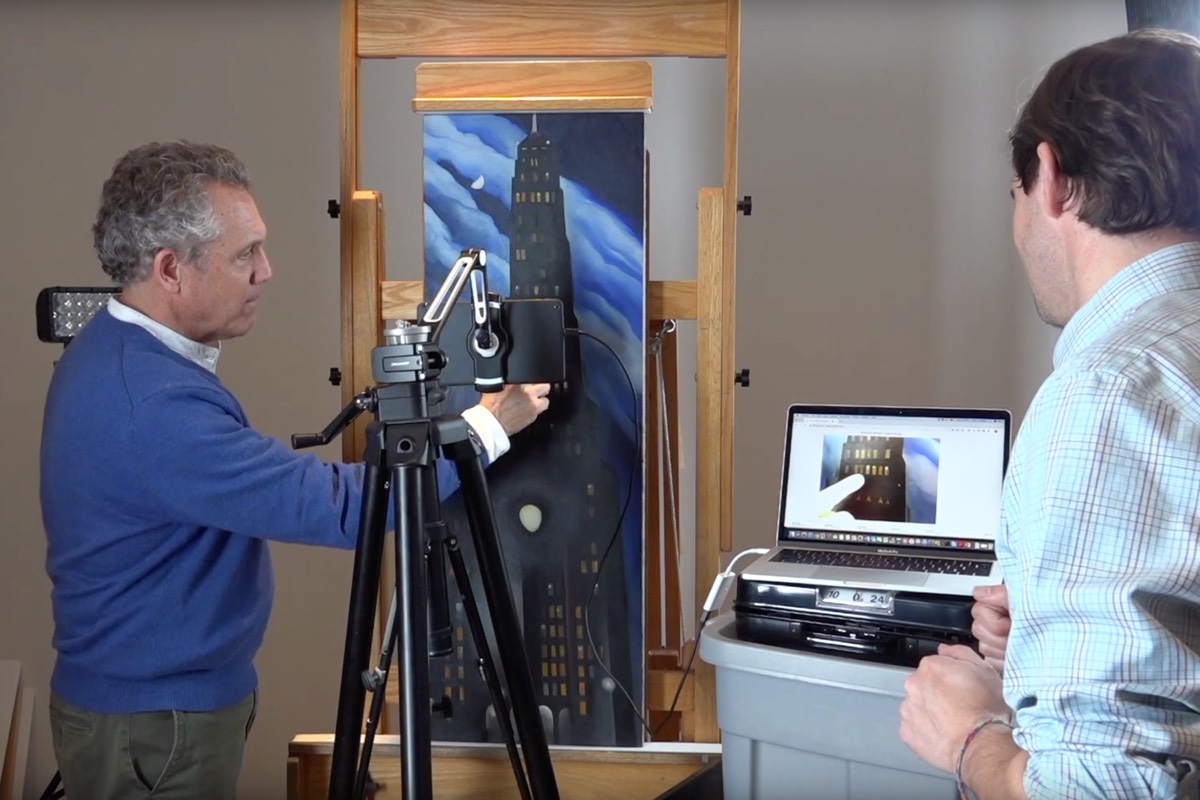
Enlarge/ Dale Kronkright (left), head of conservation at the Georgia O’Keeffe Museum in Santa Fe, uses a handy new imaging tool to study “acne” on O’Keeffe’s Ritz Tower. Northwestern University’s Oliver Cossairt (right) developed the tool.
The Georgia O’Keeffe Museum in Santa Fe, New Mexico, houses some 140 oil paintings by the iconic American artist, along with thousands of additional works from O’Keeffe’s prolific career. But the oil paintings have been developing tiny pin-sized blisters, almost like acne, for decades. Conservationists and scholars initially assumed they were grains of sand trapped in the paint. But then the protrusions grew, spread, and started flaking off, leading to mounting concern.
Now an interdisciplinary team of scientists from Northwestern University is studying this mysterious “paint disease,” using a low-cost, portable tool that allows the scientists to image the surface of the paintings quickly and easily with a smartphone or a tablet. They demonstrated the new technique last week at the American Association for the Advancement of Science conference in Washington, DC.
This “paint disease” isn’t limited to O’Keeffe’s oeuvre. Conservators have found similar deterioration in oil-based masterpieces across all time periods, including works by Rembrandt. Chemists concluded that the blisters are actually metal carboxylate soaps, the result of a chemical reaction between metal ions in the lead and zinc pigments and fatty acids in the binding medium used in the paint. The soaps start to clump together to form the blisters and migrate through the paint film. “They can form exudates on the surface, which obscure the painting itself, creating an insoluble film, or an effect of transparency, so you can look through those layers, which was not the intention of the artist,” said Marc Walton of Northwestern University, who co-led the study.
Some 70 percent of all oil paintings have deterioration associated with metal soaps.
In fact, some 70 percent of all oil paintings have deterioration associated with metal carboxylate soaps to varying degrees, according to Walton. “Often it’s benign, and nothing will happen in terms of deterioration of the paint, but in some cases it’s quite destructive,” he said. That’s the case with O’Keeffe’s work, where determining the rate of deterioration is of paramount importance.
Walton is co-director of Northwestern’s Center for the Scientific Studies in the Arts (CSSA), dedicated to working with cultural institutions to offer scientific assistance as needed to solve these kinds of problems. His Northwestern colleague, Oliver Cossairt, almost attended the Art Institute of Chicago before switching to computer vision and computational imaging, so he was the perfect choice to collaborate with Walton on figuring out an easy, affordable means of documenting how the protrusions develop over time.
The two men met Dale Kronkright, head of conservation at the O’Keeffe Museum, while working with the Art Institute of Chicago. They were working on imaging the surface shape of the institute’s collection of Paul Gauguin prints several years ago. Kronkright told them about the unusual protrusions he’d noticed on many of O’Keeffe’s paintings while conducting a survey of the museum’s collection. Some paintings have more pronounced protrusions than others, but even when the conservators restored the most damaged canvases, the pimpling returned.
Enlarge/ An up-close look at a detailed section of O’Keeffe’s Pedernal (1941) shows micron-sized “protrusions” from metal soaps.
Dale Kronkright/Georgia O’Keeffe Museum
“We’ve been working on this idea of applying 3D surface measurement [techniques] to paintings as an analysis tool for a while,” said Cossairt. “We think it’s possible to develop measurement tools using devices that are readily accessible to museum conservators, to get that little bit more information a conservator would need to make more informed decisions.”
It’s based on a technique called reflectance transformation imaging, which usually involves a lot of large, bulky equipment, including a dome containing several light sources. Most museums don’t have the financial resources to buy and maintain such equipment, so Cossairt devised a more user-friendly option.
“We want to implement these 3D measurement systems as cheaply as possible and put them in the hands of as many people as possible,” he said. His method uses the LED flash or LCD display of a smart phone or a tablet as a convenient light source. That source would reflect light off the surface of the canvas and capture those reflections with the front-facing camera.
The idea is elegantly simple and intuitive, similar to looking at a skyscraper with reflective windows that act as mirrors. “You see the reflection of another skyscraper or some other structure, and you notice that the lines are bent when they should be straight,” said Cossairt. So the window’s surface must be curved rather than flat, and that lets you determine the 3D shape of the window.
A similar principle is at work with Cossairt’s imaging tool. If a painting’s surface is completely flat, you would get an exact reflection of the patterns on the canvas. If there’s pimpling causing unevenness, “the pattern locally distorts and stretches and shrinks in different areas,” he said.
Ultimately, Cossairt hopes to build the equivalent of a handheld Star Trek “Tricorder” for museum conservationists. It would allow them to take out a smart phone, wave it in front of a canvas, and software would automatically do the analysis as the screen moves across the object, stitching together the field of view. Subsequent images can be compared to earlier ones to get a sense of what has changed since the last measurement.
Enlarge/ Oliver Cossairt sets up his portable “Tricorder” 3D-imaging apparatus in front of Georgia O’Keeffe’s Ritz Tower.
YouTube/Northwestern University
Another Northwestern colleague, Aggelos Katsaggelos, is developing those software tools. “The technology uses machine learning to distinguish whether texture is a soap protrusion or something benign like a brush stroke,” said Katsaggelos. “Then, for protrusions, we extract statistics: the density, size, and shape.”
Cossairt’s “Tricorder” tool will never replace a synchrotron, which will always be a higher-power, higher-resolution instrument for this kind of imagining. It’s already commonly used to non-destructively analyze works of art and archaeological artifacts. For instance, scientists used synchrotron radiation to reconstruct the portrait of a peasant woman painted by Vincent van Gogh that the artist had then painted over when he created 1887’s Patch of Grass.
However, you can’t take every single piece away from a collection and bring it to a synchrotron, and access to such facilities is limited, since synchrotrons are useful for many different applications and are in high demand among scientists. So Cossairt’s tool is a useful complementary method.
The next step to devising a solution for conservators is to better understand what specific factors contribute to the pimpling, including environmental factors like humidity, temperature, and exposure to direct sunlight. Walton’s team is now experimenting with surrogate paintings in the laboratory, creating their own metal-soap reactions and documenting the process. Kronkright provided tons of information about the travel and exhibition history for the collection, since paintings that have traveled to public exhibitions the most seem to have more and larger protrusions.
[embedded content]
Courtesy of Northwestern University.
https://arstechnica.com/?p=1458169
Fallout: Wasteland Warfare: A “rad” miniatures game full of Nuka-Cola flavor
Welcome to Ars Cardboard, our weekend look at tabletop games! Check out our complete board gaming coverage at cardboard.arstechnica.com.
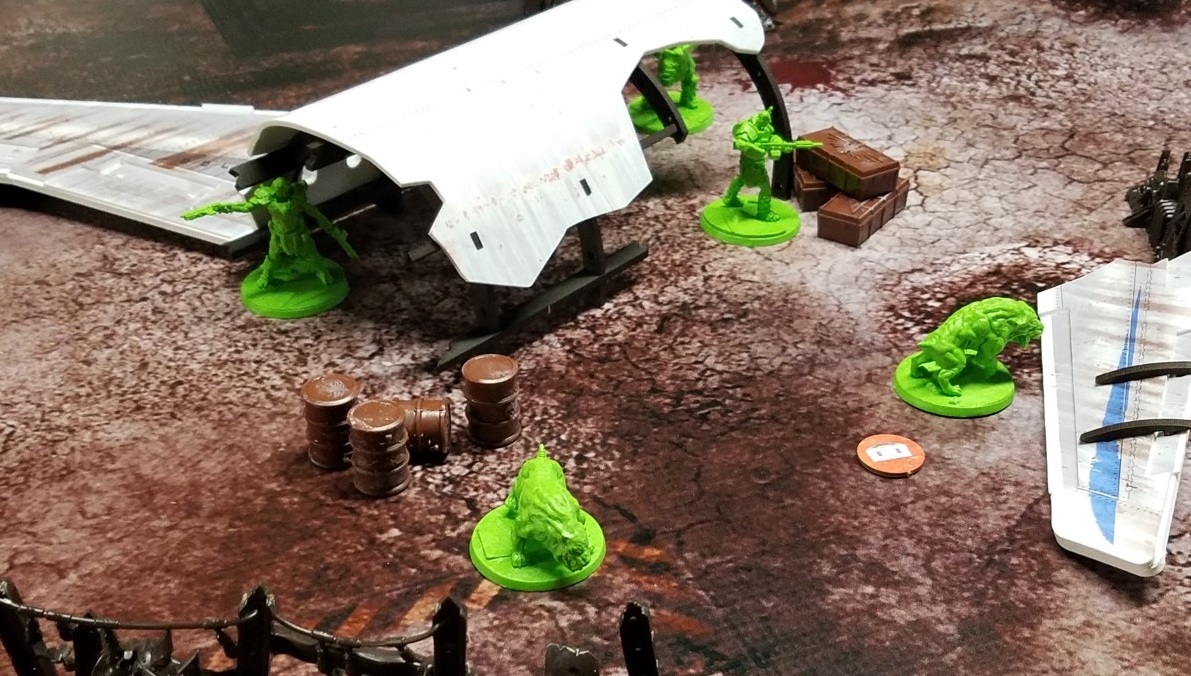
After going decades without a proper Fallout tabletop title, we’ve now been graced with two quality releases in the span of a little more than a year. While Fantasy Flight’s offering is a narrative adventure game about roaming the wasteland, Modiphius’ new Wasteland Warfare is a miniatures skirmish design that features grizzled war bands clashing in harrowing environments. (Think Warhammer, but we swap Space Marines for the Brotherhood of Steel and Orks for Super Mutants.) At the risk of making you cringe, I’ll say it: the game is pretty rad.
Because this is a true miniatures game, it requires some work. The two-player starter set comes with pre-assembled plastic miniatures, but expansion figures are multi-part and will require assembly. You will fight with 6-12 of these figures over the stretch of an hour or two, and you will need to supply your own terrain for the brutes to battle over. It’s a commitment, as these games tend to be, but one that promises a deep and immersive experience in return.
A complex beast
Wasteland Warfare is not a simple or streamlined design; the game takes every possible opportunity to add detail and complexity.
Consider the activation system. The game builds on the common approach of alternating activations where players take turns using one model from their squads. Things aren’t quite that simple, however, since players also have the option of delaying actions, instead marking one of your units simply as “ready.” You can repeat this process on each of your turns, later deciding to activate a large swathe of your miniatures all at once for a coordinated strategic assault.
The system is slick. It allows a balance between tactical immediacy and strategic maneuvering, but it comes with a complexity tax and additional rules verbiage. On its own, this is no problem—but it’s merely a single skull in a mass grave of irradiated bones.
Your squad will feature characters with seven stats, keywords, special abilities, and three armor types. You may have multiple perks with additional rules— perhaps a leader ability!—faction rules, and weapon and equipment cards. You can use drugs that affect stats, power armor that provides buffs, and items that offer special abilities. You need to manage several different-color dice when building pools for stat rolls. All of this means that you need to total many modifiers before taking any action—and the process can take a few moments.
The result of this complication is additional clutter. When activated or readied, miniatures need tokens placed next to them on the table. There are chits for overwatch and for wounds, for objectives and for searchable locations, for caps and for a dozen other items you need to track. Handling movement and weapon ranges requires you to flip between multiple colored rulers. (If your figure is running, it will use a different stick than if it’s walking. for instance.) Organization and familiarity are the keys to keeping things moving.
Once you gain comfort with the processes, the game does march along relatively quickly. The system as a whole feels like a more streamlined version of the popular Infinity ruleset from Corvus Belli, and it offers a rich and engrossing experience.
A vibrant apocalypse
The upside of all this detail is the game’s wealth of options. It doesn’t hurt that the campaign mode is also one of the best I’ve seen. You construct a settlement of various building types, waging war to gather supplies and to expand your reach. The campaign adds context to the skirmish battles and emotional weight to their outcomes.
There’s also a fantastic solitaire system where you can take on an “AI-controlled” opponent. Every single model in the game comes with an AI card that contains a simple chart you can use when the unit activates. It’s an easy-going procedure that occasionally requires some interpretation or fudging of the results; however, it strikes a strong balance between making few decisions for the other side and a more complex but thorough solution.
Equipment cards for your squad.
The game has LOTS of chits…
Some of the game’s character cards.
An “AI” card for solo or co-op play.
Because the enemy units can be handled this way, you can even play the game as a co-op. This sense of freedom is the defining element of Wasteland Warfare. It’s a design that offers a sandbox as wide as the source material it emulates. You can run a small campaign of several warbands struggling to survive. You can play a linked series of narrative missions that tell an evolving story. You can simply pick up some minis and play a one-off battle to kill an afternoon.
Crammed into each of these play modes is personality. All of the colorful options and characters from the beloved video game series are present. Weirdness rules the day, and the rules of the “real” Fallout world don’t get in your way. Say you want to run a Brotherhood of Steel cell that’s rescued a mutant hound and adopted it into the ranks. Totally fine! The system lets you mix factions while still maintaining setting integrity.
There’s also a strong sense of vision at work. It appears that Modiphius is committed to the health of this release for the long term. For instance, the point values for each character and item are not found on the components themselves but in a free PDF. This means the design can evolve and balance can shift as needed. It also means that expansions should be seamless.
Fallout: Wasteland Warfare is complex and sophisticated. Its gameplay is demanding, but the rewards are commensurate with your effort. The greatest challenge with any such game is convincing your group to commit. Those who do venture into the badlands will return with scars and mangled flesh, but they’ll also find a world as rich and wide as the sprawling avenues of Junktown.
https://arstechnica.com/?p=1462987
$100K Mario seller: “It’s probably the wrong move, long term, to sell”
Last week, a copy of the first printing of Super Mario Bros. in pristine condition sold for just over $100,000. This week, the collector who sold that gem told Ars that he’s been preparing for this moment for years.
The seller—who asked to remain anonymous to protect his privacy but goes by the handle Bronty online—told Ars he didn’t even have an NES growing up. He just played games like Super Mario Bros. at a friend’s house. But around 2002, at age 27, Bronty was gripped by a desire to once again play the NES games he hadn’t thought about for well over a decade.
A quick trip to eBay got him his nostalgic gaming fix and sparked an interest in a new hobby that fewer people were paying attention to at the time. “Having already been a comic collector for many years, I had an interest in collecting in general,” Bronty told Ars. “I started thinking, ‘Would this be an interesting thing to collect?'”
“I started fairly early on, and back in 2002, sealed game prices were nothing like today,” he continued. “Stuff that is worth 10, 15, 20 thousand dollars now was $200 to $400 then. The other people I was competing against… they were largely students maybe in fourth year university or something. I was a little older, 27, I had a bit of a job [in a financial field], so it was a little easier for me to afford.”
By 2007, Bronty had amassed a near-complete collection of well over 600 NES games, all still sealed in their shrink wrap. And he said he knew he was well ahead of where the market would be. “I 100 percent just saw this as ‘A’ material. Not to this extent, but I saw this [increase in value] coming,” Bronty said. “I knew that these were special items and that my window to buy was now. I spent everything I could, sold all my good comics, went into debt, I went all out.”
Even with his all-in approach, Bronty’s biggest single sealed-in-box find was still to come.
Finding the “holy grail”
By all rights, a sticker-sealed Super Mario Bros. should probably not even exist in such perfect condition more than three decades after it was first put on store shelves. When it comes to sealed games, the “great, great, great majority” come from unsold inventory found in stores that have closed, Bronty said. “There was one lot I found through eBay that had 3,000 sealed NES games,” for instance.
Enlarge/ Even shrink-wrapped old games aren’t often found in the pristine condition of this sealed Super Mario Bros.. These examples were found in an abandoned video rental store.
The problem with that kind of sourcing, though, is that “even in a lot that big, most of it is garbage… because it’s unsold inventory,” Bronty noted. “And what went unsold? The garbage titles [released] from ’90 to ’92, because that’s when a lot of these closeouts happen. The stuff from ’85, ’86, ’87, it sold the minute it hit the shelves.”
That stuff includes the 17 “black box” games that were sold in extremely limited quantities as part of the NES’ test market launch in New York and Los Angeles starting in late 1985. These “sticker-sealed” games, which were never protected by shrink wrap, were never going to sit unloved on store shelves for decades. “Something like this from the very, very beginning [of the NES’ lifespan], it just doesn’t happen,” Bronty said. “The install base was still very small. The stock that went through the sales channels was very, very tiny.”
Deniz Kahn, CEO and founder of game grading service Wata Games, estimates that only 2,000 to 10,000 copies of each matte-sticker-sealed test-market NES game were ever made. The vast majority were likely opened and played, and even those that weren’t opened likely got dinged up over the years due to the lack of shrink wrap. Kahn estimates that only “single digit” numbers of each individual sticker-sealed title still exist unopened in 2019, and he has only heard hearsay about one other sticker-sealed Super Mario Bros. existing in beat-up condition.
So you can understand that Bronty was surprised to see a good-condition sticker-sealed copy of the original Mario Bros. (the NES version of the arcade game) pop up on eBay in late 2012. He acted. And after winning that auction (for about $8,000), Bronty discovered that the Wisconsin-based seller had over 100 other sticker-sealed and early shrink-wrapped NES games for sale.
It was this particular lot that just so happened to include a sticker-sealed copy of Super Mario Bros. that may well be one-of-a-kind.
The original seller told Bronty the bounty had come from his father, who had recently passed away and left these sealed boxes behind. Apparently, as the son tells it to Bronty, this late collector had been purchasing pretty much every major new video game since the late ’70s on the day of release. “He started buying in the Atari days, he was opening and playing them at that time,” Bronty said. “When it got to the titles that were later in his collection, they were all unopened; he had stopped playing.”
Close up examples of the sticker seal that only appeared on games sold during the NES’ test market launch.
“It took somebody doing something that made no sense for this copy [of Super Mario Bros.] to survive,” Bronty continued. “A grown man buying video games and putting them on the shelf without playing them, that just didn’t happen back then. They’re like $50 each [in ’80s money], to do a large collection of that, somebody would be spending thousands of dollars on something they’re not going to use, which makes no sense. They weren’t thought of in any way whatsoever as collectibles.”
In most hobbies, Bronty said, when you see someone preserving new purchases like this before a secondary market has developed, “it’s usually somebody who has more of a hoarder mindset than someone who’s doing this as a collector out of foresight. It’s obsessive behavior, a compulsion more than anything. But hey, it’s amazing because for geeks like us 30 years later, it provides pristine examples we can enjoy.”
Hidden in plain sight
After a bit of bargaining, Bronty and a fellow collector (who asked to go by the name “Kevin” for the sake of anonymity) partnered up to spend $50,000 to $60,000 on a total of 60 to 75 NES games that had been preserved in that single lot. But the box that would eventually become the first six-figure private video game sale wasn’t even considered the jewel of the bunch at the time.
In making their collective offer, Kevin told Ars that the pair “individually considered each game and assigned what we thought was a fair value.” Kevin and Bronty valued a few early NES rarities like Clu Clu Land, Kid Icarus, and Donkey Kong in the $5,000 to $6,000 range, Kevin said. The sticker-sealed Super Mario Bros., on the other hand, was worth “in the $2,000 to $4,000 range,” by their estimation. “These were typical going rates for these games at the time, so we were careful not to underwhelm with our offer and risk not making a deal,” Kevin said.
“We both knew [Super Mario Bros.] was special and it was definitely something we both saw as being very desirable and one of the best games in the lot, but it wasn’t [considered] head and shoulders above everything else, no.” Bronty told Ars. “Even then, Super Mario Bros. was very much recognized as being a special piece, just maybe not to this degree.”
The sticker-sealed Super Mario Bros. in its original VGA case, where it stayed until a re-rating by Wata Games last year.
The back of the box. Don’t worry, that tape is closing a plastic bag outside the outer case.
The sticker-sealed Super Mario Bros., as it was first shown to Bronty and Kevin in a dark, low-quality photo from the original seller.
The sticker-sealed Super Mario Bros. sits next to a sticker-sealed Mario Bros. which the buyers actually valued much more highly in 2012.
The sticker-sealed Super Mario Bros. sits with a few other pieces from the same lot, waiting for grading and authentication by the Video Game Authority.
It wasn’t just Nintendo-developed games in the lot. This shrink-wrapped copy of Mega Man was also quite rare and valuable.
Back in 2012, it was more difficult to assess the true rarity and value of these early games, Bronty continued. “You have to keep in mind, when I started collecting… the amount that people understood about the chronology of the different variants was very, very little,” Bronty said. “We all understood there were different [versions] and sort of knew a little bit about some of them being a little bit harder to find, but we had no idea about which ones came first and which ones came truly later… It’s only through different bits of research by different people over the years that we started to understand this stuff.”
Indeed, Wata Games Chief Grader Kenneth Thrower told Ars it took years of collective effort from the community to compile a definitive list of all the variant versions of Nintendo’s first 30 “black box” NES games. Over time, collectors were able to cross-reference sealed boxes they had in their possession with lists of release dates provided by Nintendo. This allowed them to figure out when certain features started appearing and disappearing from the production line.
“Maybe the biggest smoking gun was that the last three [black box] games made in 1987 were the only ones that have never been found with sticker seals,” Thrower said. Meanwhile, he added, “1985 releases are also the only titles to have Matte sticker seals (1st possible printing) while 1986 releases are only available in Gloss sticker and later (2nd possible printing). Nintendo’s earlier Game & Watch handheld games were also sealed with this sticker seal, so it further fortifies the timeline.”
But none of this was common knowledge in 2012, even among serious collectors. So when the time came to divide up the lot, Kevin said he prioritized personal favorites like Metroid, Donkey Kong Jr., Rygar, and Mega Man over the sticker-sealed Super Mario Bros.. “I knew [Mario] was valuable, but so were many of the first-round games we bought,” Kevin said. “At the time, we didn’t really consider the sticker seal all that much more valuable over a ‘regular’ sealed copy.”
Reflecting on last week’s sale, Kevin said he’s “a bit surprised at the dollar value of the Super Mario Bros.… but I suspect I’ll continue to be surprised more and more as time goes on.” Looking back, Kevin still doesn’t have any regrets about what he calls an amicable splitting of the sealed NES lot with Bronty.
“I’m very happy for [Bronty] to have gotten [Super Mario Bros.],” Kevin said. “He… was the one who got his foot in the door with the seller and orchestrated most of the deal. He deserves it! I was just along for the ride for the most part, [and] I ended up [with] several nice pieces myself, so no complaints here.”
“When you are splitting things up at a point in time, you do your best as to what’s fair then,” Bronty added. “What’s fair eight years later might not be the same.”