Flickr gives free accounts a few more days to save their pictures from destruction
Last November, photo-hosting site Flickr announced that it was going to slash the storage afforded to free accounts; they’d be capped at just 1,000 pictures each. Starting January 8 this year, free accounts with more than 1,000 pictures were rendered unable to upload any new images, and on February 5, the service was due to start deleting the excess images. Flickr intends to delete pictures working from the oldest to the newest until each account is brought under the threshold.
February 5 has come and gone, and so far nothing has been deleted. Deletion is still in the cards, but Flickr has extended its deadline to March 12, giving its users a few more weeks to rescue their pictures. The extension comes amid widespread difficulties with downloading pictures en masse from the site, especially among its very heaviest users. As Flickr’s own help pages note, it can take as long as a week to package your pictures into a single downloadable ZIP file.
Alternatively, account holders can upgrade to Flickr Pro to safeguard their pictures.
The deletion plan has another important nuance for photographers that used Creative Commons licenses. Any photos uploaded before November 1, 2018, and licensed with a Creative Commons license will not be counted against the 1,000 picture limit. This means that Flickr won’t be deleting the substantial number of pictures that have licensing policies more permissive than the default “all rights reserved” that would otherwise apply. All of the various Creative Commons license variants are covered by this exception.
https://arstechnica.com/?p=1453087
Disney+ will be a true Netflix competitor, with non-Disney shows streaming, too
Enlarge/ Captain Marvel’s cinematic adventure will appear on Disney+, not Netflix.
The more we learn about Disney’s new streaming TV and movie service, the more ambitious it sounds. Disney CEO Bob Iger told investors on the company’s quarterly earnings call that the service (called Disney+) will host TV shows and movies licensed from other parties in addition to content being made in-house by Disney properties like Lucasfilm and Marvel Studios.
Iger hedged a little in terms of long-term plans, though, saying that the larger strategy is focused on producing original content but that third-party content will be part of the launch strategy later this year. He said that the long-term strategy is “pretty heavily weighted to internally sourced versus externally sourced.”
Referring to the launch window, he also said, “Because we need to launch the service with some volume and it takes time to ramp up, we’re buying certain products from the outside opportunistically.” Disney will additionally tap some of the programming it gained ownership of in its merger with Fox.
According to Iger, Captain Marvel will be the first movie from the company that will stream only on Disney+. Previously, Marvel films have made their way to Netflix. He said every part of Disney is working on content for the service—he specifically named Pixar, Marvel, Lucasfilm, and National Geographic.
Disney has previously announced a live-action Star Wars TV series titled The Mandalorian executive produced by famed director/screenwriter Jon Favreau and Thor: Ragnarok director Taika Waititi. Disney also plans to introduce something based on Pixar’s Monsters, Inc. franchise, a series about Thor’s nemesis Loki, a revival of Star Wars: The Clone Wars, and a High School Musical series.
Disney already runs or has a hand in a couple of other streaming services. With a similar naming convention to Disney+, ESPN+ offers live sports and other athletics-related programming for $4.99 per month. Disney is also a partial owner of Hulu, and the company has alluded to plans to bundle all three service in one package in addition to offering them individually.
Disney will preview Disney+ to investors at a meeting on April 11, but the company has not announced when the service will launch for the public or how much it will cost.
https://arstechnica.com/?p=1452261
Check out the first footage from zombie black comedy Little Monsters
[embedded content]
Director Abe Forsythe talks about his new film Little Monsters, which debuted at the Sundance Film Festival.
We’ve got our first look at footage from Little Monsters, Australian director Abe Forsythe’s new black comedy that just debuted at the Sundance Film Festival. It’s been described as Zombieland meets Kindergarten Cop, and based on this footage (courtesy of Sundance), we think it looks like a lot of good bloody fun.
This film should not be confused with the 1989 film of the same name (in which a young Fred Savage discovers a secret world of prankster monsters). Kindergarten teacher Miss Caroline (Lupita Nyong’o) takes her young charges on a school field trip to Pleasant Valley Farm. Tagging along as a chaperone is Dave (Alexander England), a failed musician whose nephew is in her class. Dave has a romantic interest in Miss Caroline and is chagrined to discover that he has a rival for her affections: a famous children’s TV personality, Teddy McGiggle (Josh Gad), who also happens to be at the farm organizing all the planned activities.
But something has gone terribly wrong at a nearby military base, and a zombie outbreak turns the innocent excursion into a bloody fight for survival. Miss Caroline, Dave, and Teddy join forces to make sure the kids don’t get eaten—and hopefully aren’t traumatized for life by the sight of the ravenous undead.
Miss Caroline (Lupita Nyong’o) cheerfully greets her students.
YouTube/Sundance Institute
Feeding a baby goat at Pleasant Valley Farm.
YouTube/Sundance Institute
Teddy McGiggle (Josh Gad) is an obnoxious children’s show host.
YouTube/Sundance Institute
Never interrupt a hungry zombie’s meal.
YouTube/Sundance Institute
Of course the zombie outbreak spreads.
YouTube/Sundance Institute
Herding the kids toward safety as zombies run amok.
YouTube/Sundance Institute
Teddy and Dave (Alexander England) must put aside their rivalry to protect the kids.
YouTube/Sundance Institute
Run, Miss Caroline, run!
YouTube/Sundance Institute
Don’t mess with Miss Caroline’s kids!
YouTube/Sundance Institute
Dave tries to distract the kids from the bloody massacre with song.
YouTube/Sundance Institute
Miss Caroline keeps a watchful eye.
YouTube/Sundance Institute
Story time! Just don’t look up at the window.
YouTube/Sundance Institute
These hungry zombies are unsuitable viewing for young children.
YouTube/Sundance Institute
Miss Caroline stands her ground.
This isn’t an official trailer, just a short interview with Forsythe, but so many scenes are included that it really conveys a sense of the film. Apparently Forsythe was inspired to write the script because his young son (five at the time) has severe food allergies, so the day he started kindergarten was the first time he was out of his father’s charge. Forsythe describes Little Monsters as a “feel-good black comedy,” adding, “I was trying to make something that isn’t predictable, that takes elements we’re familiar with and delivers them in a new and surprising way.” Judging by the reaction of Sundance audiences, he succeeded.
Little Monsters doesn’t yet have a release date, but Deadline Hollywood reports that NEON and Hulu won an intense bidding war among four different studios for the rights. And apparently the plan is to combine a theatrical release with massive cross promotion on Hulu’s streaming platform. So hopefully we’ll see Little Monsters on our big and small screens soon.
EA turns in bummer fiscal report: “We’re disappointed in our underperformance”
EA’s latest quarterly fiscal report included a stark admission: Battlefield V‘s sales fell way below expectations. This, combined with a severe drop in mobile-gaming revenue, led EA’s executives to admit that they were “disappointed in our underperfomance” in fiscal Q3 2019.
BFV‘s sales to date, according to EA COO and CFO Blake Jorgensen, have reached 7.3 million copies across all platforms worldwide, which the company says is “one million less” than it had indicated in previous Q3 2019 guidance. Jorgensen didn’t mince words: he blamed the drop in the series’ uptake by the developers’ focus on a single-player campaign, as opposed to having a promised battle royale mode ready for fans in time for the game’s launch.
EA CEO Andrew Wilson took the opportunity to confirm that BFV‘s battle royale mode, currently dubbed Firestorm, will launch in March of this year. Wilson did not offer further details about any monetization strategy for that mode; it currently requires that consumers buy the game’s retail edition, much like the battle royale mode found in Activision’s multiplayer-only game Call of Duty: Black Ops 4. (That Activision game includes additional microtransactions in its battle royale mode.)
The executives repeatedly blamed “intense competition” in that quarter for general underperformance, which Wilson clarified later as “Fortnite, Call of Duty, and Red Dead Redemption 2. (Fortnite‘s hugely popular battle royale mode launched well before the October 2018 start of the fiscal quarter in question.) Wilson added that BFV‘s release delay into November 2018 resulted in a “better game,” but he cited “the combination of a poor start in our marketing campaign with a longer development cycle that put us in a more competitive window.”
In addition to a lack of uptake on new mobile game Command and Conquer Rivals, EA also cited one delayed mobile game and “changes to broaden Madden Mobile‘s appeal” that “failed” to drive monetization. The company’s net bookings for mobile-only products dropped in Q3 2019 to $142 million, compared to $183 million in the same quarter in fiscal year 2018—a drop of over 23 percent.
The executives reminded investors that the EA Sports line of games and Ultimate Team microtransaction systems continue to drive revenue. “FIFA stands out as a robust franchise during a tumultuous time in the industry,” Wilson said. Executives also praised new game Apex Legends‘ solid performance after launching 24 hours earlier, though Wilson made clear that its one-day metrics weren’t a measure on which to base expectations just yet.
When pressed about EA’s sales expectations for Anthem in the wake of a wonky public demo, Jorgensen said that EA still expects its first-quarter sales to reach roughly 5-6 million units. “We’re comfortable with that based on what we’re seeing in the outcome of both demos,” Jorgensen added. “A lot of excitement, a lot of interest.”
EA confirmed that a range of console-specific games is expected to launch by year’s end, including a new Plants vs. Zombies “shooter,” a new game in the Need for Speed series, and the Respawn-developed Star Wars game Jedi: Fallen Order. An additional Titanfall-related game is also slated to launch by year’s end, but Wilson would not offer any further details about what shape that game might take (meaning: a remake of an existing Titanfall game isn’t yet out of the question).
Wilson further clarified that Respawn has “two fully staffed teams, one focused on the shooter genre, and one focused on action-adventure.” He also dodged questions about any new Battlefield-series games launching in 2019.
Wilson told investors to expect “deliberate changes to our organization and operational focus.”
EA is listed on the NASDAQ stock exchange, which means the investor call began as soon as markets closed on Tuesday. After-hours trading suggests a severe drop in stock price from the day’s close of $92.52 to somewhere below $76—already lower than the company’s previous major low in late 2016.
Netflix buys into Goop hooey with deal to make a wellness docuseries
Enlarge/ Gwyneth Paltrow attends the In Goop Health Summit on June 9, 2018 in Culver City, California.
If you’re one for Netflix bingeing, you may want to grab a bucket.
Gwyneth Paltrow’s lifestyle and “contextual commerce” venture, Goop, has signed a deal with Netflix to produce a wellness “docuseries”—despite the brand’s sordid history of making unsubstantiated and abhorrent health claims.
The deal was first made public in an article on Variety.com on Monday. The outlet interviewed Goop’s chief content officer, Elise Loehnen, who said the series will contain 30-minute episodes and “utilize experts, doctors, and researchers to examine issues relating to physical and spiritual wellness.”
Netflix and Goop have since both confirmed the news to Ars. But neither partner would provide additional details. Netflix said that it is keeping mum because the series is not in production yet and its content is not final. But Netflix declined to answer Ars’ questions regarding how it would handle Goop’s health claims, including if it would require substantiation or fact-checking.
In 2017, a similarly high-profile deal between Goop and publisher Condé Nast fell through over the issue. The partnership would have led to a glossy, goopy magazine for the aspirational lifestyle brand. But it failed to materialize, in part because Condé Nast insisted on having the publication fact-checked—something Goop refused to do. (Disclaimer: Condé Nast is the parent company of Ars.)
It was a bad choice on Goop’s part. Last year, Goop settled a lawsuit brought by 10 state prosecutors, who accused Paltrow’s brand of peddling products using unsubstantiated health claims. These included suggesting that the infamous jade egg could treat gynecological health issues when jammed into a vagina and that a blend of essential oils could prevent depression. Goop paid $145,000 in civil fines and agreed to stop making claims “regarding the efficacy or effects of any of its products without possessing competent and reliable scientific evidence that substantiates the claims.”
In a subsequent interview with the BBC, Paltrow showed no remorse at the possibility that unsubstantiated health claims made by her company could harm people. “We just wanted to settle it and put it behind us,” she said of the lawsuit. She emphasized that Goop did not have to admit any wrongdoing in the settlement. Instead, she blamed practitioners of evidence-based medicine for not “believing” in her unsubstantiated treatments, and she suggested that it was inevitable to face such resistance when trying to “empower women.”
While Paltrow’s explanations may cause rage strokes, her business is thriving. Its valuation reached $250 million last year and is expanding in all directions, with brick-and-mortar stores on multiple continents and even into the troposphere. In addition to the Netflix series, Variety.com reported that Goop also signed a distribution agreement with Delta Airlines for the Goop podcast.
One bright spot for advocates of fact-based reality: Dr. Jennifer Gunter—obstetrician-gynecologist and vocal critic of Goop and pseudoscience that threatens women’s health—is producing her own health-related series. Gunter told Ars that she can’t reveal details yet of the project, but she noted on Twitter that she has already “shot my first season,” which is in editing now.
“It will be interesting to see what resonates more with people, authenticity in health or aspirational health,” she tweeted.
https://arstechnica.com/?p=1451653
FX adaptation of What We Do in the Shadows looks as good as original
[embedded content]
What We Do in the Shadows debuts on FX March 27.
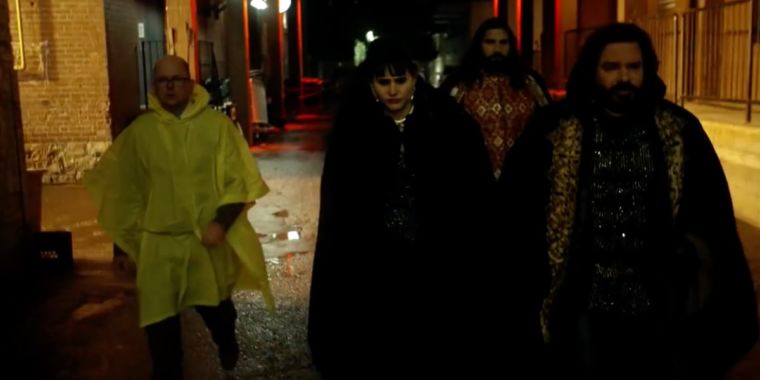
We had our doubts when FX first announced it was adapting the New Zealand cult hit “mockumentary” What We Do in the Shadows for TV. But the positive buzz has been building since a surprise screening at NYCC last October, and now we have the first full trailer (and a release date). Verdict: the FX version looks to be just as clever and witty as the film. Count us among those keen to see the full series.
Taika Waititi and Jemaine Clement wrote, directed, and starred in the original 2014 horror-comedy, playing vampire roommates Vladislav (Clement) and Viago (Waititi) in Wellington, New Zealand. Given their nocturnal nature, they and their vampire friends haven’t adapted to modern life particularly well, and their mishaps as they struggle to navigate mundane trivialities in the 21st century are the source of much of the film’s deadpan humor. What We Do in the Shadows garnered a solid cult following after premiering at the Sundance Film Festival, ultimately earning $6.9 million—a decent showing given its modest $1.6 million budget.
“He awakens!” Guillermo (Harvey Guillen) is the human “familiar” to Nandor (Kayvan Novak).
YouTube/FX
“Very cool, master. Very scary.”
YouTube/FX
Nandor rocking a vampire bat ornament in years past.
YouTube/FX
Lazslo (Matt Berry) and Nadja (Natasia Demetriou) are constantly bickering, longtime vampire lovers.
YouTube/FX
Laszlo gets his cape caught in the cab door.
YouTube/FX
The merry trio has been together for a few generations, it seems.
YouTube/FX
Mid-air vamp fight.
YouTube/FX
Cullen (Mark Proksch) is an “energy vampire,” boring or enraging his officemates regularly.
YouTube/FX
Guillermo is not a killer. He just finds people who are easy to kill (preferably virgins).
YouTube/FX
Nandor is displeased with Guillermo’s choice of macabre decoration.
YouTube/FX
Vamps on the town.
The FX adaptation is set in New York City, because where better for vampires to thrive than the city that never sleeps? The vampire roommates this time around are Nandor (Kayvan Novak), Laszlo (Matt Berry), his lover Nadja (Natasia Demetriou), and their human “familiar” Guillermo (Harvey Guillen). Plot-wise, the roommates must prepare for the arrival of an ancient vampire called The Baron while dealing with an “energy vampire” (Mark Proksch), who finds a natural target in office environments: “We either bore you with a long conversation or we enrage you.”
FX made the wise decision to bring Waititi and Clement aboard for the adaptation—with ten 30-minute episodes—pretty much ensuring that the same tone and energy that made the film such a cult hit would be preserved. We saw a bit of that in one of the brief teasers released last November. In it, Nandor and Guillermo are shopping for groceries, and Nandor struggles with the modern concept of credit and debit cards. (“Sir, you can’t be throwing ancient coins at me,” the weary clerk says.)
We get more of a taste of what’s to come. Nandor calls a house meeting to discuss the sad state of hygiene in the cell downstairs, where they maintain their human food sources. He keeps finding said humans half drunk—not as in consuming alcohol, but as in, Lazslo drinks their blood but doesn’t finish his meal. “It’s not hygienic!” Nandor insists. And then the vamp fight is on. As Nadja complains, “The problem with living with other vampires are the vampires I have chosen to stay with.”
Time-travel drama Travelers has been one of my favorite streaming shows of recent years. It followed a group of time travelers sent from hundreds of years in the future to try to avert multiple catastrophes that left the world ravaged by war and environmental disaster, with humanity eking out its survival in a handful of biodomes. The first two seasons were produced by Showcase in Canada and streamed by Netflix. The third, released last December, was a Netflix exclusive.
Unlike viewers of other cancelled shows, we are at least spared the misery of an unresolved cliffhanger. The third season felt perhaps a little rushed—it could have made its way to the same endpoint over many more seasons—but it ended in a way that wrapped up the story and even gave some of the characters a happy ending. But even with the story wrapped up, it left plenty of room for exploring the same universe. Moreover, it strongly implied that the future crisis had not been averted and that there was still work for the time travelers to do if a brighter future for humanity was to be created.
As such, season 3 presented a nice hedge against cancellation; it was a satisfactory ending if no more episodes were to be produced, but it left the door open to more. Admittedly, ripple effects from changing the past mean that most of the cast would have been hard-pressed to return, with the notable exception of McCormack himself. But that might have been just the element necessary to keep the show fresh.
How to rate streaming success
The logic behind Netflix’s cancellations remains inscrutable. For regular broadcast TV, viewership numbers are published soon after shows are aired, making it easy to know which shows are underperforming and which are not. Nielsen has claimed to track streaming viewership, but Netflix has rejected the data firm’s claims, saying that it’s inaccurate, leaving streaming viewership something of an unknown.
With Netflix not selling ads alongside shows, what even makes a show a success or failure is not clear. Driving subscriptions is, of course, the long-term goal. But that goal may be achieved better through a show that few watch but that the media talks about endlessly than something that’s popular but makes little splash outside of the existing subscriber base. In those terms, Travelers was no Stranger Things or House of Cards; there was no wider media phenomenon, just a solid, enjoyable, well-assembled TV show.
It’s also possible, of course, that with the story neatly concluded, the show’s creators felt they’d rather end on a high—an artistic decision not to continue, rather than a business decision. Either way, the cancellation leaves behind plenty of disappointed fans. We’ll have to find our time-travel fix somewhere else.
Microsoft’s Xbox Live is coming to Switch, iOS, Android
Aurich / Nintendo / Microsoft
Xbox Live users will soon be able to take their “gaming achievement history, their friends list, their clubs, and more” to games on the Nintendo Switch and mobile platforms. That’s according to a Game Developers Conference session description recently posted ahead of the March conference (and first noticed by Windows Central).
The conference session is titled “Xbox Live: Growing & Engaging Your Gaming Community Across iOS, Android, Switch, Xbox, and PC” and is led by members of the Xbox team. It promises a first look at a new “cross-platform XDK” that will “enable game developers to connect players between iOS, Android, and Switch in addition to Xbox and any game in the Microsoft Store on Windows PCs.” That will expand the potential audience for Xbox Live from 400 million gaming devices to over 2 billion, by Microsoft’s count—the service currently has 68 million active players, Microsoft says.
But the SDK being described in this conference talk seems to go a step further, letting Switch and mobile gamers access all the “social, communication, and multiplayer interaction” features of Xbox Live. That could be an especially big boon on Switch, which offers extremely limited messaging capabilities and requires a separate smartphone app as its “official” voice chat solution (though some Switch games, like Fortnite, use their own native voice chat services).
Sony’s PlayStation platform is notably absent from Microsoft’s session description. That could be because Microsoft sees Sony’s PS4, and its native PlayStation Network, as more direct competitors to the Xbox One and Xbox Live in the living room console space. On the other side, it also seems likely that Sony would be reluctant to let Microsoft’s branded social network get full access to what is still a relatively closed console platform.
Microsoft has shown some willingness to work with mobile and portable gaming platforms in the past, though. A number of Microsoft Game Studios titles have appeared on Nintendo’s portable systems, including a couple of Age of Empires titles and a Viva Pinata port. And just last year, Microsoft announced a Funko-themed Gears of War spinoff would be hitting iOS and Android soon.
The session description also makes mention of developers using Microsoft’s PlayFab gaming services to allow “communities to mingle more freely across platforms.” That platform-agnostic matchmaking and network demand-management service launched in preview last November after Microsoft purchased the company behind it in early 2018.
Microsoft’s apparent Xbox Live move follows a similar announcement from Epic Games, which in December said it would begin sharing the cross-platform online services used in Fortnite with developers free of charge. Now that cross-platform gameplay and services are all but expected in the gaming world, the gold rush is on to be the company that controls the social and networking infrastructure behind those games.
https://arstechnica.com/?p=1450931
New trailer for Avengers: End Game: The lights are on, but who’s home?
[embedded content]
Marvel dropped a second teaser trailer for Avengers: End Game just as Super Bowl LIII kicked off.
Just as Super Bowl LIII got underway, Marvel dropped a second teaser trailer for Avengers: End Game, the hotly anticipated follow-up to 2018’s Infinity War. There’s some new footage, but very few hints about what we can expect when the movie premiers this spring.
(Spoilers for Infinity War and Ant-Man and The Wasp below.)
In Avengers: Infinity War, Thanos (an intergalactic supervillain from Titan) successfully collected all six Infinity Stones: the Power Stone, the Space Stone, the Time Stone, the Reality Stone, the Soul Stone, and the Mind Stone. Once collected and placed in the Infinity Gauntlet, they gave Thanos the power to wipe out half of all living beings in the universe. And despite the valiant collective efforts of pretty much every superhero in the Marvel cinematic universe, Thanos succeeds. With a single snap of his fingers, half of the universe dissolves into dust, including many of our beloved superheroes.
The first trailer dropped in December, giving us our first glimpse of the Avengers who survived the Snappening. Tony Stark (Robert Downey Jr.) is floating aimlessly in space, with no food or water left, and rapidly dwindling oxygen—and, he thinks, no hope of rescue. Thor (Chris Hemsworth), Black Widow (Scarlett Johansson), Banner (Mark Ruffalo), Steve Rogers/Captain America (Chris Evans), and Hawkeye (Jeremy Renner)—who Black Widow discovers lurking somewhere in Asia—are all brooding and depressed (with good reason). The only one who’s still fairly chipper is Scott Lang/Ant-Man (Paul Rudd) showing up unexpectedly at the Avengers base. That means he escaped the quantum realm where he was presumably trapped at the end of Ant-Man and The Wasp.
Memento mori
Hope van Dyne/The Wasp: dusted.
YouTube/Marvel Studios
Peter Quill/Starlord, Groot, Draxx, and Gamora: dusted Guardians of the Galaxy
YouTube/Marvel Studios
Doctor Strange: dusted
YouTube/Marvel Studios
Your friendly neighborhood Spider-Man: dusted.
YouTube/Marvel Studios
T’Challa/Black Panther: dusted
YouTube/Marvel Studios
Sam Wilson/The Falcon: dusted
YouTube/Marvel Studios
The Scarlet Witch: dusted.
YouTube/Marvel Studios
Vision: dusted.
YouTube/Marvel Studios
Bucky Barnes: dusted.
YouTube/Marvel Studios
We knew from the rumor mill that this second trailer would only use footage from the first 20 minutes of the film. The surviving Avengers are still dealing with their staggering loss; it looks like Cap is in a therapy support group. “Some people move on. But not us,” his voiceover intones. The first few seconds show us the fallen in rapid succession, in black and white hues with red highlights.
But we also see them starting to regroup. Black Widow gets in a little target practice. Tony Stark is in the lab with Nebula, at work on…. something, so clearly he didn’t perish in space (as if anyone really thought he would). And we see War Machine and Ant Man gearing up for a supposed mission. Thor, Rocket, and Hawkeye make brief appearances. The last shot is our trust crew striding together to face whatever fight lies ahead.
In short, this doesn’t tell us much we didn’t already know, but serves the purpose of keeping us psyched for the film’s release. Avengers: End Game hits theaters April 26, 2019.
Steve Rogers finds himself in a support group.
YouTube/Marvel Studios
Rogers can’t let go of those he lost.
YouTube/Marvel Studios
Sad Thor mourns his fallen comrades.
YouTube/Marvel Studios
The world is a bleaker place, post Infinity War
YouTube/Marvel Studios
Something mysterious in the sky?
YouTube/Marvel Studios
Tony Stark and Nebula working side by side in the lab.
YouTube/Marvel Studios
Black Widow takes in a bit of target practice.
Hawkeye is coming out of retirement, it seems.
YouTube/Marvel Studios
Rocket is the only Guardian of the Galaxy left.
YouTube/Marvel Studios
War Machine and Ant Man, ready for action.
YouTube/Marvel Studios
Putting hand to shield for the coming showdown.
YouTube/Marvel Studios
The surviving Avengers assemble.
YouTube/Marvel Studios
Listing image by Marvel Studios
https://arstechnica.com/?p=1450357
Highbrow meets lowbrow in Netflix’s art world/horror mashup Velvet Buzzsaw
Enlarge/ Reunited: former Nightcrawler co-stars Rene Russo and Jake Gyllenhaal play a manipulative art dealer and snobby art critic who become enthralled with a sinister stash of paintings by an obscure artist.
An obscure artist dies and leaves behind a trove of strangely alluring paintings, becoming a posthumous success, in the Netflix original film Velvet Buzzsaw. It turns out to be literally art to die for.
(Some spoilers below.)
Rene Russo (Frigga in Thor) and Jake Gyllenhaal (Mysterio in the forthcoming Spiderman: Far From Home) co-starred in writer/director Dan Gilroy’s 2014 thriller, Nightcrawler, a dark, disturbing tale that skewered the “if it bleeds, it leads” mentality of broadcast news. The triumvirate is back in top eccentric form with Velvet Buzzsaw, this time targeting the indulgent narcissism and greed of the Los Angeles contemporary art scene.
Gyllenhaal plays Morf Vandewalt, a snooty, sexually fluid art critic—”Critique is so limiting and emotionally draining”—whose reviews can make or break a career. His tastes are highly simpatico with those of ruthlessly pragmatic gallery owner Rhodora Haze (Russo). “We don’t sell durable goods, we peddle perception,” she tartly observes. Rhodora’s assistant, Josephina (Zawe Ashton, Nocturnal Animals), finds her reclusive elderly neighbor dead in the hallway, and discovers the man—one Vetril Dease—was a gifted artist, with an apartment filled with canvases. When she learns he has no surviving family, she steals the stash, even though Dease had left explicit instructions that all his art was to be destroyed upon his death.
Josephina and Rhodora strike a bargain to market Dease’s paintings to collectors eager for a fresh addition to the “outsider art” category. When the people who benefited from the buying and selling of Dease’s work begin disappearing and/or dying under mysterious circumstances, Morf (who’s been having disturbingly vivid visual and aural hallucinations) is convinced something is terribly wrong.
Aspiring art dealer Josephina (Zawe Ashton) discovers a neighbor’s body, and discovers he was a brilliant unknown artist.
Gallery owner Rhodora Haze (Rene Russo) strikes a bargain with Josephina for marketing the dead artist’s paintings.
“We have a taste relationship,” the sexually fluid art critic Morf Vandewalt (Jake Gyllenhaal) tells Josephina.
Toni Collette plays Gretchen, curator for an LA museum, who admires an installation dubbed “Sphere.”
“Have you ever felt invisible?” Animatronic Hoboman proves a critical failure.
Jon Dondon (Mark Sturridge) runs a rival gallery trying to poach burnt-out artist Piers (John Malkovich) from Rhodora.
Morf is not enthralled by one of Piers’ alcohol-fueled creations.
One of Vetril Dease’s disturbing paintings.
The tormented canvas of an outsider artist
Look at an original Dease painting long enough, and it… moves?
A mysterious suicide
Sure, it’s edgy, but is it art?
Josephina finds herself awash in paint colors.
“If you gaze long into an abyss, the abyss also gazes into you.” Yeah. What Nietzsche said.
Dease’s paintings cast an irresistible spell on whoever views them. “If you look at it long enough, it moves,” up-and-coming street artist Damrish (Daveed Diggs, Blindspotting) tells Josephina at one point, unable to tear his gaze away. The paintings seem to have a kind of sentience, “watching” those who are observing them; perhaps it is the act of being seen that gives them that power (and why Dease wanted them all destroyed). The camerawork accentuates this; there are several shots where we view the characters from the perspective of the artwork they’re viewing, calling to mind Friedrich Nietzsche’s dictum in Beyond Good and Evil: “If you gaze long into an abyss, the abyss also gazes into you.”
There are hints that Dease had a dark, twisted history, and that he used some unconventional materials in his paintings (described as “personal effects” by the conservationist who catalogues the collection). But Gilroy is happy to keep the specifics vague. For instance, is it the ghost of Dease inhabiting his art and taking revenge, or has his art taken on a life of its own? Dease was trying to destroy the paintings when he suddenly (and mysteriously) died, after all. He might well have been the first victim. The deliberate ambiguity works, in my opinion; sometimes it’s better to leave details to the viewer’s imagination.
If Robert Altman had ever dipped his toe into horror, it might look something like this.
Gilroy worked with several outside consultants to get the “art speak” in his script down pat. But anyone expecting Velvet Buzzsaw to be a searing satirical indictment of the 21st century fine art enterprise is bound to be disappointed. Yes, the film pokes fun at the jargon, pretentiousness, and naked greed often found in such circles, but it targets the lowest-hanging fruit most ripe for mockery. At one point, a character mistakes a garbage bag for art, and when a body shows up in a museum, visitors assume it’s part of the exhibit. The stellar cast all deliver excellent performances, but the characters are more colorful types than complex personalities (whether you deem them mere stereotypes or horror archetypes likely depends on your perspective).
Ultimately, this is supernatural horror, checking off the tropes of the genre with tongue firmly in cheek. It just happens to be set in the art world—a clever mashup of highbrow and lowbrow. If Robert Altman had ever dipped his toe into horror, it might look something like this. Frankly, I haven’t had this much fun watching an artist (or in this case, the art) take revenge since the 1973 camp classic Theater of Blood. (Vincent Price plays an aging Shakespearean actor who begins murdering all the critics who savaged his performances over the years—offing them in ingenious ways inspired by Shakespeare’s plays.)
Velvet Buzzsaw has less obvious camp, but it’s best enjoyed in the same spirit. If you relax and enjoy the film on its own terms, and don’t look too hard for some deeply profound meaning, it’s a smartly satisfying romp.
Velvet Buzzsaw premiered last month at the 2019 Sundance Film Festival. It is currently streaming on Netflix and playing in select theaters.