Fireball Island review: A classic 1986 board game returns in style
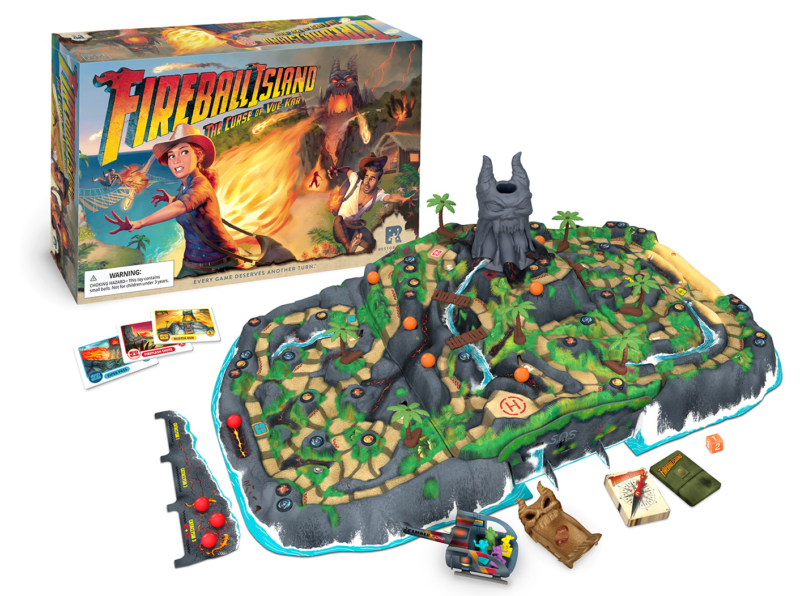
The game has some amazing table presence.
Enlarge / The game has some amazing table presence.
Welcome to Ars Cardboard, our weekend look at tabletop games! Check out our complete board gaming coverage at cardboard.arstechnica.com.

Stranger Things, Bandersnatch, GLOW—the ‘80s are in, and the tabletop world isn’t immune to this cultural wave. Yet another piece of ‘80s gaming nostalgia has now been unleashed, this one made of hulking plastic topped with a sinister skull.

Fireball Island is certainly an artifact of its time, boasting an over-the-top Indiana Jones-like goal of nabbing an idol while avoiding molten balls of fury. In 1986, this was something special. It did little to inspire as a game, as it was largely a roll-and-move exercise in repetition, but its physicality and toy-like nature created a true experience. It was something to behold, if not to play.

Restoration Games has now re-imagined this aging design, dusting off the jagged cliffs and sheltered nooks in an attempt to freshen the whole thing up. The challenge of modernizing without blunting the nostalgic character of a game like this is a tough one—did Restoration succeed?

The nuts and bolts of Vul-Kar

In the new version of Fireball Island, gameplay has switched from roll-and-move to a card-based action system. You choose to play one card per turn (from your hand of two cards), which determines your movement points and perhaps triggers a special power, such as flicking ember marbles from their perches or rotating the island’s plastic palm trees in order to redirect future falling fireballs.

You can’t backtrack or stall here—this is a game of momentum and constant action. Your character darts around paths, across bridges, and up ladders to grab the many treasure tiles scattered about. You can also pass special “photograph” spaces in order to snap a quick picture and receive one of the landscape cards as a bonus. The final way to score points is to seize the mighty heart of Vul-Kar, a plastic gem sitting at the base of the foul demon skull. This is worth more than other options, but the downside is that the heart of Vul-Kar can be stolen by any other player who passes through your space. Once taken, the gem creates an ongoing game of “reverse tag” that can alter your movement plans, depending on the proximity of the heart.

At some point, as you’re running about the island and stuffing your pants full of treasure, someone will play a Cataclysm card. This is the main event—Fireball Island’s crowd pleaser. A Cataclysm allows the player to drop a small number of cinders (marbles) through the black hole of Vul-Kar’s noggin, and the blazing balls then exit his jaw from one of three randomized chutes. They fly across the board, bouncing over hills and felling adventurers; it’s chaos, pure and plastic and kinetic.

There’s a clever pacing mechanism here, as Vul-Kar’s vomited marbles increase over time. In the early going you’ll only drop a single cylinder through his maw, but by the end of play you’ll be launching several—and unleashing a great deal of tumult.

The game’s climax occurs after 45 minutes of jostling with your fellow trespassers and amassing loot and photographs. Once a player has snapped photographs of three different areas, the race is on. Everyone makes a beeline for the exit and hops aboard the “hello-copter” (yes, that’s what it’s really called) to tally their final scores.

A hollow volcano of nostalgia?

Typically, a novelty game like this is best left in the proverbial closet, where it will continue to appreciate in value. (Original editions of Fireball Island can now command several hundred dollars on the secondary market.) In some respects, revitalizing this monstrosity proves the point.

Without nostalgia to fall back on, a hobby gamer familiar with modern offerings may struggle to find the joy here. Those looking for a nuanced strategic experience will not find one. The new version of the game has improved from its roll-and-move origins, offering a bit of player agency as you decide which of two cards to play, but there’s not much “meat” here.

The physical production is also uneven. The island now is plastic and has been split into three pieces. On the whole, it looks damn good on the table, with Vul-Kar menacing on the peak and glaring over the broken topography below, but you’ll notice a painted surface chipped here or misaligned there. A slightly warped bottom lip is not uncommon. The palm trees used as flippers to redirect marbles often don’t do much. When the board is jostled, pieces tend to dislodge, requiring cleanup. Finally, packing the game up can prove challenging; you have to carefully fit the pieces together in order to even close the flimsy lid.

But if you can approach the game with carefree enthusiasm, you may discover the simple joy of toy melding with game to create something superior to its individual parts. Despite its issues, the game remains a physical presence to behold. The island sits as a hulking relic atop your table. It will absolutely enrapture a child, and it does a good job of capturing the attention of a wide range of participants with simple rules and its stylish presence.

As a lighter, family-weight game, the new Fireball Island largely succeeds. It offers a modern take on the classic concept with breezy play. There are plenty of standup, fist-pumping moments as destruction rains down from Vul-Kar, and even those too young to read the cards can still participate with a little guidance.

If this sounds like your kind of game, you’ll be happy to hear that the new edition has launched with a truly excessive amount of expansion content. Most visually impressive is the swanky pirate ship in The Wreck of the Crimson Cutlass, which offers a new area to explore and new treasure to plunder. Most practical, however, is The Last Adventurer, which adds the option for a fifth player along with some finicky snake marbles and a hilarious foam boulder. (None of these additions are necessary, however, and some even clutter up the experience.)

The 2018 Fireball Island is absolutely faithful to the spirit of 1986. It remains full of energy while using its few gameplay mechanisms in a more modern way. It’s not a radical overhaul, and prospective players should be aware of its limitations. But if those limitations work for you, this one shines—and offers an experience the entire household can enjoy.

https://arstechnica.com/?p=1446627


Nintendo throws out Metroid Prime 4 work, restarts with Retro Studios

This continues to be the only image Nintendo has released of its apparently troubled <em>Metroid Prime 4</em> project.
Enlarge / This continues to be the only image Nintendo has released of its apparently troubled Metroid Prime 4 project.

Nintendo has announced that it is “essentially… restarting development from the beginning” on the highly anticipated Metroid Prime 4, saying the game as it currently exists “has not reached the standards we seek in a sequel to the Metroid Prime series.”

The surprise announcement comes from Nintendo General Manager for Development Shinya Takahashi. He said in a YouTube video posted this morning that current Metroid Prime 4 producer Kensuke Tanabe will begin “collaborating” on the game with Retro Studios, the studio responsible for the original Metroid Prime trilogy. Tanabe has previously worked as producer on multiple Retro-developed Metroid Prime titles.

“The current development status of the game is very challenged and we have made a very difficult decision as a development team,” Takahashi said in the subtitled video. “We have decided to reexamine the development structure and change it.”

“This change will essentially mean restarting development from the beginning, so the completion of the game will be delayed from our initial internal plan,” Takahashi continued. “It will be a long road until the next time we will be able to update you on the development progress, and development time will be extensive.”

The news is the first public update on the progress of Metroid Prime 4 since the game was announced with a brief logo reveal about 19 months ago. Nintendo made it clear at the time that Retro Studios would not be working on the project. Later reports suggested that Nintendo had tapped Namco Bandai for the game’s development. Major delays of big-name games aren’t uncommon in the game industry: see the long saga of planned Grand Theft Auto V release dates or the four-year wait for Super Smash Bros. for Wii U for some examples.

What’s notable here is how upfront Nintendo is being about the extent of the development troubles behind that delay. Admitting publicly that you’re throwing out years of unsatisfactory work to start from scratch with a new developer is pretty rare in the secretive game industry. The move shows an uncharacteristic openness on Nintendo’s part to alleviate fans’ concerns about such a long wait for the game without any new public information.

Metroid Prime 4‘s delay leaves a big hole in the list of upcoming first-party Switch exclusives that have been publicly announced. An unnamed Pokemon RPG (which has also seen no public details announced) is the biggest name on that list, but new Luigi’s Mansion, Animal Crossing, Fire Emblem, and Yoshi games are also planned for 2019.

As NPD recently reported, the Switch managed to have a very successful 2018 largely on the back of bestselling exclusives like Pokemon: Let’s Go and Super Smash Bros. Ultimate. For 2019, it looks like it will be looking to do the same with one less major exclusive franchise on its release list.

https://arstechnica.com/?p=1446479


In response to visa woes, indie game devs create their own virtual gaming expo

In response to visa woes, indie game devs create their own virtual gaming expo
GameDev.World

In recent years, more stories have bubbled up around tech conferences whose developers have faced a specific kind of hardship: visa troubles and other international-law woes. Thursday’s announcement of GameDev.World, a virtual conference scheduled for June 21-23, 2019, revolves largely around finding an answer to this and other accessibility issues for game makers around the world.

Vlambeer co-founder and development toolkit creator Rami Ismail confirmed that GD.W, a live-streamed video event full of live-translated speeches and Q&As, picked up significant steam after he struggled to organize a single conference panel last year. It wasn’t because his Game Developers Conference panel members canceled or flaked. It’s because five of his hopeful attendees had their visas to visit the United States canceled with barely a month’s notice—in one case, a week’s notice.

Ismail’s Thursday announcement included confirmation that this moment crystallized an effort he’d begun years earlier. Having attended conferences around the world since launching popular games like Nuclear Throne and Ridiculous Fishing, Ismail said he saw missing voices at major gaming events due to visas, travel costs, or in some cases, foreign speakers not being as welcome due to thickly accented English. “The language of games is supposed to be universal, but for most people around the world, the world itself is not accessible,” Ismail said at the aforementioned 2018 GDC panel.

The June event’s speakers and sponsors have not been announced, but Ismail has already begun pledging that the event will be free for anyone to watch online thanks to sponsors already in place.

GD.W’s board includes developer-diversity advocates like Sarah Elmaleh (the lead voice actor in indie hit Gone Home) and will likely draw some game-making pedigree—not to mention a wider international speaker pool, which will benefit from the event’s hire of a private, real-time translation firm to prepare closed-captioned subtitles in English, Spanish, French, German, Russian, Portuguese, Arabic, Chinese, and Japanese. In an interview with VentureBeat, Ismail claimed that he has yet to find proof of an existing, live-streamed event with that many real-time translations combined.

Visa repercussions, from Iran to Vancouver

One of the more infamous stories about GDC access revolved around an Iranian-born game-development student who was refused a visa to enter the United States in 2013. The student, Mahdi Bahrami, returned to GDC the following year to present a stunning game that combined traditional Iranian weaving and geometrical puzzles, which eventually launched internationally as Engare in 2017.

Visa entry woes may have contributed to at least one other seismic shift for a gaming event in the past year. Valve Software’s multi-million gaming tournament The International, dedicated to its Dota 2 championships, left the Seattle area in 2018 to relocate to nearby Vancouver, BC. The move’s announced reason was construction on a Seattle stadium, but esports fans have speculated that visa woes may have factored in.

[embedded content]
An example of a #1reasontobe presentation from GDC 2018. This event’s visa woes in part motivated the creation of the new GameDev.World event.

https://arstechnica.com/?p=1446327


Report: Netflix will continue streak of video game series with Resident Evil

This logo is from one of the series' video games; there's no telling what logo may come from an eventual Netflix take on the series.
Enlarge / This logo is from one of the series’ video games; there’s no telling what logo may come from an eventual Netflix take on the series.

Hours before the newest Resident Evil video game reaches PCs and game consoles, a report has linked the zombie-horror franchise to relatively new territory: a deal with Netflix.

Deadline has what appears to be a very early scoop on the news. Reporter Nellie Andreeva firmly claimed on Thursday that the horror series is “coming to television” and that Netflix has claimed it as a “global original,” courtesy of German film and TV production company Constantin Film.

If that name doesn’t sound familiar, it’s the company responsible for all six live-action Resident Evil films released between 2002 and 2016. Each film starred Milla Jovovich, and while the 2016 entry was subtitled “The Final Chapter” and was formally described as the film series’ finale, its events left a sizable hole in the plot to make room for a follow-up story.

Deadline’s report indicates that the film series’ take on the fictional Umbrella Corporation, which loosed a zombifying outbreak on Earth’s populace, will remain the driver of the Netflix series’ stories. The news didn’t include a single director, writer, producer, or actor.

Netflix’s portfolio of exclusive game-related series will thus grow if this deal comes to fruition, joining the likes of Castlevania, Carmen Sandiego, and a still-in-development series based on The Witcher. As of press time, neither Netflix nor Constantin has made any announcements or comments about Deadline’s report.

Thursday’s news doesn’t appear to get in the way of Constantin’s plans to additionally reboot the film series with a new cast, but its reporting on that part of the story has shifted. Screenwriter Greg Russo (tied to an in-development Mortal Kombat film) was originally linked to the series’ next film, but Andreeva’s report now says a relatively unknown British filmmaker by the name of Johannes Roberts (47 Meters Down) will be that movie’s writer and director.

https://arstechnica.com/?p=1446289


Oxford scientists successfully recreated a famous rogue wave in the lab

[embedded content]
Courtesy of the University of Oxford.

In 1995, a powerful rogue wave slammed into an offshore gas pipeline platform operated by Statoil in the southern tip of Norway. Dubbed the “Draupner wave,” it generated intense interest among scientists, since the platform’s various sensors and instruments provided precise details about the wave’s dynamics. Rogue waves had long been considered a myth, so those readings—combined with damage to the platform consistent with a wave some 84 feet high—provided crucial evidence for the phenomenon

It wasn’t long before scientists were attempting to recreate rogue waves in the laboratory, the better to understand the mechanisms behind how they form in the first place. Now a team at the University of Oxford in England has successfully recreated the “Draupner wave” in a circular water tank, according to a new paper in the Journal of Fluid Mechanics, shedding further light on the mechanisms that produced it. Bonus: the wave profile bears a striking resemblance to The Great Wave off Kanagawa, a famous 19th-century woodblock print by Japanese artist Katsushika Hokusai.

“The measurement of the Draupner wave in 1995 was a seminal observation initiating many years of research into the physics of freak waves and shifting their standing from mere folklore to a credible real-world phenomenon,” said co-author Mark McAllister of the University of Oxford. “By recreating the Draupner wave in the lab, we have moved one step closer to understanding the potential mechanisms of this phenomenon.”

A rogue wave is usually defined as a wave that is 2.2 times taller than the average waves around it. They are notoriously difficult to predict and can appear quite suddenly, making them very dangerous to ships and deep-sea drilling platforms. In 1978, a supposedly “unsinkable” cargo ship called the MS München was lost at sea. Analysis of the floating wreckage that was recovered indicated a powerful rogue wave (possibly more than one) was the most likely culprit.

Rogue waves can also form in lakes, like Lake Superior’s “Three Sisters” phenomenon (three large waves hitting a ship one after the other before the first wave can clear). This is believed to have caused the sinking of the SS Edmund Fitzgerald, immortalized in a 1975 ballad by Gordon Lightfoot.

<em>The Great Wave off </em><em>Kanagawa</em>, a 19th-century woodcut print by Japanese artist Katsushika Hokusai.
Enlarge / The Great Wave off Kanagawa, a 19th-century woodcut print by Japanese artist Katsushika Hokusai.
Public domain

Despite numerous anecdotal eyewitness accounts about rogue waves, there wasn’t any hard scientific evidence for them, so such claims were dismissed as myths or legends. In fact, a French naval officer in 1826, Jules Dumont d’Urville, reported seeing a 108-foot-high wave in the Indian Ocean and was roundly ridiculed by physicist François Arago for his trouble. At the time, scientists didn’t think waves could be higher than 30 feet.

In the early 1960s, the National Institute of Oceanography reported measuring a 67-foot wave, cited in a seminal 1964 paper by Laurence Draper on the subject. “Modern research has confirmed that such monsters can occur, and that wave heights can exceed by an appreciable amount the maximum values which have been accepted in responsible circles,” Draper wrote.

But scientific evidence was still mostly lacking, until a rogue wave was recorded slamming into a platform in the North Sea in 1984. Satellite and radar imagery over the past few decades further confirmed that rogue waves are very real.

Rogue waves are a combination of the energy of several ordinary waves focused into one spot. Early lab attempts to recreate rogue waves used long, straight wave tanks and relied on paddles or similar mechanical means to create different kinds of waves. Those experiments revealed that not just any chance combination of multiple waves is sufficient to produce a rogue wave. Rather, the waves start out with roughly the same dominant wavelength, but a small perturbation will make one wave a bit higher than the others. This causes the waves behind it to speed up, while the waves in front slow down. Energy piles up in a positive feedback loop until the wave with the initial perturbation “goes rogue.”

But ocean waves are not produced by mechanical means; they’re the result of wind interacting with the surface of the water. And it’s tough to recreate those precise dynamics with long, straight water tanks. So in 2017, physicists built at large, ring-shaped water tank (5 meters in diameter) at the University of Turin in Italy, using fans to blow air over the surface to simulate wind. They observed the same “self-focusing” effect in the rogue waves produced in the tank.

In this latest experiment, the Oxford scientists generated two sets of waves in a circular water tank at the University of Edinburgh and made sure they crossed each other at various angles, the better to recreate the conditions under which the Draupner wave had formed. In these conditions, the wave doesn’t break like you’d normally expect. Wave breaking usually serves to limit a wave’s maximum height, but that limiting factor doesn’t occur when waves cross each other at large angles.

The sweet spot turned out to be an angle of 120 degrees: when the groups of waves crossed at that angle, they formed a wave that scaled neatly with the height and length of the Draupner wave (albeit at 1/35th the size of the original).

All this research matters, because a better understanding of how powerful rogue waves form could help scientists make better predictions as to when they are likely to occur. That means ships and offshore drilling platforms can be better prepared for such an event. “Not only does this laboratory observation shed light on how the famous Draupner wave may have occurred, it also highlights the nature and significance of wave breaking in crossing sea conditions,” said co-author Ton van den Bremer.

DOI: Journal of Fluid Mechanics, 2019. 10.1017/jfm.2018.886  (About DOIs).

Listing image by Public domain

https://arstechnica.com/?p=1445393


Hulu will make its basic plan cheaper as Netflix gets pricier

Hulu on the Web.
Enlarge / Hulu on the Web.
Samuel Axon

In February, Hulu will drop the price of its ad-supported, on-demand streaming service from $7.99 per month to $5.99, while also raising the base price of its live TV cable replacement service from $39.99 per month to $44.99, Deadline reports. Its ad-free on-demand service will stay at $11.99.

The price changes will go into effect for new customers on February 26 and for existing customers in the billing cycle that follows that date.

One of Hulu’s chief competitors, Netflix, did just the opposite recently—it raised the prices of all its plans by a dollar or two per month. Hulu is structured quite differently from Netflix, though; while Netflix licenses some shows from other content providers, its primary focus is on original content produced just for the online platform. Hulu, on the other hand, is co-owned by several of the broadcast TV networks and is primarily oriented toward distributing those networks’ shows (and other content from traditional Hollywood sources) online. Hulu has some original series, too, though.

Surveys have suggested that some consumers would consider dropping Netflix as a result of that service’s price hike. That doesn’t bode well for Netflix if true, as the service is still offered at an unsustainably low price given the cost of producing high-quality original series and films in the volume that Netflix needs to achieve its long-term goals, not to mention steep licensing fees for third-party programming. Netflix is likely to wean itself off those outside content deals more and more as time goes on.

Hulu is also anticipating growing competition as Disney and Apple also plan to launch robust streaming services. Apple has made moves that signal the service will be available beyond Apple hardware, and it has made numerous content deals with high-profile industry talent, suggesting that it is not just a specialty play but an aggressive move to launch a new service at the scale of Apple Music. And Disney’s efforts will likely be equally ambitious.

https://arstechnica.com/?p=1445375


An extreme sports game with a story? FutureGrind’s developers talk cyberpunk

Yesterday, an indie extreme-sports game called FutureGrind launched on PlayStation 4, Nintendo Switch, and Windows. And it’s about time, too. I had played the game at events like E3, PlayStation Experience, and the Game Developers Conference several times over the years, and I got addicted—to the point that, in the lead-up to any new industry show, I started to wonder, “Oh man, I wonder what’s new with FutureGrind.”

Now FutureGrind is here, and I’m enjoying it just as much as I expected. In it, you ride bikes on rail-based tracks and perform stunts in gameplay that draws from popular extreme sports titles like OlliOlli, SSX, and most of all Trials. But there are all sorts of unique spins (pun only sort of intended) made possible by the game’s futuristic setting.

FutureGrind is hardly the only extreme sports game set in the future, but it doubles down on story more than most others do, and it uses the setting to add to game design in fresh ways.

For example, the bikes you ride in the game stick to rails, but they don’t just stick to the tops of rails—they stick to the bottom, too. Further, most of the bikes have two wheels of different colors. Attach a blue wheel to a blue rail and you’re in good shape for racking up points. Attach a blue wheel to a red rail, though, and you die. You also end up wanting to avoid neutral white rails, not because they don’t kill you, but because they reset your skill multiplier.

I talked to Owen Goss, one of the two developers of FutureGrind (the other is Matt Rix) about the cyberpunk setting and storyline. First off, why have a story in a game like this at all? Some of the best examples of the genre don’t bother.

“When we began prototyping FutureGrind in 2014, our plan was to have the game consist just of a set of levels to work through,” Goss answered. “We wanted levels to be in several different environments but all feel connected. So we wrote a whole story outline for why the world was the way it was.”

That rapidly expanded, he said:

We dove in and planned out quite a large story. We fleshed out the sponsors and their reps and created backstories for them all. And we created the whole plot arc and subplots.

At that point in development, we decided we wanted the characters in the story to communicate with you, the player, via a kind of text-message interface. They would send you messages talking to you and assign you work to do. You would jump back and forth between conversations in a phone-like interface and complete tasks. We built a complete user interface for it and wrote the first fifth or so of the story.

The problem was, it was extremely text heavy, and when we showed it to people, they got confused by the interface, and we noticed a lot of people would just skip through the dialog.

Goss said they discovered the sprawling story didn’t fit the gameplay, which was conversely fast and tight. After taking some time to think about it, Goss and Rix decided to drop most of the text and keep it to one short message per assignment.

“By placing a constraint on the story, we were able to create a much better balance between the story and the gameplay,” Goss explained. “We don’t get the nuance that we could have had with the longer story, but I think it works a lot better for the game. What we were trying to write first was a novel, and what we ended up with is more like the story from a comic book, which suits FutureGrind much better.”

Some initial reviews of FutureGrind have said the story isn’t too special, and while I sort of agree, I think it serves its role of enriching and contextualizing the experience. Yes, the cyberpunk story here is a bit generic, but that also makes it a sort of cyberpunk comfort food, if ever there was such a thing.

[embedded content]
FutureGrind‘s trailer.

FutureGrind is like watching an episode of Star Trek; if you’ve watched three or four before, you know all the beats already long before they happen, but it starts to feel oddly pleasant to have the same story you’ve enjoyed before presented in familiar-but-new variations.

The general vibe is just as important as the narrative beats, and FutureGrind has that down pat. Said Goss: “The visual style of the game was influenced by movies and games like Tron but also a lot of other indie games. The narrative makes some nods to Brave New World but was also influenced by current news around climate change and advances in AI.”

But how does FutureGrind play? Like a weird, inventive take on Trials, of course.

Gameplay: Extreme digital future motorsports

I used to say I don’t like hard games—I played about three hours of Dark Souls before deciding I’d had enough, and while I understood and appreciated everything FTL was trying to do and why it was good at doing it, I gave up quickly because it stressed me out. And yet I have played hours upon hours of Trials Fusion, a game that is practically belligerent in its difficulty, pointing its finger and laughing at you as you repeatedly fail spectacularly.

I’ve realized over time that I just don’t enjoy stressful games. While there’s some crossover between “stressful” and “hard,” they are not synonymous. I stress about important decisions all day at my job and personal life. When I’m sitting down to play a video game, I’m looking for a flow state that will take me out of those worries to a place that elegantly unfolds learning and mastery, because the rest of my life is far messier than that.

All that is to say that FutureGrind is just my kind of game: it strikes a perfect balance—it can be quite difficult, but it is never too stressful.

That’s partly down to how dying works—like Trials, one of the face buttons of the controller is permanently mapped to restarting the level, and the levels are very short. You die a lot, but you get into the habit of hitting that restart button (triangle on the PS4) mere frames into your death animation. So the stress never manifests, because after you build that reflex, you never really have time to think about it, get anxious, and worry: you just keep going until you get it right.

FutureGrind is full of inventive additions to the formula set forth by other games like it; it actually owes a special bit of credit to an oldie called Uniracers. Most of the new ideas here owe to the setting’s weirdly wonderful bike designs. Each time a new wrinkle or element was added, I found myself snickering at how clever it could be. That’s a good sign.

“Setting the game in a cyberpunk future let us do a lot of things with the gameplay that wouldn’t make sense in other contexts,” Goss told me. “We were able to invent new technologies that let our bikes defy gravity, boost into the air, spin very quickly, and hang from rails. This let us create new kinds of gameplay that you don’t see in other extreme-sports or stunt games.”

If you’re really good, you can finish FutureGrind‘s story in one or two sessions, though I suspect the final big track will be a timesink for even highly skilled players. But the real fun is mastering the game, replaying tracks with new objectives or to get more points on the leaderboard.

I’ll admit my scores are middle-of-the-road, but I’m working on it. I might have to hit triangle on my PS4 controller 5,000 more times, but I am determined to climb those leaderboards.

FutureGrind is on Steam (Windows-only—sorry fellow Mac gamers), PlayStation 4, and Nintendo Switch right now.

Listing image by Milkbag Games

https://arstechnica.com/?p=1444997


HBO mines Asian mythology for scary monsters in anthology series Folklore

[embedded content]
HBO Asia’s new horror anthology series, Folklore, features six standalone episodes, each set in a different Asian country.

Back in the 1990s, HBO notably produced the cult-classic horror anthology series Tales from the Crypt. For its new horror anthology, Folklore, the scary monsters are drawn from the mythologies of various Asian cultures. Instead of a vampire, you get a pontianak, and in place of a trickster genie who grants wishes, there is a blood-drinking toyol from Malaysia.

Created by Singaporean Director Eric Khoo, the series features six standalone episodes, each with a different director and cast, set in a different country: Indonesia, Japan, Singapore, Thailand, Malaysia, and Korea. (Khoo directed the Singapore-set episode, “Nobody.”) The episodes have been making the rounds at film festivals, including the 2018 Fantastic Fest in Austin, Texas, and the 2018 Toronto Film Festival. And now they’re coming to the small screen.

In “A Mother’s Love,” a single mother moves into a mansion with her young son and finds several unkempt children in the attic. When she helps return them to their families, she incurs the wrath of Wewe Gombel, a child-snatching vengeful spirit—although, to be fair, in the original folktale she only takes children who have been abused. (The story is reminiscent of how the Icelandic ogre Gryla was portrayed as a protector of children recently in The Chilling Adventures of Sabrina solstice special.)

A group of construction workers unearth a girl’s body in the Khoo-directed “Nobody,” and when they fail to properly burn the body according to custom, they awaken a pontianak. Traditionally, a pontianak is the spirit of a woman who died while pregnant. Usually depicted as a pale woman with long black hair and red eyes, she kills her victims via evisceration and feeds on their organs. Hopefully the workers know they can plunge a nail into the nape of her neck to turn the pontianak into a beautiful, obedient woman (at least until the nail is removed).

We encounter a Korean bachelor ghost in search of a bride in “Mongdal,” while a chatty Thai ghost named Pob wants a local journalist to tell his side of the story in “Pob.” (Thai folklore has a dizzying array of popular ghosts.) If you’re reading this in English, chances are you’ve never heard of a toyol, a Malaysian spirit that features in the fifth episode of the series. They’re kind of like supernatural pets who are kept in jars or urns and do their owners’ bidding—for a price. (That price is usually feeding off their owner’s blood). They’re frequently used to steal from neighbors or amass sudden wealth. In the Folklore episode, the MP of a small fishing village forges a bond with a woman who helps fix the town’s economic struggles. I’m guessing she’ll turn out to have a toyol or two.

All in all, the new series looks like it will offer plenty of thrills and chills while introducing Western viewers to a whole new cache of monsters that have long been staples of Asian horror. Folklore premieres on HBO February 1, 2019.

Listing image by YouTube/HBO Asia

https://arstechnica.com/?p=1444857


Alexandria Ocasio-Cortez, video games, and the new online town square

Alexandria Ocasio-Cortez, video games, and the new online town square
Aurich / Getty

Over the weekend, tens of thousands of people—including one sitting US Congressperson—gathered online to watch a marathon stream of someone playing Donkey Kong 64. The most notable thing about this, perhaps, was just how little organic interest in Donkey Kong 64 actually had to do with much of the gathering.

Let me back up a little bit. The main, ostensible purpose for Harry “Hbomberguy” Brewis’ “Donkey Kong Nightmare Stream” was that he simply wanted to beat Donkey Kong 64, as he put it on YouTube. DK64 was a game Brewis said he “never finished properly as a kid… I want to destroy Donkey Kong 64, so until that has been achieved, the stream doesn’t stop. I don’t care if I fall asleep. I don’t care if I run out of food. The stream will continue.”

But the stream was also set up as a fundraiser for Mermaids, a UK-based gender-dysphoria charity that has recently been criticized by TV writer and comedian Graham Linehan (The IT Crowd, Father Ted). And Brewis was clear that Linehan’s words also served as a direct motivation for the charity marathon.

“I chose Mermaids in specific because when they were designated some funding by the [UK] National Lottery, Graham Linehan… went on Mumsnet and told them to email a lady from the National Lottery en masse and now the funding is under review,” Brewis said. “So well done, Graham! You have a massive audience and the power to choose to fight for progress in all the many forms we need in the world right now and you used it to make sure some children won’t have access to helpful resources.”

Before the game streaming actually started, Brewis had already sailed past his initial fundraising goal of $500. As of this writing, after 58 hours of streaming, he has raised over $344,000.

[embedded content]
Harry “Hbomberguy” Brewis introduces his charity marathon stream.

Come together, right now, over Donkey Kong 64

If you look back at the start of that marathon streaming session, Brewis and the text-based Twitch chatters watching him are mainly focused on his progress in the game. Throughout Saturday, gaming personalities like John Romero and Jim Sterling made guest appearances to support both Brewis’ quixotic gameplay effort and the charity cause it supported.

As the weekend continued, though, the stream’s charity aspect started attracting more major social media and traditional media attention outside of the gaming realm. As that reach grew, the stream itself and the chat surrounding it became less focused on Donkey Kong 64 itself and more focused on trans rights and other political issues.

That trend reached its zenith Sunday evening when freshman Congresswoman Alexandra Ocasio-Cortez (D-N.Y.) called in to the stream, to Brewis’ amused shock. And the congresswoman made it pretty clear that it wasn’t any particular interest in or knowledge of Donkey Kong 64 that inspired her to show up. “I never owned an N64, though I do think it’s probably the best system out of all of them,” she said on stream. “I used to go to my cousin’s house all the time and he had Super Mario 64, Pokemon Snap, and probably a handful of other things.”

Instead of focusing on the game, Ocasio-Cortez used the charity stream as a platform to address the kinds of political issues that are important to her. “The added layer of discrimination [that trans people face] makes these issues much more acute in these crises then they usually are on average for other people,” she said. “It’s important we do talk about these issues in the economic frame but not let go of the fact that discrimination is a core reason for the economic hardship.”

In and of itself, that’s some pretty stock-standard political speech-making from Ocasio-Cortez. What made the speech a bit surreal was the backdrop of a guy playing a decades-old video game, complete with jangly theme music, as excited viewers typed strings of all-caps chat messages faster than they could be read.

Maybe this is just the modern version of politicians stumping at, say, the Iowa state fair, where they are often forced to pretend they have a deep-seated interest in cow sculptures made of butter, for instance. Savvy politicians have always gone where the people are, and Ocasio-Cortez—who is no stranger to online politicking—sensed that the people tuning in to this charity stream made a good audience for her brand of politics.

That includes those core Brewis followers who were eagerly watching to see his progress in Donkey Kong 64, no doubt. But by the time Ocasio-Cortez came on, it also surely included many more people tuning in primarily to support and discuss trans rights and who would otherwise never seek out video of someone playing Donkey Kong 64 (or any other classic video game). Somehow, in the course of a weekend, this gaming marathon became the impromptu gathering place for a core part of a political movement.

Why we’re all gathered here today

Seeing the stream develop over the weekend highlighted to me the unique ways video games have always created convenient social spaces for people to gather around. This goes back to the golden age of arcades, where games from Pong to Street Fighter II and beyond would gather crowds that could develop into entire communities. In the console era, games like Halo, Super Smash Bros., and countless others provided excuses to just sit on the couch and BS with friends, controller in hand.

In the online realm, a game like World of Warcraft is sometimes criticized for being little more than an “interactive chat room,” where the simplistic gameplay is just something to keep you occupied while you talk with friends. Derisive or not, that kind of description probably captures a large part of why World of Warcraft has been able to sustain itself for well over a decade.

Today, everyone from The Verge to Lifehacker to Quartz has described Fortnite as less of a game and more of a social network in and of itself. For every super-serious Fortnite player looking for that “Victory Royale,” there are probably 10 more just messing around semi-aimlessly while they have a nice chat.

Yeah lol, I'm gonna kill you. So anyway, my mom was on my case again last night...
Enlarge / Yeah lol, I’m gonna kill you. So anyway, my mom was on my case again last night…

Perhaps more than any other artistic medium, games provide a handy latch point for that kind of casual secondary social interaction. Meeting friends at a concert or a movie or a book reading might offer some opportunities for socializing, but those events often demand too much attention to really allow you to focus on your fellow attendees. The right kind of game, though, can serve as a kind of conversational background noise, not taking too much attention away from your companions while also providing just enough distraction to smooth over any lulls (see also: road trips and sporting events).

In much the same way, Donkey Kong 64 ended up serving as a pleasant, amusing yet easily ignorable backdrop for a weekend-long trans rights fundraiser. Even viewers with next to no interest in the game could appreciate the stream as a focal point that smoothed out the seriousness of the issues being discussed.

We see this kind of thing on Twitch all the time, where the game itself is often secondary to the appeal of the person playing it. Popular Twitch personalities use their streams to carry on live conversations with their viewers about much more than just the game being played, forming a kind of parasocial relationship that can be much more engaging than, say, watching a speedrun on YouTube.

This idea reaches its zenith in Desert Bus for Hope, an annual Twitch charity marathon centered around a game that was literally created to be the most boring game in existence. Somehow, that “boring” game serves as the gathering point for thousands of viewers donating hundreds of thousands of dollars to charity each year. I doubt most of those viewers are tuning in primarily to check out the game.

When people ask me what Twitch is, my default answer is that it’s a place to watch people playing video games. But that’s really an incomplete answer. These days, Twitch is just as often a place where watching video games serves as a convenient excuse to gather with like-minded streamers and viewers in the closest thing we have to a live digital town square.

The game itself is increasingly beside the point. The chance to gather together around the game is what makes these online gatherings special.

https://arstechnica.com/?p=1444187


Old Gods and New Gods prepare for war in new trailer for American Gods S2

[embedded content]
Second trailer for American Gods season 2, which debuts on Starz March 10.

We’re less than two months away from the second season debut of American Gods, the TV adaptation of Neil Gaiman’s 2001 novel, and Starz has rewarded fans’ patience with a shiny new trailer.

(Spoilers for first season below.)

In season one, recently released convict Shadow Moon (Ricky Whittle) falls in with the mysterious Mr. Wednesday (Ian McShane) as his bodyguard after losing his wife, Laura (Emily Browning). But Mr. Wednesday is not who he seems. He’s actually the ancient Norse god Odin, seeking to rally all the remaining Old Gods, who are slowly dying off from people’s lack of belief. Their mission: beat back the encroaching influence of all the New Gods so they can survive.

The first season covered roughly the first third of Gaiman’s novel, culminating in a gathering of the gods at the home of the goddess Easter (Kristin Chenoweth), who inflicted widespread drought on Earth as Mr. Wednesday revealed his true identity. So expect season two to cover much of the second third. Per the official season synopsis: “The battle between Old Gods and New Gods continues to brew as we join Mr. Wednesday just a few short hours after his declaration of war and the epic showdown that ensued at Easter’s party.” Gaiman confirmed last October at New York Comic Con that season three will cover the last third of the book.

We know there will be some new faces in the cast, most notably Kahyun Kim replacing Gillian Anderson as Media, as well as Mama-Ji (Sakina Jaffrey), the Hindu goddess of death (now working as a waitress at Motel America), Mr. Town (Dean Winters), a ruthless agent of the New Gods. and Sam Black Crow (Devery Jacobs), a hitch-hiking college student.

The first trailer for the new season dropped in October, and it looked quite promising, even if it was mostly tantalizing glimpses of the returning cast. We expressed hope that the rumors of production turmoil surrounding season two—leading to the departure of original show runners Bryan Fuller and Michael Green, followed by their replacement, Jesse Alexander—would not, in the end, adversely affect the final product. But we were less impressed by the sneak peek Starz posted on Twitter in December, showing the first three minutes of the new season.

It opens with a well-heeled man teeing off on the golf course when he is mowed down by a careening limo, driven by none other than Technical Boy (Bruce Langley). I guess this is meant to show the capriciousness of the gods, both Old and New, toward human life. Or maybe it was punishment for the golfer’s obnoxious vanity license plate, PAR-TEE. Anyway, Technical Boy drives to a dimly lit garage, and a badly wounded Mr. World (Crispin Glover) emerges.

Then all we get is Glover muttering dark threats about taking out Mr. Wednesday once and for all, with overwrought lines like eradicating the “paternal stain from the geriatric tomes of every decrepit church, temple, and back alley apothecary.” He’s there to enlist an ally and instructs Technical Boy to go find Media in the meantime. “This is a time for preparation,” he says. “I can’t sell war without my best salesman.”

This second trailer looks a bit more promising, with a ton of new footage. Mr. Wednesday is also preparing for war and assures Shadow he has a big role to play. But there’s always a catch with Mr. Wednesday: there’s no assurance that role will be a pleasant one. It also looks like we’re going to get a few more flashbacks, as there are scenes clearly set in the Old West, Nazi Germany, and what looks to be an ancient tribal conflict of some kind. We’re most intrigued by the purpose of Mr Wednesday’s clearly magical carousel. Does it transport people in space as it spins faster and faster, or through space and time, as a means of visiting conflict in ages past? Or something else entirely? We’ll soon find out.

Season 2 of American Gods will debut on Starz on March 10, 2019.

Listing image by YouTube/Starz

https://arstechnica.com/?p=1443963