Vampire Survivors—a cheap, minimalistic indie game—is my game of the year
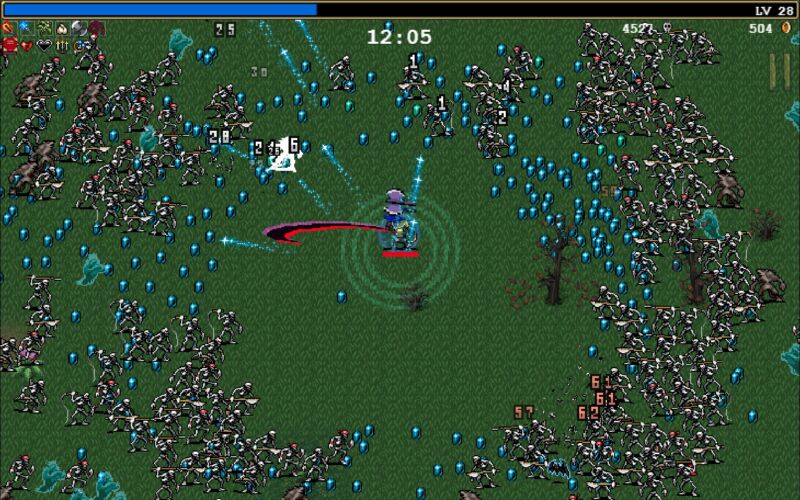
Kill monsters, pick up XP gems, upgrade character.
Enlarge / Kill monsters, pick up XP gems, upgrade character.

If you’re a fan of roguelites and haven’t heard of Vampire Survivors, let me be the first to welcome you to your new obsession.

The “gothic horror casual game with roguelike elements,” as its developer calls it, has been taking the indie world by storm over the past year, racking up over 120,000 “overwhelmingly positive” reviews on Steam and capturing effusive praise from critics. And until today, it was still in Early Access.

The game has even spawned a new sub-subgenre, with games of its ilk incorporating ideas from bullet-hell shoot-em-ups, roguelites, and timed horde-survival games. These games are almost all in Early Access, and every last one is curiously cheap—$5 seems to be the price cap. But while many pretenders to the throne have arisen, Vampire Survivors still reigns supreme. It was the second real game of its kind, after the 2021 Android-exclusive Magic Survival.

Why is a small game with unassuming pixel graphics and minimalistic gameplay so popular?

That’s easy—it’s fantastically, relentlessly fun.

What a horrible night to have a curse

The gameplay loop is simple: Kill monsters, collect the experience-point gems they drop to level up, and try to piece together a character build strong enough to keep pace with the game’s ever-escalating difficulty. Survive for 30 minutes and you’ve won (at the end of a successful run, “the reaper” appears and kills you, but still, you’ve won).

Here’s the twist, though. You do only two things in Vampire Survivors: move your character around and make decisions about what abilities to take and upgrade as you level up. Your character’s weapons—you start with one but add more as a run progresses—fire automatically at a set pace; it’s up to you to position your hero to stay out of danger and be in the right place to hit enemy targets. Some weapons target the nearest enemy, some shoot in specific or random directions, and others fire at random enemies. So the gameplay basically boils down to “walk around the screen as enemies trudge toward your position.”

I get it: That sounds minimalistic to a fault—and probably more than a little boring. But if you’re anything like me, this game will get its hooks into you.

One of my favorite aspects of roguelites is their ability to distill the essence of character progression in a role-playing game down to a bite-sized experience. For my money, there’s nothing more satisfying in gaming than taking a character from zero to hero, carefully selecting new abilities and gear to make your build tough enough to take on endgame challenges. Roguelites like The Binding of Isaac have you start each 30- to 60-minute run as a wimpy pushover, but by the end of that brief play session, you’re a veritable god of destruction.

Vampire Survivors takes that concept and simplifies it even further. What if you could build a character in a cool 20–30 minutes, but your build “plays itself,” and the only thing you need to worry about is positioning?

It might sound like “the lazy person’s roguelite,” but there’s more going on than you might initially think.

https://arstechnica.com/?p=1891279


Lost something? Search through 91.7 million files from the ’80s, ’90s, and 2000s

Vintage floppy disks go under the microscope.
Enlarge / Search through millions of vintage files with Discmaster.
Aurich Lawson | Getty Images

Today, tech archivist Jason Scott announced a new website called Discmaster that lets anyone search through 91.7 million vintage computer files pulled from CD-ROM releases and floppy disks. The files include images, text documents, music, games, shareware, videos, and much more.

Discmaster opens a window into digital media culture around the turn of the millennium, turning anyone into a would-be digital archeologist. It’s a rare look into a slice of cultural history that is often obscured by the challenges of obsolete media and file format incompatibilities.

The files on Discmaster come from the Internet Archive, uploaded by thousands of people over the years. The new site pulls them together behind a search engine with the ability to perform detailed searches by file type, format, source, file size, file date, and many other options.

“The value proposition is the value proposition of any freely accessible research database,” Scott told Ars Technica. “People are enabled to do deep dives into more history, reference their findings, and encourage others to look in the same place.”

Searching for "Beatles" on Discmaster returns images, sounds you can hear, and documents you can read.
Enlarge / Searching for “Beatles” on Discmaster returns images, sounds you can hear, and documents you can read.
Ars Technica

Discmaster is the work of a group of anonymous history-loving programmers who approached Scott to host it for them. Scott says that Discmaster is “99.999 percent” the work of that anonymous group, right down to the vintage gray theme that is compatible with web browsers for older machines. Scott says he slapped a name on it and volunteered to host it on his site. And while Scott is an employee of the Internet Archive, he says that Discmaster is “100 percent unaffiliated” with that organization.

One of the highlights of Discmaster is that it has already done a lot of file format conversion on the back end, making the vintage files more accessible. For example, you can search for vintage music files—such as MIDI or even digitized Amiga sounds—and listen to them directly in your browser without any extra tools necessary. The same thing goes for early-90s low-resolution video files, images in obscure formats, and various types of documents.

“It’s got all the conversion to enable you to preview things immediately,” says Scott. “So there’s no additional external installation. That, to me, is the fundamental power of what we’re dealing with here.”

In the Discmaster Twitter announcement thread, people are already using the service to rediscover programs they lost during the 1990s, rare BBS files, ZZT worlds, bitmap fonts, shareware they wrote 20-plus years ago, and vintage music software. There is a lot of user-created data in the set, not just professional releases.

Using Discmaster, you can search through vintage stock photo CD-ROMs on many subjects.
Enlarge / Using Discmaster, you can search through vintage stock photo CD-ROMs on many subjects.
Ars Technica

“It is probably, to me, one of the most important computer history research project opportunities that we’ve had in 10 years,” says Scott. “It’s not done. They’ve analyzed 7,000 and some-odd CD-ROMs. And they’re about to do another 8,000.”

Humans being humans, you’ll also find a large amount of vintage pornographic media represented in the Discmaster data set—it’s easy to run into by accident. Users who want to avoid NSFW material should select “Strict” in the “Safe Search” options near the bottom.

By casting a wide archival net, everything is captured and available in its unvarnished form. “The [resources] they are choosing are very specifically compilation and presentation CD-ROMs, like the best shareware discs,” says Scott, “pulling in the ones that were meant to be encapsulated plastic resources of information.”

Scott is no stranger to radical acts of digital archivism, having participated in backing up GeoCities, preserving Flash files, making thousands of MS-DOS games playable though a web browser, and more. On his personal site, Textfiles.com, he has hosted archives of BBS files and CD-ROMs for almost two decades. But until now, those resources had never been searchable with the degree of precision that Discmaster allows.

“Maybe some people don’t want to go through a pile of old things,” he says. “But if you are somebody for whom going through a pile of old things would really positively affect you, this is Shangri-La.”

https://arstechnica.com/?p=1890903


What it takes to re-create Rings of Power title sequence with Chladni figures

[embedded content]
Steve Mould re-created The Rings of Power title sequence using patterns produced by vibrating square plates.

The first time I saw the opening credits for The Lord of the Rings: The Rings of Power, I thought the patterns looked remarkably like so-called “Chladni figures“: vibrational patterns that form when one scatters sand on a vibrating plate. It seems I was not the only one. British science communicator and YouTube star Steve Mould got so many comments from viewers about the similarities that he decided to test that hypothesis—by re-creating the title sequence with his own vibration-generated patterns. He documents the journey, and the associated science, in the video above. The final re-created title sequence starts at the 10:55 mark.

The phenomenon is technically known as cymatics. In 1680, Robert Hooke experimented with running a bow along glass plates covered in flour to induce vibrations and noted the telltale nodal patterns that formed in the flour. “A rigid plate will have a set of natural resonance frequencies just like a string, and when the plate is excited at one of these frequencies, it will form a standing wave with fixed nodes,” University of North Carolina physicist Greg Gbur wrote back in 2013. “These nodes will form lines on the plate, in contrast to points on the string.” The flour on the plate made those nodal lines visible.

The 18th-century German physicist and musician Ernest Chladni perfected the method 100 years later when he repeated Hooke’s pioneering experiments with circular plates, even demonstrating the effect before Napoleon. The various shapes or patterns created by resonance frequencies are known as “Chladni figures” in his honor. Chladni even came up with a mathematical formula to predict which patterns would form. The higher the rate of oscillation, the more complex those figures will be. Similar methods are still used when designing acoustic instruments: violins, guitars, and cellos, for example.

The closest Mould could come to the iconic series of rings featured in the title sequence.
Enlarge / The closest Mould could come to the iconic series of rings featured in the title sequence.
YouTube/Steve Mould

Mould’s videos explore a wide variety of topics, including one on the physics of the so-called “chain fountain” (rising self-siphoning beads) that inspired two physicists to test his hypothesis and publish a 2014 paper. Mould also created a hugely popular YouTube video in 2016 about the science behind Chladni figures, which he demonstrated by sprinkling couscous on a large vibrating metal square. So he was a natural person to approach for people curious about whether The Rings of Power title sequence had been created in a similar fashion.

First, Mould took a closer look at the specific shapes featured in the title sequence and then tried to figure out how to re-create them (or a similar pattern) using his own vibrating plates, along with the transitions between the patterns. That involved more than a little math.

Mould used a program called Desmos to run through various combinations of the two variables at play and the patterns that should be produced on a square plate. (He also experimented with a pentagonal plate for contrast.) Many seemed to match fairly well with patterns in the title sequence. Then he set about trying to make those patterns for real. “I swept through a huge range of frequencies, found a handful that worked really well, and then I coded something up so I could quickly switch between those good frequencies,” Mould says.

The biggest challenge was achieving the distinctive pattern of circles featured at one point in the sequence. This required tweaking the boundary conditions to get different standing waves at different frequencies. Chladni’s original experiment involved a plate that was fixed at the center so that all the patterns had lines that went through that center, which doesn’t move and thus is part of a node line. But in the actual title sequence, that pattern of circles has no lines going through the center. So Mould vibrated the plate from the middle rather than running a bow along the edge, as Chladni did.

In the end, Mould came pretty close to the original pattern of circles, although he suspects the original owes a lot to CGI. “Maybe the whole thing is CGI,” he says in the video. “But if it is, I reckon they’re using simulation software for at least some of it to produce those Chladni figures.”

[embedded content]
Behind the scenes of The Rings of Power title sequence.

Listing image by YouTube/Steve Mould

https://arstechnica.com/?p=1886376


Nvidia’s last-minute 12GB RTX 4080 rebrand will be a pain for GPU makers

Nvidia’s last-minute 12GB RTX 4080 rebrand will be a pain for GPU makers
Getty Images

Late last Friday, Nvidia decided that it was “unlaunching” the lower-end 12GB version of its upcoming GeForce RTX 4080 graphics card so that it could be renamed and released at a later date. This was good news for the people who care about this kind of thing—the $899 12GB RTX 4080 and $1,199 16GB RTX 4080 were substantially different cards with much different performance levels. Giving them both the same name could have created unnecessary disappointment and confusion for buyers of the cheaper card.

The problem for GPU makers is that Nvidia planned to launch those cards in mid-November, and partners had already started manufacturing and packaging them so they could be shipped out to retailers. Gamers Nexus has spoken with sources at two of Nvidia’s board partners about some of these logistical hurdles, reporting that existing boxes for 12GB RTX 4080 cards were being “collected and destroyed” and that Nvidia “is at least subsidizing the boxes, or part of them, to be replaced.” The relabeled GPUs will supposedly be reintroduced or relaunched (or un-unlaunched?) around CES in January 2023.

There will be other costs for board partners, too, both for GPUs that have already been produced and those that will be manufactured after Nvidia has settled on a name (Gamers Nexus says this hasn’t happened, but that “4070” or “4070 Ti” seems most likely). GPU coolers usually have the card’s name and model number printed on them somewhere, occasionally in a prominent place with programmable LEDs underneath. These coolers will either need to be rebadged, reprinted, or replaced to switch out the old RTX 4080 branding with the new branding.

The BIOSes on the cards will need to be re-flashed, too, so that the GPUs properly identify themselves (both to drivers and to operating systems) with their new model number rather than showing up as RTX 4080 cards. Gamers Nexus and its sources didn’t know for sure whether Nvidia would also be adjusting the card’s specs to go with its new model name, though Nvidia’s post from last week makes it sound unlikely.

“The RTX 4080 12GB is a fantastic graphics card, but it’s not named right,” reads the original blog post. To change its specs just because the name is changing could run the risk of making it less “fantastic” and would likely engender some of the same consumer backlash that prompted Nvidia to change the name in the first place.

Finally, Gamers Nexus says that Nvidia “will also be reducing the price” of its rebranded GPU to reflect the new name. This could be tricky for partners that have already manufactured cards with its old retail price in mind, especially because profit margins for these board partners are reportedly already pretty low. If you built GPUs for (say) $700 or $800 expecting to sell them for $900, you would only have so much room to lower the price before you started losing money, and we don’t know whether Nvidia would offer some kind of rebate or reimbursement for partners who have already purchased those GPU dies.

Asked by Ars about the reimbursements, an Nvidia spokesperson told us the company had “nothing to add.”

One partner that won’t be affected by this? EVGA, which broke its longstanding ties to Nvidia in September because of an alleged lack of communication and because of competition from Nvidia’s first-party Founders Edition cards. There were other sides to this story—EVGA’s profit margins on GPUs were supposedly lower than some of Nvidia’s other board partners because they didn’t manufacture their own circuit boards or coolers, for example—but if you wanted to prove that Nvidia could be difficult to work with, “renaming a GPU weeks before release and only partially compensating partners for the trouble” is a pretty good example.

https://arstechnica.com/?p=1890596


Build a shelf-size vintage computer museum made of paper

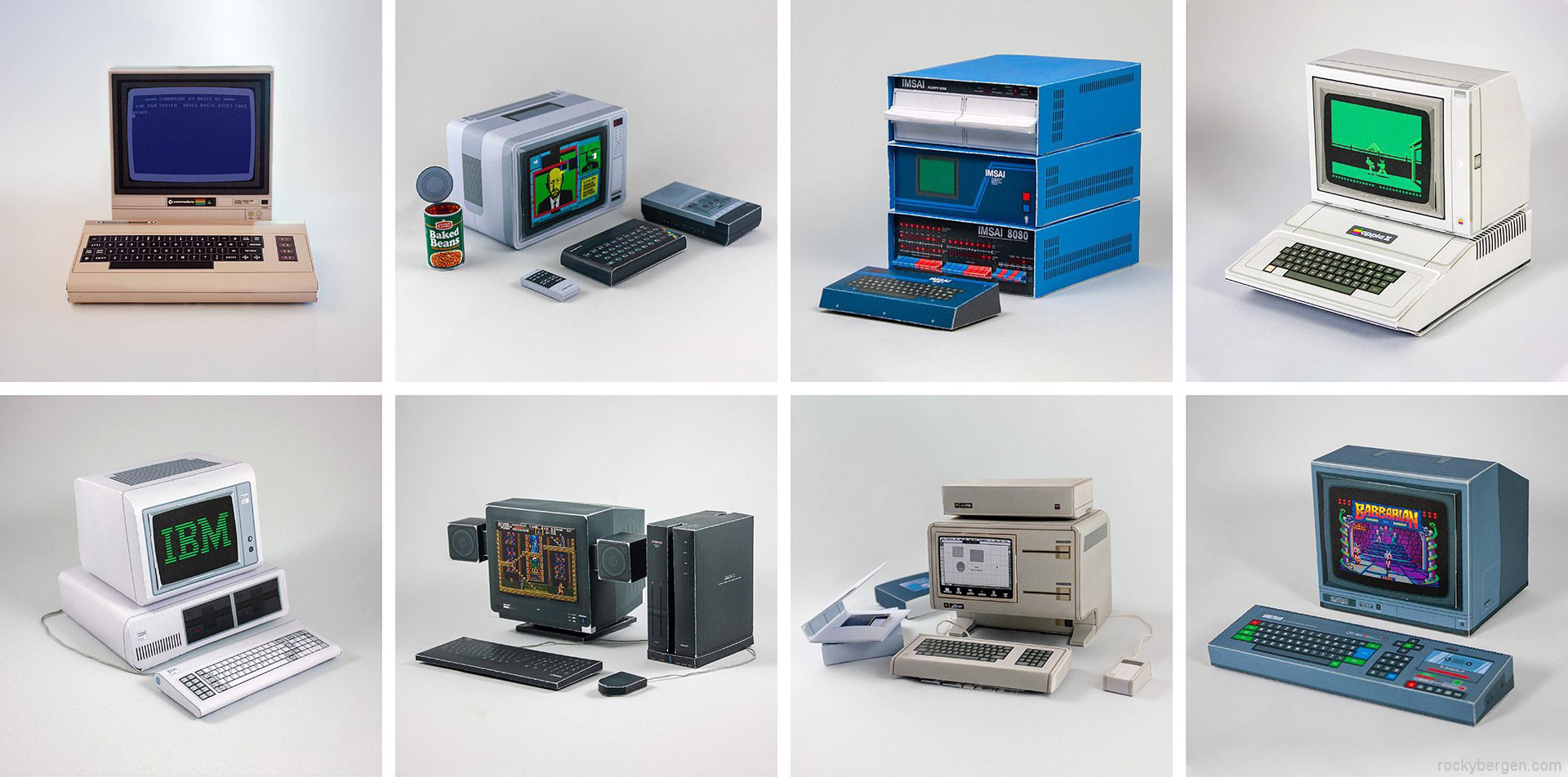
An example of eight papercraft vintage computer models designed and assembled by Rocky Bergen.
Enlarge / An example of eight papercraft vintage computer models designed and assembled by Rocky Bergen.

Yesterday, a Winnipeg, Canada-based artist named Rocky Bergen released a free collection of miniature papercraft vintage computer models that hobbyists can assemble for fun. They are available on The Internet Archive in a pack of 24 PDF files that you can print out on letter-size paper and fold into three dimensions.

Among Bergen’s Barbie-size papercraft models, you’ll find representations of classic computers originally released during the 1970s and ’80s, such as the Apple II, IBM PC 5150, Commodore 64, Apple Macintosh, and even the rare Apple Lisa 1. You’ll also find papercraft models of a few classic game consoles like the Sega Master System and the Nintendo GameCube.

Bergen began creating the papercraft models in the summer of 2016, starting with an Amstrad CPC 464 he designed for a CPC fanzine. “I grew up with a Commodore 64 and have always been a fan of old computers and their industrial design,” Bergen told Ars Technica. “I would love to have a huge collection of them, but it’s not always practical for people to have a massive amount of hardware with them at all times.”

A vintage Mac 128K papercraft model designed by Rocky Bergen, complete with accessories.
Enlarge / A vintage Mac 128K papercraft model designed by Rocky Bergen, complete with accessories.

To create the models, Bergen collects photos of the equipment from the Internet and slices and dices them in Adobe Illustrator until he gets a satisfactory result. “I typically keep the serial numbers intact so it is possible to check to see if I used your computer or not,” he says.

Many of Bergen’s papercraft models include extra variations with different software or games on the monitors that can be exchanged by inserting folded screen images into slots on the units. Many models also include delightful details, such as appropriate scale-model accessories: disk drives, mice, floppy disks, software boxes, and even modems.

“The response from the Internet has been very encouraging,” says Bergen. “So I have created a large number of these models so that you can go nuts and build out an entire computer museum.”

Once printed, cut out, and folded, the models typically only stand 3 to 4 inches tall, but the scale varies depending on the paper size used. Bergen designed the models for 11×17 paper (A3). At that size, they appear “the size of a typical mini console.” But they can also be automatically scaled down to 8.5×11-inch letter-size paper, which makes them roughly “Barbie Doll scale.”

Four papercraft models designed by Rocky Bergen, including the Nintendo AVS prototype.
Enlarge / Four papercraft models designed by Rocky Bergen, including the Nintendo AVS prototype.

Bergen finds assembling the models a meditative experience. “I did not think I would enjoy the cutting and folding process, but it is my favorite part of the process,” he says. “I thought it would be stressful to do, but it turns out to be quite relaxing.”

To get started building your own papercraft museum, you’ll need a color printer, paper, and scissors. Download the PDFs from the Internet Archive, print them out, cut along the lines, fold the tabs, and insert them into the slots. Bergen says that working with thicker paper makes it easier. “A paper-folding tool (referred to as a bone folder) really helps to create nice edges,” he says. “But any butter knife without serrations will work excellently, too.”

It’s no secret that the prices of vintage computers and game consoles have been skyrocketing over the past few years, especially during the pandemic. That makes collecting the actual machines far more difficult and expensive than a decade ago. Bergen says those factors are always at the back of his mind while designing his papercraft sculptures.

“I like the idea of removing rarity or cost from the equation,” he says. For the price of paper and ink, you can have fun with rare vintage machines that might cost thousands (or tens of thousands) of dollars. “My Apple Lisa 1 will only cost you your time, and you might learn something about it, too. I know I did.”

https://arstechnica.com/?p=1890527


Hacker gets discontinued P.T. running on unmodified PS5

Loading this onto a PS5 requires jumping through quite a few hoops.
Enlarge / Loading this onto a PS5 requires jumping through quite a few hoops.

For years now, Hideo Kojima’s cult classic P.T. (or “Playable Trailer” for a canceled Silent Hills project) has only been playable on the million or so increasingly hard-to-find PS4 consoles that downloaded the free demo (and didn’t delete it) before it was completely removed from the PlayStation Network. Now, one hacker has gotten the game to run on an unmodified PlayStation 5 by using a second, jailbroken PS5 as a go-between.

Streamer Lance McDonald demonstrated his P.T.-on-PS5 method in a stream early Monday, detailing several prerequisites and steps that will make it difficult for many interested players to copy. Chief among them is McDonald’s access to a second PS5 system that he said he hadn’t plugged in for over a year, when he used it to try the Elden Ring Network Test. That means the console was still running an old version of the PS5 firmware and was thus susceptible to the recently revealed PS5 jailbreaking method that Sony patched after firmware version 4.3.

Using that jailbroken system, McDonald says he could log in to the system from a PC using an FTP client and “edit the list of games you’re allowed to run on your PS5.” That’s important, because even users who have previously managed to transfer a legitimate PS4 copy of P.T. to their PS5 have been faced with a message saying: “You can’t use this PS4 game or app on the PS5.”

That’s great if you have an older, jailbreakable PS5. But McDonald also discovered the jailbreak helps enable a workaround for unmodified PS5s running the latest Sony firmware.

As he said on his stream, “I just hoped that if I did a USB system backup of my jailbroken PS5… I thought maybe included in that backup will be the list of games you’re allowed to play on the PS5. And I was right, it turned out it does, it backs up the list. So you can edit the list of games you’re allowed to play on PS5, back it up on USB, and restore that to a fully updated PS5. And that’s what I did.”

“Such a weird edge case”

Aside from having multiple PS5 consoles, McDonald said his method requires access to a PSN account that previously accessed P.T. during the game’s short availability window on the PS4. Users also have to jump through some hoops to get the game onto a PS5; McDonald said he transferred a copy downloaded from the Internet Archive via USB using the jailbroken system’s debug menu.

Combined with the need for two PS5s—at least one of which is jailbreakable—McDonald estimates that “I must be one of the only people in that situation.” And while Sony could patch future PS5 firmware versions to block this particular workaround, McDonald said his setup was “such a weird edge case” that he doubts they’ll even bother. That said, McDonald added that “they could definitely ban me” for doing this, which would cut off his entire collection of PSN games and saves.

Regardless, it’s now even more abundantly clear that P.T.‘s longstanding lack of PS5 compatibility is a licensing decision on the part of Konami and Sony, and not a technical issue inherent to the PS5 hardware. With Konami promising to reveal new updates on the future of the Silent Hill series this week, now would be the perfect time for the publisher to offer an official PS5-compatible download of P.T. for those who missed out the first time. How about it, Konami?

https://arstechnica.com/?p=1890541


Removing notes from Mendelssohn overture shows plight of humpback whales

[embedded content]
Hebrides Overture’s disappearing notes highlight the plight of humpback whales.

Felix Mendelssohn’s The Hebrides was inspired by the composer’s 1829 trip to the British Isles. His overture has now inspired collaboration between a Cambridge economist and a composer, using sound to call attention to the loss of biodiversity on Earth. Hebrides Redacted successively removes notes from the 10- to 11-minute overture in proportion to the decline in humpback whale populations over many decades. A short film about the project (embedded above) was released today as part of the Cambridge Zero Climate Change Festival.

“Over the past century we have seen nearly a million species pushed to the brink of extinction—nature is going quiet,” said Matthew Agarwala, an economist at the University of Cambridge. “Researchers—including me—have been sounding the alarm about the consequences of biodiversity loss for a long time, but the message isn’t landing. Music is visceral and emotional, and grabs people’s attention in ways that scientific papers just can’t.”

Mendelssohn visited England and Scotland at the invitation of the Philharmonic Society. It was during his tour of Fingal’s Cave on the Scottish island of Staffa that inspiration struck, and he quickly wrote down the opening theme that came to him. The opening notes feature violas, cellos, and bassoons to evoke the cave’s beauty, while a secondary theme is meant to convey the rolling waves of the sea.

He finished the piece in June 1832 and conducted the first performance in January 1833 in Berlin. It’s widely considered one of his greatest compositions, sometimes described as a tone poem. No less a luminary than Johannes Brahms once declared, “I would gladly give all I have written to have composed something like the Hebrides overture.”

Per Agarwala, there are about 30,000 notes in Mendelssohn’s original score, which roughly corresponds to the number of humpback whales that populated the oceans in 1829. But a thriving whaling industry reduced their numbers to the brink of extinction. By the 1960s, there were only around 5,000 humpback whales left, and the International Whaling Commission (IWC) banned commercial humpback whaling as a protective measure.

<a href="https://rassegna.lbit-solution.it/wp-content/uploads/2022/10/removing-notes-from-mendelssohn-overture-shows-plight-of-humpback-whales-1.jpg" class="enlarge" data-height="1471" data-width="1200" alt="Hebrides Redacted score with notes scrubbed out to reflect declining humpback whale population. This segment corresponds to 1890, when 60 percent of whales remained.”><img alt="Hebrides Redacted score with notes scrubbed out to reflect declining humpback whale population. This segment corresponds to 1890, when 60 percent of whales remained.” src=”https://rassegna.lbit-solution.it/wp-content/uploads/2022/10/removing-notes-from-mendelssohn-overture-shows-plight-of-humpback-whales.jpg” width=”640″ height=”785″ srcset=”https://rassegna.lbit-solution.it/wp-content/uploads/2022/10/removing-notes-from-mendelssohn-overture-shows-plight-of-humpback-whales-1.jpg 2x”>
Enlarge / Hebrides Redacted score with notes scrubbed out to reflect declining humpback whale population. This segment corresponds to 1890, when 60 percent of whales remained.
Ewan Campbell

The species has since rebounded, with a 2018 worldwide population of around 135,000 whales, 13,000 of which call the North Atlantic home. But they still face threats like getting entangled in fishing gear, colliding with vessels, and excessive ocean noise, as well as the destruction of their coastal habitats and adverse impacts of climate change.

That’s why Agarwala and composer Ewan Campbell chose to build Hebrides Redacted around the plight of those creatures, figuring it was highly likely that during his trip, Mendelssohn would have seen a humpback whale or two—or hundreds. Campbell divided the score into sections to represent decades, and gradually removed notes according to how the whale populations declined over those decades. Yet the piece ends optimistically, allowing for an 8 percent rise every decade in whale populations in the future.

“At its nadir, the score is thin and fragmented, with isolated notes reaching for a tune that is only partially present,” said Campbell. “But even in the face of devastating destruction, nature is resilient and always beautiful, and so even when two-thirds of the music is absent there’s still a delicate beauty, though a pale imitation of its once dramatic glory. ‘Redaction’ is a word normally associated with censorship, and silencing history. I find it really apt for this piece of music. We’re showing how human activities have silenced nature.”

Hebrides Redacted received a standing ovation when it was performed by a 38-piece orchestra at the August Wilderness Festival in Oxfordshire, England, with Campbell conducting and Agarwala narrating.

https://arstechnica.com/?p=1890094


Dwarf Fortress, the most inscrutable game of two decades, is getting a tutorial

Screen showing the
Enlarge / Part of the tutorial that will give new Dwarf Fortress players some pointers, if not full understanding, when the game is available on Steam at some point.
Bay 12 Games / Steam

Dwarf Fortress, the fantasy mining simulation with the motto “losing is fun,” is softening its learning curve just the tiniest bit. In its upcoming (but not yet dated) Steam release, a new tutorial will explain what you can do and how things work—if not, exactly, how to survive.

Co-creator Zach Adams showed off some images from an optional tutorial in an update on the game’s Steam Store page. Even with the upgraded pixel art and improved control scheme of the Steam release, the team thought the newcomer experience “still needs something.” So they built a tutorial that walks a player through camera controls, mining, stockpiling, woodcutting, and, at a basic level, survival.

What’s more, the developers are testing it on Annie, Zach Adams’ wife. After a failed attempt with an earlier version, the latest tutorial took Annie far enough to where she could “tunnel under a bog and drown her fortress.” Presumably, that is good.

<img alt="The optional tutorial prompt that appears when starting Dwarf Fortress‘ Steam edition. A mineral-rich region of this world could be yours.” src=”https://rassegna.lbit-solution.it/wp-content/uploads/2022/10/dwarf-fortress-the-most-inscrutable-game-of-two-decades-is-getting-a-tutorial-1.png” width=”1920″ height=”1080″>
The optional tutorial prompt that appears when starting Dwarf Fortress‘ Steam edition. A mineral-rich region of this world could be yours.

“Our aim is to make this level of play achievable by anyone,” Zach Adams wrote on the Steam page. “We want the world to be able to lose this game and have fun doing it.”

A complex game offering a tutorial wouldn’t normally be news. But Dwarf Fortress‘ dense, often impenetrable interlocking mechanics are a large part of the game’s mystique. Former Ars editor Casey Johnston documented 10 hours with the ASCII-based Dwarf Fortress in 2013, starting out with a drive to “avoid using external guides or hints and hold off using internal explanations unless I felt lost.” The results were epic, in the historical sense; things happen suddenly, and there was death.

To wit:

Gray X’s start streaming in from one wall of the fortress and settle into the clump of icons that were already displayed on the screen. They blink aggressively. One turns into an R, maybe. The rest disappear. I receive no alerts. I have no idea what just happened.

During that journey nearly a decade ago, Johnston noted that an upfront tutorial was far from the only thing Dwarf Fortress could use to make the experience more inviting for, well, just about anybody:

What Dwarf Fortress really lacks, aside from a built-in tutorial that at least gets you started, is the ability to learn from tinkering. I would never have figured out the first step—digging a mine—on my own, let alone the dozens of following steps that apparently are crucial to building an effective, or even rudimentary, fortress. And I’m still not done. And I’m still hitting major roadblocks.

<img alt="A child that the player might never have even noticed was created and born bleeds to death, many hours into a Dwarf Fortress playthrough.” src=”https://rassegna.lbit-solution.it/wp-content/uploads/2022/10/dwarf-fortress-the-most-inscrutable-game-of-two-decades-is-getting-a-tutorial-2.png” width=”754″ height=”436″>
A child that the player might never have even noticed was created and born bleeds to death, many hours into a Dwarf Fortress playthrough.

Dwarf Fortress, coded entirely by brothers Zach and Tarn Adams, has subsisted on donations, Patreon memberships, and other goodwill gestures since it began development in 2003. The game’s Steam (and Itch.io) release will introduce a graphical tileset, improved keyboard shortcuts and UI, and, most notably, a price, anticipated to be $20. The money will mostly go toward ensuring the brothers have health care and can sustain themselves through more development. A cancer scare for Zach in the late 2010s pushed the move forward.

The game will continue to be available as a free download, with an optional donation, at Bay 12’s site. There’s no date yet set for commercial release.

https://arstechnica.com/?p=1890123


Nvidia will “unlaunch” the 12GB RTX 4080, says it’s “not named right”

Nvidia will “unlaunch” the 12GB RTX 4080, says it’s “not named right”

Nvidia announced today that it would be “unlaunching” the 12GB version of its upcoming GeForce RTX 4080-series GPU on the basis that “having two GPUs with the 4080 designation is confusing.” The card will not be launching in the originally planned November window, but it will return at some point following a rebranding.

“The RTX 4080 12GB is a fantastic graphics card, but it’s not named right,” reads a brief, anonymous Nvidia blog post. The 16GB version of the 4080 will still launch on November 16.

The 16GB version of the 4080 was in keeping with past xx80-series Nvidia cards—it used the same GPU die as the high-end RTX 4090, but with some of the CUDA cores switched off and the clock speeds reduced. But the difference between the 12GB and 16GB versions of the 4080 was much larger than their names would suggest; the 12GB version came with many fewer CUDA cores and a narrower 192-bit memory bus, and rumors indicated it used a totally different GPU die. Benchmarks from Nvidia suggested the 12GB version could be as much as 30 percent slower than the 16GB version of the 4080.

The most likely course of action is that Nvidia and its partners will rebadge and rebrand all existing 12GB RTX 4080 cards as some flavor of RTX 4070. This will probably have exactly zero impact on the card’s performance or pricing. But it will bring the card’s branding more in line with past generations, possibly alleviating some confusion from people wondering why two cards with the same model number offer such different performance.

https://arstechnica.com/?p=1890156


Only PC players need a registered phone number for Modern Warfare 2

Only PC players need a registered phone number for Modern Warfare 2


Recent updates to online store and support pages suggested that all Modern Warfare II players would have to register a unique, text-capable phone number with their account to play the game. In a blog post this week, though, the team behind the game’s Ricochet anti-cheat system suggests that the requirement will only apply to PC players.

That’s a significant difference from Blizzard’s policy regarding Overwatch 2, which initially required all players across PC and consoles to register a phone number for its “SMS Protect” system. Blizzard later partially rolled back that policy to exempt players who used a Battle.net account to play the original Overwatch.

Activision’s SMS security requirement will also extend to PC players of the free-to-play Warzone 2.0, Team Ricochet writes. Players who accessed the original Warzone on PC have needed to link a phone number since May 2020 and will not be exempt from that requirement for the sequel.

The 2019 reboot of Modern Warfare—which includes access to Warzone—added a similar SMS phone requirement in August 2022. That’s because the anti-cheat team “started seeing more cheaters attempt to access Warzone from Modern Warfare to bypass the SMS policy, so the security team recommended the update to further combat the illicit account market.”

Similar reasoning seems to apply to the security requirements for this month’s launch of Modern Warfare 2 and the associated Warzone 2.0. “SMS verification is critical to our anti-cheat enforcement efforts, tackling illicit account creation at its source,” Team Ricochet writes. “This helps our security team to maintain account and game security in order to provide a safe, fair, and fun gaming experience for all our players.”

Modern Warfare 2 will also be the first franchise game to require PC players to use Ricochet’s kernel-level anti-cheat drivers at launch. Those drivers are also being updated to “provide more information to our security teams in the event of cheaters getting into the game, feeding data to our detection and mitigation systems,” the developers write.

While the Ricochet system was partially in place for the game’s open beta earlier this year (and led to more than 20,000 account bans), the team says it will be rolling out “all existing [cheat] mitigation systems” for the game’s full launch on October 28. That includes measures that can strike cheaters blind, remove their weapons, and shield their opponents from damage, as well as more cheater-frustrating effects. https://arstechnica.com/?p=1890131