Pokémon Go creators launch AR-game contest that (nearly) resembles American Idol

An cute, unfinished digital creature roams an unfinished digital cityscape beneath the Niantic logo.

How could Niantic, the leading developers of Pokémon Go, possibly top its augmented-reality (AR) gaming sensation? Today’s announcement from the studio hints at its future strategy: find someone else to do it.

The Niantic Beyond Reality Developer Contest talks up a prize pool of more than $1 million, but the real meat of this “contest” is a brand-new incubator program that seeks to marry nimble, indie teams with Niantic’s proprietary “Real World Platform” toolset. Interested developers need to come up with a team of at least five people with demonstrable experience in Unity and Java Server and send a 10-page pitch document (as opposed to a working prototype).

Where’s Simon Cowell?

Niantic has also asked for pitch videos of up to five minutes in length from each interested developer, which somewhat resembles a reality-TV contest. However, a quick scan of the contest’s rules includes no mention of contestants agreeing to any sort of ongoing filmed content as part of the contest (especially since most of the three-month period will be spent in participants’ home cities).

Before the $300,000 grand prize (and two $100,000 runner-up prizes) is awarded, 10 finalists will receive travel accommodations for two Bay Area events and a $50,000 “stipend” to work on a pitched prototype for a period of three months. (Worth noting: if you pitch a project with a team of more than five people, you don’t get more money.) Those trips will include conversations with Niantic developers and executives, access to Niantic’s 24/7 servers, and access to the company’s proprietary development platform.

Niantic clearly has an open mind about what qualifies for the contest, and well it should, since “AR” gaming and apps have a simple selection of base requirements: a 3D-capable smartphone, a camera, and GPS access. “If you have an idea that bridges gaming and other areas, like physical activity, social, travel, or shopping, please feel free to submit,” Niantic writes in its blog post.

How much of the developed work in this contest will remain in contestants’ hands, and how much must they cough up as a result of the contest’s arrangement? We have two answers to this question in the contest’s rules. The first is a relatively clear answer of how much content Niantic will have access to:

Any intellectual property created by your team–including proposed artwork and concepts–will be owned by your team. In turn, Niantic will retain ownership over its technology and the Real World Platform, as well as any other resources provided to you during the contest. All entrants, upon submission, will provide Niantic with a perpetual license to use their entries, both for marketing purposes and to incorporate any features or concepts, including gameplay, into its platform, technology, and future products.

Additionally, the contest’s fine print includes a paragraph about “first right of offer or refusal” for a period of up to 90 days after the contest concludes, in the event of some other game publisher wanting to swoop in and buy up whatever a contest participant’s project entails. What’s missing between these two clauses is a clear delineation of what, if anything, Niantic will be owed by an outside publisher (or even an indie team publishing its game by itself) for use of Niantic’s tools and platform.

Backs getting scratched?

Thus, Niantic’s promotion somewhat resembles other incubator and accelerator programs across the tech world, which offer younger teams a mix of training and proprietary tools in exchange for giving away some of their creative and developmental results. And like other incubator programs, particularly Ubisoft’s Station F program in Paris, this effort sees an established studio asking brand-new voices for fresh ideas. (Ubisoft’s program, as reported by GamesIndustry.biz, seeks ideas in the realms of artificial intelligence and machine learning that may or may not eventually apply to its video game businesses.)

Whether these programs offer a fair “scratch-my-back, I’ll-scratch-yours” exchange or not is up for debate, especially as more game developers and tech workers speak out about the benefits of unionization and establishing best practices instead of taking advantage of desperate labor (whether because of age or lower cost of living).https://arstechnica.com/?p=1432415


Fortnite’s paid outfits, dances have made it a target for lucrative account theft

Fortnite’s paid outfits, dances have made it a target for lucrative account theft
Fortnite / Aurich

A Thursday BBC report takes a look at the state of Epic Games’ mega-popular game Fortnite through the eyes of a particular audience: its black market of account thieves. After speaking with “about 20” perpetrators, reporter Joe Tidy put together a report that breaks down what’s being stolen and resold, how it’s happening, and what the game’s players can do to shore up their own accounts.

The resulting story shouldn’t surprise anyone in the infosec world, and it doesn’t expose any apparent data leaks on the part of Epic. But it’s a reminder that a few modern trends have come together in convenient fashion, ready for any enterprising script kiddie to tap into, and that users should know how a mountain of years-old data leaks can come back to haunt them.

Off-the-shelf, off your old passwords

The report begins with a teenaged Fortnite fan speaking to the BBC via webcam with his identity hidden. He got into the Fortnite-theft game inadvertently, he claims, by starting as a victim. The bad news began when he received email alerts from Epic Games—one saying his account’s email address had been changed, and another saying that two-factor authentication (2FA) had been turned on (and attached to a phone number that wasn’t his). His original account was totally lost as a result, the teen alleged.

After taking to Twitter to publicly complain about his inability to reclaim the account and its paid content (including “battle pass” purchases and cosmetic items), the unidentified teen noticed something: other Fortnite accounts for sale. These offered all manner of in-game loot (particularly outfits and emotes) for much less than those items would cost via Epic’s official store.

This teen then laid out the process that other unidentified thieves separately confirmed to BBC. Some of the steps include: hiding behind proxy servers; combing through major data breaches full of combinations of usernames, passwords, and email addresses; paying for “off-the-shelf” software that would automate the login process at Epic’s site; and quickly accessing a swiped account for long enough to change its email and 2FA settings, presumably with anonymous or automated email addresses and phone numbers.

The first teen in the report told the BBC that he only spent one day trying to swipe other users’ accounts in this manner—but still managed to scoop up more than 1,000 accounts in that span of time. The implication, then, is that many Fortnite account thefts come as a result of reused usernames, email addresses, and associated passwords.

Hackers confirmed that one issue consistently locked them out of successful quick-hit thefts: when victims already had 2FA enabled for their accounts. (In other words, for these script kiddies, they simply jiggled the car’s door handle, noticed it was locked, and went on to the next one.)

1 vs. 99, meet 1 vs. £1,500

The BBC referred to PayPal and Bitcoin transaction records to confirm seriously high stolen-account sales, including this aforementioned teen racking up £1,500 in “his first few weeks” as a go-between for other thieves and sellers.

But for all the details this report scooped up about account sales, it lacks a serious response from Epic Games itself. (Epic did not immediately respond to requests for comment from Ars.) The primary point of contention is in understanding if or how Epic is recognizing automated attempts by single users to log in to a wave of accounts, then immediately change their credentials.

Additionally, Epic doesn’t appear to have a system in place that allows aggrieved players to verify their payment credentials as part of a “my account was stolen” process. A visit to Epic’s primary help site includes zero articles in either its main listing page or via a “stolen account” search that offer steps or help with the scenario of an account being stolen or locked out.

Epic does dangle a carrot for its Fortnite players to turn 2FA on in the form of free, exclusive in-game cosmetics, but the company doesn’t require 2FA to log in to any of its games. While most online services don’t mandate the use of 2FA, one game maker, Valve Software, has leveraged 2FA to reinforce the idea of account identity in the online shooter game Counter-Strike: Global Offensive. Should you wish to join that game’s “prime” series of servers, you can either pay the free-to-play game’s retail price or submit a valid and verified phone number and then rack up a reasonable amount of gameplay time without any signs of cheating or other inappropriate activity in the online game.

https://arstechnica.com/?p=1431405


Thor Ragnarok stars reunite, kick alien butt in MiB International trailer

Chris Hemsworth and Tessa Thompson join forces as Agent H and Agent M to ward off an alien attack in <em>Men in Black: International.</em>
Enlarge / Chris Hemsworth and Tessa Thompson join forces as Agent H and Agent M to ward off an alien attack in Men in Black: International.

If you couldn’t get enough of Chris Hemsworth’s Thor and Tessa Thompson’s Valkyrie fighting side by side in Thor: Ragnarok, you’ll love the trailer for the forthcoming Men in Black: International trailer. The comrades-in-arms are in top form battling more invading other-worldly beings—and seemingly having a blast doing it. We weren’t sure how much longer Sony could milk this particular franchise, but the trailer is surprisingly good, with all the elements that made the original films global blockbusters.

The first Men in Black film (1997) was an instant classic and pretty much cemented Will Smith’s status as a mega-star. Smith’s chemistry with costar Tommy Lee Jones was a sheer delight, rounded out by an equally terrific cast. Miraculously, the sequel, Men in Black II (2002), was just as good, and a Hollywood franchise was born, reuniting Smith and Jones one last time with Men in Black 3 in 2012.

This time around, Thompson takes on the Will Smith role as the talented rookie to Hemsworth’s jaded pro, except instead of being recruited, she seeks out the MiB herself. Somehow she finds the US headquarters of the most secret organization in the world, which, she points out to an uber posh-looking Emma Thompson, pretty much makes her perfect for the job.

Agent M’s (in my mind she’ll always be “Agent T”) first assignment: trouble is brewing across the pond, and she joins up with London’s MiB International Unit to foil the nefarious plot of a couple of aliens who like to bust a move at local nightclubs when not causing trouble for the human race. She has partnered with Agent H (Hemsworth), who is supposedly the best and used to work with Liam Neeson. Now he seems primarily occupied with napping and Taco Tuesdays in the cafeteria—shades of Smith’s wise-cracking agent in the earlier films. When the chips are down, however, he shows his true MiB chops.

All in all, the film looks like a lot of fun, with plummy British accents to boot. It should be a worthy addition to this long-running franchise.

Men in Black: International hits theaters next summer.

[embedded content]
Sony’s Men in Black: International trailer.

https://arstechnica.com/?p=1431383


Minecraft lays its last brick on Xbox 360, other last-gen consoles

4J Studios' collection of "legacy" console dev kits are being sent off to pasture, and that means those consoles will no longer receive official Minecraft updates.
Enlarge / 4J Studios’ collection of “legacy” console dev kits are being sent off to pasture, and that means those consoles will no longer receive official Minecraft updates.
4J Studios

Following an announcement earlier this year, Microsoft and Mojang have followed through on bad news for owners of Minecraft on older game systems. Yesterday marked the end of development on the popular game’s “legacy” branch.

That means if you still play Minecraft on the game’s first-ever console port platform, the Xbox 360, this week’s 1.83 patch is the last one you can expect to ever receive. The same goes for owners of the game on PlayStation 3, Wii U, and PlayStation Vita.

Most of the game’s modern versions, ranging from iOS and Android to PC and “current-gen” consoles, were unified in a shared-codebase manner by primary developer Mojang earlier this year. This version originated from a “Pocket Edition” codebase and later became known as the “Bedrock” edition. The aforementioned legacy platforms, on the other hand, remained in the development hands of independent Scottish studio 4J. Microsoft’s relationship with 4J began in the Xbox 360 era with ports of classic Rare games Banjo-Kazooie and Perfect Dark (which were ported from their original N64 versions, owing to Microsoft’s current ownership of those franchises).

4J confirmed the final-patch news on Tuesday morning by posting an image of its older-console development kits unplugged and arranged against a wall. “As we pack up our Xbox 360, PS3, PS Vita, and Wii U development kits, we’re getting all nostalgic,” the tweet read.

This patch includes the same new “mob” characters that can randomly appear in Bedrock versions of the game (including cats and pandas) along with other bug fixes. Thus, this appears to be the last time anyone can expect feature parity between current-gen and last-gen versions of Minecraft.

4J has not announced whether it will continue supporting the Minecraft franchise as a developer, and neither the studio nor Microsoft immediately replied to requests for clarification. Sources indicated to Ars Technica that 4J’s relationship with Minecraft will continue but did not elaborate.

This is the second major branch of the game to be shut down by Microsoft, following the shuttering of its Windows Phone and Windows Mobile versions in 2017.

We can estimate up to 4.5 million Minecraft players will be left in the cold by this update, based on information provided by Mojang’s original announcement. At that time, the developer indicated that “less than 5 percent” of players play on these platforms, and the game is currently up to roughly 91 million monthly players.

Minecraft‘s original early access period included a “buy it once, own it forever” promise, and that persists, thanks to back-end work at Mojang’s site to support the game’s original buyers between 2009-11… but only if they redeemed a permanent voucher for a version on Windows 10. Buyers of the game’s Xbox 360 version originally had a free-upgrade path to claiming the game’s license for use on Xbox One, but that temporary upgrade offer has since expired. And the current-gen version supports cross-play on nearly every platform imaginable, save one.

https://arstechnica.com/?p=1430777


Enter for a chance to win consoles, smartwatches, and more in the 2018 Ars Charity Drive

Enter for a chance to win consoles, smartwatches, and more in the 2018 Ars Charity Drive

It’s once again that special time of year when we give you a chance to do well by doing good. That’s right—it’s time for the 2018 edition of our annual Charity Drive.

Every year since 2007, we’ve been actively encouraging readers to give to Penny Arcade’s Child’s Play charity, which provides toys and games to kids being treated in hospitals around the world. In recent years, we’ve added the Electronic Frontier Foundation to our annual charity push, aiding in their efforts to defend Internet freedom. This year, as always, we’re providing some extra incentive for those donations by offering donors a chance to win pieces of our big pile of vendor-provided swag. We can’t keep it (ethically), and we don’t want it clogging up our offices anyway. It’s now yours to win.

This year’s swag pile is full of high-value geek goodies. We have nearly 20 prizes amounting to nearly $5,000 in value, including game consoles, computer accessories, collectibles, smartwatches, and more. In 2017, Ars readers raised over $36,000 for charity, contributing to a total haul of more than $280,000 since 2007. We want to raise even more this year, and we can do it if readers really dig deep.

How it works

Donating is easy. Simply donate to Child’s Play using PayPal or donate to the EFF using PayPal, credit card, or Bitcoin. You can also support Child’s Play directly by picking an item from the Amazon wish list of a specific hospital on its donation page. Donate as much or as little as you feel comfortable with—every little bit helps.

Once that’s done, it’s time to register your entry in our sweepstakes. Just grab a digital copy of your receipt (a forwarded email, a screenshot, or simply a cut-and-paste of the text) and send it to ArsCharityDrive@gmail.com with your name, postal address, daytime telephone number, and email address by 11:59pm ET Thursday, January 7, 2019. (One entry per person, and each person can only win up to one prize. US residents only. NO PURCHASE NECESSARY. See official rules for more information, including how to enter without making a donation. Also refer to the Ars Technica privacy policy.)

We’ll then contact the winners and have them choose their prize by January 31 (choosing takes place in the order the winners are drawn).

The prizes

Here are quick descriptions of some of the biggest, most desirable prizes in this year’s contest. See page two for a complete list of available prizes.

Thrustmaster TPR Pendular Rudder Pedals

Our own Lee Hutchinson called these pedals “the best flight sim pedals you can buy in a store like a normal person” in his review earlier this year. But he can’t keep them like a normal person, and his loss could be your gain!

PS4 Pro 500 Million Limited Edition

We took this beauty out of the box to snap some photos earlier this year, then put it right back away knowing some lucky reader would be winning it in this very charity drive. Despite the misleading name (in honor of 500 million PlayStation consoles sold) only 50,000 units were made, and sold out fast, so this could be your best chance to get your hands on this collectible console.

Garmin Fenix 5S Smartwatch

Valentina Palladino

Ars’ Valentina Palladino found the Fenix 5S to be great for hardcore athletes who want an all-purpose device. But being a Fenix watch, it doesn’t come cheap. That may not bother you, though, if you win this coveted smartwatch in our sweepstakes.

Cyberpunk 2077 E3 press-exclusive statuette

Ars’ Sam Machkovech was pretty blown away by the behind-closed-doors demo he got for CD Project Red’s Cyberpunk 2077 at E3 this year. Besides the memories, he walked away from that demo with a limited edition statuette, only given out to demo attendees at E3 and Gamescom. You could walk away from this sweepstakes with the same statue.

Nothing grabbing your eye yet? The next page has dozens more prizes you can win by entering. Have a look!

https://arstechnica.com/?p=1426919


Chilling Adventures of Sabrina charms with some welcome holiday horror

Sabrina Spellman (Kiernan Shipka) toasts friends and family at the witchy winter solstice in <em>The Chilling Adventures of Sabrina</em> holiday special.
Enlarge / Sabrina Spellman (Kiernan Shipka) toasts friends and family at the witchy winter solstice in The Chilling Adventures of Sabrina holiday special.

Looking for a palate cleanser after all those wholesome Christmas movies saturating every TV channel? We recommend “A Midwinter’s Tale,” a special holiday episode of the Netflix horror series The Chilling Adventures of Sabrina. It caps off a strong first season for the fledgling series. And Sabrina has just been renewed for a third and fourth season (16 episodes in total), which means we’ll get even more sinister witchy goodness in the future.

The series is based on the comic book series of the same name, part of the Archie Horror imprint, and it’s much, much darker in tone than the original Sabrina the Teenaged Witch comics. Originally intended as a companion series to the CW’s Riverdale—a gleefully Gothic take on the original Archie comic books—Sabrina ended up on Netflix instead. It’s a stronger series for it, evidenced by rave reviews and a rapidly expanding fan base.

(Some spoilers for season 1 below.)

Both series are smart twists on beloved wholesome characters, and neither one takes itself too seriously. But Riverdale feels more like a (highly entertaining) primetime soap opera, whereas Sabrina embraces full-blown horror without bowing to the niceties imposed by network television. There are murders, demons, exorcisms, blood rites, cannibalism, spells, misguided attempts to raise the dead, a cloven-hoofed devil, and even a witch trial where Sabrina is defended by Daniel Webster himself.

Let’s leave aside the obvious fact that real followers of Wicca don’t actually worship Satan.

That’s not to say we don’t get our share of high school melodrama. The pilot episode opens just before half-human, half-witch Sabrina Spellman (Kiernan Shipka, Mad Men) turns sweet sixteen (on Halloween, of course). That’s a significant age for a witch: she’s preparing for her Dark Baptism, a blood ritual where she will sign the Dark Lord’s (i.e., Satan’s) book and fully embrace her witchy nature. But Sabrina—who lost both parents in a mysterious accident and was raised by her aunts—has some lingering doubts, particularly about preserving her free will. She’ll also have to leave her high school and renounce her mortal friends to attend the Academy of Unseen Arts.

Let’s leave aside the obvious fact that real followers of Wicca don’t actually worship Satan; Sabrina is not a documentary. (That said, Netflix just settled a copyright infringement lawsuit by the Satanic Temple because a statue featured on the show bore a strong resemblance to their statue of goat-headed deity Baphomet.) Given the strong parallels the show draws between the patriarchal dominance of both the Dark Lord’s “church” and traditional Christianity—and the fact that Sabrina founds a girls’ support group called WICCA at her high school—I’m betting there’s a future rebellion in the works. Why else would the Dark Lord be so invested in making sure she signs his book?

Sabrina boasts a stellar cast, most notably Lucy Davis (Etta Candy in Wonder Woman) as Sabrina’s warmly addled Aunt Hilda, and Miranda Otto (Eowyn in The Lord of the Rings trilogy) as her strict, traditionalist Aunt Zelda. Michelle Gomez (“Missy” on Doctor Who) seems to be having a blast camping it up as Madam Satan, posing as Sabrina’s teacher and mentor at Baxter High. And self-identified non-binary [corrected] actor Lachlan Watson shines as one of Sabrina’s mortal BFFs, Suzie Portman, who is struggling with her gender identity.

Happy winter solstice!

Reminiscent of the annual Doctor Who Christmas specials, “A Midwinter’s Tale” is more than a holiday placeholder. It both tells a spooky solstice story and sets up several plot points for the future. The deliciously macabre events of Part 1 have strained Sabrina’s friendship with mortal BFFs Suzie and Roz (Jaz Sinclair), and leads to a bitter breakup with her boyfriend Harvey (Ross Lynch). We are not a huge fan of Harvey, who comes from a long line of witchfinders. Hunky teenage warlock Nick Scratch (Gavin Leatherwood) is much more interesting. But Harvey’s beef with Sabrina is entirely justified.

As the winter solstice approaches, Sabrina decides it’s the perfect time to contact her deceased mother with a séance and recruits the Weird Sisters (orphan witches who are her new frenemies) to help. Naturally there are complications: the mischievous “Yule Lads” invade the house and wreak havoc. They are real mythical figures, the sons of an Icelandic ogre named Gryla, said to turn naughty children into stew each Yuletide.

Shipka deserves a great deal of credit for her slyly subversive performance as Sabrina.

Here, Gryla is reimagined as a protector of lost children, which makes her the perfect person to take on a demonic mall Santa Claus—clearly modeled on the legend of Krampus, although going by the Austrian appellation, Bartel. He’s been preying on the children of Greendale for years, preserving their souls in wax and using those figures to decorate his otherwise wholesome Santa display. It’s a fun bit of holiday horror, flanked by all the ongoing interpersonal drama.

Shipka deserves a great deal of credit for her slyly subversive performance as Sabrina, keeping her character poised on the knife-edge between sinister and likable. She’s not a “good girl,” nor is she fully evil (although her ruthless dexterity with a knife gives one pause). Some fans were upset with the sharp turn Sabrina takes toward the dark side in the last few episodes of Part 1. I found it a fascinating development and perfectly in keeping with the character. Teenagers need to test boundaries and sow a few wild oats; when that teenager is a witch, the stakes are a bit higher.

Based on the trailer for the upcoming Part 2, Sabrina will be leaning into her wild side (and her flirtation with Nick Scratch) even more—with more unintended consequences likely to fall as a result. The Chilling Adventures of Sabrina returns to Netflix on April 5.

[embedded content]
Chilling Adventures of Sabrina Part 2 teaser.

https://arstechnica.com/?p=1427885


Video: Total War: Rome II devs built all of Europe—and the AI ignored most of it

[embedded content]
Shot and edited by Justin Wolfson. Motion graphics by John Cappello. Click here for transcript.

Creative Assembly’s Total War franchise has been around for so long that it’s old enough to drive, vote, and even drink in most countries. For the three people reading this who haven’t played at least one title in the series, the games provide a blend of real-time strategy and turn-based resource management that manages to scratch a number of itches simultaneously. You can direct the conquest of large regions from a god’s-eye overhead view and then step down to the battlefield and move units around like Command and Conquer.

As technology and the 2000s progressed, new entries in the series became more sophisticated; by the time 2013 rolled around and Creative Assembly was working its magic on Total War: Rome II, the design goals were ambitious indeed. Designers wanted to give players total freedom to move around all of classical-era Europe, from Caledonia to Arachosia and all points in between. Building a canvas this broad to play on meant the small team of designers had to rely on some clever procedural tools, and although you might expect those tools to be the point of this particular War Story, that’s not actually what the problem turned out to be.

What if we threw a war and nobody came?

In order to properly test a game with thousands of square miles of playable space, the designers employed automated tools running on their office PCs. In the evenings when it was time to go home, Creative Assembly would set as many PCs as they could to playing the game in AI-only mode, iterating through battles and scenarios in order to help see which units needed balancing and which scenarios needed tweaking. Along the way, they would also find areas where their procedural terrain generation hadn’t gotten things quite right (like requiring a campaign battle to awkwardly play out on a near-vertical slope).

But the biggest issue was that gameplay mirrored real life in a very interesting way: rather than having battles ranging across the vast and varied landscape as the designers had intended, battles tended to occur near cities or at strategic chokepoints. This bias of engagement at strategic points also showed up in early play-testing feedback and prompted the designers to reassess a lot of the decisions around how the single-player campaign would work and how its missions were laid out.

But don’t take my word for it—Creative Assembly’s Pawel Wojs explains things better than I do and also throws in some great details about how the game’s design process worked. We’ve got several more “War Stories” videos in the production queue right now, too, including one very special video about dead things in space, so stay tuned!

https://arstechnica.com/?p=1429239


Sony inadvertently leaks player counts for PS4 titles

Sony inadvertently leaks player counts for PS4 titles

Here at Ars, we have a longstanding obsession with revealing the hidden numbers in the secretive world of video game sales and gameplay data. So we were intrigued this weekend when we heard that Sony seems to have inadvertently revealed the total number of players for a large majority of the PS4’s library.

The leak centers on Sony’s recent My PS4 Life promotion, which lets users generate a personalized statistics video for their PSN Gamertag. Amid some aggregate statistics and “total hours played” numbers for your favorite games, the video also lists your “rarest” trophy and, crucially, the precise number of PSN users who have earned that trophy.

Sony has long made public the percentage of a game’s players that have earned any specific trophy on PSN (rounded to the nearest tenth of a percent). Combining that percentage with the “My PS4 Life” numbers, that makes it relatively simple to reverse-engineer an overall “players” estimate for that game.

Reddit user gamstat, who was among the first to notice this treasure trove of accidentally public data, summarizes the math: “Here, 33,764 players earned the ‘Photo Bomber’ trophy in Fallout 76. And on playstation.com it’s revealed that 8.3% of all players got this trophy. Simple math: the total number of people who have played Fallout 76 on PS4 = 33,764 * 100% / 8.3% = 406,795.”

This data extrapolation isn’t without its issues. For one, the data seems to have been generated between November 20 and December 4 (based on player reports of trophy timing) and seems unlikely to be updated going forward. Data for some games is limited to the specific regions in which those trophies were earned, and trophies that are rounded to “0.1%” of users might not generate accurate player numbers. And the number of “players” being discussed here might not track precisely to the total number of “owners” across the PS4 ecosystem (possibly including completely offline players for disc-based games).

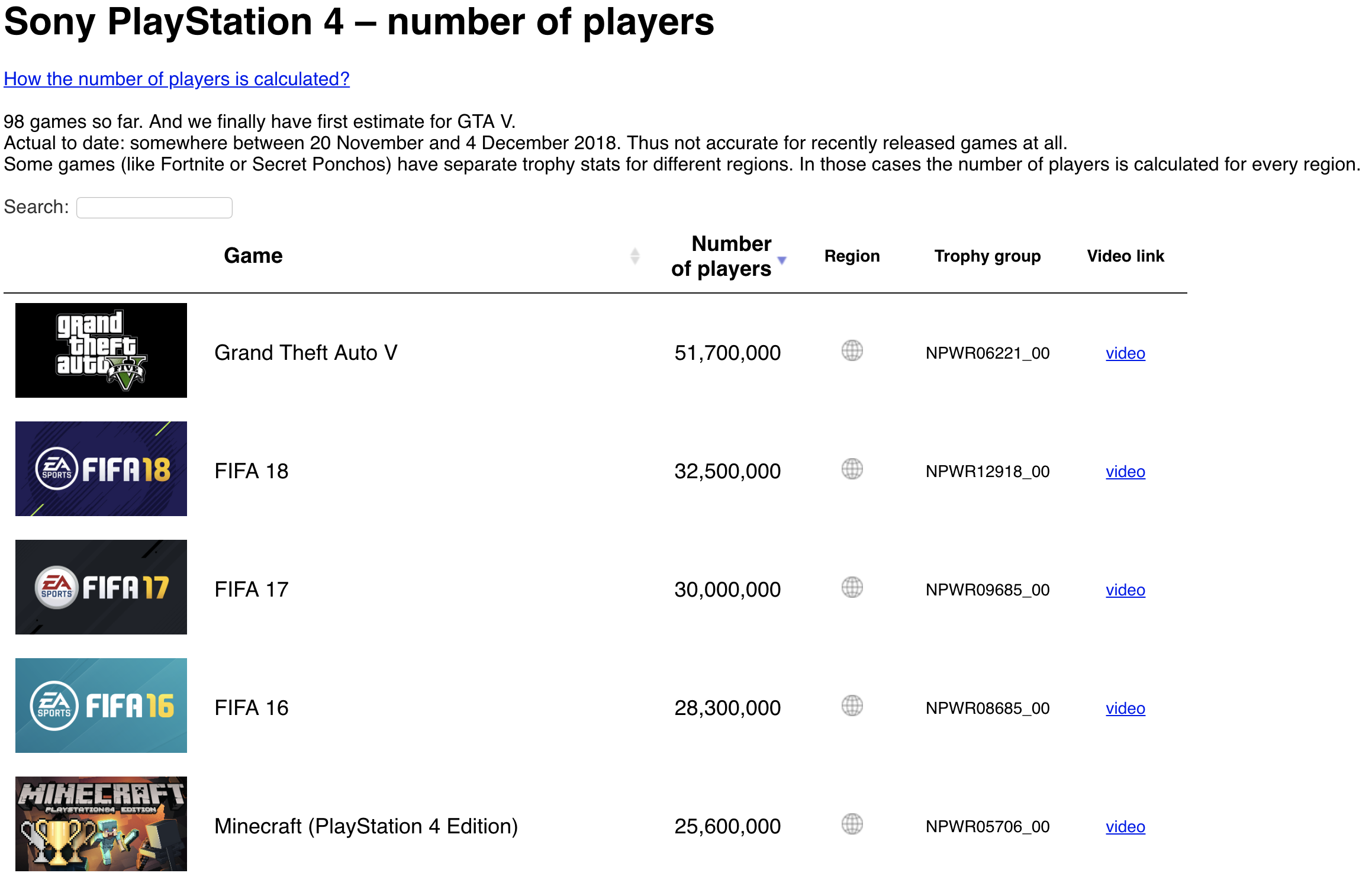
The top five PS4 games by number of players, according to gamstat.
Enlarge / The top five PS4 games by number of players, according to gamstat.
http://gamstat.com/

In any case, gamstat has expanded beyond Reddit and set up a separate website that currently lists the extrapolated PSN player counts for nearly 100 games, from Grand Theft Auto V (51.7 million estimated PS4 players) and FIFA 18 (32.5 million players) to, uh, VVVVVV (28,800 players). But that’s just a small taste of the thousands of My PS4 Life videos that have been shared online with the handy #MyPS4Life hashtag.

Gamstat has downloaded as many of these videos as he can and collected a handy ZIP file of about 3,700 screenshots showing the relevant trophy data for various games. As those get converted to player counts, we should see data for a wide array of PS4 titles.

You might remember that Valve saw a similar leak of Steam sales data via Achievement percentages earlier this year. That came after the company took steps to shut down third-party sites like Steam Spy in favor of a still-nebulous “more accurate” version that would provide “official” sales statistics.

Until then, we’ll constantly be on the lookout for new ways behind the game industry’s usually opaque data curtain.

https://arstechnica.com/?p=1429341


Apple to bring Charlie Brown and the Peanuts to its streaming service

Apple to bring Charlie Brown and the Peanuts to its streaming service
DHX Media, Peanuts

Apple snagged a whole group of stars in its latest get for its upcoming streaming service. According to a report by Variety, Apple signed a deal with Canadian broadcaster DHX Media to produce new content featuring the Peanuts gang, Charles M. Schulz’s band of friends including Charlie Brown, Lucy, and the lovable beagle Snoopy.

Under the deal, DHX and its subsidiary, Peanuts Worldwide, will produce “original series, specials, and shorts” based on the characters from Schultz’s iconic comic strip. Some of that content will be STEM related and feature astronaut Snoopy, a product of a partnership between Peanuts Worldwide and NASA. The two companies recently came together through a Space Act Agreement to inspire a passion for space and STEM-related fields in kids.

In 2017, DHX Media acquired a majority stake in Peanuts Worldwide through a $345 million deal, which also included total control over Strawberry Shortcake. The Schultz family owns the remaining stake in Peanuts Worldwide.

Charles M. Schulz introduced Charlie Brown, Snoopy, and the rest of the gang in a newspaper comic strip back in 1950. The comic strip outgrew its print home as its characters gained immense popularity, making their way into films, series, and animated specials like It’s the Great Pumpkin, Charlie Brown that still air today.

This is the latest high-profile partnership to come from Apple’s search for original and exclusive content with which to populate its forthcoming streaming service. Set to launch in the first half of 2019, the service will compete with Netflix, Hulu, and the like, and Apple has been on a quest to create and find content that will make the service competitive while also fitting into Apple’s company vision.

Maintaining that balance isn’t as easy of a task as it may sound. While Apple reportedly wants to stay away from “gratuitous sex, profanity, and violence,” it has also signed deals with companies like A24 studio, a production company that has produced movies including Moonlight, Ex Machina, Lady Bird, and others. Apple has also reportedly axed and changed the direction of a few projects that it deemed too risqué for its intended audience.

But the Peanuts gang is undoubtedly well-suited for Apple’s streaming service, providing iconic characters for fun, family-friendly content. It’s currently unclear how Apple will structure its streaming service—how much it will cost and which devices it will be available on are still unknown details. However, we can expect to learn more sometime in the first half of 2019.

https://arstechnica.com/?p=1429137


Forget Fortnite—my son is still obsessed with Minecraft

Forget Fortnite—my son is still obsessed with Minecraft
Aurich / Getty

Though my ten-year-old’s obsession with Minecraft first took hold three years ago—back when Minecraft was all the rage—I have to hand it to him. He’s sticking with it, despite the imperialist hegemony of Fortnite. What’s more, he’s not a fan of the newer game. “Too much violence,” he says, despite his affection for Nerf guns and laser tag.

The Minecraft connection began when some of my friends came by with an iPad and a teenager. “While we catch up,” my friends said, “Henry [their kid] can show Gus [my kid] all the stuff he’s building in Minecraft.” 

It sounded innocent enough—not like the kind of thing that would destroy the very fabric of our family.

“Hey dad,” Gus asked the next day. “Can I download an app? It’s only $4.99.” 

Coincidentally, his aunt had just sent him an iTunes gift card, so who was I to say no?

Five minutes later, he was laughing at the iPad. I felt good. For once I had done the right thing. I had allowed him his freedom. Little did I know that would be the last normal conversation my son and I would share before I lost him forever, literally down a mineshaft.

Hours later, he remained unmoved on the couch, still chuckling at the device.

“What are you watching now?” I asked.

“Still playing Minecraft!” he shouted over the din in his earbuds.

I choked on my coffee. What would my wife do when she caught wind of this? We had not discussed whether or not downloading Minecraft was okay. 

I began formulating my arguments. My first line of defense would be to deny culpability: “I didn’t know what he was downloading!” No good. What parent lets his kid download something without knowing what it is? 

Better to play the nostalgia card. “Let’s not overreact here,” I’d mansplain. “Don’t forget—you had an Atari 2600 growing up. And when I was seven, I had some weird triangular Coleco thing. I spent my childhood days rotating a giant knob in order to hit a green square with a rectangle. And I turned out fine!”

As is often encouraged in parenting books that I’ve read the jackets of while waiting for my family at the mall, it’s best to show some interest in your children’s activities. So I took a seat next to Gus on the sofa.

“Wow!” I said, “Looks cool. Kind of pixellated and retro-y. Yet futuristic.”

 “Want to see my house?” Gus said. “That’s my bed…”

A bed? In a video game? How raunchy does this game get?

“Why do you need a bed?”

“Duh. So I can sleep.”

This explained nothing.

“Do you have to make the bed? Wash the sheets?”

“Of course not, dad!”

That’s when I realized something. Even though this was his first solo game of Minecraft, he seemed to know everything about it. 

“Gus,” I asked, not wishing to appear dumber than I already did. “Didn’t you just download Minecraft this morning? How do you know all this stuff?”

“Reading, dad! They have books in the library. Plus, we play it at Noah’s.” 

I breathed a big sigh of relief. The fault was not entirely mine! I could pin the rap on the Damaskes—a family so adorable nobody could ever stay mad at them for anything.

“So, what’s your score?” I asked him.

“There is no score.”

“How do you know who’s winning?”

“Nobody wins in creative. You just play.”

“How many lives do you have left?”

“I said I’m in creative!”

“What does that even mean?”

“It means you just build stuff!”

“How many blocks do you get?”

“As many as you want. Want to play?” he asked.

Truth be told, I did want to play. But I held back. Because, like a professional gambler or an obsessive collector (my grandfather and father, respectively), I had stopped playing video games after I flunked out of med school thanks to Prince of Persia (Mac version, 1993).  

Friends with similarly addicted children have tried to be reassuring. “It’s not as bad as other games,” they say. “It’s social, at least. Sort of. And… creative!” 

Our house is now full of Minecraft paraphernalia—books, Legos, night lights, swords, and stuffed animals. One stuffed animal just looks like a giant green erection, testicles and all. Thousands of years from now, the plastic action figures will be dug up by future archaeologists who will rack their brains trying to unravel their significance. 

It’s overwhelming—and I haven’t even mentioned the videos.

One morning, Gus was using the iPad when a new voice filled the room—an Englishman’s voice. I got a creepy feeling. 

The horror...
Enlarge / The horror…

“Guys?” I asked from the kitchen, “Are you, like, playing Minecraft over the Internet?”

“I’m watching a video.”

“A video… of Minecraft?”

“Yeah, this guy’s awesome! His name is DanTDM.”

Actually, DanTDM is apparently so awesome that if you type “Da” in the YouTube Search Bar what you see first is “DanTDM.” I clicked, a sinking feeling rising from my bowels, and read:

“The Diamond Minecart. 1,706 videos. 9,251,825 subscribers.”

“Holy f**k!” I said reflexively. “Minecraft | 5 Secrets About DanTDM!! has 21 MILLION views! How the hell did he get 21 million views?”

“By being awesome, that’s how!”

“Sorry, I just. I can’t. I don’t. I’m not sure how to process this.”

I looked back on everything I’d done and suddenly realized my life was nothing more than a series of thwarted efforts: getting thrown out of medical school, moving to LA, getting laid off by the National Lampoon, then moving back to Boston and finding six years of digital comedy wiped clean from the website, as if it never existed. When all I ever had to do was play video games!

So here’s the big question: is my boy technically “addicted” to Minecraft? Let’s look at the risk factors, as enumerated by Medical News Today.

1. Person takes the substance and cannot stop. Things have gotten so bad that our only effective punishment is withdrawal of Minecraft. Such threats result in everything that occurs with addiction: “moodiness, bad temper, poor focus, a feeling of being depressed and empty, frustration, anger, bitterness and resentment.” 

2. Symptoms of insomnia accompany withdrawal. On weekends, Gus wakes up before sunrise to play Minecraft or watch Minecraft videos. 

3. Addiction continues despite health problem. Gus’s thumb is blistered and sore as a result of playing. Nevertheless, he chooses to suffer. 

4. Social and/or recreational sacrifices accompany addiction. The other night Gus stated he would much rather stay home by himself playing Minecraft than see his sister perform at their school—though this should come as no surprise to anyone. 

5. User diligently maintains a good supply. Gus is hyper-vigilant about plugging the iPad in at night to ensure it will be fully charged come morning. 

6. User takes risks to acquire substance. The boy frequently steals the iPad, without asking, to sneak in a game of Minecraft. 

7. User needs substance to deal with problems. Gus’ happiness is directly proportional to the time spent playing Minecraft. 

8. Obsession with substance. It’s all he talks about. He literally counts down the minutes to the time he’s finally allowed to play: “Ten minutes till Minecraft!”

9. User seeks solitude and acts in secrecy. On more than one occasion, Gus has hidden beneath a blanket, secretly indulging in Minecraft. Given a choice, I feel confident he would much rather hang out with Minecraft than with either one of his parents (though, again, this should come as no surprise to anybody).

10. User denies having a problem. Far from being a problem, Gus sees Minecraft as a solution. Perhaps the solution… to boredom, interpersonal relationships, you name it.  

In fact, Gus is better equipped to survive in the Minecraft world than in the real one. Which leads me to my latest theory: some sort of higher power is behind all this—some alien presence or non-physical entity who is totally in charge and who knows exactly what’s going on. And these virtual worlds are training camps for the youth, preparing them for the day when the planet becomes uninhabitable. When this time comes, the physical world will be replaced by a virtual one… and everyone will live in individual Life Pods™, where all our basic biological needs will be taken care of: nutrients and water and oxygen in, waste and CO2 out. 

Immobility will be the trade-off for immortality. These kids will be the last generation to inhabit the Earth—since no one will be able to have actual sex—but they will live forever, together in their addictive virtual kingdom, just like in Minecraft creative. 

https://arstechnica.com/?p=1428575