Eight great board games we played at PAX Unplugged

Welcome to Ars Cardboard, our weekend look at tabletop games! Check out our complete board gaming coverage at cardboard.arstechnica.com.

PAX Unplugged, the tabletop board gaming conference that emerged from the PAX video game conference empire, took place in Philadelphia last week. It was bigger and better than last year’s inaugural event, with more space allocated to the exhibit floor and an amazing “first look” section of games, many of which are not yet out in North America.

It was impossible to play even a fraction of the new material available, but I did my best, spending three straight days at the con and playing plenty of “new hotness” along with a few older games (hello, Roll Player). Here, I want to run down a few of the most interesting that might appeal to the Ars crowd—even if not all held my attention equally in the end.

Crown of Emara

Benjamin Schwer, 1-4 players, 45-75 minutes, ages 12+

Holy medieval empire building, Batman! Crown of Emara features a meaty double rondel that sprawls across two central boards. Your player marker on each board can only move clockwise around that board’s four spaces, taking whatever resources or actions are available in the space on which it lands. How far can the marker move? That’s controlled by three empty slots per round, which you fill with three of the nine cards from your hand. (Cards provide resources or actions together with movement.)

The resulting rush of options nearly melted my brain—after the 25-minute rules explanation was over. There is a lot going on in Crown of Emara, and you only have 18 card plays in the full game (moving through your deck twice). That means you can’t afford to waste moves, which (combined with the sheer range of options to gain points) can induce paralysis. Still, after mucking our way through a couple of rounds, the massive decision space started to feel more manageable. The big selling point is that, though extremely crunchy, Crown of Emara can be played in under an hour. That’s a difficult goal to achieve, and I certainly want to try this one again.

The Estates

Klaus Zoch, 2-5 players, 45-60 minutes, ages 10+

A deliciously nasty auction game about building urban apartment towers. You bid for cubes, which can be added to the street map or placed atop already existing cubes. The trick, though, is that each tower belongs only to the color on the top level of the building, so you want to swoop in, buy up the right piece at the right time, and drop it right on top of your opponent’s tallest tower—and then cap it with a roof.

But your opponent, knowing you may do this, can respond by lengthening or shortening the street on which your tower sits, preventing you from filling the street—or filling it too early. (The game ends when two of three streets are completed; the uncompleted street scores negative points.) Adding the mayor to a street doubles the value of every building on that street, but this applies to negative scores as well.

In short, it’s very possible to think you’re winning the game, only to find that an opponent has lengthened your most lucrative street, doubled its score, shortened another street, and then completed the game, leaving your massive tower on the incomplete street to cost you huge points.

Mean, mean, mean. And wonderful. Had a great time with this one—and got my butt kicked.

Word Slam (and Word Slam Family)

Inka and Markus Brand, 3-99 players, 45 minutes, ages 12+ (or 10+)

German design gurus Inka and Markus Brand love to jump genres—from escape rooms (Exit) to roll-and-writes (Noch Mal) to legacy games (Rise of Queensdale) to traditional eurogames (Rajas of the Ganges). So, naturally, why not a word game for parties?

Word Slam is their marriage of Concept and card games. Two teams each have a clue-giver trying to get teammates to guess a shared single word first, but no gestures or speech can be used. Instead, the word can only be described by playing cards that contain nouns, verbs, adjectives, and relations. Clues for “hot dog” might include “eat,” “animal,” “brown” and “hot.” (Each team has an identical deck of these clue cards.) Sound easy? Wait until you try to get your team to describe “enlightenment.” The first team to guess the word correctly takes the card and scores a point.

I played this once at PAX Unplugged and multiple times with my family, who enjoy guessing the words as a single team rather than as a competition. (The cheaper family version also has some easier clues.) The idea for the game is a good one, though I’d like to play it in larger groups before coming to any final judgments. The game appears to hum along nicely when the clue-giver is regularly tossing out new cards to guide guessing; it stalls, though, when a clue-giver sits for thirty seconds, riffling through a deck in search of something new, or when all relevant words are played and no one seems close to getting the answer. The clue cards are limited in what they describe, so serious creativity is called for here, especially with more difficult clues. Fortunately, the word cards are color-coded by difficulty, making it easy to dial this one into the right level for your group.

Mesozooic

Florian Fay, 2-6 players, 20 minutes, ages 8+

You don’t often find a game that combines “dinosaur park management” with “those plastic slide-y number puzzles where only one space is open”—but Mesozooic fits the bill, and I was curious to try it out. Each player drafts cards for a dinosaur park, arranges them in a grid (that has one empty space), and turns over a timer. Then it’s a mad scramble to slide your cards around into the highest-scoring formation, linking park monorail lines or completing enclosures. When the timer runs out, you score your park. That’s… pretty much it. Even with some more advanced cards, this one felt too limited to me. On the plus side, the price is right (MSRP is just twenty bucks), it’s about dinosaurs, and the art is lovely.

Orbis

Tim Armstrong, 2-4 players, 45 minutes, ages 10+

A new puzzler from the makers of Splendor, Orbis has you drawing 15 tiles over the course of 15 rounds to form a pyramidal tableau on the table before you. Taking each tile alters the number of “worshippers” spread across the central pool of tiles, and you’ll need to manage your collection of these worshippers, because they are needed to purchase new tiles. Placement rules require that, as you build your pyramid higher, you have to match one of the colors of the two pieces below the current piece. As each row shrinks in length, certain colors thus become unusable for each player.

Building this pyramid and topping it with a bonus “god” tile is a relatively rules-light (and themeless) experience that should appeal to fans of abstract puzzlers. I played it with my 12-year old daughter and we both enjoyed it, though it lacks the “instant magic” of something like Splendor. Still, another solid entry from publisher Space Cowboys.

Gingerbread House

Phil Walker-Harding, 2-4 players, 30-45 minutes, 8+

Well, here’s a happy little fairy tale game about… using treats to lure magical creatures to your gingerbread house, where you shackle them in the yard and feast on their sweet, sweet points. The latest from Phil Walker-Harding, designer of Sushi Go, Imhotep, and Bärenpark, Gingerbread House‘s innovation is that its tile placement is three dimensional. Build your house up many layers high, taking actions based on the symbols you cover up, until you have enough pieces of tasty gingerbread to lure Prince Charming (8 points!) into your trap.

Dark if you think too hard about it, but the game is easy to teach and fun to play. If you own other tile-layers like Barenpark, you may not need to add this one to the collection, but it’s certainly a fun holiday treat that plays quickly and smoothly. Recommended.

Roll Player

Keith Matejka, 1-4 players, 60-90 minutes, ages 10+

Tom Vasel of The Dice Tower taught Roll Player to a roomful of people on Saturday night—which was terrific, because there is quite a bit going on in Roll Player and the thought of reading another game manual at that point in the con made me physically ill. In Roll Player, which first appeared in 2016, players create a character for use in a role-playing game, complete with an alignment, a back story, and stats like Charisma and Strength. This happens by bidding each round on available dice, which come in various colors. These are then slotted into holes in your character board with the goal of achieving certain stats targets or altering your alignment or getting certain dice colors into certain locations. Along the way, players can also buy a huge variety of items to outfit their characters in weapons, armor, and bonuses.

Ars’ own Aaron Zimmerman has recommended Roll Player for some time, but this was my first chance to play. It certainly lived up to the hype. I would compare it to the slightly more complex Sagrada; both games involve the placement of colored dice and offer strong, midweight puzzles to solve. Sagrada can slow down with four players, but Roll Player seemed to move along admirably. In the end, my chaotic neutral Elf with the incomplete chain mail armor lost, badly. But I loved the experience, and the game is on my “to buy”  list.

Snow White and the Seven Dwarfs: A Gemstone Mining Game

Sérgio Halaban, Scott Morris, and Andrew Wolf, 3-7 players, 45-60 minutes, ages 8+

I was not expecting to like a 1) licensed game 2) about Snow White, but this was a surprise hit of the show for me. New from USAopoly, Snow White is an updated re-theming of the older gem-mining game Quartz. It’s a press-your-luck exercise in how many times you will draw gemstones from a bag before you bust by drawing too many black obsidians. Gems score more points based on rarity, but certain combinations (such as three gems of any one color) will provide a bonus to some other color.

Staying in the mine longer leads to more end-of-round bonuses, but the risks are higher, and Snow White herself will reward you with “pie points” for being first to exit the mine with whatever collection of gems she wants that round. The game is mean, with a collection of cards that let you steal another player’s gem, or archive gems safely for later use, or draw seven gems from the bag at once.

Winning this one may have colored my impression, but I enjoyed it a lot. Turns are quick, tension is high, gems are chunky—and how many games let you play as Dopey?

Azul: Stained Glass of Sintra

Michael Kiesling, 2-4 players, 30 minutes, ages 10+

It’s enough like the original mega-hit Azul (read our review) that Sintra feels more like a reimagining than a true sequel. Glass pieces are still pulled from “factories” in the center of the table and applied to one’s player board—though here each column of the player board is modular and double-sided. Fill in an column and it scores, then flips over. Fill it again and that column is complete for the game. Sounds simple, though Sintra allows you only to fill columns to the right of any column in which you last placed a piece of glass. This pushes you further and further toward your board’s right-most edge until you use up a turn resetting your player marker to its initial spot in the far left. Throw in a scoring system that rewards you for filling columns to the left of already completed columns, and bonus points for finishing adjacent columns, and you have a serious puzzle on your hands.

I enjoyed my play quite a bit, though Sintra lacks the smooth-as-butter elegance of the original game. Its production quality, to my eye at least, is also lower than the original Azul with its chunky bakelite tiles; the new glass pieces look like cheap plastic candies. Solid game, but not sure I need to add it to my collection.

https://arstechnica.com/?p=1425235


Obsidian Entertainment finally announces its Fallout: New Vegas successor

Obsidian Entertainment, developers of games like Pillars of Eternity, Star Wars: Knights of the Old Republic II, and Alpha Protocol ran a trailer for a new game at The Game Awards last night. Titled The Outer Worlds, it’s a first-person shooter and RPG that the trailer seems to position as a spiritual successor to Fallout: New Vegas, one of Obsidian’s most beloved previous works.

Set to a song by Iggy Pop, the trailer includes witty, devil-may-care dialogue that might evoke Borderlands for some fans. The game’s development is led by Tim Cain and Leonard Boyarsky, who are billed by publisher Private Division as the original creators of Fallout.

[embedded content]
The trailer revealed at The Game Awards.

The game is slated for a release in 2019, according to the trailer. Trailers like this are often made far enough in advance of launch that while some or all of it likely runs in-engine, some trickery is probably used to produce gameplay footage that resembles what the final, working game will look like.

The info-light website for the new title carries the following copy from Obsidian:

The Outer Worlds is a new single-player, first-person, sci-fi RPG from Obsidian Entertainment and Private Division. Lost in transit while on a colonist ship bound for the furthest edge of the galaxy, you awake decades later only to find yourself in the midst of a deep conspiracy threatening to destroy the Halcyon colony. As you explore the furthest reaches of space and encounter various factions, all vying for power, the character you decide to become will determine how this player-driven story unfolds. In the corporate equation for the colony, you are the unplanned variable.

Recently, Microsoft announced that it is acquiring Obsidian Entertainment and bringing it into its growing and shifting portfolio of first party studios, presumably with a mind for Xbox development.

That said, The Outer Worlds‘ trailer specifies that the game is coming to PlayStation 4, not just Xbox One and PC. And it is not published by Microsoft; rather, it will be published by Private Division, a publishing label of Take-Two Interactive. Private Division published a PS4 and Xbox One port of PC title Kerbal Space Program earlier this year.

The Fallout legacy

RPG enthusiasts might be particularly interested in this title because the marketing positions it as a follow-up to Fallout: New Vegas.

The Fallout franchise was originally developed by some of the same people who now work at Obsidian, but The Elder Scrolls V: Skyrim developer Bethesda Game Studios has stewarded the franchise since 2008. However, Obsidian used Bethesda’s technology and intellectual property to make Fallout: New Vegas (released in 2010). There’s a passionate contingent of Fallout fans who consider that title one of the best of the franchise’s post-Bethesda era.

Further, Bethesda’s latest entry into the franchise—Fallout 76—has not been well-received by some critics and fans. It’s a multiplayer game, and the studio’s first modern effort at one, to boot. It’s not scratching the same itch that some single-player RPG fans want to scratch (albeit by design) and it has faced considerable technical problems.

So there could hardly have been better timing to announce a spiritual successor to New Vegas, a game that some players displeased with Fallout 76 point to as a model.

However, despite Fallout New Vegas‘ cult classic status, Obsidian has struggled with quality in some releases just like Bethesda has—RPGs like this are very difficult to make. Infamously, significant amounts of content were cut from Obsidian’s Star Wars: Knights of the Old Republic II.

The promise is here, though it’s too early to know if it will be fulfilled. But barring any delays, we’ll find out if this is the spiritual successor fans have wanted in 2019.

https://arstechnica.com/?p=1425193


At last! Marvel finally drops first trailer for Avengers: End Game

"Part of the journey is the end." How many of the original Avengers will survive <em>Avengers: End Game</em>? We'll have to wait until May 3, 2019 to find out.
Enlarge / “Part of the journey is the end.” How many of the original Avengers will survive Avengers: End Game? We’ll have to wait until May 3, 2019 to find out.
Marvel Entertainment

There is much rejoicing on the Internet today as Marvel Studios finally dropped the long-awaited first trailer for the movie formerly known as Avengers 4. Now we know it will be called Avengers: End Game, and, as expected, that’s exactly what the trailer tells us it’s going to be: a fitting conclusion to the shocking events of Avengers: Infinity War.

(Spoilers below for Avengers: Infinity War and Ant-Man and the Wasp)

Infinity War was technically an ensemble Avengers film, but Thanos (an intergalactic supervillain from Titan) is the central character. He is on a quest to collect all six Infinity Stones: the Power Stone, the Space Stone, the Time Stone, the Reality Stone, the Soul Stone, and the Mind Stone. Once collected and placed in the Infinity Gauntlet, they will give Thanos the power to wipe out half of all living beings in the universe. Why would anyone want to do such a thing? Thanos is the ultimate Malthusian, believing that the universe is overpopulated and will eventually run out of resources—precisely what happened to his own home town.

Despite the valiant collective efforts of pretty much every superhero in the Marvel cinematic universe, Thanos succeeds (at great personal cost). And with a single snap of his fingers, we get the Snappening: half of the universe dissolves into dust, including many of our beloved superheroes. It might be one of the ballsiest moves in film history, and it paid off royally for Marvel Studios. Avengers: Infinity War became the fourth film overall, and first superhero film, to gross more than $2 billion worldwide, and it was the highest-grossing film of this year (the fourth-highest grossing overall).

Reeling from a staggering loss

The Internet meme machine had a field day, including the website, DidThanosKillMe, where fans could click a button to learn if they would have survived the Snappening. By far the most ambitious fan effort was a subreddit, /r/thanosdidnothingwrong, which garnered some 700,000 subscribers (including both of the Russo brothers, who directed Infinity War and End Game) drawn by its promise to randomly ban half of them on July 9 of this year in its own version of the Snappening. Those banned, including Anthony Russo, joined a new subreddit, /r/inthesoulstone, reflecting the popular fan theory that those who disintegrated still survive in some sense in the Soul Stone.

So yeah, the film was a major pop-culture event. And it’s safe to say there has been a lot of anticipation about the sequel—and much speculation about exactly how our remaining superheroes plan to reverse the devastating effects of Thanos’ infamous snap. Let’s call it the Un-Snappening.

It’s worth taking a moment to review who was lost in the Snappening: Bucky Barnes, T’Challa/Black Panther, Groot, the Scarlet Witch (aka Wanda Maximoff), Doctor Strange, Sam Wilson/Falcon, Mantis, Drax, Peter Quill/Star-Lord, Nick Fury, Maria Hill, and—one of the most heartbreaking farewells—Tony Stark’s protege, young Peter Parker (Spiderman). All the original Avengers survived (Tony Stark/Iron Man, Steve Rogers/Captain America, Natasha Romanoff/Black Widow, Thor, and Bruce Banner/The Hulk), along with Rhodey/War Machine, Rocket, M’Baku, Nebula, and Okoye—and hopefully Shuri, although her fate is uncertain. Ditto for Hawkeye, who was largely absent from Infinity War.

The new trailer opens with Stark (Robert Downey Jr.) floating aimlessly in space, with no food or water left, and rapidly dwindling oxygen—and, he thinks, no hope of rescue. (I’ll go out on a limb here and say someone rescues him.) He leaves one last message for Pepper Potts (Gwyneth Paltrow) believing he will die soon.

Avengers, regroup!

One by one we get glimpses of the other remaining Avengers: Thor (Chris Hemsworth), Black Widow (Scarlett Johansson), Banner (Mark Ruffalo), Rogers (Chris Evans), and (surprise!) Black Widow finds a brooding Hawkeye (Jeremy Renner) lurking somewhere in Asia. Everyone is brooding, and that’s understandable. They suffered a crushing defeat to Thanos, and half of all living things paid the price.

That’s mostly it. What else could Marvel do with the first trailer other than focus on the original surviving Avengers? Anything else would give too much away. But they nonetheless hatch a plan, and Black Widow tells Rogers, “This is going to work.” The logo shows pieces coming back together to form the title, an indication that she is correct: they will succeed in reversing the devastating losses.

There’s been plenty of speculation about what that plan might entail, as well, particularly that it likely involves the quantum realm. That looks like a correct assumption. We get one final scene of Scott Lang/Ant-Man (Paul Rudd) showing up unexpectedly at the Avengers base. That means he and Hope van Dyne/The Wasp (Evangeline Lilly) escaped the quantum realm where they were presumably trapped at the end of Ant-Man and The Wasp (Hope’s mother and father were among the disintegrated).

“Part of the journey is the end.”

The trailer gives nothing else away. But right before he hands over the Time Stone to Thanos to save Tony Stark’s life in Infinity War, Doctor Strange uses his powers to run through millions of possible futures, concluding that there is only one scenario where Thanos loses and the Avengers are victorious. “It was the only way,” he tells a devastated Stark as he dissolves into dust along with the others.

Alternate timelines—and specifically, the Many Worlds version of a multiverse—are a direct consequence of a literal interpretation of quantum mechanics. That’s the most likely path toward fixing what Thanos has wrought. It’s linked to the notion that a subatomic particle is in a superposition of all possible states at once, described by an equation called the wave function, until some kind of measurement is made. Then the wave function collapses into a distinct reality.

But what happens to all those other realities Strange envisioned? Many Worlds says they still exist somewhere, in separate universes all their own. The catch: those universes can never interact with each other. That’s only binding in real-world physics, however. In the Marvel cinematic universe, you can bend or even break the rules as the narrative requires. It remains to be seen precisely how this could work. But clearly Ant-Man and the quantum realm will be important.

Chances are, not all of the original Avengers will survive this final battle. It’s called End Game for a reason. But as Tony Stark says, “Don’t feel bad about this. Part of the journey is the end.”

Avengers: End Game hits theaters May 3, 2019.

[embedded content]
Marvel’s Avengers: End Game trailer.

https://arstechnica.com/?p=1424723


Stranger Things 3 game will let you jump into new Hawkins madness

Stranger Things 3 game will let you jump into new Hawkins madness

The forthcoming new season of Stranger Things will be accompanied by its own mobile game. Series creators Matt and Ross Duffer announced a new mobile game, simply titled Stranger Things 3: The Game, last night at The Game Awards and dropped a short trailer to tease the game. The game will follow the events of season 3 and will reportedly be available on all platforms.

The Duffer Brothers didn’t provide any more details about the game, and the trailer is quite short, so it doesn’t give too much away. However, it does show some of the show’s beloved characters, including Hopper and Steve, fighting enemies in messy storage rooms, a food-court-like setting, and in front of a movie theater. Users will reportedly be able to take control of characters and go through some of the season’s events, with surprises throughout.

The locations shown in the trailer jibe with the mega-mall that will come to Hawkins, Indiana, in the show’s third season. The season’s cryptic yet nostalgia-filled trailer promised that the town will “step into the future” with the addition of the Starcourt Mall, where we can expect to see characters hang out, shop, and even work (Steve appears to be the newest employee of the Scoops Ahoy ice cream shop).

Developer Bonus XP partnered with Netflix to create this 16-bit title, following up their previous partnership that created Stranger Things: The Game. That was another mobile, top-down game that was based loosely on the first season of the popular sci-fi show.

The trailer didn’t come with a release date for the game, and there were no announcements about the release date for Stranger Things‘ third season. However, we can expect both to arrive around the same time, sometime in 2019.

https://arstechnica.com/?p=1424785


Epic Games Store launches with extremely limited selection of games

The Epic Games Store logo.
Enlarge / The Epic Games Store logo.

PC gamers accustomed to the literally thousands of new games that flood Steam every year may be surprised that Epic is launching its recently announced Game Store tonight with just three third-party titles. A small handful more are listed as “coming soon.”

As part of tonight’s Game Awards presentation, Epic announced three new games that are currently available through the Epic Games Store interface:

  • Ashen (A44 and Annapurna Interactive)
  • Hades (Supergiant Games)
  • Hello Neighbor: Hide and Seek (tinyBuild)

Three other games will be coming to the service before the end of the month, Epic said, including a couple that will be free on the service for a limited time (the store page itself says that it will offer a new free game to customers every two weeks):

  • Darksiders III – coming December 14 (Gunfire Games/THQ Nordic)
  • Subnautica – coming December 14 (Unknown Worlds – free through December 27)
  • Super Meat Boy coming December 28 (Team Meat – free through January 10)

A handful of other titles were announced as “coming soon”:

  • Genesis Alpha One (Radiation Blue/Team 17)
  • Journey (thatgamecompany/Annapurna Interactive)
  • Maneater (Tripwire Interactive)
  • Outer Wilds (Mobius Digital/Annapurna Interactive)
  • Pathless (Giant Squid Studios)
  • Rebel Galaxy Outlaw (Double Damage Games)
  • Satisfactory (Coffee Stain Studios)
  • Super Meat Boy Forever (Team Meat)
  • World War Z (Saber Interactive)

While many of these games will be (or already are) sold on Steam, the developers will get 88 percent of the total revenue when the games are purchased on the Epic Games Store rather than the standard 70 percent they get through Valve’s marketplace. Developers using the Unreal Engine also don’t have to pay the usual 5 percent royalty fee when selling with Epic.

Epic has said its “hand-curated” store will “start small” before opening up more broadly in 2019. Epic co-founder and CEO Tim Sweeney told Ars the approval process for the store will “mostly focus on the technical side of things and general quality” with the only content-based restrictions being on “adult-only content.”

If this initial list of titles doesn’t convince you to try out Epic’s new storefront, remember too that PC and Mac versions of Epic-developed titles like Fortnite will also be exclusive to the Epic Games Store. That alone should ensure that millions of potential players are exposed to these and any other games that make it over to Epic’s service.

https://arstechnica.com/?p=1424583


Counter-Strike GO becomes F2P, adds a shrunken battle royale mode

On Thursday, Valve Software surprise-launched a comprehensive update to its five-year-old game Counter-Strike: Global Offensive (CS:GO) with two equally major changes: a new battle royale-inspired combat mode and a shift to the free-to-play economic model.

The battle royale mode in question, dubbed “Danger Zone,” resembles popular fare like PUBG and Fortnite in that it revolves around a similar formula. Players drop onto an island with very little equipment, then search for weapons, ammo, and gear while trying to be the last person surviving. In order to speed combat up, a constantly shrinking “safe zone” forces players to run towards each other.

Danger Zone’s most obvious difference is game size. Unlike the 100-person battles of PUBG and Fortnite, each Danger Zone match only contains 16 players (or 18, in the case of team-based modes that include squads of two or three). And these smaller pools of players drop onto the battlefield by selecting a spot on the map before a match even begins, thus guaranteeing that every match’s combatants land a certain distance from each other. From there, the rest of the combat plays out in a decidedly more Counter-Strike fashion, as extended sessions revolve around money: finding it on the battlefield, taking it from dead foes, and using it to purchase weapons, ammo, armor, and upgrades.

You’ll pay for these items using a tablet interface (seen in the above gallery), and upon placing an order, a drone will start buzzing in your direction from the edge of the map. Yes, you can be spotted by other players who see a drone stop and drop an item where you’re hiding, and yes, you can shoot down other players’ drones to swipe whatever loot they paid for.

Should the whole loud-drone concept not tickle your fancy, you can still pick up items scattered around the island, and that money can be spent on things like unlocking special doors, which typically hide powerful bonuses like weapons and armor.

Initial testing reveals a smooth-enough gameplay experience, in terms of CS:GO‘s aging aesthetic scaling well to pretty much any gaming PC imaginable. Unfortunately, the jump-through-windows standard of most battle royale games has landed in Danger Zone without any tweaks to CS:GO‘s controls, so these kinds of jumps require an awkward, perfectly timed tap of the crouch button once you’re about to go through a window’s opening.

While we are already charmed by the economy-driven tweaks, and we like the handheld tablet map that can vaguely lead players towards other combatants, something is up with the game’s server infrastructure on launch day. In spite of tens of thousands of people logging in to play, matches are taking no less than eight minutes at a time to gather 16 combatants.

Meanwhile, every mode of CS:GO is now completely free to access. Existing, paid players have received a bump to the game’s new “prime status” tier. This perk allows players to join a “prime-only” matchmaking pool for every mode and additionally promises certain cosmetic bonuses over time (though none of those were active as of press time).

Should you not wish to spend $15 on prime status (its current cost on Steam), you can play the game enough to earn a high reputation, then supply a valid phone number to Valve. Upon doing this, you’ll receive prime status consideration. Details on how that works appear in the second gallery, above.

CS:GO has included enough microtransactions over the past few years, complete with a bevy of mixed currencies (including required “unlock” keys for certain items), to already resemble a free-to-play game ahead of Thursday’s update. This economy of in-game items has led to an industry of item shuffling via the Steam Marketplace, which resulted in many users turning its items into a gambling service.

Listing image by Valve Software

https://arstechnica.com/?p=1424553


Move over AlphaGo: AlphaZero taught itself to play three different games

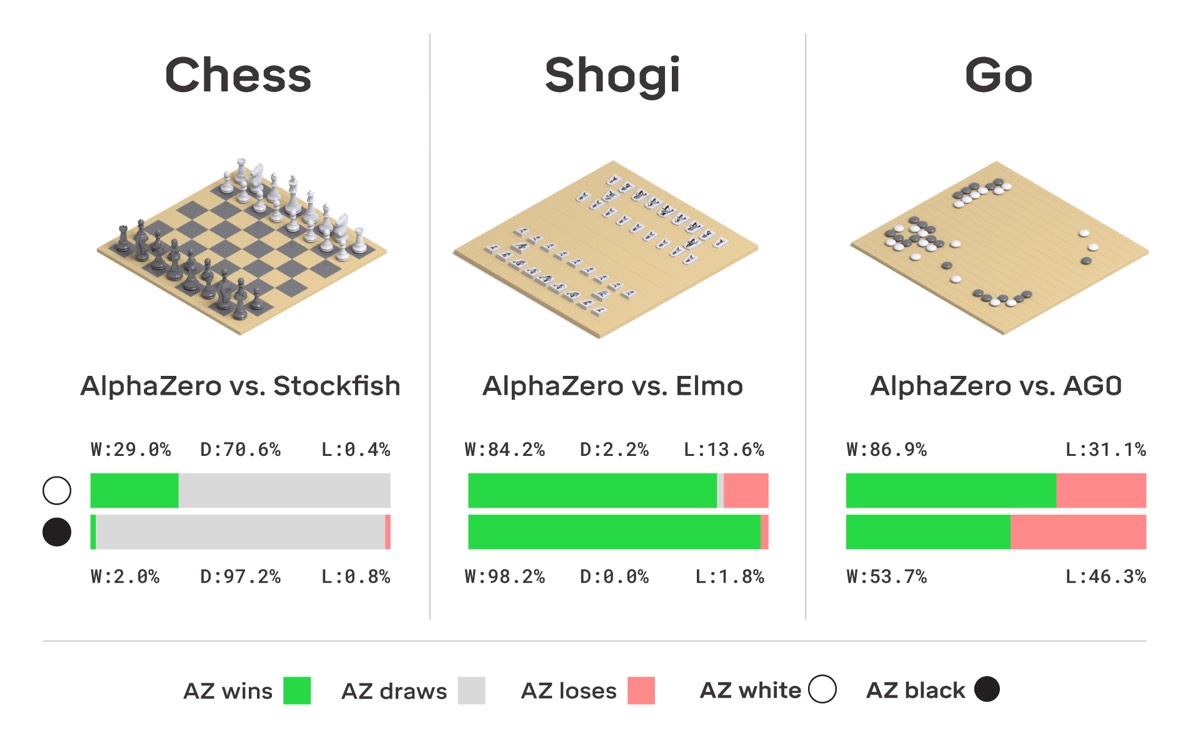
Starting from random play and knowing just the game rules, AlphaZero defeated a world champion program in the games of Go, chess, and shogi (Japanese chess).
Enlarge / Starting from random play and knowing just the game rules, AlphaZero defeated a world champion program in the games of Go, chess, and shogi (Japanese chess).
DeepMind Technologies, Ltd.

Google’s DeepMind—the group that brought you the champion game-playing AIs AlphaGo and AlphaGoZero—is back with a new, improved, and more-generalized version. Dubbed AlphaZero, this program taught itself to play three different board games (chess, Go, and shogi, a Japanese form of chess) in just three days, with no human intervention.

A paper describing the achievement was just published in Science. “Starting from totally random play, AlphaZero gradually learns what good play looks like and forms its own evaluations about the game,” said Demis Hassabis, CEO and co-founder of DeepMind. “In that sense, it is free from the constraints of the way humans think about the game.”

Chess has long been an ideal testing ground for game-playing computers and the development of AI. The very first chess computer program was written in the 1950s at Los Alamos National Laboratory, and in the late 1960s, Richard D. Greenblatt’s Mac Hack IV program was the first to play in a human chess tournament—and to win against a human in tournament play. Many other computer chess programs followed, each a little better than the last, until IBM’s Deep Blue computer defeated chess grand master Garry Kasparov in May 1997.

As Kasparov points out in an accompanying editorial in Science, these days your average smartphone chess playing app is far more powerful than Deep Blue. So AI researchers turned their attention in recent years to creating programs that can master the game of Go, a hugely popular board game in East Asia that dates back more than 2,500 years. It’s a surprisingly complicated game, much more difficult than chess, despite only involving two players with a fairly simple set of ground rules. That makes it an ideal testing ground for AI.

Starting from random play, knowing just the basic rules, AlphaZero defeated a world champion program in the games of Go, chess, and shogi.
Enlarge / Starting from random play, knowing just the basic rules, AlphaZero defeated a world champion program in the games of Go, chess, and shogi.
DeepMind Technologies, Ltd.

AlphaZero is a direct descendent of DeepMind’s AlphaGo, which made headlines worldwide in 2016 by defeating Lee Sedol, the reigning (human) world champion in Go. Not content to rest on its laurels, AlphaGo got a major upgrade last year, becoming capable of teaching itself winning strategies with no need for human intervention. By playing itself over and over again, AlphaGo Zero (AGZ) trained itself to play Go from scratch in just three days and soundly defeated the original AlphaGo 100 games to 0. The only input it received was the basic rules of the game.

The secret ingredient: “reinforcement learning,” in which playing itself for millions of games allows the program to learn from experience. This works because AGZ is rewarded for the most useful actions (i.e., devising winning strategies). The AI does this by considering the most probable next moves and calculating the probability of winning for each of them. AGZ could do this in 0.4 seconds using just one network. (The original AlphaGo used two separate neural networks: one determined next moves, while the other calculated the probabilities.) AGZ only needed to play 4.9 million games to master Go, compared to 30 million games for its predecessor.

“Instead of processing human instructions and knowledge at tremendous speed, AlphaZero generates its own knowledge.”

AGZ was designed specifically to play Go. AlphaZero generalizes this reinforced-learning approach to three different games: Go, chess, and shogi, a Japanese version of chess. According to an accompanying perspective penned by Deep Blue team member Murray Campbell, this latest version combines deep reinforcement learning (many layers of neural networks) with a general-purpose Monte Carlo tree search method.

“AlphaZero learned to play each of the three board games very quickly by applying a large amount of processing power, 5,000 tensor processing units (TPUs), equivalent to a very large supercomputer,” Campbell wrote.

“Instead of processing human instructions and knowledge at tremendous speed, as all previous chess machines, AlphaZero generates its own knowledge,” said Kasparov. “It does this in just a few hours, and its results have surpassed any known human or machine.” Hassabis, who has long been passionate about chess, says that the program has also developed its own new dynamic style of play—a style Kasparov sees as much like his own.

There are some caveats. Like its immediate predecessor, AlphaZero’s basic algorithm really only works for problems where there are a countable number of actions one can take. It also requires a strong model of its environment, i.e., the rules of the game. In other words, Go is not the real world: it’s a simplified, highly constrained version of the world, which means it is far more predictable.

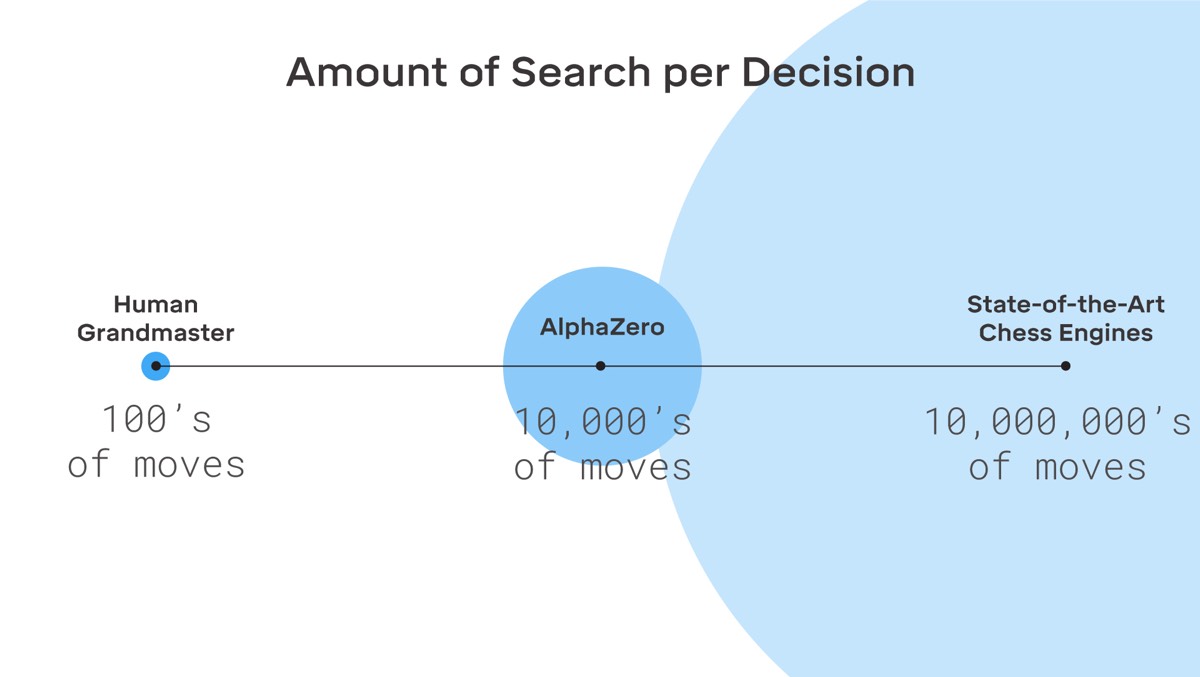
AlphaZero searches only a small fraction of the positions considered by traditional chess engines.
Enlarge / AlphaZero searches only a small fraction of the positions considered by traditional chess engines.
DeepMind Technologies, Ltd.

“[AlphaZero] is not going to put chess coaches out of business just yet,” Kasparov writes. “But the knowledge it generates is information we can all learn from.” David Silver, lead researcher of the AlphaZero project, has high hopes for future applications of that knowledge. “My dream is to see the same kind of system applied not just to board games but to all kinds of real-world applications, [such as] drug design, material design, or biotech,” he said.

Poker is one contender for future AIs to beat. It’s essentially a game of partial information—a challenge for any existing AI. As Campbell notes, there have been some programs capable of mastering heads-up, no-limit Texas Hold ‘Em, when only two players are left in a tournament. But most poker games involve eight to 10 players per table. An even bigger challenge would be multi-player video games, such as Starcraft II or Dota 2. “They are partially observable and have very large state spaces and action sets, creating problems for Alpha-Zero like reinforcement learning approaches,” he writes.

One thing seems clear: chess and Go are no longer the gold standard for testing the capabilities of AIs. “This work has, in effect, closed  a multi-decade chapter in AI research,” Campbell writes. “AI researchers need to look to a new generation of games to provide the next set of challenges.”

DOI: Science, 2018. 10.1126/science.aar6404  (About DOIs).

https://arstechnica.com/?p=1422731


Epic undercuts Steam with new store that gives devs more money

Steam is the guy standing his ground on the left. Epic is the guy jumping in with a Superman punch on the right.
Enlarge / Steam is the guy standing his ground on the left. Epic is the guy jumping in with a Superman punch on the right.

Over the years, we’ve seen a lot of new PC game platforms try to make a dent in Steam’s market-dominating position. Epic Games announced it’s having a go at the leader this morning with an upcoming platform, the Epic Games Store, that promises more developer-friendly publishing terms.

Unlike Valve, which takes a baseline 30 percent of revenues from most games and content sold on Steam, Epic is promising to take only 12 percent of developer revenues on its new store. That matches the revenue cut Epic already takes on development assets sold through the existing Unreal Marketplace, a cut the company recently lowered from 30 percent.

“As a developer ourselves, we’ve always wanted access to a store with fair revenue-sharing that gives us direct access to our customers,” Epic Founder and CEO Tim Sweeney told Ars in an email interview. “Now that we’ve built such a store, and Fortnite has brought in a huge audience of PC gamers, we’re working to open it up to all developers.”

Keep it small

Epic is keeping mum for now on specific launch date and game line-up details for its new store, but said in a release that “the store will launch soon with a hand-curated set of games on PC and Mac and will open up more broadly to additional games and other open platforms throughout 2019.” Sweeney told Ars that the company plans to “start small” and will “sometimes fund developers to release games exclusively through the store,” Sweeney told Ars.

The approval process for new games will “mostly focus on the technical side of things and general quality,” Sweeney said. “Except for adult-only content, we don’t plan to curate based on developers’ creative or artistic expression.” That differs somewhat from Steam, which now allows adult-oriented content as part of a largely lasseiz-faire curation policy.

The Epic Games Store logo.
Enlarge / The Epic Games Store logo.

Sweeney also told Ars Epic will “manually curate the Epic Games storefront rather than relying on algorithms or paid ads.” That’s a not-too-subtle dig at Steam’s more programmatic methods for guiding users through an increasingly bloated list of games.

“We believe the ultimate vector for players to discover new games will not be our storefront but creators,” Sweeney said. To that end, Epic said the Store’s “Support-a-Creator” program will “connect developers with over 10,000 creators, such as YouTube video makers and Twitch streamers,” to bring more exposure to listed titles.

Rising above the competition

Epic isn’t the only company that has tried to take on Steam in recent months. Popular gaming-focused social network Discord launched its own curated game store earlier this year, including a number of timed exclusive “first on Discord” indie games. And browser-focused gaming network Kongregate recently launched its own PC gaming store where players can receive discounts on games and other real-world rewards for earning in-game achievements.

A graphic from Epic highlighting the different revenue splits developers can earn through various platforms.
Enlarge / A graphic from Epic highlighting the different revenue splits developers can earn through various platforms.

But Epic comes into the crowded PC game platform market with a few advantages. For one, the company has already grown Fortnite into one of the most popular games in the world without the help of third-party platforms like Steam or Google’s Play store on Android. Fortnite will be exclusive to the Epic Games Store on PC and Mac, Sweeney said, alongside other Epic Games titles like the new Unreal Tournament. And while the launch will just include a basic storefront, Sweeney said Epic “plan[s] to take more of the online features we built for our own games, and open them up to other developers.”

Epic also has the advantage of being one of the biggest game engine makers in the world through the Unreal Engine. While Epic said the first games for Epic’s store will span “Unreal, Unity and other engines,” Unreal-powered games will get somewhat preferential treatment through a waiving of Epic’s usual 5 percent engine royalty fees. That means game-makers using Unreal could take home an additional 23 percent of a game’s revenue by selling on the Unreal Games Store rather than Steam.

Valve is already showing some signs that it’s worried about increasing competition for Steam. Last week, the company announced it was changing its own royalty structure for Steam, reducing its cut slightly for games that sell $10 million or more.

Still, Sweeney says he isn’t expecting to take over Valve’s dominant position in the near future. “We’re not looking to crush Steam any time soon,” he said. “We’re just building a store with a fair deal for developers that creates new opportunities for content creators! We’ll be expanding it and investing in it for years to come.”

https://arstechnica.com/?p=1422489


Complex networks study ranks the most influential films of all time

The rankings are based on an "influence score" determined by how many times each film has been referenced in subsequent films.
Enlarge / The rankings are based on an “influence score” determined by how many times each film has been referenced in subsequent films.
Metro-Goldwyn-Mayer

Well, this is sure to spark some intensive debate. The classic 1939 film The Wizard of Oz is the most influential movie of all time, with Star Wars: A New Hope and Alfred Hitchcock’s Psycho in second and third place, respectively. That’s the conclusion of a new study by Italian scientists in the journal Applied Network Science, suggesting a fresh metric for determining a film’s success, similar to that used for scientific publications.

According to co-author Livio Bioglio of the University of Turin, the usual metrics used to measure a film’s success are inadequate for evaluating its true quality and significance. Box office receipts, for example, are affected by such non-aesthetic factors as advertising and distribution, while reviews are by nature inherently subjective. Plenty of now-classic films bombed at the box office and/or were critically savaged at the time of their release. (Ahem. Blade Runner, anyone?)

The Italian scientists reasoned that maybe the science of complex networks can help. “We propose an alternative method to box office takings and reviews for analyzing the success of a film,” said Bioglio. “We have developed an algorithm that uses references between movies as a measure for success, and which can also be used to evaluate the career of directors, actors and actresses, by considering their participation in top-scoring movies.”

<em>Star Wars: A New Hope</em> (1977) is the second most influential film of all time, per a new analysis.
Enlarge / Star Wars: A New Hope (1977) is the second most influential film of all time, per a new analysis.
20th Century Fox

Bioglio et al. applied their algorithm to information collected on 47,000 films at the Internet Movie Database (IMDB). (The authors caution that there is a bias in their data towards Western films, since those are the films most likely to be listed on IMDB.) Each film is treated as a node in the network, and the number of connections it has to other films indicates how influential it is likely to be, especially if it is linked with several other influential films.

With the exception of Star Wars, their results were markedly different from traditional box office rankings. King Kong (1933), 2001: A Space Odyssey (1968), Metropolis (1927), Citizen Kane (1941), The Birth of a Nation (1915), Frankenstein (1931), and Snow White and the Seven Dwarfs (1937) round out the top ten. If we rank films by box office receipts (adjusted for inflation), Gone with the Wind (1939) ranks first (it’s #19 in the Italian ranking), followed by Star Wars: A New Hope (1977) and The Sound of Music (1965), which didn’t make the Italian team’s top 20. The Wizard of Oz and Psycho (1960) don’t even crack the top 100 in box office receipts.

This new approach is similar to the metric used to rank the prestige of academic journals—known as the “impact factor“—or the citation index used to determine the relative importance and influence of individual papers on an academic field. The impact factor is based on the average number of times that a journal’s articles are cited over the past two years. But it has met with harsh criticism over the last decade or so, because the distribution of citations is badly skewed. For example, journals like Nature have very high impact factors thanks to a small number of very highly cited papers, but most papers published in Nature on average only received 10 to 20 citations.

There is clearly a bias toward older films in this new analysis.

A solid argument could be made for skewed results when it comes to determining the most influential films. For one thing, there is clearly a bias toward older films in this new analysis; not a single film in the top 20 was released later than 1977. That makes sense. Older films have been around much longer, so naturally they will have more connections to later films, influential or not. But it’s hardly fair to more recent releases.

A similar skewing affects the rankings of directors, as the authors acknowledged (and tried to address). When the Italian researchers applied their algorithm to directors, the most influential were George Cukor, Victor Fleming, and Alfred Hitchcock. Cukor and Fleming likely earned their spots because of their association with Gone with the Wind, while five of the men credited for The Wizard of Oz ranked among the top eight directors.

Deciding that a different metric was needed for evaluating directors (and actors and actresses), Bioglio et al. employed a medal ranking similar to that used by the Olympic Games. A “gold” point was awarded for each film that reached the top 5 percent of influence in the year it was released; a “silver” point was awarded for a film in the best 5 to10 percent ranking; and a “bronze” point was awarded for any film in the best 10 to 25 percent ranking. All the points were added up for each person, with the more precious metals factoring more highly in the final evaluation.

Alfred Hitchcock's <em>Psycho</em> (1960), with its famous shower scene, ranked as the third most influential film.
Enlarge / Alfred Hitchcock’s Psycho (1960), with its famous shower scene, ranked as the third most influential film.
Universal Pictures

The result: Hitchcock moved into the top spot for directors, Steven Spielberg moved up from fifth to second place, and Brian de Palma—who didn’t make the top 20 in the first analysis—took the third slot. Cukor and Fleming didn’t make the top 20 in the second analysis.

The top actors were Samuel L. Jackson, Clint Eastwood, and Tom Cruise. The top actresses were Lois Maxwell (she played Miss Moneypenny in the early James Bond films), Carrie Fisher, and Maureen O’Sullivan. Unsurprisingly, there was a strong male bias. The authors noted that actresses consistently amassed lower point totals than their male counterparts. When actors and actresses were not separated by gender, only Maxwell cracked the top ten. “The only exceptions were musical movies, where results showed moderate gender equality, and movies produced in Sweden, where actresses ranked better compared to actors,” said Bioglio

It’s great that scientists are applying the tools of network science to develop a better ranking system for films, much like the search continues for the perfect academic ranking system. Every proposed alternative in academia so far has its pluses and minuses, and the same could be said for Bioglio et al.’s new algorithm. Granted, it’s yielded some insights into certain trends, like the influence of 1950s Japanese monster movies on Western cinema, and the notorious gender inequality in Hollywood.

But it’s notoriously tricky to measure such a nebulous quality as “influence,” because definitions and criteria for determining said influence can vary widely. The Princess Bride neither broke box office records or won more than moderate critical acclaim, and it didn’t rank very highly using this new analysis either. Yet it has had an undeniably enormous cultural impact since its release in 1987.

Conclusion: by all means, let’s keep on fighting for better metrics in Hollywood. But in the end, there’s always going to be a certain degree of subjectivity and bias.

DOI: Applied Network Science, 2018. 10.1007/s41109-018-0105-0  (About DOIs).

https://arstechnica.com/?p=1419783


War Stories: Thief’s intuitive stealth system wasn’t intuitive to design

[embedded content]
Video shot by Justin Wolfson, edited by Lee Manansala. Click here for transcript.

Update: On November 30, 1998, gamers began to learn that being stealthy could be a viable strategy, too—that’s because game developers at Looking Glass released the landmark first-person sneaker, Thief: The Dark Project. As writer Richard Moss outlined in his history of first-person shooters, Thief succeeded despite running counter to all the prevailing trends at the time. This happened in large part because “its intelligent enemies—who tried to flee when injured and responded realistically to both auditory and visual cues—opened the door to a wealth of emergent design possibilities.”

Earlier this year, Ars caught up with Looking Glass founder Paul Neurath to hear about how he and the team developed that groundbreaking AI. And with the game’s 20th anniversary happening this weekend, we’re resurfacing that interview. The above video and accompanying story first ran on February 20, 2018, and they appear unchanged here.

Older PC gamers who were playing games in the late ’90s and early 2000s likely have a soft spot in their hearts for Looking Glass Studios. The company’s two best-known properties are Thief and System Shock, though Looking Glass was also responsible for the visually stunning Flight Unlimited and, of course, Ultima Underworld. Although financial troubles at publisher Eidos Interactive (caused in part by the development of the hilarious money pit that was Daikatana) led to the eventual dissolution and sale of Looking Glass, the studio left an outsized footprint on the history of PC gaming through its excellent games.

The Thief series in particular—or at least the first two games—resonated with audiences. The phrase “innovative gameplay” is a laughable cliché in 2018, but Thief really did have innovative gameplay when it was released—other FPS titles had explored stealth-focused gameplay before, but none had managed to so completely capture the experience of sneaking. More, Thief took the unusual (for FPSes at the time) approach of incentivizing the player to not murder everyone and everything in the level—brutality, in fact, was actively punished by the game’s scoring system. Sneaking through an entire level without detection became a more important goal than wiping out guards.

But it turns out the tightly coupled gameplay mechanisms that enabled players to so easily understand how hidden they were from the CPU’s prying eyes was nowhere near as intuitive to design as it was to use. We sat down with Looking Glass founder Paul Neurath, who was involved heavily in Thief‘s design and development, to get the scoop. And even though he didn’t take any rips from a wolf bong, he did have some juicy info on how Thief and its signature sneaking came to be.

https://arstechnica.com/?p=1262797